WeOrthodox
EN UA

Orthodox discussions worth reading

Only the posts and videos that started a real conversation, with the most thoughtful opinions.

Persecution of Christians in the Holy Land and the theology of Christian Zionism

The post presents a series of arguments against Christian support for the modern state of Israel. It opens with statistics from 2025 documenting 155 anti-Christian incidents in Israel and East Jerusalem, including 61 physical attacks, 52 attacks on church properties, 28 harassment incidents, and 14 defacements of Christian signage. It cites two specific attacks on churches in Gaza: the October 2023 airstrike on the Greek Orthodox Church of St.…

The post presents a series of arguments against Christian support for the modern state of Israel. It opens with statistics from 2025 documenting 155 anti-Christian incidents in Israel and East Jerusalem, including 61 physical attacks, 52 attacks on church properties, 28 harassment incidents, and 14 defacements of Christian signage.

It cites two specific attacks on churches in Gaza: the October 2023 airstrike on the Greek Orthodox Church of St. Porphyrios compound that killed civilians sheltering there, and the July 2025 Israeli tank fire on Holy Family Catholic Church that killed three people. The post then references declassified Israeli military documents regarding a 1948 biological warfare campaign, code-named Cast Thy Bread, that contaminated Palestinian water supplies in villages including the predominantly Christian village of Eilabun in the Galilee, citing Israeli historians.

The theological section argues that Christianity predates Rabbinic Judaism, noting that the Church inherited the Septuagint from Jewish scholars, while the Masoretic text was standardized around the tenth century. It traces modern Christian Zionism to John Nelson Darby's dispensationalism in the 1830s, the 1909 Scofield Reference Bible, the founding of AIPAC in the 1950s, and the 2006 formation of Christians United for Israel.

The post contrasts Genesis 12:3 with Paul's teaching that those in Christ are Abraham's offspring, asserting that the Apostolic Church has understood itself as the fulfillment of Israel for two thousand years.

  • 155 anti-Christian incidents documented in Israel and East Jerusalem in 2025, including attacks on clergy and church properties
  • Greek Orthodox Church of St. Porphyrios in Gaza struck by airstrike in October 2023; Holy Family Catholic Church hit by tank fire in July 2025
  • Declassified documents allege 1948 Israeli biological warfare campaign contaminated water in Christian village of Eilabun and other locales
  • Argument that Christianity is older than Rabbinic Judaism and the Church received the Septuagint before the Masoretic text was standardized
  • Christian Zionism traced to 19th-century dispensationalism, Scofield Bible, and modern political lobbying groups
8 opinions in the discussion Even if it were only Muslims getting bombed we should still care btw. We are all God's creations! Even when we don't agree with their religion. Read the discussion
Kyle YouTube discussion

Orthodox gamer: GTA 6 reveals entertainment cannot save us

Orthodox gamer: GTA 6 reveals entertainment cannot save us 13:42

An Orthodox Christian content creator, formerly an avid gamer, reviews Grand Theft Auto 6 and uses its failure to examine the spiritual condition of modern entertainment culture. He describes the game as technically flawed, running at 30 frames per second with bugs and monotonous gameplay that forces players to perform virtual chores, painting, baking, working out, earning money, simulating real life without soul. The intense anticipation…

An Orthodox Christian content creator, formerly an avid gamer, reviews Grand Theft Auto 6 and uses its failure to examine the spiritual condition of modern entertainment culture. He describes the game as technically flawed, running at 30 frames per second with bugs and monotonous gameplay that forces players to perform virtual chores, painting, baking, working out, earning money, simulating real life without soul.

The intense anticipation surrounding the release, built over 13 years, functioned as a false hope: many believed the game would solve their problems and deliver extraordinary happiness. Professional reviewers awarded perfect scores while actual players rejected the experience, exposing a disconnect between industry hype and genuine satisfaction.

The speaker frames this disappointment as a wake-up call. He contrasts the hedonic treadmill of gaming, thousands of hours invested with nothing lasting to show, with the deeper happiness he found in communion with God, church community, and embracing ordinary life rather than fleeing it. He cites Saint Augustine's observation that the human heart is restless until it rests in God, and argues that the cycle of anticipation, trailers, rumors, leaks, speculation, mirrors the endless pursuit of the next promotion or purchase that never finally satisfies.

The critique extends to broader media trends: nostalgia sold as product, exemplified by Marvel's reliance on emotional attachment after Endgame, and the glorification of degeneracy, crime, and sexual immorality in GTA 6. The speaker does not reject recreation entirely, he still plays Mario Kart, board games, The Sims, and Oblivion with his wife, but insists entertainment must occupy its proper place beneath spiritual life and real relationships.

He concludes by calling viewers to repent, draw near to Christ, and join the Orthodox Church.

Key moments

  1. 0:00 GTA 6 runs at 30 FPS with bugs and monotonous gameplay that makes players do virtual chores like painting a house, baking a table, working out, and earning money, simulating real life without soul.
  2. 1:03 People have talked about GTA 6 for 13 years as if waiting for heaven itself, believing the game would solve their problems and bring extraordinary happiness.
  3. 2:04 Professional reviewers gave GTA 6 perfect scores while actual players say it is not what they wanted, revealing that lasting satisfaction cannot be found in video games.
  4. 3:06 The speaker still plays Mario Kart, board games, The Sims, and Oblivion with his wife, but warns against organizing life around the next big game as the center of existence.
  5. 4:09 After finding God, the speaker cares about church and community in real life, discovering deeper happiness through prayer, repentance, and humility rather than the hedonic treadmill of entertainment.
  6. 6:14 Avengers Endgame exemplifies the nostalgia problem: high ratings driven by emotional attachment to a decade of Marvel films, but the story relies on time travel that undermines consequences and set up years of creative failure.
  7. 9:22 GTA 6 glorifies degeneracy, crime, violence, greed, and sexual immorality, and Christians must discern whether entertainment cultivates virtue or feeds the passions.
  8. 10:23 The addiction to anticipation (trailers, rumors, leaks, speculation) mirrors the hedonic treadmill: "When I get a promotion I'll be happy... GTA 6 finally releases, I'll be happy," but satisfaction never lasts because only God can fill the human heart.
18 opinions in the discussion Before Orthodoxy I never would've guessed I'd find this kind of stuff boring (some movies aside, not gonna lie). I want so much less from the world and its entertainment now. Wouldn't have… Read the discussion

One Orthodox Church or many? A response to the claim of 14 separate churches

The video presents a claim that there is no single Eastern Orthodox Church but rather 14 separate churches corresponding to 14 patriarchs, which disagree on governance, doctrine, and sacraments. The claim cites Russian theologian Vladimir Solovyov, who said that on the day the Russian and Greek churches formally break, the world will see the ecumenical Eastern Church is a fiction and only isolated national churches exist. The speaker echoes this…

The video presents a claim that there is no single Eastern Orthodox Church but rather 14 separate churches corresponding to 14 patriarchs, which disagree on governance, doctrine, and sacraments. The claim cites Russian theologian Vladimir Solovyov, who said that on the day the Russian and Greek churches formally break, the world will see the ecumenical Eastern Church is a fiction and only isolated national churches exist. The speaker echoes this view, calling it the on-the-ground reality.

The speaker then responds that the claim is intellectually dishonest and false. Not every autocephalous church is headed by a patriarch, and autocephaly means self-government within a wider communion, not independent denominations. The churches together constitute the Orthodox Catholic Church.

Breaks in communion between major sees are not unprecedented; Rome and Constantinople were out of communion for 35 years during the Great Schism. The Orthodox claim is that the one Church exists as a communion of local apostolic churches sharing the same faith, sacraments, and episcopacy, and a rupture does not entail that there is no communion.

Saint Cyprian of Carthage is cited: the episcopate is one, each part held by each one for the whole, and the Church is one, spread abroad into a multitude.

Key moments

  1. 0:00 The claim is made that there is no Eastern Orthodox Church, only 14 Eastern Orthodox Churches because there are 14 patriarchs, and they are not in agreement on governance, doctrine, or sacraments between the Russians and the Greeks.
  2. 0:00 A Russian theologian, Vladimir Solovyov, is quoted saying that on the day the Russian and Greek churches formally break, the world will see the ecumenical Eastern Church is a fiction and only isolated national churches exist.
  3. 0:30 The speaker echoes the theologian's view that there is no Orthodox Church, only Orthodox Churches, and says this is the on-the-ground reality.
  4. 1:02 The speaker responds that the claim there are 14 Orthodox Churches because there are 14 patriarchs is intellectually dishonest and false, because not every autocephalous church is headed by a patriarch.
  5. 1:02 Autocephaly means self-government within the wider communion of the Church, not multiple separate churches as independent denominations; the churches together constitute the Orthodox Catholic Church.
  6. 1:37 Breaks in communion between major sees are not unprecedented, as Rome and Constantinople were out of communion for 35 years during the Great Schism.
  7. 1:37 The Orthodox claim is that the one church exists as a communion of local apostolic churches sharing the same faith, sacraments, and episcopacy, and a rupture does not entail that there is no communion.
  8. 1:37 Saint Cyprian of Carthage is cited: the episcopate is one, each part held by each one for the whole, and the Church is one, spread abroad into a multitude.
21 opinions in the discussion Never bring up the western schism to Roman Catholics, the time the west had 3 popes at once, with canonized saints in their own church who backed different sides of it. Read the discussion

Accepting the Canon While Rejecting the Church That Witnessed It

The speaker argues there is no factual historical evidence that John wrote the Gospel attributed to him. He directs the listener to early church history and apostolic succession, the chain of disciples who learned from John and taught others, as the basis for the text's authority. The speaker then criticizes a figure known as "The God Logic" for appealing to the early church to defend the Bible while rejecting its teaching on the real presence…

The speaker argues there is no factual historical evidence that John wrote the Gospel attributed to him. He directs the listener to early church history and apostolic succession, the chain of disciples who learned from John and taught others, as the basis for the text's authority. The speaker then criticizes a figure known as "The God Logic" for appealing to the early church to defend the Bible while rejecting its teaching on the real presence in the Eucharist and the authority of bishops.

He contends that if the apostolic church was wrong about its doctrines, there is no reason to trust its testimony about Scripture. The argument concludes that one cannot reject the very church whose witness undergirds the canon.

Key moments

  1. The speaker states there is no factual historical evidence that John wrote the Gospel attributed to him.
  2. The speaker directs the listener to early church history and the concept of apostolic succession, those who knew the disciples and their disciples.
  3. The speaker describes apostolic succession as people who learned from John becoming teachers themselves.
  4. The speaker accuses "The God logic" of relying on the early church to defend the Bible but rejecting it when it contradicts his theology.
  5. The speaker notes that "The God logic" appeals to apostolic succession but dismisses the church's teaching on the real presence in the Eucharist and episcopal authority.
  6. The speaker argues that if the apostolic church was wrong about its teachings, one cannot be certain it was right about the Bible.
  7. The speaker concludes that you cannot reject the very church whose testimony you depend on to defend your scripture.
10 opinions in the discussion Only leans on apostolic succession when convenient, tosses it when it's not Read the discussion
Kyle YouTube discussion

Saints See the World as a Hospital, Not a Courtroom

Saints See the World as a Hospital, Not a Courtroom 17:54

The speaker explains that Orthodox saints view the world as a cauldron boiling with sin but see it as a hospital rather than a courtroom. Where ordinary people condemn sinners, saints recognize them as spiritually sick people in need of the divine physician, Christ. The closer a person draws to God, the more clearly he sees his own sinfulness and the less he condemns others. This paradox is illustrated by Saint Sisoes the Great, who on his…

The speaker explains that Orthodox saints view the world as a cauldron boiling with sin but see it as a hospital rather than a courtroom. Where ordinary people condemn sinners, saints recognize them as spiritually sick people in need of the divine physician, Christ. The closer a person draws to God, the more clearly he sees his own sinfulness and the less he condemns others.

This paradox is illustrated by Saint Sisoes the Great, who on his deathbed said he had not even begun to repent. Such spiritual clarity produces compassion rather than judgment. Saint Isaac the Syrian describes a merciful heart that grieves for all creation, unable to endure the suffering of another creature without being moved to prayer.

Saint Silouan the Athonite taught that love for enemies is an essential sign of the Holy Spirit's presence. The battle against evil must begin within one's own heart, since the same passions that corrupt the world exist in every human heart. True change comes through repentance and cooperation with divine grace rather than outrage at society's sins.

The Church functions as a spiritual hospital with Christ as the divine physician, and the sacraments, prayer, fasting, confession, repentance, and ascetic struggle are the means by which his healing grace works within us.

Key moments

  1. 0:10 The world is like a great cauldron constantly boiling with sin, temptation, suffering, and spiritual warfare, consumed by passions such as pride, lust, envy, greed, anger, vanity, and hatred.
  2. 0:41 Saints do not look upon the world with disgust and condemnation but see a world wounded by sin filled with people who desperately need healing, viewing sinners as sick patients needing a physician rather than wicked people deserving punishment.
  3. 1:13 The closer a person draws to God, the more clearly he sees the tragedy of sin and the less inclined he becomes to condemn his neighbor, because the world is a hospital, not a courtroom, and sin is a sickness that wounds the soul and separates us from communion with God.
  4. 2:15 The church is a spiritual hospital with Christ as the divine physician, and the sacraments, prayer, fasting, confession, repentance, and ascetic struggle are the means by which his healing grace works within us, not to earn salvation but to be cured of our sickness.
  5. 3:50 Sisoes the Great on his deathbed said, "I have not even begun to repent," demonstrating that the greater the saint, the greater his awareness of his own sin, a paradox where holiness brings spiritual clarity like sunlight revealing dust in a dark room.
  6. 6:26 Saint Isaac the Syrian describes a merciful heart that burns with love for all creation, grieving for sinners and even those who oppose God, unable to endure the suffering of another creature without being moved to prayer.
  7. 8:28 Saint Silouan the Athonite taught that love for enemies is an essential sign of the Holy Spirit's presence, and that Christian love cannot be restricted to those we consider deserving, or we are no different from the world.
  8. 10:29 The cauldron of sin is within us as well; Christ teaches that evil thoughts proceed from the human heart, so the battle against evil must begin within, and the Jesus Prayer, "have mercy on me", directs us to repent of our own wickedness rather than condemn the world's.
6 opinions in the discussion It is so hard not to hate the wicked, those who blaspheme or act against God. I'm ashamed to admit that when I heard a certain powerful and corrupt politician had died, a big part of me was… Read the discussion

Christ's Establishment of the Church as Institution in Matthew 18

A dialogue examines whether Christ established an institution. One speaker argues that religious systems and institutions kill the spirit of God and questions whether Christ founded an institution. The other responds that God established a way of salvation. The first speaker then cites Matthew 18 as explicit evidence that Christ did establish an institution. He outlines the three-step process Jesus gives for dealing with a sinning brother: first…

A dialogue examines whether Christ established an institution. One speaker argues that religious systems and institutions kill the spirit of God and questions whether Christ founded an institution. The other responds that God established a way of salvation. The first speaker then cites Matthew 18 as explicit evidence that Christ did establish an institution.

He outlines the three-step process Jesus gives for dealing with a sinning brother: first confront him privately, then bring two or three witnesses, and finally bring the matter to the church. The speaker argues that this third step, bringing the matter to the church, demonstrates an institution that transcends the body of believers, concluding that the church is both a body and an institution.

Key moments

  1. The first speaker claims that religious systems and institutions are the things that kill the spirit of God in the world.
  2. The first speaker asks whether Christ established an institution.
  3. The second speaker answers that God established a way of salvation.
  4. The first speaker argues that Christ established an institution, pointing to Matthew chapter 18 as explicit evidence.
  5. The first speaker outlines the steps in Matthew 18: go to the brother privately, then bring two or three witnesses, which constitutes a church, and if they refuse to listen, bring them to the church.
  6. The first speaker concludes that this third category demonstrates an institution transcending just the body, affirming that the church is both a body and an institution.
4 opinions in the discussion This argument doesn't get enough credit. Any kind of church discipline that actually does anything requires being the exclusive church. Read the discussion

Orthodox Delegations Arrive in Moscow for Patriarch Kirill's 80th Birthday

Delegations from across the Eastern Orthodox Church arrived in Moscow on November 19, ahead of the official celebrations on November 20 honoring the 80th birthday of His Holiness Patriarch Kirill of Moscow and All Rus'. From the Church of Antioch: His Beatitude Patriarch John of Antioch and All the East, His Eminence Metropolitan Elijah of Tyre and Sidon, His Eminence Metropolitan Ephraim of Aleppo, and His Eminence Bishop Paul of Tarsus. From…

Delegations from across the Eastern Orthodox Church arrived in Moscow on November 19, ahead of the official celebrations on November 20 honoring the 80th birthday of His Holiness Patriarch Kirill of Moscow and All Rus'.

From the Church of Antioch: His Beatitude Patriarch John of Antioch and All the East, His Eminence Metropolitan Elijah of Tyre and Sidon, His Eminence Metropolitan Ephraim of Aleppo, and His Eminence Bishop Paul of Tarsus.

From the Church of Jerusalem: His Most Divine Beatitude Patriarch Theophilos of Jerusalem and All Palestine, and His Eminence Metropolitan Isychiy of Capitoliad.

From the Church of Georgia: His Eminence Metropolitan Theodore of Akhaltsikhe and Tao-Klarjeti, His Eminence Metropolitan Gerasim of Zugdidi and Tsaishi, His Eminence Metropolitan Andrey of Gori and Ateni, and His Eminence Bishop Vakhtang of Nikortsmind.

From the Church of Bulgaria: His Eminence Bishop Isaac of Velbuzhd.

From the Church of Albania: His Eminence Bishop Ignatius of Amantios.

From the Church of the Czech Lands and Slovakia: His Beatitude Metropolitan Rastislav of the Czech Lands and Slovakia.

From the Church of Macedonia/Ohrid: His Eminence Metropolitan George of Debar and Kichevo, and His Eminence Bishop Clement of Heraclea.

From the Japanese Orthodox Church: His Eminence Metropolitan Seraphim of All Japan.

  • Delegations from multiple autocephalous Orthodox Churches have arrived in Moscow for Patriarch Kirill's 80th birthday.
  • The Church of Antioch is represented by Patriarch John and three hierarchs.
  • The Church of Jerusalem is represented by Patriarch Theophilos and Metropolitan Isychiy.
  • The Church of Georgia sends four metropolitans and one bishop.
  • Other Churches represented include Bulgaria, Albania, Czech Lands and Slovakia, Macedonia/Ohrid, and Japan.
11 opinions in the discussion so there's nobody from Jerusalem, Greece, Romania or Serbia sending anyone? Read the discussion

Why are Orthodox parishes in America less accessible than Catholic churches?

It appears that parishes in this country are not very active. Several parishes are near me, yet each offers only vespers and a single Divine Liturgy on Sunday at a set time. My work schedule prevents me from attending most Liturgies. I have noticed that Catholic churches remain open daily, with at least one Mass each day or some form of adoration, making the church accessible. Why is the Orthodox Church never accessible?

18 opinions in the discussion Catholic priests are basically monks in practice. Their only responsibility is the parish, they often have several priests plus paid staff who can be at the building outside service times.… Read the discussion
Holy Resurrection YouTube discussion

St. Paisios: Grumbling Destroys the Person, Glorifying God Brings Grace

St. Paisios: Grumbling Destroys the Person, Glorifying God Brings Grace 3:50

The post shares a teaching from St. Paisios the Athonite, taken from the book Guard Your Soul! Conversations with Elder Paisios of Mount Athos on Salvation in the Modern World. The elder explains that grumbling brings misery and destroys the one who practices it, while glorifying God in every circumstance brings blessing and peace. He illustrates this with a monk on Mount Athos who grumbles whether it rains or stops raining, showing how…

The post shares a teaching from St. Paisios the Athonite, taken from the book Guard Your Soul! Conversations with Elder Paisios of Mount Athos on Salvation in the Modern World. The elder explains that grumbling brings misery and destroys the one who practices it, while glorifying God in every circumstance brings blessing and peace.

He illustrates this with a monk on Mount Athos who grumbles whether it rains or stops raining, showing how grumbling becomes an irrational habit even for a sensible man. He contrasts two farmers from Epirus: one with modest land who trusted God, worked without worry, and said "Glory to You, O God" even when his crops were ruined, and everything went well for him; the other had abundant land and livestock but no children, constantly complained, and suffered successive misfortunes despite his wealth.

St. Paisios emphasizes that experiencing God's grace depends on our disposition: those who glorify God even for little, like dry bread, receive heavenly sweetness and spiritual sensitivity, while those whose hearts are covered in "sticky mud" of dissatisfaction can never be satisfied. True happiness lies in eternity, not in worldly vanity. The teaching also notes that when a person glorifies God instead of grumbling at a difficulty, the devil bursts with rage and goes to find someone else who grumbles.

Key moments

  1. 0:12 Grumbling brings only misery and begets more grumbling, while glorifying God begets more glorification; when a person glorifies God instead of grumbling at a difficulty, the devil bursts with rage and goes to find someone else who grumbles.
  2. 0:43 The more one grumbles, the more he destroys himself; grumbling steals peace and makes one dissatisfied with everything, whereas a person who lives spiritually finds reason to glorify God in every circumstance and receives His blessing.
  3. 0:43 A monk on Mount Athos habitually grumbles whether it rains ("we will rot from all this humidity") or stops raining ("everything will dry up"), showing how grumbling becomes an irrational habit even for a sensible man.
  4. 1:44 Two farmers from Epirus illustrate the contrast: one owned a field or two, trusted God, worked without worry saying "I will do what I can accomplish," and said "Glory to You, O God" even when rain rotted his bundles or wind scattered them, and everything went well for him.
  5. 2:15 The other farmer had many fields and livestock but no children; he never said "Glory to You, O God," only grumbled and complained, and suffered successive misfortunes (a cow dying, other calamities) so that nothing prospered for him despite his wealth.
  6. 2:46 Glorifying God is a great thing; it depends on us whether we experience the graces God bestows, if God gives a banana but we wonder what the wealthy eat, we miss the blessing, while those who eat only dry bread yet glorify God day and night are nourished by heavenly sweetness.
  7. 3:18 Those who glorify God in all things acquire spiritual sensitivity and come to know God's tender touch; we do not know this because our hearts have become covered with sticky mud, and nothing can satisfy us; we fail to understand that happiness lies in eternity, not in vanity.
2 opinions in the discussion Honestly, this one is hard for me too, not going to pretend otherwise. Read the discussion

Women at church ignore me and I'm considering leaving

The women at my church don't acknowledge me. They never say hello and look annoyed when I'm around. There are plenty of other friendly, warm people there, but this is getting to the point where I almost want to switch parishes. It's making me really uncomfortable, especially because there's nothing I can do about it.

I always try to wave and smile, but they act like I don't exist. Maybe I'm being too sensitive? As a fellow woman, it's really starting to hurt my feelings.

  • Women at church ignore and appear annoyed by the author
  • Author waves and smiles but receives no acknowledgment
  • Considering switching parishes due to discomfort
  • Questions whether she is being too sensitive
  • Feels particular hurt because the exclusion comes from other women
39 opinions in the discussion Personally, I really don't care how I'm treated at church. I don't go there to make friends, I almost never interact with anyone anyway. That's not to say I'm unfriendly or haven't built… Read the discussion

How three traditions answer which church is true after a split

The speaker compares how Catholics, Protestants, and Eastern Orthodox identify the true church after a split. Catholics rely on the Pope's authority as external confirmation. Protestants rely on private scriptural interpretation to judge each church. Eastern Orthodoxy requires submission to the bishop and does not allow private scriptural judgment of the church. The speaker then challenges the Catholic and Protestant approaches. He notes that…

The speaker compares how Catholics, Protestants, and Eastern Orthodox identify the true church after a split. Catholics rely on the Pope's authority as external confirmation. Protestants rely on private scriptural interpretation to judge each church.

Eastern Orthodoxy requires submission to the bishop and does not allow private scriptural judgment of the church. The speaker then challenges the Catholic and Protestant approaches. He notes that the Western Schism required a council to resolve competing papal claims, which challenges the Catholic method.

He also notes that when churches disagree, Protestants cannot determine whose scriptural interpretation is correct. Orthodox Christians instead appeal to the Holy Spirit working through the entire church, not one man's authority or individual interpretation. Through scripture, apostolic tradition, the fathers, and ecumenical councils, they can judge whether bishops remained faithful to the teachings handed down by the apostles.

Key moments

  1. 0:00 The question is how to know which side of a church split is the true church.
  2. 0:00 Catholics identify the true church by following the Pope as external confirmation.
  3. 0:00 Protestants identify the true church by privately judging each church against scripture.
  4. 0:00 Eastern Orthodoxy requires submission to the bishop and does not allow private scriptural judgment of the church.
  5. 0:00 The Western Schism required a council to resolve competing papal claims, challenging the Catholic method.
  6. 0:00 When churches disagree, Protestants cannot determine whose scriptural interpretation is correct.
  7. 0:00 Orthodox Christians appeal to the Holy Spirit working through the entire church, not one man's authority or individual interpretation.
  8. 0:37 Through scripture, apostolic tradition, the fathers, and ecumenical councils, we can judge whether bishops remained faithful to the teachings handed down by the apostles.
15 opinions in the discussion Beautifully put. Papalists and prots don't understand the EO position and strawman like crazy Read the discussion
Kyle YouTube discussion

Why Orthodox Call Priests 'Father' Despite Matthew 23:9

Why Orthodox Call Priests 'Father' Despite Matthew 23:9 9:51

The video addresses the Protestant objection to calling priests 'father' based on Matthew 23:9. It argues that isolating this verse ignores its context: Jesus condemns the Pharisees' pride and love of honorific titles like 'rabbi' and 'teacher,' not the words themselves. The chapter is a sustained condemnation of the scribes and Pharisees who loved prestige, outward appearances, and honorific titles. A literal reading would also forbid calling…

The video addresses the Protestant objection to calling priests 'father' based on Matthew 23:9. It argues that isolating this verse ignores its context: Jesus condemns the Pharisees' pride and love of honorific titles like 'rabbi' and 'teacher,' not the words themselves. The chapter is a sustained condemnation of the scribes and Pharisees who loved prestige, outward appearances, and honorific titles.

A literal reading would also forbid calling anyone 'teacher' in verse 10, yet Scripture everywhere acknowledges teachers and fathers as legitimate roles. The commandment to honor one's father and mother remains in force, and Paul explicitly describes spiritual fatherhood in 1 Corinthians 4:15, saying he became the Corinthians' father in Christ Jesus through the gospel.

He also refers to Timothy and Titus as his sons in the faith. The Pharisees' error was seeking honor for themselves and building a cult of personality, directing loyalty to themselves rather than to God. Christ condemns leaders who burden others, seek recognition, and accumulate disciples loyal to themselves instead of God, making an idol of a person.

Orthodox priests are called father because they participate in God's fatherhood, not because they replace it; all fatherhood derives from God, as Ephesians 3:14-15 states. The Church's liturgical structure intentionally minimizes personality cults by centering worship on Christ. The priest disappears into the liturgy, and kissing his hand venerates Christ's priesthood, which the priest shares through apostolic succession, just as honoring icons or Scripture points to God.

The video also notes that Orthodox Christians have used the title since the earliest centuries of the church, showing continuity with apostolic practice.

Key moments

  1. 0:00 Protestants cite Matthew 23:9 to forbid calling priests father, but Orthodox Christians have used the title since the earliest centuries of the church.
  2. 0:31 Matthew 23 is a sustained condemnation of the scribes and Pharisees who loved prestige, outward appearances, and honorific titles like "rabbi," not a prohibition on the vocabulary itself.
  3. 1:03 Jesus also says "neither be called teachers" in verse 10; a literal interpretation would forbid both titles, yet Scripture everywhere acknowledges teachers and fathers as legitimate roles.
  4. 2:06 The Pharisees' error was seeking honor for themselves and building a cult of personality, directing loyalty to themselves rather than to God.
  5. 2:38 The commandment "Honor your father and mother" and Paul's statement "I became your father in Christ Jesus through the gospel" (1 Cor 4:15) show spiritual fatherhood is biblical and does not contradict Christ.
  6. 4:13 Christ condemns leaders who burden others, seek recognition, and accumulate disciples loyal to themselves instead of God, making an idol of a person.
  7. 5:16 All fatherhood derives from God (Eph 3:14-15); biological and spiritual fathers reflect God's fatherhood, not compete with it.
  8. 6:48 Orthodox structure minimizes personality cults: the priest disappears into the liturgy, and kissing his hand honors Christ's priesthood received through apostolic succession.
4 opinions in the discussion In Latin, "doctor" literally means "teacher." So any Protestant with a PhD who lets people call them "Dr." has "teacher" baked into their own title, but somehow they don't see that as… Read the discussion

Patristic Case Against Filioque: Spirit Proceeds from Father Alone

The author presents a polemical argument against Roman Catholicism, listing six doctrinal errors: the Filioque, papacy, purgatory, predestination, and two Vatican II documents (Nostra Aetate and Unitatis Redintegratio). The bulk of the text focuses on the Filioque, asserting that the Holy Spirit proceeds eternally from the Father alone. The author cites numerous Old Testament passages (Psalm 32:6, Psalm 103:30, Psalm 113:25, Psalm 138:7-8,…

The author presents a polemical argument against Roman Catholicism, listing six doctrinal errors: the Filioque, papacy, purgatory, predestination, and two Vatican II documents (Nostra Aetate and Unitatis Redintegratio). The bulk of the text focuses on the Filioque, asserting that the Holy Spirit proceeds eternally from the Father alone.

The author cites numerous Old Testament passages (Psalm 32:6, Psalm 103:30, Psalm 113:25, Psalm 138:7-8, Isaiah 11:2-3, Isaiah 61:1) and New Testament passages (Matthew 10:19-20, Matthew 12:28, John 14:16, John 15:26, John 16:13-15, John 20:22, Acts 2, Romans 8:11, 1 Corinthians 2:11-12, Galatians 4:6). For each, extensive patristic quotations are provided from figures such as Basil the Great, Gregory of Nyssa, Gregory Nazianzen, Cyril of Alexandria, Ambrose, Augustine, John Chrysostom, and others, interpreting these verses as teaching the Spirit's procession from the Father.

The author also addresses John 14:16 ("I will ask the Father to send the Spirit") as evidence that the Son is not a cause of the Spirit's procession. Gregory Palamas is cited to distinguish eternal manifestation through the Son from eternal procession from the Son. The post concludes that the Filioque introduces two causes in the Trinity, subordinates the Holy Spirit, and contradicts the monarchy of the Father (Sola Arche).

The work is framed as a second volume in a series, opening with a prayer invoking saints such as Gregory Palamas, Photios the Great, and Mark of Ephesus.

  • Argues Catholicism has corrupted original doctrine, listing six errors including Filioque and Vatican II documents.
  • Contends the Holy Spirit proceeds eternally from the Father alone, citing Old and New Testament passages.
  • Provides extensive patristic commentary on Psalm 32:6 and Psalm 103:30 from Basil, Gregory of Nyssa, Gregory Nazianzen, Cyril, Ambrose, Augustine, Chrysostom.
  • Uses John 14:16 ("I will ask the Father") to refute the Son as a cause of the Spirit's procession.
  • Cites Gregory Palamas on the distinction between eternal manifestation through the Son and procession from the Father, warning that Filioque subordinates the Spirit.
20 opinions in the discussion the Spirit's procession from the Son isn't solely economic, there's an eternal procession of the Spirit from the Son as well Read the discussion

Jesus Prayer as spiritual weapon: scriptural roots and desert fathers' practice

The speaker urges using the Jesus Prayer with a prayer rope during spiritual attack. He says that when attacked, one should take up the prayer rope and say the Jesus Prayer patiently until the Lord draws near. He cites Saint Paisius the Athonite, who called each knot ammunition and the large knots heavy artillery, and said the name of Jesus causes demons to erupt in fire. He also cites Saint Anthony the Great, who saw devils scorched by the sign…

The speaker urges using the Jesus Prayer with a prayer rope during spiritual attack. He says that when attacked, one should take up the prayer rope and say the Jesus Prayer patiently until the Lord draws near. He cites Saint Paisius the Athonite, who called each knot ammunition and the large knots heavy artillery, and said the name of Jesus causes demons to erupt in fire.

He also cites Saint Anthony the Great, who saw devils scorched by the sign of the cross and the name of Jesus. The speaker introduces the Jesus Prayer for those unfamiliar and explains that each phrase comes directly from Scripture: "Lord Jesus Christ" reflects Romans 10:9, "Son of God" reflects Matthew 16:16, and "have mercy on me a sinner" reflects Luke 18:13. He traces the practice to fourth-century Egyptian desert fathers who used short repeated prayers to fulfill Paul's command to pray without ceasing.

This developed into the Jesus Prayer, later formalized with prayer ropes. The rope moves one knot per prayer to keep the mind contemplative. The prayer is not empty repetition but Scripture, repentance, and remembrance of Christ condensed.

Saint John Climacus advises uniting the remembrance of Jesus to every breath to know the value of stillness. The speaker also mentions a partnership with Theoria for Church Fathers' writings.

Key moments

  1. 0:00 Take up the prayer rope when attacked and say the Jesus prayer patiently until the Lord draws near; Saint Paisius the Athonite called each knot ammo and his large knots heavy artillery, and the name of Jesus causes demons to erupt in fire; Saint Anthony the Great saw devils scorched by the sign of the cross and the name of Jesus.
  2. 0:36 Fight back by calling on God's name; the Jesus prayer is introduced for those unfamiliar, and each part is drawn from Scripture.
  3. 1:07 The scriptural sources are identified: "Lord Jesus Christ" from Romans 10:9, "Son of God" from Matthew 16:16, and "have mercy on me a sinner" from Luke 18:13.
  4. 1:42 Fourth-century Egyptian desert fathers used short repeated prayers to fulfill Paul's command to pray without ceasing, which developed into the Jesus prayer; the prayer rope moves one knot per prayer to keep the mind contemplative; the prayer is not empty repetition but Scripture, repentance, and remembrance of Christ condensed; Saint John Climacus says to unite the remembrance of Jesus to every breath to know the value of stillness; the speaker mentions a partnership with Theoria for Church Fathers' writings.
8 opinions in the discussion The Jesus Prayer is an ICBM on the Demons. I challenge anyone to grab a prayer rope, throw your phone across the room and go for a 20 minute walk saying it while you count the beads like… Read the discussion

Tell your priest when parish conversations drive visitors away

Everyone is on their own Orthodox journey. A person might walk into church for the first time on a Sunday, coming from a completely non-religious background. They might fall in love with the Liturgy, feel drawn to Orthodoxy, and then hear people making political comments or jokes during coffee hour that make them uncomfortable enough to never come back. I know it's hard to avoid current events when they seem to happen every day, and I recognize…

Everyone is on their own Orthodox journey. A person might walk into church for the first time on a Sunday, coming from a completely non-religious background. They might fall in love with the Liturgy, feel drawn to Orthodoxy, and then hear people making political comments or jokes during coffee hour that make them uncomfortable enough to never come back.

I know it's hard to avoid current events when they seem to happen every day, and I recognize people can hold different political and social views without those differences being incompatible with Orthodoxy. But when a visitor hears people taking rigid, uncompromising stances on these issues, it can be hard to reconcile that atmosphere with the welcome and love they experienced in the Liturgy.

My bigger point is this: please tell your priest if this is happening in your parish.

Yes, it's possible he's aware of the conversations and supports them. But it's much more likely he simply doesn't know they're happening. Priests are busy on Sundays. Mine is lucky to make it to coffee hour before the coffee gets cold, and once he arrives he's often surrounded by people wanting to talk with him. He may not have the chance to see or hear everything happening around the room.

He needs to know if there is discord in the parish or if conversations are taking place publicly that could make visitors uncomfortable and discourage them from returning. He can decide whether to address the issue privately with the individual involved or speak to the parish as a whole.

And this applies to so much more than politics.

If someone is telling people they need to go to confession because they voted a certain way, insisting that homeschooling is the only acceptable way to raise children and making mothers who don't homeschool feel inadequate, or declaring that Mickey Mouse is of the devil, please tell your priest.

We cannot assume that everyone who walks through our church doors has the same background, experiences, opinions, or understanding of Orthodoxy. We should be making room for people to grow in their faith, ask questions, and find their place in the Church, not telling them they're unwelcome because of the things we discuss.

Edit to add: I'm on the parish council and we have been given a strict directive by the priest to alert him when we hear these kinds of conversations. Everything I said came from what he told us.

  • Visitors may be driven away by rigid political or social comments during coffee hour
  • Priests often don't hear these conversations because they're busy on Sundays
  • Parishioners should alert the priest so he can address the issue appropriately
  • The problem extends beyond politics to any extreme stance that makes people feel unwelcome
  • The author's priest directed the parish council to report such conversations
52 opinions in the discussion I don't believe any serious Christian should lean too hard into any political ideology. I get suspicious when someone clearly puts their political side above their faith. If you'd say… Read the discussion
Kyle YouTube discussion

The Symbolism of the Beard in Orthodox Tradition

The Symbolism of the Beard in Orthodox Tradition 11:49

The speaker explains the symbolism of the beard in Orthodox tradition, linking it to continuity with the ancient church, biblical patriarchs, and Christ's image. He cites Leviticus 19:27, which forbids rounding the beard to separate Israel from pagan shaving customs, the humiliation of David's ambassadors whose beards were shaved, Psalm 133 which depicts the high priest's beard as a channel of anointing and grace, and Samson's hair as a sign of…

The speaker explains the symbolism of the beard in Orthodox tradition, linking it to continuity with the ancient church, biblical patriarchs, and Christ's image. He cites Leviticus 19:27, which forbids rounding the beard to separate Israel from pagan shaving customs, the humiliation of David's ambassadors whose beards were shaved, Psalm 133 which depicts the high priest's beard as a channel of anointing and grace, and Samson's hair as a sign of Nazarite consecration and God-given strength.

The beard reflects a renunciation of worldly vanity and a mark of humility, asceticism, and spiritual authority. Icons of Christ, the apostles, and prophets consistently show beards, which the speaker says honor Christ's full humanity and masculinity. Monastics and clergy grow beards to imitate Christ and renounce vanity.

Early church canons forbade clergy from shaving because shaving was seen as altering God's creation and imitating worldly customs; the Russian Orthodox Church Outside Russia requires priests not to shave, though a priest without a beard is not anathema. The speaker notes that beard symbolism appears across religions and cultures, Islam, Hinduism, Sikhism, ancient philosophers, Vikings, East Asian scholars, and Shinto, all linking beards to wisdom, piety, and masculinity.

He emphasizes that the beard is a symbol pointing to maturity, wisdom, and humility, not a commandment; holiness is measured by repentance, love, and obedience. Inability to grow a beard is not a flaw, and one should cultivate virtue instead.

Key moments

  1. 0:00 The speaker introduces the beard as a universal cultural symbol and states he will discuss its symbolism and offer hope for those without beards.
  2. 0:32 The beard reflects continuity with the ancient church, biblical patriarchs, and Christ; it honors God's creation, expresses humility and asceticism, and maintains apostolic tradition.
  3. 1:34 Old Testament passages associate the beard with manhood, dignity, and consecration: Leviticus 19:27 forbids rounding the beard to separate Israel from pagan shaving; David's ambassadors' shaved beards signify humiliation; Psalm 133 depicts the high priest's beard as a channel of anointing and grace.
  4. 2:37 Samson's hair exemplifies the spiritual symbolism of hair as a sign of Nazarite consecration and God-given strength; cutting his hair represented loss of divine empowerment.
  5. 4:10 New Testament and early Christian art consistently depict Christ, apostles, and prophets with beards; icons show Christ's beard as essential to his full humanity and masculinity; monastics and clergy grow beards to imitate Christ and renounce vanity.
  6. 6:45 Early church canons forbade clergy from shaving because shaving was seen as altering God's creation and imitating worldly customs; ROCOR requires priests not to shave, but a priest without a beard is not anathema.
  7. 7:16 Beard symbolism appears across religions and cultures: Islam (Muhammad's beard, hadiths), Hinduism (monks, sages), Sikhism (unshorn hair), ancient philosophers, Vikings, East Asian scholars, and Shinto all link beards to wisdom, piety, and masculinity.
  8. 8:49 The beard is a symbol pointing to maturity, wisdom, and humility, not a commandment; holiness is measured by repentance, love, and obedience; inability to grow a beard is not a flaw, and one should cultivate virtue instead.
10 opinions in the discussion It's always so weird to me that people who are 30 want to look like they're 13. Read the discussion

Orthodox answer: salvation by grace through living faith, not three separate merits

The speaker responds to a critic who claims Orthodoxy requires faith, sacraments, and good works as three separate merits for salvation. He argues this misrepresents the Orthodox position, which holds that we are saved by grace through faith in union with Christ. The sacraments and obedience are not alternatives to faith but part of the life of faith Christ gave. Scripture supports this: Peter says baptism saves, Christ says eating his flesh and…

The speaker responds to a critic who claims Orthodoxy requires faith, sacraments, and good works as three separate merits for salvation. He argues this misrepresents the Orthodox position, which holds that we are saved by grace through faith in union with Christ. The sacraments and obedience are not alternatives to faith but part of the life of faith Christ gave.

Scripture supports this: Peter says baptism saves, Christ says eating his flesh and drinking his blood gives life, James says faith without works is dead, and Paul speaks of faith working through love. The critic's use of Romans 4:5 does not prove faith alone apart from sacraments or works; Paul there denies earning righteousness as a wage, which Orthodoxy also denies.

James explicitly states a man is justified by works and not by faith alone. Orthodoxy teaches that the grace of Christ saves us through a living, sacramental, obedient faith working through love, as St. Cyril of Jerusalem describes baptism as a ransom, remission, death of sin, and new birth.

Key moments

  1. The critic lists three Orthodox requirements for salvation: faith, the saving sacraments (baptism, confirmation, repentance and confession, and the Eucharist), and good works, claiming faith is not enough.
  2. The speaker rejects the idea that faith, sacraments, and works are three competing methods to earn salvation.
  3. The Orthodox position is that we are saved by grace through faith in union with Christ, and the sacraments and obedience are part of the life of faith Christ gave.
  4. Scripture is cited: 1 Peter says baptism now saves you; Christ says unless you eat his flesh and drink his blood you have no life; James says faith without works is dead; Paul says faith works through love.
  5. The critic quotes Romans 4:5 about faith counted as righteousness for the one who does not work, but Romans 4:4 clarifies Paul is denying righteousness earned as a wage, which Orthodoxy also denies.
  6. Romans 4 does not say baptism, the Eucharist, obedience, and repentance are unnecessary; that must be read into the text.
  7. James explicitly states a man is justified by works and not by faith alone.
  8. Orthodoxy teaches the grace of Christ saves us through a living, sacramental, obedient faith working through love, as St. Cyril of Jerusalem describes baptism as a ransom, remission, death of sin, and new birth.
18 opinions in the discussion The Protestant mind just can't handle both/and Read the discussion

Concern about convert disdain toward other Christians

I am a cradle Orthodox Christian living in the United States, and I am growing increasingly concerned and saddened by the disdain that many converts to the Orthodox faith display toward Christians of other denominations. By the grace of God we belong to the original Church. Many Protestants, sincere in their faith, lived according to Christ's commandments and died in the hope of the resurrection and the life to come without ever knowing holy…

I am a cradle Orthodox Christian living in the United States, and I am growing increasingly concerned and saddened by the disdain that many converts to the Orthodox faith display toward Christians of other denominations.

By the grace of God we belong to the original Church. Many Protestants, sincere in their faith, lived according to Christ's commandments and died in the hope of the resurrection and the life to come without ever knowing holy Orthodoxy.

This closed-mindedness and zealous self-righteousness reveals a lack of love and humility, and it actually harms our credibility as stewards of the true faith.

"If anyone says, 'I love God,' and hates his brother, he is a liar; for he who does not love his brother whom he has seen cannot love God whom he has not seen." Let us remain humble and take care not to lose sight of God's commandment, for He can raise up children of Abraham from stones. May God help us and save us by His mercy.

  • Converts often show disdain toward Christians of other denominations
  • Sincere Protestants lived faithfully and died in hope without knowing Orthodoxy
  • Self-righteousness reveals lack of love and humility
  • Such attitudes damage Orthodox credibility as stewards of the true faith
  • We must stay humble; God can raise children of Abraham from stones
19 opinions in the discussion Look at it from their side. Most converts came to Orthodoxy for a reason. Everyone coming from another tradition has something concrete that felt lacking where they were. Some left because… Read the discussion

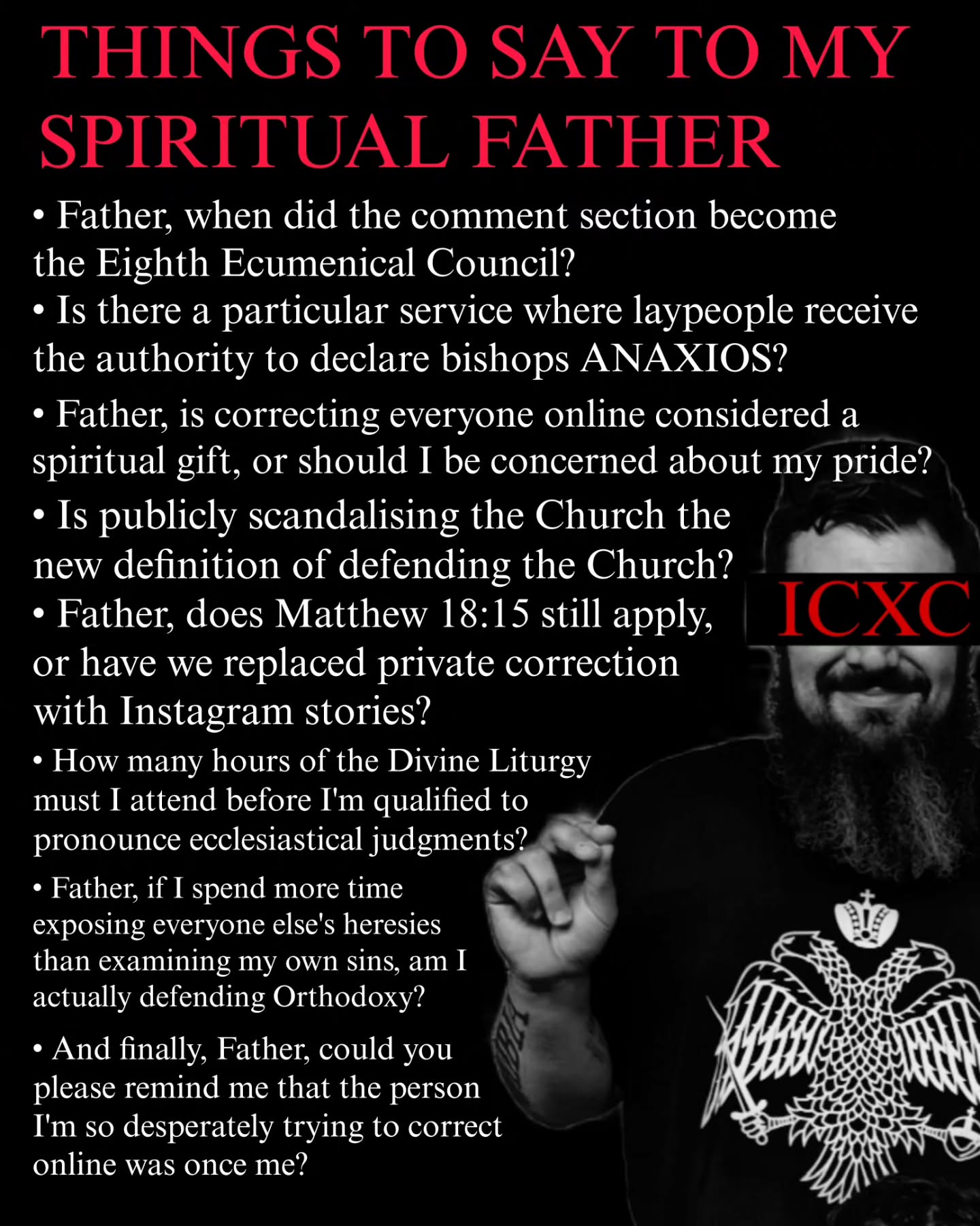
Questions for a Spiritual Father About Correcting Strangers Online

A satirical list framed as 'Things to say to my spiritual father' turns the lens on Orthodox Christians who spend their time correcting, exposing and condemning others online. One question cites Matthew 18:15, where Christ commands private correction before public rebuke, and asks whether Instagram stories have replaced it. Another asks how many hours of the Divine Liturgy qualify a person to pronounce ecclesiastical judgments. The sharpest…

A satirical list framed as 'Things to say to my spiritual father' turns the lens on Orthodox Christians who spend their time correcting, exposing and condemning others online. One question cites Matthew 18:15, where Christ commands private correction before public rebuke, and asks whether Instagram stories have replaced it. Another asks how many hours of the Divine Liturgy qualify a person to pronounce ecclesiastical judgments.

The sharpest question turns inward: if I spend more time exposing everyone else's heresies than examining my own sins, am I actually defending Orthodoxy? The list ends by asking the priest to remind the speaker that the person he is desperately trying to correct online was once himself. The author frames the post with 'Lord have mercy upon us all, especially myself' and the Greek 'Δόξα τῷ Θεῷ πάντων ἕνεκεν' (Glory to God for all things), closing with ICXC.

The piece reads as a self-directed examination of conscience about online polemics, pride and the commandment to correct in private.

  • The list poses satirical questions to a spiritual father about judging bishops and other Orthodox online
  • It asks which service grants laypeople authority to declare bishops 'anaxios'
  • It invokes Matthew 18:15 on private correction versus Instagram stories
  • It asks whether exposing others' heresies while neglecting one's own sins counts as defending Orthodoxy
  • It closes by asking to be reminded that the person one corrects online was once oneself
5 opinions in the discussion "I will not be asked how many hungry I fed, how many I clothed, or how many sick I nursed, but rather how many people I called heretics for making small mistakes online" -St Maria of Paris… Read the discussion

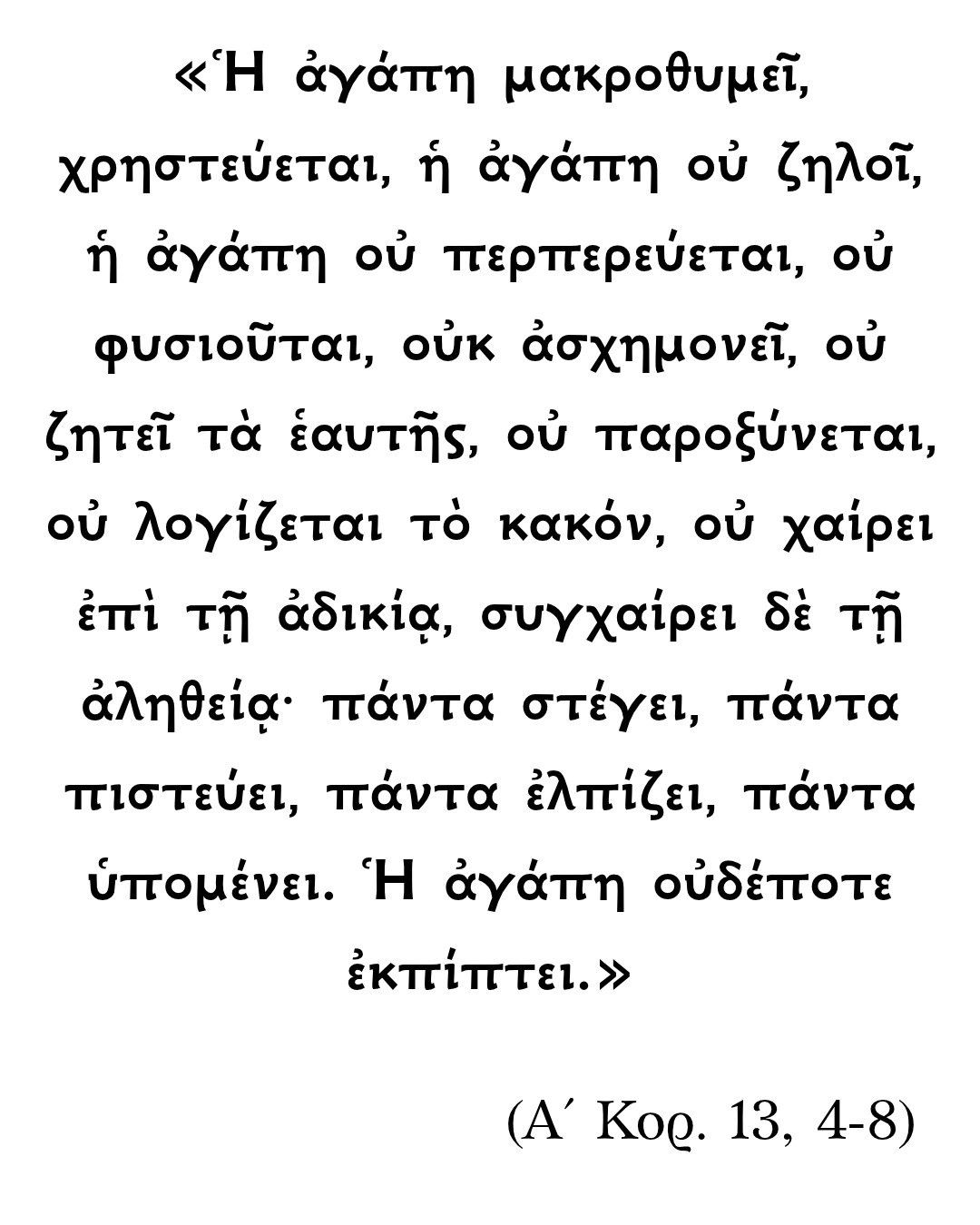
St. Paul on Love: An Orthodox Interpretation

The post presents the Greek text of 1 Corinthians 13:4-8 alongside an interpretive commentary drawn from the book "The New Testament with Brief Interpretation" by the late Professor Panagiotis N. Trembelas of the Theological School of the University of Athens and the Brotherhood of Theologians "O Soter" (11th edition, May 2025, Athens). The commentary expands each quality of love named by the Apostle Paul, patience, kindness, absence of envy,…

The post presents the Greek text of 1 Corinthians 13:4-8 alongside an interpretive commentary drawn from the book "The New Testament with Brief Interpretation" by the late Professor Panagiotis N. Trembelas of the Theological School of the University of Athens and the Brotherhood of Theologians "O Soter" (11th edition, May 2025, Athens).

The commentary expands each quality of love named by the Apostle Paul, patience, kindness, absence of envy, humility, proper conduct, selflessness, calmness, refusal to count wrongs, rejection of injustice, joy in truth, covering faults, trust, hope, endurance, into a fuller ethical and spiritual description. It explains that the person who possesses love becomes magnanimous, tolerant, broad-hearted, beneficent, and useful; does not envy, boil with passion, or act with arrogance and self-will; does not puff up with conceit and pride; does nothing unseemly, seeks not his own interests, is not provoked by anger and wrath, never thinks evil against another, nor accounts the evil suffered from him.

He does not rejoice when he sees injustice done, but rejoices when truth prevails. He covers all the shortcomings of the other and does not mock him for them; forms a favorable confidence in all things for the one he loves. And when faced with the other's deviations, he hopes that from all these he will be corrected; in all things he shows patience for his fellow man. Love never fails, but remains always true and strong, even after our death.

  • Presents 1 Corinthians 13:4-8 in Greek
  • Provides commentary from Trembelas' "New Testament with Brief Interpretation"
  • Explains each attribute of love in ethical and spiritual terms
  • Describes the practical behavior of one who possesses love
  • Notes love's permanence beyond death
4 opinions in the discussion In short, nobody loves, because this love seems impossible to achieve. Read the discussion