
 Ιερά Σκήτη Προφήτη Ηλία Αγίου Όρους
Instagram
St. Paul on Love: An Orthodox Interpretation
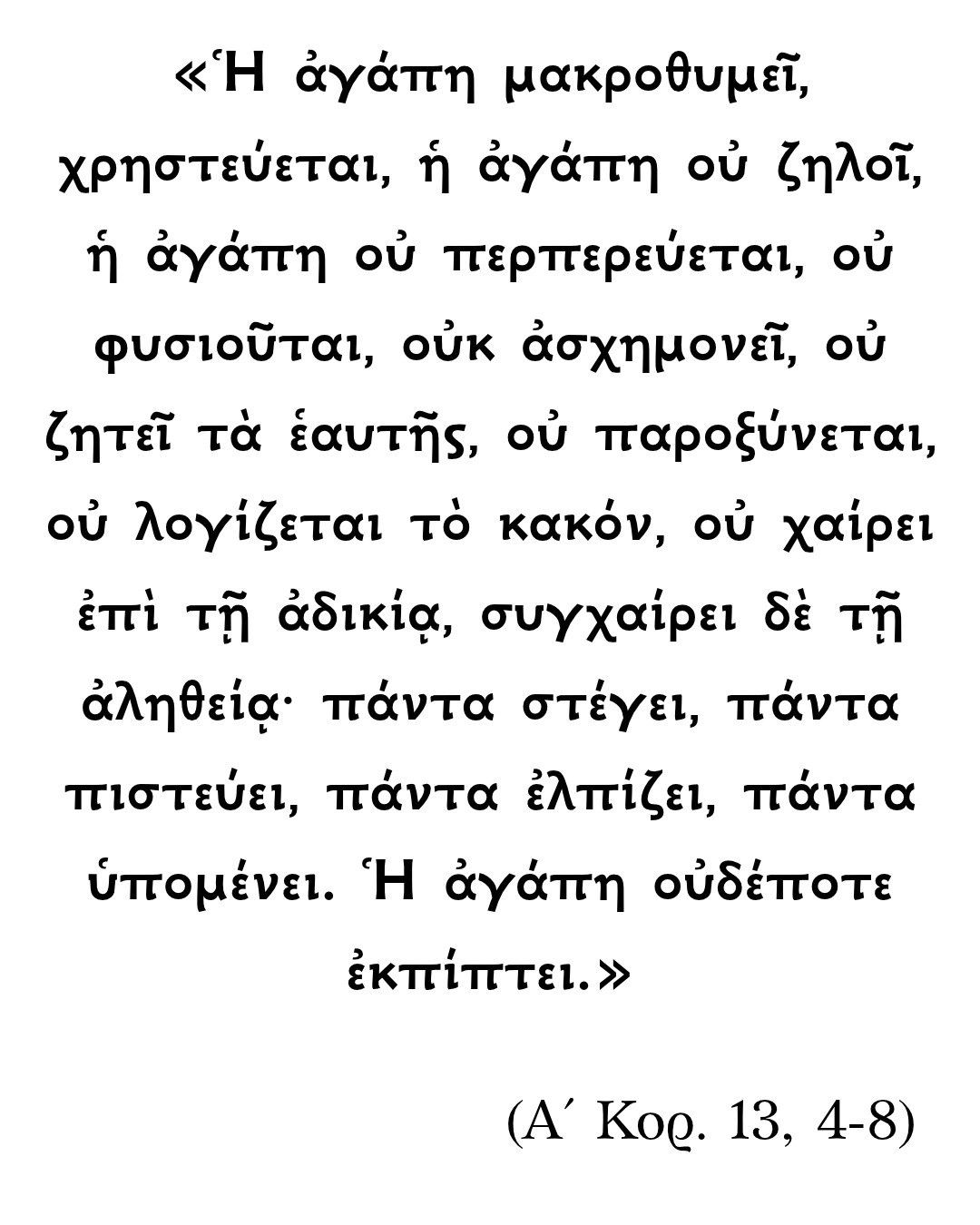
The post presents the Greek text of 1 Corinthians 13:4-8 alongside an interpretive commentary drawn from the book "The New Testament with Brief Interpretation" by the late Professor Panagiotis N. Trembelas of the Theological School of the University of Athens and the Brotherhood of Theologians "O Soter" (11th edition, May 2025, Athens).
The commentary expands each quality of love named by the Apostle Paul, patience, kindness, absence of envy, humility, proper conduct, selflessness, calmness, refusal to count wrongs, rejection of injustice, joy in truth, covering faults, trust, hope, endurance, into a fuller ethical and spiritual description. It explains that the person who possesses love becomes magnanimous, tolerant, broad-hearted, beneficent, and useful; does not envy, boil with passion, or act with arrogance and self-will; does not puff up with conceit and pride; does nothing unseemly, seeks not his own interests, is not provoked by anger and wrath, never thinks evil against another, nor accounts the evil suffered from him.
He does not rejoice when he sees injustice done, but rejoices when truth prevails. He covers all the shortcomings of the other and does not mock him for them; forms a favorable confidence in all things for the one he loves. And when faced with the other's deviations, he hopes that from all these he will be corrected; in all things he shows patience for his fellow man. Love never fails, but remains always true and strong, even after our death.
Main points
- Presents 1 Corinthians 13:4-8 in Greek
- Provides commentary from Trembelas' "New Testament with Brief Interpretation"
- Explains each attribute of love in ethical and spiritual terms
- Describes the practical behavior of one who possesses love
- Notes love's permanence beyond death