WeOrthodox
EN UA

Orthodox posts, videos and discussions

We follow Orthodox channels, communities and blogs across the web, summarise every post and video, and highlight the conversations with real substance.

Persecution of Christians in the Holy Land and the theology of Christian Zionism

The post presents a series of arguments against Christian support for the modern state of Israel. It opens with statistics from 2025 documenting 155 anti-Christian incidents in Israel and East Jerusalem, including 61 physical attacks, 52 attacks on church properties, 28 harassment incidents, and 14 defacements of Christian signage. It cites two specific attacks on churches in Gaza: the October 2023 airstrike on the Greek Orthodox Church of St.…

The post presents a series of arguments against Christian support for the modern state of Israel. It opens with statistics from 2025 documenting 155 anti-Christian incidents in Israel and East Jerusalem, including 61 physical attacks, 52 attacks on church properties, 28 harassment incidents, and 14 defacements of Christian signage.

It cites two specific attacks on churches in Gaza: the October 2023 airstrike on the Greek Orthodox Church of St. Porphyrios compound that killed civilians sheltering there, and the July 2025 Israeli tank fire on Holy Family Catholic Church that killed three people. The post then references declassified Israeli military documents regarding a 1948 biological warfare campaign, code-named Cast Thy Bread, that contaminated Palestinian water supplies in villages including the predominantly Christian village of Eilabun in the Galilee, citing Israeli historians.

The theological section argues that Christianity predates Rabbinic Judaism, noting that the Church inherited the Septuagint from Jewish scholars, while the Masoretic text was standardized around the tenth century. It traces modern Christian Zionism to John Nelson Darby's dispensationalism in the 1830s, the 1909 Scofield Reference Bible, the founding of AIPAC in the 1950s, and the 2006 formation of Christians United for Israel.

The post contrasts Genesis 12:3 with Paul's teaching that those in Christ are Abraham's offspring, asserting that the Apostolic Church has understood itself as the fulfillment of Israel for two thousand years.

  • 155 anti-Christian incidents documented in Israel and East Jerusalem in 2025, including attacks on clergy and church properties
  • Greek Orthodox Church of St. Porphyrios in Gaza struck by airstrike in October 2023; Holy Family Catholic Church hit by tank fire in July 2025
  • Declassified documents allege 1948 Israeli biological warfare campaign contaminated water in Christian village of Eilabun and other locales
  • Argument that Christianity is older than Rabbinic Judaism and the Church received the Septuagint before the Masoretic text was standardized
  • Christian Zionism traced to 19th-century dispensationalism, Scofield Bible, and modern political lobbying groups
8 opinions in the discussion Even if it were only Muslims getting bombed we should still care btw. We are all God's creations! Even when we don't agree with their religion. Read the discussion
Kyle YouTube discussion

Orthodox gamer: GTA 6 reveals entertainment cannot save us

Orthodox gamer: GTA 6 reveals entertainment cannot save us 13:42

An Orthodox Christian content creator, formerly an avid gamer, reviews Grand Theft Auto 6 and uses its failure to examine the spiritual condition of modern entertainment culture. He describes the game as technically flawed, running at 30 frames per second with bugs and monotonous gameplay that forces players to perform virtual chores, painting, baking, working out, earning money, simulating real life without soul. The intense anticipation…

An Orthodox Christian content creator, formerly an avid gamer, reviews Grand Theft Auto 6 and uses its failure to examine the spiritual condition of modern entertainment culture. He describes the game as technically flawed, running at 30 frames per second with bugs and monotonous gameplay that forces players to perform virtual chores, painting, baking, working out, earning money, simulating real life without soul.

The intense anticipation surrounding the release, built over 13 years, functioned as a false hope: many believed the game would solve their problems and deliver extraordinary happiness. Professional reviewers awarded perfect scores while actual players rejected the experience, exposing a disconnect between industry hype and genuine satisfaction.

The speaker frames this disappointment as a wake-up call. He contrasts the hedonic treadmill of gaming, thousands of hours invested with nothing lasting to show, with the deeper happiness he found in communion with God, church community, and embracing ordinary life rather than fleeing it. He cites Saint Augustine's observation that the human heart is restless until it rests in God, and argues that the cycle of anticipation, trailers, rumors, leaks, speculation, mirrors the endless pursuit of the next promotion or purchase that never finally satisfies.

The critique extends to broader media trends: nostalgia sold as product, exemplified by Marvel's reliance on emotional attachment after Endgame, and the glorification of degeneracy, crime, and sexual immorality in GTA 6. The speaker does not reject recreation entirely, he still plays Mario Kart, board games, The Sims, and Oblivion with his wife, but insists entertainment must occupy its proper place beneath spiritual life and real relationships.

He concludes by calling viewers to repent, draw near to Christ, and join the Orthodox Church.

Key moments

  1. 0:00 GTA 6 runs at 30 FPS with bugs and monotonous gameplay that makes players do virtual chores like painting a house, baking a table, working out, and earning money, simulating real life without soul.
  2. 1:03 People have talked about GTA 6 for 13 years as if waiting for heaven itself, believing the game would solve their problems and bring extraordinary happiness.
  3. 2:04 Professional reviewers gave GTA 6 perfect scores while actual players say it is not what they wanted, revealing that lasting satisfaction cannot be found in video games.
  4. 3:06 The speaker still plays Mario Kart, board games, The Sims, and Oblivion with his wife, but warns against organizing life around the next big game as the center of existence.
  5. 4:09 After finding God, the speaker cares about church and community in real life, discovering deeper happiness through prayer, repentance, and humility rather than the hedonic treadmill of entertainment.
  6. 6:14 Avengers Endgame exemplifies the nostalgia problem: high ratings driven by emotional attachment to a decade of Marvel films, but the story relies on time travel that undermines consequences and set up years of creative failure.
  7. 9:22 GTA 6 glorifies degeneracy, crime, violence, greed, and sexual immorality, and Christians must discern whether entertainment cultivates virtue or feeds the passions.
  8. 10:23 The addiction to anticipation (trailers, rumors, leaks, speculation) mirrors the hedonic treadmill: "When I get a promotion I'll be happy... GTA 6 finally releases, I'll be happy," but satisfaction never lasts because only God can fill the human heart.
18 opinions in the discussion Before Orthodoxy I never would've guessed I'd find this kind of stuff boring (some movies aside, not gonna lie). I want so much less from the world and its entertainment now. Wouldn't have… Read the discussion

One Orthodox Church or many? A response to the claim of 14 separate churches

The video presents a claim that there is no single Eastern Orthodox Church but rather 14 separate churches corresponding to 14 patriarchs, which disagree on governance, doctrine, and sacraments. The claim cites Russian theologian Vladimir Solovyov, who said that on the day the Russian and Greek churches formally break, the world will see the ecumenical Eastern Church is a fiction and only isolated national churches exist. The speaker echoes this…

The video presents a claim that there is no single Eastern Orthodox Church but rather 14 separate churches corresponding to 14 patriarchs, which disagree on governance, doctrine, and sacraments. The claim cites Russian theologian Vladimir Solovyov, who said that on the day the Russian and Greek churches formally break, the world will see the ecumenical Eastern Church is a fiction and only isolated national churches exist. The speaker echoes this view, calling it the on-the-ground reality.

The speaker then responds that the claim is intellectually dishonest and false. Not every autocephalous church is headed by a patriarch, and autocephaly means self-government within a wider communion, not independent denominations. The churches together constitute the Orthodox Catholic Church.

Breaks in communion between major sees are not unprecedented; Rome and Constantinople were out of communion for 35 years during the Great Schism. The Orthodox claim is that the one Church exists as a communion of local apostolic churches sharing the same faith, sacraments, and episcopacy, and a rupture does not entail that there is no communion.

Saint Cyprian of Carthage is cited: the episcopate is one, each part held by each one for the whole, and the Church is one, spread abroad into a multitude.

Key moments

  1. 0:00 The claim is made that there is no Eastern Orthodox Church, only 14 Eastern Orthodox Churches because there are 14 patriarchs, and they are not in agreement on governance, doctrine, or sacraments between the Russians and the Greeks.
  2. 0:00 A Russian theologian, Vladimir Solovyov, is quoted saying that on the day the Russian and Greek churches formally break, the world will see the ecumenical Eastern Church is a fiction and only isolated national churches exist.
  3. 0:30 The speaker echoes the theologian's view that there is no Orthodox Church, only Orthodox Churches, and says this is the on-the-ground reality.
  4. 1:02 The speaker responds that the claim there are 14 Orthodox Churches because there are 14 patriarchs is intellectually dishonest and false, because not every autocephalous church is headed by a patriarch.
  5. 1:02 Autocephaly means self-government within the wider communion of the Church, not multiple separate churches as independent denominations; the churches together constitute the Orthodox Catholic Church.
  6. 1:37 Breaks in communion between major sees are not unprecedented, as Rome and Constantinople were out of communion for 35 years during the Great Schism.
  7. 1:37 The Orthodox claim is that the one church exists as a communion of local apostolic churches sharing the same faith, sacraments, and episcopacy, and a rupture does not entail that there is no communion.
  8. 1:37 Saint Cyprian of Carthage is cited: the episcopate is one, each part held by each one for the whole, and the Church is one, spread abroad into a multitude.
21 opinions in the discussion Never bring up the western schism to Roman Catholics, the time the west had 3 popes at once, with canonized saints in their own church who backed different sides of it. Read the discussion

Venerable Gabriel of Samtavro on prayer from the heart

The post presents a prayer to Venerable Gabriel of Samtavro, a Georgian saint known for his fool-for-Christ asceticism. The prayer asks his intercession for deliverance from every affliction, the destruction of demonic nets, the quenching of enmity, and the healing of illnesses. It notes that the river of God's wonders from his holy relics does not cease, nor does the stream of His mercy toward sinners who entreat him. The prayer recalls that…

The post presents a prayer to Venerable Gabriel of Samtavro, a Georgian saint known for his fool-for-Christ asceticism. The prayer asks his intercession for deliverance from every affliction, the destruction of demonic nets, the quenching of enmity, and the healing of illnesses. It notes that the river of God's wonders from his holy relics does not cease, nor does the stream of His mercy toward sinners who entreat him.

The prayer recalls that the saint was granted the great gift of love from the Lord, bearing the burdens of neighbors and shedding tears for sinners and sufferers, and asks him to bring the faithful's prayers and repentant tears to God's throne. The accompanying video summary conveys the saint's teaching that prayer should be constant, not limited to convenient times, and especially offered in moments of pain.

He advises against seeking beautiful words, urging instead to speak to God simply as a father, giving the example: "Lord, I understand nothing, but you are with me, help." Such sincere prayer, where words carry the soul, is described as stronger than a thousand formal prayers and as moving both heaven and earth.

Key moments

  1. Pray not when convenient but always, especially when it hurts, and speak to God as to a father without searching for beautiful words.
  2. A sincere prayer with the soul in the words, such as "Lord, I understand nothing, but you are with me, help", is stronger than a thousand formal prayers and causes heaven to hear and earth to humble itself.

Bread Is a Gift from God: Protoierey Andrey Tkachev on Sacred Daily Habits

Protoierey Andrey Tkachev teaches that bread is a divine gift, not mere fuel, and warns against treating food carelessly. He advises that uneaten bread be dried and given to birds rather than discarded. The table, as the place where bread is eaten, becomes a throne; in old Christian custom people kissed the table after meals to honor God's gift. He recounts a practice from eastern Poland where peasants cut a cross on the loaf with a knife and…

Protoierey Andrey Tkachev teaches that bread is a divine gift, not mere fuel, and warns against treating food carelessly. He advises that uneaten bread be dried and given to birds rather than discarded. The table, as the place where bread is eaten, becomes a throne; in old Christian custom people kissed the table after meals to honor God's gift.

He recounts a practice from eastern Poland where peasants cut a cross on the loaf with a knife and distributed the first crust to the father, then the eldest son, then the rest. Tkachev lists habits that keep a person close to God: not spitting in a well, not putting feet on the table, not mocking people with disabilities, sharing with the poor, attending church on Sunday, and respecting elders.

He argues that in today's plastic, concrete, and computer-driven civilization these simple but vital truths must be implanted in the soul before theology. He calls for protecting nature, trees, branches, flowers, birds, and children, as part of this foundational reverence.

  • Bread is a gift from God, not fuel; waste is forbidden.
  • Uneaten bread should be dried and given to birds.
  • The table is a throne when bread is on it; old custom kissed the table after meals.
  • Polish peasants cut a cross on the loaf and gave the first crust to the father, then eldest son.
  • Simple habits, reverence for food, nature, elders, and Sunday worship, keep one near God.
Athonite Audio YouTube

Desert Fathers on Love: Sayings from Chapter 17

Desert Fathers on Love: Sayings from Chapter 17 14:13

The post presents Chapter 17 of the Sayings of the Desert Fathers from the SAGOM Press edition, focusing on love. Abba Anthony teaches that love casts out fear and that one's standing with God depends on treatment of one's neighbor. When Abba Ammonus asks why Anthony has a greater reputation despite a less strenuous life, Anthony answers that he loves God more. Abba Arsenius tells Abba Marcos he shuns people because he cannot be with God and…

The post presents Chapter 17 of the Sayings of the Desert Fathers from the SAGOM Press edition, focusing on love. Abba Anthony teaches that love casts out fear and that one's standing with God depends on treatment of one's neighbor. When Abba Ammonus asks why Anthony has a greater reputation despite a less strenuous life, Anthony answers that he loves God more.

Abba Arsenius tells Abba Marcos he shuns people because he cannot be with God and with people at the same time; the heavenly hosts have one purpose while people have innumerable purposes. Abba Agathon never slept with a grudge. Abba John prevents a guide's shame when they are lost by pretending to be tired and stopping for the night, so the guide discovers his own mistake in the morning and asks forgiveness without humiliation.

Abba Poemen brings food and wine to a jealous elder who initially refuses them; their perseverance in the heat moves the elder to welcome them, and he declares Poemen a hundred times greater than he had heard. Abba Poemen teaches that bearing harsh words and injury patiently without retribution is laying down one's life for a friend, fulfilling John 15:13. Abba Piamun accepts wine from a robber leader at swordpoint, knowing the robber desires God; the robber repents, promises to harm no one, and the whole band is converted because Piamun abandoned his own will for God's sake.

A younger brother confesses he sinned with a woman; the older brother says he will carry half the burden of that sin, and the younger realizes they can live together until death. Practical love appears in a brother giving his basket handles to a neighbor, another traveling to Egypt for fresh bread for a sick elder, and an elder judging that tending the sick surpasses extreme fasting.

An elder attributes the loss of grace to cold love and dragging neighbors down. Three harvesters trust a sick brother's prayers to complete his share; an elder rules he must accept the pay. Elders wash a tempted brother with prayed-over water for immediate purging.

Two elders cannot quarrel even when trying. An elder directs double kindness to the brother with a bad reputation. A brother endures washing foul sores, using the stench as a weapon against tempting thoughts, and the elder heals.

Key moments

  1. 0:01 Abba Anthony says he no longer fears God but loves him because love casts out fear, and that life and death come from our neighbor: winning a neighbor's respect wins God's respect, scandalizing a neighbor scandalizes God.
  2. 0:32 When Abba Ammonus asks why Anthony has a greater reputation despite a less strenuous life, Anthony answers that he loves God more.
  3. 1:04 Abba Arsenius tells Abba Marcos he shuns people because he cannot be with God and with people at the same time; the heavenly hosts have one purpose while people have innumerable purposes.
  4. 2:05 Abba John prevents a guide's shame when they are lost by pretending to be tired and stopping for the night, so the guide discovers his own mistake in the morning and asks forgiveness without humiliation.
  5. 2:37 Abba Poemen brings food and wine to a jealous elder who initially refuses them; their perseverance in the heat moves the elder to welcome them, and he declares Poemen a hundred times greater than he had heard.
  6. 3:39 Abba Poemen teaches that bearing harsh words and injury patiently without retribution is laying down one's life for a friend, fulfilling John 15:13.
  7. 4:42 Abba Piamun accepts wine from a robber leader at swordpoint, knowing the robber desires God; the robber repents, promises to harm no one, and the whole band is converted because Piamun abandoned his own will for God's sake.
  8. 6:51 A younger brother confesses he sinned with a woman; the older brother says he will carry half the burden of that sin, and the younger realizes they can live together until death.
Athonite Audio YouTube

Desert Fathers' Stories of Patience and Forbearance

Desert Fathers' Stories of Patience and Forbearance 13:52

The chapter collects sayings and stories of the Desert Fathers that illustrate patience and forbearance. Abba Galatios owns a parchment Bible worth eighteen gold pieces; when a pilgrim steals it, he does not pursue him. The thief later tries to sell it for sixteen pieces, but the buyer consults Galatios, who affirms its value. The buyer lies, saying Galatios called the price too high, so the thief returns the book in repentance, and Galatios…

The chapter collects sayings and stories of the Desert Fathers that illustrate patience and forbearance. Abba Galatios owns a parchment Bible worth eighteen gold pieces; when a pilgrim steals it, he does not pursue him. The thief later tries to sell it for sixteen pieces, but the buyer consults Galatios, who affirms its value.

The buyer lies, saying Galatios called the price too high, so the thief returns the book in repentance, and Galatios accepts it to give him peace. At a meeting, a priest tells Abba Vagrios he would have been made a bishop in his homeland; Vagrios bows and replies with Job 40:5, saying he has spoken once and will add nothing. John the Younger serves his elder Abba Ammonus for twelve years during illness without praise until the elder, on his deathbed, takes his hand three times, says "May you be saved," and declares him an angel.

Abba Moses endures racial slurs from elders at a Scetis meeting, hearing them call him an Ethiopian, yet he remains silent; afterward he cites Psalm 76:5, saying he was troubled but did not speak. A monk whose cell is robbed tells the thieves they are welcome to what they see; when they overlook a small cross, he runs after them to give it, and they return everything in repentance.

Philosophers test two monks: the first, well-dressed, responds rudely; the second, a peasant, comes when insulted and turns the other cheek when struck. The philosophers prostrate themselves and ask what the monks do beyond asceticism; the monk answers they trust in God's grace and guard their nous. An elder sees a brother stealing from his cell but harbors no resentment, working harder and fasting more, saying the brother may be in need.

On his deathbed he calls the thief, kisses his hands, and thanks him, saying those hands will bring him into the kingdom; the thief repents and becomes an exemplary monk.

Key moments

  1. 0:02 Abba Galatios possesses a book written on parchment worth 18 gold pieces containing the complete Old and New Testaments, which he puts in the church for any brother to read; a pilgrim brother steals it and departs, but Galatios does not chase after him.
  2. 0:32 The thief tries to sell the book for 16 gold pieces; the prospective buyer takes it to Abba Galatios to verify its worth, and Galatios says it is worth the price; the buyer lies to the thief, saying Galatios called the price too high, so the thief returns the book in penitence, and Galatios accepts it to give the thief peace.
  3. 2:08 At a meeting, a priest tells Abba Vagrios he would have been made a bishop in his native land; Vagrios bows his head and says, "It is true, Father. Nevertheless, I have spoken once. I will add nothing a second time," quoting Job 40:5.
  4. 3:10 John the Younger, disciple of Abba Ammonus, ministers to the elder for 12 years during his illness without receiving any sign of approval until the elder, on his deathbed, takes John's hand and says three times, "May you be saved," and declares, "He is not a man, he is an angel."
  5. 4:42 At a meeting in Scetis, some elders belittle Abba Moses, saying, "What does this Ethiopian think he is doing coming to our meeting?" He hears but says nothing; afterward they ask if he was upset, and he replies, "I was troubled, but I did not speak," citing Psalm 76:5.
  6. 7:21 Robbers enter a monk's cell and take everything; he tells them, "You are welcome to what you can see, my sons." When they overlook a small cross, he runs after them and gives it to them, saying, "Take this also, my sons. You overlooked it in the cell." They return everything in repentance, saying, "Truly, this is a man of God."
  7. 9:24 Philosophers test two monks: the first, well-dressed, responds rudely to their call; the second, a peasant, comes when insulted and turns the other cheek when struck. The philosophers prostrate themselves, honor him, and ask what the monks do beyond their own ascetic practices; the monk answers, "We trust in the grace of God and keep guard over our nous."
  8. 13:05 An elder sees a brother stealing from his cell but harbors no resentment, working harder and fasting more, saying, "Perhaps that brother is in need." On his deathbed, he calls the thief, kisses his hands, and says, "I give thanks for these hands of yours, brother, for because of them I am about to enter the kingdom of heaven." The thief repents and becomes an exemplary monk.
CHRISTIANITY UNITED Instagram

Christ as the Gate and Good Shepherd in John 10

The post reflects on Jesus Christ's self-description as the Gate and the Good Shepherd in John 10:7-9. It contrasts the many voices in the world that promise happiness, peace, and salvation, some offering wealth, others freedom without responsibility, many urging life according to one's own desires, with the singular voice of Christ, who offers salvation and eternal communion with God. The author explains the ancient shepherd's role: protecting…

The post reflects on Jesus Christ's self-description as the Gate and the Good Shepherd in John 10:7-9. It contrasts the many voices in the world that promise happiness, peace, and salvation, some offering wealth, others freedom without responsibility, many urging life according to one's own desires, with the singular voice of Christ, who offers salvation and eternal communion with God.

The author explains the ancient shepherd's role: protecting the flock from thieves, predators, and danger, providing guidance and nourishment, and applies this image to the relationship between Christ and the faithful. Without the Good Shepherd, people are easily led astray by passions, temptations, and false promises. In the Orthodox understanding, salvation is not merely a declaration of belief but a living relationship with Christ entered through faith, repentance, prayer, the Holy Mysteries, and obedience to His commandments.

Christ does not call to restrict freedom; true freedom is found in Him, not in slavery to sin. The gate remains open to any sinner who sincerely seeks repentance, no matter how far they have wandered. The world offers countless paths, but only Christ leads from death into eternal life.

The post concludes with a prayer asking the Lord to teach recognition of His voice and prevent wandering.

  • Christ identifies Himself as the Gate for the sheep and the Good Shepherd in John 10:7-9.
  • Worldly voices promise happiness and freedom but lead away from truth.
  • The ancient shepherd protected, guided, and fed the flock; Christ fulfills this role spiritually.
  • Orthodox salvation is a living relationship through faith, repentance, prayer, the Mysteries, and obedience.
  • The gate is open to every repentant sinner, no matter how far they have strayed.
Read more

Saint David of Gareja and the Miraculous Spring on Mount Mtatsminda

Saint David of Gareja, one of the Thirteen Syrian Fathers, arrived in Georgia in the 6th century with the blessing of the Holy Theotokos and Saint Simeon the Stylite. He settled on Mount Mtatsminda, which means Holy Mountain, overlooking Tbilisi, and labored there in asceticism through prayer, fasting, and spiritual stillness. According to ancient tradition, a spring emerged at the site of his hermitage through his prayers. Known as "David's…

Saint David of Gareja, one of the Thirteen Syrian Fathers, arrived in Georgia in the 6th century with the blessing of the Holy Theotokos and Saint Simeon the Stylite. He settled on Mount Mtatsminda, which means Holy Mountain, overlooking Tbilisi, and labored there in asceticism through prayer, fasting, and spiritual stillness. According to ancient tradition, a spring emerged at the site of his hermitage through his prayers.

Known as "David's Tears," the spring has remained a place of prayer and spiritual consolation for centuries. The faithful visit to seek health, healing, and God's help, and women in particular come to ask for the gift of motherhood through the saint's intercession. The video shows the speaker at the hermitage describing how the wonderworking spring continues to work miracles today, drawing many Georgians and Orthodox faithful from around the world who gather there like bees to a hive to receive help.

Key moments

  1. The speaker is at the hermitage of Saint David Gareji.
  2. Saint David Gareji is one of the thirteen holy monk fathers who came from Syria.
  3. They came with the blessing of the Holy Theotokos and Saint Simeon the Stylite, their spiritual father.
  4. Saint David settled on Mount Mtacminda, which translates as Holy Mountain.
  5. He labored there for years at the site of his hermitage.
  6. A wonderworking spring emerged at that site and works miracles to this day.
  7. Many Georgians and people from the whole Orthodox world gather there like bees to a hive to receive help.

Human beings created to participate in eternal blessedness by following God's will

The post sets out the fundamental choice human beings face: to live according to God's will, which is the purpose of their creation, or to choose the opposite path. The philosopher Bora Knežević describes man as a being who can bring joy to God or shame to the devil. This formulation echoes Christ's question about what profit a man gains if he acquires the whole world but loses his soul, and what he can give in exchange for it. The discussion…

The post sets out the fundamental choice human beings face: to live according to God's will, which is the purpose of their creation, or to choose the opposite path. The philosopher Bora Knežević describes man as a being who can bring joy to God or shame to the devil. This formulation echoes Christ's question about what profit a man gains if he acquires the whole world but loses his soul, and what he can give in exchange for it.

The discussion emphasizes that a person should be conscious that he lives only once and must use that life in the best way, according to how God made him. God created human beings to participate in the blessedness of eternal life in His kingdom.

Key moments

  1. We can act as God wants, which is why He created us as human beings, or we can act contrary to His will.
  2. Philosopher Bora Knežević says man is a being who can make God rejoice and the devil be ashamed.
  3. This reflects Christ's words: what does it profit a man to gain the whole world and lose his soul, or what can a man give in exchange for his soul?
  4. A person should be aware that he lives only once and use that life in the best way, as God created him.
  5. God created us to participate in the blessedness of eternal life in His kingdom.
Read more
Lives of the Saints 🙏 Instagram

Saint Valerius and Thirty-Two Martyrs of Melitene

The post recounts the martyrdom of Saint Valerius and thirty-two fellow Christians in the Armenian city of Melitene during the reign of Emperor Diocletian in the year 298. Imperial authorities, determined to suppress Christianity in Armenia and Cappadocia, sent two soldiers to find and execute those who refused to worship pagan idols. The soldiers carried out their orders by the sword. Although little is preserved about Valerius's personal life,…

The post recounts the martyrdom of Saint Valerius and thirty-two fellow Christians in the Armenian city of Melitene during the reign of Emperor Diocletian in the year 298. Imperial authorities, determined to suppress Christianity in Armenia and Cappadocia, sent two soldiers to find and execute those who refused to worship pagan idols.

The soldiers carried out their orders by the sword. Although little is preserved about Valerius's personal life, his witness stands as a reminder that holiness does not depend on earthly recognition or written records. Many martyrs left no writings or monuments, yet their faithfulness remains precious before God. The account concludes with a call to examine our own willingness to remain faithful to Christ when courage and sacrifice are required, and a prayer for the intercession of Saint Valerius and the thirty-two martyrs.

  • Saint Valerius martyred with thirty-two believers in Melitene, Armenia
  • Martyrdom occurred in 298 under Emperor Diocletian
  • Two soldiers sent to execute Christians refusing idol worship
  • Killed by the sword; few details of Valerius's life preserved
  • Account emphasizes faithfulness over earthly recognition
Read more
Lives of the Saints 🙏 Instagram

Patriarch Paul the Confessor Martyred at the Altar During Liturgy

The post recounts the life of Saint Paul the Confessor, Patriarch of Constantinople in the fourth century. As Patriarch Alexander approached death, the faithful asked whom they should choose as their next spiritual shepherd. He answered: "If you desire a patriarch who will teach you and shine with virtue, choose Paul." The people followed his counsel and elected Saint Paul. His appointment angered the Arians, who denied the full divinity of…

The post recounts the life of Saint Paul the Confessor, Patriarch of Constantinople in the fourth century. As Patriarch Alexander approached death, the faithful asked whom they should choose as their next spiritual shepherd. He answered: "If you desire a patriarch who will teach you and shine with virtue, choose Paul."

The people followed his counsel and elected Saint Paul. His appointment angered the Arians, who denied the full divinity of Jesus Christ, and Emperor Constantius, who supported their cause. Saint Paul was removed from his patriarchal throne and forced into exile. Together with Saint Athanasius the Great, he traveled to Rome, where Pope Julius and Emperor Constans welcomed them and supported their defense of the Orthodox Faith.

Through their intervention, Paul was restored to Constantinople. After the death of Emperor Constans, his opponents once again seized power and banished him to Cucusus in Armenia. Even in exile, Saint Paul continued serving Christ and defending the truth.

In the year 351, while celebrating the Divine Liturgy, he was attacked by Arians and strangled with his own omophorion, the sacred vestment of a bishop. Thus the holy patriarch received the crown of martyrdom while serving at the altar of God. His relics were transferred to Constantinople in 381 and later to Venice in 1236.

His faithful clerics, Saints Marcian and Martyrius, also suffered martyrdom. The post ends with a prayer: "Holy Hieromartyr Paul the Confessor, pray to God for us. Lord, for Your glory, not mine."

  • Patriarch Alexander recommended Paul as a virtuous teacher before his death.
  • Paul was elected but deposed by Arian opponents and Emperor Constantius.
  • He found support in Rome from Pope Julius and Emperor Constans, leading to his restoration.
  • After Constans' death, Paul was exiled to Cucusus in Armenia.
  • In 351, he was martyred by Arians while celebrating the Divine Liturgy, strangled with his omophorion.
Read more
☦️An Orthodox Blog☦️ with Orthodoxy ☦︎ Instagram

Elder Isaac Atallah on Worldly Schemes and a Prayer Confronting Death

The post presents a quotation from Elder Isaac Atallah the Athonite warning that worldly schemes aim to distance people from God by promoting unnecessary luxuries and ever-changing fashions. The elder explains that clothing has shifted from a covering to a means of display, exposing the body according to fashion, and that the Church does not approve because humans are created in God's image, not objects for fashion. Accompanying the text is a…

The post presents a quotation from Elder Isaac Atallah the Athonite warning that worldly schemes aim to distance people from God by promoting unnecessary luxuries and ever-changing fashions. The elder explains that clothing has shifted from a covering to a means of display, exposing the body according to fashion, and that the Church does not approve because humans are created in God's image, not objects for fashion.

Accompanying the text is a video of a liturgical prayer that addresses death as a foreign power holding sway over humanity, kings, and even the Lord, and that proclaims the kingdom of immortal life in Christ. The prayer concludes with the doxology "now and ever and unto ages of ages" and the Trisagion "Holy, Holy, Holy."

Key moments

  1. Death is addressed as a foreign, alien power.
  2. The doxology 'Now and ever and unto ages of ages. Amen.' is recited.
  3. The prayer mentions the power of death over man, kings, and the Lord.
  4. It speaks of the kingdom and immortal life in Christ.
  5. It concludes with the Trisagion: 'Holy, Holy, Holy.'

St. Nektarios: Holy Tradition Preceded Holy Scripture

St. Nektarios the Wonderworker teaches that the Holy Church of Christ was based on Holy Tradition before the writing of the Holy Scriptures, that is, the Gospels, the Acts, and the Epistles of the Holy Apostles, and before they were spread to all the churches of the world. He concludes that the Holy Scriptures are only a part of the whole.

The statement reflects the Orthodox view that Scripture exists within the broader life of Tradition, which preceded and encompasses the written New Testament.

  • Holy Tradition was the foundation of the Church before the New Testament was written.
  • The New Testament includes the Gospels, Acts, and Epistles.
  • These writings were spread to all churches over time.
  • Holy Scripture is only a part of the whole of Holy Tradition.
  • The quote is attributed to St. Nektarios the Wonderworker.

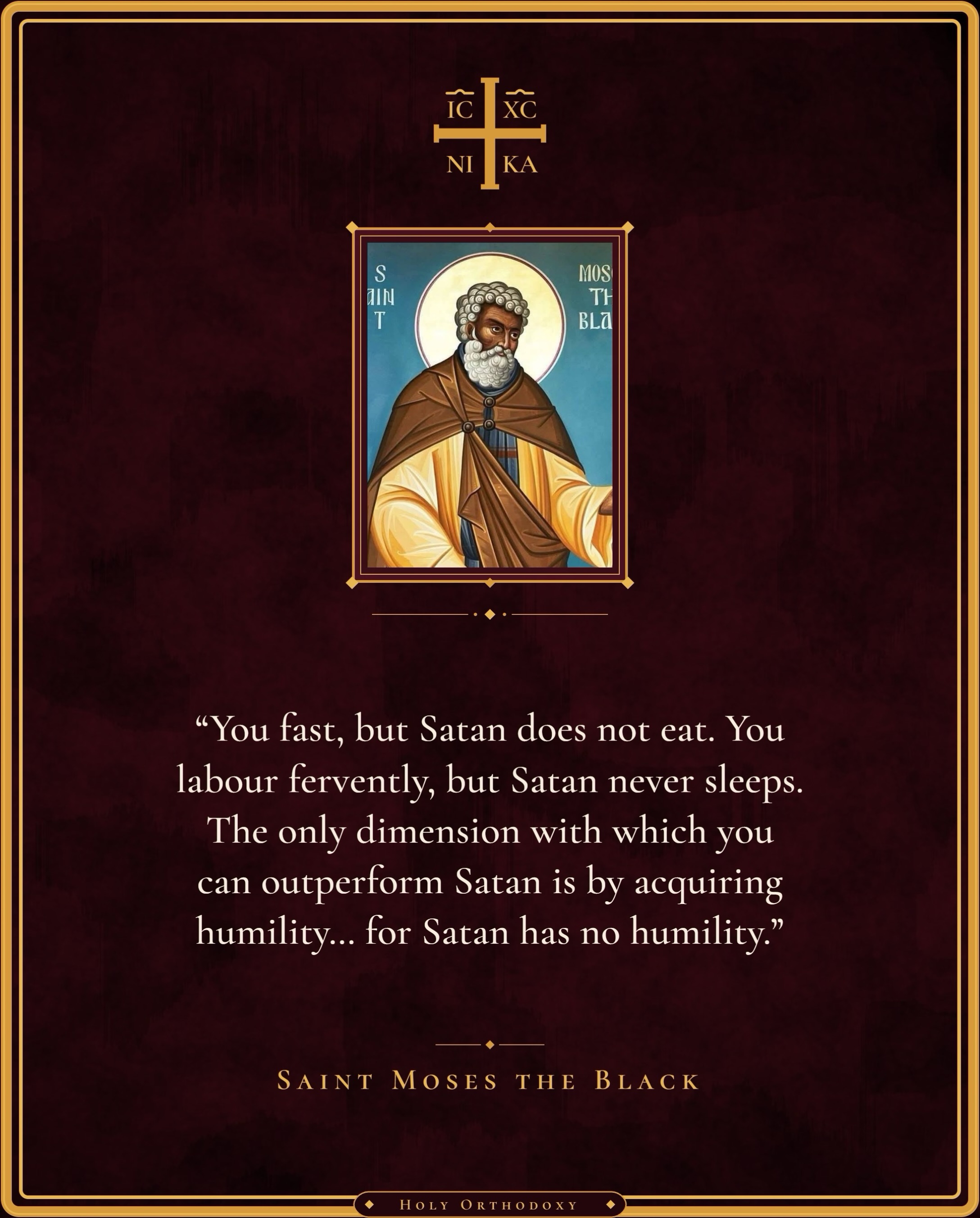
St. Moses the Black on humility as the weapon against Satan

The post shares a saying attributed to St. Moses the Black, a fourth-century Egyptian robber who became a monk in Scetis and one of the great Desert Fathers. The saying contrasts human ascetic effort with Satan's nature: fasting does not affect Satan because he does not eat, and labor does not weary him because he never sleeps. The only dimension in which a person can surpass Satan is humility, since Satan has none. The post notes that Moses'…

The post shares a saying attributed to St. Moses the Black, a fourth-century Egyptian robber who became a monk in Scetis and one of the great Desert Fathers. The saying contrasts human ascetic effort with Satan's nature: fasting does not affect Satan because he does not eat, and labor does not weary him because he never sleeps. The only dimension in which a person can surpass Satan is humility, since Satan has none.

The post notes that Moses' own life illustrates this: his repentance, not his own strength, turned him from a feared gang leader into a saint. He was martyred by raiders in the early fifth century. The text concludes with a request for his prayers.

  • St. Moses the Black was a robber and gang leader in Egypt before converting and becoming a monk in Scetis
  • He is counted among the great Desert Fathers and was martyred in the early 5th century
  • The attributed saying states that fasting and labor cannot outdo Satan because Satan does not eat or sleep
  • Humility is the only virtue Satan lacks and the only way to surpass him
  • Moses' own repentance, not personal effort, transformed him from robber to saint
Read more

Father Seraphim Rose: suffering points to the Kingdom of Heaven

The post shares a quotation from Father Seraphim Rose, an Orthodox hieromonk and writer. He states that suffering indicates another Kingdom which Christians look toward. If being Christian meant happiness in this life, the Kingdom of Heaven would not be needed. The quote presents suffering as a sign that directs believers toward the eternal Kingdom rather than earthly comfort.

  • Suffering points to the Kingdom of Heaven
  • Christian faith is not about happiness in this life
  • The Kingdom of Heaven is necessary because this life involves suffering
  • The quote comes from Father Seraphim Rose, an Orthodox Christian teacher
Read more
M mysteries_of_christendom Instagram

The Way of a Pilgrim: peace through the Jesus Prayer

The post recounts the story at the heart of The Way of a Pilgrim, a nineteenth‑century Russian spiritual classic. A man loses his arm to his older brother's violence as a boy; years later that same brother burns down his house. He becomes a wandering pilgrim, carrying only a knapsack, dry bread, and a Bible. In a church he hears Saint Paul's words "Pray without ceasing" and cannot imagine how to live them. He travels from village to village…

The post recounts the story at the heart of The Way of a Pilgrim, a nineteenth‑century Russian spiritual classic. A man loses his arm to his older brother's violence as a boy; years later that same brother burns down his house. He becomes a wandering pilgrim, carrying only a knapsack, dry bread, and a Bible.

In a church he hears Saint Paul's words "Pray without ceasing" and cannot imagine how to live them. He travels from village to village until a monk explains the nuce, the eye of the soul meant to see God, which becomes scattered in worries and daily life. The monk gives him the Jesus Prayer: "Lord Jesus Christ, Son of God, have mercy on me, a sinner."

He prays it with every step until it takes root in his heart. His outer circumstances do not change; he remains poor, hungry, beaten, and robbed. Yet his nuce returns home, and he perceives God everywhere, even saying the trees seem to pray for him.

The speaker concludes that faith teaches God does not always alter what we endure but heals the heart that endures it.

Key moments

  1. 0:00 An Orthodox man in 1800s Russia lost his arm to his older brother's violence as a boy, and years later that same brother burned his house down.
  2. 0:00 He took to the road alone with only a knapsack, some dry bread, and a Bible.
  3. 0:30 He heard "Pray without ceasing" from Saint Paul in a church and could not imagine living that way, so he searched village to village until a monk taught him.
  4. 0:30 The monk explained the nuce as the eye of the soul meant to see God, which gets scattered in worries and everyday life, and healing begins when it returns to the heart.
  5. 1:00 The monk gave him the Jesus Prayer: "Lord Jesus Christ, Son of God, have mercy on me, a sinner."
  6. 1:00 He prayed it with every step until it was living in his heart, though nothing around him changed, he was still poor, hungry, beaten, and robbed.
  7. 1:31 His nuce had come home, and he could see God everywhere; he said the trees seemed to be praying for him.
  8. 1:31 The speaker states that faith teaches God does not always change what we go through but heals the heart that goes through it.
Read more

Fasting as preparation of the heart in Orthodoxy

The post explains that Orthodox fasting is a journey of the heart rather than a diet. It cites Matthew 6:17-18, where Christ says to anoint your head and wash your face when you fast. The Church asks believers to avoid meat, dairy, and eggs on fast days; fish may be eaten on certain feast days. Wednesdays and Fridays are fast days throughout the year, and longer seasons such as Great Lent require more. The Nativity Fast began on 15 November; the…

The post explains that Orthodox fasting is a journey of the heart rather than a diet. It cites Matthew 6:17-18, where Christ says to anoint your head and wash your face when you fast. The Church asks believers to avoid meat, dairy, and eggs on fast days; fish may be eaten on certain feast days.

Wednesdays and Fridays are fast days throughout the year, and longer seasons such as Great Lent require more. The Nativity Fast began on 15 November; the Dormition Fast runs from 1 to 14 August. Fasting works alongside prayer, charity, and patience; its goal is love, not hunger.

The post quotes Galatians 5:15, warning not to bite and devour one another, and urges fasting from anger as well as food. It describes the monastic table on Mount Athos: meals are mostly plant-based, lentil soup, bread, olives, and vegetables, eaten in silence while one monk reads aloud. The post presents fasting as a way to make room for God by cultivating prayer, humility, patience, and love.

  • Fasting is a preparation of the heart, not merely dietary restriction
  • Church practice: avoid meat, dairy, eggs on fast days; fish allowed on certain feasts
  • Weekly fast days: Wednesdays and Fridays; major seasons: Nativity Fast, Great Lent, Dormition Fast
  • Fasting accompanied by prayer, charity, patience; goal is love, not hunger
  • Monastic example: Mount Athos meals are plant-based, eaten in silence with reading aloud
Read more
Fr.TEDTalks Instagram

Why the Orthodox Church Keeps Ancient Rituals: Organic Tradition Over Empty Habit

The post introduces a Fr.TEDTalks discussion on why the Orthodox Church continues ancient rituals such as incense, candles, vestments, chanting, and processions. The author notes that to a modern observer these practices may seem outdated or merely ceremonial, but within Orthodoxy they serve a deeper purpose. The Church does not preserve ancient rituals simply because they are old; they are expressions of theology that connect the physical and…

The post introduces a Fr.TEDTalks discussion on why the Orthodox Church continues ancient rituals such as incense, candles, vestments, chanting, and processions. The author notes that to a modern observer these practices may seem outdated or merely ceremonial, but within Orthodoxy they serve a deeper purpose. The Church does not preserve ancient rituals simply because they are old; they are expressions of theology that connect the physical and spiritual dimensions of worship.

The discussion makes a distinction: rituals are not magical formulas, and tradition is not mere repetition. When the faithful understand the meaning, the practices can draw them closer to Christ; when performed without understanding, they risk becoming empty religious habits. The speaker explains that ritual is important as an organic tradition passed down for twenty centuries, not simply because the Church mandates it.

The Orthodox Church focuses on what was normative from the beginning, looking to the practices of the apostles and apostolic fathers and the reasons behind them. Deviating from established theology or practice opens the door to experimentation, as seen in other denominations. The speaker's community therefore strives to avoid new things and stay in line with tradition to maintain unbroken continuity both liturgically and theologically.

The goal of the discussion is not simply to preserve ancient practices, but to allow them to transform the lives of those who participate.

Key moments

  1. Ritual is important as an organic tradition passed down for twenty centuries, not simply because the church says so.
  2. The Orthodox Church focuses on what was normative from the beginning, specifically what the apostles and apostolic fathers did and why they did it.
  3. Deviating from established theology or practice leads to experimentation, which the speaker observes in other denominations.
  4. The speaker's community tries to avoid new things and stay in line with tradition to maintain unbroken continuity liturgically and theologically.
Orthodox Health Instagram

Health as Communion, Not Optimization: An Orthodox Perspective

The post begins by noting that modern medicine has become remarkably good at measuring the human body, blood glucose, cholesterol, inflammation, hormones, calories, steps, sleep scores, and that there is genuine value in understanding these things. However, it warns of a peculiar temptation: believing that if we perfect enough measurements, we will finally have everything under control. Orthodoxy offers a different vision. The body is neither an…

The post begins by noting that modern medicine has become remarkably good at measuring the human body, blood glucose, cholesterol, inflammation, hormones, calories, steps, sleep scores, and that there is genuine value in understanding these things. However, it warns of a peculiar temptation: believing that if we perfect enough measurements, we will finally have everything under control.

Orthodoxy offers a different vision. The body is neither an enemy to be conquered nor an idol to be worshiped; it is part of the person whom God created, loves, and calls into communion with Himself. The Incarnation matters profoundly for how we understand health. Christ had a human body, and that body had cholesterol. This fact gives a different understanding of health than simply trying to maximize material lifespan or eliminate substances deemed dangerous, sugar, salt, cholesterol, and saturated fat, which participate in normal physiology but have been subjected to sweeping dietary condemnation.

Understanding health requires considering the whole person, where physiology, nutrition, and food quality matter but must remain properly ordered. We do not pursue health simply for the sake of endlessly pursuing health. Rather, we seek to be capable of fulfilling responsibilities, loving families, serving neighbors, participating in the life of the church, and offering ourselves to Christ.

Fasting presents a beautiful paradox: we voluntarily abstain from good things, not because those things are secretly evil, but because even the best created things cannot become the ultimate object of our desires. The post concludes by directing readers to Episode 87 of the Orthodox Health Podcast, "In Defense of Sugar: What Your Body Actually Does With It."

Key moments

  1. Christ had a human body and that body had cholesterol.
  2. This fact gives a different understanding of health than simply trying to maximize material lifespan or eliminate substances deemed dangerous.
  3. The four horsemen, sugar, salt, cholesterol, and saturated fat, participate in normal physiology but have been subjected to sweeping dietary condemnation.
  4. Understanding health requires considering the whole person, where physiology, nutrition, and food quality matter but must remain properly ordered.
  5. We do not pursue health simply for the sake of endlessly pursuing health.
  6. Rather, we seek to be capable of fulfilling responsibilities, loving families, serving neighbors, participating in the life of the church, and offering ourselves to Christ.
  7. Fasting presents a beautiful paradox: we voluntarily abstain from good things.
  8. We do this not because those things are secretly evil, but because even the best created things cannot become the ultimate object of our desires.