WeOrthodox
EN UA

Prayer Orthodoxy ®

Instagram ↗ 196 discussions

Prayer Orthodoxy® Orthodox Christianity Through Scripture, Tradition, and the Saints Deepen Your Understanding of the Faith

Orthodox teaching on faith and works from James 2:26

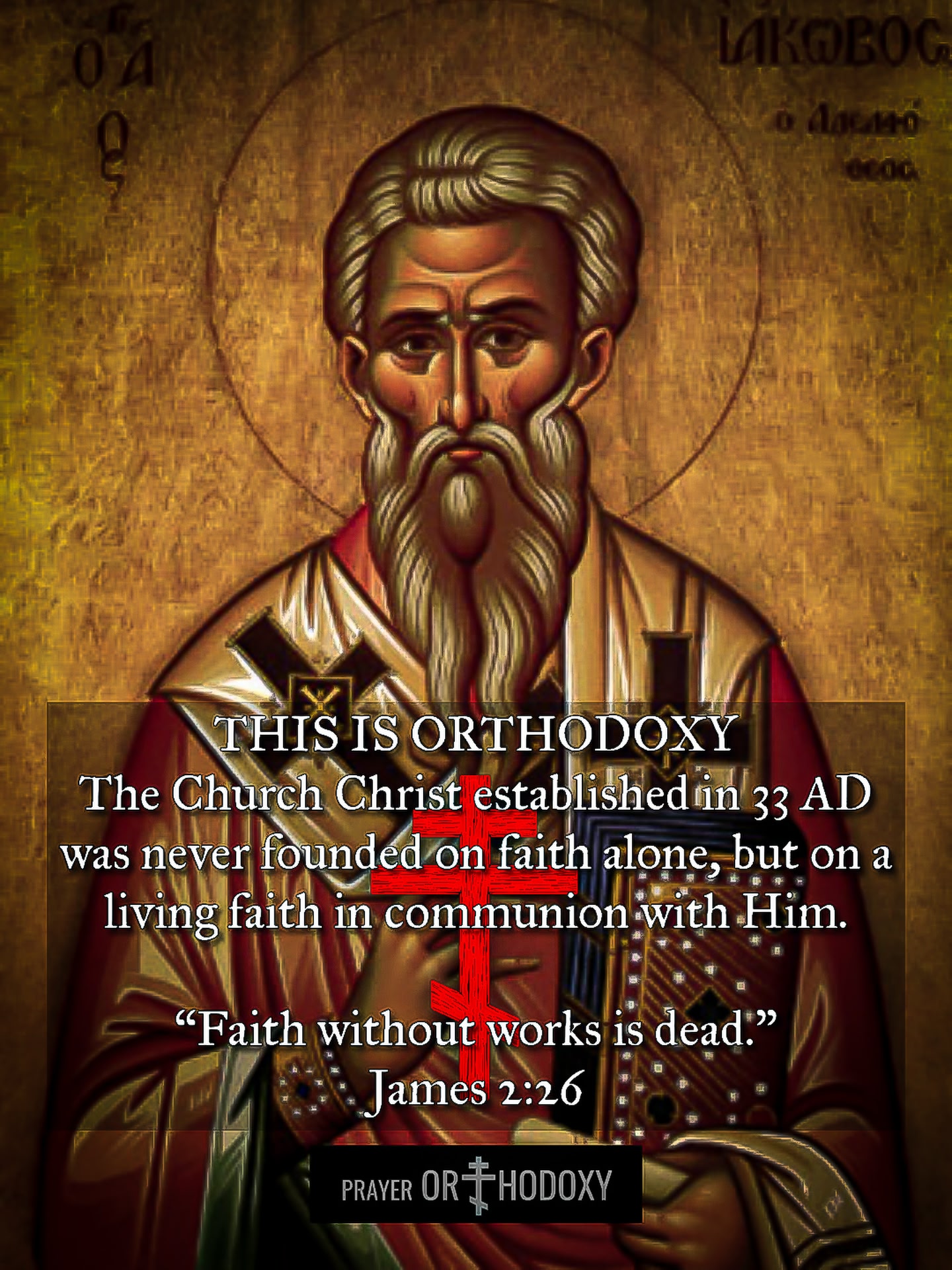
The post presents the Orthodox understanding of salvation through grace and living faith, citing James 2:26 that faith without works is dead. It states the Orthodox Church preserves apostolic teaching that salvation comes through God's grace and a living faith expressed in repentance, obedience, love, and good works. The image includes the same verse and the phrase "This is Orthodoxy" with the Prayer Orthodoxy branding.

  • James 2:26 cited: faith without works is dead
  • Orthodox Church preserves apostolic teaching on living faith
  • Salvation through God's grace and faith expressed in repentance, obedience, love, good works
  • Teaching presented in English and Greek
  • Church identified as established in 33 AD
Read more

Weekly Communion Was the Apostolic Practice, Not an Occasional Event

The speaker addresses the argument that communion should not be celebrated every week to prevent it from becoming a mindless routine. He rejects this reasoning by comparing it to the absurdity of ceasing prayer or church attendance for the same reason, noting that such logic undermines the necessity of constantly pursuing union with Christ. The speaker cites Acts 20:7, which records that Christians gathered on the first day of the week to break…

The speaker addresses the argument that communion should not be celebrated every week to prevent it from becoming a mindless routine. He rejects this reasoning by comparing it to the absurdity of ceasing prayer or church attendance for the same reason, noting that such logic undermines the necessity of constantly pursuing union with Christ.

The speaker cites Acts 20:7, which records that Christians gathered on the first day of the week to break bread, and references St. Justin Martyr's testimony in his First Apology confirming that the early church celebrated the Eucharist every Sunday. He concludes that the apostles treated communion as a regular, weekly practice rather than an occasional event, and that the contemporary church should follow this pattern.

The discussion centers on the frequency of the Eucharist, the scriptural and patristic evidence for weekly celebration, and the theological implication that regular communion sustains the believer's ongoing union with Christ.

Key moments

  1. The argument that communion is not held every Sunday to prevent rote practice does not logically follow.
  2. One would not stop praying or attending church simply because those actions might become routine.
  3. This reasoning undermines the necessity of constantly going after Christ and being united with him.
  4. Acts records that Christians gathered on the first day of the week to break bread.
  5. St. Justin Martyr confirms that Christians celebrated the Eucharist every Sunday.
  6. The apostles did not treat communion as an occasional event, so neither should we.
Read more
Prayer Orthodoxy ® Instagram

When to avoid entering the church during the Divine Liturgy

A guide to church etiquette during the Divine Liturgy explains which moments of the service call for standing still and not moving about the church. Out of reverence for the sacred mysteries, the faithful are asked to avoid entering the nave, lighting candles, or moving through the church during the Little Entrance, when the Holy Gospel is carried in procession; during the censing of the icons and the faithful; during the reading of the Epistle…

A guide to church etiquette during the Divine Liturgy explains which moments of the service call for standing still and not moving about the church. Out of reverence for the sacred mysteries, the faithful are asked to avoid entering the nave, lighting candles, or moving through the church during the Little Entrance, when the Holy Gospel is carried in procession; during the censing of the icons and the faithful; during the reading of the Epistle and Gospel; and during the sermon.

The same applies at the Great Entrance, when the Holy Gifts are carried to the altar; during the Nicene Creed; during the Anaphora and Consecration, when the Eucharistic offering is made and the Holy Spirit is invoked upon the Gifts; during the Lord's Prayer; and during Holy Communion, when the faithful receive the Body and Blood of Christ.

The guide frames these rules with a short reflection on entering the House of God: the Church is the Body of Christ, a holy place where Heaven and Earth meet. Those who enter are asked to leave behind the distractions, concerns, and vanities of the world and to approach with humility, reverence, and a heart prepared for prayer, since they stand on holy ground.

The post states that these are traditional pastoral guidelines and directs readers to follow the direction of their parish priest. Reverence, it says, begins the moment we enter God's Holy House, and respecting the sacred moments of worship allows the heart and mind to turn toward Christ without distraction.

  • Avoid entering the nave, lighting candles, or moving through the church during the Little Entrance, the censing, the Epistle and Gospel readings, and the sermon.
  • The same applies during the Great Entrance, the Nicene Creed, the Anaphora and Consecration, the Lord's Prayer, and Holy Communion.
  • The Church is described as the Body of Christ, a holy place where Heaven and Earth meet.
  • Those entering are asked to leave behind distractions and approach with humility and a heart prepared for prayer.
  • These are traditional pastoral guidelines; readers should follow the direction of their parish priest.
Read more
Prayer Orthodoxy ® with Holy Orthodoxy Instagram

St Paisios: Prayer Begins When Another's Pain Becomes Your Own

The post draws on the life of Saint Paisios the Athonite to show what it means to pray for others. Visitors to his cell on Mount Athos said he seemed to feel their troubles as if they were his own, and he stayed up through the night praying for strangers he had only just met. The author draws a practical lesson from this: prayer that costs us nothing often stays on the surface, and when we let someone's pain reach us, our prayer for them becomes…

The post draws on the life of Saint Paisios the Athonite to show what it means to pray for others. Visitors to his cell on Mount Athos said he seemed to feel their troubles as if they were his own, and he stayed up through the night praying for strangers he had only just met. The author draws a practical lesson from this: prayer that costs us nothing often stays on the surface, and when we let someone's pain reach us, our prayer for them becomes real.

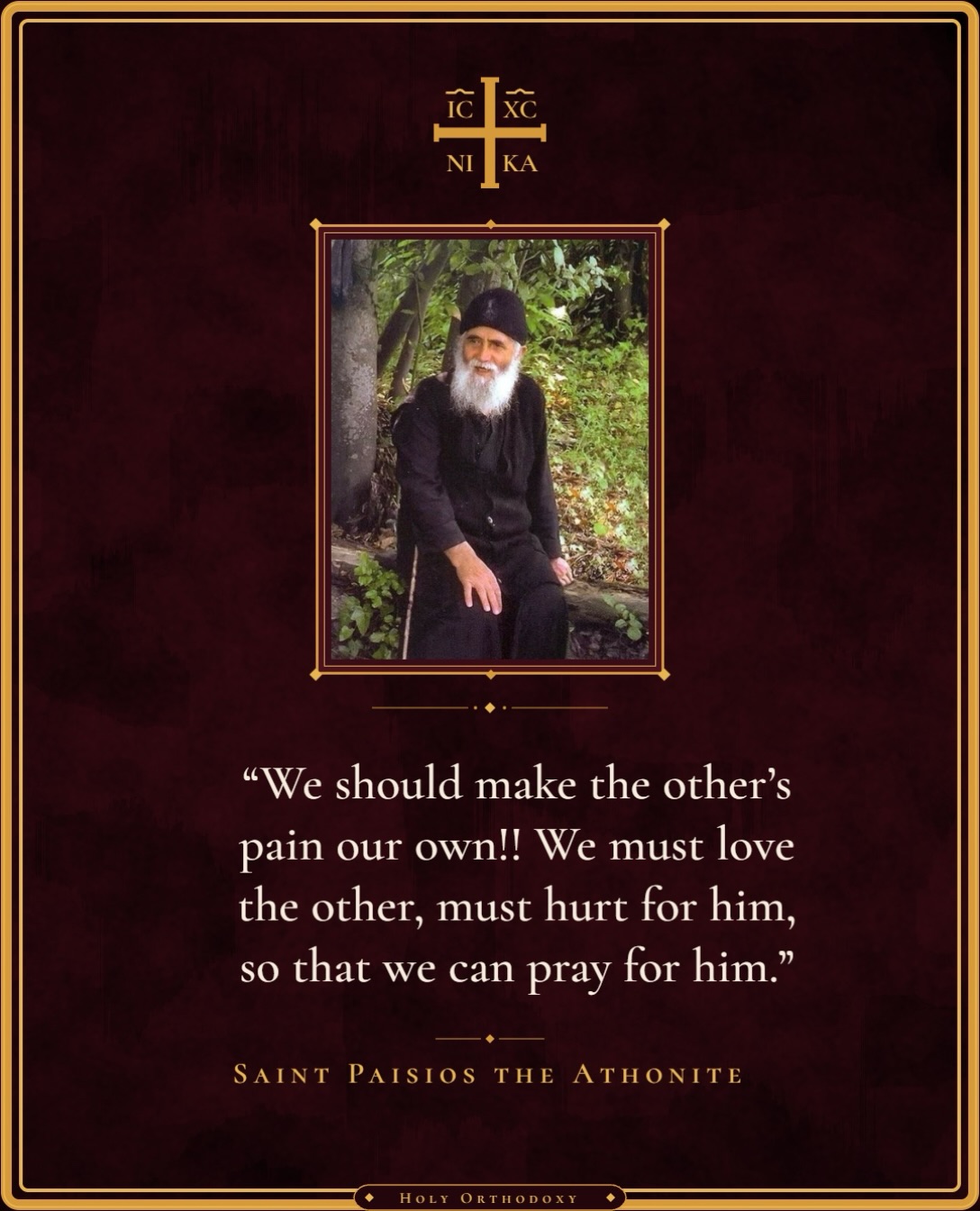
The post quotes the Apostle Paul: "Bear one another's burdens, and so fulfill the law of Christ" (Galatians 6:2, NKJV). It ends with a concrete exhortation to think of one person who is struggling right now and pray for them that night as if their burden were yours. A quote card from Saint Paisios carries the same thought: "We should make the other's pain our own!! We must love the other, must hurt for him, so that we can pray for him."

  • Visitors to Saint Paisios's cell on Mount Athos said he felt their troubles as if they were his own.
  • He stayed up through the night praying for strangers he had only just met.
  • The author teaches that prayer that costs us nothing often stays on the surface.
  • The post quotes Galatians 6:2: "Bear one another's burdens, and so fulfill the law of Christ."
  • Readers are asked to choose one person who is struggling and pray for them that night as if their burden were their own.
Read more

Mount Athos: The Cross as Anchor and Ladder to God

The author reflects on Mount Athos, where stone peaks rise above the Aegean Sea and touch the vault of heaven. In that place a person stands stripped before eternity and alone before the face of God. The cross worn in the heart and signed in prayer is not only a remembrance of sacrifice but a firm anchor amid the restless sea of this world and a silent ladder by which the soul ascends toward uncreated light. When the waves striking the rocks and…

The author reflects on Mount Athos, where stone peaks rise above the Aegean Sea and touch the vault of heaven. In that place a person stands stripped before eternity and alone before the face of God. The cross worn in the heart and signed in prayer is not only a remembrance of sacrifice but a firm anchor amid the restless sea of this world and a silent ladder by which the soul ascends toward uncreated light.

When the waves striking the rocks and the storm of thoughts within grow still, in the gathered silence the voice of God is heard, the One who holds both the depths of the sea and the summits of the mountains, calling us to a peace and love that never cease.

Key moments

  1. The hymn opens by declaring the kingdom of the Lord blessed and calling for the Lord to be praised and exalted to all ages.
  2. It summons light and darkness, nights and days to bless the Lord.
  3. It calls upon humanity and Israel to bless the Lord.
  4. The faithful bless Father, Son, and Holy Spirit as the Lord.
  5. The hymn concludes with the faithful praising, blessing, worshipping, hymning, and glorifying the Lord to all ages.
Read more

Every meal on Mount Athos begins and ends with prayer

The post explains that in the Athonite trapeza, every meal begins and ends with prayer. This practice reminds those who eat to receive all things with humility and thanksgiving, glorifying God in every action. The text quotes 1 Corinthians 10:31, where Saint Paul instructs that whether one eats or drinks, all should be done to the glory of God. The message appears in both English and Greek.

  • The Athonite trapeza opens and closes each meal with prayer
  • The custom fosters humility and thanksgiving in receiving food
  • All actions, including eating and drinking, are offered to God's glory
  • The practice follows 1 Corinthians 10:31
  • The text is presented in English and Greek
Read more

Three occult practices Christians should avoid, with Scripture and Orthodox teaching

The speaker identifies three practices normalized today that Scripture warns against: tarot cards and divination, using crystals for spiritual power, and trusting astrology. Deuteronomy 18:10-12 forbids divination, and the Orthodox Church rejects it because guidance comes from God, not occult methods. Romans 1:25 warns against serving created things rather than the Creator; crystals are part of creation but cannot provide spiritual protection,…

The speaker identifies three practices normalized today that Scripture warns against: tarot cards and divination, using crystals for spiritual power, and trusting astrology. Deuteronomy 18:10-12 forbids divination, and the Orthodox Church rejects it because guidance comes from God, not occult methods. Romans 1:25 warns against serving created things rather than the Creator; crystals are part of creation but cannot provide spiritual protection, that comes from Christ.

Isaiah 47:13-14 and 2 Corinthians 5:17 show that star signs do not determine destiny; being in Christ makes a new creation. The world calls these harmless entertainment, but Orthodox Christians are called to discern and seek the Creator, not creation. The post details that tarot cards involve trusting a deck of cards for the future instead of God, and the Orthodox Church has always rejected divination.

Regarding crystals, admiring stones is fine as God's creation, but believing they absorb negative energy, protect from evil spirits, or bring spiritual healing crosses into worshiping created things; protection comes from Jesus Christ, not crystal energy. On astrology, allowing a star sign to determine personality, relationships, or future places trust in something other than God; Isaiah 47:13-14 warns against looking to stars to predict what is coming.

Second Corinthians 5:17 states that if anyone is in Christ, he is a new creation; the day you were born does not determine your spiritual destiny, your zodiac sign does not define you, your relationship with Jesus Christ does. The world calls these things harmless entertainment, spiritual awakening, or positive energy, but Orthodox Christians are called to discern; we do not need tarot cards to guide us, crystals to protect us, or stars to determine our future; stop looking to creation for what only the Creator provides.

Key moments

  1. 0:00 Three normalized practices the Bible warns against: tarot cards and divination, crystals for spiritual power, and astrology; some Christians participate without understanding the spiritual consequences.
  2. 0:00 Tarot cards and divination: trusting a deck of cards for the future instead of God; Deuteronomy 18:10-12 explicitly warns against divination, interpreting omens, sorcery, and consulting spirits; the Orthodox Church has always rejected divination because we seek guidance from God, not occult practices.
  3. 0:40 Crystals for spiritual power and protection: admiring stones is fine as God's creation, but believing they absorb negative energy, protect from evil spirits, or bring spiritual healing crosses into worshiping created things; Romans 1:25 warns against serving creation rather than the Creator; protection comes from Jesus Christ, not crystal energy.
  4. 0:40 Astrology and trusting the stars: allowing a star sign to determine personality, relationships, or future places trust in something other than God; Isaiah 47:13-14 warns against looking to stars to predict what is coming.
  5. 1:40 Second Corinthians 5:17: if anyone is in Christ, he is a new creation; the day you were born does not determine your spiritual destiny, your zodiac sign does not define you, your relationship with Jesus Christ does.
  6. 1:40 The world calls these things harmless entertainment, spiritual awakening, or positive energy, but Orthodox Christians are called to discern; we do not need tarot cards to guide us, crystals to protect us, or stars to determine our future; stop looking to creation for what only the Creator provides.
Read more
Prayer Orthodoxy ® with Prayer Orthodoxy® Instagram

Three Holy Fathers on repentance, temptation, and spiritual struggle

The post presents three quotations from Church Fathers on the necessity of repentance and spiritual effort. St. Anthony the Great warns that temptation continues until death. St. Isaac the Syrian states that life is given for repentance and should not be wasted on vain pursuits. St. Maximus the Confessor teaches that without struggle there is no purification of the heart. The accompanying text in English and Greek summarizes the patristic…

The post presents three quotations from Church Fathers on the necessity of repentance and spiritual effort. St. Anthony the Great warns that temptation continues until death. St. Isaac the Syrian states that life is given for repentance and should not be wasted on vain pursuits.

St. Maximus the Confessor teaches that without struggle there is no purification of the heart. The accompanying text in English and Greek summarizes the patristic teaching that the path to Christ requires repentance, humility, perseverance, and spiritual struggle, urging the reader to remain steadfast in the faith.

  • St. Anthony the Great: expect temptation until your last breath
  • St. Isaac the Syrian: this life is given for repentance, not vain pursuits
  • St. Maximus the Confessor: without struggle there is no purification of the heart
  • The path to Christ requires repentance, humility, perseverance, and spiritual struggle
  • The text urges remaining steadfast in the faith
Read more
Prayer Orthodoxy ® Instagram discussion

Why Orthodox Christians Stand on Sundays: Canons on Resurrection Joy

The post explains the Orthodox practice of standing during Sunday prayers instead of kneeling. It cites Canon 20 of the First Ecumenical Council (325 AD) which directs Christians to pray standing on Sundays and throughout the fifty days from Pascha to Pentecost. Canon 90 of the Council in Trullo (692 AD) reaffirmed this, specifying that kneeling ceases at Saturday evening Vespers and resumes at Sunday evening prayers. The Holy Fathers taught…

The post explains the Orthodox practice of standing during Sunday prayers instead of kneeling. It cites Canon 20 of the First Ecumenical Council (325 AD) which directs Christians to pray standing on Sundays and throughout the fifty days from Pascha to Pentecost. Canon 90 of the Council in Trullo (692 AD) reaffirmed this, specifying that kneeling ceases at Saturday evening Vespers and resumes at Sunday evening prayers.

The Holy Fathers taught that posture expresses faith: kneeling signifies repentance and humility, while standing on Sundays proclaims joy in Christ's victory over death. Every Sunday celebrates the Resurrection.

  • Canon 20 of the First Ecumenical Council (325 AD) mandates standing prayer on Sundays and during the Paschal season.
  • Canon 90 of the Council in Trullo (692 AD) reaffirmed the prohibition against kneeling on Sundays.
  • Kneeling ceases at Saturday Vespers and resumes at Sunday evening prayers.
  • Standing honors Christ's Resurrection; kneeling expresses repentance and humility.
  • The tradition reflects the theological meaning of Sunday as a weekly Pascha.
4 opinions in the discussion What about the bigger point Paul makes when he says we should be humble toward one another the way Christ humbled himself and was then exalted with the Name above every Name... that at the… Read the discussion
Prayer Orthodoxy ® with The National Herald Instagram

Turkey grants citizenship to Ecumenical Patriarchate hierarchs and clergy

The National Herald reports that the Turkish government has decided to grant Turkish citizenship to a group of hierarchs, archimandrites, and deacons of the Ecumenical Patriarchate. According to information obtained from within the Patriarchate, on July 27, 2026, Ecumenical Patriarch Bartholomew personally handed Turkish President Recep Tayyip Erdogan a list of names with their institutional positions and roles, requesting citizenship for them.…

The National Herald reports that the Turkish government has decided to grant Turkish citizenship to a group of hierarchs, archimandrites, and deacons of the Ecumenical Patriarchate. According to information obtained from within the Patriarchate, on July 27, 2026, Ecumenical Patriarch Bartholomew personally handed Turkish President Recep Tayyip Erdogan a list of names with their institutional positions and roles, requesting citizenship for them.

The list includes Archbishops Makarios of Australia and Apostolos of Canada; Metropolitans Vissarion of Spain and Portugal, Kyrillos of Rhodes, Amphilochios of Adrianople, Joseph of Proikonnisos, Job of Pisidia, and Evangelos of Sardis; Bishops Ambrosios of Eudokiada, Smaragdos of Daphnousia, and Isidoros of Andida. Also listed are Archimandrites Aetios, Director of the Patriarch's Private Office and Great Ecclesiarch; Vospórios, Chief Secretary; and Kallinikos (Chasapis).

Deacons on the list include Anatolios, Eulogios (codicographer), Oikoumenios (undersecretary), Hieronymos (Great Synkellos and Librarian), Iakovos (Great Archimandrite), Epiphanios (Third Deacon), and Photios (Patriarchal Deacon). The article emphasizes that the Phanar was on a path toward a slow death had Erdogan not taken this step, because the number of hierarchs born there who remain at the Patriarchate is very small. The report is presented as exclusive information obtained by The National Herald.

  • Turkish government grants citizenship to Ecumenical Patriarchate hierarchs and clergy
  • Patriarch Bartholomew delivered list to President Erdogan on July 27, 2026
  • List includes 2 archbishops, 7 metropolitans, 3 bishops, 3 archimandrites, and 7 deacons
  • Named individuals include Archbishops Makarios of Australia and Apostolos of Canada, Metropolitans Vissarion, Kyrillos, Amphilochios, Joseph, Job, Evangelos, Bishops Ambrosios, Smaragdos, Isidoros, and Patriarchal Court officials
  • Article states Phanar faced slow death without this step due to few hierarchs born in Turkey remaining
Read more
Prayer Orthodoxy ® Instagram discussion

Entering the House of God: Orthodox Etiquette for Worship

The post presents a guide to proper conduct when entering an Orthodox church, grounded in the understanding that the church is the Body of Christ and a place where heaven and earth meet. The author cites Psalm 92:5, "Holiness befits Your house, O Lord, forevermore," to frame the reverence required. The text explains that worshippers leave behind worldly distractions, concerns, and vanities and approach with humility, reverence, and a heart…

The post presents a guide to proper conduct when entering an Orthodox church, grounded in the understanding that the church is the Body of Christ and a place where heaven and earth meet. The author cites Psalm 92:5, "Holiness befits Your house, O Lord, forevermore," to frame the reverence required. The text explains that worshippers leave behind worldly distractions, concerns, and vanities and approach with humility, reverence, and a heart prepared for prayer, standing on holy ground.

The guide includes two sets of practical rules presented in image text. The first lists seven behaviors to avoid: chewing gum, eating, or drinking in church; crossing arms or legs; placing hands in pockets or behind the back; crossing oneself when the censer is blessing; prostrations or bowing before the Holy Gifts; wearing T-shirts or shorts; and men wearing hats.

The second set offers positive directives: keep hands at one's side or in front, prepared to cross oneself; cross arms over the chest when approaching the Holy Gifts and cross oneself after receiving; bow only when the censer is blessing; and wear conservative, muted clothing that covers the body to avoid drawing attention to oneself.

The accompanying image shows an Orthodox church interior featuring an iconostasis. The post appears in both English and Greek, with the Greek text translating the opening theological reflection.

  • The church is the Body of Christ, requiring humility and reverence upon entry
  • Seven specific behaviors are prohibited, including eating, crossing limbs, and casual dress
  • Hands should be kept at sides or folded, ready to make the sign of the cross
  • Arms are crossed over the chest when approaching the Holy Gifts
  • Conservative, muted clothing that covers the body is expected
16 opinions in the discussion I've attended churches under three different jurisdictions and more than half of these customs aren't even observed there Read the discussion

Three Lessons on Persecution from Luke 21:7-19

The post examines Jesus' words in Luke 21:7-19, where he warns his disciples that they will be hated, persecuted, betrayed, and put to death for his name. He tells them not to be deceived by false claimants or terrified by wars, earthquakes, famines, and heavenly signs, because these must come first but the end is not immediate. Before these events, followers will be seized and brought before kings and rulers, which becomes an occasion for…

The post examines Jesus' words in Luke 21:7-19, where he warns his disciples that they will be hated, persecuted, betrayed, and put to death for his name. He tells them not to be deceived by false claimants or terrified by wars, earthquakes, famines, and heavenly signs, because these must come first but the end is not immediate. Before these events, followers will be seized and brought before kings and rulers, which becomes an occasion for testimony.

Jesus promises to give them a mouth and wisdom that no adversary can resist. He says they will be betrayed by parents, brothers, relatives, and friends, some put to death, all hated for his name, yet not a hair of their heads shall be lost, and by their patience they will possess their souls.

The speaker draws three lessons. First, following Christ brings oppression; Jesus says persecution will come, not if it comes, and standing for truth may cost friendships and provoke opposition from family, but rejection by the world does not mean abandonment by God. Second, God gives wisdom in trials; Christ tells disciples not to be anxious about their defense because the same Lord who warns of persecution promises to be with them, as seen in saints and martyrs who stood before emperors trusting God rather than their own strength.

Third, endurance is essential to salvation; the Greek word hypomonē means steadfast perseverance, and in the Orthodox life salvation is not a one-time profession but faithful following through repentance, prayer, obedience, and perseverance, with true faith revealed when everything falls apart yet one refuses to abandon Christ.

Key moments

  1. 0:00 Jesus tells his disciples they will be hated, persecuted, betrayed, and put to death for his name, and when they ask for the sign, he warns them not to be deceived by false claimants or terrified by wars and commotions, because these must come first but the end is not immediate.
  2. 0:36 Jesus describes nations rising against nations, earthquakes, famines, pestilences, and fearful heavenly signs, but says before all these his followers will be seized, persecuted, brought before kings and rulers, and that this will become an occasion for testimony, for he will give them a mouth and wisdom no adversary can contradict or resist.
  3. 1:09 Jesus says they will be betrayed by parents, brothers, relatives, and friends, some will be put to death, and all will be hated for his name, yet not a hair of their heads shall be lost, and by their patience they will possess their souls.
  4. 1:45 The first lesson: following Christ brings oppression, Jesus says persecution will come, not if it comes, and standing for the truth may cost friendships, bring rejection, or provoke opposition from family, but rejection by the world does not mean abandonment by God.
  5. 2:17 The second lesson: God gives wisdom in trials, Christ tells the disciples not to be anxious about their defense because the same Lord who warns of persecution promises to be with them, as seen in the saints, martyrs, and confessors who stood before emperors trusting God rather than their own strength.
  6. 2:51 The third lesson: endurance is essential to salvation, the Greek word hypomonē means steadfast perseverance, and in the Orthodox life salvation is not a one-time profession but faithful following through repentance, prayer, obedience, and perseverance, with true faith revealed when everything falls apart yet one refuses to abandon Christ.
Read more
Prayer Orthodoxy ® Instagram

Why Orthodox parents hold infants in the right arm for Communion

The post addresses a practical question about Orthodox liturgical practice: which arm a parent should use when bringing an infant to receive Holy Communion. It explains that in Orthodox tradition the right arm is generally preferred. The reason given is liturgical: the priest ordinarily holds the Holy Chalice in his left hand and administers the Holy Gifts with the spoon in his right hand. When the parent cradles the infant in the right arm, the…

The post addresses a practical question about Orthodox liturgical practice: which arm a parent should use when bringing an infant to receive Holy Communion. It explains that in Orthodox tradition the right arm is generally preferred. The reason given is liturgical: the priest ordinarily holds the Holy Chalice in his left hand and administers the Holy Gifts with the spoon in his right hand.

When the parent cradles the infant in the right arm, the child's head is positioned so the priest can commune the infant safely and reverently. At the same time, the parent's left hand is free to secure the infant's arms, preventing the child from reaching toward the spoon or the chalice. The text emphasizes that this instruction is a pastoral custom rather than a canonical requirement found in the Euchologion.

It reflects the Orthodox principle of good liturgical order (Εὐταξία), which calls for approaching the Holy Mysteries with reverence, preparation, and care. The post concludes by advising parents to follow the specific guidance of their own priest.

  • Right arm is the customary hold for infants approaching the chalice.
  • Priest holds chalice in left hand, spoon in right; right-arm hold aligns infant for safe communion.
  • Left hand free to secure infant's arms and prevent sudden movements.
  • Practice is a pastoral custom, not a rule in the Euchologion.
  • Reflects principle of good liturgical order (Εὐταξία); parents should follow their priest's guidance.
Read more
Prayer Orthodoxy ® Instagram

Reverence in Orthodox Worship: Posture, Processions and Stillness

The post presents the Orthodox way of life as lived reverence, explaining that how a person stands, turns and moves in church shows what they believe about Christ present among them. It calls reverence the heart of Orthodox worship, where every gesture and moment of stillness expresses humility before Christ and His Holy Altar. The text then gives practical guidance for conduct during services. During processions, such as when clergy cense the…

The post presents the Orthodox way of life as lived reverence, explaining that how a person stands, turns and moves in church shows what they believe about Christ present among them. It calls reverence the heart of Orthodox worship, where every gesture and moment of stillness expresses humility before Christ and His Holy Altar. The text then gives practical guidance for conduct during services.

During processions, such as when clergy cense the church or the Holy Gifts move through the nave at the Great Entrance, worshippers should not turn their back on the Holy Altar; they should stand sideways and turn in a way that their back never fully faces the Altar, since turning one's back casually is turning away from the presence of the King.

During Orthros, when approaching to venerate the Holy Gospel, one makes the sign of the Cross, kisses the Gospel first and then the priest's or bishop's hand, and when stepping away does not turn their back on the Gospel, instead walking backwards or stepping to the side with a bowed head until the Gospel has re-entered the Holy Altar.

When the Holy Gifts are placed on the Holy Altar, icon veneration ceases; from the Cherubic Hymn onward, attention belongs fully to Christ upon the Altar. When the Gifts rest on the Altar or Holy Communion is being given, the church keeps complete reverence: no candle lighting, icon veneration, talking or distraction, but sacred stillness.

The post appeared in both English and Greek, with the Greek text stating that reverence lies at the heart of Orthodox worship and that every movement and moment of silence expresses humility and respect before Christ.

  • Reverence is described as the heart of Orthodox worship, expressing humility before Christ and His Holy Altar.
  • During processions and censing, worshippers should stand sideways so their back never fully faces the Holy Altar.
  • When venerating the Gospel at Orthros: cross oneself, kiss the Gospel, then the priest's hand, and step away without turning one's back on it.
  • From the Cherubic Hymn onward, icon veneration ceases and attention belongs to Christ upon the Altar.
  • While the Gifts are on the Altar or Communion is given, the church keeps sacred stillness with no candles, veneration or talking.
Read more
Prayer Orthodoxy ® Instagram

Faith Without Works Is Dead: The Orthodox Answer to Faith Alone

The Orthodox Christian faith calls believers to live what they profess. Prayer, repentance, humility, obedience and love for the neighbor make faith visible in daily life, as St James writes: 'For as the body without the spirit is dead, so faith without works is dead also' (James 2:26). True faith bears fruit through the grace of God and the work of the Holy Spirit. Orthodoxy has always held that faith and works belong together. In the 1500s the…

The Orthodox Christian faith calls believers to live what they profess. Prayer, repentance, humility, obedience and love for the neighbor make faith visible in daily life, as St James writes: 'For as the body without the spirit is dead, so faith without works is dead also' (James 2:26). True faith bears fruit through the grace of God and the work of the Holy Spirit.

Orthodoxy has always held that faith and works belong together. In the 1500s the Reformation introduced Sola Fide, faith alone, which treats works as a result of salvation but not part of it. Scripture teaches otherwise: St James says faith without works is dead, and Orthodox Christians believe faith must live.

Works are not about earning salvation; they are how faith breathes. The faithful fast to humble the body, pray to unite the heart to God, give alms to love Christ in the neighbor, repent to be healed, and obey to be transformed. St James concludes that a man is justified by works, and not by faith only (James 2:24), so the faith that saves is alive.

Key moments

  1. In the 1500s the Reformation introduced Sola Fide, faith alone, which says works are a result of salvation but not a part of it.
  2. St James writes that faith by itself, if it does not have works, is dead (James 2:17).
  3. Works are not about earning salvation; they are how faith breathes: we fast to humble the body, pray to unite the heart to God, give alms to love Christ in our neighbor, repent to be healed, and obey to be transformed.
  4. St James concludes that a man is justified by works, and not by faith only (James 2:24), so the faith that saves is alive.
Read more
Prayer Orthodoxy ® Instagram

Why We Fast: Humility, Obedience, and the Witness of Works

The post explains the purpose of fasting in Orthodox Christian life. It teaches that fasting cultivates humility, obedience, and self-discipline, drawing the faithful closer to Christ. Through fasting combined with prayer, repentance, and acts of mercy, believers learn to overcome passions, strengthen faith, and open their hearts to the grace of the Holy Spirit. A quotation from St. John Chrysostom challenges the reader: "Do you fast? Give me…

The post explains the purpose of fasting in Orthodox Christian life. It teaches that fasting cultivates humility, obedience, and self-discipline, drawing the faithful closer to Christ. Through fasting combined with prayer, repentance, and acts of mercy, believers learn to overcome passions, strengthen faith, and open their hearts to the grace of the Holy Spirit.

A quotation from St. John Chrysostom challenges the reader: "Do you fast? Give me proof of it by your works!" The accompanying image reinforces the teaching with three points: fasting humbles us, disciplines desires, and draws us to Christ; through fasting, prayer, and repentance we strengthen our souls, resist temptation, and make room for God; and two sayings of St. Basil the Great declare that true fasting is the enemy of evil and consists in estrangement from vices.

  • Fasting teaches humility, obedience, and self-discipline, drawing us closer to Christ
  • Combined with prayer, repentance, and mercy, fasting helps overcome passions and strengthen faith
  • St. John Chrysostom demands proof of fasting through works
  • St. Basil the Great calls true fasting the enemy of evil and estrangement from vices
  • The teaching is presented bilingually in English and Greek
Read more

Death to Sin and the World, Prayer for a Pure Heart

The post presents a call to put to death sin, fleshly desires, and the world. It offers a prayer to Christ the Resurrection, asking that He who raised up humanity would grant a pure heart to hymn and glorify Him. The text concludes with a citation of Psalm 150, calling for praise with trumpet and cymbal and for every breath to praise the Lord. The author's brief personal statement places Christ first, notes leading and providing for family, and…

The post presents a call to put to death sin, fleshly desires, and the world. It offers a prayer to Christ the Resurrection, asking that He who raised up humanity would grant a pure heart to hymn and glorify Him. The text concludes with a citation of Psalm 150, calling for praise with trumpet and cymbal and for every breath to praise the Lord.

The author's brief personal statement places Christ first, notes leading and providing for family, and declares death to the world, accompanied by Orthodox Christian symbols and Australian and Greek flags.

Key moments

  1. Death to the sin. Death to fleshly desires. Death to this world.
  2. A prayer to Christ the Resurrection asks that He who raised up humanity would grant a pure heart to hymn and glorify Him.
  3. The text cites Psalm 150: praise Him with the sound of trumpet, praise Him with the sound of cymbal; let every breath praise the Lord.
Read more

Christian courage versus pacifism: protecting the innocent and standing firm against evil

The author argues that the world has conditioned Christian men to equate pacifism with righteousness, often citing the claim that Jesus never killed anyone. He responds that Christ's victory over death is the ultimate goal and that meekness must not be confused with cowardice nor peace with the abandonment of responsibility. Christians are called to love their enemies while also protecting the innocent, defending the vulnerable, and standing…

The author argues that the world has conditioned Christian men to equate pacifism with righteousness, often citing the claim that Jesus never killed anyone. He responds that Christ's victory over death is the ultimate goal and that meekness must not be confused with cowardice nor peace with the abandonment of responsibility. Christians are called to love their enemies while also protecting the innocent, defending the vulnerable, and standing firm against evil.

The Orthodox faith was preserved through generations of persecution, sacrifice, and unwavering devotion, not through cowardice. The author quotes Romans 14:8 to affirm that whether living or dying, believers belong to the Lord. He also cites Isaiah 6:8, expressing readiness to be sent. The text concludes with a Greek Paschal hymn proclaiming Christ's resurrection and God's enduring mercy, calling on creation to praise God and recounting the deliverance of Israel from Egypt through the sea by the hand of an angel.

Key moments

  1. 0:00 The world manipulates Christian men into believing pacifism is synonymous with righteousness, using arguments like "Jesus never killed anyone."
  2. 0:31 Meekness is not cowardice and peace is not abandonment of responsibility; Christians must protect the innocent, defend the vulnerable, and stand firm against evil.
  3. 1:02 The Orthodox faith was preserved through persecution, sacrifice, and unwavering devotion, not cowardice; Romans 14:8 is quoted: "whether we live or die, we are the Lord's."
  4. 1:49 The speaker declares "Christ is risen! Victory! Truly the Lord is risen" and begins a Greek hymn: "Alleluia, sing to God, for His mercy endures forever Alleluia."
  5. 2:24 The hymn calls on the sea, the heavens, the springs, and the lights to praise God, for His mercy endures forever.
  6. 4:14 The hymn recounts God striking Egypt and bringing His people through the midst of the sea by the hand of an angel, for His mercy endures forever.
Read more

Saint Simon's Cave on Mount Athos and the Founding of Simonopetra

0:44

The post describes the cave where Saint Simon the Myrrh-Gusher lived in solitude on Mount Athos. It notes that he practiced fasting, prayer, and complete devotion to Christ. According to Athonite tradition, Saint Simon saw a divine light on a nearby rock, which led him to establish the Holy Monastery of Simonopetra in the 13th century. The monastery was originally named New Bethlehem. The text is presented in both English and Greek.

  • Saint Simon the Myrrh-Gusher lived in a cave on Mount Athos in solitude, fasting, and prayer.
  • Athonite tradition says he witnessed a divine light on a rock.
  • This vision led him to found the Holy Monastery of Simonopetra in the 13th century.
  • The monastery was originally called New Bethlehem.
  • The post includes both English and Greek versions of the account.
Read more

Correcting "ortho-bros" with humility and love

The post addresses the phenomenon of "ortho-bros", a term for aggressive or self-righteous Orthodox Christians online, and urges believers not to condemn them from a position of superiority. The author acknowledges the concerning behavior but warns that judging these brothers while elevating oneself risks becoming the very thing one criticizes. Citing Matthew 18:15, the text calls for correction rooted in truth, love, and humility, reminding…

The post addresses the phenomenon of "ortho-bros", a term for aggressive or self-righteous Orthodox Christians online, and urges believers not to condemn them from a position of superiority. The author acknowledges the concerning behavior but warns that judging these brothers while elevating oneself risks becoming the very thing one criticizes.

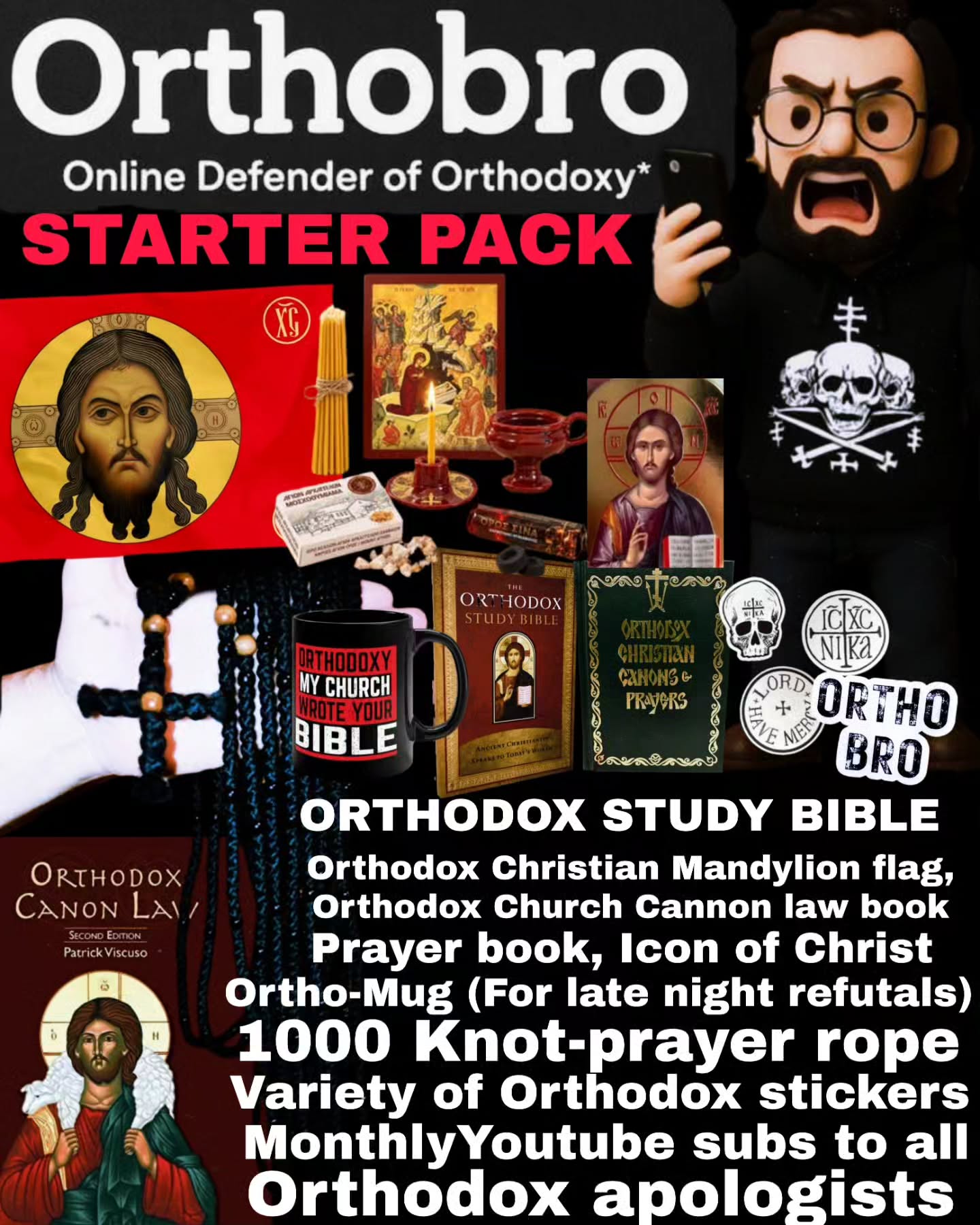
Citing Matthew 18:15, the text calls for correction rooted in truth, love, and humility, reminding readers that all are sinners in need of Christ's mercy. The accompanying image presents a satirical "starter pack" for the "orthobro" archetype, depicting items such as icons, a prayer rope, the Orthodox Study Bible, canon law books, and merchandise like an "Ortho-Mug" and stickers.

The discussion turns on the tension between calling out harmful behavior and maintaining a spirit of gentleness, emphasizing that the goal is to lead others toward the faith rather than to win arguments or signal virtue.

  • Warns against condemning "ortho-bros" from a stance of self-righteousness
  • Cites Matthew 18:15 as basis for correction with love and humility
  • Notes that all Christians are sinners needing Christ's mercy
  • Includes a satirical "starter pack" image caricaturing the online archetype
  • Urges guiding others with patience rather than judgment
27 opinions in the discussion My approach to defending Orthodoxy is simple: SHUT UP, KEEP TO YOURSELF, PRAY FOR OTHERS and LOVE ALL. "Love is patient, love is kind. It does not envy, it does not boast, it is not proud.… Read the discussion