WeOrthodox
EN UA

Orthodox discussions worth reading

Only the posts and videos that started a real conversation, with the most thoughtful opinions.

Torn between Catholicism and Orthodoxy: how did you finally decide?

Hi everyone! Short version: I was born and raised in an atheist country and now live in the US Midwest. About a year ago I started reading the Bible seriously, and that is how I became a Christian. For a long time I read alone at home, but a few months ago I felt I wanted to join an actual community. I tried a few non-denominational churches, but that was not it. I work in marketing, and the whole experience struck me as brilliant marketing:…

Hi everyone!

Short version: I was born and raised in an atheist country and now live in the US Midwest. About a year ago I started reading the Bible seriously, and that is how I became a Christian. For a long time I read alone at home, but a few months ago I felt I wanted to join an actual community.

I tried a few non-denominational churches, but that was not it. I work in marketing, and the whole experience struck me as brilliant marketing: everything was built around me, the visitor, to make the experience as good as possible. It did not feel real.

So I kept searching, because I was convinced there must be a church I could trace all the way back to Jesus. That led me to Catholic and Orthodox parishes. I have been attending both, talking with people at both, and taking part in OCIA and Inquirers' classes.

Now I am torn. Both feel authentic in different ways, and I do not think either one is the wrong choice. At Catholic masses and Orthodox Liturgies alike I feel I am exactly where I should be, and my relationship with God deepens in both.

Has anyone else been torn between Catholicism and Orthodoxy? What helped you finally decide?

  • Raised atheist, came to Christianity through reading the Bible a year ago
  • Non-denominational churches felt like marketing aimed at the visitor
  • Wants a church traceable back to Jesus, so exploring Catholic and Orthodox parishes
  • Attends both, joins OCIA and Inquirers' classes, feels at home in both
  • Asks what helped others make the final decision
35 opinions in the discussion I genuinely love the Mass, the Rosary, and Gregorian chant. If I went purely by what I personally prefer, I'd pick Roman Catholicism every single time without hesitation. But the truth is… Read the discussion
Timothy Instagram discussion

Post tagged with Orthodox, Catholic, and atheist topics

2:03

The post contains only hashtags: #orthodoxchristian, #christian, #orthodoxy, #catholic, #atheist. No additional text or discussion is present.

  • Hashtags reference Orthodox Christianity
  • Includes Catholic and atheist tags
  • No substantive content or discussion
20 opinions in the discussion "Constantinople II teaches papal supremacy" 😭😭 that's why the pope got thrown in jail and forced to submit to the council even though he demanded they submit to his apostolic authority Read the discussion

What would Church reunification mean?

Recent talks between the Pope in Rome and Orthodox leaders have opened a dialogue aimed at full communion, which would reunite the Church. What would this mean for you? Would you want to see a united Church? Pressure toward sin is growing everywhere, in almost every institution, and especially in those targeting our youth. Whatever differences exist, we hold a shared, clear view of what is evil, and we all face the same tribulations with sin. As…

Recent talks between the Pope in Rome and Orthodox leaders have opened a dialogue aimed at full communion, which would reunite the Church. What would this mean for you? Would you want to see a united Church?

Pressure toward sin is growing everywhere, in almost every institution, and especially in those targeting our youth. Whatever differences exist, we hold a shared, clear view of what is evil, and we all face the same tribulations with sin. As the forces against Christianity come together, shouldn't Christianity come together against them?

Shouldn't we fight the devil and his influence rather than fighting our brothers and sisters? Please give your comments and thoughts below.

  • Recent Catholic-Orthodox talks aim for full communion and Church reunification
  • Asks what reunification would mean personally and whether one desires a united Church
  • Notes rising sinful pressures in institutions, especially those targeting youth
  • Argues Christians share a common view of evil and face the same spiritual battles
  • Questions why Christians fight each other instead of uniting against the devil
31 opinions in the discussion It's either the death of Orthodoxy or the death of Catholicism. Both can't survive inside one church, not after a thousand years of theological divergence. Read the discussion
Tzanetos Kavaliotis YouTube discussion

When God Stays Silent: St. Silouan's Fifteen Years of Darkness and St. Sophrony's Three Seasons of Grace

When God Stays Silent: St. Silouan's Fifteen Years of Darkness and St. Sophrony's Three Seasons of Grace 20:19

The video takes up a familiar experience: a person once felt God's presence in prayer, at a liturgy, or after confession, and then one year the same prayers and services return nothing. People often draw wrong conclusions from that silence, deciding that God is angry, that they were never believers, or that it was only a phase, while the world offers its own vocabulary of burnout and deconstruction. Against this, the video sets the teaching of…

The video takes up a familiar experience: a person once felt God's presence in prayer, at a liturgy, or after confession, and then one year the same prayers and services return nothing. People often draw wrong conclusions from that silence, deciding that God is angry, that they were never believers, or that it was only a phase, while the world offers its own vocabulary of burnout and deconstruction.

Against this, the video sets the teaching of St. Sophrony of Essex, who wrote that no tribulation is harder to bear than the soul losing grace. He taught that the Christian life passes through three seasons: grace given as a gift, grace withdrawn, and grace returning at another level of being. The withdrawal is not punishment but a planned test that shows whether a person loves God or the feeling of God.

Sophrony compares it to a father letting go of his son's hands while the boy learns to walk: it looks like abandonment, but the father never stops watching. The Lord withdraws only the perception of grace, while communion continues unbroken, and Sophrony called this season a privilege and a chance to manifest free will. The story of St. Silouan the Athonite anchors the teaching. Silouan saw the living Christ at vespers on Mount Athos a few months after arriving in 1892, then endured fifteen years of darkness he could only describe as demons, until he received the answer: keep thy mind in hell and despair not.

Sophrony himself was flooded with uncreated light on Holy Saturday 1924 in Paris, and the light left him as soon as he began to analyze the experience with his reason. Sophrony gave three reasons for God's hiding: protection from pride, the revelation of true freedom and love, and Christ's words in John 16:7 that his going away was for our good. The video closes with practical instructions for the season of silence.

Key moments

  1. 0:05 Many remember a first real encounter with God, at a liturgy, in prayer, or after confession, and then one year the same prayers and services feel empty and silent.
  2. 1:38 People draw wrong conclusions from the silence: that God is angry, that they were never believers, or that it was just a phase, and the world offers vocabulary like burnout and deconstruction.
  3. 2:09 Saint Sophrony of Essex wrote that no tribulation is harder to bear than the soul losing grace, and taught that the Christian life passes through three seasons: grace given as a gift, grace withdrawn, and grace returning at another level of being.
  4. 4:11 The withdrawal is like a father letting go of his son's hands while teaching him to walk; it looks like abandonment but the father never stops watching.
  5. 4:43 Sophrony himself was flooded with uncreated light on Holy Saturday 1924 in Paris, and the light left him as soon as he began to analyze the experience with his reason.
  6. 6:17 The Lord withdraws only the perception of grace while communion with man continues unbroken; Sophrony saw this season as a privilege and an opportunity to manifest free will, echoed in Song of Songs 5:6.
  7. 7:49 Silouan the Athonite saw the living Christ at vespers on Mount Athos, then endured fifteen years of darkness before receiving the answer: keep thy mind in hell and despair not.
  8. 11:00 Sophrony gave three reasons for God's hiding: protection from pride, the revelation of true freedom and love, and Christ's own words in John 16:7 that his going away was for our good; the video ends with practical instructions, including keep praying, refuse the verdict of despair, tell your spiritual father, pray for others, and have a cup of tea.
6 opinions in the discussion 1. Keep doing what grace taught you 2. Refuse to accept a verdict (silence will try to tell you what it means) 3. Look for pride, gently 4. Tell your spiritual father 5. Pray for someone… Read the discussion

Afraid to return to confession after falling again: readers offer encouragement

A person preparing for confession describes being terrified to return to their spiritual father. After months of living in a worldly way, they had confessed to fornication and premarital relations, and felt their priest responded with deep disappointment. Though their circumstances did not change, they fell into the same temptation again and now feel ashamed and afraid to go back, a fear compounded by a language barrier that makes communication…

A person preparing for confession describes being terrified to return to their spiritual father. After months of living in a worldly way, they had confessed to fornication and premarital relations, and felt their priest responded with deep disappointment. Though their circumstances did not change, they fell into the same temptation again and now feel ashamed and afraid to go back, a fear compounded by a language barrier that makes communication with the priest difficult.

They ask for help and encouragement. The responses are uniformly compassionate and pastoral rather than judgmental. Commenters normalize the experience of repeated falls, stressing that everyone sins after confession and that healing from sexual passions takes time, citing St John the Long-suffering as an example of long perseverance in struggle.

Several note that the very shame the poster feels is a sign of a working conscience, and that priests would far rather hear the worst sins confessed than lose a penitent to silence and avoidance. Others point out that God already knows the sins before confession, so the sacrament is a means of releasing the burden and receiving strength, not a surprise report to a disappointed judge.

Practical suggestions include going anyway despite the fear, working with the priest on concrete strategies to avoid the occasion of sin, attending more regularly, and even, if the anxiety is overwhelming, finding another church where confession feels more anonymous. One commenter shares their own nervousness before a first lifetime confession before chrismation, mentioning how readings from St Paisios reshaped their understanding of confession as healing rather than punishment.

Another jokes that even without a language barrier, misunderstandings with a priest happen, reassuring the poster that imperfect communication does not invalidate repentance. The overall message: return to confession, trust the spiritual father's love, and persist without giving up.

  • The poster fears returning to confession after relapsing into the same sexual sin, worsened by a language barrier with their priest.
  • Commenters stress that repeated falls are normal; healing from lust takes time, citing St John the Long-suffering.
  • Shame is framed as a sign of conscience, not a reason to avoid the sacrament.
  • Priests would rather hear the worst sins confessed than have a penitent stay away; God already knows everything.
  • Practical advice: go anyway, work with the priest on avoiding temptation, consider regular attendance or another church if fear blocks confession.
14 opinions in the discussion Same here, I have my first confession ever coming up this Saturday before my chrismation. I've been listening to talks by St. Paisios about confession and they've given me a whole new… Read the discussion
Father Moses YouTube discussion

Is Your Repentance Actually Pride in Disguise?

Is Your Repentance Actually Pride in Disguise? 7:48

This post, drawn from a talk by an Orthodox priest, distinguishes between two kinds of repentance: a false, ego-driven version and true, God-centered metanoia. The false kind looks like humility but is actually pride. It shows up as shame and hiding, like Adam and Eve concealing themselves in the garden after the Fall. When someone says, 'I can't believe I did that,' the speaker argues this really means 'I thought I was better than my sin'—a…

This post, drawn from a talk by an Orthodox priest, distinguishes between two kinds of repentance: a false, ego-driven version and true, God-centered metanoia. The false kind looks like humility but is actually pride. It shows up as shame and hiding, like Adam and Eve concealing themselves in the garden after the Fall. When someone says, 'I can't believe I did that,' the speaker argues this really means 'I thought I was better than my sin'—a form of self-regard that keeps a person stuck rather than moving them toward God.

The truly humble person, by contrast, is not shocked by sin at all; they are surprised daily that they do not fall into it even more. Real repentance, the post says, is shocked not by sin but by mercy. It drags sin into the light, brings it honestly to confession rather than concealing it, and grieves not out of self-loathing but because one keeps turning away from a God who loves so greatly.

Its hope rests entirely in Christ, not in self-improvement, since Christ's power is made perfect in weakness. Repentance is therefore not merely a change of behavior but an internal turning of the eyes of the heart from sin toward God, which then bears external fruit. The speaker stresses that while our effort is required to turn the heart, all the power for transformation comes from Christ and the Holy Spirit, not from willpower or self-reliance.

The post also promotes a paid community offering direct access to the priest, monthly live Q&As, courses, and a brotherhood, with a portion of the $10 monthly fee going toward building a new church in Texas. No substantive discussion appears in the comments; the material stands as a compact teaching on the difference between shame-based self-focus and grace-centered repentance that actually changes a life.

Key moments

  1. 0:31 There are two kinds of repentance: false, ego-based repentance and real repentance based on a change and transformation of the heart.
  2. 1:04 Ego-based repentance leads to hiding, like Adam and Eve hiding from God after sinning, driven by self-loathing.
  3. 1:34 Saying 'I can't believe I did that' is pride; the truly humble person isn't shocked by their sin but is surprised daily they don't fall back into it.
  4. 2:06 The truly repentant person has given up self-reliance; their only hope is in the Lord, since Christ's power is made perfect in weakness.
  5. 3:10 Repentance is not just changing behavior—it's turning the eyes of the heart from sin to God, an internal turn that then shows externally.
  6. 4:14 The truly repentant person reveals their sins in confession rather than hiding them, wanting the light of Christ to shine on the darkness within.
  7. 5:15 Real sorrow is God-centered—grieving because one keeps turning away from a God who loves so much—not self-centered sorrow.
  8. 6:47 Real change requires our effort to turn the heart to Christ, but all the power for transformation comes from Christ and the Holy Spirit.
9 opinions in the discussion My heart feels extremely hardened; I can’t genuinely repent or feel deep remorse. In prayer I’m being totally honest, admitting that I love sin more than God and that my idols mean more to… Read the discussion
Kyle YouTube discussion

Is the Holy Fire a Hoax? An Orthodox Response to a Catholic Attack

Is the Holy Fire a Hoax? An Orthodox Response to a Catholic Attack 21:19

This video responds to a Catholic apologetics video titled 'Orthodoxy's greatest miracle is a lie,' which attacks the annual Holy Fire ceremony in Jerusalem. The speaker's central argument is that the Holy Fire is not dogma: even if it were shown to be naturally lit, Orthodoxy would not thereby be disproved, just as a false Marian apparition would not disprove Catholicism. He walks through the history and meaning of the ceremony, in which the…

This video responds to a Catholic apologetics video titled 'Orthodoxy's greatest miracle is a lie,' which attacks the annual Holy Fire ceremony in Jerusalem. The speaker's central argument is that the Holy Fire is not dogma: even if it were shown to be naturally lit, Orthodoxy would not thereby be disproved, just as a false Marian apparition would not disprove Catholicism.

He walks through the history and meaning of the ceremony, in which the Patriarch of Jerusalem enters Christ's tomb on Holy Saturday and light is distributed to thousands of candles, and cites ancient documentation from Eusebius, Gregory of Nyssa, Egeria, the Armenian lectionary, St. John of Damascus, Bernard the Monk, Muslim sources, and the 1579 column-splitting account.

He rebuts specific claims about natural ignition, website wording changes, and a reported 2026 Greek court ruling, arguing that a civil court cannot settle theological questions and that natural ignition would not make the fire a hoax, since blessed things like holy water can become holy through prayer. The heart of the video is a warning against building faith on a 'scoreboard of miracles': Scripture commands testing signs, false prophets can work wonders, and chasing miracles sets people up for deception by the Antichrist.

The real question, he argues, is which church preserves the apostolic tradition of the first millennium. The comment section complicates the picture: several Orthodox commenters agree the Fire is not magic and note hierarchs are not infallible, but others press a sharper critique—that if clergy have knowingly overstated the miracle for generations, this raises questions of institutional integrity and trust, which is the real point of the Catholic criticism rather than a claim that a false fire disproves Orthodoxy outright.

Key moments

  1. 0:00 Orthodoxy is growing while Protestants and Catholics attack secondary issues because they lose on core issues like papal supremacy and the filioque; Catholicism is an evolving system with a 1960s Mass, while Orthodoxy preserves the liturgy and faith of the first thousand years.
  2. 1:33 The video 'Orthodoxy's greatest miracle is a lie' attacks the Holy Fire, but even if it were false, Orthodoxy would not be false since the Holy Fire is not dogmatic, just as Fatima being false wouldn't disprove Catholicism.
  3. 2:05 Natural ignition does not make the Holy Fire a hoax; like holy water, the flame can become holy through Christ's blessing and prayer, and some Orthodox clergy have historically not insisted on miraculous ignition.
  4. 3:38 Christianity is not a miracle competition; miracles cannot determine which church is true, since false religions and false prophets can show signs and wonders, and Scripture commands testing the spirits.
  5. 5:11 Chasing miracles sets people up for deception by the Antichrist; Orthodoxy is cautious about visions and apparitions, and the greatest miracle is Christ's life, resurrection, and public revelation through the apostolic church.
  6. 7:46 The Holy Fire ceremony: each Holy Saturday the Patriarch of Jerusalem enters Christ's tomb in the Church of the Holy Sepulchre, and light is distributed to thousands of candles, representing Christ's resurrection light.
  7. 9:19 The tradition's historical evidence is ancient: Eusebius records an Easter vigil lamp miracle, Gregory of Nyssa, Egeria, the Armenian lectionary, St. John of Damascus, Bernard the Monk, Muslim sources, and the 1579 column-splitting account all document the ceremony long ago.
  8. 11:25 Claims about the fire not burning, website wording changes, a 2026 Greek court ruling, and pilgrim testimonies are overstated; a civil court cannot settle theological questions, and even granting the entire critique, Catholicism would not thereby become true—the real test is apostolic fidelity, where Orthodoxy stands.
29 opinions in the discussion I don't think the problem is collecting miracles or keeping score. The problem is that if the leadership has been lying about this for generations, that reveals deep corruption on multiple… Read the discussion

Debate over unusual halo on horse in icon sparks AI vs. tradition discussion

A post featuring an icon of a mounted saint — likely St. George — drew attention to a curious detail: what appears to be a halo on the horse itself. The original question, "Is that a halo on the horse?" opened a thread examining the image's artistic origins and authenticity. Commenters noted a stylistic tension in the icon, blending softened, Western-influenced Russian facial features with more traditional Byzantine drapery folds. This visual…

A post featuring an icon of a mounted saint — likely St. George — drew attention to a curious detail: what appears to be a halo on the horse itself. The original question, "Is that a halo on the horse?" opened a thread examining the image's artistic origins and authenticity. Commenters noted a stylistic tension in the icon, blending softened, Western-influenced Russian facial features with more traditional Byzantine drapery folds.

This visual mix led some to suspect the work might be AI-generated, with one user pointing to the equine halo as a likely "hallucination" by an image model. Others appreciated the icon's beauty regardless of origin and expressed interest in its date and provenance. A lighthearted comment riffed on the saint's name ("Saint Naaaay a horsus") while also noting the unusual scene of the saint seemingly fighting a fellow Christian, prompting curiosity about the specific hagiography depicted.

The discussion reflects broader concerns in Orthodox circles about AI art entering devotional contexts, while also highlighting how iconographic details — even anomalous ones — can invite deeper engagement with saintly narratives and artistic tradition.

  • Icon shows a mounted saint with an apparent halo on the horse
  • Commenters debate whether the image is AI-generated or a genuine stylistic blend
  • Style mixes Western-influenced Russian faces with Byzantine drapery
  • The equine halo is cited as a possible AI hallucination
  • Discussion touches on the saint's identity and unusual combat scene
12 opinions in the discussion I believe what people are mistaking for AI is simply the icon's style. It blends the later Russian manner — with soft facial features shaped by Western religious painting — alongside more… Read the discussion

Why does Christ change Simon's name to Peter?

Can it really be that the name change has nothing to do with Peter being somehow inseparable from the Rock of Matthew 16? It seems strange that Christ would say "You are Peter" in the middle of talking about the Rock of the Church, and that this would have nothing to do with the nature of that Rock. Why wouldn't He have just said something like "And I tell you, on this confession I will build my Church," if it was only about the confession? No,…

Can it really be that the name change has nothing to do with Peter being somehow inseparable from the Rock of Matthew 16? It seems strange that Christ would say "You are Peter" in the middle of talking about the Rock of the Church, and that this would have nothing to do with the nature of that Rock. Why wouldn't He have just said something like "And I tell you, on this confession I will build my Church," if it was only about the confession?

No, He specifically says "You are Peter." Literally, "You are Rock." To Peter. Why? The more I repeat and pray this verse, the clearer it seems to me that Peter is also the Rock.

  • Christ says "You are Peter" right in the middle of speaking about the Rock of the Church
  • If only the confession mattered, He could have said "on this confession I will build my Church"
  • Literally He says to Peter, "You are Rock"
  • Praying over the verse, the author concludes Peter is also the Rock
19 opinions in the discussion It's a sign that he is God. Just like in the old testament, God changes Abram to Abraham and Jacob to Israel. Read the discussion

Pentecostal considering Orthodoxy: two concerns before becoming a catechumen

Afternoon, greetings to my brothers in Christ, if I can get past my objections. I hope you are all well. I am Pentecostal, but I am thinking the Orthodox Church in America might be my pathway forward. I keep feeling a calling to the ancient versions of Christianity, but Catholicism worries me because there seem to be too many things that could be way off from correct. In Orthodoxy, two major parts of the faith concern me, and if I can get past…

Afternoon, greetings to my brothers in Christ, if I can get past my objections. I hope you are all well.

I am Pentecostal, but I am thinking the Orthodox Church in America might be my pathway forward. I keep feeling a calling to the ancient versions of Christianity, but Catholicism worries me because there seem to be too many things that could be way off from correct.

In Orthodoxy, two major parts of the faith concern me, and if I can get past them I would love to become a catechumen.

1.) Icons. My concern is that this is idolatry. The examples I compare it to are the Israelites worshipping the golden calf, and John and Cornelius being rebuked for bowing. None of these examples were sacrificial, so you cannot really make that argument.

2.) The lack of evangelization. Monasteries, cultural differences and the lack of missionaries seem to put Orthodoxy at a disadvantage compared to Catholicism or even Protestantism.

I would appreciate any help from someone considering joining.

  • The author is Pentecostal and feels drawn to the Orthodox Church in America
  • Catholicism worries them as possibly too far from correct
  • Concern 1: icons may be idolatry, citing the golden calf and John and Cornelius rebuked for bowing
  • Concern 2: Orthodoxy lacks evangelization, missionaries and cultural reach compared to Catholicism and Protestantism
  • They would become a catechumen if these objections are resolved
12 opinions in the discussion He is risen! Both concerns are fair, especially from a Pentecostal background. On icons, Orthodoxy doesn't teach that wood, paint, or the person depicted is God. Worship belongs to God… Read the discussion
Kyle YouTube discussion

Where Was the Protestant Church Before 1500? A Case for Orthodox Indefectibility

Where Was the Protestant Church Before 1500? A Case for Orthodox Indefectibility 28:50

This video presents what the speaker calls a decisive argument against Protestantism: the impossibility of locating a visible, continuous Protestant church in any century before the Reformation. The argument begins not with contested doctrines, where both sides can quote Scripture and the Fathers indefinitely, but with the deeper question of what Christ established at Pentecost and what became of His Church. The New Testament, the speaker…

This video presents what the speaker calls a decisive argument against Protestantism: the impossibility of locating a visible, continuous Protestant church in any century before the Reformation. The argument begins not with contested doctrines, where both sides can quote Scripture and the Fathers indefinitely, but with the deeper question of what Christ established at Pentecost and what became of His Church.

The New Testament, the speaker argues, presents the Church as Christ's body, the pillar and ground of truth, promised the Holy Spirit and protection from the gates of Hades—not an invisible collection of believers. Early Fathers such as Irenaeus, Clement, Cyprian, Athanasius, and Augustine teach the Church's indefectibility and apostolic succession through the episcopate.

The sharpest dilemma concerns practices the Reformation rejected: invocation of saints, relics, icon veneration, and especially monasticism, which the Church venerated as a model of holiness for over a millennium. Either the Spirit guided the Church through those centuries, or the Reformation corrected it—but not both. The speaker rejects the Old Testament analogy of restoration, noting that Israel's reformers worked within a living covenant people, and points to St. John Chrysostom and St. Maximus the Confessor as reformers who suffered injustice within the Church rather than founding new ones.

The comment section became a substantive debate: Protestants objected that the argument conflates the Church as Christ's body with institutional infallibility, cited Acts 20's warning that even Spirit-appointed overseers can err, and noted that the Reformers claimed succession through the Western church rather than being restorationists.

Others listed pre-Reformation dissenters like Wycliffe and Hus as a Protestant 'succession,' while supporters cited 2 Thessalonians 2:15 on tradition and apostolic succession. One inquirer described the argument as the strongest version he had heard, while questioning whether the conclusion fully follows.

Key moments

  1. 0:00 Debates over individual doctrines can go on forever, since both sides can quote Scripture and Fathers; the deeper question is what Christ established at Pentecost and what happened to the Church.
  2. 1:02 The New Testament presents the Church as Christ's body, the pillar and ground of truth, promised the Holy Spirit and protection from the gates of Hades—not an invisible collection of believers.
  3. 2:34 Early Fathers like Irenaeus, Clement, Cyprian, Athanasius, and Augustine teach the indefectability of the Church and apostolic succession through the episcopate.
  4. 5:42 Protestants cannot point to a visible group holding their views in every age, while Orthodox can; individual corruption is different from the universal normalization of 'accretions' for centuries.
  5. 6:44 Practices like invocation of saints, monasticism, relics, and icon veneration were widespread for over a millennium before the Reformation critiqued them—raising the question of where the faithful opposing church was.
  6. 12:29 Monasticism makes the dilemma sharpest: the Church venerated monastic saints as models of holiness for a thousand years, then the Reformation abolished monasteries—either the Spirit guided the Church or the Reformation, not both.
  7. 20:12 The Old Testament analogy fails: Israel's reformers worked within an existing covenant people, and Pentecost changed everything; reform within a living tradition differs from restoring a dead one.
  8. 23:19 St. John Chrysostom and St. Maximus the Confessor show reformers suffered injustice within the Church rather than founding new ones; Luther should have reformed from within or become Orthodox.
20 opinions in the discussion Wow, what a coincidence. I'm an orthodox inquirer and have been going to a church in Texas for around four months and really love it. The issue is I'm not educated, and even the low-level… Read the discussion
Timothy Instagram discussion

Real Presence Requires Actual Body and Blood, Speaker Argues

1:44

The speaker responds to an objection that believing the Eucharist literally becomes Christ's body and blood is a "big no-no" and potential idolatry. The objector claims to affirm a real presence without a molecular change. The speaker counters that defining real presence apart from Christ's actual body and blood simply redefines the Eucharist. He cites Jesus's statement "this is my body" and the discourse in John 6, where Christ uses a Greek…

The speaker responds to an objection that believing the Eucharist literally becomes Christ's body and blood is a "big no-no" and potential idolatry. The objector claims to affirm a real presence without a molecular change. The speaker counters that defining real presence apart from Christ's actual body and blood simply redefines the Eucharist.

He cites Jesus's statement "this is my body" and the discourse in John 6, where Christ uses a Greek verb meaning "gnaw" or "chew" and allows disciples to walk away rather than clarify a symbolic meaning. The speaker references Saint Paul's use of "koinonia," which indicates participation in the body and blood of Christ. He explains that the term "anamnesis," translated as remembrance, is biblical and liturgical memorial language, not merely mentally recalling something absent.

Historical evidence from Saint Ignatius writing around 107 AD confirms the early church confessed the Eucharist as the flesh of Jesus Christ, noting that heretics do not confess this. The speaker states there was no major challenge to this historic view until Berengar of Tours in the 11th century. The speaker concludes that claiming the real presence while denying Christ's actual body and blood is a contradiction dressed as a compromise and has never been Christian doctrine.

Key moments

  1. The transcript opens with an objection that believing the Eucharist literally becomes Christ's body and blood is a "big no-no" and potential idolatry, while the objector claims to believe in a real presence without a molecular change.
  2. The speaker responds that defining real presence apart from Christ's actual body and blood simply redefines the Eucharist.
  3. The speaker cites Jesus's statement "this is my body" and John 6, where Jesus uses a Greek verb meaning "gnaw" or "chew" and lets disciples walk away rather than clarify a symbolic meaning.
  4. The speaker references Saint Paul's term "koinonia," meaning participation in the body and blood of Christ.
  5. The speaker explains the word "anamnesis" (remembrance) is biblical, liturgical memorial language, not merely mentally recalling something absent.
  6. The speaker cites Saint Ignatius writing around 107 AD that heretics do not confess the Eucharist to be the flesh of Jesus Christ.
  7. The speaker notes there was no major challenge to this historic view until Berengar of Tours in the 11th century.
  8. The speaker concludes that claiming the real presence while denying Christ's actual body and blood is a contradiction dressed as a compromise and has never been Christian doctrine.
16 opinions in the discussion Also the verse right after, John 6:60, literally has the disciples calling it "a hard teaching" and questioning how anyone could accept it. I don't see how he could've been speaking… Read the discussion

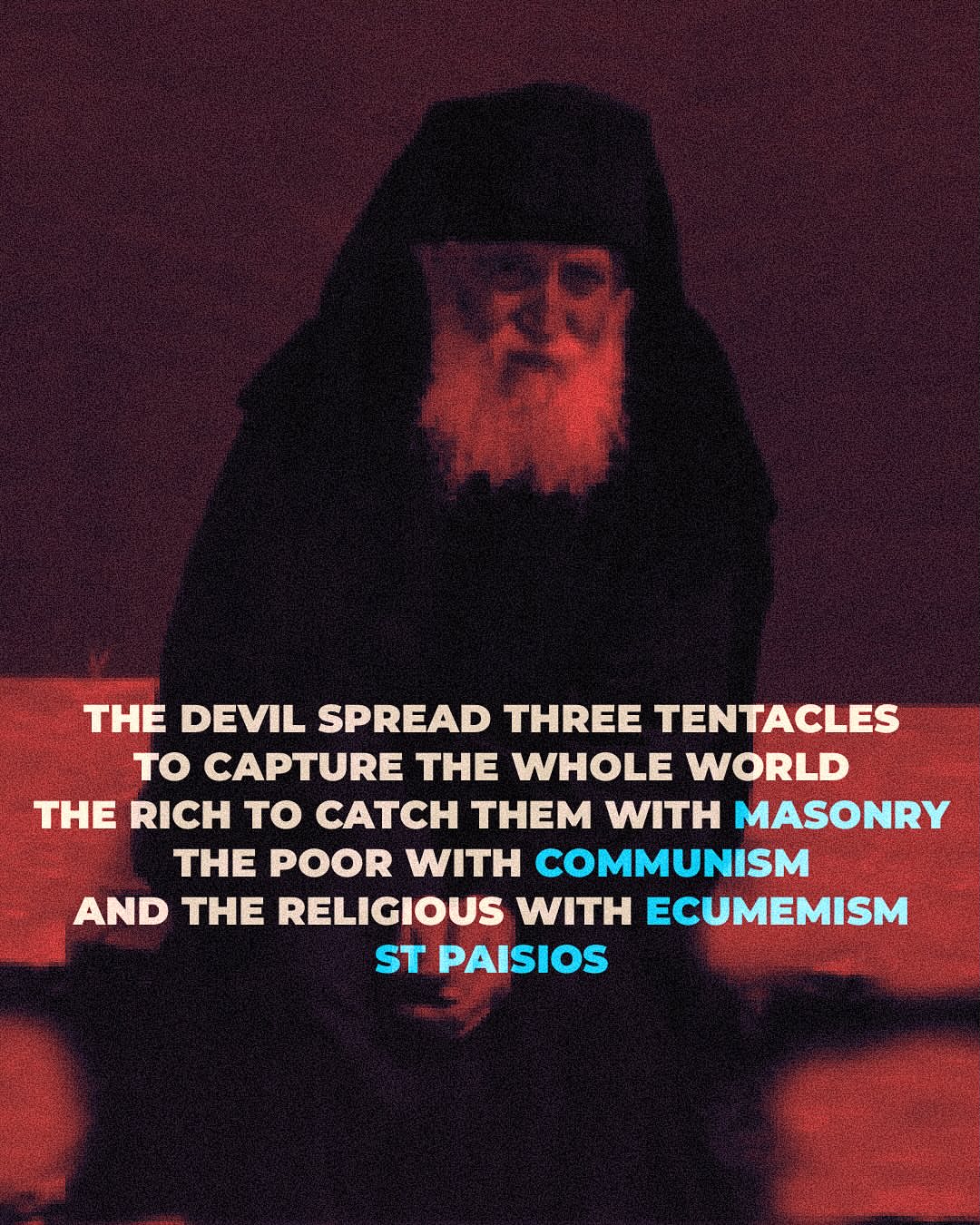
Fifteen saintly quotes condemn ecumenism as betrayal of Christ and Orthodoxy

I have gathered fifteen quotes from the saints on ecumenism. They show how the movement places unity with heretics above truth and amounts to a betrayal of Christ and Orthodox doctrine. This comes as the Ecumenical Patriarch moves toward reunion with Rome.

Read all fifteen passages, then take them to your clergy and metropolitans who have not studied what the Church has taught on ecumenism, beginning with Canon 33. You cannot erase the boundaries of Orthodoxy and still call it Orthodoxy.

  • Fifteen quotes from saints condemn ecumenism
  • Ecumenism prioritizes unity with heretics over truth
  • Ecumenism is called a betrayal of Christ and Orthodox doctrine
  • Recent news: Ecumenical Patriarch plans reunion with Rome
  • Urges readers to confront clergy and metropolitans starting with Canon 33
35 opinions in the discussion When we stand before God and He asks why His bride was divided, are we going to answer, "but they used a different number of fingers to make the sign of the cross! How could your grace… Read the discussion
r/OrthodoxChristianity Reddit discussion

Mother's Concerns About Orthodox Infant Baptism Addressed by Experienced Parents

A mother married to an Orthodox husband seeks reassurance about their baby's upcoming baptism. She worries that the immersion in water and the ceremony's unfamiliarity could be traumatic or overly stressful for the infant, especially given that babies often cry during the rite. She also asks about the post-baptism practice of attending church for three consecutive Sundays, during which the baby receives Holy Communion (including a small amount…

A mother married to an Orthodox husband seeks reassurance about their baby's upcoming baptism. She worries that the immersion in water and the ceremony's unfamiliarity could be traumatic or overly stressful for the infant, especially given that babies often cry during the rite. She also asks about the post-baptism practice of attending church for three consecutive Sundays, during which the baby receives Holy Communion (including a small amount of wine from the chalice), and mentions a term she recalls as "kineftonomia."

Commenters, many of whom are parents and godparents with direct experience, overwhelmingly reassure her that the baptism is brief, the water is warmed, and priests are skilled at handling infants gently. They note that crying is a normal reaction to strangers and new sensations, not a sign of trauma, and that children show no lasting distress — often growing to love the church and communion.

Regarding the three-week tradition, commenters clarify that it is customary for the godparents to bring the newly illumined child to receive Communion for the first three Sundays, establishing a pattern of regular participation. The term she heard may refer to the Greek "kseladoma" or Cypriot "mira," related to the 40-day churching or the post-baptismal anointing.

The consensus: maternal anxiety is natural but unnecessary; the baby will be fine, and speaking with the priest beforehand can ease specific concerns.

  • Baptismal immersion is brief, water is warmed, and priests are experienced in handling infants gently.
  • Crying during the ceremony is a normal reaction to strangers and new sensations, not an indication of trauma.
  • No evidence suggests lasting negative effects; children typically grow to love church and communion.
  • Post-baptism custom: godparents bring the child to receive Communion for the first three Sundays.
  • The term "kineftonomia" likely refers to the 40-day churching (kseladoma/mira) or post-baptismal anointing.
29 opinions in the discussion Three of my own children have been baptized and I've watched dozens of infant baptisms, while priests have probably done hundreds over their careers. Some babies cry, some don't. Some cry… Read the discussion
r/OrthodoxChristianity Reddit discussion

Friend Cut Off All Contact After Moving to a Monastery Community — Should I Reach Out?

The poster, a non-Orthodox Christian, describes how a close friend who was instrumental in bringing them to faith in Christ moved three years ago to live near Saint Anthony's Greek Orthodox Monastery in Arizona. At first she stayed in touch and invited visits, but then she stopped contacting family and friends entirely, with no explanation. Her husband has likewise been estranged from his own family for years. The poster wonders whether a…

The poster, a non-Orthodox Christian, describes how a close friend who was instrumental in bringing them to faith in Christ moved three years ago to live near Saint Anthony's Greek Orthodox Monastery in Arizona. At first she stayed in touch and invited visits, but then she stopped contacting family and friends entirely, with no explanation.

Her husband has likewise been estranged from his own family for years. The poster wonders whether a spiritual father or her husband encouraged the cutoff, and asks whether it would be inappropriate or disrespectful to send an email proposing modest letter correspondence, or whether continuing silence is the more loving choice. The discussion that followed focused less on theology and more on the specific community.

Commenters generally agreed that cutting off all contact is not a normal Orthodox practice: even monks on Mount Athos and novices at other American monasteries commonly keep letter correspondence with family, often with their abbot's blessing. Several respondents said that strict ascetic practices, such as cutting ties with the world, apply to monastics and are not expected of laypeople, and that a married woman living in a lay community should not be bound by them.

Multiple users reported hearing concerning things specifically about the community around Saint Anthony's, describing unusual rules such as overnight services, strict dress codes, and head coverings, and suggesting that extreme behaviors sometimes arise in lay communities that form around monasteries. Others shared personal experiences of families living there for decades, painting a mixed picture.

The practical consensus was that the poster should go ahead and reach out — ideally by letter or even an in-person visit — since a respectful attempt at contact is unlikely to harm the friend, while the lack of closure continues to weigh on those who love her.

  • The poster's friend moved to a lay community near Saint Anthony's Greek Orthodox Monastery and, without explanation, stopped contacting family and friends nearly three years ago.
  • The poster asks whether proposing letter correspondence would disrespect her friend's way of life, or whether continued silence is better.
  • Commenters agree total cutoff is not standard Orthodox practice; even monks and novices often keep letter contact with family, sometimes with their abbot's blessing.
  • Strict ascetic practices like cutting worldly ties apply to monastics, not married laypeople.
  • Several users reported odd or concerning accounts about the Saint Anthony's community specifically, and the practical advice was to send a letter or visit.
51 opinions in the discussion Every single thing I come across regarding that monastery just sounds stranger and stranger. Read the discussion
George Instagram discussion

Why Most People Make the Sign of the Cross Wrong, and What Each Movement Means

1:07

The speaker says most people make the sign of the cross incorrectly: too fast, only halfway, or as a small wave in front of the chest. He traces the problem to a simple cause: nobody told them what the gesture means. He then explains the hand position. The three pressed fingers stand for the Holy Trinity, the Father, the Son, and the Holy Spirit, three persons and one God. The two folded fingers stand for Jesus, who is fully God and fully man,…

The speaker says most people make the sign of the cross incorrectly: too fast, only halfway, or as a small wave in front of the chest. He traces the problem to a simple cause: nobody told them what the gesture means. He then explains the hand position. The three pressed fingers stand for the Holy Trinity, the Father, the Son, and the Holy Spirit, three persons and one God.

The two folded fingers stand for Jesus, who is fully God and fully man, and they point down because He came down to us. Next he explains the movement itself. Touching the forehead means giving God your mind. Moving to the stomach means giving Him your heart. Touching the shoulders means giving Him your strength, everything you do.

Once a person knows this meaning, he says, rushing becomes impossible, because in those few seconds you are giving your whole self to God: mind, heart, and strength. He closes by asking viewers how they were taught to make the sign of the cross, or whether they were ever taught at all.

Key moments

  1. Most people make the sign of the cross too fast, halfway, or as a small wave in front of the chest, because nobody told them what they are doing.
  2. The three pressed fingers stand for the Holy Trinity: the Father, the Son, and the Holy Spirit, three persons, one God.
  3. The two folded fingers stand for Jesus, fully God and fully man, and point down because He came down to us.
  4. Forehead: giving Him your mind; down to the stomach: your heart; right and left shoulders: your strength, everything you do.
  5. Knowing the meaning, you cannot rush anymore, because you are giving your whole self to God, mind, heart, and strength, in three seconds.
  6. The speaker asks viewers how they were taught to make the cross, or whether they were taught at all.
6 opinions in the discussion Our Orthodox church teaches us left to right is correct ✔️ it means Jesus saved and converted children from left to right.. The right shows power and authority. We know Jesus sits at the… Read the discussion
Kyle YouTube discussion

Why New Age Spirituality Is Not as Harmless as It Looks — an Orthodox Critique

Why New Age Spirituality Is Not as Harmless as It Looks — an Orthodox Critique 17:47

This video examines New Age spirituality from an Orthodox Christian standpoint, arguing that its apparent harmlessness conceals serious spiritual dangers. The presenter acknowledges that the movement's growth reflects a genuine human hunger for God, but contends that New Age practices—manifestation, astrology, crystals, chakras, reincarnation, and the idea that the divine dwells within everything—lack any tradition of discernment. Without the…

This video examines New Age spirituality from an Orthodox Christian standpoint, arguing that its apparent harmlessness conceals serious spiritual dangers. The presenter acknowledges that the movement's growth reflects a genuine human hunger for God, but contends that New Age practices—manifestation, astrology, crystals, chakras, reincarnation, and the idea that the divine dwells within everything—lack any tradition of discernment.

Without the guides Christ established in the apostles and their successors, seekers become their own shepherds, trusting subjective feelings, coincidences, and extraordinary experiences that can easily deceive them. The video contrasts this with Orthodox teaching: God is a personal Trinity, not an impersonal cosmic energy; theosis is union with God by grace while remaining a created person, not self-deification; and prayer, such as the Jesus Prayer, is communion with Christ rather than mind-emptying or altered states.

Chasing spiritual experiences for their own sake is warned against as prelest, spiritual delusion, and practices that contact spirits or predict the future are deemed incompatible with Christianity. Father Seraphim Rose is highlighted as a key witness: having passed through the very mid-century alternative spiritualities that later fed the New Age movement, he saw their emptiness firsthand and warned against seeking visions and occult experiences without discernment.

The second half features a convert's testimony: a head injury drew him into Kundalini and ideas about synchronicities, followed by depression and a period of unbelief, until he called on Jesus. He moved through non-denominational Christianity into Orthodoxy, drawn by its theological unity, precision, and the transcendent beauty of his first liturgy in a Russian parish in Vienna.

The comment section became a lively debate: some shared deliverance stories from psychedelics and occult practices, others defended astrology, meditation, yoga, and Eastern philosophies as ancient rather than 'New Age' or as inherently neutral, and one commenter pointed out an apparent tension between the video's warning against trusting subjective experiences and the convert's own experience-based path to conversion.

Key moments

  1. 0:00 New Age spirituality includes manifestation, astrology, crystals, chakras, reincarnation, and the belief that the divine is within everything; its growth reflects a real human yearning for God.
  2. 1:01 Orthodoxy rejects pantheism: God is personal Trinity, not an impersonal cosmic energy; theosis is union with God by grace while remaining a created person, not self-deification.
  3. 1:32 New Age is self-shepherding with no discernment; the Church provides guides—the apostles and their successors—established by Christ.
  4. 2:02 New Age looks inward to hidden divinity; Christianity looks outward to Christ; self-salvation through secret knowledge was rejected as Gnosticism.
  5. 2:34 Orthodoxy warns against pursuing spiritual experiences for their own sake—spiritual deception (prelest) is a real danger; practices contacting spirits or predicting the future are incompatible with Christianity.
  6. 3:05 Orthodox prayer like the Jesus Prayer is personal communion with Christ, not emptying the mind or altered states; New Age is not a living tradition, unlike Orthodoxy which requires the Church and a teacher.
  7. 5:08 Father Seraphim Rose passed through the spiritual environments that fed the New Age movement, saw the emptiness and hypocrisy of figures like Alan Watts, and warned against seeking visions and occult experiences without discernment.
  8. 7:44 A convert recounts his journey: a head injury led him to Kundalini awakening ideas, then depression and anti-religion, until he sincerely called on Jesus, later moved from non-denominational Christianity to Orthodoxy, drawn by its unity, theological precision, and transcendent first liturgy in a Russian parish in Vienna.
23 opinions in the discussion The Greek word pharmakeia, rendered as sorcery or witchcraft in scripture, referred largely to using substances to alter consciousness — it's the root of 'pharmaceutical.' All magic works… Read the discussion
Father Moses YouTube discussion

Why Willpower Fails: Use Self-Control Early, Then Pray and Flee

Why Willpower Fails: Use Self-Control Early, Then Pray and Flee 12:44

Father Moses argues that self-control is not a reliable weapon against strong temptation, because it collapses as desire rises. Everyone has full self-control when desire is low; push desire past a certain point and willpower fails every time. The wise strategy, therefore, is to use self-control while it is still strong—early, to avoid putting yourself in high-temptation situations altogether. He illustrates this with everyday examples: if…

Father Moses argues that self-control is not a reliable weapon against strong temptation, because it collapses as desire rises. Everyone has full self-control when desire is low; push desire past a certain point and willpower fails every time. The wise strategy, therefore, is to use self-control while it is still strong—early, to avoid putting yourself in high-temptation situations altogether.

He illustrates this with everyday examples: if social media keeps leading you into lust, delete it; if certain places or habits pull you down, stay out of the danger zone rather than testing yourself. For men who are dating, he advises avoiding kissing before marriage, since desire is already at its maximum and the failure rate rises with it.

Rooting his point in the holy fathers, he notes that man naturally seeks pleasure and avoids pain, mostly through physical gratification, and that old sins return through memories of pleasure provoked by the devil—so one must be honest about personal weaknesses. When temptation does strike despite precautions, he offers only two moves: say the Jesus Prayer, turning the heart to Christ, and physically flee the situation rather than fight it head-on.

He closes with encouragement that temptation is a sign of genuine spiritual struggle and love for Christ, who said, ‘If you love me, you will keep my commandments.’

Key moments

  1. 0:00 If social media keeps leading you into lust, get rid of it; use self-control to be wise and disciplined.
  2. 1:00 Everyone has full self-control when desire is low, but as desire rises, self-control naturally collapses.
  3. 3:10 Use self-control while it is strong to avoid putting yourself in high-temptation situations; failure rates rise with desire.
  4. 3:41 Advice to men dating: avoid kissing before marriage because desire is already at a maximum—stay out of the danger zone.
  5. 6:49 The holy fathers teach that man naturally seeks pleasure and avoids pain, mostly through physical gratification.
  6. 7:54 Old sins and temptations return; the devil provokes old memories of pleasure—be honest with yourself about your weaknesses.
  7. 9:27 When temptation hits, do two things: say the Jesus Prayer, turning your heart to Christ, and flee temptation rather than fight it.
  8. 11:30 Love of Christ is shown in the struggle against temptation, not in the absence of temptation; avoiding sin is the way to spiritual progress.
19 opinions in the discussion St Mary of Egypt spent 45 years in the desert away from temptation. We can't exactly do that, but when possible it's wise to simply distance ourselves from whatever tempts us. The Oreo… Read the discussion

Fr. Alexey Uminsky: Faith Beyond Rules and Rituals

Fr. Alexey Uminsky: Faith Beyond Rules and Rituals 1:03:13

In this conversation, Fr. Alexey Uminsky responds to a letter from a lifelong Orthodox Christian who, challenged by non-Christian friends, finds herself unable to articulate the meaning of the Trinity, Christ's divinity, or the Eucharist. Her crisis reveals a widespread problem: many 'churched' people have reduced faith to moral compliance and ritual observance — worrying about cross-shaped drains or lists of permissions and prohibitions — while…

In this conversation, Fr. Alexey Uminsky responds to a letter from a lifelong Orthodox Christian who, challenged by non-Christian friends, finds herself unable to articulate the meaning of the Trinity, Christ's divinity, or the Eucharist. Her crisis reveals a widespread problem: many 'churched' people have reduced faith to moral compliance and ritual observance — worrying about cross-shaped drains or lists of permissions and prohibitions — while missing the living God.

Fr. Alexey argues that such religion mistakes tradition for faith and behavioral conformity for a relationship with the invisible, incomprehensible God who is infinitely greater than human categories.

The core of Christianity, he insists, is not a moral code but the revelation that God is eternal, self-giving love (1 John 4:8). This love explains the Holy Trinity not as a mathematical puzzle but as a communion of Persons: the Father eternally begets the Son, the Spirit eternally proceeds, three hypostases consubstantial and united in one will.

The Incarnation is God's union with humanity; the Son takes on sin and death, destroys hell by divine love, rises as the God-man, and grants deification through Baptism and the Eucharist. The talk concludes with a testimony of a child's direct encounter with the living God as love, illustrating that true faith begins not with rules but with a personal meeting with the One who is Love itself.

Key moments

  1. 0:00 Opening critique: reducing faith to lists of what is allowed or forbidden (e.g., a cross-shaped drain) empties Christianity of its content; the true God is invisible, incomprehensible, and infinitely greater than human categories.
  2. 1:03 Introduction of the letter from Yulia, a cradle Orthodox Christian whose conversations with friends of other faiths exposed her inability to explain the Trinity, Christ's unique divinity, or the meaning of Communion, leading her to avoid prayers to Jesus and the Theotokos.
  3. 8:23 Diagnosis: many 'churched' people mistake religious tradition and behavioral conformity for faith; they have not entered into a personal relationship with the living God who is invisible, intangible, and infinitely greater than human consciousness.
  4. 10:27 Two inadequate concepts of God: (1) a generic higher intelligence, and (2) a moralistic lawgiver of 'allowed/forbidden' common to all religions; Christian faith transcends both by revealing God as self-giving love.
  5. 13:07 Critique of popular clergy media that answer casuistic questions (bathtub drains, euthanasia, interfaith communion) as if they were the heart of faith; if the Son of God became man for such trivialities, 'it is a very strange faith indeed.'
  6. 16:47 The core of Christian faith: 'God is love' (1 John 4:8). This love is eternal, unconditional, and the source of all dogma; the Trinity is not a mathematical puzzle but the fullness of divine love—Father, Son, and Holy Spirit as three personal expressions of one divine essence.
  7. 18:20 Patristic explanation of the Trinity from love: the Father is eternally Father only if He eternally begets the Son; the Spirit eternally proceeds. The three hypostases are consubstantial, equal in glory, and united in one will—unity in threeness, not tritheism.
  8. 42:57 Salvation through the Incarnation: the Son of God becomes man to unite humanity with God, takes on sin and death, destroys hell by divine love, rises as the God-man, and grants deification (theosis) through Baptism (death/resurrection with Christ) and the Eucharist (union with His Body and Blood).
8 opinions in the discussion Dear Father Alexei. I'm about your age, a psychiatrist, and for years I've been surrounded by deprived, suffering people. I know well the helplessness and burnout that come with it. I… Read the discussion
Kyle YouTube discussion

Do Jews, Muslims, and Christians Worship the Same God? An Orthodox Case for Saying No

Do Jews, Muslims, and Christians Worship the Same God? An Orthodox Case for Saying No 7:47

This video challenges the popular notion of 'Abrahamic faiths' worshiping one and the same God, arguing that this framing amounts to a denial of the gospel. The speaker proposes a simple test: point to an icon of Christ and ask whether that is your God. Since whoever denies the Son does not have the Father (citing 1 John 2), he concludes that those who reject Christ's divinity do not worship the God Christians worship. He then examines rabbinic…

This video challenges the popular notion of 'Abrahamic faiths' worshiping one and the same God, arguing that this framing amounts to a denial of the gospel. The speaker proposes a simple test: point to an icon of Christ and ask whether that is your God. Since whoever denies the Son does not have the Father (citing 1 John 2), he concludes that those who reject Christ's divinity do not worship the God Christians worship.

He then examines rabbinic Judaism, describing it as a later development from Pharisaic tradition rather than the religion of the Old Testament, and rejects dual-covenant theology, holding that the Church is the new Israel. Turning to Islam, he argues that the Quran describes Allah in anthropomorphic terms, never as Father, and denies Christ's divinity and crucifixion—placing it, in his view, alongside Arianism, which the First Ecumenical Council condemned.

He claims trinitarian theology is already present in Old Testament theophanies, such as the angel of the Lord and Daniel 7. Finally, he extends the argument to Mormonism (a revival of tritheism) and the Bahá'í faith (which treats Jesus as one manifestation among many). The comment section became a lively debate. Supporters cited St. John of Damascus, Galatians 1:8, and Vatican II's Lumen Gentium—some noting that Rome's declaration that Muslims 'adore the one God' illustrates the very error being critiqued.

Critics pushed back on philosophical grounds, arguing that calling Arians 'wrong about Christ' presupposes a shared referent, so error about God still implies reference to the same God. Others raised the Hebraic concept of agency (shlichut) regarding the Angel of the Lord, objected to harsh language about the Jewish people—pointing to the Theotokos and the saints who were Jews—or cautioned the speaker to examine whether pride, not Christ, motivated the video.

Key moments

  1. 0:00 The 'Abrahamic religions worship the same God' idea is false and a denial of the gospel; the test is asking whether the icon of Christ is one's God.
  2. 1:01 Whoever denies the Son does not have the Father (John 2); modern Jews who reject Christ do not worship the same God as Christians.
  3. 1:33 There is no dual covenant theology; the old covenant was preparatory and fulfilled in Christ, and the Church is the new Israel, not modern rabbinic Judaism (invented in the 600s).
  4. 2:35 In John 8, Jesus tells the Pharisees their father is the devil; rabbinic Judaism follows the Pharisees' tradition.
  5. 3:06 Islam, arising 600 years after Christianity, describes Allah with body parts (a shin, two right hands, one eye), never as Father, and denies Jesus's divinity and crucifixion—so it worships a different God.
  6. 4:39 Denying Christ's divinity is Arianism, condemned at the First Ecumenical Council; the church fathers held that Arians do not worship the one God.
  7. 5:11 Old Testament theophanies (the angel of the Lord, Daniel 7, the 'two powers in heaven' idea) show trinitarian theology was present in the Old Testament.
  8. 6:45 Mormonism reinvents tritheism (three beings united in purpose, not essence), and the Bahá'í faith treats Jesus as merely one manifestation among many—none worship the same God.
22 opinions in the discussion Mormonism is pure heresy. I grew up in that faith but eventually escaped during a semester abroad in Russia, where I encountered Eastern Orthodoxy — partly through reading Dostoevsky. In my… Read the discussion