WeOrthodox
EN UA

Orthodox posts, videos and discussions

We follow Orthodox channels, communities and blogs across the web, summarise every post and video, and highlight the conversations with real substance.

Disgruntled Docs with The Via Negativa Instagram

Niketas Choniates on the 1204 Sack of Constantinople

The post presents excerpts from Niketas Choniates, a Byzantine historian who witnessed the Latin sack of Constantinople in 1204. Choniates describes how the populace greeted the crusaders with crosses and icons, but the Latins were unmoved and began plundering immediately, seizing both private property and articles consecrated to God. He recounts the desecration of the Eucharist, the smashing of chalices and patens, and the use of sacred vessels…

The post presents excerpts from Niketas Choniates, a Byzantine historian who witnessed the Latin sack of Constantinople in 1204. Choniates describes how the populace greeted the crusaders with crosses and icons, but the Latins were unmoved and began plundering immediately, seizing both private property and articles consecrated to God.

He recounts the desecration of the Eucharist, the smashing of chalices and patens, and the use of sacred vessels as common tableware. The altar of the Great Church, fashioned from precious materials, was broken apart and divided among the looters. Pack animals were led into the sanctuary to strip silver and gold overlays; some slipped on the marble and were killed, defiling the floor with blood and excrement.

Choniates calls the crusaders forerunners of Antichrist and notes that they trampled the Cross they bore on their backs for gold and silver. He contrasts their conduct with the Muslims who took Jerusalem, observing that the Muslims allowed Christians to depart with their possessions after paying a ransom. The post also cites Steven Runciman calling the Fourth Crusade one of the most ghastly incidents in history, and Michael Whelton on the burning of libraries and destruction of manuscripts.

The discussion centers on the horror of Christians attacking fellow Christians and the lasting trauma of the event.

  • Choniates' eyewitness account of the 1204 Latin sack of Constantinople
  • Crusaders ignored crosses and icons carried by the populace and plundered indiscriminately
  • Desecration of the Eucharist, relics, icons, and the Hagia Sophia altar
  • Sacred vessels smashed or used as common tableware; pack animals brought into the sanctuary
  • Choniates contrasts Latin cruelty with Muslim restraint during the capture of Jerusalem
Read more
George Instagram discussion

Confession: Christ Receives, the Priest Witnesses, You Are Healed

The video addresses why many people avoid confession for years, identifying fear of the priest's judgment or changed perception as the main obstacle. It explains the Orthodox understanding: during confession the priest declares that Christ stands invisibly to receive the confession while the priest serves only as a witness. The penitent stands before a doctor, not a judge, and there is nothing the priest has not heard before. Practical steps are…

The video addresses why many people avoid confession for years, identifying fear of the priest's judgment or changed perception as the main obstacle. It explains the Orthodox understanding: during confession the priest declares that Christ stands invisibly to receive the confession while the priest serves only as a witness. The penitent stands before a doctor, not a judge, and there is nothing the priest has not heard before.

Practical steps are given: find a priest and ask to make your confession; prepare by honestly examining yourself using the commandments or the questions in an Orthodox prayer book and writing down what is on your heart. During confession, state simply what you did and how often, without excuses, explanations, or other people's stories; the priest will ask for more detail if needed.

At the end the priest places his stole over your head and reads the prayer of forgiveness. The speaker testifies that regular confession with a spiritual father has made him refrain from small sins he once committed without thinking, because he knows he will have to name them again. He cites Saint John's promise that God is faithful and just to forgive confessed sins, and urges not to wait for a perfect moment because there is none.

Key moments

  1. People avoid confession for years because they fear the priest will judge them, look at them differently, or because they are scared to say the words aloud.
  2. In Orthodox confession the priest says, "Christ stand here invisibly, receiving your confession. I'm only a witness."
  3. You are not standing before a judge but before a doctor, and there is nothing you can say that the priest has not heard before.
  4. To start, find a priest and simply ask, "Father, I'd like to make my confession."
  5. Before going, sit down and be honest with yourself, go through the commandments or use the questions in the Orthodox prayer book, and write down what is on your heart.
  6. When confessing, do not explain, make excuses, or tell the story of everyone else; just say what you did, naming it honestly and saying how often.
  7. The priest puts his stole over your head and reads the prayer of forgiveness at the end.
  8. Since the speaker began confessing regularly with his spiritual father, he holds back many small sins he used to do without thinking, because he knows he will have to say them again.
7 opinions in the discussion If I've never confessed before... do I confess everything I've done in my life from the very start, or do I begin from somewhere in the middle? (new to the orthodox faith) Read the discussion

The Eucharist and Christ's Return: Augustine's Distinction

The speaker addresses a claim that the Catholic understanding of the Eucharist contradicts Christ's second coming by portraying Jesus as returning daily as a wafer to be re-sacrificed and worshipped. He states that Jesus ascended into heaven and sits at the right hand of the Father, and that his return will be in power and glory with angels. The Eucharist does not contradict the second coming because Christ promised to remain with his church…

The speaker addresses a claim that the Catholic understanding of the Eucharist contradicts Christ's second coming by portraying Jesus as returning daily as a wafer to be re-sacrificed and worshipped. He states that Jesus ascended into heaven and sits at the right hand of the Father, and that his return will be in power and glory with angels.

The Eucharist does not contradict the second coming because Christ promised to remain with his church until the end of the age. Saint Augustine explains this distinction: Christ is in heaven and also with us. The Eucharist is Christ truly present in his body and blood, while the second coming is his visible return in glory.

Christ's presence with his church fulfills his promise and does not contradict his future return.

Key moments

  1. The Catholic Jesus is described as returning everyday on an altar in the form of a wafer to be re-sacrificed, idolized, worshipped and consumed by humans.
  2. Jesus ascended into heaven and is currently seated at the right hand of the Father; when he returns from heaven it will be in power and great glory with angels.
  3. The Eucharist does not contradict the second coming; Christ himself promised to remain with his church until the end of the age.
  4. Saint Augustine addresses this distinction when he says Christ, while in heaven, is also with us.
  5. The Eucharist is Christ truly present in his body and blood; the second coming is his visible return in glory; Christ's presence with his church does not contradict his return but fulfills his promise.
Read more

Marriage as Mutual Obedience to God: A Hierarchy of Love

Marriage as Mutual Obedience to God: A Hierarchy of Love 3:56

Fr. Bassam Nassif, associate professor at the University of Balamand, presents the Orthodox understanding of marriage as a mystery of mutual obedience to God. He explains that obedience in marriage is often misunderstood when separated from Christ. The husband is called the head of the family, but his headship is patterned after Christ, who gives himself first and sacrifices himself completely for the Church. To be the head means to be the first…

Fr. Bassam Nassif, associate professor at the University of Balamand, presents the Orthodox understanding of marriage as a mystery of mutual obedience to God. He explains that obedience in marriage is often misunderstood when separated from Christ. The husband is called the head of the family, but his headship is patterned after Christ, who gives himself first and sacrifices himself completely for the Church.

To be the head means to be the first to love, the first to serve, and the first to offer himself. Submission is not slavery or fear; it is part of a hierarchy of love where both spouses give themselves to one another in prayer, sacrifice, and holiness. Marriage becomes a shared path toward the Kingdom.

The teaching begins with Ephesians 5: "Obey each other. Both of you have obedience to God." St. John Chrysostom observes that no man would refuse his wife's respect and care, and no wife would be unhappy with a husband who gives her everything, his heart, power, mind, and care for all her needs. The husband's headship is not tyrannical or military; it is modeled on Christ who sacrifices himself first.

The wife submits because she sees his love and sacrifice, and she offers her life in return, creating a hierarchy of love rather than mastery. St. John Chrysostom encourages husbands and wives to compete with each other in prayer, vigils, helping the poor, and reading Scripture and the saints, asking who wants to be the head in spiritual life.

A family living this vision is blessed because it follows God's commandments and lives true divine love in the home.

Key moments

  1. 0:00 Ephesians 5 teaches: "Obey each other. Both of you have obedience to God."
  2. 0:31 St. John Chrysostom says no man would refuse his wife's respect, care, and help, and no wife would be unhappy with a husband who sacrifices everything, his heart, power, mind, and care for all her needs.
  3. 1:33 The husband is the head of the family, but not as a tyrant or military captain; headship means he is given the task of sacrificing himself like Christ.
  4. 2:04 The husband sacrifices first; the wife submits because she sees his love and sacrifice, respects it, and offers her life for him as well.
  5. 2:35 This is a positive hierarchy of love, not tyranny or a master-slave relationship.
  6. 3:05 St. John Chrysostom encourages husband and wife to compete in prayer, vigils, helping the poor, reading Scripture, and reading the saints, asking who wants to be the head in spiritual life.
  7. 3:36 A family with this vision is blessed because it lives according to God's commandments and the true love of God in the house.
Kyle YouTube discussion

One Orthodox channel recommended; theosis demands the cross, not comfort

One Orthodox channel recommended; theosis demands the cross, not comfort 6:54

The speaker recommends Father Moses as the single best Orthodox YouTube channel, describing his sermons as spiritually edifying, theologically rich, and directly applicable to daily life, especially for men facing cultural challenges and struggles with pride and egotism. The speaker urges listeners to move beyond media consumption and engage directly in the life of the Church through the sacraments, altar service, church board work, or time in a…

The speaker recommends Father Moses as the single best Orthodox YouTube channel, describing his sermons as spiritually edifying, theologically rich, and directly applicable to daily life, especially for men facing cultural challenges and struggles with pride and egotism. The speaker urges listeners to move beyond media consumption and engage directly in the life of the Church through the sacraments, altar service, church board work, or time in a monastery.

He emphasizes that the Christian life is a costly cross of self-denial rather than a pursuit of comfort. The goal is theosis, becoming holy by grace through purification of the heart and communion with God, not mere outward morality. This requires acknowledging one's sinfulness and acting with urgency because death can come at any moment.

The speaker cites St. Seraphim of Sarov on acquiring a peaceful spirit so that a thousand around you will be saved, and the scriptural command to be holy as God is holy. He notes that Father Moses is a married priest with children, that his church is growing rapidly, and that even non-religious people watch his videos. The speaker also stresses that all Christians are called to the ascetic struggle of denying themselves; for married people this means dying to ego for spouse and children.

Practical involvement in the parish is presented as a heavy cross but necessary for spiritual growth.

Key moments

  1. 0:00 If you only watch one Orthodox channel, watch Father Moses; every video is spiritually edifying and leads toward Christ, the saints, and repentance.
  2. 0:32 Father Moses is funny, entertaining, a married priest with kids, and his church is growing rapidly; even non-religious people watch him.
  3. 1:04 His sermons interconnect the Bible, the saints, and his priestly experience in a way that is phenomenal and directly applicable to the listener's life.
  4. 2:08 Father Moses teaches that modern Christianity is crossless Christianity and emphasizes the spiritual struggle, especially for men, against subtle pride and egotism.
  5. 2:40 You do not need a YouTube channel to make a difference; you need the Church, the sacraments, repentance, and to become a saint.
  6. 3:11 Get involved practically: serve at the altar, read the epistle, join the church board (a heavy cross), or spend time in a monastery.
  7. 4:11 All Christians are called to the ascetic struggle of denying yourself; for married people this means dying to ego for spouse and children, Christianity is a cross, not comfort.
  8. 5:45 The goal is theosis, purification of the heart and participation in the life of God, not outward morality; as St. Seraphim of Sarov said, acquire a peaceful spirit and a thousand around you will be saved, and Scripture commands: be holy, for I am holy.
12 opinions in the discussion I love Fr. Spyridon Bailey. Very lowkey & calming. Read the discussion
CHRISTIANITY UNITED Instagram

The Incarnation as the heart of Orthodox salvation and theosis

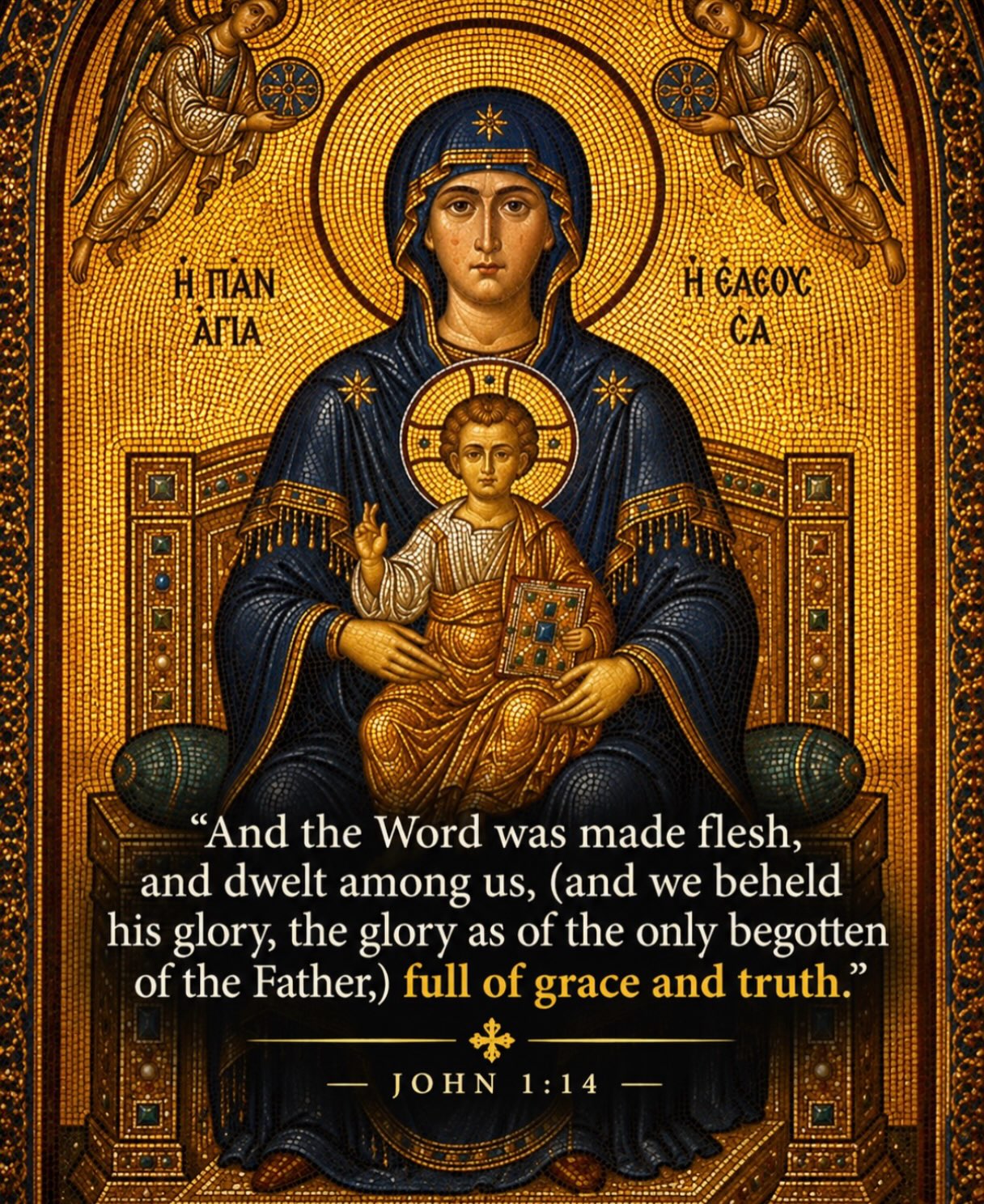
The post opens with the words of John 1:14, "And the Word became flesh, and dwelt among us", identifying this as one of the greatest mysteries of the Christian faith. It describes the eternal Son of God, through whom all things were created, entering the world He made. He came not as an earthly king with armies and riches but in humility: born in a manger, raised in an ordinary human family. The Creator became part of His creation without…

The post opens with the words of John 1:14, "And the Word became flesh, and dwelt among us", identifying this as one of the greatest mysteries of the Christian faith. It describes the eternal Son of God, through whom all things were created, entering the world He made. He came not as an earthly king with armies and riches but in humility: born in a manger, raised in an ordinary human family.

The Creator became part of His creation without ceasing to be God. The post lists what this entailed: the One who formed the heavens experienced hunger, thirst, exhaustion, sorrow, and suffering. He walked among ordinary people, touched the sick, welcomed sinners, and wept with mourners.

He became truly human while remaining truly divine, motivated by immeasurable love for mankind.

In the Orthodox Church, the Incarnation is central to salvation. God did not merely send instructions; He came Himself. Through His life, death, and Resurrection, Christ opened the way for humanity to be restored to communion with God. The post cites Saint Athanasius the Great: "For He was made man that we might be made god."

It clarifies that this does not mean humans become God by nature but that through grace we are called to participate in His divine life, the mystery the Orthodox Church calls theosis.

The post connects this to holy icons. Because the invisible God truly became visible in Jesus Christ, His human face can be depicted, proclaiming the reality of the Incarnation. Christianity is presented not as a collection of moral teachings or beautiful traditions but as the astonishing truth that God loved humanity so deeply He came to live among us, suffer for us, and conquer death for our salvation.

The post concludes: "The Word became flesh. And through Him, the way to eternal life was opened."

  • The eternal Son of God entered creation in humility, becoming fully human while remaining fully divine
  • Saint Athanasius the Great taught the Incarnation makes theosis possible, participation in divine life by grace
  • Holy icons are vindicated because the invisible God became visible in Christ
  • The Incarnation is the center of Orthodox salvation: God came Himself, not just instructions
  • Christ experienced human suffering, hunger, thirst, exhaustion, sorrow, out of love for mankind
Read more

The Theology Behind St. John the Baptist's Icon

The video explains the theological symbols in the icon of St. John the Baptist. His wings depict him as an angel of the desert, signifying his radical ascetic life, angelic purity, and role as a heavenly messenger sent to prepare the way of the Lord. An axe at the root of a cut tree recalls his Gospel warning that the axe is laid at the root of the trees and every tree that does not bear good fruit is cut down, an urgent call to repentance and…

The video explains the theological symbols in the icon of St. John the Baptist. His wings depict him as an angel of the desert, signifying his radical ascetic life, angelic purity, and role as a heavenly messenger sent to prepare the way of the Lord. An axe at the root of a cut tree recalls his Gospel warning that the axe is laid at the root of the trees and every tree that does not bear good fruit is cut down, an urgent call to repentance and metanoia.

The decapitated head on a plate shows his martyrdom within the same image, and the plate also represents the Holy Eucharist, indicating his witness spiritually feeds the Church; Christ blesses him from heaven above. He holds a cross and a scroll with his prophetic message, serving as the living bridge between the Old and New Testaments, the supreme Zeta who teaches preparation of the heart for the living God.

Greek letters at the top read "O Agios Ioannis O Prodromos," meaning St. John the Forerunner. His staff topped with a cross symbolizes his proclamation of Christ's sacrifice and his descent to Hades to announce the Messiah. He wears a rough camel-hair tunic and leather belt exactly as described in Matthew's Gospel: "And John had his garment of camel's hair," representing total renunciation of worldly luxury; his unkempt hair and beard reflect a life removed from urban comfort and convention, the visual mark of one who has died to the world's standards to live for God alone.

Key moments

  1. 0:00 The wings show him as an angel of the desert, not because he became incorporeal but to depict his radically ascetic life, angelic purity, and office as a heavenly messenger sent to prepare the way of the Lord.
  2. 0:31 The axe at the root of the cut tree quotes his own Gospel words: "The axe is already laid at the root of the trees. Every tree that does not bear good fruit is cut down," an urgent call to repentance and metanoia.
  3. 0:31 The decapitated head on a plate portrays his martyrdom within the same icon, and the plate also represents the Holy Eucharist, signifying that his martyr's witness spiritually feeds the Church.
  4. 0:31 Christ appears above blessing him from heaven, validating his ministry.
  5. 1:04 He holds a cross and a scroll with his prophetic message; he is the living bridge between the Old and New Testaments, the supreme Zeta who teaches preparation of the heart to receive the living God.
  6. 1:04 The Greek letters at the top read "O Agios Ioannis O Prodromos," meaning simply St. John the Forerunner.
  7. 1:36 His staff topped with a cross is not an ordinary shepherd's crook; it symbolizes his prophetic proclamation of Christ's coming sacrifice and serves as the herald's banner descending to Hades to announce the Messiah's arrival, according to patristic tradition.
  8. 2:13 He wears a rough tunic of camel skin and leather exactly as Matthew's Gospel states: "And John had his garment of camel's hair," representing total renunciation of worldly luxury; his unkempt hair and beard reflect a life completely removed from urban comfort, fashion, and convention, the visual mark of one who has died to the world's standards to live exclusively for God.
Read more
r/OrthodoxChristianity Reddit

Identifying icons found at a flea market

I found these icons at a flea market a few days ago and thought they were interesting. Could someone tell me what the icon on the right depicts? Also, what is Jesus holding in that icon, and what does the inscription say? I know a little Greek but I can't decipher the letters.

  • What is the icon on the right?
  • What is Jesus holding?
  • What does the Greek inscription say?
  • The author knows some Greek but cannot read the letters.
Read more
George Instagram discussion

Why the Church Existed Before the New Testament

The speaker argues that sola scriptura is inconsistent because the New Testament emerged from the life of the Church, not the reverse. The apostles and their disciples baptized, celebrated the liturgy, prayed for the dead, and taught the faith orally for decades before any books were written. Christ established a church, not a book, and the first Christians relied entirely on the apostles and the traditions they passed on. The same Church that…

The speaker argues that sola scriptura is inconsistent because the New Testament emerged from the life of the Church, not the reverse. The apostles and their disciples baptized, celebrated the liturgy, prayed for the dead, and taught the faith orally for decades before any books were written. Christ established a church, not a book, and the first Christians relied entirely on the apostles and the traditions they passed on.

The same Church that preserved those traditions later discerned which books belong in the New Testament, a process that took more than three hundred years after the Resurrection. Trusting the Bible while rejecting the Church's way of life, prayer, and worship is compared to accepting a letter but ignoring the sender's face-to-face teaching.

The speaker cites St. John's statement that Jesus did many other things not recorded, indicating not everything was written down. The Bible remains central to belief, but it must be read within the Church that wrote it, kept it, and transmitted it to the world.

Key moments

  1. Sola scriptura claims the Bible is the only final authority and tradition is man-made.
  2. The New Testament was written by apostles and their disciples who baptized, celebrated the liturgy, prayed for the dead, and taught the faith by word of mouth before anything was written down.
  3. Christ never wrote a book; he built a church.
  4. For years after the resurrection, the first Christians had no New Testament, only the apostles and the traditions they passed on.
  5. The church that kept those traditions decided which books belong in the Bible, a process that took more than 300 years.
  6. It is inconsistent to trust the book these people wrote and chose while rejecting how they lived, prayed, and worshipped.
  7. St. John wrote that Jesus did many other things not recorded, implying not everything was written down.
  8. The Bible is the heart of belief but must be read as it was always read inside the church that wrote it, kept it, and gave it to the world.
12 opinions in the discussion The Bible is the map to Our Lord, Holy Tradition is the car, the Sacraments are the fuel and the saints are the signs pointing you to the destination… Easy to get lost and exhausted if you… Read the discussion
Lives of the Saints 🙏 Instagram

Saint Abercius converts Hierapolis through prayer and miracles

The post recounts the life of Saint Abercius, Bishop of Hierapolis in Phrygia during the reign of Emperor Antoninus in the second century. At that time the city was largely pagan, with only a small Christian community. Deeply saddened by the spiritual darkness surrounding him, Abercius prayed continually that God would lead the people to the truth. During a major pagan festival he entered a temple and destroyed the idols. The enraged crowd…

The post recounts the life of Saint Abercius, Bishop of Hierapolis in Phrygia during the reign of Emperor Antoninus in the second century. At that time the city was largely pagan, with only a small Christian community. Deeply saddened by the spiritual darkness surrounding him, Abercius prayed continually that God would lead the people to the truth.

During a major pagan festival he entered a temple and destroyed the idols. The enraged crowd wanted to kill him, but three young men suffering from demonic possession fell before him, crying out in torment. Abercius prayed, and through the power of Jesus Christ the evil spirits departed.

The young men were immediately restored to peace. Witnessing this miracle, the crowd's anger turned into astonishment. Five hundred people received Holy Baptism, and gradually the entire city of Hierapolis embraced Christianity. Later Abercius restored the sight of the blind mother of Publius, the regional governor, bringing him and many others to faith in Christ.

His miracles became known far beyond Hierapolis. He was summoned to Rome, where according to his life he healed the emperor's daughter. The Lord Jesus Christ appeared to him on several occasions, strengthening him in his sacred mission. At God's command Abercius also traveled through Syria and Mesopotamia, preaching the Gospel and bringing souls to Christ.

He peacefully reposed in Hierapolis at an advanced age near the end of the second century. The post concludes by noting that one faithful servant of God can become an instrument through which thousands discover Christ, as Abercius's prayers led to the conversion of an entire city, and ends with the invocation: Holy Saint Abercius, Equal-to-the-Apostles, pray to God for us.

  • Saint Abercius, Bishop of Hierapolis in Phrygia, second century under Emperor Antoninus
  • He destroyed idols during a pagan festival, leading to the healing of three possessed youths and the baptism of five hundred people
  • The entire city of Hierapolis gradually converted to Christianity
  • He healed the blind mother of Governor Publius and later the emperor's daughter in Rome
  • He traveled through Syria and Mesopotamia preaching the Gospel and reposed in Hierapolis at an advanced age
Read more

St. John Chrysostom: Life, Teachings, and Enduring Legacy

The post presents a biographical sketch of St. John Chrysostom, born in Antioch around 347 AD. It notes his reputation for scriptural knowledge, eloquence, and ascetic discipline, his ordination as a priest in Antioch, and his later service as Archbishop of Constantinople. The summary highlights his teaching that true Christianity requires humility, repentance, prayer, love, and compassion for the poor, along with emphasis on Holy Scripture, the…

The post presents a biographical sketch of St. John Chrysostom, born in Antioch around 347 AD. It notes his reputation for scriptural knowledge, eloquence, and ascetic discipline, his ordination as a priest in Antioch, and his later service as Archbishop of Constantinople. The summary highlights his teaching that true Christianity requires humility, repentance, prayer, love, and compassion for the poor, along with emphasis on Holy Scripture, the Divine Liturgy, and transformation of the heart through virtue.

It mentions his homilies on the Gospels and Epistles as treasured Orthodox teachings. The account describes his confrontation of corruption, luxury, and injustice, which led to persecution and exile, and his death in exile in 407 AD with the words "Glory to God for all things." Three sayings attributed to St. John Chrysostom appear alongside the biography: a call to pray for those who mock one's faith because judgment will be no laughing matter; a warning that most punishments and sins begin from words; and a statement that God is more blasphemed by a corrupt Christian than by an impure heathen. An icon of the saint holding a scroll with Greek text is also noted.

  • Born in Antioch c. 347 AD; became priest there and later Archbishop of Constantinople
  • Taught Christianity expressed through humility, repentance, prayer, love, and compassion for the poor
  • Homilies on Gospels and Epistles remain central Orthodox teachings
  • Confronted corruption and injustice, suffered exile, died in 407 AD saying "Glory to God for all things"
  • Three attributed sayings: pray for those who mock faith; sins begin from words; corrupt Christians blaspheme God more than heathens
Read more

St. Paisios: Earthly Suffering Is a Drop in the Ocean of Eternity

St. Paisios the Athonite compares the years of testing and suffering in this life to a tiny drop in the boundless ocean of eternity. He says these years are a small number, while the years of Paradise are beyond counting. The quote offers a perspective on the brevity of earthly trials relative to eternal life.

  • Earthly suffering lasts only a few years.
  • Paradise lasts beyond all counting.
  • Present trials are like a drop in the ocean of eternity.
  • St. Paisios the Athonite is the source.
  • The quote encourages an eternal perspective on suffering.
Read more

Hieromonk Seraphim Rose: God expects more from Orthodox Christians

The post is a prayer asking Hieromonk Seraphim Rose to intercede, paired with a quotation from him. In the quoted passage he warns that Christians everywhere are tempted to take the easy path: to seek peace and security, to flee from pain and affliction, and to treat life as an occasion for enjoying earthly blessings. Against this he sets the Christian understanding of life as a time of trial in which our eternal destiny is to be decided. He…

The post is a prayer asking Hieromonk Seraphim Rose to intercede, paired with a quotation from him. In the quoted passage he warns that Christians everywhere are tempted to take the easy path: to seek peace and security, to flee from pain and affliction, and to treat life as an occasion for enjoying earthly blessings. Against this he sets the Christian understanding of life as a time of trial in which our eternal destiny is to be decided.

He states that God expects more than this from those who glory in the name of Orthodox Christians. The post is a short devotional item: a plea for his prayers together with his own words on how an Orthodox Christian should view earthly life. There is no further discussion in the post; it consists of the prayer, the quotation, and a note that the text is from a sermon of St. Peter.

  • The post asks Hieromonk Seraphim Rose to pray for us.
  • The quoted text warns against seeking peace, security and earthly enjoyment.
  • Seraphim Rose describes life as a time of trial in which eternal destiny is decided.
  • He says God expects more from those who glory in the name of Orthodox Christians.
  • The quotation is identified as coming from the sermon of St. Peter.

"Papouli, I Want to Be a Good Person": St. Paisios and a Child's Faith

The post shares a recorded scene with St. Paisios the Athonite. It begins to drizzle and an elder says he has lost his sight, telling him, "I cannot see you, geronda, I cannot see you." St. Paisios answers warmly that they can still be friends. He asks a child about school and learns that everything is fine and that the children have a very good teacher, Mrs. Sofia. He asks the children to say a prayer for her, because her husband died and she…

The post shares a recorded scene with St. Paisios the Athonite. It begins to drizzle and an elder says he has lost his sight, telling him, "I cannot see you, geronda, I cannot see you." St. Paisios answers warmly that they can still be friends. He asks a child about school and learns that everything is fine and that the children have a very good teacher, Mrs. Sofia.

He asks the children to say a prayer for her, because her husband died and she is very sad. He then asks a child what he wants to ask God for, and the child answers that he wants God to help him be a good child. The child affectionately calls St. Paisios "Papouli," meaning Grandfather, and with the innocence of a pure heart expresses his desire to become a good person.

Later, the elder recognizes someone by the sound of a komboskini, the prayer rope, saying "Is that you?", tells him to get up, and says "Thank our Christ." The post frames the scene as a reminder of the beauty of childlike faith, humility, and God's grace, quoting Luke 1:37: "For with God nothing will be impossible." The Greek text accompanying the post says that faith sees where the eyes cannot.

The post consists of the scene itself with this short reflection; there is no further discussion beyond the description of the encounter and the verse.

Key moments

  1. The elder says he suddenly lost his sight when it began to drizzle: 'I cannot see you, geronda.'
  2. He tells the child they can still be friends even though he cannot see him.
  3. A child reports that school is going well and that they have a very good teacher, Mrs. Sofia.
  4. The elder asks the children to pray for Mrs. Sofia, because her husband died and she is very sad.
  5. Asked what he wants from God, a child answers: 'To help me be a good child.'
  6. The elder recognizes someone through his komboskini, asks 'Is that you?', tells him to get up, and says to thank our Christ.
Read more
Prayer Orthodoxy ® with Holy Orthodoxy Instagram

The Nicene Creed: Confessed Word for Word for Over 1,600 Years

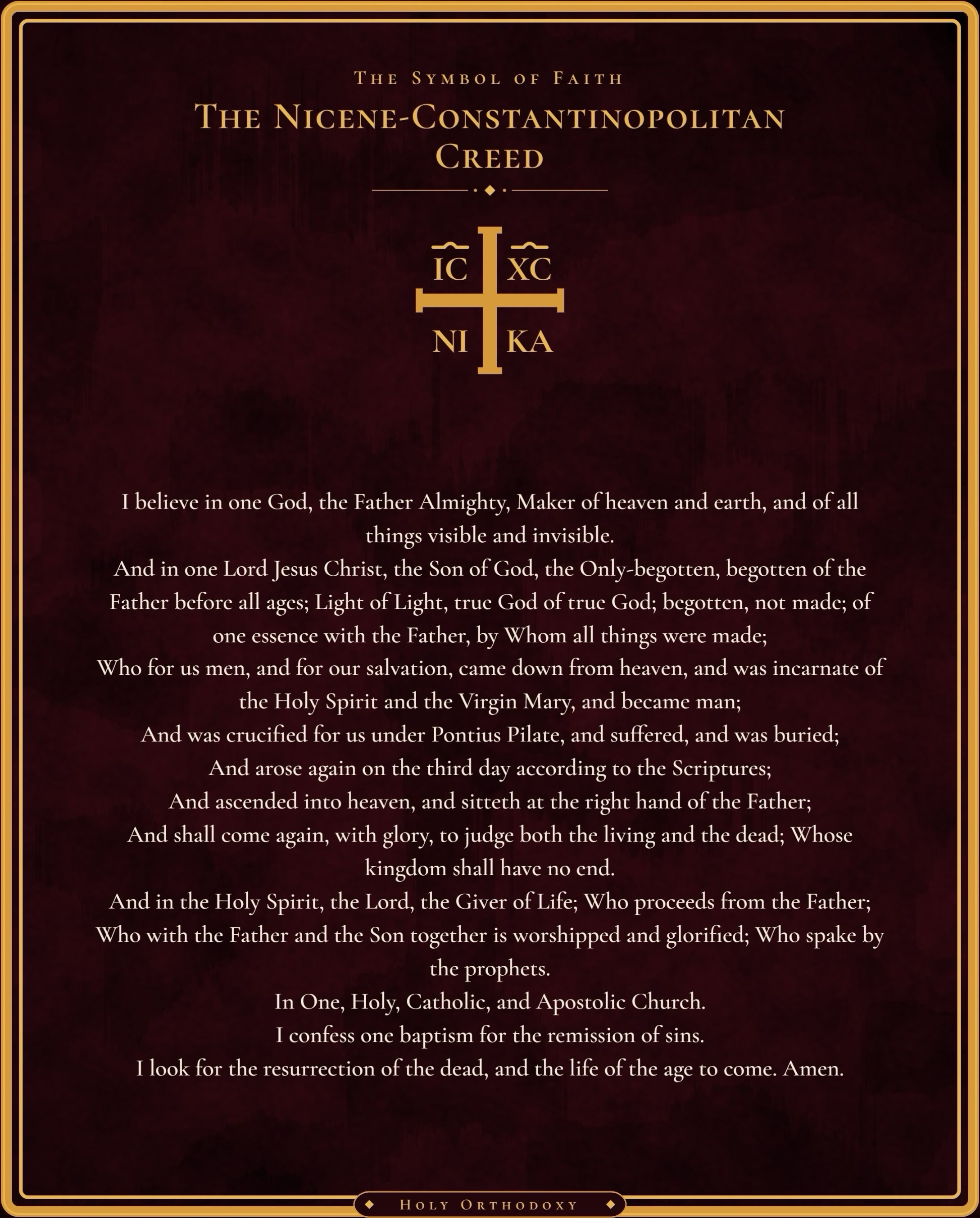
The post presents the full text of the Symbol of Faith, the Nicene-Constantinopolitan Creed, in the form the Orthodox Church uses. It notes that the Creed was begun at the First Ecumenical Council in Nicaea in 325 and completed at the Second Ecumenical Council in Constantinople in 381. For more than 1,600 years the Orthodox Church has confessed it word for word, exactly as the councils gave it, and it is said aloud at every Divine Liturgy and at…

The post presents the full text of the Symbol of Faith, the Nicene-Constantinopolitan Creed, in the form the Orthodox Church uses. It notes that the Creed was begun at the First Ecumenical Council in Nicaea in 325 and completed at the Second Ecumenical Council in Constantinople in 381. For more than 1,600 years the Orthodox Church has confessed it word for word, exactly as the councils gave it, and it is said aloud at every Divine Liturgy and at every baptism.

The post then prints the Creed in full. It opens with belief in one God, the Father Almighty, Maker of heaven and earth, and of all things visible and invisible, and in one Lord Jesus Christ, the Son of God, the Only-begotten, begotten of the Father before all ages, Light of Light, true God of true God, of one essence with the Father.

It confesses that Christ came down from heaven for us men and for our salvation, was incarnate of the Holy Spirit and the Virgin Mary, was crucified under Pontius Pilate, suffered and was buried, arose again on the third day according to the Scriptures, ascended into heaven, sits at the right hand of the Father, and shall come again with glory to judge the living and the dead.

The Creed continues with the Holy Spirit, the Lord and Giver of Life, Who proceeds from the Father, is worshipped and glorified together with the Father and the Son, and spoke by the prophets, followed by confession of the One, Holy, Catholic and Apostolic Church, one baptism for the remission of sins, the resurrection of the dead, and the life of the age to come.

The author suggests saving the text to learn it and sharing it with someone who has asked what Orthodox Christians believe.

  • The Creed was begun at the First Ecumenical Council in Nicaea (325) and completed at the Second in Constantinople (381).
  • The Orthodox Church has confessed it word for word for over 1,600 years.
  • It is said aloud at every Divine Liturgy and at every baptism.
  • The full text is given, from 'I believe in one God' through the resurrection of the dead and the life of the age to come.
  • The Creed names Christ as of one essence with the Father and the Holy Spirit as proceeding from the Father.
Read more
George Instagram discussion

Feeling Christ's Love Requires Forgiving the Undeserving

The speaker describes a common experience: years of Orthodox practice, attending church, lighting candles, fasting, praying, yet still feeling empty inside. He realized the purpose of faith is not rule-keeping but feeling Christ's love, warmth, and peace, the sense that Christ is truly present. Those who truly feel Christ's presence are the ones trying to become like him, not the ones who know the most. Traditions are important and should be…

The speaker describes a common experience: years of Orthodox practice, attending church, lighting candles, fasting, praying, yet still feeling empty inside. He realized the purpose of faith is not rule-keeping but feeling Christ's love, warmth, and peace, the sense that Christ is truly present. Those who truly feel Christ's presence are the ones trying to become like him, not the ones who know the most.

Traditions are important and should be kept, but most people stop at traditions and do not move beyond them. Many claim belief and Orthodox identity yet refuse to forgive, to stop hating, or to be humble, saying that is not who they are or that they are not good at it. Christ is met precisely when everything is against you: when someone laughs at you, hurts you, makes you feel your worst, and you still find strength to forgive.

Christ himself said loving only those who love you brings no reward, and on the cross he prayed, "Father, forgive them, for they don't know what they are doing." St. John wrote that anyone who says he loves God but hates his brother is a liar, so to feel Christ's love you must give it first, especially to the one who least deserves it.

Key moments

  1. Many people practice their faith for years, going to church, lighting candles, fasting, praying, and still feel empty inside.
  2. The speaker found that the whole point of faith is not rule-keeping but feeling Christ's love, warmth, and peace, the sense that Christ is truly with you.
  3. Those who truly feel Christ's presence are the ones trying to become like him, not the ones who know the most.
  4. Traditions are important and should be kept, but most people stop at traditions and do not move beyond them.
  5. Many claim belief and Orthodox identity yet refuse to forgive, to stop hating, or to be humble, saying 'that's not me' or 'I'm not good at that.'
  6. Christ is met precisely when everything is against you: when someone laughs at you, hurts you, makes you feel your worst, and you still find strength to forgive.
  7. Christ himself said loving only those who love you brings no reward, and on the cross he prayed, 'Father, forgive them, for they don't know what they are doing.'
  8. St. John wrote that anyone who says he loves God but hates his brother is a liar, so to feel Christ's love you must give it first, especially to the one who least deserves it.
13 opinions in the discussion Hi George, I'm pretty new to Christianity and now exploring Orthodoxy. I've prayed a few times, should I continue and add fasting? I haven't been to an Orthodox church yet, should I hold… Read the discussion

Gerontas Filimon: patience waters the heart like a drizzle

Gerontas Filimon of the Holy Skete of Prophet Elias on Mount Athos teaches that when a person is in distress, the first response must be patience and the avoidance of tension. He compares God's mercy to a light drizzle that gently waters the heart, not a waterfall. The miracle belongs to God; our role is to strive to be a living example for the suffering person to imitate. He cites Saint John Chrysostom, who said a Christian is like a rider on a…

Gerontas Filimon of the Holy Skete of Prophet Elias on Mount Athos teaches that when a person is in distress, the first response must be patience and the avoidance of tension. He compares God's mercy to a light drizzle that gently waters the heart, not a waterfall. The miracle belongs to God; our role is to strive to be a living example for the suffering person to imitate.

He cites Saint John Chrysostom, who said a Christian is like a rider on a horse whom everyone watches; observers see the example and recognize a Christian by it. Patience is required throughout all spiritual life, in relations with others, and in forgiveness; without it, nothing succeeds. Modern habits of speed and efficiency do not apply to spiritual matters, because God's grace works slowly.

Key moments

  1. When another person is in distress, the first thing to do is practice patience and not create tensions, letting God's mercy water their heart like a light drizzle, not a waterfall.
  2. The miracle belongs to God; our role is to try to be an example and model for that person to imitate.
  3. Saint John Chrysostom said a Christian is like a rider on a horse whom everyone watches; they see the example and say, 'That is a Christian.'
  4. Patience is necessary in all of spiritual life, with fellow human beings, and in forgiveness; without patience, nothing works.
  5. We have all learned to be fast and effective, but that is not how it works; the grace of God works slowly.
Orthodox Life Instagram

Saint George Karslides: New Confessor of Drama

The post recounts the life of Saint George Karslides, the New Confessor of Drama. Born Athanasios in 1901 in Argyroupolis, Pontos, he was orphaned as an infant and raised by his pious grandmother, who nurtured his love for the liturgical life. As a child tending sheep, he experienced visions that foretold his monastic calling. He traveled to Georgia and was tonsured a monk in 1919 under the name Symeon. During communist persecutions, he was…

The post recounts the life of Saint George Karslides, the New Confessor of Drama. Born Athanasios in 1901 in Argyroupolis, Pontos, he was orphaned as an infant and raised by his pious grandmother, who nurtured his love for the liturgical life. As a child tending sheep, he experienced visions that foretold his monastic calling.

He traveled to Georgia and was tonsured a monk in 1919 under the name Symeon. During communist persecutions, he was arrested, severely tortured, and sentenced to death by firing squad, but survived the execution attempt. He was ordained a priest in 1925, taking the name George. In 1929 he relocated to Greece and settled in the village of Taxiarches (Sipsa) near Drama, where he founded the Monastery of the Ascension of Christ.

The monastery became a spiritual center for the region. Father George lived a rigorous ascetic life, keeping daily vigils, eating wild greens, and wearing the same cassock for thirty years. He was known for spiritual gifts including clairvoyance, healing, and discernment of hearts. During World War II, Bulgarian occupation forces led him away to be executed, but they fled in panic after his calm prayer filled them with fear.

Witnesses also reported seeing him levitate during the Divine Liturgy. He predicted the exact day of his death and reposed peacefully on November 4, 1959, at age 58. His gravesite behind the monastery church became a major shrine where pilgrims continue to report miraculous healings.

  • Born 1901 in Argyroupolis, Pontos; orphaned and raised by pious grandmother.
  • Tonsured monk Symeon in Georgia 1919; survived communist firing squad; ordained priest George 1925.
  • Founded Monastery of the Ascension in Taxiarches, Drama, 1929; lived strict asceticism.
  • Known for clairvoyance, healing, discernment; Bulgarian execution attempt failed 1941; levitation during Liturgy witnessed.
  • Predicted death date; reposed November 4, 1959; gravesite became shrine with reported healings.
Read more

Why God Makes Some Wait: Lessons from Joseph and Moses

The speaker contrasts those who experience early success with those who endure long wilderness seasons, noting that early success carries spiritual dangers such as pride, arrogance, temptation, and forgetting the God who blessed them. Biblical figures such as Joseph and Moses illustrate how God develops character in private before public purpose. Joseph was betrayed by his brothers, sold into slavery, and imprisoned before becoming ruler of…

The speaker contrasts those who experience early success with those who endure long wilderness seasons, noting that early success carries spiritual dangers such as pride, arrogance, temptation, and forgetting the God who blessed them. Biblical figures such as Joseph and Moses illustrate how God develops character in private before public purpose.

Joseph was betrayed by his brothers, sold into slavery, and imprisoned before becoming ruler of Egypt. Moses spent 40 years in the wilderness before God called him to lead His people. The speaker warns that suffering does not automatically mean one is chosen for greatness, nor does success guarantee God's approval; the real measure is whether one is becoming more like Christ in humility, patience, discipline, and faith.

God's primary work is building the soul, not finances, career, or reputation. The listener is urged to stop comparing timelines and remain faithful in work and prayer.

Key moments

  1. Early success comes with spiritual dangers: pride, arrogance, temptation, and forgetting the God who blessed you.
  2. Joseph was betrayed by his brothers, sold into slavery, and imprisoned before becoming ruler of Egypt.
  3. Moses spent 40 years in the wilderness before God called him to act out his purpose.
  4. God develops your character in private before allowing you to act out your purpose in public.
  5. Success without humility can destroy a man; influence without wisdom can corrupt him; authority without self-control can become dangerous.
  6. Your suffering does not automatically mean you are chosen for greatness, and your success does not automatically mean you have God's approval.
  7. The real question is whether you are becoming more like Christ in humility, patience, discipline, and faith.
  8. The greatest thing God is building is your soul, not your finances, career, or reputation.
4 opinions in the discussion He doesn't care Read the discussion
Prayer Orthodoxy ® Instagram

Psalm 50: The Penitential Prayer at the Heart of Orthodox Worship

The post shares the text of Psalm 50, known in the Orthodox Church as the great penitential psalm attributed to the prophet and king David. The psalm is presented in English and Greek, accompanied by an image that displays eight panels with verses from the Septuagint numbering. The first panel names the location: St. Nicholas Greek Orthodox Chapel in Protaras, Cyprus. The following panels contain the opening verses: "Have mercy on me, O God,…

The post shares the text of Psalm 50, known in the Orthodox Church as the great penitential psalm attributed to the prophet and king David. The psalm is presented in English and Greek, accompanied by an image that displays eight panels with verses from the Septuagint numbering. The first panel names the location: St. Nicholas Greek Orthodox Chapel in Protaras, Cyprus.

The following panels contain the opening verses: "Have mercy on me, O God, according to Thy great mercy" (Psalm 50:1), "Wash me thoroughly from mine iniquity" (50:2-3), "Thou shalt sprinkle me with hyssop, and I shall be made clean" (50:7), "A heart that is clean create in me, O God" (50:10), "Cast me not away from Thy presence" (50:11), "Restore unto me the joy of Thy salvation" (50:12), and "A sacrifice unto God is a broken spirit; a heart that is broken and humbled God will not despise" (50:17). The post ends with a question asking which verse speaks most deeply to the reader.

  • Psalm 50 attributed to King David as a prayer of repentance
  • Text given in English and Greek with an image of selected verses
  • Location noted as St. Nicholas Greek Orthodox Chapel in Protaras, Cyprus
  • Verses displayed include pleas for mercy, cleansing, and a renewed spirit
  • Post invites readers to reflect on which verse touches them most
Read more