WeOrthodox
EN UA

Mireasma Athosului Η Ευωδία του Αγίου Όρους

Instagram ↗ 19 discussions

Preasfântă Născătoare de Dumnezeu, miluiește-ne pe noi🙏☦️

Saint Simon's Cave on Mount Athos and the Founding of Simonopetra

0:44

The post describes the cave where Saint Simon the Myrrh-Gusher lived in solitude on Mount Athos. It notes that he practiced fasting, prayer, and complete devotion to Christ. According to Athonite tradition, Saint Simon saw a divine light on a nearby rock, which led him to establish the Holy Monastery of Simonopetra in the 13th century. The monastery was originally named New Bethlehem. The text is presented in both English and Greek.

  • Saint Simon the Myrrh-Gusher lived in a cave on Mount Athos in solitude, fasting, and prayer.
  • Athonite tradition says he witnessed a divine light on a rock.
  • This vision led him to found the Holy Monastery of Simonopetra in the 13th century.
  • The monastery was originally called New Bethlehem.
  • The post includes both English and Greek versions of the account.
Read more

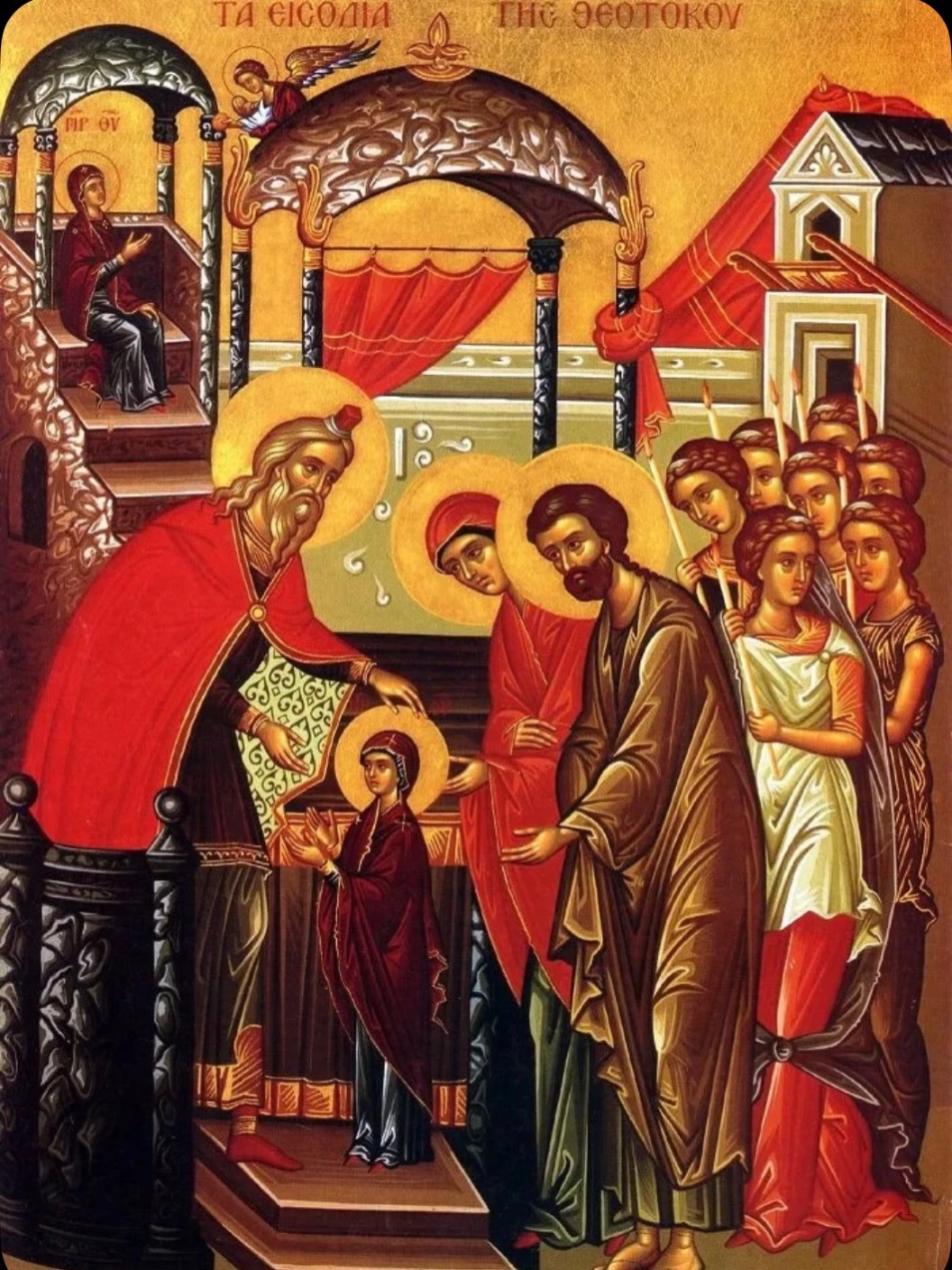
The Entrance of the Theotokos into the Temple

The post describes the feast of the Entrance of the Theotokos into the Temple, celebrated on 21 November. Mary was three years old when her parents, Joachim and Anna, fulfilled their promise to dedicate her to God. She walked up the fifteen steps of the Temple unaided. The high priest Zachariah received her. She remained in the Temple praying, reading, and serving, becoming the Living Temple who would later carry Christ. The post concludes that…

The post describes the feast of the Entrance of the Theotokos into the Temple, celebrated on 21 November. Mary was three years old when her parents, Joachim and Anna, fulfilled their promise to dedicate her to God. She walked up the fifteen steps of the Temple unaided. The high priest Zachariah received her.

She remained in the Temple praying, reading, and serving, becoming the Living Temple who would later carry Christ. The post concludes that God keeps His promises and prepares people in secret before using them, ending with the invocation "Most Holy Theotokos, pray for us."

  • Feast of the Entrance of the Theotokos observed on 21 November.
  • Mary entered the Temple at age three after her parents vowed to dedicate her.
  • She ascended the fifteen steps alone and was received by High Priest Zachariah.
  • She lived in the Temple praying, reading, and serving, becoming the Living Temple.
  • The post affirms that God keeps promises and prepares His servants in secret.
Read more

Ancient Stephen stone at Milișăuți holds prayers of those before us

The author reflects on places that stay with a person long after a visit. At Milișăuți, an old stone from the time of Stephen the Great still keeps the prayers of earlier generations.

  • Some places are carried in the heart after leaving.
  • Milișăuți has an ancient stone dating to Stephen the Great.
  • The stone preserves the prayers of those who came before.

The Theotokos as Model and Protectress of Mount Athos

The post presents the Orthodox Church's veneration of the Most Holy Theotokos as the model of purity, obedience, and complete devotion to God for nearly two thousand years. It states the ancient tradition that Mount Athos became her inheritance and is known as the Garden of the Panagia. For over a thousand years, monks have lived and prayed on the Holy Mountain under her protection, continually invoking her intercession with the prayer "Most Holy Theotokos, save us" (Υπεραγία Θεοτόκε, σώσον ημάς).

  • The Church has honored the Theotokos as model of purity, obedience, and devotion for nearly 2000 years
  • Ancient tradition holds Mount Athos as the Theotokos's inheritance, called the Garden of the Panagia
  • Monks have lived and prayed on Mount Athos under her protection for over 1000 years
  • The continual monastic prayer is "Most Holy Theotokos, save us" in Greek and English
  • The post presents this teaching in both English and Greek
Read more

Do Christians and Muslims worship the same God? Orthodoxy says no

The author argues that Christians and Muslims do not worship the same God. He cites Vatican II's Lumen Gentium 16 and Catechism 841, which state that Muslims adore the one merciful God together with Christians, but he rejects this as ecumenical relativism. Orthodoxy teaches that God is one in essence and three in persons, Father, Son, and Holy Spirit, from all eternity. Citing 1 John 2:23, the author notes that whoever denies the Son does not…

The author argues that Christians and Muslims do not worship the same God. He cites Vatican II's Lumen Gentium 16 and Catechism 841, which state that Muslims adore the one merciful God together with Christians, but he rejects this as ecumenical relativism. Orthodoxy teaches that God is one in essence and three in persons, Father, Son, and Holy Spirit, from all eternity.

Citing 1 John 2:23, the author notes that whoever denies the Son does not have the Father. Islam denies the Son, the Incarnation, the Crucifixion, and the Trinity; therefore it worships a different deity, which he describes as demonic. He references St. Mark of Ephesus, who refused union without truth, and St. Justin Popovich, who called ecumenism the heresy of all heresies.

The author concludes that monotheism alone is not Christianity, since demons are also monotheists, and Christians worship the Trinity alone.

Key moments

  1. 0:00 The speaker asserts that Christians and Muslims do not worship the same God.
  2. 0:00 He references Catechism 841 which states Muslims adore the one God with Christians, but calls this ecumenism relativism.
  3. 0:00 Orthodoxy rejects this view; God is one in essence, three in persons, Father, Son, and Holy Spirit, from all eternity.
  4. 0:00 The Father and Son cannot be split; denying the Son means denying the Father.
  5. 0:00 Islam denies the Son, the Incarnation, the Crucifixion, and the Trinity, which constitutes a different deity and is demonic.
  6. 0:00 St. Mark of Ephesus refused union without truth.
  7. 0:00 St. Justin Popovich called ecumenism the heresy of all heresies.
  8. 0:00 Monotheism alone is not Christianity; demons are monotheists too; Christians worship the Trinity and nothing else.

Fasting as training for spiritual warfare against Satan

The author writes that Satan seeks to stop spiritual fighting not only through evil acts but by inducing weariness, distraction, comfort, and procrastination. Fasting serves as training for the real battle against temptations such as lust, anger, and pride. By practicing denial for forty days, the soul learns to say no when stronger temptations arise. The speaker in the accompanying video argues that modern Christianity has reduced fasting to a…

The author writes that Satan seeks to stop spiritual fighting not only through evil acts but by inducing weariness, distraction, comfort, and procrastination. Fasting serves as training for the real battle against temptations such as lust, anger, and pride. By practicing denial for forty days, the soul learns to say no when stronger temptations arise.

The speaker in the accompanying video argues that modern Christianity has reduced fasting to a dietary practice, while true fasting is spiritual warfare. The difficulty of fasting stems from a lifetime of indulgence, and the pain of denial is intentional. Saints fasted to become dangerous to the devil, to sin, and to their own flesh, not to be agreeable.

The post urges believers to treat the fast as war, not a diet, and to fight harder when hunger comes rather than give up. The message connects the Nativity Fast to this understanding of spiritual preparation. The video further explains that fasting was never about food but about the soul learning to kill what it loves.

The struggle arises because every desire has been indulged, so saying no hurts, and that pain is the point. The saints fasted to be dangerous to the devil, to sin, and to their own flesh, not to be nice. The author concludes by urging readers to stop treating the fast like a diet and start treating it like war: in war one does not give up because of hunger but fights harder to win.

Key moments

  1. Fasting was never about food; it is about the soul learning to kill what it loves.
  2. The struggle comes because every time you wanted something in life you got it, and now saying no hurts, and that pain is supposed to happen.
  3. The saints fasted to be dangerous to the devil, to sin, and to their own flesh, not to be nice.
  4. Stop treating the fast like a diet and start treating it like war: in war you do not give up because you are hungry, you fight harder to win.
Read more

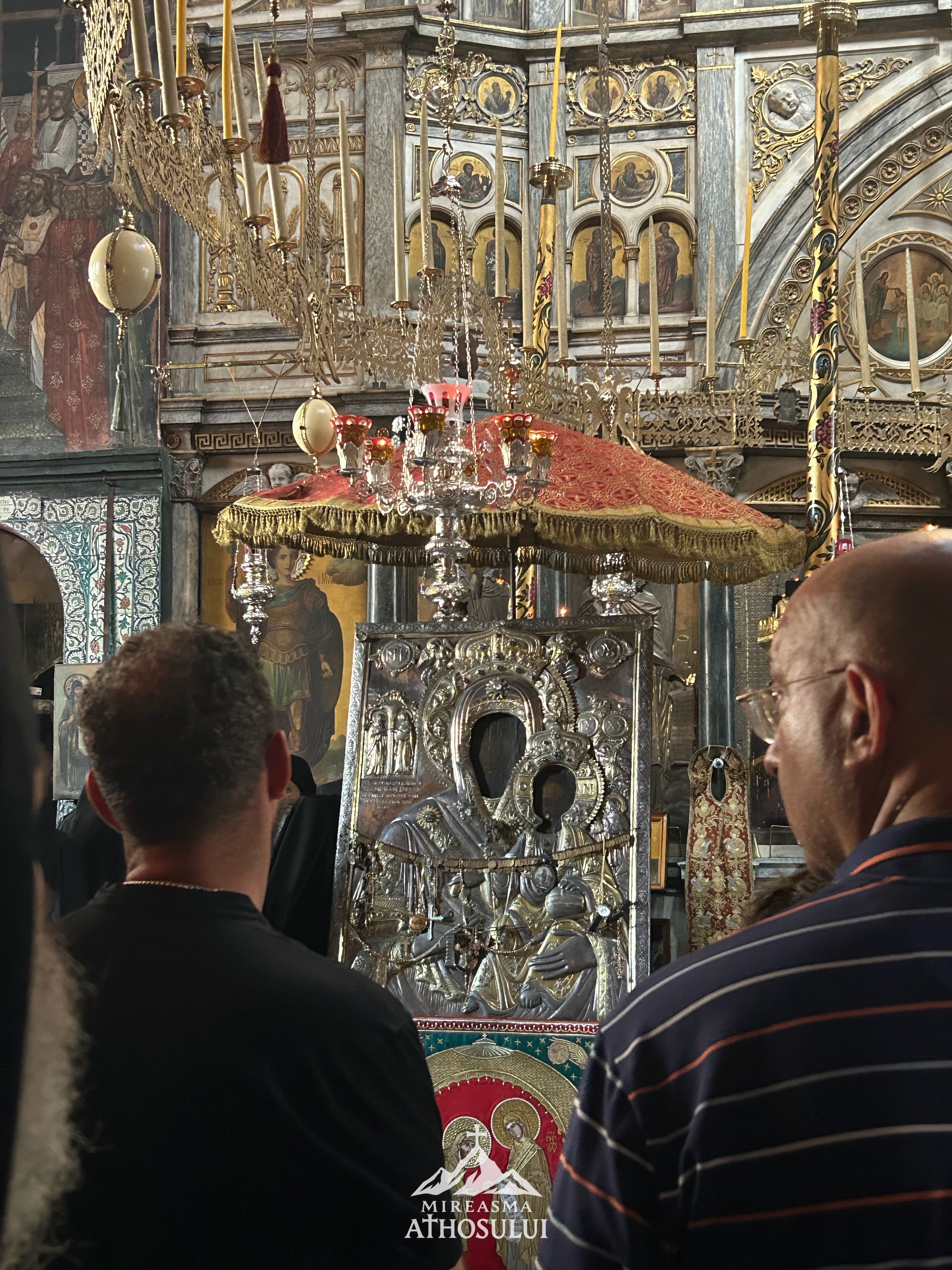
The icon of the Mother of God 'Koukouzelissa' at the Great Lavra

The post presents the icon of the Mother of God known as 'Koukouzelissa' (Cucuzelița), kept at the Great Lavra monastery on Mount Athos. The accompanying images show the icon in detail, including its inscriptions. Around the figures the Greek text reads 'MP ΘY' (Meter Theou, Mother of God) and 'NI', while below appears the prayer 'Θεοτόκε βοήθει τω δούλω σου Ιωάννη τω Παπαδόπουλω', 'Mother of God, help your servant John the Papadopoulos'. The…

The post presents the icon of the Mother of God known as 'Koukouzelissa' (Cucuzelița), kept at the Great Lavra monastery on Mount Athos. The accompanying images show the icon in detail, including its inscriptions. Around the figures the Greek text reads 'MP ΘY' (Meter Theou, Mother of God) and 'NI', while below appears the prayer 'Θεοτόκε βοήθει τω δούλω σου Ιωάννη τω Παπαδόπουλω', 'Mother of God, help your servant John the Papadopoulos'.

The name Koukouzelissa connects the icon with the tradition of St. John Koukouzelis, the famous Athonite cantor, to whom the icon is associated in Athonite memory. The post offers the icon itself for veneration and viewing, with no further discussion in the thread.

  • The icon of the Mother of God 'Koukouzelissa' is kept at the Great Lavra on Mount Athos.
  • The images show the icon in close detail.
  • The inscription includes the prayer 'Mother of God, help your servant John the Papadopoulos'.
  • The icon's name is linked to St. John Koukouzelis, the Athonite cantor.

Hieromonk Theodosios chants a hymn to the Theotokos on her purity and Gabriel's greeting

The video presents a fragment of a liturgical hymn addressed to the Theotokos, chanted by Hieromonk Theodosios at the Cell of the Holy Unmercenaries in New Skete. The hymn references the Theotokos's purity and the announcement of the Archangel Gabriel, who cries out to her. It poses the question of what name to give to the one who received the Word in her womb, and concludes with a petition for grace. The recording captures the chanting in a monastic setting.

Key moments

  1. The hymn addresses the Theotokos, mentioning her purity and Gabriel's announcement to her.
Read more

Apolytikion of Saint Nektarios in Dutch praises him as friend of the poor and healer

The video presents the Apolytikion of Saint Nektarios sung in Dutch. The hymn identifies Nektarios as the son of Selymbria who appeared in recent years as a friend of the poor. It calls believers to venerate him as servants inspired by hope in Christ. The text states that healing flows from him to all who beseech him with devotion. Glory is given to Nektarios who was promised, and to Christ who works wonders and healing through him.

Key moments

  1. The hymn identifies Nectarius as the son of Selymbria who appeared as a friend of the poor in the last years.
  2. Believers are called to honor Nectarius as servants animated by hope in Christ.
  3. Healing springs from Nectarius for all who entreat him with devotion.
  4. Glory is given to Nectarius who was promised, and to Christ who makes wonders and healing known through him.
Read more

Saint Paisios: From Civil War Radio Operator to Holy Mount Hermit

The post shows the path to Panagouda, the humble cell of Saint Paisios on Mount Athos, and includes a video summary of his life. Before monasticism he was Arsenios Hatzis, a radio operator in the Greek Civil War who repeatedly chose the most dangerous posts so that men with families could be spared. He bore the safety of others as a joy. Later he went to the Holy Mountain and took the name Paisios. Pilgrims climbed for hours to reach his small…

The post shows the path to Panagouda, the humble cell of Saint Paisios on Mount Athos, and includes a video summary of his life. Before monasticism he was Arsenios Hatzis, a radio operator in the Greek Civil War who repeatedly chose the most dangerous posts so that men with families could be spared. He bore the safety of others as a joy. Later he went to the Holy Mountain and took the name Paisios.

Pilgrims climbed for hours to reach his small hut, and he received each one, often naming their sorrow before they spoke. He gave his days to prayer and his heart to everyone who sought him. His counsel remains: guard the heart, forgive quickly, trust each care to God, and let humility open the way to joy. The post ends with a short prayer to Saint Paisios in English and Greek.

Key moments

  1. Arsenios Hatzis served as a radio operator in the Greek Civil War and repeatedly took the most dangerous posts so that men with wives and children might be spared.
  2. He carried the safety of others on his own shoulders and counted it a joy.
  3. He went to the Holy Mount and took the name Paisios.
  4. Pilgrims climbed for hours to reach his small hut and he received each one, often naming the sorrow before a word was spoken.
  5. He gave his days to prayer and his heart to everyone who sought him.
  6. His counsel: guard the heart, forgive quickly, trust each care to God, and let humility open the way to joy.
Read more

"Papouli, I Want to Be a Good Person": St. Paisios and a Child's Faith

The post shares a recorded scene with St. Paisios the Athonite. It begins to drizzle and an elder says he has lost his sight, telling him, "I cannot see you, geronda, I cannot see you." St. Paisios answers warmly that they can still be friends. He asks a child about school and learns that everything is fine and that the children have a very good teacher, Mrs. Sofia. He asks the children to say a prayer for her, because her husband died and she…

The post shares a recorded scene with St. Paisios the Athonite. It begins to drizzle and an elder says he has lost his sight, telling him, "I cannot see you, geronda, I cannot see you." St. Paisios answers warmly that they can still be friends. He asks a child about school and learns that everything is fine and that the children have a very good teacher, Mrs. Sofia.

He asks the children to say a prayer for her, because her husband died and she is very sad. He then asks a child what he wants to ask God for, and the child answers that he wants God to help him be a good child. The child affectionately calls St. Paisios "Papouli," meaning Grandfather, and with the innocence of a pure heart expresses his desire to become a good person.

Later, the elder recognizes someone by the sound of a komboskini, the prayer rope, saying "Is that you?", tells him to get up, and says "Thank our Christ." The post frames the scene as a reminder of the beauty of childlike faith, humility, and God's grace, quoting Luke 1:37: "For with God nothing will be impossible." The Greek text accompanying the post says that faith sees where the eyes cannot.

The post consists of the scene itself with this short reflection; there is no further discussion beyond the description of the encounter and the verse.

Key moments

  1. The elder says he suddenly lost his sight when it began to drizzle: 'I cannot see you, geronda.'
  2. He tells the child they can still be friends even though he cannot see him.
  3. A child reports that school is going well and that they have a very good teacher, Mrs. Sofia.
  4. The elder asks the children to pray for Mrs. Sofia, because her husband died and she is very sad.
  5. Asked what he wants from God, a child answers: 'To help me be a good child.'
  6. The elder recognizes someone through his komboskini, asks 'Is that you?', tells him to get up, and says to thank our Christ.
Read more

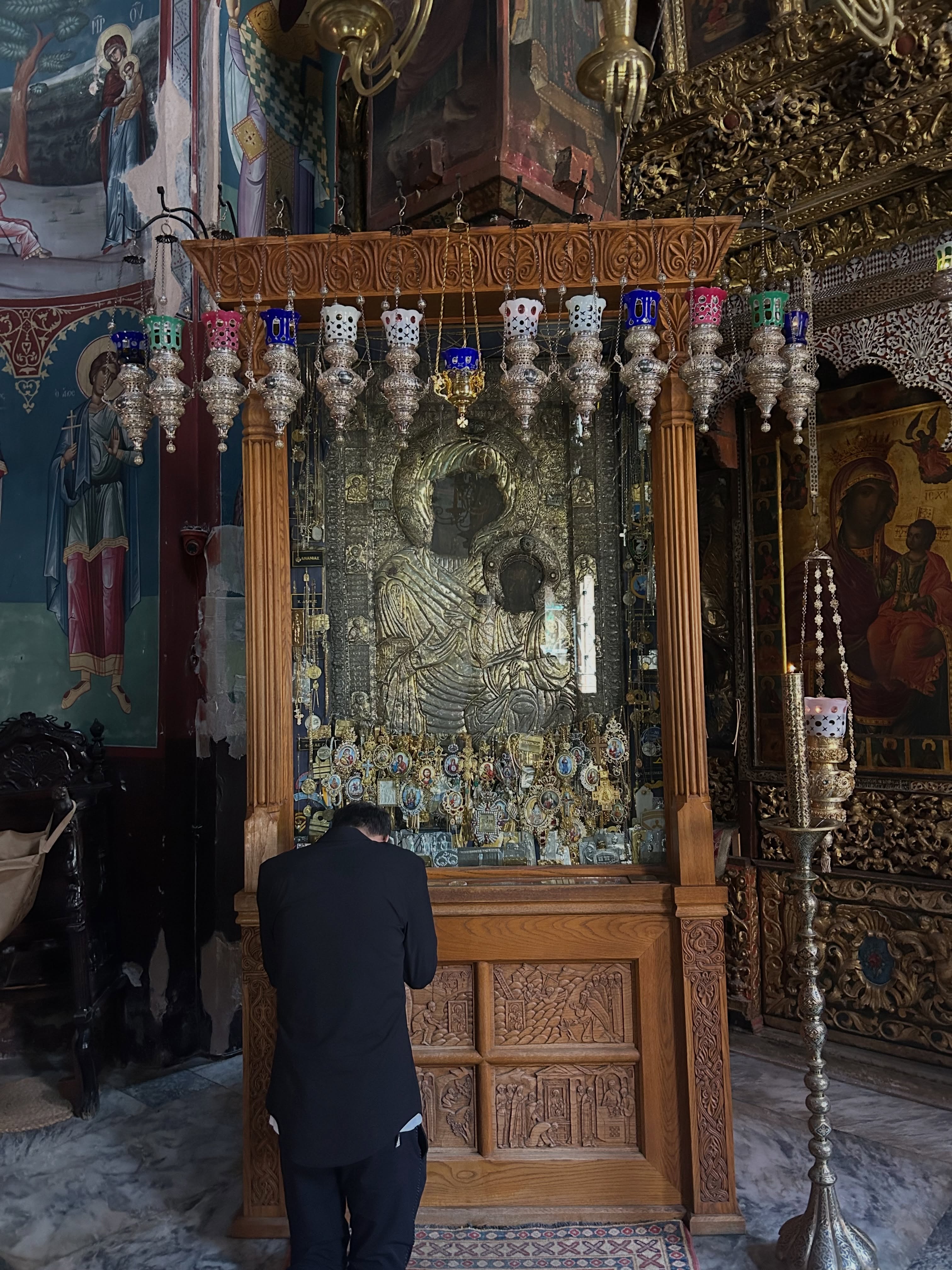
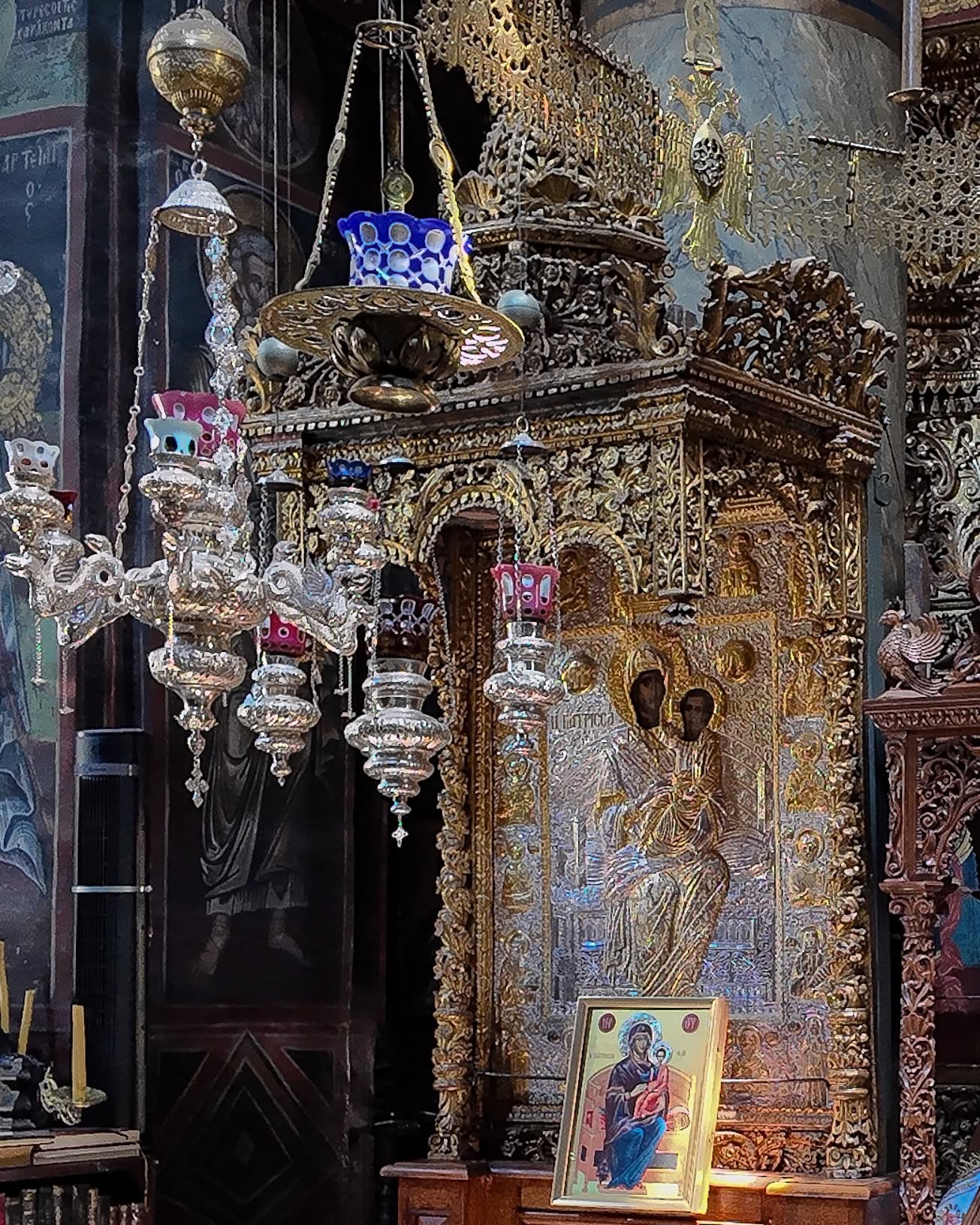
The Portaitissa icon of the Mother of God at Iviron Monastery

The post presents the icon of the Mother of God known as the Portaitissa, kept at the Holy Monastery of Iviron on Mount Athos. The text names the icon in Romanian and Greek, identifying it as the image of the Panagia Portaitissa from Iviron Monastery. The accompanying image shows the icon with the Mother of God holding Christ, with the usual Greek abbreviations marking the names of Jesus Christ and the Mother of God, and the title Hagios (Holy)…

The post presents the icon of the Mother of God known as the Portaitissa, kept at the Holy Monastery of Iviron on Mount Athos. The text names the icon in Romanian and Greek, identifying it as the image of the Panagia Portaitissa from Iviron Monastery. The accompanying image shows the icon with the Mother of God holding Christ, with the usual Greek abbreviations marking the names of Jesus Christ and the Mother of God, and the title Hagios (Holy) inscribed on the halos.

No further story, teaching or discussion accompanies the post; it stands as a presentation of this well-known wonderworking icon of the Athonite monastery, which is one of the most venerated images of the Mother of God in the Orthodox world.

  • The icon shown is the Portaitissa of the Mother of God at Iviron Monastery on Mount Athos.
  • The post names the icon in both Romanian and Greek.
  • The image shows the Mother of God with Christ Child and standard Greek inscriptions identifying them.
  • Iviron Monastery is the home of this venerated icon.
Read more

Why Orthodox Christians Venerate the Theotokos

The post explains why the Panagia, the Most Holy Theotokos, holds a central place in Orthodox Christian devotion. Through her humility, obedience, and unwavering faith, she became the Mother of Jesus Christ, the Lord and Savior. Orthodox Christians honor her as the Mother of God, seek her prayers and intercessions, and turn to her as a loving mother who continually directs them toward her Son. The Greek text repeats these themes: the Theotokos…

The post explains why the Panagia, the Most Holy Theotokos, holds a central place in Orthodox Christian devotion. Through her humility, obedience, and unwavering faith, she became the Mother of Jesus Christ, the Lord and Savior. Orthodox Christians honor her as the Mother of God, seek her prayers and intercessions, and turn to her as a loving mother who continually directs them toward her Son.

The Greek text repeats these themes: the Theotokos occupies a unique place in every Orthodox heart, and through her virtues she was deemed worthy to become the Mother of the Lord. The faithful venerate her as Theotokos, ask for her intercessions, and take refuge in her maternal protection, knowing she always leads them to her Son.

The post concludes with the traditional invocation "Hyperagia Theotoke, soson imas" (Most Holy Theotokos, save us). An image accompanying the post shows icon inscriptions referring to the Mother of God the Faithful and similar liturgical titles. The post is attributed to Prayer Orthodoxy.

  • The Theotokos is central to Orthodox devotion due to her humility, obedience, and faith
  • She is honored as Mother of God who became worthy through her virtues
  • Orthodox Christians seek her prayers and intercessions
  • She is viewed as a loving mother who always points to Christ
  • The post includes the traditional prayer "Most Holy Theotokos, save us"
Read more

Apolytikion of Saint Gabriel of Georgia in Dutch

The post presents the Apolytikion of Saint Gabriel of Georgia in the Dutch language. The hymn addresses Gabriel as a God-inspired monk and priest who was proven in his divine way of life. It venerates him as a beacon of spiritual insight and a healer of the sick, from whom abundant power flows. The faithful call upon him as father and grant of God's ways, asking for his blessing upon all who honor him. This Apolytikion is a liturgical hymn sung…

The post presents the Apolytikion of Saint Gabriel of Georgia in the Dutch language. The hymn addresses Gabriel as a God-inspired monk and priest who was proven in his divine way of life. It venerates him as a beacon of spiritual insight and a healer of the sick, from whom abundant power flows.

The faithful call upon him as father and grant of God's ways, asking for his blessing upon all who honor him. This Apolytikion is a liturgical hymn sung in honor of the saint, expressing the Church's veneration and seeking his intercession. The Dutch translation makes this traditional Orthodox hymn accessible to Dutch-speaking faithful.

Key moments

  1. The hymn addresses Gabriel as a God-inspired monk and priest proven in his divine life.
  2. Gabriel is venerated as a beacon of spiritual insight and a healer of the sick.
  3. The faithful ask Gabriel, as father and grant of God's ways, to bestow his blessing on those who honor him.

Mount Athos: The Garden of the Theotokos

The post describes Mount Athos as a center of Orthodox monasticism for over a thousand years. Known as the Garden of the Most Holy Theotokos, the Holy Mountain is dedicated to the Virgin Mary, honored by monks as its Abbess and Protectress. Generations of monks have devoted their lives to Christ there, continually seeking the intercessions of the Panagia.

  • Mount Athos has been a center of Orthodox monasticism for over a thousand years
  • It is known as the Garden of the Most Holy Theotokos
  • The Virgin Mary is honored as Abbess and Protectress of the Holy Mountain
  • Monks devote their lives to Christ and seek the Panagia's intercessions
  • The description is given in both English and Greek
Read more

Mount Athos: The Garden of the Theotokos and a millennium of monastic life

The post describes Mount Athos as the Garden of the Most Holy Theotokos, a center of Orthodox monasticism for over a thousand years. The Holy Mountain is dedicated to the Virgin Mary, whom the monks honor as its Abbess and Protectress. Generations of monks have devoted their lives to Christ there, continually seeking the Panagia's intercessions.

  • Mount Athos has been a center of Orthodox monasticism for over a thousand years
  • It is known as the Garden of the Theotokos, dedicated to the Virgin Mary
  • Monks honor the Theotokos as Abbess and Protectress of the Holy Mountain
  • Generations of monks have lived lives of prayer, fasting, and spiritual struggle
  • The post includes the prayer "Most Holy Theotokos, save us" in English and Greek
Read more

St. Demetrios Cathedral: 5th-century basilica with relics and martyrdom crypt

The post describes the Cathedral of Saint Demetrios in Thessaloniki, Greece, one of the most important pilgrimage destinations in Orthodox Christianity. The basilica was constructed in the 5th century on the site traditionally linked to the martyrdom of Saint Demetrios, the Great Martyr, who suffered in 306 AD. He is honored as the patron saint and protector of Thessaloniki. Below the church lies the ancient crypt associated with his…

The post describes the Cathedral of Saint Demetrios in Thessaloniki, Greece, one of the most important pilgrimage destinations in Orthodox Christianity. The basilica was constructed in the 5th century on the site traditionally linked to the martyrdom of Saint Demetrios, the Great Martyr, who suffered in 306 AD. He is honored as the patron saint and protector of Thessaloniki.

Below the church lies the ancient crypt associated with his imprisonment and martyrdom, a place of deep veneration. The cathedral also houses the sacred relics of Saint Demetrios, which draw Orthodox faithful from around the world. His feast day is celebrated annually on October 26. The post includes a Greek translation of the same historical and devotional details.

Five images accompany the text: the first shows the cathedral's exterior or a title card; the second depicts an ornate altar area with a dome and rows of wooden chairs; the third reveals the interior with a dome mosaic of the Virgin Mary and Child, lit by large windows; the fourth captures a close-up of the apse with mosaics and icons, highlighting architectural details; the fifth presents the underground crypt of martyrdom.

The English and Greek texts are nearly identical, providing the same historical timeline, spiritual significance, and liturgical information. The images collectively illustrate the cathedral's architectural grandeur, its iconographic program centered on the Theotokos and the saint, and the subterranean space where the martyr's final witness occurred.

The post concludes with the invocation, "Saint Demetrios, pray unto God for us," in both English and Greek.

  • Cathedral built in the 5th century over the site of Saint Demetrios' martyrdom in 306 AD
  • Saint Demetrios is the patron saint and protector of Thessaloniki
  • Ancient crypt beneath the church linked to his imprisonment and martyrdom
  • Sacred relics of Saint Demetrios are housed in the cathedral
  • Feast day celebrated on October 26

Gunmen Attack Jordanian Orthodox Church During Funeral, Seven Killed

A social media post reports that on October 23, 2026, two gunmen attacked the Greek Orthodox Church of Saint George in Hamoud village, Al Karak, Jordan during a funeral service. According to Jordan's Public Security Directorate, seven faithful were killed and thirty-four wounded. The post states that the faithful had gathered to mourn and that what should have been prayer became terror. The Church of Saint George is described as part of the…

A social media post reports that on October 23, 2026, two gunmen attacked the Greek Orthodox Church of Saint George in Hamoud village, Al Karak, Jordan during a funeral service. According to Jordan's Public Security Directorate, seven faithful were killed and thirty-four wounded. The post states that the faithful had gathered to mourn and that what should have been prayer became terror.

The Church of Saint George is described as part of the ancient Christian community of Jordan, Christians who have kept the faith in that land since the time of the Apostles. The author asks readers to pray for the victims, their families, and the Christians of Jordan, ending with "Memory Eternal. Lord have mercy." The accompanying image text repeats the breaking news headline and details: gunmen opened fire inside the Greek Orthodox Church during a funeral, seven killed and thirty-four wounded, and notes the attack occurred during a Christian funeral.

  • Attack occurred October 23, 2026 at Greek Orthodox Church of Saint George in Hamoud, Al Karak, Jordan
  • Two gunmen opened fire during a funeral service
  • Seven killed and thirty-four wounded per Jordan's Public Security Directorate
  • Church belongs to ancient Christian community dating to Apostolic times
  • Author requests prayers for victims, families, and Christians of Jordan
Read more

Memorial Service at Orthodox Youth Camp with Athonite Abbot in Belgium

A memorial service took place at an Orthodox youth camp in Zedelgem, Belgium, with the abbot of the Athonite monastery of Pantokratoros presiding. The service included prayers for the departed. According to the video transcript, the prayer states that the continuation is for all, for everyone. It asks God to quicken the souls of his servants because he alone is immortal. It affirms that God is the one for ages of ages. It declares that God alone…

A memorial service took place at an Orthodox youth camp in Zedelgem, Belgium, with the abbot of the Athonite monastery of Pantokratoros presiding. The service included prayers for the departed. According to the video transcript, the prayer states that the continuation is for all, for everyone. It asks God to quicken the souls of his servants because he alone is immortal.

It affirms that God is the one for ages of ages. It declares that God alone is pure and the way and the truth. The post includes hashtags in English and Dutch referencing Orthodoxy and the Orthodox Church.

Key moments

  1. The continuation is for all, for everyone.
  2. Quicken also the souls of your servants, for you alone are immortal.
  3. And and and.
  4. For you are it and the ages of ages amen.
  5. You alone are pure and the way the truth that the of the of the and and the to.
Read more

Geronda Damaskinos Neoskiotis chants the Jesus Prayer with his synodia

The video shows Geronda Damaskinos Neoskiotis chanting the Greek prayer "Ὦ ἀγαθὲ καὶ φιλάνθρωπε Δέσποτα, οἰκτῖραι ἡμᾶς" (O good and philanthropic Master, have mercy on us) together with his synodia. The chant begins at the start of the recording and continues without variation for seven minutes and thirty seconds. The prayer repeats continuously from 0:00 through the end at 7:30. No other hymns, readings, or spoken words appear in the recording.…

The video shows Geronda Damaskinos Neoskiotis chanting the Greek prayer "Ὦ ἀγαθὲ καὶ φιλάνθρωπε Δέσποτα, οἰκτῖραι ἡμᾶς" (O good and philanthropic Master, have mercy on us) together with his synodia. The chant begins at the start of the recording and continues without variation for seven minutes and thirty seconds. The prayer repeats continuously from 0:00 through the end at 7:30. No other hymns, readings, or spoken words appear in the recording.

The original post title in Romanian reads "Duhul Sfânt pe toate le dăruiește" (The Holy Spirit bestows all things) and identifies the chanter as gheronda Damaschin Neoskitiotul with his synodia.

Key moments

  1. 0:00 The prayer "Ὦ ἀγαθὲ καὶ φιλάνθρωπε Δέσποτα, οἰκτῖραι ἡμᾶς" begins and repeats.
  2. 0:30 The same prayer continues without change.
  3. 1:30 Repetition of the prayer persists.
Read more