WeOrthodox
EN UA

Aparchi | Orthodox Christian Theology

YouTube 8 discussions · Open the original ↗

✨Discover the Orthodox faith through pastoral videos, theology, and living tradition.✨ Aparchi is an Orthodox Christian platform dedicated to sharing the living tradition of the Church through pastoral and catechetical videos, theological reflections, and interviews. Here you will find content…

Beyond Good Works: The Mystical Heart of Orthodox Life

Beyond Good Works: The Mystical Heart of Orthodox Life 4:32

Fr. Andreas Houpos reflects on the essential balance between active service and the mystical life that defines Orthodox Christianity. While feeding the poor, clothing the needy, and serving the community are good and necessary, they are not unique to Christianity; many non-Christians perform similar works. What distinguishes Orthodox life is communion with Christ through the mysteries of the Church — repentance, prayer, the noetic life of the heart, and above all the Divine Liturgy and the Eucharist.

The priest emphasizes that we gather not first for a sermon, social activity, or moral encouragement, but to encounter the Lord and receive His life in the Eucharist. True Orthodox service must flow from this deeper sacramental foundation, beginning in awe before the mystery of God and continuing as a lifelong journey of transformation in Christ.

The discussion highlights how an overemphasis on hands-on service often stems from a desire to participate in community and is influenced by Protestant models that prioritize activism over sacramental and noetic life. Protestantism tends to emphasize service and activity at the expense of the mysteries, repentance, and the descent of the mind into the heart.

Orthodox parishes that adopt charitable activities from other Christians face the challenge of maintaining focus on the mystical life in Christ. Converts from Protestantism frequently experience a transformative shift when they encounter the Divine Liturgy and the centrality of the Eucharist, which opens their hearts to a deeper understanding of worship and discipleship.

Even clergy must remain in continual awe and exploration of the mysteries such as baptism and the Eucharist, recognizing that a mystery easily comprehended is no mystery at all — God cannot be contained in human understanding.

  • Good works are necessary but not sufficient; the mystical life in Christ through the sacraments, prayer, and the noetic heart is the core of Orthodox identity.
  • The Divine Liturgy and the Eucharist are the center of Orthodox worship, not the sermon, fellowship, or social activism.
  • An overemphasis on service often reflects Protestant influence that prioritizes activism over sacramental and contemplative life.
  • Converts are frequently transformed by experiencing the Liturgy and the Eucharist as the heart of worship, shifting from a sermon-centered to a mystery-centered faith.

Key moments: 0:000:321:03

From Quantity to Encounter: How Orthodoxy Reshapes Thinking

From Quantity to Encounter: How Orthodoxy Reshapes Thinking 5:18

Dr. Daniel Hinshaw reflects on how Orthodox Christianity gradually transforms a person's entire way of perceiving reality, shifting from a Western, quantitative mindset — measuring spiritual life by achievements, numbers of people helped, or tasks completed — to an Orthodox vision centered on the quality of encounter, humility, and the inner life.

Drawing on the teaching of Father Roman Braga, he describes the "inner universe" and the patient struggle to move from the head into the heart, where the true question becomes whether Christ is encountered in the person standing before us. Hinshaw recounts his own journey: first encountering Orthodoxy through Timothy Ware's book in the 1970s, feeling unwelcome at a Greek parish, spending years in Anglican liturgical worship, and finally being received into the Antiochian Orthodox Church in 1995 through the witness of an Arab-American physician and his wife.

Now in later life, he senses Father Roman's continued guidance as he begins to grasp the quiet, ongoing transformation from intellectual understanding to heartfelt communion with God. The reflection emphasizes that spiritual life is not measured by external success but by the hidden, humble work of setting aside the ego and waiting on God for genuine encounter.

  • Orthodoxy shifts focus from quantitative achievements to qualitative encounter with Christ in each person.
  • Father Roman Braga's teaching on the "inner universe" highlights the struggle against ego and the movement from head to heart.
  • Good deeds can miss the real encounter with God; true spiritual life requires humility and patient waiting on God.
  • The speaker's personal journey: from reading Timothy Ware in the 1970s, through Anglican worship, to canonical reception in the Antiochian Church in 1995.

Key moments: 0:000:321:03

Orthodox Approach to World Religions: Dialogue, Discernment, and Witness

Orthodox Approach to World Religions: Dialogue, Discernment, and Witness 3:03

Fr. Brandon Gallaher reflects on how Orthodox Christians should engage with other world religions. He emphasizes that dialogue is not a denial of the Gospel but a way to prepare peace so others may encounter Christ, the incarnate Word. Drawing on St. Justin the Philosopher, he notes that seeds of the Logos are present throughout human conscience, culture, and religious longing.

However, discernment is essential: the Orthodox Christian looks for Christ's presence without ignoring distortion, falsehood, or serious theological contradictions. Using Islam as an example, he points out that while Christ is revered as a prophet, the Holy Trinity, the Incarnation, and the Cross are denied. True dialogue meets people where they are while witnessing to the fullness of truth found in the Orthodox Church.

The reflection also references the Ecumenical Patriarch's emphasis on peace at a recent theological congress in Athens and Metropolitan George Hatter's call to seek Christ in all religions like the widow searching for her lost coin. Ultimately, the Word implanted in conscience points to the living Christ present in the Orthodox Church, and the Christian task is pastoral witness to that fullness.

  • Dialogue serves peace and prepares others to encounter Christ, not a compromise of the Gospel.
  • Seeds of the Logos exist in all religions and cultures (St. Justin the Philosopher), requiring discernment.
  • Serious theological contradictions must be acknowledged, e.g., Islam's denial of the Trinity, Incarnation, and Cross.
  • Orthodox witness meets people where they are and proclaims the fullness of truth in the Church.

Key moments: 0:000:301:01

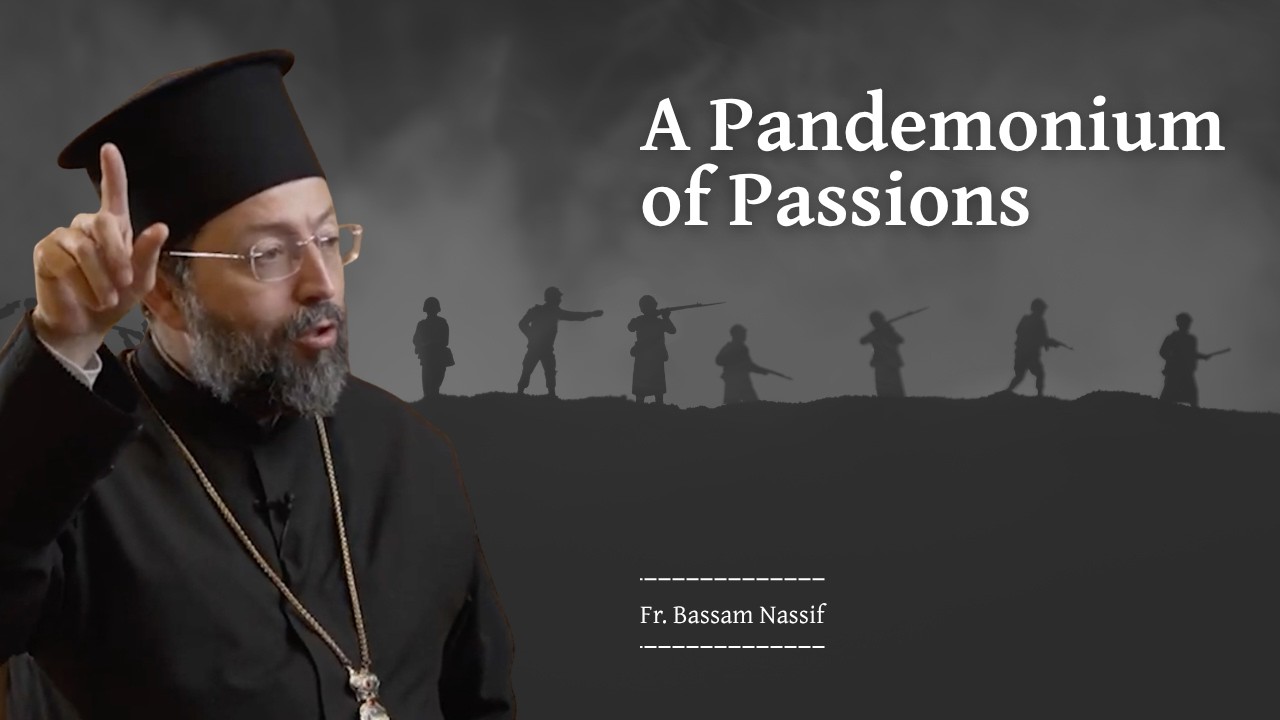
War as the Greatest Sin: An Orthodox Witness from the Middle East

War as the Greatest Sin: An Orthodox Witness from the Middle East 4:07

In a reflection rooted in the lived reality of the Middle East, Fr. Bassam Nassif, Associate Professor at the University of Balamand, presents war not as a political failure or tragic necessity but as the highest expression of evil. War breaks the commandments of God and wounds the image of God in every human person. The Church, he insists, cannot bless war as a solution to conflict.

Her witness follows Christ, who prayed for His executioners from the Cross, and the saints, who manifest the power of mercy, forgiveness, and prayer. Even when innocent people lose homes, churches, and security, the Christian response remains shaped by the face of the Good Samaritan — serving all who suffer, regardless of faith. Fr. Bassam describes Orthodox villagers in southern Lebanon who have become refugees in their own country, hosted by northern parishes.

The community continues to pastorally serve both Muslims and Christians, embodying Christ's mercy toward enemies. This mission demands great faith and relies on external support. The Church prays for peace and seeks to discern God's will and the phronema of the Church in each situation, refusing to let violence define its identity.

  • War is the highest expression of evil, violating all Ten Commandments and the image of God in humanity.
  • The Church cannot bless war; its witness follows Christ's forgiveness on the Cross and the saints' mercy.
  • Orthodox Christians in the Middle East serve all sufferers — Muslims and Christians alike — as the Good Samaritan.
  • Many Orthodox villagers are internally displaced, having lost homes and churches; they depend on communal and external support.

Key moments: 0:000:001:03

Can Western Thought Be Orthodox? A Symbolic Ontology of Creation

Can Western Thought Be Orthodox? A Symbolic Ontology of Creation 5:38

In this reflection, Professor Seraphim Bruce Foltz examines whether Western philosophical traditions can be integrated into an Orthodox worldview. He identifies a persistent tension in Western thought between transcendence and immanence, the visible and the invisible, spirit and matter — polarities that Orthodoxy resolves through a symbolic ontology rooted in the theology of St. Maximus the Confessor and St. Gregory Palamas.

According to this framework, every created being carries its own logos, a divine intention, and participates in God’s uncreated energies, making the material world a true meeting place of the invisible. Creation is not a veil to be pierced but a sacrament to be read. Foltz draws on personal encounters with nature — fields, birds, a coyote — as moments of revelation, and shows how Western figures such as Van Gogh, John Muir, Coleridge, Ruskin, and Gerard Manley Hopkins intuited this symbolic depth without full theological articulation.

He critiques naturalistic reductionism that mistakes scientific abstraction for the whole of reality, insisting that beauty, goodness, and holiness are not subjective projections but objective features of a creation radiant with God’s presence. The result is a vision in which the world is holy, meaningful, and everywhere discloses the divine.

  • Creation's being is to be a symbol (sumbolon) uniting visible and invisible; Western thought oscillates between transcendence and immanence.
  • Orthodox theology provides a framework for divine immanence without pantheism: divine energies distinct from essence, and the logoi of beings in St. Maximus.
  • Personal experiences of God in nature serve as concrete revelations of creation's symbolic depth.
  • Western artists and writers (Van Gogh, Muir, Coleridge, Hopkins) intuited this symbolic ontology but lacked its full theological articulation.

Key moments: 0:000:311:03

Catechesis as Formation for Life: Beyond Childhood into Mystagogia

Catechesis as Formation for Life: Beyond Childhood into Mystagogia 7:39

This reflection, featuring His Grace Bishop Anthony of Synada, explores catechesis not merely as the transmission of religious information but as the formation of an Orthodox way of life. In multicultural societies, Orthodox Christians frequently need to articulate their faith clearly — explaining practices such as the dating of Pascha, the sign of the cross, and the veneration of icons — so that belief becomes intelligible and lived.

Catechesis begins with simple, age-appropriate actions, like teaching children to kiss icons and cross themselves, but it must mature alongside the person. The discussion distinguishes between catechesis, which historically preceded baptism, and mystagogia, the post-baptismal unfolding of the grace already received. A central challenge identified is the cessation of formal religious education after high school, leaving young adults unprepared to confront existential questions — suffering, death, divine justice, the meaning of life — with a mature Orthodox framework.

The pandemic unexpectedly accelerated adult education through online platforms, prompting many parishes to adopt hybrid models that now reach adults more effectively. The conversation underscores that catechesis must integrate both doctrinal content and the practice of Christian life within one's concrete context, forming believers who can not only know the faith but live and explain it.

  • Catechesis forms a way of life, not just knowledge; it must grow with the person from childhood through adulthood.
  • Mystagogia deepens the baptismal grace already given, explaining the spiritual reality behind the sacraments.
  • In multicultural settings, Orthodox Christians need clear explanations for practices like Pascha's date, icon veneration, and the sign of the cross.
  • Formal religious education often ends at high school, leaving adults unequipped for deep existential questions.

Key moments: 0:000:301:02

Authentic Orthodox Mysticism: Costly Grace and the Wrestling School of Catechesis

Authentic Orthodox Mysticism: Costly Grace and the Wrestling School of Catechesis 5:50

Fr. Ignatius Green distinguishes authentic Orthodox mysticism from vague, consumer-style spirituality. True mysticism is grounded in a living relationship with the incarnate Christ and demands total commitment — taking up the Cross, struggling against passions, and entering the life of the Church. Grace is free yet costs everything.

The tools of this transformation are fasting, prayer, almsgiving, and repentance, which foster self-knowledge rather than serving as mere customs. Catechesis operates on two tracks: doctrinal learning and the lived Orthodox way of life. Drawing on St. John Chrysostom, Fr. Ignatius likens the catechumenate to a wrestling school where falls are safe and instructive, preparing for baptismal life.

He notes a post-COVID surge of inquirers in America, driven by shaken assumptions about life and death. Because catechumens arrive from wildly diverse backgrounds — elderly, children, former Protestant pastors, former Satanists, Wiccans, and others — St. Gregory of Nyssa's principle of tailored instruction is essential: correcting one error may confirm another's.

The Jesus Prayer is not a technique among many but a personal address to Christ; authentic mysticism transcends reason without becoming abstract. The discussion underscores that Orthodoxy is not information alone but a comprehensive way of life.

  • Authentic Orthodox mysticism is rooted in the incarnate Christ and requires costly discipleship, not vague spirituality.
  • Grace is freely given but demands everything: cross-bearing, struggle against passions, and sacramental church life.
  • Catechesis combines intellectual formation with ascetic practice (fasting, prayer, almsgiving, repentance) as tools for transformation.
  • The catechumenate is a 'wrestling school' (St. John Chrysostom) where falls reveal weakness and teach spiritual combat.

Key moments: 0:000:311:33

Creation as the Footprint of God: A Maximian Vision

Creation as the Footprint of God: A Maximian Vision 8:09

In a lecture at the Institute for Orthodox Christian Studies, Elizabeth Theokritoff explores how creation is not a backdrop to human life but the very arena in which we encounter God. Drawing on St. Maximus the Confessor, she presents creation as permeated by logoi — inner principles that bear the signature of the Creator Logos. Every creature, from angels to worms, becomes a word spoken by God.

This vision refuses to separate humanity from the rest of creation; theology itself is centered on creation because without it there would be no creatures to know God. The creative and redemptive works of God mirror each other, revealed in three concrete modes: creation, Scripture, and the Incarnation. Athanasius notes that God’s work was too vast for human perception, so Christ comes at a human scale to make the divine pattern visible.

The Pauline image of the Church as an interdependent body extends to the whole ecosystem, reflecting the relational, Trinitarian nature of God where life is communion and love. The Eucharist gathers this cosmic interdependence: bread and wine embody the labor of soil, seed, water, microorganisms, and human hands. In Christ, creation is not discarded but offered, transformed, and drawn toward the Kingdom. Our journey of theosis necessarily pulls the entire cosmos along with it.

  • Human beings are fully embedded in creation, not separate from it; theology centers on creation because without it there would be no knowers of God.
  • Creation includes angels, humans, and all material reality — not merely "nature" or "environment."
  • The logoi of things are imprints of the Creator Logos, bearing God’s signature and revealing divine patterns at every scale.
  • The interdependence of the ecosystem reflects the Trinitarian life of communion and love, extending the Pauline body metaphor to all creation.

Key moments: 0:000:301:32