WeOrthodox
EN UA

Orthodox posts, videos and discussions

We follow Orthodox channels, communities and blogs across the web, summarise every post and video, and highlight the conversations with real substance.

Elder Damaskinos and his brotherhood chant the Polychronion at Mount Athos

A recording from Mount Athos shows Elder Damaskinos and his brotherhood chanting the Polychronion, sung in Greek in Byzantine style at the monastery. The post tags it with Orthodox, Byzantine, chant, Mount Athos and monastery, and names the piece in Romanian, Greek and English. The hymn is doxological and addressed to Christ. It proclaims that only the Only-begotten Son, the immortal God the Word, accepted to be incarnate for our salvation. He…

A recording from Mount Athos shows Elder Damaskinos and his brotherhood chanting the Polychronion, sung in Greek in Byzantine style at the monastery. The post tags it with Orthodox, Byzantine, chant, Mount Athos and monastery, and names the piece in Romanian, Greek and English. The hymn is doxological and addressed to Christ. It proclaims that only the Only-begotten Son, the immortal God the Word, accepted to be incarnate for our salvation.

He took flesh from the Holy Theotokos and ever-virgin Mary and became man without change. Christ God was crucified and trampled death by death. He is glorified together with the Father and the Holy Spirit as one of the Holy Trinity. The chant closes with the prayer: 'Save us.' The recording lets listeners hear the brotherhood's Byzantine singing as it sounds in the monastery, with the text of the hymn set out for those who want to follow the words while they listen.

Key moments

  1. Only the Only-begotten Son, the immortal God the Word, accepted to be incarnate for our salvation.
  2. He took flesh from the Holy Theotokos and ever-virgin Mary and became man without change.
  3. Christ God was crucified and trampled death by death.
  4. He is glorified together with the Father and the Holy Spirit as one of the Holy Trinity.
  5. The hymn ends with the prayer: 'Save us.'
Read more
Citations Orthodoxes ☦ Instagram

Saint Basil the Great on troubles as tools for good fortune

The post presents a saying attributed to Saint Basil the Great in French. He compares troubles to brooms and shovels that clear the road toward a good man's fortune. He adds that many men curse rain falling on their heads without knowing it brings abundance to drive away hunger. The quote uses two metaphors. The first treats difficulties as implements that prepare the way for later good. The second treats unwelcome weather as unrecognized…

The post presents a saying attributed to Saint Basil the Great in French. He compares troubles to brooms and shovels that clear the road toward a good man's fortune. He adds that many men curse rain falling on their heads without knowing it brings abundance to drive away hunger.

The quote uses two metaphors. The first treats difficulties as implements that prepare the way for later good. The second treats unwelcome weather as unrecognized provision. Both images suggest that present hardship often carries hidden benefit that becomes clear only afterward.

The text gives no further commentary, context, or citation beyond the attribution to Saint Basil the Great. The language of the post is French.

  • Saint Basil the Great describes troubles as brooms and shovels that clear a good man's path to fortune
  • Many people curse rain on their heads not knowing it brings abundance to drive away hunger
  • The saying uses two metaphors linking present difficulty to future benefit
  • The text appears in French with no additional commentary or citation
Holy Resurrection YouTube

Love of Neighbor: The Visible Field of Love for the Invisible God

Love of Neighbor: The Visible Field of Love for the Invisible God 7:02

This post presents an excerpt from a homily by St. Nikolaj Velimirović on the 15th Sunday after Pentecost (Matthew 22:35–46), explaining why Christ calls the second great commandment—love your neighbor as yourself—like unto the first. The homily argues that the two commandments are inseparable because love for God naturally overflows into love for His creatures, just as love for one's mother strengthens love for one's siblings. Whoever loves God…

This post presents an excerpt from a homily by St. Nikolaj Velimirović on the 15th Sunday after Pentecost (Matthew 22:35–46), explaining why Christ calls the second great commandment—love your neighbor as yourself—like unto the first. The homily argues that the two commandments are inseparable because love for God naturally overflows into love for His creatures, just as love for one's mother strengthens love for one's siblings.

Whoever loves God easily loves human beings as his brothers in God; whoever does not love God can only deceive himself about loving others, possessing at best a vague pity rooted in self-pity. Christ expanded the meaning of neighbor beyond one's own people to all mankind and gave a new commandment to love one another as He loved us—new because spoken by Him who manifested the greatest love, even commanding love for enemies, since God shines on both the good and the evil, leaving judgment to Him alone.

Neighbors are described as the visible field on which we show love for the invisible God; God is moved by our love for neighbors as a mother is moved by a stranger's kindness to her child. The apostle John's warning that whoever claims to love God while hating his brother is a liar underscores that neighbors are a school training us in the perfect love of God.

The homily enumerates the chief works of love—mercy, forgiveness, prayer for others, supporting the weak, instructing the ignorant, defending the oppressed—and closes with the image of the faithful as members of one body in Christ, called to assist one another's growth, since when one member prospers or suffers, the whole body shares in it.

The post accompanies a video presentation of the homily and includes parish support links; no substantive discussion appears in the comments.

Key moments

  1. 0:12 The second commandment is like the first: it concerns love, but for God's creatures rather than the Creator; loving one's mother strengthens love for siblings, just as loving God leads to loving humanity as brethren.
  2. 0:43 Whoever loves God easily loves men as brothers in God; whoever does not love God can only deceive himself about loving others, possessing at best a vague pity rooted in self-pity.
  3. 1:15 Christ gives a new commandment to love one another as He loved us; it is new because spoken by Him who manifested the greatest love, and because the meaning of neighbor extends beyond Jews to all mankind.
  4. 1:45 Love your enemies, for God shines on both the good and the evil; our task is to love all for the sake of God's love, leaving judgment to Him.
  5. 2:16 Neighbors are the visible field upon which we manifest love for the invisible God; God is moved by our love for neighbors as a mother is moved by a stranger's love for her child.
  6. 2:47 The apostle John calls anyone who claims to love God while hating his brother a liar; neighbors are a school training us in perfect love of God.
  7. 3:17 The chief works of love are mercy, forgiveness, prayer for others, support for the weak, humbling the proud, admonishing the unrighteous, instructing the ignorant, concealing shortcomings, praising virtues, defending the oppressed, and sacrificing one's life.
  8. 4:21 All faithful are members of Christ's body; we must assist one another's growth, for when one member prospers the whole body benefits, and when one suffers the whole body suffers.
Read more
Orthodox Life Instagram

Saint Dionysios the Areopagite: judge, bishop, and the writings that shaped Christian mysticism

The post commemorates Saint Dionysios the Areopagite on October 3rd. Dionysios was a 1st-century Athenian judge who converted after hearing the Apostle Paul preach at the Areopagus. The Book of Acts names him as one of the few prominent citizens of Athens to accept the faith during Paul's visit, and later Christian tradition holds that he became the first bishop of Athens. The post then turns to the Corpus Areopagiticum, a collection of…

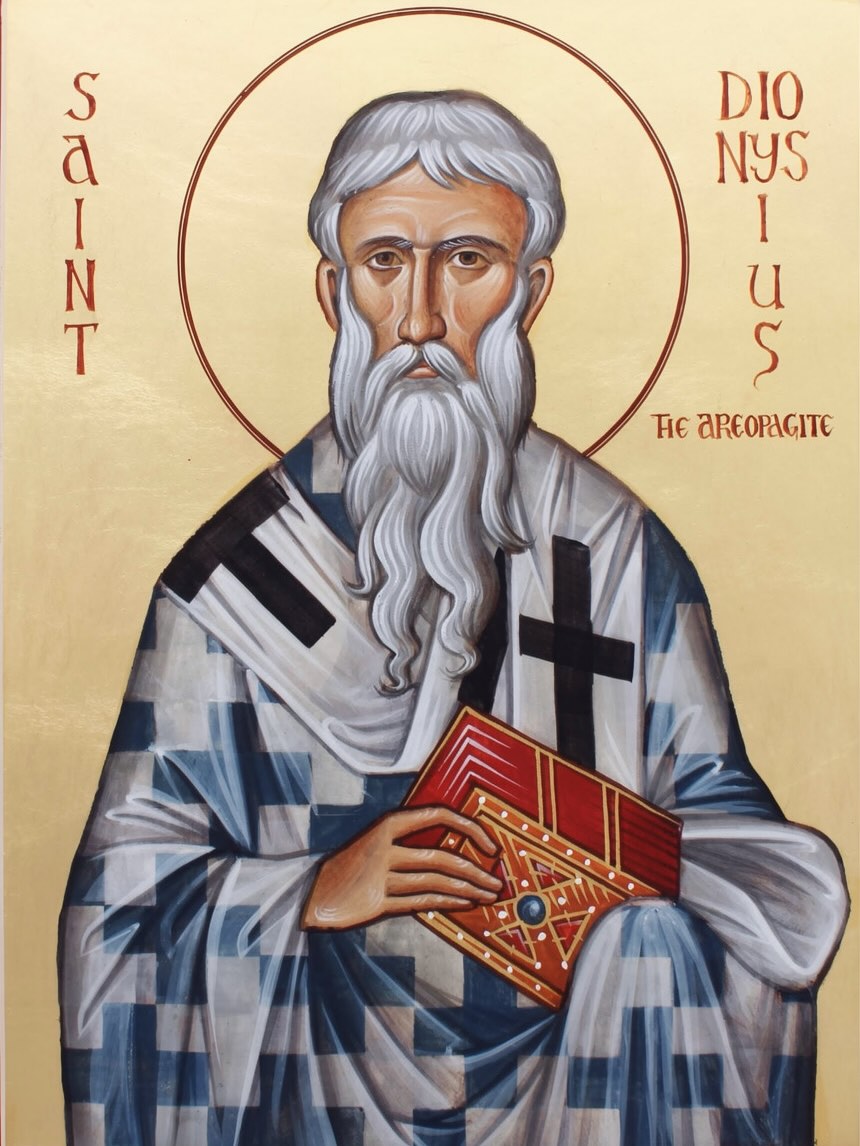
The post commemorates Saint Dionysios the Areopagite on October 3rd. Dionysios was a 1st-century Athenian judge who converted after hearing the Apostle Paul preach at the Areopagus. The Book of Acts names him as one of the few prominent citizens of Athens to accept the faith during Paul's visit, and later Christian tradition holds that he became the first bishop of Athens.

The post then turns to the Corpus Areopagiticum, a collection of influential theological writings that appeared under his name in the early 6th century. Modern scholars agree these texts were written centuries later by an anonymous author, called Pseudo-Dionysios. Even with the pseudonymous origin, the works permanently shaped Christian thought.

They connected Neoplatonic philosophy with Christian theology: the author used the frameworks of thinkers like Proclus to explain the nature of God, the celestial realms, and the soul's path toward the divine, giving early Christian mysticism an intellectual language. The post closes with a pious legend about the saint's death. It says he was beheaded around 96 AD, after which his headless body stood up, picked up the severed head, and walked several miles preaching a sermon of repentance.

He collapsed at the feet of a Christian woman named Catula, who buried his body. The discussion a reader will find is the combination of the biblical figure, the later pseudonymous writings attributed to him, and the martyrdom legend, all presented together in one commemoration.

  • Dionysios the Areopagite was a 1st-century Athenian judge who converted after hearing Paul preach at the Areopagus, as recorded in the Book of Acts.
  • Later tradition holds he became the first bishop of Athens.
  • The Corpus Areopagiticum appeared in the early 6th century under his name; scholars attribute it to an anonymous author known as Pseudo-Dionysios.
  • The writings used Neoplatonic philosophy, drawing on thinkers like Proclus, to describe God, the celestial realms, and the soul's path toward the divine.
  • A pious legend says he was beheaded around 96 AD, carried his head while preaching repentance, and was buried by a woman named Catula.
Read more

Inside the Katholikon of Vatopedi Monastery on Mount Athos

The post presents the katholikon, the main church, of the Holy and Great Monastery of Vatopedi. It describes the interior of the church, where sacred icons, frescoes, and centuries of Orthodox prayer surround the faithful who enter. The katholikon is dedicated to the Annunciation of the Theotokos, and the post states that it remains the spiritual heart of the monastery. The text appears in both English and Greek, with the Greek version carrying…

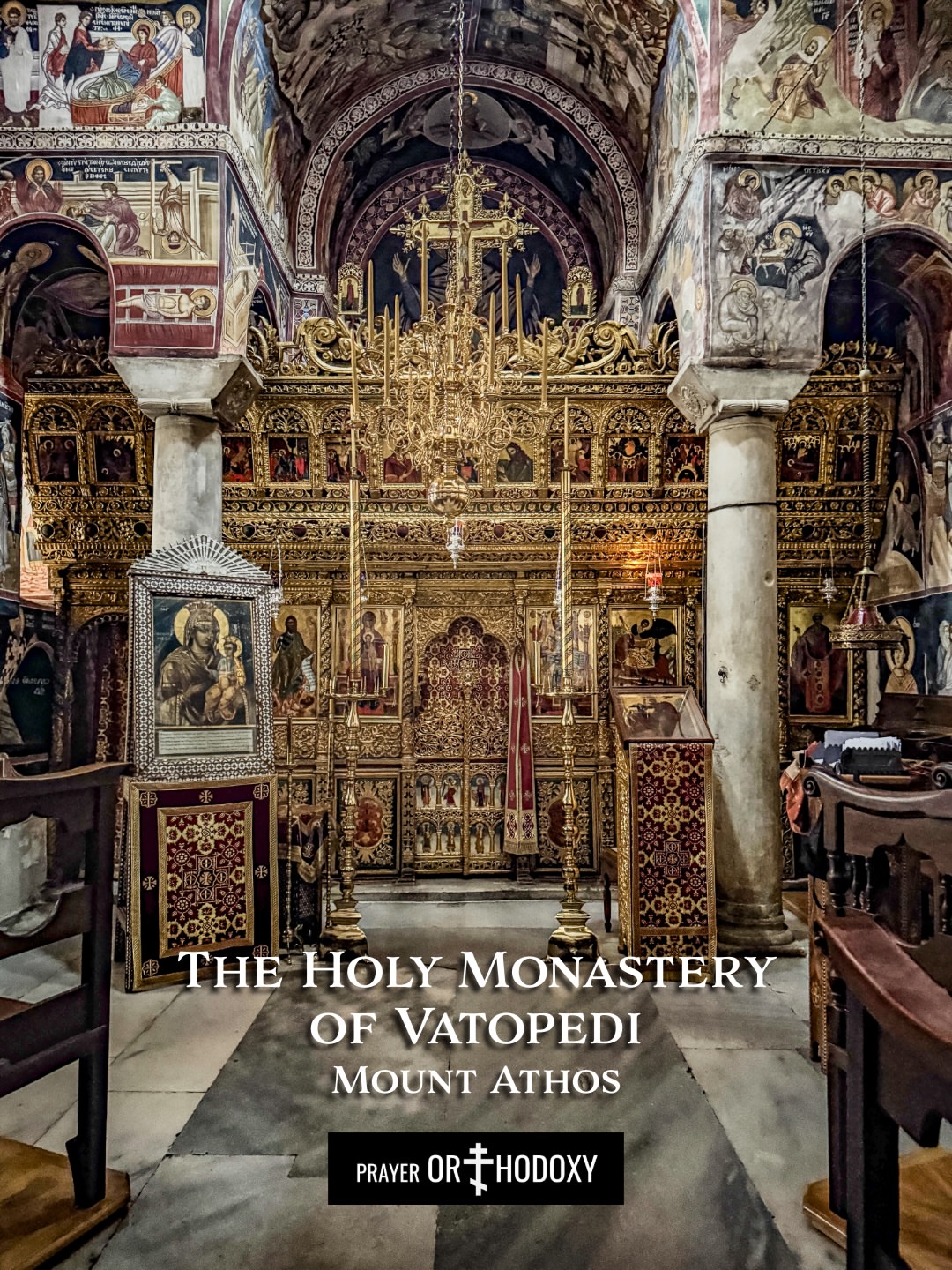
The post presents the katholikon, the main church, of the Holy and Great Monastery of Vatopedi. It describes the interior of the church, where sacred icons, frescoes, and centuries of Orthodox prayer surround the faithful who enter. The katholikon is dedicated to the Annunciation of the Theotokos, and the post states that it remains the spiritual heart of the monastery.

The text appears in both English and Greek, with the Greek version carrying the same content under the title 'Το Καθολικό της Ιεράς Μονής Βατοπαιδίου'. The post is tagged with references to Orthodoxy, Vatopedi, the Theotokos, Athos, and monasticism, and is credited as an original production of Prayer Orthodoxy. There is no discussion in the source beyond the description itself; the post serves as a short presentation of the church and its dedication, naming the monastery on Mount Athos and the feast to which its main church is dedicated.

No dates, builders, or historical events are given, and no claims are made beyond what the text states about the icons, frescoes, and the church's role in the life of the monastery.

  • The katholikon is the main church of the Holy and Great Monastery of Vatopedi.
  • Its interior holds sacred icons and frescoes, and centuries of Orthodox prayer surround the faithful.
  • The church is dedicated to the Annunciation of the Theotokos.
  • The post calls the katholikon the spiritual heart of the monastery.
  • The text is given in both English and Greek and is credited to Prayer Orthodoxy.
Read more
Discover Orthodox Christianity Facebook

Young Man Speaks Before the 'Quick to Hear' Icon at Docheiariou Monastery on Mt. Athos

This post recounts a reported miracle at Docheiariou Monastery on Mount Athos in early December 2016, described by a monk who witnessed the event and later retold at a public Church gathering in Thessaloniki. According to the account, an eighteen-year-old man from Strumica, who had never spoken clearly and could produce only unintelligible sounds (the headline describes him as mute from birth, while the body text also mentions a severe stutter),…

This post recounts a reported miracle at Docheiariou Monastery on Mount Athos in early December 2016, described by a monk who witnessed the event and later retold at a public Church gathering in Thessaloniki. According to the account, an eighteen-year-old man from Strumica, who had never spoken clearly and could produce only unintelligible sounds (the headline describes him as mute from birth, while the body text also mentions a severe stutter), visited the monastery to venerate the wonderworking icon of the Mother of God known as 'Gorgoepikoos' — 'Quick to Hear.' Standing before the icon, the young man suddenly cried out in his native language: 'Mother Mary, give me my health.' Those present, who knew his condition, were astonished.

After a monk continued reading the prayer service, the young man addressed those who had prayed with him, saying: 'Thank you everybody, now I feel very well.' The post frames the event as a manifestation of the grace that Orthodox tradition associates with the Panagia through this particular icon, which has a long history at Docheiariou and is honored for swiftly answering the prayers of the faithful.

The monastery's abbot, Elder Gregorios, and the brethren are described as continually offering supplicatory services and praying for the living and the departed. The account closes with a liturgical acclamation to the Mother of God as she 'who art quick to hear, fulfilling our petitions for our benefit.' The post presents the story as an eyewitness testimony circulated via the Greek website Vimaorthodoxias.gr; readers are invited to receive it within the Church's living tradition of the Theotokos' merciful intercession.

  • A miracle was reported in early December 2016 at Docheiariou Monastery, Mt. Athos, before the wonderworking icon 'Gorgoepikoos' ('Quick to Hear').
  • An eighteen-year-old from Strumica, who had never spoken intelligibly, suddenly cried out 'Mother Mary, give me my health' before the icon.
  • Afterwards he thanked those present, saying he felt well; the event was witnessed and recounted by a monk.
  • The story was also told at a public Church event in Thessaloniki and reported by Vimaorthodoxias.gr.
  • The post presents this as an example of the Theotokos' swift mercy through her 'Quick to Hear' icon.
Orthodox Sound YouTube

Elder Simeon of Pskov-Pechersk: How to Treat Those Who Hate Us

Elder Simeon of Pskov-Pechersk: How to Treat Those Who Hate Us 25:29

Elder Simeon Zhelnin of the Pskov Caves answers a practical question: what should a Christian do when someone becomes hostile toward him? His counsel, drawn from Georgy Malkov's 2014 book on his life and teachings, is to conduct oneself 'according to Christ' rather than taking emotional direction from the attacker. He warns that the real danger is not another person's anger but letting it enter us, where it grows from memory into thought,…

Elder Simeon Zhelnin of the Pskov Caves answers a practical question: what should a Christian do when someone becomes hostile toward him? His counsel, drawn from Georgy Malkov's 2014 book on his life and teachings, is to conduct oneself 'according to Christ' rather than taking emotional direction from the attacker. He warns that the real danger is not another person's anger but letting it enter us, where it grows from memory into thought, judgment, resentment, and hatred, so that we carry an enemy inside our own mind.

Forgiveness is presented as spiritual warfare rather than sentimentality. It does not call evil good and does not forbid boundaries, distance, or speaking the truth sharply, but it refuses to keep the wound alive or build one's life around an injury. The elder gives concrete disciplines: do not pay attention to provocations, make the sign of the cross, pray, remain sober in mind, and remember that everyone is mortal and stands under the same judgment.

Christ commands prayer for persecutors, not admiration of them; praying forces us to remember that a person is more than the offense committed against us. Every person bears the image of God, and we see behavior while God sees the heart, so discernment that calls behavior dangerous differs from condemnation that calls a person hopeless.

Meekness keeps us from hatred and firmness keeps us from compromise. The teaching ends with the call to guard the heart, since the greatest victory is not defeating an enemy but refusing to become his enemy in return.

Key moments

  1. 1:02 Elder Simeon teaches that with those hostile toward us we are to conduct ourselves according to Christ, not according to fear, pride, or the desire to please people.
  2. 2:05 When attacked, we instinctively begin living according to the attacker, becoming angry when they are angry; the elder says not to let another person's hostility decide what kind of person we become.
  3. 3:39 Do not pay attention to those who provoke you; make the sign of the cross, pray, remain sober in mind, and remember that everyone is mortal and stands under the same judgment.
  4. 5:14 The deeper danger is that another person's anger may enter us, growing from memory into thought, judgment, resentment, and hatred, so that we carry an enemy inside our own mind.
  5. 6:16 Forgiveness is spiritual warfare, not sentimentality: it does not call evil good and does not forbid boundaries, distance, or speaking sharply, but it refuses to keep the wound alive.
  6. 8:22 Christ commands us to pray for those who persecute us, not to admire or approve of them; praying forces us to remember that the person is more than the offense committed against us.
  7. 11:28 Every person is God's creation and bears the image of God; we see behavior while God sees the heart, so discernment ('this behavior is dangerous') differs from condemnation ('this person is hopeless').
  8. 17:11 Meekness keeps us from hatred and firmness from compromise; let the enemy answer before God for what he has done, and guard your own heart from resentment, revenge, and pride.

Pentecostal considering Orthodoxy: two concerns before becoming a catechumen

Afternoon, greetings to my brothers in Christ, if I can get past my objections. I hope you are all well. I am Pentecostal, but I am thinking the Orthodox Church in America might be my pathway forward. I keep feeling a calling to the ancient versions of Christianity, but Catholicism worries me because there seem to be too many things that could be way off from correct. In Orthodoxy, two major parts of the faith concern me, and if I can get past…

Afternoon, greetings to my brothers in Christ, if I can get past my objections. I hope you are all well.

I am Pentecostal, but I am thinking the Orthodox Church in America might be my pathway forward. I keep feeling a calling to the ancient versions of Christianity, but Catholicism worries me because there seem to be too many things that could be way off from correct.

In Orthodoxy, two major parts of the faith concern me, and if I can get past them I would love to become a catechumen.

1.) Icons. My concern is that this is idolatry. The examples I compare it to are the Israelites worshipping the golden calf, and John and Cornelius being rebuked for bowing. None of these examples were sacrificial, so you cannot really make that argument.

2.) The lack of evangelization. Monasteries, cultural differences and the lack of missionaries seem to put Orthodoxy at a disadvantage compared to Catholicism or even Protestantism.

I would appreciate any help from someone considering joining.

  • The author is Pentecostal and feels drawn to the Orthodox Church in America
  • Catholicism worries them as possibly too far from correct
  • Concern 1: icons may be idolatry, citing the golden calf and John and Cornelius rebuked for bowing
  • Concern 2: Orthodoxy lacks evangelization, missionaries and cultural reach compared to Catholicism and Protestantism
  • They would become a catechumen if these objections are resolved
12 opinions in the discussion He is risen! Both concerns are fair, especially from a Pentecostal background. On icons, Orthodoxy doesn't teach that wood, paint, or the person depicted is God. Worship belongs to God… Read the discussion

Desert Fathers Retold: The Woman Under the Barrel

The post introduces a new storytelling project: retelling the lives and sayings of Orthodox saints in modern prose, beginning with a story from the Desert Fathers traditionally attributed to Abba Macarius (though it appears under Abba Ammonas in the Sayings of the Desert Fathers). The story is a classic episode of mercy and discretion from the monastic tradition. A monk of bad reputation is visited by a woman, and when the local brothers learn…

The post introduces a new storytelling project: retelling the lives and sayings of Orthodox saints in modern prose, beginning with a story from the Desert Fathers traditionally attributed to Abba Macarius (though it appears under Abba Ammonas in the Sayings of the Desert Fathers). The story is a classic episode of mercy and discretion from the monastic tradition.

A monk of bad reputation is visited by a woman, and when the local brothers learn of it, they gather to expel him from his cell, asking the bishop to join them. The monk hides the woman in a large cask. The elder, seeing the situation clearly, chooses to protect the sinner rather than expose him: he sits on the cask, orders the cell searched, and when nothing is found, gently rebukes the accusers — 'May God forgive you!' — then privately warns the brother, 'Be on your guard,' and departs.

The accompanying video dramatizes the scene: the woman slipping into the cell, the brothers forcing their way in and searching, the elder sitting on the barrel to conceal her, and the final embrace between elder and monk. The post invites readers to suggest which saints or stories should be retold next. There are no substantive comments in the thread; the discussion is essentially an open call for feedback on the new format and requests for future retellings.

The story's enduring appeal lies in its portrayal of mercy over judgment — the elder shields a fallen brother from public shame while still offering him a quiet word of correction, embodying the desert tradition's insistence that covering a neighbor's weakness is greater than exposing it.

Key moments

  1. A woman slips into a monk's cell and hides inside an overturned barrel as the brothers begin knocking at the door.
  2. The brothers force their way in, whispering accusations, and begin searching the sparse cell.
  3. The elder Macarius arrives, declares they have searched everywhere, and sits on the barrel, concealing the woman with his weight.
  4. After the brothers depart, Macarius rises and tells the monk, 'Brother, be on your guard,' and the two embrace.
Archim. Christódoulos Papadeas Instagram

Evening Services at Saint Dionysius Church in Piraeus

The speaker is visiting the Church of Saint Dionysius in Piraeus, a suburb of Athens, to participate in evening services through the saint's intercession. Saint Dionysius was one of Athens' first bishops, converted after hearing Saint Paul preach about Christ's crucifixion, and reflected on the darkness at the Crucifixion before coming to faith in Christ as the Son of God. The church is situated near a soccer field. Great Vespers with the bishop…

The speaker is visiting the Church of Saint Dionysius in Piraeus, a suburb of Athens, to participate in evening services through the saint's intercession. Saint Dionysius was one of Athens' first bishops, converted after hearing Saint Paul preach about Christ's crucifixion, and reflected on the darkness at the Crucifixion before coming to faith in Christ as the Son of God.

The church is situated near a soccer field. Great Vespers with the bishop of Piraeus begins at 7 p.m., served by a young priest approximately 35 years old, who is one of three clergy at the parish and has four to five children. Tomorrow morning a Divine Liturgy is expected to draw hundreds or thousands of faithful. The speaker concludes by requesting the prayers of Saint Dionysius, the Theotokos (Panagia), and all the saints.

Key moments

  1. Location: Piraeus, a suburb of Athens, at the Church of Saint Dionysius.
  2. Purpose: Participating in services by God's grace and the prayers of Saint Dionysius.
  3. Church setting: The church is situated near a soccer field.
  4. Saint Dionysius background: Early bishop of Athens who heard Saint Paul's preaching, reflected on the darkness at the Crucifixion, and came to faith in Christ as the Son of God.
  5. Schedule: Great Vespers at 7 p.m. with the bishop of Piraeus.
  6. Clergy: A young priest (about 35 years old), one of three priests at the parish, with four to five children.
  7. Upcoming service: Divine Liturgy tomorrow morning, anticipated to attract hundreds or thousands of faithful.
  8. Closing invocation: Requesting the intercession of Saint Dionysius, Panagia, and all the saints.
Read more
Athonite Audio YouTube

Evergetinos, Vol. 3, Hypothesis 21: Trusting God When Life's Necessities Run Out

Evergetinos, Vol. 3, Hypothesis 21: Trusting God When Life's Necessities Run Out

This narration presents Hypothesis 21 from the third book of the Evergetinos: the Christian, even when deprived of life's necessities, should not become fainthearted but should give thanks to the Lord, wait on Him, and hope without hesitation that God in His goodness will unfailingly provide. The hypothesis also holds that it is shameful for an ascetic, a servant of God, to associate with worldly people and ask for what he needs, even if he is…

This narration presents Hypothesis 21 from the third book of the Evergetinos: the Christian, even when deprived of life's necessities, should not become fainthearted but should give thanks to the Lord, wait on Him, and hope without hesitation that God in His goodness will unfailingly provide. The hypothesis also holds that it is shameful for an ascetic, a servant of God, to associate with worldly people and ask for what he needs, even if he is burdened by poverty.

The text draws on the lives of St. Theodosios the Coenobiarch and St. Savvas, and on sayings from St. Ephraim, Abba Isaiah, Abba Isaac, St. Maximos, and the Gerontikon. In the life of St. Theodosios, his twelve disciples had no bread or oil on the eve of Pascha, not even bread for the divine liturgy. Theodosios told them to prepare only the holy table, for the one who fed Israel in the wilderness would provide.

At sunset a man arrived leading mules laden with foods suitable for ascetics, including bread for the holy table, and the provisions lasted until Pentecost. When the disciples pestered him to approach a wealthy almsgiver while they ate carob pods and roasted date pits, he answered, 'Who among those who have placed their confidence in God has ever been completely abandoned?' citing Jeremiah, Job and David.

On another occasion a laden animal halted against its driver's will and went to the monastery as if invisibly pulled; the driver gave twice what the other benefactor was accustomed to giving. In the life of St. Savvas, God sent a vision to Marcian in Bethlehem commanding him to send provisions to the destitute brothers at the Castellion.

Lacking money for cells, Savvas gave a half solidus as a deposit; a stranger gave the fathers 170 gold solidi and left without his name, and Savvas paid for the cells and built a hospice. When the lavra lacked even the prosphoron for Sunday liturgy, Savvas cited Matthew 6:34, and before Sunday men arrived with 30 pack animals loaded with wheat, wine, oil and other food.

Key moments

  1. 0:01 Hypothesis 21 states that the Christian deprived of necessities should give thanks to the Lord, wait on him, and hope without hesitation that God will unfailingly provide, and that it is shameful for an ascetic to ask worldly people for what he needs even in extreme poverty.
  2. 0:32 On the eve of Pascha, the 12 disciples of St. Theodosius had no bread or oil, not even bread for the divine liturgy. Theodosius told them to prepare only the holy table, for the one who fed Israel in the wilderness would provide for them.
  3. 2:04 Just as a ram appeared to Abraham, a man arrived at sunset leading mules laden with foods suitable for ascetics, including bread for the holy table; the provisions lasted until Pentecost.
  4. 3:39 The disciples pestered Theodosius to make themselves known to a wealthy almsgiver who never gave to them, while they ate carob pods and roasted date pits. He replied, 'Who among those who have placed their confidence in God has ever been completely abandoned?' citing Jeremiah, Job and David.
  5. 5:42 A man leading a laden animal intended to pass the monastery, but the beast halted against his will and went straight to the monastery as if invisibly pulled. Seeing God's providence, he gave twice what the other benefactor was accustomed to giving, and the disciples ceased to pester the saint.
  6. 7:46 While St. Savas built cells at the Castellion, God sent a vision to Marcian in Bethlehem, telling him that Savas and his brothers were destitute and commanding him to send provisions. Savas received the goods and regarded them as a token of God's approval of the settlement.
  7. 10:52 Lacking money to buy cells, Savas gave the owners his half solidus as a deposit, trusting God. A stranger unaware of his situation gave the fathers 170 gold solidi and departed without giving his name; Savas paid for the cells and built a hospice.
  8. 13:33 When the lavra lacked even the prosphoron for the Sunday liturgy, Savas refused to despair, citing Matthew 6:34. Before Sunday, men came with 30 pack animals loaded with wheat, wine, oil and other food, so much that there was almost no room for it in the lavra.
Ancient Faith YouTube

Forming the Heart: Benjamin Lyda on Orthodox Education and the St. Nectarios Educators Conference

Forming the Heart: Benjamin Lyda on Orthodox Education and the St. Nectarios Educators Conference 38:59

In this episode of Ancient Faith Presents, Melanie interviews Benjamin Lyda, founder of the Scriptorum Writing curriculum and co-host of the St. Nectarios Orthodox Educators Conference. Benjamin recounts his journey from evangelical Protestantism to Orthodoxy—sparked by studying church history some twenty years ago—and his two decades in education, including teaching grades four through twelve, directing Shakespeare plays, helping found a…

In this episode of Ancient Faith Presents, Melanie interviews Benjamin Lyda, founder of the Scriptorum Writing curriculum and co-host of the St. Nectarios Orthodox Educators Conference. Benjamin recounts his journey from evangelical Protestantism to Orthodoxy—sparked by studying church history some twenty years ago—and his two decades in education, including teaching grades four through twelve, directing Shakespeare plays, helping found a school, and now training teachers through his consulting organization Living Classical.

The heart of the conversation is his conviction that the first priority of education is forming the heart toward Christ. Using the metaphor of Pegasus, he explains that education can aid the ascent toward God but cannot complete it; only Christ and the Holy Spirit convert hearts, and educators must seek what St. John of Kronstadt called the door to a child's heart.

The discussion critiques both progressive education, which rests on pragmatic and materialistic assumptions about the human person, and much of what passes for classical education today, which often shares the same pedagogy while wearing different clothes. Benjamin cautions parents against sending children to public schools without critical reflection—not out of conspiracy thinking, but because teachers' unexamined assumptions inevitably come through.

He also addresses practical questions: co-ops and parish schools can learn from one another, homeschoolers can use good Christian materials even when not explicitly Orthodox, and loving Christ and loving to learn matter more than standardized tests. Drawing on Charlotte Mason, he notes that atmosphere, habits, and living ideas—familiar from Orthodox liturgical life—are the tools that shape the heart.

The episode closes with details on the online St. Nectarios Orthodox Educators Conference (November 6-7, 2026), featuring speakers such as David Hicks, Andrew Kern, and Josh Gibbs, with recordings available to registrants.

Key moments

  1. 0:35 Benjamin grew up evangelical, began studying church history about 20 years ago, converted to Orthodoxy, and studied at St. Vladimir Seminary; he has taught fourth through twelfth grade, directed Shakespeare plays, helped found a school, and now trains teachers through his consulting organization Living Classical.
  2. 3:10 Using the Pegasus metaphor, he explains that education can aid the ascent toward God but cannot complete it—only Christ and the Holy Spirit convert hearts—so educators must prioritize educating the heart, illustrated by St. John of Kronstadt's story about finding 'the door to a child's heart.'
  3. 6:49 Pedagogical methods rest on assumptions about what it means to be human; much 'classical' education today is pedagogically similar to progressive models, and John Dewey's progressive education rests on pragmatic, materialistic assumptions that shape the wrong kind of person.
  4. 9:56 While sympathetic to families with no alternatives, he warns against sending children to public schools without critical thought—not because of conspiracy, but because teachers' unexamined assumptions about humanity inevitably come through; a priest in Texas even told his parish to pull their kids out and built support structures.
  5. 13:33 Co-ops, parish schools, and formal schools can learn from each other: co-ops should write down a shared vision and goals, while formal schools can learn that much education can be accomplished without large funds; some states now even provide money for alternative schooling.
  6. 16:43 Homeschoolers lack explicitly Orthodox materials, but most good Christian materials don't contradict the faith; citing John Senior, he notes even Protestant literature teaches virtue, and encourages families that loving Christ and loving to learn matter more than standardized tests.
  7. 21:59 Classical education is hard to define but at its broadest is a search for objectively true, communicable truth; he draws on Charlotte Mason's insight that children need living relationships with ideas, and that atmosphere, habits, and ideas—intuitively familiar from Orthodox liturgical life—are the tools that shape the heart.
  8. 27:11 The St. Nectarios Orthodox Educators Conference (November 6-7, online, at stnectariuseducators.com) is an invitation to anyone concerned with making their children into saints; speakers include David Hicks, Andrew Kern, Josh Gibbs, and others, with recordings available to registrants who cannot attend live.
Kyle YouTube discussion

Where Was the Protestant Church Before 1500? A Case for Orthodox Indefectibility

Where Was the Protestant Church Before 1500? A Case for Orthodox Indefectibility 28:50

This video presents what the speaker calls a decisive argument against Protestantism: the impossibility of locating a visible, continuous Protestant church in any century before the Reformation. The argument begins not with contested doctrines, where both sides can quote Scripture and the Fathers indefinitely, but with the deeper question of what Christ established at Pentecost and what became of His Church. The New Testament, the speaker…

This video presents what the speaker calls a decisive argument against Protestantism: the impossibility of locating a visible, continuous Protestant church in any century before the Reformation. The argument begins not with contested doctrines, where both sides can quote Scripture and the Fathers indefinitely, but with the deeper question of what Christ established at Pentecost and what became of His Church.

The New Testament, the speaker argues, presents the Church as Christ's body, the pillar and ground of truth, promised the Holy Spirit and protection from the gates of Hades—not an invisible collection of believers. Early Fathers such as Irenaeus, Clement, Cyprian, Athanasius, and Augustine teach the Church's indefectibility and apostolic succession through the episcopate.

The sharpest dilemma concerns practices the Reformation rejected: invocation of saints, relics, icon veneration, and especially monasticism, which the Church venerated as a model of holiness for over a millennium. Either the Spirit guided the Church through those centuries, or the Reformation corrected it—but not both. The speaker rejects the Old Testament analogy of restoration, noting that Israel's reformers worked within a living covenant people, and points to St. John Chrysostom and St. Maximus the Confessor as reformers who suffered injustice within the Church rather than founding new ones.

The comment section became a substantive debate: Protestants objected that the argument conflates the Church as Christ's body with institutional infallibility, cited Acts 20's warning that even Spirit-appointed overseers can err, and noted that the Reformers claimed succession through the Western church rather than being restorationists.

Others listed pre-Reformation dissenters like Wycliffe and Hus as a Protestant 'succession,' while supporters cited 2 Thessalonians 2:15 on tradition and apostolic succession. One inquirer described the argument as the strongest version he had heard, while questioning whether the conclusion fully follows.

Key moments

  1. 0:00 Debates over individual doctrines can go on forever, since both sides can quote Scripture and Fathers; the deeper question is what Christ established at Pentecost and what happened to the Church.
  2. 1:02 The New Testament presents the Church as Christ's body, the pillar and ground of truth, promised the Holy Spirit and protection from the gates of Hades—not an invisible collection of believers.
  3. 2:34 Early Fathers like Irenaeus, Clement, Cyprian, Athanasius, and Augustine teach the indefectability of the Church and apostolic succession through the episcopate.
  4. 5:42 Protestants cannot point to a visible group holding their views in every age, while Orthodox can; individual corruption is different from the universal normalization of 'accretions' for centuries.
  5. 6:44 Practices like invocation of saints, monasticism, relics, and icon veneration were widespread for over a millennium before the Reformation critiqued them—raising the question of where the faithful opposing church was.
  6. 12:29 Monasticism makes the dilemma sharpest: the Church venerated monastic saints as models of holiness for a thousand years, then the Reformation abolished monasteries—either the Spirit guided the Church or the Reformation, not both.
  7. 20:12 The Old Testament analogy fails: Israel's reformers worked within an existing covenant people, and Pentecost changed everything; reform within a living tradition differs from restoring a dead one.
  8. 23:19 St. John Chrysostom and St. Maximus the Confessor show reformers suffered injustice within the Church rather than founding new ones; Luther should have reformed from within or become Orthodox.
20 opinions in the discussion Wow, what a coincidence. I'm an orthodox inquirer and have been going to a church in Texas for around four months and really love it. The issue is I'm not educated, and even the low-level… Read the discussion

Divine Punishment as Loving Admonition, Not Retribution

Divine Punishment as Loving Admonition, Not Retribution 2:19

In a recent broadcast, Archpriest Alexei Uminsky addresses a viewer's question about whether God ever punishes, clarifying a common misunderstanding. The viewer inferred that if God never punishes, He must forgive everyone automatically, rendering confession unnecessary. Father Alexey corrects this premise: he never claimed God never punishes. Rather, he distinguishes between suffering, disease, and death — which are not divine retribution for…

In a recent broadcast, Archpriest Alexei Uminsky addresses a viewer's question about whether God ever punishes, clarifying a common misunderstanding. The viewer inferred that if God never punishes, He must forgive everyone automatically, rendering confession unnecessary. Father Alexey corrects this premise: he never claimed God never punishes.

Rather, he distinguishes between suffering, disease, and death — which are not divine retribution for sins — and true divine punishment, which exists as a form of loving admonition. This punishment is not torture or revenge but God's pedagogical action through life circumstances, encounters, and the inner realization of one's mistakes, often leading to repentance.

Forgiveness, Father Alexey emphasizes, is not automatic; it requires active seeking, genuine desire, striving, and acceptance through sincere remorse and repentance. This dynamic is precisely why the sacrament of confession exists: it provides the structured means to seek, express, and receive that forgiveness. The discussion thus centers on the nature of God's justice as restorative rather than punitive, and the indispensable role of human cooperation in the process of reconciliation.

Key moments

  1. 0:00 A viewer asks: if God never punishes anyone, it follows He forgives everyone, so why is confession necessary?
  2. 0:34 Father Alexey corrects the premise: he never said God never punishes; diseases, suffering, and death are not punishments for sins, but divine punishment does exist as admonition and lesson.
  3. 1:04 Divine punishment is not torture or revenge; it is God admonishing a person through life encounters, collisions, and the realization of mistakes, including through repentance.
  4. 1:37 Forgiveness is not automatic; one must seek, desire, strive for, and accept it from God through sincere remorse and repentance.
  5. 1:37 That is exactly why confession exists.
Read more
Orthodox Sound YouTube

The Theotokos as Mother and Refuge in the Teachings of the Saints

The Theotokos as Mother and Refuge in the Teachings of the Saints 27:57

This video is a reflection on the Most Holy Theotokos as mother, refuge, protection, and intercessor, built from the teachings of Orthodox saints and elders. It opens at the cross, where Mary stood and did not flee, and then gathers testimonies from St. Gabriel of Georgia, St. Cyril of Alexandria, St. John of Damascus, St. Paisios the Athonite, St. Joseph the Hesychast, St. Matrona of Moscow, St. Seraphim of Sarov, and others. St. Cyril of…

This video is a reflection on the Most Holy Theotokos as mother, refuge, protection, and intercessor, built from the teachings of Orthodox saints and elders. It opens at the cross, where Mary stood and did not flee, and then gathers testimonies from St. Gabriel of Georgia, St. Cyril of Alexandria, St. John of Damascus, St. Paisios the Athonite, St. Joseph the Hesychast, St. Matrona of Moscow, St. Seraphim of Sarov, and others.

St. Cyril of Alexandria defended the title Theotokos as a confession about Christ himself: if Jesus is God, the virgin who bore him according to the flesh is truly the Mother of God. St. John of Damascus contemplated that her hands steadied the first steps of the one who established the earth, and her lips helped the Word of God form his first human words.

The saints describe her maternal care in small matters: St. Paisios approached her icon with the trust of a baby in its mother's arms, and after an all-night vigil of fasting, when he thought a request for food too small to bring her, a monk appeared with bread, figs, and grapes in her honor and then disappeared. St. Anthimos of Chios compared her to a cool tree whose shade made his heart larger.

The reflection also carries a warning from St. Maximos the Greek: outward devotion becomes empty if a person continues in hatred, falsehood, theft, exploitation, and injustice; the Theotokos wants prayer to produce repentance and honor to produce mercy. St. Paisios taught that the salutations to the Theotokos are also thanksgiving, for mercy not deserved and protection never noticed.

The video ends with a prayer for her protection, humility, and remembrance at the final hour, closing with the words 'In Christ, always in Christ'.

Key moments

  1. 0:00 Beneath the cross stood the mother of Christ, who did not turn away or flee. St. Gabriel of Georgia described that day so intensely that people wept as though at Golgotha, and his message was: do not leave the blessed Virgin Mary, she is suffering now, stay near the mother of God.
  2. 1:03 St. Cyril of Alexandria defended the title Theotokos: if Jesus Christ is God, then the virgin who gave birth to him according to the flesh is truly the mother of God. This is a confession about Christ himself.
  3. 1:34 St. John of Damascus contemplated that the hands of the virgin steadied the first steps of the one who established the earth, and her lips helped the Word of God form his first human words.
  4. 3:08 St. Paisios the Athonite felt like a little child beside Panagia, approaching her icon with the trust of a baby in its mother's arms. St. Anthimos of Chios compared her to a cool tree whose shade made his heart become larger.
  5. 4:39 St. Maximos the Greek warns that outward devotion becomes empty if a person continues in hatred, falsehood, theft, exploitation, and injustice. The Theotokos wants prayer to produce repentance and honor to produce mercy.
  6. 6:15 St. Paisios taught that the salutations to the Theotokos are also a way of giving thanks, not only for asking favors: thank you for mercy not deserved, for protection never noticed, even for the trial teaching endurance.
  7. 7:16 After an all-night vigil while fasting, St. Paisios became dizzy from hunger and thought a request for food too small to bring to Panagia. A monk appeared with bread, figs, and grapes in honor of the Lady Theotokos, then disappeared. Paisios exclaimed: what kind of mother is this, who cares even for the smallest details?
  8. 11:28 When a great fire on Mount Athos could not be stopped by hundreds and thousands, an elder told thirty monks to take the icon of Panagia and trust in her protection. The fire burned what surrounded the monastery but did not pass through the walls.
Hellenic College Holy Cross Instagram

Hellenic College Partners with Greek Orthodox Metropolis of Chicago to Train Future Church Leaders

Hellenic College has announced a new nonprofit partnership with the Greek Orthodox Metropolis of Chicago. The collaboration is designed for students enrolled in the college's Nonprofit Leadership and Management program, giving them hands-on experience in Church administration and ministry. Rather than learning only in the classroom, students will gain practical exposure to how a diocese of the Greek Orthodox Archdiocese of America operates—its…

Hellenic College has announced a new nonprofit partnership with the Greek Orthodox Metropolis of Chicago. The collaboration is designed for students enrolled in the college's Nonprofit Leadership and Management program, giving them hands-on experience in Church administration and ministry. Rather than learning only in the classroom, students will gain practical exposure to how a diocese of the Greek Orthodox Archdiocese of America operates—its administration, ministries, and day-to-day leadership challenges.

The announcement frames the partnership as an investment in the formation of the next generation of Orthodox leaders, and the college expresses gratitude to the Metropolis of Chicago for making this possible. The post is a straightforward institutional announcement with no discussion or comments attached, so there is no debate to summarize; its interest lies in what it signals: a growing effort within Orthodox higher education to connect academic training with real ecclesial service.

For readers, it offers a glimpse of how Orthodox institutions are preparing young people not only for general nonprofit work but specifically for service within the Church—combining professional management skills with ministry formation. It may be of particular interest to students considering careers in Church administration, parents exploring Orthodox higher education, and parish or metropolis leaders thinking about leadership pipelines and how dioceses can partner with academic institutions to cultivate future servants of the Church.

  • Hellenic College announces a new partnership with the Greek Orthodox Metropolis of Chicago.
  • Students in the Nonprofit Leadership and Management program will receive hands-on experience in Church administration and ministry.
  • The partnership aims to form the next generation of Orthodox leaders through practical training.
  • The college expresses gratitude to the Metropolis of Chicago for investing in this formation.
  • The post is an announcement with no attached discussion.
CHRISTIANITY UNITED with Prayer Orthodoxy® Instagram

Praying directly to the Holy Spirit who dwells within

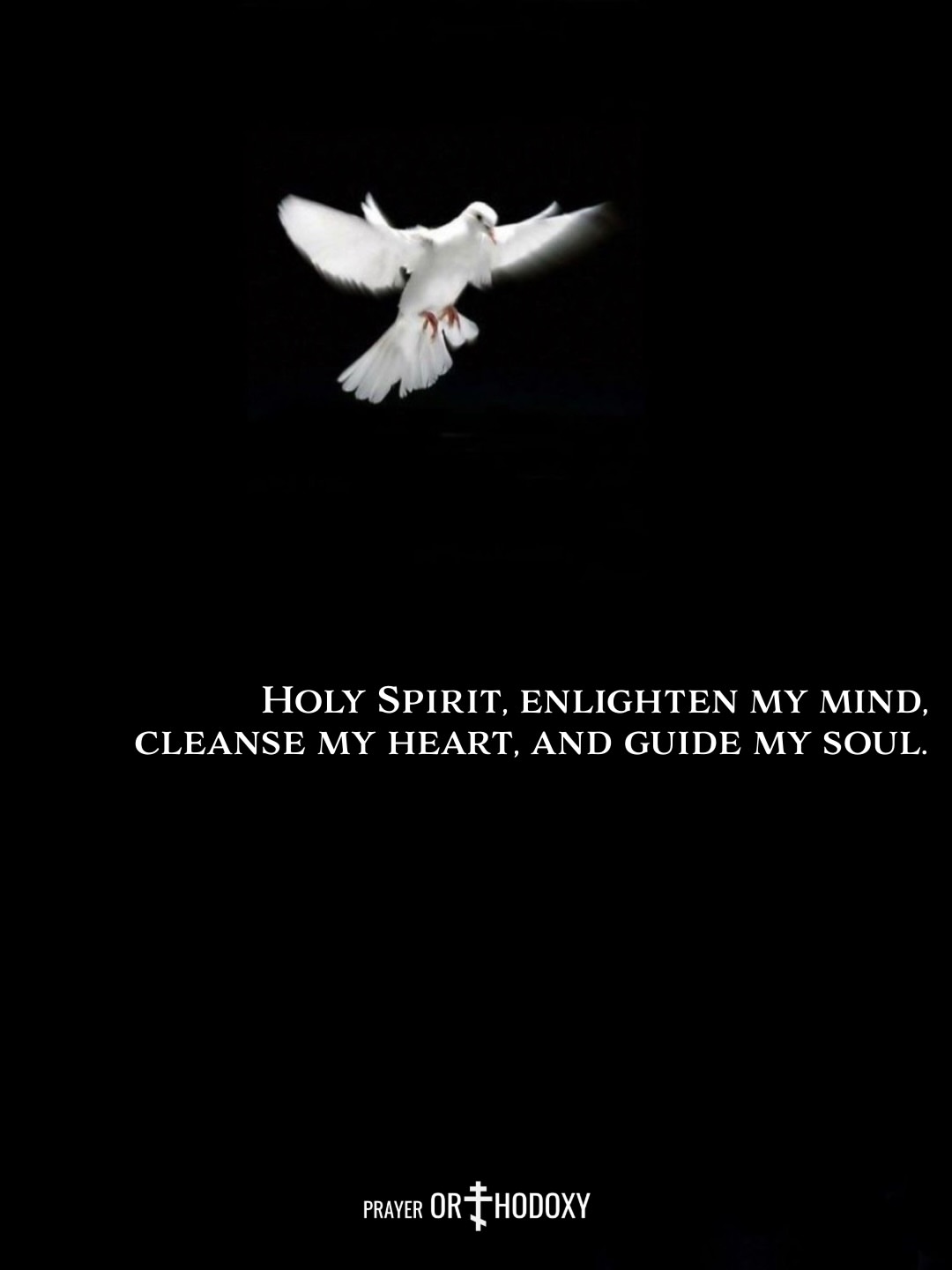
The author reminds readers that they can pray directly to the Holy Spirit who dwells within them. The post lists four specific requests to make of the Spirit: that it enlighten the mind, cleanse the heart, strengthen the soul, and guide every step toward Christ. The message appears in both English and Greek, with the Greek text translating the same four petitions. The text carries the attribution "An Original Production of Prayer Orthodoxy®" and…

The author reminds readers that they can pray directly to the Holy Spirit who dwells within them. The post lists four specific requests to make of the Spirit: that it enlighten the mind, cleanse the heart, strengthen the soul, and guide every step toward Christ. The message appears in both English and Greek, with the Greek text translating the same four petitions.

The text carries the attribution "An Original Production of Prayer Orthodoxy®" and includes hashtags for Orthodox, Holy Spirit, Prayer, Christ, and Faith. The post does not cite Scripture or patristic sources. It presents the practice of addressing the Holy Spirit directly as something believers often forget.

  • The Holy Spirit dwells within believers
  • Believers can pray directly to the Holy Spirit
  • Four specific petitions: enlighten mind, cleanse heart, strengthen soul, guide steps to Christ
  • Post presented in English and Greek
  • Attributed to Prayer Orthodoxy®
Read more
F Fr. Barnabas Powell Substack

What God Calls Blessed: The Beatitudes as a Reboot for the Human Heart

This reflection contrasts the modern, social-media use of the word 'blessed'—comfort, success, abundance, things going our way—with what Jesus actually calls blessed in Luke 6:17-23: the poor, the hungry, those who weep, and those who are hated and excluded for His sake. The author is careful to note that gratitude for good gifts is right, but that our culture has quietly redefined blessing as comfort and popularity—measurements that can all be…

This reflection contrasts the modern, social-media use of the word 'blessed'—comfort, success, abundance, things going our way—with what Jesus actually calls blessed in Luke 6:17-23: the poor, the hungry, those who weep, and those who are hated and excluded for His sake. The author is careful to note that gratitude for good gifts is right, but that our culture has quietly redefined blessing as comfort and popularity—measurements that can all be lost in an afternoon.

The post walks through the Gospel passage read at the Liturgy and draws out three main lessons. First, Christ deliberately turns the world's definition of blessing upside down—not to romanticize suffering (He heals the sick and frees the possessed throughout the Gospels), but to expose how badly our priorities have been scrambled when we measure blessing only by what is temporary.

Second, our disordered desires enslave us: if being blessed depends on possessions, fullness, constant happiness, or others' approval, we are slaves to each of those things. The Beatitudes act as a diagnosis—what we call blessed reveals what we actually worship—and each 'blessed' condition strips away an illusion of self-sufficiency, which is where healing begins.

Third, the Church's spiritual disciplines let us practice the Beatitudes on purpose: fasting is chosen hunger, almsgiving is chosen poverty, Confession is chosen tears, and living the Faith in a mocking culture is chosen rejection for Christ's sake. The post closes with the life of Sts. Cyprian and Justina, martyred at Nicomedia under Diocletian: Cyprian, once a pagan sorcerer whose demons fled before Justina's sign of the Cross, burned his magic books, was baptized, became a bishop, and died for Christ—proof that everything once called power can turn out to be slavery, and everything once despised can prove blessed.

  • The world defines 'blessed' as comfort, success, and abundance; Jesus blesses the poor, hungry, weeping, and rejected (Luke 6:17-23).
  • Christ does not romanticize suffering—He heals and frees—but reorients our priorities away from temporary measures of blessing.
  • If our sense of blessing depends on possessions, pleasure, feelings, or approval, we are enslaved by them; what we call blessed reveals what we worship.
  • The Church's disciplines—fasting, almsgiving, Confession, enduring mockery—are the Beatitudes practiced on purpose.
  • Sts. Cyprian and Justina: the sorcerer whose demons fled before a Christian virgin's faith repented, became a bishop, and was martyred under Diocletian.
radioimlemesou Instagram

Metropolitan Athanasios on Balanced Self-Knowledge

Metropolitan Athanasios of Limassol offers a concise yet profound teaching on the Orthodox understanding of self-knowledge (αὐτογνωσία). He emphasizes that while knowing oneself is essential, it must be pursued along a middle path — neither sinking into despair over one's sins nor hardening into prideful self-justification. True self-knowledge, he explains, involves honestly recognizing one's character, passions, and weaknesses. This awareness…

Metropolitan Athanasios of Limassol offers a concise yet profound teaching on the Orthodox understanding of self-knowledge (αὐτογνωσία). He emphasizes that while knowing oneself is essential, it must be pursued along a middle path — neither sinking into despair over one's sins nor hardening into prideful self-justification. True self-knowledge, he explains, involves honestly recognizing one's character, passions, and weaknesses.

This awareness is not an end in itself but the starting point for spiritual struggle. The Metropolitan stresses that correction of these passions must be undertaken "beautifully, humbly, simply" — adjectives that reflect the Orthodox ascetic tradition's emphasis on gentleness and lack of self-reliance. Crucially, the entire endeavor depends on invoking the grace and mercy of Christ; human effort alone cannot heal the soul.

The teaching encapsulates the patristic balance between rigorous honesty about the human condition and unwavering trust in divine compassion, avoiding the twin distortions of discouragement and spiritual pride.

Key moments

  1. Self-knowledge (αυτογνωσία) is a very important matter.
  2. It must be pursued in a balanced middle way, not in despair nor in hardness and pride.
  3. True self-knowledge involves knowing our own self and character.
  4. We must understand our passions and weaknesses.
  5. We are to struggle against these passions and weaknesses.
  6. Correction should be done beautifully, humbly, and simply.
  7. We must call upon the grace and mercy of Christ in this struggle.
Read more

Elder Philemon of Mount Athos: Choosing Retreat, Calm and Peace

Elder Philemon, a priest of the Holy Coenobitic Skete of the Prophet Elijah of Pantokratoros on Mount Athos, speaks about choosing retreat, calm and peace instead of quarreling. He tells the story of two monks who heard others arguing and decided to argue as well. They placed a glass in the middle, and one of them declared that the glass belonged to him. The other answered: 'If it is yours, take it,' and the argument ended there. The two monks…

Elder Philemon, a priest of the Holy Coenobitic Skete of the Prophet Elijah of Pantokratoros on Mount Athos, speaks about choosing retreat, calm and peace instead of quarreling. He tells the story of two monks who heard others arguing and decided to argue as well. They placed a glass in the middle, and one of them declared that the glass belonged to him.

The other answered: 'If it is yours, take it,' and the argument ended there. The two monks never came to a quarrel. Elder Philemon notes that the same spirit operates in his own monastery. There, calm prevails and the prevailing attitude is 'don't trouble yourself, take it.' He presents this disposition as a way of life rather than a story from elsewhere.

The talk is presented by Pemptousia, and the full video, titled 'Mount Athos: The Garden of the Panagia,' is available on the Pemptousia website. The post carries hashtags on Mount Athos, retreat, calmness, peace, faith, Christianity and Orthodoxy, and names Elder Philemon and the Holy Skete of the Prophet Elijah. The video summary shows that the talk centers on this one anecdote and its application to monastic life: two monks imitate an argument, stage a dispute over a glass, and dissolve it with a single sentence of concession.

The elder connects the anecdote to the daily atmosphere of his skete, where monks avoid disputes by yielding to one another. The card points readers to the full video for the elder's own words.

Key moments

  1. Δύο μοναχοί άκουσαν άλλους να μαλώνουν και είπαν να μαλώσουν κι εκείνοι.
  2. Έβαλαν ένα ποτήρι στη μέση και ο ένας είπε: 'Αυτό το ποτήρι είναι δικό μου'.
  3. Ο άλλος απάντησε: 'Άμα είναι δικό σου, πάρ' το', και δεν μαλώσανε.
  4. Ο ομιλητής λέει ότι κάτι τέτοιο γίνεται και στο δικό του περιβάλλον: υπάρχει ηρεμία και το πνεύμα του 'δεν βαριέσαι, πάρ' το'.
Read more