WeOrthodox
EN UA

Orthodox posts, videos and discussions

We follow Orthodox channels, communities and blogs across the web, summarise every post and video, and highlight the conversations with real substance.

Tzanetos Kavaliotis YouTube discussion

When God Stays Silent: St. Silouan's Fifteen Years of Darkness and St. Sophrony's Three Seasons of Grace

When God Stays Silent: St. Silouan's Fifteen Years of Darkness and St. Sophrony's Three Seasons of Grace 20:19

The video takes up a familiar experience: a person once felt God's presence in prayer, at a liturgy, or after confession, and then one year the same prayers and services return nothing. People often draw wrong conclusions from that silence, deciding that God is angry, that they were never believers, or that it was only a phase, while the world offers its own vocabulary of burnout and deconstruction. Against this, the video sets the teaching of…

The video takes up a familiar experience: a person once felt God's presence in prayer, at a liturgy, or after confession, and then one year the same prayers and services return nothing. People often draw wrong conclusions from that silence, deciding that God is angry, that they were never believers, or that it was only a phase, while the world offers its own vocabulary of burnout and deconstruction.

Against this, the video sets the teaching of St. Sophrony of Essex, who wrote that no tribulation is harder to bear than the soul losing grace. He taught that the Christian life passes through three seasons: grace given as a gift, grace withdrawn, and grace returning at another level of being. The withdrawal is not punishment but a planned test that shows whether a person loves God or the feeling of God.

Sophrony compares it to a father letting go of his son's hands while the boy learns to walk: it looks like abandonment, but the father never stops watching. The Lord withdraws only the perception of grace, while communion continues unbroken, and Sophrony called this season a privilege and a chance to manifest free will. The story of St. Silouan the Athonite anchors the teaching. Silouan saw the living Christ at vespers on Mount Athos a few months after arriving in 1892, then endured fifteen years of darkness he could only describe as demons, until he received the answer: keep thy mind in hell and despair not.

Sophrony himself was flooded with uncreated light on Holy Saturday 1924 in Paris, and the light left him as soon as he began to analyze the experience with his reason. Sophrony gave three reasons for God's hiding: protection from pride, the revelation of true freedom and love, and Christ's words in John 16:7 that his going away was for our good. The video closes with practical instructions for the season of silence.

Key moments

  1. 0:05 Many remember a first real encounter with God, at a liturgy, in prayer, or after confession, and then one year the same prayers and services feel empty and silent.
  2. 1:38 People draw wrong conclusions from the silence: that God is angry, that they were never believers, or that it was just a phase, and the world offers vocabulary like burnout and deconstruction.
  3. 2:09 Saint Sophrony of Essex wrote that no tribulation is harder to bear than the soul losing grace, and taught that the Christian life passes through three seasons: grace given as a gift, grace withdrawn, and grace returning at another level of being.
  4. 4:11 The withdrawal is like a father letting go of his son's hands while teaching him to walk; it looks like abandonment but the father never stops watching.
  5. 4:43 Sophrony himself was flooded with uncreated light on Holy Saturday 1924 in Paris, and the light left him as soon as he began to analyze the experience with his reason.
  6. 6:17 The Lord withdraws only the perception of grace while communion with man continues unbroken; Sophrony saw this season as a privilege and an opportunity to manifest free will, echoed in Song of Songs 5:6.
  7. 7:49 Silouan the Athonite saw the living Christ at vespers on Mount Athos, then endured fifteen years of darkness before receiving the answer: keep thy mind in hell and despair not.
  8. 11:00 Sophrony gave three reasons for God's hiding: protection from pride, the revelation of true freedom and love, and Christ's own words in John 16:7 that his going away was for our good; the video ends with practical instructions, including keep praying, refuse the verdict of despair, tell your spiritual father, pray for others, and have a cup of tea.
6 opinions in the discussion 1. Keep doing what grace taught you 2. Refuse to accept a verdict (silence will try to tell you what it means) 3. Look for pride, gently 4. Tell your spiritual father 5. Pray for someone… Read the discussion

Afraid to return to confession after falling again: readers offer encouragement

A person preparing for confession describes being terrified to return to their spiritual father. After months of living in a worldly way, they had confessed to fornication and premarital relations, and felt their priest responded with deep disappointment. Though their circumstances did not change, they fell into the same temptation again and now feel ashamed and afraid to go back, a fear compounded by a language barrier that makes communication…

A person preparing for confession describes being terrified to return to their spiritual father. After months of living in a worldly way, they had confessed to fornication and premarital relations, and felt their priest responded with deep disappointment. Though their circumstances did not change, they fell into the same temptation again and now feel ashamed and afraid to go back, a fear compounded by a language barrier that makes communication with the priest difficult.

They ask for help and encouragement. The responses are uniformly compassionate and pastoral rather than judgmental. Commenters normalize the experience of repeated falls, stressing that everyone sins after confession and that healing from sexual passions takes time, citing St John the Long-suffering as an example of long perseverance in struggle.

Several note that the very shame the poster feels is a sign of a working conscience, and that priests would far rather hear the worst sins confessed than lose a penitent to silence and avoidance. Others point out that God already knows the sins before confession, so the sacrament is a means of releasing the burden and receiving strength, not a surprise report to a disappointed judge.

Practical suggestions include going anyway despite the fear, working with the priest on concrete strategies to avoid the occasion of sin, attending more regularly, and even, if the anxiety is overwhelming, finding another church where confession feels more anonymous. One commenter shares their own nervousness before a first lifetime confession before chrismation, mentioning how readings from St Paisios reshaped their understanding of confession as healing rather than punishment.

Another jokes that even without a language barrier, misunderstandings with a priest happen, reassuring the poster that imperfect communication does not invalidate repentance. The overall message: return to confession, trust the spiritual father's love, and persist without giving up.

  • The poster fears returning to confession after relapsing into the same sexual sin, worsened by a language barrier with their priest.
  • Commenters stress that repeated falls are normal; healing from lust takes time, citing St John the Long-suffering.
  • Shame is framed as a sign of conscience, not a reason to avoid the sacrament.
  • Priests would rather hear the worst sins confessed than have a penitent stay away; God already knows everything.
  • Practical advice: go anyway, work with the priest on avoiding temptation, consider regular attendance or another church if fear blocks confession.
14 opinions in the discussion Same here, I have my first confession ever coming up this Saturday before my chrismation. I've been listening to talks by St. Paisios about confession and they've given me a whole new… Read the discussion
St Anthony’s Youth SA ☦︎ Instagram

Why the Devil Works Hardest to Keep Us From Prayer

A priest explains that the devil does not want people to pray, because prayer draws them closer to God. He says the enemy will try to distract us, make us tired, fill our minds with worries, or convince us that prayer can wait until later. The answer to these obstacles is not to pray less but to pray even more at exactly those moments. He cites the words of Christ from the Gospel: 'Watch and pray, lest you enter into temptation' (Matthew 26:41).…

A priest explains that the devil does not want people to pray, because prayer draws them closer to God. He says the enemy will try to distract us, make us tired, fill our minds with worries, or convince us that prayer can wait until later. The answer to these obstacles is not to pray less but to pray even more at exactly those moments.

He cites the words of Christ from the Gospel: 'Watch and pray, lest you enter into temptation' (Matthew 26:41). Prayer, he says, is not only words. It is communion with God, strength in temptation, and a weapon in spiritual warfare. God, who desires our salvation, calls each of us by name to pray every day, and a day without prayer must be meaningless to us. The message ends with a call to resist the enemy's work and seek union with God.

Key moments

  1. The devil does not want us to pray.
  2. God, who desires our salvation, calls each of us by name to pray every day.
  3. A day without prayer must be meaningless to us.
  4. Resist the enemy's work and seek union with God.
Read more
Orthodox Health with Fr.TEDTalks Instagram

Why You Need to Be Bad at Something: The Humility of Being a Beginner

The speaker, in episode 80 of the Orthodox Health Podcast, argues that many adults confuse competence with maturity. People get good at their jobs, learn the vocabulary, collect credentials, and build routines that work. Along the way, they also learn to avoid rooms where somebody might correct them: they mute the person who disagrees, choose the hobby they already excel at, explain away the loss, and rename their experiences. Discomfort becomes…

The speaker, in episode 80 of the Orthodox Health Podcast, argues that many adults confuse competence with maturity. People get good at their jobs, learn the vocabulary, collect credentials, and build routines that work. Along the way, they also learn to avoid rooms where somebody might correct them: they mute the person who disagrees, choose the hobby they already excel at, explain away the loss, and rename their experiences.

Discomfort becomes "misalignment," correction becomes "toxicity," and being exposed becomes "bad energy." The result, the speaker says, is that a person can build an impressively competent life that never requires saying "I was wrong," "He got me," or "Show me." That, he states, is not spiritual maturity. Orthodox Christianity, in his words, gives nowhere to hide from this problem.

Its practices of confession, fasting, bowing, and repentance keep reminding a person that expertise has never made anybody self-sufficient. He does not tell listeners to abandon excellence; he tells them to become excellent while making sure excellence has not become the armor they use to stay uncorrectable. The episode's title, "Why You Need to Be Bad at Something: The Humility of Being a Beginner," carries the main point: willingness to be a beginner, to fail and be corrected, is part of the Christian life.

The post ends with an invitation to comment "BEGINNER" to receive the full episode, and closes with the podcast's hashtags on Orthodoxy, humility, Christian living, and repentance.

Key moments

  1. The sender asks for a video or audio file, stating that access to the media is needed to generate a transcript.
Read more
Ancient Faith YouTube

Desire or the Holy Spirit: Fr. Stephen De Young on Why No One Truly Seeks the Priesthood's Burden

Desire or the Holy Spirit: Fr. Stephen De Young on Why No One Truly Seeks the Priesthood's Burden 7:40

In this talk, Fr. Stephen De Young reflects on St. Paul's warning that not many should presume to become teachers, applying it to the contemporary pursuit of ordained ministry. He observes that people often seek the priesthood out of desire—for power, money, status, or as an escape from sin—rather than out of a genuine calling. Some imagine that dedicating themselves to the Church will free them from their passions, yet experience shows…

In this talk, Fr. Stephen De Young reflects on St. Paul's warning that not many should presume to become teachers, applying it to the contemporary pursuit of ordained ministry. He observes that people often seek the priesthood out of desire—for power, money, status, or as an escape from sin—rather than out of a genuine calling. Some imagine that dedicating themselves to the Church will free them from their passions, yet experience shows struggles often intensify instead.

Fr. Stephen stresses that no one naturally desires the true burden of priesthood: bearing the sins of the community and giving an account at the last judgment for every soul served. More broadly, he argues that following desire never fills our inner lack; obtaining what we want only leads to chasing the next thing, ending in despair.

The alternative he proposes is cultivating sensitivity to the Holy Spirit—doing what we already know is right, since the commandments are written on our hearts. This sensitivity is fostered through prayer and through doing difficult things even when we do not feel like it. He closes with advice once given to him by a Roman Catholic priest: try everything else first, because if God is calling you to the priesthood, you will find yourself unable to do anything else.

He notes this principle extends beyond clergy to every form of priesthood, including parents and community leaders. The discussion, drawn from an Ancient Faith Ministries podcast, centers on discerning vocation, the deceptive nature of desire, and the practical life of obedience and prayer by which one learns to hear the Spirit rather than one's own appetites.

Key moments

  1. 0:00 St. Paul said not many should presume to be teachers because many people were presuming to be teachers, a tendency that continues today.
  2. 0:30 People treat choices and others as instruments to gain what they think they want—power, control, freedom—including ordained office.
  3. 1:01 Some view the priesthood as a position of power, money, or a way out of poverty; others think dedicating themselves to the church will free them from sin, but struggles often worsen.
  4. 2:07 No one desires the real burden of priesthood: bearing the sins of the community and giving an account at the last judgment for everyone served.
  5. 3:11 Following desire never fills our lack; getting what we want only leads to pursuing the next thing, eventually leading to despair that nothing will make us happy.
  6. 4:14 The alternative is sensitivity to the Holy Spirit: doing what we know is right, since the commandments are written on our hearts.
  7. 5:16 We foster this sensitivity through prayer and by doing hard things even when we don't feel like it.
  8. 5:48 Advice from a Roman Catholic priest: try everything else before clergy; if God calls you to priesthood, you'll be compelled to it—this applies to all priesthoods, including parents and leaders.
Read more
Orthodox Life Instagram

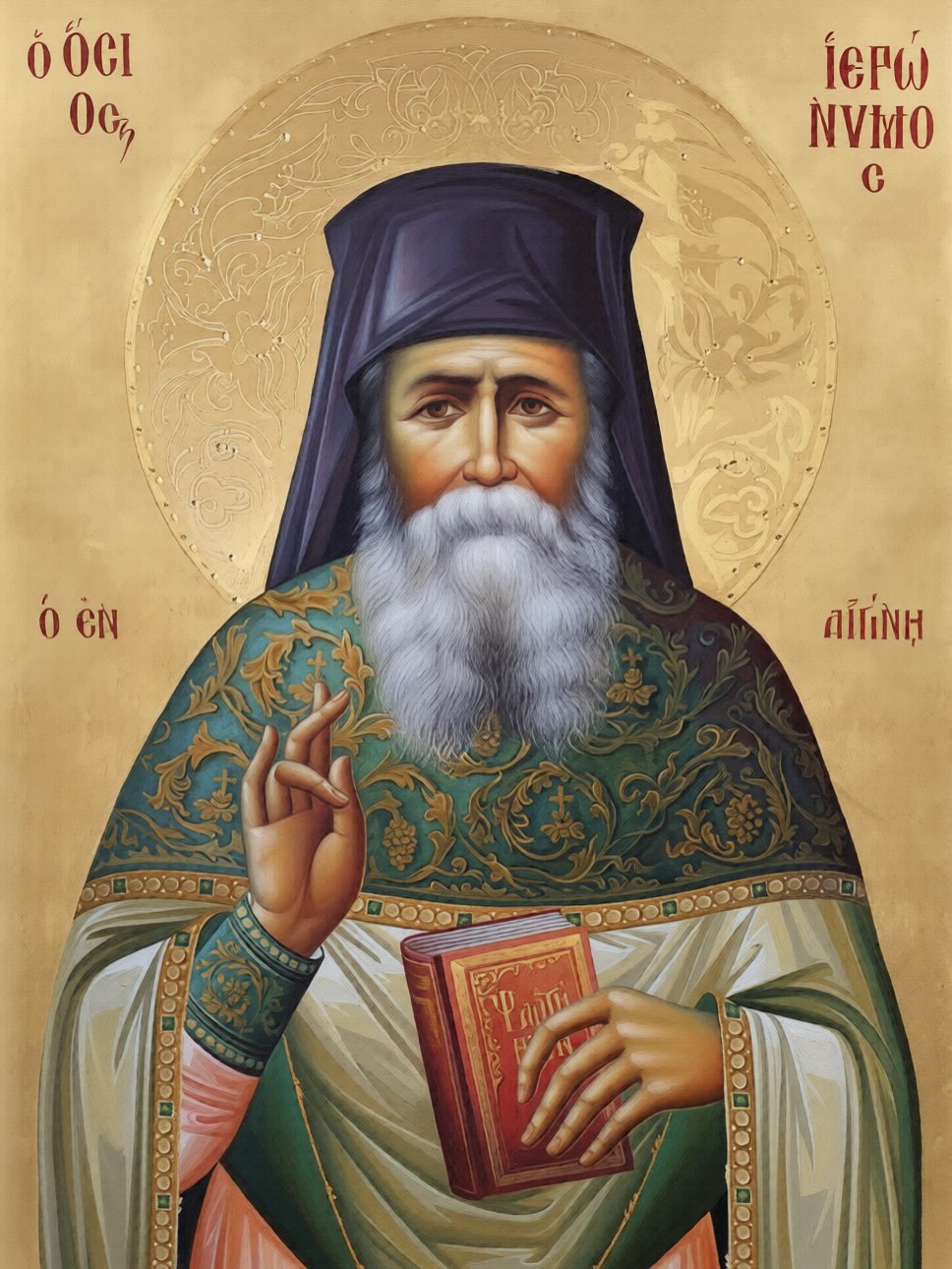
Saint Ieronymos of Aegina: Refugee Priest, Hermit, and Confessor Commemorated on October 3

The post commemorates Saint Ieronymos of Aegina, an Eastern Orthodox elder and ascetic remembered on October 3. He was born Basil Apostolides in 1883 in Gelveri, Cappadocia, in modern-day Turkey. As a child he was influenced by local cave-ascetics and an atmosphere of unceasing prayer. He was ordained a deacon in Constantinople and served in Asia Minor early in his ministry. After the collapse of the Ottoman Empire and the population exchange of…

The post commemorates Saint Ieronymos of Aegina, an Eastern Orthodox elder and ascetic remembered on October 3. He was born Basil Apostolides in 1883 in Gelveri, Cappadocia, in modern-day Turkey. As a child he was influenced by local cave-ascetics and an atmosphere of unceasing prayer. He was ordained a deacon in Constantinople and served in Asia Minor early in his ministry.

After the collapse of the Ottoman Empire and the population exchange of the 1920s between Greece and Turkey, he came to Greece as a refugee. He was ordained a hieromonk in 1923 and settled on the island of Aegina, where he spent the rest of his life. There he served as a hospital chaplain and built a hospital church dedicated to St. Dionysios.

He became known across Greece as a gifted father-confessor, a clairvoyant, and a healer of souls who cared for the poor and suffering. Later he founded the Hermitage of the Annunciation of the Theotokos and lived as a strict monastic hermit, practicing noetic prayer. After a vision of Christ's flesh and blood in the communion chalice, he stopped serving the Divine Liturgy out of holy awe, though crowds still traveled to his monastery for counsel.

In 1940 he returned to the traditional Old Calendar, seeing the Greek Church's calendar change as a compromise with secularization. He avoided factionalism, refused to condemn New Calendarists, and prioritized Christian love and church unity, so that Old and New Calendarists alike regarded him as a living saint. He reposed in an Athens hospital on October 3, 1966, and his relics were returned to his hermitage on Aegina.

  • Saint Ieronymos was born Basil Apostolides in 1883 in Gelveri, Cappadocia, and ordained a deacon in Constantinople.
  • He came to Greece as a refugee after the 1920s population exchange and was ordained a hieromonk in 1923.
  • On Aegina he served as a hospital chaplain, built a church dedicated to St. Dionysios, and founded the Hermitage of the Annunciation of the Theotokos.
  • After a vision of Christ's flesh and blood in the chalice, he ceased serving the Divine Liturgy out of holy awe.
  • In 1940 he returned to the Old Calendar while refusing to condemn New Calendarists; he reposed on October 3, 1966.
Read more
Giovanni Guaita YouTube

What Is Valuable and Important: The Call to Take Up the Cross

What Is Valuable and Important: The Call to Take Up the Cross 15:52

This homily by Hieromonk John (Guaita) reflects on the Gospel reading for the first Sunday after the Exaltation of the Cross (Mark 8:34–38). The passage follows Peter's confession at Caesarea Philippi, where he acknowledges Jesus as the Messiah but then rejects the Lord's prediction of His suffering and death. Christ's sharp rebuke — "Get behind Me, Satan" — reveals the tension between human expectations of a triumphant Messiah and the divine…

This homily by Hieromonk John (Guaita) reflects on the Gospel reading for the first Sunday after the Exaltation of the Cross (Mark 8:34–38). The passage follows Peter's confession at Caesarea Philippi, where he acknowledges Jesus as the Messiah but then rejects the Lord's prediction of His suffering and death. Christ's sharp rebuke — "Get behind Me, Satan" — reveals the tension between human expectations of a triumphant Messiah and the divine path of the Cross.

The homily explores the Lord's subsequent call to the crowd and disciples: to deny oneself, take up one's cross, and follow Him. The speaker emphasizes that "losing one's life" for Christ's sake means a willingness to risk everything for truth, justice, and non‑violence in a generation that prefers comfort and compromise. A pastoral illustration from confession — a woman who felt she had "ruined her life" — illuminates the literal sense of the Greek: whoever ruins his life for the Gospel will save it.

The homily challenges listeners to examine whether they are ashamed of Christ and His words in an "adulterous and sinful generation," reminding them that the Son of Man will be ashamed of those who are ashamed of Him when He comes in glory. The message is a summons to authentic discipleship that embraces the Cross rather than seeking a Christianity without suffering.

Key moments

  1. 0:00 Introduction to the feast day (first Sunday after Exaltation of the Cross) and the two Gospel readings offered: Matthew 18 (unmerciful servant) and Mark 8:34-38.
  2. 0:33 Reading of Mark 8:34-38: Jesus calls the crowd and disciples to deny themselves, take up their cross, follow Him; whoever loses life for His sake saves it; gaining the world but forfeiting the soul; not being ashamed of Christ.
  3. 2:12 Context: This passage is a turning point at Caesarea Philippi near Mount Hermon; Jesus asks disciples who people say He is, then 'Who do you say I am?'
  4. 3:22 Peter confesses 'You are the Messiah' — a profession of faith paralleled by Andrew and Martha; Jesus does not match popular Messianic expectations (from Nazareth, self-taught).
  5. 7:06 In Matthew's parallel, Jesus blesses Peter as rock of the Church, then predicts His suffering and death; Peter rebukes Him, and Jesus calls him 'Satan' for thinking human thoughts, not God's.
  6. 9:30 Today's reading follows directly: the call to take up the cross is precisely what Peter rejected; we often desire a comfortable Christianity without suffering ('wolves sated, sheep safe').
  7. 11:52 Illustration from confession: a woman who felt she 'ruined her life'; literal translation 'he who has ruined his life for Christ's sake will save it' — meaning readiness to risk for truth, choose right over safe.
  8. 14:45 Choosing God's truth, justice, and non-violence in an adulterous generation means swimming against the current; if we are not ashamed of Christ, He will not be ashamed of us at His coming.
Read more
Orthodox Sound YouTube

Do Not Let the Demons Defile You: The Holy Fathers on Spiritual Warfare

Do Not Let the Demons Defile You: The Holy Fathers on Spiritual Warfare 20:38

A narration draws on Mark 7:14-23, where the Lord teaches that evil thoughts proceed from within, out of the heart of man, so the deepest struggle of the Christian life takes place inside the heart. The Orthodox Sound channel presents this teaching through patristic sources: the Ladder of Divine Ascent of St. John Climacus, On Watchfulness and Holiness of St. Hesychios the Priest, On the Spiritual Law of St. Mark the Ascetic, Four Hundred Texts…

A narration draws on Mark 7:14-23, where the Lord teaches that evil thoughts proceed from within, out of the heart of man, so the deepest struggle of the Christian life takes place inside the heart. The Orthodox Sound channel presents this teaching through patristic sources: the Ladder of Divine Ascent of St. John Climacus, On Watchfulness and Holiness of St. Hesychios the Priest, On the Spiritual Law of St. Mark the Ascetic, Four Hundred Texts on Love of St. Maximus the Confessor, On Prayer of Evagrios the Solitary, and teachings on thoughts from Elder Paisios the Athonite.

The fathers practice watchfulness, or nepsis: recognizing thoughts, distinguishing temptation from consent, guarding the mind, and turning back to God through prayer. An unwanted thought is not a sin merely because it appears; the fathers separate the initial suggestion from the moment the mind willingly accepts it. The enemy can suggest but cannot compel the will. Carelessness says a thought does not matter, and despair says such a thought means God has abandoned us; both are wrong, since a thought can pass like a stranger passing by a house.

St. Hesychios connects watchfulness with the invocation of the name of Jesus, and the narration cites St. Paul on bringing every thought into captivity to the obedience of Christ. The mind is also purified by filling itself with what is true, honest, just, pure and lovely, through prayer, scripture, the sacraments, and the example of the saints.

St. Maximus explains how external events awaken passions already within us, and St. James teaches that resistance to the devil begins with submission to God. Elder Paisios compared troubling thoughts to airplanes passing overhead: you cannot stop them appearing, but you do not have to let them land. The answer to sin is repentance rather than self-hatred, and the prayer ends with the words, Create in me a clean heart, O God.

Key moments

  1. 0:00 In Mark 7 the Lord teaches that nothing entering a man from outside defiles him; evil thoughts, adulteries, murders, thefts, pride and other evils come from within, from the heart.
  2. 2:34 The fathers distinguish the first appearance of a thought from welcoming it: suggestion, conversation, delight, and consent. The enemy can suggest but cannot compel the will.
  3. 3:37 Carelessness says a thought does not matter; despair says such a thought means God has abandoned us. Neither is true; a thought can pass like a stranger passing by a house.
  4. 4:08 Saint Hesychios of Sinai connects watchfulness with prayer and the invocation of the name of Jesus, and Saint Paul speaks of bringing every thought into captivity to the obedience of Christ.
  5. 5:09 Saint Paul's list in Philippians shows the mind is purified by filling itself with what is true, honest, just, pure and lovely, not only by pushing evil away.
  6. 6:43 Saint Peter says to be sober and vigilant and resist the devil steadfast in the faith; Saint James says to submit to God, resist the devil, and draw nigh to God.
  7. 8:50 Saint Maximus the Confessor explains how external things form thoughts that interact with passions already within us, so watchfulness attends to what happens inside us when events occur.
  8. 13:29 Saint Paisios the Athonite compared troubling thoughts to airplanes passing overhead: you cannot stop them appearing, but you do not have to let them land.
Father Moses YouTube discussion

Is Your Repentance Actually Pride in Disguise?

Is Your Repentance Actually Pride in Disguise? 7:48

This post, drawn from a talk by an Orthodox priest, distinguishes between two kinds of repentance: a false, ego-driven version and true, God-centered metanoia. The false kind looks like humility but is actually pride. It shows up as shame and hiding, like Adam and Eve concealing themselves in the garden after the Fall. When someone says, 'I can't believe I did that,' the speaker argues this really means 'I thought I was better than my sin'—a…

This post, drawn from a talk by an Orthodox priest, distinguishes between two kinds of repentance: a false, ego-driven version and true, God-centered metanoia. The false kind looks like humility but is actually pride. It shows up as shame and hiding, like Adam and Eve concealing themselves in the garden after the Fall. When someone says, 'I can't believe I did that,' the speaker argues this really means 'I thought I was better than my sin'—a form of self-regard that keeps a person stuck rather than moving them toward God.

The truly humble person, by contrast, is not shocked by sin at all; they are surprised daily that they do not fall into it even more. Real repentance, the post says, is shocked not by sin but by mercy. It drags sin into the light, brings it honestly to confession rather than concealing it, and grieves not out of self-loathing but because one keeps turning away from a God who loves so greatly.

Its hope rests entirely in Christ, not in self-improvement, since Christ's power is made perfect in weakness. Repentance is therefore not merely a change of behavior but an internal turning of the eyes of the heart from sin toward God, which then bears external fruit. The speaker stresses that while our effort is required to turn the heart, all the power for transformation comes from Christ and the Holy Spirit, not from willpower or self-reliance.

The post also promotes a paid community offering direct access to the priest, monthly live Q&As, courses, and a brotherhood, with a portion of the $10 monthly fee going toward building a new church in Texas. No substantive discussion appears in the comments; the material stands as a compact teaching on the difference between shame-based self-focus and grace-centered repentance that actually changes a life.

Key moments

  1. 0:31 There are two kinds of repentance: false, ego-based repentance and real repentance based on a change and transformation of the heart.
  2. 1:04 Ego-based repentance leads to hiding, like Adam and Eve hiding from God after sinning, driven by self-loathing.
  3. 1:34 Saying 'I can't believe I did that' is pride; the truly humble person isn't shocked by their sin but is surprised daily they don't fall back into it.
  4. 2:06 The truly repentant person has given up self-reliance; their only hope is in the Lord, since Christ's power is made perfect in weakness.
  5. 3:10 Repentance is not just changing behavior—it's turning the eyes of the heart from sin to God, an internal turn that then shows externally.
  6. 4:14 The truly repentant person reveals their sins in confession rather than hiding them, wanting the light of Christ to shine on the darkness within.
  7. 5:15 Real sorrow is God-centered—grieving because one keeps turning away from a God who loves so much—not self-centered sorrow.
  8. 6:47 Real change requires our effort to turn the heart to Christ, but all the power for transformation comes from Christ and the Holy Spirit.
9 opinions in the discussion My heart feels extremely hardened; I can’t genuinely repent or feel deep remorse. In prayer I’m being totally honest, admitting that I love sin more than God and that my idols mean more to… Read the discussion
Kyle YouTube discussion

Is the Holy Fire a Hoax? An Orthodox Response to a Catholic Attack

Is the Holy Fire a Hoax? An Orthodox Response to a Catholic Attack 21:19

This video responds to a Catholic apologetics video titled 'Orthodoxy's greatest miracle is a lie,' which attacks the annual Holy Fire ceremony in Jerusalem. The speaker's central argument is that the Holy Fire is not dogma: even if it were shown to be naturally lit, Orthodoxy would not thereby be disproved, just as a false Marian apparition would not disprove Catholicism. He walks through the history and meaning of the ceremony, in which the…

This video responds to a Catholic apologetics video titled 'Orthodoxy's greatest miracle is a lie,' which attacks the annual Holy Fire ceremony in Jerusalem. The speaker's central argument is that the Holy Fire is not dogma: even if it were shown to be naturally lit, Orthodoxy would not thereby be disproved, just as a false Marian apparition would not disprove Catholicism.

He walks through the history and meaning of the ceremony, in which the Patriarch of Jerusalem enters Christ's tomb on Holy Saturday and light is distributed to thousands of candles, and cites ancient documentation from Eusebius, Gregory of Nyssa, Egeria, the Armenian lectionary, St. John of Damascus, Bernard the Monk, Muslim sources, and the 1579 column-splitting account.

He rebuts specific claims about natural ignition, website wording changes, and a reported 2026 Greek court ruling, arguing that a civil court cannot settle theological questions and that natural ignition would not make the fire a hoax, since blessed things like holy water can become holy through prayer. The heart of the video is a warning against building faith on a 'scoreboard of miracles': Scripture commands testing signs, false prophets can work wonders, and chasing miracles sets people up for deception by the Antichrist.

The real question, he argues, is which church preserves the apostolic tradition of the first millennium. The comment section complicates the picture: several Orthodox commenters agree the Fire is not magic and note hierarchs are not infallible, but others press a sharper critique—that if clergy have knowingly overstated the miracle for generations, this raises questions of institutional integrity and trust, which is the real point of the Catholic criticism rather than a claim that a false fire disproves Orthodoxy outright.

Key moments

  1. 0:00 Orthodoxy is growing while Protestants and Catholics attack secondary issues because they lose on core issues like papal supremacy and the filioque; Catholicism is an evolving system with a 1960s Mass, while Orthodoxy preserves the liturgy and faith of the first thousand years.
  2. 1:33 The video 'Orthodoxy's greatest miracle is a lie' attacks the Holy Fire, but even if it were false, Orthodoxy would not be false since the Holy Fire is not dogmatic, just as Fatima being false wouldn't disprove Catholicism.
  3. 2:05 Natural ignition does not make the Holy Fire a hoax; like holy water, the flame can become holy through Christ's blessing and prayer, and some Orthodox clergy have historically not insisted on miraculous ignition.
  4. 3:38 Christianity is not a miracle competition; miracles cannot determine which church is true, since false religions and false prophets can show signs and wonders, and Scripture commands testing the spirits.
  5. 5:11 Chasing miracles sets people up for deception by the Antichrist; Orthodoxy is cautious about visions and apparitions, and the greatest miracle is Christ's life, resurrection, and public revelation through the apostolic church.
  6. 7:46 The Holy Fire ceremony: each Holy Saturday the Patriarch of Jerusalem enters Christ's tomb in the Church of the Holy Sepulchre, and light is distributed to thousands of candles, representing Christ's resurrection light.
  7. 9:19 The tradition's historical evidence is ancient: Eusebius records an Easter vigil lamp miracle, Gregory of Nyssa, Egeria, the Armenian lectionary, St. John of Damascus, Bernard the Monk, Muslim sources, and the 1579 column-splitting account all document the ceremony long ago.
  8. 11:25 Claims about the fire not burning, website wording changes, a 2026 Greek court ruling, and pilgrim testimonies are overstated; a civil court cannot settle theological questions, and even granting the entire critique, Catholicism would not thereby become true—the real test is apostolic fidelity, where Orthodoxy stands.
29 opinions in the discussion I don't think the problem is collecting miracles or keeping score. The problem is that if the leadership has been lying about this for generations, that reveals deep corruption on multiple… Read the discussion
St Anthony’s Youth SA ☦︎ Instagram

Video tagged as Orthodox history repeats a Hindu mantra throughout

0:13

The video carries hashtags about Orthodox history, Byzantium and Saint George, but its audio content is something else. From the first seconds to the end, the only sound is the repeated chanting of the mantra 'ॐ नमः शिवाय' (Om Namah Shivaya), a mantra addressed to Shiva. There is no other spoken content, no narration and no explanation of the hashtags. Each repetition cycle lasts about thirty seconds and contains five recitations of the mantra.…

The video carries hashtags about Orthodox history, Byzantium and Saint George, but its audio content is something else. From the first seconds to the end, the only sound is the repeated chanting of the mantra 'ॐ नमः शिवाय' (Om Namah Shivaya), a mantra addressed to Shiva. There is no other spoken content, no narration and no explanation of the hashtags.

Each repetition cycle lasts about thirty seconds and contains five recitations of the mantra. The chanting begins at the start of the video and continues without interruption. A viewer opening the post expecting material on Orthodox or Byzantine history will find only this continuous chant.

The summary lists a single point: the chanting of 'ॐ नमः शिवाय' begins and continues throughout the video. Nothing in the summary connects the audio to Saint George, Byzantine history or any Orthodox subject, and no names, dates or events are mentioned.

Key moments

  1. 0:04 The chanting of 'ॐ नमः शिवाय' begins and continues throughout the video.
Hellenic College Holy Cross Instagram

Archbishop Elpidophoros Visits the HCHC Libraries

Archbishop Elpidophoros of America paid a special visit to the Libraries of Hellenic College Holy Cross (HCHC) this Friday. During his time there, His Eminence toured the Archbishop Iakovos Library, the Cotsidas-Tonna Library, and the Archives, Special Collections, and Rare Book Library, becoming acquainted with the breadth of collections and scholarly resources held by the institution. He met with Director of Libraries Menios Papadimitriou,…

Archbishop Elpidophoros of America paid a special visit to the Libraries of Hellenic College Holy Cross (HCHC) this Friday. During his time there, His Eminence toured the Archbishop Iakovos Library, the Cotsidas-Tonna Library, and the Archives, Special Collections, and Rare Book Library, becoming acquainted with the breadth of collections and scholarly resources held by the institution.

He met with Director of Libraries Menios Papadimitriou, Assistant Director Hilary Rogler, professional librarians, and student workers, reviewing the collections together and discussing the current projects of the library system. The Archbishop also spoke with students about their experiences using the libraries and the essential role these resources play in both their academic and spiritual formation.

In closing his visit, His Eminence congratulated the library leadership and staff on their dedicated work and entrusted them with the continued responsibility of stewardship, preservation, and expansion of the collections, underscoring their importance for future generations. The post closes with gratitude expressed to the Archbishop for his visit, his encouragement, and his ongoing commitment to preserving the intellectual, historical, and spiritual heritage entrusted to HCHC.

No discussion followed the announcement, so the card reflects the announcement itself: a pastoral visit highlighting the place of the library not merely as a repository of books, but as a living resource for the formation of future clergy and scholars of the Church, and the archbishop's personal interest in the people who maintain and use these collections daily.

  • Archbishop Elpidophoros of America visited the HCHC Libraries on Friday.
  • He toured the Archbishop Iakovos Library, the Cotsidas-Tonna Library, and the Archives, Special Collections, and Rare Book Library.
  • He met with library leadership, staff, and student workers to review collections and discuss current projects.
  • He spoke with students about the libraries' role in their academic and spiritual formation.
  • He entrusted the staff with continued stewardship and preservation of the collections for future generations.
Read more
St Anthony’s Youth SA ☦︎ Instagram

Apolytikion Chant for Saint Paisios on His Feast Day

A chanter sings the apolytikion for Saint Paisios, whose feast is celebrated on this day. The hymn asks the saint to accept the struggle of the athlete and to imitate the equal-to-the-apostles ones. It calls the faithful to honour Saint Paisios as a protection of gifts and a shield against all sorrows. The chant includes the triple doxology: glory to him who gave you strength, glory to him who crowned you, glory to him who works healings through…

A chanter sings the apolytikion for Saint Paisios, whose feast is celebrated on this day. The hymn asks the saint to accept the struggle of the athlete and to imitate the equal-to-the-apostles ones. It calls the faithful to honour Saint Paisios as a protection of gifts and a shield against all sorrows.

The chant includes the triple doxology: glory to him who gave you strength, glory to him who crowned you, glory to him who works healings through you. The chanter is congratulated with the words 'Bravo, Antonis, many years', and the hymn ends with the doxology: 'Blessed is our God, always, now and ever, and unto the ages of ages.'

Key moments

  1. The chanter sings the apolytikion for Saint Paisios on his feast day, asking him to receive the struggle of the athlete and the innocent cry.
  2. The hymn calls the faithful to honour Saint Paisios as a protection of gifts and a shield against all sorrows.
  3. The faithful cry out: glory to him who gave you strength, glory to him who crowned you, glory to him who works healings through you.
  4. The chanter is congratulated ('Bravo, Antonis, many years'), and the hymn concludes with 'Blessed is our God, always, now and ever, and unto the ages of ages.'
Read more

Debate over unusual halo on horse in icon sparks AI vs. tradition discussion

A post featuring an icon of a mounted saint — likely St. George — drew attention to a curious detail: what appears to be a halo on the horse itself. The original question, "Is that a halo on the horse?" opened a thread examining the image's artistic origins and authenticity. Commenters noted a stylistic tension in the icon, blending softened, Western-influenced Russian facial features with more traditional Byzantine drapery folds. This visual…

A post featuring an icon of a mounted saint — likely St. George — drew attention to a curious detail: what appears to be a halo on the horse itself. The original question, "Is that a halo on the horse?" opened a thread examining the image's artistic origins and authenticity. Commenters noted a stylistic tension in the icon, blending softened, Western-influenced Russian facial features with more traditional Byzantine drapery folds.

This visual mix led some to suspect the work might be AI-generated, with one user pointing to the equine halo as a likely "hallucination" by an image model. Others appreciated the icon's beauty regardless of origin and expressed interest in its date and provenance. A lighthearted comment riffed on the saint's name ("Saint Naaaay a horsus") while also noting the unusual scene of the saint seemingly fighting a fellow Christian, prompting curiosity about the specific hagiography depicted.

The discussion reflects broader concerns in Orthodox circles about AI art entering devotional contexts, while also highlighting how iconographic details — even anomalous ones — can invite deeper engagement with saintly narratives and artistic tradition.

  • Icon shows a mounted saint with an apparent halo on the horse
  • Commenters debate whether the image is AI-generated or a genuine stylistic blend
  • Style mixes Western-influenced Russian faces with Byzantine drapery
  • The equine halo is cited as a possible AI hallucination
  • Discussion touches on the saint's identity and unusual combat scene
12 opinions in the discussion I believe what people are mistaking for AI is simply the icon's style. It blends the later Russian manner — with soft facial features shaped by Western religious painting — alongside more… Read the discussion
CHRISTIANITY UNITED Instagram

Father Macarie feeds birds at Romanian mountain monastery

The post shows Father Macarie at Piatra Tăieturii Monastery in Suceava County, Romania, quietly feeding birds while a monastery dog waits behind him. The author notes that Orthodox monastic life has always maintained a close relationship with creation. Monks spend their days surrounded by forests, mountains, animals, work, silence, and prayer. The lives of the saints repeatedly show animals becoming unusually comfortable around people who treat…

The post shows Father Macarie at Piatra Tăieturii Monastery in Suceava County, Romania, quietly feeding birds while a monastery dog waits behind him. The author notes that Orthodox monastic life has always maintained a close relationship with creation. Monks spend their days surrounded by forests, mountains, animals, work, silence, and prayer.

The lives of the saints repeatedly show animals becoming unusually comfortable around people who treat them with gentleness. The author says this does not need to be called a miracle; sometimes it is simply kindness, and that is beautiful enough. The monastery stands high in the mountains where Father Macarie and the brotherhood live and pray.

The scene reminds viewers that God's creation was given not only to use but also to care for. The post cites Proverbs 12:10: "The righteous man regardeth the life of his beast." The author hopes readers may learn to be gentler with everything God has placed around them.

  • Father Macarie feeds birds at Piatra Tăieturii Monastery in Romania
  • A monastery dog waits quietly behind him during the feeding
  • Orthodox monastic life emphasizes a close relationship with creation
  • The author references Proverbs 12:10 on caring for animals
  • Kindness toward animals is presented as beautiful without needing to be called miraculous
Read more
Discover Orthodox Christianity Facebook

Panagia Kitrinopetritissa: The Miraculous Founding of the Monastery of St George in Yellow Rock, Australia

This post recounts the miraculous story behind the icon of Panagia Kitrinopetritissa (Panagia of Yellow Rock), commemorated on the 4th of October, and the founding of the Holy Monastery of St George at Yellow Rock, New South Wales. Eleni, the monastery's founder, fervently prayed with her husband Dimitrianos for guidance in their lives. She received a vision of the Mother of God directing them to a faraway land overseas, which subsequent visions…

This post recounts the miraculous story behind the icon of Panagia Kitrinopetritissa (Panagia of Yellow Rock), commemorated on the 4th of October, and the founding of the Holy Monastery of St George at Yellow Rock, New South Wales. Eleni, the monastery's founder, fervently prayed with her husband Dimitrianos for guidance in their lives.

She received a vision of the Mother of God directing them to a faraway land overseas, which subsequent visions made clear was Australia. The couple arrived in Sydney from London on the 8th of March 1958. In 1960, Eleni saw a vision of wild bushland with creeks and eucalyptus trees and a large silver cross in the sky, accompanied by a voice telling her, "You are to build a Church here."

When she asked how this could be accomplished, the voice answered, "The people will help you." After several twists and turns that nearly led her to the wrong locations, the Mother of God appeared to Eleni again in a dream, telling her she was looking in the wrong places. Eleni eventually found herself at Yellow Rock, where she immediately recognised the land from her vision.

She sought the counsel of His Eminence Archbishop Ezekiel of blessed memory, who gave his blessing for the couple to purchase the land. Upon inspecting the property, Eleni joyfully proclaimed, "This is the place Your Eminence!" Archbishop Ezekiel prayed and declared that the monastery would be named after Saint George.

In 2012, through the spiritual guidance of the then-Abbot, Bishop Kyriakos of Melbourne, the icon of Panagia of Yellow Rock was commissioned. Faithful pilgrims venerate the holy icon at the monastery, and some have experienced miracles through it. The post is a devotional account of the monastery's founding, emphasising the role of divine guidance, obedience to the Theotokos's visions, and the hierarchy's blessing in establishing the monastery.

  • Eleni received visions of the Mother of God directing her and her husband Dimitrianos to Australia; they arrived in Sydney from London on 8 March 1958.
  • In 1960 Eleni saw a vision of bushland with a silver cross in the sky and a voice telling her to build a church there, promising the people would help.
  • After being told she was looking in the wrong places, Eleni recognised the land at Yellow Rock; Archbishop Ezekiel blessed the purchase and named the monastery after Saint George.
  • In 2012, under Abbot Bishop Kyriakos of Melbourne, the icon of Panagia Kitrinopetritissa was commissioned.
  • The icon is kept at the Holy Monastery of St George, Yellow Rock, commemorated on 4 October, and some faithful have experienced miracles venerating it.
Read more
Lives of the Saints 🙏 Instagram

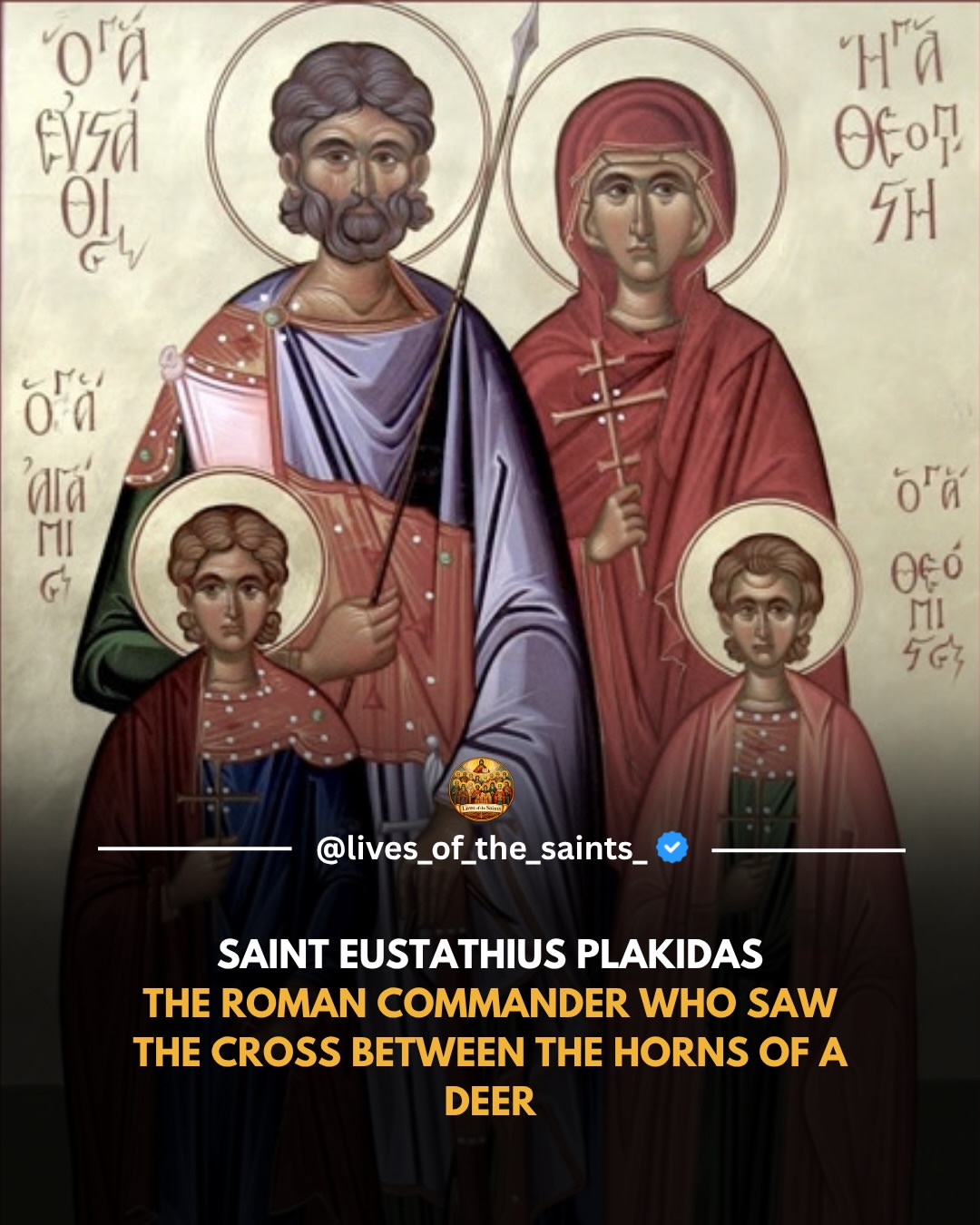
Saint Eustathius Plakidas: Roman Commander Who Became a Martyr

The post recounts the life of Saint Eustathius, born Plakidas, a Roman commander during the reigns of Emperors Titus and Trajan. Although pagan, he was just and merciful, compared to Cornelius the Centurion. While hunting, he saw a radiant Cross between the horns of a deer and heard the voice of the Lord calling him to seek a Christian priest for baptism. Plakidas, his wife, and their two sons were baptized, taking the names Eustathius,…

The post recounts the life of Saint Eustathius, born Plakidas, a Roman commander during the reigns of Emperors Titus and Trajan. Although pagan, he was just and merciful, compared to Cornelius the Centurion. While hunting, he saw a radiant Cross between the horns of a deer and heard the voice of the Lord calling him to seek a Christian priest for baptism.

Plakidas, his wife, and their two sons were baptized, taking the names Eustathius, Theopiste, Agapius, and Theopistus. Eustathius returned to the vision site to give thanks, and the Lord revealed he would suffer greatly for His name but also strengthened him. Soon he lost his wife and sons and lived for fifteen years as a hired worker in an Egyptian village.

By divine providence he was discovered, returned to the Roman army, and led it to victory. On the journey back to Rome he was reunited with his wife and both sons. Emperor Hadrian demanded he sacrifice to idols; Eustathius confessed he was a Christian.

He, his wife, and their sons were tortured, but wild beasts would not harm them. Finally they were placed inside a heated metal bull and gave up their souls. When their bodies were removed, they were dead but unharmed.

The post ends by stating that Saint Eustathius shows God does not abandon those who belong to Him through loss, exile, and suffering, and that he rendered to Caesar what was Caesar's and to God what was God's. The text includes hashtags for Saint Eustathius, Orthodox saints, great martyr, Orthodox faith, and Christian martyrs.

  • Plakidas was a Roman commander under Titus and Trajan who converted after seeing a Cross between a deer's horns
  • He, his wife, and two sons were baptized and received new names: Eustathius, Theopiste, Agapius, Theopistus
  • He lost his family and spent fifteen years as a laborer in Egypt before being restored to command
  • Reunited with his family, he refused Hadrian's order to sacrifice to idols and confessed Christ
  • The family was tortured, unharmed by beasts, and martyred in a heated bronze bull; bodies found intact
Lives of the Saints 🙏 Instagram

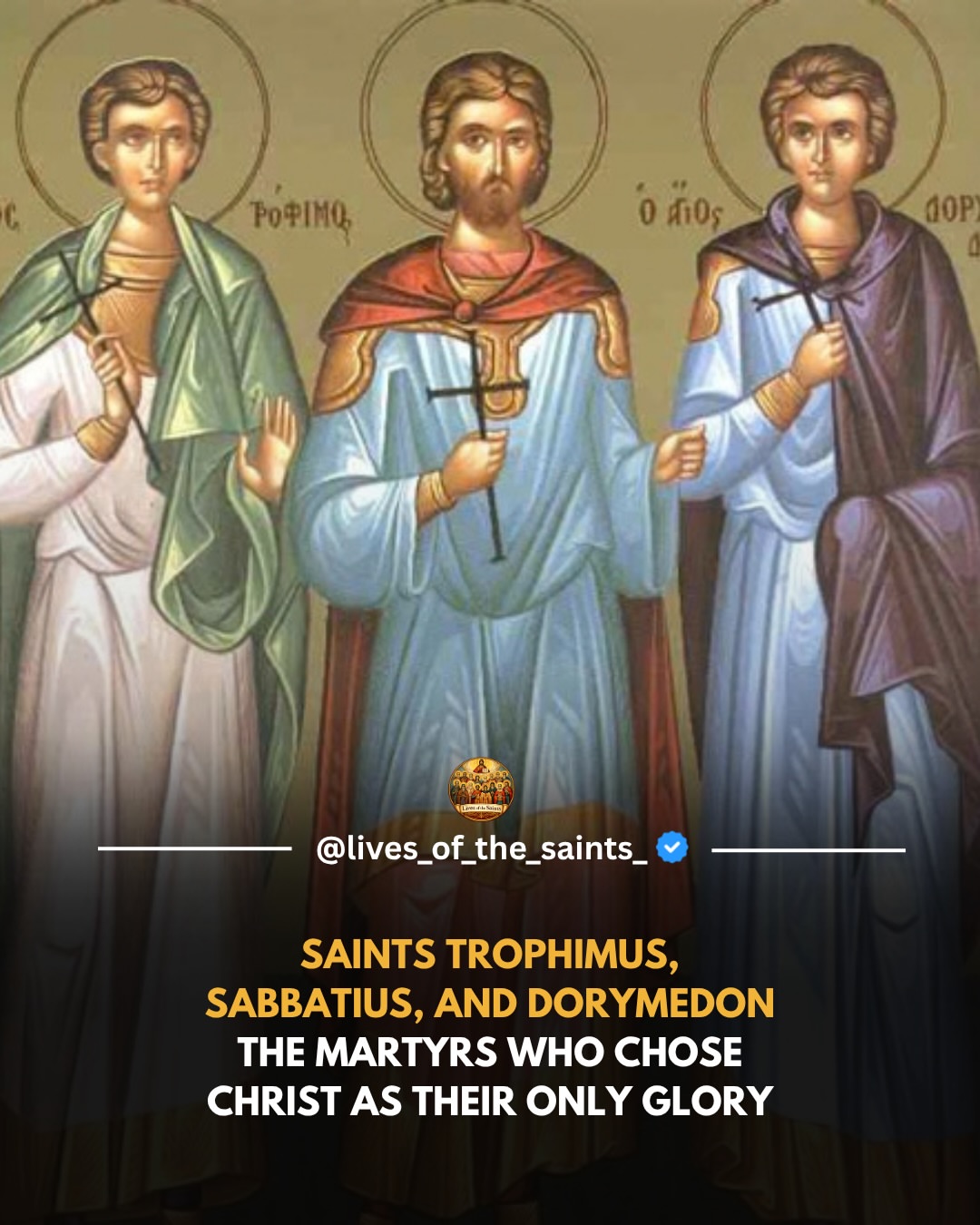
Martyrdom of Trophimus, Sabbatius, and Dorymedon in Antioch and Phrygia

During the reign of Emperor Probus, Saints Trophimus and Sabbatius traveled to Antioch. At that time, pagans were holding a feast and sacrifice to Apollo near the city, and Governor Atticus ordered everyone to take part. When it became known that Trophimus and Sabbatius refused to join the celebration, they were brought before the governor. They would not deny Christ. After being beaten and tortured, Saint Trophimus was sent to Phrygia to face…

During the reign of Emperor Probus, Saints Trophimus and Sabbatius traveled to Antioch. At that time, pagans were holding a feast and sacrifice to Apollo near the city, and Governor Atticus ordered everyone to take part. When it became known that Trophimus and Sabbatius refused to join the celebration, they were brought before the governor.

They would not deny Christ. After being beaten and tortured, Saint Trophimus was sent to Phrygia to face another cruel persecutor, while Saint Sabbatius remained before Atticus. When the governor asked Sabbatius about his rank and dignity, he answered: "My rank, my dignity, my homeland, my glory, and my wealth are Christ, the Son of God."

For this confession, he was tortured so terribly that he gave his soul to God. Saint Trophimus was also tortured and imprisoned. There, a senator named Dorymedon, who was secretly a Christian, came to serve him. When this was discovered, both men were tortured again and thrown before wild beasts.

The beasts would not touch them. Even when Saint Dorymedon tried to provoke a bear, the animal became gentle before him. Finally, Saints Trophimus and Dorymedon were killed by the sword.

  • Saints Trophimus and Sabbatius refused to join a pagan feast to Apollo in Antioch under Governor Atticus
  • Sabbatius confessed Christ as his only rank and wealth before being tortured to death
  • Trophimus was sent to Phrygia, imprisoned, and served by Senator Dorymedon
  • Wild beasts refused to harm Trophimus and Dorymedon; a bear became gentle before Dorymedon
  • Both saints were ultimately killed by the sword

Recurring Thoughts After Confession: Elder Philemon on Rejecting Temptation

A questioner asks Elder Philemon, a confessor at the Holy Monastic Skete of the Prophet Elias on Mount Athos, what to do when thoughts of past mistakes keep returning even after confession, sometimes appearing in dreams. The elder answers that the mind is not our best friend and jokes that in English 'ideas' sounds like 'my ties', so we should not keep company with our thoughts. He advises treating a troublesome thought like a dirty fly from the…

A questioner asks Elder Philemon, a confessor at the Holy Monastic Skete of the Prophet Elias on Mount Athos, what to do when thoughts of past mistakes keep returning even after confession, sometimes appearing in dreams. The elder answers that the mind is not our best friend and jokes that in English 'ideas' sounds like 'my ties', so we should not keep company with our thoughts.

He advises treating a troublesome thought like a dirty fly from the toilet that lands in your mouth: reject it instantly and the temptation leaves quickly. If the thought comes, let it come, but do not accept it. He warns that the devil often replaces prayer with anxious self-examination, making us ask 'why did I say that' instead of saying 'Lord have mercy', so we waste time.

He quotes an elder who said that when we are covered in mud, we should leave it to dry and it falls off by itself. The discussion stays on this theme: do not dwell on weaknesses, because when you think about them they do not go away.

Key moments

  1. 0:00 A questioner says that after confessing a mistake to the spiritual father, the thought of it keeps coming back, even in dreams, and asks if prayer is the answer.
  2. 0:50 The speaker says the mind is not our best friend and jokes that 'ideas' in English sounds like 'my ties', so we should not keep company with our thoughts.
  3. 1:10 He advises picturing the troublesome thought as a dirty fly from the toilet in your mouth, so you reject it at once and the temptation leaves quickly; if it comes, let it come, do not accept it.
  4. 1:30 The devil often makes us think anxiously 'why did I say that' instead of saying 'Lord have mercy', and we waste time; leave it.
  5. 1:50 An elder said that when we are covered in mud, do not touch it; let it dry and it falls off. Do not dwell on weaknesses, because when you think about them they do not go away.
Read more

Why does Christ change Simon's name to Peter?

Can it really be that the name change has nothing to do with Peter being somehow inseparable from the Rock of Matthew 16? It seems strange that Christ would say "You are Peter" in the middle of talking about the Rock of the Church, and that this would have nothing to do with the nature of that Rock. Why wouldn't He have just said something like "And I tell you, on this confession I will build my Church," if it was only about the confession? No,…

Can it really be that the name change has nothing to do with Peter being somehow inseparable from the Rock of Matthew 16? It seems strange that Christ would say "You are Peter" in the middle of talking about the Rock of the Church, and that this would have nothing to do with the nature of that Rock. Why wouldn't He have just said something like "And I tell you, on this confession I will build my Church," if it was only about the confession?

No, He specifically says "You are Peter." Literally, "You are Rock." To Peter. Why? The more I repeat and pray this verse, the clearer it seems to me that Peter is also the Rock.

  • Christ says "You are Peter" right in the middle of speaking about the Rock of the Church
  • If only the confession mattered, He could have said "on this confession I will build my Church"
  • Literally He says to Peter, "You are Rock"
  • Praying over the verse, the author concludes Peter is also the Rock
19 opinions in the discussion It's a sign that he is God. Just like in the old testament, God changes Abram to Abraham and Jacob to Israel. Read the discussion