WeOrthodox
EN UA

Citations Orthodoxes ☦

Instagram ↗ 5 discussions

Jésus-Christ est venu au monde pour sauver les pécheurs, dont je suis le premier.

Citations Orthodoxes ☦ Instagram

St. George's Church in Gogni: 7th-century shrine where doors refuse to stay

The post describes the Church of St. George in Gogni, a village in the Imereti region of western Georgia. The stone church dates from the seventh and eighth centuries and is known locally as Gognis Tsminda Giorgi, Karugdebeli. According to local tradition, an icon of St. George was discovered in a river and placed on a cart pulled by oxen. The animals climbed the hill and stopped at the exact spot where the sanctuary was later built. The church…

The post describes the Church of St. George in Gogni, a village in the Imereti region of western Georgia. The stone church dates from the seventh and eighth centuries and is known locally as Gognis Tsminda Giorgi, Karugdebeli. According to local tradition, an icon of St. George was discovered in a river and placed on a cart pulled by oxen.

The animals climbed the hill and stopped at the exact spot where the sanctuary was later built. The church earned its nickname Karugdebeli, meaning "the place where doors are rejected," because tradition holds that every time doors were installed they fell off mysteriously. The site remains an active pilgrimage destination throughout the year.

On the feast days of St. George, 6 May and 23 November, thousands of faithful ascend the hill to pray, some walking barefoot as a sign of devotion. The post credits Eklesianews.ge for the information and includes a photograph of the church on the hilltop.

  • Church of St. George in Gogni, Imereti, Georgia, dates from 7th-8th centuries
  • Local name Gognis Tsminda Giorgi, Karugdebeli means "place where doors are rejected"
  • Tradition: icon found in river, placed on ox-cart; oxen stopped at church site
  • Doors installed repeatedly fell off, giving rise to the nickname
  • Pilgrims visit year-round; thousands climb hill barefoot on feast days 6 May and 23 November
Read more
Citations Orthodoxes ☦ Instagram

Saint John Chrysostom on life's value and Paul's desire to be with Christ

The post presents a passage from Saint John Chrysostom reflecting on the value of life and death. He writes that life is a good only when used well; when used for sin, death becomes preferable. Death received for a noble motive becomes a source of countless goods, as shown by the martyrs whose death made them the happiest of men. Chrysostom then cites Philippians 1:22-24, where Paul expresses being pressed between two desires: to depart and be…

The post presents a passage from Saint John Chrysostom reflecting on the value of life and death. He writes that life is a good only when used well; when used for sin, death becomes preferable. Death received for a noble motive becomes a source of countless goods, as shown by the martyrs whose death made them the happiest of men.

Chrysostom then cites Philippians 1:22-24, where Paul expresses being pressed between two desires: to depart and be with Christ, which is far better, or to remain in the flesh for the sake of others. The passage moves from a general principle about the moral use of life to the specific example of martyrs, then to Paul's own words as recorded in Scripture.

Chrysostom uses Paul's dilemma to illustrate the tension between personal desire for union with Christ and the obligation to serve others. The quote ends with the full citation of Philippians 1:22-24 in French.

  • Life is a good only when used rightly; misused for sin, it ceases to be a good
  • Death becomes preferable when life is used for wrongdoing
  • Death accepted for a noble motive brings innumerable goods
  • The martyrs exemplify this: their death made them the happiest of men
  • Paul desired to depart and be with Christ, yet saw remaining as necessary for others
Citations Orthodoxes ☦ Instagram

Saint Nicolas Cabasilas on maturity as condition for fruitfulness

The post presents a short saying in French attributed to Saint Nicolas Cabasilas. The saying opens with an observation about trees: their fruits indicate their vigor. It then states a natural constraint: before a tree reaches maturity, nature does not give it the capacity to produce fruits. The saying then draws a parallel with human life using the phrase "De même" (similarly). It asserts that no man is good for others if he is not first good…

The post presents a short saying in French attributed to Saint Nicolas Cabasilas. The saying opens with an observation about trees: their fruits indicate their vigor. It then states a natural constraint: before a tree reaches maturity, nature does not give it the capacity to produce fruits.

The saying then draws a parallel with human life using the phrase "De même" (similarly). It asserts that no man is good for others if he is not first good toward himself. The comparison equates the tree's maturity with a person's goodness toward himself, and the tree's fruits with a person's goodness toward others.

The logic implies that a proper ordering exists: inner condition precedes outer effect. The text does not elaborate on what constitutes maturity for a human being, nor does it describe the kinds of fruits that follow. It does not reference a specific scriptural passage or patristic work.

The attribution identifies the author as Saint Nicolas Cabasilas, but the post gives no further biographical or historical detail. The language of the original post is French. The saying functions as a standalone moral aphorism that uses a natural analogy to express a principle of spiritual priority.

  • The quote uses a tree analogy: fruits reveal vigor; maturity precedes fruitfulness.
  • Saint Nicolas Cabasilas applies this to humans: one must be good to oneself before being good to others.
  • The saying presents a natural order where inner condition enables outer benefit.
  • The text does not define what being good toward oneself entails.
  • The post is in French and attributes the saying to Saint Nicolas Cabasilas.
Citations Orthodoxes ☦ Instagram

Saint Theophan the Recluse on the path to communion with God

Saint Theophan the Recluse states that it is true that one can know the final purpose of man: communion with God. He adds that one can also describe the path that leads to this purpose: faith and living according to the Commandments, with the help of divine grace. He then says that it suffices to say in addition: here is the path, start walking. The quote consists of three sentences. The first sentence affirms that the final purpose of man is…

Saint Theophan the Recluse states that it is true that one can know the final purpose of man: communion with God. He adds that one can also describe the path that leads to this purpose: faith and living according to the Commandments, with the help of divine grace. He then says that it suffices to say in addition: here is the path, start walking.

The quote consists of three sentences. The first sentence affirms that the final purpose of man is knowable and identifies it as communion with God. The second sentence asserts that the path to this purpose is also describable and names two elements: faith and living according to the Commandments, and notes the assistance of divine grace.

The third sentence gives a direct command to begin walking on that path. The language is French. The attribution is to Saint Theophan the Recluse, a recognized Orthodox saint and spiritual writer. The quote does not provide further explanation of what communion with God entails, nor does it detail the content of faith or the specific Commandments.

It does not discuss the nature of divine grace beyond mentioning its help. It does not address potential obstacles or stages of the path. The statement functions as a concise summary of the Christian life as understood in the Orthodox tradition: a known goal, a known way, and a call to immediate action.

The quote is presented as a standalone aphorism. It uses the first person plural to indicate general accessibility of this knowledge. The phrase suggests that the only remaining step after knowing the goal and the way is the decision to act. The exclamation carries urgency. The name is the French form of Saint Theophan the Recluse, a 19th-century Russian bishop and ascetic writer.

His works often emphasize the practical application of Orthodox theology. This quote reflects that emphasis on practice. The text does not cite a specific work or date. The source text provided contains only this quote; there is no accompanying discussion or commentary.

  • The final purpose of man is communion with God.
  • The path to this purpose is faith and living according to the Commandments.
  • Divine grace assists on this path.
  • Saint Theophan the Recluse urges immediate action: start walking.
  • The quote is in French and attributed to Saint Theophan the Recluse.
Citations Orthodoxes ☦ Instagram

Gaza Orthodox women killed in strike, buried at Saint Porphyrius Church

On the night of October 2 to 3, an Israeli strike struck an apartment in the Rimal neighborhood of Gaza City. Maysa Khader Ibrahim Abu Daoud and her daughter Mary Hafez Michel Najjar, members of the Orthodox Church of Gaza, were killed. They were among five Palestinians who died in the attack, four of them women. The Orthodox community gathered at Saint Porphyrius Church to celebrate their funerals. The two women were well known in the parish…

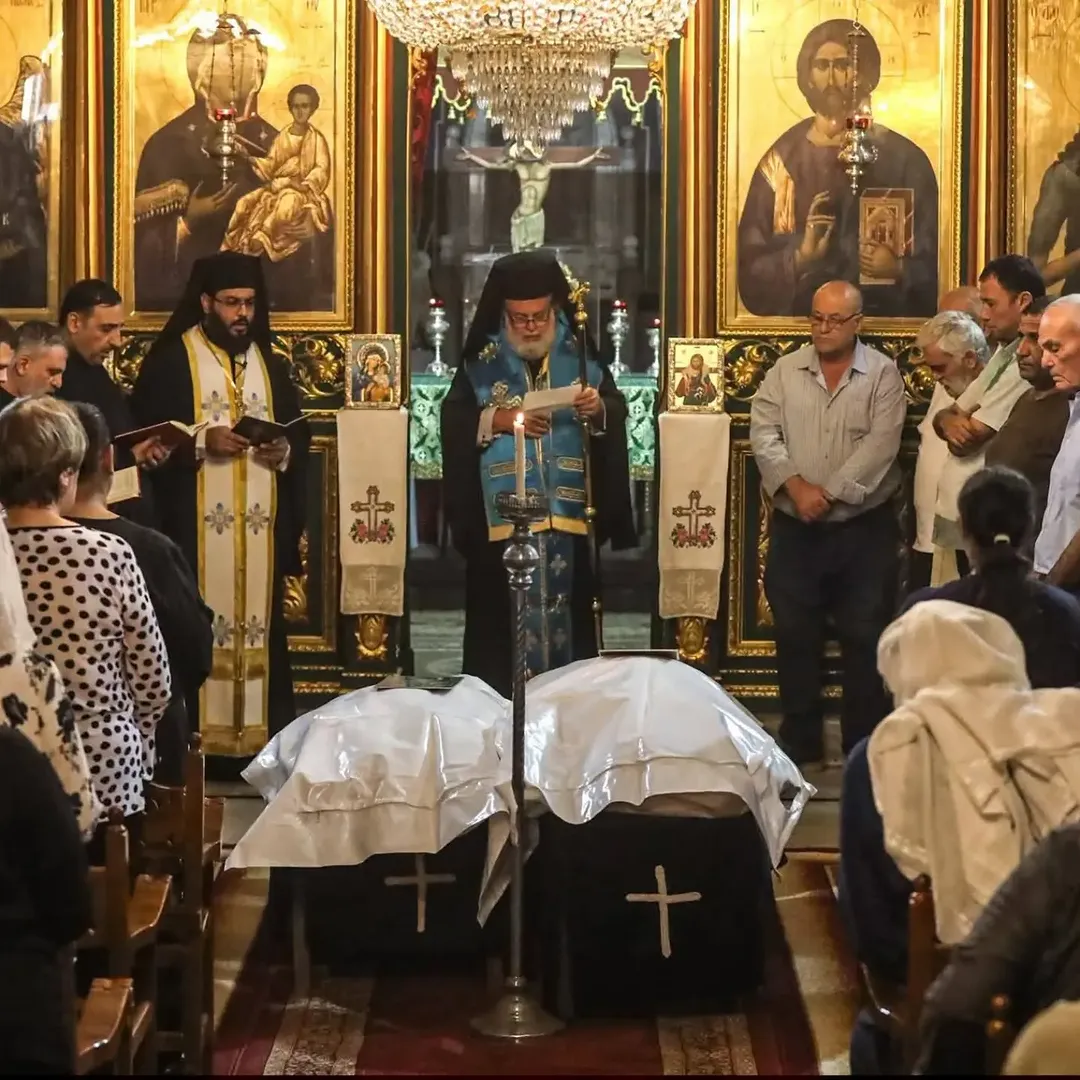
On the night of October 2 to 3, an Israeli strike struck an apartment in the Rimal neighborhood of Gaza City. Maysa Khader Ibrahim Abu Daoud and her daughter Mary Hafez Michel Najjar, members of the Orthodox Church of Gaza, were killed. They were among five Palestinians who died in the attack, four of them women.

The Orthodox community gathered at Saint Porphyrius Church to celebrate their funerals. The two women were well known in the parish and had devoted much of their time to helping the faithful and displaced persons. The text asks that the Lord receive them into His Kingdom and grant strength and consolation to their families, the entire Church of Gaza, and the victims. Eternal memory.

  • Israeli strike on Rimal apartment kills two Orthodox women on night of October 2-3
  • Victims: Maysa Khader Ibrahim Abu Daoud and daughter Mary Hafez Michel Najjar
  • Five Palestinians killed total, four women among them
  • Funerals held at Saint Porphyrius Church in Gaza
  • Both women known for serving parish faithful and displaced persons
Read more