WeOrthodox
EN UA

Discover Orthodox Christianity

Facebook ↗ 15 discussions

The purpose of this group 'Discover Orthodox Christianity' is to create an atmosphere where Orthodox or non-Orthodox people can gain spiritual advice from the Holy Saints, Monastics, Fathers, and Mothers of the Holy Orthodox Church.

Discover Orthodox Christianity Facebook

St. Arsenios Helps Barren Couple Through Prayer

A couple from a village near Farasa in Cappadocia had been married for many years without children and suffered great sorrow. They heard of the holy priest Father Arsenios and the miracles God performed through him. They came to him with tears, asking for his blessing and prayers. The saint, filled with compassion, told them: "Have faith in God and patience. The Lord is able to make the barren womb fruitful." He prayed over them, blessed them…

A couple from a village near Farasa in Cappadocia had been married for many years without children and suffered great sorrow. They heard of the holy priest Father Arsenios and the miracles God performed through him. They came to him with tears, asking for his blessing and prayers.

The saint, filled with compassion, told them: "Have faith in God and patience. The Lord is able to make the barren womb fruitful." He prayed over them, blessed them with his Gospel book, and anointed them with oil from the vigil lamp of Saint John the Baptist's chapel. He sent them home in peace, telling them to thank God. In time the woman conceived and bore a child, a miracle granted through Saint Arsenios's fervent prayer.

Out of gratitude the parents brought the newborn to the saint for baptism. When baptizing children, Saint Arsenios always gave them the names of great saints, often according to divine inspiration. It is said he gave this child the name of a saint who would protect him throughout his life.

The account illustrates the power of pure prayer, the compassionate heart of Saint Arsenios, and the living faith of those who sought his help. The post notes that Saint Arsenios's feast day is commemorated on November 10.

  • A childless couple from a village near Farasa sought St. Arsenios's help.
  • The saint prayed, blessed them with his Gospel book, and anointed them with oil from St. John the Baptist's vigil lamp.
  • The woman later conceived and bore a child.
  • The parents brought the child to St. Arsenios for baptism; he gave the child a saint's name by divine inspiration.
  • The story illustrates the power of pure prayer and St. Arsenios's compassion; his feast is November 10.
Discover Orthodox Christianity Facebook

Construction Worker Survives Fifth-Floor Fall Through St. Nektarios' Intercession

Gerontissa Timothei narrates the account of a construction worker who fell from the fifth floor and struck his head. The worker survived, which is attributed to the grace of God and the intercessions of St. Nektarios.

  • Construction worker falls from fifth floor
  • Worker hits his head in the fall
  • Survival attributed to God's grace
  • St. Nektarios' intercessions credited
  • Account narrated by Gerontissa Timothei
Read more
Discover Orthodox Christianity Facebook

St. John of Damascus on Angels: Nature, Liturgy, and Guardian Angels

Fr. George Papavarnavas summarizes the teaching of Saint John of Damascus on the angelic orders. Angels are spiritual, ever-moving, free, and bodiless beings who serve God and are immortal by grace. Their exact form is known only to God; compared to God they are material, formed of fine matter. They communicate without spoken language, exchanging thoughts directly. When appearing to humans they take visible shape, bright and clothed in white,…

Fr. George Papavarnavas summarizes the teaching of Saint John of Damascus on the angelic orders. Angels are spiritual, ever-moving, free, and bodiless beings who serve God and are immortal by grace. Their exact form is known only to God; compared to God they are material, formed of fine matter.

They communicate without spoken language, exchanging thoughts directly. When appearing to humans they take visible shape, bright and clothed in white, signifying purity. Their sustenance is the vision of God. In every Divine Liturgy, which unites heaven and earth, angels concelebrate with the bishop or priest.

During the Small Entrance the celebrant prays for angels to join in glorifying God, and the deacon asks for an angel of peace as a faithful guide and guardian. From baptism a guardian angel stands beside each person, departing only when driven away by sin and returning through true repentance. The angels rejoice when someone repents sincerely.

  • Angels are bodiless spiritual beings created by God, immortal by grace, and known fully only to Him.
  • They communicate without language and appear to humans in bright white form.
  • Angels concelebrate at every Divine Liturgy, invoked during the Small Entrance and by the deacon's prayer.
  • A guardian angel is assigned at baptism and remains unless turned away by sin.
  • Sincere repentance restores the guardian angel's presence and causes the angels to rejoice.
Discover Orthodox Christianity Facebook

St. John Chrysostom on Angels at the Altar and Reverence in Church

The post consists of a quotation attributed to St. John Chrysostom and two lines of Greek text displayed in an image. The quotation addresses the worshipper who stands before the altar where Christ reposes. Chrysostom says that such a person ought no longer to think they are among men, but should believe that troops of angels and archangels are standing by, trembling with respect before the sovereign Master of Heaven and earth. From this reality…

The post consists of a quotation attributed to St. John Chrysostom and two lines of Greek text displayed in an image. The quotation addresses the worshipper who stands before the altar where Christ reposes. Chrysostom says that such a person ought no longer to think they are among men, but should believe that troops of angels and archangels are standing by, trembling with respect before the sovereign Master of Heaven and earth.

From this reality he draws a practical conclusion: when you are in church, be there in silence, fear, and veneration. The Greek text in the image provides a liturgical context. The first line identifies the Archangel Michael as the commander and historian of the angelic order. The second line names the Synaxis of the Archangels, which is the feast day commemorating the gathering of the archangels and all the bodiless powers, observed on November 8 in the Orthodox calendar.

The juxtaposition suggests that the quote is being shared in connection with that feast. It simply presents the patristic words and the feast reference together, linking the theological vision of the angelic presence at the Eucharist with the Church's annual celebration of the archangelic hosts.

  • St. John Chrysostom describes angels and archangels present at the altar.
  • He urges silence, fear, and veneration in church.
  • Image text names Archangel Michael as commander of the angelic order.
  • Image text references the Synaxis of the Archangels feast.
  • The post connects the patristic quote with the feast of the bodiless powers.
Read more
Discover Orthodox Christianity Facebook

St. Gabriel and St. George Karslidis on the Divine Liturgy

The post reflects on the Divine Liturgy as the Divine Table prepared by Christ through the clergy by the grace of the Holy Spirit. It cites St. Gabriel of Georgia, who said that if one knew the greatness of the Liturgy's blessing, one would collect even the dust from the church floor to wash one's face with it. The author notes that angels attend the Liturgy, heaven and earth meet, and the saints participate. St. George Karslidis is quoted…

The post reflects on the Divine Liturgy as the Divine Table prepared by Christ through the clergy by the grace of the Holy Spirit. It cites St. Gabriel of Georgia, who said that if one knew the greatness of the Liturgy's blessing, one would collect even the dust from the church floor to wash one's face with it. The author notes that angels attend the Liturgy, heaven and earth meet, and the saints participate.

St. George Karslidis is quoted urging the faithful not to sit during the Liturgy, but to devote all their time in church to prayer, because the King has prepared Himself for our salvation. The post explains that we owe God our full body and mind, concentrated in prayer, so that we may be clothed in a wedding garment with heart, body, mind, and soul made "whiter than snow" (Psalm 50).

When the congregation approaches to partake of the Body and Blood of Christ, the author asks whether we should not stand in awe, fear of God, and love, keeping our attention fixed on prayer.

  • The Divine Liturgy is the Divine Table prepared by Christ through the clergy by the Holy Spirit's grace
  • St. Gabriel of Georgia: the blessing of the Liturgy is so great one would use church dust to wash one's face
  • Angels attend, heaven and earth meet, and the saints participate in the Liturgy
  • St. George Karslidis: do not sit; devote all time in church to prayer because the King is present for our salvation
  • We must give full body and mind to concentrated prayer, becoming "whiter than snow" (Psalm 50) as a wedding garment
Read more
Discover Orthodox Christianity Facebook

Post invokes St. David of Evia; video hymn honors Prophet David

The post text requests the intercessions of St. David of Evia, identifying him as the child who met St. John the Baptist. An attached video presents a hymn that glorifies the Prophet David as the all-glorious, divinely inspired forefather of Christ and source of sacred virtue. The hymn calls upon the Prophet David, described as most true and holiest of all and equal to the saints, to entreat Christ God the Son that the Father may grant great mercy to the faithful.

Key moments

  1. David is praised magnificently in the midst of glory as the all-glorious, godly forefather of Christ and origin of sacred virtue.
  2. He is called most true and the holiest of all, equal to the saints.
  3. The hymn asks David to entreat Christ God the Son, through whom the Father acts, to grant great mercy to us.
Discover Orthodox Christianity Facebook

Child Healed of Leukemia Through St. David of Evia's Intercession in 1976

Nicholas and Eleutheria Kouphomargaritis from Moschato in Attica had a daughter named Martha who suffered from leukemia. The parents consulted many doctors, but none offered hope for the child's recovery. They then met Eleutheria Tzini from Rovies in Evia, who had herself been rescued from a serious illness by Venerable David. Eleutheria Tzini spoke to them about "our Saint," Venerable David of Evia. When the mother asked who this saint was,…

Nicholas and Eleutheria Kouphomargaritis from Moschato in Attica had a daughter named Martha who suffered from leukemia. The parents consulted many doctors, but none offered hope for the child's recovery. They then met Eleutheria Tzini from Rovies in Evia, who had herself been rescued from a serious illness by Venerable David.

Eleutheria Tzini spoke to them about "our Saint," Venerable David of Evia. When the mother asked who this saint was, having never heard of him, Eleutheria replied, "Venerable David." The mother then took her sick child into her arms, lifted her up, and prayed from her heart: "My Saint David, make my daughter well."

At that moment the child became immediately well. The parents brought the healthy child to the monastery where St. David had lived, and there they glorified the holy Elder. The miracle occurred in 1976. The Orthodox Church celebrates the feast day of St. David of Evia on November 1st.

  • Martha Kouphomargaritis suffered from leukemia and doctors gave no hope
  • Eleutheria Tzini from Rovies told the parents about Venerable David of Evia
  • The mother prayed directly to St. David: "My Saint David, make my daughter well"
  • The child was healed instantly at that moment in 1976
  • The family brought the healed child to the monastery to glorify the saint
Read more
Discover Orthodox Christianity Facebook

Myrrh miracle at St. Demetrios' relics witnessed by deacon in 1987

Fr. Christos Kotios, then a newly ordained deacon at the Church of St. Demetrios in Thessaloniki, recounts a miracle he witnessed on the evening of October 26, 1987. The city was celebrating its liberation from Ottoman rule (1430-1912) on the feast of the martyrdom of its protector, St. Demetrios. Around 10:00 p.m., about thirty to forty pilgrims were in the church. A group of ten women chanted the Paraklesis before the silver reliquary holding…

Fr. Christos Kotios, then a newly ordained deacon at the Church of St. Demetrios in Thessaloniki, recounts a miracle he witnessed on the evening of October 26, 1987. The city was celebrating its liberation from Ottoman rule (1430-1912) on the feast of the martyrdom of its protector, St. Demetrios. Around 10:00 p.m., about thirty to forty pilgrims were in the church.

A group of ten women chanted the Paraklesis before the silver reliquary holding the saint's relics. The only cleric present was the deacon, instructed to stay by the proistamenos, the future Metropolitan Panteleimon of Boeria, Naousa and Kampania. During the chant, the women shouted; the deacon ran to them and saw the reliquary bathed in an oily, yellowish-green myrrh.

The quantity was so great he likened it to at least two buckets poured down the sides. The fragrance was indescribable and filled the church and the street outside. The deacon fetched cotton from the altar and soaked up the myrrh, but it continued to flow mystically without a visible source.

He noticed that after he cleaned a smooth area of the reliquary, a woman's touch immediately caused fresh myrrh to appear on her hand. Meanwhile, pilgrims discovered that all the icons in the church, on stands and on the iconostasis, were also streaming myrrh; handkerchiefs wiped on the icon frames turned yellow. Soon a line formed to venerate the reliquary. The proistamenos and other priests arrived, unlocked the reliquary, and found the relics fragrant, though the myrrh's scent was distinct.

Metropolitan Panteleimon II Chrysaphakes of Thessaloniki attributed the miracle to a university celebration that evening where the keynote speaker omitted any mention of the saint. He said St. Demetrios showed he would never abandon the city, having saved it from slavery and earthquakes, while some proved ungrateful and distant from Christ.

Twenty-four years later, Fr. Christos writes as a priest in Thessaloniki, recalling the joy, astonishment, and sense of living a mystery. He says such events strengthen faith and confirm that the faith is alive.

  • Deacon witnesses myrrh gushing from St. Demetrios' relics during Paraklesis on Oct 26, 1987
  • Myrrh flows abundantly, fragrance fills church and street, icons also stream myrrh
  • Pilgrims venerate, priests open reliquary, relics fragrant with distinct myrrh scent
  • Metropolitan Panteleimon II Chrysaphakes links miracle to university speaker omitting saint
  • Fr. Christos reflects 24 years later: event strengthens faith, shows faith is alive
Read more
Discover Orthodox Christianity Facebook

Patriarch Bartholomew Affirms Human Sanctity Amid AI and Robotocracy

The post features a statement by His All Holiness Patriarch Bartholomew, the Ecumenical Patriarch of Constantinople, addressing the challenges of rapid technological change. He notes the upheaval of values and dizzying advances, specifically mentioning artificial intelligence and the impending robotocracy. In response, he proclaims the Church's teaching that nothing is more sacred than the human being, with whom God shared His nature. The quote…

The post features a statement by His All Holiness Patriarch Bartholomew, the Ecumenical Patriarch of Constantinople, addressing the challenges of rapid technological change. He notes the upheaval of values and dizzying advances, specifically mentioning artificial intelligence and the impending robotocracy. In response, he proclaims the Church's teaching that nothing is more sacred than the human being, with whom God shared His nature.

The quote is accompanied by four photographs showing the Patriarch in various liturgical settings: holding a cross and staff, leading a ceremony inside a church, standing before a large icon, and blessing a crowd. The post presents the Patriarch's words as a direct affirmation of human dignity rooted in the Incarnation, set against contemporary technological developments. There is no accompanying discussion or commentary in the provided text.

  • Patriarch Bartholomew identifies rapid change, value upheaval, and technological advances including AI and robotocracy.
  • He declares the Church's proclamation that the human being is most sacred because God shared human nature.
  • The statement grounds human dignity in the Incarnation.
  • Images depict the Patriarch in liturgical vestments performing episcopal duties.
Discover Orthodox Christianity Facebook

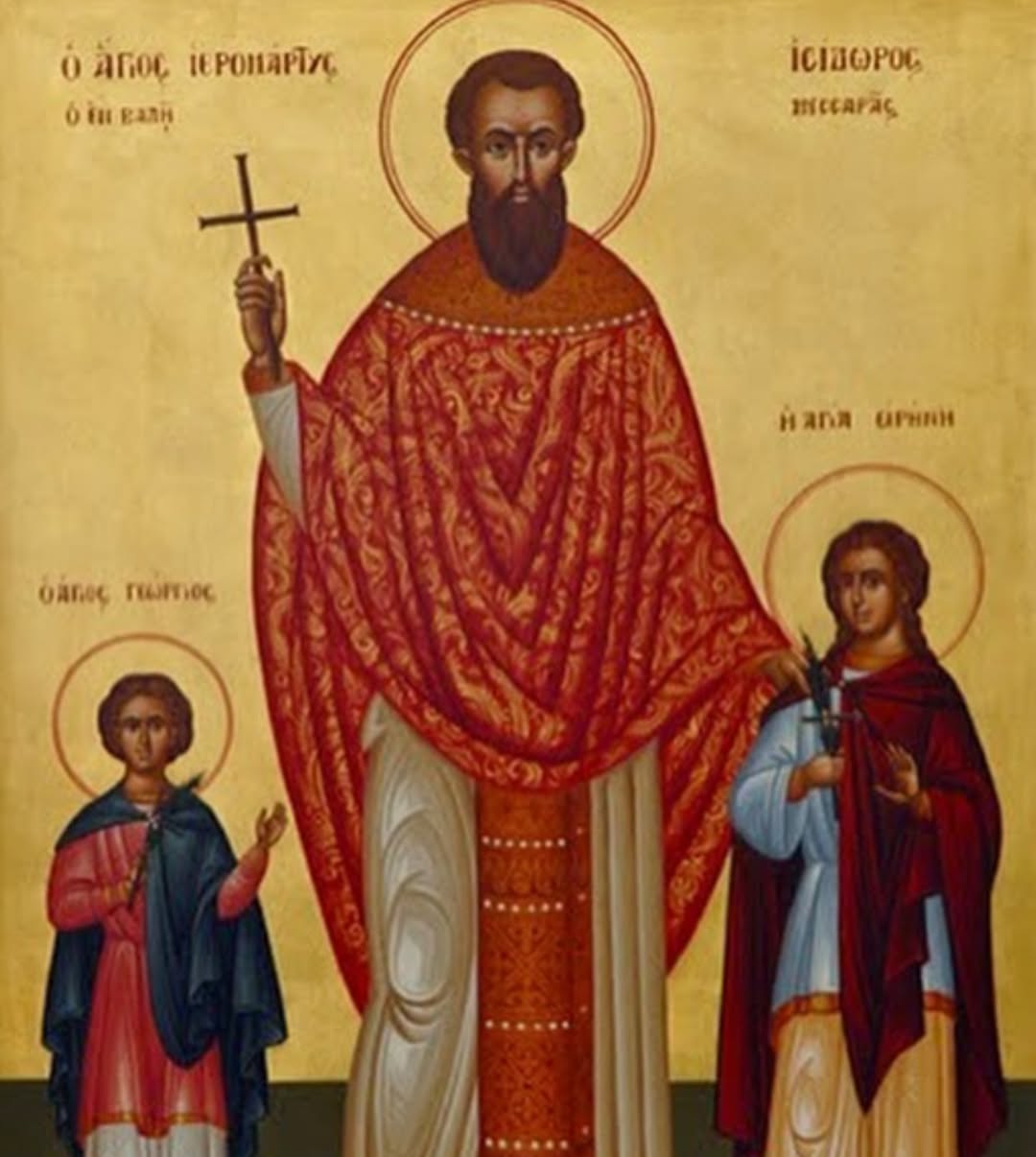
Saint Isidore and his children revealed in 1953 Crete

In the spring of 1953 a priest began appearing in dreams to villagers of Vali in Crete. A grocer and chanter named Demetrios saw a priest who told him to dig at a specific place on the grounds of the old primary school to "remove" him from there. The priest identified himself as Papa-Tsiteris and said he had been slaughtered by the Saracens during the initial Turkish raids on the island before the 1650s, together with his two children Irene and…

In the spring of 1953 a priest began appearing in dreams to villagers of Vali in Crete. A grocer and chanter named Demetrios saw a priest who told him to dig at a specific place on the grounds of the old primary school to "remove" him from there. The priest identified himself as Papa-Tsiteris and said he had been slaughtered by the Saracens during the initial Turkish raids on the island before the 1650s, together with his two children Irene and George.

Demetrios wrote the name on a shoe carton and fell asleep again. The priest appeared a second time saying "Wake up, and do what I told you." Demetrios went to the location and dug, uncovering three skeletons, an adult and two children.

Further revelations to the residents disclosed that the priest had been beheaded with his children in the church he served while celebrating the Divine Liturgy. Christians had gathered their relics and buried them with heads placed at their feet, and the skeletons were found in exactly that position. The account is compared to the revelation of the Holy New Martyrs Raphael, Nicholas, and Irene in 1959 on Lesvos.

On October 18, 1953 the relics were translated to the Church of Saint Demetrios in Vali. In September 2003 the people of Vali erected a church in his honor, and at the behest of the Metropolitan it was named "Saint Isidore the New Martyr." Today only portions of the relics remain for veneration because an impious nun stole the greater portion.

The memory of the newly revealed Saints Isidore, Irene, and George is celebrated on October 18.

  • Priest Papa-Tsiteris appeared in dreams to villagers of Vali, Crete in spring 1953
  • Demetrios dug at indicated site and found three skeletons matching the vision
  • Saints identified as Hieromartyr Isidore (Papa-Tsiteris) and his children Irene and George, martyred by Saracens before 1650s
  • Relics translated to Church of Saint Demetrios on October 18, 1953; church dedicated to Saint Isidore built in 2003
  • Greater portion of relics stolen by a nun; memory celebrated October 18
Read more
Discover Orthodox Christianity Facebook

Relics of Saint Chryse identified near Edessa castle ruins

The Holy Metropolis of Edessa, Pella and Almopia announced the discovery of the holy relics of Saint Chryse, the New and Great Martyr, near the ruins of the old Church of the Dormition of the Theotokos at the castle of Chryse. The relics were examined by the Forensic Medicine Service of Thessaloniki and two specialised scientific laboratories in Germany. The examinations determined that the bones belonged to a young woman approximately seventeen…

The Holy Metropolis of Edessa, Pella and Almopia announced the discovery of the holy relics of Saint Chryse, the New and Great Martyr, near the ruins of the old Church of the Dormition of the Theotokos at the castle of Chryse. The relics were examined by the Forensic Medicine Service of Thessaloniki and two specialised scientific laboratories in Germany.

The examinations determined that the bones belonged to a young woman approximately seventeen years of age and that the year of her death was 1795, which matches the account in her Life. The Metropolis noted that even an ordinary observer can see signs of terrible torture on the ribs and skull. A fragrance continually emanates from the relics, which the Metropolis cited as a clear sign of her sanctity.

In its concluding statement, the Holy Metropolis glorified God for the blessing bestowed two centuries after the saint's martyrdom, at a time described as one of great spiritual challenges and temptations, and exhorted the faithful to have recourse with faith to her holy intercessions and the grace of her relics.

  • Holy Metropolis of Edessa, Pella and Almopia announced discovery of Saint Chryse's relics near castle ruins
  • Forensic analysis in Thessaloniki and two German labs confirmed bones of a young woman aged about seventeen
  • Year of death determined as 1795, consistent with her Life
  • Visible torture marks on ribs and skull; fragrance emanates from relics
  • Metropolis calls faithful to seek her intercessions and venerate her relics
Discover Orthodox Christianity Facebook

Panagia Kitrinopetritissa: The Miraculous Founding of the Monastery of St George in Yellow Rock, Australia

This post recounts the miraculous story behind the icon of Panagia Kitrinopetritissa (Panagia of Yellow Rock), commemorated on the 4th of October, and the founding of the Holy Monastery of St George at Yellow Rock, New South Wales. Eleni, the monastery's founder, fervently prayed with her husband Dimitrianos for guidance in their lives. She received a vision of the Mother of God directing them to a faraway land overseas, which subsequent visions…

This post recounts the miraculous story behind the icon of Panagia Kitrinopetritissa (Panagia of Yellow Rock), commemorated on the 4th of October, and the founding of the Holy Monastery of St George at Yellow Rock, New South Wales. Eleni, the monastery's founder, fervently prayed with her husband Dimitrianos for guidance in their lives.

She received a vision of the Mother of God directing them to a faraway land overseas, which subsequent visions made clear was Australia. The couple arrived in Sydney from London on the 8th of March 1958. In 1960, Eleni saw a vision of wild bushland with creeks and eucalyptus trees and a large silver cross in the sky, accompanied by a voice telling her, "You are to build a Church here."

When she asked how this could be accomplished, the voice answered, "The people will help you." After several twists and turns that nearly led her to the wrong locations, the Mother of God appeared to Eleni again in a dream, telling her she was looking in the wrong places. Eleni eventually found herself at Yellow Rock, where she immediately recognised the land from her vision.

She sought the counsel of His Eminence Archbishop Ezekiel of blessed memory, who gave his blessing for the couple to purchase the land. Upon inspecting the property, Eleni joyfully proclaimed, "This is the place Your Eminence!" Archbishop Ezekiel prayed and declared that the monastery would be named after Saint George.

In 2012, through the spiritual guidance of the then-Abbot, Bishop Kyriakos of Melbourne, the icon of Panagia of Yellow Rock was commissioned. Faithful pilgrims venerate the holy icon at the monastery, and some have experienced miracles through it. The post is a devotional account of the monastery's founding, emphasising the role of divine guidance, obedience to the Theotokos's visions, and the hierarchy's blessing in establishing the monastery.

  • Eleni received visions of the Mother of God directing her and her husband Dimitrianos to Australia; they arrived in Sydney from London on 8 March 1958.
  • In 1960 Eleni saw a vision of bushland with a silver cross in the sky and a voice telling her to build a church there, promising the people would help.
  • After being told she was looking in the wrong places, Eleni recognised the land at Yellow Rock; Archbishop Ezekiel blessed the purchase and named the monastery after Saint George.
  • In 2012, under Abbot Bishop Kyriakos of Melbourne, the icon of Panagia Kitrinopetritissa was commissioned.
  • The icon is kept at the Holy Monastery of St George, Yellow Rock, commemorated on 4 October, and some faithful have experienced miracles venerating it.
Read more
Discover Orthodox Christianity Facebook

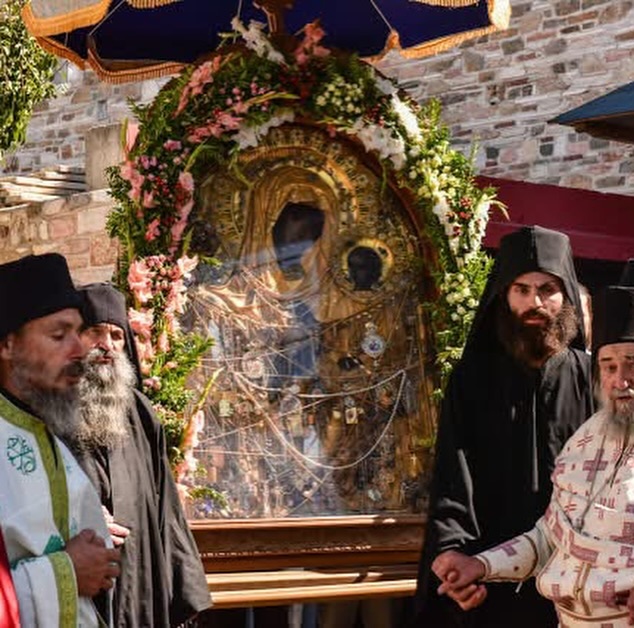
Young Man Speaks Before the 'Quick to Hear' Icon at Docheiariou Monastery on Mt. Athos

This post recounts a reported miracle at Docheiariou Monastery on Mount Athos in early December 2016, described by a monk who witnessed the event and later retold at a public Church gathering in Thessaloniki. According to the account, an eighteen-year-old man from Strumica, who had never spoken clearly and could produce only unintelligible sounds (the headline describes him as mute from birth, while the body text also mentions a severe stutter),…

This post recounts a reported miracle at Docheiariou Monastery on Mount Athos in early December 2016, described by a monk who witnessed the event and later retold at a public Church gathering in Thessaloniki. According to the account, an eighteen-year-old man from Strumica, who had never spoken clearly and could produce only unintelligible sounds (the headline describes him as mute from birth, while the body text also mentions a severe stutter), visited the monastery to venerate the wonderworking icon of the Mother of God known as 'Gorgoepikoos' — 'Quick to Hear.' Standing before the icon, the young man suddenly cried out in his native language: 'Mother Mary, give me my health.' Those present, who knew his condition, were astonished.

After a monk continued reading the prayer service, the young man addressed those who had prayed with him, saying: 'Thank you everybody, now I feel very well.' The post frames the event as a manifestation of the grace that Orthodox tradition associates with the Panagia through this particular icon, which has a long history at Docheiariou and is honored for swiftly answering the prayers of the faithful.

The monastery's abbot, Elder Gregorios, and the brethren are described as continually offering supplicatory services and praying for the living and the departed. The account closes with a liturgical acclamation to the Mother of God as she 'who art quick to hear, fulfilling our petitions for our benefit.' The post presents the story as an eyewitness testimony circulated via the Greek website Vimaorthodoxias.gr; readers are invited to receive it within the Church's living tradition of the Theotokos' merciful intercession.

  • A miracle was reported in early December 2016 at Docheiariou Monastery, Mt. Athos, before the wonderworking icon 'Gorgoepikoos' ('Quick to Hear').
  • An eighteen-year-old from Strumica, who had never spoken intelligibly, suddenly cried out 'Mother Mary, give me my health' before the icon.
  • Afterwards he thanked those present, saying he felt well; the event was witnessed and recounted by a monk.
  • The story was also told at a public Church event in Thessaloniki and reported by Vimaorthodoxias.gr.
  • The post presents this as an example of the Theotokos' swift mercy through her 'Quick to Hear' icon.
Discover Orthodox Christianity Facebook

Miracle of Panagia Gorgoepikoos: Healing from Death's Door

The post recounts a documented miracle attributed to the icon of Panagia Gorgoepikoos (the Theotokos "Quick to Hear"), commemorated on October 1. The testimony comes from Thekla Periorellis of Piraeus, Athens, describing events from the summer of 1987. Her husband suffered an acute myocardial infarction complicated by pulmonary edema and was declared dying by Dr. Papoutsakis at the General State Hospital in Nicea. Holding an icon of Panagia…

The post recounts a documented miracle attributed to the icon of Panagia Gorgoepikoos (the Theotokos "Quick to Hear"), commemorated on October 1. The testimony comes from Thekla Periorellis of Piraeus, Athens, describing events from the summer of 1987. Her husband suffered an acute myocardial infarction complicated by pulmonary edema and was declared dying by Dr. Papoutsakis at the General State Hospital in Nicea.

Holding an icon of Panagia Gorgoepikoos, Mrs. Periorellis placed it in her husband's arms as her only hope, then withdrew to the hallway to pray fervently for his life, their children, and herself. Within ten minutes, the physician emerged from the intensive care unit visibly confused and announced, "A miracle happened." The unexpected recovery was immediate and medically inexplicable.

The account emphasizes the icon's longstanding reputation for swift intercession, reflecting the meaning of the title Gorgoepikoos — "She who hears speedily." The post concludes by noting the feast day of this miraculous icon, inviting the faithful to seek the Virgin's protection and quick aid. No discussion comments are provided, so the card focuses solely on the presented testimony and its liturgical context.

  • Icon of Panagia Gorgoepikoos known for swift intercession
  • 1987 testimony: husband near death from heart attack and pulmonary edema
  • Wife placed icon in his arms and prayed in hospital hallway
  • Doctor emerged within minutes declaring a miracle had occurred
  • Feast day commemorated October 1
Read more
Discover Orthodox Christianity Facebook

Saint Euphrosyne: The Monk Who Was Secretly a Woman for 38 Years

This post recounts the life of Saint Euphrosyne of Alexandria, commemorated on September 25. Living during a time of persecution of Christians, she fled an arranged marriage desired by her father Paphnutios, disguised herself as a man, and entered a male monastery, where she cut her hair and took up the monastic struggle. For 38 years she labored in fasting and unceasing prayer, overcoming the weakness of her body and astonishing the brotherhood…

This post recounts the life of Saint Euphrosyne of Alexandria, commemorated on September 25. Living during a time of persecution of Christians, she fled an arranged marriage desired by her father Paphnutios, disguised herself as a man, and entered a male monastery, where she cut her hair and took up the monastic struggle. For 38 years she labored in fasting and unceasing prayer, overcoming the weakness of her body and astonishing the brotherhood with her virtue, all while concealing her identity.

Only near her death, around the year 470, did she reveal that she was a woman. In God's providence, her father came to the same monastery seeking spiritual guidance precisely as she was dying. Not recognizing the monk as his daughter, he spoke with grief about having lost his child.

Hearing his sorrow, Saint Euphrosyne shed tears and said only, "O father," then gave her spirit into God's hands. The astonished father then realized that the radiant monk was his own daughter and knelt down. The post closes with a request for her intercession before the Lord.

There were no notable comments in the discussion; the post stands as a devotional retelling of her hagiography, emphasizing her renunciation of worldly joys, her hidden ascetic struggle, the providential reunion with her father, and the Church's commemoration of her memory today.

  • Saint Euphrosyne fled her father Paphnutios's marriage plans, disguised herself as a man, and entered a male monastery.
  • She struggled 38 years in labor and unceasing prayer, amazing the brotherhood while hiding her identity.
  • Only at the end of her life, around 470, did she reveal she was a woman.
  • Her father, seeking spiritual guidance at the same monastery, unknowingly spoke with his dying daughter about his grief; she said only, "O father," and reposed.
  • The Church commemorates her on September 25; the post asks her intercession.
Read more