WeOrthodox
EN UA

Orthodox posts, videos and discussions

We follow Orthodox channels, communities and blogs across the web, summarise every post and video, and highlight the conversations with real substance.

F Fr. Barnabas Powell Substack

The Parable of the Vineyard: A Call to Spiritual Fruitfulness
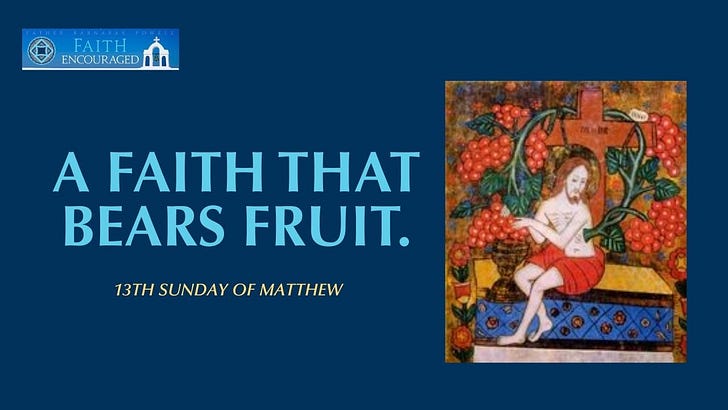
The post reflects on the Parable of the Vineyard as a lens for understanding the Christian vocation. The vineyard owner's expectation of a harvest becomes an image of God's call to His people: not merely to exist, but to bear fruit — lives progressively shaped by faith, repentance, love, and communion with Him. The author emphasizes that spiritual growth is not optional or decorative; it is the very purpose of the Christian life. Just as a…

The post reflects on the Parable of the Vineyard as a lens for understanding the Christian vocation. The vineyard owner's expectation of a harvest becomes an image of God's call to His people: not merely to exist, but to bear fruit — lives progressively shaped by faith, repentance, love, and communion with Him. The author emphasizes that spiritual growth is not optional or decorative; it is the very purpose of the Christian life.

Just as a vineyard is cultivated for produce, the soul is tended by God for holiness. The reflection touches on the dynamic nature of this fruitfulness: it is not a static achievement but an ongoing process of transformation. Faith, repentance, and love are presented not as isolated virtues but as interconnected marks of a life rooted in Christ.

The piece concludes with a brief note about the publication, "Faith Encouraged," being reader-supported, inviting subscribers to sustain the work. There are no comments recorded, so the card reflects only the original article's content.

  • The Parable of the Vineyard illustrates God's expectation of spiritual fruit in the Christian life.
  • Fruitfulness means growth in faith, repentance, love, and communion with God.
  • Spiritual growth is the purpose of the Christian vocation, not an optional addition.
  • These virtues are interconnected and develop dynamically over a lifetime.
  • The author's publication, Faith Encouraged, is reader-supported.
Anthony’s Cell YouTube

Creation Out of Nothing: The Orthodox Study Bible on Genesis and St. Basil

Creation Out of Nothing: The Orthodox Study Bible on Genesis and St. Basil 4:49

An audio reading from Anthony's Cell presents the article on Creation from the Orthodox Study Bible, drawing on Scripture and St. Basil the Great. The reading opens with the Nicene Creed's confession that the one true God is the maker of heaven and earth, of all things visible and invisible. St. Basil is quoted on Moses engraving the awesome name of God in our hearts as a seal and safeguard with the words 'In the beginning God created.' God was…

An audio reading from Anthony's Cell presents the article on Creation from the Orthodox Study Bible, drawing on Scripture and St. Basil the Great. The reading opens with the Nicene Creed's confession that the one true God is the maker of heaven and earth, of all things visible and invisible. St. Basil is quoted on Moses engraving the awesome name of God in our hearts as a seal and safeguard with the words 'In the beginning God created.' God was not forced to create; in his goodness and loving-kindness he freely chose to create the universe out of nothing, in contrast to the creation myths of surrounding ancient cultures.

The reading sets out the roles of Christ the Word, through whom all things were made according to John's Gospel, and of the Holy Spirit, shown in Genesis 1:2, Psalm 103:30, and Psalm 32:6. On the question of science, the reading states that the Orthodox Church has not dogmatized any particular view on the scientific accuracy of Genesis or on evolution.

What is dogmatically proclaimed is that the triune God created everything and that man alone is made in the image and likeness of God, citing Genesis 1:26-27. The Church Fathers affirm that each species came into existence instantaneously at God's command with its seed within itself, and that the development of life was not accident but the work of supreme intelligence and wisdom.

St. Basil, discussing the scientific theories of his day, counsels keeping admiration for the wisdom of God, the source of such perfect order, and recognizing that all that exists is sustained by the creator's power. The reading closes on the repeated 'And God saw that it was good' in Genesis 1, which shows the fundamental goodness of matter and the created order, the basis for a sacramental worldview, with creation's beauty and vastness intended to draw mankind to worship the creator.

Key moments

  1. 0:33 The Nicene Creed affirms the one true God as the source of everything that exists, both physical and spiritual, animate and inanimate.
  2. 1:04 Saint Basil the Great says Moses engraved the awesome name of God in our hearts as a seal and safeguard: 'In the beginning God created.'
  3. 1:34 God was not forced to create the universe; in his goodness and loving-kindness he freely chose to create out of nothing, in contrast to the creation myths of surrounding ancient cultures.
  4. 2:05 John's Gospel states that all things were made through the Word, and Genesis 1:2, Psalm 103:30, and Psalm 32:6 show the Holy Spirit's role in creation.
  5. 2:36 The Orthodox Church has not dogmatized any particular view on the scientific accuracy of Genesis or evolution; what is proclaimed is that the triune God created everything and man alone is made in the image and likeness of God (Genesis 1:26-27).
  6. 3:09 The Church Fathers affirm each species came into existence instantaneously at God's command with its seed within itself; development of life was not by accident but the work of supreme intelligence and wisdom.
  7. 3:39 Saint Basil the Great, discussing scientific theories of his day, says to keep admiration for the source of such perfect order, the wisdom of God, and to recognize that all that exists is sustained by the creator's power.
  8. 4:11 The repeated 'And God saw that it was good' in Genesis 1 shows the fundamental goodness of matter and the created order, the basis for a sacramental worldview, and creation's beauty and vastness are intended to draw mankind to worship the creator.
r/OrthodoxChristianity Reddit discussion

Mother's Concerns About Orthodox Infant Baptism Addressed by Experienced Parents

A mother married to an Orthodox husband seeks reassurance about their baby's upcoming baptism. She worries that the immersion in water and the ceremony's unfamiliarity could be traumatic or overly stressful for the infant, especially given that babies often cry during the rite. She also asks about the post-baptism practice of attending church for three consecutive Sundays, during which the baby receives Holy Communion (including a small amount…

A mother married to an Orthodox husband seeks reassurance about their baby's upcoming baptism. She worries that the immersion in water and the ceremony's unfamiliarity could be traumatic or overly stressful for the infant, especially given that babies often cry during the rite. She also asks about the post-baptism practice of attending church for three consecutive Sundays, during which the baby receives Holy Communion (including a small amount of wine from the chalice), and mentions a term she recalls as "kineftonomia."

Commenters, many of whom are parents and godparents with direct experience, overwhelmingly reassure her that the baptism is brief, the water is warmed, and priests are skilled at handling infants gently. They note that crying is a normal reaction to strangers and new sensations, not a sign of trauma, and that children show no lasting distress — often growing to love the church and communion.

Regarding the three-week tradition, commenters clarify that it is customary for the godparents to bring the newly illumined child to receive Communion for the first three Sundays, establishing a pattern of regular participation. The term she heard may refer to the Greek "kseladoma" or Cypriot "mira," related to the 40-day churching or the post-baptismal anointing.

The consensus: maternal anxiety is natural but unnecessary; the baby will be fine, and speaking with the priest beforehand can ease specific concerns.

  • Baptismal immersion is brief, water is warmed, and priests are experienced in handling infants gently.
  • Crying during the ceremony is a normal reaction to strangers and new sensations, not an indication of trauma.
  • No evidence suggests lasting negative effects; children typically grow to love church and communion.
  • Post-baptism custom: godparents bring the child to receive Communion for the first three Sundays.
  • The term "kineftonomia" likely refers to the 40-day churching (kseladoma/mira) or post-baptismal anointing.
29 opinions in the discussion Three of my own children have been baptized and I've watched dozens of infant baptisms, while priests have probably done hundreds over their careers. Some babies cry, some don't. Some cry… Read the discussion

Six Years of Struggle: The Detail We Miss in the Life of Saint Moses the Black

1:15

This post reflects on a small but easily overlooked detail in the life of Saint Moses the Black, the great repentant father of the Egyptian desert. While his story is well known as a powerful example of deliverance from a violent past and a life of sin, the speaker draws attention to a single line: after Moses was first beset by dark thoughts of fornication and lust, he sought guidance from Abba Isidore, who told him not to be discouraged, and…

This post reflects on a small but easily overlooked detail in the life of Saint Moses the Black, the great repentant father of the Egyptian desert. While his story is well known as a powerful example of deliverance from a violent past and a life of sin, the speaker draws attention to a single line: after Moses was first beset by dark thoughts of fornication and lust, he sought guidance from Abba Isidore, who told him not to be discouraged, and from another elder, who counselled him to fast, pray, and be vigilant.

What follows is the striking part—he struggled with these thoughts for six years. The post emphasizes that Moses was not struggling alone or without support: he was under the guidance of Abba Macarius and Abba Isidore, living in the same generation and place as Abba Arsenius, arguably the greatest generation of spiritual elders in Church history.

Even surrounded by such fathers, holiness did not come quickly or easily. It is precisely this long endurance that makes Moses such a remarkable example of transformation. He did not lose heart when victory was delayed; he remained hopeful and continued to fight for a life of virtue and communion with Christ year after year.

The post closes with the implication for us: if Abba Moses, the man whom the demons fear, struggled for that long while surrounded by the greatest elders, then we should not despair at our own slow progress. His life teaches patience and hope with ourselves, showing that perseverance through years of unseen struggle is itself a path to sanctity.

Readers are invited to reflect on how this forgotten detail of six years can change the way they view their own spiritual battles.

Key moments

  1. Many people miss a detail about Saint Moses the Black's struggle with lust, found in a simple line of his life.
  2. After first having dark thoughts of fornication and lust, Moses went to Abba Isidore, who told him not to be discouraged.
  3. He then went to another elder who told him to fast, pray, and be vigilant.
  4. The overlooked detail: Moses struggled with these thoughts for six years.
  5. Moses was guided by Abba Macarius and Abba Isidore, in the same place and generation as Abba Arsenius—arguably the greatest generation of spiritual elders in Church history.
  6. His six years of hopeful struggle make him an incredible example of transformation and perseverance in the life of virtue and with Christ.
Read more
F Fr. Barnabas Powell Substack

The Healing Power of Communal Worship: Why 'Go to Church' Remains the Orthodox Answer

The post reflects on the Gospel account of Jesus healing a leper (Luke 5:12-16) to illustrate that true spiritual healing in Orthodoxy requires communal participation, not isolation. The author, drawing from retreat presentations given around the country, emphasizes that the Church's liturgical rhythm and intentional community have formed saints for centuries, long before modern programs or technology. Jesus sent the healed leper to the priest…

The post reflects on the Gospel account of Jesus healing a leper (Luke 5:12-16) to illustrate that true spiritual healing in Orthodoxy requires communal participation, not isolation. The author, drawing from retreat presentations given around the country, emphasizes that the Church's liturgical rhythm and intentional community have formed saints for centuries, long before modern programs or technology.

Jesus sent the healed leper to the priest for official recognition, showing that restoration to community completes healing; leprosy was a social curse, and healing meant reintegration into family and society. Isolation feeds spiritual illness, while communion is where genuine healing grows. Citing St. Cyprian's dictum that one cannot have God as Father without the Church as Mother, and noting that less than 25% of Orthodox Christians attend Liturgy weekly, the author argues that "Lone Ranger" spirituality leads to weak theology and that children drift from the faith by following parental example.

Growing Orthodox parishes share two traits: frequent services and robust religious education. Even when physical attendance is impossible, the home as "the little church" must sustain communal prayer. The commemoration of St. Kyriakos the Hermit underscores that solitude, when rooted in the Church, serves the Body of Christ rather than withdrawing from it; his desert life was a vocation of intercession for the community.

The piece concludes with a direct call to regular church attendance and a prayer for healing that leads back into sustained communion with God's people.

  • Healing in Orthodoxy is communal, not individualistic; the leper's restoration required priestly recognition and reintegration into society.
  • Regular liturgical participation and religious education correlate with parish growth and spiritual maturity.
  • Isolation weakens faith; the Church as Mother is essential for authentic Christian life (St. Cyprian).
  • Domestic prayer ("the little church") sustains communion when building attendance is impossible.
  • St. Kyriakos exemplifies solitude lived in service to the Church, not separation from it.
Holy Resurrection YouTube

No Sin Exceeds God's Mercy—Except Unrepentance

No Sin Exceeds God's Mercy—Except Unrepentance 4:09

This video shares teachings of Archimandrite Thaddeus (from 'Our Thoughts Determine Our Life') on repentance, humility, and worthy preparation for Holy Communion. Its centerpiece is the story of St. Anthony the Great and Satan: an old man asks Anthony whether repentance exists for him, and the Lord reveals the visitor is actually the devil, seeking to learn whether repentance remains for him. The Lord's answer is striking—Satan need only stand…

This video shares teachings of Archimandrite Thaddeus (from 'Our Thoughts Determine Our Life') on repentance, humility, and worthy preparation for Holy Communion. Its centerpiece is the story of St. Anthony the Great and Satan: an old man asks Anthony whether repentance exists for him, and the Lord reveals the visitor is actually the devil, seeking to learn whether repentance remains for him.

The Lord's answer is striking—Satan need only stand facing east for three years praying, 'Forgive me, O Lord, my remaining malice'—yet he will not repent. From this the elder draws the essential Orthodox teaching: there is no sin that can exhaust the Lord's mercy; the so-called blasphemy against the Holy Spirit is nothing other than stubborn persistence in unrepentance and opposition to the truth.

The video then turns to preparation of the heart for Communion. Fasting humbles the body and thereby the soul, as the Church prescribes, but abstinence alone is worthless if one harbors malice: receiving Communion with hatred toward others is not unto salvation but retains hellish dispositions. Obedience is greater than fasting and prayer—'He who is not obedient fasts and prays in vain'—and Communion must be received with a meek, humble heart, lest it become unto judgment.

A saying is also cited in which the Theotokos defines a monk as 'an intercessor for the whole world,' with a warning against warring in one's thoughts against teachers or parents. Finally, the elder contrasts pilgrims: those who visit monasteries merely to see monuments and frescos return with empty souls, while the pious visitor seeking salvation and inner peace returns full of consolation.

The post frames all of this under the theme 'Every temple is built first in the heart,' and includes appeals supporting a parish building fund and channel ministry.

Key moments

  1. 0:12 A monk asked the Theotokos what a monk truly is, and she answered: 'A monk is an intercessor for the whole world.' Warring against teachers or parents in one's thoughts brings no goodwill.
  2. 0:43 An old man asked St. Anthony the Great whether there was repentance for him; the Lord revealed the old man was actually Satan seeking to hear if repentance existed for him.
  3. 1:15 The Lord's answer: Satan should stand facing east for three years praying, 'Forgive me, O Lord, my remaining malice'—but he would not repent.
  4. 1:47 There is no unforgivable sin that can destroy the Lord's mercy; blasphemy against the Holy Spirit is stubborn persistence in unrepentance and opposition to the truth.
  5. 2:18 The heart must be prepared for Holy Communion; fasting humbles the body and thereby the soul, as the Church has prescribed.
  6. 2:51 One can abstain from food yet harbor malice; receiving Communion with hatred toward others is not unto salvation but retains hellish dispositions.
  7. 3:21 Obedience is greater than fasting and prayer: 'He who is not obedient fasts and prays in vain.' Communion must be received with a meek, humble heart, lest it be unto judgment.
  8. 3:52 Whoever visits monasteries only to see monuments and frescos returns with an empty soul, but the pious visitor seeking salvation and inner peace returns full of consolation.
Read more
r/OrthodoxChristianity Reddit discussion

Friend Cut Off All Contact After Moving to a Monastery Community — Should I Reach Out?

The poster, a non-Orthodox Christian, describes how a close friend who was instrumental in bringing them to faith in Christ moved three years ago to live near Saint Anthony's Greek Orthodox Monastery in Arizona. At first she stayed in touch and invited visits, but then she stopped contacting family and friends entirely, with no explanation. Her husband has likewise been estranged from his own family for years. The poster wonders whether a…

The poster, a non-Orthodox Christian, describes how a close friend who was instrumental in bringing them to faith in Christ moved three years ago to live near Saint Anthony's Greek Orthodox Monastery in Arizona. At first she stayed in touch and invited visits, but then she stopped contacting family and friends entirely, with no explanation.

Her husband has likewise been estranged from his own family for years. The poster wonders whether a spiritual father or her husband encouraged the cutoff, and asks whether it would be inappropriate or disrespectful to send an email proposing modest letter correspondence, or whether continuing silence is the more loving choice. The discussion that followed focused less on theology and more on the specific community.

Commenters generally agreed that cutting off all contact is not a normal Orthodox practice: even monks on Mount Athos and novices at other American monasteries commonly keep letter correspondence with family, often with their abbot's blessing. Several respondents said that strict ascetic practices, such as cutting ties with the world, apply to monastics and are not expected of laypeople, and that a married woman living in a lay community should not be bound by them.

Multiple users reported hearing concerning things specifically about the community around Saint Anthony's, describing unusual rules such as overnight services, strict dress codes, and head coverings, and suggesting that extreme behaviors sometimes arise in lay communities that form around monasteries. Others shared personal experiences of families living there for decades, painting a mixed picture.

The practical consensus was that the poster should go ahead and reach out — ideally by letter or even an in-person visit — since a respectful attempt at contact is unlikely to harm the friend, while the lack of closure continues to weigh on those who love her.

  • The poster's friend moved to a lay community near Saint Anthony's Greek Orthodox Monastery and, without explanation, stopped contacting family and friends nearly three years ago.
  • The poster asks whether proposing letter correspondence would disrespect her friend's way of life, or whether continued silence is better.
  • Commenters agree total cutoff is not standard Orthodox practice; even monks and novices often keep letter contact with family, sometimes with their abbot's blessing.
  • Strict ascetic practices like cutting worldly ties apply to monastics, not married laypeople.
  • Several users reported odd or concerning accounts about the Saint Anthony's community specifically, and the practical advice was to send a letter or visit.
51 opinions in the discussion Every single thing I come across regarding that monastery just sounds stranger and stranger. Read the discussion
Saint Wisdom Instagram

Saint Moses the Black: the one who sees his own sins has no time for another's

The video presents a saying of Saint Moses the Black on the habit of watching other people's sins. He says that the person who sees his own sins has no time to examine the sins of another. The point is developed with a warning: do not spend your life watching who is falling around you. Instead, look at your own heart. The saying closes with the reason for this: on the day you stand before God, you will answer for your life, not for the life of…

The video presents a saying of Saint Moses the Black on the habit of watching other people's sins. He says that the person who sees his own sins has no time to examine the sins of another. The point is developed with a warning: do not spend your life watching who is falling around you.

Instead, look at your own heart. The saying closes with the reason for this: on the day you stand before God, you will answer for your life, not for the life of the person beside you. The video keeps to the saint's words and gives no other context or commentary. The hashtags attached to the post, love, orthodox, and saints, show that it is meant for Orthodox Christian viewers interested in the lives and sayings of the saints.

The saying belongs to a well-known theme in the desert fathers' teaching, where judging others and attending to one's own repentance are set against each other. Saint Moses the Black, remembered as a desert father of Egypt, is often quoted on humility and mercy toward the fallen. In this video his words are offered as a short instruction for daily life: turn attention inward, keep watch over your own heart, and leave the judgment of others to God, before whom each person stands alone to give an account.

Key moments

  1. Saint Moses the Black says the person who sees his own sins has no time to examine the sins of another.
  2. He tells us not to spend our life watching who is falling around us, but to look at our own heart.
  3. On the day you stand before God, you will answer for your life, not for the life of the person beside you.
Orthodox Sound YouTube

St. Nektarios on Hope as Anchor and Despair's Danger

St. Nektarios on Hope as Anchor and Despair's Danger 23:36

St. Nektarios of Aegina teaches that hope is a divine gift created with the human soul to strengthen people through trials. He describes hope as a joyful sound, the pillar of sorrowful souls, and a guide through life's stormy sea. Hope comforts the sick, strengthens the timid, delivers the fallen, sustains the elderly, encourages the young, and makes death painless for those who hope in eternal life. St. John Chrysostom calls hope a secure…

St. Nektarios of Aegina teaches that hope is a divine gift created with the human soul to strengthen people through trials. He describes hope as a joyful sound, the pillar of sorrowful souls, and a guide through life's stormy sea. Hope comforts the sick, strengthens the timid, delivers the fallen, sustains the elderly, encourages the young, and makes death painless for those who hope in eternal life.

St. John Chrysostom calls hope a secure anchor, impregnable fortress, and peaceful harbor that finds a way even when none appears. The person who hopes in God lives with profound peace, fears no evil, trusts not in weapons or wealth but in the Lord's mighty arm, and walks without anxiety. Despair is portrayed as a dreadful force born of Tartarus that denies God's providence, drives away hope, and destroys human existence by discouraging the courageous and leading the suffering to violate divine and human laws.

Despondency is worse than despair: the despondent person loses faith, hope, and love, finds no joy in creation, considers the condition incurable, hides suffering, and ultimately abandons life only to enter eternal suffering.

Key moments

  1. 0:00 Hope is praised as a joyful sound, an unfailing gift of God created with the human soul to strengthen man in trials, make him rise above circumstances, and lead him toward perfection and God.
  2. 1:35 Hope remains beside the incurably sick when all abandon them, strengthens timid hearts, revives the weary, drives away despair, delivers those fallen into sin, raises the wounded, and loosens bonds of captives.
  3. 3:40 Hope is the first creative power behind every good thing, guiding scholars, placing sailors on rafts to cross darkened seas, moving everyone to action, and renewing the human being corrupted by sin.
  4. 5:11 Heroes, martyrs of faith, liberty, science, and justice were led by hope as a sacred guide toward the living God who grants eternal life to those in communion with Him.
  5. 6:14 The divine Chrysostom calls hope a secure anchor, foundation of life, salvation of lost souls, impregnable fortress, unfallen wall, invincible tower, and peaceful harbor that finds a way where none exists.
  6. 7:18 The one who hopes in God fears no evil, places all hope in the Lord, praises Him day and night, asks and receives, knocks and finds mercy's doors opened, and enjoys profound peace even amid war.
  7. 12:33 Despair is a dreadful word, black like a daughter of Hades, born to destroy human existence, deny God's providence and Christ the Savior, discourage the brave, and deliver strugglers into enemy hands.
  8. 17:44 Despondency is worse than despair: the despondent man loses faith, hope, and love, finds no pleasure in creation's beauty, considers his condition incurable, hides suffering, and chooses death only to enter eternal suffering.
Ancient Faith YouTube

Matins: The Orthodox Morning Watch from Darkness to Resurrection Light

Matins: The Orthodox Morning Watch from Darkness to Resurrection Light 35:54

Deacon Seraphim Richard Roland walks through the structure and theology of Matins (Orthros), the Orthodox morning watch service. He begins with the Six Psalms (Hexapsalmos) chanted in a dark church while the priest prays the Twelve Morning Prayers before the closed holy doors. These psalms trace a descent into despair — enemies, sin, thirst, the pit — and an ascent to mercy, forgiveness, and morning guidance, mirroring the pattern of salvation.…

Deacon Seraphim Richard Roland walks through the structure and theology of Matins (Orthros), the Orthodox morning watch service. He begins with the Six Psalms (Hexapsalmos) chanted in a dark church while the priest prays the Twelve Morning Prayers before the closed holy doors. These psalms trace a descent into despair — enemies, sin, thirst, the pit — and an ascent to mercy, forgiveness, and morning guidance, mirroring the pattern of salvation.

The deacon then proclaims "God is the Lord" (Psalm 117), announcing Christ's revelation in the darkness. Troparia of the day and Kathismata with Sessional Hymns follow, interpreting the Psalter through the feast or resurrection. On Sundays, one of the eleven Resurrection Gospels is carried into the nave for veneration, making the faithful witnesses to the risen Christ; the Gospel book is placed in the center, showing word and sacrament as complementary revelations.

Psalm 50 leads into the Canon, a poetic structure built on nine biblical odes that teaches a Christological reading of the Old Testament. The Magnificat is sung at the ninth ode, followed by the Praises (Psalms 148–150) and the Great Doxology — "Glory to Thee who hast shown us the light" — summoning all creation into the light of the Resurrection.

Deacon Seraphim notes key differences in practice: Greek and Antiochian traditions serve Matins before Sunday Divine Liturgy, while Slavic practice joins it to Vespers as the All-Night Vigil on Saturday evenings. He roots the service in the biblical tradition of meeting God in the night — Israel at the Red Sea, the psalmist at midnight, Christ praying before dawn, the myrrh-bearers at the tomb — and encourages participation in Matins as essential preparation for the Divine Liturgy. Handouts and further resources are provided for deeper study.

Key moments

  1. 0:01 Matins begins in a dark church with the Six Psalms (Hexapsalmos) read in stillness while the priest stands before the closed holy doors praying the 12 Morning Prayers; the psalms move from despair and thirst to hope in God's mercy.
  2. 1:33 Matins (Greek Orthos, Latin Matins) is the church's morning watch; in Greek/Antiochian practice it precedes Sunday Divine Liturgy, while Slavic practice joins it to Vespers as the All-Night Vigil on Saturday evenings.
  3. 3:06 The service belongs to the biblical tradition of meeting God in the night (Israel at the Red Sea, the psalmist at midnight, Christ praying before dawn, the myrrh-bearers at the tomb); darkness is not empty but a time of watchfulness for the Bridegroom.
  4. 4:09 After the Royal Office (Psalms 19, 20) and the opening Trinitarian doxology, the Six Psalms (3, 37, 62, 87, 102, 142 LXX) are chanted in two groups of three; tradition holds they will be read by an angel at the Last Judgment, and the faithful stand immobile during them.
  5. 7:18 The Six Psalms form a descent into despair (enemies, sin, thirst, the pit) and ascent to mercy (forgiveness, healing, morning guidance), mirroring the pattern of salvation; the priest reads the 12 Morning Prayers during the second group.
  6. 12:33 The deacon proclaims 'God is the Lord' (Ps 117), announcing Christ's revelation in the darkness; Troparia of the day follow, then Kathismata (Psalter sections) with Sessional Hymns interpreting the psalms through the feast or resurrection.
  7. 17:18 On Sundays, the Resurrection Gospel (one of 11 in a cycle) is brought into the nave for veneration; the Gospel makes the people witnesses to the resurrection, and the Gospel book is placed in the center — word and sacrament are complementary revelations of the same Lord.
  8. 21:30 Psalm 50 leads into the Canon, a poetic structure built on nine biblical odes (skipping the penitential second ode) that teaches a Christological reading of the Old Testament; the Magnificat is sung at the ninth ode, followed by the Praises (Ps 148–150) and the Great Doxology ('Glory to Thee who has shown us the light').
Read more
Hellenic College Holy Cross Instagram

Bishop Maxim Urges Seminarians to Engage World's Deepest Questions

Bishop Maxim of Los Angeles, of the Serbian Orthodox Church, recently visited Hellenic College Holy Cross at the invitation of the Huffington Ecumenical Institute for a colloquium honoring Ecumenical Patriarch Bartholomew. As an Adjunct Professor of Dogmatics and Patristics at the school, His Grace addressed students preparing for ministry and parish life. Drawing on Saint Justin of Ćelije, Bishop Maxim warned that the Church becomes useless if…

Bishop Maxim of Los Angeles, of the Serbian Orthodox Church, recently visited Hellenic College Holy Cross at the invitation of the Huffington Ecumenical Institute for a colloquium honoring Ecumenical Patriarch Bartholomew. As an Adjunct Professor of Dogmatics and Patristics at the school, His Grace addressed students preparing for ministry and parish life.

Drawing on Saint Justin of Ćelije, Bishop Maxim warned that the Church becomes useless if it fails to answer life's most important questions. He emphasized that a seminarian or future priest must engage with the problems of the world and the concerns of contemporary people to exercise a truly Christ-like ministry. Christ, though the transcendent Son of God, entered history as the Son of Man, embracing all that is human except sin.

Therefore, theology students should be open to cosmic reality and the deepest anthropological issues. Bishop Maxim encouraged students to read widely, like a bee gathering nectar from many flowers, discerning what is existentially relevant under their professors' guidance, so they can later address those issues effectively as priests.

The talk underscored the necessity of a theology that is both rooted in patristic tradition and responsive to the existential anxieties of modern humanity.

Key moments

  1. Saint Justin of Celije said that if the church does not answer the most important questions of life, the church is useless.
  2. A seminarian or future priest must take into account the problems of the world and what concerns contemporary man to do a Christ-like ministry.
  3. Christ, as the transcendent Son of God, became the Son of Man in history, accepting everything human except sin.
  4. This perspective requires any student to be open to cosmic reality and the deepest anthropological issues.
  5. When studying, one should read like a bee: from many sources but take the best, the nectar of theology.
  6. Following professors' instructions and discerning what is truly existentially relevant will help a theology student become a priest capable of addressing the issues.
Read more
George Instagram discussion

Why Most People Make the Sign of the Cross Wrong, and What Each Movement Means

1:07

The speaker says most people make the sign of the cross incorrectly: too fast, only halfway, or as a small wave in front of the chest. He traces the problem to a simple cause: nobody told them what the gesture means. He then explains the hand position. The three pressed fingers stand for the Holy Trinity, the Father, the Son, and the Holy Spirit, three persons and one God. The two folded fingers stand for Jesus, who is fully God and fully man,…

The speaker says most people make the sign of the cross incorrectly: too fast, only halfway, or as a small wave in front of the chest. He traces the problem to a simple cause: nobody told them what the gesture means. He then explains the hand position. The three pressed fingers stand for the Holy Trinity, the Father, the Son, and the Holy Spirit, three persons and one God.

The two folded fingers stand for Jesus, who is fully God and fully man, and they point down because He came down to us. Next he explains the movement itself. Touching the forehead means giving God your mind. Moving to the stomach means giving Him your heart. Touching the shoulders means giving Him your strength, everything you do.

Once a person knows this meaning, he says, rushing becomes impossible, because in those few seconds you are giving your whole self to God: mind, heart, and strength. He closes by asking viewers how they were taught to make the sign of the cross, or whether they were ever taught at all.

Key moments

  1. Most people make the sign of the cross too fast, halfway, or as a small wave in front of the chest, because nobody told them what they are doing.
  2. The three pressed fingers stand for the Holy Trinity: the Father, the Son, and the Holy Spirit, three persons, one God.
  3. The two folded fingers stand for Jesus, fully God and fully man, and point down because He came down to us.
  4. Forehead: giving Him your mind; down to the stomach: your heart; right and left shoulders: your strength, everything you do.
  5. Knowing the meaning, you cannot rush anymore, because you are giving your whole self to God, mind, heart, and strength, in three seconds.
  6. The speaker asks viewers how they were taught to make the cross, or whether they were taught at all.
6 opinions in the discussion Our Orthodox church teaches us left to right is correct ✔️ it means Jesus saved and converted children from left to right.. The right shows power and authority. We know Jesus sits at the… Read the discussion
Orthodox Health Instagram

Why You Need to Be Bad at Something: The Humility of Being a Beginner

0:35

The post, drawn from episode 80 of the Orthodox Health Podcast, argues that competence becomes dangerous when it turns into an identity that must be protected. The author describes a quiet temptation of adulthood: arranging life so that we rarely have to be corrected. We learn which rooms make us look capable, and being competent stops being about possessing a skill and becomes about defending a self-image. Against this, the author recommends…

The post, drawn from episode 80 of the Orthodox Health Podcast, argues that competence becomes dangerous when it turns into an identity that must be protected. The author describes a quiet temptation of adulthood: arranging life so that we rarely have to be corrected. We learn which rooms make us look capable, and being competent stops being about possessing a skill and becomes about defending a self-image.

Against this, the author recommends staying a beginner somewhere, not because incompetence is virtuous but because remaining teachable is. The Christian life, the author says, never allows us to graduate from that posture: repentance still requires correction, prayer still begins from dependence, and humility requires enough freedom from our own self-image to hear "You have more to learn" without treating it as a threat.

The closing counsel is to become excellent, useful and skilled, but not unteachable. The accompanying video summary develops the point: life eventually places everyone in situations they did not volunteer for, and some things will not care how optimized a routine is. Becoming a parent shows this quickly, since the baby does not read your schedule.

Other examples include losing a job, the body no longer doing what it used to do, a hard season in marriage, sickness, the death of someone you love, and a spiritual trial that cannot be solved by reading one more book. In each case reality presents something where existing competence is not enough, and a person becomes a beginner again, this time without choosing the class.

The discussion therefore turns on how chosen incompetence, practiced deliberately, prepares a person for the unchosen moments when life forces beginner status on everyone.

Key moments

  1. Life will put everyone in situations they did not volunteer for, and some things will not care how optimized your routine is.
  2. Becoming a parent shows this quickly: the baby did not read your schedule.
  3. Other trials include losing a job, the body failing, a hard season in marriage, sickness, the death of someone you love, and a spiritual trial that one more book cannot solve.
  4. Reality will present something where your existing competence is not enough, and you become a beginner again, this time without choosing the class.
Kyle YouTube

The Battle Between Good and Evil Runs Through Your Own Heart, Not Against Other People

The Battle Between Good and Evil Runs Through Your Own Heart, Not Against Other People 11:31

This video challenges the common tendency to reduce Christianity to an ideology of 'us versus them.' The speaker argues that the true battlefield is within one's own heart, and that awareness of one's own sins—weeping over them—is the foundation of Christian life. Repentance, in this view, is a full-time occupation, not a hobby. From there, the video explores how early Christians converted the world: not through argument, but through radical…

This video challenges the common tendency to reduce Christianity to an ideology of 'us versus them.' The speaker argues that the true battlefield is within one's own heart, and that awareness of one's own sins—weeping over them—is the foundation of Christian life. Repentance, in this view, is a full-time occupation, not a hobby.

From there, the video explores how early Christians converted the world: not through argument, but through radical love and good deeds. A striking example is the story of a monk who, when robbed, offered his remaining belongings to the robber—an act of generosity that led the thief to repentance and eventual sainthood. The speaker cites patristic teaching that one compassionate deed accomplishes more than hours of debate with atheists or the embittered, since it is the devil, not the person, who provokes conflict; a meek deed is like water poured on fire.

The discussion then turns to the Protestant Reformation. The reformers, the speaker contends, were primarily polemicists rather than ascetics: they rejected Catholic authority and replaced it with private interpretation of Scripture, but discarded monasticism and asceticism—the very practices that cultivate holiness and discernment.

Henry VIII's dissolution of the monasteries is cited as emblematic. Luther's rage, Calvin's moralistic rule in Geneva, and the absence of saints among the reformers are contrasted with Orthodoxy's understanding that only three saints—John the Theologian, Gregory the Theologian, and Simeon the New Theologian—bear the title 'theologian,' because their words flowed from direct experience of God rather than academic study.

Finally, the video addresses troubling episodes in the lives of saints, such as St. Nicholas striking Arius, explaining that such zeal arose from purified hearts and divine love. Ordinary believers should imitate the saints' humility and spirit—not their dramatic actions—and begin their own path to holiness with repentance.

Key moments

  1. 0:00 Christianity is not an ideology; the line between good and evil runs through every man's heart, and crying over your own sins is the foundation of Christian life.
  2. 1:03 Early Christians converted others through radical love, humility, and minimalism, as when a robbed monk's generosity led the robber to repent and become a saint.
  3. 2:08 Atheists, madmen, and the embittered are persuaded more easily by good deeds than by words; a meek deed is like water on fire, and the devil—not the man—provokes you.
  4. 3:41 The Protestant reformers were primarily polemicists, not ascetics; they replaced papal authority with private interpretation of scripture without the ascetic holiness needed for true discernment.
  5. 5:16 In Orthodoxy only three saints—John the Theologian, Gregory the Theologian, and Simeon the New Theologian—are called theologians, because true theology comes from direct experience of God, not study alone.
  6. 6:53 Henry VIII dissolved the monasteries, seizing property and selling monastic land to the aristocracy; the reformers got rid of monasticism and asceticism, the fatal flaw of the Reformation.
  7. 7:55 Luther was full of rage and mockery, Calvin ran Geneva as a moralistic state and contributed to an execution, and the reformers produced systems and ideology, not saints.
  8. 8:58 Shocking acts of the saints, like St. Nicholas striking Arius, flowed from deep holiness and divine love; we should imitate their spirit and humility, not their actions, and seek our own holiness starting with awareness of our own sins.
Read more
Orthodox Sound YouTube

Elder Ephraim: Friendship with the World Is Enmity with God

Elder Ephraim: Friendship with the World Is Enmity with God 12:36

Elder Ephraim of Arizona opens with a blessing and warns that friendship with the world is enmity with God. He contrasts momentary worldly pleasures, which lead to consequences, with spiritual pleasures that are first fruits of eternal delights in God's kingdom. Time is given as money to trade for salvation; squandering it on entertainments and carnal pleasures leaves no defense at judgment. The elder urges buying precious works tried by fire…

Elder Ephraim of Arizona opens with a blessing and warns that friendship with the world is enmity with God. He contrasts momentary worldly pleasures, which lead to consequences, with spiritual pleasures that are first fruits of eternal delights in God's kingdom. Time is given as money to trade for salvation; squandering it on entertainments and carnal pleasures leaves no defense at judgment.

The elder urges buying precious works tried by fire rather than chaff, sowing good works with tears to reap eternal life. God tests like a general training soldiers for battle; keeping Christ's commandments proves love. Contemplating the martyrs and monks strengthens resolve, and the love of Jesus overpowers every natural love.

The elder describes heaven's infinite wisdom, beauty, angelic melodies, and unending Pascha. He rejoices at the recipient's desire for monasticism, quoting Psalm 84:10 and Philippians 3:8. Present sufferings are not worthy to be compared with future glory. Youth passes silently like water in a creek; the wise renounce the world to follow Christ.

At death only good works help; monastic life consists of works conducive to salvation. Life hangs by a hair, millions wake never to see evening. Remember death and judgment to acquire fear of God and weep for sins, for tears console the soul. Temptations continue even in the monastery, but distance from the world gives freedom to fight in the open with spiritual reinforcements.

The elder urges struggle with all strength, destroying bad thoughts immediately with prayer, humbling oneself, and rebuking oneself before battling. The fight is against principalities and powers and requires prudence.

Key moments

  1. 0:00 Opening blessing and warning that friendship with the world is enmity with God; worldly pleasures are momentary and lead to consequences, while spiritual pleasures are first fruits of eternal delights.
  2. 1:04 Time is given as money to trade for salvation; squandering it on theaters, entertainments, debauchery, and carnal pleasures leaves no defense at the final account.
  3. 1:35 Buy precious works tried by fire, not chaff; sow good works with tears to reap eternal life.
  4. 3:08 God tests like a general training soldiers; keeping Christ's commandments proves love. Contemplate martyrs and monks to strengthen disposition.
  5. 5:10 Look on high where Jesus sits; heaven holds infinite wisdom, inconceivable beauty, angelic melodies, riches of divine love, life free from pain, and unending Pascha.
  6. 6:13 The elder rejoices at the desire for monasticism; consider everything rubbish to gain Christ; sufferings not worthy compared to future glory.
  7. 7:16 Youth passes silently like water in a creek; the wise renounce the world to follow Christ. At death only good works help; monastic life consists of works conducive to salvation.
  8. 11:20 Temptations continue even in the monastery, but distance from the world gives freedom to fight in the open. Destroy bad thoughts immediately with prayer, humble yourself, rebuke yourself, then battle; the fight is against principalities and powers and requires prudence.
Hellenic College Holy Cross Instagram

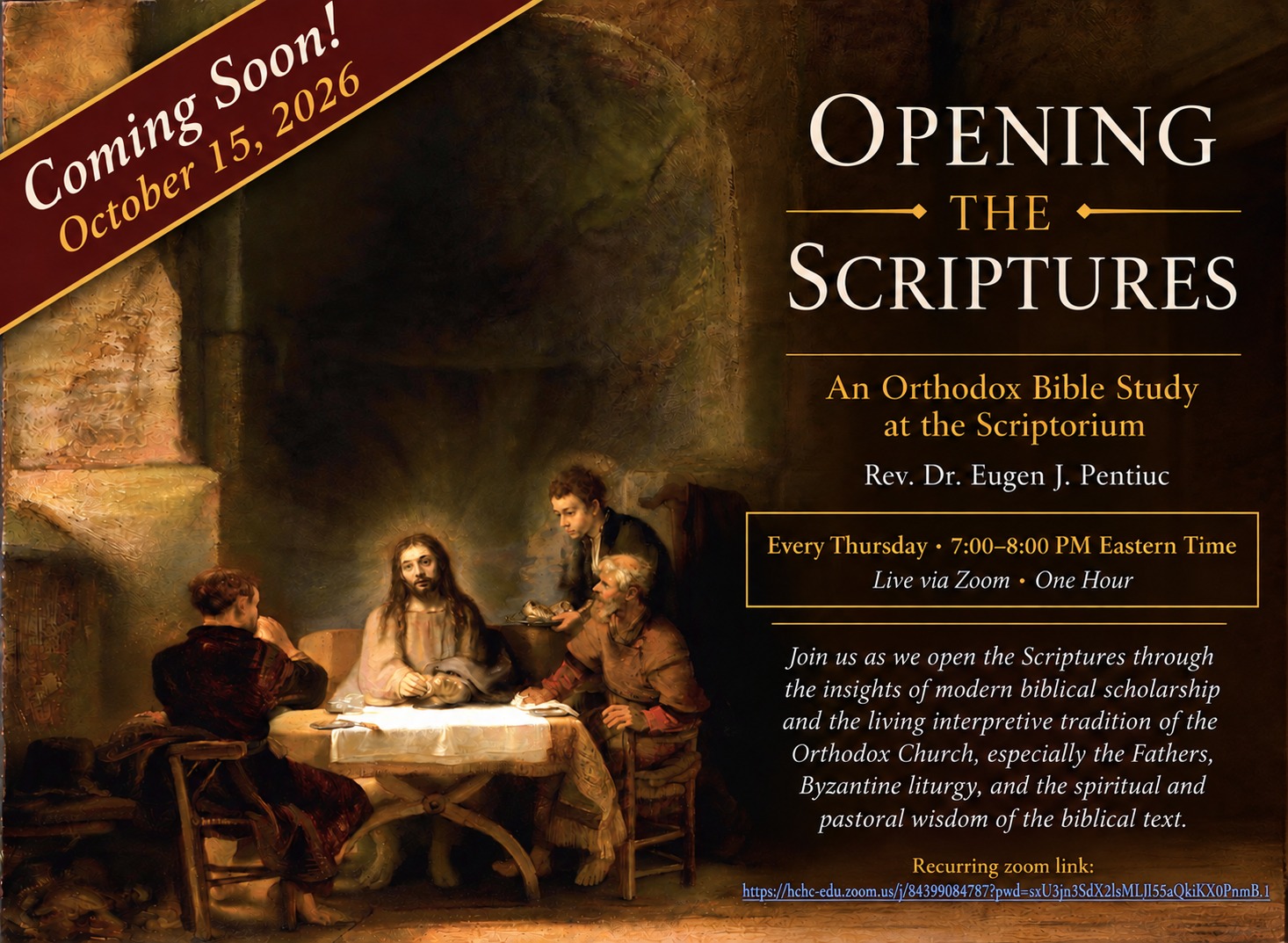
Weekly Orthodox Bible Study with Fr. Eugen Pentiuc Begins Oct 15

Rev. Dr. Eugen J. Pentiuc, Dean of Holy Cross Greek Orthodox School of Theology and Distinguished Professor of Biblical Studies, will lead a weekly Bible study every Thursday at 7:00 PM Eastern Time via Zoom beginning October 15, 2026. The study is offered through The Scriptorium Initiative at Holy Cross, a program funded by a grant from Lilly Endowment Inc. It is open to all — seminarians, clergy, lay faithful, seekers, and anyone interested in…

Rev. Dr. Eugen J. Pentiuc, Dean of Holy Cross Greek Orthodox School of Theology and Distinguished Professor of Biblical Studies, will lead a weekly Bible study every Thursday at 7:00 PM Eastern Time via Zoom beginning October 15, 2026. The study is offered through The Scriptorium Initiative at Holy Cross, a program funded by a grant from Lilly Endowment Inc.

It is open to all — seminarians, clergy, lay faithful, seekers, and anyone interested in deepening their understanding of how Scripture is read, interpreted, and lived within the Orthodox Christian tradition. The sessions aim to provide accessible, scholarly, and spiritually grounded engagement with the biblical text, reflecting the patristic and liturgical hermeneutics that shape Orthodox exegesis.

Participants may register and find further details, including the recurring Zoom link, at www.thescriptoriuminitiative.org. The initiative represents a sustained effort to make rigorous biblical scholarship available to a broad audience while remaining rooted in the worshipping life of the Church. No prior theological training is required, and the format encourages both learning and communal reflection.

This offering continues Holy Cross’s commitment to theological education that serves the Church and the wider world.

  • Weekly Bible study led by Fr. Eugen Pentiuc, Dean of Holy Cross, starting October 15, 2026
  • Held Thursdays at 7:00 PM Eastern via Zoom, open to all without prerequisites
  • Part of The Scriptorium Initiative at Holy Cross, funded by Lilly Endowment
  • Focus on Orthodox scriptural interpretation — patristic, liturgical, and communal
  • Registration and recurring Zoom link available at www.thescriptoriuminitiative.org
Fr.TEDTalks Instagram

Archbishop Apostolos of Canada: Christ Is Found in the Church, Not in Technology

Archbishop Apostolos of Canada speaks about where a person can truly come to know Christ. He notes that someone can ask an AI what Christ is and receive an answer drawn from texts posted on the internet. Such an answer exists, but he warns against expecting any technology to give real knowledge and education about Christ. The church, he says, is the place that provides the truth and, most importantly, communion with Christ. This communion is…

Archbishop Apostolos of Canada speaks about where a person can truly come to know Christ. He notes that someone can ask an AI what Christ is and receive an answer drawn from texts posted on the internet. Such an answer exists, but he warns against expecting any technology to give real knowledge and education about Christ.

The church, he says, is the place that provides the truth and, most importantly, communion with Christ. This communion is received through participation in the holy sacraments of the church. In the sacraments the Holy Spirit illumines the heart and soul, connecting a person with Christ.

The archbishop's words, shared with the hashtags on Orthodoxy, the church, truth and Christ, set the church against the tools of the internet age: information can be gathered from posted texts, but communion with Christ is given in the sacramental life of the church. The post presents this as a reminder that the only place to find Christ is in the Church.

Key moments

  1. An AI can answer the question 'what is Christ' using texts posted on the internet.
  2. No technology can provide real knowledge and education about Christ.
  3. The church is the real place that provides the truth and communion with Christ.
  4. Communion with Christ comes through receiving communion and participating in the holy sacraments of the church.
  5. The Holy Spirit illumines our heart and soul to be connected with Christ.
Read more
F Fr. Barnabas Powell Substack

Blessed, Not Indulged: True Freedom Requires Disciplined Desires

This reflection, built on the Gospel reading of Luke 6:17-23, examines the modern assumption that egalitarianism and individualism are the highest goods, and that freedom simply means doing whatever one wants. The author argues that unchecked desire, without prior discipline and maturity, quickly becomes addiction rather than freedom. The deep human longing for real justice and equality is good—it flows from the image of God within us—but when…

This reflection, built on the Gospel reading of Luke 6:17-23, examines the modern assumption that egalitarianism and individualism are the highest goods, and that freedom simply means doing whatever one wants. The author argues that unchecked desire, without prior discipline and maturity, quickly becomes addiction rather than freedom.

The deep human longing for real justice and equality is good—it flows from the image of God within us—but when pursued apart from God, it is indulged in unhealthy ways and becomes slavery to passions mistaken for liberty.

The meditation centers on Christ standing on a level place, teaching the Beatitudes to a crowd that came seeking physical healing. He healed their bodies, but then insisted they confront their deeper spiritual illness, since physical healing is always temporary while true healing addresses the passions that enslave us.

Three lessons are drawn. First, the genuine desire for justice and equality finds its answer not in political philosophy, legislation, or ideology, but in the Person of Jesus Christ; if society is to escape its fractured tribalism, Christians must become proactive disciples who live out the true freedom and equality He reveals. Second, desires must be disciplined and mature, or they devolve into fantasy, revenge, and an 'us versus them' mentality that merely substitutes one tyranny for another; defining freedom in purely economic or material terms always ends this way.

Parishes and homes are meant to be living examples of heaven on earth, extending Christ's blessings to everyone. Third, believers must embrace generosity and repentance rather than clinging to prideful, tribal communities, becoming genuine persons rather than mere individuals, and allowing the Holy Spirit to confront wrong thinking and its resulting actions.

The post closes with the commemoration of St. Baruch the Prophet, Jeremiah's scribe, whose hymn foretold the Incarnation: 'This is our God, there shall be none compared to Him.'

  • Modern individualism defines freedom as doing whatever one wants, but undisciplined desire becomes addiction, not freedom.
  • The longing for justice and equality is good—it comes from the image of God—but is answered in Christ, not ideology.
  • In Luke 6:17-23, Christ heals bodily illness but insists on healing the deeper spiritual sickness behind our passions.
  • Christians are called to disciplined desires, repentance, and parishes that model heaven on earth for a fractured society.
  • St. Baruch the Prophet is commemorated as one who foretold the Incarnation centuries before it occurred.
radioimlemesou Instagram

We Are Made for Joy: Metropolitan Athanasios on Harmony of the Soul

A short teaching by Metropolitan Athanasios of Limassol on the nature of human joy. He explains that man is created to live in grace, beauty, and like-mindedness, and that the soul naturally rejoices in peace, harmony, and love. When instead there is discord, quarreling, envy, and strife, the soul grieves, because such things are contrary to our nature. The metropolitan applies this concretely to everyday life: we are made to be glad when there…

A short teaching by Metropolitan Athanasios of Limassol on the nature of human joy. He explains that man is created to live in grace, beauty, and like-mindedness, and that the soul naturally rejoices in peace, harmony, and love. When instead there is discord, quarreling, envy, and strife, the soul grieves, because such things are contrary to our nature.

The metropolitan applies this concretely to everyday life: we are made to be glad when there is peace in our home, in our relationships, and in our marriage. The post presents this as a brief excerpt of his words, shared with tags pointing to Orthodox Christian faith. There were no notable comments in the thread, so the discussion consists of the teaching itself.

The message is simple and pastoral: joy is not an accident but part of how we are designed; living in unity with others allows the soul to flourish, while division and envy wound it. For readers, it offers a small examination of conscience—where in my life is there peace, and where is there discord that saddens my soul?

Key moments

  1. Humans are formed to delight in grace, beauty, and unity.
  2. The soul naturally rejoices in peace, joy, harmony, and love.
  3. Discord, disharmony, quarrels, envy, and pain cause the soul grief.
  4. We are made to be glad when peace exists in the home, relationships, and marriage.

Repentance as a New Beginning: Elder Philimon on Mount Athos

Elder Philimon, Dikaios of the Holy Koinobitic Skete of the Prophet Elijah on Mount Athos, speaks about repentance and the new beginning it offers. He says that Mount Athos gives joy through its offering, and he identifies that offering as repentance. His talk centers on people on Mount Athos who repented and made a new start, people who said, 'I was there and I will go elsewhere.' He describes their state when they came to confession: they had…

Elder Philimon, Dikaios of the Holy Koinobitic Skete of the Prophet Elijah on Mount Athos, speaks about repentance and the new beginning it offers. He says that Mount Athos gives joy through its offering, and he identifies that offering as repentance. His talk centers on people on Mount Athos who repented and made a new start, people who said, 'I was there and I will go elsewhere.' He describes their state when they came to confession: they had looked with their eye toward the sky, toward nowhere, disappointed and despairing.

Despite this condition, they took courage and began again from the beginning. The video presents repentance as the path by which those who have fallen find hope and make a fresh start. The full video is available on YouTube on the channel 'Nektari Psychis'.

The post carries hashtags on Mount Athos, repentance, hope, faith, Christianity and Orthodoxy, and names Elder Philimon and the Holy Skete of the Prophet Elijah of Mount Athos.

Key moments

  1. Mount Athos leaves joy through its offering, which is repentance.
  2. The speaker focuses on people on Mount Athos who repented and made a beginning, saying 'I was there and I will go elsewhere.'
  3. When they confessed, they had looked with their eye at the sky, at nowhere, disappointed and despairing.
  4. They take courage and begin again from the start.
Read more