WeOrthodox
EN UA

Orthodox posts, videos and discussions

We follow Orthodox channels, communities and blogs across the web, summarise every post and video, and highlight the conversations with real substance.

St. Paisios on God-centered marriage

The post shares a teaching attributed to St. Paisios stating that true love between a man and a woman can only exist when God is at the center of their lives. The quote appears in text over an image of a church interior with frescoes.

  • St. Paisios teaches God must be central for true marital love
  • Quote presented on church interior image
Read more
Fr.TEDTalks Instagram

Christ Does Not Promise a Life Without Storms, But Communion With Him in Them

The speaker reflects on the questions that rise in suffering: 'Don't you care, Jesus? God, where are you? Why is this happening to me?' He argues that we often misunderstand Christianity because we want God to eliminate everything that frightens us and hand us a life without storms. What Christ offers instead is communion with him in the storm, and this is a greater gift, because storms are inevitable. Every person will face rejection, loss,…

The speaker reflects on the questions that rise in suffering: 'Don't you care, Jesus? God, where are you? Why is this happening to me?' He argues that we often misunderstand Christianity because we want God to eliminate everything that frightens us and hand us a life without storms. What Christ offers instead is communion with him in the storm, and this is a greater gift, because storms are inevitable.

Every person will face rejection, loss, failure, and eventually the reality of death. The question is not whether these things will happen, but who you will become when they happen. The reflection belongs to a familiar strand of Christian teaching on suffering, where the presence of God within trials matters more than their removal, and it invites readers to examine what they actually ask of God in prayer when hardship comes.

Key moments

  1. In suffering we ask God, 'Don't you care, Jesus? Where are you? Why is this happening to me?'
  2. We misunderstand Christianity when we want God to eliminate everything that frightens us and give us a life without storms.
  3. Christ offers communion with him in the storm, a greater gift because storms are inevitable.
  4. You will experience rejection, loss, failure, and eventually confront the reality of death like every human being.
  5. The question is not whether these things will happen, but who you will become when they happen.
Read more

Venerable Theodore the Confessor: Liturgical Prayer to the Saints

The post presents a liturgical invocation for the commemoration of Venerable Theodore the Confessor, Abbot of the Studion. The prayer repeats the refrain "Saints of God, intercede for us" and describes the saints as servants of the Holy One who take up all things and make the soul wise through their prayers. It names Christ as the light-giver for God and the cause of piety directed toward the Life-giver. The invocation asks the saints to…

The post presents a liturgical invocation for the commemoration of Venerable Theodore the Confessor, Abbot of the Studion. The prayer repeats the refrain "Saints of God, intercede for us" and describes the saints as servants of the Holy One who take up all things and make the soul wise through their prayers. It names Christ as the light-giver for God and the cause of piety directed toward the Life-giver.

The invocation asks the saints to intercede as those through whom the Holy Trinity shines forth via the Holy Apostles, and through whom the nations received their established inheritance. It recounts that the apostles, in obedience to God's name, piously sanctified all things through the light of grace and subjected the whole inhabited world to the glorious Gospel.

The text is a prayerful appeal to the saints for intercession, grounding their mediation in the apostolic witness and the sanctification of creation.

Key moments

  1. The prayer opens with the refrain "Saints of God, intercede for us" and describes the saints as servants of the Holy One who take up all things and make the soul wise through their prayers.
  2. Christ is named as the light-giver for God and the cause of piety directed toward the Life-giver.
  3. The saints are invoked as those through whom the Holy Trinity shines forth via the Holy Apostles, and through whom the nations received their established inheritance.
  4. The apostles, in obedience to God's name, piously sanctified all things through the light of grace and subjected the whole inhabited world, establishing the glorious Gospel.
George Instagram discussion

Why Orthodox Christians repeat 'Lord have mercy' many times

The speaker answers the question of why Orthodox Christians repeat 'Lord have mercy' many times in their services despite Christ's warning against empty repetitions in prayer. He points to the Gospel account of a blind man sitting by the road who shouted 'Jesus, Son of David, have mercy on me' persistently, even when the crowd told him to be quiet, until Christ stopped and healed him. The speaker explains that this persistent cry is what the…

The speaker answers the question of why Orthodox Christians repeat 'Lord have mercy' many times in their services despite Christ's warning against empty repetitions in prayer. He points to the Gospel account of a blind man sitting by the road who shouted 'Jesus, Son of David, have mercy on me' persistently, even when the crowd told him to be quiet, until Christ stopped and healed him.

The speaker explains that this persistent cry is what the repeated 'Lord have mercy' represents. It is not an empty word. In Greek, the phrase is 'Kyrie Eleison.' Many teachers connect the word for mercy, 'eleos,' to 'elaion,' the word for olive oil, which was used to heal wounds. Thus the prayer asks Christ to pour out his healing. Christ's warning was against praying with an empty heart, not against repeating prayers.

The repetition is not because God did not hear the first time, but because the human heart needs time to truly mean the words. The speaker notes that in services the prayer is said three, twelve, or forty times in a row. He encourages listeners to say it with the same persistence as the blind man when they hear it.

Key moments

  1. Christ told us not to pray with empty repetitions, yet Christians say "Lord have mercy" three, twelve, or forty times in a row.
  2. In the Gospel, a blind man by the road shouts "Jesus, Son of David, have mercy on me" repeatedly, even when told to be quiet, until Christ stops and heals him.
  3. That persistent cry is what "Lord have mercy" represents; it is not an empty word.
  4. In Greek, "Kyrie Eleison" means "Lord have mercy," and many teach that the Greek word for mercy (eleos) is connected to olive oil (elaion), which was used to heal wounds.
  5. When we say the prayer, we are asking Christ to pour his healing on us.
  6. Christ warned against praying with an empty heart, not against repeating prayers.
  7. We repeat the prayer not because God did not hear us the first time, but because our heart needs time to really mean it.
  8. Next time you hear "Lord have mercy" forty times in church, say it with the blind man.
3 opinions in the discussion Thank you☦️ On "vain repetition" vs. true persistence: Orthodoxy holds that Christ's warning against battalogein (rendered "babbling" or "vain repetitions" in Matthew 6:7) was aimed at the… Read the discussion
Orthodox Christian TV YouTube

Fr. Nicholas Louh on burnout, anxiety, and the Church's tools for healing

Fr. Nicholas Louh on burnout, anxiety, and the Church's tools for healing 18:45

Fr. Nicholas Louh, senior priest at St. John the Divine Greek Orthodox Church in Jacksonville, Florida, speaks with Fr. Chris about burnout and anxiety from an Orthodox Christian perspective. He and his wife, psychologist Dr. Roxanne Louh, have written extensively about mental health from a faith perspective. Fr. Nicholas describes a culture that pushes constant work and busyness, where husbands and wives average only about four minutes of…

Fr. Nicholas Louh, senior priest at St. John the Divine Greek Orthodox Church in Jacksonville, Florida, speaks with Fr. Chris about burnout and anxiety from an Orthodox Christian perspective. He and his wife, psychologist Dr. Roxanne Louh, have written extensively about mental health from a faith perspective. Fr. Nicholas describes a culture that pushes constant work and busyness, where husbands and wives average only about four minutes of productive conversation a day and families no longer eat together.

People answer 'I'm busy' instead of 'I'm relaxing,' and the baptism service itself warns of the noonday demon, who attacks when we are fatigued. He points to social media as a source of isolation and overwhelm, noting that platform executives testified they would not let their own children use their products, and that the phone has become our office.

He defines burnout as activity without purpose, quoting the saying that if the devil cannot make you sin, he will make you busy, while Christ went into the desert to find stillness. A friend of the Syrian said that if you give your life to earth, earth gives you a tomb, but if you give your life to heaven, Christ gives you a throne.

The remedy he describes is the Church's rhythm of prayer, fasting, and liturgy: morning and evening prayers, fasting on Wednesdays and Fridays, and the Divine Liturgy's plural language of carrying burdens together. He argues against the saying that God never gives us more than we can handle, saying God does give us more than we can handle so that we depend on him.

He affirms counseling and therapy as tools God provides, working alongside the sacramental life of the Church, and encourages people to bring their weakness to God in prayer and to seek professional help when needed.

Key moments

  1. 1:44 Father Nicholas cites statistics showing husbands and wives now average only about 4 minutes of productive conversation a day, and families are no longer eating together.
  2. 2:15 Culture pushes the lie that more work is better, so people answer 'I'm busy' instead of 'I'm relaxing,' and the church's baptism service itself warns of the noonday demon, who attacks us when we are fatigued.
  3. 4:18 Social media executives testified they would not let their own children use the platforms; the phone has become our office, and something called social media is extraordinarily isolating, affecting neurological patterns in children and adults.
  4. 5:21 He quotes the saying that if the devil can't make you sin, he'll just make you busy, while Christ would go off into the desert to find stillness.
  5. 5:53 Burnout is not just being tired: activity minus purpose equals burnout, and a friend of the Syrian said if you give your life to earth, earth gives you a tomb, but if you give your life to heaven, Christ gives you a throne.
  6. 6:54 The Orthodox Church builds prayer into daily life with morning and evening prayers, fasting on Wednesdays and Fridays, and many liturgies, and the vertical relationship with Christ shapes the horizontal relationships with ourselves and others.
  7. 9:28 Against the saying that God never gives us more than we can handle, he argues God does give us more than we can handle so that we depend on him rather than ourselves, and whoever sits on the throne of our life guides it.
  8. 10:30 The enemy speaks loudest when we are loneliest; Adam and Eve hid when alone, and the devil's first words sowed doubt, so community, common prayer, and the plural language of the Divine Liturgy are how we carry burdens together.
Orthodox Health Instagram

Artificial theosis through technology repeats Babel's error

The post promotes Episode 86 of the Orthodox Health Podcast, "The Roots of Healthcare: Why Your Doctor Has a Theology," featuring Dr. Zachary Porcu. It opens by acknowledging that technology can heal, restore, and serve, then asks what happens when it promises something far greater. Dr. Porcu calls this promise "artificial theosis." The Christian life aims at becoming truly human through communion with God, becoming more fully what we were…

The post promotes Episode 86 of the Orthodox Health Podcast, "The Roots of Healthcare: Why Your Doctor Has a Theology," featuring Dr. Zachary Porcu. It opens by acknowledging that technology can heal, restore, and serve, then asks what happens when it promises something far greater. Dr. Porcu calls this promise "artificial theosis." The Christian life aims at becoming truly human through communion with God, becoming more fully what we were created to be.

The counterfeit, exemplified by the Tower of Babel, claims we do not need prayer, repentance, virtue, or dependence on God; we can build our way to transcendence. This redefines progress: if technological progress gives greater control while separating us from the source of our being, becoming more powerful does not mean becoming more human.

The attempt to transcend every limit can diminish us. Dr. Porcu argues that God is the arche, the source of being itself; we have being only insofar as we are connected to Him. Theosis is the invitation to become more fully real through that connection. Artificial theosis through technology is essentially the error of Babel: the more progress achieved in that direction, the less connected to the arche and the less real we become.

This path is suicidal and, as Dr. Porcu puts it, "Then we make hell." The episode examines why a doctor's theology matters for healthcare, linking the roots of medical practice to the theological understanding of the human person and the dangers of adopting transhumanist assumptions. The post directs viewers to watch the full episode.

Key moments

  1. God is the arche, the source of being itself.
  2. We only have being insofar as we are connected to him.
  3. The invitation of theosis is to become more and more fully real.
  4. Artificial theosis through technology is essentially what Babel is.
  5. The more progress achieved in that artificial theosis, the less connected to the arche and the less real we become.
  6. This path is suicidal and results in making hell.
Kyle YouTube

Priest urges spiritual readiness for coming trials through Church life and saints' lives

Priest urges spiritual readiness for coming trials through Church life and saints' lives 12:07

The priest warns that difficult days lie ahead before an eventual upswing prior to the end of the world. He emphasizes maintaining a living connection to the Church through the holy mysteries, a spiritual father, and daily reading of the lives of contemporary twentieth- and twenty-first-century saints before turning to earlier ones. Pilgrimage to holy places and seeking out living elders follows the pattern of the saints themselves.…

The priest warns that difficult days lie ahead before an eventual upswing prior to the end of the world. He emphasizes maintaining a living connection to the Church through the holy mysteries, a spiritual father, and daily reading of the lives of contemporary twentieth- and twenty-first-century saints before turning to earlier ones.

Pilgrimage to holy places and seeking out living elders follows the pattern of the saints themselves. Understanding history from alpha to omega, recognizing that the Church has almost always been persecuted and that martyrdom is the normative Christian path, removes false expectations and the anxiety they produce. Despair arises from self-focus; the remedy is to serve one's neighbor and the Church, turning attention outward.

The present crisis is an opportunity for mission, not fear, and St. Porphyrios' counsel to fix one's gaze on Christ rather than on the world's evil remains the sure way to peace. Regarding the coming turmoil, described as an intentional implosion of the status quo, likely including transhumanist agendas and a major war within a few years, the priest insists these events are outside human control.

The only effective response is fervent prayer, repentance, and faith, which guard the spiritual sphere given to each person; without prayer the void is filled by demonic influence. Practical readiness such as storing food is simply normal Christian living, not prepping, but it avails nothing without spiritual preparation and abandonment to God.

The difficult road ahead stems from humanity's lack of repentance, yet those who double down on prayer and trust in Christ will weather the storm.

Key moments

  1. 0:12 Difficult days lie ahead before an eventual upswing; a living connection to the Church through the holy mysteries, confession, communion, and a spiritual father is essential.
  2. 0:42 Read the lives of the saints daily, beginning with contemporary twentieth- and twenty-first-century saints and then moving backward; otherwise the approach becomes Protestant and intellectual rather than Orthodox.
  3. 1:13 The saints themselves read the lives of saints and went on pilgrimage to seek out the living tradition and the renowned elders of their day; we must do the same.
  4. 2:14 Fr. Seraphim Rose taught that understanding alpha (the beginning) and omega (the end) as bookends lets one understand everything in between; without this perspective anxiety and loss of focus are inevitable.
  5. 2:46 Church history shows the Church is almost always persecuted and the vast majority of saints are martyrs; martyrdom is the normative Christian way, and having no worldly expectations removes anxiety.
  6. 3:47 Despair comes from focusing on oneself; the primary healing method is to get out and serve one's neighbor, the Church, and the priest, because egotism is the root of spiritual sickness.
  7. 6:54 An intentional implosion of the status quo is coming, globalists create crises to reshape society, including transhumanism and a likely world war within a few years, but all of this is outside our control.
  8. 7:57 Focus on what is missing: prayer, repentance, and faith; the void left by prayer is filled by demonic influence, so fervent prayer guards one's spiritual sphere, while practical preparation without Christ is a delusion.
Read more
George Instagram

Fifty days in, a sinner invites others to the Nativity Fast

The speaker marks fifty days since starting his account and thanks more than eighty thousand followers. He rejects the perception that he has met God or has life figured out, admitting he is a daily sinner who struggles to connect with God and often feels empty inside. He says viewers see only a small snapshot of his life, the videos, the things he reads, the moments he shares, and that he is nobody special, just like them, and probably a worse…

The speaker marks fifty days since starting his account and thanks more than eighty thousand followers. He rejects the perception that he has met God or has life figured out, admitting he is a daily sinner who struggles to connect with God and often feels empty inside. He says viewers see only a small snapshot of his life, the videos, the things he reads, the moments he shares, and that he is nobody special, just like them, and probably a worse sinner.

He confesses that he sins every day, struggles with many things daily, has moments when it is really hard to connect with God, and has days when he still feels empty inside. His only consistent practice is daily prayer and regular confession, trusting that slow progress makes him a better person. For the first time in his life, he will observe the full forty-day Nativity Fast through Christmas.

He created a free daily program called The 40 Days to Bethlehem so they can go through the whole fast together day by day; more than four hundred people have already joined. He invites others to walk this road with him, not as a teacher but as a brother who is struggling too.

Key moments

  1. The speaker started the account 50 days ago and now has more than 80,000 followers.
  2. He says viewers only see a small snapshot of his life, the videos, the things he reads, the moments he shares, and that he is nobody special, just like them, and probably a worse sinner.
  3. He confesses that he sins every day, struggles with many things daily, has moments when it is really hard to connect with God, and has days when he still feels empty inside.
  4. The only thing he really tries to do is pray every day, because he knows that if he keeps praying and going to confession, slowly, little by little, he can become a better person.
  5. This year, for the first time in his life, he is going to follow the whole 40 days of the Nativity Fast all the way to Christmas.
  6. He created a free program called The 40 Days to Bethlehem so they can go through the whole fast together day by day, and more than 400 people have already joined.
  7. He invites others to walk this road with him, not as a teacher but as a brother who is struggling too.
Read more

Answering the objection to Mary's perpetual virginity

The speaker addresses the claim that Jesus' brothers named in Scripture disprove Mary's perpetual virginity. He begins with the objection: the Gospels name four brothers and imply at least two sisters, which would mean seven children in total. In response, he points to Mary's question to Gabriel, "How can this be since I do not know a man", as evidence of a prior commitment to virginity rather than an ordinary marital expectation. At the…

The speaker addresses the claim that Jesus' brothers named in Scripture disprove Mary's perpetual virginity. He begins with the objection: the Gospels name four brothers and imply at least two sisters, which would mean seven children in total. In response, he points to Mary's question to Gabriel, "How can this be since I do not know a man", as evidence of a prior commitment to virginity rather than an ordinary marital expectation.

At the crucifixion, Jesus entrusts Mary to John's care, an action that only makes sense if she had no other biological sons to assume that responsibility. The speaker then turns to biblical typology: Luke presents Mary as the Ark of the Covenant overshadowed by the Spirit, and the early Church applied Ezekiel's prophecy of the closed eastern gate to her as a type of the ever-virgin Theotokos.

Historically, Irenaeus in the second century calls Mary the new Eve whose obedience loosed Eve's knot, and by the fourth century perpetual virginity was universally confessed in East and West. The doctrine was retained even by the Reformers. Finally, he notes that the Greek word "adelphoi" used for Jesus' brothers does not require a biological relationship to Mary.

Key moments

  1. 0:00 The objection states that Scripture names four brothers of Jesus and implies at least two sisters, totaling seven children, which would make the doctrine of perpetual virginity false.
  2. 0:31 Mary's response to Gabriel, "How can this be since I do not know a man," signals a prior vow of virginity, not a normal marital expectation.
  3. 0:31 At the crucifixion Jesus gives Mary to John's care, which only makes sense if she had no other biological sons to assume that responsibility.
  4. 1:03 Luke portrays Mary as the Ark of the Covenant overshadowed by the Spirit, and the early church applied Ezekiel's closed eastern gate to her as a type of the ever-virgin Theotokos.
  5. 1:35 Irenaeus in the second century calls Mary the new Eve whose obedience loosed Eve's knot, and by the fourth century perpetual virginity was universally received in East and West.
  6. 1:35 The Reformers also kept this doctrine, and the Greek word "adelphoi" used for Jesus' brothers does not necessitate biological sons of Mary.
18 opinions in the discussion The Bible also calls Jesus the son of Joseph, so following PAM's reasoning that would make Jesus Joseph's biological son. Read the discussion

Protestant argues Reformers abandoned apostolic Christianity

The speaker identifies as a Protestant by conviction, not convenience or complacency, and argues that the Reformers, Martin Luther, John Calvin, Ulrich Zwingli, Philipp Melanchthon, and John Knox, did not restore apostolic Christianity but departed from it. He names them as those who reformed the church but says they actually did the opposite of restoring apostolic Christianity. He cites three early church fathers to show what the early church…

The speaker identifies as a Protestant by conviction, not convenience or complacency, and argues that the Reformers, Martin Luther, John Calvin, Ulrich Zwingli, Philipp Melanchthon, and John Knox, did not restore apostolic Christianity but departed from it. He names them as those who reformed the church but says they actually did the opposite of restoring apostolic Christianity.

He cites three early church fathers to show what the early church held. Saint Ignatius of Antioch defended the authority of bishops. Saint Irenaeus of Lyons defended apostolic succession. Saint Basil the Great defended holy tradition and its authority.

The speaker then points to specific rejections by two leading Reformers. Luther rejected the sacramental priesthood. Calvin rejected the Eucharistic sacrifice. The speaker asserts these departures contradict both the early church and Scripture itself.

He observes that Protestants remain divided over baptism, the Eucharist, salvation, and church authority. He concludes that a movement cannot claim to restore the apostolic faith while remaining divided over what that faith is. The speaker presents his case as a Protestant who has examined the historical record and found the Reformation's claims wanting.

The discussion turns on whether the Reformation was a recovery or a rupture, and the speaker contends the evidence shows rupture.

Key moments

  1. The speaker states he is a Protestant out of conviction, not convenience or complacency.
  2. He names the Reformers, Martin Luther, John Calvin, Zwingli, Melanchthon, Knox, as those who reformed the church but says they actually did the opposite of restoring apostolic Christianity.
  3. He cites St. Ignatius defending the authority of bishops, St. Irenaeus defending apostolic succession, and St. Basil defending holy tradition and its authority.
  4. He says Luther rejected the sacramental priesthood and Calvin rejected the Eucharistic sacrifice.
  5. He asserts these departures contradict the early church and Scripture itself.
  6. He observes Protestants remain divided over baptism, the Eucharist, salvation, and church authority.
  7. He concludes you cannot claim to restore the apostolic faith while remaining divided over what the faith even is.
8 opinions in the discussion And then all the reformers went to war with each other and produced an endless number of denominations. 👌 Read the discussion
Anthony’s Cell YouTube

The Seven Functions of Holy Icons in Orthodox Teaching

The Seven Functions of Holy Icons in Orthodox Teaching 12:38

The audio reading presents Dr. Constantine Cavarnos' essay "The Functions of Icons" from his work Orthodox Iconography. Cavarnos identifies seven functions of holy icons: they beautify the church with spiritual depth, instruct the faithful more vividly than words, remind believers of the faith they forget, lift the mind from the visible to the invisible prototypes, stir imitation of the virtues of the saints, help transform and sanctify the…

The audio reading presents Dr. Constantine Cavarnos' essay "The Functions of Icons" from his work Orthodox Iconography. Cavarnos identifies seven functions of holy icons: they beautify the church with spiritual depth, instruct the faithful more vividly than words, remind believers of the faith they forget, lift the mind from the visible to the invisible prototypes, stir imitation of the virtues of the saints, help transform and sanctify the soul, and serve as a liturgical means of veneration.

The reading cites a Triodion hymn for the Sunday of Orthodoxy and Nikitas Stethatos' account of St. Simeon adorning his monastery church. St. John Damascene notes icons teach the illiterate; St. Photios says they imprint knowledge on the soul more vividly than written accounts, as in compositions like the Nativity or Crucifixion.

John Damascene calls icons concise memorials that recall Christ's saving suffering. The anagogic function makes icons authentic symbols leading from the physical to the spiritual. The Seventh Ecumenical Council decreed that continual sight of holy personages in icons lifts beholders to memory of the prototypes and aspiration toward them.

The primary liturgical function involves the faithful lighting candles, bowing, crossing themselves, kissing the icon, and praying, offering honorable reverence that passes to the prototype, not worship of the icon itself, as Basil the Great states. Ignoring this distinction led to the iconoclast edict of Emperor Leo the Isaurian in 726, which condemned icons as idolatry, showing ignorance of the icon's symbolic nature.

The practice of honoring sacred images is rooted in Mosaic veneration of the tabernacle and Christian veneration of the cross.

Key moments

  1. 0:34 Holy icons serve seven purposes: they enhance the beauty of a church, instruct in the Christian faith, remind of that faith, lift us to the prototypes, arouse imitation of the virtues of the holy personages depicted, help transform and sanctify us, and serve as a means of worship and veneration.
  2. 1:06 The most obvious function is enhancing the beauty of a church, attested by a Triodion hymn for the Sunday of Orthodoxy and by Nikitas Stethatos' account of St. Simeon adorning the monastery church with icons and marbles.
  3. 2:41 Icons instruct the faithful; St. John Damascene notes they teach the illiterate, and St. Photios says they imprint knowledge on the soul more vividly than written accounts, as seen in compositions like the Nativity or Crucifixion that present many elements simultaneously.
  4. 3:41 Icons remind us of the faith we tend to forget; John Damascene calls them concise memorials, and the icon of Christ's crucifixion recalls his saving suffering when the passion is not in mind.
  5. 4:43 Icons lift us to the prototypes in an anagogic function: seeing icons of Christ, the Theotokos, and the saints raises our thought and feeling to a higher plane, making the icon a symbol that leads from the physical to the spiritual, a pattern of something heavenly.
  6. 5:45 Icons stir us to imitate the virtues of the holy personages; the Seventh Ecumenical Council decreed that the more continually holy personages are seen in icons, the more beholders are lifted to the memory of the prototypes and to aspiration after them.
  7. 7:16 The primary liturgical function is worship and veneration: the faithful light candles, bow, cross themselves, kiss the icon, and pray, offering honorable reverence that passes to the prototype, not worship of the icon itself, as Basil the Great states that honor given to the icon passes to the prototype.
  8. 10:26 Ignoring the functions and the distinction between veneration and worship leads to iconoclasm, as in 726 when Emperor Leo the Isaurian condemned icons as idolatry, showing ignorance of the icon's symbolic power to lead to the prototype.

St. Nektarios: The Eucharist Is the Highest Mystery

The post presents a statement attributed to St. Nektarios the Wonderworker describing the Divine Eucharist. He identifies it as the mystery handed down by the Lord, the highest of all mysteries, and the most wondrous miracle performed by the power of God. The text offers no further commentary or discussion.

  • The Divine Eucharist is a mystery handed down by the Lord.
  • It is the highest of all mysteries.
  • It is the most wondrous miracle of God's power.
  • The statement is ascribed to St. Nektarios the Wonderworker.
CHRISTIANITY UNITED Instagram

Orthodox Car Blessings: Prayer and Responsibility on the Road

The post explains the Orthodox tradition of having a priest bless a vehicle with holy water. The author frames it with humor, contrasting trust in airbags or insurance companies with the practice of seeking a priest's blessing before driving. The blessing asks God to protect those who travel in the car, keep them safe from danger, and guide their journeys. The post makes clear that a blessing does not make a car accident-proof; the driver must…

The post explains the Orthodox tradition of having a priest bless a vehicle with holy water. The author frames it with humor, contrasting trust in airbags or insurance companies with the practice of seeking a priest's blessing before driving. The blessing asks God to protect those who travel in the car, keep them safe from danger, and guide their journeys.

The post makes clear that a blessing does not make a car accident-proof; the driver must still wear a seatbelt, obey the speed limit, and pay for insurance. It jokes that reckless driving should not be expected to please one's guardian angel. The tradition's purpose is to remind believers to place trust in God while also taking responsibility for their actions.

Before a journey, the faithful should make the sign of the cross, say a short prayer, and ask the Lord to guide them safely. The post ends with a prayer for safe travels for everyone on the road, offered for God's glory.

  • Orthodox Christians have priests bless cars with holy water to invite God's protection during travel.
  • The blessing asks God to keep travelers safe and guide their journeys.
  • A blessing does not replace practical safety measures like seatbelts, speed limits, and insurance.
  • The tradition reminds believers to trust God while taking personal responsibility.
  • Before trips, the faithful should make the sign of the cross and pray for safe guidance.
Read more
Prayer Orthodoxy ® Instagram

Saint Arsenios the Cappadocian: Priest, Healer, Spiritual Father of Saint Paisios

Saint Arsenios the Cappadocian is commemorated on November 10. He was a priest from Cappadocia known for deep prayer, humility, and love for those who suffered. Through his prayers God granted healing and comfort to Christians and Muslims alike. He baptized the infant who would become Saint Paisios, giving him the name Arsenios. He accompanied his community to Greece during the population exchange of 1924. He fell asleep in the Lord on November…

Saint Arsenios the Cappadocian is commemorated on November 10. He was a priest from Cappadocia known for deep prayer, humility, and love for those who suffered. Through his prayers God granted healing and comfort to Christians and Muslims alike. He baptized the infant who would become Saint Paisios, giving him the name Arsenios.

He accompanied his community to Greece during the population exchange of 1924. He fell asleep in the Lord on November 10, 1924 on the island of Corfu. His holy relics are treasured at the Monastery of Saint John the Theologian in Souroti near Thessaloniki, where Saint Paisios's grave is also located.

The commemoration includes a Greek translation of the same text. The feast marks his life of prayer that brought healing and comfort to many at the monastery, the veneration of his relics there, his baptism of the future Saint Paisios, the presence of Saint Paisios's grave at the same monastery, and the intercession of both saints.

Key moments

  1. November 10th marks the feast of Saint Arsenius the Cappadocian.
  2. Saint Arsenius was a holy priest whose life of prayer brought healing and comfort to many at the monastery of Saint John the Theologian in Suroti near Thessaloniki.
  3. His holy relics are treasured at that monastery.
  4. Saint Arsenius baptized the child who would become Saint Paisios.
  5. Saint Paisios's grave also rests within these sacred grounds.
  6. As we approach his holy relics and the grave of Saint Paisios, we remember two lives devoted to Christ, whose love continues to draw souls toward him.
  7. Saint Arsenius and Saint Paisios intercede for us.
Read more
Discover Orthodox Christianity Facebook

St. Arsenios Helps Barren Couple Through Prayer

A couple from a village near Farasa in Cappadocia had been married for many years without children and suffered great sorrow. They heard of the holy priest Father Arsenios and the miracles God performed through him. They came to him with tears, asking for his blessing and prayers. The saint, filled with compassion, told them: "Have faith in God and patience. The Lord is able to make the barren womb fruitful." He prayed over them, blessed them…

A couple from a village near Farasa in Cappadocia had been married for many years without children and suffered great sorrow. They heard of the holy priest Father Arsenios and the miracles God performed through him. They came to him with tears, asking for his blessing and prayers.

The saint, filled with compassion, told them: "Have faith in God and patience. The Lord is able to make the barren womb fruitful." He prayed over them, blessed them with his Gospel book, and anointed them with oil from the vigil lamp of Saint John the Baptist's chapel. He sent them home in peace, telling them to thank God. In time the woman conceived and bore a child, a miracle granted through Saint Arsenios's fervent prayer.

Out of gratitude the parents brought the newborn to the saint for baptism. When baptizing children, Saint Arsenios always gave them the names of great saints, often according to divine inspiration. It is said he gave this child the name of a saint who would protect him throughout his life.

The account illustrates the power of pure prayer, the compassionate heart of Saint Arsenios, and the living faith of those who sought his help. The post notes that Saint Arsenios's feast day is commemorated on November 10.

  • A childless couple from a village near Farasa sought St. Arsenios's help.
  • The saint prayed, blessed them with his Gospel book, and anointed them with oil from St. John the Baptist's vigil lamp.
  • The woman later conceived and bore a child.
  • The parents brought the child to St. Arsenios for baptism; he gave the child a saint's name by divine inspiration.
  • The story illustrates the power of pure prayer and St. Arsenios's compassion; his feast is November 10.

St. Isaac the Syrian's Prayer for Contrition and the Great Doxology

The post presents a short prayer attributed to St. Isaac the Syrian that asks for a contrite heart and strength so that acceptable tears may flow and the heart may be illumined by pure prayer. Alongside this prayer, a video summary describes the structure of a liturgical hymn that begins by glorifying the one who has shown the light, continues with the angelic hymn from Luke 2:14, glory to God in the highest and on earth peace, good will among…

The post presents a short prayer attributed to St. Isaac the Syrian that asks for a contrite heart and strength so that acceptable tears may flow and the heart may be illumined by pure prayer. Alongside this prayer, a video summary describes the structure of a liturgical hymn that begins by glorifying the one who has shown the light, continues with the angelic hymn from Luke 2:14, glory to God in the highest and on earth peace, good will among men, and concludes with the worshippers praising, blessing, worshipping, glorifying, and giving thanks to God for his great Lord.

The video points list three key lines: glory to the one who has shown the light; glory in the highest to God and on earth peace, good will among men; and we praise you, we bless you, we worship you, we glorify you, we give thanks to you for your great Lord. The post combines a personal petition for compunction from a seventh-century Syrian ascetic with an outline of the Great Doxology, a hymn used in Orthodox matins and other services. No further discussion or commentary is included in the source.

Key moments

  1. Glory be to you who have shown the light.
  2. Glory in the highest to God and on earth peace good will among men.
  3. We praise you, we bless you, we worship you, we glorify you, we give thanks to you for your great Lord.
Read more

Elder Philimon on fear and the river of life

The speaker describes how Elder Philimon of the Holy Skete of Prophet Elijah on Mount Athos addressed his fears about the future. The Elder used the image of a river: from one bank the view is one way, but crossing to the other side reveals the same reality from a different perspective. He said that when daily life is seen through the spirit and will of God, fear disappears completely. The speaker confirms that the Elder's words proved true in his experience.

Key moments

  1. The speaker approached the Elder with fears about the unknown future, as every person fears tomorrow.
  2. The Elder told him not to fear, using the image of a river that looks different once you cross to the opposite bank.
  3. The Elder was proven right: seeing daily life through the spirit and will of God removes all fear.
Prayer Orthodoxy ® with Holy Orthodoxy, Timothy Instagram

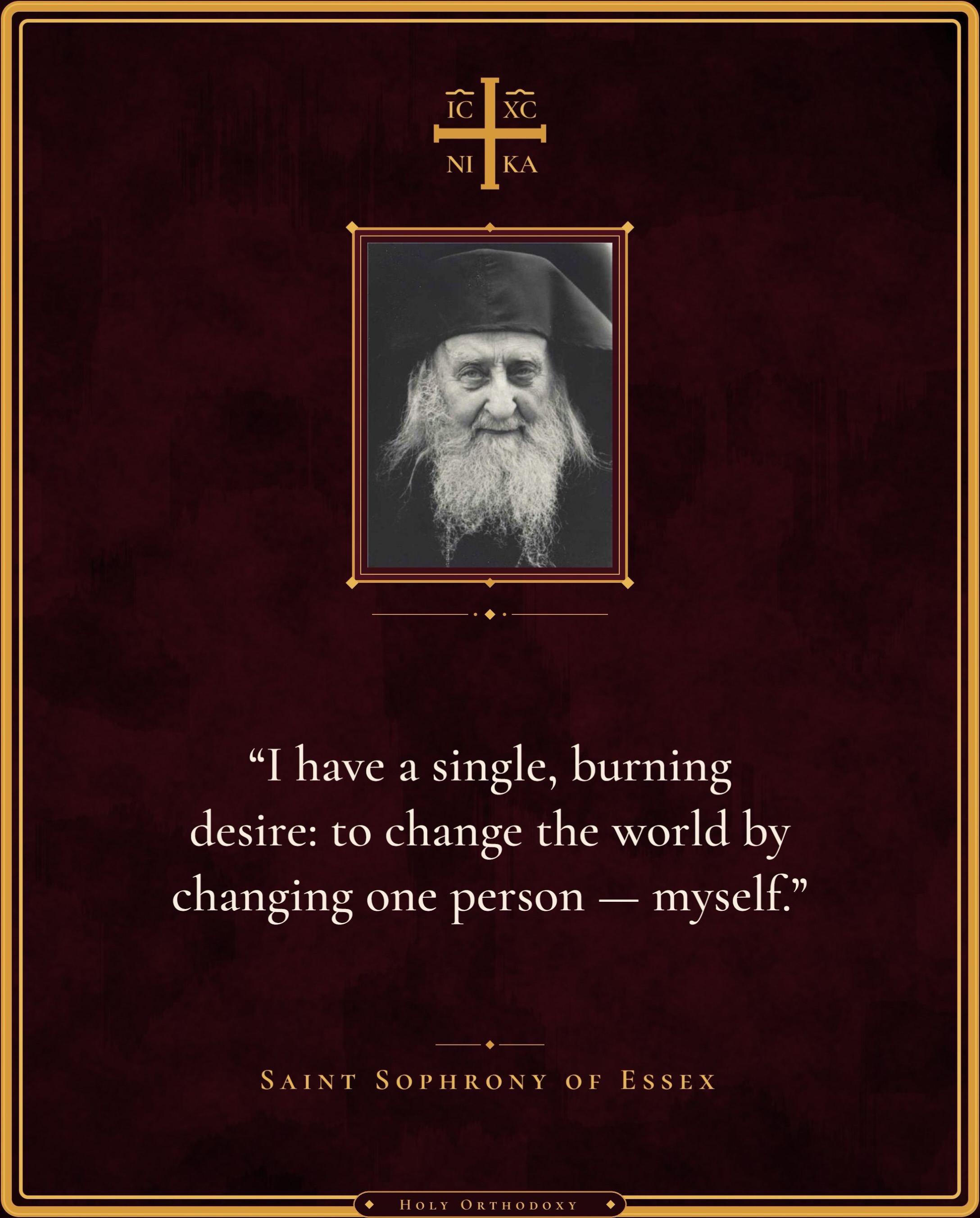
St. Sophrony of Essex: Change Begins with One's Own Heart

The post shares a quotation from Saint Sophrony of Essex: "I have a single, burning desire: to change the world by changing one person, myself." The author reflects that while it is easy to want the world to change, St. Sophrony points to the heart as the true starting point. Through repentance, prayer, and humility, the Lord transforms a person, and that transformation then extends to those around them.

The post concludes with a request for the saint's intercession: "Holy Father Sophrony, pray for us."

  • St. Sophrony of Essex teaches that changing the world begins with changing oneself.
  • The quote expresses a single burning desire to transform oneself.
  • Repentance, prayer, and humility are the means by which the Lord transforms a person.
  • Personal transformation then affects those around the individual.
  • The post ends with a prayer to Holy Father Sophrony.
Read more
Orthodox Life Instagram

Saint Arsenius of Cappadocia: Prophet, Healer, and Spiritual Father of Saint Paisios

The post commemorates Saint Arsenius of Cappadocia on November 10. It recounts his birth in Pharasa, Cappadocia, and his childhood rescue from drowning by Saint George, which led him to dedicate his life to God. At age 26 he was tonsured a monk at the Monastery of the Flavians in Caesarea and later ordained a priest to serve his home village. Known as Hadjiephentis, he lived ascetically, sleeping on a dirt floor and fasting strictly, yet showed…

The post commemorates Saint Arsenius of Cappadocia on November 10. It recounts his birth in Pharasa, Cappadocia, and his childhood rescue from drowning by Saint George, which led him to dedicate his life to God. At age 26 he was tonsured a monk at the Monastery of the Flavians in Caesarea and later ordained a priest to serve his home village.

Known as Hadjiephentis, he lived ascetically, sleeping on a dirt floor and fasting strictly, yet showed boundless love and secretly taught Greek children reading and writing under Ottoman rule. He became a renowned wonderworker, healing both Christians and Muslims through prayers and the Psalms without accepting payment. He possessed the gift of prophecy, notably foretelling the forced expulsion of Greeks from Asia Minor.

Before the exile, he baptized the infant son of the village president, naming him Arsenios and prophesying he would become a great monk; that child grew up to be Saint Paisios of Mount Athos. In 1924, at age 83, Saint Arsenius led his community on a 400-mile foot journey across Turkey during the population exchange, refusing assistance and hiding sacred vessels.

He had predicted he would live only forty days after reaching Greece, and he died exactly forty days after arriving on the island of Corfu on November 10, 1924. His spiritual child, Saint Paisios, later transferred his relics to the Monastery of Saint John the Evangelist in Souroti, Greece, where they remain a pilgrimage site. The post also includes a series of images with Greek captions illustrating episodes from his life, his childhood rescue, his teaching of children, his meeting with Saint Paisios, and the inscription on his tomb in Corfu dated November 10, 1924, as well as a quotation from Saint Paisios stating that God desires all people to be saved and to come to the knowledge of the truth.

  • Born in Pharasa, saved from drowning by Saint George, vowed to serve God.
  • Tonsured at 26, became priest, lived ascetically, secretly taught Greek children.
  • Wonderworker who healed Christians and Muslims, prophesied the population exchange.
  • Baptized and named future Saint Paisios, foretold his monastic greatness.
  • Led 400-mile exile at age 83, died 40 days later in Corfu; relics now in Souroti.
Read more
Prayer Orthodoxy ® Instagram

The zeon: why hot water is poured into the chalice before Communion

The post explains the Orthodox rite known as the zeon, from the Greek word meaning boiling or fervent. Just before Holy Communion, the priest or deacon pours a small amount of hot water into the chalice. The water recalls the blood and water that flowed from Christ's pierced side when a soldier thrust a spear into Him, as recorded in the Gospel of John. The warmth of the water points to the risen life of Christ and the fervor of the Holy Spirit.…

The post explains the Orthodox rite known as the zeon, from the Greek word meaning boiling or fervent. Just before Holy Communion, the priest or deacon pours a small amount of hot water into the chalice. The water recalls the blood and water that flowed from Christ's pierced side when a soldier thrust a spear into Him, as recorded in the Gospel of John.

The warmth of the water points to the risen life of Christ and the fervor of the Holy Spirit. Together, the water and its heat proclaim Christ's sacrifice on the Cross and His victory over death. As the faithful approach the chalice, they receive the true Body and Blood of the same Lord who suffered for them, rose from the tomb, and now unites them to Himself in Holy Communion.

The post presents this teaching in both English and Greek, and the accompanying image text breaks the explanation into a series of short slides that repeat the same points.

  • The rite is called zeon, from the Greek for boiling or fervent.
  • Hot water is added to the chalice by the priest or deacon just before Holy Communion.
  • The water recalls the blood and water from Christ's pierced side (John 19:34).
  • The warmth symbolizes Christ's risen life and the fervor of the Holy Spirit.
  • Receiving the chalice unites the faithful with the Lord who suffered, rose, and gives life.
Read more