WeOrthodox
EN UA

Orthodox posts, videos and discussions

We follow Orthodox channels, communities and blogs across the web, summarise every post and video, and highlight the conversations with real substance.

Prayer Orthodoxy ® with Jamey Bennett Instagram

Free Orthodox Field Guide Explains the Divine Liturgy in 33 Stops

The post announces a free online resource called A Field Guide to the Orthodox Church, available at orthodoxfieldguide.com. The guide is designed to be used like a field guide during a church visit. It covers practical details for a first visit, including where to stand and when to sit, and walks through the Divine Liturgy in 33 stops from the courtyard to the coffee urn.

The author suggests reading the guide before Sunday so that visitors can focus on paying attention during the service rather than figuring out what to do.

Key moments

  1. The Orthodox Field Guide is a free online resource at orthodoxfieldguide.com designed to be taken to church like a field guide.
  2. It covers a first visit, where to stand, when to sit, and the Divine Liturgy in 33 stops from the courtyard to the coffee urn.
  3. The guide should be read before Sunday so visitors can focus on paying attention during the service.
Read more

Is the Sinai Pantocrator's dual face intentional or accidental?

I am an artist and architecture student who began studying historical iconography after becoming a catechumen. I have read articles claiming the Sinai Pantocrator was designed with a dual meaning, a gentle, forgiving Christ on the left and a harsher, judging Christ on the right. But as someone who draws portraits, I wonder whether this was the iconographer's actual intention or simply how the work turned out. The differences are really quite…

I am an artist and architecture student who began studying historical iconography after becoming a catechumen. I have read articles claiming the Sinai Pantocrator was designed with a dual meaning, a gentle, forgiving Christ on the left and a harsher, judging Christ on the right.

But as someone who draws portraits, I wonder whether this was the iconographer's actual intention or simply how the work turned out. The differences are really quite minor: shadows are slightly darker on the right side of the face, the right cheekbone is less pronounced, and the outline around the iris is a bit larger on that side.

It feels like people are reading meaning into what was likely an accident, similar to how an entire art style developed around the muted tones of the Sistine Chapel ceiling, only for people to be upset when cleaning revealed bright, vibrant colors.

  • Whether the dual expression (gentle/judging) was the iconographer's intention
  • The physical differences are minor: darker shadows on right, less pronounced right cheekbone, larger iris outline on right
  • The interpretation may be reading meaning into an accident
  • Comparison to the Sistine Chapel colors being misread before cleaning
16 opinions in the discussion That is not some little happy accident like Bob Ross talks about. That is a bunch of decisions about shape and shading that went through several drying sessions. Looking at it as an artist,… Read the discussion
Fr.TEDTalks Instagram

One mistake does not define you; confession lets you release guilt

The speaker says that one mistake, one action, or one decision does not define a person unless they allow it to. If a person lets a single moment define them, they wallow in self-pity and become stuck in a past delusion. Worrying about things that have not happened makes a person suffer for them, and if those things happen the person suffers twice. Holding onto past bad experiences causes a person to relive the same trauma over and over. Kicking…

The speaker says that one mistake, one action, or one decision does not define a person unless they allow it to. If a person lets a single moment define them, they wallow in self-pity and become stuck in a past delusion. Worrying about things that have not happened makes a person suffer for them, and if those things happen the person suffers twice.

Holding onto past bad experiences causes a person to relive the same trauma over and over. Kicking oneself for the same sins repeatedly turns that suffering into the person's identity over time. Confession is described as a great gift because it is meant to let those things go.

In confession a person must let go of the guilt associated with past sins. Through confession the church offers love, compassion, and acceptance.

Key moments

  1. One mistake, one action, one decision doesn't define everything unless we let it.
  2. If we let a moment define us, we wallow in self-pity and become stuck in past delusion.
  3. Worrying about things that haven't happened makes us suffer for them, and if they happen we suffer twice.
  4. Holding onto past bad experiences causes us to relive the same trauma over and over.
  5. Kicking ourselves for the same sins repeatedly turns that suffering into our identity over time.
  6. Confession is a great gift because it is meant to let those things go.
  7. In confession we must let go of the guilt associated with past sins.
  8. We receive love, compassion, and acceptance from the church through confession.
Read more
Orthodox Sound YouTube

The Expanding Heart: Learning to Pray for All People

The Expanding Heart: Learning to Pray for All People 24:02

The reflection explores intercessory prayer through Scripture and the writings of Orthodox saints and elders. It draws on passages such as Mark 2:1-12, where Christ forgives the paralytic because of the faith of those who carried him; Luke 22:31-32, where Jesus prays for Peter before his denial; John 17:20-23, where he prays for future believers; Luke 23:34, where he prays for his executioners; Matthew 5:44-45, commanding prayer for enemies;…

The reflection explores intercessory prayer through Scripture and the writings of Orthodox saints and elders. It draws on passages such as Mark 2:1-12, where Christ forgives the paralytic because of the faith of those who carried him; Luke 22:31-32, where Jesus prays for Peter before his denial; John 17:20-23, where he prays for future believers; Luke 23:34, where he prays for his executioners; Matthew 5:44-45, commanding prayer for enemies; Acts 7:54-60, where St. Stephen prays for his stoners; 1 Timothy 2:1-4, on prayer for all people; and Hebrews 7:25, on Christ's unceasing intercession.

The Holy Fathers cited include St. John Chrysostom, St. Ambrose of Milan, St. John Climacus, and St. Maximos the Confessor. Later saints and elders include St. Silouan the Athonite, St. John of Kronstadt, St. Porphyrios of Kavsokalyvia, St. Paisios the Athonite, St. Joseph the Hesychast, Elder Joseph of Vatopedi, St. Gabriel of Georgia, St. Gavrilia, and St. Evmenios Saridakis.

The teaching begins with the paralytic lowered through a roof, showing that a person can be brought to mercy through the faith and love of others. Jesus models intercession by praying for Peter, for future believers, and for his crucifiers; St. Stephen follows this pattern, and his prayer bears fruit in Saul's conversion. St. Silouan teaches that the desire to pray for another originates in God's prior mercy: when God wills mercy, he inspires another to pray.

St. John Climacus counsels not to refuse a request to pray even when feeling unworthy, because the requester's faith may awaken contrition. St. Porphyrios and St. Paisios emphasize gentle, secret heart-prayer as more effective than words. St. Gabriel of Georgia instructs beginning with family and neighbors and gradually extending prayer to all people, including enemies.

St. Evmenios Saridakis exemplifies a heart enlarged to pray successively for all people, those of other religions, the departed from Adam, Judas, and finally the devil; God receives each petition until the last, because the devil possesses no goodwill toward salvation. The reflection concludes that we entrust others to a love infinitely greater than our own, participating in Christ's unceasing intercession.

Key moments

  1. 0:00 The four men who carried the paralytic to Jesus demonstrate that a person can be brought to mercy through the faith and love of others, since Christ saw their faith and forgave the sick man's sins.
  2. 1:04 Jesus prayed for Peter before his denial, asking that his faith not fail, and later prayed for all who would believe through the apostles' preaching, extending his intercession to future generations.
  3. 2:38 On the cross Jesus prayed for his executioners, and St. Stephen followed this pattern by asking God not to charge his stoners with sin, a prayer that bore fruit in the conversion of Saul, who became the Apostle Paul.
  4. 4:11 St. Silouan the Athonite teaches that the desire to pray for another person originates in God's prior mercy: when God wants to have mercy on someone, he inspires another to pray for him and helps in that prayer.
  5. 5:46 St. John Climacus counsels not to refuse a request to pray for someone's soul even when one feels lacking in prayer, because the requester's faith may awaken saving contrition in the one asked.
  6. 9:23 St. Porphyrios of Kafsokalivia emphasizes that gentle, loving prayer for others is selfless and more effective than words or arguments, and St. Paisios adds that secret heart-prayer has greater power than a thousand words when someone refuses to listen.
  7. 15:05 St. Gabriel of Georgia instructs beginning prayer with those closest, family, neighbors, community, country, and gradually extending it to all people, including enemies, asking God to fill their hearts with kindness and wisdom.
  8. 18:13 St. Eumenios Saridakis prayed successively for the salvation of all people, then for those of other religions and atheists, then for all the departed from Adam, then for Judas, and finally for the devil; God was pleased until the last petition, because the devil possesses no goodwill toward salvation.

Discerning God's Will: Salvation Over a Detailed Life Plan

The speaker addresses the frequent question of how to discern God's will daily. He observes that many Christians carry a Protestant-influenced anxiety that God has a detailed life plan requiring exact choices for marriage and career. The speaker states that God's will is for all people to be saved and to come to the knowledge of the truth. Daily discernment therefore consists in keeping Christ's commands: to be loving, gentle, peaceful,…

The speaker addresses the frequent question of how to discern God's will daily. He observes that many Christians carry a Protestant-influenced anxiety that God has a detailed life plan requiring exact choices for marriage and career. The speaker states that God's will is for all people to be saved and to come to the knowledge of the truth.

Daily discernment therefore consists in keeping Christ's commands: to be loving, gentle, peaceful, merciful, and a presence of Christ. He emphasizes God's mercy and eternity: even if someone fails for thirty, forty, or fifty years, God does not close the book or shut the door as long as He grants more time.

Key moments

  1. 0:00 The number one question is what is God's will for me and how to discern it daily, and the speaker notes a Protestant-influenced mindset that God has a detailed life plan requiring exact marriage and job choices.
  2. 0:32 God's will is that all be saved and come to the knowledge of the truth, so on a daily basis we follow his commands to be loving, gentle, peaceful, merciful, and a presence of Christ.
  3. 0:32 God is merciful and eternal; even if one messes up the first 30, 40, or 50 years, if he gives more time, that is all that matters because he does not close the book or shut the door.
Read more
Ancient Faith YouTube

Deacon Seraphim on the Liturgy of the Catechumens and St. Maximus's Eschatological Reading

Deacon Seraphim on the Liturgy of the Catechumens and St. Maximus's Eschatological Reading 52:22

Deacon Seraphim continues his walk through the Divine Liturgy from the Little Entrance to the dismissal of the catechumens. He explains the Prayer of the Trisagion, which addresses God as Lord of Sabaoth, acknowledges the creation of man in God's image, and asks that the thrice-holy hymn be accepted from sinners and joined to angelic worship. The Trisagion hymn itself, "Holy God, Holy Mighty, Holy Immortal", is traced to a child taken to heaven…

Deacon Seraphim continues his walk through the Divine Liturgy from the Little Entrance to the dismissal of the catechumens. He explains the Prayer of the Trisagion, which addresses God as Lord of Sabaoth, acknowledges the creation of man in God's image, and asks that the thrice-holy hymn be accepted from sinners and joined to angelic worship.

The Trisagion hymn itself, "Holy God, Holy Mighty, Holy Immortal", is traced to a child taken to heaven during a procession in Constantinople who brought back the words of heavenly worship.

The Prokeimenon, a scriptural refrain usually from the Psalms, prepares the assembly for the Epistle and Gospel readings. Deacon Seraphim recommends reading the full Psalm at home to see its relation to the readings. Before the Gospel, the priest prays for the "incorrupt light of divine knowledge" to shine in hearts and for the "eyes of the mind" to be opened, since recognizing words differs from understanding Christ's preaching.

The Gospel is chanted so the text carries itself with reverence and clarity, removing the temptation to impose interpretation through vocal emphasis.

After the Gospel, the Fervent Litany prays for the whole Church, civil authorities, the departed, and specific needs, with the priest asking God to measure His response by the abundance of His mercy. The Litany for Catechumens entrusts those preparing for baptism to Christ as Teacher and Good Shepherd, asking for the laver of regeneration, forgiveness of sins, the robe of incorruption, and incorporation into the Catholic and Apostolic Church.

According to St. Maximus the Confessor, everything up to the dismissal of the catechumens corresponds to the incarnation, life, and teaching of Christ and the Church Age culminating in the Last Judgment; what follows takes place in the Age to Come. The dismissal creates a boundary before the Eucharist, read as a type of the last judgment warning all to live into their baptismal gift.

Key moments

  1. 0:32 The lesson continues from the Little Entrance, asking heavenly powers to join the congregation's worship and moving toward the life of the age to come.
  2. 2:06 The Prayer of the Trisagion addresses God as Lord of Sabaoth, acknowledges He created man in His image and adorned him with every gift, and asks that He accept the thrice holy hymn from sinners and join their worship to the angels'.
  3. 5:45 The Trisagion hymn "Holy God, Holy Mighty, Holy Immortal" came from a child taken to heaven during a procession in Constantinople, bringing the very words of heavenly worship into the service.
  4. 14:04 The Prokeimenon is a scriptural refrain (usually from the Psalms) that prepares the people for the Epistle and Gospel; Deacon Seraphim recommends reading the full Psalm at home to see how it relates to the readings.
  5. 19:46 Before the Gospel, the priest prays for the "incorrupt light of divine knowledge" to shine in hearts and for the "eyes of the mind" to be opened, because recognizing words is not the same as understanding Christ's preaching.
  6. 24:23 The Gospel is chanted so the text carries itself with reverence and clarity, removing the temptation for the reader to impose interpretation through vocal emphasis.
  7. 29:30 The Fervent Litany follows the Gospel with renewed urgency, praying for the whole Church, civil authorities, the departed, and specific needs, while the priest asks God to measure His response by the abundance of His mercy.
  8. 38:50 The Litany for Catechumens entrusts those preparing for baptism to Christ as Teacher and Good Shepherd, asking for the laver of regeneration, forgiveness of sins, the robe of incorruption, and incorporation into the Catholic and apostolic Church.

Calling on Jesus' name and the sign of the cross in spiritual warfare

The post teaches that in times of temptation one should immediately call upon the name of Jesus Christ and make the sign of the cross. The author states that demons tremble at the name of Christ and that the cross is the sign of His victory over sin, death, and the devil. The Jesus Prayer, "Lord Jesus Christ, Son of God, have mercy on me, a sinner", is given as the specific invocation. The text cites James 4:7: "Resist the devil, and he will…

The post teaches that in times of temptation one should immediately call upon the name of Jesus Christ and make the sign of the cross. The author states that demons tremble at the name of Christ and that the cross is the sign of His victory over sin, death, and the devil. The Jesus Prayer, "Lord Jesus Christ, Son of God, have mercy on me, a sinner", is given as the specific invocation.

The text cites James 4:7: "Resist the devil, and he will flee from you." The accompanying video summary adds that Jesus Christ is the slayer of Satan and that His name acts as kryptonite to evil. It notes that St. Paul describes the Christian life as a condition of spiritual war.

When sensing attack, one should humble oneself, call on the name of Jesus, and make the sign of the cross in the name of the Father, the Son, and the Holy Spirit. The video recounts that St. Anthony the Great saw demons assaulting him erupt in fire when he invoked the Lord's name and made the sign of the precious cross. Refuge is found in the name of the Lord, and drawing His cross brings rescue, peace, and protection.

The video further explains that speaking or calling on the name of Jesus is great power and great protection, and that the sign of the cross is a great and potent force against all evil. It emphasizes that we live in a condition of spiritual war, as St. Paul says, and that the proper response to demonic assault is humility, invocation of the name, and the sign of the cross.

St. Anthony's experience illustrates the immediate effect of these weapons: the demons erupted in fire. The conclusion is that the name of the Lord is a refuge and that making the sign of the cross brings the Lord's rescue, granting great peace and protection.

Key moments

  1. Jesus Christ is the slayer of Satan, and His name is kryptonite to evil.
  2. Speaking or calling on the name of Jesus is great power and great protection.
  3. The sign of the cross is a great and potent force against all evil.
  4. We live in a condition of spiritual war, as St. Paul says.
  5. When sensing attack, one should humble oneself, call on the name of Jesus, and make the sign of the cross in the name of the Father, the Son, and the Holy Spirit.
  6. St. Anthony the Great saw demons assaulting him erupt in fire when he called on the name of the Lord and made the sign of the precious cross.
  7. Find refuge in the name of the Lord; draw His cross on you and the Lord will come to your rescue and grant great peace and protection.
Read more

Saint George Church in Mantouki preserves Saint Cosmas of Aetolia's sacred shirt

The Church of Saint George in Mantouki, Corfu, contains a red-and-gold wooden iconostasis with intricate carvings crowned by dragons that symbolize Christ's triumph over evil. The church also safeguards the sacred shirt of Saint Cosmas of Aetolia, an Orthodox missionary saint. The relic was brought to Mantouki in the 19th century and has been preserved in Saint George's Church after its original home was destroyed during World War II.

  • The church features a carved red-and-gold iconostasis with dragons representing Christ's victory over evil.
  • It houses the sacred shirt of Saint Cosmas of Aetolia, a revered Orthodox missionary.
  • The relic was transferred to Mantouki in the 19th century.
  • The shirt was preserved in Saint George's Church after the destruction of its previous location in World War II.
  • The site combines artistic, historical, and spiritual significance.
Read more

Saint Silouan the Athonite on Humility and Prayer for Enemies

The post presents the life and teaching of Saint Silouan the Athonite (1866-1938), a Russian Orthodox monk at the Monastery of St. Panteleimon on Mount Athos. Born Simeon Ivanovich Antonov, he entered monastic life in 1892 and devoted himself to prayer, repentance, humility, and unceasing communion with God. Through profound spiritual struggles he experienced the grace of Christ and became known for extraordinary humility, compassion, and love…

The post presents the life and teaching of Saint Silouan the Athonite (1866-1938), a Russian Orthodox monk at the Monastery of St. Panteleimon on Mount Athos. Born Simeon Ivanovich Antonov, he entered monastic life in 1892 and devoted himself to prayer, repentance, humility, and unceasing communion with God. Through profound spiritual struggles he experienced the grace of Christ and became known for extraordinary humility, compassion, and love for all humanity.

His central teaching is "Keep thy mind in hell, and despair not," which expresses the struggle against pride and despair through humility and unwavering hope in Christ. His spiritual life was deeply rooted in prayer for the whole world, including his enemies, whom he regarded as equally worthy of God's mercy. The post also includes a second saying: "The man who cries out against evil men but does not pray for them will never know the grace of God."

His life and writings were preserved by his disciple Archimandrite Sophrony, and he remains a powerful witness to Orthodox spirituality and the path of genuine holiness.

  • Saint Silouan (1866-1938) was a Russian monk at St. Panteleimon Monastery on Mount Athos.
  • His central teaching: "Keep thy mind in hell, and despair not."
  • He emphasized prayer for the whole world, including enemies.
  • A second saying: "The man who cries out against evil men but does not pray for them will never know the grace of God."
  • His spiritual legacy was preserved by his disciple Archimandrite Sophrony.
Read more

St. Silouan on the Monk as Unceasing Intercessor for the World

The post presents five sayings attributed to Starets Silouan on the nature and purpose of monasticism. The first saying contrasts the layperson who prays occasionally with the monk who prays constantly, identifying the monk as an intercessor for all people. A second saying states that thanks to monks on earth, prayers to the Lord never cease, and that the world endures because of prayer. A third saying describes monasticism among Serbs as an…

The post presents five sayings attributed to Starets Silouan on the nature and purpose of monasticism. The first saying contrasts the layperson who prays occasionally with the monk who prays constantly, identifying the monk as an intercessor for all people. A second saying states that thanks to monks on earth, prayers to the Lord never cease, and that the world endures because of prayer.

A third saying describes monasticism among Serbs as an immense historical reality that has played a greater role than ktetorship (endowment of churches), because a ktetor gives all his possessions while a monk gives himself in service to God. A fourth saying defines monasticism as conscience, consciousness, and the revelation of the Kingdom of God in man.

The final saying repeats that the monk is an intercessor for all. The post is tagged with Visoki Dečani, Orthodoxy, the Serbian Orthodox Church, Kosovo and Metohija, and Serbia, indicating its connection to Serbian Orthodox monastic tradition and the monastery of Visoki Dečani.

  • The monk prays unceasingly as an intercessor for all people, unlike the layperson who prays occasionally
  • The world continues to exist because of the unceasing prayers of monks
  • Among Serbs, monasticism has been a greater historical force than church endowment, because the monk gives himself entirely to God
  • Monasticism is described as conscience, consciousness, and the revelation of God's Kingdom in man
  • Attributed to Starets Silouan, posted with tags linking to Visoki Dečani and the Serbian Orthodox Church
Read more

Metropolitan Dimitrije: The Theotokos is our mother

Metropolitan Dimitrije describes the Virgin Mary's purity, humility, and devotion to God. He explains that by giving birth to Christ she became our mother and adopts us to God. This draws believers into the unique love between the Theotokos and her Son, a mystery that continues in the Church where its power is experienced when the faithful gather. He states that she is honored as more honorable than the Cherubim and more glorious than the…

Metropolitan Dimitrije describes the Virgin Mary's purity, humility, and devotion to God. He explains that by giving birth to Christ she became our mother and adopts us to God. This draws believers into the unique love between the Theotokos and her Son, a mystery that continues in the Church where its power is experienced when the faithful gather.

He states that she is honored as more honorable than the Cherubim and more glorious than the Seraphim, having fallen asleep in the Lord and remaining closest to Him. Angels and archangels rejoice in her, and Saint John Damascene's hymn declares that all creation, both angelic hosts and the human race, rejoices in her. Her womb became wider than the heavens, and she is all joy, love, power, and help when we turn to her.

In hardship, suffering, and life's crossroads, Metropolitan Dimitrije urges the faithful to remember the Theotokos, her faith, and to pray to her before relying on their own thoughts and reasoning.

Key moments

  1. The Virgin Mary appears with purity, humility, and devotion to God, and by giving birth to Christ she becomes our mother and adopts us to God.
  2. We enter the unique relationship of love between the Theotokos and Jesus Christ, a mystery that continues in the Church where we experience its power when gathered together.
  3. She is not only mother but more honorable than the Cherubim and more glorious than the Seraphim, having fallen asleep in the Lord and being closest to Him.
  4. Angels and archangels rejoice in her, and St. John Damascene's hymn declares that all creation, angelic hosts and the human race, rejoices in her.
  5. Her womb became wider than the heavens, and she is all joy, love, power, and help when we turn to the Theotokos.
  6. In hardship, suffering, life problems, and crossroads, we should remember the Theotokos, her faith, and pray to her before our own thoughts and reasoning.
Read more

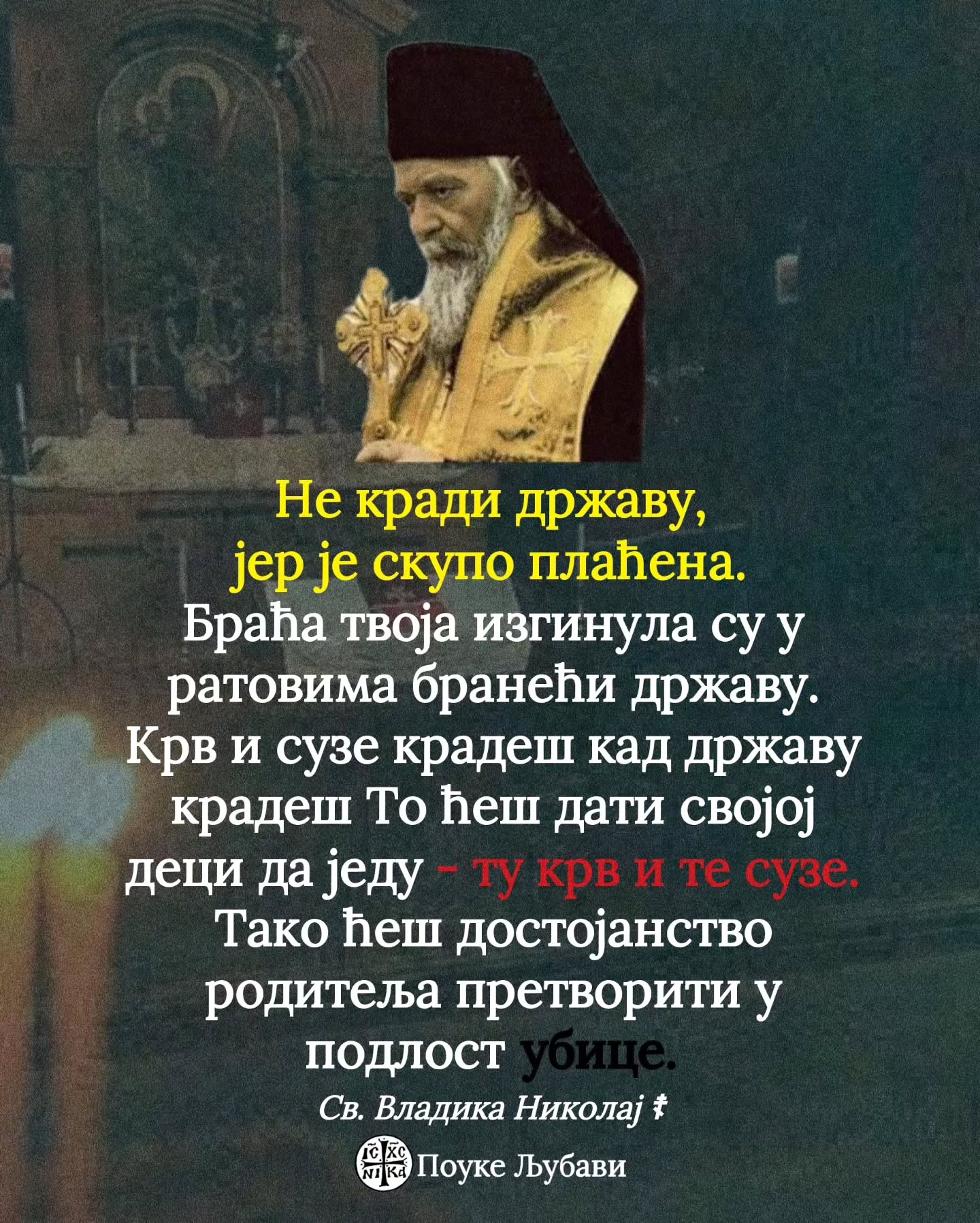
St. Nikolai Velimirovich: Stealing from the state is betrayal of ancestors

The post presents a passage from St. Nikolai Velimirovich's "Teachings of Love" condemning theft of state property. The saint cites Zechariah 5:3, where God declares that every thief and false swearer shall be cut off, calling both acts a curse. He warns that stealing from the state, money, land, forests, materials, or any public property, brings a curse upon the thief, his household, and the state itself. St. Nikolai argues that the state was…

The post presents a passage from St. Nikolai Velimirovich's "Teachings of Love" condemning theft of state property. The saint cites Zechariah 5:3, where God declares that every thief and false swearer shall be cut off, calling both acts a curse. He warns that stealing from the state, money, land, forests, materials, or any public property, brings a curse upon the thief, his household, and the state itself.

St. Nikolai argues that the state was bought with the blood, sweat, tears, and lives of one's ancestors who fought, suffered, and died for it. To steal from the state is to steal from one's own kin, from the fatherland, and from the brothers, sons, and daughters of one's forebears. The ancestors, he says, do not recognize the thief as a citizen; they reject him before God and count him among traitors.

The saint attributes this blindness to unbelief in the living, all-seeing God, the terrible avenger of justice. He warns that the hour of realization will come, but it may be the thirteenth hour, too late. The accompanying image text repeats the core message: the state was dearly paid for with the lives of brothers in war; stealing it means stealing blood and tears, which one will feed to one's own children, turning parental dignity into the baseness of a murderer.

  • St. Nikolai cites Zechariah 5:3 to show theft and false oaths are divine curses
  • Stealing state property brings a curse on the thief, his house, and the state
  • The state was won by ancestors' blood, suffering, and death in its defense
  • Ancestors reject the thief before God and count him among traitors
  • Unbelief in the just, all-seeing God blinds one to this reality
Read more
Orthodox Health Instagram

Healthcare Has No Neutral Baseline: Worldview Defines Health

The post promotes Episode 86 of the Orthodox Health Podcast, titled "The Roots of Healthcare: Why Your Doctor Has a Theology," featuring Dr. Zac Porcu. The speaker argues that there is no neutral definition of a healthy human being because no human control group exists free from cultural, genetic, or geographic factors. Consequently, categories such as health, disease, normality, quality of life, and longevity do not simply emerge from data;…

The post promotes Episode 86 of the Orthodox Health Podcast, titled "The Roots of Healthcare: Why Your Doctor Has a Theology," featuring Dr. Zac Porcu. The speaker argues that there is no neutral definition of a healthy human being because no human control group exists free from cultural, genetic, or geographic factors. Consequently, categories such as health, disease, normality, quality of life, and longevity do not simply emerge from data; each already assumes something about the human person.

He asks what a human being should be capable of, what should be preserved or eliminated, and whether avoiding pain, extending life, maximizing autonomy, or increasing control are the goals. These are not laboratory questions but flow from the story we believe about what a human being is and what human life is for. The speaker identifies the modern worldview as a form of hedonism that treats pleasure and personal satisfaction as the ultimate markers of value, equating happiness with good and pain with bad.

This view assumes physical longevity is the highest good. In contrast, a traditional religious perspective values wisdom, character, virtue, and communion with God above physical health. For the Christian, physical health can never be the final measure of human flourishing. The discussion turns on the fundamental question: what do you believe a human being is for?

Key moments

  1. There is no human control group because no person exists devoid of cultural, genetic, or geographic factors.
  2. Words like health, normal, and disease have assumptions baked into them, specifically one's worldview.
  3. The modern worldview is a form of hedonism that treats pleasure and personal satisfaction as the ultimate markers of value.
  4. Under hedonism, being happy and satisfied is good, while pain and misery are bad.
  5. The desire to live forever contains a worldview problem because it assumes physical longevity is the highest good.
  6. For a traditional religious person, there is more to life than physical health, including wisdom, character, and virtue.
  7. What counts as healthy or not healthy depends on your view of the person and therefore your worldview.
Prayer Orthodoxy ® Instagram

Saint Nektarios: faithfulness through injustice and suffering

The post presents Saint Nektarios of Aegina as a model of faithfulness amid false accusation, rejection, and misunderstanding. It states that he answered injustice with humility and bitterness with forgiveness, and that his life shows God sees every hidden sorrow and holiness can grow through suffering. The feast day is given as November 9. Three sayings attributed to Saint Nektarios appear in the image: "Seek the Lord daily; but seek Him within…

The post presents Saint Nektarios of Aegina as a model of faithfulness amid false accusation, rejection, and misunderstanding. It states that he answered injustice with humility and bitterness with forgiveness, and that his life shows God sees every hidden sorrow and holiness can grow through suffering. The feast day is given as November 9. Three sayings attributed to Saint Nektarios appear in the image: "Seek the Lord daily; but seek Him within your heart," "He who loves God, naturally, also loves God's work," and "Our purpose in life is to become perfect and holy."

The text is bilingual, English and Greek, and ends with a request for the saint's intercession.

  • Saint Nektarios endured false accusation and rejection with humility and forgiveness
  • His life illustrates that God sees hidden sorrows and holiness can grow through suffering
  • Feast day celebrated November 9
  • Three sayings: seek the Lord within the heart; love of God leads to love of God's work; life's purpose is to become perfect and holy
  • Bilingual English and Greek text with intercessory prayer
Read more
☦️An Orthodox Blog☦️ Instagram

St. Nectarios of Aegina: Forgiveness as Spiritual Strength

The video presents St. Nectarios of Aegina as a model of Christian response to injustice. It describes a world that treats revenge as the answer to every wrong and mistakes forgiveness for weakness. St. Nectarios endured slander, humiliation, persecution, and unjust exclusion, yet he never allowed resentment to take hold. He answered offenses with silence, injustices with patience, and hatred with prayer. The teaching emphasizes that turning the…

The video presents St. Nectarios of Aegina as a model of Christian response to injustice. It describes a world that treats revenge as the answer to every wrong and mistakes forgiveness for weakness. St. Nectarios endured slander, humiliation, persecution, and unjust exclusion, yet he never allowed resentment to take hold.

He answered offenses with silence, injustices with patience, and hatred with prayer. The teaching emphasizes that turning the other cheek is not a loss of dignity but spiritual strength, a way to avoid becoming what harms us. The true Christian victory is not defeating the offender but refusing to let hatred conquer the heart.

Key moments

  1. The world treats revenge as the response to injustice and confuses forgiveness with weakness.
  2. St. Nectarios endured slander, humiliation, persecution and unjust exclusion yet responded with silence, patience and prayer.
  3. Turning the other cheek shows spiritual strength, not loss of dignity, and the Christian victory is keeping hatred from conquering the heart.

St. Kosmas' Prophecies on Constantinople's Liberation Explained by Elder Paisios

The post presents a series of prophecies attributed to St. Kosmas Aitolos concerning the future liberation of Constantinople, accompanied by interpretations from Elder Paisios the Hagiorite. The text lists several specific prophecies: "The red vests will drive the Turks from the City," whose meaning remains unknown though some speculate about uniform colors; "There will be so much blood spilled in the City that a three-year-old calf could swim…

The post presents a series of prophecies attributed to St. Kosmas Aitolos concerning the future liberation of Constantinople, accompanied by interpretations from Elder Paisios the Hagiorite. The text lists several specific prophecies: "The red vests will drive the Turks from the City," whose meaning remains unknown though some speculate about uniform colors; "There will be so much blood spilled in the City that a three-year-old calf could swim in it," which Elder Paisios supplemented with a vision of a fierce battle between Russians and Europeans; "Armies will pass through the valley of Mouzini headed for Constantinople.

Let the women and children go to the mountains. They will ask you, 'Is the City far away?' Answer: 'It is near'. By answering that way, you will avoid much disaster." The Mouzini Valley is identified as located in Northern Epirus, now part of Albania but with a largely Greek population. Another prophecy states: "When you hear that a fleet is sailing in the Mediterranean Sea, know that the Constantinople question will soon be resolved," indicating naval involvement.

A further prophecy: "The armies will not even get halfway to the City when they will hear news that 'the desired' (Retaking Constantinople) has come." Elder Paisios also spoke about future events in Serbia and the division of Turkey, saying Europeans would create a Muslim state (Bosnia, Herzegovina) and later divide Turkey by supporting Kurdish and Armenian independence.

He referenced St. Arsenius of Cappadocia telling the faithful of Faras they would lose their fatherland but regain it. Another prophecy mentions a foreign army that does not know Greek but believes in Christ, asking "Where is the City?" Elder Paisios emphasized that Constantinople would be retaken without Greece's direct participation because the majority of Greek youth have become degraded, and God will arrange for others to take the City and give it to Greece. The post ends with a promotional offer for icons.

  • St. Kosmas Aitolos prophesied about the liberation of Constantinople with several specific sayings.
  • Elder Paisios interpreted and supplemented these prophecies, including a battle between Russians and Europeans.
  • Prophecies mention armies passing through Mouzini Valley in Northern Epirus, a Mediterranean fleet, and a foreign Christian army.
  • Elder Paisios predicted the division of Turkey and that Constantinople would be retaken without Greece's direct military action.
  • The post includes a promotional link for St. Kosmas icons.
4 opinions in the discussion Like St. Paisios said in the 10th slide and St. Justin Popović also said, both Serbs and Greeks have degraded themselves. To be worthy of the lands of Kosovo, Metohija, Kappadokia,… Read the discussion
Kyle YouTube

Orthodox Response to Protestant Critique of Icons and Marian Veneration

Orthodox Response to Protestant Critique of Icons and Marian Veneration 25:45

The speaker responds to a YouTuber named Testify who rejects Orthodox icon veneration and Marian devotion. He argues that rejecting icons logically extends to rejecting veneration of the Bible itself, since both are material symbols pointing to Christ. The core theological difference lies in the understanding of salvation: Orthodoxy teaches theosis, healing and union with God through the Church and sacraments, rather than a mere legal…

The speaker responds to a YouTuber named Testify who rejects Orthodox icon veneration and Marian devotion. He argues that rejecting icons logically extends to rejecting veneration of the Bible itself, since both are material symbols pointing to Christ. The core theological difference lies in the understanding of salvation: Orthodoxy teaches theosis, healing and union with God through the Church and sacraments, rather than a mere legal declaration of righteousness.

Because the saints participate in God's glory and remain alive in Christ, they function as secondary causes in salvation under Christ as primary cause. This explains the veneration of icons, relics, and the intercession of the saints, including Mary as the new Eve and mother of all Christians. The speaker addresses objections to Akathist hymns and Marian prayers, showing that their poetic language reflects ancient reverence, not worship, and fits a theology of secondary causality where Mary's unique role flows from her obedience and the incarnation.

He defends the Dormition and bodily assumption of Mary with historical evidence from scholars like Steven Shoemaker and the absence of bodily relics. The speaker concludes by distinguishing veneration from idolatry: icons represent real persons as windows to heaven, not deities to be sustained, and invites engagement with Orthodox scholars and the historic Church.

Key moments

  1. 0:23 Rejecting icon veneration implies rejecting veneration of the Bible, since both are symbols pointing to Christ.
  2. 0:54 Salvation is theosis: union with God through the Church and sacraments, not a legal status change based on nominalism.
  3. 1:59 Saints are alive and intercede; Christ is the primary cause of salvation, but saints and physical objects such as relics and Paul's handkerchiefs are secondary causes through which God works.
  4. 3:32 Mary is the new Eve and mother of all Christians; her blessedness comes from faith and obedience, not merely physical motherhood.
  5. 7:12 Akathist hymns use poetic, symbolic language to honor Mary as a secondary cause; modern Protestant sensibilities mistake veneration for worship.
  6. 10:52 Specific hymn passages such as 'gate of salvation' and baptismal imagery are consistent with secondary causality and early patristic teaching.
  7. 13:28 Mary truly died at her Dormition and was raised; historical evidence from scholars like Steven Shoemaker and the absence of bodily relics support her bodily assumption.
  8. 17:38 Marian prayers express humility and ask for intercession, not independent divine power; St. Gregory Palamas teaches Mary as the boundary between created and uncreated through the incarnation.
Read more

Apolytikion of Saint Nektarios in Dutch praises him as friend of the poor and healer

The video presents the Apolytikion of Saint Nektarios sung in Dutch. The hymn identifies Nektarios as the son of Selymbria who appeared in recent years as a friend of the poor. It calls believers to venerate him as servants inspired by hope in Christ. The text states that healing flows from him to all who beseech him with devotion. Glory is given to Nektarios who was promised, and to Christ who works wonders and healing through him.

Key moments

  1. The hymn identifies Nectarius as the son of Selymbria who appeared as a friend of the poor in the last years.
  2. Believers are called to honor Nectarius as servants animated by hope in Christ.
  3. Healing springs from Nectarius for all who entreat him with devotion.
  4. Glory is given to Nectarius who was promised, and to Christ who makes wonders and healing known through him.
Read more
Eastern Orthodoxy Daily He/Who/Is with Timothy Instagram

Confession to a Priest: Biblical and Early Church Foundations

The speaker argues that confession to a priest rests on biblical and historical grounds. In John 20 Christ breathes on the apostles and gives them authority to forgive or retain sins, a power that requires sins to be disclosed. James 5 instructs a sick Christian to call the presbyters, links forgiveness to their prayer, and commands Christians to confess sins to one another. Early Christian documents confirm the practice. The Didache directs…

The speaker argues that confession to a priest rests on biblical and historical grounds. In John 20 Christ breathes on the apostles and gives them authority to forgive or retain sins, a power that requires sins to be disclosed. James 5 instructs a sick Christian to call the presbyters, links forgiveness to their prayer, and commands Christians to confess sins to one another.

Early Christian documents confirm the practice. The Didache directs Christians to acknowledge transgressions in church and confess before breaking bread on the Lord's Day. Tertullian describes exomologesis as the penitent bowing before presbyters and asking the church for prayer. Cyprian tells Christians to confess while confession can still be received and speaks of satisfaction and remission made by priests.

The speaker says confession developed organically from the apostolic church and is not a medieval invention. The objection that one can confess directly to God is challenged by whether people actually name their sins before God and by the scriptural command to confess to one another. In Orthodoxy the priest acts as a witness and minister of Christ's church, and confession forces the penitent to stop hiding.

Key moments

  1. 0:00 Christ breathes on the apostles and gives them authority to forgive or retain sins, which requires sins to be disclosed.
  2. 0:31 James 5 instructs a sick Christian to call the presbyters, links forgiveness to their prayer, and commands Christians to confess sins to one another.
  3. 1:02 The Didache directs Christians to acknowledge transgressions in church and confess before breaking bread on the Lord's Day.
  4. 1:02 Tertullian describes exomologesis as the penitent bowing before presbyters and asking the church for prayer.
  5. 1:02 Cyprian tells Christians to confess while confession can still be received and speaks of satisfaction and remission made by priests.
  6. 1:34 Confession developed organically from the apostolic church and is not a medieval invention.
  7. 2:04 The claim "I just confess to God" is challenged by whether one actually names sins before God and by the scriptural command to confess to one another.
  8. 2:04 In Orthodoxy the priest is a witness and minister of Christ's church, and confession forces the penitent to stop hiding.
Read more
George Instagram discussion

The Logic Behind Making the Sign of the Cross: Three for the Trinity, Once for a Blessing

The speaker explains the traditional Orthodox practice governing how many times the faithful make the sign of the cross. Although no strict written rule exists, a consistent logic shapes the custom: three crosses are made when honoring the Holy Trinity, and one cross is made when receiving a blessing. Three crosses accompany entering or leaving the church with a small bow, kissing an icon (twice before, once after), and during trisagion prayers…

The speaker explains the traditional Orthodox practice governing how many times the faithful make the sign of the cross. Although no strict written rule exists, a consistent logic shapes the custom: three crosses are made when honoring the Holy Trinity, and one cross is made when receiving a blessing. Three crosses accompany entering or leaving the church with a small bow, kissing an icon (twice before, once after), and during trisagion prayers such as "Holy God, Holy Mighty, Holy Immortal" or the triple "Alleluia."

A single cross is made upon hearing the Trinitarian invocation "in the name of the Father and of the Son and of the Holy Spirit," when the priest blesses with the cross or Gospel, and before daily activities such as eating, sleeping, leaving the house, or beginning an important task. No cross is made directly before the chalice during communion to avoid striking the holy gifts.

The speaker notes that many Orthodox Christians mistakenly cross themselves three times when once is appropriate, or once when three are called for, and some even cross themselves in front of the chalice. He advises following the custom of one's parish, because the essential point is that every cross is made with the heart.

Key moments

  1. Most Orthodox Christians make the sign of the cross the wrong number of times, crossing three times when once is enough and once when it should be three.
  2. Some even cross themselves right in front of the chalice, which is incorrect.
  3. There is no strict written rule, but a beautiful logic governs the practice: three times for honoring the Holy Trinity, once for a blessing.
  4. Three crosses are made when entering or leaving the church with a small bow, when kissing an icon (twice before, once after), and during services whenever a prayer comes in threes such as "Holy God, Holy Mighty, Holy Immortal" or "Alleluia, Alleluia, Alleluia."
  5. One cross is made when hearing "in the name of the Father and of the Son and of the Holy Spirit," when the priest blesses with the cross or Gospel, before eating, before sleeping, before leaving the house, or before starting something important.
  6. No cross is made at all right in front of the chalice when receiving communion so as not to hit the holy gifts.
  7. The simple way to remember is three for the Holy Trinity and once for a blessing.
  8. If a parish does it differently, follow the parish, because what matters most is that every cross is made with the heart.
19 opinions in the discussion I'm new to Liturgy and I've been doing it wrong this whole time. There really isn't an instruction manual for newcomers. But nobody shames me for it. Read the discussion