WeOrthodox
EN UA

Orthodox posts, videos and discussions

We follow Orthodox channels, communities and blogs across the web, summarise every post and video, and highlight the conversations with real substance.

Orthodox Ethical Discernment Requires Humility, Not Certainty

Orthodox Ethical Discernment Requires Humility, Not Certainty 12:25

Fr. Sampson Nash, a professor at the University of Ohio, explains that Orthodox ethical discernment begins with humility before Christ rather than rigid certainty. He illustrates this with a clinical ethics case from the COVID Delta wave: a 26-year-old pregnant woman on ECMO developed irreversible pulmonary fibrosis and was not a candidate for lung transplant. Her care team debated whether to withdraw ECMO support to save a transplant-eligible…

Fr. Sampson Nash, a professor at the University of Ohio, explains that Orthodox ethical discernment begins with humility before Christ rather than rigid certainty. He illustrates this with a clinical ethics case from the COVID Delta wave: a 26-year-old pregnant woman on ECMO developed irreversible pulmonary fibrosis and was not a candidate for lung transplant.

Her care team debated whether to withdraw ECMO support to save a transplant-eligible patient. The team never withdrew the machine; she delivered her baby, held it, and then died. Nash contrasts this concrete suffering with theoretical debates at his seminary about government overreach, public health guidance, and whether resistance showed lack of faith.

An older seminarian wept during the presentation, and that relational encounter shifted the student conversation. Nash argues that Orthodox ethics cannot be reduced to an algorithm or a set of abstract rules applied from a distance. It is a royal pathway that avoids both rigorism and self-will, requiring prayer, community, spiritual authority, factual expertise, and willingness to encounter the person rather than reduce them to a theoretical case.

He acknowledges many COVID overreaches but advises listening to bishops unless they violate dogmatic truth. The royal path between antinomies is not the Aristotelian mean but the path of Christ, as Father George Florovsky writes about the antinomies of empire and desert. Askesis is not only putting off a good for a time but also the particular cross each person bears.

Orthodox ethics is personal, mindful of the weaker brother, and includes absolute prohibitions that must never be crossed. Even the most advanced artificial intelligence cannot produce Orthodox discernment, ethos, or phronema.

Key moments

  1. 0:30 At the seminary, COVID controversies were debated on a theoretical level: the extent of government overreach, whether public health guidance was evidence-based, and whether resisting it showed lack of faith in God's healing grace.
  2. 1:01 The speaker was consulted during a six-hour drive about a 26-year-old pregnant woman on ECMO (extracorporeal membrane oxygenation) whose lungs had developed severe pulmonary fibrosis during the Delta wave; she was not a candidate for lung transplant.
  3. 2:02 The woman delivered her baby and held it, yet she was still not expected to survive, and the ethics question was whether to withdraw ECMO to save a transplant-eligible patient.
  4. 3:37 An older seminarian wept during the presentation, and this relational account shifted the conversation among students.
  5. 4:39 The speaker acknowledges many COVID overreaches but advises listening to bishops unless they violate dogmatic truth, and respecting episcopal authority.
  6. 6:46 The royal path between antinomies is not the Aristotelian mean but the path of Christ; both desert fathers and saints engaged in complex urban life are glorified, as Father George Florovsky writes in the antinomies of empire and desert.
  7. 7:47 Orthodox ethics cannot be systematized or turned into an algorithm; even the most advanced artificial intelligence cannot produce Orthodox discernment, ethos, or phronema.
  8. 10:59 Askesis is not only putting off a good for a time for soul improvement but also the particular cross each person bears; Orthodox ethics is personal, mindful of the weaker brother, and includes absolute prohibitions that must never be crossed.
Orthodox Life Instagram

Saint Stefan Dečanski: King, Martyr, and Founder of Visoki Dečani

The post recounts the life of Saint Stefan Dečanski, born around 1276 to King Stefan Milutin of the Nemanjić dynasty. As a youth he was sent as a hostage to the court of Nogai Khan of the Golden Horde. Later, false accusations by his stepmother led King Milutin to order his blinding and exile to Constantinople around 1314. Stefan lived humbly at the Monastery of the Pantocrator, where, according to tradition, Saint Nicholas appeared in a vision…

The post recounts the life of Saint Stefan Dečanski, born around 1276 to King Stefan Milutin of the Nemanjić dynasty. As a youth he was sent as a hostage to the court of Nogai Khan of the Golden Horde. Later, false accusations by his stepmother led King Milutin to order his blinding and exile to Constantinople around 1314.

Stefan lived humbly at the Monastery of the Pantocrator, where, according to tradition, Saint Nicholas appeared in a vision and restored his eyesight. After his father's death in 1321, Stefan returned to Serbia, defeated rival claimants, and was crowned king in early 1322. His reign brought stability and a decisive victory over the Bulgarians at the Battle of Velbazhd in 1330.

Known for piety and philanthropy, he funded churches across the Christian world and began building Visoki Dečani Monastery. In 1331, nobles turned his son Stefan Dušan against him; Stefan was overthrown, imprisoned at Zveča Fortress, and strangled on November 11. The Serbian Orthodox Church canonized him as a Great-Martyr for enduring betrayal and violent death with Christian meekness.

His feast is celebrated on November 24 (November 11 Julian). His incorrupt relics rest in the church of Visoki Dečani, where believers pray for healing, especially of eye ailments.

  • Born c. 1276 to King Stefan Milutin; sent as hostage to Nogai Khan
  • Blinded and exiled c. 1314 after false accusations; sight restored by vision of Saint Nicholas
  • Crowned King of Serbia 1322; won Battle of Velbazhd 1330
  • Founded Visoki Dečani Monastery; known for church building and philanthropy
  • Overthrown by son Stefan Dušan 1331; strangled in prison; canonized as Great-Martyr
Read more
Kyle YouTube discussion

Father Michael: Gym as Ascetic Training for Christian Life

Father Michael: Gym as Ascetic Training for Christian Life 23:12

Father Michael presents the gym as an ascetic space where men learn discipline, planning, perseverance through pain, and delayed gratification. These habits transfer to school, work, relationships, and the Christian life. He describes watching young men battle anger, addiction, pornography, and broken relationships in the gym, growing calm and finding peace. Mature masculinity, he says, is a gift from God meant to serve others, protecting…

Father Michael presents the gym as an ascetic space where men learn discipline, planning, perseverance through pain, and delayed gratification. These habits transfer to school, work, relationships, and the Christian life. He describes watching young men battle anger, addiction, pornography, and broken relationships in the gym, growing calm and finding peace.

Mature masculinity, he says, is a gift from God meant to serve others, protecting family, worshipping, working, and creating value, not chasing pleasure in sex, drugs, or games. Young men today suffer from a crushing lack of confidence, not pride, and simple encouragement from other men can change a life. He warns against defeatism and the "black pill," urging men to take small daily steps of 1% improvement, fall and get up like the desert fathers, and never quit.

Orthodoxy in America has great potential, but Orthodox Christians must use social media with humility and love, not hatred, and evangelize by listening, affirming, and inviting over coffee. The talk addresses cultural pressures on men, including progressive ideology that condemns natural male drive, popular culture that reduces men to base appetites, and the absence of societal programs for men comparable to those for women.

Male university enrollment has dropped, about a third of men do not work, and 45 percent of men aged 18 to 25 have never approached a woman. Father Michael connects physical training to Christian disciplines such as denial, fasting, prayer, and attending liturgy even when one does not feel like it.

Key moments

  1. 0:09 The gym teaches planning, sticking to the plan, going when you don't want to, working through pain, delaying gratification, eating differently, and persevering, lessons transferable to every area of life.
  2. 1:12 The gym is ascetic; men wrestle with anger, broken relationships, disappointment, bad upbringing, addiction, alcohol, porn, drugs, and leave toxic relationships, finding peace and change.
  3. 2:15 It is never too late to start; self-improvement stacks and mirrors Christian disciplines like denial, fasting, prayer, and attending liturgy even when you don't feel like it.
  4. 5:21 Men are not doing well: progressive left, toxic masculinity rhetoric, wokeism, and equality-of-outcomes ideology condemn men's natural drive; popular culture reduces men's enjoyment to "boobs, beer, and bacon" while telling them to get in touch with feelings or just "man up."
  5. 6:56 No societal programs exist for men like those for women; male university enrollment has dropped, about a third of men don't work, and 45% of men 18-25 have never approached a woman.
  6. 8:29 Mature masculinity is a gift from God; we use our male capacities to add value and serve others, protecting family, worshipping, working, creating products that relieve suffering.
  7. 10:33 Young men's problem is not pride but a crushing lack of confidence; even a small word of encouragement from another man can mean the world.
  8. 16:20 The 1% daily improvement rule: small incremental steps (pray each morning, learn a little) compound over years; reframe obstacles as the necessary steps toward your goal.
5 opinions in the discussion People complaining that Orthobros are mean is just a dodge. Tone isn't the real issue (and yes, I think the truth should be shared kindly), folks cry meanness because of our exclusivist… Read the discussion

Orthodox growth in America challenged by historical latinization and ecumenism

The author warns that certain practices in American Orthodox parishes, such as dog collars, kneeling on Sundays, omitting "catechumens depart," using the Latin calendar, infrequent confession, no veiling, women giving homilies, and not baptizing normatively, are gateways to false unity with heterodox Christians and joint prayer. He traces this latinization to historical events: the 1596 Union of Brest, when Orthodox bishops in the…

The author warns that certain practices in American Orthodox parishes, such as dog collars, kneeling on Sundays, omitting "catechumens depart," using the Latin calendar, infrequent confession, no veiling, women giving homilies, and not baptizing normatively, are gateways to false unity with heterodox Christians and joint prayer.

He traces this latinization to historical events: the 1596 Union of Brest, when Orthodox bishops in the Polish-Lithuanian Commonwealth entered communion with Rome under political pressure; the Kiev Theological Academy founded by Saint Peter Mogila in 1615, which adopted scholastic Western methods and Latin as the principal language of instruction because of intense missionary efforts; the influence of this Western education on Moscow, contributing to Peter the Great's abolition of the patriarchate and creation of the Holy Synod; the 1923 Constantinople council convened by Patriarch Meletios IV, a Freemason, which proposed reforms including married clergy after ordination, removal of vestments and beards, shortened services, and relaxed fasts, but only the calendar change to the Gregorian calendar passed, despite its prior anathematization three times in the 16th century; Patriarch Athenagoras, also a Freemason, pursued ecumenical dialogue with the Pope, leading the Holy Mountain to cease commemorating him; and Metropolitan Philaret of New York, who is incorrupt, presiding over the 1971 ROCOR Synod against ecumenism, warning against practices like kneeling on Sundays, dog collars, shortened liturgies, pushing people away from baptism, lacking an iconostasis, using the Catholic kiss of peace, treating the Eucharist without seriousness, and installing pews. The author argues that tradition in its entirety must be resisted against latinization.

Key moments

  1. 0:00 Orthodoxy is growing massively in the United States, but this growth is frightening because the root of religious compromise almost always stems from the goal of political power.
  2. 0:00 In 1589 the Moscow Patriarchate was granted autocephaly while Orthodox Ruthenians faced hardships under the Catholic Polish-Lithuanian Commonwealth, with restricted political power for nobles and bishops and intense missionary efforts from papal Protestants.
  3. 0:34 The Polish king feared Moscow's political power, and through demonic temptation the Union of Brest in 1596 led many Orthodox bishops to enter communion with Rome while keeping their liturgical traditions and dogmas, a contradictory move that the opposition resisted under heavy persecution.
  4. 0:34 In 1615 Saint Peter Mogila established the Kiev Theological Academy, which used scholastic Western argumentation and Latin as the principal language of instruction because of the massive missionary efforts they faced.
  5. 1:04 This Western influence reached Moscow and led to Peter the Great taking control of the church, abolishing the Moscow Patriarchate, and establishing the Holy Synod, further Westernizing state-controlled institutions.
  6. 1:34 In 1923 a council in Constantinople convened by Patriarch Meletios IV, a Freemason, proposed allowing clergy to marry after ordination, removing vestments and beards, shortening services, and relaxing fasts; none passed except the calendar change from the Julian to the Western festival calendar, which had been anathematized three times in the 16th century.
  7. 2:04 Patriarch Athenagoras of Constantinople, also a Freemason, described the Orthodox and Papist churches as sister churches and attempted to lift excommunications when meeting with the Pope, causing the Holy Mountain to cease commemorating him during the liturgy.
  8. 2:41 Metropolitan Philaret of New York, who is incorrupt, presided over the 1971 ROCOR Synod against Ecumenism and warned of practices such as kneeling on Sundays, dog collars, shortened liturgies, pushing people away from baptism, lacking an iconostasis, using the Catholic handshake kiss of peace, treating the Eucharist without seriousness, and installing pews, all fruits of ecumenism that must be addressed before Orthodoxy in America can truly grow.
35 opinions in the discussion Guess what all these saints who pointed out the Latin captivity and spoke out against ecumenism did? That's right, they baptized everyone. Read the discussion
radioimlemesou Instagram

Loving the poor, not just pitying them: Saint John the Merciful's example

Metropolitan Athanasios of Limassol speaks on the significance of almsgiving, stating that it is almsgiving that will present us before God. He illustrates this through the life of Saint John the Merciful. As a child, John experienced a vision in which a young girl appeared to him. She told him that if he loved her, she would lead him to the king. When John asked her identity, she replied, "I am Almsgiving." The saint embraced almsgiving, and…

Metropolitan Athanasios of Limassol speaks on the significance of almsgiving, stating that it is almsgiving that will present us before God. He illustrates this through the life of Saint John the Merciful. As a child, John experienced a vision in which a young girl appeared to him.

She told him that if he loved her, she would lead him to the king. When John asked her identity, she replied, "I am Almsgiving." The saint embraced almsgiving, and his life became a reflection of God's own mercy, earning him the title "the Merciful."

The metropolitan then draws attention to the wording of the saint's apolytikion, which in Greek says "τούς πτωχούς ἀγαπήσας", "you loved the poor", rather than "τούς πτωχούς ελεήσας," which would mean "you had mercy on the poor." He emphasizes that loving the poor is a far greater and more transformative act than merely pitying them.

To love the poor, he explains, is to become one with them, entering into their condition and sharing their life. The metropolitan stresses that the saint did not simply perform acts of charity from a distance; he became one with the poor, loving them directly. He notes that just as God is merciful, so John became merciful, but the apolytikion highlights love, not mercy, as the defining virtue.

Mercy can remain at a distance, while love requires union. The saint's love for the poor meant he shared their life, becoming poor with them. This, the metropolitan suggests, is the standard for all Christians: almsgiving that presents us before God is not measured by the amount given but by the love that unites the giver with the receiver.

Key moments

  1. Almsgiving is what will present us before God.
  2. Saint John the Merciful as a child saw a vision of a girl who promised to lead him to the king if he loved her.
  3. The girl identified herself as Almsgiving.
  4. John loved almsgiving and was called the Merciful, mirroring God's mercy.
  5. The apolytikion of Saint John says "you loved the poor" not "you had mercy on the poor."
  6. Loving the poor is much more than having mercy on them.
  7. To love the poor means to become one with them.
Read more

Orthodoxy accepts postmortem purification but rejects the Latin penal framework

The post explains that Orthodoxy does not deny the possibility of purification after death. What it rejects is the later Latin theological framework constructed around that purification, specifically the juridical model of temporal punishment (poena temporalis). The Latin framework treats sin as involving guilt and consequences that may require temporal punishment; forgiveness can remove guilt while temporal punishment remains, defining a…

The post explains that Orthodoxy does not deny the possibility of purification after death. What it rejects is the later Latin theological framework constructed around that purification, specifically the juridical model of temporal punishment (poena temporalis). The Latin framework treats sin as involving guilt and consequences that may require temporal punishment; forgiveness can remove guilt while temporal punishment remains, defining a particular postmortem purification.

The Orthodox framework understands sin as guilt, corruption, and a wounded relationship with God. Forgiveness and healing are distinct but inseparable aspects of salvation. The Church prays for the departed without defining an equivalent penal mechanism.

In Catholicism, guilt and temporal punishment are distinguished, so a person can be forgiven yet still require purification from the sin's consequences. Orthodoxy questions the necessity of this construction: if sin is a spiritual sickness, purification should be healing and restoration, not an outstanding penal debt. Orthodox soteriology sees salvation as the healing of human nature and restoration of communion with God (theosis).

Sin is not a legal transgression requiring acquittal but a corruption of human nature that separates us from God. Salvation is not removal of guilt or punishment but restoration and transformation through grace, participation in God's uncreated energies. Purification is understood within this therapeutic framework.

Common ground includes affirmation that the departed await the resurrection and final judgment, the Church intercedes for their repose, and Scripture and Tradition describe Hades/sheol, with some traditions mentioning aerial toll houses (not universally dogmatized). Orthodoxy affirms judgment, purification, and God's mercy without defining the intermediate state through a system of penal satisfaction.

At the Council of Florence, St. Mark of Ephesus opposed the Latin formulation without rejecting prayer for the departed. The disagreement is not whether God purifies, but how theology explains that purification. The post concludes with a quote from St. Isaac of Nineveh: "God chastises with love, not for the sake of revenge."

  • Orthodoxy accepts postmortem purification but rejects the Latin penal framework (poena temporalis) built around it.
  • Latin theology uses a juridical model distinguishing guilt and temporal punishment; Orthodoxy uses a therapeutic model of healing and theosis.
  • Sin is understood as spiritual sickness and corruption, not merely a legal transgression; salvation is restoration and participation in divine life.
  • Both traditions affirm prayer for the departed, the final judgment, and God's mercy, but differ on the explanation of the intermediate state.
  • St. Mark of Ephesus opposed the Latin formulation at the Council of Florence; St. Isaac of Nineveh describes God's chastisement as loving, not vengeful.
7 opinions in the discussion Purgatory is usually framed in terms of debt, penance and suffering because of the punishment given to King David, but it's worth noting that in the Western framework temporal debt can be… Read the discussion
radioimlemesou Instagram

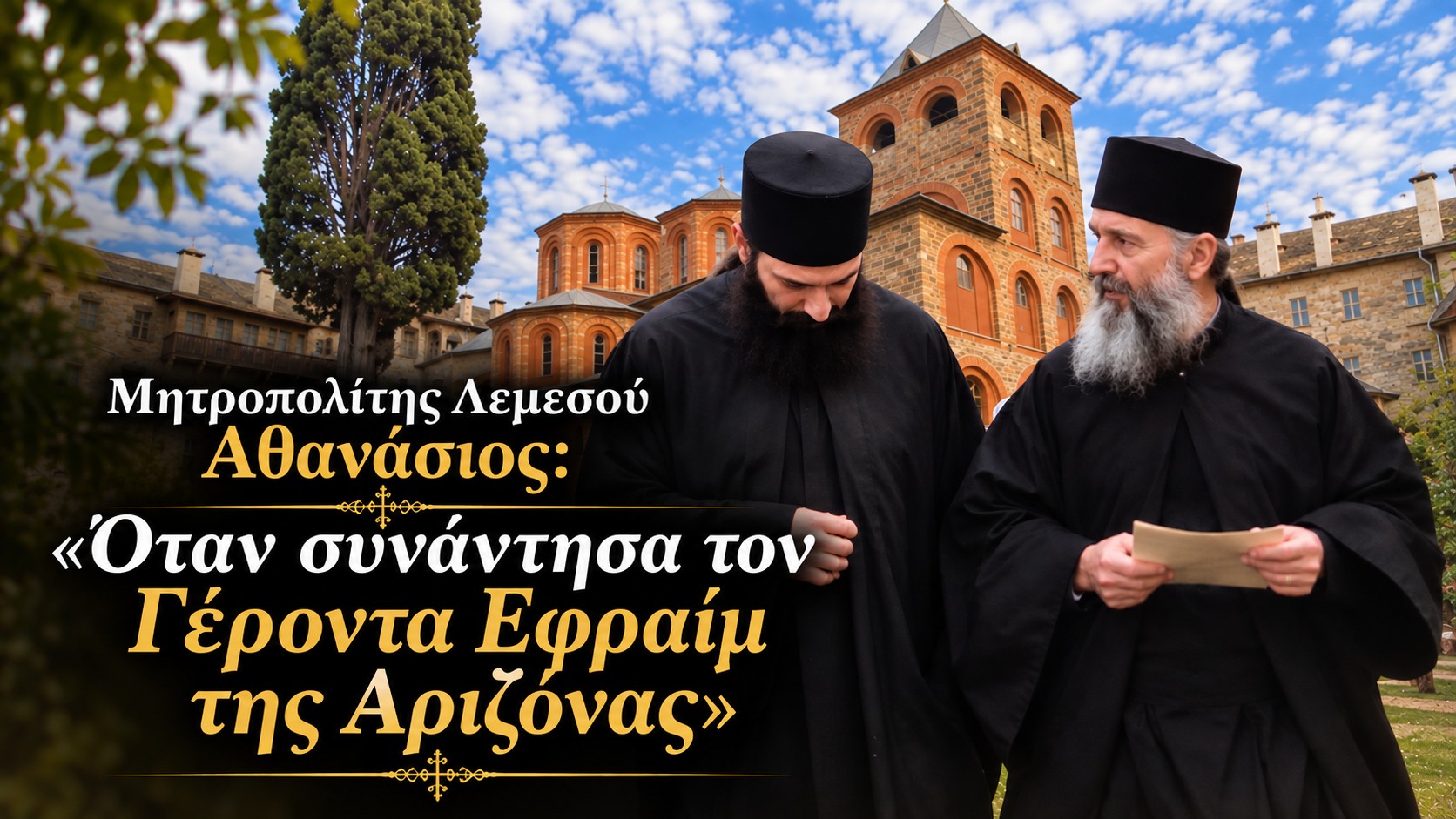
Metropolitan Athanasios of Limassol recalls Elder Ephraim of Arizona

Metropolitan Athanasios of Limassol, in an excerpt from the program "Cardiac Logos, Nostalgia of Holy Forms," speaks about Elder Ephraim of Philotheou, also known as Elder Ephraim of Arizona. He shares memories of their first meetings and communication. The metropolitan describes these encounters as deeply moving. Despite the strictness of monastic life and the typikon of the Holy Monastery of Philotheou, he felt the elder very close to his…

Metropolitan Athanasios of Limassol, in an excerpt from the program "Cardiac Logos, Nostalgia of Holy Forms," speaks about Elder Ephraim of Philotheou, also known as Elder Ephraim of Arizona. He shares memories of their first meetings and communication. The metropolitan describes these encounters as deeply moving.

Despite the strictness of monastic life and the typikon of the Holy Monastery of Philotheou, he felt the elder very close to his heart because of the boundless love with which the elder embraced those who approached him. Through these memories, the figure of a man wholly dedicated to God emerges, marked by ceaseless prayer, great spiritual struggle, and strict ascetic life, yet simultaneously possessing boundless love for every person. The excerpt is available on the program's YouTube channel.

  • Metropolitan Athanasios of Limassol recounts meetings with Elder Ephraim of Arizona
  • The encounters were deeply moving despite the elder's strict monastic demeanor
  • The elder's boundless love made him feel close to the heart
  • The elder is portrayed as wholly dedicated to God with ceaseless prayer and ascetic struggle
  • The excerpt is from the show "Cardiac Logos, Nostalgia of Holy Forms" and available on YouTube
Prayer Orthodoxy ® Instagram

The Antimension: Cloth Linking Liturgy to Christ's Burial and the Martyrs

During the Orthodox Divine Liturgy the priest unfolds a consecrated linen or silk cloth called the antimension upon the Holy Altar. The cloth typically depicts Christ's entombment with the four Evangelists at its corners and often bears words from the Holy Saturday hymn describing Joseph of Arimathea wrapping Christ's body in fine linen and laying it in a new tomb. The image and hymn connect the antimension with Christ's burial and His saving…

During the Orthodox Divine Liturgy the priest unfolds a consecrated linen or silk cloth called the antimension upon the Holy Altar. The cloth typically depicts Christ's entombment with the four Evangelists at its corners and often bears words from the Holy Saturday hymn describing Joseph of Arimathea wrapping Christ's body in fine linen and laying it in a new tomb.

The image and hymn connect the antimension with Christ's burial and His saving sacrifice. When folded the antimension is kept inside a protective cloth called the eileton, often red, beneath the Gospel Book; traditional explanations associate these cloths with the burial linens of Christ. The priest unfolds them in preparation for the Eucharistic offering and after Communion carefully gathers any sacred particles remaining on them.

The antimension is consecrated by a bishop and bears his signature authorizing its use. The bishop is the chief pastor of his diocese and stands within the Church's apostolic succession; even when absent the priest celebrates with his blessing. The signed antimension expresses the communion of bishop, clergy, and faithful within the one Orthodox Church.

Ordinarily the antimension contains a small relic of a saint, traditionally a martyr, secured in a sewn pocket. This preserves the early Christian practice of celebrating the Eucharist at the tombs of martyrs. Beneath the Holy Gifts rests a tangible reminder of those who remained faithful to Christ even unto death and who live in Him.

  • The antimension is a consecrated cloth placed on the altar beneath the Holy Gifts during the Divine Liturgy.
  • It depicts Christ's entombment, often with the four Evangelists and words from the Holy Saturday hymn.
  • The cloth is kept folded in a protective eileton and unfolded by the priest for the Eucharistic offering.
  • It bears the bishop's signature, authorizing its use and expressing the communion of the local church.
  • A saint's relic, usually a martyr's, is sewn into the antimension, linking the Liturgy to the early Church's worship at martyrs' tombs.
Read more
harmony YouTube

Saint Longinus: Centurion at the Cross, Martyr, and Wonderworker

Saint Longinus: Centurion at the Cross, Martyr, and Wonderworker 12:06

Saint Longinus was the Roman centurion who commanded the soldiers at Golgotha and guarded Christ's tomb. When the earthquake and darkness occurred at the crucifixion, he and his men feared greatly and confessed that Jesus was truly the Son of God. After the resurrection, Jewish leaders bribed the tomb guards to say the disciples stole the body; they also tried to bribe Longinus, but he refused. Threatened with death, he removed his military…

Saint Longinus was the Roman centurion who commanded the soldiers at Golgotha and guarded Christ's tomb. When the earthquake and darkness occurred at the crucifixion, he and his men feared greatly and confessed that Jesus was truly the Son of God. After the resurrection, Jewish leaders bribed the tomb guards to say the disciples stole the body; they also tried to bribe Longinus, but he refused.

Threatened with death, he removed his military belt, was baptized by the apostles along with two fellow soldiers, and secretly left Jerusalem for Cappadocia. There he devoted himself to fasting and prayer, and as a living witness of the resurrection he brought many pagans to the faith. Later, Pontius Pilate sent soldiers to behead him. Longinus spiritually perceived their arrival, welcomed them into his home without revealing his identity, and hosted them.

While they slept, he prayed all night, then in the morning put on white burial shrouds with his companions, instructed his household, showed them a burial place, and revealed himself to the soldiers, urging them to carry out their orders. They beheaded him, and his head was thrown on a garbage heap outside Jerusalem. Centuries later, a 14th‑century monk also named Longinus served as gatekeeper at the Kiev Caves Monastery.

His heart was so pure that he knew the thoughts of everyone who entered or left; his incorrupt relics remain in Theodosius's cave. After the centurion's martyrdom, a blind widow in Cappadocia whose only son had died on the way to Jerusalem received a vision from Longinus. He promised to restore her sight and show her son in heavenly glory, directing her to find his head on the Jerusalem garbage heap.

She dug there, touched the head, and her eyes opened immediately. She took the head, washed it, anointed it with fragrance, and kept it in her home as a precious treasure. The video also includes a meditation on Saint Stephen's speech in Acts 7 and on God's righteousness described as mountains and His judgments as a great deep, presenting the saints as bearers of that righteousness across time and space.

Key moments

  1. 0:01 The story of Saint Longinus, the Roman soldier who stood at Christ's cross, has been preserved for two thousand years along with the stories of many earlier saints.
  2. 0:40 The centurion and those with him, seeing the earthquake and other events at the crucifixion, feared greatly and confessed that Jesus was truly the Son of God; this centurion was Longinus, commander of the soldiers at Golgotha and chief of the tomb guards.
  3. 1:16 When Jewish leaders bribed soldiers to claim Christ's disciples stole His body, they also tried to bribe Longinus, but he refused; they then decided to kill him, so he removed his military belt, was baptized by the apostles with two companions, and secretly left Jerusalem for Cappadocia.
  4. 1:48 In Cappadocia Longinus devoted himself to fasting and prayer, and as a living witness of the resurrection he brought many pagans to the true faith; later Pilate sent soldiers to behead him, but Longinus spiritually perceived their coming, met them without revealing his identity, and hosted them in his home.
  5. 2:18 While the soldiers slept, Longinus stood praying all night to prepare for death; in the morning he called his two companions, put on white burial shrouds, instructed his household, showed them a burial place on a small hill, then revealed his identity to the soldiers and urged them to obey their superior's order to behead him.
  6. 3:25 A 14th-century monk named Longinus at the Kiev Caves Monastery served as gatekeeper and his heart was so pure that he always knew the thoughts with which people entered and left the monastery; his incorrupt relics are preserved in Theodosius's cave.
  7. 5:31 After Longinus's martyrdom, a blind widow in Cappadocia whose only son died on the way to Jerusalem received a vision from Longinus promising to restore her sight and show her son in heavenly glory; he directed her to find his head on the garbage heap outside Jerusalem's wall.
  8. 7:04 The woman dug at the garbage heap, touched the holy martyr's head, and immediately her eyes opened; she took the head, washed it, anointed it with fragrance, and placed it in her home as the most precious treasure on earth.
Read more
Lives of the Saints 🙏 Instagram

Saint Anastasia of Rome: Martyrdom under Emperor Decius

Saint Anastasia of Rome was born into a noble family in Rome and became an orphan at three years old. She was raised in a convent near Rome under Abbess Sophia, a woman of great spiritual wisdom and holiness. As she grew, Anastasia became known among Christians for her devotion to God, prayer, and ascetic life. Her beauty attracted the pagan governor Probus, who sent soldiers to bring her before him. Before her departure, Abbess Sophia spent two…

Saint Anastasia of Rome was born into a noble family in Rome and became an orphan at three years old. She was raised in a convent near Rome under Abbess Sophia, a woman of great spiritual wisdom and holiness. As she grew, Anastasia became known among Christians for her devotion to God, prayer, and ascetic life.

Her beauty attracted the pagan governor Probus, who sent soldiers to bring her before him. Before her departure, Abbess Sophia spent two hours strengthening her spiritual daughter, encouraging her to remain faithful through every temptation and suffering. Anastasia answered: "My heart is ready to suffer for Christ, and my soul is ready to die for my sweetest Jesus."

Standing before the governor, she openly confessed her faith in the Lord Jesus Christ. Neither promises nor threats could persuade her to deny Him. She declared: "I am ready to die for my Lord not once, but a hundred times if it were possible."

The governor ordered her to be humiliated and subjected to terrible tortures. During her suffering, Anastasia became desperately thirsty and asked for water. A Christian named Cyril showed her mercy and gave her something to drink.

For this act of compassion, he too was killed. According to her holy life, an angel of God appeared to Anastasia and strengthened her through her sufferings. Finally, she was executed by the sword outside the city. Her beloved Abbess Sophia recovered her body and buried it with reverence. Thus, during the reign of Emperor Decius, Saint Anastasia received the eternal crown of martyrdom.

The narrative concludes that true courage is not the absence of suffering but remaining faithful to Christ despite it, and that the sacrifice of Cyril teaches that even a simple act of mercy can become a powerful testimony of Christian love. The post also includes a Greek icon inscription identifying her as the young nun who chose martyrdom rather than deny Jesus Christ, and ends with a prayer to the Holy Venerable Martyr Anastasia.

  • Born noble, orphaned at three, raised by Abbess Sophia in a convent near Rome.
  • Governor Probus summoned her; she confessed Christ before him, refusing to deny Him.
  • Endured tortures; Cyril gave her water and was martyred for it; an angel strengthened her.
  • Executed by sword under Emperor Decius; Abbess Sophia buried her body.
  • The account emphasizes faithfulness amid suffering and the witness of simple mercy.
Read more
Lives of the Saints 🙏 Instagram

Saint Paraskeva: Martyr Who Gave Wealth and Life for Christ

Saint Paraskeva, also known as Saint Petka, was born in the city of Iconium to wealthy and deeply devout Christian parents. From her youth she loved Jesus Christ and desired to live according to His commandments. After the death of her parents, she inherited their possessions, but instead of seeking comfort and luxury, she began distributing her wealth to the poor, the sick, and those in need. Everything she gave, she offered in the name of…

Saint Paraskeva, also known as Saint Petka, was born in the city of Iconium to wealthy and deeply devout Christian parents. From her youth she loved Jesus Christ and desired to live according to His commandments. After the death of her parents, she inherited their possessions, but instead of seeking comfort and luxury, she began distributing her wealth to the poor, the sick, and those in need.

Everything she gave, she offered in the name of Jesus Christ. During the persecution of Christians under Emperor Diocletian, Paraskeva was arrested and brought before the local governor. When he demanded to know her name, she answered: "My name is Christian."

Angered, the governor asked why she refused to give her ordinary name. Saint Paraskeva replied: "I had to tell you first the name of eternal life, and only afterward the name of this temporary life." Her courageous confession enraged the governor, who ordered her to be brutally beaten and thrown into prison.

But the Lord did not abandon His faithful servant. According to her holy life, an angel of God appeared to her in prison, healed her wounds, and strengthened her spirit. Through her prayers, the idols in a pagan temple were destroyed, revealing the power of the living God. Despite prolonged and terrible tortures, Saint Paraskeva refused to renounce Jesus Christ.

Finally, she was executed by the sword, receiving the eternal crown of martyrdom. Her life reminds us that our greatest treasure is not what we possess in this world, but the faith we carry in our hearts. She gave her wealth to the suffering and her very life to Christ.

The account ends with the invocation: "Holy Martyr Paraskeva, pray to God for us. Lord, for Your glory, not mine."

  • Born in Iconium to wealthy Christian parents, she loved Christ from youth.
  • After her parents' death, she distributed her inheritance to the poor and needy.
  • Arrested under Diocletian, she confessed her faith with the words "My name is Christian."
  • An angel healed her in prison, and through her prayers pagan idols were destroyed.
  • She endured tortures and was executed by the sword, receiving the crown of martyrdom.
Read more

Putting Christ First: Daily Orthodox Habits of Prayer and Trust

The author urges believers to center daily life on Christ through three habitual expressions. Before any task, say "God willing" (Πρώτα ο Θεός). Upon receiving news, good or bad, say "Glory to God" (Δόξα τω Θεώ). When uncertain or worried, remember "God will provide" (Έχει ο Θεός). The speaker adds concrete practices: make the sign of the cross from within when sitting down to eat; cross the steering wheel when starting a car journey; before…

The author urges believers to center daily life on Christ through three habitual expressions. Before any task, say "God willing" (Πρώτα ο Θεός). Upon receiving news, good or bad, say "Glory to God" (Δόξα τω Θεώ). When uncertain or worried, remember "God will provide" (Έχει ο Θεός).

The speaker adds concrete practices: make the sign of the cross from within when sitting down to eat; cross the steering wheel when starting a car journey; before confirming an appointment, first ask God whether it will happen, and if speaking aloud might cause offense, keep the prayer in the heart. These habits aim to keep God at the centre of every action, trusting His providence and giving Him glory in all things.

Key moments

  1. 0:00 Put Christ first in all things; when you sit to eat, make the sign of the cross from within yourself.
  2. 0:00 When you begin a car trip, cross the steering wheel.
  3. 0:00 Before agreeing to an appointment, first say "God first" and ask God whether it will come to pass.
  4. 0:00 If you do not want to speak this aloud to avoid scandalizing others, keep it in your heart.
CHRISTIANITY UNITED Instagram

Counting all things loss for the sake of Christ

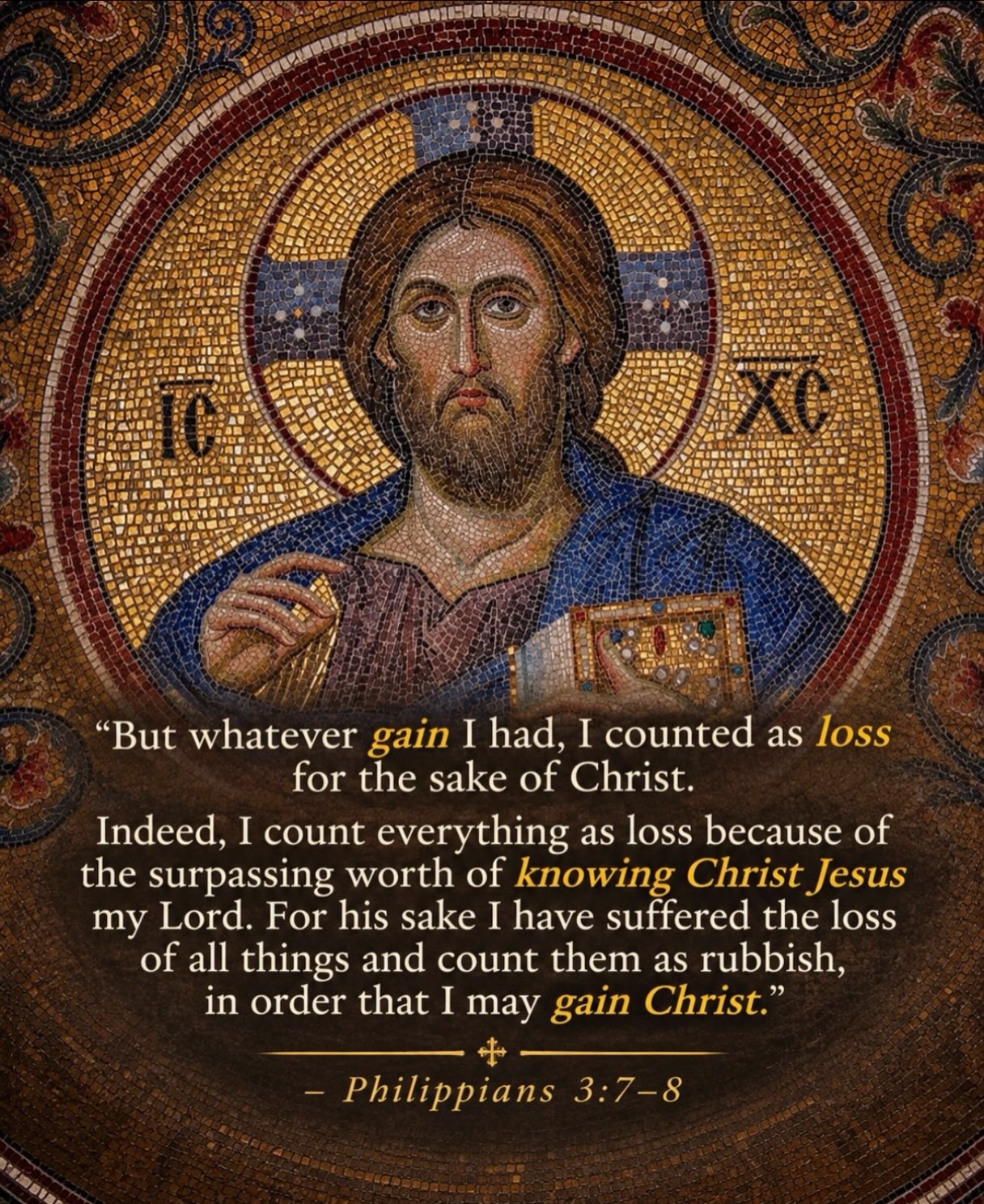
The post reflects on Philippians 3:7-8, where Paul writes that he counted his former gains as loss for the sake of Christ. The author describes how people spend their lives chasing money, success, recognition, comfort, possessions, and the approval of others, believing these will bring satisfaction. We convince ourselves that once we achieve enough, we will finally be satisfied. Before his conversion, Paul was a respected Pharisee, educated and…

The post reflects on Philippians 3:7-8, where Paul writes that he counted his former gains as loss for the sake of Christ. The author describes how people spend their lives chasing money, success, recognition, comfort, possessions, and the approval of others, believing these will bring satisfaction. We convince ourselves that once we achieve enough, we will finally be satisfied.

Before his conversion, Paul was a respected Pharisee, educated and zealous for his traditions. After encountering the risen Christ, he considered his achievements insignificant compared to knowing Christ. The post asks readers to examine how much time they spend building earthly lives versus preparing their souls for eternity.

We make plans for careers, finances, and future, but how often do we give the same attention to prayer, repentance, humility, and love? It notes that the Orthodox Church does not teach that money, work, or possessions are inherently evil; the danger begins when these things become more important than God. The saints understood that true wealth is measured by communion with Christ, not by what is possessed.

One day everything accumulated in this world will be left behind; titles, possessions, and earthly achievements cannot save the soul. Gain the whole world, and you will still leave it behind. Gain Christ, and you have found the treasure that death cannot take away. The post concludes with a prayer asking the Lord to teach us to seek Him above all things.

  • Paul's former achievements counted as loss after knowing Christ (Philippians 3:7-8)
  • Worldly pursuits such as money, success, and recognition cannot satisfy
  • Orthodox teaching: possessions are not evil but dangerous when preferred to God
  • True wealth is communion with Christ, not material accumulation
  • Earthly gains are left behind; Christ is the treasure death cannot take
Read more

Orthodox Teaching on Baptism Validity and Early Practice

The post examines what constitutes a valid baptism from an Orthodox perspective. It begins by questioning who has authority to declare a baptism real given over 10,000 denominations and corrupted formulas. The author describes first-century practice: baptism in the name of the Father, Son, and Holy Spirit per Matthew 28:19, triple immersion in living water, and the Didache (c. 90 AD) prescribing fasts and exorcisms before the ritual. Modern…

The post examines what constitutes a valid baptism from an Orthodox perspective. It begins by questioning who has authority to declare a baptism real given over 10,000 denominations and corrupted formulas. The author describes first-century practice: baptism in the name of the Father, Son, and Holy Spirit per Matthew 28:19, triple immersion in living water, and the Didache (c. 90 AD) prescribing fasts and exorcisms before the ritual.

Modern practices are contrasted: some baptize in the "Name of Jesus" using "Creator, Sustainer, and Redeemer"; Mormons use the words but mean three separate gods; others sprinkle or use water guns; independent storefront churches keep no records of how they baptized. For uncertainty, the post cites Canon 72 of the Fifth Council of Carthage (AD 401): those without certain witnesses ought to be baptized without scruple.

The author argues Scripture commands baptism but a book cannot verify a local pastor; private interpretation leaves believers guessing; Christ gave binding authority to a living Church. Rome's approach is criticized: the Council of Trent (1547) dogmatized that any heretic confers valid baptism with water and the names, replacing true faith with mechanical formulas.

The post notes Rome accepted Mormon baptisms until 2001 and invented conditional rites. Sacraments are not autonomous rituals separated from the Body of Christ (Ephesians 1:22); bishops hold the keys to bind and loose (Matthew 16:19). The early Church evaluated converts through councils and bishops, sometimes baptizing from scratch when previous ceremonies could not be verified or had incorrect form, sometimes receiving through anointing with oil where the Church supplied the grace of the Holy Spirit they were lacking.

The conclusion: Orthodox Christianity alone preserves the exact first-century method, and the living Church determines whether a prior baptism suffices.

  • Validity depends on correct form (triple immersion in the Trinity's name) and authority within the historic Church.
  • Early practice included triple immersion, fasting, and exorcisms as recorded in the Didache (c. 90 AD).
  • Modern variations such as single-name formulas, sprinkling, and lack of records create uncertainty.
  • Canon 72 of Carthage (401) mandates baptism when prior baptism cannot be verified.
  • Orthodox teaching holds that sacraments require the living Church's discernment, not private interpretation or mechanical formulas.
Read more
Holy Resurrection YouTube

St. Maximus the Confessor on the Soul Left Desolate

St. Maximus the Confessor on the Soul Left Desolate 12:08

The reading comes from St. Maximus the Confessor's treatise On the Ascetic Life, also known in Latin as Liber Asceticus, a work of 45 chapters written around AD 626, or before AD 633-634, at the request of the priest Elpidius. The text quoted is from A Discourse on the Ascetic Life in the Russian edition of St. Maximus's Selected Works translated by A. I. Sidorov (Moscow: Palomnik, 2004), pages 109-135. The discourse is a penitential examination…

The reading comes from St. Maximus the Confessor's treatise On the Ascetic Life, also known in Latin as Liber Asceticus, a work of 45 chapters written around AD 626, or before AD 633-634, at the request of the priest Elpidius. The text quoted is from A Discourse on the Ascetic Life in the Russian edition of St. Maximus's Selected Works translated by A. I. Sidorov (Moscow: Palomnik, 2004), pages 109-135. The discourse is a penitential examination of the soul in the voice of one who confesses his own desolation.

It opens with those who keep Christ's commandments and can say with the Apostle, 'It is no longer I who live, but Christ lives in me': being reviled they bless, being persecuted they endure, being defamed they entreat, following the command to love enemies. The speaker then confesses that we act contrary to all the commandments and have become a house of merchandise instead of the temple of God, a den of thieves instead of a house of prayer, and sons of lawlessness instead of sons of God, fallen into bondage to evil spirits through impure passions.

The discourse gathers Scripture to show this condition: Isaiah's lament over the sick head and the wounds from the sole of the foot to the head; the Apostle's list of unrighteousness, fornication, envy, murder, deceit, pride and disobedience to parents; and the Lord's words, 'Behold, your house is left unto you desolate.' Isaiah's rebuke of vain sacrifices shows that ascetic struggle without love is foreign to God, since whoever hates his brother is a murderer.

The Lord's indictment of the Pharisees is applied to present-day hypocrites who bind heavy burdens on others, love to be honored, and appear righteous outwardly while inwardly filled with hypocrisy. The prayer ends asking God not to deliver us up utterly, but to remember His covenant, the firstfruits of our nature that the Son of God bears in heaven, and His mercy, since our hope is not in our own righteousness.

Key moments

  1. 0:03 Those who make room within themselves for the whole Christ through the commandments can say, 'It is no longer I who live, but Christ lives in me,' and being reviled they bless, being persecuted they endure, being defamed they entreat, following the Lord's command to love enemies.
  2. 1:05 Because we act contrary to all Christ's commandments, we have become a house of merchandise instead of the temple of God, a den of thieves instead of a house of prayer, and sons of lawlessness instead of sons of God, having fallen into bondage to evil spirits through impure passions.
  3. 1:35 Isaiah cries out over our fallen condition: the whole head is sick, from the sole of the foot to the head there is no soundness but wounds and petrified sores, and the daughter of Zion is left as a cottage in a vineyard and as a besieged city.
  4. 2:38 The Apostle describes those who did not like to retain God in their knowledge as filled with all unrighteousness, fornication, envy, murder, deceit, pride, and disobedience to parents, so that God gave them up to vile affections and His wrath is revealed from heaven against all ungodliness.
  5. 3:39 The Lord laments, 'O Jerusalem, Jerusalem, thou that killest the prophets... how often would I have gathered thy children together, even as a hen gathereth her chickens under her wings, and ye would not. Behold, your house is left unto you desolate.'
  6. 4:10 Isaiah rebukes those who perform only outward bodily service while neglecting the spiritual life: God is full of burnt offerings, incense is an abomination to Him, He hides His eyes and will not hear their many prayers, because their hands are full of blood, and whoever hates his brother is a murderer.
  7. 5:41 The Lord's words against the Pharisees are applied to present-day hypocrites: we bind heavy burdens on others' shoulders, do all works to be seen by men, love the chief places and to be called rabbi, shut the kingdom of heaven against men, strain out a gnat and swallow a camel, and are like whitewashed tombs outwardly righteous but inwardly filled with hypocrisy and uncleanness.
  8. 7:45 Because of this we who were sons of the kingdom have become sons of Gehenna, delivered into the hands of savage demons and the prince of these demons; the prayer asks God not to disannul His covenant, to remember the firstfruits of our nature that the Son of God bears in heaven, and to blot out our sins for His name's sake, for we do not place our hope in our own righteousness but in His mercy.

God's Strength Is Made Perfect in Weakness

The post reflects on why some of the strongest Christians are those who have endured hardship rather than easy lives. It describes believers who have faced rejection, betrayal, loneliness, disappointment, and seasons when God seemed silent, yet who continue to pray, attend Divine Liturgy, repent, and glorify God even when life has not unfolded as they hoped. The author argues that such strength does not come from willpower alone but from the…

The post reflects on why some of the strongest Christians are those who have endured hardship rather than easy lives. It describes believers who have faced rejection, betrayal, loneliness, disappointment, and seasons when God seemed silent, yet who continue to pray, attend Divine Liturgy, repent, and glorify God even when life has not unfolded as they hoped.

The author argues that such strength does not come from willpower alone but from the grace of God, citing St Paul's words in 2 Corinthians 12:9: "My grace is sufficient for you, for My strength is made perfect in weakness." The post also sets a boundary against a possible misunderstanding: in Orthodox Christianity, suffering is not proof that a person is chosen or spiritually superior.

What matters is how suffering is endured. When a person bears trials with faith, humility, patience, and repentance, God can transform those trials into opportunities for spiritual growth. The author concludes that true faith is not shown only when God gives a person what he wants; it is shown when a person continues to trust God even when he does not understand His plan.

There is no further discussion in the post; it stands as a short reflection on endurance, grace, and trust in God amid trials.

  • The strongest Christians are often those who endured rejection, betrayal, loneliness, and disappointment yet still pray, attend Divine Liturgy, repent, and glorify God.
  • Their strength comes from the grace of God, not willpower alone, citing 2 Corinthians 12:9: "My grace is sufficient for you, for My strength is made perfect in weakness."
  • In Orthodox Christianity, suffering is not proof that someone is chosen or spiritually superior.
  • When suffering is endured with faith, humility, patience, and repentance, God can turn trials into opportunities for spiritual growth.
  • True faith is revealed when we trust God even when we do not understand His plan.
Read more
Orthodox Life Instagram

November 11: Saint Menas of Egypt, Great Martyr and Wonder-worker

The post tells the life of Saint Menas of Egypt, commemorated on November 11, one of the most beloved Great Martyrs and wonder-workers in the Eastern Orthodox tradition. Menas was born in Egypt around 285 AD to devout Christian parents, orphaned young, and joined the Roman army. Serving in Phrygia, he rose through the ranks and earned respect for bravery, patience, and self-discipline. When Emperor Diocletian issued an edict in 298 AD ordering…

The post tells the life of Saint Menas of Egypt, commemorated on November 11, one of the most beloved Great Martyrs and wonder-workers in the Eastern Orthodox tradition. Menas was born in Egypt around 285 AD to devout Christian parents, orphaned young, and joined the Roman army. Serving in Phrygia, he rose through the ranks and earned respect for bravery, patience, and self-discipline.

When Emperor Diocletian issued an edict in 298 AD ordering soldiers to worship pagan idols and persecute Christians, Menas refused. He cast aside his military belt and withdrew to the wilderness mountains, where he spent years in solitude, fasting, and prayer. During a major pagan festival in Kotyaeion he felt called by God to come down and confess Christ publicly as the one true God.

Brought before the prefect Pyrrhus, he refused to offer sacrifice to idols even when offered the return of his rank. After tortures he was beheaded around 304 AD. Believers carried his relics back to Egypt on a camel, which stopped near Lake Mareotis in the western desert and would not move. Taking this as a divine sign, they buried him there. The site became known for miraculous healings, and the pilgrimage city of Abu Mena rose over his tomb.
Sick pilgrims came from across the Christian world and carried home blessed oil and water in small clay Menas flasks. The saint is often depicted standing in prayer between two kneeling camels, recalling his burial. He is venerated across the Orthodox world as a healer, a protector of travelers, and one invoked to find lost items.

The accompanying images show icons and inscriptions of Saint Menas and a reliquary holding a relic decorated with flowers.

  • Saint Menas was born in Egypt around 285 AD, orphaned young, and served in the Roman army in Phrygia
  • In 298 AD he refused Diocletian's edict to worship idols, left the army, and lived in asceticism in the mountains
  • He confessed Christ before the prefect Pyrrhus in Kotyaeion, refusing his rank back, and was beheaded around 304 AD
  • His relics were carried to Egypt by a camel that stopped near Lake Mareotis, where he was buried
  • His tomb at Abu Mena became a pilgrimage site of healings; he is invoked as healer, protector of travelers, and helper in finding lost items
Read more
Archim. Christódoulos Papadeas Instagram

St. Nektarios: Persecuted from Within the Church, Counted as Joy

On the feast day of St. Nektarios, the Kelli of St. George presented its holy relic of the saint to the faithful gathered at the Chapel of Saint Basil for the Divine Liturgy. The speaker then reflects on the saint's life, drawing on the film 'Man of God' and on the words of St. James: 'Count it complete joy, my brethren, when you are persecuted for my name's sake.' The central point is that St. Nektarios suffered persecution not from outside the…

On the feast day of St. Nektarios, the Kelli of St. George presented its holy relic of the saint to the faithful gathered at the Chapel of Saint Basil for the Divine Liturgy. The speaker then reflects on the saint's life, drawing on the film 'Man of God' and on the words of St. James: 'Count it complete joy, my brethren, when you are persecuted for my name's sake.' The central point is that St. Nektarios suffered persecution not from outside the Church but from within it.

His own brother, fellow clergy and bishops condemned him, envying his humility, devotion and prayerful disposition instead of proclaiming his holiness. He endured this for the sake of Christ, who rose from the dead yet was crucified on the cross for all people. The speaker connects this to Christ's blood spilled on the cross for human sins of thought, action and word, the wrongs people commit day in and day out.

The lesson drawn for clergy and lay people alike is that when a Christian suffers at the hands of others and counts that persecution as joy, he can know he is following in Christ's footsteps and walking the right path. The post closes with the doxology that Christ our God is wondrous in His Saints, whose miracles continue to bless the faithful.

Key moments

  1. The speaker references the film 'Man of God' about St. Nektarios and quotes St. James: 'Count it complete joy, my brethren, when you are persecuted for my name's sake.'
  2. St. Nektarios was persecuted from inside the Church, condemned by his own brother, co-clergyman and bishops, who envied his humility, devotion and prayerful disposition instead of proclaiming his holiness.
  3. St. Nektarios endured this persecution for the sake of Christ, who rose from the dead but was crucified on a cross for all of us.
  4. Christ spilled His blood on the cross for our sins of thought, action and word, the things we do day in and day out that are not right.
  5. When priests, bishops and lay people count it joy when others persecute them, they know they are on the right path and following in Christ's footsteps.
Read more

Two infallible councils contradict on salvation outside the Church

The speaker presents a historical argument concerning Roman Catholic teaching on the necessity of the Church for salvation. He cites Pope Boniface VIII's 1302 declaration that submission to the Roman pontiff is absolutely necessary for salvation for every human creature. The Council of Florence in 1442 taught that those outside the Catholic Church cannot inherit eternal life unless they are joined to the Church before death, and explicitly…

The speaker presents a historical argument concerning Roman Catholic teaching on the necessity of the Church for salvation. He cites Pope Boniface VIII's 1302 declaration that submission to the Roman pontiff is absolutely necessary for salvation for every human creature. The Council of Florence in 1442 taught that those outside the Catholic Church cannot inherit eternal life unless they are joined to the Church before death, and explicitly stated that even martyrdom for Christ does not save someone who remains outside the Church.

The Second Vatican Council, by contrast, teaches that those who through no fault of their own do not know Christ or his Church can attain salvation, and it includes Muslims in God's plan of salvation. Catholic apologists often appeal to an implicit desire for the Church to reconcile these positions, but the speaker observes that Florence demands actual union with the Church before death.

Because the Roman Catholic Church claims its dogmatic definitions are infallible, the speaker argues that two contradictory teachings cannot both be infallible. He concludes that this contradiction requires a return to apostolic Christianity, which he identifies as the Orthodox Church.

Key moments

  1. Pope Boniface VIII declared in 1302 that it is absolutely necessary for salvation that every human creature be subject to the Roman pontiff.
  2. The Council of Florence in 1442 taught that those outside the Catholic Church cannot inherit eternal life unless they are joined to the Church before death, and that martyrdom for Christ does not save someone outside the Church.
  3. The Second Vatican Council teaches that those who through no fault of their own do not know Christ or his Church can attain salvation, and it includes Muslims in God's plan of salvation.
  4. Catholic apologists appeal to an implicit desire for the Church, but Florence explicitly requires union with the Church before death.
  5. Since Rome claims its dogmatic definitions are infallible, two contradictory teachings cannot both be infallible, therefore we must return to the Orthodox Church as the one, holy, Catholic and apostolic church.
Saint Wisdom Instagram

Saint Basil: The Bread You Hoard Belongs to the Hungry

Saint Basil the Great teaches that goods we keep unused belong by right to those who need them. The bread in the cupboard belongs to the hungry, the coat left unworn belongs to the one without clothing, the shoes that sit rotting belong to the one who has none, and hoarded money belongs to the poor. He then draws a hard conclusion: if stripping a man of his clothes makes someone a thief, then the person who could clothe the naked and does not…

Saint Basil the Great teaches that goods we keep unused belong by right to those who need them. The bread in the cupboard belongs to the hungry, the coat left unworn belongs to the one without clothing, the shoes that sit rotting belong to the one who has none, and hoarded money belongs to the poor. He then draws a hard conclusion: if stripping a man of his clothes makes someone a thief, then the person who could clothe the naked and does not deserves the same name.

The words are presented as a quote from the saint, set against the themes of love, the saints, Scripture and Christian life. The teaching leaves no middle ground between possessing and sharing: what we hold back from those in need is not ours to keep. Basil frames almsgiving not as generosity beyond duty but as the return of what belongs to another, and he measures the failure to give by the same standard as taking by force.

Key moments

  1. The bread in the cupboard belongs to the hungry, the unused coat to the one who needs it, and the shoes that sit rotting to the one who has none.
  2. Hoarded money belongs to the poor.
  3. If stripping a man of his clothes makes someone a thief, then the person who could clothe the naked and does not deserves the same name.
Read more