WeOrthodox
EN UA

Orthodox posts, videos and discussions

We follow Orthodox channels, communities and blogs across the web, summarise every post and video, and highlight the conversations with real substance.

Holy Resurrection YouTube

St. Ignatius Brianchaninov on the Conscience: God's Icon Within Us

St. Ignatius Brianchaninov on the Conscience: God's Icon Within Us 1:08:10

This catechetical lecture continues a study of St. Ignatius Brianchaninov's spiritual classic "The Field," focusing on Chapter 14's teaching on the conscience. The conscience is presented as God's icon in every human being — a universal natural law written on the heart (Romans 2) that gives innate knowledge of good and evil, present even in isolated tribes and infants. Because of the hardness of heart brought by sin, written law and Christ's…

This catechetical lecture continues a study of St. Ignatius Brianchaninov's spiritual classic "The Field," focusing on Chapter 14's teaching on the conscience. The conscience is presented as God's icon in every human being — a universal natural law written on the heart (Romans 2) that gives innate knowledge of good and evil, present even in isolated tribes and infants.

Because of the hardness of heart brought by sin, written law and Christ's fuller teaching became necessary; baptism and the Gospel heal the conscience from sin's infection.

The speaker warns that accepting incorrect thoughts gradually shifts the conscience away from truth, leading to spiritual paralysis, deafness, and blindness in prayer. Willful sin dulls the conscience but cannot destroy it; it will accompany a person to the Last Judgment as an accuser, and unrepented sin makes one demon-like. The conscience is sharpened by fulfilling the Gospel commandments; feeling remorse when reading Scripture is a sign of grace.

Reading the lives of saints (such as St. Avvakum) breaks the heart and provides perspective. One must not fight the conscience — self-righteousness (the Pharisee) is more dangerous than falling into sin; vigilance (nepsis) and guarding the conscience in both heart and deeds are essential.

Chapter 15 introduces the eight chief passions — gluttony, fornication, avarice, anger, sorrow, despondency, vainglory, and pride — with their subdivisions. The talk concludes by identifying sin as the "great wound" and confession as the primary medicine, contrasting the sacrament of confession with secular therapy.

Key moments

  1. 0:02 Introduction to St. Ignatius Brianchaninov's "The Field" and Chapter 14 on the conscience as God's icon and voice within us.
  2. 6:22 Conscience as the universal law of the heart (Romans 2); innate knowledge of good and evil in all humans, even isolated tribes and babies.
  3. 10:31 Written law given due to hardness of heart; Christ's teaching confirmed by baptism heals the soul from sin's infection.
  4. 12:36 Incorrect thoughts shift the conscience away from the correct path; spiritual paralysis/deafness/blindness in prayer; liturgical structure (six psalms) heals this.
  5. 18:57 Willful sin dulls but cannot kill the conscience; it accompanies a person to judgment; unrepentant sin makes one demon-like.
  6. 24:08 Conscience sharpened by Gospels and commandments; remorse when reading Scripture is a good sign; lives of saints (e.g., St. Avvakum) break the heart and give perspective.
  7. 30:24 Do not fight the conscience; sin imprisons; self-righteousness (Pharisee) is worse than sin; need nepsis (vigilance) and guarding conscience in heart and deeds.
  8. 39:49 Chapter 15: The eight chief passions with subdivisions—gluttony, fornication, avarice, anger, sorrow, despondency, vainglory, pride—and the great wound of sin requiring confession as essential medicine.
Fruits of Orthodoxy Instagram

The Trisagion Hymn: History, Meaning, and Translations

The post presents the Trisagion hymn, a central prayer in Eastern Orthodox worship. It explains that the Greek word Trisagion means "Thrice Holy" and that the hymn addresses God as holy in three qualities: Holy God, Holy Mighty, Holy Immortal. The author recounts the traditional origin story from the Greek Menology: during the reign of Emperor Theodosius II (408–450), a violent earthquake struck Constantinople on 24 September. While the people,…

The post presents the Trisagion hymn, a central prayer in Eastern Orthodox worship. It explains that the Greek word Trisagion means "Thrice Holy" and that the hymn addresses God as holy in three qualities: Holy God, Holy Mighty, Holy Immortal. The author recounts the traditional origin story from the Greek Menology: during the reign of Emperor Theodosius II (408–450), a violent earthquake struck Constantinople on 24 September.

While the people, the emperor, and Patriarch Proclus prayed for deliverance, a child was miraculously lifted into the air. The crowd cried "Kyrie eleison," and the child descended, instructing them to pray the Trisagion. The post then provides the hymn text in multiple languages, including Albanian, Bulgarian, Georgian, Romanian, Russian, Serbian, the original Greek, and Arabic.

Following the translations, the author adds a brief apologetic statement describing the Orthodox Church as the original church tracing its lineage to Christ and the Apostles, unchanged in theology and worship since Pentecost, and encourages readers to inquire at a local Orthodox parish about catechism or seminary courses.

  • The Trisagion ("Thrice Holy") hymn addresses God as Holy God, Holy Mighty, Holy Immortal.
  • Traditional origin linked to a 5th-century earthquake in Constantinople and a miraculous child.
  • Text of the hymn given in nine languages: Albanian, Bulgarian, Georgian, Romanian, Russian, Serbian, Greek, Arabic, and English.
  • Orthodoxy described as the original apostolic church with unbroken continuity to Pentecost.
  • Invitation to explore Orthodoxy through local parish catechism or seminary programs.
Read more
Holy Resurrection YouTube

The True Goal of Asceticism: Purity of Heart

The True Goal of Asceticism: Purity of Heart 4:34

This post presents an outline from Saint John Cassian's First Conference in the Philokalia (Volume II), explaining the purpose and structure of the ascetic struggle. Cassian teaches that every craft has an aim (scopos) and an end (telos); the ascetic life is no different. Its ultimate end is the Kingdom of God, and its immediate, indispensable goal is purity of heart. Without purity of heart, the end cannot be attained. Saint Paul confirms this,…

This post presents an outline from Saint John Cassian's First Conference in the Philokalia (Volume II), explaining the purpose and structure of the ascetic struggle. Cassian teaches that every craft has an aim (scopos) and an end (telos); the ascetic life is no different. Its ultimate end is the Kingdom of God, and its immediate, indispensable goal is purity of heart.

Without purity of heart, the end cannot be attained. Saint Paul confirms this, identifying the fruit of the Christian life as holiness and the end as eternal life, thereby equating the goal with purity of heart.

All ascetic practices — fasting, vigils, solitude, scripture reading, poverty, and the desert life — are means to preserve purity of heart, not ends in themselves. Cassian emphasizes that if purity of heart is kept intact, the omission of a particular discipline does not cause great harm. Conversely, fulfilling every external discipline while losing purity of heart yields no spiritual profit.

Therefore, the monk or Christian must constantly direct every action toward this goal, correcting any deviation, lest all labor be in vain. The teaching calls for a reorientation of ascetic effort: the practices serve the heart's purification, and the heart's purity serves the Kingdom.

Key moments

  1. 0:12 All sciences and arts have an aim (scopos) and an end (telos); the practitioner endures labor for that end, like a farmer who toils for a harvest.
  2. 0:43 Ascetic struggle likewise has an aim and end; for its sake we gladly undertake fasting, vigils, scripture reading, poverty, and the desert life.
  3. 1:14 The end is the Kingdom of God; the goal is purity of heart, without which the end is unattainable. We must fix our gaze on this goal and correct any deviation.
  4. 1:45 St. Paul teaches that the fruit is holiness and the end is everlasting life, meaning the goal is purity of heart and the end is eternal life.
  5. 2:15 Whatever leads to purity of heart must be pursued; whatever draws away must be avoided. For this goal we leave parents, homeland, riches, and worldly comforts.
  6. 2:47 Keeping the goal before our eyes directs all actions toward it; otherwise labors are in vain. For purity we embrace the desert, fasts, vigils, labors, poverty, reading, and virtues.
  7. 3:18 Fasts, vigils, solitude, and meditation are undertaken for the chief purpose of purity of heart. This principal virtue must not be disturbed; if preserved, omission of a lesser labor is not greatly harmful.
  8. 3:49 Ascetic struggles are means, not perfection itself. Fulfilling all disciplines while violating purity of heart brings no profit. Labor is in vain if one rests in the means rather than extending toward the end.
Read more
Orthodox Health Instagram

Serious Doesn't Automatically Mean Holy: On Humor and Reverence

The episode of the Orthodox Health Podcast, episode 79, titled "Why Do We Laugh When Life is Hard?" with Carollynn Xavier, takes up the question of when laughter fits the Christian life and when reverence does. Carollynn jokes that if a priest got up and did a "hot 10" for the homily, people would have questions, and the speakers agree. At the same time, they note that a joke can break tension, make someone approachable, and help people connect,…

The episode of the Orthodox Health Podcast, episode 79, titled "Why Do We Laugh When Life is Hard?" with Carollynn Xavier, takes up the question of when laughter fits the Christian life and when reverence does. Carollynn jokes that if a priest got up and did a "hot 10" for the homily, people would have questions, and the speakers agree.

At the same time, they note that a joke can break tension, make someone approachable, and help people connect, showing that a priest is not a scary figure. The discussion turns on the confusion between the appearance of seriousness and spiritual maturity. The speakers say you can become so concerned with looking solemn, restrained, or "pious" that the performance of seriousness becomes its own kind of self-importance, and that this is not the royal path either.

One speaker admits he gets confused about when reverence is needed and takes that question to his spiritual father. He jokes that he makes jokes on the internet, and reading the holy fathers' warnings about every idle word makes him feel doomed, since he is "nothing but idle words all the time." The speakers observe that people who read the fathers or grew up in puritanical households can become over-pious and confuse seriousness with holiness.

They insist that Christian joy does not require trivializing suffering, and reverence does not require becoming humorless people who are miserable to be around. Sometimes the appropriate human response is to mourn, sometimes to be silent, and sometimes to laugh.

Key moments

  1. A priest cracking a joke to break tension can help people connect and show he is not a big scary guy, but there is also a time for reverence, and the speaker admits he gets confused about that.
  2. He goes to his spiritual father about this, saying he is an idiot who makes jokes on the internet while the holy fathers' quotes warn that every idle word brings judgment.
  3. He jokes that he is doomed because he is 'nothing but idle words all the time.'
  4. People who read the fathers or grew up in puritanical households can become over-pious and confuse seriousness with holiness, the flip side of the royal path they discussed.
Read more
Saint Wisdom Instagram

Saint John Cassian on Defeating Lust Through Guarding Body and Mind

Saint John Cassian's teaching on overcoming lust, presented in paraphrase, states that to defeat lust one must remove whatever feeds carnal passion. This requires guarding the body from occasions of temptation and guarding the mind through scripture, prayer, watchfulness, and solitude. The teaching emphasizes that lust continually fed will not disappear simply because one wishes it to. The paraphrase distills these points into four practical…

Saint John Cassian's teaching on overcoming lust, presented in paraphrase, states that to defeat lust one must remove whatever feeds carnal passion. This requires guarding the body from occasions of temptation and guarding the mind through scripture, prayer, watchfulness, and solitude. The teaching emphasizes that lust continually fed will not disappear simply because one wishes it to.

The paraphrase distills these points into four practical directives for spiritual combat against carnal passion. The first directive calls for removing from oneself whatever feeds carnal passion. The second directs the faithful to guard the body from occasions of temptation.

The third instructs guarding the mind through scripture, prayer, watchfulness, and solitude. The fourth warns that lust continually being fed will not disappear simply because one wishes it to. These points form a cohesive strategy that addresses both external circumstances and internal dispositions in the struggle against carnal passion.

The paraphrase is presented without additional commentary or elaboration beyond these four points.

Key moments

  1. Remove from yourself whatever feeds carnal passion.
  2. Guard the body from occasions of temptation.
  3. Guard the mind through scripture, prayer, watchfulness, and solitude.
  4. Lust that is continually being fed will not disappear simply because you wish it to.
Read more
Tzanetos Kavaliotis YouTube

Hevel: Solomon's Word for Vapour, Not Vanity

Hevel: Solomon's Word for Vapour, Not Vanity 13:58

The preacher reads Ecclesiastes as a diagnosis rather than a mood. He opens with Ecclesiastes 1:2 and argues that the Hebrew word hevel means vapour or breath, not vanity or meaninglessness. That is a claim about weight, not meaning: a meaningless world can be shrugged at, but a world made of vapour leaves you holding nothing and still gripping. The Septuagint renders it mataiotes, emptiness, something that will not bear weight. King Solomon had…

The preacher reads Ecclesiastes as a diagnosis rather than a mood. He opens with Ecclesiastes 1:2 and argues that the Hebrew word hevel means vapour or breath, not vanity or meaninglessness. That is a claim about weight, not meaning: a meaningless world can be shrugged at, but a world made of vapour leaves you holding nothing and still gripping. The Septuagint renders it mataiotes, emptiness, something that will not bear weight.

King Solomon had money, houses, vineyards, women, reputation and wisdom, and denied his eyes nothing. In chapter 2 he documents the experiment: I built, I made, I amassed for myself. The preacher stresses that Solomon never claims the pleasure was fake. The enjoyment was real and still came to nothing, so the restlessness remains even at the ceiling of what a human can acquire, which removes the excuse that emptiness comes from not having enough.

The discussion then connects Solomon's words to modern life. All toil and achievement spring from one person's envy of another, and phones are described as envy delivery systems monetized through doomscrolling. Abundance permits the rich man no sleep while the labourer sleeps.

Nostalgia is called a failure of wisdom, since with much wisdom comes much sorrow. The cause of the restlessness is one verse: God has set eternity in the human heart, an appetite nothing in time can fill.

Solomon is not a nihilist. Meaning is not under the sun, and the culture that keeps his despair while discarding his conclusion, including the Stoic version, is Solomon's despair with God removed. The book ends with the image of old age and death and a four-line protocol: stop asking the vapour to hold, ask for whom you toil, remember your end while you have strength, and look above the sun to Christ. The conclusion is to fear God and keep his commandments.

Quoted passages come from Ecclesiastes 1, 2, 3, 4, 5, 7 and 12, with the opening verse in King James wording and the rest in modern English.

Key moments

  1. 0:04 The Hebrew word hevel means vapor or breath, not vanity or meaninglessness, a claim about weight rather than meaning.
  2. 1:07 Solomon had every measure of success, then wrote at the end of his life that none of it worked; the Septuagint renders it mataiotes, emptiness, something that will not bear weight.
  3. 2:09 Chapter 2 documents Solomon's pleasure experiment: I built, I made, I amassed for myself, denying his eyes nothing, the condition the modern world has nearly delivered to ordinary people.
  4. 4:16 Solomon never claims the pleasure was fake; the enjoyment was real and still came to nothing, so the restlessness remains even at the ceiling of what a human can acquire.
  5. 5:19 All toil and achievement spring from one person's envy of another; phones are envy delivery systems monetized through doomscrolling, and abundance permits the rich no sleep.
  6. 7:24 Do not ask why the old days were better; with much wisdom comes much sorrow, and the cause is that God has set eternity in the human heart, an appetite nothing in time can fill.
  7. 8:58 Solomon is not a nihilist: meaning is not under the sun, and the culture that keeps the vapor as an excuse, like the Stoic version, is Solomon's despair with God removed.
  8. 11:34 The four-line protocol: stop asking the vapor to hold, ask for whom you toil, remember your end while you have strength, and look above the sun to Christ; the conclusion is to fear God and keep his commandments.
Read more
Athonite Audio YouTube

Elder Ephraim on Curses: 'Bless and Do Not Curse' (Romans 12:14)

Elder Ephraim on Curses: 'Bless and Do Not Curse' (Romans 12:14) 8:58

Elder Ephraim of Philotheou and Arizona preaches on the Apostle Paul's commandment, 'Bless and do not curse' (Romans 12:14). He says the mouth should voice only blessed words, not thorns that wound a brother. Curses are usually spoken by parents, especially mothers, toward disobedient children in moments of anger. God gives parents no such right, and they become guilty before God when they curse. Instead of cursing, a mother should kneel and…

Elder Ephraim of Philotheou and Arizona preaches on the Apostle Paul's commandment, 'Bless and do not curse' (Romans 12:14). He says the mouth should voice only blessed words, not thorns that wound a brother. Curses are usually spoken by parents, especially mothers, toward disobedient children in moments of anger.

God gives parents no such right, and they become guilty before God when they curse. Instead of cursing, a mother should kneel and pray with tears for her child's obedience, advise the child with love, teach prayer and church attendance, and edify by her own example. Elder Ephraim warns that the enemy can fulfill a mother's curse and take possession of the child, starting a chain of worse behavior and more anger.

He gives two examples. In a Greek village, a mother cursed her insubordinate son, who kept secretly taking his uncle's rifle to hunt, saying, 'May you die by the rifle.' Years later the son went hunting and never returned. While jumping a fence the rifle's trigger engaged and he shot himself; his mother and bride then dressed in black.

Elder Ephraim also describes the devil's method with mourners: to deprive them of God's consolation, lock them at home, isolate them, and surround them with destructive thoughts, often leading to suicide. The second example concerns a bishop who cursed a pauper who did not answer his greeting. The bishop's deacon saw a crow come from the bishop's mouth, circle, and return to him.

The man turned out to be deaf, so the unjust curse returned on the one who voiced it. Elder Ephraim concludes that we must always bless, that prayer with repentance is the remedy, and that God forgives everything when a person repents. The homily is available in the book 'The Art of Salvation' from the Holy Monastery of Saint Nektarios in Roscoe, New York.

Key moments

  1. 0:01 The Apostle Paul commands, 'Bless and do not curse' (Romans 12:14), and our mouth should voice only blessed words, not thorns that wound our brother.
  2. 0:33 Curses are usually voiced by parents, particularly mothers, toward disobedient children in moments of anger, making them guilty before God, since God gives parents no such right.
  3. 1:35 Instead of cursing, a mother should kneel and pray with tears for her child's prudence and obedience; the enemy can fulfill a mother's curse and take possession of the child, starting a chain reaction of worse behavior and more anger.
  4. 2:37 Mothers should advise children with love, teach them to pray, encourage church attendance, and edify them by personal example, so the children find the path to salvation.
  5. 3:09 A mother in a Greek village cursed her insubordinate son, who kept secretly taking his uncle's rifle to hunt, saying, 'May you die by the rifle.'
  6. 4:42 Years later the son went hunting, never returned, and was found dead: while jumping a fence the rifle's trigger engaged and he shot himself; his mother and bride then dressed in black.
  7. 5:14 The devil's method is to deprive mourners of God's consolation, lock them at home, isolate them, and surround them with destructive thoughts, often leading to suicide.
  8. 6:18 A bishop cursed a pauper who did not answer his greeting; his deacon saw a crow come from the bishop's mouth, circle, and return to him, and they found the man was deaf: an unjust curse returns on the one who voiced it, so we must always bless, and prayer with repentance is the remedy.
Read more
Orthodox Sound YouTube

Corn in a Sieve: St. Macarius on What Separates Christians from the Men of This World

Corn in a Sieve: St. Macarius on What Separates Christians from the Men of This World 41:08

This reading of Homily V from the Fifty Spiritual Homilies of St. Macarius the Egyptian contrasts true Christians with the men of this age. Since Adam's fall, the prince of wickedness has sifted the whole sinful race like corn in a sieve, agitating people with restless thoughts, earthly desires and fears, as the Lord forewarned: 'Satan hath desired to have you that he may sift you as wheat.' The sentence on Cain, 'groaning and trembling and…

This reading of Homily V from the Fifty Spiritual Homilies of St. Macarius the Egyptian contrasts true Christians with the men of this age. Since Adam's fall, the prince of wickedness has sifted the whole sinful race like corn in a sieve, agitating people with restless thoughts, earthly desires and fears, as the Lord forewarned: 'Satan hath desired to have you that he may sift you as wheat.' The sentence on Cain, 'groaning and trembling and tossed shalt thou be upon the earth,' is a type of what sinners undergo in secret after falling from the commandment.

True Christians, born from above and partakers of the Holy Spirit, have their minds in the peace of Christ and are no longer tossed by vain thoughts. The difference lies in the renewing of the mind, won through conflicts, labors and trials by the grace of God. Macarius shows how a single worldly affection, such as love of glory, turns the scale of the heart and produces judgment of a brother, unseemly words, blows and even murder, and how every passion a man does not war against weighs his mind down.

Illustrations of a burning house, a shipwreck and an enemy raid show that those who cling to temporal things perish or are taken captive, while those who flee with nothing but themselves are saved. Job, who blessed the Lord saying 'The Lord gave, and the Lord hath taken away,' and Abraham, who offered his only son, show the character of perfected love that keeps nothing besides God.

Few come through to the end, because most want the kingdom without trouble or sweat, though Scripture says, 'Through much tribulation we may enter into the kingdom of heaven.' The homily ends with the hope of the resurrection: as trees put forth leaves in spring, the glory hidden in the souls of the saints will clothe their bodies, and Christ will set those bearing the seal of the Spirit on his right hand.

Key moments

  1. 0:00 The men of this world are bound in earthly bonds, while Christians long after the love of the heavenly Father, having him only before their eyes.
  2. 1:03 Since Adam fell, the prince of wickedness sifts the whole sinful race like corn in a sieve, shaking men through earthly businesses, vain thoughts and base desires.
  3. 2:07 The sentence on Cain, 'groaning and trembling and tossed shalt thou be upon the earth,' is a type of what all sinners undergo in secret after falling from the commandment.
  4. 5:14 True Christians, born of God and partakers of the Holy Ghost, arrive through many conflicts at rest and freedom from disturbance, their mind in the peace of Christ.
  5. 6:17 Most men think the difference from the world lies in outward form, but in heart and mind they are bound with earthly bonds because they never sought rest from God.
  6. 10:31 Many are pricked at heart and partake of heavenly grace, but through conflicts and worldly affections they do not hold out; those who would come through to the end must admit no other love with the heavenly one.
  7. 13:39 A man who will not deny himself passes judgment on his brother for the sake of his own glory, and from one worldly affection spring unseemly words, blows and even murder.
  8. 24:34 Job, who blessed the Lord saying 'The Lord gave, and the Lord hath taken away,' and Abraham, who offered his only son, show the straight character of perfected love that keeps nothing besides God.
Hellenic College Holy Cross Instagram

New "Encounters" Series Launches with Fr. John Chryssavgis Interview of Jane Goodall

The Huffington Ecumenical Institute at Hellenic College Holy Cross has launched a new series titled "Encounters," conceived by longtime friend and publisher Maria Kokkinou of Akritas Books in Athens. Fr. John Chryssavgis, writing in the Observer, explains that the series embodies the institute's mission of meeting and opening up to other people and worldviews. The inaugural volume features Fr. John's interview with renowned primatologist and…

The Huffington Ecumenical Institute at Hellenic College Holy Cross has launched a new series titled "Encounters," conceived by longtime friend and publisher Maria Kokkinou of Akritas Books in Athens. Fr. John Chryssavgis, writing in the Observer, explains that the series embodies the institute's mission of meeting and opening up to other people and worldviews.

The inaugural volume features Fr. John's interview with renowned primatologist and United Nations peace ambassador Jane Goodall (1934–2025). In the conversation, Goodall speaks openly about care for the planet, peace in the world, and hope for the future. The series aims to foster dialogue across disciplines and perspectives, reflecting the ecumenical institute's commitment to engagement with contemporary issues through a lens of faith and reason.

Photos accompanying the piece are courtesy of Fr. John Chryssavgis. Readers are directed to the full article for the complete interview and further context on the series' vision.

  • New "Encounters" series from Huffington Ecumenical Institute at Hellenic College Holy Cross
  • Series concept originated with publisher Maria Kokkinou of Akritas Books
  • First volume features Fr. John Chryssavgis interview with Jane Goodall
  • Interview covers planetary care, world peace, and future hope
  • Series reflects institute's mission of dialogue across worldviews
Kyle YouTube

From Instrument of Shame to Symbol of Victory: The Cross Across Christian History

From Instrument of Shame to Symbol of Victory: The Cross Across Christian History 22:07

The video traces the transformation of the cross from a Roman instrument of torture and public humiliation into the central symbol of Christian faith. Through Christ's crucifixion and resurrection, the cross became a proclamation of victory over sin and death. Early Christians adopted the sign of the cross as a constant spiritual practice — described by Tertullian and Cyril of Jerusalem as protective and sacramental — integrating it into daily…

The video traces the transformation of the cross from a Roman instrument of torture and public humiliation into the central symbol of Christian faith. Through Christ's crucifixion and resurrection, the cross became a proclamation of victory over sin and death. Early Christians adopted the sign of the cross as a constant spiritual practice — described by Tertullian and Cyril of Jerusalem as protective and sacramental — integrating it into daily life as spiritual armor.

As Christianity spread across cultures, diverse artistic expressions of the cross emerged, each reflecting the same core belief: Christ conquered death through death. The presentation surveys dozens of cross forms, from the Latin and Greek crosses to the three-bar Orthodox cross, the Celtic ring cross, Coptic geometric designs, Ethiopian interwoven crosses (including the Lalibela cross), Armenian khachkars with vegetal motifs, and the Georgian Bolnisi and St. Nino's crosses.

It also covers Byzantine, Slavic, and Western variations — patriarchal and papal crosses, the Jerusalem cross, Maltese cross, heraldic crosses, saint-specific forms (St. Peter's inverted cross, St. Andrew's saltire, St. Anthony's Tau), and functional crosses such as pectoral and processional crosses. The video concludes with the Orthodox veneration of True Cross relics, underscoring a theology of relics continuous with Scripture.

Across two millennia and countless cultures, the multitude of cross designs points to one historical reality: the instrument of execution became the universal symbol of hope.

Key moments

  1. 0:00 In the Roman Empire the cross was a symbol of defeat, torture, and shame; the Christian claim that God was crucified turned that meaning upside down, making the cross a sign of victory, life, and glory through Christ's resurrection.
  2. 1:31 The cross cannot be separated from the resurrection; Christian life means taking up one's cross daily, denying self, and uniting suffering to Christ so that even death is no longer the final word.
  3. 3:37 Early Christians believed in the real power of the cross — Tertullian (c. 200) and Cyril of Jerusalem describe constant signing with the cross as a protective, sacramental practice rooted in apostolic tradition.
  4. 4:40 As Christianity expanded, different cultures developed their own cross designs; the video presents estimated dates for each form, beginning with the Latin cross, Greek cross, Tau cross, staurogram, and Chi-Rho.
  5. 5:42 Byzantine, Slavic, and Oriental traditions produced distinctive crosses: the three-bar Orthodox cross, Russian diagonal footrest, eight-pointed cross, patriarchal and papal crosses, Jerusalem cross, Maltese cross, and crosses of military orders.
  6. 6:12 Ancient Christian civilizations created unique forms: the Celtic ring cross, Coptic geometric crosses, Ethiopian interwoven crosses (including the Lalibela cross), Armenian khachkars with vegetal motifs, and the Georgian Bolnisi and St. Nino's crosses.
  7. 7:13 Later Western developments include heraldic crosses (pattée, moline, fourchée), saint-specific crosses (St. Peter's inverted, St. Andrew's saltire, St. Anthony's Tau), the anchor cross, and functional crosses (pectoral, processional, Golgotha with Adam's skull).
  8. 8:47 The Orthodox Church preserves fragments of the True Cross, underscoring a theology of relics continuous with Scripture; the multitude of cross designs across two millennia all point to the same reality — Christ's death defeated death, making the cross a universal symbol of hope.
Read more
Discover Orthodox Christianity Facebook

Saint Euphrosyne: The Monk Who Was Secretly a Woman for 38 Years

This post recounts the life of Saint Euphrosyne of Alexandria, commemorated on September 25. Living during a time of persecution of Christians, she fled an arranged marriage desired by her father Paphnutios, disguised herself as a man, and entered a male monastery, where she cut her hair and took up the monastic struggle. For 38 years she labored in fasting and unceasing prayer, overcoming the weakness of her body and astonishing the brotherhood…

This post recounts the life of Saint Euphrosyne of Alexandria, commemorated on September 25. Living during a time of persecution of Christians, she fled an arranged marriage desired by her father Paphnutios, disguised herself as a man, and entered a male monastery, where she cut her hair and took up the monastic struggle. For 38 years she labored in fasting and unceasing prayer, overcoming the weakness of her body and astonishing the brotherhood with her virtue, all while concealing her identity.

Only near her death, around the year 470, did she reveal that she was a woman. In God's providence, her father came to the same monastery seeking spiritual guidance precisely as she was dying. Not recognizing the monk as his daughter, he spoke with grief about having lost his child.

Hearing his sorrow, Saint Euphrosyne shed tears and said only, "O father," then gave her spirit into God's hands. The astonished father then realized that the radiant monk was his own daughter and knelt down. The post closes with a request for her intercession before the Lord.

There were no notable comments in the discussion; the post stands as a devotional retelling of her hagiography, emphasizing her renunciation of worldly joys, her hidden ascetic struggle, the providential reunion with her father, and the Church's commemoration of her memory today.

  • Saint Euphrosyne fled her father Paphnutios's marriage plans, disguised herself as a man, and entered a male monastery.
  • She struggled 38 years in labor and unceasing prayer, amazing the brotherhood while hiding her identity.
  • Only at the end of her life, around 470, did she reveal she was a woman.
  • Her father, seeking spiritual guidance at the same monastery, unknowingly spoke with his dying daughter about his grief; she said only, "O father," and reposed.
  • The Church commemorates her on September 25; the post asks her intercession.
Read more
Orthodox Sound YouTube

Elder Thaddeus of Vitovnica: How Our Thoughts Decide Our Peace With Others and God

Elder Thaddeus of Vitovnica: How Our Thoughts Decide Our Peace With Others and God

This teaching comes from the book Our Thoughts Determine Our Lives by Elder Thaddeus of Vitovnica. He explains that our thoughts disturb our peace and shape our relationships with family, coworkers, friends, and neighbors. Instead of carrying our own cares and those of others inside our minds, we should place them before the Lord, who alone can give rest. When thoughts become peaceful through prayer and trust in God, we can approach people with…

This teaching comes from the book Our Thoughts Determine Our Lives by Elder Thaddeus of Vitovnica. He explains that our thoughts disturb our peace and shape our relationships with family, coworkers, friends, and neighbors. Instead of carrying our own cares and those of others inside our minds, we should place them before the Lord, who alone can give rest.

When thoughts become peaceful through prayer and trust in God, we can approach people with love, patience, and compassion.

The speaker cites Saint Euenicus the Great, a soldier for twenty years who never lost a battle and later became a wonder-working monk, as an example of laying down one's life for others. All work on earth belongs to God and must be done sincerely from the heart, not for human employers. Strictness toward others is harmful; kindness, meekness, and mercy are required, and one zealous person in a family brings harmony.

A central story concerns Sister Jay at Tuman Monastery in 1980. She complained of unkind colleagues, and the speaker advised her to stop the mental war, pray for them, not return offenses even in thought, and ask God to send an angel of peace. In 1981 at Vitovnica Monastery she reported that her coworkers had changed and that she had made peace with a former enemy by obeying the Gospel command to love enemies.

Elder Thaddeus warns that haste leads to sin against our neighbor, who bears God's image, and that sin against neighbor is sin against God who dwells in every soul. At large gatherings it is best to keep silent and entrust justice to God, since defending justice with words often makes matters worse. A Chinese man who prayed silently at a meeting rather than argue illustrates this.

The discussion turns on sincerity, prayer for those who offend us, and doing every work from the heart.

Key moments

  1. 0:00 We should defend one another as brothers in faith; as a community we lay down our lives for each other, following Christ's word that there is no greater love. The example of Saint Euenicus the Great, a soldier for twenty years who never lost a battle and laid down his life for others, later a monk and wonder-worker.
  2. 1:03 All work on earth is God's work; we must perform it from the heart without reservation, not for human superiors but for God, because the universe belongs to Him.
  3. 2:38 Strictness toward our neighbor is dangerous and only reaches physical abstinence; we must be kind, meek, and merciful. One zealous person in a family brings harmony.
  4. 3:08 Story of Sister Jay at Tuman Monastery in 1980: she complained of unkind colleagues; the speaker advised her to stop the mental war, pray for them, not return offenses even in thought, and ask God to send an angel of peace.
  5. 5:11 In 1981 at Vitovnica Monastery, Sister Jay reported her coworkers had changed and she had made peace with a difficult person by obeying the Gospel command to love enemies; one prayerful person brings peace everywhere.
  6. 6:43 Listening with love and compassion relieves burdens; we are God's creatures but often weighed down by our own cares. We must turn to God in prayer to bear both our own and our neighbor's troubles.
  7. 11:27 Haste traps us into sinning against our neighbor; plans and hurry prevent awareness of others. Sin against neighbor is sin against God who dwells in every soul.
  8. 16:12 At large gatherings we should keep silent, mind our own business, and keep peace. Defending justice with words often worsens matters; we must turn to God who alone gives justice, as shown by a Chinese man who prayed silently at a meeting.
F Fr. Barnabas Powell Substack

Put Off, Put On: Letting Go of the Old Nature

This reflection opens with a simple, relatable image: the author finally throwing out a beloved but worn-out pair of sneakers, and the reluctance we all feel about letting go of things that no longer serve us. From there it turns to St. Paul's Epistle to the Ephesians (4:17-25), read at the end of the week, in which Paul urges believers to 'put off your old nature' and 'put on the new nature, created after the likeness of God.' The post walks…

This reflection opens with a simple, relatable image: the author finally throwing out a beloved but worn-out pair of sneakers, and the reluctance we all feel about letting go of things that no longer serve us. From there it turns to St. Paul's Epistle to the Ephesians (4:17-25), read at the end of the week, in which Paul urges believers to 'put off your old nature' and 'put on the new nature, created after the likeness of God.' The post walks through the passage in three movements.

First, Paul's stark description of the old pagan life—futility of mind, darkened understanding, hardness of heart, callousness, greed for uncleanness—is shown to be not freedom but slavery: to confusion, habit, and a way of living that only feels comfortable because it is familiar. Second, the renewal begins in the mind itself: 'be renewed in the spirit of your minds.' The author connects this to metanoia, noting that change starts the moment we honestly admit we need it, and links the 'new nature' to the Orthodox practice of calling the newly baptized and chrismated 'newly illumined.' Third, the new nature is nothing less than theosis—a nature created after the very likeness of God—and this work is not merely private self-improvement but communal: believers support, encourage, and learn from one another because they share this new nature in common.

The reflection then turns to the day's saint, St. Euphrosyne of Alexandria, a fifth-century woman who disguised herself as a man to enter a monastery and spent decades in hidden asceticism, putting off her old identity, family, and social role entirely to put on Christ. It closes with a personal challenge—asking whether readers still wear the old nature, or try to wear both at once—and a simple prayer asking Christ to forgive our forgetfulness and help us become who He made us to be.

  • St. Paul's Epistle to the Ephesians (4:17-25) calls believers to put off the old nature and put on the new, created after the likeness of God.
  • The old way of life is exposed as slavery to confusion, habit, and sin, however comfortable it feels.
  • Renewal begins in the mind—'be renewed in the spirit of your minds'—linking the passage to metanoia and the 'newly illumined' who are baptized and chrismated.
  • The new nature points to theosis and is lived communally, with believers supporting and learning from one another.
  • St. Euphrosyne of Alexandria, who lived disguised as a monk, exemplifies putting off one's old identity entirely for Christ.

Byzantine chant 'Konstantis, the Only Son' sung by an archimandrite and a metropolitan

The recording presents a traditional Greek song, 'Konstantis, the Only Son' (Monogenis o Konstantis), performed by Archimandrite Cherouvim Tsinoglou and Metropolitan Filotheos. The clip is a short piece of Greek Byzantine chant, sung from the beginning to the end of the recording. The chanter opens with a hymn line that addresses someone as a bee: 'Rejoice, bee, in the golden adornment of heaven, rejoicing with the pure spirits.' The singing…

The recording presents a traditional Greek song, 'Konstantis, the Only Son' (Monogenis o Konstantis), performed by Archimandrite Cherouvim Tsinoglou and Metropolitan Filotheos. The clip is a short piece of Greek Byzantine chant, sung from the beginning to the end of the recording. The chanter opens with a hymn line that addresses someone as a bee: 'Rejoice, bee, in the golden adornment of heaven, rejoicing with the pure spirits.' The singing continues with lines that include the phrase 'the teacher learns to be a disciple.' The chant closes by repeating this phrase about the teacher learning discipleship.

The title of the piece is given in Greek with a Romanian rendering, 'Konstantis, singurul fiu', indicating the recording is presented for a Romanian-speaking audience alongside the Greek original. The performance features two voices from the Orthodox Church, an archimandrite and a metropolitan, singing the traditional melody together.

Key moments

  1. 0:00 The chant opens with a hymn line addressing the subject as a bee: 'Rejoice, bee, in the golden adornment of heaven, rejoicing with the pure spirits.'
  2. 0:31 The singing continues with lines that include the phrase 'the teacher learns to be a disciple.'
  3. 1:01 The chant ends by repeating the phrase about the teacher learning to be a disciple.
Read more
Orthodox Sound YouTube

How Christ Lived and Suffered for Us, According to St. Innocent of Alaska

How Christ Lived and Suffered for Us, According to St. Innocent of Alaska 12:58

A narration drawn from St. Innocent of Alaska's 'The Way Into the Kingdom of Heaven' recounts the life and Passion of Jesus Christ. It begins with the premise that the basis of life is love of God and neighbor, but that because of sinfulness no one loves perfectly except Christ. The text describes how Christ, being God, humbled himself: born in poverty in a manger in a cave, circumcised on the eighth day, brought to the temple on the 40th day,…

A narration drawn from St. Innocent of Alaska's 'The Way Into the Kingdom of Heaven' recounts the life and Passion of Jesus Christ. It begins with the premise that the basis of life is love of God and neighbor, but that because of sinfulness no one loves perfectly except Christ. The text describes how Christ, being God, humbled himself: born in poverty in a manger in a cave, circumcised on the eighth day, brought to the temple on the 40th day, obedient to his mother and Joseph, and paying taxes.

He lived willingly in poverty, washed his disciples' feet, prayed constantly, and made pilgrimages to the temple in Jerusalem. People slandered him as a sinner, a carpenter's son, a friend of drunkards, and possessed; some tried to stone him or throw him from a mountaintop, yet he pitied them and prayed for their salvation. After he raised Lazarus, who had been in the grave four days, the high priests and scribes resolved to kill both Christ and Lazarus.

At the last supper he instituted Holy Communion. In Gethsemane his sweat became blood as he took on the sins of all people from Adam onward, and he foresaw the hypocrites, false teachers, and schisms that would come even among Christians. The Sanhedrin sentenced him to death for blasphemy. Pilate wanted to release him but gave in to the crowd, freed Barabbas, and handed Christ over to be scourged, crowned with thorns, and crucified at Golgotha between two robbers.

The sun darkened and the earth quaked at his death. The narration states that he suffered for all mankind, for enemies and sinners who crucify him again by their sins, and closes by asking who can comprehend this mystery of godly love.

Key moments

  1. 0:00 Because of sinfulness, no one can love God and neighbor perfectly; only Jesus Christ loved everyone, even his enemies.
  2. 0:32 Christ, the sovereign heavenly king, came down from heaven, was incarnate, and was born in poverty in a manger in a cave to restore our corrupted nature.
  3. 1:04 He submitted to the Jewish law: circumcised on the eighth day, brought to the temple on the 40th day, obedient to his mother and Joseph, respectful to elders and governors, and paying taxes.
  4. 1:34 He lived willingly in poverty, served people and washed his disciples' feet, prayed constantly, took part in synagogue prayers, and made pilgrimages to the temple in Jerusalem.
  5. 2:37 People slandered him as a sinner, a carpenter's son, a friend of drunkards, and possessed; some tried to stone him or throw him from a mountaintop, yet he pitied them and prayed for their salvation.
  6. 4:13 He raised Lazarus, who had been in the grave four days, and after this miracle many believed, but the high priests and scribes decided to kill both Christ and Lazarus.
  7. 5:16 At the last supper he instituted Holy Communion; in Gethsemane his sweat became blood as he took on the sins of billions of people, and he foresaw hypocrites, false teachers, and schisms in the church.
  8. 7:51 The Sanhedrin sentenced him to death for blasphemy; Pilate, though wanting to release him, gave in to the crowd, freed Barabbas, and Christ was scourged, crowned with thorns, and crucified at Golgotha, where the sun darkened and the earth quaked.
Holy Resurrection YouTube

St. Isaac the Syrian on Pride: The Hidden Danger After Spiritual Victory

St. Isaac the Syrian on Pride: The Hidden Danger After Spiritual Victory 10:38

The post presents excerpts from St. Isaac the Syrian's Ascetical Homilies (Homilies 21, 34, 78, 79) compiled in a 2008 Lavra publication. The central theme is pride's insidious nature: it often strikes after a person has undertaken great spiritual labors and acquired virtues. St. Isaac warns that when God withdraws His help, the soul discovers its supposed strength was actually divine providence, for human nature alone cannot conquer the…

The post presents excerpts from St. Isaac the Syrian's Ascetical Homilies (Homilies 21, 34, 78, 79) compiled in a 2008 Lavra publication. The central theme is pride's insidious nature: it often strikes after a person has undertaken great spiritual labors and acquired virtues. St. Isaac warns that when God withdraws His help, the soul discovers its supposed strength was actually divine providence, for human nature alone cannot conquer the passions.

The martyr Theodore serves as an example: during torture, a youth (Christ or an angel) wiped his sweat, strengthened him, and brought refreshment, illustrating that God's grace secretly sustains every true feat. The tragedy comes when one forgets this and attributes spiritual dignity to oneself. Such ingratitude leads to God's withdrawal of grace, a catastrophic fall into impurity, and demonic temptations.

St. Isaac lists specific afflictions — demonic attacks beyond strength, loss of wisdom, burning lust, anger, delusion, blasphemy, bodily sufferings, and deprivation of divine hope — as diagnostic signs revealing the depth of hidden pride. The discussion underscores that the ascetic must continually recognize himself as an instrument through whom God conquers, asking for that same power to give glory to God, lest the sacred ministry become an occasion for pride rather than a gift received.

Key moments

  1. 0:12 Pride assaults a man after many labors and virtues; the test comes when God withholds help, revealing whether strength was one's own or divine.
  2. 0:44 God's providence is the true power behind every ascetic victory and martyrdom; human nature alone cannot overcome the continual assaults of the passions.
  3. 1:46 The ease with which one endures fierce bodily demands compared to others who fail proves that another power—God's grace—is at work, not natural ability.
  4. 2:48 The account of the martyr Theodore shows divine assistance: a young man (Christ/angel) wiped his sweat, strengthened him, and brought refreshment during torture.
  5. 3:21 Man must not be ungrateful; he is but an instrument while the Lord conquers within him, and should continually ask for that same power to give glory to God.
  6. 4:24 Many ascetics fell from great heights because they forgot the grace of their calling, treating sacred ministry as a favor to God rather than a gift received.
  7. 6:27 God withdraws His grace from the proud, exposing their helplessness; they fall into impurity and shame, fulfilling the Apostle's word about a reprobate mind (Rom 1:28).
  8. 7:29 Settled pride brings specific temptations: demonic attacks beyond strength, loss of wisdom, burning lust, anger, delusion, blasphemy, bodily afflictions, and deprivation of divine hope—by these fruits one discerns the depth of pride.
Read more
Saint Wisdom Instagram

Chrysostom's example of what a husband should say to his wife

The post shares a passage from John Chrysostom's Homily 20 on Ephesians, in which he gives an example of what a husband should say to his wife. The poster notes it is not a full quote. In the example, a husband tells his wife that he could have married a woman with greater wealth or from a more distinguished family, but he chose her instead. He explains that he saw the beauty of her soul, her gentleness, her modesty, and her love for God. He…

The post shares a passage from John Chrysostom's Homily 20 on Ephesians, in which he gives an example of what a husband should say to his wife. The poster notes it is not a full quote. In the example, a husband tells his wife that he could have married a woman with greater wealth or from a more distinguished family, but he chose her instead.

He explains that he saw the beauty of her soul, her gentleness, her modesty, and her love for God. He tells her these qualities are worth more to him than gold, and that he loves her and values her above his own soul. The homily is part of Chrysostom's preaching on the Epistle to the Ephesians, where he addresses marriage and the duties of husbands and wives.

The passage presents the husband's words as a model of how a man can express love for his wife by naming the qualities of her soul rather than outward advantages. The post is tagged with topics of love, saints, the Bible, and Orthodoxy, and is presented as a short excerpt for readers interested in patristic teaching on marriage.

Key moments

  1. The husband says he could have chosen a wealthier woman or one from a more distinguished family, but chose her because he saw the beauty of her soul, her gentleness, her modesty, and her love for God.
  2. He tells her these qualities are worth more to him than gold, and that he loves her and values her above his own soul.
Read more
Prayer Orthodoxy ® Instagram

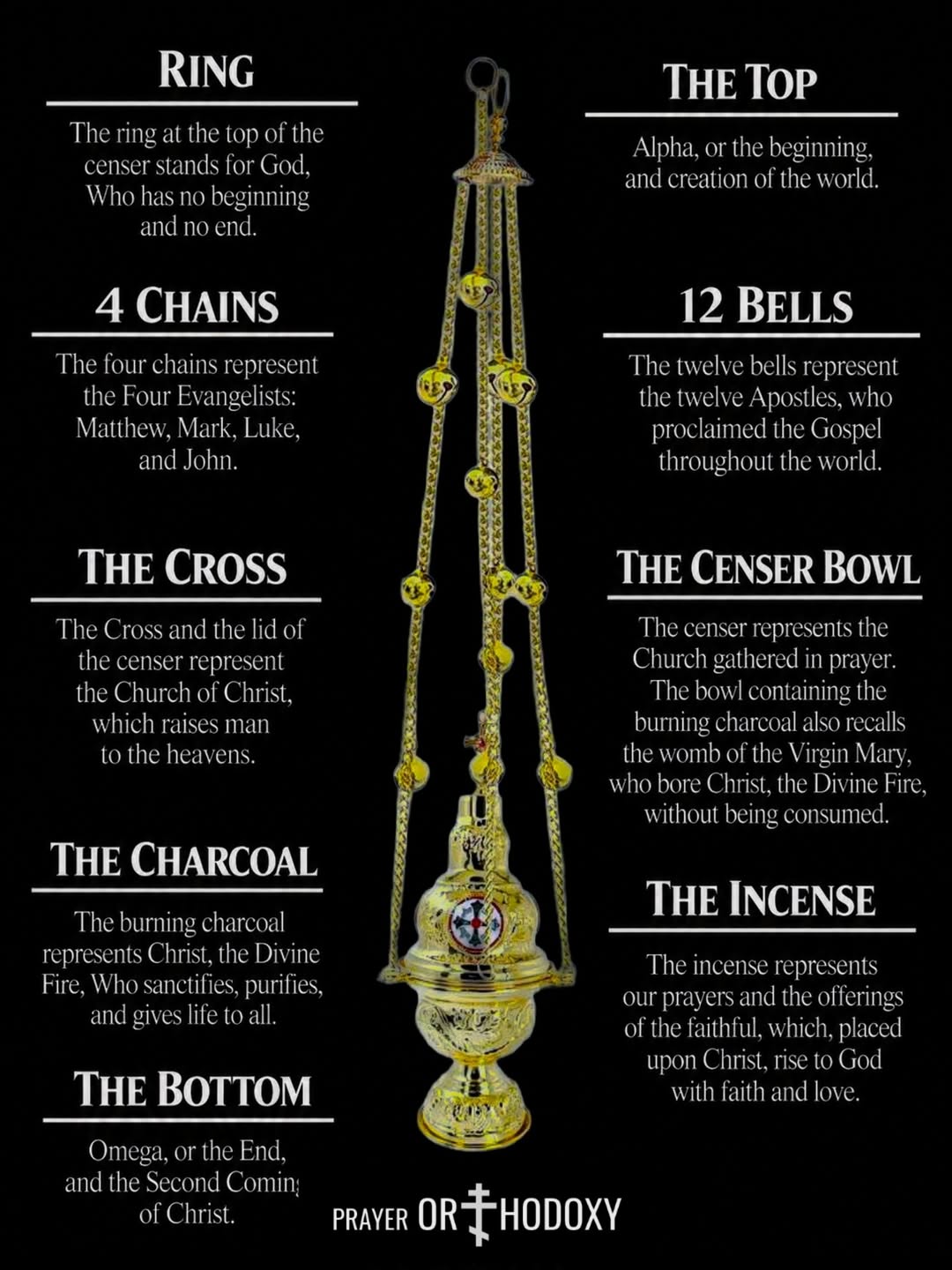
Four Chains, Twelve Bells: What the Orthodox Censer Means

Four chains, twelve bells, a bowl, burning charcoal, and incense: the post assigns a meaning to each part of the Orthodox censer. It gives the explanation twice, first in English and then in Greek, and the two versions match sentence for sentence. Both open with the same claim: 'The Orthodox censer is filled with meaning.' In Greek this reads 'Ὁ ὀρθόδοξος θυμιατὸς εἶναι γεμάτος νόημα', where θυμιατὸς means censer. The author then goes through…

Four chains, twelve bells, a bowl, burning charcoal, and incense: the post assigns a meaning to each part of the Orthodox censer. It gives the explanation twice, first in English and then in Greek, and the two versions match sentence for sentence. Both open with the same claim: 'The Orthodox censer is filled with meaning.' In Greek this reads 'Ὁ ὀρθόδοξος θυμιατὸς εἶναι γεμάτος νόημα', where θυμιατὸς means censer.

The author then goes through the vessel part by part. The four chains symbolize the Four Evangelists. The twelve bells symbolize the Twelve Apostles. The bowl of the censer recalls the womb of the Virgin Mary; the Greek text uses the word μήτρα, womb, and calls her the Panagia. The post states the comparison in one line: Mary bore Christ, whom it calls the Divine Fire, without being consumed.

The Greek puts it as 'χωρὶς νὰ κατακαεῖ', without being burned. Two symbols complete the list. The burning charcoal represents Christ. The incense represents the prayers of the faithful, which rise to God.

The Divine Fire is the only image the post develops: it appears in the line about the Virgin Mary and again in the charcoal that represents Christ. The post keeps to this list. It cites no Scripture verse, no feast, and no church, and it does not describe how the censer is handled in services, when it is swung, or who carries it.

It gives no history of the vessel and no source for the symbolism. The numbers four and twelve are the only figures in the text. The post closes with the credit line 'An Original Production of Prayer Orthodoxy' and five tags: Orthodox, Censer, Incense, Prayer, Tradition.

The Greek version lists the symbols in the same order as the English: chains, bells, bowl, charcoal, incense.

  • The four chains of the censer symbolize the Four Evangelists; the twelve bells symbolize the Twelve Apostles.
  • The bowl recalls the womb of the Virgin Mary, who bore Christ the Divine Fire without being consumed.
  • The burning charcoal represents Christ; the incense represents the prayers of the faithful rising to God.
  • The same explanation appears in English and in Greek, with matching content in both.
  • The post cites no Scripture and describes no liturgical use; it ends with the credit 'An Original Production of Prayer Orthodoxy' and five tags.
Read more
Hellenic College Holy Cross Instagram

Hellenic College Open House in Brookline: October 17, 2026

Hellenic College in Brookline, Massachusetts has announced an Open House on October 17, 2026, inviting prospective students, their friends, and families to spend a day on campus. The program offers a chance to experience the school community firsthand: visitors will tour the campus, meet faculty, students, and staff, attend a demonstration class to get a sense of the academic atmosphere, and visit the school's Chapel as well as the permanent…

Hellenic College in Brookline, Massachusetts has announced an Open House on October 17, 2026, inviting prospective students, their friends, and families to spend a day on campus. The program offers a chance to experience the school community firsthand: visitors will tour the campus, meet faculty, students, and staff, attend a demonstration class to get a sense of the academic atmosphere, and visit the school's Chapel as well as the permanent Archbishop Iakovos Collection, which honors the late primate of the Greek Orthodox Archdiocese of America.

Meals will be provided for attendees, and registration is available through the Open House link in the announcement. The invitation emphasizes a warm welcome and encourages guests to bring others along. As an institution of the Greek Orthodox Archdiocese of America, Hellenic College draws students interested in Orthodox Christian studies, theology, and related liberal arts programs, and events like this Open House serve as an accessible entry point for those discerning study at an Orthodox college.

No discussion or comments accompanied the announcement, so the post stands as a straightforward invitation rather than a debated topic. For readers considering Orthodox higher education, or simply curious about the campus and its collection, the event offers a low-commitment way to visit, ask questions, and see the community in person.

Those interested should register in advance through the provided link and plan to attend with family or friends.

  • Open House at Hellenic College, Brookline, Massachusetts, on October 17, 2026.
  • Visitors can tour campus, meet the community, and sit in on a demo class.
  • Program includes visits to the Chapel and the permanent Archbishop Iakovos Collection.
  • Meals will be provided; guests are encouraged to bring friends and family.
  • Registration is through the 'Open House' link in the announcement.
Read more
Athonite Audio YouTube

Pain and Prayer: Faith, the Name of Jesus, and the Fathers' Counsel in Affliction

Pain and Prayer: Faith, the Name of Jesus, and the Fathers' Counsel in Affliction 25:22

This is the second section of Chapter 1, 'Confronting Pain,' from Part 2, 'The Benefits of Pain,' of a book on pain, read aloud on pages 154 to 166. The section treats the relation between pain and prayer. It begins with the link between faith and prayer: faith is a prerequisite for prayer, and prayer is the result of faith, shaping it as personal conversation with God. The holy fathers call prayer a consolation and a guard against sorrow. The…

This is the second section of Chapter 1, 'Confronting Pain,' from Part 2, 'The Benefits of Pain,' of a book on pain, read aloud on pages 154 to 166. The section treats the relation between pain and prayer. It begins with the link between faith and prayer: faith is a prerequisite for prayer, and prayer is the result of faith, shaping it as personal conversation with God.

The holy fathers call prayer a consolation and a guard against sorrow. The psalmist cries to God in the day of trouble and from the depths, with his whole heart, and Ecclesiasticus 51 describes calling on the Lord near death, with no man to help, praying for deliverance and wisdom. Christ himself prays in agony before his passion, teaching the filial prayer 'Abba, Father' and the obedient 'not what I will, but what thou wilt,' and the Father answers by sending the strengthening angel.

The Apostle Paul urges constant prayer in tribulation. Prayer made in the name of Jesus wants what he wants, carries sacramental power, eases pain, and brings the soul toward the kingdom; frequent invocation makes the supplicating cry a sacrament. Fathers cited include John Chrysostom, Isaac the Syrian, Gregory Palamas, John Climacus, Isaiah the Hermit, Mark the Ascetic, and Nicodemus the Hagiorite.

They teach that prayer in pain must be spontaneous, constant, and unceasing, since the name of Jesus scourges the demons and is the greatest weapon in heaven or on earth. Isaac the Syrian writes that this life was given for unceasing prayer and calls prayer a haven of assistance, a source of salvation, a treasury of confidence, and a harbor that saves from storms.

Gregory Palamas calls prayer a God-making virtue. The church prays incessantly in the liturgy for the sick and suffering, and only fervent prayer to the crucified and resurrected Jesus can console and sweeten our pain.

Key moments

  1. 0:00 Faith is a prerequisite for prayer and prayer the result of faith, which it shapes as personal conversation with God.
  2. 1:04 The psalmist cries to God in affliction: 'In the day of my trouble, I call on thee' and 'Out of the depths I cry unto thee, O Lord.'
  3. 2:37 Ecclesiasticus 51 describes calling on the Lord in trouble, near death, with no man to help, and praying for deliverance and wisdom.
  4. 4:42 For those who accept the crucible of pain with prayer and patience, it gushes out wisdom, prudence, sapience, and good sense.
  5. 5:43 Christ's prayer before his passion is filial ('Abba, Father'), obedient ('yet not what I will, but what thou wilt'), and answered by the angel who strengthens him.
  6. 10:22 Prayer made in the name of Jesus wants what he wants and introduces the suffering person into the presence of God; frequent invocation makes the supplicating cry a sacrament.
  7. 11:54 St. John Chrysostom counsels that when storms, sicknesses, and afflictions arise, we should remain thanking, praising, beseeching, and supplicating God.
  8. 19:38 St. Isaac the Syrian says prayer becomes a haven of assistance, a source of salvation, a treasury of confidence, and a harbor that saves from storms.