
 Prayer Orthodoxy ®
Instagram
Prayer Orthodoxy ®
Instagram
Four Chains, Twelve Bells: What the Orthodox Censer Means
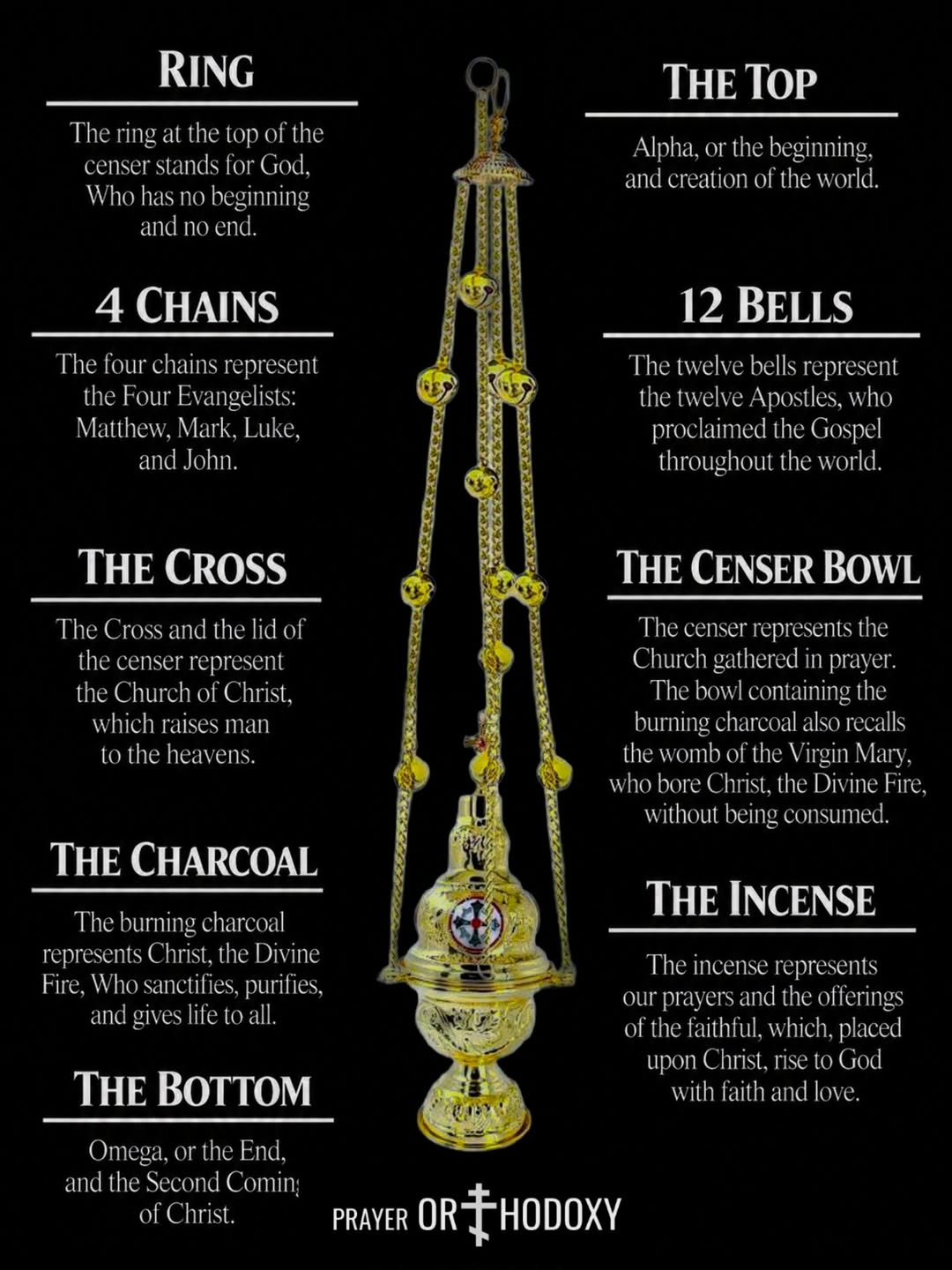
Four chains, twelve bells, a bowl, burning charcoal, and incense: the post assigns a meaning to each part of the Orthodox censer. It gives the explanation twice, first in English and then in Greek, and the two versions match sentence for sentence. Both open with the same claim: 'The Orthodox censer is filled with meaning.' In Greek this reads 'Ὁ ὀρθόδοξος θυμιατὸς εἶναι γεμάτος νόημα', where θυμιατὸς means censer.
The author then goes through the vessel part by part. The four chains symbolize the Four Evangelists. The twelve bells symbolize the Twelve Apostles. The bowl of the censer recalls the womb of the Virgin Mary; the Greek text uses the word μήτρα, womb, and calls her the Panagia. The post states the comparison in one line: Mary bore Christ, whom it calls the Divine Fire, without being consumed.
The Greek puts it as 'χωρὶς νὰ κατακαεῖ', without being burned. Two symbols complete the list. The burning charcoal represents Christ. The incense represents the prayers of the faithful, which rise to God.
The Divine Fire is the only image the post develops: it appears in the line about the Virgin Mary and again in the charcoal that represents Christ. The post keeps to this list. It cites no Scripture verse, no feast, and no church, and it does not describe how the censer is handled in services, when it is swung, or who carries it.
It gives no history of the vessel and no source for the symbolism. The numbers four and twelve are the only figures in the text. The post closes with the credit line 'An Original Production of Prayer Orthodoxy' and five tags: Orthodox, Censer, Incense, Prayer, Tradition.
The Greek version lists the symbols in the same order as the English: chains, bells, bowl, charcoal, incense.
Main points
- The four chains of the censer symbolize the Four Evangelists; the twelve bells symbolize the Twelve Apostles.
- The bowl recalls the womb of the Virgin Mary, who bore Christ the Divine Fire without being consumed.
- The burning charcoal represents Christ; the incense represents the prayers of the faithful rising to God.
- The same explanation appears in English and in Greek, with matching content in both.
- The post cites no Scripture and describes no liturgical use; it ends with the credit 'An Original Production of Prayer Orthodoxy' and five tags.