WeOrthodox
EN UA

Orthodox posts, videos and discussions

We follow Orthodox channels, communities and blogs across the web, summarise every post and video, and highlight the conversations with real substance.

Mount Athos Legacy Facebook

Pride Blocks the Knowledge of God: St. Silouan on Faith and Revelation
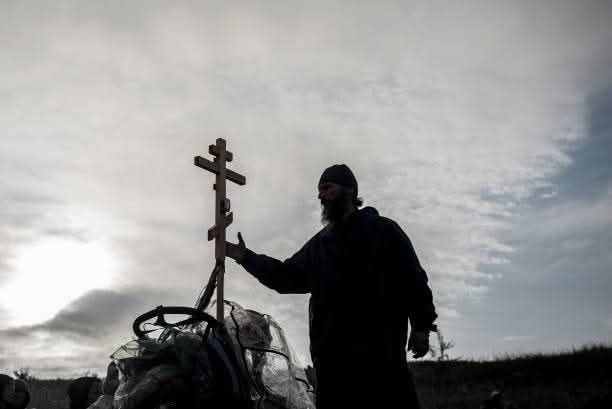
A quotation from St. Silouan the Athonite on the origin of unbelief. He says unbelief comes from pride. The proud person claims he will know everything through his mind and through science, but the knowledge of God remains unreachable for him, because God is known only through the revelation of the Holy Spirit. The Lord reveals Himself to humble souls. To them He shows His works, which are beyond the grasp of our mind. With our natural mind we…

A quotation from St. Silouan the Athonite on the origin of unbelief. He says unbelief comes from pride. The proud person claims he will know everything through his mind and through science, but the knowledge of God remains unreachable for him, because God is known only through the revelation of the Holy Spirit. The Lord reveals Himself to humble souls. To them He shows His works, which are beyond the grasp of our mind.

With our natural mind we can know only earthly things, and even those partially, while God and all heavenly things are known through the Holy Spirit. The post presents this teaching as a single attributed quotation, with no further commentary or discussion attached. It sets two ways of knowing side by side: the natural mind, which reaches earthly things in part, and the Holy Spirit, through whom God and the things of heaven are known.

It also names pride as the obstacle and humility as the condition in which the Lord reveals Himself and shows His works, which the mind cannot contain.

  • St. Silouan the Athonite says unbelief comes from pride.
  • The proud person claims he will know everything by his mind and by science, but the knowledge of God stays unreachable for him.
  • God is known only through the revelation of the Holy Spirit.
  • The Lord reveals Himself to humble souls and shows them His works, which our mind cannot grasp.
  • The natural mind knows only earthly things, and partially, while God and all heavenly things are known through the Holy Spirit.
Orthodox Sound YouTube

Believing God Exists Versus Knowing Him Through Experience

Believing God Exists Versus Knowing Him Through Experience 10:31

The video presents Orthodox teaching on the distinction between believing that God exists and knowing Him directly. St. Nicholas of Serbia uses a pyramid analogy: one can trust witnesses who have climbed it or climb it oneself. St. Basil the Great compares describing God to describing honey's sweetness to someone who has never tasted it; teaching cannot replace personal encounter. St. Silouan the Athonite teaches that nearness to God comes…

The video presents Orthodox teaching on the distinction between believing that God exists and knowing Him directly. St. Nicholas of Serbia uses a pyramid analogy: one can trust witnesses who have climbed it or climb it oneself. St. Basil the Great compares describing God to describing honey's sweetness to someone who has never tasted it; teaching cannot replace personal encounter.

St. Silouan the Athonite teaches that nearness to God comes through humility, not wealth or status, and that God is known by the Holy Spirit through keeping the commandments. The evidence is a soul burning with love for God day and night, detached from earthly things. St. Gennadius of Constantinople urges constant remembrance of God's presence everywhere.

St. Barsanuphius the Great says to cast all care on God and trust His mercy even when the future is unseen. St. Seraphim of Sarov contrasts true hope that seeks only God's kingdom and brings peace with false hope that turns to God only in misfortune. St. John of Kronstadt says spiritual vision sees God in everything while bodily vision sees only matter.

St. Silouan describes the soul that knows God's love as feeling the Father's closeness and finding joy in all things. For those who do not yet feel this love, St. Silouan advises not to despair but to think on God's mercy, guard against sin, and continue. St. Simeon of Daibabe compares the soul to a nail in fire that gradually glows like the fire. The end result is a soul that desires nothing but God, where belief has become love.

Key moments

  1. 0:00 Belief in God's existence differs from knowing Him; St. Nicholas of Serbia uses the pyramid analogy: one must trust witnesses or go oneself.
  2. 1:04 St. Basil the Great says God's goodness cannot be communicated by teaching without personal experience, like describing honey's sweetness to one who never tasted it.
  3. 1:35 Nearness to God depends on humility, not wealth or status; St. Silouan states God appears in the humble heart, and every poor person can know Him.
  4. 2:06 Humility must become a way of life; St. Silouan teaches God is known by the Holy Spirit through keeping commandments, not by science, and the evidence is a soul burning with love for God day and night.
  5. 3:10 St. Gennadius of Constantinople urges constant remembrance of God's presence everywhere, which changes the ordinary day.
  6. 3:41 St. Barsanuphius the Great says to cast all care on God, fear nothing, and trust His mercy even when the future is unseen.
  7. 4:46 St. Seraphim of Sarov contrasts true hope that seeks only God's kingdom and brings peace with false hope that turns to God only in misfortune.
  8. 10:02 The soul that fully knows God desires nothing else; love of God surpasses all earthly sweetness, and what began as hearing becomes nearness, teaching becomes experience, belief becomes love.
Francesco Hasibra Instagram

Saint Seraphim of Sarov feeds a bear by hand in the forest

The video recounts an episode from the life of Saint Seraphim of Sarov in which a bear emerged from the trees and approached the saint while he was alone and unarmed. Rather than flee, the saint broke off a piece of his own bread and fed the animal by hand. The narrator notes that wolves and foxes also came near the saint without causing harm. The narrator describes bears as dangerous predators capable of outrunning a person, breaking bones, and…

The video recounts an episode from the life of Saint Seraphim of Sarov in which a bear emerged from the trees and approached the saint while he was alone and unarmed. Rather than flee, the saint broke off a piece of his own bread and fed the animal by hand. The narrator notes that wolves and foxes also came near the saint without causing harm.

The narrator describes bears as dangerous predators capable of outrunning a person, breaking bones, and killing prey their own size, yet this bear submitted to the saint's presence. The narrator attributes the peaceful interaction to the saint's closeness to God and adds that Seraphim's life contained even more extraordinary events than the bear encounter.

Key moments

  1. Bears are described as dangerous predators that can outrun a person, break bones, and kill something their size.
  2. A bear walked out of the trees toward a man who was alone and unarmed.
  3. The man broke off a piece of his own bread and fed the bear by hand.
  4. Wolves and foxes also approached the man, and nothing happened to him.
  5. The man is identified as Saint Seraphim of Sarov.
  6. The narrator says the saint lived so close to God that even the deadliest forest predators submitted to him.
  7. The narrator claims the saint's life was filled with even crazier events than a wild bear eating from his hand.
Read more
Saint Wisdom Instagram

Saint Anthony the Great on salvation through constant awareness of God

The video presents three teachings attributed to Saint Anthony the Great on the path to salvation. The first teaching states that to achieve salvation, a person must keep God always before their eyes in thoughts, choices, and the way they live. The second teaching directs that everything a person does should be measured against the Holy Scriptures rather than against their own desires. The third teaching addresses stability: wherever God has…

The video presents three teachings attributed to Saint Anthony the Great on the path to salvation. The first teaching states that to achieve salvation, a person must keep God always before their eyes in thoughts, choices, and the way they live. The second teaching directs that everything a person does should be measured against the Holy Scriptures rather than against their own desires.

The third teaching addresses stability: wherever God has placed a person, they should not be quick to leave simply because life becomes difficult. Instead, they should remain patient, faithful, and steadfast. The video offers these points as a concise summary of Anthony's guidance for Christian living.

The post includes hashtags referencing love, Orthodoxy, and saints, indicating an Orthodox Christian audience. No further discussion or commentary accompanies the video summary in the provided text.

Key moments

  1. Keep God always before your eyes, in your thoughts, your choices, and the way you live.
  2. Let everything you do be measured against the Holy Scriptures, rather than your own desires.
  3. Wherever God has placed you, do not be quick to leave simply because life becomes difficult; remain patient, faithful, and steadfast.
Read more
Orthodox Health with Fr.TEDTalks Instagram discussion

Yoga's spiritual ambiguity and the case for Pilates

1:35

The post promotes Episode 81 of the Orthodox Health Podcast, 'When Life Falls Apart, You Need a Bunker,' featuring Fr. Ted Paraskevopoulos. It opens with the statement that a stretch can be physically useful without every practice built around that stretch being spiritually interchangeable. The post states that Christians are formed by more than propositions; practices teach us too. They shape what we attend to, what we repeat, what we…

The post promotes Episode 81 of the Orthodox Health Podcast, 'When Life Falls Apart, You Need a Bunker,' featuring Fr. Ted Paraskevopoulos. It opens with the statement that a stretch can be physically useful without every practice built around that stretch being spiritually interchangeable. The post states that Christians are formed by more than propositions; practices teach us too.

They shape what we attend to, what we repeat, what we normalize, and eventually the framework through which we interpret our own experience. That is why discernment matters. Someone deeply rooted in the Orthodox faith may recognize where ordinary mobility work ends and another spiritual anthropology begins. Someone who barely knows the Creed, rarely participates in the sacramental life, and is hungry for something 'mystical' is in a very different position.

The speaker distinguishes traditional Indian yoga from the commercialized North American version, calling the latter a bastardized form. Even the commercialized version can introduce meditation elements the speaker does not recommend. Most Orthodox Christians, especially cradle Orthodox, do not know their faith well enough to discern safe yoga from unsafe yoga.

The speaker recounts friends who abandoned Christianity after a yoga studio pushed spirituality; they accepted everything because they were ignorant of their faith. The danger comes from lack of discernment, not necessarily demonic forces. The speaker recommends Pilates for fitness, noting it was created by a Greek man in Germany and offers biomechanically optimal movements for mobility.

The speaker questions why people remain attached to the word 'yoga' when better exercise options exist. The first question to anyone considering yoga is how well they know their faith; if not well-versed, they should stay away and not dabble. The post also invites readers to comment 'BUNKER' to receive the full conversation with Fr. Ted.

Key moments

  1. Yoga in India and yoga in North America are two different things; the North American version is a bastardized, commercialized form.
  2. Even the commercialized version can be dangerous because it includes meditation elements the speaker does not recommend.
  3. Most Orthodox Christians, especially cradle Orthodox, do not know their faith well enough to discern safe yoga from unsafe yoga.
  4. The speaker knows friends who fell away from Christianity after a yoga studio pushed spirituality; they accepted everything because they were ignorant of their faith.
  5. The danger comes from lack of discernment, not necessarily from demonic forces.
  6. The speaker recommends Pilates for fitness, noting it was created by a Greek man in Germany and offers biomechanically optimal movements for mobility.
  7. The speaker questions why people are so attached to the word "yoga" when better exercise options exist.
  8. The speaker's first question to anyone considering yoga is how well they know their faith; if not well-versed, they should stay away and not dabble.
7 opinions in the discussion Repentant former certified yoga teacher here: NOPE. (Don't dabble) 🙏 Read the discussion
M mysteries_of_christendom Instagram

Saint Gerasimos and the lion that guarded a monastery donkey

The post recounts the life of Saint Gerasimos, a fifth-century Eastern Orthodox monk who lived near the Jordan River. While walking by the river, he found a lion suffering from a thorn embedded in its paw. Gerasimos removed the thorn and bandaged the wound. The lion then followed him to his monastery and remained there. The monks gave the lion the task of watching the donkey that carried water for the community. One day a camel driver stole the…

The post recounts the life of Saint Gerasimos, a fifth-century Eastern Orthodox monk who lived near the Jordan River. While walking by the river, he found a lion suffering from a thorn embedded in its paw. Gerasimos removed the thorn and bandaged the wound. The lion then followed him to his monastery and remained there.

The monks gave the lion the task of watching the donkey that carried water for the community. One day a camel driver stole the donkey. Gerasimos assumed the lion had eaten the animal and compelled the lion to perform the donkey's labor, carrying water jars. Some time later the lion spotted the same camel driver, roared, frightened the men away, and herded the donkey back to the monastery along with three camels.

When Gerasimos died, the lion searched the monastery until it was led to the grave. It lay down on the grave, beat its head against the ground, roared, and died there. A monk who visited the monastery recorded this narrative fourteen hundred years ago.

The Orthodox Church still commemorates Saint Gerasimos. The author also observes that well-known paintings showing Saint Jerome with a lion probably portray the lion that belonged to Gerasimos, not Jerome. The post ends with a question asking whether readers had previously heard of Saint Gerasimos.

Key moments

  1. 0:00 The speaker notes that a famous painting of Saint Jerome with a lion likely depicts a lion that belonged to the early Eastern monk Gerasimos, not Jerome.
  2. 0:31 Gerasimos encounters a lion in pain by the Jordan River, removes a thorn from its paw, bandages it, and the lion follows him to the monastery.
  3. 1:08 The monks give the lion the task of watching the donkey that carries their water.
  4. 1:41 A camel driver steals the donkey; Gerasimos believes the lion ate it and forces the lion to carry water as punishment.
  5. 1:41 The lion later sees the same camel driver, roars, frightens the men away, and leads the donkey back with three camels.
  6. 2:13 After Gerasimos dies, the lion searches the monastery, is led to the grave, lies on it, beats its head, roars, and dies there.
Read more
Citations Orthodoxes ☦ Instagram

Saint John Chrysostom on life's value and Paul's desire to be with Christ

The post presents a passage from Saint John Chrysostom reflecting on the value of life and death. He writes that life is a good only when used well; when used for sin, death becomes preferable. Death received for a noble motive becomes a source of countless goods, as shown by the martyrs whose death made them the happiest of men. Chrysostom then cites Philippians 1:22-24, where Paul expresses being pressed between two desires: to depart and be…

The post presents a passage from Saint John Chrysostom reflecting on the value of life and death. He writes that life is a good only when used well; when used for sin, death becomes preferable. Death received for a noble motive becomes a source of countless goods, as shown by the martyrs whose death made them the happiest of men.

Chrysostom then cites Philippians 1:22-24, where Paul expresses being pressed between two desires: to depart and be with Christ, which is far better, or to remain in the flesh for the sake of others. The passage moves from a general principle about the moral use of life to the specific example of martyrs, then to Paul's own words as recorded in Scripture.

Chrysostom uses Paul's dilemma to illustrate the tension between personal desire for union with Christ and the obligation to serve others. The quote ends with the full citation of Philippians 1:22-24 in French.

  • Life is a good only when used rightly; misused for sin, it ceases to be a good
  • Death becomes preferable when life is used for wrongdoing
  • Death accepted for a noble motive brings innumerable goods
  • The martyrs exemplify this: their death made them the happiest of men
  • Paul desired to depart and be with Christ, yet saw remaining as necessary for others
George Instagram

Saint Paisios on Bad Thoughts: Do Not Build an Airport in Your Head

1:04

The speaker opens by admitting a personal struggle with shameful bad thoughts that keep returning and asks how to deal with them. The answer comes from a saying of Saint Paisios recorded by his disciple: thoughts are like airplanes flying in the sky. If you ignore them, there is no problem. If you pay attention to them, you build an airport inside your head and let them land. The speaker applies this image to the usual way people respond to bad…

The speaker opens by admitting a personal struggle with shameful bad thoughts that keep returning and asks how to deal with them. The answer comes from a saying of Saint Paisios recorded by his disciple: thoughts are like airplanes flying in the sky. If you ignore them, there is no problem. If you pay attention to them, you build an airport inside your head and let them land.

The speaker applies this image to the usual way people respond to bad thoughts. Most people fight them by arguing with them, analyzing them, and worrying about them, and in doing so they build the runway that lets the thought land and stay. The speaker then draws on the teaching of the Fathers about the stages of a thought.

A thought that simply passes by is not a sin. The problem begins when you invite the thought, start talking with it, and agree with it. The practical advice follows from the airplane image: do not argue with a bad thought, because arguing is exactly the attention it needs. Let it fly past, and turn your mind to Christ instead. Even a short prayer works, such as 'Lord Jesus Christ, have mercy on me.' The speaker closes by asking viewers whether bad thoughts keep trying to land in their heads, inviting them to reflect on their own experience with the struggle described.

Key moments

  1. The speaker admits to struggling with shameful bad thoughts that will not go away.
  2. Saint Paisios, recorded by his disciple, compared thoughts to airplanes flying in the sky: ignore them and there is no problem, pay attention and you build an airport inside your head.
  3. Most people try to fight a bad thought by arguing with it, analyzing it, and worrying about it, which builds the runway for it to land.
  4. A thought passing by is not a sin; the Fathers teach the problem starts when you invite it, talk with it, and agree with it.
  5. Instead of arguing with a bad thought, let it fly past and turn your mind to Christ, even with the simple prayer 'Lord Jesus Christ, have mercy on me.'
  6. The speaker asks viewers whether bad thoughts keep trying to land in their heads.
Read more
Prayer Orthodoxy ® Instagram

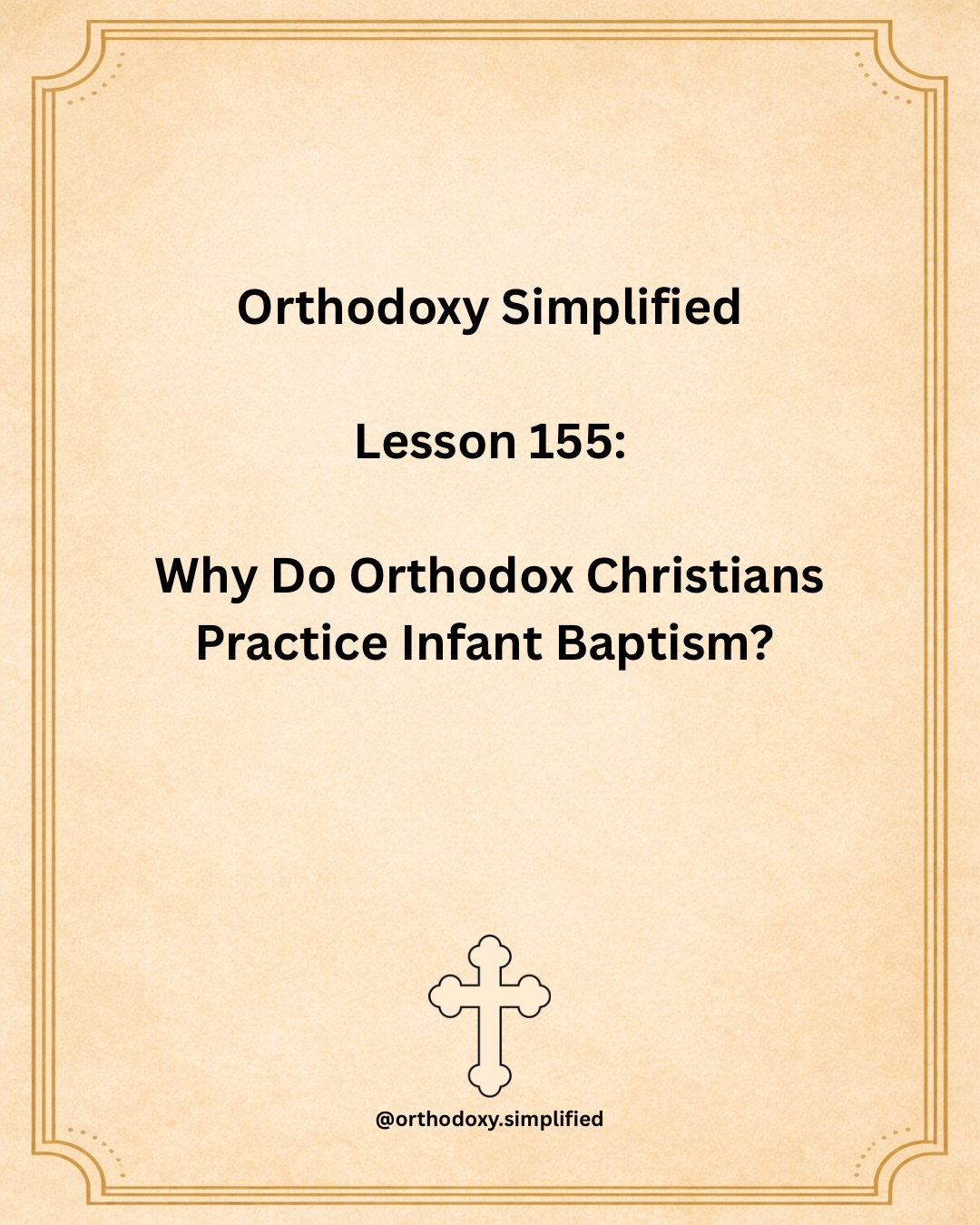
Why Orthodox Christians Baptize Infants

A lesson explains the Orthodox practice of baptizing infants. Baptism is described as the beginning of a new life in Christ and entrance into His Church, not a ceremony that waits for personal understanding or belief. Babies are welcomed into the Church and receive God's grace before they can understand the faith for themselves. The lesson states that Orthodox Christians do not baptize infants because the babies have personally sinned. Instead,…

A lesson explains the Orthodox practice of baptizing infants. Baptism is described as the beginning of a new life in Christ and entrance into His Church, not a ceremony that waits for personal understanding or belief. Babies are welcomed into the Church and receive God's grace before they can understand the faith for themselves.

The lesson states that Orthodox Christians do not baptize infants because the babies have personally sinned. Instead, every person is born into a fallen world marked by sin, corruption, suffering, and death, and Christ came to heal and restore humanity from this condition. Through baptism, chrismation, and Holy Communion, the child begins life in Christ, while parents and godparents take responsibility for raising the child in the faith.

The lesson connects infant baptism to the Church's belief that the life of Christ is a gift that should not be withheld until a person reaches a certain age. The baptized child is received as a true member of the Church and then grows into a conscious and personal faith through prayer, worship, repentance, the Sacraments, and the teaching of the Church.

From the beginning of life, the goal for every Christian is the same: to know Christ, become united to Him, and grow toward eternal life with God.

  • Baptism is the beginning of new life in Christ and entrance into the Church, not a ceremony that follows personal belief.
  • Infants are not baptized because they have personally sinned; all are born into a fallen world marked by sin, corruption, suffering, and death.
  • Christ came to heal and restore humanity from this fallen condition.
  • Through baptism, chrismation, and Holy Communion the child begins life in Christ, while parents and godparents commit to raising the child in the faith.
  • The baptized child grows into conscious faith through prayer, worship, repentance, the Sacraments, and the Church's teaching.
Read more
Hellenic College Holy Cross Instagram

Holy Cross Catechist Program Launches with 46 of 65 Students at First Q&A

Holy Cross Greek Orthodox School of Theology launched its Catechist Certificate Program through The Scriptorium Initiative. The first course, Divine Revelation, opened with a Zoom Q&A session held October 7 at 7:30 PM ET. Of the 65 students enrolled in Module One of The Catechist, 46 joined the live session. The school describes the turnout as a sign of the thirst among the people of God for the basics of the Orthodox faith and tradition, and…

Holy Cross Greek Orthodox School of Theology launched its Catechist Certificate Program through The Scriptorium Initiative. The first course, Divine Revelation, opened with a Zoom Q&A session held October 7 at 7:30 PM ET. Of the 65 students enrolled in Module One of The Catechist, 46 joined the live session.

The school describes the turnout as a sign of the thirst among the people of God for the basics of the Orthodox faith and tradition, and says the Holy Cross faculty is responding by sharing Orthodox theology with those who want to learn and grow in faith. The post includes a short clip from the Zoom session. In the clip, a speaker explains the tenth commandment, which forbids desiring the good of your neighbor.

He says people often forget this commandment even though it stands at number 10. He turns to Cain as an example of the same mistake: Cain desired the good of his brother and was envious of him because God looked favorably on his brother's sacrifice. God came to Cain and said that if he acted this way and was not content with his relationship with God, the sin would be after him.

The post is an announcement from the school about the program's start, paired with a teaching excerpt from the first live session.

Key moments

  1. The tenth commandment says do not desire the good of your neighbor, and the speaker says we often forget it even though it is number 10.
  2. Cain desired the good of his brother and was envious of him because God looked favorably on his brother's sacrifice.
  3. God came to Cain and said that if he did this and was not happy with his relationship with God, the sin would be after him.
T timotheos.orthodoxy Instagram

Fasting makes the feast: borsch after a strict fast day

0:46

Tim, a catechumen of the Greek Orthodox Church, describes his experience with Orthodox fasting. He cooked Russian borsch on Tuesday and ate a small portion. Wednesday was a strict meatless fast day, so the two full pots remained untouched in the refrigerator.

When the fast ended on Thursday, he found the borsch tasted incredibly good. He explains that the restrictions and the inability to eat whenever one wants add joy to the meals where meat is permitted. He asks whether the listener understands this point.

Key moments

  1. The speaker follows the Orthodox fasting routine.
  2. Russian borsch was cooked on Tuesday and only a small portion was eaten.
  3. Wednesday was a strict fasting day, meatless, so the borsch could not be eaten.
  4. Two full pots of borsch sat in the fridge during the fast.
  5. On Thursday the fast ended and the borsch tasted incredibly good.
  6. The speaker says the rules and the inability to eat whenever one wants give much more joy to meals where meat is allowed.
  7. The speaker asks if the listener understands this point.
Read more
T timotheos.orthodoxy Instagram

Catechumen shares Orthodox journey with fitness and business background

0:36

Tim, a catechumen in the Greek Orthodox Church, introduces his account with a welcome to all viewers regardless of denomination or belief. He expresses gratitude for the love and support received since starting the account. Tim describes his status as someone preparing for full communion in the Orthodox Church and states he will share his learnings and obstacles along that path. He notes nearly two decades of experience in fitness, including…

Tim, a catechumen in the Greek Orthodox Church, introduces his account with a welcome to all viewers regardless of denomination or belief. He expresses gratitude for the love and support received since starting the account. Tim describes his status as someone preparing for full communion in the Orthodox Church and states he will share his learnings and obstacles along that path.

He notes nearly two decades of experience in fitness, including competitive experience, and mentions he has built a successful business. The account combines three areas: Orthodoxy, fitness, and business. Tim invites people to follow to grow together in these areas.

The post serves as an introduction and statement of purpose for the account, making clear that everyone remains welcome regardless of where they stand in relation to the Orthodox faith.

Key moments

  1. Welcome to all regardless of denomination or belief
  2. Expression of love and gratitude for support received
  3. Sharing personal journey toward Orthodoxy
  4. Status as a catechumen in the Greek Orthodox Church
  5. Reiteration that everyone is welcome on the account
Read more
Kyle YouTube

Plague Scare in Russia and the Christian Answer to Fear

Plague Scare in Russia and the Christian Answer to Fear 13:08

A 28-year-old worker at Russia's Yukus Antiplague Institute died of severe pneumonia in October 2026, possibly after a lab exposure to plague bacteria, though this remains unconfirmed. Russian tests found no plague and authorities describe it as pneumonia of unknown origin. About 200 contacts were quarantined as a precaution, and the WHO says the epidemic risk is low. The speaker takes this news as an occasion to address how Christians should…

A 28-year-old worker at Russia's Yukus Antiplague Institute died of severe pneumonia in October 2026, possibly after a lab exposure to plague bacteria, though this remains unconfirmed. Russian tests found no plague and authorities describe it as pneumonia of unknown origin. About 200 contacts were quarantined as a precaution, and the WHO says the epidemic risk is low.

The speaker takes this news as an occasion to address how Christians should respond to alarming headlines. He warns against doom scrolling, noting that social media algorithms feed on fear and that every week brings a new crisis demanding attention, from climate change and nuclear war to pandemics and economic collapse. Plagues, wars, and famines have always existed, he says; there is nothing new under the sun.

Christians should take reasonable precautions without being consumed by fear, since Christ has conquered death. He traces anxiety to attachment to the things of this world and to expectations of control, stability, and security. Christ never promised a life free from suffering, but he told us not to be anxious and not to fear.

The speaker calls for daily remembrance of death, repentance today, and forgiveness today, because no one knows which day will be their last. He recalls that during past plagues and persecutions Christians prayed, repented, served others, and prepared their souls. On the question of why plagues happen, he says humanity lives in a fallen world corrupted by sin.

Scripture sometimes links plagues to judgment, as with Egypt, but he rejects the claim that every tragedy punishes a specific personal sin, citing Job and Christ's words in the Gospel of John. Sickness, he says, humbles us and can lead to repentance and deeper reliance on God, while we still pray for healing and use medicine. God transformed even the Roman cross into a symbol of hope, so we say glory to God in all things.

Key moments

  1. 0:00 A 28-year-old worker at Russia's Yukus Antiplague Institute died of severe pneumonia in October 2026, possibly from a lab exposure to plague, but this is unconfirmed; Russia reports no plague detected, about 200 contacts were quarantined, and the WHO calls the epidemic risk low.
  2. 0:30 Christians should remember there is nothing new under the sun: plagues, war, famine, and suffering have always existed, so be prudent without being consumed by fear, since Christ has conquered death.
  3. 1:02 Anxiety within comfort comes from clinging to the things of this world; remember death daily, repent today, and forgive today because you do not know if it will be your last.
  4. 1:33 Social media algorithms thrive on fear and doom scrolling, and every week brings a new crisis demanding attention, from climate change and nuclear war to pandemics and economic collapse.
  5. 3:06 Anxiety is born from attachment to expectations of control, stability, and security; Christ never promised a life free from suffering but told us not to be anxious and not to fear.
  6. 4:08 During past plagues and persecutions Christians prayed, repented, served others, loved God and neighbor, and prepared their souls; refuse to be spiritually consumed by fear while still taking reasonable precautions.
  7. 8:15 Plagues happen because humanity lives in a fallen world corrupted by sin; Scripture sometimes shows plagues as judgment, as with Egypt, but Job and the Gospel of John reject the idea that every tragedy is tied to personal guilt, and tragedies should awaken repentance.
  8. 10:19 Sickness humbles us, strips away the illusion of control, and can lead to repentance and deeper faith; we still pray for healing and use medicine, and God transformed even the Roman cross into a symbol of hope, so we say glory to God in all things.
Read more

Greek vs Russian Orthodox Traditions

Yesterday I talked with a Greek Orthodox priest and asked him some questions about the church. His answers seemed to be the opposite of what I've read about Orthodoxy, and it left me confused. I asked him about head coverings and when I should wear one, and he said he thinks that was only an issue for the church in Corinth. He added that most of the women in his parish don't cover their heads. I also asked what the church teaches about…

Yesterday I talked with a Greek Orthodox priest and asked him some questions about the church. His answers seemed to be the opposite of what I've read about Orthodoxy, and it left me confused. I asked him about head coverings and when I should wear one, and he said he thinks that was only an issue for the church in Corinth.

He added that most of the women in his parish don't cover their heads. I also asked what the church teaches about submission in marriage, like what you say yes to and what you say no to. He surprised me by saying he doesn't believe in it at all, that marriage is simply a partnership and nothing more.

So now I'm confused. Does the Orthodox church not hold these beliefs? Whenever I see an Orthodox church online, the women are wearing head coverings, but maybe that's just a Russian tradition? I thought the churches were supposed to be unified in doctrine and belief, so I don't understand why this priest seems to be giving me his own opinions instead of the church's teaching.

  • A Greek Orthodox priest said head coverings were only an issue for the church in Corinth, and most women in his parish don't wear them
  • The priest said he doesn't believe in submission in marriage, calling marriage just a partnership
  • The author wonders if head coverings are only a Russian tradition
  • The author is confused because the churches are supposed to be unified in doctrine and belief
39 opinions in the discussion Russian Orthodox here. When my husband and I got married, our priest specifically pointed out that it's becoming a common misconception that women should submit. He said it's a wrong… Read the discussion
George Instagram discussion

How to Greet an Orthodox Priest: Ask for a Blessing

1:04

Many people feel awkward when greeting an Orthodox priest because they do not know whether to shake his hand, kiss it, or simply say hello. The video explains the proper greeting: ask for the priest's blessing. You place your right palm over your left, both facing up, and say, 'Father, bless me.' The priest then makes the sign of the cross over you, places his right hand in yours, and you kiss his hand. The video also explains the gesture the…

Many people feel awkward when greeting an Orthodox priest because they do not know whether to shake his hand, kiss it, or simply say hello. The video explains the proper greeting: ask for the priest's blessing. You place your right palm over your left, both facing up, and say, 'Father, bless me.' The priest then makes the sign of the cross over you, places his right hand in yours, and you kiss his hand.

The video also explains the gesture the priest makes while blessing. He shapes his fingers to form the letters IC XC, the short form of the name Jesus Christ in Greek. This means the priest blesses in Christ's name, not in his own.

Kissing the priest's hand is explained as a way of honoring the hands that hold the body and blood of Christ at every liturgy. The video closes with a simple instruction: the next time you see a priest, hold out your hands and say, 'Father, bless me.'

Key moments

  1. Many people feel awkward greeting a priest because they do not know whether to shake his hand, kiss it, or just say hello.
  2. The proper greeting is to ask for his blessing: put your right palm over your left, facing up, and say, 'Father, bless me.'
  3. The priest makes the sign of the cross over you, places his right hand in yours, and you kiss his hand.
  4. When blessing, the priest shapes his fingers into the letters IC XC, the short form of Jesus Christ in Greek, so he blesses in Christ's name, not his own.
  5. Kissing the priest's hand honors the hands that hold the body and blood of Christ at every liturgy.
  6. Next time you see a priest, hold out your hands and say, 'Father, bless me.'
15 opinions in the discussion Nope, nobody ever taught me either, so thank you for this. Read the discussion
Prayer Orthodoxy ® Instagram

Theotokos fragment in the first mode from Petros Bereketis' eight-mode 'Agni Parthene'

A recording shares a fragment of Byzantine chant dedicated to the Mother of God, sung by Elder Damaschinenos (Gheronda Damaschin). The piece is the first verse in the first mode with a kratema (a melodic passage on syllables without words), taken from the eight-mode 'Theotoke Parthene' ('Agni Parthene') composed by Petros Bereketis. The post's title also carries the Romanian words 'Născătoare de Dumnezeu' ('Mother of God'), and the tags point to…

A recording shares a fragment of Byzantine chant dedicated to the Mother of God, sung by Elder Damaschinenos (Gheronda Damaschin). The piece is the first verse in the first mode with a kratema (a melodic passage on syllables without words), taken from the eight-mode 'Theotoke Parthene' ('Agni Parthene') composed by Petros Bereketis.

The post's title also carries the Romanian words 'Născătoare de Dumnezeu' ('Mother of God'), and the tags point to Byzantine chant, the Theotokos, and Mount Athos. The transcript of the recording itself contains only the repeated Greek prayer 'Kyrie eleison' ('Lord have mercy'), which continues from the beginning to the end of the recording with no other spoken text.

The post thus presents a short chant excerpt from Athonite monastic practice, attributed to a known composer of the piece and to a named elder as the singer.

Key moments

  1. 0:01 The prayer "Κύριε ἐλέησον" ("Lord have mercy") begins and is repeated many times.
  2. 0:31 The repetition of "Κύριε ἐλέησον" continues.
  3. 1:01 The repeated prayer continues to the end of the recording.
Read more
☦️An Orthodox Blog☦️ Instagram

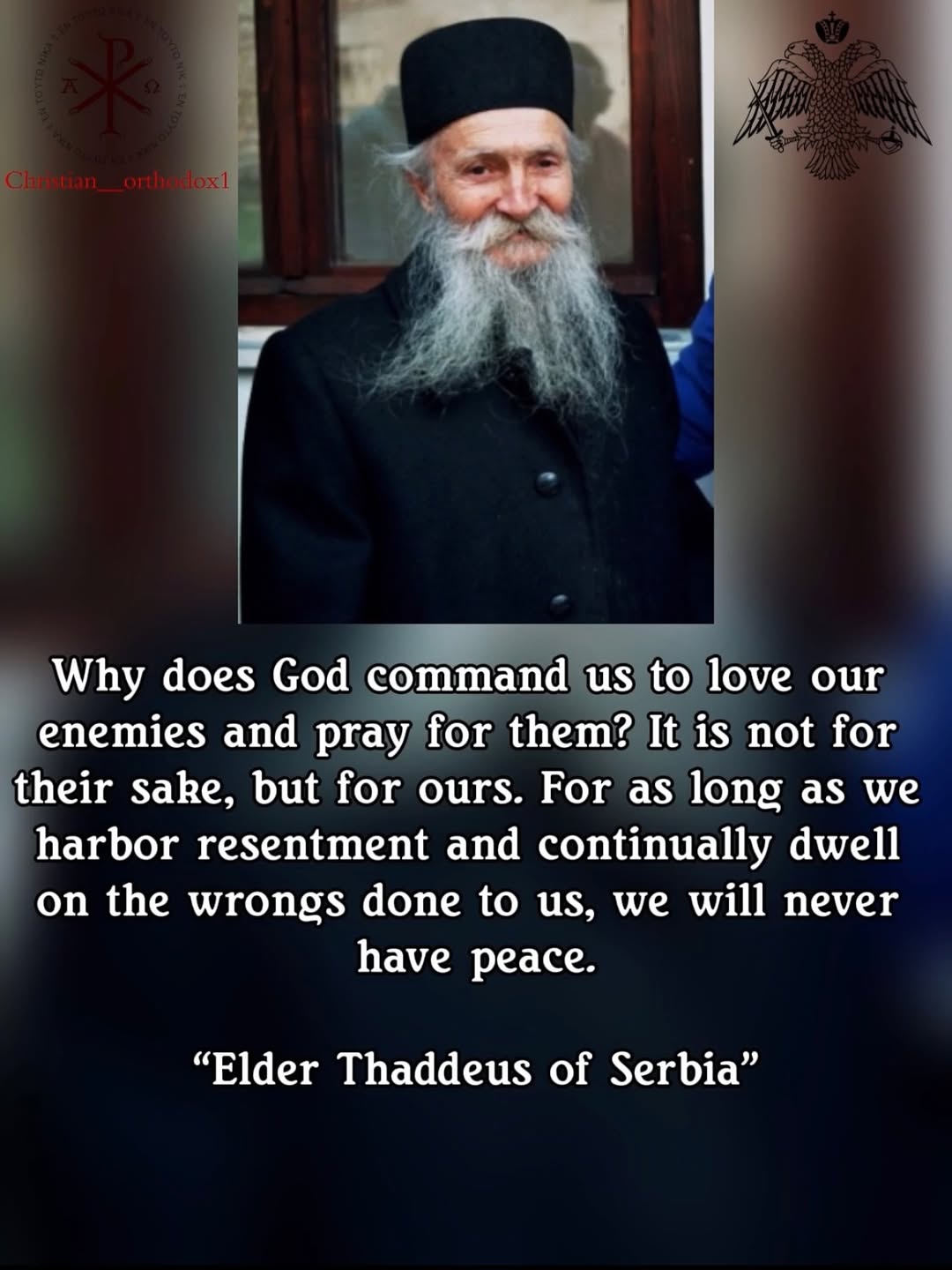
Elder Thaddeus of Serbia: We Love Our Enemies for Our Own Sake

The post quotes Elder Thaddeus of Serbia on why God commands us to love our enemies and pray for them. The elder says the command is not for their sake but for ours. As long as we harbor resentment and continually dwell on the wrongs done to us, we will never have peace.

The quote is presented with tags for Christian, Orthodox, church, faith, and church fathers content. The post consists of the quotation alone, with no further commentary or discussion in the source text.

  • Elder Thaddeus of Serbia is quoted on the command to love and pray for enemies.
  • He says the command is not for their sake, but for ours.
  • Harboring resentment and dwelling on wrongs done to us removes our peace.
  • The quote is shared with Orthodox and church fathers tags.
Athonite Audio YouTube

St. Sergius of Radonezh: Founder of the Northern Thebaid

St. Sergius of Radonezh: Founder of the Northern Thebaid 56:51

The post presents a condensed life of St. Sergius of Radonezh drawn from the account written by his disciple Epiphanius the Wise. The translation was compiled by St. Seraphim of Platina and Fr. Herman Podmoshensky and published by the St. Herman of Alaska Brotherhood in 2004. Sergius was born in 1314 in Rostov to Kir and Mary and baptized Bartholomew. As a youth he could not learn to read until a holy elder gave him prosphora, after which he…

The post presents a condensed life of St. Sergius of Radonezh drawn from the account written by his disciple Epiphanius the Wise. The translation was compiled by St. Seraphim of Platina and Fr. Herman Podmoshensky and published by the St. Herman of Alaska Brotherhood in 2004.

Sergius was born in 1314 in Rostov to Kir and Mary and baptized Bartholomew. As a youth he could not learn to read until a holy elder gave him prosphora, after which he understood Scripture. After his parents died he gave his inheritance to his brother Peter and joined his brother Stephen at the Khotkov monastery.

The two settled in a forest, built a church to the Holy Trinity, and Stephen departed. Sergius was tonsured at age 23 by Abbot Metrophanes. Disciples gathered, and Bishop Athanasius of Volynia ordained him priest and made him abbot.

The life records several miracles: a spring of water arose at his prayer, he raised a dead child, and he exorcised a possessed nobleman. A vision of multiplying birds foretold the growth of his monastic family. Patriarch Philotheus urged cenobitic life, which Metropolitan Alexis instituted. Sergius founded many monasteries directly and through disciples such as Andronicus and Theodore.

He blessed Grand Prince Dmitry Donskoy before the Battle of Kulikovo. The Theotokos appeared to him in 1388 promising perpetual protection. He reposed in 1392. His relics were found incorrupt in 1422. The monastery endured Tartar destruction, the Polish siege of 1608-1610, and Soviet closure.

Key moments

  1. 0:34 St. Sergius was born in 1314 in Rostov to pious parents Kir and Mary and baptized as Bartholomew.
  2. 1:36 He struggled with learning until a holy elder gave him prosphora, after which he could read and understand Scripture.
  3. 7:43 After his parents' death he gave his inheritance to his brother Peter and went to his brother Stephen at the Khotkov monastery.
  4. 8:15 They settled in a forest, built a church to the Holy Trinity; Stephen left, and Sergius was tonsured at 23 by Abbot Metrophanes.
  5. 14:29 Disciples gathered, and Bishop Athanasius of Volynia ordained him priest and made him abbot.
  6. 28:30 He performed miracles: a spring of water arose at his prayer, he raised a dead child, and exorcised a possessed nobleman; a vision of multiplying birds foretold his monastic family's growth.
  7. 32:40 Patriarch Philotheus urged cenobitic life, which Metropolitan Alexis instituted; Sergius founded many monasteries directly and through disciples such as Andronicus and Theodore.
  8. 40:57 He blessed Grand Prince Dmitry Donskoy before the Battle of Kulikovo; the Theotokos appeared to him in 1388 promising perpetual protection; he reposed in 1392, his relics were found incorrupt in 1422, and the monastery endured Tartar destruction, the Polish siege, and Soviet closure.

Street evangelist Bryce Crawford tells a stranger what he 'senses' about his past

The post asks whether Bryce Crawford has always done what the poster calls the mind reading prophet thing, tagging it with orthodox, protestant, orthodoxchristian, apologetics and christianreels. The clip shows Crawford, a street evangelist, approaching a young man and telling him he senses in his heart that the man lost a friend between the ages of 8 and 10. He asks whether that is true, says he is going to check on him, calls him Tupac, and…

The post asks whether Bryce Crawford has always done what the poster calls the mind reading prophet thing, tagging it with orthodox, protestant, orthodoxchristian, apologetics and christianreels. The clip shows Crawford, a street evangelist, approaching a young man and telling him he senses in his heart that the man lost a friend between the ages of 8 and 10. He asks whether that is true, says he is going to check on him, calls him Tupac, and gives him a hug.

When the young man asks how he could know that, Crawford answers that he does not know, and that Jesus sees the man in his pain. He then asks the young man what he thinks about it. The question in the post invites viewers to weigh this style of evangelism: whether such statements about a stranger's private grief are a legitimate way of pointing someone to Christ, or a performance that borrows the language of prophecy.

The tags suggest the audience for the debate includes both Orthodox and Protestant Christians interested in apologetics, and the poster's phrasing hints at skepticism about the practice. The clip itself does not resolve the question; it only records the encounter and Crawford's own explanation, which attributes the knowledge to Jesus rather than to himself.

Key moments

  1. Bryce Crawford tells a young man he heard in his heart that the man lost a friend when he was 8 to 10 years old, and asks if it is true.
  2. He says he is going to go check on the man, calls him Tupac, and gives him a hug.
  3. Asked how he could know that, he says he does not know, and that it is because Jesus sees the man in his pain.
  4. He asks the young man what he thinks about this.
21 opinions in the discussion "When you were 8 to 10 years old". That's exactly how psychics and mediums work. A two-year window is not the kind of accuracy you see when the Holy Spirit actually operates. Read the discussion