WeOrthodox
EN UA

Orthodox posts, videos and discussions

We follow Orthodox channels, communities and blogs across the web, summarise every post and video, and highlight the conversations with real substance.

Luke 6: Mercy, prayer, love for enemies, and a firm foundation

The post explains the sixth chapter of Luke, showing what life of a true follower of Christ looks like. Christ demonstrates that mercy must not yield to external formalism by healing a man on the Sabbath, revealing that doing good is inseparable from God's will. Before choosing the twelve apostles, He withdraws to a mountain and spends the night in prayer, showing the importance of prayer in every significant work. In the Beatitudes He reveals…

The post explains the sixth chapter of Luke, showing what life of a true follower of Christ looks like. Christ demonstrates that mercy must not yield to external formalism by healing a man on the Sabbath, revealing that doing good is inseparable from God's will. Before choosing the twelve apostles, He withdraws to a mountain and spends the night in prayer, showing the importance of prayer in every significant work.

In the Beatitudes He reveals the true values of the Kingdom of God: poverty, hunger, weeping, and suffering for Christ's sake are not the final word on human life. Opposite them stand woes to those satisfied with earthly wealth, fullness, and human glory. Patristic interpretation stresses that Christ's words about the rich apply not to every wealthy person but to those who seek nothing beyond wealth.

The deepest call of the chapter is the command to love enemies: do good to those who hate you, bless those who curse you, pray for those who abuse you. The Fathers say this command is given for our spiritual growth. "Be merciful, even as your Father is merciful." Christ calls us not to judge, to forgive, and to give.

He warns us to examine our own heart first, because a person's inner state is revealed through words and deeds, as a tree is known by its fruit. The chapter ends with the essential lesson: it is not enough to hear Christ's words and call Him Lord; one must do what He commands. Such a person resembles one who built a house on a firm foundation, on rock.

Key moments

  1. Light a candle if it has gone out, and let your soul shine with light.
  2. Pray for health and salvation in the name of Jesus Christ.
  3. Stand before the icon, keep your soul pure, and do not pray to anyone but Jesus Christ.
  4. Light a candle every day until death.
Prayer Orthodoxy ® Instagram discussion

Have you noticed the priest waving a veil over the Holy Gifts during the Creed?

Have you noticed the priest gently waving a veil over the Holy Gifts during the Creed? This is the aer, the large veil that covers the chalice and diskos. Its movement expresses honor toward Christ our King and carries symbolism connected with His Resurrection and the activity of the Holy Spirit. Have you observed the priest moving a veil gently above the Holy Gifts while the Creed is recited? It is the aer, the great covering of the Holy…

Have you noticed the priest gently waving a veil over the Holy Gifts during the Creed?

This is the aer, the large veil that covers the chalice and diskos. Its movement expresses honor toward Christ our King and carries symbolism connected with His Resurrection and the activity of the Holy Spirit.

Have you observed the priest moving a veil gently above the Holy Gifts while the Creed is recited?

It is the aer, the great covering of the Holy Chalice and the diskos. Its motion shows reverence to Christ, our King, and is linked symbolically to His Resurrection and the working of the Holy Spirit.

5 opinions in the discussion Keep in mind, you also have to picture them doing this in a dusty candle-lit room with 100 people who haven't bathed in a month and no AC and so on. So there were TONS of bugs flying… Read the discussion

Icons as Spiritual Reality: The Christological Basis from the Seventh Council

The speaker responds to an objection against icons that focuses on physical details in the depiction, such as an eye blemish and long hair, citing 1 Corinthians 11 where long hair is called a shame to a man. He explains that icons are not simply pictures or reminders of the saints but constitute a spiritual reality. This reality was affirmed by the Seventh Ecumenical Council, which established the veneration of icons as a christological issue.…

The speaker responds to an objection against icons that focuses on physical details in the depiction, such as an eye blemish and long hair, citing 1 Corinthians 11 where long hair is called a shame to a man. He explains that icons are not simply pictures or reminders of the saints but constitute a spiritual reality. This reality was affirmed by the Seventh Ecumenical Council, which established the veneration of icons as a christological issue.

Because Christ became man and took on flesh, matter can be sanctified. God indwells physical matter in icons to glorify Himself and to glorify the saints. The argument rests on the incarnation: the fact that God took on material flesh means that material things can become vessels of grace and presence.

The Council's teaching means that honor given to the icon passes to the prototype, and the icon becomes a means through which God works. The objection about physical appearance misses the theological point that the icon is not a mere likeness but a participation in the reality it represents.

Key moments

  1. The objection references an eye blemish and long hair, which 1 Corinthians 11 calls a shame unto a man.
  2. Icons are not simply pictures or reminders of the saints but a spiritual reality.
  3. The Seventh Ecumenical Council confirms this spiritual reality of icons.
  4. The Council makes icon veneration a christological issue: if Christ took on flesh, matter can be holy.
  5. God can indwell physical objects and matter, and does so in icons.
  6. God indwells icons to glorify Himself and to glorify the saints.
Read more
Prayer Orthodoxy ® with Holy Orthodoxy Instagram

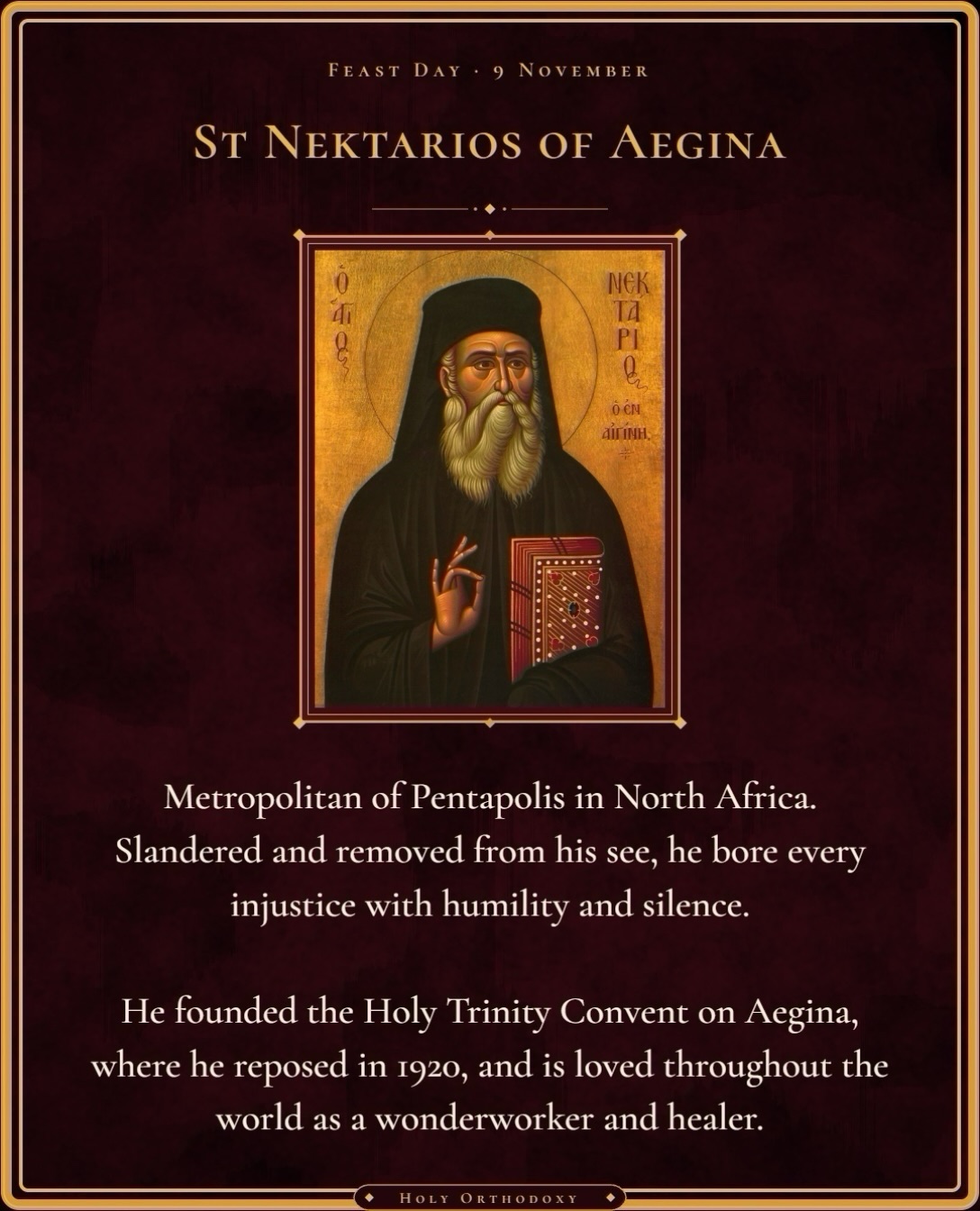
St Nektarios of Aegina: Feast Day, Life, and Miracles

The post marks the feast day of St Nektarios of Aegina on 9 November. It recounts his birth in Thrace in 1846, his elevation to Metropolitan of Pentapolis in North Africa in 1889, and his removal from that see within a year due to envy and slander. The text notes that he never defended himself but bore the injustice with humility. In 1904 he founded the Holy Trinity Convent on the island of Aegina, where he spent his final years in prayer. He…

The post marks the feast day of St Nektarios of Aegina on 9 November. It recounts his birth in Thrace in 1846, his elevation to Metropolitan of Pentapolis in North Africa in 1889, and his removal from that see within a year due to envy and slander. The text notes that he never defended himself but bore the injustice with humility.

In 1904 he founded the Holy Trinity Convent on the island of Aegina, where he spent his final years in prayer. He reposed in 1920. Since then countless miracles have been attributed to his intercession, particularly the healing of those suffering from cancer. The post concludes with a prayer for his intercession.

  • Born in Thrace in 1846.
  • Became Metropolitan of Pentapolis in North Africa in 1889.
  • Removed from his see within a year due to envy and slander; he never defended himself.
  • Founded the Holy Trinity Convent on Aegina in 1904, where he lived in prayer until his repose in 1920.
  • Known as a wonderworker; countless miracles attributed, especially healing of cancer.
Read more
☦️An Orthodox Blog☦️ Instagram

St. Nektarios on overcoming habitual sins through patience and return to God

The post shares a teaching attributed to St. Nektarios addressing those who struggle with habitual sins. The teaching explains that such sins derive their power from the force of habit rather than from any inherent impossibility of overcoming them. Victory over these sins requires the passage of time combined with fervent effort. The saint advises three practical steps: pray for God's strength, accept falls patiently when they occur, and…

The post shares a teaching attributed to St. Nektarios addressing those who struggle with habitual sins. The teaching explains that such sins derive their power from the force of habit rather than from any inherent impossibility of overcoming them. Victory over these sins requires the passage of time combined with fervent effort.

The saint advises three practical steps: pray for God's strength, accept falls patiently when they occur, and immediately turn back to God rather than remaining in the state of sin. The emphasis is on immediate return to God after each fall, not lingering in discouragement or shame.

Key moments

  1. Habitual sins gain their strength from the force of habit, not from an inherent impossibility of overcoming them.
  2. Conquest comes only with time and fervor, so one must pray for God's strengthening, accept falls patiently, and immediately return to God after each fall instead of staying in that state.
Read more

Saint Nektarios of Aegina: Life, Miracles, and Spiritual Wisdom

The post presents a biographical sketch of Saint Nektarios (1846-1920), born Anastasios in Thrace. He studied in Constantinople, became a monk on Chios in 1876, and was ordained deacon in 1877, taking the name Nektarios. After theological studies he was ordained priest in Alexandria in 1886 and consecrated Metropolitan of Pentapolis in Libya in 1889. False accusations by envious clerics led Patriarch Sophronios to expel him from Egypt in 1890.…

The post presents a biographical sketch of Saint Nektarios (1846-1920), born Anastasios in Thrace. He studied in Constantinople, became a monk on Chios in 1876, and was ordained deacon in 1877, taking the name Nektarios. After theological studies he was ordained priest in Alexandria in 1886 and consecrated Metropolitan of Pentapolis in Libya in 1889.

False accusations by envious clerics led Patriarch Sophronios to expel him from Egypt in 1890. In Athens he could not obtain a bishopric and became director of the Rizarios Ecclesiastical School in 1894, where he wrote the hymn "Agni Parthene." Known for humility, sweeping floors and cleaning toilets, he founded the Holy Trinity convent on Aegina in 1904 and lived there from 1908 until his death from prostate cancer in 1920.

After his repose his undershirt healed a paralyzed man, and his funeral was conducted by Saint Savvas of Kalymnos. The post also collects eleven sayings attributed to Saint Nektarios on themes including being remembered in others' darkness, suffering as purification, prayer as the breath of the soul, happiness as a pure heart, vigilance against temptation, hope amid repeated falls, trust in God's unseen answers, and the purpose of temptations to reveal hidden passions.

  • Born in Thrace 1846; monk on Chios 1876; Metropolitan of Pentapolis 1889
  • Expelled from Egypt 1890 after false accusations; directed Rizarios School in Athens
  • Founded Holy Trinity convent on Aegina 1904; lived there 1908-1920
  • Posthumous miracle: undershirt healed a paralyzed man; funeral by Saint Savvas of Kalymnos
  • Eleven collected sayings on suffering, prayer, hope, temptation, and pure heart
Read more

St. Paisios on the Fall of the USSR and Turkey's Future

The post gathers several prophecies attributed to St. Paisios of Mount Athos, beginning with an episode from the Brezhnev era when the USSR seemed invincible. A visitor, Mr. D. K., told the elder that no one could break apart that enormous might; St. Paisios replied, "You'll see!" and foretold that the Soviet Union would dissolve within the visitor's lifetime. The elder also spoke of Turkey's future: a war lasting two periods would end with…

The post gathers several prophecies attributed to St. Paisios of Mount Athos, beginning with an episode from the Brezhnev era when the USSR seemed invincible. A visitor, Mr. D. K., told the elder that no one could break apart that enormous might; St. Paisios replied, "You'll see!" and foretold that the Soviet Union would dissolve within the visitor's lifetime.

The elder also spoke of Turkey's future: a war lasting two periods would end with Orthodox victory, though the Greeks might lose one or two islands while gaining Constantinople. The Turks would leave but later return to Hexamillia, where one third would perish, one third would come to believe in Christ, and one third would flee to Kokkini Milia.

In another encounter, St. Paisios addressed a distorted interpretation of St. Cosmas of Aitolias's prophecy about "six miles." He explained that the six miles refer to the continental shelf, a maritime boundary over which Greece and Turkey have contended, and that the Turks would advance only to that limit before meeting great calamities from the north.

He added that the Russians would eventually occupy Turkey, causing it to disappear from the map, with the same threefold division of the Turkish people. The post notes that many crypto-Christians exist among Turks today, with pilgrims reporting requests for icons, prayer books, and opportunities for confession and Communion. Concerning the phrase "two summers and two Paschalias together," the elder clarified that it pointed to the liberation of Northern Epirus, not a Turkish invasion of Greece, and he warned that explaining prophecies with human reasoning causes great harm and spreads false thinking. The post concludes with unrelated promotional material for an icon vendor.

  • St. Paisios predicted the dissolution of the USSR during the Brezhnev era despite its apparent strength.
  • He foresaw a war in which Turkey would break apart, with one third of Turks perishing, one third converting, and one third fleeing.
  • He interpreted St. Cosmas's "six miles" as a maritime boundary dispute, not a land invasion of Greece.
  • He said the Russians would occupy Turkey and the country would vanish from the map.
  • He explained "two summers and two Paschalias together" as referring to the opening of borders for Northern Epirus, and cautioned against private interpretations of prophecy.
Read more

Opening prayers for Saint Nectarius commemoration service

The video presents the opening prayers of an Orthodox service commemorating Saint Nectarius Kephalas, Metropolitan of Pentapolis. Greek and English texts alternate throughout. The service begins with an invocation to the Archangel: "Upon You and by Your grace, Archangel, therefore also peace. I was sent down." This is followed by the declaration: "From heaven, peace to men." The Great Doxology is then chanted in both languages: "Glory in the…

The video presents the opening prayers of an Orthodox service commemorating Saint Nectarius Kephalas, Metropolitan of Pentapolis. Greek and English texts alternate throughout. The service begins with an invocation to the Archangel: "Upon You and by Your grace, Archangel, therefore also peace. I was sent down." This is followed by the declaration: "From heaven, peace to men."

The Great Doxology is then chanted in both languages: "Glory in the highest to God, and on earth peace, goodwill among men." The prayer continues with praise addressed to the Trinity: "We praise You, we bless You, we worship You, we glorify You. We give thanks to You for Your great glory. O Lord heavenly King, God the Father Almighty.

O Lord, the only begotten Son, Jesus Christ, and Holy Spirit." The text breaks off at the address "O Lord God."

Key moments

  1. 0:10 The opening words invoke the Archangel: "Upon You and by Your grace, Archangel, therefore also peace. I was sent down."
  2. 0:43 The next line declares: "From heaven, peace to men."
  3. 1:16 The Great Doxology is chanted in Greek and English: "Glory in the highest to God, and on earth peace, goodwill among men."
  4. 1:47 The prayer of praise addresses the Trinity: "We praise You, we bless You, we worship You, we glorify You. We give thanks to You for Your great glory. O Lord heavenly King, God the Father Almighty. O Lord, the only begotten Son, Jesus Christ, and Holy Spirit."
  5. 2:21 The text breaks off at the address "O Lord God."

The Saints' Forgotten Ecological Wisdom

The Saints' Forgotten Ecological Wisdom 4:46

Mrs. Elisabeth Theokritoff, lecturer at the Institute for Orthodox Christian Studies in Cambridge, reflects on how care for creation appears throughout the lives of the saints as a natural fruit of holiness rather than a modern addition. From the desert dwellers who lived at the mercy of the elements to modern saints such as St. Porphyrios, the natural world served as a place of encounter with God. St. Porphyrios spoke of the "little love" found…

Mrs. Elisabeth Theokritoff, lecturer at the Institute for Orthodox Christian Studies in Cambridge, reflects on how care for creation appears throughout the lives of the saints as a natural fruit of holiness rather than a modern addition. From the desert dwellers who lived at the mercy of the elements to modern saints such as St. Porphyrios, the natural world served as a place of encounter with God.

St. Porphyrios spoke of the "little love" found in nature drawing the heart toward the "great love," Christ Himself. The saints often lived in harmony with animals, plants, and landscapes because they perceived creation as bearing the signature of God. In inter-Christian environmental discussions, St. Francis of Assisi is often treated as the only saint who related to nature, but this relationship is actually the norm across Christian history.

St. Seraphim of Sarov exemplified this by sharing bread with a bear and other animals. St. Maximus the Confessor taught that the world, man, and the church mirror each other, reflecting God's signature in creation. Scientific discoveries such as the "wood wide web" of fungal networks through which trees communicate reveal divine wisdom in nature.

Because humans are created in the image of the Logos, we should appreciate and tune into the logos present in other creatures. The Citami monastery, supervised by Elder Porphyrios, continues this tradition with an environmental education center on a rare natural habitat with endemic plants and hermit caves made into chapels.

Key moments

  1. 0:00 Francis of Assisi is wrongly treated as the only saint with a relationship to nature in inter-Christian environmental conversations.
  2. 0:31 From earliest times, desert dwellers lived with animals and at the mercy of the elements, cooperating with their environment.
  3. 1:01 St. Porphyrios is a prominent modern example with wonderful openness to the natural world as a path to Christ.
  4. 1:33 Citami monastery, supervised by Elder Porphyrios, has an environmental education center on a rare natural habitat with endemic plants and hermit caves made into chapels.
  5. 2:03 St. Seraphim of Sarov had good relations with a bear and distributed bread to animals weekly.
  6. 3:06 St. Maximus the Confessor teaches that the world, man, and the church all mirror each other, showing God's signature in creation.
  7. 3:37 Science discovers intricate divine wisdom in nature, such as the "wood wide web" where trees communicate through fungal networks in their roots.
  8. 4:10 Humans are created in the image of the Logos, so we should appreciate and tune into the logos and wisdom in other creatures.
George Instagram

Ethiopian martyrs ignored while Christians war online

The speaker draws a sharp contrast between the killing of nearly one hundred Orthodox Christians in Ethiopia over less than three weeks, which has drawn almost no global attention, and the fierce online debates among American Christians. In those debates, narratives warn of a Muslim takeover and urge armed readiness, while Orthodox, Catholics, and Protestants attack one another over who is right, who is closer to God, and who will be saved. The…

The speaker draws a sharp contrast between the killing of nearly one hundred Orthodox Christians in Ethiopia over less than three weeks, which has drawn almost no global attention, and the fierce online debates among American Christians. In those debates, narratives warn of a Muslim takeover and urge armed readiness, while Orthodox, Catholics, and Protestants attack one another over who is right, who is closer to God, and who will be saved.

The speaker asks what would happen if today were the day of judgment. Christ, he recalls, will ask whether we fed the hungry, gave drink to the thirsty, welcomed strangers, visited the sick and those in prison, not whether we won arguments. He also cites Christ's warning that not everyone who calls him Lord will enter the kingdom, but only those who do the Father's will.

The challenge is direct: our attention goes to anger, arguments, and readiness for war online instead of to the works Christ commanded. The speaker says he wants to be able to answer, "I tried to love like you," not "I defended you in the comments."

Key moments

  1. Nearly 100 Orthodox Christians were killed in Ethiopia in less than three weeks, and the world barely noticed.
  2. Online in America, narratives claim Muslims are taking over the country and many Christians are ready to fight back.
  3. Christians attack other Christians daily online, Orthodox, Catholics, and Protestants debating who is right, who is closer to God, and who will be saved.
  4. Everyone is angry and ready for war.
  5. Christ already told us what he will ask: I was hungry and you gave me food, thirsty and you gave me drink, a stranger and you took me in, sick and you visited me, in prison and you came to me.
  6. Whatever you did to the least of these, you did to Christ.
  7. Not everyone who says 'Lord, Lord' will enter the kingdom of heaven, but the one who does the will of the Father.
  8. Our attention goes to arguments, anger, and fighting online instead of what Christ actually asked; the speaker wants to say 'I tried to love like you,' not 'I defended you in the comments.'
Read more
Fr.TEDTalks with Ally ☦︎ Instagram

Fr. Ted on the Archangels, repentance, and the theology of the demons

Fr. Ted reflects on the feast of the Holy Archangels, presenting the angels as models of eternal obedience to God. Because angels are bodiless spiritual beings who stand constantly in God's presence, their choices are final and unchangeable. The demons are angels who rebelled with full knowledge and can never repent. Humans, by contrast, live behind a veil of ignorance and receive the grace to repent throughout this life, but after death the…

Fr. Ted reflects on the feast of the Holy Archangels, presenting the angels as models of eternal obedience to God. Because angels are bodiless spiritual beings who stand constantly in God's presence, their choices are final and unchangeable. The demons are angels who rebelled with full knowledge and can never repent.

Humans, by contrast, live behind a veil of ignorance and receive the grace to repent throughout this life, but after death the opportunity ends because everything becomes clear. The priest recalls a seminary professor's warning that the more a Christian learns God's will through Scripture, the saints, and church attendance, the fewer excuses remain for disobedience.

Knowing the truth and failing to act on it is called "the theology of the demons," since demons believe and know the truth but refuse to obey. Therefore growth in knowledge must be matched by growth in obedience. Fr. Ted calls the faithful to an active spiritual life: coming to church, participating in the Holy Mysteries, receiving Holy Communion with proper preparation, repenting, and continually turning their hearts back to Christ.

He urges them not to take the lifetime given for repentance for granted, because after death the time for repentance has passed. He asks the Holy Archangels to intercede and help the faithful remain faithful to Christ.

Key moments

  1. 0:00 The feast of the Holy Archangels is celebrated as the church's secondary saints after the Prophet Elias and Saint Theodora, and the Archangels exemplify obedience to the word of God.
  2. 0:30 Demons are angels who rebelled against God, beginning with Lucifer, so the distinction between angels and demons is obedience versus rebellion.
  3. 1:01 Angels originally possessed free will, but their choices are eternal and irreversible because they are bodiless spiritual powers always in God's presence and see everything.
  4. 2:01 Lucifer's fall was eternal because he had no excuse, he knew the full truth and rejected it, and the loyal angels remain loyal forever for the same reason.
  5. 3:03 Human beings have the grace to repent repeatedly during earthly life because of their ignorance, but after death the soul sees everything and can no longer repent.
  6. 3:33 The goal is to die oriented toward God like the faithful angels, because a state of rebellion at death becomes permanent separation from God, which is hell.
  7. 5:41 A seminary professor taught that the more a Christian learns, through Scripture, the saints, and church attendance, the fewer excuses remain for sin, making knowledge a double-edged sword.
  8. 6:11 Knowing God's will and failing to do it is "the theology of the demons," since demons believe and know the truth but refuse to obey; therefore growth in faith must be matched by growth in obedience.
Read more

Fr. Alexey Uminsky on the Rich Man and Lazarus: True Wealth and Seeing Our Neighbor

Fr. Alexey Uminsky on the Rich Man and Lazarus: True Wealth and Seeing Our Neighbor 10:56

Fr. Alexey Uminsky preaches on the parable of the rich man and Lazarus from Luke 16. He notes Luke's particular indignation toward the wealthy who show no mercy, emphasizing that God casts down the mighty and exalts the humble. Wealth itself does not make a person bad, nor poverty good; poverty can drive people to crime and decay, and there is nothing good in poverty itself. Lazarus is named while the rich man remains unnamed. The name Lazarus…

Fr. Alexey Uminsky preaches on the parable of the rich man and Lazarus from Luke 16. He notes Luke's particular indignation toward the wealthy who show no mercy, emphasizing that God casts down the mighty and exalts the humble. Wealth itself does not make a person bad, nor poverty good; poverty can drive people to crime and decay, and there is nothing good in poverty itself.

Lazarus is named while the rich man remains unnamed. The name Lazarus means "God is my help," indicating he is not forgotten by God and represents a path to God. The sermon connects Lazarus to the Canaanite woman who asked for crumbs from the Lord's table; both images show faith and humility that accept life as a gift from God's hand, even bitter bread.

Lazarus is comforted because he accepted his bitter bread from the Lord, while the rich man suffers; a fixed chasm separates them. The rich man knew Lazarus by name but did not want him in his life, not wanting to disturb his peace; he did not do evil actively but ignored the poor at his gate. In hell the rich man comes to his senses, realizes he lived wrongly, and asks Abraham to send Lazarus to warn his brothers so they might repent.

Abraham replies that they have Moses and the prophets; the rich man insists they would believe if someone rose from the dead, but Jesus raises Lazarus of Bethany and many still refuse to believe. The sermon concludes by applying the greatest commandment to Orthodox Christians today, warning against clinging to tradition and comfortable prosperity while overlooking suffering neighbors who need help, prayer, and love.

Key moments

  1. 0:30 Luke's Gospel shows particular indignation toward the rich who are unmerciful and cruel, emphasizing God casts down the mighty and exalts the humble.
  2. 1:33 Wealth does not make a person bad nor poverty good; poverty can drive people to crime and decay, and there is nothing good in poverty itself.
  3. 2:36 Lazarus is named while the rich man remains unnamed; the name Lazarus means "God is my help," showing he is not forgotten by God and represents a path to God.
  4. 4:09 Lazarus parallels the Canaanite woman who asked for crumbs from the Lord's table; both images show faith and humility that accept life as a gift from God's hand.
  5. 5:43 Lazarus is comforted because he accepted his bitter bread from the Lord, while the rich man suffers; a fixed chasm separates them.
  6. 6:13 The rich man knew Lazarus by name but did not want him in his life, not wanting to disturb his peace; he did not do evil actively but ignored the poor at his gate.
  7. 7:15 In hell the rich man comes to his senses, realizes he lived wrongly, and asks Abraham to send Lazarus to warn his brothers so they might repent.
  8. 8:16 Abraham says they have Moses and the prophets; the rich man insists they would believe if someone rose from the dead, but Jesus does raise Lazarus of Bethany and they still do not believe.
Read more

Synaxis of the Archangels Michael and Gabriel: Feast, Roles, and Our Angelic Communion

The Orthodox Church celebrates the Synaxis of the Holy Archangels Michael and Gabriel and all the Bodiless Heavenly Powers on November 8. The feast also includes the Archangel Raphael. The word synaxis denotes a solemn commemoration or gathering. The celebration honors the nine ranks of bodiless powers: angels, archangels, thrones, dominions, virtues, principalities, and seraphim. The Archangel Michael is honored as the defender of the heavenly…

The Orthodox Church celebrates the Synaxis of the Holy Archangels Michael and Gabriel and all the Bodiless Heavenly Powers on November 8. The feast also includes the Archangel Raphael. The word synaxis denotes a solemn commemoration or gathering. The celebration honors the nine ranks of bodiless powers: angels, archangels, thrones, dominions, virtues, principalities, and seraphim.

The Archangel Michael is honored as the defender of the heavenly hosts, representing fidelity to God and the struggle against evil. The Archangel Gabriel is honored as the messenger who announced the Incarnation to the Theotokos. The post cites Psalm 102(103):20: "Bless the Lord, you his angels, mighty in strength, who perform his word."

A video presentation by Father Mario from the Sacred Greek Orthodox Archdiocese of Mexico proposes three questions for meditation. First, whether one recognizes God's presence and help in daily life. Second, whether one asks for the Archangel Michael's protection in struggles and the Archangel Gabriel's aid to hear God's voice.

Third, how one can live with greater confidence knowing the company of the holy angels God gives. The presentation invites the faithful to remain firm in faith, listen to God's will, and become messengers of his love and peace. The post concludes with a request for the intercession of the holy archangels.

Key moments

  1. The feast honors the Archangels Michael, Gabriel, and Raphael specifically.
  2. It also honors all the bodiless heavenly powers: angels, archangels, thrones, dominions, virtues, principalities, and seraphim.
  3. The word synaxis means a solemn gathering or commemoration.
  4. The first meditation question asks if one recognizes God's presence and help in everyday life.
  5. The second meditation question asks if one seeks the Archangel Michael's protection in struggles and the Archangel Gabriel's help to hear God's voice.
  6. The third meditation question asks how to live with more confidence knowing the company of the holy angels God gives.
CHRISTIANITY UNITED Instagram

Repentance, the Narrow Gate, and Friendship with the World

The post presents three Scripture passages, Luke 13:3, Matthew 7:13-14, and James 4:4, and explains their Orthodox meaning. The author states that following Christ requires repentance, obedience, and a change of heart, not merely belief in His existence. The wide gate and broad road lead to destruction; the narrow gate and difficult way lead to life, and few find it. Friendship with the world is described as enmity with God. The author clarifies…

The post presents three Scripture passages, Luke 13:3, Matthew 7:13-14, and James 4:4, and explains their Orthodox meaning. The author states that following Christ requires repentance, obedience, and a change of heart, not merely belief in His existence. The wide gate and broad road lead to destruction; the narrow gate and difficult way lead to life, and few find it.

Friendship with the world is described as enmity with God. The author clarifies that rejecting friendship with the world does not mean hating people or abandoning society, but refusing the sinful passions and values that separate us from Christ. In the Orthodox Church, repentance is a lifelong journey. Through prayer, confession, fasting, the Holy Eucharist, and God's grace, Christians struggle to overcome passions and draw closer to Him.

When they fall, they must rise again. The narrow path is not for those who never stumble, but for those who keep returning to Christ. God calls to repentance because He loves us and desires our salvation. The post ends with a call to examine the heart: what sins have become comfortable, what worldly attachments pull away from God, and a prayer for mercy and guidance toward repentance.

  • Three Scripture warnings: repent or perish (Luke 13:3), enter the narrow gate (Matthew 7:13-14), friendship with the world is enmity with God (James 4:4)
  • Following Christ requires repentance, obedience, and a change of heart, not only belief
  • Rejecting worldliness means refusing sinful passions and values, not hating people
  • Orthodox repentance is a lifelong journey through prayer, confession, fasting, the Eucharist, and grace
  • The narrow path belongs to those who keep returning to Christ after falling
Read more
Discover Orthodox Christianity Facebook

St. John of Damascus on Angels: Nature, Liturgy, and Guardian Angels

Fr. George Papavarnavas summarizes the teaching of Saint John of Damascus on the angelic orders. Angels are spiritual, ever-moving, free, and bodiless beings who serve God and are immortal by grace. Their exact form is known only to God; compared to God they are material, formed of fine matter. They communicate without spoken language, exchanging thoughts directly. When appearing to humans they take visible shape, bright and clothed in white,…

Fr. George Papavarnavas summarizes the teaching of Saint John of Damascus on the angelic orders. Angels are spiritual, ever-moving, free, and bodiless beings who serve God and are immortal by grace. Their exact form is known only to God; compared to God they are material, formed of fine matter.

They communicate without spoken language, exchanging thoughts directly. When appearing to humans they take visible shape, bright and clothed in white, signifying purity. Their sustenance is the vision of God. In every Divine Liturgy, which unites heaven and earth, angels concelebrate with the bishop or priest.

During the Small Entrance the celebrant prays for angels to join in glorifying God, and the deacon asks for an angel of peace as a faithful guide and guardian. From baptism a guardian angel stands beside each person, departing only when driven away by sin and returning through true repentance. The angels rejoice when someone repents sincerely.

  • Angels are bodiless spiritual beings created by God, immortal by grace, and known fully only to Him.
  • They communicate without language and appear to humans in bright white form.
  • Angels concelebrate at every Divine Liturgy, invoked during the Small Entrance and by the deacon's prayer.
  • A guardian angel is assigned at baptism and remains unless turned away by sin.
  • Sincere repentance restores the guardian angel's presence and causes the angels to rejoice.
Tzanetos Kavaliotis YouTube

St. Silouan on Anger's Foothold and Loving Enemies

St. Silouan on Anger's Foothold and Loving Enemies 17:01

The video begins with the common experience of rehearsing arguments in the shower against people who are not there, identifying this as the "remembrance of wrongs" that St. John of the Ladder calls a nail in the soul and a foothold for the devil, citing Ephesians 4:26-27. St. Silouan the Athonite, who as a young man nearly killed someone in a brawl, became a great teacher that love for enemies is impossible by human strength alone but is a gift…

The video begins with the common experience of rehearsing arguments in the shower against people who are not there, identifying this as the "remembrance of wrongs" that St. John of the Ladder calls a nail in the soul and a foothold for the devil, citing Ephesians 4:26-27. St. Silouan the Athonite, who as a young man nearly killed someone in a brawl, became a great teacher that love for enemies is impossible by human strength alone but is a gift of the Holy Spirit given to those who ask.

The parable of the unforgiving servant (Matthew 18:21-35) illustrates that every grudge held is a hundred denarii set against the ten thousand talents God has already cancelled. St. John Chrysostom warns that refusing to forgive revokes our own pardon and that revenge wounds only the one who rehearses it. Christ on the Cross prayed for His killers, and Silouan's practice was to pray for enemies by name before feeling any love, trusting that grace follows constrained prayer.

The saints offer six concrete steps: pray for the offender by name, do not let the sun go down on anger, replace rehearsal with the Jesus Prayer, examine one's own pride first, remember the disproportion between debts, and hand justice to God (Romans 12:19). Peace comes not from winning the mental argument but from the prayer "Lord, as you prayed for your enemies, teach me to love mine."

Key moments

  1. 0:03 You stand in the shower arguing with someone who isn't there, replaying the perfect comeback fifty times in your head, in the car, at the gym, lying in bed, each time winning but coming out shaking with jaw tight and heart beating fast over something that happened three weeks ago, three years ago, or when you were twelve.
  2. 1:07 The Church and Scripture name what is happening: St. Paul writes to the Ephesians, "in your anger do not sin, do not let the sun go down while you are still angry, and do not give the devil a foothold", a place to put his foot in the door of your life.
  3. 1:39 St. Silouan, a monk on Mount Athos and one of the greatest twentieth-century teachers on loving enemies, began as a young Russian peasant enormously strong and quick to fight who once struck a man in a brawl and nearly killed him.
  4. 3:12 St. John of the Ladder calls settled anger the "remembrance of wrongs," the consummation of anger that pays rent in the soul, naming it "poison of the soul," "worm of the mind," and "a nail stuck in the soul" that hurts every time you move.
  5. 4:46 St. John Chrysostom preaches that revenge is not against another but against yourself: every replay makes you suffer in sleep, prayer, peace, and health while the offender feels nothing, and you thrust the sword into yourself by being revengeful.
  6. 7:54 In the parable of the unforgiving servant, a debt of ten thousand talents (impossible to repay in a hundred lifetimes) is cancelled, yet the servant refuses mercy on a hundred denarii; St. John Chrysostom says refusing forgiveness tears up your own pardon and revokes the gift.
  7. 9:29 St. Silouan teaches that without the Grace of God we cannot love our enemies, because human strength alone makes it impossible; that love is a gift of the Holy Spirit given to a soul that asks for it.
  8. 13:41 The saints give six steps: pray for the offender by name before you feel like it, constrain the heart and grace follows; do not let the sun go down, hand anger to God each night; stop rehearsing and swap the argument for the Jesus Prayer; accuse yourself first, seeing the pride the offender only revealed; remember the ten thousand talents cancelled beside the hundred denarii owed; leave justice to God, taking the case off your docket (Romans 12:19).
Read more

Saint Demetrius of Thessaloniki: Great Martyr and Myrrh-Streamer

The post recounts the life of Saint Demetrius of Thessaloniki. It states he was born in the city to noble and devout Christian parents who had long prayed for a child. After his father's death, Emperor Maximian appointed him governor of Thessaloniki. The emperor ordered him to persecute and destroy the Christians in the city, but Demetrius refused. Instead, he openly confessed Jesus Christ as the true God and fearlessly preached the Gospel…

The post recounts the life of Saint Demetrius of Thessaloniki. It states he was born in the city to noble and devout Christian parents who had long prayed for a child. After his father's death, Emperor Maximian appointed him governor of Thessaloniki.

The emperor ordered him to persecute and destroy the Christians in the city, but Demetrius refused. Instead, he openly confessed Jesus Christ as the true God and fearlessly preached the Gospel throughout Thessaloniki. When Maximian discovered this, he summoned Demetrius and demanded an explanation.

Standing before the emperor, Demetrius boldly declared that he was a Christian and refused to worship false gods. Enraged, Maximian ordered him imprisoned. Knowing martyrdom awaited him, Demetrius entrusted all his possessions to his faithful servant Lupus, instructing him to distribute everything among the poor. In prison, an angel of God appeared and said, "Peace be with you, sufferer of Christ.

Be courageous!" A few days later, soldiers entered his cell and found him praying. They pierced his body with spears, and Saint Demetrius surrendered his soul to Christ. Christians secretly recovered his body and buried him with reverence.

According to Holy Tradition, fragrant, healing myrrh later flowed from his holy relics, bringing healing to many who approached with faith. Among them was Leontius, who was healed of a serious illness and built a magnificent church in thanksgiving. Throughout the centuries, Saint Demetrius became known as the Myrrh-Streamer and the heavenly protector of Thessaloniki.

The post concludes that his life reminds us that no earthly position, wealth, or power is worth more than faithfulness to Jesus Christ, because he chose to serve the King of Heaven rather than an emperor.

  • Born in Thessaloniki to noble Christian parents; appointed governor by Emperor Maximian
  • Refused imperial order to persecute Christians; confessed Christ and preached the Gospel
  • Imprisoned after declaring faith; gave possessions to servant Lupus for the poor
  • Martyred by spears while praying; relics streamed healing myrrh
  • Venerated as Myrrh-Streamer and protector of Thessaloniki; example of choosing heavenly kingship over earthly power
Read more

Saints Marcian and Martyrius: Martyrs Who Rejected Bribes for the Faith

In the fourth century, as Arianism spread with imperial support, Patriarch Paul of Constantinople was exiled to Armenia and killed. His secretaries, the reader Marcian and the subdeacon Martyrius, refused to abandon Orthodoxy. Their persecutors offered bribes of wealth and honor, but both saints rejected every offer. When bribery failed, they were sentenced to death. Before their beheading in 355, they prayed: "Lord, we rejoice that we depart…

In the fourth century, as Arianism spread with imperial support, Patriarch Paul of Constantinople was exiled to Armenia and killed. His secretaries, the reader Marcian and the subdeacon Martyrius, refused to abandon Orthodoxy. Their persecutors offered bribes of wealth and honor, but both saints rejected every offer.

When bribery failed, they were sentenced to death. Before their beheading in 355, they prayed: "Lord, we rejoice that we depart this life by such a death. Make us worthy to share in eternal life, for You are our life!" They bowed their heads and were executed. Years later, Saint John Chrysostom built a church over their wonderworking relics.

Their lives show that true faith cannot be purchased and loyalty to Christ must not depend on earthly rewards.

  • Marcian was a reader and Martyrius a subdeacon, both secretaries to Patriarch Paul of Constantinople.
  • After Paul's exile and death, they refused bribes to betray the Orthodox Faith.
  • They were beheaded in 355 after rejecting all offers of wealth and honor.
  • Before execution they prayed, rejoicing in their martyrdom and asking for eternal life.
  • Saint John Chrysostom later built a church over their wonderworking relics.
r/OrthodoxChristianity Reddit

Patriarch Theophilos III meets Patriarch Kirill in Moscow

On November 5, 2026, Patriarch Theophilos III of Jerusalem and All Palestine met with Patriarch Kirill of Moscow and All Rus' at the Patriarchal residence in Moscow. The two primates discussed the development of church life in the Russian Church, the situation of Christians in the Middle East, the Al-Karak terrorist attack, ways to overcome current problems in inter-Orthodox relations, and the upcoming anniversary of the Baptism of Jesus Christ…

On November 5, 2026, Patriarch Theophilos III of Jerusalem and All Palestine met with Patriarch Kirill of Moscow and All Rus' at the Patriarchal residence in Moscow.

The two primates discussed the development of church life in the Russian Church, the situation of Christians in the Middle East, the Al-Karak terrorist attack, ways to overcome current problems in inter-Orthodox relations, and the upcoming anniversary of the Baptism of Jesus Christ in 2030.

Gifts were exchanged at the end of the meeting.

Also taking part were Metropolitan Anthony of Volokolamsk, Archpriest Nikolay Balashov, and Archpriest Igor Yakimchuk.

  • Patriarch Theophilos III and Patriarch Kirill met in Moscow on November 5, 2026
  • They discussed church life in the Russian Church, Christians in the Middle East, the Al-Karak attack, inter-Orthodox relations, and the 2030 Baptism anniversary
  • Gifts were exchanged
  • Metropolitan Anthony of Volokolamsk and two archpriests also attended
Read more

Should an icon be timeless or speak to our time?

Nearly a year has passed since I last posted here. At that time I received a range of responses to my work, both positive and critical, and I am thankful for all of them; several of those comments have stayed with me and prompted further reflection. I continue to ask myself whether a contemporary icon can serve as a bridge to an ancient tradition while also addressing people today, and whether it can inspire or touch someone personally. Or…

Nearly a year has passed since I last posted here. At that time I received a range of responses to my work, both positive and critical, and I am thankful for all of them; several of those comments have stayed with me and prompted further reflection.

I continue to ask myself whether a contemporary icon can serve as a bridge to an ancient tradition while also addressing people today, and whether it can inspire or touch someone personally.

Or should an icon stand apart from time altogether? I would value your thoughts, and I am sharing a few of my recent pieces.

  • Can a contemporary icon bridge ancient tradition and speak to people today?
  • Can it inspire or touch someone personally?
  • Should an icon remain outside of time?
12 opinions in the discussion Nothing exists outside of time. The style we see in Orthodox iconography is just the style that developed in a particular time and place, the late antique eastern Mediterranean, with some… Read the discussion