WeOrthodox
EN UA

Orthodox posts, videos and discussions

We follow Orthodox channels, communities and blogs across the web, summarise every post and video, and highlight the conversations with real substance.

Synaxis of Archangel Michael and the Bodiless Powers

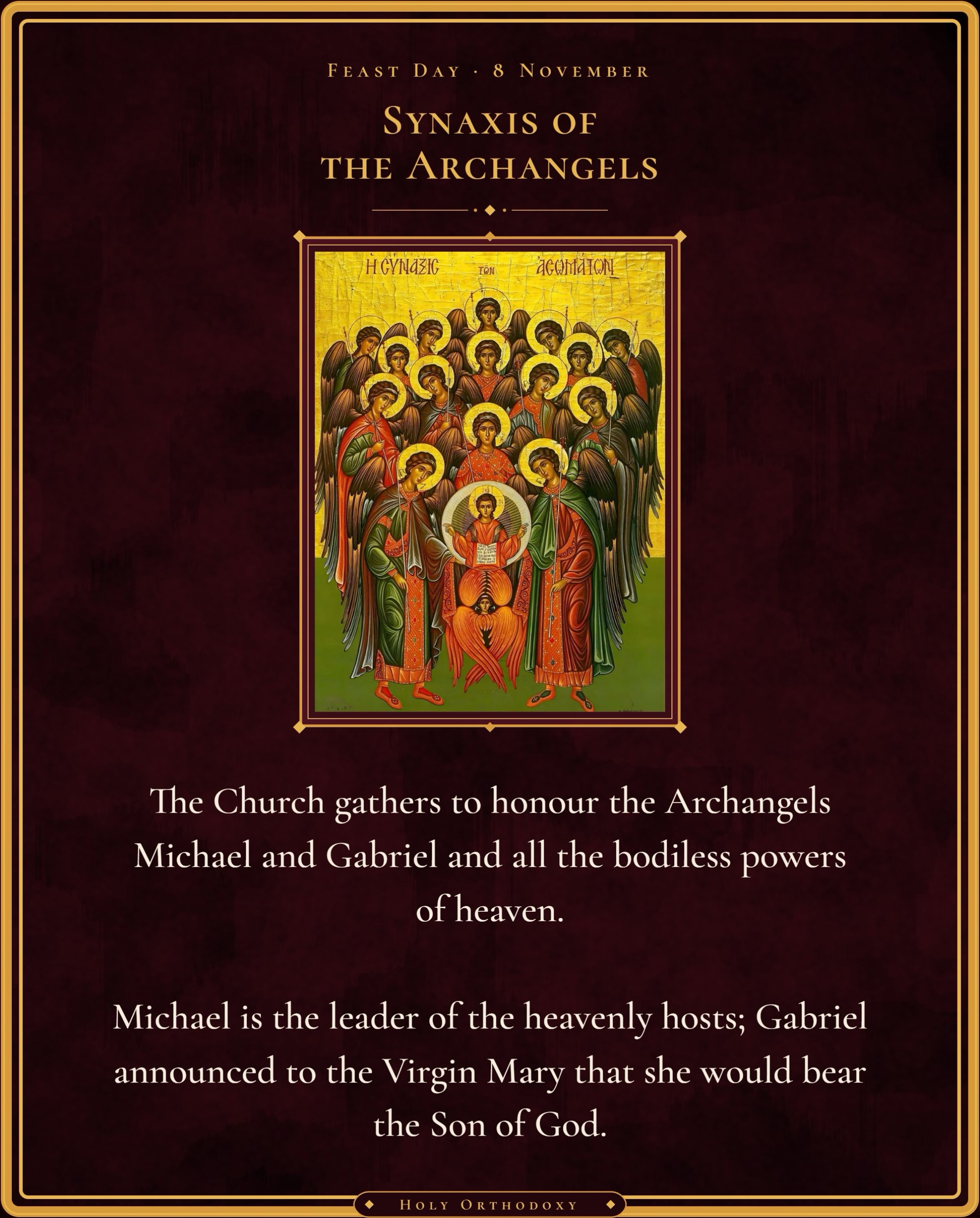
The post announces the feast of the Synaxis of the Archangel Michael and all the Bodiless Powers of Heaven. It names the seven archangels: Michael, Gabriel, Raphael, Uriel, Selaphiel, Jegudiel, and Barachiel, together with the countless hosts of angels. It describes their worship before the throne of God, singing the trisagion without ceasing. It outlines their active ministry: they guard, heal, bring good news, and stand beside the faithful in…

The post announces the feast of the Synaxis of the Archangel Michael and all the Bodiless Powers of Heaven. It names the seven archangels: Michael, Gabriel, Raphael, Uriel, Selaphiel, Jegudiel, and Barachiel, together with the countless hosts of angels. It describes their worship before the throne of God, singing the trisagion without ceasing.

It outlines their active ministry: they guard, heal, bring good news, and stand beside the faithful in every trial. The post notes that at every Divine Liturgy the faithful join their voices with the angelic choirs. It cites Psalm 34:7: "The angel of the LORD encamps all around those who fear Him, And delivers them." It concludes with a prayer to the holy archangels and all the bodiless powers of heaven.

  • Feast of the Synaxis of Archangel Michael and all Bodiless Powers observed today
  • Seven archangels named: Michael, Gabriel, Raphael, Uriel, Selaphiel, Jegudiel, Barachiel
  • Angels worship before God's throne and serve by guarding, healing, announcing, and assisting the faithful
  • Divine Liturgy unites the voices of the faithful with the angelic choirs
  • Psalm 34:7 cited: the angel of the Lord encamps around those who fear Him
Read more

Elder Ephraim of Katounakia: Prayer as a direct line to Christ and the Theotokos

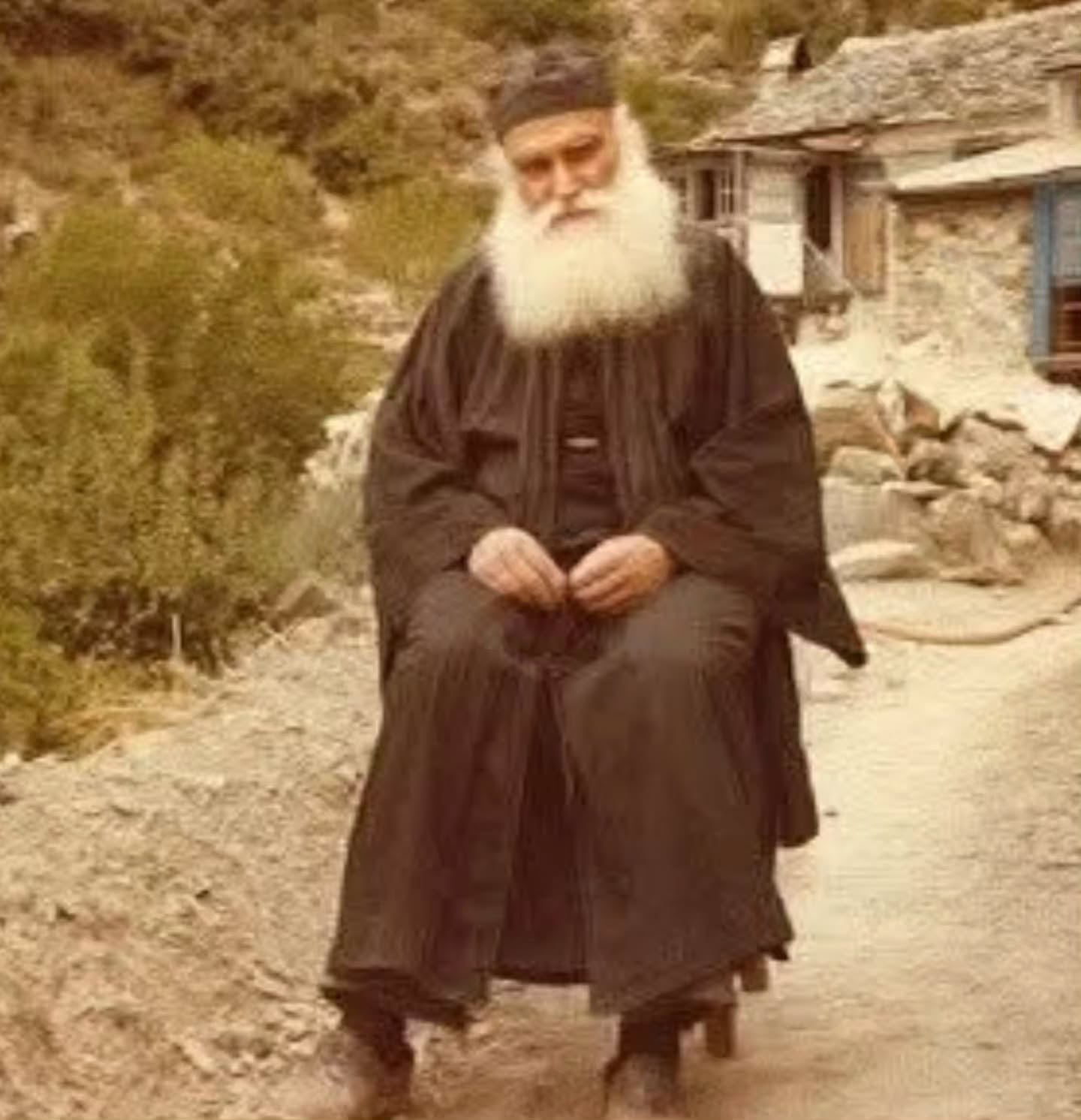
The post shares a saying attributed to Elder Ephraim of Katounakia. He compares the Jesus Prayer ("Lord Jesus Christ, have mercy on me") to Christ's phone number and the prayer to the Theotokos ("Most Holy Theotokos, save me") to her phone number. He urges believers to use these prayers often, not only in desperate situations but also when life is going well. The image shows an elderly bearded monk in dark robes sitting outdoors, likely depicting the elder.

  • Elder Ephraim of Katounakia likens the Jesus Prayer to a direct line to Christ.
  • He likens the prayer to the Theotokos to a direct line to her.
  • He encourages frequent use of both prayers.
  • The prayers should be used in good times as well as in crises.
  • The post includes an image of an elderly monastic figure outdoors.
Read more

Great Martyr Demetrios of Thessaloniki: life, martyrdom, and miracles

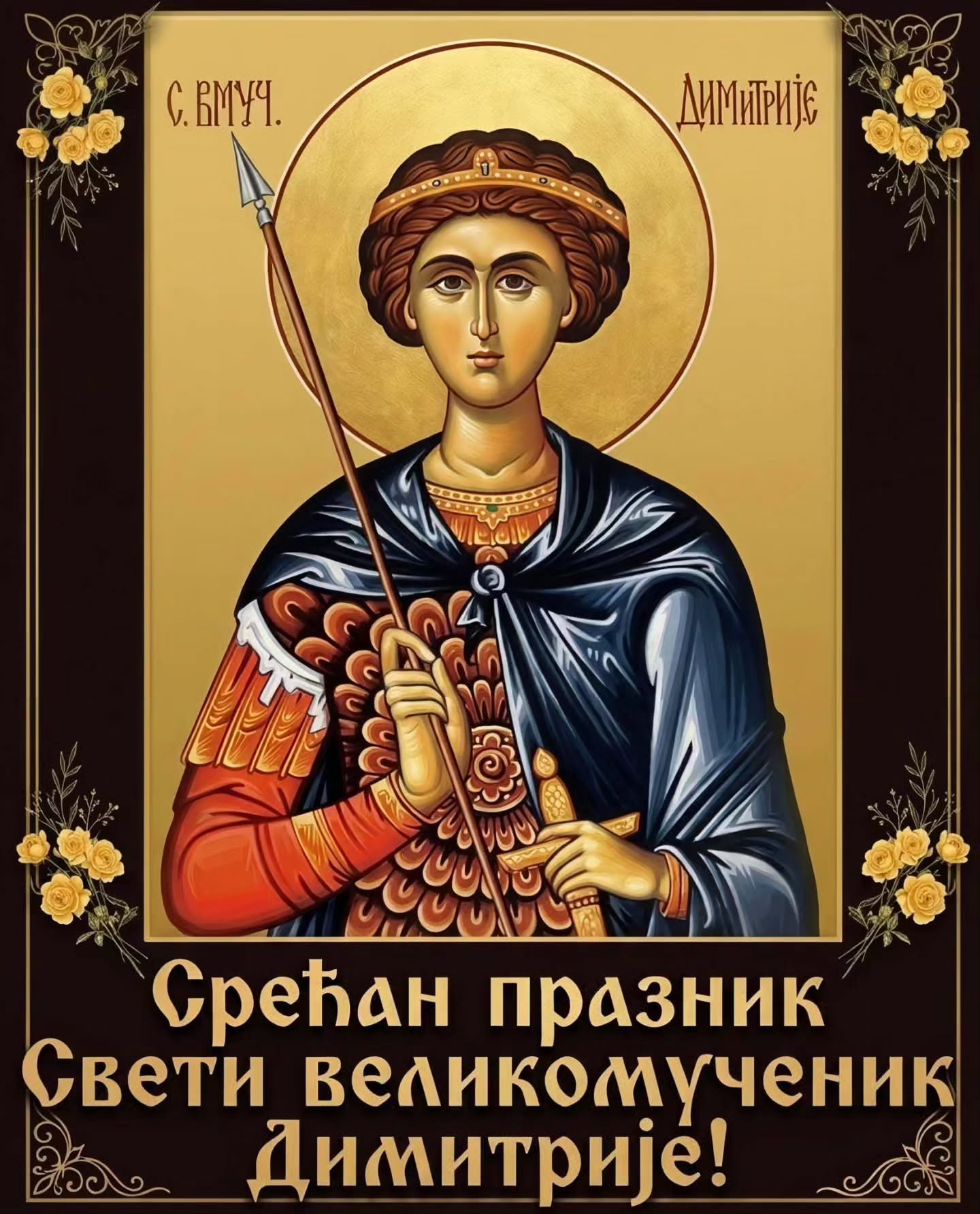
The post recounts the life of Saint Demetrios, born in Thessaloniki to Christian parents who concealed their faith from unbelievers during persecution while raising their son in love for Christ. When Emperor Maximian appointed him proconsul of the Thessalonian region, expecting him to persecute Christians, Demetrios instead confessed Christ publicly, preached the Gospel, distributed his wealth to the needy, and prepared for suffering. Imprisoned…

The post recounts the life of Saint Demetrios, born in Thessaloniki to Christian parents who concealed their faith from unbelievers during persecution while raising their son in love for Christ. When Emperor Maximian appointed him proconsul of the Thessalonian region, expecting him to persecute Christians, Demetrios instead confessed Christ publicly, preached the Gospel, distributed his wealth to the needy, and prepared for suffering.

Imprisoned for his faith, he blessed the young Christian Nestor, who entered the arena against Lyaios, the emperor's wrestler, and defeated him. Maximian ordered Nestor executed and then Demetrios pierced with spears; the saint suffered around 306 AD. The account describes miracles accompanying his veneration: according to his Life, myrrh flowed from his relics and the sick received healing.

The Illyrian noble Leontius, seriously ill, was healed at the saint's tomb and built a church in his honor out of gratitude. When Leontius attempted to take a portion of the relics to his estate, Saint Demetrios appeared to him and forbade it; Leontius took only a mantle soaked in the martyr's blood. The Life also states that the saint miraculously protected Thessaloniki from enemy attacks and famine.

For this reason he is venerated as a myrrh-streaming great martyr and heavenly protector of Thessaloniki, his name glorified by Orthodox Christians through the ages. The text concludes with greetings for the feast of Mitrovdan and for those celebrating the saint as their family patron (slava), asking that his prayers bring peace, health, harmony, and every good thing.

  • Born in Thessaloniki to pious parents who hid their faith during persecution
  • Appointed proconsul by Maximian but confessed Christ and aided the poor instead of persecuting Christians
  • Blessed Nestor from prison, who defeated the imperial wrestler Lyaios; both martyred c. 306
  • Myrrh flowed from his relics; healings occurred; Leontius built a church after being cured
  • Venerated as myrrh-streaming great martyr and protector of Thessaloniki; feast is Mitrovdan
Read more
Disgruntled Docs with Kara Mosher Instagram

St. Seraphim's Counsel: Acquire Peace to Save Souls

The author recounts repeated guidance from their spiritual father, who answers the question of how best to work for the salvation of loved ones by citing St. Seraphim of Sarov: "Acquire the Spirit of Peace, and a thousand souls around you will be saved." The post presents this teaching as a direct link between personal spiritual struggle and the broader salvation of others, framing the pursuit of inner peace as a means by which one's own…

The author recounts repeated guidance from their spiritual father, who answers the question of how best to work for the salvation of loved ones by citing St. Seraphim of Sarov: "Acquire the Spirit of Peace, and a thousand souls around you will be saved." The post presents this teaching as a direct link between personal spiritual struggle and the broader salvation of others, framing the pursuit of inner peace as a means by which one's own salvation becomes inseparable from the salvation of the world.

The message is offered on the feast of the Archangels and is sent from Holy Archangels Monastery, marking the occasion with a liturgical greeting.

  • Spiritual father consistently directs the author to St. Seraphim's words on acquiring the Spirit of Peace
  • The quote promises that a thousand surrounding souls will be saved through one person's peace
  • Personal salvation work is described as simultaneously working for the salvation of the world
  • The post is shared on the feast of the Archangels
  • The greeting originates from Holy Archangels Monastery
Read more
Orthodox Life Instagram

Synaxis of Archangel Michael and the Bodiless Powers (November 8)

The Orthodox Church celebrates the Synaxis of the Archangel Michael and the Other Bodiless Powers on November 8. The word synaxis means an assembly, calling the faithful to gather in honor of the entire heavenly host. The feast was established after the fourth-century Council of Laodicea. It presents the angels not as distant myths but as active, living servants of God. Orthodox tradition describes a heavenly hierarchy of nine ranks grouped into…

The Orthodox Church celebrates the Synaxis of the Archangel Michael and the Other Bodiless Powers on November 8. The word synaxis means an assembly, calling the faithful to gather in honor of the entire heavenly host. The feast was established after the fourth-century Council of Laodicea. It presents the angels not as distant myths but as active, living servants of God.

Orthodox tradition describes a heavenly hierarchy of nine ranks grouped into three triads. The highest order includes Seraphim, Cherubim, and Thrones. The middle order includes Dominions, Powers, and Authorities. The lowest order includes Principalities, Archangels, and Angels.

Each rank reflects a specific way these pure, incorporeal spirits receive and transmit divine light. At the head of all nine ranks stands the Archangel Michael, whose Hebrew name means "Who is like God?" When Lucifer rebelled out of pride, Michael rallied the heavenly forces with the cry, "Let us attend!

Let us stand aright before our Creator!" He cast the fallen spirits down from heaven and became Chief Commander of the Heavenly Hosts. Alongside Michael, the Church venerates other prominent archangels with distinct missions: Gabriel the herald, Raphael the healer, Uriel the enlightener, Salaphiel, Jehudiel, Barachiel, and Jeremiel.

Every Christian receives a personal Guardian Angel at baptism to guide and protect them. On the feast day, Orthodox Christians gather for the Divine Liturgy to seek the protection of these immaterial powers, asking the angels to shelter them under the wings of their glory and deliver them from spiritual and physical harm.

  • The feast of the Synaxis of the Archangel Michael and the Bodiless Powers is celebrated on November 8.
  • The term synaxis refers to an assembly of the faithful to honor the heavenly host.
  • Orthodox tradition outlines a hierarchy of nine angelic ranks grouped in three triads.
  • Archangel Michael, whose name means "Who is like God?", leads the heavenly hosts after casting down Lucifer.
  • The Church also venerates Gabriel, Raphael, Uriel, Salaphiel, Jehudiel, Barachiel, and Jeremiel, and teaches that each Christian receives a guardian angel at baptism.

Synaxis of the Archangels Michael and Gabriel, 8 November

The post marks the feast of the Synaxis of the Archangels Michael and Gabriel and all the bodiless powers on 8 November. It explains that the Church gathers to honour the holy angels who stand before God's throne, guard the faithful, and carry His messages. Michael, whose name means "Who is like God?", is identified as the leader of the heavenly hosts. Gabriel is noted as the messenger who announced to the Virgin Mary that she would bear the Son…

The post marks the feast of the Synaxis of the Archangels Michael and Gabriel and all the bodiless powers on 8 November. It explains that the Church gathers to honour the holy angels who stand before God's throne, guard the faithful, and carry His messages. Michael, whose name means "Who is like God?", is identified as the leader of the heavenly hosts.

Gabriel is noted as the messenger who announced to the Virgin Mary that she would bear the Son of God. The post gives the reason for the date: November is the ninth month counting from March, the month of creation, recalling the nine ranks of angels. The Fathers call the Last Judgement "the eighth day", when the angels will come with Christ in glory.

The post concludes with a prayer to the holy archangels and a greeting to those celebrating their name day: Michael, Gabriel, Angelos, Angeliki, and Taxiarchis.

  • The feast honours Archangels Michael and Gabriel and all bodiless powers.
  • Michael means "Who is like God?" and leads the heavenly hosts.
  • Gabriel announced the Incarnation to the Virgin Mary.
  • The date 8 November reflects the ninth month from March (creation) and the nine angelic ranks.
  • The Fathers call the Last Judgement the eighth day, when angels accompany Christ.
Read more

Saint Paisios: From Civil War Radio Operator to Holy Mount Hermit

The post shows the path to Panagouda, the humble cell of Saint Paisios on Mount Athos, and includes a video summary of his life. Before monasticism he was Arsenios Hatzis, a radio operator in the Greek Civil War who repeatedly chose the most dangerous posts so that men with families could be spared. He bore the safety of others as a joy. Later he went to the Holy Mountain and took the name Paisios. Pilgrims climbed for hours to reach his small…

The post shows the path to Panagouda, the humble cell of Saint Paisios on Mount Athos, and includes a video summary of his life. Before monasticism he was Arsenios Hatzis, a radio operator in the Greek Civil War who repeatedly chose the most dangerous posts so that men with families could be spared. He bore the safety of others as a joy. Later he went to the Holy Mountain and took the name Paisios.

Pilgrims climbed for hours to reach his small hut, and he received each one, often naming their sorrow before they spoke. He gave his days to prayer and his heart to everyone who sought him. His counsel remains: guard the heart, forgive quickly, trust each care to God, and let humility open the way to joy. The post ends with a short prayer to Saint Paisios in English and Greek.

Key moments

  1. Arsenios Hatzis served as a radio operator in the Greek Civil War and repeatedly took the most dangerous posts so that men with wives and children might be spared.
  2. He carried the safety of others on his own shoulders and counted it a joy.
  3. He went to the Holy Mount and took the name Paisios.
  4. Pilgrims climbed for hours to reach his small hut and he received each one, often naming the sorrow before a word was spoken.
  5. He gave his days to prayer and his heart to everyone who sought him.
  6. His counsel: guard the heart, forgive quickly, trust each care to God, and let humility open the way to joy.
Read more

Early Church Fathers on confession as essential sacrament

The post presents early Christian writings to show that sacramental confession existed from the first centuries. The Didache, dated to the first or early second century, commands Christians to confess sins in church before prayer and the Eucharist, citing Didache 4:14 and 14:1: "Confess your sins in church, and do not go up to your prayer with an evil conscience" and "On the Lord's Day gather together, break bread, and give thanks, after…

The post presents early Christian writings to show that sacramental confession existed from the first centuries. The Didache, dated to the first or early second century, commands Christians to confess sins in church before prayer and the Eucharist, citing Didache 4:14 and 14:1: "Confess your sins in church, and do not go up to your prayer with an evil conscience" and "On the Lord's Day gather together, break bread, and give thanks, after confessing your transgressions so that your sacrifice may be pure."

Tertullian, writing around 203 AD in On Repentance chapters 8-9, describes exomologesis, a public confession before presbyters with the community interceding, and states: "Confession of sins lightens, as much as dissimulation aggravates them." Origen, around 248 AD in Homilies on Leviticus 2:4, speaks of the sinner declaring sin to a priest of the Lord to seek medicine: "The remission of sins through penance, when the sinner ... does not shrink from declaring his sin to a priest of the Lord and from seeking medicine."

The author argues that Protestants accept the authority of these Fathers on doctrine such as the Trinity but dismiss them on confession and other sacraments. The post lists further witnesses: Cyprian on priestly reconciliation, Basil on confession to those entrusted with God's mysteries. It asks whether readers are willing to encounter the early Church on its own terms rather than through modern denominational lenses.

The Orthodox Church, it says, calls people to receive the faith handed down through the apostles. The text includes a repeated section titled "QUESTION THAT CANNOT BE IGNORED" and an Arabic phrase meaning true faith.

  • The Didache (1st-early 2nd century) commands confession in church before the Eucharist.
  • Tertullian (c. 203) describes public confession before presbyters as necessary repentance.
  • Origen (c. 248) presents confession to a priest as seeking spiritual medicine.
  • The author challenges selective acceptance of the Church Fathers on sacraments versus doctrine.
  • The post calls for encountering the early Church on its own terms and receiving the apostolic faith.
Read more

Quotes from Saints on Faith, Persecution, and the End Times

The post presents a collection of fourteen quotations from Orthodox saints and Church Fathers. St. John Chrysostom advises praying for those who laugh at one's faith, noting there will be no laughter on the day of judgment. Hieromonk Seraphim Rose appears several times: he says faith makes one look foolish and urges getting in the boat before the flood; he writes that everything passes away except God, and we must choose God over the world; he…

The post presents a collection of fourteen quotations from Orthodox saints and Church Fathers. St. John Chrysostom advises praying for those who laugh at one's faith, noting there will be no laughter on the day of judgment. Hieromonk Seraphim Rose appears several times: he says faith makes one look foolish and urges getting in the boat before the flood; he writes that everything passes away except God, and we must choose God over the world; he urges sharing Orthodoxy rather than keeping it private; and he states that suffering indicates another kingdom, for if Christianity meant happiness in this life we would not need heaven.

St. Justin Popovich declares that one who lives in faith within the risen God-man lives above death, and that European civilization built without Christ will inevitably collapse soon. St. Paisios the Athonite affirms that difficult and dangerous years will end with Christ's victory. Eugene (Fr. Seraphim) Rose contrasts Western Christendom, where God is dead and leaders prepare for Antichrist, with Orthodox Christians who know the living God and find salvation in the unchanging Orthodox path, not in ecumenical union with unbelievers.

St. Anthony the Great warns against communication with schismatics and heretics, urging unity with Christ and the saints. The Didache (chapter 1) commands blessing those who curse you, praying for enemies, and fasting for persecutors. St. Synkletike notes the great struggle and toil at the beginning of coming to God, followed by indescribable joy.

St. Gabriel Urgebadze says true faith is in the heart, not the mind; those with faith in the mind will follow the antichrist, while those with faith in the heart will recognize him. St. Theophan the Recluse describes the enemy waging war through the mind with doubt, despair, and distraction, urging believers to take every thought captive to Christ and make the heart a fortress of prayer.

The quotations are presented without additional commentary, forming a series of exhortations on faithfulness, spiritual warfare, and the last things.

  • St. John Chrysostom: pray for those who mock your faith; judgment will be no laughing matter.
  • Hieromonk Seraphim Rose: faith appears foolish to the world; choose God over the passing world; share Orthodoxy; suffering points to the Kingdom of Heaven.
  • St. Justin Popovich: life in the risen Christ transcends death; godless civilization will collapse.
  • St. Paisios and Fr. Seraphim Rose: Christ will ultimately win; salvation is found in the unchanging Orthodox path, not in ecumenical compromise.
  • St. Theophan the Recluse and St. Gabriel Urgebadze: spiritual warfare attacks the mind; guard the heart with prayer; true faith resides in the heart, not the intellect.
Read more
Orthodox Health Instagram

Dietitian ranks Orthodox fasting carbs, warns against extra rules

The post shares a video episode titled "The Ultimate Orthodox Fasting Carb Tier List" from Logos Cinema. In the video, a registered dietitian evaluates carbohydrate sources commonly used during the Orthodox 40-day fast, such as the Nativity Fast. The dietitian reacts skeptically to the marketing term "ingraining" found on food packaging, indicating caution toward automatic health claims. The analysis shows that a food can perform well in one…

The post shares a video episode titled "The Ultimate Orthodox Fasting Carb Tier List" from Logos Cinema. In the video, a registered dietitian evaluates carbohydrate sources commonly used during the Orthodox 40-day fast, such as the Nativity Fast. The dietitian reacts skeptically to the marketing term "ingraining" found on food packaging, indicating caution toward automatic health claims.

The analysis shows that a food can perform well in one nutritional category but not in another; for example, lentils may rank highly as a protein source but lower as a carbohydrate source. The video presents a tier list ranking: potatoes are placed in the top tier, white rice is ranked lower, honey outranks oats, and lentils are knocked down a peg.

The speaker emphasizes that the existing Orthodox fasting discipline is sufficient and warns against adding extra dietary rules beyond what the tradition requires. During the 40-day fast, Orthodox Christians give up many foods they normally rely on, and replacement foods can leave a person underfueled, struggling to recover, or simply exhausted.

The ranking aims to help believers choose carbohydrate sources that provide adequate energy so that the fast functions as medicine rather than a reckless endeavor. The post also states that Orthodox fasting has never been about winning a nutritional deprivation contest, and that dietary restriction should not be confused with nutritional wisdom.

There is room for asceticism without making poor nourishment a badge of honor, and room for discernment without turning every meal into a theological examination. The ultimate purpose of fasting is to unite oneself to Christ.

Key moments

  1. A registered dietitian reacts negatively to the marketing term "ingraining" on packaging, indicating skepticism toward automatic health claims.
  2. Lentils may rank lower as a carbohydrate source than they do as a protein source.
  3. A food can perform extremely well in one nutritional category but not as well in another.
  4. The Orthodox fasting discipline already exists and does not require invented dietary commandments.
  5. During the 40-day fast, Orthodox Christians give up many foods they normally rely on.
  6. Replacement foods can leave a person underfueled, struggling to recover, or simply exhausted.
  7. The video ranks the best and worst fasting carbohydrate sources, including potatoes, rice, fruit, and honey.
  8. The purpose of the ranking is to ensure the fast functions as medicine rather than a reckless practice.

History of Seraphim-Diveyevo Monastery: Fourth Portion of the Theotokos

The history of the Seraphim-Diveyevo Monastery begins around 1758 when the widow Agafia Semenovna Melgunova, with her three-year-old daughter, entered the Kiev Florovsky Ascension Convent and received the monastic name Alexandra. According to monastery tradition, the Theotokos appeared to her in Kiev and directed her to travel north through Russia, visiting convents dedicated to Her, promising to reveal the site for a great monastery. On her way…

The history of the Seraphim-Diveyevo Monastery begins around 1758 when the widow Agafia Semenovna Melgunova, with her three-year-old daughter, entered the Kiev Florovsky Ascension Convent and received the monastic name Alexandra. According to monastery tradition, the Theotokos appeared to her in Kiev and directed her to travel north through Russia, visiting convents dedicated to Her, promising to reveal the site for a great monastery.

On her way to the Sarov desert, Alexandra stopped in the village of Diveyevo, where the Theotokos appeared again and identified this as the chosen place. She declared that She would found Her community there, calling it the Fourth Portion on earth after Iveria, Mount Athos, and Kiev. Around 1767 Alexandra returned to Diveyevo. In 1773 she began building a stone church dedicated to the Kazan Icon of the Theotokos on the site associated with the apparition; it was completed in 1779 after six years.

In 1788 she obtained land for a sisterhood, built three cells, and gathered sisters living in prayer and work. Before her repose on June 13, 1789, she entrusted the sisters to Elder Pachomius and the Venerable Seraphim of Sarov. Tradition holds that on November 25, 1825, the Theotokos appeared to Seraphim in the Sarov forest and instructed him to establish a new sisterhood in Diveyevo.

Eight sisters were chosen, and on December 9, 1826, construction of a mill began, giving the community the name Mill Community. The sisters built cells and the Holy Canal, which became one of Diveyevo's most renowned holy sites. The two sisterhoods were united into a monastery by a decision of the Holy Synod in 1861, and on November 17, 1862, Maria (Ushakova) was appointed abbess.

During her tenure numerous churches and monastery buildings were erected, including the Trinity Cathedral in 1875. The monastery was closed in 1927. Church life began to revive in 1988, and the decision to restore the monastery was published on July 21, 1991.

  • Foundation by nun Alexandra after Theotokos apparitions in Kiev and Diveyevo (c. 1758-1767).
  • Construction of Kazan Icon church (1773-1779) and establishment of sisterhood (1788).
  • Entrustment to Elder Pachomius and St. Seraphim of Sarov before Alexandra's repose (1789).
  • St. Seraphim's vision of the Theotokos (1825) leading to Mill Community and Holy Canal.
  • Unification as monastery by Holy Synod (1861), closure (1927), revival (1988) and restoration decision (1991).
Read more
Mount Athos Legacy Facebook

St. Augustine on Who Christ Is for Us

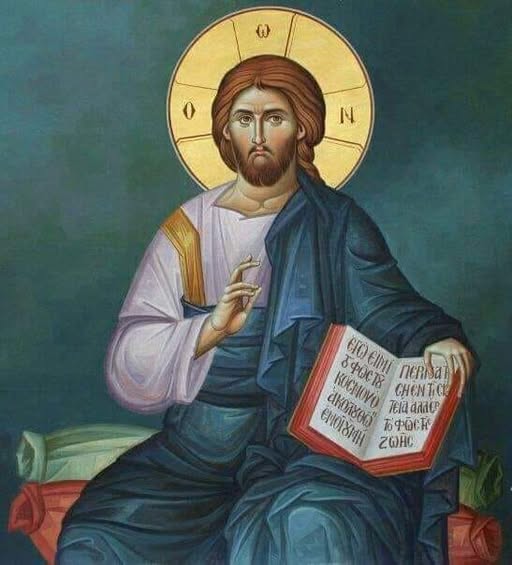
The post presents a series of questions and answers attributed to St. Augustine that describe Christ's identity in relation to human needs. Each line pairs a human condition with a title of Christ: the Physician for wounds, Peace for a troubled soul, Justice for injustice, Power for helplessness, Life for fear of death, the Way for those seeking heaven, Light for those who hate darkness, and Food for hunger. The accompanying image shows a halo…

The post presents a series of questions and answers attributed to St. Augustine that describe Christ's identity in relation to human needs. Each line pairs a human condition with a title of Christ: the Physician for wounds, Peace for a troubled soul, Justice for injustice, Power for helplessness, Life for fear of death, the Way for those seeking heaven, Light for those who hate darkness, and Food for hunger.

The accompanying image shows a halo inscribed with "Ο ΩΝ" (He Who Is) and an open book displaying John 8:12 in Greek: "I am the light of the world; he who follows me shall not walk in darkness but shall have the light of life." The text functions as a compact Christological catechesis, drawing on scriptural titles to show how Christ meets every spiritual lack. No further commentary or discussion is included in the source.

  • Attributed to St. Augustine
  • Eight pairs of human need and Christ's title
  • Includes Physician, Peace, Justice, Power, Life, Way, Light, Food
  • Image cites John 8:12 in Greek
  • No additional commentary or discussion present

Bishop Dositej on Marriage and Virginity as Complementary Paths

Bishop Dositej speaks on the holiness of marriage and the holiness of virgin life, presenting them as two great virtues that complement each other and two ways to please God. He notes that virginity slightly surpasses marriage, citing the Apostle Paul: whoever unites with the Lord becomes one spirit with Him, while whoever unites with a woman becomes one flesh. The bishop explains that both states share the same fidelity, because in each a…

Bishop Dositej speaks on the holiness of marriage and the holiness of virgin life, presenting them as two great virtues that complement each other and two ways to please God. He notes that virginity slightly surpasses marriage, citing the Apostle Paul: whoever unites with the Lord becomes one spirit with Him, while whoever unites with a woman becomes one flesh.

The bishop explains that both states share the same fidelity, because in each a person surrenders their being to the chosen one. This surrender shows trust in God to keep that trust toward the beloved, and thus demonstrates trust in God and fidelity to God.

Key moments

  1. The speaker notes the great holiness of marriage and the holiness of virgin life.
  2. The speaker states these are two great virtues that complement each other.
  3. The speaker says they are two ways to please God.
  4. The speaker explains that virginity slightly surpasses marriage, citing the Apostle Paul: whoever unites with the Lord becomes one spirit with Him.
  5. The speaker contrasts that whoever unites with a woman becomes one flesh.
  6. The speaker asserts that both are the same fidelity, because one surrenders one's being to the chosen one.
  7. The speaker adds that this surrender shows trust in God to keep that trust toward the beloved.
  8. The speaker concludes that this demonstrates trust in God and fidelity to God.
Read more
Ancient Faith YouTube

Fr. Andrew Damick: Ecclesiology and Confession Against Isolation

Fr. Andrew Damick: Ecclesiology and Confession Against Isolation 6:42

Fr. Andrew Stephen Damick argues that ecclesiology, understood as the Church as the Body of Christ, addresses the deepening isolation in modern Western culture. He notes that social participation has declined for decades, harming mental, spiritual, and physical health. Confession is the quintessential ecclesial experience: it heals, restores, and enacts repentance within the communal life of the Church, not in private isolation. Confessing to a…

Fr. Andrew Stephen Damick argues that ecclesiology, understood as the Church as the Body of Christ, addresses the deepening isolation in modern Western culture. He notes that social participation has declined for decades, harming mental, spiritual, and physical health. Confession is the quintessential ecclesial experience: it heals, restores, and enacts repentance within the communal life of the Church, not in private isolation.

Confessing to a priest differs from confessing alone to God because it draws a person out of the self and participates in how God works through His Body. Fear that clergy mediate access to God, often rooted in anti-Roman Catholic reaction, leads people to reject the means God provided in Scripture for forgiveness through mutual confession.

Abuse of the sacrament does not invalidate its proper use. Avoiding communal participation amounts to self-excommunication; the call is to be present, endure discomfort if necessary, and receive the healing and forgiveness that exist only within the Body of Christ. The speaker tracks declining participation in churches and civic organizations over decades.

Confession involves both exclusion for unrepentance aimed at repentance and protection of others, and the positive aspect of healing and restitution within the Body. Private prayer and Bible reading are good but cannot supply the ecclesial dimension; the Church is specifically a gathering and relationship. God grants forgiveness through confession to others as given in Scripture.

Past wounds should not define one's identity because the Church remains the Body of Christ.

Key moments

  1. 0:00 Ecclesiology is critical for our cultural moment because isolation is increasing in America and the West, with declining participation in social groups such as churches and civic organizations tracked over decades.
  2. 0:32 This isolation produces negative effects on mental health, spiritual health, and physical health, creating widespread suffering.
  3. 1:02 Ecclesiology, how we are the Church as the Body of Christ, the complex of His capacities and works in the world, is the remedy for this isolation and deterioration.
  4. 1:35 Confession is a quintessential ecclesial experience: it involves both the negative aspect of exclusion for unrepentance (aimed at repentance and protecting others) and the positive aspect of healing, restitution, and repentance within the Body of Christ.
  5. 2:38 Private prayer and Bible reading are good but cannot supply the ecclesial, communal dimension; the Church is specifically a gathering and a relationship, and confessing to a priest beside you is a different experience that takes you out of yourself.
  6. 3:09 God works through His Body, the Church, and through other people; fear that clergy stand between a person and God leads to rejecting God's own provision, but nothing can stand between a person and God.
  7. 4:13 Confession is given in Scripture; God grants forgiveness of sins through confession to others, and abuse of the sacrament does not negate its proper use, we correct excesses but do not discard the gift.
  8. 5:15 Not participating in the Body of Christ is self-excommunication; the solution is to be present, endure discomfort if necessary, and not let past wounds define one's identity, because the Church remains the Body of Christ.
Read more

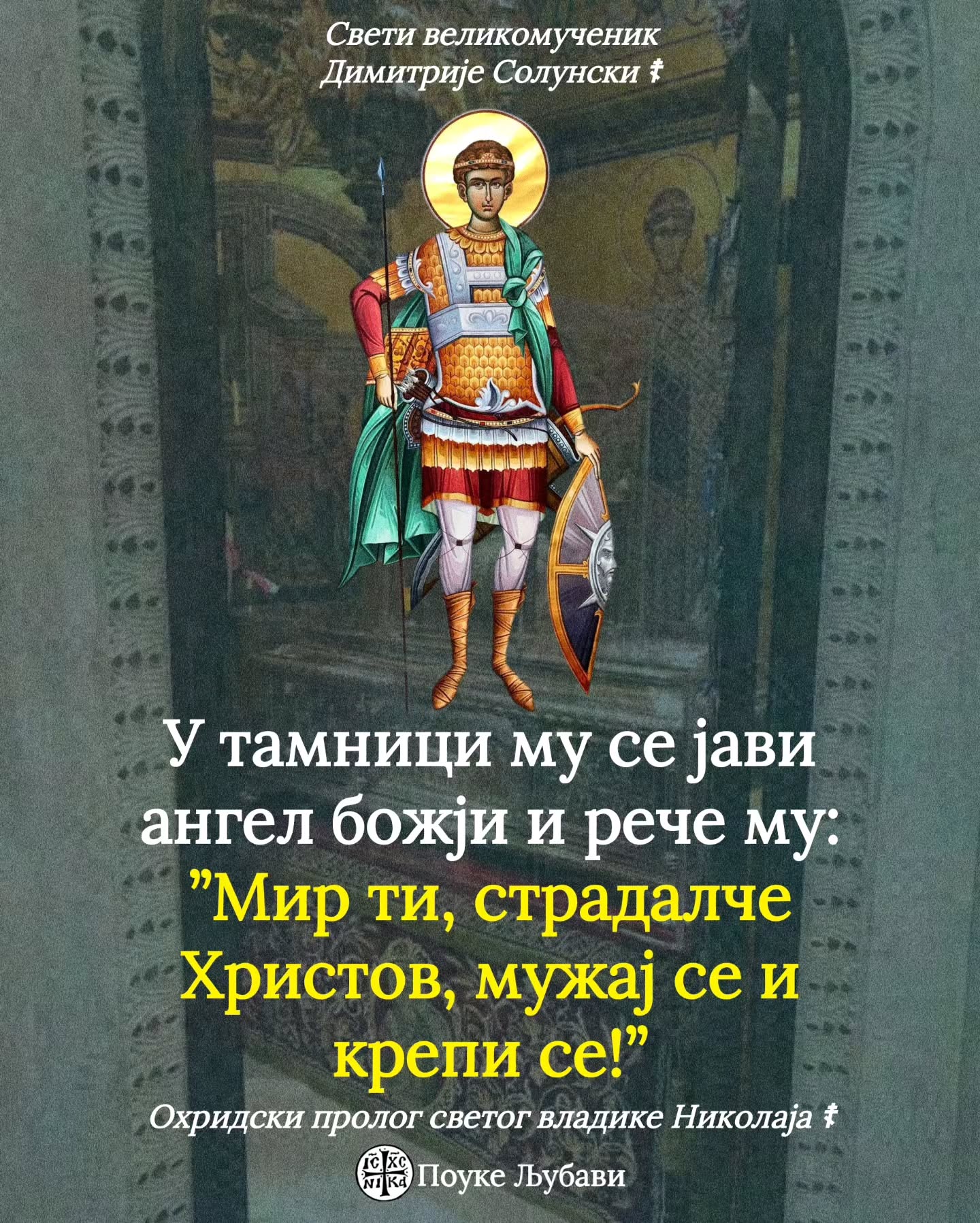
St. Demetrios of Thessaloniki: Martyrdom, Myrrh, and City Protector

The post presents the life of St. Demetrios of Thessaloniki as told in the Ohrid Prologue of St. Nikolai Velimirovich. Born to noble, pious parents in Thessaloniki, he was their only child after years of childlessness. His father served as the city's commander; after his death, Emperor Maximian appointed Demetrios to the same post. The emperor ordered him to persecute Christians, but Demetrios openly confessed Christ and preached the faith. When…

The post presents the life of St. Demetrios of Thessaloniki as told in the Ohrid Prologue of St. Nikolai Velimirovich. Born to noble, pious parents in Thessaloniki, he was their only child after years of childlessness. His father served as the city's commander; after his death, Emperor Maximian appointed Demetrios to the same post.

The emperor ordered him to persecute Christians, but Demetrios openly confessed Christ and preached the faith. When Maximian returned from war against the Sarmatians, he stopped in Thessaloniki to test Demetrios. The saint confessed his faith and denounced idolatry, leading to his imprisonment.

Before his arrest, Demetrios gave his possessions to his servant Lupus to distribute to the poor and went to prison joyfully. An angel appeared to him, saying, 'Peace to you, sufferer for Christ, be brave and strong!' Soldiers later found him praying and killed him with spears. Christians secretly buried his body, from which healing myrrh flowed.

A small church was built over his relics. An Illyrian nobleman, Leontius, suffering from an incurable illness, was healed at the relics and built a larger church in gratitude; the saint appeared to him twice. Emperor Justinian later attempted to transfer the relics to Constantinople, but flames erupted from the tomb and a voice commanded, 'Stop, do not touch!' The relics remained in Thessaloniki.

As the city's protector, St. Demetrios appeared many times and saved it from great calamities. The text notes that his miracles are innumerable. It also states that Russians regard him as the patron of Siberia, which was conquered and annexed to Russia on October 26, 1581.

  • St. Demetrios, born to noble parents in Thessaloniki, was appointed commander by Emperor Maximian but openly confessed Christ and denounced idolatry.
  • He was imprisoned, visited by an angel, and martyred by spears while praying.
  • Healing myrrh flowed from his relics; a small church was built over them.
  • The nobleman Leontius was healed at the relics, built a larger church, and the saint appeared to him twice.
  • Emperor Justinian's attempt to move the relics to Constantinople was stopped by flames and a voice; the relics remained in Thessaloniki, and Russians venerate him as patron of Siberia annexed on October 26, 1581.
Prayer Orthodoxy ® with The National Herald Instagram

Metropolitan Athenagoras Enthroned as Metropolitan of New Jersey

Metropolitan Athenagoras was enthroned as Metropolitan of New Jersey on November 7 at the Cathedral of St. John the Theologian in Tenafly, New Jersey. The Holy Synod of the Ecumenical Patriarchate elected him on October 1, 2026, while he was serving as Bishop of Nazianzos. The election followed the elevation of Metropolitan Apostolos to Archbishop of Canada. Video from the service shows the congregation chanting repeatedly in Spanish and Greek:…

Metropolitan Athenagoras was enthroned as Metropolitan of New Jersey on November 7 at the Cathedral of St. John the Theologian in Tenafly, New Jersey. The Holy Synod of the Ecumenical Patriarchate elected him on October 1, 2026, while he was serving as Bishop of Nazianzos. The election followed the elevation of Metropolitan Apostolos to Archbishop of Canada.

Video from the service shows the congregation chanting repeatedly in Spanish and Greek: "Acción, acción, acción. Señor ten piedad, ten piedad, ten piedad. Kirieleison, kirieleison, kirieleison. ven, ven, ven, ven." The canonical election of the new ruling hierarch for the God-saved Metropolis of New Jersey was then proclaimed.

The people responded with the triple acclamation "Axios, axios, axios." A speaker addressed the newly elected hierarch, saying, "I want to hear your stories, share your worries and rejoice in what you have done. You have accomplished." The enthronement marks the beginning of Metropolitan Athenagoras's leadership of the Metropolis of New Jersey under the Ecumenical Patriarchate.

Key moments

  1. The congregation chants "Acción, acción, acción. Señor ten piedad, ten piedad, ten piedad. Kirieleison, kirieleison, kirieleison. ven, ven, ven, ven."
  2. The canonical election to be the ruling hierarch of the God-saved Metropolis of New Jersey is proclaimed.
  3. The people acclaim "Axios, axios, axios."
  4. A speaker tells the newly elected hierarch: "I want to hear your stories, share your worries and rejoice in what you have done. You have accomplished."
Read more

Four rules for living as preparation for eternity

The post presents four practical guidelines framed by the principle that present life prepares for the next. The first rule advises against going to places where one would not want to die. The second warns against speaking words one would not want as one's last.

The third cautions against wearing clothes in which one cannot pray. The fourth states the governing principle: because current life is preparation for the next, it must be used wisely. The text appears as a numbered list with no attribution to a specific saint or source.

  • Avoid places where you would not want to die
  • Do not speak words you would not want as your last
  • Do not wear clothes in which you cannot pray
  • Present life is preparation for the next life
  • Use present life wisely
George Instagram discussion

Responding to Mockery with Christ's Silence and Prayer

The speaker addresses how Christians often react with angry arguments when their faith is mocked online or in daily life. Jesus responded to mockery, spitting, and humiliation with silence, not from weakness but because he did not need to win. He taught that those insulted for his sake are blessed and have a great reward in heaven. Saint Peter instructs believers to be ready to explain their hope with gentleness and respect. The speaker urges…

The speaker addresses how Christians often react with angry arguments when their faith is mocked online or in daily life. Jesus responded to mockery, spitting, and humiliation with silence, not from weakness but because he did not need to win. He taught that those insulted for his sake are blessed and have a great reward in heaven.

Saint Peter instructs believers to be ready to explain their hope with gentleness and respect. The speaker urges prayer for those who mock instead of writing angry comments, trusting that peace speaks louder than argument. The mocker may one day ask for prayer.

Key moments

  1. Christians online often get into fights and endless arguments when someone makes fun of their faith.
  2. The best response to mockery is not an argument but the example of Jesus.
  3. In everyday life, friends, colleagues, or family may laugh at practices like making the sign of the cross or going to church.
  4. When Jesus was laughed at, spat on, and dressed as a fake king, he stayed silent, not from weakness but because he did not need to win.
  5. Jesus said blessed are you when they insult you and say all kinds of evil against you because of him, and to rejoice because great is your reward in heaven.
  6. When someone laughs at your faith, you are not losing; you are walking the same road Jesus walked.
  7. Saint Peter tells us to always be ready to explain the hope we have, but with gentleness and respect.
  8. Before writing an angry comment, pray for the mocker instead, because your peace will speak louder than any argument, and the mocker may one day ask you to pray for them.
6 opinions in the discussion I think part of why we try to explain and argue about this is our pride, we want to win and be proven right in front of them. But we forget that what matters most is our inner faith, and… Read the discussion

Scripture Is Tradition, but Tradition Is Not Limited to Scripture

The post presents the Orthodox understanding of the relationship between Scripture and Holy Tradition through a series of points. It states that Scripture and Holy Tradition are not competing authorities; rather, Scripture is the divinely inspired written expression of Holy Tradition, and both transmit the same apostolic faith entrusted to the Church through Christ and the apostles. Scripture exists within Tradition, not outside or independent…

The post presents the Orthodox understanding of the relationship between Scripture and Holy Tradition through a series of points. It states that Scripture and Holy Tradition are not competing authorities; rather, Scripture is the divinely inspired written expression of Holy Tradition, and both transmit the same apostolic faith entrusted to the Church through Christ and the apostles.

Scripture exists within Tradition, not outside or independent of it. Before the New Testament was written and compiled, the Church was already preaching, baptizing, celebrating the Eucharist, and transmitting apostolic doctrine. The apostles did not establish Christianity by handing out a completed Bible; they transmitted the faith through preaching, worship, oral instruction, and eventually written testimony.

The Church did not emerge from the New Testament canon; the New Testament emerged from the Church. St. Paul commands Christians to preserve the apostolic teachings transmitted both orally and in writing, citing 2 Thessalonians 2:15: "So then, brethren, stand firm and hold to the traditions which you were taught by us, either by word of mouth or by letter."

The Greek word παραδόσεις (paradoseis) means "that which is handed down" or "transmitted." St. Paul makes no distinction in authority between apostolic teachings delivered orally and those delivered through written epistles. The post also addresses the formation of the canon, noting that the New Testament did not arrive with an inspired table of contents labeling its own canon.

The Church received, preserved, and circulated the apostolic writings over centuries. The same Church that transmitted the apostolic faith also recognized its authoritative written testimony as Tradition. To accept the canon of Scripture is to acknowledge the historical process of its transmission through Church Tradition.

The final point reiterates: Scripture is Tradition, but Tradition is not limited to Scripture.

  • Scripture and Holy Tradition are not competing authorities; Scripture is the written expression of Tradition.
  • The Church existed and transmitted the faith before the New Testament canon was formed.
  • St. Paul commands holding to traditions taught both orally and in writing (2 Thessalonians 2:15).
  • The Church recognized the canon of Scripture over centuries through Tradition.
  • Scripture is Tradition, but Tradition is not limited to Scripture.
Read more
Giovanni Guaita YouTube

Hieromonk John (Guaita) on the Parable of the Rich Man and Lazarus

Hieromonk John (Guaita) on the Parable of the Rich Man and Lazarus 14:03

The post shares a sermon by Hieromonk John (Guaita) delivered on 8 November 2026 on the parable of the rich man and Lazarus from Luke 16:19-31. The sermon reads the Gospel passage and divides it into three sections. The first contrasts the rich man, clothed in purple and fine linen and feasting daily, with Lazarus, a named beggar covered in sores who lies at the gate longing for crumbs while dogs lick his wounds. The second section describes…

The post shares a sermon by Hieromonk John (Guaita) delivered on 8 November 2026 on the parable of the rich man and Lazarus from Luke 16:19-31. The sermon reads the Gospel passage and divides it into three sections. The first contrasts the rich man, clothed in purple and fine linen and feasting daily, with Lazarus, a named beggar covered in sores who lies at the gate longing for crumbs while dogs lick his wounds.

The second section describes their deaths: angels carry Lazarus to Abraham's side, while the rich man is buried and suffers in Hades. Abraham explains the reversal of fortunes and a fixed chasm that prevents crossing, which the speaker identifies as the chasm of the rich man's lifelong indifference to Lazarus. The third section shows the rich man asking Abraham to send Lazarus to warn his five brothers, but Abraham replies that if they do not listen to Moses and the Prophets they will not be convinced even by a resurrection, an allusion to Christ's own rising.

The speaker applies the parable to the Church: the rich man is condemned not for wealth but for indifference, and Lazarus appears at our doorstep in the homeless and needy we ignore. The five brothers represent those still alive who can still change; Luke does not tell us what they did, but we see ourselves in them and it is not too late for us.

The post provides the sermon text in Russian, Italian, French, English, and Spanish, along with a video link on Boosty and the daily Scripture reading from Azbyka.

Key moments

  1. 0:39 The rich man was dressed in purple and fine linen and feasted every day, while Lazarus lay at his gate covered with sores, longing for crumbs, and dogs licked his sores.
  2. 1:55 Lazarus has a name and therefore a face, a personality, and a story, but the rich man has no name at all.
  3. 2:26 When they die, the angels carry Lazarus to Abraham's side, but the rich man is only said to have been buried, likely with a lavish funeral.
  4. 3:32 In Hades the rich man sees Abraham and Lazarus and asks for water, but Abraham replies that a great chasm has been fixed so that no one can cross from either side.
  5. 4:46 The chasm is the rich man's own indifference, he did not see Lazarus during his life, and now that indifference makes it impossible to cross.
  6. 5:58 The rich man then asks Abraham to send Lazarus to warn his five brothers, but Abraham says they have Moses and the Prophets and will not be convinced even if someone rises from the dead.
  7. 7:39 The parable is addressed to us in the Church: the rich man is condemned not for his wealth but for his indifference, and Lazarus is at our doorstep in the homeless and the needy we ignore.
  8. 12:49 The five brothers are still alive and can still change; Luke does not tell us what they did, but we see ourselves in them and it is not too late for us.
Read more