WeOrthodox
EN UA

Prayer Orthodoxy ®

Instagram ↗ 196 discussions

Prayer Orthodoxy® Orthodox Christianity Through Scripture, Tradition, and the Saints Deepen Your Understanding of the Faith

Prayer Orthodoxy ® Instagram

Saint Paisios: Pride draws us to the devil, humility to Christ

The post shares a saying of Saint Paisios of Mount Athos, presented in both English and Greek. The saying states that pride brings a person closer to the devil, while humility brings a person closer to Christ. It adds that Saint Paisios called the devil the greatest egotist, and poses the question of whose company one chooses when pride and selfishness rule the heart. The post also includes a video summary. In the video, the speaker recounts a…

The post shares a saying of Saint Paisios of Mount Athos, presented in both English and Greek. The saying states that pride brings a person closer to the devil, while humility brings a person closer to Christ. It adds that Saint Paisios called the devil the greatest egotist, and poses the question of whose company one chooses when pride and selfishness rule the heart.

The post also includes a video summary. In the video, the speaker recounts a memory of his mother asking her children who is the biggest egoist. His brother Rafael answered. The mother then explained that the biggest egoist is the devil. She asked the speaker if he is an egoist, and whose friend he would be in that case. She urged her children to humble themselves.

Key moments

  1. The mother asks who is the biggest egoist.
  2. Rafael, the speaker's brother, answers the mother's question.
  3. The mother wants to say that the biggest egoist is the devil.
  4. The mother asks if the speaker is an egoist, whose friend he would be.
  5. The mother urges her children to humble themselves.
Read more

St. Porphyrios: open a window to Christ rather than fight darkness

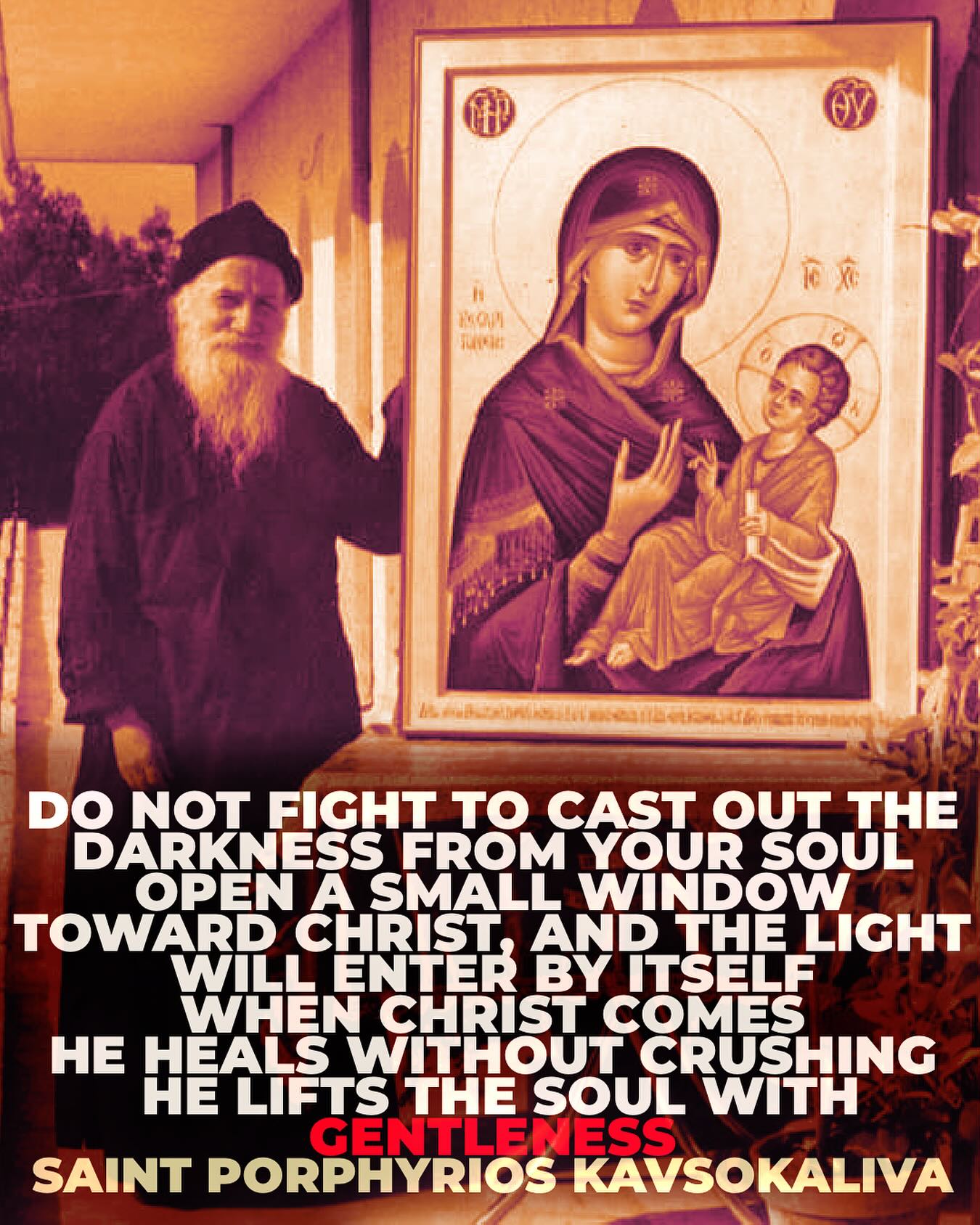
The post presents a teaching from St. Porphyrios of Kavsokalyva. He writes that one should not fight to cast out darkness from the soul. Instead, one should open a small window toward Christ, and the light will enter by itself. When Christ comes, He heals without crushing; He lifts the soul with gentleness.

  • Do not fight darkness directly in the soul
  • Open a small window toward Christ
  • Christ's light enters by itself
  • Christ heals without crushing
  • Christ lifts the soul with gentleness
Read more
Prayer Orthodoxy ® with ICXC☦️NIKA Instagram

St. Catherine's Monastery threatened with conversion to tourism resort

The post presents Saint Catherine's Monastery at Mount Sinai as the single most significant historical and theological location in the world. It states the monastery has stood for more than fifteen centuries with unceasing prayer. Inside are the actual Burning Bush, the oldest church on the planet, the oldest and most critical library containing scientific and historical documents over 1,000 years old, the oldest and largest collection of…

The post presents Saint Catherine's Monastery at Mount Sinai as the single most significant historical and theological location in the world. It states the monastery has stood for more than fifteen centuries with unceasing prayer. Inside are the actual Burning Bush, the oldest church on the planet, the oldest and most critical library containing scientific and historical documents over 1,000 years old, the oldest and largest collection of ancient iconography, the Well of the Prophet Moses where he met Sarah, the oldest complete Bible in existence (Codex Sinaiticus), and the oldest depiction of Jesus Christ.

The Prophet Muhammad issued a protective edict signed with his handprint. Napoleon Bonaparte is said to have called it home during exile. Countless saints were forged there. It is a UNESCO World Heritage Site.

The post warns that a single legal action now threatens its extermination. Some media outlets portray this as a victory for humanity; the author calls it the furthest thing from victory. The monastery has welcomed visitors since the third century; the first written account is by Egeria from Spain in the fourth century, before Emperor Justinian built the outer walls.

Greedy individuals now seek to strip the monastery of rights that have stood for millennia to turn it into a tourism resort. For more than 1,700 years the Sinaitic Fathers have prayed for the world; the author urges readers to take action in whatever way they can. The consequences are described as dire. The post ends with "Lord have mercy."

Key moments

  1. The speaker says: "Here is mine. Here, in this space, in my world. In this world here, next to this world here."

God's Desperate Love: Christ's Cross and Descent into Hades

The video presents an Orthodox theological explanation of God's love for humanity as revealed in Scripture and the Church Fathers. The speaker argues that the biblical narrative and patristic tradition consistently witness to a God who is desperately in love with humanity, not a deity who turned away in wrath after the Fall. Humanity was the target of God's love from before the foundations of the world. Christ, identified as the Lamb slain…

The video presents an Orthodox theological explanation of God's love for humanity as revealed in Scripture and the Church Fathers. The speaker argues that the biblical narrative and patristic tradition consistently witness to a God who is desperately in love with humanity, not a deity who turned away in wrath after the Fall. Humanity was the target of God's love from before the foundations of the world.

Christ, identified as the Lamb slain before creation, utterly united himself to humanity by emptying himself and accepting public crucifixion so the whole world would know this love. By being lifted up on the cross and becoming "cursed" according to the scriptural declaration "cursed is he who hangs on a tree," Christ removes any claim that a person is beyond rescue.

The speaker emphasizes that this act robs every human being of the ability to say "you can't rescue me." Christ invades death itself and descends to the deepest parts of Sheol to claim even the lowest, saying "you're mine." The teaching addresses those who might feel their sins place them beyond forgiveness, asserting that the cross and descent into Hades demonstrate that no depth of human failure exceeds God's reach.

Key moments

  1. The story of the scriptures and of the New Testament is a story of a God who's desperately in love with us, not a God who saw us mess up in the garden and in his wrath can't look upon us.
  2. The tradition of the fathers and everyone else confirms this as a story of a God who's desperately in love with us.
  3. Man is the target of God, and even before the foundations of the world.
  4. Christ, the lamb slain before the foundations of the world, so utterly united himself to us that he emptied himself and allowed himself to be murdered on a cross publicly so the whole world can know that he loves us.
  5. He calls all men to him to invade death and to tell his bride, "I will never leave you."
  6. To people who might hear that message and go, "that's neat, but I'm cursed" or "I've done something so evil God could never forgive it," Scripture says otherwise because "cursed is he who hangs on a tree."
  7. Christ allowing himself to be lifted up on the cross and to be called cursed robs any human being of saying, "you can't rescue me."
  8. He can crawl into the deepest parts of Sheol under the lowest person in there and say, "You're mine. You're mine."
Read more

Nine Martyrs of Jordan and the Living Christian Heritage of the Land

The post commemorates nine martyrs of Christ in Jordan and presents a historical argument for the deep, indigenous Christian presence in the country. It moves through several key sites: the ancient church of Aqaba dating to approximately 290 AD, the Baptism Site of Christ at Al-Maghtas, the sixth-century Madaba mosaic map in the Church of Saint Georgios, and the broader archaeological remains of Byzantine churches and monastic communities. The…

The post commemorates nine martyrs of Christ in Jordan and presents a historical argument for the deep, indigenous Christian presence in the country. It moves through several key sites: the ancient church of Aqaba dating to approximately 290 AD, the Baptism Site of Christ at Al-Maghtas, the sixth-century Madaba mosaic map in the Church of Saint Georgios, and the broader archaeological remains of Byzantine churches and monastic communities.

The text insists that Christians are not visitors or recent arrivals but have lived, worshipped, and witnessed in these lands since the dawn of Christianity. It then references a commemorative postage-stamp collection titled "Jordan Saints" issued by Jordan in October 2025, which highlights saints, monks, and martyrs connected to the land.

The post concludes with a direct exhortation: if Christians do not know their faith, they cannot live it or pass it on. It calls believers to learn the Scriptures, study the Church Fathers, participate in the sacramental life of the Church, and raise their children in the faith, warning that spiritual ignorance opens the door to attacks against the faith.

  • Commemoration of nine martyrs of Christ in Jordan
  • Ancient Christian presence evidenced by the Aqaba church (~290 AD), the Baptism Site at Al-Maghtas, the Madaba mosaic map, and Byzantine ruins
  • Christians are indigenous to Jordan, present since the dawn of Christianity
  • Jordan issued a "Jordan Saints" commemorative stamp collection in October 2025
  • Call to know the faith through Scripture, Church Fathers, sacramental life, and raising children in the faith to avoid spiritual ignorance
Read more

Repentance as rebirth from God and the narrow path to peace

The author reflects on repentance as a spiritual rebirth from God and the soul's return to true freedom. Repentance is described as the mortification of sin and the beginning of innocence, bringing peace to heart and soul. The text portrays the moment when the soul casts off earthly burdens and, in the silence of the heart, cries out to the Lord. In response, stones open before it and divine light illuminates the paths leading to the heavenly…

The author reflects on repentance as a spiritual rebirth from God and the soul's return to true freedom. Repentance is described as the mortification of sin and the beginning of innocence, bringing peace to heart and soul. The text portrays the moment when the soul casts off earthly burdens and, in the silence of the heart, cries out to the Lord.

In response, stones open before it and divine light illuminates the paths leading to the heavenly kingdom. The author contrasts the broad road traveled by many with the narrow, steep path of the heart that loves God. On this path, a person remains alone with the Creator, finding a peace that the world can neither give nor take away.

The reflection presents repentance not merely as regret but as a fundamental reorientation of the soul toward God, framed as a divine gift that restores the soul to its true liberty. The language of mortification and innocence echoes patristic theology, where repentance kills the old man and restores the baptismal garment. The image of the soul shedding earthly burdens in the silence of the heart recalls the hesychast tradition of inner stillness.

The opening of stones and illumination by divine light evokes both the resurrection narrative and the transformative power of grace. The narrow path is explicitly identified with the heart that loves God, a path of solitude with the Creator rather than worldly company. The peace found there is distinguished from worldly peace by its inviolability.

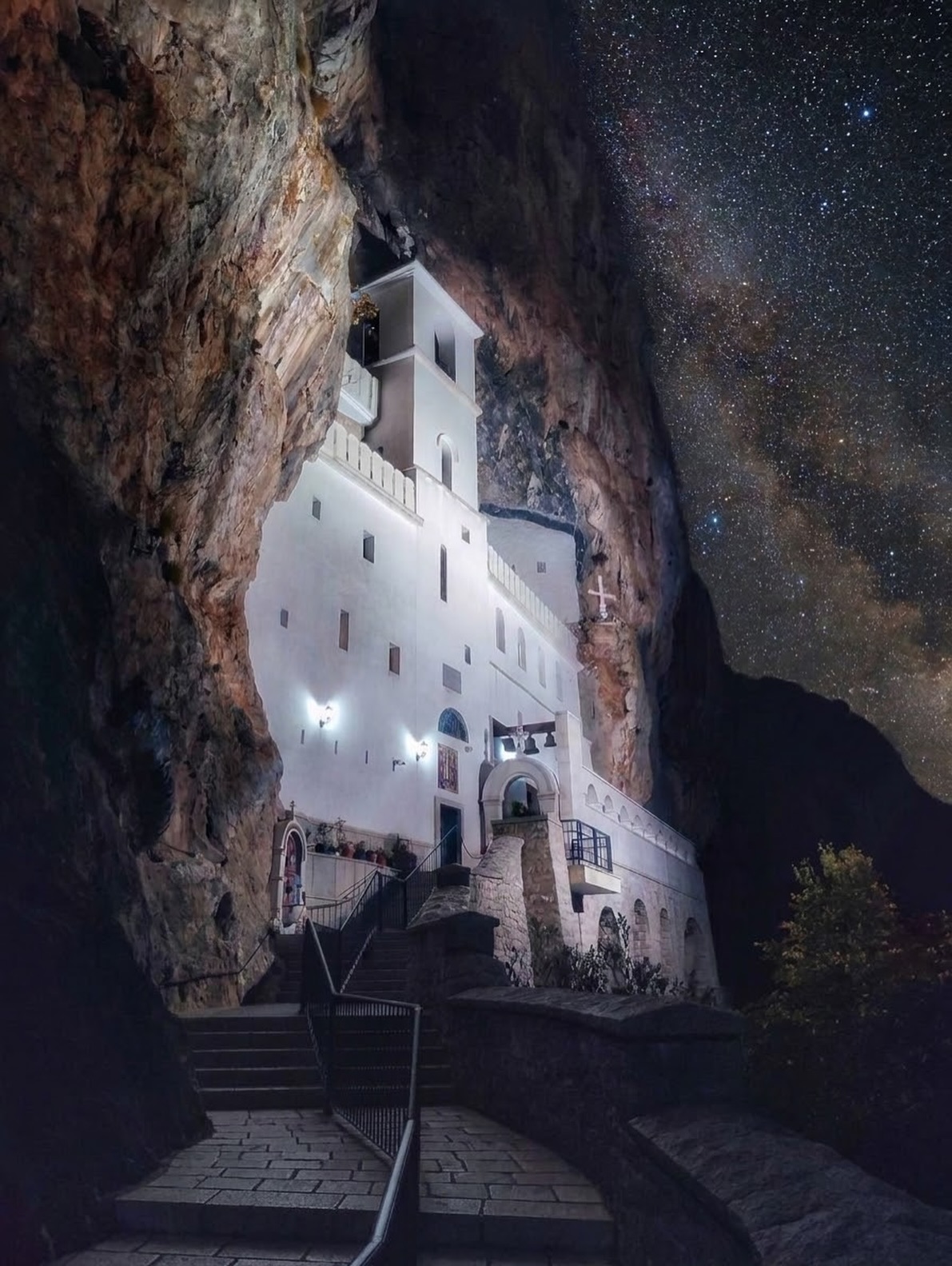
The final metaphor of the heart as a temple and prayer as incense draws on liturgical and biblical imagery, while the closing reference to the Lord's nearness to the brokenhearted cites Psalm 34:19 (LXX 33:19) / Psalm 51:19. The post is accompanied by a photograph credited to @vaske13 and tagged with references to Ostrog monastery in Nikšić, Montenegro.

  • Repentance defined as rebirth from God, return to true freedom, mortification of sin, beginning of innocence, and peace of heart and soul.
  • The soul that casts off earthly burdens and cries to God in silence encounters opened stones and divine light on the path to the heavenly kingdom.
  • The narrow, steep path of the heart that loves God is contrasted with the broad road; on it one stands alone with the Creator, finding peace the world cannot give or take.
  • The heart is urged to become a temple and prayer to rise as incense to the heavenly stars.
  • The reflection closes with the scriptural assurance that the Lord is near to the brokenhearted and humble in spirit (Psalm 34:19 / 51:19).
Read more

Mount Athos: The Garden of the Theotokos

The post describes Mount Athos as a center of Orthodox monasticism for over a thousand years. Known as the Garden of the Most Holy Theotokos, the Holy Mountain is dedicated to the Virgin Mary, honored by monks as its Abbess and Protectress. Generations of monks have devoted their lives to Christ there, continually seeking the intercessions of the Panagia.

  • Mount Athos has been a center of Orthodox monasticism for over a thousand years
  • It is known as the Garden of the Most Holy Theotokos
  • The Virgin Mary is honored as Abbess and Protectress of the Holy Mountain
  • Monks devote their lives to Christ and seek the Panagia's intercessions
  • The description is given in both English and Greek
Read more
Prayer Orthodoxy ® with Prayer Orthodoxy® Instagram

Christ's Promise on Persistent Prayer from Luke 11:9-10

The post presents Luke 11:9-10 where Jesus teaches that those who ask receive, those who seek find, and to those who knock the door will be opened. The author reflects that Christ calls believers to approach Him with faith, humility, and perseverance, urging them never to cease praying or seeking His presence, while trusting that God hears every prayer according to His divine will.

  • Jesus promises that persistent asking, seeking, and knocking will be answered
  • Believers should approach God with faith, humility, and perseverance
  • Prayer should be continuous and trust in God's will
  • The passage is presented in English and Greek
Read more
Prayer Orthodoxy ® with Come & See Instagram

Happiness found in seeking God's kingdom

The post contrasts the worldly pursuit of happiness with the Orthodox Christian understanding of true fulfillment. It presents three scenes: a monk whispering the Jesus Prayer among trees, a child resting in loving arms, and a church filled with the presence of God. The author suggests that happiness was never about acquiring more but about drawing closer to God. The reflection concludes with a citation of Matthew 6:33, "Seek first the kingdom of God."

  • The world tells us to chase happiness through having more.
  • True happiness appears as a monk praying, a child at rest, and a church alive with God's presence.
  • Happiness comes from drawing closer to God, not from accumulation.
  • The post cites Matthew 6:33: "Seek first the kingdom of God."
Read more

Greek-Australian recalls WWII brotherhood and prays for the fallen

A first-generation Greek-Australian reflects on the historical military bond between Australia and Greece. He describes how, separated by thousands of kilometres, the two nations share a brotherhood forged in sacrifice and the defence of freedom. During the darkest hours of Greece's history, Australian and New Zealand soldiers stood alongside Greek forces on foreign soil. Many Australians made the ultimate sacrifice on Greek soil, and many…

A first-generation Greek-Australian reflects on the historical military bond between Australia and Greece. He describes how, separated by thousands of kilometres, the two nations share a brotherhood forged in sacrifice and the defence of freedom. During the darkest hours of Greece's history, Australian and New Zealand soldiers stood alongside Greek forces on foreign soil.

Many Australians made the ultimate sacrifice on Greek soil, and many ordinary Greek men and women risked their lives to shelter and protect Australian servicemen separated from their comrades. The author notes that nearly 90 Greek Australians served at Gallipoli and on the Western Front during World War I. In 1941, Australian soldiers fought alongside Greek and Cretan forces against the German invasion, and local families took fatal risks to shelter Australians.

The author emphasizes that this bond is more than a chapter in history; it is a bond written in blood, remembered through generations, and honoured by two nations that understand the true cost of freedom. He expresses pride in his Greek heritage and gratitude for the life his family has built in Australia. He states that he will never forget the men who fought and fell, the Greeks who stood beside them, or the families who never saw their loved ones return.

The reflection concludes with a prayer for the repose of the souls of all men, women, and children who died for Australia in the two world wars and other conflicts, asking forgiveness for their voluntary and involuntary transgressions and that the Lord establish their souls where the just repose.

Key moments

  1. Nearly 90 Greek Australians served at Gallipoli and the Western Front during World War I.
  2. In 1941, Australian soldiers fought alongside the local population in Greece and Crete against the invading German army, and many Greek and Cretan families took fatal risks to shelter Australian soldiers.
  3. A prayer is offered for the repose of the souls of all men, women, and children who died for Australia in the two world wars and other conflicts, asking for the forgiveness of their voluntary and involuntary transgressions and that the Lord establish their souls where the just repose.
Read more
Prayer Orthodoxy ® with Live Orthodox Instagram

Saint Demetrios' myrrh still fragrant after a year

The author marks the feast of Saint Demetrios of Thessaloniki by recalling a visit to the saint's church in Thessaloniki last year. During that visit the author received holy myrrh from the saint's relics. The myrrh's fragrance has remained unchanged since then. The post ends with a feast-day greeting and a doxology.

  • Author visited the Holy Church of Saint Demetrios in Thessaloniki last year
  • Received holy myrrh from the saint's relics during the visit
  • The myrrh's fragrance has persisted to the present day
  • Post offered as a feast-day greeting for Saint Demetrios
  • Closes with "Glory to God for all things"
Read more
Prayer Orthodoxy ® with radioimlemesou Instagram

Metropolitan Athanasios: Our relationship with Christ is love, not ideology

Metropolitan Athanasios of Limassol explains that the Christian relationship with God is a relationship of love, not an ideology or a movement of followers. The Gospel is not an ideology. In the Church we learn to love Christ, and because we love Him we want to see Him and His holy form, as well as the forms of the saints, the friends of Christ. That is why the Church has holy icons depicting Christ. The Metropolitan recalls that the Church has…

Metropolitan Athanasios of Limassol explains that the Christian relationship with God is a relationship of love, not an ideology or a movement of followers. The Gospel is not an ideology. In the Church we learn to love Christ, and because we love Him we want to see Him and His holy form, as well as the forms of the saints, the friends of Christ.

That is why the Church has holy icons depicting Christ. The Metropolitan recalls that the Church has stated clearly that Christians do not worship icons, nor are icons idols. Instead, the faithful offer honorific and relative veneration to the icons that depict the Lord Christ and His friends, the saints.

Key moments

  1. Our relationship with God is a relationship of love, not a relationship between an ideology and its adherent.
  2. The Gospel is not an ideology.
  3. In the Church we learn to love Christ.
  4. Because we love Christ, we want to see Him; we have a need to see His holy form and the forms of the saints, the friends of Christ.
  5. Therefore we have holy icons that depict Christ.
  6. The Church said clearly that we do not worship icons, nor are icons idols.
  7. We venerate icons honorifically and relatively, with maternal veneration, giving honor to the holy icons that depict the Lord Christ and His friends, the saints.
Read more
Prayer Orthodoxy ® Instagram

Feast of St. Demetrios the Myrrh Streamer, Patron of Thessaloniki

The post announces the commemoration of the Holy Great Martyr St. Demetrios the Myrrh Streamer on October 26. He is identified as the patron saint and protector of Thessaloniki, Greece. The author asks for the saint's holy intercessions and extends name day wishes to those named Demetrios, Dimitris, Dimitras, and Demetrias. The message appears in both English and Greek, with the Greek text repeating the same information.

  • Commemoration of St. Demetrios the Myrrh Streamer on October 26
  • He is the patron saint and protector of Thessaloniki
  • Request for the saint's intercessions
  • Name day greetings for variations of the name Demetrios
  • Text provided in English and Greek
Read more

God Is With Us: From Bethlehem to Al-Karak

The post features a declaration in Arabic proclaiming "God is with us," drawing on the biblical promise of Isaiah 8:9-10. The speaker asserts that because God is present, the nations will ultimately be defeated despite any temporary victories. The proclamation spans from the birthplace of Christ in Bethlehem to Al-Karak, Jordan, a city with deep Christian history. The video expands on this theme: the speaker addresses the ends of the earth and…

The post features a declaration in Arabic proclaiming "God is with us," drawing on the biblical promise of Isaiah 8:9-10. The speaker asserts that because God is present, the nations will ultimately be defeated despite any temporary victories. The proclamation spans from the birthplace of Christ in Bethlehem to Al-Karak, Jordan, a city with deep Christian history.

The video expands on this theme: the speaker addresses the ends of the earth and the strong, declaring their defeat is certain because God remains with the faithful. This testimony reflects the Orthodox understanding of divine protection and the ultimate triumph of God's purpose over worldly powers. The phrase "God is with us" is a traditional Orthodox affirmation, often sung during Great Compline and associated with the Nativity.

The geographic reference connects the biblical narrative to the living Christian presence in the Holy Land and Jordan.

Key moments

  1. The speaker asserts that God is with them, therefore the nations will not overcome them.
  2. The speaker addresses the ends of the earth and the strong ones, stating they will be defeated and any temporary victory they achieve will ultimately be reversed because God is with the speaker.
Read more

Saint Tikhon the Athonite on humility and the Jesus Prayer

Saint Tikhon the Athonite (1884-1968) was a Russian ascetic who lived on Mount Athos and became the spiritual father of Saint Paisios. He dedicated his life to humility, repentance, and unceasing prayer. The post presents four sayings attributed to him. He taught that three prostrations offered with humility are better than a thousand prostrations made with arrogance.

He declared that only humility will save us. He called the Jesus Prayer, "Lord Jesus Christ, have mercy upon me!", the pure wheat. He also urged death to the world.

  • Saint Tikhon the Athonite (1884-1968), Russian ascetic of Mount Athos
  • Spiritual father of Saint Paisios
  • Life centered on humility, repentance, and unceasing prayer
  • "Better three prostrations with humility than 1,000 prostrations with arrogance."
  • "The prayer, 'Lord Jesus Christ, have mercy upon me!' is the pure wheat."
Read more
Prayer Orthodoxy ® with Jesus My Inspiration Instagram

St. Demetrios Foretells Nestor's Victory and Martyrdom

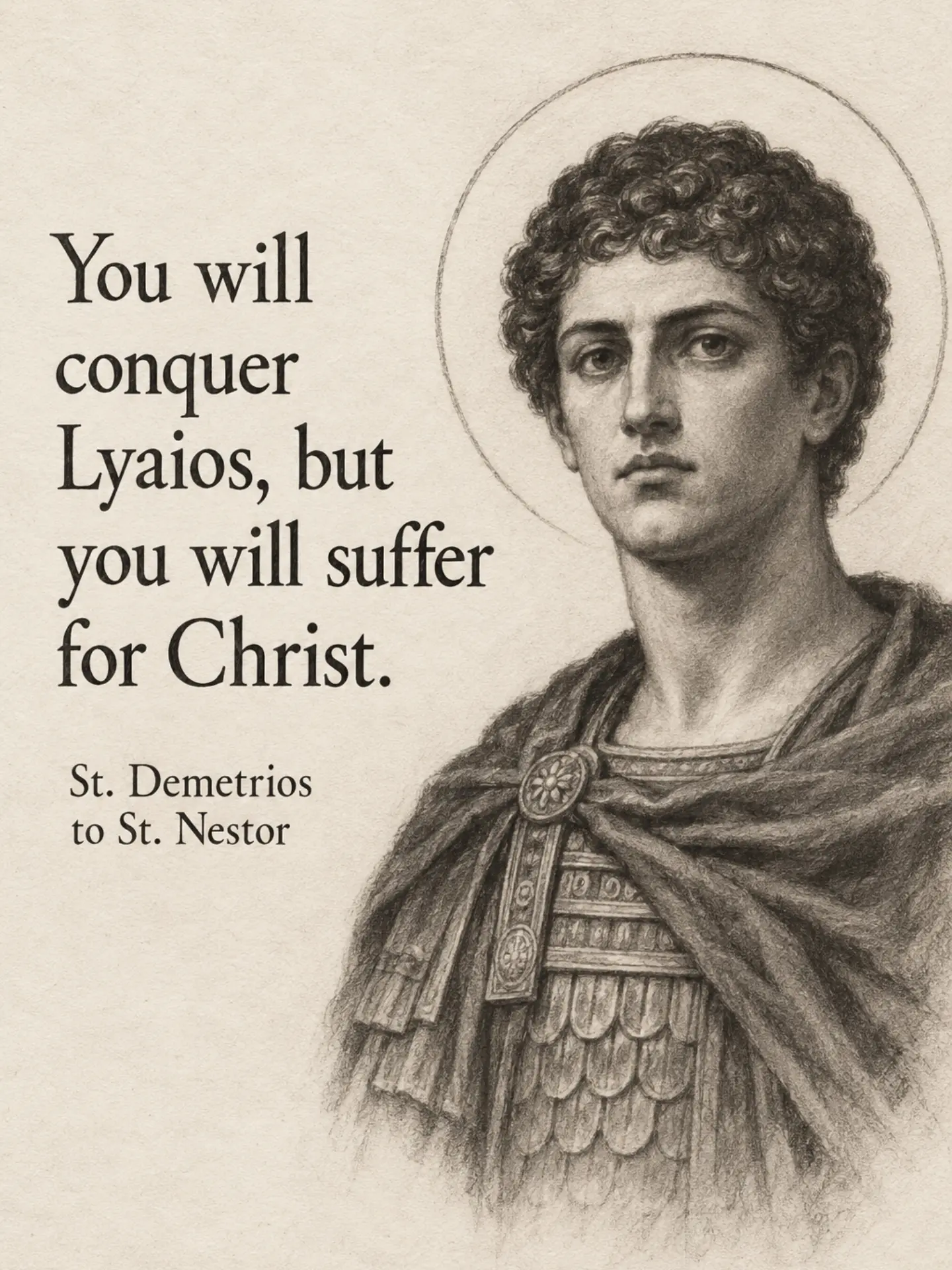
The Orthodox Church commemorates St. Demetrios the Myrrh-streamer of Thessaloniki on October 26. According to the tradition recorded in the post, St. Demetrios blessed the young Nestor before his contest with Lyaios. The saint foretold two outcomes: Nestor would conquer Lyaios, and he would suffer martyrdom for Christ. The image accompanying the post carries the direct words attributed to St. Demetrios: "You will conquer Lyaios, but you will…

The Orthodox Church commemorates St. Demetrios the Myrrh-streamer of Thessaloniki on October 26. According to the tradition recorded in the post, St. Demetrios blessed the young Nestor before his contest with Lyaios. The saint foretold two outcomes: Nestor would conquer Lyaios, and he would suffer martyrdom for Christ. The image accompanying the post carries the direct words attributed to St. Demetrios: "You will conquer Lyaios, but you will suffer for Christ."

This brief account highlights the spiritual dimension of Nestor's physical victory, the triumph was not an end in itself but a prelude to witness through death. The commemoration of St. Demetrios on this day brings to mind his role as a spiritual father who strengthened a young martyr, and the myrrh-streaming associated with his relics in Thessaloniki continues to draw veneration.

The post presents the core of the narrative without elaboration on the historical context of the games in Thessaloniki, the identity of Lyaios, or the later veneration of both saints.

  • St. Demetrios the Myrrh-streamer is commemorated on October 26
  • He blessed the young Nestor before his contest with Lyaios
  • St. Demetrios foretold Nestor's victory over Lyaios
  • St. Demetrios also foretold Nestor's martyrdom for Christ
  • The prophecy is quoted: "You will conquer Lyaios, but you will suffer for Christ"
Read more

Mount Athos: The Garden of the Theotokos and a millennium of monastic life

The post describes Mount Athos as the Garden of the Most Holy Theotokos, a center of Orthodox monasticism for over a thousand years. The Holy Mountain is dedicated to the Virgin Mary, whom the monks honor as its Abbess and Protectress. Generations of monks have devoted their lives to Christ there, continually seeking the Panagia's intercessions.

  • Mount Athos has been a center of Orthodox monasticism for over a thousand years
  • It is known as the Garden of the Theotokos, dedicated to the Virgin Mary
  • Monks honor the Theotokos as Abbess and Protectress of the Holy Mountain
  • Generations of monks have lived lives of prayer, fasting, and spiritual struggle
  • The post includes the prayer "Most Holy Theotokos, save us" in English and Greek
Read more
Prayer Orthodoxy ® with ☦︎ICXC•NIKA☦︎ Instagram

A sinner's return: mercy found in the pits of hell

1:27

The author describes a long journey back to Christ after years of pride, ambition, and wandering away. He calls it the ultimate betrayal, yet Christ called him back from what he describes as the pits of hell. He was not beyond God's reach, and God did not abandon him in darkness. Through mercy, God began to strengthen him. The journey remains unfinished. He must continue to endure, repent, and humble himself to become the husband, father, and…

The author describes a long journey back to Christ after years of pride, ambition, and wandering away. He calls it the ultimate betrayal, yet Christ called him back from what he describes as the pits of hell. He was not beyond God's reach, and God did not abandon him in darkness.

Through mercy, God began to strengthen him. The journey remains unfinished. He must continue to endure, repent, and humble himself to become the husband, father, and man Christ calls him to be, not by his own strength or will, but through grace and mercy. His family needs him to lead through love, sacrifice, prayer, and obedience to Christ, not through pride or self-righteousness.

He acknowledges he has a long way to go and remains a sinner in need of mercy. He prays for strength to endure, to carry his cross, to lead his family in Christ's truth, and to remain steadfast until death. He concludes with "Glory to God for all things."

  • Years of pride and wandering ended when Christ called the author back from despair
  • God's mercy, not the author's strength, began the restoration
  • The journey of repentance and humility continues daily
  • Family leadership must come through love, sacrifice, prayer, and obedience
  • The author prays for endurance to carry the cross and remain steadfast
Read more

St. Demetrios Cathedral: 5th-century basilica with relics and martyrdom crypt

The post describes the Cathedral of Saint Demetrios in Thessaloniki, Greece, one of the most important pilgrimage destinations in Orthodox Christianity. The basilica was constructed in the 5th century on the site traditionally linked to the martyrdom of Saint Demetrios, the Great Martyr, who suffered in 306 AD. He is honored as the patron saint and protector of Thessaloniki. Below the church lies the ancient crypt associated with his…

The post describes the Cathedral of Saint Demetrios in Thessaloniki, Greece, one of the most important pilgrimage destinations in Orthodox Christianity. The basilica was constructed in the 5th century on the site traditionally linked to the martyrdom of Saint Demetrios, the Great Martyr, who suffered in 306 AD. He is honored as the patron saint and protector of Thessaloniki.

Below the church lies the ancient crypt associated with his imprisonment and martyrdom, a place of deep veneration. The cathedral also houses the sacred relics of Saint Demetrios, which draw Orthodox faithful from around the world. His feast day is celebrated annually on October 26. The post includes a Greek translation of the same historical and devotional details.

Five images accompany the text: the first shows the cathedral's exterior or a title card; the second depicts an ornate altar area with a dome and rows of wooden chairs; the third reveals the interior with a dome mosaic of the Virgin Mary and Child, lit by large windows; the fourth captures a close-up of the apse with mosaics and icons, highlighting architectural details; the fifth presents the underground crypt of martyrdom.

The English and Greek texts are nearly identical, providing the same historical timeline, spiritual significance, and liturgical information. The images collectively illustrate the cathedral's architectural grandeur, its iconographic program centered on the Theotokos and the saint, and the subterranean space where the martyr's final witness occurred.

The post concludes with the invocation, "Saint Demetrios, pray unto God for us," in both English and Greek.

  • Cathedral built in the 5th century over the site of Saint Demetrios' martyrdom in 306 AD
  • Saint Demetrios is the patron saint and protector of Thessaloniki
  • Ancient crypt beneath the church linked to his imprisonment and martyrdom
  • Sacred relics of Saint Demetrios are housed in the cathedral
  • Feast day celebrated on October 26
Prayer Orthodoxy ® with Live Orthodox Instagram

St. Anthony the Great on love casting out fear

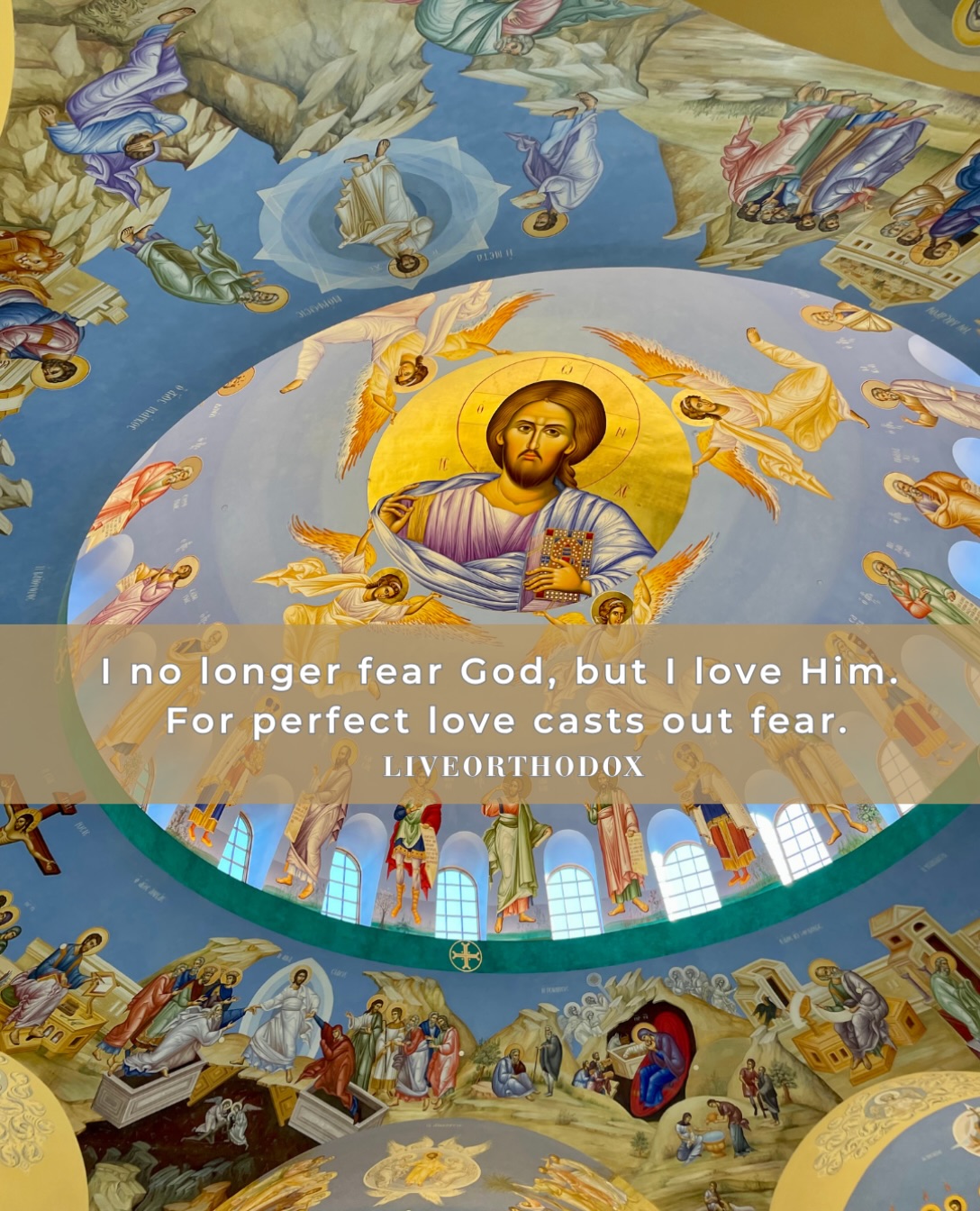
The post shares a saying attributed to St. Anthony the Great describing how a believer's relationship with God changes. As one grows closer to God, dread and terror of damnation give way to intimate affection. The internal panic of punishment disappears when a person truly knows and loves God.

The accompanying image text quotes the saint directly: "I no longer fear God, but I love Him. For perfect love casts out fear," referencing 1 John 4:18. The passage presents the classic monastic teaching that perfect love removes servile fear.

  • St. Anthony the Great teaches that closeness to God replaces fear with love
  • The dread of damnation disappears through true knowledge of God
  • Direct quote: "I no longer fear God, but I love Him"
  • References 1 John 4:18: "perfect love casts out fear"
  • Illustrates the monastic distinction between servile fear and filial love
Read more