WeOrthodox
EN UA

Eastern Orthodoxy Daily He/Who/Is

Instagram ↗ 112 discussions

Scripture, Saints & Satire Left Rome for Home 📍Illinois USA📍 ╬☦️ Dyophysite Eastern Orthodox ☦️╬

Holy Prophet Obadiah: Protector of Prophets and Voice of Judgment

The post presents the Holy Prophet Obadiah, commemorated on November 19, as one of the Twelve Minor Prophets of the Old Testament. It recounts that Obadiah served in the household of King Ahab and acted to protect one hundred prophets from the persecution initiated by Queen Jezebel. He hid these prophets in caves and supplied them with food and water. The post then turns to the content of Obadiah's prophetic book, stating that it condemns pride,…

The post presents the Holy Prophet Obadiah, commemorated on November 19, as one of the Twelve Minor Prophets of the Old Testament. It recounts that Obadiah served in the household of King Ahab and acted to protect one hundred prophets from the persecution initiated by Queen Jezebel. He hid these prophets in caves and supplied them with food and water.

The post then turns to the content of Obadiah's prophetic book, stating that it condemns pride, injustice, and betrayal, while proclaiming the coming judgment of God and the ultimate triumph of His Kingdom. A specific verse is quoted from Obadiah 1:15: "For the day of the Lord upon all the nations is near; as you have done, it shall be done to you."

  • Commemorated on November 19 as one of the Twelve Minor Prophets
  • Served in King Ahab's household and protected 100 prophets from Queen Jezebel's persecution
  • Hid the prophets in caves and provided them with food and water
  • His prophetic book condemns pride, injustice, and betrayal
  • Proclaims God's coming judgment and the triumph of His Kingdom, citing Obadiah 1:15

Accepting the Canon While Rejecting the Church That Witnessed It

The speaker argues there is no factual historical evidence that John wrote the Gospel attributed to him. He directs the listener to early church history and apostolic succession, the chain of disciples who learned from John and taught others, as the basis for the text's authority. The speaker then criticizes a figure known as "The God Logic" for appealing to the early church to defend the Bible while rejecting its teaching on the real presence…

The speaker argues there is no factual historical evidence that John wrote the Gospel attributed to him. He directs the listener to early church history and apostolic succession, the chain of disciples who learned from John and taught others, as the basis for the text's authority. The speaker then criticizes a figure known as "The God Logic" for appealing to the early church to defend the Bible while rejecting its teaching on the real presence in the Eucharist and the authority of bishops.

He contends that if the apostolic church was wrong about its doctrines, there is no reason to trust its testimony about Scripture. The argument concludes that one cannot reject the very church whose witness undergirds the canon.

Key moments

  1. The speaker states there is no factual historical evidence that John wrote the Gospel attributed to him.
  2. The speaker directs the listener to early church history and the concept of apostolic succession, those who knew the disciples and their disciples.
  3. The speaker describes apostolic succession as people who learned from John becoming teachers themselves.
  4. The speaker accuses "The God logic" of relying on the early church to defend the Bible but rejecting it when it contradicts his theology.
  5. The speaker notes that "The God logic" appeals to apostolic succession but dismisses the church's teaching on the real presence in the Eucharist and episcopal authority.
  6. The speaker argues that if the apostolic church was wrong about its teachings, one cannot be certain it was right about the Bible.
  7. The speaker concludes that you cannot reject the very church whose testimony you depend on to defend your scripture.
10 opinions in the discussion Only leans on apostolic succession when convenient, tosses it when it's not Read the discussion

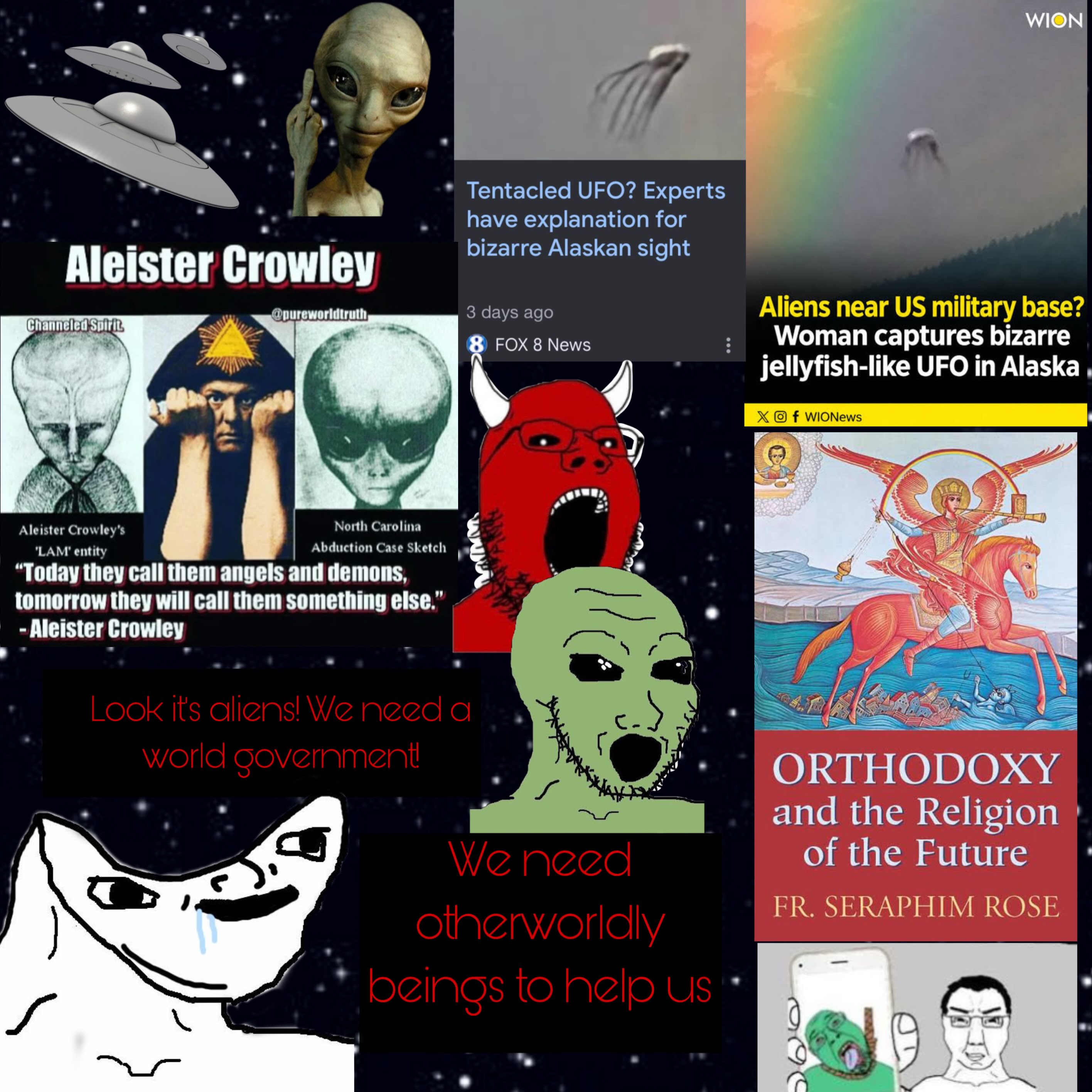
Fr. Seraphim Rose on UFOs as demonic deception

The post presents a series of images connecting modern UFO phenomena to occult practices and Fr. Seraphim Rose's critique in "Orthodoxy and the Religion of the Future." It begins with Aleister Crowley, the influential occultist who claimed contact with an entity called LAM, depicted in a drawing that resembles later "grey alien" imagery. News screenshots show recent jellyfish-like UFO sightings near military bases in Alaska. A sketch from a…

The post presents a series of images connecting modern UFO phenomena to occult practices and Fr. Seraphim Rose's critique in "Orthodoxy and the Religion of the Future." It begins with Aleister Crowley, the influential occultist who claimed contact with an entity called LAM, depicted in a drawing that resembles later "grey alien" imagery.

News screenshots show recent jellyfish-like UFO sightings near military bases in Alaska. A sketch from a North Carolina abduction case and the caption "Channelled Spirit" link alien encounters to spirit channeling. A quote attributed to Crowley states: "Today they call them angels and demons, tomorrow they will call them something else."

The final image displays the cover of Fr. Seraphim Rose's book alongside text suggesting a false alien disclosure could be used to justify world government. The author's caption asserts that aliens are "fake gay and demonic" and that New Age occultists promote them as intelligent helpers. The discussion centers on the Orthodox view that UFOs and alien encounters are demonic deceptions preparing humanity for a counterfeit spirituality and globalist control, a theme Fr. Seraphim developed from patristic teaching on prelest (spiritual deception).

  • Aleister Crowley's LAM entity resembles modern grey alien imagery
  • Recent UFO sightings in Alaska shown near military installations
  • Abduction sketches and channeling linked to occult spirit contact
  • Crowley quote suggests rebranding of demons as aliens
  • Fr. Seraphim Rose's work frames UFOs as end-times deception for world government
Read more

Christ's Establishment of the Church as Institution in Matthew 18

A dialogue examines whether Christ established an institution. One speaker argues that religious systems and institutions kill the spirit of God and questions whether Christ founded an institution. The other responds that God established a way of salvation. The first speaker then cites Matthew 18 as explicit evidence that Christ did establish an institution. He outlines the three-step process Jesus gives for dealing with a sinning brother: first…

A dialogue examines whether Christ established an institution. One speaker argues that religious systems and institutions kill the spirit of God and questions whether Christ founded an institution. The other responds that God established a way of salvation. The first speaker then cites Matthew 18 as explicit evidence that Christ did establish an institution.

He outlines the three-step process Jesus gives for dealing with a sinning brother: first confront him privately, then bring two or three witnesses, and finally bring the matter to the church. The speaker argues that this third step, bringing the matter to the church, demonstrates an institution that transcends the body of believers, concluding that the church is both a body and an institution.

Key moments

  1. The first speaker claims that religious systems and institutions are the things that kill the spirit of God in the world.
  2. The first speaker asks whether Christ established an institution.
  3. The second speaker answers that God established a way of salvation.
  4. The first speaker argues that Christ established an institution, pointing to Matthew chapter 18 as explicit evidence.
  5. The first speaker outlines the steps in Matthew 18: go to the brother privately, then bring two or three witnesses, which constitutes a church, and if they refuse to listen, bring them to the church.
  6. The first speaker concludes that this third category demonstrates an institution transcending just the body, affirming that the church is both a body and an institution.
4 opinions in the discussion This argument doesn't get enough credit. Any kind of church discipline that actually does anything requires being the exclusive church. Read the discussion

Four Biblical Habits for Spiritual and Mental Strength

The post outlines four biblical habits that build mental strength through surrender to Christ rather than self-reliance. The first habit is patience with God's timing, citing Ecclesiastes 7:8 that the patient in spirit is better than the proud in spirit. Unanswered prayers may require preparation and spiritual maturity, and God not answering as expected does not mean He has not heard. The second habit is accepting correction with humility,…

The post outlines four biblical habits that build mental strength through surrender to Christ rather than self-reliance. The first habit is patience with God's timing, citing Ecclesiastes 7:8 that the patient in spirit is better than the proud in spirit. Unanswered prayers may require preparation and spiritual maturity, and God not answering as expected does not mean He has not heard.

The second habit is accepting correction with humility, referencing Proverbs 15:31 that the ear that hears rebukes abides among the wise. Not every criticism is an attack; God sometimes uses others to expose weaknesses we refuse to see, and the Orthodox Church teaches humility is essential for spiritual growth. The third habit is remaining faithful without seeing results, walking by faith not by sight as stated in 2 Corinthians 5:7. Real faith means staying faithful during seasons when fasting, prayer, and church attendance do not change circumstances, trusting God even when we do not understand what He allows.

The fourth habit is finding strength through weakness, because Christ says His grace is sufficient and His strength is made perfect in weakness (2 Corinthians 12:9). Mental strength is not about becoming emotionless or pretending nothing affects us, but about developing patience, humility, perseverance, and unwavering faith in Jesus Christ.

Key moments

  1. 0:00 The first habit is learning patience with God's timing, because Ecclesiastes 7:8 says the patience of spirit is better than the proud in spirit.
  2. 0:00 The thing you are praying for may require patience, preparation, and spiritual maturity, and God not answering as expected does not mean he has not heard you.
  3. 0:32 The second habit is accepting correction with humility, since Proverbs 15:31 teaches that the ear hearing rebukes abides among the wise.
  4. 0:32 Not every criticism is an attack; God sometimes uses others to expose weaknesses we refuse to see, and the Orthodox Church teaches humility is essential for spiritual growth.
  5. 1:05 The third habit is remaining faithful without seeing results, walking by faith not by sight as 2 Corinthians 5:7 states.
  6. 1:05 Real faith means staying faithful during seasons when fasting, prayer, and church attendance do not change circumstances, trusting God even when you do not understand what he allows.
  7. 1:40 The fourth habit is finding strength through weakness, because Christ says his grace is sufficient and his strength is made perfect in weakness (2 Corinthians 12:9).
  8. 1:40 Mental strength is not about becoming emotionless or pretending nothing affects you, but about developing patience, humility, perseverance, and unwavering faith in Jesus Christ.
Read more

Why Orthodox Christians "write" icons instead of painting them

The post explains the theological reasoning behind the Orthodox terminology of "writing" icons rather than "painting" them. It states that iconography is understood as a sacred theological expression, not merely an artistic practice. An icon functions as a visual proclamation of the Gospel, communicating the faith through sacred images.

Just as the Gospel is written in words, the icon is written in images. This linguistic distinction reflects the belief that iconography participates in the same revelatory work as Scripture.

  • Iconography is a sacred theological expression, not just art
  • Icons are visual proclamations of the Gospel
  • The Gospel is written in words; icons are written in images
  • The phrase "write an icon" reflects this theological understanding
  • The terminology distinguishes Orthodox iconography from secular painting
Read more

How three traditions answer which church is true after a split

The speaker compares how Catholics, Protestants, and Eastern Orthodox identify the true church after a split. Catholics rely on the Pope's authority as external confirmation. Protestants rely on private scriptural interpretation to judge each church. Eastern Orthodoxy requires submission to the bishop and does not allow private scriptural judgment of the church. The speaker then challenges the Catholic and Protestant approaches. He notes that…

The speaker compares how Catholics, Protestants, and Eastern Orthodox identify the true church after a split. Catholics rely on the Pope's authority as external confirmation. Protestants rely on private scriptural interpretation to judge each church.

Eastern Orthodoxy requires submission to the bishop and does not allow private scriptural judgment of the church. The speaker then challenges the Catholic and Protestant approaches. He notes that the Western Schism required a council to resolve competing papal claims, which challenges the Catholic method.

He also notes that when churches disagree, Protestants cannot determine whose scriptural interpretation is correct. Orthodox Christians instead appeal to the Holy Spirit working through the entire church, not one man's authority or individual interpretation. Through scripture, apostolic tradition, the fathers, and ecumenical councils, they can judge whether bishops remained faithful to the teachings handed down by the apostles.

Key moments

  1. 0:00 The question is how to know which side of a church split is the true church.
  2. 0:00 Catholics identify the true church by following the Pope as external confirmation.
  3. 0:00 Protestants identify the true church by privately judging each church against scripture.
  4. 0:00 Eastern Orthodoxy requires submission to the bishop and does not allow private scriptural judgment of the church.
  5. 0:00 The Western Schism required a council to resolve competing papal claims, challenging the Catholic method.
  6. 0:00 When churches disagree, Protestants cannot determine whose scriptural interpretation is correct.
  7. 0:00 Orthodox Christians appeal to the Holy Spirit working through the entire church, not one man's authority or individual interpretation.
  8. 0:37 Through scripture, apostolic tradition, the fathers, and ecumenical councils, we can judge whether bishops remained faithful to the teachings handed down by the apostles.
15 opinions in the discussion Beautifully put. Papalists and prots don't understand the EO position and strawman like crazy Read the discussion

Elder Joseph of Vatopedi: Hesychastic Life and Sayings

The post presents a brief biography of Elder Joseph of Vatopedi (1921-2009), a renowned Athonite elder and spiritual father. It describes his early pursuit of a life devoted to Christ, his monastic tonsure on Mount Athos, and his discipleship under Elder Joseph the Hesychast. The text outlines his intense ascetic struggle, unceasing prayer, obedience, fasting, and renunciation of worldly comforts, all within the hesychastic tradition centered on…

The post presents a brief biography of Elder Joseph of Vatopedi (1921-2009), a renowned Athonite elder and spiritual father. It describes his early pursuit of a life devoted to Christ, his monastic tonsure on Mount Athos, and his discipleship under Elder Joseph the Hesychast. The text outlines his intense ascetic struggle, unceasing prayer, obedience, fasting, and renunciation of worldly comforts, all within the hesychastic tradition centered on the Jesus Prayer.

Through years of spiritual discipline, solitude, and obedience, he cultivated humility, patience, and continual remembrance of God, becoming an example of authentic Athonite spirituality. As a spiritual father, he guided many monks and helped renew the monastic brotherhood of Vatopedi Monastery. The post concludes that his life demonstrates true spiritual greatness lies not in worldly recognition but in humility, repentance, prayer, and surrender to God's will, and that his legacy witnesses to the enduring beauty of Orthodox monastic tradition.

Accompanying the biography are four sayings attributed to the elder: first, that nothing done in this world is ever lost, for whatever a person does here they will find in the life to come; second, that despondency is a dreadful thing that must never be allowed a place within us; third, that we receive grace when we do not judge others, and if we do not practice love, grace does not draw near; fourth, that we should embrace the love of labor, for it is the mightiest weapon against the devil and reveals the true meaning of the cross. A black-and-white portrait of the elder holding a cane is also included.

  • Elder Joseph of Vatopedi (1921-2009) was an Athonite monk and disciple of Elder Joseph the Hesychast.
  • He lived a life of intense asceticism, unceasing prayer, and the Jesus Prayer in the hesychastic tradition.
  • As spiritual father, he guided many monks and helped renew Vatopedi Monastery.
  • His sayings address the eternal value of deeds, the danger of despondency, grace through non-judgment and love, and labor as a weapon against the devil.
  • A portrait of the elder accompanies the post.
Read more

Jesus Prayer as spiritual weapon: scriptural roots and desert fathers' practice

The speaker urges using the Jesus Prayer with a prayer rope during spiritual attack. He says that when attacked, one should take up the prayer rope and say the Jesus Prayer patiently until the Lord draws near. He cites Saint Paisius the Athonite, who called each knot ammunition and the large knots heavy artillery, and said the name of Jesus causes demons to erupt in fire. He also cites Saint Anthony the Great, who saw devils scorched by the sign…

The speaker urges using the Jesus Prayer with a prayer rope during spiritual attack. He says that when attacked, one should take up the prayer rope and say the Jesus Prayer patiently until the Lord draws near. He cites Saint Paisius the Athonite, who called each knot ammunition and the large knots heavy artillery, and said the name of Jesus causes demons to erupt in fire.

He also cites Saint Anthony the Great, who saw devils scorched by the sign of the cross and the name of Jesus. The speaker introduces the Jesus Prayer for those unfamiliar and explains that each phrase comes directly from Scripture: "Lord Jesus Christ" reflects Romans 10:9, "Son of God" reflects Matthew 16:16, and "have mercy on me a sinner" reflects Luke 18:13. He traces the practice to fourth-century Egyptian desert fathers who used short repeated prayers to fulfill Paul's command to pray without ceasing.

This developed into the Jesus Prayer, later formalized with prayer ropes. The rope moves one knot per prayer to keep the mind contemplative. The prayer is not empty repetition but Scripture, repentance, and remembrance of Christ condensed.

Saint John Climacus advises uniting the remembrance of Jesus to every breath to know the value of stillness. The speaker also mentions a partnership with Theoria for Church Fathers' writings.

Key moments

  1. 0:00 Take up the prayer rope when attacked and say the Jesus prayer patiently until the Lord draws near; Saint Paisius the Athonite called each knot ammo and his large knots heavy artillery, and the name of Jesus causes demons to erupt in fire; Saint Anthony the Great saw devils scorched by the sign of the cross and the name of Jesus.
  2. 0:36 Fight back by calling on God's name; the Jesus prayer is introduced for those unfamiliar, and each part is drawn from Scripture.
  3. 1:07 The scriptural sources are identified: "Lord Jesus Christ" from Romans 10:9, "Son of God" from Matthew 16:16, and "have mercy on me a sinner" from Luke 18:13.
  4. 1:42 Fourth-century Egyptian desert fathers used short repeated prayers to fulfill Paul's command to pray without ceasing, which developed into the Jesus prayer; the prayer rope moves one knot per prayer to keep the mind contemplative; the prayer is not empty repetition but Scripture, repentance, and remembrance of Christ condensed; Saint John Climacus says to unite the remembrance of Jesus to every breath to know the value of stillness; the speaker mentions a partnership with Theoria for Church Fathers' writings.
8 opinions in the discussion The Jesus Prayer is an ICBM on the Demons. I challenge anyone to grab a prayer rope, throw your phone across the room and go for a 20 minute walk saying it while you count the beads like… Read the discussion

Fr. Seraphim Rose and Saints: UFOs Are Demonic Deceptions

The post gathers Orthodox teaching on UFO phenomena, identifying them as demonic deceptions rather than extraterrestrial visitations. It begins with a meme that contrasts an imagined atheist expectation of Christian panic with an actual Orthodox response: "Children, according to the continuous teaching of the Church these aliens are demons. Now get your prayer ropes and burn these demons in the name of Christ! Kyrie Eleison." The core of the…

The post gathers Orthodox teaching on UFO phenomena, identifying them as demonic deceptions rather than extraterrestrial visitations. It begins with a meme that contrasts an imagined atheist expectation of Christian panic with an actual Orthodox response: "Children, according to the continuous teaching of the Church these aliens are demons.

Now get your prayer ropes and burn these demons in the name of Christ! Kyrie Eleison." The core of the post consists of quotations from recognized elders and saints. Father Seraphim Rose, an American Orthodox monk whose glorification process was blessed by ROCOR on May 5, 2026, devoted a chapter of his 1975 book "Orthodoxy and the Religion of the Future" to UFOs.

He writes that case histories of people drawn into contact with UFOs reveal characteristics of involvement with demons in the occult realm, and that each close encounter has the specific purpose of deceiving the individual and leading him to spiritual confusion and disorientation. His conclusion is direct: "The manifestations of today's flying saucers are quite within the technology of demons.

Indeed, nothing else can explain them as well." Father Seraphim compares modern UFO sightings to demonic apparitions described in the lives of saints, noting the same pattern of solid-looking beings and objects that materialize and dematerialize, always aiming to awe, confuse, and seduce the soul away from Christ. Saint Gabriel Urgebadze of Georgia (reposed 1995) warns that during the time of the Antichrist the strongest temptation will be anticipation of salvation from the cosmos, from humanoid extraterrestrials that are actually demons, and advises rarely looking up at the sky because the signs might be deceptive.

Saint Paisios the Athonite states: "You should know that these are all demonic things, which take various forms. There is no life on another planet!" The discussion turns on the Orthodox understanding of spiritual warfare, the interpretation of modern phenomena through patristic demonology, and the authority of contemporary saints in discerning the signs of the times.

  • The post presents a meme contrasting atheist and Orthodox Christian reactions to the hypothetical discovery of alien life.
  • Fr. Seraphim Rose (glorification process blessed by ROCOR in 2026) teaches in "Orthodoxy and the Religion of the Future" that UFOs are demonic phenomena, not extraterrestrial spacecraft.
  • Fr. Seraphim compares modern UFO encounters to demonic apparitions in saints' lives, noting identical patterns of materialization and deception.
  • St. Gabriel Urgebadze warns that in the Antichrist era the greatest temptation will be false salvation from cosmic humanoids, which are demons.
  • St. Paisios the Athonite affirms that UFO phenomena are demonic and that there is no life on other planets.
Read more

Trusting God when He seems silent: faith tested by suffering

The speaker asks how anyone knows they truly trust God if their faith has never been tested. It is easy to believe when life goes well, but faith is proven when prayers go unanswered, loved ones are lost, and God seems silent. James 1:2-3 teaches that trials produce patience, and the Orthodox Church sees suffering endured with faith as spiritual purification, like gold refined by fire. Job lost everything yet declared, "Though he slay me, yet I…

The speaker asks how anyone knows they truly trust God if their faith has never been tested. It is easy to believe when life goes well, but faith is proven when prayers go unanswered, loved ones are lost, and God seems silent. James 1:2-3 teaches that trials produce patience, and the Orthodox Church sees suffering endured with faith as spiritual purification, like gold refined by fire.

Job lost everything yet declared, "Though he slay me, yet I will trust him," showing trust based on who God is, not on understanding circumstances. The speaker distinguishes believing God exists from remaining faithful to Him, noting even demons believe, as James 2:19 states. He admits his own faith is still being refined through humility, obedience, and repentance, but he has no doubt Christ is real and loves him; his struggle is learning to love Christ and stay faithful when life does not make sense.

Key moments

  1. 0:00 Faith is only truly tested when life falls apart, when prayers go unanswered, loved ones are lost, and God seems silent.
  2. 0:37 James 1:2-3 says to count trials as joy because the testing of faith produces patience, and the Orthodox Church teaches that suffering endured with faith becomes spiritual purification, like gold refined by fire.
  3. 1:09 Job lost his possessions, children, and health, yet declared, "Though he slay me, yet I will trust him," trusting God because of who He is, not because he understood his suffering.
  4. 1:09 There is a difference between believing God exists and remaining faithful to Him; even demons believe God exists, as James 2:19 states.
  5. 1:40 The speaker acknowledges his faith is still being refined through humility, obedience, and repentance, but he has no doubt Jesus Christ is real and loves him.
  6. 1:40 His greatest struggle is not believing Christ exists, but learning to love Him and remain faithful when carrying a cross he never asked for.
Read more

Four Saints on Prayer, Humility, Forgiveness, and Fasting

The post collects four quotations from Orthodox saints that address aspects of spiritual life. St. Barsanuphius of Optina speaks to the experience of prayer becoming inattentive and mechanical. He advises against discouragement and points out that at the hour of prayer with the name of the Lord Jesus Christ, even the mouth is sanctified. St. Isaac the Syrian, a seventh-century father, describes a pattern in which God allows greater temptations…

The post collects four quotations from Orthodox saints that address aspects of spiritual life. St. Barsanuphius of Optina speaks to the experience of prayer becoming inattentive and mechanical. He advises against discouragement and points out that at the hour of prayer with the name of the Lord Jesus Christ, even the mouth is sanctified.

St. Isaac the Syrian, a seventh-century father, describes a pattern in which God allows greater temptations to come upon a person who begins to have great ideas about himself. The purpose of these temptations is to defeat the person so that he is humbled and seeks God's help again. St. Silouan the Athonite formulates a law connecting the forgiveness of others to the forgiveness of God.

He states that if you forgive, it means God has forgiven you, but if you do not forgive your brother, it means your sin remains with you. St. Basil the Great redefines true fasting as more than abstinence from food. He lists estrangement from evil, temperance of tongue, abstinence from anger, separation from desires, slander, falsehood, and perjury, and says that privation of these is true fasting.

  • St. Barsanuphius of Optina: inattentive prayer should not discourage; invoking Jesus' name sanctifies the mouth
  • St. Isaac the Syrian: God permits greater temptations to humble those who think highly of themselves
  • St. Silouan the Athonite: forgiveness of others is the sign of God's forgiveness; withholding forgiveness retains sin
  • St. Basil the Great: true fasting is abstinence from evil, anger, slander, falsehood, and perjury, not only from food
Read more

Trinity defense cites early heresies and church continuity

A video presents a debate on the Trinity. One speaker identifies as a Christian who rejects the Trinity, arguing it contradicts the Bible and urging others to reject it as well. Another speaker responds that denying the Trinity means rejecting Christ and the historic teaching of the church. The defender cites two second-century errors: Theodotus, who denied Christ's divinity and was excommunicated, and Noetus, who denied the distinction between…

A video presents a debate on the Trinity. One speaker identifies as a Christian who rejects the Trinity, arguing it contradicts the Bible and urging others to reject it as well. Another speaker responds that denying the Trinity means rejecting Christ and the historic teaching of the church. The defender cites two second-century errors: Theodotus, who denied Christ's divinity and was excommunicated, and Noetus, who denied the distinction between Father and Son and was refuted by Saint Hippolytus using Scripture.

The speaker concludes by challenging the idea that the Spirit-guided church erred on God's identity while a modern individual claims to have corrected it after 2,000 years.

Key moments

  1. I'm a Christian and I don't believe in the Trinity. And neither should you because the Trinity contradicts the Bible.
  2. You're not a Christian then, by rejecting who God is, you're denying what it means to follow Christ. You are rejecting Scripture and what the church has always taught.
  3. In the second century, Theodotus denied Christ's divinity and was excommunicated.
  4. In the second century, Noetus denied the distinction between Father and Son, Saint Hippolytus refuted this with Scripture.
  5. So why would we believe the church guided by the Holy Spirit erred on God's identity, but you figured it all out 2,000 years later.
Read more

Debate on RCC origins, apostasy, and baptismal regeneration

A video presents a debate between two participants on when the Roman Catholic Church began and when it fell into apostasy. One participant dates the church's origin to 380 AD and places its apostasy in the seventh century with the development of the papacy, which he says was retroactively fabricated. The other participant cites the 381 Nicene-Constantinopolitan Creed's affirmation of "one holy orthodox Catholic Church and one baptism for the…

A video presents a debate between two participants on when the Roman Catholic Church began and when it fell into apostasy. One participant dates the church's origin to 380 AD and places its apostasy in the seventh century with the development of the papacy, which he says was retroactively fabricated. The other participant cites the 381 Nicene-Constantinopolitan Creed's affirmation of "one holy orthodox Catholic Church and one baptism for the remission of sins" and asks whether the first participant accepts it.

The first participant accepts the creed but reinterprets the preposition "for" as meaning "because of" remission of sins rather than "for the purpose of" remission. The second participant presses whether seventh-century Christians practiced baptism in a manner matching Eastern Orthodoxy or the first participant's view, noting the first participant is unsure.

The second participant asserts a unanimous consensus in the first seven centuries on baptismal regeneration, listing Justin Martyr, Tertullian, Polycarp, Clement, Irenaeus, and Ignatius as witnesses. He dismisses the first participant as a modern voice ("Taco Talks") contradicting seven centuries of unanimous church consensus.

Key moments

  1. 0:00 One participant claims the Roman Catholic Church was created in 380 and fell into apostasy around the seventh century when the papacy became official and was retroactively fabricated.
  2. 0:31 The other participant cites the 381 Nicene-Constantinopolitan Creed's statement "we believe in one holy orthodox Catholic Church and one baptism for the remission of sins" and asks if the first participant accepts it.
  3. 0:31 The first participant accepts the creed but interprets "for" as "because of" remission of sins, not "for the purpose of" remission.
  4. 1:08 The second participant asks whether seventh-century Christians practiced baptism in a way matching Eastern Orthodoxy or the first participant's view, noting the first participant is unsure.
  5. 1:08 The second participant asserts there is unanimous consensus in the first seven centuries, listing Justin Martyr, Tertullian, Polycarp, Clement, Irenaeus, and Ignatius as agreeing with baptismal regeneration.
  6. 1:44 The second participant mocks the first participant as "Taco Talks" from 2026 contradicting seven centuries of unanimous church consensus on baptism.
Read more

Apostles are called by Christ, not made by ceremony

The post argues that apostles are not created through modern rituals such as oil ceremonies, speaking in tongues, or congregational declarations. They were personally chosen and commissioned by Christ, as stated in John 15:16. When Judas was replaced, the Apostles selected Matthias from those who had accompanied Christ's ministry and could testify to His Resurrection, establishing a precedent recorded in Acts 1:21-26. St. Paul likewise defended…

The post argues that apostles are not created through modern rituals such as oil ceremonies, speaking in tongues, or congregational declarations. They were personally chosen and commissioned by Christ, as stated in John 15:16. When Judas was replaced, the Apostles selected Matthias from those who had accompanied Christ's ministry and could testify to His Resurrection, establishing a precedent recorded in Acts 1:21-26. St. Paul likewise defended his apostleship by appealing to his encounter with the risen Christ in 1 Corinthians and Galatians.

The early Church continued the Apostles' ministry through bishops, the laying on of hands, and the preservation of apostolic teaching, a continuity known as apostolic succession. St. Irenaeus cited the succession of bishops as evidence of this continuity in Against Heresies 3.3, and Tertullian did the same in Against the Heretics.

The Orthodox Church recognizes the broader biblical use of "apostle" for commissioned messengers but maintains that the unique foundational authority of the Twelve cannot be acquired through any modern ceremony.

  • Apostles were personally chosen and commissioned by Christ, not self-appointed or created by ritual (John 15:16).
  • The replacement of Judas required direct witness to Christ's ministry and Resurrection (Acts 1:21-26).
  • St. Paul grounded his apostleship in his encounter with the risen Christ (1 Corinthians, Galatians).
  • Apostolic succession continues through bishops, laying on of hands, and preservation of apostolic teaching.
  • Church Fathers Irenaeus and Tertullian cited episcopal succession as proof of continuity with the Apostles.
Read more

Orthodox answer: salvation by grace through living faith, not three separate merits

The speaker responds to a critic who claims Orthodoxy requires faith, sacraments, and good works as three separate merits for salvation. He argues this misrepresents the Orthodox position, which holds that we are saved by grace through faith in union with Christ. The sacraments and obedience are not alternatives to faith but part of the life of faith Christ gave. Scripture supports this: Peter says baptism saves, Christ says eating his flesh and…

The speaker responds to a critic who claims Orthodoxy requires faith, sacraments, and good works as three separate merits for salvation. He argues this misrepresents the Orthodox position, which holds that we are saved by grace through faith in union with Christ. The sacraments and obedience are not alternatives to faith but part of the life of faith Christ gave.

Scripture supports this: Peter says baptism saves, Christ says eating his flesh and drinking his blood gives life, James says faith without works is dead, and Paul speaks of faith working through love. The critic's use of Romans 4:5 does not prove faith alone apart from sacraments or works; Paul there denies earning righteousness as a wage, which Orthodoxy also denies.

James explicitly states a man is justified by works and not by faith alone. Orthodoxy teaches that the grace of Christ saves us through a living, sacramental, obedient faith working through love, as St. Cyril of Jerusalem describes baptism as a ransom, remission, death of sin, and new birth.

Key moments

  1. The critic lists three Orthodox requirements for salvation: faith, the saving sacraments (baptism, confirmation, repentance and confession, and the Eucharist), and good works, claiming faith is not enough.
  2. The speaker rejects the idea that faith, sacraments, and works are three competing methods to earn salvation.
  3. The Orthodox position is that we are saved by grace through faith in union with Christ, and the sacraments and obedience are part of the life of faith Christ gave.
  4. Scripture is cited: 1 Peter says baptism now saves you; Christ says unless you eat his flesh and drink his blood you have no life; James says faith without works is dead; Paul says faith works through love.
  5. The critic quotes Romans 4:5 about faith counted as righteousness for the one who does not work, but Romans 4:4 clarifies Paul is denying righteousness earned as a wage, which Orthodoxy also denies.
  6. Romans 4 does not say baptism, the Eucharist, obedience, and repentance are unnecessary; that must be read into the text.
  7. James explicitly states a man is justified by works and not by faith alone.
  8. Orthodoxy teaches the grace of Christ saves us through a living, sacramental, obedient faith working through love, as St. Cyril of Jerusalem describes baptism as a ransom, remission, death of sin, and new birth.
18 opinions in the discussion The Protestant mind just can't handle both/and Read the discussion

Fasting, Chastity and Prayer: Three Disciplines of the Orthodox Path

The speaker sets out three spiritual disciplines that shape how a Christian lives and grows in relationship with God: fasting, chastity and prayer. Fasting, he explains, is not about skipping meals or losing weight but about learning to say no to your own desires, because constantly satisfying every appetite enslaves a person to the passions. The Church teaches fasting not because food is evil, but so that desires do not control our lives and…

The speaker sets out three spiritual disciplines that shape how a Christian lives and grows in relationship with God: fasting, chastity and prayer. Fasting, he explains, is not about skipping meals or losing weight but about learning to say no to your own desires, because constantly satisfying every appetite enslaves a person to the passions.

The Church teaches fasting not because food is evil, but so that desires do not control our lives and attention turns toward God, citing Matthew 6:16, 'When you fast...'. Chastity is presented as an answer to a culture where lust, casual sex, pornography and instant gratification have become normal. For the unmarried it means sexual abstinence; for the married, faithfulness, self-control and sometimes mutually agreed periods of abstinence, as Saint Paul teaches in 1 Corinthians 7:5. Purity here is not only guarding the body but purifying the heart and learning to see other people with dignity rather than as objects of pleasure, with 1 Thessalonians 4:3 calling believers to sanctification.

Prayer, the speaker says, is not about convincing God to give us what we want. It is communion with God, and consistent prayer cultivates humility, repentance and spiritual attentiveness. Through God's grace it develops discernment to recognize the temptations, distractions and passions that pull a person away from Christ, and its aim is to transform the heart so that we desire to do God's will rather than make God do ours, following 1 Thessalonians 5:17, 'Pray without ceasing.' The talk closes with the summary that fasting disciplines the body, chastity guards the heart and prayer draws the soul into communion with God, and with Matthew 6:33: 'But seek first the kingdom of God and His righteousness.'

Key moments

  1. 0:00 Fasting is not about skipping meals or losing weight but about learning to say no to your own desires, because constantly satisfying every appetite and craving gradually enslaves you to your passions.
  2. 0:31 The Orthodox Church teaches fasting not because food is evil, but so that our desires do not control our lives, weakening attachment to passions and turning attention toward God.
  3. 0:31 Chastity responds to a society where lust, casual sex, pornography, and instant gratification have become normalized, and 1 Thessalonians 4:3 calls believers to abstain from sexual immorality.
  4. 1:04 For the unmarried, chastity means sexual abstinence; for the married, it means faithfulness, self-control, and sometimes mutually agreed periods of abstinence, as Saint Paul teaches in 1 Corinthians 7:5.
  5. 1:04 Purity is not only about guarding your body but about purifying your heart and learning to see other people with dignity rather than as objects of pleasure.
  6. 1:37 Prayer is not about asking God for blessings, opportunities, or money; it is about communion with God, and consistent prayer cultivates humility, repentance, and spiritual attentiveness.
  7. 1:37 Through God's grace, prayer develops discernment to recognize the temptations, distractions, and passions pulling you away from Christ, and its purpose is to transform your heart so you desire to do His will.
  8. 1:37 Fasting disciplines the body, chastity guards the heart, and prayer draws us into communion with God.
Read more

Why God Became Man: The Orthodox Meaning of Christmas

The post explains the Orthodox understanding of the Incarnation celebrated at Christmas. It opens with John 1:14 and states that the eternal Son of God took human nature through the Virgin Mary, becoming truly man without ceasing to be truly God. The purpose was not merely to teach morality or establish a religion but to save humanity from sin, corruption, and death. Through Adam's fall humanity became subject to corruption and death; Christ,…

The post explains the Orthodox understanding of the Incarnation celebrated at Christmas. It opens with John 1:14 and states that the eternal Son of God took human nature through the Virgin Mary, becoming truly man without ceasing to be truly God. The purpose was not merely to teach morality or establish a religion but to save humanity from sin, corruption, and death.

Through Adam's fall humanity became subject to corruption and death; Christ, the New Adam, came to restore fallen nature, reconcile humanity with God, and open the way to eternal life, as Luke 19:10 affirms. By uniting human nature to His divinity, Christ conquered death through His voluntary suffering, death on the Cross, and Resurrection, opening the gates of Paradise.

The post quotes Saint Athanasius the Great from On the Incarnation 54: "For He was made man that we might be made God." This introduces the mystery of theosis (deification), central to Orthodox Christianity. Citing 2 Peter 1:4, it explains that believers are called to become partakers of the divine nature by grace, not by essence.

The Creator entered creation, the Eternal entered time, the Immortal accepted death so that humanity might receive eternal life. Christmas is therefore not simply the celebration of Christ's birth but the celebration of God's love and the beginning of the fulfillment of salvation through Jesus Christ.

  • The Incarnation is motivated by God's infinite love for humanity
  • Christ as the New Adam restores human nature corrupted by Adam's fall
  • Saint Athanasius teaches the Incarnation enables theosis (deification)
  • Theosis means participation in divine life by grace, not becoming God by essence
  • Christmas marks the beginning of salvation's fulfillment through Christ
Read more

Why Icons Are Not Idolatry: Kissing and Bowing as Respect

The speaker argues that Orthodox Christians face accusations of idolatry for using icons, while kissing and bowing before them are expressions of love and respect, not worship. He cites Saint Paul's instruction to greet one another with a holy kiss and the example of King Solomon bowing before his mother as biblical precedents for such gestures.

The speaker questions why religious images are labeled idolatry only when Orthodox Christians have them, implying a double standard in the criticism.

Key moments

  1. 0:04 The speaker asks why Orthodox Christians are accused of idolatry for having icons when kissing and bowing are expressions of love and respect, citing Saint Paul's command to greet with a holy kiss and King Solomon bowing before his mother.
14 opinions in the discussion To venerate means to treat someone or something with deep respect, reverence, or intense admiration. Do you "worship" your country's flag or venerate it? Medal of Honor recipients? What… Read the discussion

The Nativity Fast: Forty Days of Preparation for the Incarnation

The post outlines the Nativity Fast, observed from November 15 to December 24 in the Orthodox Church, as a forty-day period of spiritual preparation for the feast of Christ's Nativity. It explains the theological foundation: the Incarnation of the eternal Son of God, who became man out of love to save humanity from sin, corruption, and death, restoring human nature and opening the path to eternal life. Saint Athanasius the Great is cited: "God…

The post outlines the Nativity Fast, observed from November 15 to December 24 in the Orthodox Church, as a forty-day period of spiritual preparation for the feast of Christ's Nativity. It explains the theological foundation: the Incarnation of the eternal Son of God, who became man out of love to save humanity from sin, corruption, and death, restoring human nature and opening the path to eternal life.

Saint Athanasius the Great is cited: "God became man so that man might become god," referring to theosis, participation in divine life by grace. The purpose of fasting is described as repentance, prayer, humility, and purification of the heart, not merely dietary change. Traditional abstinence from meat, dairy, and eggs is noted, with allowances varying by day and tradition.

The post emphasizes that true fasting includes abstaining from anger, pride, hatred, gossip, and all sinful passions, along with almsgiving, forgiveness, intensified prayer, and participation in church services. It then presents a series of patristic quotations on fasting from Saint Symeon of Thessalonica, Saint Seraphim of Sarov, Saint Tikhon of Zadonsk, Saint Basil the Great, Saint Gregory Palamas, Saint John Chrysostom, Saint Athanasius the Great, Saint Moses the Black, Saint Ignatius Brianchaninov, Saint Abba Dorotheus, Saint Isaac the Syrian, Saint Paisios of Mount Athos, and Christ's words in Matthew 6:16-18. These quotations address the spiritual meaning of fasting, its connection to humility, mercy, reconciliation, and the struggle against passions, and the necessity of combining fasting with prayer and virtues.

The post concludes with a summary statement on why the Orthodox Church fasts: to train the will, weaken passions, and become more receptive to God's grace, with body and soul fasting together.

  • The Nativity Fast runs from November 15 to December 24 as preparation for Christ's birth.
  • The Incarnation is the theological basis: God became man so that humanity might participate in divine life (theosis).
  • Fasting aims at repentance, prayer, humility, and purification, not only dietary abstinence.
  • Patristic quotations stress fasting from passions, almsgiving, forgiveness, and humility.
  • Fasting and prayer together train the will, weaken passions, and open the soul to God's grace.
Read more