WeOrthodox
EN UA

Orthodox posts, videos and discussions

We follow Orthodox channels, communities and blogs across the web, summarise every post and video, and highlight the conversations with real substance.

Questions for a Spiritual Father About Correcting Strangers Online
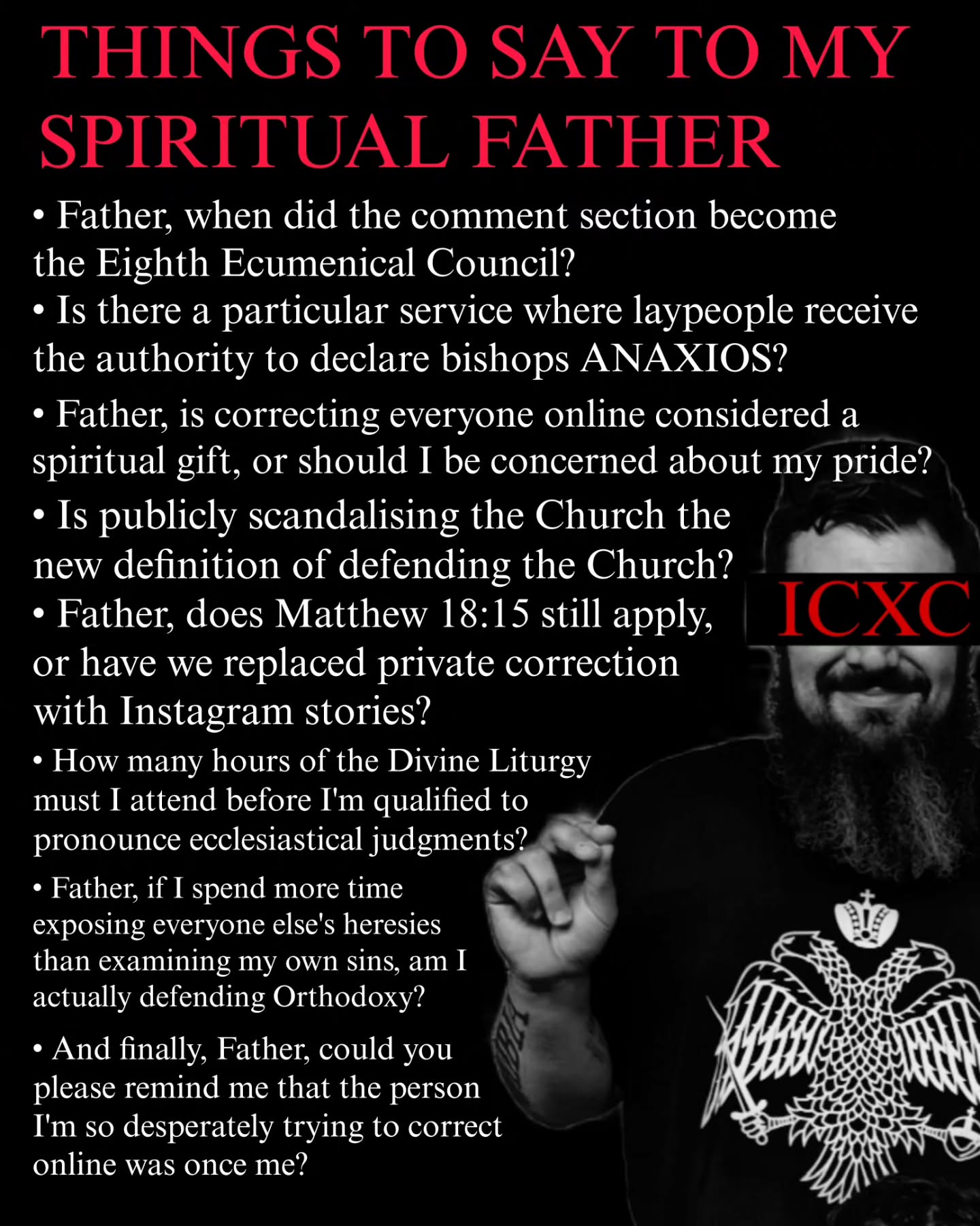
A satirical list framed as 'Things to say to my spiritual father' turns the lens on Orthodox Christians who spend their time correcting, exposing and condemning others online. One question cites Matthew 18:15, where Christ commands private correction before public rebuke, and asks whether Instagram stories have replaced it. Another asks how many hours of the Divine Liturgy qualify a person to pronounce ecclesiastical judgments. The sharpest…

A satirical list framed as 'Things to say to my spiritual father' turns the lens on Orthodox Christians who spend their time correcting, exposing and condemning others online. One question cites Matthew 18:15, where Christ commands private correction before public rebuke, and asks whether Instagram stories have replaced it. Another asks how many hours of the Divine Liturgy qualify a person to pronounce ecclesiastical judgments.

The sharpest question turns inward: if I spend more time exposing everyone else's heresies than examining my own sins, am I actually defending Orthodoxy? The list ends by asking the priest to remind the speaker that the person he is desperately trying to correct online was once himself. The author frames the post with 'Lord have mercy upon us all, especially myself' and the Greek 'Δόξα τῷ Θεῷ πάντων ἕνεκεν' (Glory to God for all things), closing with ICXC.

The piece reads as a self-directed examination of conscience about online polemics, pride and the commandment to correct in private.

  • The list poses satirical questions to a spiritual father about judging bishops and other Orthodox online
  • It asks which service grants laypeople authority to declare bishops 'anaxios'
  • It invokes Matthew 18:15 on private correction versus Instagram stories
  • It asks whether exposing others' heresies while neglecting one's own sins counts as defending Orthodoxy
  • It closes by asking to be reminded that the person one corrects online was once oneself
5 opinions in the discussion "I will not be asked how many hungry I fed, how many I clothed, or how many sick I nursed, but rather how many people I called heretics for making small mistakes online" -St Maria of Paris… Read the discussion

Kipina Monastery: a church carved into a vertical rock above the Kalaritikos river

The Monastery of the Dormition of the Mother of God, known as Kipina, stands in the region of Epirus, in the mountains of Northern Tzoumerka near the village of Kalarites in Greece, built into an almost vertical rock above the Kalaritikos river. One tradition says Archbishop Gregory founded it in 1212, another attributes its founding to monks of the nearby Vyliza monastery in the 13th century. The Archaeological Service of Ioannina records its…

The Monastery of the Dormition of the Mother of God, known as Kipina, stands in the region of Epirus, in the mountains of Northern Tzoumerka near the village of Kalarites in Greece, built into an almost vertical rock above the Kalaritikos river. One tradition says Archbishop Gregory founded it in 1212, another attributes its founding to monks of the nearby Vyliza monastery in the 13th century.

The Archaeological Service of Ioannina records its existence at least from 1349. The monastery received its present architectural form at the end of the 17th and the beginning of the 18th century. It is dedicated to the Dormition of the Mother of God and also celebrates on Friday of Bright Week, the feast of the Life-Giving Spring.

The church is set into a natural cave, its walls decorated with 18th-century frescoes, and the complex includes monastic cells on two levels fitted into the rock. A narrow path cut into the rock and a wooden drawbridge, which monks once raised for protection against unwanted visitors, lead to the monastery. From the church one enters a cave 240 metres long, decorated with stalactites and stalagmites, closed to visitors.

Under Ottoman rule, according to local tradition, the monastery housed a secret school and the cave served as a refuge for the local population. The monastery flourished in the 18th century; its abbot Kallinikos is recorded as donating money in 1760 for the construction of a bridge. It was abandoned in the 19th century, and since 1931 it has been a dependency of the Monastery of the Nativity of the Mother of God on Tsouka.

It has no permanent monastic community today; its preservation is cared for by Archimandrite Thomas Andreu, abbot of the Tsouka monastery.

  • Kipina is dedicated to the Dormition of the Mother of God and also celebrates the Life-Giving Spring on Friday of Bright Week.
  • Traditions differ on its founding: Archbishop Gregory in 1212, or monks of the Vyliza monastery in the 13th century; it is documented from at least 1349.
  • The church is carved into a natural cave with 18th-century frescoes, and monks once raised a wooden drawbridge for protection.
  • A 240-metre cave with stalactites and stalagmites lies behind the church; under Ottoman rule it sheltered locals and, by tradition, a secret school.
  • Abandoned in the 19th century, since 1931 it has been a dependency of the Tsouka monastery, cared for by Archimandrite Thomas Andreu.
Read more
CHRISTIANITY UNITED with Atanasij Instagram

Saint Paisios listened before he spoke

The post describes how Saint Paisios of Mount Athos received visitors who came seeking his counsel. Before offering any guidance, he listened to them. He lived a simple life centered on prayer and made himself available to people burdened with worries. The author notes that his example shows the value of giving someone full attention. The post concludes with a request for the saint's intercession.

  • Saint Paisios listened before offering advice
  • He lived simply and devoted himself to prayer
  • He made time for people who came with worries
  • His example shows the value of giving full attention
  • The post ends with a prayer for his intercession
Read more
Lives of the Saints 🙏 Instagram

Saint Joannicius the Great: Soldier, Monk, and Defender of Icons

Saint Joannicius the Great was born in the village of Marykatos in Bithynia to Christian parents named Myritrikios and Anastasia. As a young boy he worked as a shepherd, and even then his heart longed for God. While tending his flock he often withdrew into solitude, spending entire days in prayer and making the sign of the Cross over his sheep to protect them. Later he entered military service and became known for extraordinary courage,…

Saint Joannicius the Great was born in the village of Marykatos in Bithynia to Christian parents named Myritrikios and Anastasia. As a young boy he worked as a shepherd, and even then his heart longed for God. While tending his flock he often withdrew into solitude, spending entire days in prayer and making the sign of the Cross over his sheep to protect them.

Later he entered military service and became known for extraordinary courage, especially in battles against the Bulgarians. Despite his strength and military achievements, his soul desired something greater than earthly victories. After leaving the army he withdrew to Mount Olympus in Asia Minor and embraced the monastic life.

For more than fifty years he devoted himself to fasting, prayer, humility, and spiritual struggle. According to Holy Tradition, God granted him remarkable spiritual gifts: through his prayers the sick were healed, demons were driven away, wild animals became peaceful, and even serpents obeyed him. He also received the gifts of prophecy and other extraordinary miracles.

Yet despite his great physical strength and spiritual gifts, he remained deeply humble and gentle. During the controversy over holy icons he initially fell into the error of iconoclasm, but through repentance he returned to Orthodox teaching and became a courageous defender of the veneration of sacred icons. He was a close friend of Saint Methodius, Patriarch of Constantinople.

After ninety-four years of earthly life, Saint Joannicius peacefully departed to the Lord in 846. His miracles continued even after his repose. His life reminds us that holiness does not mean never making mistakes; it means humbling ourselves, repenting, and returning to the truth of Christ.

  • Born in Marykatos, Bithynia, to Myritrikios and Anastasia; shepherd in youth, devoted to prayer
  • Served as a soldier, noted for courage against the Bulgarians
  • Became a monk on Mount Olympus for over fifty years, practicing fasting, prayer, and humility
  • Granted gifts of healing, exorcism, authority over animals, and prophecy
  • Initially an iconoclast, repented and defended icon veneration; friend of Saint Methodius; died at 94 in 846
Read more
Lives of the Saints 🙏 Instagram

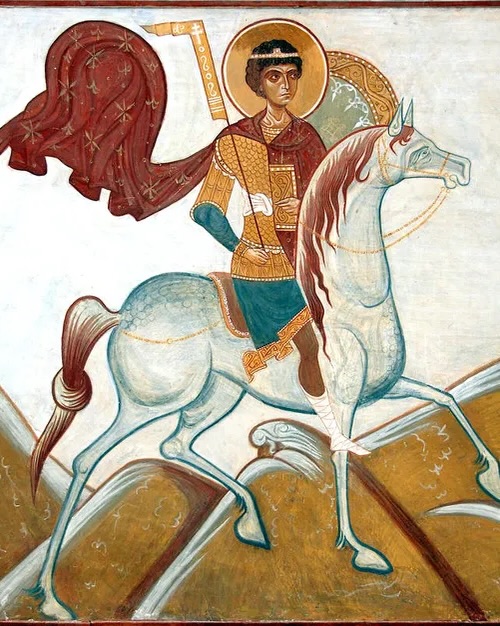
Transfer of Saint George's Relics to Lydda Commemorated

The Orthodox Church commemorates the transfer of the holy relics of Saint George the Great Martyr from Nicomedia to Lydda in Palestine. Saint George was a soldier who suffered martyrdom under Emperor Diocletian for refusing to abandon his faith in Christ. Before his death, he instructed his servant to take his body to Palestine, his mother's homeland, where his family property had been distributed to the poor. The servant fulfilled this wish.…

The Orthodox Church commemorates the transfer of the holy relics of Saint George the Great Martyr from Nicomedia to Lydda in Palestine. Saint George was a soldier who suffered martyrdom under Emperor Diocletian for refusing to abandon his faith in Christ. Before his death, he instructed his servant to take his body to Palestine, his mother's homeland, where his family property had been distributed to the poor.

The servant fulfilled this wish. Years later, during the reign of Emperor Constantine the Great, Christians in Lydda built a church dedicated to Saint George. At its consecration, his relics were solemnly transferred into the church and laid to rest with great reverence. According to Holy Tradition, many miracles and healings occurred through his sacred relics, revealing the grace of God working through His faithful servant.

Saint George became one of the most beloved martyrs of the Orthodox Church, honored throughout the Christian world for his courage, faith, and heavenly intercessions. His life reminds us that the true victory of a Christian is not found in earthly power or military strength, but in remaining faithful to Jesus Christ until the very end.

  • Commemoration of the transfer of Saint George's relics from Nicomedia to Lydda
  • Saint George's martyrdom under Diocletian for refusing to worship false gods
  • His burial request to be taken to Palestine fulfilled by his servant
  • Church built in Lydda under Constantine the Great; relics transferred at consecration
  • Miracles through his relics; honored as a great martyr and intercessor
Read more
Holy Resurrection YouTube

St. John of Kronstadt on Christ in the Heart and Undivided Prayer

St. John of Kronstadt on Christ in the Heart and Undivided Prayer 6:41

St. John of Kronstadt teaches that Christ abides in the heart through faith, bringing peace and joy, and that the saints are His resting place. He urges looking beyond outward appearances, faces, garments, houses, books, music, to the inner spirit, because honoring the created over the Creator offends God's image. The body is a temporary garment; one must look at the one who wears it. Letters are the body of a book, but the content is its…

St. John of Kronstadt teaches that Christ abides in the heart through faith, bringing peace and joy, and that the saints are His resting place. He urges looking beyond outward appearances, faces, garments, houses, books, music, to the inner spirit, because honoring the created over the Creator offends God's image. The body is a temporary garment; one must look at the one who wears it.

Letters are the body of a book, but the content is its spirit. Sounds should be discerned by the impression they leave on the soul: if they awaken peaceful, chaste, and holy feelings, they nourish the soul; if passions pour in, one must cease listening. The morning hours offer a unique freedom from worldly darkness, resembling the future resurrection, and should be seized for prayer.

The inner man emerges more freely upon awakening, unbound by temptations like a fish leaping to the surface. Even in prayer, the heart often falls into darkness and constriction from unbelief, but divine light never fails in God, in the church, or in the material world where His eternal power is visible. One must not lose courage but drive away satanic darkness with the sign of the cross and pray wholeheartedly, even after a day's labor, because prayer is God's work.

Negligence in prayer leads to spiritual unrest, while sincerity draws the heart to God. God's zeal corrects duplicity to keep the heart close to Him. If one hurries through prayer for bodily rest, both bodily and spiritual rest are lost.

Whatever prayer rule is undertaken must be fulfilled with complete conscientiousness; a divided heart loses both rests.

Key moments

  1. 0:12 Christ brought into the heart through faith abides there in peace and joy; "Holy are thou and thou restest in the saints." Do not gaze at the beauty of a person's face but look at his soul; the body is a temporary garment, so look at the one who wears it; do not look at the splendor of the house but at its inhabitant.
  2. 0:43 Otherwise you offend the image of God in men and dishonor the king by bowing before his servant while failing to render the king honor. Do not look at the beauty of a book's printed type but at the spirit of the book; letters are the body, content is the spirit. Do not be beguiled by melodious sounds but discern their spirit by the impression they leave on the soul; if sounds awaken peaceful, chaste, and holy feelings, listen and nourish your soul; if passions pour in, cease listening and cast aside both the body and the spirit of that music.
  3. 1:14 In the morning upon awakening, the inner man emerges more freely from the vanity of the world and the darkness of his flesh, unbound by temptations like a fish leaping to the surface; at other times he is covered by an almost impenetrable darkness and a painful blindfold concealing the true order of spiritual and material things. Seize the morning hours; they are hours of a life made new, renewed by brief sleep, giving a glimpse of the state in which we shall arise renewed on the universal morning of the unwaning day of the resurrection or when released from this mortal body.
  4. 1:45 Even in prayer a man is most often not a son of freedom but a slave to necessity and duty; few pray with a free and open heart, with living faith and love. Moments of deadly darkness and constriction of the heart arise from the heart's unbelief, for unbelief is darkness. Do not lose courage: although divine light has ceased to shine within you, it always shines in all its splendor in God, in the church of God both heavenly and earthly, and in the material world where His eternal power and Godhead are visible. Truth never grows weak because truth is God Himself; only the weak, sinful, darkened heart falters. The nearest proof is within yourself: when the light of faith dwells in your heart, your heart is peaceful, steadfast, strong, and alive; when that light ceases, your heart becomes restless, weak as a reed shaken by the wind, and lifeless. Pay no heed to this satanic darkness; drive it from your heart with the sign of the life-giving cross. Do not spare yourself in heartfelt prayer even after a whole day's work; do not allow the slightest negligence in holy prayer; offer it all to the Lord from your heart, for it is God's work.
  5. 2:18 Having undertaken the task, do not plead that you lack strength; having put your hand to the plow, do not look back. If you have prayed carelessly without your whole heart, you will not fall asleep until you have wept over your sin before God, this happens to those who have advanced in the spiritual life. Take care not to place your flesh above God, but for His sake forego even bodily rest.
  6. 2:48 Whatever prayer rule you have undertaken, fulfill it with complete conscientiousness; if it is long, fulfill the whole rule well; if it is short, do likewise. Do not perform God's work with a divided heart, half belonging to God and half to your flesh. The zeal of the Lord God will not tolerate your duplicity or self-pity; He will give you over to the devil, and the devil will give your heart no rest because you have neglected Him who is your heart's true rest.
  7. 3:20 God does this for your own benefit to keep your heart close to Him. Every insincere prayer draws the heart away from God and turns it against the person himself; every sincere prayer draws the human heart closer to God and makes it dear to Him. Believe these words: if you hurry through prayer for the sake of bodily rest, hoping to rest sooner, you will lose both bodily and spiritual rest. With what labors, sweat, and tears do we draw our hearts near to God? Shall we then make our very prayer, through negligence, a means of departing from Him? God's zeal moves Him to bring us unfailingly back to Himself with a whole heart; He wants us always to belong to Him.
Read more

Fasting, Chastity and Prayer: Three Disciplines of the Orthodox Path

The speaker sets out three spiritual disciplines that shape how a Christian lives and grows in relationship with God: fasting, chastity and prayer. Fasting, he explains, is not about skipping meals or losing weight but about learning to say no to your own desires, because constantly satisfying every appetite enslaves a person to the passions. The Church teaches fasting not because food is evil, but so that desires do not control our lives and…

The speaker sets out three spiritual disciplines that shape how a Christian lives and grows in relationship with God: fasting, chastity and prayer. Fasting, he explains, is not about skipping meals or losing weight but about learning to say no to your own desires, because constantly satisfying every appetite enslaves a person to the passions.

The Church teaches fasting not because food is evil, but so that desires do not control our lives and attention turns toward God, citing Matthew 6:16, 'When you fast...'. Chastity is presented as an answer to a culture where lust, casual sex, pornography and instant gratification have become normal. For the unmarried it means sexual abstinence; for the married, faithfulness, self-control and sometimes mutually agreed periods of abstinence, as Saint Paul teaches in 1 Corinthians 7:5. Purity here is not only guarding the body but purifying the heart and learning to see other people with dignity rather than as objects of pleasure, with 1 Thessalonians 4:3 calling believers to sanctification.

Prayer, the speaker says, is not about convincing God to give us what we want. It is communion with God, and consistent prayer cultivates humility, repentance and spiritual attentiveness. Through God's grace it develops discernment to recognize the temptations, distractions and passions that pull a person away from Christ, and its aim is to transform the heart so that we desire to do God's will rather than make God do ours, following 1 Thessalonians 5:17, 'Pray without ceasing.' The talk closes with the summary that fasting disciplines the body, chastity guards the heart and prayer draws the soul into communion with God, and with Matthew 6:33: 'But seek first the kingdom of God and His righteousness.'

Key moments

  1. 0:00 Fasting is not about skipping meals or losing weight but about learning to say no to your own desires, because constantly satisfying every appetite and craving gradually enslaves you to your passions.
  2. 0:31 The Orthodox Church teaches fasting not because food is evil, but so that our desires do not control our lives, weakening attachment to passions and turning attention toward God.
  3. 0:31 Chastity responds to a society where lust, casual sex, pornography, and instant gratification have become normalized, and 1 Thessalonians 4:3 calls believers to abstain from sexual immorality.
  4. 1:04 For the unmarried, chastity means sexual abstinence; for the married, it means faithfulness, self-control, and sometimes mutually agreed periods of abstinence, as Saint Paul teaches in 1 Corinthians 7:5.
  5. 1:04 Purity is not only about guarding your body but about purifying your heart and learning to see other people with dignity rather than as objects of pleasure.
  6. 1:37 Prayer is not about asking God for blessings, opportunities, or money; it is about communion with God, and consistent prayer cultivates humility, repentance, and spiritual attentiveness.
  7. 1:37 Through God's grace, prayer develops discernment to recognize the temptations, distractions, and passions pulling you away from Christ, and its purpose is to transform your heart so you desire to do His will.
  8. 1:37 Fasting disciplines the body, chastity guards the heart, and prayer draws us into communion with God.
Read more
Prayer Orthodoxy ® Instagram

Private Prayer Sustains but Cannot Replace the Divine Liturgy

The post argues that a relationship with Christ requires participation in the Church He established, centered on the Divine Liturgy. It cites Matthew 16:18 where Christ says He will build His church, 1 Timothy 3:15 calling the church the pillar and ground of truth, and Acts 2:42 describing early Christians gathering for the Apostles' teaching, fellowship, breaking of bread, and prayer. The author notes that the Church is Christ's Body,…

The post argues that a relationship with Christ requires participation in the Church He established, centered on the Divine Liturgy. It cites Matthew 16:18 where Christ says He will build His church, 1 Timothy 3:15 calling the church the pillar and ground of truth, and Acts 2:42 describing early Christians gathering for the Apostles' teaching, fellowship, breaking of bread, and prayer.

The author notes that the Church is Christ's Body, referencing 1 Corinthians 10:17, and that St. Clement and St. Ignatius in the first and second centuries witnessed to the Church's apostolic ministry and shared worship. Early Christians sometimes met in homes but still gathered; location did not make communal worship optional. Private prayer sustains the life of the Church but cannot replace the Eucharist, the sacraments, or life together in His Body.

The post includes a graphic with four panels: the first challenges the claim that one does not need church for a relationship with Christ; the second presents scriptural foundations; the third explains the Church as His Body and the necessity of gathering; the fourth contrasts private prayer with the call to gather. The message appears in both English and Greek and ends with the tagline "Orthodoxy Since 33 AD."

The conclusion calls readers to attend the Divine Liturgy, prepare for the sacraments, and live as members of Christ's Body.

  • Christ established the Church as the pillar and ground of truth (Matthew 16:18; 1 Timothy 3:15).
  • Early Christians gathered for teaching, fellowship, breaking of bread, and prayer (Acts 2:42).
  • The Church is Christ's Body; believers partake of one bread (1 Corinthians 10:17).
  • St. Clement and St. Ignatius attest to apostolic ministry and shared worship in the first and second centuries.
  • Private prayer sustains but cannot replace the Eucharist, sacraments, and communal life in the Church.
Read more
Prayer Orthodoxy ® with Prayer Orthodoxy® Instagram

Orthodoxy: faith from Christ through apostles, fathers, martyrs

The author presents a concise statement of Orthodox identity and continuity. The faith was established by Christ in 33 AD, preached by the apostles, defended by the fathers, and sealed by the blood of martyrs. This same faith has been entrusted to the present generation and is lived through prayer, repentance, the holy mysteries, and love. The calling is to preserve it faithfully and pass it to the next generation. The accompanying image…

The author presents a concise statement of Orthodox identity and continuity. The faith was established by Christ in 33 AD, preached by the apostles, defended by the fathers, and sealed by the blood of martyrs. This same faith has been entrusted to the present generation and is lived through prayer, repentance, the holy mysteries, and love.

The calling is to preserve it faithfully and pass it to the next generation. The accompanying image reinforces the four pillars: established by Christ, preached by the apostles, defended by the fathers, sealed by the blood of martyrs.

  • Orthodoxy traced to Christ's establishment in 33 AD
  • Transmission through apostles, fathers, and martyrs
  • Faith lived through prayer, repentance, holy mysteries, and love
  • Duty to preserve and transmit the faith to future generations
  • Statement given in both English and Greek
Read more
CHRISTIANITY UNITED Instagram

Saint John Chrysostom on true wealth: God as friend

The post presents Saint John Chrysostom's teaching that true wealth is not money but having God in one's life. It contrasts worldly measures of success, income, possessions, recognition, with spiritual riches. People spend entire lives pursuing wealth believing it brings happiness and peace, but Chrysostom reminds that a person can possess everything this world offers and still be spiritually poor, while someone who owns almost nothing can be…

The post presents Saint John Chrysostom's teaching that true wealth is not money but having God in one's life. It contrasts worldly measures of success, income, possessions, recognition, with spiritual riches. People spend entire lives pursuing wealth believing it brings happiness and peace, but Chrysostom reminds that a person can possess everything this world offers and still be spiritually poor, while someone who owns almost nothing can be richer than kings if their heart is filled with the love of Christ.

Saint John Chrysostom (c. 347-407), Archbishop of Constantinople and one of the greatest Fathers of the Orthodox Church, frequently warned Christians about the dangers of greed, pride, and attachment to earthly possessions. He did not teach that possessing money was automatically sinful; the real danger is allowing wealth to possess the heart.

Money can provide comfort, support families, and help those in need, but it cannot purchase forgiveness, holiness, eternal life, or communion with God. The post urges examination of priorities: how much time is spent pursuing financial success compared to time dedicated to prayer, repentance, helping others, and growing closer to Christ.

Working hard to provide for family is not wrong, but one should not become so busy building an earthly life that the eternal one is neglected. The saints understood the richest person is not the one who possesses the most, but the one who needs the least because their greatest treasure is Christ. Everything accumulated in this world will eventually be left behind, but a life lived in communion with God has eternal significance.

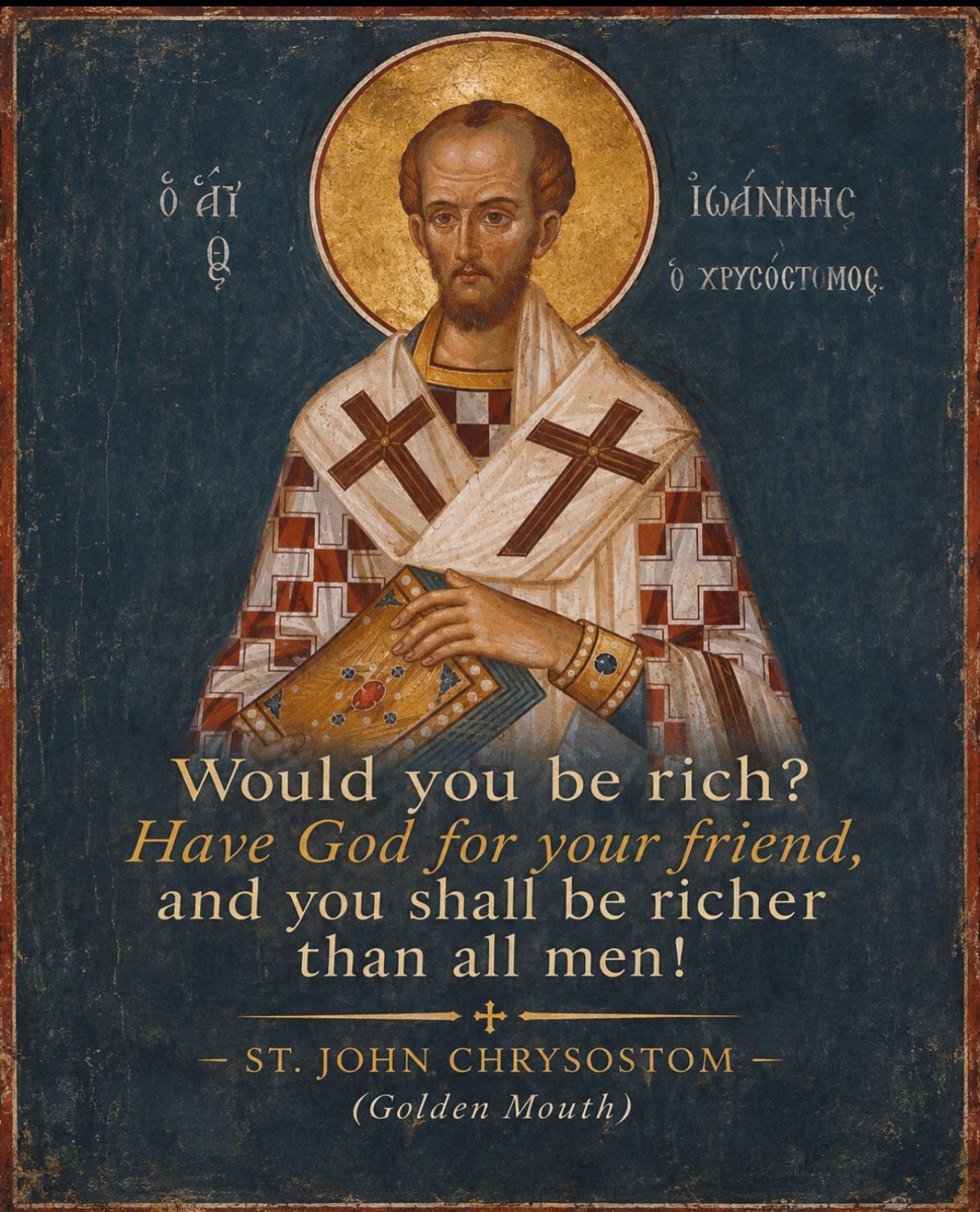
An image accompanying the post includes the quote: "Would you be rich? Have God for your friend, and you shall be richer than all men!" attributed to Saint John Chrysostom.

  • Saint John Chrysostom teaches that true wealth is having God as a friend, not material possessions.
  • Money is not inherently sinful, but allowing it to possess the heart is dangerous.
  • Earthly wealth cannot purchase forgiveness, holiness, eternal life, or communion with God.
  • Priorities should be examined: time for financial pursuits versus prayer, repentance, and helping others.
  • The richest person is the one who needs the least because Christ is their greatest treasure.
Read more
Fr.TEDTalks Instagram

The Illusion of Control Is a Form of Idolatry

The post identifies the illusion of control as a great spiritual problem behind everyday anxiety. It notes that intelligent, ambitious young people are especially vulnerable because they have been taught that hard work, careful planning, and right decisions can secure their future. This mindset confuses responsibility with omnipotence. A person is responsible for effort, not for controlling every outcome; responsible for treating others with…

The post identifies the illusion of control as a great spiritual problem behind everyday anxiety. It notes that intelligent, ambitious young people are especially vulnerable because they have been taught that hard work, careful planning, and right decisions can secure their future. This mindset confuses responsibility with omnipotence. A person is responsible for effort, not for controlling every outcome; responsible for treating others with love and respect, not for making everyone like them; responsible for studying, not for a guaranteed perfect grade; responsible for pursuing meaningful relationships, not for forcing another person to love them.

When someone demands complete control over life, they attempt to occupy a position that belongs to God, becoming a true idolater by replacing God with themselves.

Key moments

  1. The great spiritual problem behind much everyday anxiety is the illusion of control.
  2. This is especially difficult for intelligent, ambitious young people.
  3. They have been taught that if they work hard enough, plan carefully enough, and make the right decisions, they can control their future.
  4. This confuses responsibility with omnipotence.
  5. When we demand complete control over our lives, we essentially try to occupy a position that belongs to God.
Read more
Ancient Faith YouTube

Deacon Seraphim Explains the Liturgy of the Faithful and the Nicene Creed

Deacon Seraphim Explains the Liturgy of the Faithful and the Nicene Creed 44:32

Deacon Seraphim continues his walk through the Divine Liturgy, entering the Liturgy of the Faithful after the dismissal of the catechumens. He explains that "the faithful" are those baptized, chrismated, and in eucharistic communion, bearing both a relationship and responsibility to live faithfully. The first two prayers of the faithful ask God's compassion for the sins and ignorance of both clergy and people, and for worthiness to offer the…

Deacon Seraphim continues his walk through the Divine Liturgy, entering the Liturgy of the Faithful after the dismissal of the catechumens. He explains that "the faithful" are those baptized, chrismated, and in eucharistic communion, bearing both a relationship and responsibility to live faithfully. The first two prayers of the faithful ask God's compassion for the sins and ignorance of both clergy and people, and for worthiness to offer the bloodless sacrifice, not denying Christ's body and blood, but affirming no animals are slaughtered.

The priest prays for a clean conscience and the Holy Spirit's power to serve blamelessly, while the deacon petitions for grace, mercy, and protection. A second litany recapitulates the initial petitions for peace and salvation, and the priest prays for cleansing of soul and body from all pollution of flesh and spirit, including secret thoughts, so that all may stand guiltless before the altar.

The prayer extends to the people, asking for growth in faith, fear and love of God, and worthy communion. The Cherubic Hymn calls the faithful to mystically represent the cherubim, terrifying angelic beings who guard God's throne, and to lay aside all earthly cares, entering the age to come where every prayer is fulfilled. During the hymn, the deacon censes while the priest offers a profound penitential prayer acknowledging human bondage to carnal desires, yet Christ's incarnation and love make the priesthood possible.

The Great Entrance carries the holy gifts (bread and wine) to the altar in procession with commemorations for bishops, clergy, faithful, and civil authorities. St. Germanus interprets this as Christ approaching his mystical sacrifice, the altar becoming the tomb, and the hymn of Noble Joseph is sung. The gifts are covered with the aer, associated with the stone sealing the tomb, while Psalm 50 concludes with a plea for God to receive the sacrifice of righteousness.

An exchange between priest and deacon uses the words of the Annunciation, signifying the Holy Spirit who made Christ present in Mary now making him present in the gifts. The deacon calls the assembly to "complete" the prayer, bringing it to fullness through the Eucharist. The litany asks for a perfect day, an angel of peace, pardon, and a Christian ending.

The kiss of peace among clergy represents the bond of love necessary to confess the Trinity with one accord, followed by the Creed and the call to stand aright for the Anaphora.

Key moments

  1. 0:32 The deacon introduces the Liturgy of the Faithful, explaining that "the faithful" are those received into Christ through baptism and chrismation who belong to the eucharistic communion of the church, a word that names both a relationship and a responsibility to live faithfully within it.
  2. 3:09 The priest begins the first prayer of the faithful by giving thanks to the Lord God of powers for the vouchsafed permission to stand before the holy altar and fall down before God's compassion for the sins and ignorance of the people, a line drawn from the epistle to the Hebrews concerning the priest's role.
  3. 4:12 The prayer asks God to make the celebrants worthy to offer supplications, prayers, and bloodless sacrifices, meaning no animal is slaughtered, but the assembly enters into Christ's saving offering of himself once and for all.
  4. 6:49 A second litany repeats the initial petitions for peace and salvation, while the priest prays that God would cleanse souls and bodies from all pollution of flesh and spirit, reaching both visible actions and secret thoughts, so that all may stand guiltless before the altar.
  5. 9:27 The Cherubic Hymn calls the people to mystically represent the cherubim, not Renaissance babies but the terrifying, four-faced living creatures of Ezekiel and Revelation who escort God's throne, and to lay aside all earthly cares as they enter the age to come.
  6. 13:05 The priest offers a long penitential prayer confessing that none bound by carnal desires and pleasures is worthy to approach the altar, yet Christ's ineffable love and incarnation, becoming our high priest, deliver the priesthood and the bloodless sacrifice to the church.
  7. 22:27 In the Great Entrance the deacon carries the discos with the lamb and commemorative particles and the priest carries the chalice, processing with the holy gifts (not yet consecrated but already reverenced) while commemorating the bishop, clergy, faithful, and civil authorities.
  8. 28:47 After the gifts are placed on the altar and covered with the aer, the deacon says to the priest the words of the Annunciation, "The Holy Spirit shall come upon thee and the power of the Most High shall overshadow thee", signifying that the same Spirit who made Christ present in Mary now makes him present in the gifts.

Why God Became Man: The Orthodox Meaning of Christmas

The post explains the Orthodox understanding of the Incarnation celebrated at Christmas. It opens with John 1:14 and states that the eternal Son of God took human nature through the Virgin Mary, becoming truly man without ceasing to be truly God. The purpose was not merely to teach morality or establish a religion but to save humanity from sin, corruption, and death. Through Adam's fall humanity became subject to corruption and death; Christ,…

The post explains the Orthodox understanding of the Incarnation celebrated at Christmas. It opens with John 1:14 and states that the eternal Son of God took human nature through the Virgin Mary, becoming truly man without ceasing to be truly God. The purpose was not merely to teach morality or establish a religion but to save humanity from sin, corruption, and death.

Through Adam's fall humanity became subject to corruption and death; Christ, the New Adam, came to restore fallen nature, reconcile humanity with God, and open the way to eternal life, as Luke 19:10 affirms. By uniting human nature to His divinity, Christ conquered death through His voluntary suffering, death on the Cross, and Resurrection, opening the gates of Paradise.

The post quotes Saint Athanasius the Great from On the Incarnation 54: "For He was made man that we might be made God." This introduces the mystery of theosis (deification), central to Orthodox Christianity. Citing 2 Peter 1:4, it explains that believers are called to become partakers of the divine nature by grace, not by essence.

The Creator entered creation, the Eternal entered time, the Immortal accepted death so that humanity might receive eternal life. Christmas is therefore not simply the celebration of Christ's birth but the celebration of God's love and the beginning of the fulfillment of salvation through Jesus Christ.

  • The Incarnation is motivated by God's infinite love for humanity
  • Christ as the New Adam restores human nature corrupted by Adam's fall
  • Saint Athanasius teaches the Incarnation enables theosis (deification)
  • Theosis means participation in divine life by grace, not becoming God by essence
  • Christmas marks the beginning of salvation's fulfillment through Christ
Read more

St. Paul on Love: An Orthodox Interpretation

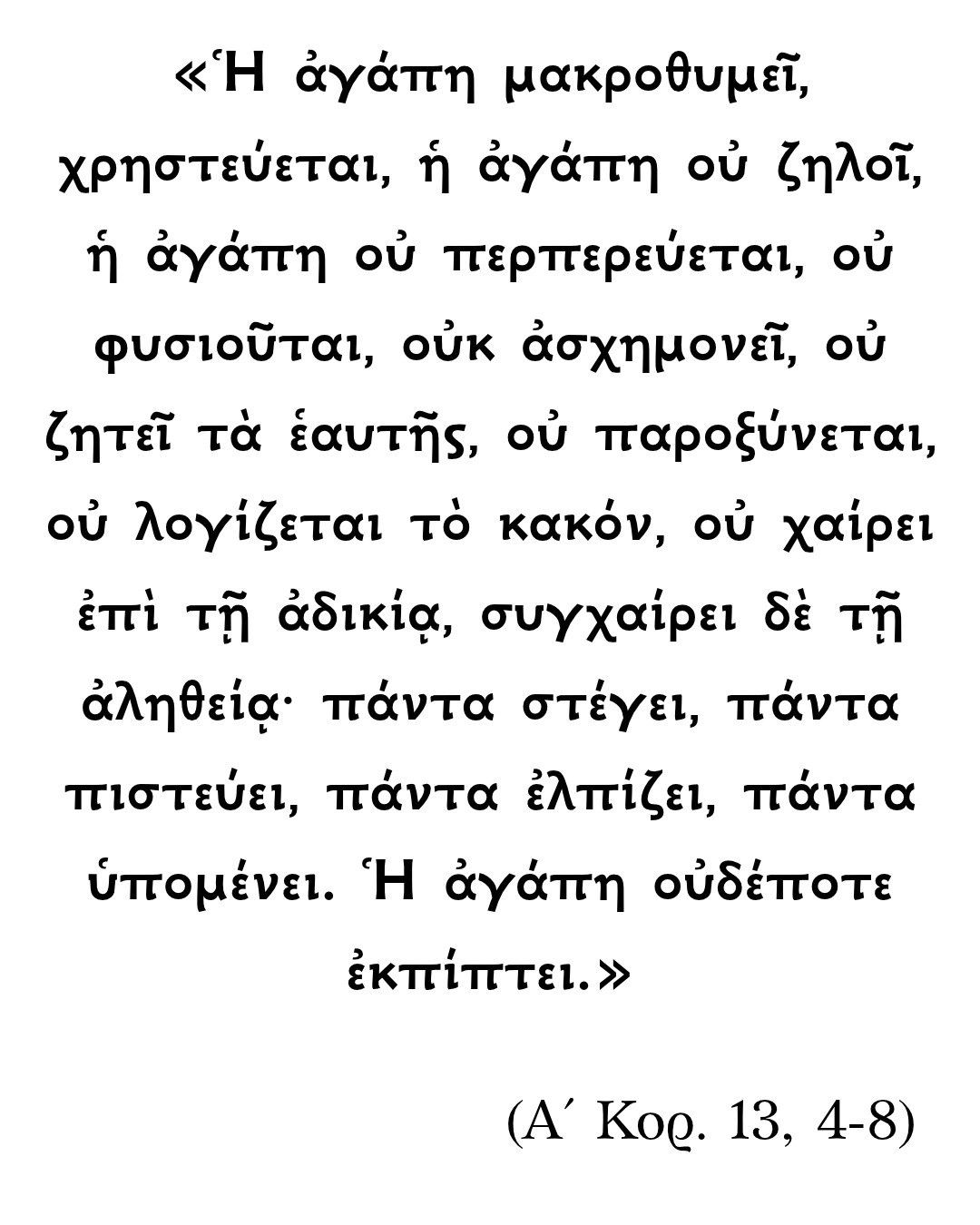
The post presents the Greek text of 1 Corinthians 13:4-8 alongside an interpretive commentary drawn from the book "The New Testament with Brief Interpretation" by the late Professor Panagiotis N. Trembelas of the Theological School of the University of Athens and the Brotherhood of Theologians "O Soter" (11th edition, May 2025, Athens). The commentary expands each quality of love named by the Apostle Paul, patience, kindness, absence of envy,…

The post presents the Greek text of 1 Corinthians 13:4-8 alongside an interpretive commentary drawn from the book "The New Testament with Brief Interpretation" by the late Professor Panagiotis N. Trembelas of the Theological School of the University of Athens and the Brotherhood of Theologians "O Soter" (11th edition, May 2025, Athens).

The commentary expands each quality of love named by the Apostle Paul, patience, kindness, absence of envy, humility, proper conduct, selflessness, calmness, refusal to count wrongs, rejection of injustice, joy in truth, covering faults, trust, hope, endurance, into a fuller ethical and spiritual description. It explains that the person who possesses love becomes magnanimous, tolerant, broad-hearted, beneficent, and useful; does not envy, boil with passion, or act with arrogance and self-will; does not puff up with conceit and pride; does nothing unseemly, seeks not his own interests, is not provoked by anger and wrath, never thinks evil against another, nor accounts the evil suffered from him.

He does not rejoice when he sees injustice done, but rejoices when truth prevails. He covers all the shortcomings of the other and does not mock him for them; forms a favorable confidence in all things for the one he loves. And when faced with the other's deviations, he hopes that from all these he will be corrected; in all things he shows patience for his fellow man. Love never fails, but remains always true and strong, even after our death.

  • Presents 1 Corinthians 13:4-8 in Greek
  • Provides commentary from Trembelas' "New Testament with Brief Interpretation"
  • Explains each attribute of love in ethical and spiritual terms
  • Describes the practical behavior of one who possesses love
  • Notes love's permanence beyond death
4 opinions in the discussion In short, nobody loves, because this love seems impossible to achieve. Read the discussion

Elder Philimon: die before death to live the new man

The video features Elder Philimon of the Skete of the Prophet Elijah on Mount Athos. He begins with a paradox: if you die before you die, you will not die when you die. He then recounts a story about Father Vasilios Ygondikakis, abbot of Sivyron, who was asked what monks do and how they spend their day. The elder replied that monks eat one biscuit: their death. Elder Philimon explains that unless a person crucifies their passions, the life to…

The video features Elder Philimon of the Skete of the Prophet Elijah on Mount Athos. He begins with a paradox: if you die before you die, you will not die when you die. He then recounts a story about Father Vasilios Ygondikakis, abbot of Sivyron, who was asked what monks do and how they spend their day.

The elder replied that monks eat one biscuit: their death. Elder Philimon explains that unless a person crucifies their passions, the life to come cannot arrive. He describes the old man and the new man as communicating vessels: something empties and something fills. As you empty yourself of the old man, the new man comes.

Key moments

  1. The speaker states a paradox: before you die you will not die, but when you die they speak to the young.
  2. Father Vasilios Ygondikakis, abbot of Sivyron, was asked what monks do and how they spend their day.
  3. The elder replied that monks eat a single biscuit: their death.
  4. Unless you crucify your passions, the life to come cannot arrive, because the old and the new man are communicating vessels.
  5. Something empties and something fills; you empty yourself of the old man and the new man comes.
Read more

A Child Asks How to Befriend the Saints

A parent reflects on the questions that arise when a child asks how to make friends with the saints. The father explains that friendship with a saint begins the same way as any friendship: by getting to know them. He advises reading the saints' lives, learning their stories, and understanding the choices they made, then following their example of loving Christ. The father adds that saints sometimes make their presence known in quiet but…

A parent reflects on the questions that arise when a child asks how to make friends with the saints. The father explains that friendship with a saint begins the same way as any friendship: by getting to know them. He advises reading the saints' lives, learning their stories, and understanding the choices they made, then following their example of loving Christ.

The father adds that saints sometimes make their presence known in quiet but unmistakable ways, yet there are also times when one must simply approach them directly and ask, "Can we be friends?" The post captures a simple, practical approach to the communion of saints that avoids overcomplication and trusts the directness of a child's question.

Key moments

  1. 0:00 The father says to start by reading the saints' lives, knowing their stories, and learning why they made the choices they made, then follow their example.
  2. 0:34 The father says saints sometimes reach out in quiet but undeniable ways, but other times you just have to walk up to them and ask, "Can we be friends?"

Why Icons Are Not Idolatry: Kissing and Bowing as Respect

The speaker argues that Orthodox Christians face accusations of idolatry for using icons, while kissing and bowing before them are expressions of love and respect, not worship. He cites Saint Paul's instruction to greet one another with a holy kiss and the example of King Solomon bowing before his mother as biblical precedents for such gestures.

The speaker questions why religious images are labeled idolatry only when Orthodox Christians have them, implying a double standard in the criticism.

Key moments

  1. 0:04 The speaker asks why Orthodox Christians are accused of idolatry for having icons when kissing and bowing are expressions of love and respect, citing Saint Paul's command to greet with a holy kiss and King Solomon bowing before his mother.
14 opinions in the discussion To venerate means to treat someone or something with deep respect, reverence, or intense admiration. Do you "worship" your country's flag or venerate it? Medal of Honor recipients? What… Read the discussion
Kyle YouTube

Spiritual Warfare in Culture, Architecture, and the Narrow Path

Spiritual Warfare in Culture, Architecture, and the Narrow Path 9:19

The speaker describes a spiritual warfare that uses culture as its medium. He contrasts the Christian calling to be in the world but not of it with secular nihilism that dismisses social engineering as conspiracy. Architecture demonstrates this conflict: brutalist buildings produce measurable negative effects on people, while traditional piazzas and churches built to glorify God create beauty that reflects objective truth. Even atheistic elites…

The speaker describes a spiritual warfare that uses culture as its medium. He contrasts the Christian calling to be in the world but not of it with secular nihilism that dismisses social engineering as conspiracy. Architecture demonstrates this conflict: brutalist buildings produce measurable negative effects on people, while traditional piazzas and churches built to glorify God create beauty that reflects objective truth.

Even atheistic elites cannot escape a teleological impulse, revealing their ideology as an inverted Christian eschatology. Modern art and media celebrate dysfunction and flaw as beauty standards, which the speaker calls a perverted iconography. The Paris Olympics opening ceremony exemplifies this degradation compared to the enduring beauty of cathedrals built by believers.

Buildings and humans are icons of belief; replaceable architecture reflects a philosophy of flux that now treats people as interchangeable widgets. The speaker concludes that Christians cannot win a proliferation war against worldly iconography but find beauty in the narrow path while drowning in the surrounding culture.

Key moments

  1. 0:30 The speaker admits he wants Christian culture to prevail or at least maintain itself, which means advocating for crafting society in a certain image that influences art and architecture.
  2. 1:33 Even the flawed theologies that built sculptures and castles praising false gods are still better than brutalist architecture because they assumed the praise of something higher.
  3. 2:34 The elite ideology tells people they are soulless animals without free will, destined to live in pods, eat bugs, and be happy, and this is being forced on people who are now rebelling.
  4. 3:35 The mechanistic world vision relies on the John Calhoun mouse experiment model, keeping people in little chambers, yet it still assumes a teleological goal toward which humanity ought to move.
  5. 4:07 Technocrats and Satanists hold a view like Plato's Republic: an unelected symposium of masters with the obligation to direct humanity, which is a religious belief borrowed and twisted from Christianity.
  6. 5:41 Modern art's impulse to rearrange reality, putting the nose on the elbow, is called digidataism, a dataism resurgence with AI where everything disformed is celebrated as cool.
  7. 6:12 The culture celebrates the flaw as the standard for beauty, such as Down Syndrome Victoria's Secret models, instead of acknowledging the flaw as fallen and helping the flawed.
  8. 7:46 Houses, churches, and humans are icons; if something is built to be replaced, it is an icon of a philosophy in flux, and now they are trying to make humans seen as replaceable widgets with no distinction between man, woman, or animal.
Read more

Mount Athos: A Living Icon of the Heavenly Kingdom

The text presents Mount Athos not merely as a geographic location but as a spiritual reality, a living icon of the Heavenly Kingdom on earth. It describes Athos as a silent refuge where souls weary of worldly noise follow the footsteps of the Mother of God, for this land is her portion and heavenly garden. Upon stepping onto Athos, one realizes all earthly glory is but a passing shadow before eternity. Among steep cliffs and ancient monastery…

The text presents Mount Athos not merely as a geographic location but as a spiritual reality, a living icon of the Heavenly Kingdom on earth. It describes Athos as a silent refuge where souls weary of worldly noise follow the footsteps of the Mother of God, for this land is her portion and heavenly garden. Upon stepping onto Athos, one realizes all earthly glory is but a passing shadow before eternity.

Among steep cliffs and ancient monastery walls, time loses its measure and the true inner dimension of existence opens: encounter with the living God in the depths of one's heart. The true feat of Athos lies not in stone temples but in the invisible struggle monks wage in the silence of their cells, the unceasing Jesus Prayer: "Lord Jesus Christ, Son of God, have mercy on me a sinner."

This prayer, like blessed dew, penetrates the parched heart, cleansing it of passions, anger, pride, and worldly sorrow. Athos teaches that God is found not in the noise of earthly events nor in the strong words of worldly sages, but in the "still small wind" of contrition and humility. Every rock, every prayerful sigh, every tear of repentance witnesses that man is created not for transience and death but for eternal joy in the unending Light of Trinitarian Love.

Athos thus remains a living call to all caught in daily busyness: to awaken, reconsider spiritual steps, and allow God's grace to transform the inner man. As long as lamps burn on Athos and prayers rise for the whole world, the Bethlehem star still shines over our planet, showing the path of salvation to all who will hear and see.

Key moments

  1. The sixth ode is appointed to be sung to the Lord.
  2. The refrain calls to praise the Lord and exalt Him unto all ages.
  3. Light and darkness, nights and days are summoned to bless the Lord.
  4. The text calls upon Israel to bless the Lord.
  5. The faithful bless the Father, Son, and Holy Spirit as the Lord.
  6. The faithful hymn and exalt the Lord unto all ages.
  7. The faithful praise, bless, and worship the Lord.
  8. The faithful hymn and glorify the Lord unto all ages.
Read more
CHRISTIANITY UNITED Instagram

Piatra Tăieturii Monastery and the Saints' Gentleness Toward Animals

The post describes Piatra Tăieturii Monastery in Bucovina, Romania, founded in 1933, closed and demolished in 1959 during communist persecution, and rebuilt after communism fell. It connects the monastery's setting to a broader Orthodox theme: the gentle relationship between saints and animals. It cites Saint Seraphim of Sarov's peaceful encounters with a bear and Saint Gerasimos of the Jordan's compassion toward a wounded lion. The author…

The post describes Piatra Tăieturii Monastery in Bucovina, Romania, founded in 1933, closed and demolished in 1959 during communist persecution, and rebuilt after communism fell. It connects the monastery's setting to a broader Orthodox theme: the gentle relationship between saints and animals. It cites Saint Seraphim of Sarov's peaceful encounters with a bear and Saint Gerasimos of the Jordan's compassion toward a wounded lion.

The author writes that holiness is not only knowing Scripture or observing traditions but allowing God's grace to transform how one treats every living creature. Creation is a gift entrusted by God, not to be treated with cruelty or indifference. The post notes that not every peaceful encounter is a miracle, but ordinary gentleness teaches patience and compassion toward animals, which should extend even more to fellow human beings.

A heart growing closer to Christ grows in gentleness. The post ends with a blessing for the monastic community and all who care for creation.

  • Piatra Tăieturii Monastery founded 1933, closed 1959, demolished, rebuilt after communism
  • Saint Seraphim of Sarov and a bear, Saint Gerasimos of the Jordan and a lion
  • Holiness involves God's grace transforming treatment of all creatures
  • Creation is a divine gift, not for cruelty or indifference
  • Gentleness toward animals should extend to greater love and mercy toward people
Read more