WeOrthodox
EN UA

Orthodox posts, videos and discussions

We follow Orthodox channels, communities and blogs across the web, summarise every post and video, and highlight the conversations with real substance.

Tell your priest when parish conversations drive visitors away

Everyone is on their own Orthodox journey. A person might walk into church for the first time on a Sunday, coming from a completely non-religious background. They might fall in love with the Liturgy, feel drawn to Orthodoxy, and then hear people making political comments or jokes during coffee hour that make them uncomfortable enough to never come back. I know it's hard to avoid current events when they seem to happen every day, and I recognize…

Everyone is on their own Orthodox journey. A person might walk into church for the first time on a Sunday, coming from a completely non-religious background. They might fall in love with the Liturgy, feel drawn to Orthodoxy, and then hear people making political comments or jokes during coffee hour that make them uncomfortable enough to never come back.

I know it's hard to avoid current events when they seem to happen every day, and I recognize people can hold different political and social views without those differences being incompatible with Orthodoxy. But when a visitor hears people taking rigid, uncompromising stances on these issues, it can be hard to reconcile that atmosphere with the welcome and love they experienced in the Liturgy.

My bigger point is this: please tell your priest if this is happening in your parish.

Yes, it's possible he's aware of the conversations and supports them. But it's much more likely he simply doesn't know they're happening. Priests are busy on Sundays. Mine is lucky to make it to coffee hour before the coffee gets cold, and once he arrives he's often surrounded by people wanting to talk with him. He may not have the chance to see or hear everything happening around the room.

He needs to know if there is discord in the parish or if conversations are taking place publicly that could make visitors uncomfortable and discourage them from returning. He can decide whether to address the issue privately with the individual involved or speak to the parish as a whole.

And this applies to so much more than politics.

If someone is telling people they need to go to confession because they voted a certain way, insisting that homeschooling is the only acceptable way to raise children and making mothers who don't homeschool feel inadequate, or declaring that Mickey Mouse is of the devil, please tell your priest.

We cannot assume that everyone who walks through our church doors has the same background, experiences, opinions, or understanding of Orthodoxy. We should be making room for people to grow in their faith, ask questions, and find their place in the Church, not telling them they're unwelcome because of the things we discuss.

Edit to add: I'm on the parish council and we have been given a strict directive by the priest to alert him when we hear these kinds of conversations. Everything I said came from what he told us.

  • Visitors may be driven away by rigid political or social comments during coffee hour
  • Priests often don't hear these conversations because they're busy on Sundays
  • Parishioners should alert the priest so he can address the issue appropriately
  • The problem extends beyond politics to any extreme stance that makes people feel unwelcome
  • The author's priest directed the parish council to report such conversations
52 opinions in the discussion I don't believe any serious Christian should lean too hard into any political ideology. I get suspicious when someone clearly puts their political side above their faith. If you'd say… Read the discussion

Trinity defense cites early heresies and church continuity

A video presents a debate on the Trinity. One speaker identifies as a Christian who rejects the Trinity, arguing it contradicts the Bible and urging others to reject it as well. Another speaker responds that denying the Trinity means rejecting Christ and the historic teaching of the church. The defender cites two second-century errors: Theodotus, who denied Christ's divinity and was excommunicated, and Noetus, who denied the distinction between…

A video presents a debate on the Trinity. One speaker identifies as a Christian who rejects the Trinity, arguing it contradicts the Bible and urging others to reject it as well. Another speaker responds that denying the Trinity means rejecting Christ and the historic teaching of the church. The defender cites two second-century errors: Theodotus, who denied Christ's divinity and was excommunicated, and Noetus, who denied the distinction between Father and Son and was refuted by Saint Hippolytus using Scripture.

The speaker concludes by challenging the idea that the Spirit-guided church erred on God's identity while a modern individual claims to have corrected it after 2,000 years.

Key moments

  1. I'm a Christian and I don't believe in the Trinity. And neither should you because the Trinity contradicts the Bible.
  2. You're not a Christian then, by rejecting who God is, you're denying what it means to follow Christ. You are rejecting Scripture and what the church has always taught.
  3. In the second century, Theodotus denied Christ's divinity and was excommunicated.
  4. In the second century, Noetus denied the distinction between Father and Son, Saint Hippolytus refuted this with Scripture.
  5. So why would we believe the church guided by the Holy Spirit erred on God's identity, but you figured it all out 2,000 years later.
Read more

Debate on RCC origins, apostasy, and baptismal regeneration

A video presents a debate between two participants on when the Roman Catholic Church began and when it fell into apostasy. One participant dates the church's origin to 380 AD and places its apostasy in the seventh century with the development of the papacy, which he says was retroactively fabricated. The other participant cites the 381 Nicene-Constantinopolitan Creed's affirmation of "one holy orthodox Catholic Church and one baptism for the…

A video presents a debate between two participants on when the Roman Catholic Church began and when it fell into apostasy. One participant dates the church's origin to 380 AD and places its apostasy in the seventh century with the development of the papacy, which he says was retroactively fabricated. The other participant cites the 381 Nicene-Constantinopolitan Creed's affirmation of "one holy orthodox Catholic Church and one baptism for the remission of sins" and asks whether the first participant accepts it.

The first participant accepts the creed but reinterprets the preposition "for" as meaning "because of" remission of sins rather than "for the purpose of" remission. The second participant presses whether seventh-century Christians practiced baptism in a manner matching Eastern Orthodoxy or the first participant's view, noting the first participant is unsure.

The second participant asserts a unanimous consensus in the first seven centuries on baptismal regeneration, listing Justin Martyr, Tertullian, Polycarp, Clement, Irenaeus, and Ignatius as witnesses. He dismisses the first participant as a modern voice ("Taco Talks") contradicting seven centuries of unanimous church consensus.

Key moments

  1. 0:00 One participant claims the Roman Catholic Church was created in 380 and fell into apostasy around the seventh century when the papacy became official and was retroactively fabricated.
  2. 0:31 The other participant cites the 381 Nicene-Constantinopolitan Creed's statement "we believe in one holy orthodox Catholic Church and one baptism for the remission of sins" and asks if the first participant accepts it.
  3. 0:31 The first participant accepts the creed but interprets "for" as "because of" remission of sins, not "for the purpose of" remission.
  4. 1:08 The second participant asks whether seventh-century Christians practiced baptism in a way matching Eastern Orthodoxy or the first participant's view, noting the first participant is unsure.
  5. 1:08 The second participant asserts there is unanimous consensus in the first seven centuries, listing Justin Martyr, Tertullian, Polycarp, Clement, Irenaeus, and Ignatius as agreeing with baptismal regeneration.
  6. 1:44 The second participant mocks the first participant as "Taco Talks" from 2026 contradicting seven centuries of unanimous church consensus on baptism.
Read more

Osovica Monastery near Srpci holds copy of Trojerucica icon from Hilandar

The post asks whether readers have visited Osovica monastery near Srpci in the Banja Luka diocese. It notes that the monastery possesses a copy of the Trojerucica icon, given to the monks by the Royal Lavra of Hilandar as a token of gratitude. In accompanying video footage, the speaker describes the monastery as a holy place deep in the forest that feels like paradise upon arrival and urges viewers to visit. He then offers a personal reflection:…

The post asks whether readers have visited Osovica monastery near Srpci in the Banja Luka diocese. It notes that the monastery possesses a copy of the Trojerucica icon, given to the monks by the Royal Lavra of Hilandar as a token of gratitude. In accompanying video footage, the speaker describes the monastery as a holy place deep in the forest that feels like paradise upon arrival and urges viewers to visit.

He then offers a personal reflection: he is not a witness to an unspecified matter, each person must struggle on their own, he judges no one, and everything has its time.

Key moments

  1. 0:00 The speaker presents quick footage from the Osovica monastery near Srpci, calling it a holy place deep in the forest that feels like paradise when you arrive, and urges viewers to visit.
  2. 0:31 The speaker says he is not a witness to something, that let everyone struggle, he is no one's judge, let it be so spoken, and everything has its time.
Read more
Orthodox Health Instagram

When counting lentils replaces seeking holiness in the Nativity Fast

The post warns against turning the Nativity Fast into a quantifiable achievement. The author notes the temptation to measure fasting by counting lentils, tracking dietary restrictions, and comparing sacrifices, while virtues like humility, repentance, and love of neighbor remain harder to quantify. The Church calls believers to holiness, not to world-class self-denial for its own sake. The referenced podcast episode illustrates how meticulous…

The post warns against turning the Nativity Fast into a quantifiable achievement. The author notes the temptation to measure fasting by counting lentils, tracking dietary restrictions, and comparing sacrifices, while virtues like humility, repentance, and love of neighbor remain harder to quantify. The Church calls believers to holiness, not to world-class self-denial for its own sake.

The referenced podcast episode illustrates how meticulous food measuring, such as weighing seventeen lentils, does not indicate spiritual progress. Preoccupation with external severity can cause one to lose sight of fasting's purpose. Fasting that leaves a person depleted, irritable with family, and neglectful of responsibilities while congratulating themselves on their asceticism is not the transformation the Church seeks.

Ascetical disciplines must fit each person's circumstances, whether monastic or a parent working full-time. Pastoral discernment and consultation with a spiritual father are essential. The hope for the Nativity Fast is that it makes believers less impressed with themselves and more attentive to Christ.

Key moments

  1. The person who is meticulously weighing out 17 lentils for dinner isn't necessarily winning that spiritual competition.
  2. We can become so preoccupied with the external severity of our fasting that we lose sight of its purpose.
  3. Someone might be eating almost nothing, feel completely depleted, become irritable with their family, neglecting their responsibilities and congratulating themselves on their ascetical discipline.
  4. There is a difference between the ascetical circumstances of someone living in a monastery and those of a parent raising young children, working full-time, or performing demanding physical labor.
  5. Fasting is not supposed to become an independent project where we compete to demonstrate who's capable of enduring the greatest nutritional deprivation.
  6. And as we always say, talk to your spiritual father.

Apostles are called by Christ, not made by ceremony

The post argues that apostles are not created through modern rituals such as oil ceremonies, speaking in tongues, or congregational declarations. They were personally chosen and commissioned by Christ, as stated in John 15:16. When Judas was replaced, the Apostles selected Matthias from those who had accompanied Christ's ministry and could testify to His Resurrection, establishing a precedent recorded in Acts 1:21-26. St. Paul likewise defended…

The post argues that apostles are not created through modern rituals such as oil ceremonies, speaking in tongues, or congregational declarations. They were personally chosen and commissioned by Christ, as stated in John 15:16. When Judas was replaced, the Apostles selected Matthias from those who had accompanied Christ's ministry and could testify to His Resurrection, establishing a precedent recorded in Acts 1:21-26. St. Paul likewise defended his apostleship by appealing to his encounter with the risen Christ in 1 Corinthians and Galatians.

The early Church continued the Apostles' ministry through bishops, the laying on of hands, and the preservation of apostolic teaching, a continuity known as apostolic succession. St. Irenaeus cited the succession of bishops as evidence of this continuity in Against Heresies 3.3, and Tertullian did the same in Against the Heretics.

The Orthodox Church recognizes the broader biblical use of "apostle" for commissioned messengers but maintains that the unique foundational authority of the Twelve cannot be acquired through any modern ceremony.

  • Apostles were personally chosen and commissioned by Christ, not self-appointed or created by ritual (John 15:16).
  • The replacement of Judas required direct witness to Christ's ministry and Resurrection (Acts 1:21-26).
  • St. Paul grounded his apostleship in his encounter with the risen Christ (1 Corinthians, Galatians).
  • Apostolic succession continues through bishops, laying on of hands, and preservation of apostolic teaching.
  • Church Fathers Irenaeus and Tertullian cited episcopal succession as proof of continuity with the Apostles.
Read more
Kyle YouTube discussion

The Symbolism of the Beard in Orthodox Tradition

The Symbolism of the Beard in Orthodox Tradition 11:49

The speaker explains the symbolism of the beard in Orthodox tradition, linking it to continuity with the ancient church, biblical patriarchs, and Christ's image. He cites Leviticus 19:27, which forbids rounding the beard to separate Israel from pagan shaving customs, the humiliation of David's ambassadors whose beards were shaved, Psalm 133 which depicts the high priest's beard as a channel of anointing and grace, and Samson's hair as a sign of…

The speaker explains the symbolism of the beard in Orthodox tradition, linking it to continuity with the ancient church, biblical patriarchs, and Christ's image. He cites Leviticus 19:27, which forbids rounding the beard to separate Israel from pagan shaving customs, the humiliation of David's ambassadors whose beards were shaved, Psalm 133 which depicts the high priest's beard as a channel of anointing and grace, and Samson's hair as a sign of Nazarite consecration and God-given strength.

The beard reflects a renunciation of worldly vanity and a mark of humility, asceticism, and spiritual authority. Icons of Christ, the apostles, and prophets consistently show beards, which the speaker says honor Christ's full humanity and masculinity. Monastics and clergy grow beards to imitate Christ and renounce vanity.

Early church canons forbade clergy from shaving because shaving was seen as altering God's creation and imitating worldly customs; the Russian Orthodox Church Outside Russia requires priests not to shave, though a priest without a beard is not anathema. The speaker notes that beard symbolism appears across religions and cultures, Islam, Hinduism, Sikhism, ancient philosophers, Vikings, East Asian scholars, and Shinto, all linking beards to wisdom, piety, and masculinity.

He emphasizes that the beard is a symbol pointing to maturity, wisdom, and humility, not a commandment; holiness is measured by repentance, love, and obedience. Inability to grow a beard is not a flaw, and one should cultivate virtue instead.

Key moments

  1. 0:00 The speaker introduces the beard as a universal cultural symbol and states he will discuss its symbolism and offer hope for those without beards.
  2. 0:32 The beard reflects continuity with the ancient church, biblical patriarchs, and Christ; it honors God's creation, expresses humility and asceticism, and maintains apostolic tradition.
  3. 1:34 Old Testament passages associate the beard with manhood, dignity, and consecration: Leviticus 19:27 forbids rounding the beard to separate Israel from pagan shaving; David's ambassadors' shaved beards signify humiliation; Psalm 133 depicts the high priest's beard as a channel of anointing and grace.
  4. 2:37 Samson's hair exemplifies the spiritual symbolism of hair as a sign of Nazarite consecration and God-given strength; cutting his hair represented loss of divine empowerment.
  5. 4:10 New Testament and early Christian art consistently depict Christ, apostles, and prophets with beards; icons show Christ's beard as essential to his full humanity and masculinity; monastics and clergy grow beards to imitate Christ and renounce vanity.
  6. 6:45 Early church canons forbade clergy from shaving because shaving was seen as altering God's creation and imitating worldly customs; ROCOR requires priests not to shave, but a priest without a beard is not anathema.
  7. 7:16 Beard symbolism appears across religions and cultures: Islam (Muhammad's beard, hadiths), Hinduism (monks, sages), Sikhism (unshorn hair), ancient philosophers, Vikings, East Asian scholars, and Shinto all link beards to wisdom, piety, and masculinity.
  8. 8:49 The beard is a symbol pointing to maturity, wisdom, and humility, not a commandment; holiness is measured by repentance, love, and obedience; inability to grow a beard is not a flaw, and one should cultivate virtue instead.
10 opinions in the discussion It's always so weird to me that people who are 30 want to look like they're 13. Read the discussion
radioimlemesou Instagram

Metropolitan Athanasios: Spiritual practices serve our need, not God's

Metropolitan Athanasios of Limassol states that God has no need of anything, being self-sufficient. He requires neither our thanksgivings, doxologies, fasts, alms, nor anything else. We perform these practices for our own benefit. We have need to learn to give thanks to God so that we become grateful people and possess gratitude. Through gratitude we increase the gifts of God. If we do not give thanks, we will not receive beyond the gifts of God…

Metropolitan Athanasios of Limassol states that God has no need of anything, being self-sufficient. He requires neither our thanksgivings, doxologies, fasts, alms, nor anything else. We perform these practices for our own benefit. We have need to learn to give thanks to God so that we become grateful people and possess gratitude.

Through gratitude we increase the gifts of God. If we do not give thanks, we will not receive beyond the gifts of God more in the grace of God. The teaching clarifies that liturgical and ascetic acts are not transactions to satisfy a divine lack but means to transform the human heart and open it to further grace.

Key moments

  1. God has no need; He is self-sufficient.
  2. God has no need of our thanksgivings, doxologies, fasts, alms, or anything at all.
  3. We have need of all these things; we do them for ourselves.
  4. We have need to learn to give thanks to God so that we become grateful and have gratitude.
  5. Through gratitude we increase the gifts of God.
  6. If we do not give thanks, we will not receive beyond the gifts of God more in the grace of God.
Read more

Orthodox answer: salvation by grace through living faith, not three separate merits

The speaker responds to a critic who claims Orthodoxy requires faith, sacraments, and good works as three separate merits for salvation. He argues this misrepresents the Orthodox position, which holds that we are saved by grace through faith in union with Christ. The sacraments and obedience are not alternatives to faith but part of the life of faith Christ gave. Scripture supports this: Peter says baptism saves, Christ says eating his flesh and…

The speaker responds to a critic who claims Orthodoxy requires faith, sacraments, and good works as three separate merits for salvation. He argues this misrepresents the Orthodox position, which holds that we are saved by grace through faith in union with Christ. The sacraments and obedience are not alternatives to faith but part of the life of faith Christ gave.

Scripture supports this: Peter says baptism saves, Christ says eating his flesh and drinking his blood gives life, James says faith without works is dead, and Paul speaks of faith working through love. The critic's use of Romans 4:5 does not prove faith alone apart from sacraments or works; Paul there denies earning righteousness as a wage, which Orthodoxy also denies.

James explicitly states a man is justified by works and not by faith alone. Orthodoxy teaches that the grace of Christ saves us through a living, sacramental, obedient faith working through love, as St. Cyril of Jerusalem describes baptism as a ransom, remission, death of sin, and new birth.

Key moments

  1. The critic lists three Orthodox requirements for salvation: faith, the saving sacraments (baptism, confirmation, repentance and confession, and the Eucharist), and good works, claiming faith is not enough.
  2. The speaker rejects the idea that faith, sacraments, and works are three competing methods to earn salvation.
  3. The Orthodox position is that we are saved by grace through faith in union with Christ, and the sacraments and obedience are part of the life of faith Christ gave.
  4. Scripture is cited: 1 Peter says baptism now saves you; Christ says unless you eat his flesh and drink his blood you have no life; James says faith without works is dead; Paul says faith works through love.
  5. The critic quotes Romans 4:5 about faith counted as righteousness for the one who does not work, but Romans 4:4 clarifies Paul is denying righteousness earned as a wage, which Orthodoxy also denies.
  6. Romans 4 does not say baptism, the Eucharist, obedience, and repentance are unnecessary; that must be read into the text.
  7. James explicitly states a man is justified by works and not by faith alone.
  8. Orthodoxy teaches the grace of Christ saves us through a living, sacramental, obedient faith working through love, as St. Cyril of Jerusalem describes baptism as a ransom, remission, death of sin, and new birth.
18 opinions in the discussion The Protestant mind just can't handle both/and Read the discussion
Fr.TEDTalks Instagram

Orthodox Teaching on Contraception and Marital Discernment

The post examines how the Orthodox Church approaches contraception through the lens of marriage as a vocation of responsibility, selflessness, and spiritual discernment rather than a rigid list of permitted and forbidden practices. The speaker states that procreation is a primary reason for marriage in the Orthodox tradition, though not the only one, and that contraception is generally discouraged within a functioning marriage because the goal…

The post examines how the Orthodox Church approaches contraception through the lens of marriage as a vocation of responsibility, selflessness, and spiritual discernment rather than a rigid list of permitted and forbidden practices. The speaker states that procreation is a primary reason for marriage in the Orthodox tradition, though not the only one, and that contraception is generally discouraged within a functioning marriage because the goal should be to have children.

The Church calls married couples to approach intimacy and family planning with love, mutual respect, openness to life, and pastoral guidance. When a couple does not want children, they must discuss the reasons with their spiritual father. Severe health concerns may lead a spiritual father to give a blessing for contraception because the alternative would be more dangerous.

However, the speaker notes that often the reluctance to have children stems from selfish attachment to lifestyle rather than selfless love, pulling toward self-expression instead of the selflessness of loving and having a family. The discussion explores why the Orthodox approach requires more than a simple yes-or-no answer and why context, intention, and spiritual maturity matter. Faith is described as learning to live responsibly in Christ, not finding loopholes.

Key moments

  1. Procreation is one of the main reasons for marriage, but it is not the only reason.
  2. The Orthodox generally do not encourage contraception in a functioning marriage.
  3. One of the goals in marriage should be to have children.
  4. If a couple does not want children, the question of why is discussed between the couple and their spiritual father.
  5. Severe health reasons may lead a spiritual father to give a blessing for contraception because the alternative would be more dangerous.
  6. Often the reasons for not wanting children are selfish, such as wanting to maintain a certain lifestyle.
  7. Selfish reasons pull toward self-expression rather than the selflessness of loving and having a family.
Read more

Concern about convert disdain toward other Christians

I am a cradle Orthodox Christian living in the United States, and I am growing increasingly concerned and saddened by the disdain that many converts to the Orthodox faith display toward Christians of other denominations. By the grace of God we belong to the original Church. Many Protestants, sincere in their faith, lived according to Christ's commandments and died in the hope of the resurrection and the life to come without ever knowing holy…

I am a cradle Orthodox Christian living in the United States, and I am growing increasingly concerned and saddened by the disdain that many converts to the Orthodox faith display toward Christians of other denominations.

By the grace of God we belong to the original Church. Many Protestants, sincere in their faith, lived according to Christ's commandments and died in the hope of the resurrection and the life to come without ever knowing holy Orthodoxy.

This closed-mindedness and zealous self-righteousness reveals a lack of love and humility, and it actually harms our credibility as stewards of the true faith.

"If anyone says, 'I love God,' and hates his brother, he is a liar; for he who does not love his brother whom he has seen cannot love God whom he has not seen." Let us remain humble and take care not to lose sight of God's commandment, for He can raise up children of Abraham from stones. May God help us and save us by His mercy.

  • Converts often show disdain toward Christians of other denominations
  • Sincere Protestants lived faithfully and died in hope without knowing Orthodoxy
  • Self-righteousness reveals lack of love and humility
  • Such attitudes damage Orthodox credibility as stewards of the true faith
  • We must stay humble; God can raise children of Abraham from stones
19 opinions in the discussion Look at it from their side. Most converts came to Orthodoxy for a reason. Everyone coming from another tradition has something concrete that felt lacking where they were. Some left because… Read the discussion

Father Jevsevije Vitić on patience as the path to spiritual maturity

Father Jevsevije Vitić writes that patience gradually leads us to spiritual maturity and the fullness of our personality. He illustrates this with an analogy: a plant cannot be forced to grow faster by pulling it upward, because that would uproot it; but if we water it patiently, it will grow, flourish, and bear fruit. Therefore, he says, patience is needed everywhere. It is needed on the path of our spiritual progress, together with persistent…

Father Jevsevije Vitić writes that patience gradually leads us to spiritual maturity and the fullness of our personality. He illustrates this with an analogy: a plant cannot be forced to grow faster by pulling it upward, because that would uproot it; but if we water it patiently, it will grow, flourish, and bear fruit. Therefore, he says, patience is needed everywhere. It is needed on the path of our spiritual progress, together with persistent and systematic effort.

It is needed in the family. It is needed outside the home, at work, in society, in relationships with people. And above all, patience is needed in life's temptations. The text presents patience not as passive waiting but as an active, steady tending that allows growth to occur in its proper time across every sphere of life.

  • Patience leads to spiritual maturity and personal fullness.
  • Forced growth uproots; patient watering yields fruit.
  • Patience is required in spiritual progress with persistent effort.
  • Patience is needed in family, work, society, and relationships.
  • Above all, patience is needed in life's temptations.
Mount Athos Legacy Facebook

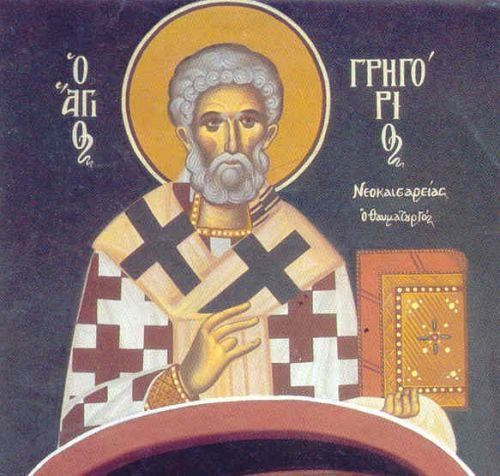
Saint Gregory Thaumaturgus: from 17 Christians to a Christian city

Saint Gregory of Neocaesarea, known as the Wonderworker, is commemorated today. He was born around 210 to 215 AD in Neocaesarea of Pontus. His given name was Theodore, and his parents were pagan Greeks who held high social position in the city. He relied on divine grace and the encouragement of his uncle Paul, who cited Second Timothy 2:1 in Greek: "Ἐνδυναμοῦ ἐν τῇ χάριτι τῇ ἐν Χριστῷ Ἰησοῦ", "Be strengthened by the grace that is in Christ…

Saint Gregory of Neocaesarea, known as the Wonderworker, is commemorated today. He was born around 210 to 215 AD in Neocaesarea of Pontus. His given name was Theodore, and his parents were pagan Greeks who held high social position in the city. He relied on divine grace and the encouragement of his uncle Paul, who cited Second Timothy 2:1 in Greek: "Ἐνδυναμοῦ ἐν τῇ χάριτι τῇ ἐν Χριστῷ Ἰησοῦ", "Be strengthened by the grace that is in Christ Jesus."

Through that grace, Gregory undertook a remarkable struggle and brought nearly the whole city to Christianity. When he assumed the episcopacy, only 17 Christians lived in the city; when he died peacefully at the end of 270 AD, only 17 pagans remained in his diocese. He exercised exceptional self-control in speech, so that no bad, superfluous, or idle word ever came from his mouth.

Because of this purity of speech, God granted him the gift of wonderworking. An image accompanying the commemoration displays the saint's name and title in Greek, broken into individual segments: "ὁ ἅγιος Γρηγόριος Νεοκαισαρείας ὁ θαυματουργός."

  • Born Theodore around 210-215 AD in Neocaesarea of Pontus to pagan Greek parents
  • Encouraged by his uncle Paul with the words of 2 Timothy 2:1
  • Converted nearly the whole city, from 17 Christians to only 17 pagans remaining at his death
  • Noted for extreme self-control in speech, uttering no idle or harmful words
  • Granted the gift of wonderworking by God
CHRISTIANITY UNITED Instagram

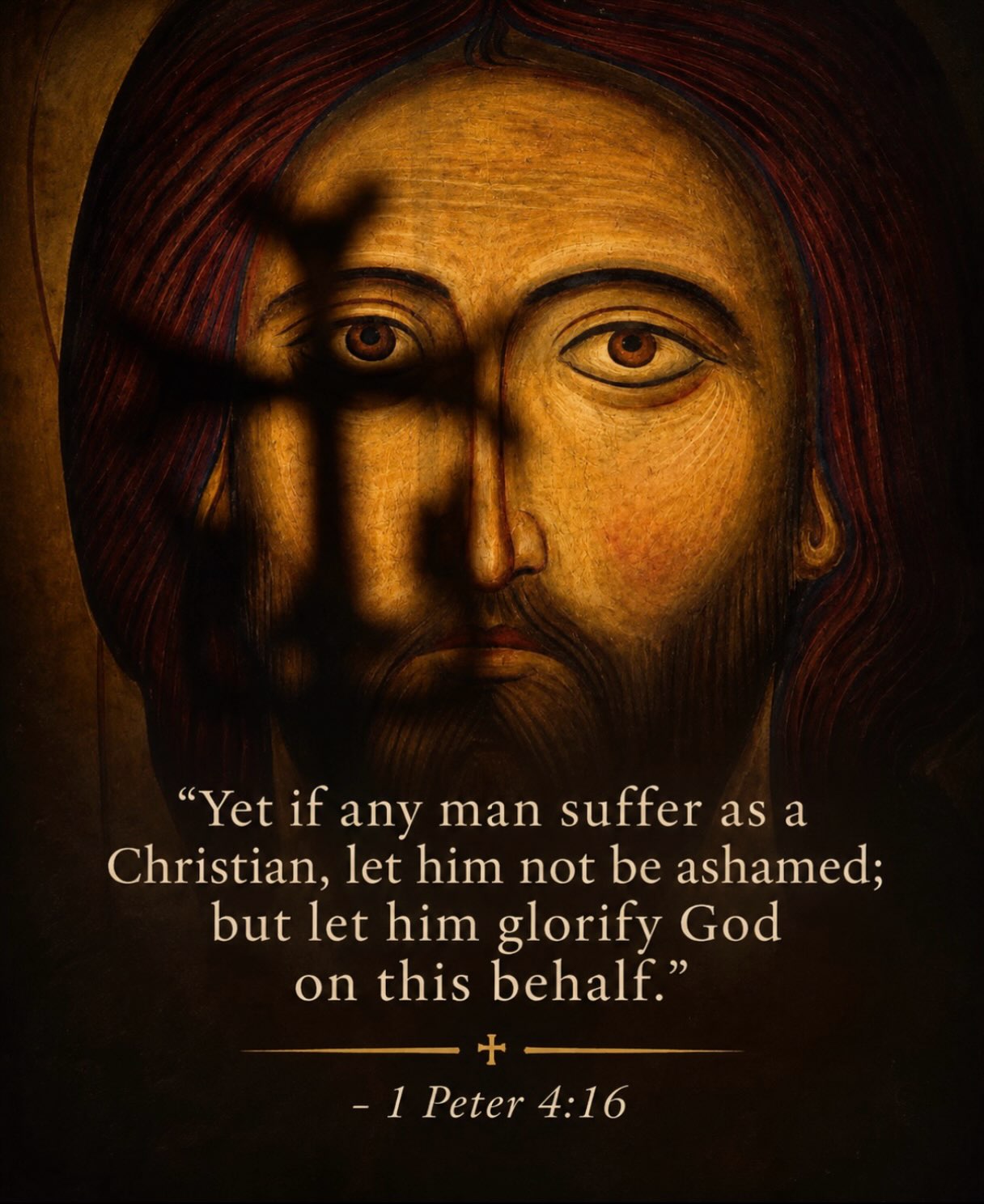
Not ashamed of Christ: persecution, martyrs, and Peter's restoration

The post reflects on 1 Peter 4:16, urging Christians not to be ashamed of Christ. It recounts how early Christians faced persecution, imprisonment, rejection, and death rather than deny their faith, valuing their relationship with Christ above worldly approval. In modern societies where faith can be practiced openly, the author notes that believers still hesitate to speak of Christ due to fear of judgment, mockery, or rejection, sometimes…

The post reflects on 1 Peter 4:16, urging Christians not to be ashamed of Christ. It recounts how early Christians faced persecution, imprisonment, rejection, and death rather than deny their faith, valuing their relationship with Christ above worldly approval. In modern societies where faith can be practiced openly, the author notes that believers still hesitate to speak of Christ due to fear of judgment, mockery, or rejection, sometimes remaining silent when faith is challenged or compromising convictions to fit in.

The Orthodox Church honors martyrs not for seeking suffering but for loving Christ more than comfort and safety, with courage rooted in faith in the risen Lord rather than hatred of persecutors. The post warns that not all criticism constitutes persecution for Christ, and suffering for faith does not justify pride, hatred, or cruelty; truth must be defended with humility and love.

It cites Saint Peter's threefold denial out of fear, his restoration through repentance, and his subsequent fearless witness as a reminder that God's mercy calls us to rise after failure. The text concludes with a prayer for persecuted Christians and a call to ensure actions reflect the confessed Lord.

  • Early Christians endured persecution and death rather than deny Christ.
  • Modern believers often stay silent about faith due to fear of rejection.
  • Martyrs are honored for loving Christ above comfort, not for seeking suffering.
  • Suffering for faith does not permit pride or cruelty; truth requires humility.
  • Saint Peter's denial and restoration show God's mercy after failure.
Read more

Abba John the Short helps thieves pack his cell and asks his brother's forgiveness

The post recounts a story from the Coptic life of Abba John the Short. While Abba John was praying in his cell, two thieves entered and began gathering his possessions. When they ordered him to help load the bags, he complied without resistance. Later his brother, with whom he shared the cell, returned and demanded to know where their things had gone. Abba John recognized the distress he had caused and asked his brother for forgiveness, saying,…

The post recounts a story from the Coptic life of Abba John the Short. While Abba John was praying in his cell, two thieves entered and began gathering his possessions. When they ordered him to help load the bags, he complied without resistance.

Later his brother, with whom he shared the cell, returned and demanded to know where their things had gone. Abba John recognized the distress he had caused and asked his brother for forgiveness, saying, "It's been a long time since I've become a monk. Please forgive me." The author emphasizes that the remarkable moment is not the giving away of possessions but the humility that followed: Abba John did not lecture his brother even though his action was virtuous; he asked forgiveness because he had put his brother through pain.

The author notes that this was Abba John's real, older brother, not merely a fellow monk. The story is taken from the book "The Holy Workshop of Virtue," and the author invites readers to find the full life of Abba John in the graphic novel "A Forest in the Desert."

  • Abba John the Short helps thieves pack his belongings when they rob his cell.
  • His brother returns and confronts him about the missing items.
  • Abba John asks his brother for forgiveness, acknowledging the pain caused.
  • The story illustrates humility: doing right yet seeking forgiveness for the brother's distress.
  • The account comes from the Coptic life of Abba John the Short in "The Holy Workshop of Virtue."

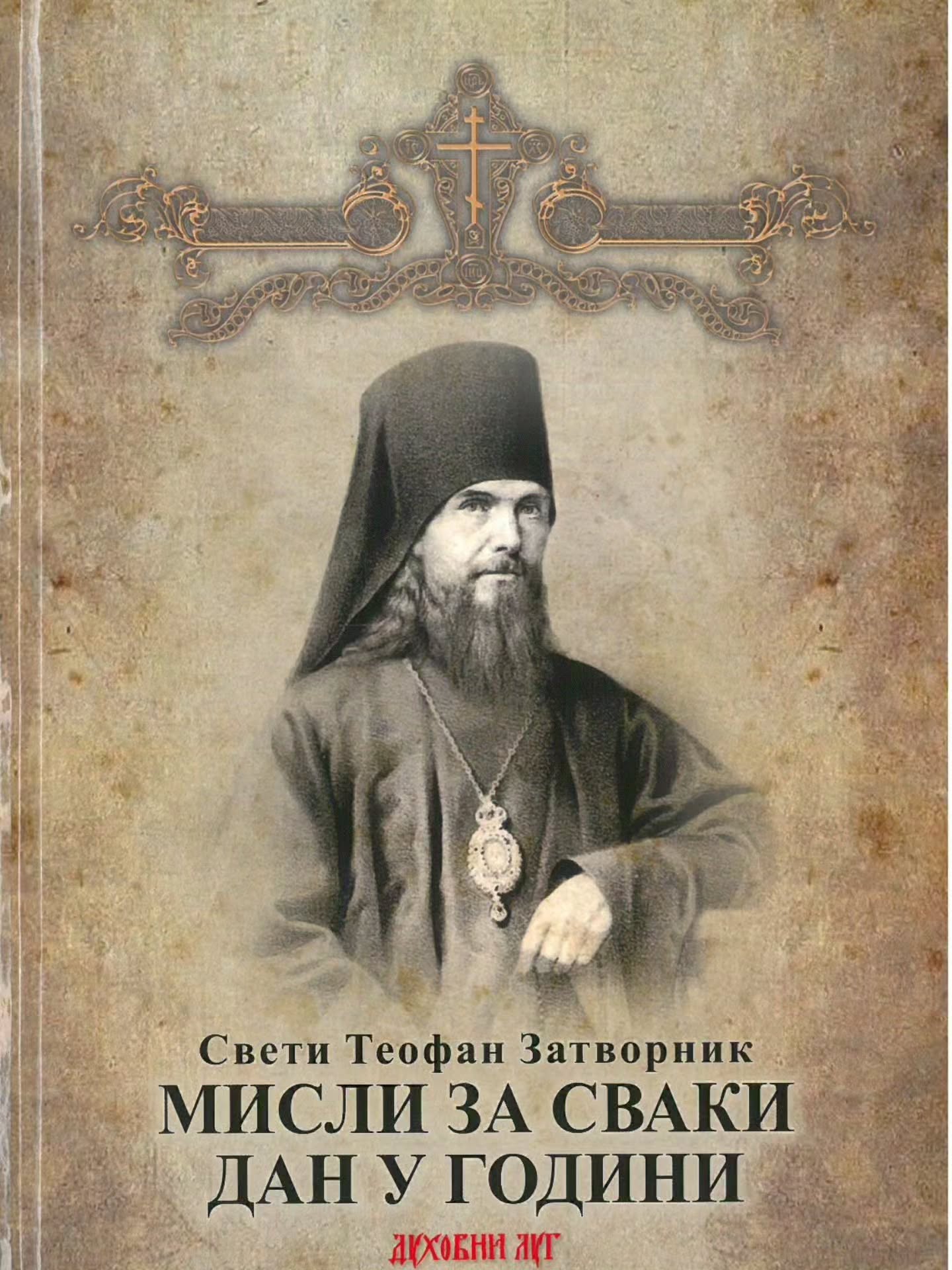
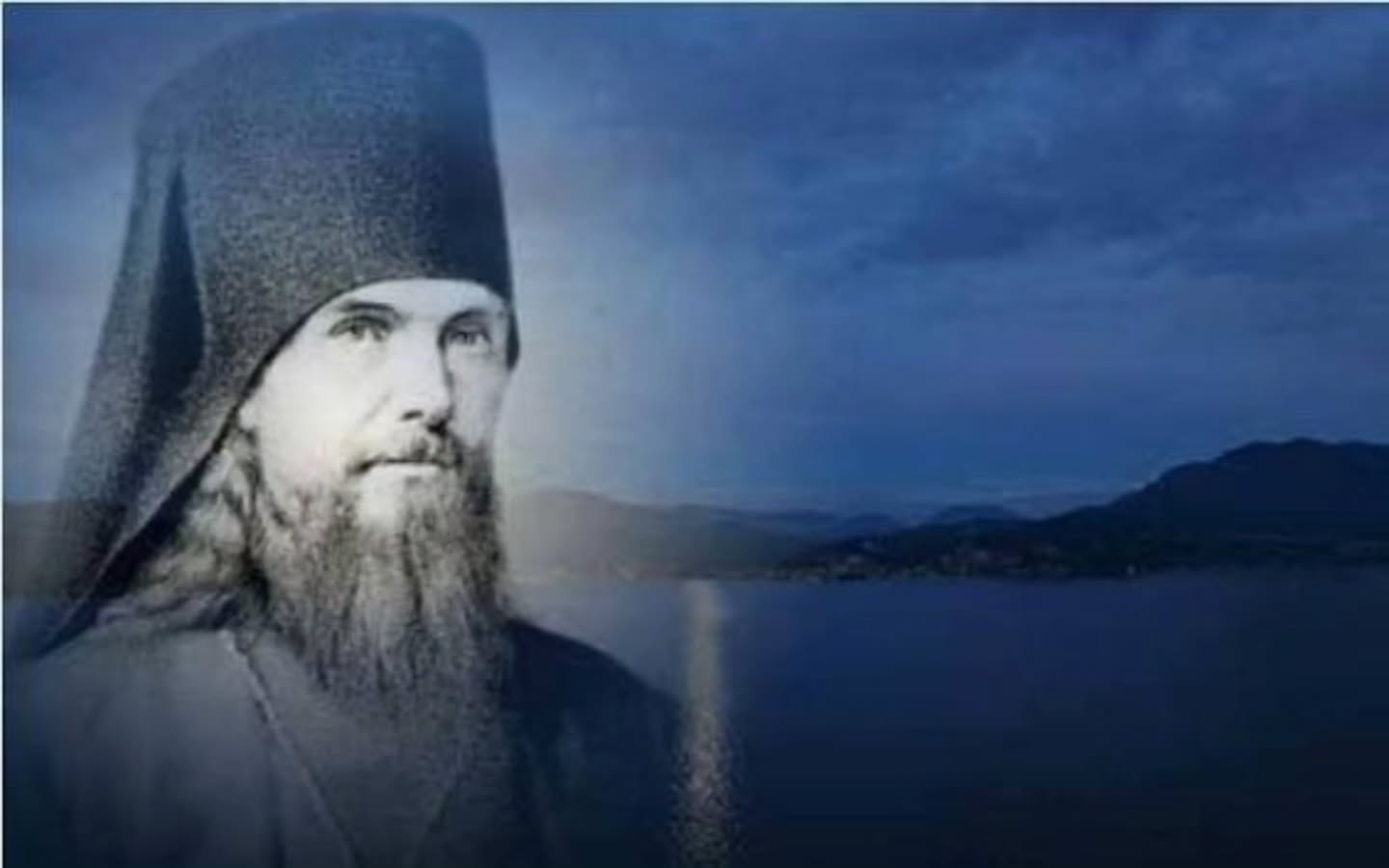
St. Theophan the Recluse: The Mind as the Lamp of the Soul

The post presents a daily thought for November 17 attributed to St. Theophan the Recluse. The saint compares the eye as the lamp of the body to the mind as the lamp of the soul. When the mind is healthy, a person sees clearly in the inner life: the relationship to God and neighbor, and how to govern oneself. The mind unites the sense of the divine, the demands of conscience, and the longing for what is better. A healthy mind brings fear of God,…

The post presents a daily thought for November 17 attributed to St. Theophan the Recluse. The saint compares the eye as the lamp of the body to the mind as the lamp of the soul. When the mind is healthy, a person sees clearly in the inner life: the relationship to God and neighbor, and how to govern oneself.

The mind unites the sense of the divine, the demands of conscience, and the longing for what is better. A healthy mind brings fear of God, conscientiousness, and freedom from external things. When the mind is unhealthy, God is forgotten, conscience ceases, and the soul sinks into the visible and transient.

Concepts become confused, works lack order, and the heart is ruled by inconsolable sadness. The person does not know what he has done, where he is, or where his path leads. In contrast, the one with a healthy mind acts cautiously, listens to the law of conscience, and does not plunge into the sensory but rises with longing for future blessedness.

The post notes the text is a translation and edition based on St. Theophan's writing, not a literal reproduction of the Hilandar edition. Biblical foundations are given as 1 Thessalonians 3:9-13 and Luke 11:34-41.

  • Quote from St. Theophan the Recluse for November 17
  • Analogy: the eye is the lamp of the body, the mind is the lamp of the soul
  • A healthy mind brings fear of God, conscience, and freedom from externals
  • An unhealthy mind leads to forgetfulness of God, disordered concepts, and sorrow
  • Biblical basis: 1 Thessalonians 3:9-13 and Luke 11:34-41

St Theophan the Recluse: the unseen work of remembering God

A passage from St Theophan the Recluse, spiritual instruction 182, 'Mental work. On the Jesus Prayer', published by Svetosavlje. The saint answers the question of whether one must always have a task or occupation. He says no one should be without work, but he distinguishes two kinds of work: work that the body performs visibly, and works that are of the mind and invisible. The invisible works, he says, are the true works. The first of them is…

A passage from St Theophan the Recluse, spiritual instruction 182, 'Mental work. On the Jesus Prayer', published by Svetosavlje. The saint answers the question of whether one must always have a task or occupation. He says no one should be without work, but he distinguishes two kinds of work: work that the body performs visibly, and works that are of the mind and invisible.

The invisible works, he says, are the true works. The first of them is the constant remembrance of God with the mind-in-the-heart prayer. No one sees this, yet people who keep themselves in this state are engaged in unceasing, strenuous activity. For St Theophan this is the one thing needful: as soon as this remembrance is present, one need not worry about other works.

The quote is presented as a short teaching on the Jesus Prayer and mental work, without further discussion in the post.

  • St Theophan the Recluse distinguishes visible bodily work from invisible works of the mind, which he calls the true works.
  • The first of these invisible works is constant remembrance of God with mind-in-the-heart prayer.
  • No one sees this labour, yet those who practise it are in unceasing, strenuous activity.
  • He calls this remembrance the one thing needful: with it, one need not worry about other works.
  • The quote comes from spiritual instruction 182, 'Mental work. On the Jesus Prayer'.

What Christ Is: Heaven That Came Down to Be With Us

Fr Dr Oliver Subotic, a priest of the Serbian Orthodox Church serving at the church of St Alexander Nevsky in Dorcol, Belgrade, head of the Missionary Department of the Belgrade-Karlovac Archdiocese, and a doctor of sociological sciences, theologian and software engineer, explains what Christ is through the architecture of Hagia Sophia. He reads the building as an image of the Incarnation: heaven has come down to be here with us. God became man…

Fr Dr Oliver Subotic, a priest of the Serbian Orthodox Church serving at the church of St Alexander Nevsky in Dorcol, Belgrade, head of the Missionary Department of the Belgrade-Karlovac Archdiocese, and a doctor of sociological sciences, theologian and software engineer, explains what Christ is through the architecture of Hagia Sophia.

He reads the building as an image of the Incarnation: heaven has come down to be here with us. God became man while remaining fully God, and he came down to us in the most intimate way possible. The speaker quotes St Justin Martyr, who says that Christ took on everything that is ours, everything bound by the five simple senses, and did this all for our sake.

The movement of the Incarnation runs in both directions. God comes among us so that we can go up again, made gods by grace. The talk stays with this single theme: the descent of the Son of God into everything that belongs to human life, and the ascent of man that this descent makes possible. The architecture of the great church serves the speaker as a way to see the mystery rather than only speak of it, since its dome and space draw the eye from earth toward heaven, the same direction the Incarnation reverses and completes.

Key moments

  1. Hagia Sophia's architecture shows what Christ is: heaven that came down to be here with us.
  2. God became man while remaining fully God, coming down to us in the most intimate way possible.
  3. As Justin says, Christ took on everything that is ours, bound by the five simple senses, all for our sake.
  4. God comes among us so that we can go up again, made gods by grace.

How a boy who survived a firing squad found Elder Joseph on Mount Athos

Archimandrite Luka (Anić), abbot of the Dajbabe monastery, now departed in the Lord, tells the life and spiritual struggles of Elder Ephraim of Arizona. He notes that stories of the Athonite ascetics' struggles are not yet written down and may only be recorded after Elder Ephraim's repose, though we hope God keeps him among us for our sake, since he no longer needs it himself. The heart of the talk is the story of Elder Ephraim's arrival on…

Archimandrite Luka (Anić), abbot of the Dajbabe monastery, now departed in the Lord, tells the life and spiritual struggles of Elder Ephraim of Arizona. He notes that stories of the Athonite ascetics' struggles are not yet written down and may only be recorded after Elder Ephraim's repose, though we hope God keeps him among us for our sake, since he no longer needs it himself.

The heart of the talk is the story of Elder Ephraim's arrival on Mount Athos. In 1942, during mass executions in which Germans shot Greek villagers, a boy called little Janis from Volos was not hit by a bullet. A merciless officer then fired a shot at the boy's head, but the boy did not move and only felt his ear burn from the blast.

The officer fell down, kissed his feet, and called him an angel. Janis did not run home but to a priest, who saw God's hand in what happened and told him he was not for this world, to go to Mount Athos, find a good elder and obey him as God, and to ask for Elder Joseph. Janis was about 16 years old when he arrived by ship. A monk waiting on the dock recognized him immediately and said that Elder Joseph had sent him to fetch the boy.

In this way Ephraim came to Elder Joseph. Archimandrite Luka adds that the five men who recognized in Elder Joseph a hesychast not born for a thousand and a half years later became abbots of five great Athonite monasteries, each today numbering around 100 to 120 monks, and they carry on Elder Joseph's work through their hands.

Key moments

  1. 0:00 Stories of the Athonite ascetics' struggles are not found in books yet and will probably be told when Elder Ephraim goes to the Lord, though we hope God keeps him here for our sake, since he no longer needs it himself.
  2. 0:00 In 1942, during mass executions in which Germans shot Greek villagers, a boy called little Janis from Volos was not hit by a bullet.
  3. 0:00 A merciless officer fired a shot at the boy's head, but he did not move; only his ear burned from the blast, and the officer fell down, kissed his feet, and said: You are an angel.
  4. 0:00 Janis ran to a priest instead of home, and the priest, seeing God's hand in it, told him he was not for this world, to go to Mount Athos as a monk, find a good elder and obey him as God, and to ask for Elder Joseph.
  5. 0:30 When Janis, about 16 years old, arrived by ship, a monk on the dock recognized him by name and said Elder Joseph had sent him to bring the boy.
  6. 0:30 The five men who recognized in Elder Joseph an ascetic not born for a thousand and a half years became abbots of five great Athonite monasteries, each today numbering about 100 to 120 monks, continuing Elder Joseph's work through their hands.
Read more

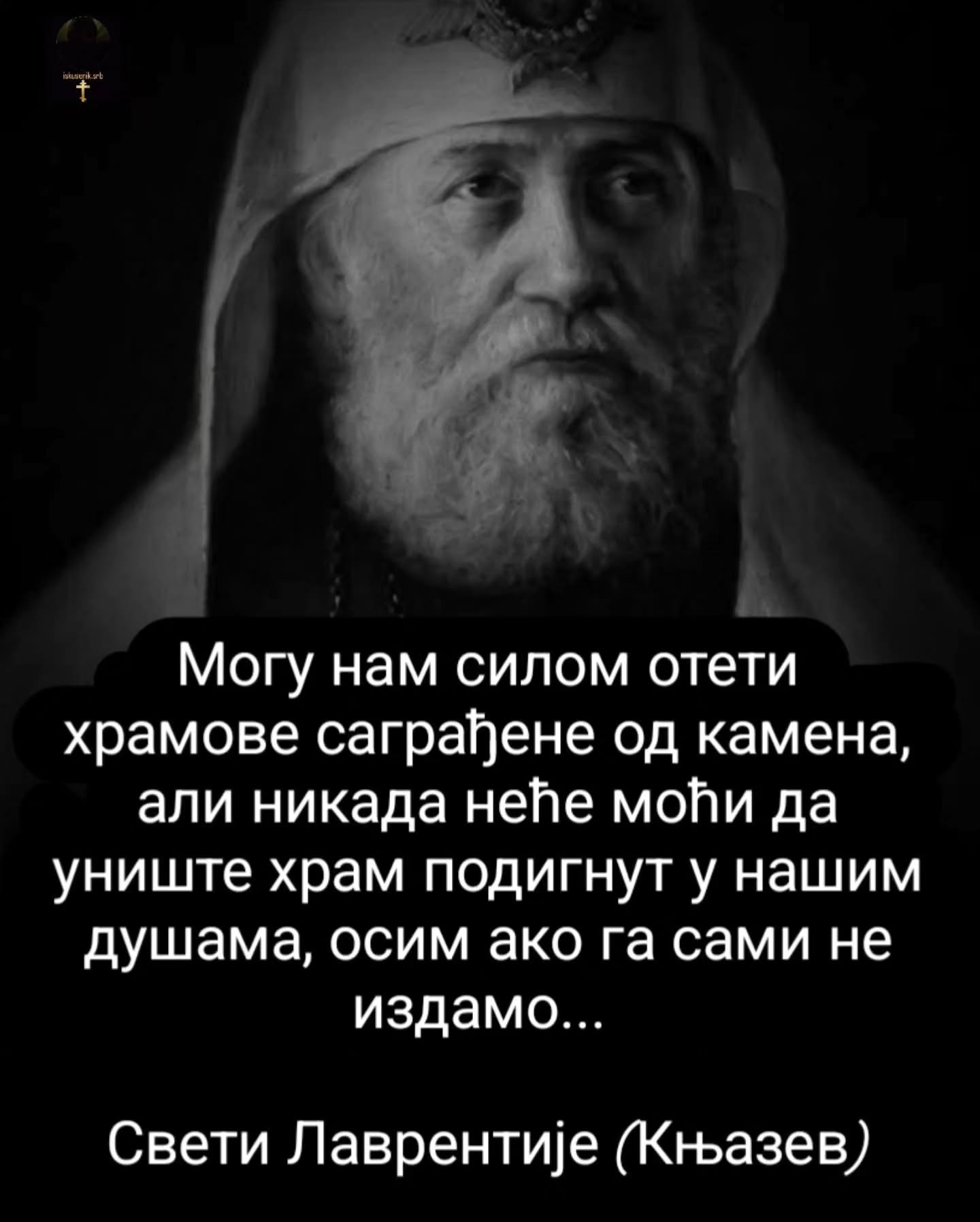
Saint Lavrentije on the temple of the soul

The post shares a saying attributed to Saint Lavrentije (Knezhev): "They can take away by force temples built of stone, but they will never be able to destroy the temple raised in our souls, unless we ourselves betray it." The quote emphasizes that the true church is the inner spiritual life, which cannot be destroyed by external persecution unless one abandons it willingly.

  • Saint Lavrentije (Knezhev) is the source of the saying.
  • The saying contrasts physical churches made of stone with the spiritual temple in the soul.
  • External force can destroy stone buildings but not the inner temple.
  • The inner temple can only be lost through personal betrayal.
  • The quote reflects Orthodox teaching on the resilience of faith under persecution.
Read more