WeOrthodox
EN UA

Orthodox posts, videos and discussions

We follow Orthodox channels, communities and blogs across the web, summarise every post and video, and highlight the conversations with real substance.

When Canons Are Turned into Weapons: Grace Cannot Be Controlled by Rules

When Canons Are Turned into Weapons: Grace Cannot Be Controlled by Rules 5:02

Sister Vassa Larin, Doctor of Theology in Vienna, Austria, speaks about the misuse of canon law for political ends. She argues that canons exist to serve the life of the Church, not state power, and that they are being weaponized to support state ideology, silence conscience, and punish those who pray for peace. A central claim is that canonicity is often misunderstood as if the correct use of rules could control the grace of God. She calls this…

Sister Vassa Larin, Doctor of Theology in Vienna, Austria, speaks about the misuse of canon law for political ends. She argues that canons exist to serve the life of the Church, not state power, and that they are being weaponized to support state ideology, silence conscience, and punish those who pray for peace. A central claim is that canonicity is often misunderstood as if the correct use of rules could control the grace of God.

She calls this teaching backwards: grace is the divine life of God and cannot be possessed or managed by human authority. Citing Gregory Palamas, who defined grace as the divine energies of the living God, she says it is by the grace of God that canonicity is received, not the other way around. When canons are separated from Christ and the Holy Spirit, they become tools of coercion rather than instruments of salvation.

She applies this to the crisis between Moscow and Ukraine, where the word canonical is used to claim that Metropolitan Onuphry's jurisdiction is legitimate while the jurisdiction that received a tomos from Patriarch Bartholomew is not. She accuses Patriarch Kirill of serving an anti-Christian and neo-fascist authority, the Putin regime, and of using the canons, including Canon 25 of the Holy Apostles, to defrock priests who pray for peace.

In her view this destroys church unity and pan-Orthodox communion. She also points to bribery in the Church of Alexandria and to the manipulation of sacred symbols of Orthodox tradition. The Church, she says, is called to discern where canon law builds up the body of Christ and where it is being used to wound it.

Key moments

  1. 0:31 Hierarchs, especially but not only in the Russian Orthodox Church, abuse canons in the dispute between the Moscow Patriarchate and the churches in Ukraine, calling Metropolitan Onuphry's jurisdiction canonical and the one with a tomos from Patriarch Bartholomew not canonical.
  2. 1:35 There is a misconception that canonicity brings grace and that without canonicity there is no grace; the speaker calls this backwards and upside down.
  3. 2:05 Gregory Palamas defined grace as the divine energies of God, which cannot be controlled by rules; rather, by the grace of God we receive canonicity.
  4. 3:06 The Moscow Patriarchate is described as serving a state ideology, an anti-Christian and neo-fascist authority, the Putin regime.
  5. 3:39 Priests are being defrocked for praying for peace, with the patriarch and his church court citing Canon 25 of the Holy Apostles.
  6. 4:11 This disconnect from Christ destroys church unity and pan-Orthodox communion through anti-Christian actions, including bribery in the Church of Alexandria and manipulation of the sacred symbols of Orthodox tradition.
CHRISTIANITY UNITED Instagram

Father Lazarus El Anthony: The World Is Our Cross, and How We Carry It

A post shares a teaching from Father Lazarus El Anthony, a Coptic Orthodox monk of the Monastery of Saint Anthony in the Egyptian desert, on what it means to carry one's cross. The post quotes Christ's words from Matthew 16:24: "If anyone desires to come after Me, let him deny himself, and take up his cross, and follow Me." It lists the difficulties people face: illness, family problems, loneliness, financial worries, disappointment, and pain…

A post shares a teaching from Father Lazarus El Anthony, a Coptic Orthodox monk of the Monastery of Saint Anthony in the Egyptian desert, on what it means to carry one's cross. The post quotes Christ's words from Matthew 16:24: "If anyone desires to come after Me, let him deny himself, and take up his cross, and follow Me." It lists the difficulties people face: illness, family problems, loneliness, financial worries, disappointment, and pain caused by people they once trusted.

It notes that we often spend our time asking God to remove these things and forget Christ's command. Carrying the cross, the post says, does not mean pretending suffering does not hurt, and it does not mean staying silent in the face of abuse or injustice. It means facing unavoidable difficulties without letting them separate us from Christ.

The post recalls Father Lazarus's own path: born in Australia, he left a comfortable life to become a monk in Egypt, following the tradition of the Desert Fathers. It adds that a cross is not always something extraordinary; it can be an illness, a person we struggle to forgive, or daily responsibilities. Not every suffering is sent by God, and we may not understand why things happen, but hard circumstances can become an occasion for prayer, patience, humility, and a closer relationship with Christ.

In the video itself, Father Lazarus says the world itself is our cross: we are hurt by other people, by sickness, by death, and by temptations, and turned from the right path in every way. He recalls his own suffering before monastic life, from nature, from snow and fire, from people who betrayed and disappointed him, and from his own foolishness and wrong decisions.

Part of the answer, he says, is to become better and learn from mistakes, the worldly wisdom that you do not put your hand twice in the fire. There is another lesson: suffering can be accepted, embraced, and remade.

Key moments

  1. As Christians we must carry our cross, and the world is our cross: we are hurt by others, by sickness, by death, by temptations.
  2. Suffering is not good while you endure it, and everyone suffers.
  3. The monk recounts his suffering before monastic life: from nature and the elements, from people who betrayed and disappointed him, and from his own foolishness and wrong decisions.
  4. Part of the solution is to become better and learn from mistakes, the worldly wisdom that you do not put your hand twice in the fire.
  5. There is another lesson: suffering can be accepted, embraced, and renovated, renewed, remade.
Read more
☦️An Orthodox Blog☦️ with Orthodoxy ☦︎ Instagram

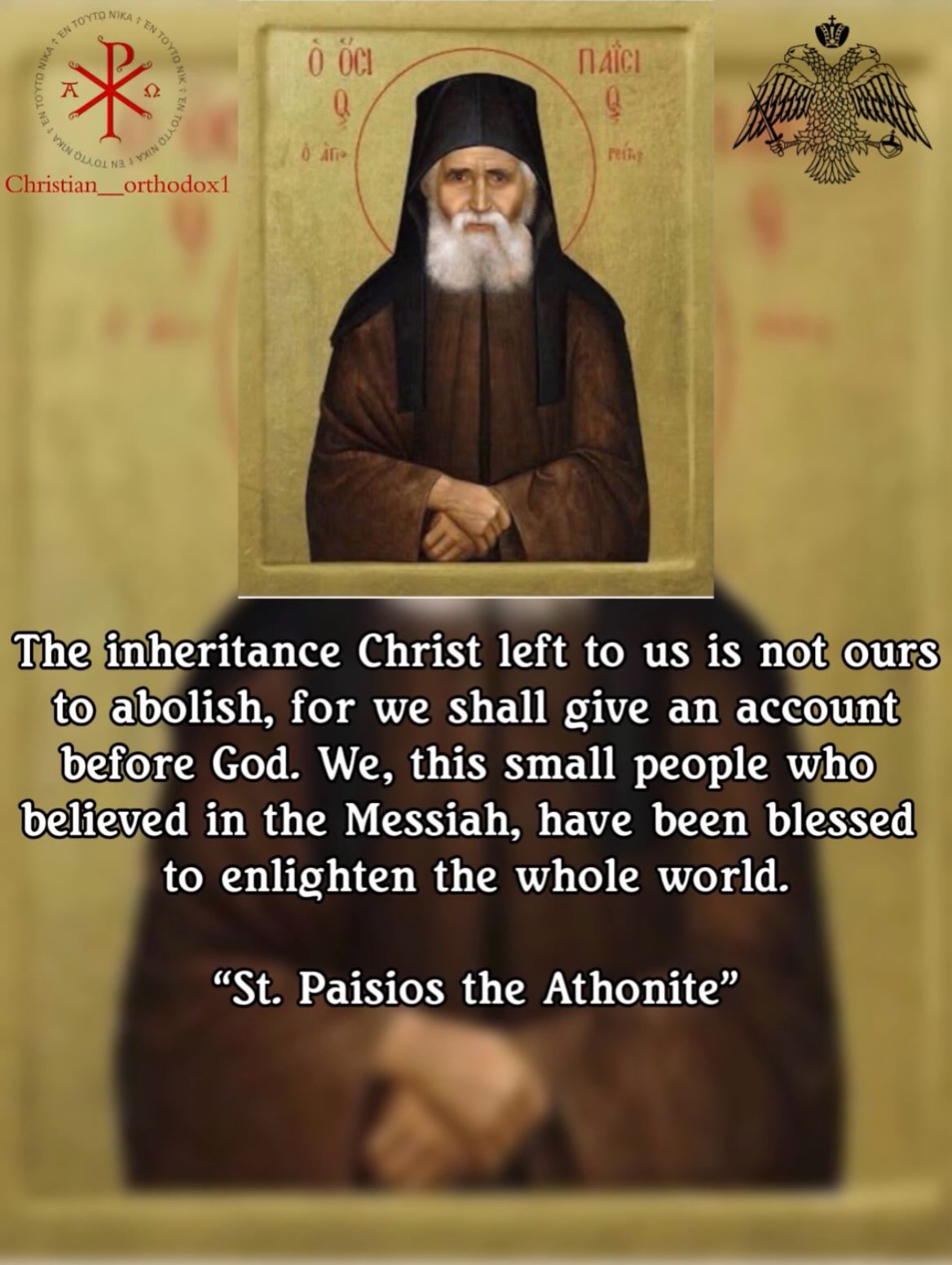
St. Paisios: The Inheritance Christ Left Us Is Not Ours to Abolish

The post quotes St. Paisios the Athonite on the inheritance Christ left to believers. The quote warns that this inheritance is not ours to abolish, because we shall give an account before God. It then speaks of the small people who believed in the Messiah and were blessed to enlighten the whole world. The post is a short devotional quotation shared with tags for Orthodox Christianity, the church, faith, and the Church Fathers. There is no…

The post quotes St. Paisios the Athonite on the inheritance Christ left to believers. The quote warns that this inheritance is not ours to abolish, because we shall give an account before God. It then speaks of the small people who believed in the Messiah and were blessed to enlighten the whole world.

The post is a short devotional quotation shared with tags for Orthodox Christianity, the church, faith, and the Church Fathers. There is no further discussion in the source text; the card presents the quotation itself and its attribution to St. Paisios the Athonite.

  • St. Paisios the Athonite is quoted on the inheritance Christ left to believers.
  • The quote says this inheritance is not ours to abolish, for we shall give an account before God.
  • It describes the believers in the Messiah as a small people blessed to enlighten the whole world.
  • The post carries tags for Orthodox Christianity, the church, faith, and the Church Fathers.

Be faithful unto death: Revelation 2:10 and a stand against the world

The post opens with a direct quotation from the Book of Revelation, chapter 2 verse 10: "Be faithful unto death!" The same verse appears in Russian as "Буди верен даже до смерти" with the citation Апокалипсис 2:10. The quotation is followed by a line of hashtags that tag the post with the topics Orthodox, Christianity, faith, and spiritual war, using both English and Russian tags. Below the hashtags a video summary is provided. The summary…

The post opens with a direct quotation from the Book of Revelation, chapter 2 verse 10: "Be faithful unto death!" The same verse appears in Russian as "Буди верен даже до смерти" with the citation Апокалипсис 2:10. The quotation is followed by a line of hashtags that tag the post with the topics Orthodox, Christianity, faith, and spiritual war, using both English and Russian tags.

Below the hashtags a video summary is provided. The summary consists of two sentences attributed to a speaker. The first sentence states that cowards will not enter God's kingdom. The second sentence declares that if the whole world opposes the speaker, by the grace of Jesus Christ the speaker stands against the whole world.

The video points section repeats these two sentences as bullet points. The first bullet point reads: "Cowards will not enter God's kingdom." The second bullet point reads: "If the whole world is against the speaker, by the grace of Jesus Christ he is against the whole world."

The post does not include a video transcript, nor does it name the speaker or give any context for the recording. No discussion, comments, or replies are present in the supplied material. The entire content is confined to the scriptural quotation in two languages, the hashtag list, and the two-sentence summary with its two corresponding bullet points.

Key moments

  1. Cowards will not enter God's kingdom.
  2. If the whole world is against the speaker, by the grace of Jesus Christ he is against the whole world.
Read more

Four Biblical Signs of a Godly Woman, According to Christian Dating Advice

The speaker addresses men who are dating and lists four biblical signs of a woman worth building a life with. The first sign is that she knows how to build a home. Proverbs 31 says she watches over the ways of her household and does not eat the bread of idleness, and the speaker describes this as bringing order, peace and warmth so that a husband feels he can walk through the door and breathe. The second sign is a genuine prayer life. The…

The speaker addresses men who are dating and lists four biblical signs of a woman worth building a life with. The first sign is that she knows how to build a home. Proverbs 31 says she watches over the ways of her household and does not eat the bread of idleness, and the speaker describes this as bringing order, peace and warmth so that a husband feels he can walk through the door and breathe.

The second sign is a genuine prayer life. The speaker points to Hannah in 1 Samuel, who prayed with such intensity and faith that Eli thought she was drunk, and says the point is a real relationship with God, not prayer only when life is easy. The third sign is respect. Ephesians 5 speaks of a wife who respects her husband, and the speaker warns men to pay attention if a woman constantly humiliates them, tears them down or competes with them.

The fourth sign is character over appearance. Proverbs 31 says charm is deceitful and beauty is vain, but a woman who fears the Lord is to be praised. The speaker adds that a godly woman is not a perfect woman but someone who continually strives to grow closer to Christ. He closes with a word to the men themselves: if you are looking for a woman with these qualities, you must also be working towards becoming a godly husband.

Beauty may attract you, but character, loyalty, peace and faith are what a marriage is built on, so do not just look for a beautiful woman; look for a woman you can build a Christ-centred life with.

Key moments

  1. She knows how to build a home: Proverbs 31 says she watches over the ways of her household and does not eat the bread of idleness, bringing order, peace and warmth.
  2. She prays with a real relationship with God, like Hannah in 1 Samuel, who prayed with such intensity and faith that Eli thought she was drunk.
  3. She respects you, as Ephesians 5 speaks of a wife who respects her husband; if she constantly humiliates, tears down or competes with you, pay attention.
  4. Look at her character: Proverbs 31 says charm is deceitful and beauty is vain, but a woman who fears the Lord is to be praised.
  5. Beauty gets your attention, but character, loyalty, peace and faith are what you build a marriage on, so choose accordingly.
Read more

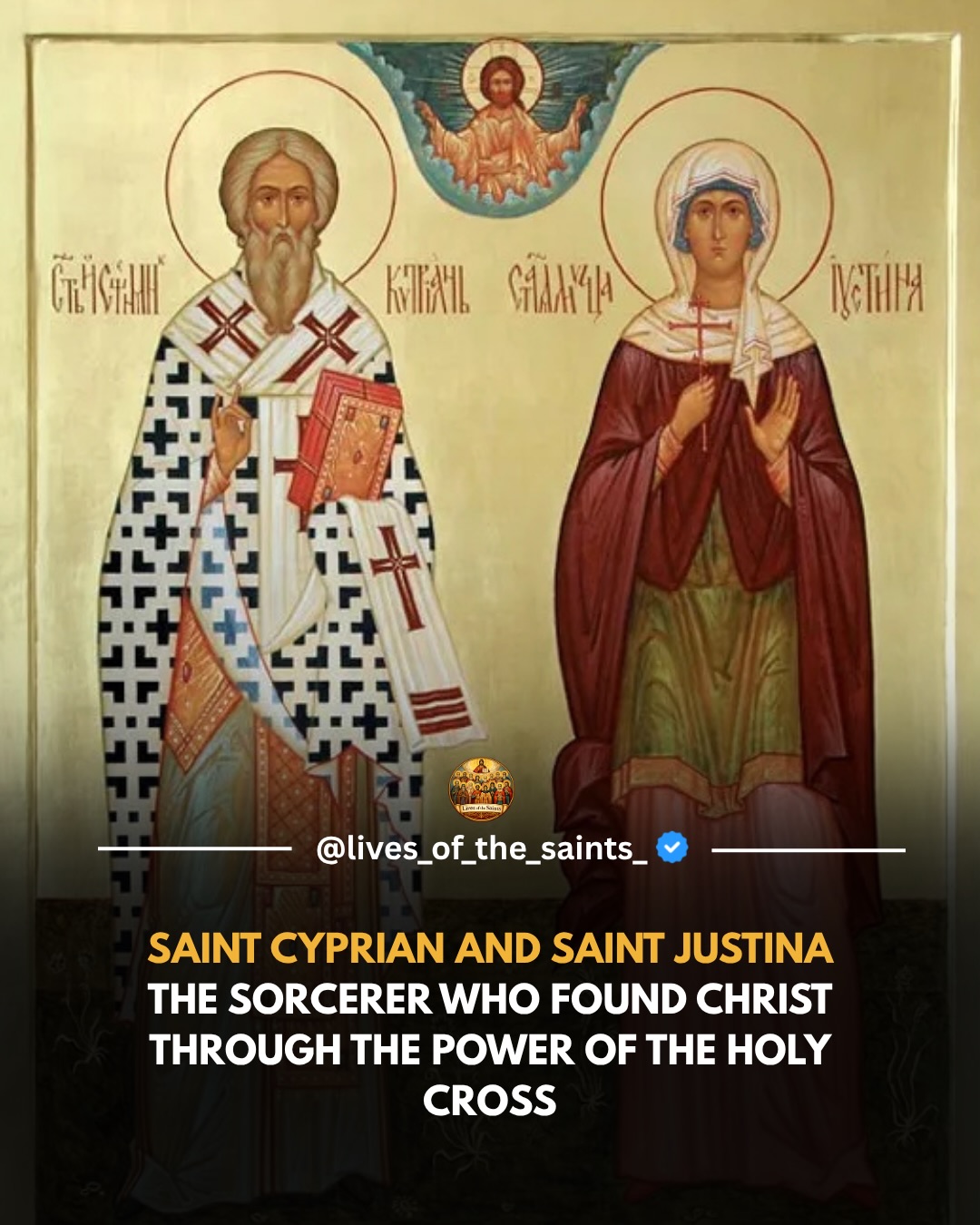
From sorcerer to bishop: Saint Cyprian's conversion through Saint Justina's faith

The post recounts the lives of Saints Cyprian and Justina. Cyprian, a sorcerer from Carthage, traveled to Antioch where Justina lived with her parents. Justina had been raised in a pagan household but discovered the Christian faith, embraced Christ, and brought her parents to believe in Him. All three were baptized and began a new life in the Lord. Cyprian practiced magic and called upon evil spirits. A pagan young man named Aglaidas became…

The post recounts the lives of Saints Cyprian and Justina. Cyprian, a sorcerer from Carthage, traveled to Antioch where Justina lived with her parents. Justina had been raised in a pagan household but discovered the Christian faith, embraced Christ, and brought her parents to believe in Him. All three were baptized and began a new life in the Lord. Cyprian practiced magic and called upon evil spirits.

A pagan young man named Aglaidas became obsessed with Justina's beauty. When she refused his advances, he turned to Cyprian for help. Cyprian sent evil spirits against Justina, hoping to tempt her and turn her away from her purity and faith.

Every time the demons approached, Justina drove them away through prayer and the sign of the Holy Cross. Nothing could overcome her faith in Christ. Seeing that even the powers of darkness were powerless before the Cross, Cyprian began to understand the truth. He abandoned his former life, received Holy Baptism, and eventually became a priest and bishop of the Church.

The man who once served evil spirits became a servant of the living God. Later, both Cyprian and Justina were arrested for their Christian faith, tortured, and finally beheaded in Nicomedia toward the end of the third century. The account concludes that their lives remind us that no darkness is greater than the light of Christ, no sin is beyond sincere repentance, and no evil power can overcome the grace of God.

  • Cyprian, a Carthaginian sorcerer, attempted to use demons against Justina in Antioch
  • Justina, a convert from paganism, repelled the demons through prayer and the Cross
  • Cyprian converted, was baptized, and became a priest and bishop
  • Both saints were martyred by beheading in Nicomedia in the late third century
  • The narrative illustrates the power of the Cross over evil spirits
Read more

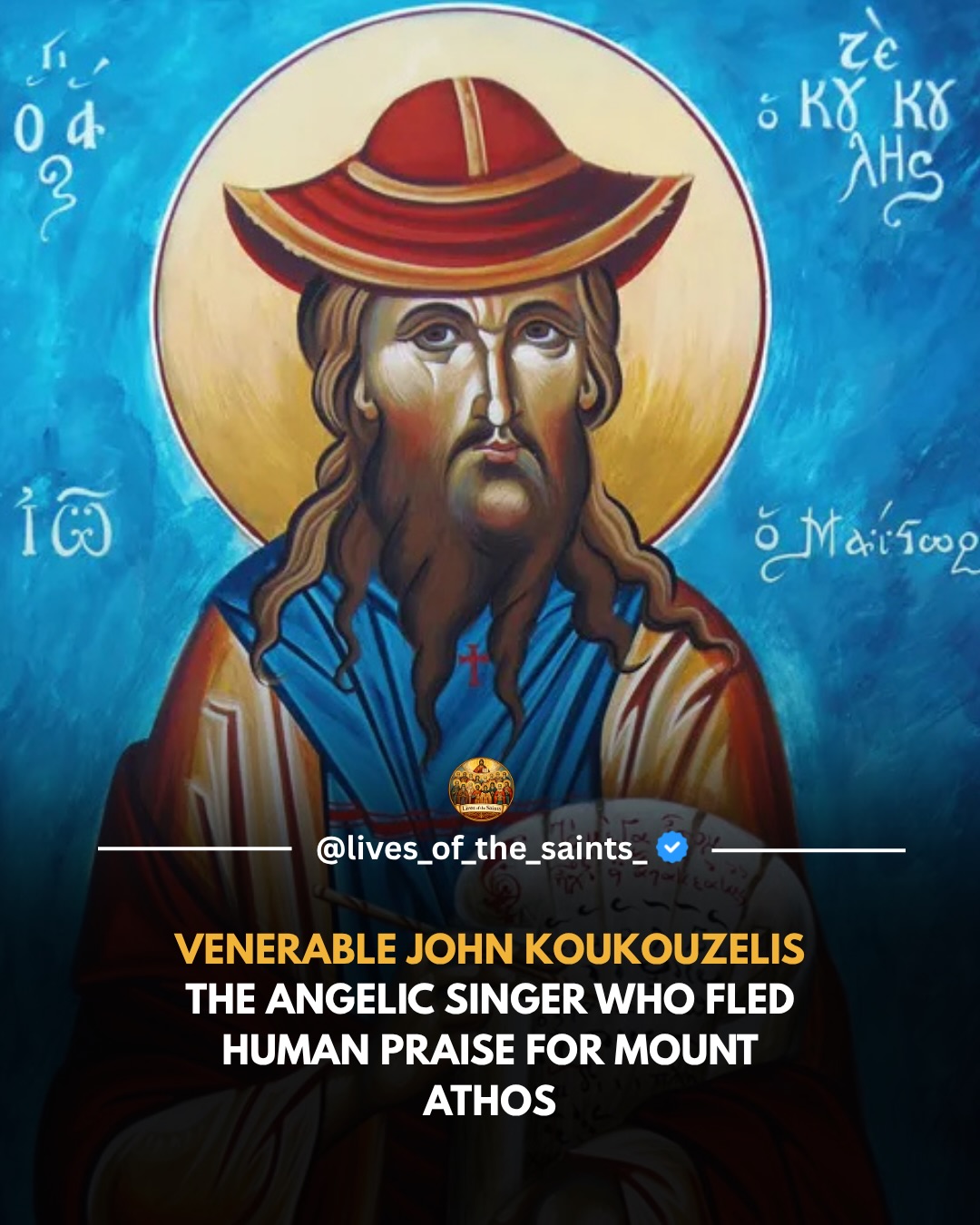
Saint John Koukouzelis: From Court Singer to Humble Shepherd on Mount Athos

Saint John Koukouzelis was a Slav from the region of Debar. As a young boy he was taken to the music school in Constantinople where his beautiful voice and gift for singing made him beloved at the imperial court. Despite this recognition he feared the danger of human praise. Instead of seeking honor, comfort, and recognition he fled to the Holy Mountain, Mount Athos. There he entered the Great Lavra, not as a famous singer, but humbly as a…

Saint John Koukouzelis was a Slav from the region of Debar. As a young boy he was taken to the music school in Constantinople where his beautiful voice and gift for singing made him beloved at the imperial court. Despite this recognition he feared the danger of human praise. Instead of seeking honor, comfort, and recognition he fled to the Holy Mountain, Mount Athos.

There he entered the Great Lavra, not as a famous singer, but humbly as a shepherd. Hidden from the world he lived as both monk and shepherd, giving himself to prayer, obedience, and spiritual struggle. Because of his humility and love for God the Most Holy Theotokos appeared to him twice.

Saint John reposed in the 12th century, leaving behind the memory of a soul that chose silence over fame and Christ over worldly glory. The post reminds readers that the gifts God gives are not for pride but for worship, humility, and the salvation of the soul.

  • Saint John Koukouzelis was a Slav from the Debar region.
  • He was taken to Constantinople's music school as a boy and became a favored singer at the imperial court.
  • Fearing human praise, he fled to Mount Athos and entered the Great Lavra as a humble shepherd.
  • The Theotokos appeared to him twice due to his humility and love for God.
  • He reposed in the 12th century, exemplifying the use of God-given gifts for worship and salvation.
Read more

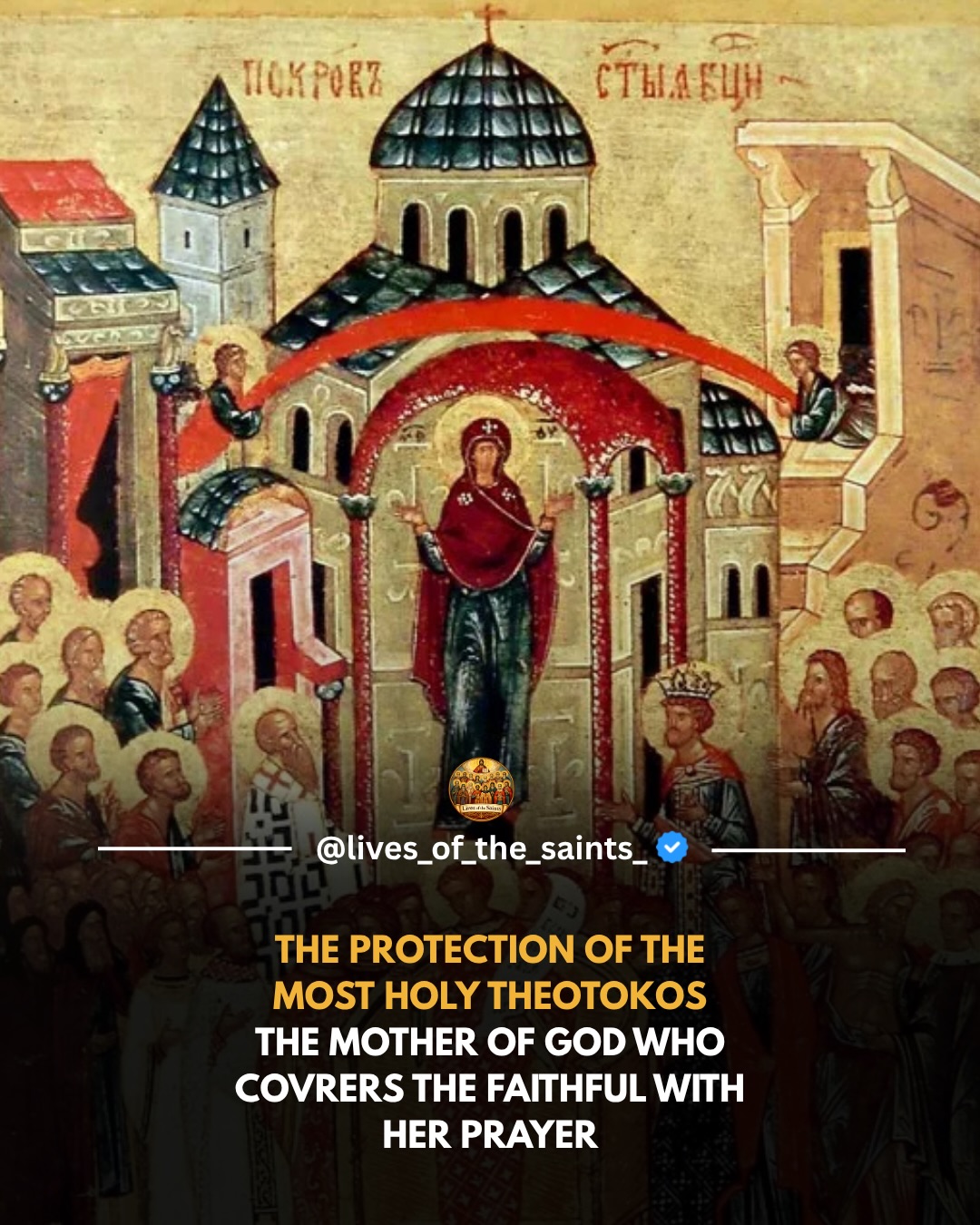
The Protection of the Theotokos: Vision at Blachernae in 911

The post describes the feast of the Protection of the Most Holy Theotokos, celebrated on October 1. It begins by stating that the Church has always glorified the Theotokos as the protector and defender of the Christian people, interceding for sinners and asking God's mercy upon the world. Her help has been shown countless times to individuals and nations, in peace and war, in monasteries and deserts, and in crowded cities. The feast commemorates…

The post describes the feast of the Protection of the Most Holy Theotokos, celebrated on October 1. It begins by stating that the Church has always glorified the Theotokos as the protector and defender of the Christian people, interceding for sinners and asking God's mercy upon the world. Her help has been shown countless times to individuals and nations, in peace and war, in monasteries and deserts, and in crowded cities.

The feast commemorates a specific event from the year 911 during the reign of Emperor Leo the Wise. An all-night vigil was held in the Church of the Theotokos at Blachernae in Constantinople. The church was filled with people. At the back stood Saint Andrew the Fool-for-Christ with his disciple Epiphanius.

During the night, the Most Holy Theotokos appeared above the people, holding her omophorion spread out in her hands as though covering the faithful. She was clothed in heavenly beauty, shining with indescribable light, surrounded by apostles, saints, martyrs, and virgins. Seeing this vision, Saint Andrew pointed to her and asked Epiphanius: "Do you see, brother, the Queen and Lady of all, praying for the whole world?"

Epiphanius answered: "I see, and I am amazed." The feast reminds the faithful that the Theotokos has not abandoned them. She covers, protects, comforts, and prays for all who call upon her in trouble, sorrow, and need. The post ends with the invocation: Most Holy Theotokos, save us.

  • The feast honors the Theotokos as protector and intercessor for the Christian people.
  • It commemorates her appearance at the Blachernae church in Constantinople in 911.
  • Saint Andrew the Fool-for-Christ and Epiphanius witnessed her holding her omophorion over the faithful.
  • She appeared surrounded by apostles, saints, martyrs, and virgins in heavenly light.
  • The feast affirms her ongoing protection and prayer for all who call upon her.
Read more

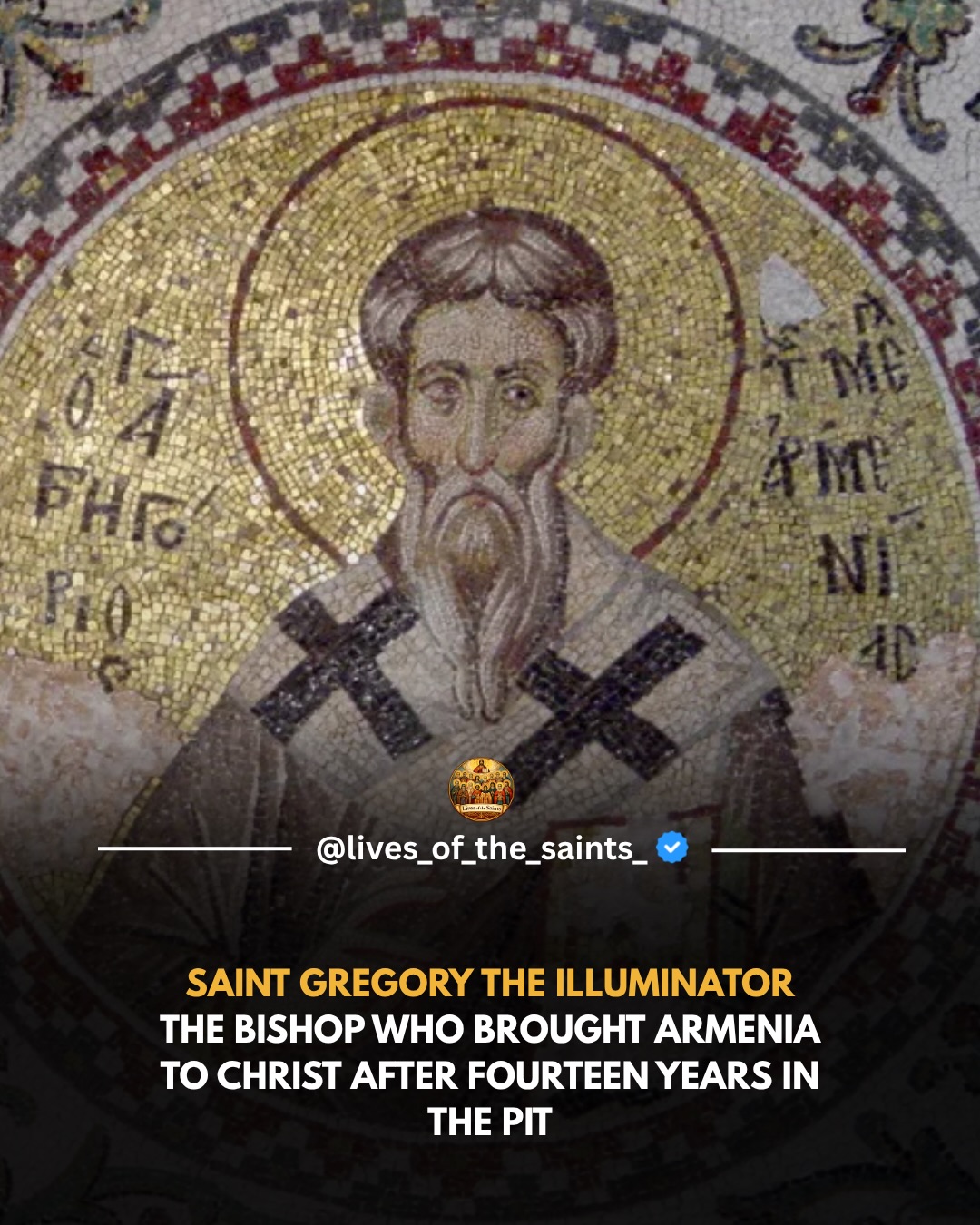
Saint Gregory the Illuminator: from pit to bishop of Armenia

The post recounts the life of Saint Gregory the Illuminator. Born into a noble family tied to Persian and Armenian royalty, Gregory fled to Caesarea in Cappadocia during a family conflict. There he encountered Christianity, was baptized, and married. After his wife died, he returned to Armenia and served King Tiridates faithfully. When the king learned Gregory was a Christian, he ordered him to deny Christ and worship idols. Gregory refused.…

The post recounts the life of Saint Gregory the Illuminator. Born into a noble family tied to Persian and Armenian royalty, Gregory fled to Caesarea in Cappadocia during a family conflict. There he encountered Christianity, was baptized, and married.

After his wife died, he returned to Armenia and served King Tiridates faithfully. When the king learned Gregory was a Christian, he ordered him to deny Christ and worship idols. Gregory refused. After many tortures, the king threw him into a deep pit filled with poisonous creatures, where Gregory survived for fourteen years.

Later, Tiridates persecuted Christians and killed the abbess Gaiania with thirty-seven sisters. The king then fell into madness and lived like a wild beast. A vision given to the king's sister revealed that Tiridates would not be healed until Gregory was released.

Once freed, Gregory healed the king and baptized him. By the king's will and God's grace, Gregory became Bishop of Armenia and spread Christianity throughout the land. He reposed in old age in the year 335 after a life marked by suffering, patience, miracles, and apostolic work. The post concludes with a reflection that God can turn a prison into preparation, suffering into mission, and a persecutor into a servant of Christ.

  • Gregory was born into nobility connected to Persian and Armenian royal houses
  • He converted to Christianity in Caesarea, married, and later served King Tiridates
  • The king imprisoned Gregory in a pit with poisonous creatures for fourteen years after he refused to worship idols
  • Tiridates killed abbess Gaiania and thirty-seven sisters, then fell into madness
  • A vision led to Gregory's release; he healed and baptized the king, then became Bishop of Armenia in 335
Read more

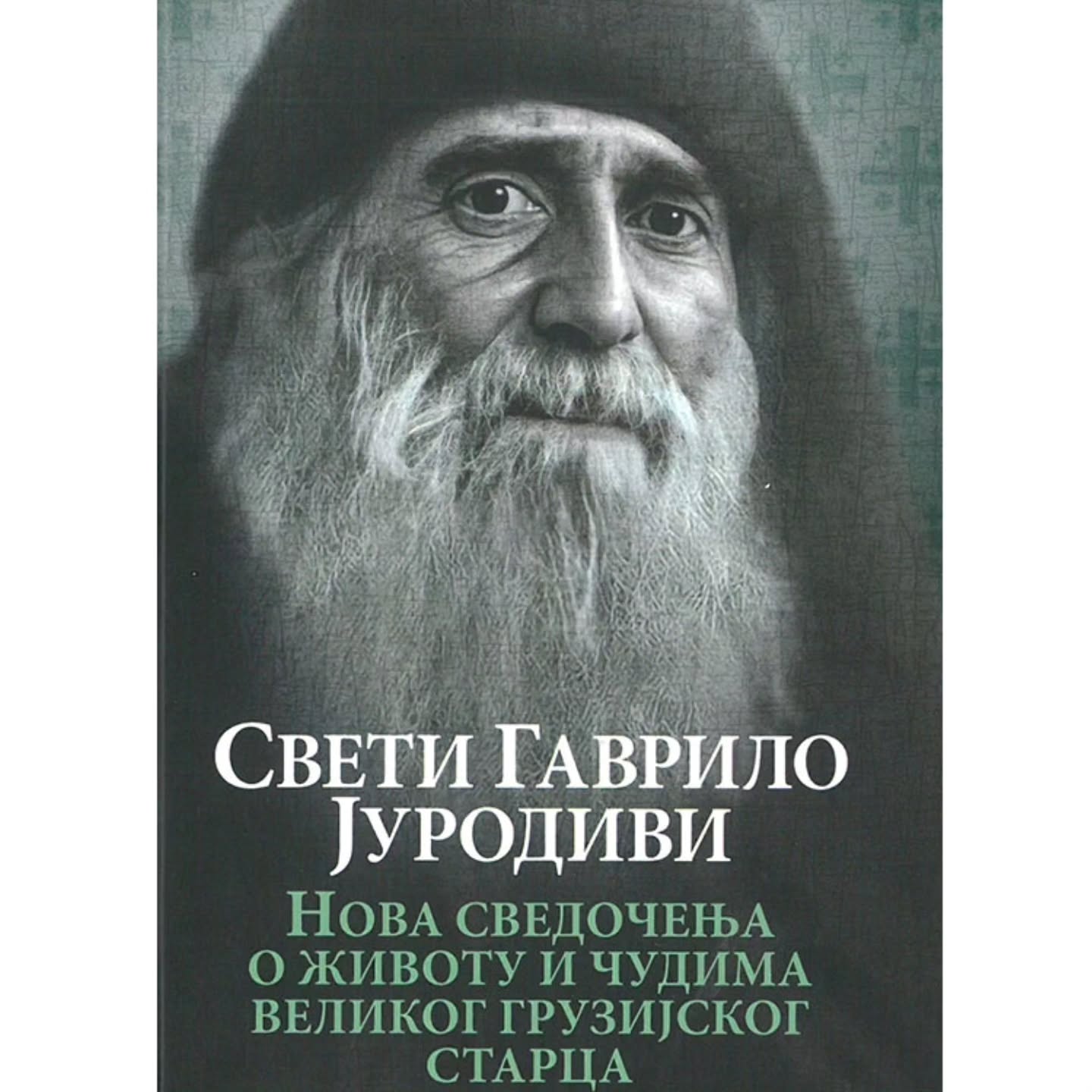
St. Gabriel of Georgia on why God takes children young

The post recounts a story told by St. Gabriel of Georgia to a woman who had lost her child and asked why the young die. St. Gabriel relates that in a certain village a believing woman, who had lost her only son, grieved before God. She said she had endured much for love of Him: insults, poverty, hardships. No one else in the village believed except her, yet God took her child. That night the woman fell asleep and dreamed: angels took her before…

The post recounts a story told by St. Gabriel of Georgia to a woman who had lost her child and asked why the young die. St. Gabriel relates that in a certain village a believing woman, who had lost her only son, grieved before God. She said she had endured much for love of Him: insults, poverty, hardships.

No one else in the village believed except her, yet God took her child. That night the woman fell asleep and dreamed: angels took her before the Lord and conveyed her complaints. Then she heard the Lord's voice: "Ask the woman what she wants."

"Return my child to me," she answered. "Do you want to see your child?" the Lord asked. "Well, I am a mother, of course I do," she answered weeping. "Show her her child!" the Lord commanded. They brought the child and she rejoiced.

"What do you now seek from Me?" the Lord asked. "Why did you take him?" she complained. Then the Lord commanded the angels: "Show her what her son would have done if I had not taken him." And suddenly, as in a film, the woman saw terrible sins her son would have committed, and then the terrible fire of hell.

"Return him again to paradise!" the mother began to weep and beg the Lord. The Lord commanded and the boy was again returned to paradise. And then He said to her: "Because of your goodness and love I took your son to Myself.

Do not think that I do not know whom and when to take." St. Gabriel presents this narrative as an answer to the question of why some leave life young.

  • St. Gabriel of Georgia tells a grieving mother a story about a woman who lost her only son
  • The woman in the story complains to God about her suffering and loss
  • In a dream, God shows her the sins her son would have committed and his destiny in hell
  • The woman begs God to return her son to paradise, and He does
  • God explains He took the son because of the mother's goodness and love, and He knows whom and when to take

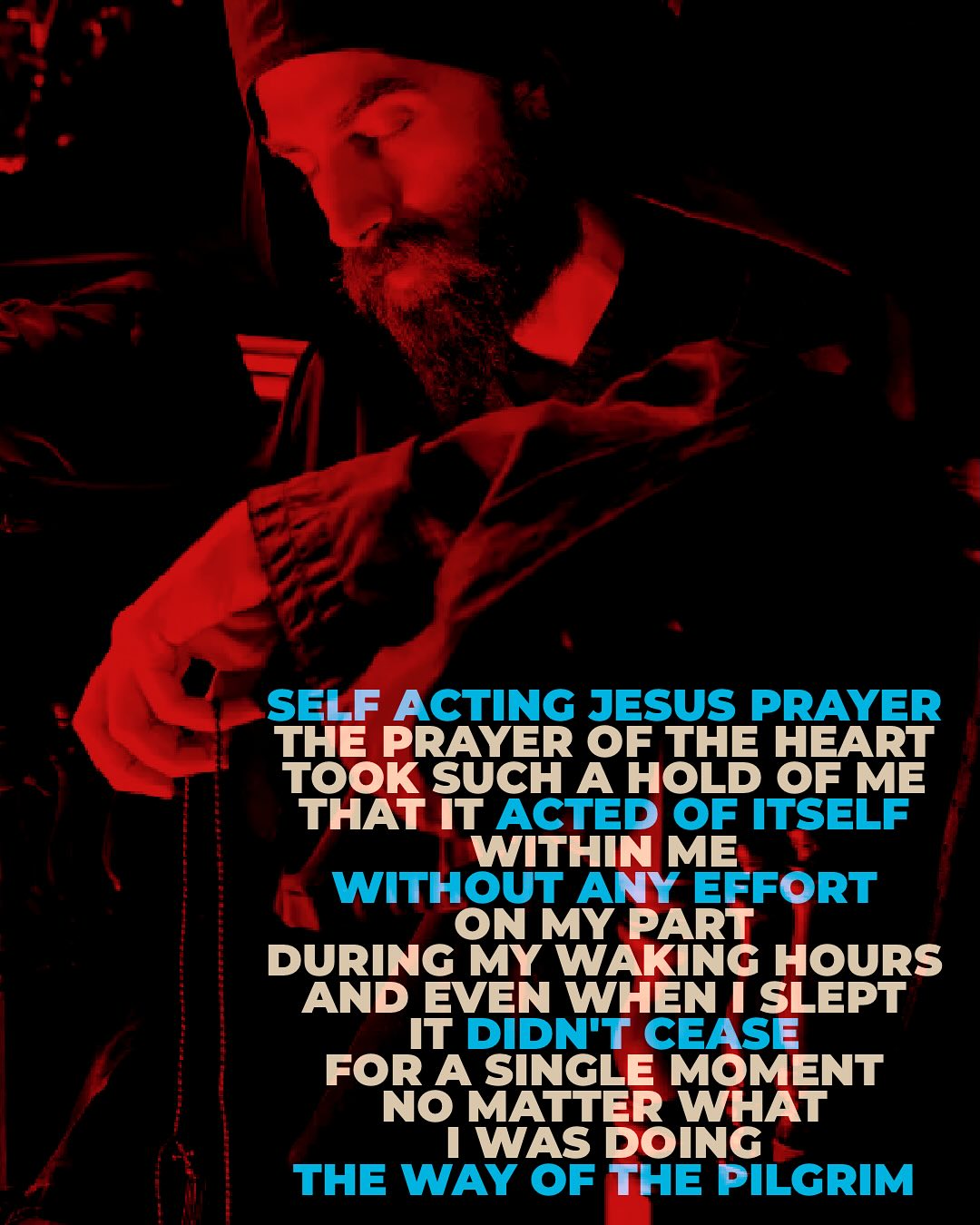
The self-acting Jesus Prayer in The Way of the Pilgrim

The post quotes a passage from The Way of the Pilgrim in which the narrator describes the prayer of the heart taking hold and acting of itself within without any effort on his part. The prayer continued during waking hours and even during sleep, not ceasing for a single moment no matter what he was doing. The accompanying text identifies this phenomenon as the self-active or self-propelling Jesus Prayer within Eastern Christian mysticism,…

The post quotes a passage from The Way of the Pilgrim in which the narrator describes the prayer of the heart taking hold and acting of itself within without any effort on his part. The prayer continued during waking hours and even during sleep, not ceasing for a single moment no matter what he was doing. The accompanying text identifies this phenomenon as the self-active or self-propelling Jesus Prayer within Eastern Christian mysticism, specifically hesychasm.

It explains that this represents an advanced spiritual stage where the prayer transitions from a conscious mental effort into an unceasing, automatic rhythm of the soul. Rather than the practitioner actively pushing to recite the words, the prayer "prays itself" within the heart. This continuous repetition persists even during sleep, work, or conversation.

The post presents both the first-person account from the classic spiritual text and the theological framework that categorizes this experience as a distinct stage of prayer development in the hesychast tradition.

  • The Way of the Pilgrim describes the Jesus Prayer becoming self-acting within the heart
  • The prayer continues without effort during waking hours and sleep
  • In hesychasm this marks an advanced spiritual stage
  • The prayer shifts from conscious recitation to automatic rhythm
  • The prayer "prays itself" continuously through all activities
Read more

God raises new Church Fathers for unseen warfare in the final age

The speaker declares that we live in the final chapters of the age and the most decisive era of spiritual warfare. God is awakening ascetic warriors and raising new Church Fathers like Chrysostom, Basil, Athanasius, and Gregory as commanders of the true Church. These soldiers carry the Jesus Prayer and the uncreated grace of the Holy Spirit. God baptized, chrismated, and feeds them His body and blood for divine purpose, having hunted them down,…

The speaker declares that we live in the final chapters of the age and the most decisive era of spiritual warfare. God is awakening ascetic warriors and raising new Church Fathers like Chrysostom, Basil, Athanasius, and Gregory as commanders of the true Church. These soldiers carry the Jesus Prayer and the uncreated grace of the Holy Spirit.

God baptized, chrismated, and feeds them His body and blood for divine purpose, having hunted them down, engineered their tribulations, protected them from demonic arrows, and transformed their passions into tools of repentance. The speaker calls Orthodox Christians to stop flirting with demons and passions, citing Saint Paul's words about putting away childish things.

They must take up the prayer rope, guard the mind, deal aggressively with ancestral and personal sins, and recognize that an Orthodox Christian who does not fight the passions is no soldier at all. Time is running out; the illusions of the secular world will be destroyed and the separation of wheat from chaff is near. The faithful must pick up their cross, draw the sword of the Spirit, stand watch over the heart, and stop treating favorite sins like pets under a false grace that requires no sacrifice.

Just as the walls of Jericho fell, the strongholds of modern darkness and demonic hierarchy shall fall, and Satan is terrified. The speaker says a divine fire is brewing in the spirits of men, and the flame of the Holy Spirit will invade and expose every hidden darkness. The call is to mount spiritual defenses, wage unseen warfare with ceaseless prayer, and use the divine fire of the Holy Spirit to conquer the flesh and inherit the kingdom of God.

Key moments

  1. 0:00 We are living in the final chapters of the age and the most crucial era of spiritual warfare; God is awakening ascetic warriors and raising new Chrysostoms, Basils, Athanasiuses, and Gregories as commanders of the true Church.
  2. 0:34 Soldiers of the cross carry the double-edged sword of the Jesus Prayer and the uncreated grace of the Holy Spirit; God will use them to gather His faithful flock for a cosmic battle the demons fear.
  3. 1:07 God baptized, chrismated, and feeds His body and blood to each person for divine purpose; He hunted them down, engineered their tribulations, protected them from demonic arrows, and transformed passions into tools of repentance.
  4. 1:37 You are a son of the kingdom and heir to the divine nature through theosis; stop playing with passions and flirting with demons of modern culture, and crush them underfoot as Saint Paul urged putting away childish things.
  5. 2:10 Put away lukewarm spirit, take up the prayer rope, guard the mind, and advance toward Christ; deal aggressively with ancestral and personal sins, for an Orthodox Christian who does not fight the passions is no soldier.
  6. 2:42 Time is running out; the illusions of the secular world will be destroyed and the separation of wheat from chaff is near; stop treating favorite sins like pets under a false grace that requires no sacrifice.
  7. 2:42 Just as the walls of Jericho crumbled, the strongholds of modern darkness and demonic hierarchy shall fall, and Satan himself is terrified; mount spiritual defenses and wage unseen warfare for Christ.
  8. 3:14 Pick up the sword of ceaseless prayer, show the dark age the power of the true faith; a divine fire is brewing, the flame of the Holy Spirit will invade and expose every hidden darkness, use that fire, guard your heart, conquer the flesh, and inherit the kingdom of God.
Read more
Orthodox Life Instagram

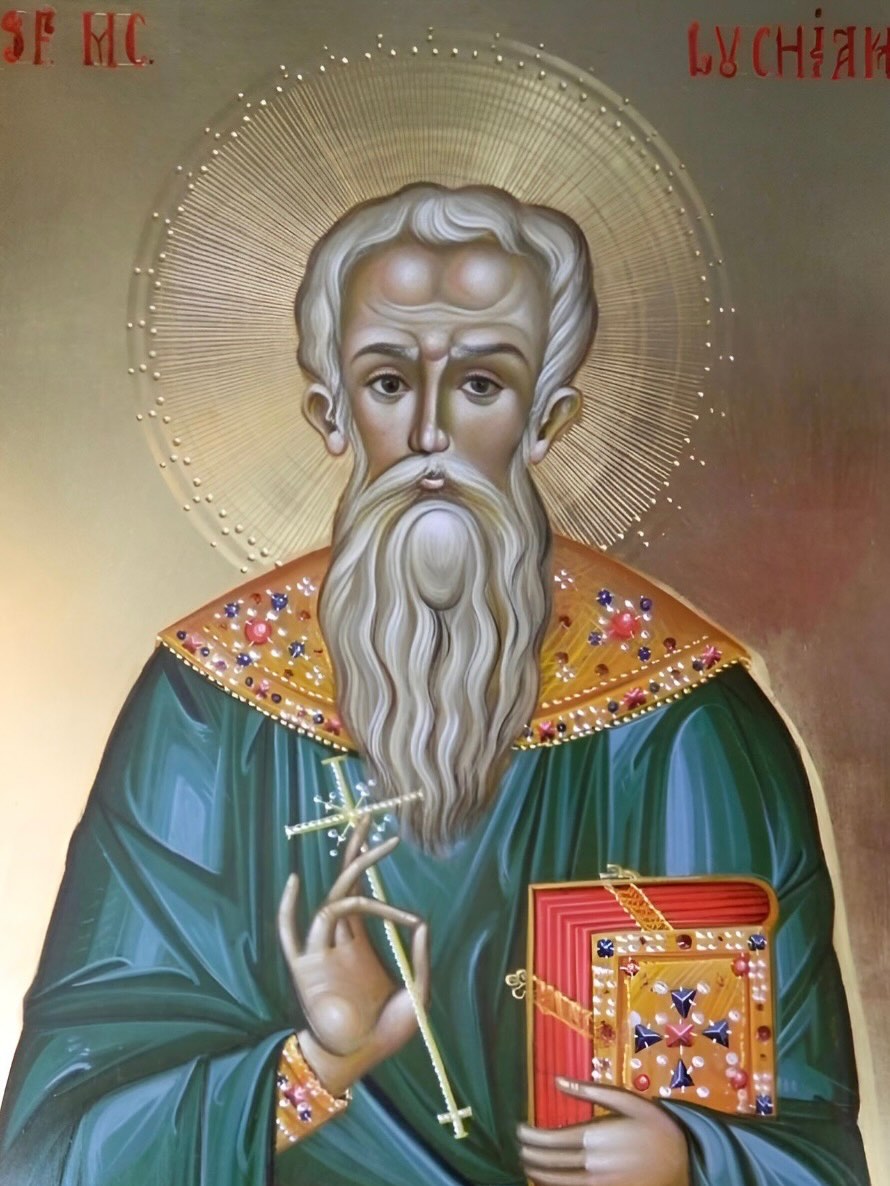
Saint Loukianos of Antioch: scholar, martyr, living altar

The post commemorates Saint Loukianos (Lucian), Priest of Antioch, whose feast falls on October 15. Born around 240 in Samosata, Syria, he was orphaned at twelve, gave his inheritance to the poor, and pursued an ascetic life. He studied Scripture under the confessor Macarius in Edessa and was ordained a presbyter in Antioch. There he founded a theological school that reshaped Christian scholarship and spent years correcting the Greek Septuagint…

The post commemorates Saint Loukianos (Lucian), Priest of Antioch, whose feast falls on October 15. Born around 240 in Samosata, Syria, he was orphaned at twelve, gave his inheritance to the poor, and pursued an ascetic life. He studied Scripture under the confessor Macarius in Edessa and was ordained a presbyter in Antioch. There he founded a theological school that reshaped Christian scholarship and spent years correcting the Greek Septuagint and New Testament, producing a text later prized by Saint Jerome.

During the persecutions of Diocletian and Maximinus, Loukianos was arrested and taken to Nicomedia, where he endured floggings and torture for nine years. He refused food offered to idols, nearly starving while strengthening fellow prisoners. On the Feast of Theophany, chained to a floor strewn with pottery shards and lacking an altar, he celebrated the Eucharist on his own chest so that visiting Christians could receive Communion.

The next day, when guards came, he declared "I am a Christian" three times and died in 312.

  • Born c. 240 in Samosata, orphaned at twelve, gave wealth to the poor
  • Studied under Macarius in Edessa; ordained presbyter in Antioch
  • Founded a theological school and produced a corrected Septuagint and New Testament valued by Saint Jerome
  • Imprisoned nine years in Nicomedia under Diocletian and Maximinus; refused idol food, encouraged fellow prisoners
  • Celebrated his final Eucharist on his chest as a living altar on the Feast of Theophany; martyred in 312
Read more

Pilgrimage to Father Boris Khramtsov's grave brings warmth and memory

The author recounts a pilgrimage to the grave of Father Boris Khramtsov. The visit leaves a sense of warmth and peace. Father Boris's earthly life has ended, but his love, care, and light continue in the chapel. Matushka, his wife, greets the pilgrims with extraordinary warmth, as if they have arrived at a parental home. Right at the graveside and at a common table, a true feast of the soul awaits: tea brewed in a real samovar, homemade pies,…

The author recounts a pilgrimage to the grave of Father Boris Khramtsov. The visit leaves a sense of warmth and peace. Father Boris's earthly life has ended, but his love, care, and light continue in the chapel. Matushka, his wife, greets the pilgrims with extraordinary warmth, as if they have arrived at a parental home.

Right at the graveside and at a common table, a true feast of the soul awaits: tea brewed in a real samovar, homemade pies, and various treats. The weather seems to rejoice with them; the sun plays with its rays, warming everyone. The author and the other pilgrims sit together at the table in a heartfelt, family-like atmosphere.

In conclusion, Matushka gives each person a photograph of Father Boris and a small brochure about him as a keepsake. Now at home there will be a piece of that warmth. The author asks for eternal memory for the dear father and feels that he remains prayerfully close.

Key moments

  1. Light spreads over the ground
  2. Snow melts quietly in the twilight
  3. Bells ring from the heights
  4. A bright day comes to everyone
  5. The air smells of bread and spring
  6. The sound of gulls is heard by the clean wall
  7. Joy of these bright days rings in people's hearts
Holy Resurrection YouTube discussion

St. Theodore and the Fathers on Illness as God's Love

St. Theodore and the Fathers on Illness as God's Love 7:46

The post draws on patristic sources to explain how Orthodox Christians should understand and endure illness. St. Theodore the Student teaches that sickness and sorrow come from God's love, not punishment, and should be met with gratitude and patience, saying "Thy will be done." Murmuring against afflictions leads to blaming others, hostility, hatred, desire for revenge, and spiritual darkness instigated by the devil. God sends illnesses out of…

The post draws on patristic sources to explain how Orthodox Christians should understand and endure illness. St. Theodore the Student teaches that sickness and sorrow come from God's love, not punishment, and should be met with gratitude and patience, saying "Thy will be done." Murmuring against afflictions leads to blaming others, hostility, hatred, desire for revenge, and spiritual darkness instigated by the devil.

God sends illnesses out of love according to our strength, granting patience to make us partakers of Christ's sufferings; whoever has not suffered for Christ will be tormented by conscience in the age to come. The holy fathers advise sanctifying medicine with holy water, not praying too insistently for healing, and relaxing the fast only out of necessity when ill.

St. Barcinius the Great recommended taking medicine with holy water. St. Ephraim the Recluse said the fast may be relaxed by a physician's advice out of necessity, not pleasure, and that patient endurance of illness ranks higher than other ascetic labors, cleansing sins and delivering from passions. If unable to attend church due to illness, one should not go but not complain, be grateful to caregivers, and pray for them; the Lord accepts patience and illness in place of fasting and prayer.

After recovery, it should be regarded as a reprieve to repent and correct life. The sick should not desire death, should thank caregivers, and endure even excessive demands patiently for abundant reward. Those who visit and serve the sick do so out of love, not for reward, comforting them with Scripture and prayer; such service delivers the visitor from pride and lust, and one should not refuse help from fear of illness.

Key moments

  1. 0:12 St. Theodore the student: be meek and patient during illness, endure with gratitude saying "Thy will be done," knowing God directs all for our good.
  2. 0:42 Murmuring against sickness leads to blaming others, hostility, hatred, desire for revenge; the devil leads the soul into darkness and despondency.
  3. 1:44 God sends illnesses out of love according to our strength, granting patience to make us partakers of Christ's sufferings; whoever has not suffered for Christ will be tormented by conscience in the age to come.
  4. 2:47 Holy fathers recommend sanctifying medicine: St. Barcinius the Great advised taking medicine with holy water; do not pray too insistently for healing.
  5. 3:20 St. Ephraim the recluse: when ill, may relax the fast by physician's advice out of necessity, not pleasure; patient endurance of illness ranks higher than other ascetic labors.
  6. 4:21 If unable to attend church due to illness, do not go but do not complain; be grateful to caregivers and pray for them; the Lord accepts patience and illness in place of fasting and prayer.
  7. 5:25 After recovery, regard it as a reprieve to repent and correct life; do not desire death when ill; endure demanding patients patiently for abundant reward.
  8. 6:27 Visit and serve the sick with patience, compassion, kind words, prayer, and divine reading; do not refuse help from fear of illness; such service delivers from demons of pride and lust.
3 opinions in the discussion It has been very fortuitous for me that several of the last videos have been about suffering patiently. All people suffer on a regular basis, and these messages are inspired by the Holy… Read the discussion
Orthodox Life Instagram

The Multiplier of Wheat Icon: Commission, Miracles, and Suppression

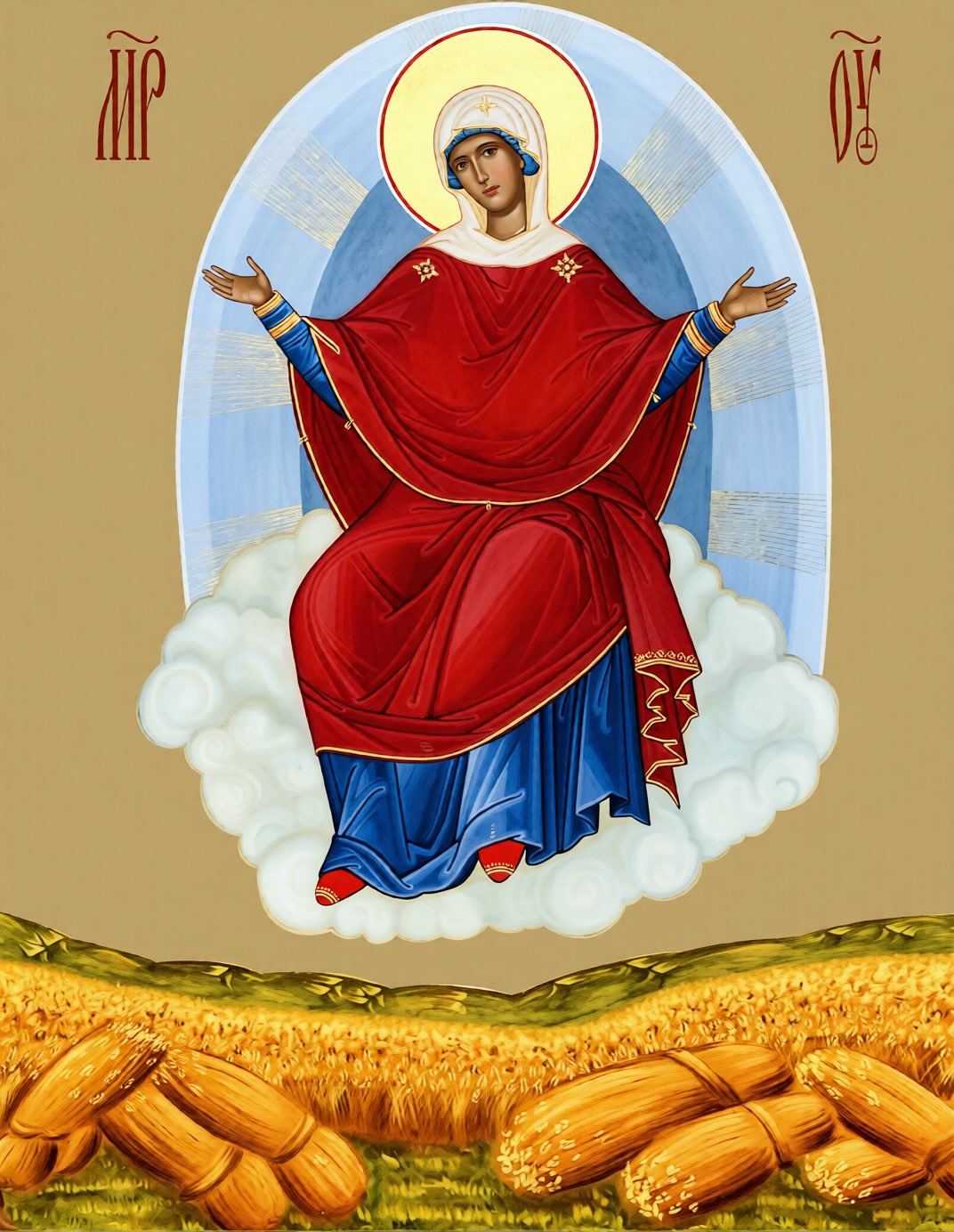
The post commemorates the Holy Icon of the Most Holy Theotokos known as the Multiplier of Wheat, also called the Prosperess of Loaves or She Who Gives or Multiplies Wheat, observed on October 15. Elder Ambrose of Optina Monastery guided the commissioning of the icon in 1890. Deeply devoted to the Virgin Mary, Ambrose envisioned the icon to comfort a nation facing agricultural hardship and dedicated it specifically to the Shamordino Convent he…

The post commemorates the Holy Icon of the Most Holy Theotokos known as the Multiplier of Wheat, also called the Prosperess of Loaves or She Who Gives or Multiplies Wheat, observed on October 15. Elder Ambrose of Optina Monastery guided the commissioning of the icon in 1890. Deeply devoted to the Virgin Mary, Ambrose envisioned the icon to comfort a nation facing agricultural hardship and dedicated it specifically to the Shamordino Convent he had founded.

He gave the icon its distinct name to remind the faithful that the Theotokos is a constant helper for humanity in their daily labors to secure physical sustenance. The visual composition uniquely bridges heavenly and mundane spheres by blending a traditional spiritual focus with a realistic agrarian terrain. The Mother of God is depicted seated upon the clouds with her hands extended in blessing.

Beneath her heavenly posture lies a harvested, compressed field filled with sheaves of rye and grass, designed to mirror the actual surrounding fields of the Shamordino region. Her posture signifies active intercession, perpetually showering blessings upon the earth and its crops. Miraculous intervention cemented the icon's legacy almost immediately after its creation.

In 1891, a devastating, widespread crop failure triggered a severe famine across Russia. Despite the surrounding misery, the fields of the Kaluga district and the Shamordino Convent remained remarkably fertile and produced an abundant harvest. A year later, a replica sent to the Pyatnitsa Monastery successfully ended a catastrophic local drought right after a Molieben was celebrated before it.

Despite these early miracles, the icon faced a period of controversy and suppression by church authorities. During the 1890s, the Holy Synod and imperial state decrees banned the image due to its unconventional, realistic art style and its non-traditional title. Nonetheless, its popular veneration persisted through the turbulent Soviet era.

  • Icon commissioned in 1890 by Elder Ambrose of Optina for Shamordino Convent
  • Depicts the Theotokos blessing a realistic field mirroring Shamordino terrain
  • 1891: Kaluga and Shamordino fields yielded abundant harvest during nationwide famine
  • 1892: Replica at Pyatnitsa Monastery ended drought after a Molieben
  • Banned by Holy Synod and imperial authorities in 1890s for unconventional style and title; veneration continued through Soviet era
Read more

Orthros: A Service in Its Own Right, Not Just a Warm-Up

The author writes about the spiritual meaning of Orthros, the morning service of the Orthodox Church. The central claim is that Orthros is not simply a preparation for the next service. The author calls it an act of worship in its own right, with its own purpose and its own content. The post then sets out four aspects of the service that show what this means in practice. The first is repentance. At Orthros the faithful acknowledge their sins and…

The author writes about the spiritual meaning of Orthros, the morning service of the Orthodox Church. The central claim is that Orthros is not simply a preparation for the next service. The author calls it an act of worship in its own right, with its own purpose and its own content. The post then sets out four aspects of the service that show what this means in practice.

The first is repentance. At Orthros the faithful acknowledge their sins and ask God for mercy. The author presents this as a defining note of the service: it begins with the heart turned toward confession and the plea for forgiveness.

The second is the resurrection. The author points especially to Sundays, when the hymns of Orthros proclaim Christ's victory over death. The service carries this paschal theme in its hymnography, and Sunday mornings make it explicit.

The third is veneration. The faithful honour Christ through the Gospel and the holy things of the Church. This ties the service to the sacred objects and texts set apart for worship.

The fourth is preparation. At Orthros the faithful turn their attention away from worldly distractions and toward prayer and the Divine Liturgy. The author keeps this dimension, but places it after and alongside the others, so that preparation appears as one part of the service rather than its whole purpose.

The post closes with a short line of emoji reflecting the themes above: prayer, the cross and Orthodox faith, prayer beads, love, peace, the defeat of death, and flags of Greece and Australia, which indicate the author's background or community. The post is brief and devotional. It reads as a compact catechesis for churchgoers who may think of Orthros as a prelude, listing four ways the morning service stands on its own: repentance, resurrection, veneration and preparation for the Liturgy.

  • The author states that Orthros is an act of worship in its own right, not simply a preparation for the next service.
  • Repentance: at Orthros we acknowledge our sins and ask God for mercy.
  • On Sundays the hymns proclaim Christ's victory over death.
  • The faithful honour Christ through the Gospel and the holy things of the Church.
  • The service turns attention away from worldly distractions toward prayer and the Divine Liturgy.
Read more
Prayer Orthodoxy ® with Prayer Orthodoxy® Instagram

Remember God and Stay Watchful for the Lord's Return

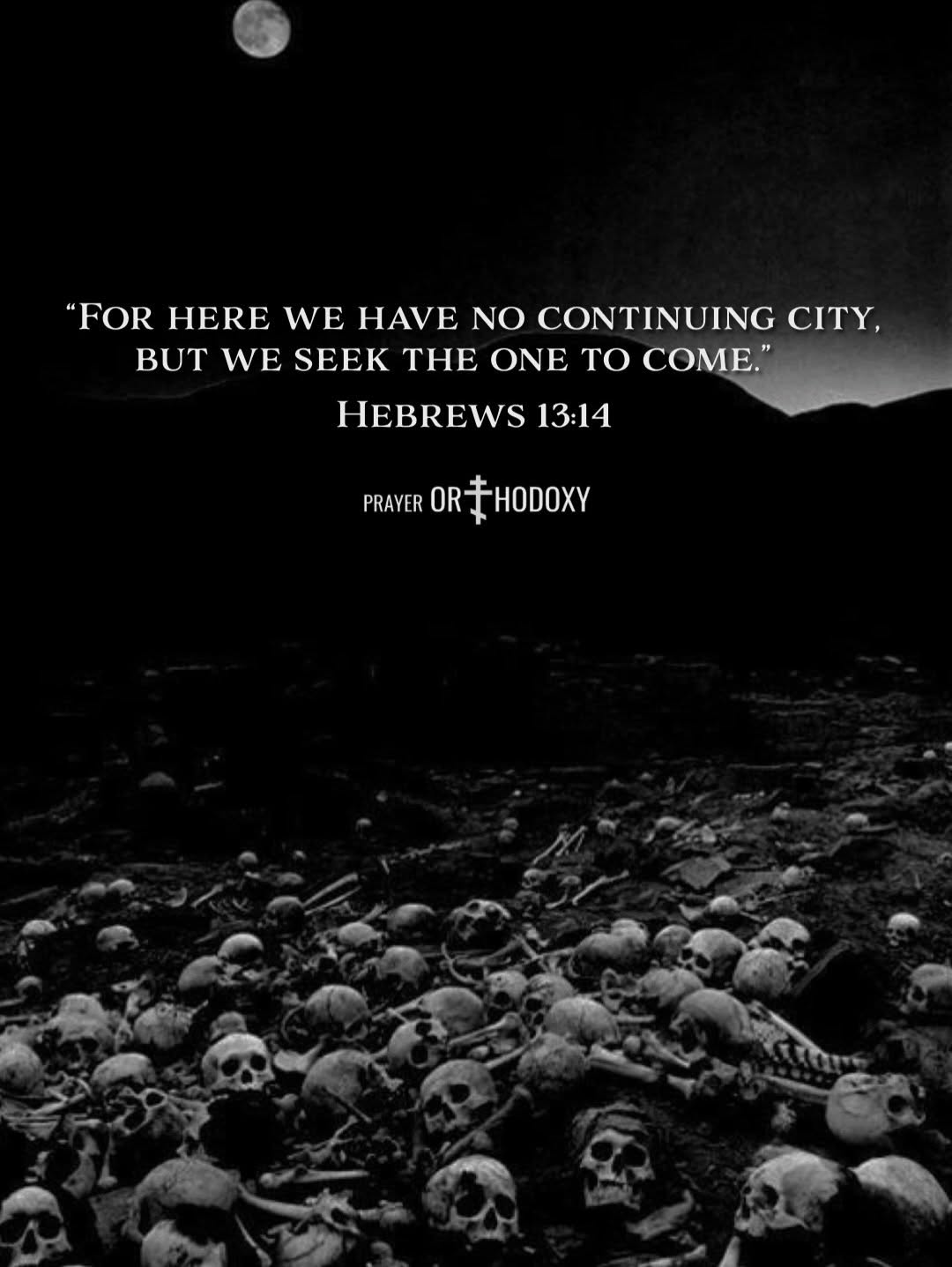
The post consists of a brief devotional exhortation presented in English and Greek. The English portion reads: "REMEMBER GOD Stay watchful. This life is temporary. Our true home is with Christ." It then cites Matthew 24:42: "Watch therefore, for you do not know what hour your Lord is coming." The Greek portion translates the same sentiments: "ΝΑ ΘΥΜΑΣΑΙ ΤΟΝ ΘΕΟ Μείνε άγρυπνος. Αυτή η ζωή είναι προσωρινή. Η αληθινή μας πατρίδα είναι κοντά στον…

The post consists of a brief devotional exhortation presented in English and Greek. The English portion reads: "REMEMBER GOD Stay watchful. This life is temporary. Our true home is with Christ." It then cites Matthew 24:42: "Watch therefore, for you do not know what hour your Lord is coming."

The Greek portion translates the same sentiments: "ΝΑ ΘΥΜΑΣΑΙ ΤΟΝ ΘΕΟ Μείνε άγρυπνος. Αυτή η ζωή είναι προσωρινή. Η αληθινή μας πατρίδα είναι κοντά στον Χριστό." The post is marked as an original production of Prayer Orthodoxy®. Hashtags accompany the text: #Orthodox, #Christ, #Prayer, #Faith, #Eternity.

The message centers on the themes of vigilance, the transient nature of earthly life, and the eternal destiny with Christ. No further discussion or commentary is included in the source material. The post functions as a standalone reminder for spiritual alertness and hope in the Christian eschatological promise.

  • The post urges remembrance of God and spiritual watchfulness.
  • It declares earthly life temporary and true home with Christ.
  • It quotes Matthew 24:42 on the unknown hour of the Lord's coming.
  • The same message appears in Greek translation.
  • It is credited to Prayer Orthodoxy® with related hashtags.
Read more
CHRISTIANITY UNITED with Prayer Orthodoxy ® Instagram

He Was There All Along: A Return Through Mercy

The speaker recounts a period of many years during which they turned away from God to follow their own will, ignoring God's voice. Throughout that time, God's mercy continued to follow the speaker through every choice, waiting patiently. Eventually the speaker reached a place of brokenness and cried out for a single miracle. God answered that cry. The speaker fell into tears, weeping from a sense of unworthiness over the years of wandering.…

The speaker recounts a period of many years during which they turned away from God to follow their own will, ignoring God's voice. Throughout that time, God's mercy continued to follow the speaker through every choice, waiting patiently. Eventually the speaker reached a place of brokenness and cried out for a single miracle.

God answered that cry. The speaker fell into tears, weeping from a sense of unworthiness over the years of wandering. Although the speaker had walked away, God had remained present and strong the entire time. God filled the speaker's heart, restored the speaker's soul, and returned the speaker's son, who came back from fear's dark hold.

The cross revealed God's love to the speaker. The speaker now declares that every breath belongs to God, who never moved even in the speaker's sorrow and cry. The testimony concludes with a quotation from Saint Paisios the Athonite: "As long as a person does not despair, God will help him."

Key moments

  1. The speaker turned away from God for many years, chasing their own will and ignoring God's voice.
  2. God's mercy followed the speaker through every choice, waiting patiently.
  3. The speaker cried out in brokenness, asking for one miracle.
  4. God answered, and the speaker fell in tears, crying in unworthiness over the years of wandering.
  5. Though the speaker walked away, God stayed strong and was there all along.
  6. God filled the speaker's heart, restored their soul, and gave back the one they had lost.
  7. The speaker's son returned from fear's dark hold.
  8. God showed love through the cross, and now every breath belongs to God, who never moved even in the speaker's sorrow and cry.
Read more
Athonite Audio YouTube

Why Do the Righteous Suffer? Job, the Prophets, and the Fathers Answer

Why Do the Righteous Suffer? Job, the Prophets, and the Fathers Answer 32:06

The episode, about 32 minutes long, is part of a series on the benefits of pain and takes up the question of why the righteous are afflicted while the impious prosper. It opens with Isaiah 33:2 and traces the question through Scripture: Jeremiah asks why the way of the wicked prospers, Habakkuk asks why God is silent when the wicked swallow the more righteous, and the psalms voice the feeling of being forgotten by God. Job stands at the center.…

The episode, about 32 minutes long, is part of a series on the benefits of pain and takes up the question of why the righteous are afflicted while the impious prosper. It opens with Isaiah 33:2 and traces the question through Scripture: Jeremiah asks why the way of the wicked prospers, Habakkuk asks why God is silent when the wicked swallow the more righteous, and the psalms voice the feeling of being forgotten by God.

Job stands at the center. He loudly questions his torments, asks how many are his iniquities, complains that the wicked live and reach old age, and describes his life as an unending martyrdom while protesting his innocence. Yet he does not investigate the cause of his calamity; he tries to prove his innocence while keeping unshakable faith in God's justice, believing that God's love is expressed through afflictions.

The holy fathers saw in Job's pained face a model of the suffering Christ, which is why the Orthodox Church reads the book of Job during Holy Week. The study presents trials as pedagogical and expiatory: 2 Maccabees 6:12 says trials are allowed not for destruction but for chastening, and St. Anthony the Great compares God's difficult providences to a doctor's bitter medicines.

Basil the Great teaches that the kingdom is attained through pain, tears, prayers, and patience, and that saying the righteous should not suffer is like saying an athlete should have no opponent. Macarios of Egypt, John Chrysostom, and Eusebius of Caesarea likewise teach that afflictions train the soul, keep the saints from pride, and prepare them for the kingdom, since through many tribulations we must enter the kingdom of God.

The episode closes by saying the pain of the righteous and the death of little children can be explained only under the criterion of eternity and life in the kingdom of God, where pain accepted with faith becomes a dialogue of love with Christ and a proof of adoption.

Key moments

  1. 0:00 The study opens with Isaiah 33:2 and the question of why the righteous are afflicted, a question that grows when the impious prosper.
  2. 1:03 Jeremiah asks why the way of the wicked prospers, Habakkuk asks why God is silent when the wicked swallow the more righteous, and the psalms voice the feeling of being forgotten by God.
  3. 2:04 Job loudly questions his torments, asks how many are his iniquities, complains that the wicked live and reach old age, and describes his life as an unending martyrdom while protesting his innocence.
  4. 6:46 The holy fathers saw in the pained face of Job the model of the suffering Christ, and the Orthodox Church reads the book of Job during Holy Week.
  5. 7:18 Job does not investigate the cause of his calamity but tries to prove his innocence while keeping unshakable faith in God's justice, believing God's love is expressed through afflictions.
  6. 8:19 2 Maccabees 6:12 says trials are allowed not for destruction but for chastening, and St. Anthony the Great compares God's difficult providences to a doctor's bitter medicines.
  7. 10:55 Basil the Great teaches that the kingdom is attained through pain, tears, prayers, and patience, and that saying the righteous should not suffer is like saying an athlete should have no opponent.
  8. 22:27 The pain of the righteous and the death of little children can be explained only under the criterion of eternity and life in the kingdom of God, and pain is understood by those who live a Christlike life, as a dialogue of love with Christ and a proof of adoption.