WeOrthodox
EN UA

Orthodox posts, videos and discussions

We follow Orthodox channels, communities and blogs across the web, summarise every post and video, and highlight the conversations with real substance.

Mount Athos Legacy Facebook

An autumn morning on Mount Athos, with one repeated phrase: 'Look at the sea. How beautiful'

The post is titled 'An autumn morning on Mount Athos' in Greek. The video it accompanies carries a single spoken line throughout its whole length, in Portuguese: 'Olha o mar. Que coisa linda', which means 'Look at the sea. How beautiful'. The phrase is said over and over from the beginning to the end. There is no other narration, teaching, or spoken content in the transcript. The title places the scene on Mount Athos in autumn, and the repeated…

The post is titled 'An autumn morning on Mount Athos' in Greek. The video it accompanies carries a single spoken line throughout its whole length, in Portuguese: 'Olha o mar. Que coisa linda', which means 'Look at the sea. How beautiful'.

The phrase is said over and over from the beginning to the end. There is no other narration, teaching, or spoken content in the transcript. The title places the scene on Mount Athos in autumn, and the repeated line draws attention to the sea, which surrounds the peninsula of the monastic republic.

The viewer is left with the sound of the phrase itself, spoken again and again, over whatever the video shows of that morning. The discussion adds nothing beyond this: the transcript contains only the one phrase, and the summary records no other content. The card therefore rests on two facts from the source, the Greek title naming the place and season, and the Portuguese line that fills the audio from start to finish.

Key moments

  1. 0:05 The phrase 'Olha o mar. Que coisa linda' ('Look at the sea. How beautiful') begins and repeats throughout the video.

Read more
P Paul Kingsnorth Substack

Hermit Crab Press sells nearly 400 books in three days, plus pilgrimages and a last Dark Mountain book

The author gives an update from Hermit Crab Press, the family publishing outfit launched three days earlier. The response has been strong: nearly 400 books sold, orders still arriving, and a second printing ordered of the poetry collection 'These Were the Stories of My People', something the author notes is rarely said of a poetry book. Some readers have also sent donations. The team is preparing and packing orders, with Nav putting time into…

The author gives an update from Hermit Crab Press, the family publishing outfit launched three days earlier. The response has been strong: nearly 400 books sold, orders still arriving, and a second printing ordered of the poetry collection 'These Were the Stories of My People', something the author notes is rarely said of a poetry book.

Some readers have also sent donations. The team is preparing and packing orders, with Nav putting time into making each package a lovely item in itself. All envelopes are being handwritten rather than printed by machine, which takes time, and the author asks for patience while several big trips to the local post office are arranged.

A support button is offered for those who want to help buy envelopes or, jokingly, fund a giant AI robot to do the work.

On pilgrimage news, one place remains on the tour around Ireland the author will lead next summer; after that a waiting list begins. A second initiative has also appeared: a week-long pilgrimage to Iona, the ancient holy island of St Columba and now home to a new Orthodox monastery. The author will be one of three teachers alongside former Archbishop of Canterbury Rowan Williams and Marcus Plested, newly appointed Chair of Divinity at St Andrews University, whose recent inaugural lecture the author recommends.

The theme is 'the world as sacrament', with teaching sessions combined with silence, prayer and exploration. The author jokes about reading stories from the forthcoming Book of Wild Saints to get away with it in such company.

Finally, the last ever Dark Mountain book will be published at the end of this month, sixteen years after the first issue. The author has written a piece for it looking back on the project. A launch takes place in London on 30th October, which the author will miss, being in Florida. Two public talks in America are also coming, in Wisconsin and Atlanta.

  • Hermit Crab Press has sold nearly 400 books in three days, and a second printing of 'These Were the Stories of My People' has been ordered.
  • Orders are being packed by hand, with handwritten envelopes, ahead of several trips to the post office.
  • One place remains on next summer's pilgrimage around Ireland before a waiting list starts.
  • The author will teach on a week-long Iona pilgrimage with Rowan Williams and Marcus Plested, on the theme 'the world as sacrament'.
  • The last ever Dark Mountain book appears at the end of this month with a launch in London on 30th October; the author also has talks coming in Wisconsin and Atlanta.
Read more

Communion is medicine 'for the forgiveness of sins and life everlasting', not for earthly success

Archimandrite P. Papadopoulos reflects on what the priest says when giving Holy Communion. The words are 'for the forgiveness of sins and life everlasting'. The priest does not say 'for forgiveness of sins and earthly prosperity, social affirmation, bodily health, that your work may go well, for a good career', and so on. To receive Communion, he writes, means being ready to say: 'Come, my God, come, my Christ, and lead me out of this vanity,…

Archimandrite P. Papadopoulos reflects on what the priest says when giving Holy Communion. The words are 'for the forgiveness of sins and life everlasting'. The priest does not say 'for forgiveness of sins and earthly prosperity, social affirmation, bodily health, that your work may go well, for a good career', and so on.

To receive Communion, he writes, means being ready to say: 'Come, my God, come, my Christ, and lead me out of this vanity, out of this mortality, and make me eternal with You, as You will, when You will.' He then warns readers to be careful when they say they received Communion and felt joy. If that joy has no source in being ready for death, it is a false joy.

He describes accepting Christ within as trembling, being enlightened, and rejoicing at already being freed from the material things that held him back. Freed from persons and circumstances, he experiences Christ alone, and this experience connects him with everything while binding him to nothing. He closes by correcting a possible misunderstanding: Holy Communion does not mean wanting to die. It means being ready to live eternally.

  • The priest's words at Communion are 'for the forgiveness of sins and life everlasting', not for health, career, or social success.
  • To commune means being ready to pray: 'Come, my God, come, my Christ, and lead me out of this vanity, out of this mortality, and make me eternal with You, as You will, when You will.'
  • Joy after Communion is false if it is not rooted in readiness for death.
  • The author describes being freed from material things, from persons and circumstances, experiencing Christ alone, connected to everything but bound to nothing.
  • Holy Communion does not mean wanting to die; it means being ready to live eternally.
Read more
☦️An Orthodox Blog☦️ with Orthodoxy ☦︎ Instagram

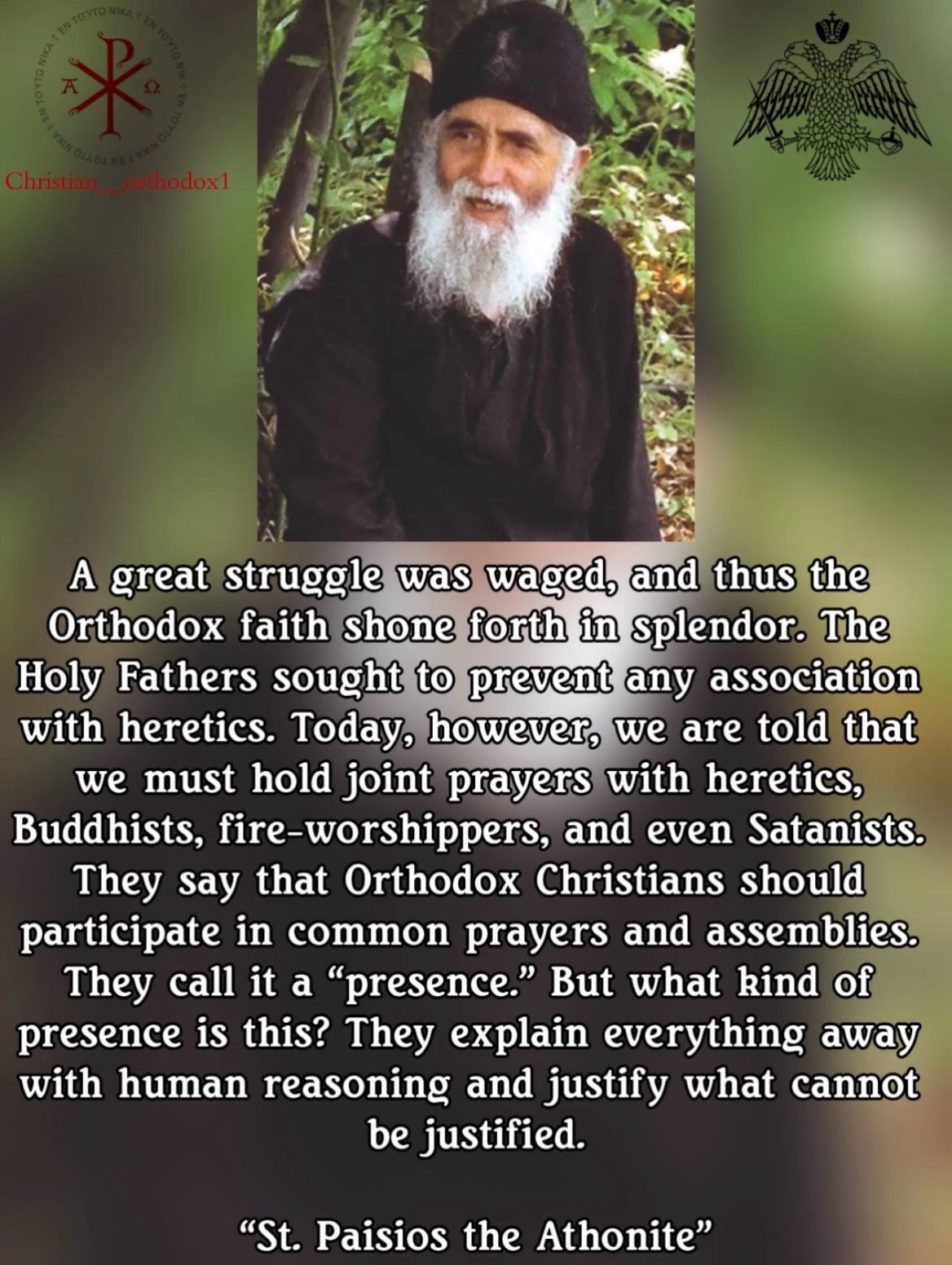
St. Paisios the Athonite on joint prayer with heretics

The post quotes St. Paisios the Athonite on the subject of common prayer between Orthodox Christians and non-Orthodox. It contrasts two situations. In the past, the Holy Fathers waged a great struggle so that the Orthodox faith would shine in splendor, and they sought to prevent any association with heretics. Today, the author says, Orthodox Christians are told they must take part in joint prayers with heretics, Buddhists, fire-worshippers, and…

The post quotes St. Paisios the Athonite on the subject of common prayer between Orthodox Christians and non-Orthodox. It contrasts two situations. In the past, the Holy Fathers waged a great struggle so that the Orthodox faith would shine in splendor, and they sought to prevent any association with heretics. Today, the author says, Orthodox Christians are told they must take part in joint prayers with heretics, Buddhists, fire-worshippers, and even Satanists, and are urged to join common prayers and assemblies.

Those who promote this call it a presence. The author questions what kind of presence this is, and says that people explain everything away with human reasoning and justify what cannot be justified. The quote is attributed to St. Paisios the Athonite, and the post carries tags for Christianity, Orthodoxy, the Church, faith, and the Church Fathers.

The post is short and presents one side of the ecumenism debate: it does not describe any specific event, council, or named person beyond the saint quoted, and it does not develop an argument beyond the contrast between the Fathers' stance and current practice. Readers opening the thread will find a short quotation raising the question of whether Orthodox participation in interfaith prayer is defensible, framed by the author as an abandonment of the Fathers' struggle to keep the faith separate from heresy.

  • The post quotes St. Paisios the Athonite on joint prayer with non-Orthodox.
  • It says the Holy Fathers struggled to prevent any association with heretics.
  • It states that today Orthodox Christians are urged to join common prayers with heretics, Buddhists, fire-worshippers, and even Satanists.
  • The author questions the word presence used for such participation.
  • The author says people justify with human reasoning what cannot be justified.
Read more

"Thank you, thank you!": Mother Gavrilia on gratitude that leaves no room for asking

A short saying of Mother Gavrilia, written in Serbian, on what happens when a person is truly thankful to God for the gifts poured out on them. She says that at such a moment a person has no time to ask God for anything else, and can hardly wait to say: "Thank you, thank you!" Gratitude then spreads over everything one sees: meeting a person calls for thanks, seeing a flower calls for thanks, a glass of milk calls for thanks. For everything,…

A short saying of Mother Gavrilia, written in Serbian, on what happens when a person is truly thankful to God for the gifts poured out on them. She says that at such a moment a person has no time to ask God for anything else, and can hardly wait to say: "Thank you, thank you!" Gratitude then spreads over everything one sees: meeting a person calls for thanks, seeing a flower calls for thanks, a glass of milk calls for thanks.

For everything, thank you. She adds that such joy enters a person's life so fully that even those closest to them cannot understand it, and she recalls a question she once heard: "What is this now?!" She then tells of her time in England, when someone asked her: "What happened? Why are you so cheerful?" Her answer: "Because I am alive and because I see you!"

The card closes with her own farewell to the reader: "I wish you a pleasant day!" The text is signed by Mother Gavrilia. There is no further discussion in the post; it consists entirely of this saying, which moves from thanksgiving for gifts, through thanks for ordinary things and people, to the joy that puzzles others, and ends with the memory of her reply in England and her greeting.

  • True gratitude to God leaves no time to ask Him for anything else.
  • Mother Gavrilia gives thanks for everything she sees: a person, a flower, a glass of milk.
  • Such joy can puzzle even those closest to us: "What is this now?!"
  • In England someone asked why she was so cheerful; she answered: "Because I am alive and because I see you!"
  • She ends with a greeting: "I wish you a pleasant day!"
Read more
☦️An Orthodox Blog☦️ with Orthodoxy ☦︎ Instagram

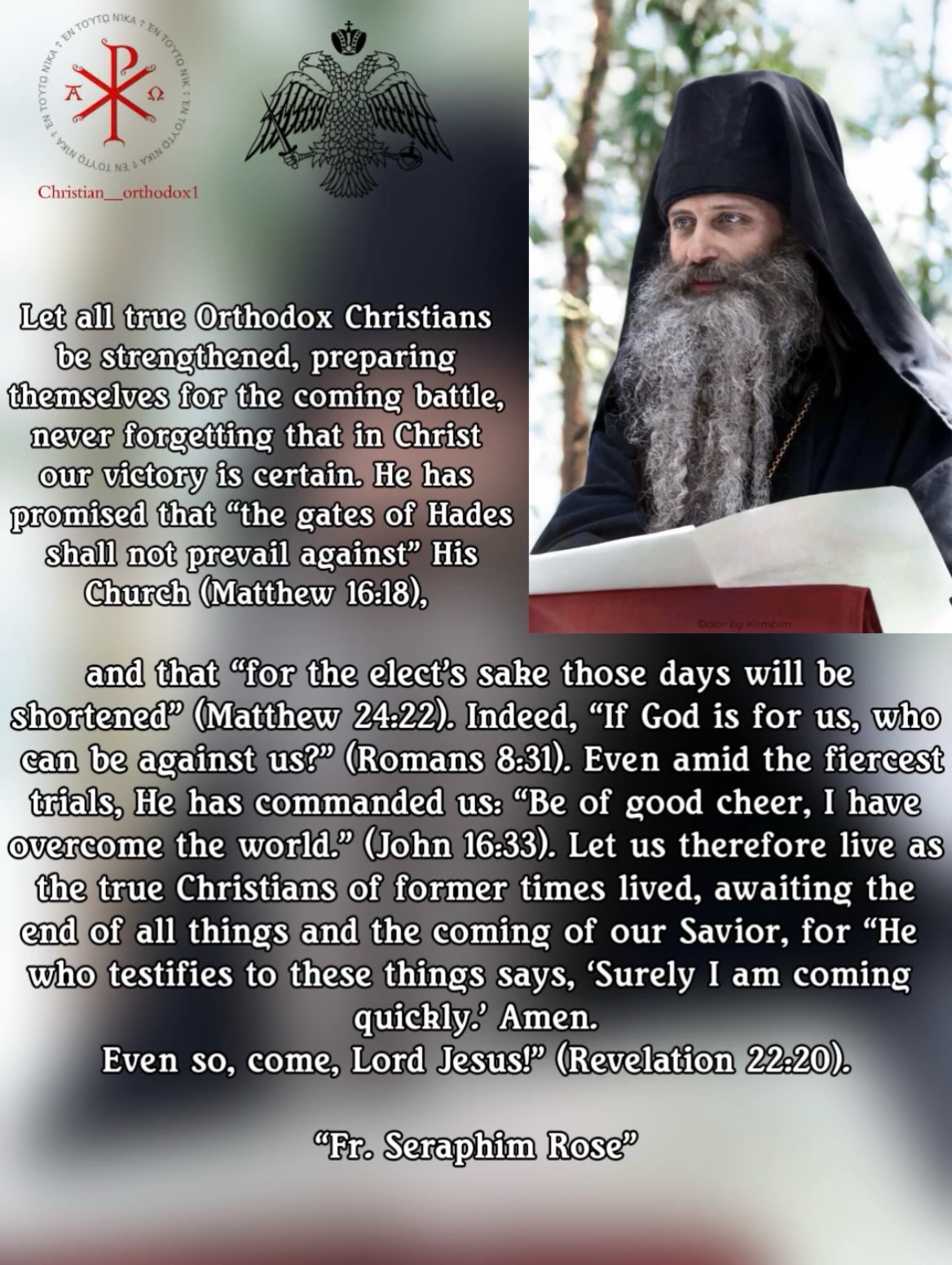
Fr. Seraphim Rose: In Christ Our Victory Is Certain

The post shares a short exhortation attributed to Fr. Seraphim Rose, addressed to Orthodox Christians as they prepare for what the author calls the coming battle. The central claim is that victory is certain because it rests in Christ, and the whole message is built from Scripture quotations strung together to support that claim. The author first cites Christ's promise that the gates of Hades shall not prevail against His Church, from Matthew…

The post shares a short exhortation attributed to Fr. Seraphim Rose, addressed to Orthodox Christians as they prepare for what the author calls the coming battle. The central claim is that victory is certain because it rests in Christ, and the whole message is built from Scripture quotations strung together to support that claim.

The author first cites Christ's promise that the gates of Hades shall not prevail against His Church, from Matthew 16:18, and the promise that for the elect's sake those days will be shortened, from Matthew 24:22. To answer fear in the face of trials, the text quotes Romans 8:31, If God is for us, who can be against us, and Christ's word from John 16:33, Be of good cheer, I have overcome the world, describing this as a command given even amid the fiercest trials.

From these quotations the author draws a practical conclusion: Christians should live as the true Christians of former times lived, awaiting the end of all things and the coming of the Savior. The post closes with the words of Revelation 22:20, Surely I am coming quickly, followed by the response, Amen. Even so, come, Lord Jesus. There is no discussion attached to the post in the source material; it stands as a single devotional text made up almost entirely of direct Scripture citations, with the author's own sentences only introducing and connecting them.

The named author of the quotation is Fr. Seraphim Rose, and the post carries tags for Christian, Orthodox, church, faith, and church fathers. The tone throughout is one of encouragement meant to strengthen readers, holding together the assurance of the Church's preservation, the shortening of the days for the elect's sake, and readiness for the Lord's return as one message rather than separate points.

  • Fr. Seraphim Rose is quoted encouraging Orthodox Christians to prepare for the coming battle, certain of victory in Christ.
  • The text cites Matthew 16:18, the gates of Hades shall not prevail against the Church.
  • It cites Matthew 24:22 on the days being shortened for the elect's sake, and Romans 8:31, If God is for us, who can be against us.
  • Christ's words from John 16:33, Be of good cheer, I have overcome the world, are presented as a command amid trials.
  • The exhortation ends with Revelation 22:20: Surely I am coming quickly. Amen. Even so, come, Lord Jesus.
Read more
Orthodox Life Instagram

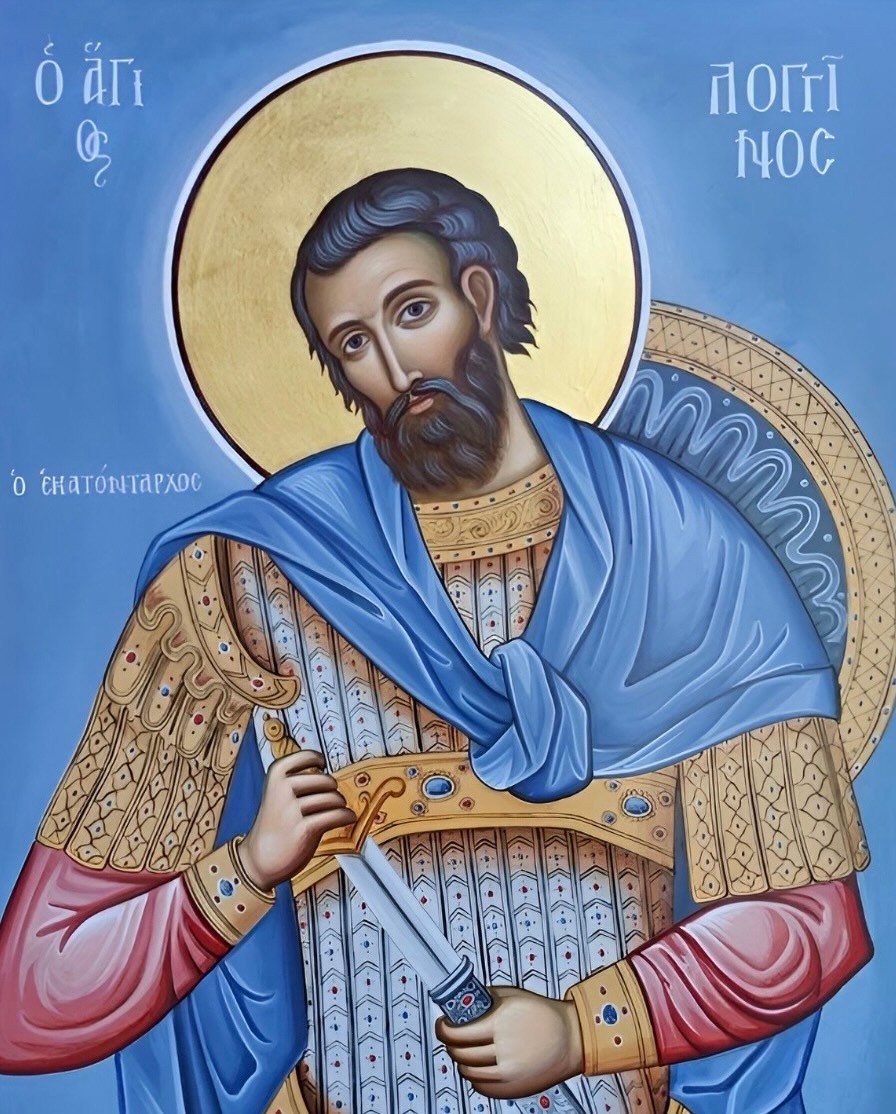
Saint Longinus the Centurion: From Golgotha to Martyrdom

The post marks October 16th, the feast of the Holy Martyr Longinus the Centurion. It recounts his life as a Roman soldier from Cappadocia serving in Judea under Pontius Pilate, commanding the detachment that watched the crucifixion of Christ on Golgotha. Witnessing the final moments of Christ's life, together with the earthquake, the darkening of the sun, and the splitting of the rocks, Longinus confessed before everyone, 'Truly, this was the…

The post marks October 16th, the feast of the Holy Martyr Longinus the Centurion. It recounts his life as a Roman soldier from Cappadocia serving in Judea under Pontius Pilate, commanding the detachment that watched the crucifixion of Christ on Golgotha. Witnessing the final moments of Christ's life, together with the earthquake, the darkening of the sun, and the splitting of the rocks, Longinus confessed before everyone, 'Truly, this was the Son of God'.

According to Orthodox Church Tradition, he was also the soldier who pierced the side of the Crucified Savior with his spear. He suffered from a severe eye affliction, and when blood and water poured from the Lord's wound, a drop touched his eyes and healed him instantly. The post describes this as opening both his physical and spiritual sight, completing his change from an indifferent executioner into a fervent believer.

After the crucifixion, Longinus and his company guarded the Holy Sepulchre and became direct eyewitnesses of the Resurrection. When Jewish elders offered the soldiers gold to spread the lie that Christ's disciples had stolen His body, Longinus and two comrades refused the bribe and proclaimed the truth of the miracle instead. The three left military service and received Holy Baptism from the Apostles.

Longinus returned to Cappadocia, where he lived in prayer and fasting and converted many pagans to Christianity. The Jewish elders then persuaded Pilate to send executioners to kill him and his companions. When the Roman soldiers arrived, Longinus welcomed, fed, and sheltered them without revealing his identity.

Once he disclosed who he was, the soldiers hesitated out of grief and respect, but Longinus and his comrades willingly accepted beheading.

  • Longinus, a Roman soldier from Cappadocia under Pilate, commanded the detachment guarding Christ's crucifixion on Golgotha.
  • He confessed, 'Truly, this was the Son of God', after witnessing the earthquake, the darkened sun, and the splitting rocks.
  • Tradition holds he pierced Christ's side with his spear, and a drop of the blood and water that flowed out healed his eye affliction.
  • He refused the elders' bribe to claim the disciples stole Christ's body, was baptized by the Apostles, and returned to Cappadocia to preach.
  • He hosted his own executioners before revealing himself, and he and two comrades were willingly beheaded.
Read more

A monk, a sack of flour, and the Panagia Portaitissa

Elder Philemon, Dikaios of the Holy Coenobitic Skete of the Prophet Elias of Pantokrator on Mount Athos, tells a small and instructive miracle of the Panagia Portaitissa. A monk of the monastery went to ask for a little bread and was told there was none. The Panagia then gave him a sack of flour (the 'flouri') so that he would have bread to eat. When Portaris saw the flour and asked what it was and where it came from, the monk answered that a…

Elder Philemon, Dikaios of the Holy Coenobitic Skete of the Prophet Elias of Pantokrator on Mount Athos, tells a small and instructive miracle of the Panagia Portaitissa. A monk of the monastery went to ask for a little bread and was told there was none. The Panagia then gave him a sack of flour (the 'flouri') so that he would have bread to eat.

When Portaris saw the flour and asked what it was and where it came from, the monk answered that a woman had given it to him, the Panagia. After seeing the miracle, his whole behavior changed. Elder Philemon draws the lesson that we should see the other person with love, as an image of God and as a veneration, just as Portaris saw the miracle.

The story is presented in a video on the website pemptousia.gr, titled 'The Ministry in Monastic Life', and the post links to the full recording. The post carries hashtags on Mount Athos, the Panagia, miracle, faith, Christianity and Orthodoxy, in Greek and English.

Key moments

  1. We should see the other with love, as an image of God, a veneration.
  2. A monk went to ask for a little bread and was told there was none.
  3. The Panagia gave him the flour and told him to go eat, to have a little bread.
  4. Portaris asked what it was and where he found it; the monk answered it was from the Panagia, a woman gave it to him.
  5. His whole behavior changed after seeing the miracle.
Read more

Attracting a Woman Is Not the Same as Being Ready for Marriage

A viewer messaged the speaker after one of his videos, saying he works on himself yet watches less disciplined, more lustful men get girlfriends. The speaker answers that getting a girlfriend proves nothing about readiness for a relationship. Many relationships turn dysfunctional, many marriages end in divorce, and many couples stay together while miserable, so simply entering a relationship is not the goal. He warns against the belief that a…

A viewer messaged the speaker after one of his videos, saying he works on himself yet watches less disciplined, more lustful men get girlfriends. The speaker answers that getting a girlfriend proves nothing about readiness for a relationship. Many relationships turn dysfunctional, many marriages end in divorce, and many couples stay together while miserable, so simply entering a relationship is not the goal.

He warns against the belief that a woman will fill an inner emptiness. That belief loads her with a burden she was never designed to carry. For a Christian man the order of priorities matters: God first, then purpose, character, and responsibilities, then the woman he is called to love.

The speaker quotes Matthew 6:33: 'Seek first the kingdom of God and His righteousness, and all these things shall be added to you.' He clarifies that this does not require becoming perfect before dating. The real question is different: instead of asking why others have girlfriends while you do not, ask whether you are becoming a man capable of loving a wife properly when she arrives.

In the written text accompanying the video, the speaker says attraction and building a faithful, lasting marriage are two different things. He tells men not to compare themselves to men who seem to have what they want. A man should work on faith, discipline, integrity, and responsibility, prepare for the duties of marriage, and put God first while building his character and pursuing his purpose.

The closing line of the video: a girlfriend is not the reward for becoming a better man; becoming a better man means becoming the person God called you to be, whether you are single or not.

Key moments

  1. A viewer messaged the speaker saying he is improving himself but sees more lustful men without their lives together still getting girlfriends.
  2. The speaker replies that getting a girlfriend is not proof you are ready for a relationship.
  3. Many relationships become dysfunctional, many marriages end in divorce, and many people stay together while miserable, so simply getting into a relationship is not the goal.
  4. Men who think a woman will make their life complete place on her a responsibility she was never designed to carry.
  5. For a Christian man the order is God first, then purpose, character, and responsibilities, then the woman you are called to love.
  6. He quotes Matthew 6:33: 'Seek first the kingdom of God and His righteousness, and all these things shall be added to you.'
  7. This does not mean becoming perfect before dating; instead of asking why others have girlfriends, ask whether you are becoming a man capable of loving a wife properly when she arrives.
  8. A girlfriend is not the reward of becoming a better man; becoming a better man is becoming the person God called you to be whether you are single or not.
☦️An Orthodox Blog☦️ with Come & See Instagram

A call to support the Fiji Orthodox Mission and Saint Tabitha's Home

The author shares a fundraiser appeal for the Fiji Orthodox Mission, describing plans to return to Fiji next year, God willing, to serve alongside the mission, spend time with the children at Saint Tabitha's Home, and support families experiencing hardship. The appeal quotes Matthew 25:35, 'For I was hungry and you gave Me food; I was thirsty and you gave Me drink,' and frames charity as putting faith into action through practical acts of love:…

The author shares a fundraiser appeal for the Fiji Orthodox Mission, describing plans to return to Fiji next year, God willing, to serve alongside the mission, spend time with the children at Saint Tabitha's Home, and support families experiencing hardship. The appeal quotes Matthew 25:35, 'For I was hungry and you gave Me food; I was thirsty and you gave Me drink,' and frames charity as putting faith into action through practical acts of love: providing food, school supplies and essential items for children and families who need support.

The author also hopes to explore, together with the mission, sustainable ways for families to provide for themselves. Readers are invited to donate through a GoFundMe link or directly to the Fiji Orthodox Mission through the mission's website. Those unable to give are asked to share the post or keep the mission in their prayers.

The author states there is no pressure and that every act of kindness matters, and closes with 'Glory to God for all things.' The work is connected to Holy Trinity Orthodox Church and Saint Tabitha's Home in Saweni, Fiji. The discussion around the post centers on how Christians can respond to the call to love their neighbour, care for the vulnerable and treat every person with dignity, and on concrete ways to help: financial support, sharing the appeal, and prayer.

Key moments

  1. Repeated invocation: 'True Light, true Light, true Light.'
  2. Prayer to Christ the God for mercy.
  3. Christ is called the light of life and the light of souls.
  4. Petition that He remain with them unto the ages.
  5. Closing appeal to the Lord.
Read more
Prayer Orthodoxy ® with Demetrios Major Instagram

Axion Estin in Plagios First Mode, Phrygios, Chanted Live for a Wedding Processional

The recording presents the hymn "Axion estin" ("It is Truly Right") set in the Plagios First mode, in the Phrygios melodic variant, as composed by Michael Chatzianastasiou (Μιχαήλ Χατζηαθανασίου). The interpretation sung on the recording is by Demetrios Major, who also chants it live. The occasion given for the performance is a wedding processional, and the post is tagged with byzantinemusic, orthodoxy, and orthodoxwedding. The title of the post…

The recording presents the hymn "Axion estin" ("It is Truly Right") set in the Plagios First mode, in the Phrygios melodic variant, as composed by Michael Chatzianastasiou (Μιχαήλ Χατζηαθανασίου). The interpretation sung on the recording is by Demetrios Major, who also chants it live. The occasion given for the performance is a wedding processional, and the post is tagged with byzantinemusic, orthodoxy, and orthodoxwedding.

The title of the post is given in Greek first, followed by the composer's name in Greek script and the name of the interpreter, with the English rendering "It is Truly Right - Phrygios" supplied in parentheses. The modal designation appears twice: once as "Ηχος πλ. Α΄" (Mode Plagios First) and once in the English line as "Plg. 1st." The word "Φρύγιος" (Phrygios) names the melodic path or variant within that mode, and the English line repeats it as "Phrygios."

The performance context is stated directly in the title: the piece was chanted live by Demetrios Major for a wedding processional. This places the hymn, which is ordinarily heard within liturgical services, at the moment of a wedding procession, and the hashtags confirm the framing of the recording as Byzantine music for an Orthodox wedding.

The post consists of the title and the three hashtags; no further description, text, or commentary accompanies the recording. Everything a reader learns about the piece comes from the title line: the hymn text, the mode and variant, the composer, the interpreter and live chanter, and the wedding setting. The recording therefore serves as a documented example of Chatzianastasiou's setting of the Axion estin in Phrygios, performed by Major in a wedding context.

  • The hymn is "Axion estin" ("It is Truly Right"), in the Plagios First mode, Phrygios variant.
  • The setting is by Michael Chatzianastasiou (Μιχαήλ Χατζηαθανασίου).
  • The interpretation is by Demetrios Major, who chants the piece live.
  • The live performance was for a wedding processional.
  • The post is tagged byzantinemusic, orthodoxy, and orthodoxwedding.
Read more
Disgruntled Docs with Ben Instagram

Fr Josiah Trenham: Zionism is foreign to historic Christianity

Fr Josiah Trenham argues that Zionism has no place in Christian faith. He says you could search in vain for 18 and a half centuries to find such teaching in the Church. For him the question is settled by how the New Testament reads the Old: the church is the fulfillment of everything in the Old Testament, and Paul calls the church the new Israel. God's people are Jewish and Gentile believers gathered from every tribe, tongue, people and nation,…

Fr Josiah Trenham argues that Zionism has no place in Christian faith. He says you could search in vain for 18 and a half centuries to find such teaching in the Church. For him the question is settled by how the New Testament reads the Old: the church is the fulfillment of everything in the Old Testament, and Paul calls the church the new Israel.

God's people are Jewish and Gentile believers gathered from every tribe, tongue, people and nation, so membership in Israel is not a matter of ethnicity. He illustrates this with his own parish in Riverside County, which he says should reflect the ethnic makeup of the surrounding county of about 3 million people: 57% Hispanic, 11% African-American, and about 30% Anglo.

He then rejects the premises behind Christian Zionism. The Old Testament came to fruition in Christ, so there is no need to rebuild a temple in Jerusalem, resume animal sacrifices, or restore the Aaronic priesthood. Everything in the Old Testament was a picture of Christ, and Christ himself told the Pharisees that the Scriptures bear witness to him.

The post presents a patristic and sacramental reading of Israel in which promises made to Israel are fulfilled in the church rather than awaiting a future national restoration.

Key moments

  1. 0:00 Zionism has no history in the Christian faith; you could search in vain for 18 and a half centuries to find such teaching.
  2. 0:00 The church is the fulfillment of everything in the Old Testament, and Paul calls the church the new Israel.
  3. 0:36 God's people are made up of Jewish and Gentile believers from every tribe, tongue, people and nation; it is not about ethnicity.
  4. 1:12 The speaker wants his Riverside County parish to reflect the county's ethnic distribution: 57% Hispanic, 11% African-American, about 30% Anglo.
  5. 1:45 The Old Testament came to fruition; there is no need to rebuild a temple, resume sacrifices, or restore the Aaronic priesthood.
  6. 1:45 Everything in the Old Testament is a type of Christ; he told the Pharisees the Scriptures bear witness to him.
Read more
Prayer Orthodoxy ® Instagram

The Epiclesis: When the Holy Spirit Descends on the Holy Gifts

The post describes the epiclesis, one of the most sacred moments of the Divine Liturgy, when the priest calls upon the Holy Spirit to descend upon the faithful and upon the Holy Gifts. Through this invocation, the bread and wine are blessed and become the precious Body and Blood of our Lord Jesus Christ. The author presents this moment as one of awe, repentance, prayer, and complete surrender before God. The text appears in both English and…

The post describes the epiclesis, one of the most sacred moments of the Divine Liturgy, when the priest calls upon the Holy Spirit to descend upon the faithful and upon the Holy Gifts. Through this invocation, the bread and wine are blessed and become the precious Body and Blood of our Lord Jesus Christ. The author presents this moment as one of awe, repentance, prayer, and complete surrender before God.

The text appears in both English and Greek, with the Greek wording carrying the same meaning: the priest invokes the Holy Spirit to come down upon us and upon the Honorable Gifts, and the bread and wine are blessed and become the Honorable Body and Blood of the Lord. The post closes with hashtags pointing to its themes: Orthodoxy, Liturgy, Eucharist, Prayer, and Christ.

There is no discussion thread attached; the post stands as a short devotional statement rather than an exchange of views. Its purpose is to draw attention to what takes place at this point in the Liturgy and to invite the reader into the reverence the author describes.

  • The priest calls upon the Holy Spirit to descend upon us and upon the Holy Gifts during the Divine Liturgy.
  • The bread and wine are blessed and become the precious Body and Blood of our Lord Jesus Christ.
  • The author names the moment as one of awe, repentance, prayer, and complete surrender before God.
  • The text is given in both English and Greek with the same content.
  • The post is tagged with Orthodox, Liturgy, Eucharist, Prayer, and Christ.
Read more
Saint Wisdom Instagram

Saint Isaac the Syrian: God Is Greater Than Every Trouble

The post presents a short reflection drawn from Saint Isaac the Syrian under the heading God is greater, tagged with love, orthodox, saints, bible, and christianity. The speaker sets out a repeated claim: God is greater than every trouble a person faces. The list of troubles is concrete. God is greater than illness, whatever it may be. He is greater than a person's deepest disappointment and greatest worry. He is greater than a person's worst…

The post presents a short reflection drawn from Saint Isaac the Syrian under the heading God is greater, tagged with love, orthodox, saints, bible, and christianity. The speaker sets out a repeated claim: God is greater than every trouble a person faces. The list of troubles is concrete. God is greater than illness, whatever it may be.

He is greater than a person's deepest disappointment and greatest worry. He is greater than a person's worst enemy and most difficult problem. The claim then widens beyond personal troubles: God is greater than life and greater than death.

The speaker does not leave this as a statement to admire. He calls listeners to respond to it in four ways: to believe it, to live by it, to affirm it, and to claim it by faith. The final image is domestic and physical. The listener should use this truth as a pillow to rest a weary soul, that is, as something to lean on when strength runs out.

The video moves in a single direction, from the naming of troubles to the invitation to rest in the one who is greater than all of them. There is no argument with opponents and no extended exposition of a text; the force comes from repetition of the one sentence, God is greater, applied in turn to each area of difficulty, and then to life and death themselves.

The tone is that of a word of encouragement addressed directly to the listener, in the tradition of Saint Isaac the Syrian's sayings on God's mercy and care.

Key moments

  1. God is greater than your illness, whatever it may be.
  2. God is greater than your deepest disappointment and your greatest worry.
  3. God is greater than your worst enemy and your most difficult problem.
  4. God is greater than life and greater than death.
  5. Believe it, live by it, affirm it, and claim it by faith.
  6. Use this truth as a pillow to rest your weary soul.
Read more
M mysteries_of_christendom Instagram

The Church Buried by the South Tower, Rebuilt 21 Years Later

St. Nicholas Greek Orthodox Church stood a couple hundred feet from the World Trade Center. Greek immigrants in the 1900s bought the building, put a cross on the roof, and turned it into a church that could barely fit 80 people. Inside it held gifts from Tsar Nicholas II of Russia and a box with relics of St. Nicholas, St. Catherine, and St. Sava, kept in a 600-pound fireproof safe. On September 11, 2001, the South Tower fell on the church and…

St. Nicholas Greek Orthodox Church stood a couple hundred feet from the World Trade Center. Greek immigrants in the 1900s bought the building, put a cross on the roof, and turned it into a church that could barely fit 80 people. Inside it held gifts from Tsar Nicholas II of Russia and a box with relics of St. Nicholas, St. Catherine, and St. Sava, kept in a 600-pound fireproof safe.

On September 11, 2001, the South Tower fell on the church and buried it completely, leaving no doors or windows. Workers dug through the rubble for weeks. They found damaged icons, charred Bibles, melted candles, and the church's bell, but the safe with the relics was never found. Twenty-one years later, on December 6, 2022, the feast day of St. Nicholas, the rebuilt church opened its doors again. It is built of white marble and glows like a candle at night over Ground Zero.

Key moments

  1. On 9/11 the South Tower of the World Trade Center fell on St. Nicholas Orthodox Church, which stood a couple hundred feet away.
  2. Greek immigrants in the 1900s bought the building, put a cross on the roof, and made it into a church that could barely fit 80 people.
  3. The church held gifts from Tsar Nicholas II of Russia and a box of relics of St. Nicholas, St. Catherine, and St. Sava, kept in a 600 lb fireproof safe.
  4. When the South Tower came down it buried the church completely, leaving no doors or windows.
  5. Workers dug through the rubble for weeks and found damaged icons, charred Bibles, melted candles, and the church's bell.
  6. On December 6th, 2022, the feast day of St. Nicholas, the church reopened, built of white marble that glows like a candle at night.
Read more
Orthodox Sound YouTube

No One Knows the Day or the Hour: Elder Cleopa on the Second Coming

No One Knows the Day or the Hour: Elder Cleopa on the Second Coming 9:41

Elder Cleopa of Romania, in his book The Truth of Our Faith, teaches that the exact time of Christ's Second Coming has not been revealed to anyone. Neither angels, nor men, nor even the Son of Man in His humanity knows the day or hour; only the Father knows. Because the Lord said He will come at an unexpected hour, like a thief in the night and as in the days of Noah, Christians are called to watchfulness rather than calculation. Elder Cleopa…

Elder Cleopa of Romania, in his book The Truth of Our Faith, teaches that the exact time of Christ's Second Coming has not been revealed to anyone. Neither angels, nor men, nor even the Son of Man in His humanity knows the day or hour; only the Father knows. Because the Lord said He will come at an unexpected hour, like a thief in the night and as in the days of Noah, Christians are called to watchfulness rather than calculation.

Elder Cleopa addresses a common objection: Christ promised that the Holy Spirit would guide the disciples into all truth and show them things to come. He explains that this promise concerned signs and events, such as the coming of the Antichrist, false prophets, and persecutions, not the date of the return. He illustrates the danger of date-setting with the example of William Miller, who predicted Christ would return between 1 March 1843 and 1 March 1844.

His disciple Snow added seven months and ten days, announcing 10 October 1844. Believers spent their fortunes, bought white garments and candles, but the day passed like any other day, and the prophets became objects of mockery. Elder Cleopa also reads Paul's words to the Thessalonians about children of light: these do not mean Christians can know the date, since the day of the Lord comes as a thief in the night.

Although the date remains unknown, Christ revealed signs that will precede His coming: the Gospel preached to all nations, the turning of the Jews to Christianity, the Antichrist in the temple of God, wars, famines, and signs in the heavens. The sequence culminates in the sign of the Son of Man, the cross, appearing in the heavens.

The teaching draws on Matthew 24-25, 1 Thessalonians, Romans 11:25-34, and Revelation 13 and 20.

Key moments

  1. 0:00 The Orthodox Church teaches that the exact time of Christ's coming has not been revealed: neither to angels, nor to men, nor to the Son of Man as man. Only the Father knows.
  2. 1:02 The Lord commands watchfulness: as in the days of Noah, His coming will be unexpected, like a thief in the night, so we must be ready at all times.
  3. 2:05 Christ's promise that the Holy Spirit would guide the disciples into all truth must be understood as He gave it, not according to human speculation about dates.
  4. 3:07 William Miller predicted Christ would return between 1 March 1843 and 1 March 1844; his disciple Snow added seven months and ten days, announcing 10 October 1844.
  5. 4:12 Believers spent their fortunes, bought white garments and candles, but the day passed like every other day, and the prophets became objects of mockery.
  6. 4:43 The promise of the Holy Spirit referred to revelations of signs and events, such as the Antichrist, false prophets, and persecution, not to the exact date of the return.
  7. 5:15 Paul's words to the Thessalonians about children of light do not mean Christians can know the date; the day of the Lord comes as a thief in the night.
  8. 6:47 Signs preceding the coming include the Gospel preached to all nations, the turning of the Jews to Christianity, the Antichrist in the temple of God, wars, famines, signs in the heavens, and finally the sign of the Son of Man, the cross.
Anthony’s Cell YouTube

The Priesthood, Hebrew and Christian: An Article From The Orthodox Study Bible

The Priesthood, Hebrew and Christian: An Article From The Orthodox Study Bible 4:40

This audio reading presents the article "The Priesthood, Hebrew and Christian" from the Orthodox Study Bible. The reading explains the Hebrew word for priest, Cohen: a Levite who stood as intercessor for the people before God, offering gifts and sacrifices so the people might be reconciled to God. The Lord directed Moses to construct the tabernacle and established a permanent hereditary priesthood beginning with Aaron and continuing through his…

This audio reading presents the article "The Priesthood, Hebrew and Christian" from the Orthodox Study Bible. The reading explains the Hebrew word for priest, Cohen: a Levite who stood as intercessor for the people before God, offering gifts and sacrifices so the people might be reconciled to God. The Lord directed Moses to construct the tabernacle and established a permanent hereditary priesthood beginning with Aaron and continuing through his sons.

Priests were consecrated with holy oil and wore richly decorated holy garments. After Aaron's death, the Lord separated the tribe of Levi to bear the ark, stand before the Lord, minister to him and bless his name. Beyond offering sacrifices, the priests blessed the people, maintained the tabernacle and later the temple, received tithes and offerings, supervised purification, acted as judges, and taught the law.

Only male Levites administered the liturgical rites. The reading then describes how the authority of the Levitical priesthood ended when Christ offered himself as a perfect sacrifice on the cross, typified by the temple curtain being torn asunder. The priesthood of the church is Christ's own priesthood, with the Eucharist as the first fruit offering.

St. John Chrysostom teaches that it is not men who sanctify the offering: the same Christ who sanctified the last supper sanctifies it now. The liturgical prayer says, "Thou thyself art the one who offers and is offered, who accepts and is distributed." The church retains the male priesthood because the man Christ Jesus officiates at every eucharistic service in and through his bishops, priests, and deacons; the clergy do not serve in the place of Christ, he serves in them.

Chrysostom writes that when the Lord is sacrificed and lies before you, you are transported to heaven: he who sits with the Father is held in our hands. The reading ends with the royal priesthood of all believers, foretold in Exodus 19:6 and Isaiah 61:6 and fulfilled in the church according to 1 Peter 2:9, 2:5, and Revelation 1:5 and 6.

Key moments

  1. 0:34 The Hebrew word for priest is Cohen. He is a Levite who stood as intercessor for the people before God, offering gifts and sacrifices so the people might be reconciled to God.
  2. 0:47 The Lord directed Moses to construct the tabernacle and established a permanent hereditary priesthood beginning with Aaron and continuing through his sons. Priests were consecrated with holy oil and wore richly decorated holy garments for the honor and glory of God.
  3. 1:07 After Aaron's death, the Lord separated the tribe of Levi to bear the ark, stand before the Lord, minister to him and bless his name.
  4. 1:22 Besides sacrifices, priests blessed the people, maintained the tabernacle and later the temple, received tithes and offerings, supervised purification, acted as judges, and taught the law. Only male Levites administered the liturgical rites.
  5. 1:37 The authority of the Levitical priesthood ended when Christ offered himself as a perfect sacrifice on the cross, typified by the temple curtain being torn asunder. The priesthood of the church is Christ's priesthood, with the Eucharist as the first fruit offering.
  6. 2:07 St. John Chrysostom teaches that it is not men who sanctify the offering: the same Christ who sanctified the last supper sanctifies it now, and is even now present and acting. The liturgical prayer says, "Thou thyself art the one who offers and is offered, who accepts and is distributed."
  7. 2:39 The church retains the male priesthood because the man Christ Jesus officiates at every eucharistic service in and through his bishops, priests, and deacons. The clergy do not serve in the place of Christ; Christ himself serves in them.
  8. 3:09 Chrysostom writes that when the Lord is sacrificed and lies before you, with priests praying over the sacrifice and all partaking of the precious blood, you are transported to heaven: he who sits with the Father is held in our hands. While the ordained priesthood serves on behalf of all, every baptized and anointed believer is a member of God's royal priesthood, foretold in Exodus 19:6 and Isaiah 61:6 and fulfilled in the church according to 1 Peter 2:9, 2:5, and Revelation 1:5 and 6. All Christians are called to offer all of creation back to God with praise and thanksgiving.

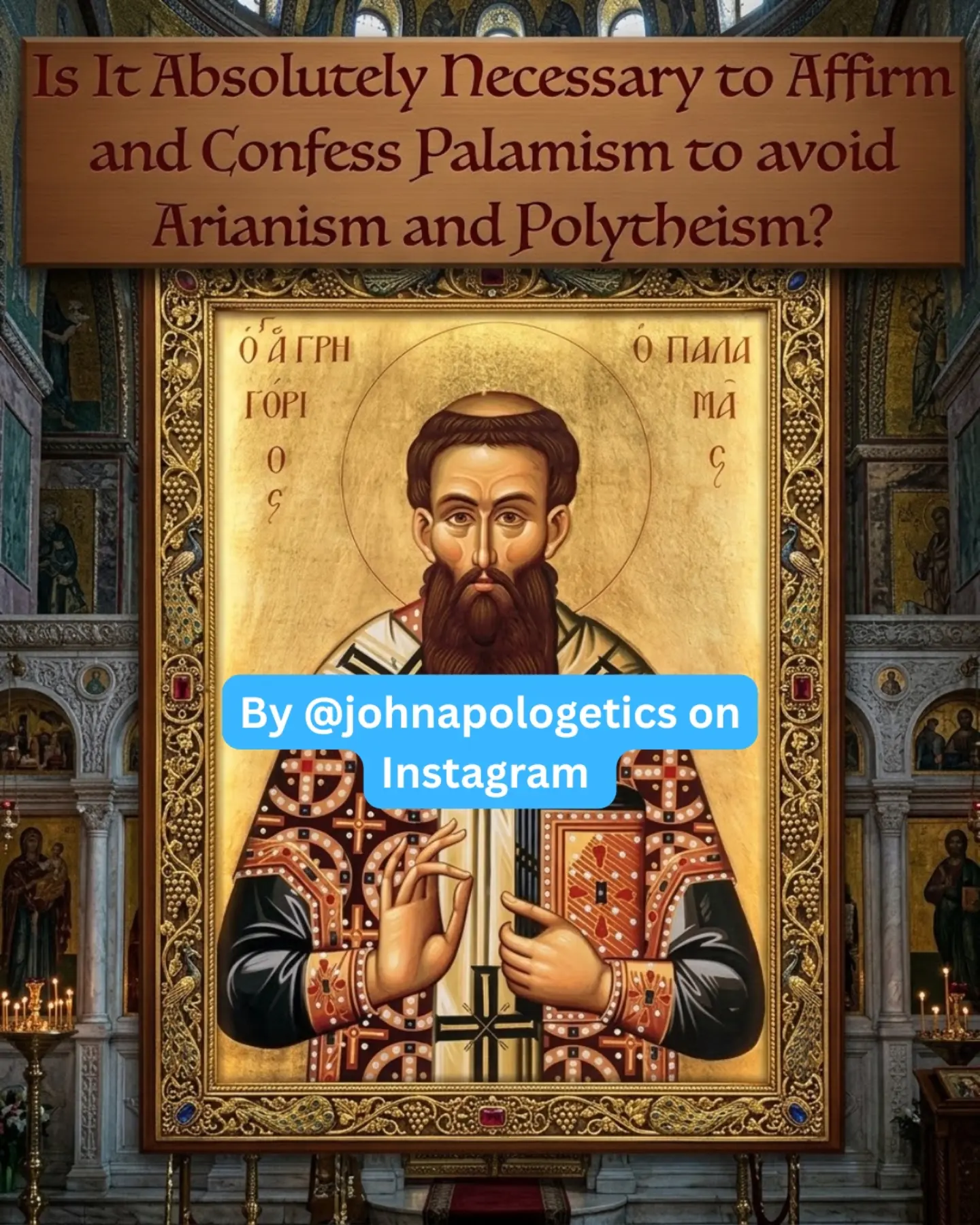
All Roads Lead To Constantinople: Thomism, Aquinas and the Church Fathers

The post consists of a short caption, 'All Roads Lead To Constantinople', followed by hashtags naming Thomism, Thomas Aquinas, the Church Fathers and Orthodoxy. No further text, argument or source material accompanies the caption, so the post itself offers only the slogan and the topics it points to. The phrase suggests a line of thought connecting Western scholastic theology, represented by Thomas Aquinas and the Thomist tradition, with the…

The post consists of a short caption, 'All Roads Lead To Constantinople', followed by hashtags naming Thomism, Thomas Aquinas, the Church Fathers and Orthodoxy. No further text, argument or source material accompanies the caption, so the post itself offers only the slogan and the topics it points to. The phrase suggests a line of thought connecting Western scholastic theology, represented by Thomas Aquinas and the Thomist tradition, with the Orthodox East and the Church Fathers, with Constantinople standing as the focal point.

Because the original post contains no body text, no claims can be attributed to its author beyond the caption and the choice of tags. Readers opening the thread will find the four tagged subjects: the theological system associated with Aquinas, the saint himself, the patristic writers of the early Church, and Orthodox Christianity.

The discussion that the tags imply would concern how these areas relate to one another, but the post does not state any position on that question. Anyone interested in the relationship between Latin scholasticism and Orthodox tradition, or in how the Fathers are read on both sides, will find here a prompt built around a single phrase and four topics rather than a developed argument.

  • The caption reads 'All Roads Lead To Constantinople'.
  • Hashtags name Thomism, Thomas Aquinas, the Church Fathers and Orthodoxy.
  • The post contains no body text beyond the caption and tags.
  • Constantinople is presented as the point toward which the tagged topics lead.
  • No argument or position is stated in the original post.
14 opinions in the discussion theres a good debate/discussion on youtube between a scholar and a dominican priest thats really pretty good. palamism "wins" in that discussion imo but its worth the watch and will dispel… Read the discussion
T timotheos.orthodoxy Instagram

A catechumen shares what joining the Orthodox Church is really like

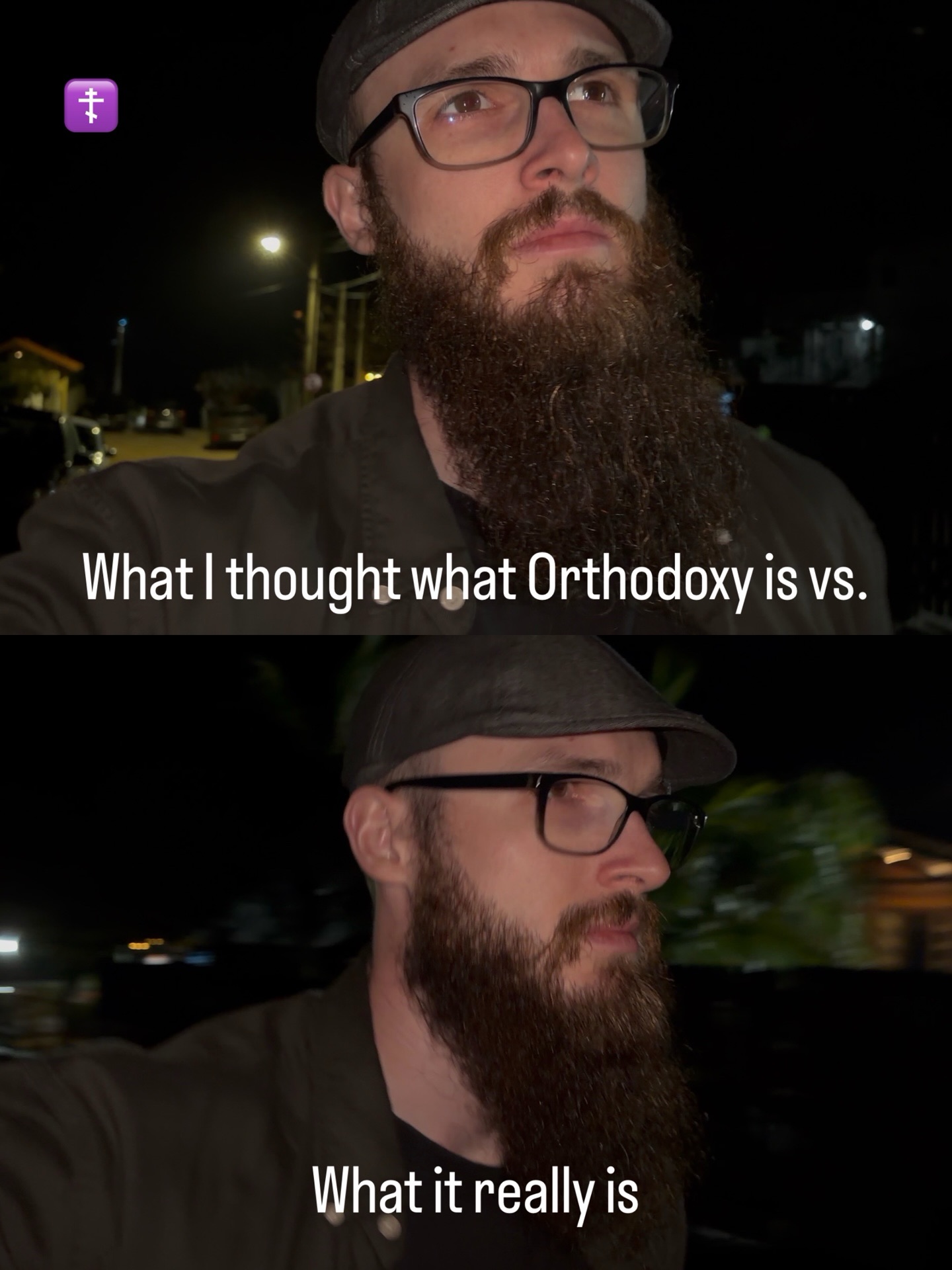
Tim, a catechumen of the Greek Orthodox Church, contrasts his expectations before approaching Orthodoxy with what the experience has actually been. The post is a short personal introduction rather than a developed argument: he says he is documenting his learnings and obstacles on the way into the Church. Alongside his catechumenate he mentions nearly two decades of training in fitness, part of it at a competitive level, and that he has built his…

Tim, a catechumen of the Greek Orthodox Church, contrasts his expectations before approaching Orthodoxy with what the experience has actually been. The post is a short personal introduction rather than a developed argument: he says he is documenting his learnings and obstacles on the way into the Church. Alongside his catechumenate he mentions nearly two decades of training in fitness, part of it at a competitive level, and that he has built his own successful business.

He frames his account as a place where Orthodoxy, fitness and business meet, and invites readers to follow his progress and grow together with him. The post closes with thanks and the words 'All praise to the Lord Amen.' Because the post is brief, the discussion it opens is about the perspective of a newcomer: what someone on the path into the Greek Orthodox Church notices, struggles with and learns, told by a person who also trains and runs a business.

It offers a first-person account from someone not yet chrismated, which is a stage many readers of an Orthodox feed have either passed through or are currently in. The value for a reader is the comparison between expectation and reality as one convert-to-be sees it, plus the example of someone trying to hold together church life, physical training and work.

  • Tim is a catechumen of the Greek Orthodox Church and writes about his learnings and obstacles on the way into Orthodoxy.
  • The post is framed as 'what I thought vs. what it really is', comparing expectations with the actual experience.
  • He has almost two decades of fitness experience, some of it competitive.
  • He has built his own successful business and combines the three topics of Orthodoxy, fitness and business.
  • The post ends with thanks and the words 'All praise to the Lord Amen.'
Read more
Hellenic College Holy Cross Instagram

Anonymous donor funds first renovation of Holy Cross gymnasium since 2000

Holy Cross Greek Orthodox School of Theology announced that an anonymous donor is funding a renovation of the Pappas Gymnasium. The donor wishes to honor the school's alumni, Fr. Savas Constantinou. This will be the gymnasium's first renovation since 2000, when a workout area was added to the facility. The announcement points readers to a news release on the school's website, hchc.edu, for further details. The post is a short announcement and…

Holy Cross Greek Orthodox School of Theology announced that an anonymous donor is funding a renovation of the Pappas Gymnasium. The donor wishes to honor the school's alumni, Fr. Savas Constantinou. This will be the gymnasium's first renovation since 2000, when a workout area was added to the facility.

The announcement points readers to a news release on the school's website, hchc.edu, for further details. The post is a short announcement and generated no discussion; it states the facts of the gift, the honoree, and where to find more information.

  • An anonymous donor is funding a renovation of the Pappas Gymnasium at Holy Cross Greek Orthodox School of Theology.
  • The donor wishes to honor the school's alumnus Fr. Savas Constantinou.
  • This is the gymnasium's first renovation since 2000, when a workout area was added.
  • A news release with more details is available at hchc.edu.
Read more