WeOrthodox
EN UA

Orthodox posts, videos and discussions

We follow Orthodox channels, communities and blogs across the web, summarise every post and video, and highlight the conversations with real substance.

Timothy with theapostolicfaithpod Instagram

Mary's Perpetual Virginity: Scripture, Fathers, and Reformers Agree

The post presents a structured defense of Mary's perpetual virginity, drawing on Scripture, early Christian writers, and the major Protestant Reformers. It begins with biblical passages: Matthew 1:23 cites Isaiah's prophecy of a virgin bearing a son, and Matthew 1:25 notes that Joseph knew Mary not until she brought forth her firstborn son, explaining that the Greek word heōs marks the time before the event without implying a change afterward.…

The post presents a structured defense of Mary's perpetual virginity, drawing on Scripture, early Christian writers, and the major Protestant Reformers. It begins with biblical passages: Matthew 1:23 cites Isaiah's prophecy of a virgin bearing a son, and Matthew 1:25 notes that Joseph knew Mary not until she brought forth her firstborn son, explaining that the Greek word heōs marks the time before the event without implying a change afterward.

John 19:26-27 records Jesus entrusting his mother to the disciple John, which the author argues would be unnecessary if she had other sons. The early church witnesses include Ignatius of Antioch (c. 107 AD), who wrote that Mary remained a virgin after Christ's birth; Athanasius (c. 373 AD), who compared Christ's exit from the womb to his entry without defilement; Jerome (4th-5th century), who confessed Mary's virginity after birth; and Augustine (5th century), who called her a mother yet a virgin.

The Protestant Reformers are also cited: Luther held that Mary remained a pure and perpetual virgin; Calvin confessed she continued a virgin after giving birth; Zwingli affirmed her virginity remained intact; and Melanchthon stated she remained a virgin even after Christ's birth. The post then lists why the doctrine matters: it affirms Christ's divine origin, fulfills Isaiah 7:14, shows Mary's unique role as Theotokos, and belongs to the faith once delivered.

Common objections are addressed: the term adelphoi can mean relatives or cousins; heōs does not imply a subsequent change; and Jesus' entrustment of Mary to John suggests she had no other sons. The conclusion states that perpetual virginity is not a medieval invention but the consistent witness of Scripture, the early church, and the Reformers, citing Hebrews 13:8.

  • Scripture affirms Mary's virginity before, during, and after Christ's birth (Matthew 1:23, 1:25; John 19:26-27).
  • Early Church Fathers including Ignatius, Athanasius, Jerome, and Augustine explicitly taught her perpetual virginity.
  • Major Protestant Reformers, Luther, Calvin, Zwingli, Melanchthon, all confessed Mary remained a virgin after Christ's birth.
  • The doctrine safeguards Christ's divine origin, fulfills Isaiah 7:14, and honors Mary as Theotokos.
  • Common objections about "brothers" and the word "until" are answered by linguistic and cultural context.
Read more
☦️An Orthodox Blog☦️ with Orthodoxy ☦︎ Instagram

St. Maximus the Confessor on silence and betrayal of the faith

The post shares a saying attributed to St. Maximus the Confessor: "Silence in the face of the distortion of the faith is betrayal. Whoever betrays the faith, though he may be alive, is dead." The text presents the statement without additional commentary or context.
  • St. Maximus the Confessor identifies silence before distortion of the faith as betrayal
  • He states that one who betrays the faith is dead even while alive
  • The saying is shared without further explanation or source reference

Christ Comes from the Depths to Judge and Separate the Flock

The video presents a depiction of Christ's return for judgment. He comes from the depths to judge the world and separate the flock. At His steps the earth and heaven tremble. Gold and silver will perish. A plea rises for the Son of God to shine.

Key moments

  1. Christ comes from the depths to judge the world and separate the flock.
  2. The earth and heaven tremble at His steps, and gold and silver will perish.
  3. A plea is made for the Son of God to shine.
Read more
r/OrthodoxChristianity Reddit discussion

ROCOR Mid-America requires written blessing for online ministry

ROCOR Mid-America has issued a policy for clergy and online ministry requiring a written blessing. I am not part of ROCOR, but I think this is probably a good step. It could get messy, though. I am wondering if other jurisdictions will follow. No need to offer names here.

  • ROCOR Mid-America now requires written blessing for clergy online ministry
  • Author thinks it is a good step but could get messy
  • Author wonders if other jurisdictions will follow suit
8 opinions in the discussion Every priest in that diocese with a "channel" or some personal platform is going to have his plans, agendas and content reviewed. Which was already the situation, but Vladyka Peter was old,… Read the discussion

Becoming the right husband before seeking a godly wife

Every man says he wants a loyal, God-fearing wife who values marriage and family. But are you actually becoming the kind of man who is ready for her? From an Orthodox Christian perspective, dating should never be driven by lust, loneliness, or physical attraction alone. It is about discernment, patience, intentionality, and finding someone who shares your desire to grow closer to Christ. Do not just look for beauty. Look for character, humility,…

Every man says he wants a loyal, God-fearing wife who values marriage and family. But are you actually becoming the kind of man who is ready for her? From an Orthodox Christian perspective, dating should never be driven by lust, loneliness, or physical attraction alone.

It is about discernment, patience, intentionality, and finding someone who shares your desire to grow closer to Christ. Do not just look for beauty. Look for character, humility, faith, and the qualities of a future mother and wife. And remember, while you are praying for a godly woman, she may be praying for a godly husband.

Before asking God for the right wife, work on becoming the right husband. Marriage is not simply about finding someone to love. It is about two people walking towards Christ together. Ephesians 5:25 says, "Husbands, love your wives, just as Christ also loved the church and gave Himself for her."

  • Every man wants a godly wife, but are you becoming the man ready for her?
  • Dating must be driven by discernment and shared desire for Christ, not lust or loneliness
  • Seek character, humility, and faith over physical beauty
  • While you pray for a godly wife, she may be praying for a godly husband
  • Marriage means two people walking toward Christ together, modeled on Christ's love for the Church
6 opinions in the discussion Why is all of this about what you want a wife to do for you, with no thought about what you bring to the table? Why would the woman you want even be interested in you? You can't change or… Read the discussion
☦️An Orthodox Blog☦️ with Orthodoxy ☦︎ Instagram

Fr. Seraphim Rose on False Unity and the Antichrist's Preparation

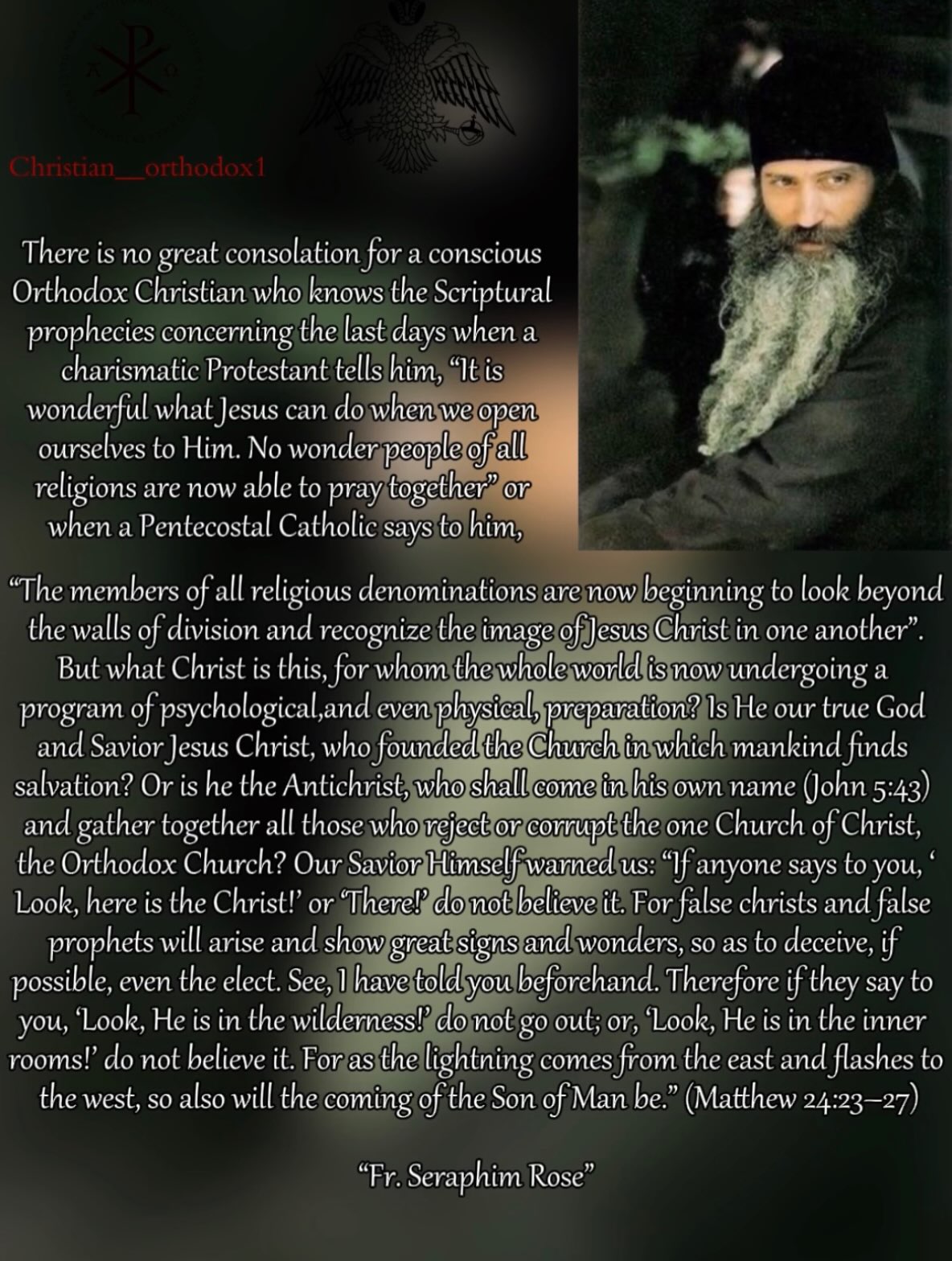
The post presents two related Orthodox perspectives on the last days. The first, attributed to Fr. Seraphim Rose, warns that ecumenical expressions of unity across religions, such as a charismatic Protestant saying "It is wonderful what Jesus can do when we open ourselves to Him. No wonder people of all religions are now able to pray together," or a Pentecostal Catholic saying "The members of all religious denominations are now beginning to look…

The post presents two related Orthodox perspectives on the last days. The first, attributed to Fr. Seraphim Rose, warns that ecumenical expressions of unity across religions, such as a charismatic Protestant saying "It is wonderful what Jesus can do when we open ourselves to Him. No wonder people of all religions are now able to pray together," or a Pentecostal Catholic saying "The members of all religious denominations are now beginning to look beyond the walls of division and recognize the image of Jesus Christ in one another", may signal a psychological and even physical preparation for the Antichrist.

Rose cites Christ's warning in Matthew 24:23-27 against false christs and false prophets who perform signs to deceive even the elect, and John 5:43 on the one who comes in his own name. He contrasts the true Christ, who founded the Orthodox Church as the ark of salvation, with a counterfeit christ who gathers those who reject or corrupt the one Church.

The second passage, attributed to Fr. Stephen Runc, addresses the Orthodox Christian's stance toward secular authorities. While acknowledging that rulers deserve respect and prayer per Romans 13:1-7, it insists they are not the true Christian Commonwealth. The "gods" of this world serve God's providential and eschatological purposes, but the Antichrist's powers will be destroyed by the breath of Christ's mouth (2 Thess. 2:8).

The Orthodox political vision is expressed in the Divine Liturgy's prayer: "For the Christian power and the Orthodox authorities, in peace, and in all piety, guard us, O Lord, and preserve us, O Lord, and grant us peace, so that we may pass the remaining time of our life in peace and repentance." The prayer for a "Sovereign" or "President" of the world is not the King of Kings who will appear "in the clouds of heaven with power and great glory" (Matt. 24:30).

  • Fr. Seraphim Rose warns that interreligious unity movements may prepare the way for the Antichrist.
  • He cites Matthew 24:23-27 on false christs deceiving with signs and wonders.
  • The true Christ founded the Orthodox Church as the sole ark of salvation.
  • Fr. Stephen Runc teaches that secular authorities, while owed prayer, are not the Kingdom of God.
  • The Divine Liturgy's prayer for Orthodox rulers reflects the Christian's true political hope.
radioimlemesou Instagram

Metropolitan Athanasios of Limassol: Repentance Covers Our Inability to Keep the Commandments

Metropolitan Athanasios of Limassol says that Christ calls anyone who wishes to follow Him to deny themselves, take up their cross, and follow Him. He states that everyone can do this in theory, but in practice no one can keep God's commandments perfectly. The Metropolitan explains that external observance of rules, laws, and commandments is not what brings a person before God or makes them a child of God.

Rather, when a person repents, their weakness, sin, failure, and the good they should have done but could not are covered.

Key moments

  1. Christ says whoever wants to follow him must deny themselves, take up their cross, and follow him.
  2. Everyone can follow Christ in theory, but in practice no one can keep God's commandments perfectly.
  3. External observance of rules, laws, and commandments is not what brings us before God or makes us succeed as children of God.
  4. When a person repents, their weakness, sin, missing the mark, and the good they should have done but could not are covered.
Read more
r/OrthodoxChristianity Reddit discussion

Prayer request for job search and career

I'm finishing my senior year of college in the next six months. The job market looks very bleak, and I struggled to even secure an internship. I'm terrified. I haven't been able to sleep, study, concentrate, eat, or even pray properly because I've been worrying night and day. The fear has seized my stomach and made me physically sick. My fiancée and I are engaged and will marry this summer, and two years after that she starts medical school, at…

I'm finishing my senior year of college in the next six months. The job market looks very bleak, and I struggled to even secure an internship.

I'm terrified. I haven't been able to sleep, study, concentrate, eat, or even pray properly because I've been worrying night and day. The fear has seized my stomach and made me physically sick. My fiancée and I are engaged and will marry this summer, and two years after that she starts medical school, at which point I'll be the sole provider for both of us.

I majored in business administration and completed multiple internships, and I want to pursue a career in HR and healthcare administration. But the job market is so bleak I don't believe it's possible to land even a basic role.

Please, I know I'm not worthy of your prayers and this is an incredibly selfish request, but if you could pray for my success in finding a job, I cannot express my gratitude.

  • College senior facing bleak job market after struggling to land internships
  • Severe anxiety affecting sleep, study, eating, and prayer
  • Engaged, marrying in summer, will be sole provider when fiancée starts med school in two years
  • Majored in business administration with multiple internships, seeks HR/healthcare administration role
  • Asks for prayers despite feeling unworthy and selfish
8 opinions in the discussion Amen, I pray to God you will find a solid first job working for nice people, through Jesus Christ, our Lord. Also, please remember Matthew 6:25-34, do not worry. Read the discussion

Fr. Josiah Trenham: pride blocks Holy Communion

Fr. Josiah Trenham teaches that the greatest obstacle to Holy Communion is pride. If a person holds anyone in contempt or refuses to forgive, he says, that person dare not approach the chalice. The priest urges the faithful to strive to be worthy of Christ's embrace and to embrace others in turn, making communion the center of life. This means preparing days in advance by reading the pre-communion prayers and giving thanks for days after…

Fr. Josiah Trenham teaches that the greatest obstacle to Holy Communion is pride. If a person holds anyone in contempt or refuses to forgive, he says, that person dare not approach the chalice. The priest urges the faithful to strive to be worthy of Christ's embrace and to embrace others in turn, making communion the center of life.

This means preparing days in advance by reading the pre-communion prayers and giving thanks for days after receiving. Proper preparation also includes avoiding judgment, keeping a regular prayer rule, and confessing regularly according to the counsel of one's spiritual father. Fr. Josiah stresses that the Divine Liturgy is not a stand-alone service but the culmination of the liturgical day.

Therefore, the faithful should attend Vespers and Orthros, sometimes combined as a Vigil, before the Liturgy, and they should come to the Liturgy as often as possible. Above all, one must be reconciled with others, bringing no hatred or lack of forgiveness to the chalice.

Key moments

  1. If we hold anyone in contempt, if we are refusing to forgive anyone, we dare not approach the chalice.
  2. We should strive for being worthy to be in the embrace of Christ and to embrace them ourselves, like that as regularly and frequently, and try to regulate your life such that communion is front and center.
  3. You think of it the days prior, you read the pre-communion prayers, you give thanks for it the days after receiving.
  4. Avoid judgment, be faithful, keep your prayers, make your confession according, regularly according to the counsel of your spiritual father.
  5. Be faithful, don't just show up in the liturgy.
  6. For us, the proper preparation is to come to the Vespers and to come to the Orthros. That's where the content of the daily commemorations are.
  7. The liturgy is not meant to be a stand-alone worship piece. No, it's the culmination of the liturgical day.
  8. So try to come to the Vespers, to the Orthros. Sometimes those are done together in churches and call the Vigil, and then to the liturgy as often as you possibly can and make sure you're reconciled with others. That you don't bring any hatred or lack of forgiveness. This is the top of the list.
Read more
Disgruntled Docs with Ben Instagram

Video argues sola scriptura impossible in first twenty years of church

The video presents an Orthodox challenge to the Protestant doctrine of sola scriptura. The speaker asks how the early church could have practiced sola scriptura during its first twenty years when no completed New Testament existed. He acknowledges that the Old Testament, the Gospels, and oral teaching from prophets and apostles were regarded as infallible in that period. The argument proceeds that during the apostles' lifetime one would not have…

The video presents an Orthodox challenge to the Protestant doctrine of sola scriptura. The speaker asks how the early church could have practiced sola scriptura during its first twenty years when no completed New Testament existed. He acknowledges that the Old Testament, the Gospels, and oral teaching from prophets and apostles were regarded as infallible in that period.

The argument proceeds that during the apostles' lifetime one would not have doubted Paul's teaching simply because it was not yet written down; therefore sola scriptura did not exist while the apostles were alive. The church relied on living apostolic teaching, which later became inscripturated. The speaker also questions what authoritative standard remains after the apostles' deaths and challenges the idea that infallible oral teaching continues today.

He concludes by thanking his debate opponent for conceding that sola scriptura is not apostolic in origin.

Key moments

  1. The speaker asks how sola scriptura could be practiced in the first twenty years of the church when there was no completed Bible or scripture.
  2. The speaker acknowledges that the Old Testament, the Gospels, and oral teaching from prophets and apostles were considered infallible.
  3. The speaker questions what the stand is after the death of the apostles and challenges the idea that there is infallible oral teaching today.
  4. The speaker says that during the apostles' time one would not doubt Paul's teaching just because it was not written down, and concludes that sola scriptura did not exist then; the church had apostolic teaching which later became scripture.
  5. The speaker thanks the opponent for conceding that sola scriptura is not apostolic.
Read more
Orthodox Life Instagram

Saint Artemios the Great Martyr of Antioch commemorated October 20

Saint Artemios the Great Martyr of Antioch was a fourth-century Roman military commander, patrician, and Imperial Prefect of Egypt. He served under Emperor Constantine the Great and converted to Christianity after witnessing the vision of the Holy Cross in the sky. Under Constantine's successor Constantius, Artemios transferred the holy relics of the Apostles Andrew and Luke to the Church of the Holy Apostles in Constantinople. When Emperor…

Saint Artemios the Great Martyr of Antioch was a fourth-century Roman military commander, patrician, and Imperial Prefect of Egypt. He served under Emperor Constantine the Great and converted to Christianity after witnessing the vision of the Holy Cross in the sky. Under Constantine's successor Constantius, Artemios transferred the holy relics of the Apostles Andrew and Luke to the Church of the Holy Apostles in Constantinople.

When Emperor Julian the Apostate began restoring paganism, Artemios traveled to Antioch and witnessed Julian torturing two Christian priests, Eugenios and Makarios, for refusing to renounce the Orthodox faith. Artemios publicly denounced the emperor for his impiety and prophesied Julian's imminent downfall and death. Enraged, Julian stripped Artemios of rank and threw him into a dungeon.

The saint endured flogging, tearing, and piercing with red-hot skewers. Jesus Christ appeared to Artemios in his cell surrounded by angels, healing his wounds and promising an incorruptible crown of glory. Julian then ordered a massive stone quarry block split in two, placing Artemios on one half and crushing him with the other.

Despite shattered bones and spilled entrails, Artemios survived, stood up, and continued praising Christ while mocking the pagan idols. Recognizing the saint's unbreakable faith, Julian ordered his beheading in 362 AD. After his martyrdom, a Christian deaconess reverently transferred his holy relics to the Church of Saint John the Baptist in Constantinople.

  • Served as Imperial Prefect of Egypt under Constantine the Great
  • Converted after witnessing the vision of the Holy Cross
  • Transferred relics of Apostles Andrew and Luke to Constantinople
  • Denounced Julian the Apostate and prophesied his downfall
  • Survived crushing by a stone block before beheading in 362 AD
Read more

The 300 Aragvian Martyrs: Defending Faith and King in 1795

The post presents the story of the 300 Aragvian martyrs through a series of illustrated slides. In 1795, three hundred Georgian warriors from the Aragvi region gathered at Saint George's Church as Persian Muslim invaders surrounded Tbilisi. They made a pledge to fight to the death defending their people, their brotherhood, and the city. When the Georgian defenses began to collapse, the Aragvians positioned themselves between the attackers and…

The post presents the story of the 300 Aragvian martyrs through a series of illustrated slides. In 1795, three hundred Georgian warriors from the Aragvi region gathered at Saint George's Church as Persian Muslim invaders surrounded Tbilisi. They made a pledge to fight to the death defending their people, their brotherhood, and the city.

When the Georgian defenses began to collapse, the Aragvians positioned themselves between the attackers and King Erekle II, holding back the Persian advance while the king escaped. They continued fighting despite massive casualties. Their sacrifice did not prevent the overall defeat, but their resistance enabled the king's survival.

In 2008, the Georgian Orthodox Church glorified them as holy martyrs for their sacrifice in defense of their Christian homeland and resistance to Islamic conquest. The post includes their troparion, which honors their steadfast courage and sacrifice, then asks them to intercede with Christ so that the faithful may stand firmly in His commandments.

The hymn includes the line: "May we stand as firmly in obedience to Christ as they stood in battle." A Georgian folk song tribute to the 300 Aragvians is noted as accompanying the presentation and available on Spotify.

  • 300 Aragvian warriors gathered at Saint George's Church in 1795 and pledged to fight to the death against Persian Muslim invaders.
  • They shielded King Erekle II during the collapse of Georgian defenses, allowing his escape while suffering massive casualties.
  • Their resistance did not prevent defeat but secured the king's survival.
  • The Georgian Orthodox Church glorified them as holy martyrs in 2008 for defending their Christian homeland.
  • Their troparion asks for their intercession to stand firmly in obedience to Christ's commandments.
Read more
Prayer Orthodoxy ® Instagram

Entering the Prayer Corner with Humility and Reverence

1:24

The post presents a sequence of actions for entering a home prayer corner, drawn from Orthodox practice. The speaker removes shoes before stepping into the space, following the example of Moses on holy ground, to leave behind worldly distractions and approach with humility. An oil lamp is lit first, then a candle, while praying for Christ to illuminate the heart and dispel darkness; the flame recalls Christ as the Light of the World. The speaker…

The post presents a sequence of actions for entering a home prayer corner, drawn from Orthodox practice. The speaker removes shoes before stepping into the space, following the example of Moses on holy ground, to leave behind worldly distractions and approach with humility. An oil lamp is lit first, then a candle, while praying for Christ to illuminate the heart and dispel darkness; the flame recalls Christ as the Light of the World.

The speaker then venerates icons in a set order: the Cross of Christ, the icon of Christ, the Theotokos for her intercessions, and Saint John the Baptist as the forerunner who called for repentance. Each act prepares the heart and mind for prayer, turning the corner into a place to withdraw from the noise of the world and seek God's peace and presence.

The text appears in English and Greek, and the video summary expands on the symbolism of each step. No discussion thread is visible; the post functions as a standalone teaching on prayer preparation.

Key moments

  1. The speaker removes shoes before entering the prayer corner to symbolically leave behind the distractions and burdens of the world, just as God commanded Moses to remove his sandals on holy ground, and approaches with humility and reverence.
  2. The speaker lights the oil lamp first, then the candle, and prays asking Jesus Christ to illuminate the heart and dispel the darkness of the world.
  3. The flame of the candle reminds the speaker of Christ as the Light of the World and the constant need for divine illumination.
  4. The speaker approaches the iconostasis to venerate the holy icons, beginning with the cross of Christ through which salvation came into the world.
  5. The speaker then venerates the icon of Jesus Christ.
  6. Next, the speaker venerates the icon of the Theotokos, asking for her intercessions.
  7. Finally, the speaker venerates the icon of St. John the Baptist, the forerunner who prepared the way for Christ and called the world to repentance.
  8. Through these simple acts of reverence the speaker prepares the heart and mind to enter into prayer, and the prayer corner becomes a place to withdraw from the noise of the world and seek the peace and presence of God.
Read more
Athonite Audio YouTube

Fellowship in Christ's Sufferings and Our Brothers' Pain

Fellowship in Christ's Sufferings and Our Brothers' Pain 54:38

The talk explains that fellowship in the sufferings of Christ cannot be separated from fellowship in the sufferings of our brothers and sisters, because all believers are one body in Christ through the Holy Spirit. This communion is nourished by the Eucharist and expressed through practical love: weeping with those who weep and bearing one another's burdens as Christ did. The teaching is traced through Scripture and the Church Fathers, including…

The talk explains that fellowship in the sufferings of Christ cannot be separated from fellowship in the sufferings of our brothers and sisters, because all believers are one body in Christ through the Holy Spirit. This communion is nourished by the Eucharist and expressed through practical love: weeping with those who weep and bearing one another's burdens as Christ did.

The teaching is traced through Scripture and the Church Fathers, including Paul's letters, Isaac the Syrian, Anthony the Great, Basil the Great, John Chrysostom, Maximus the Confessor, and Gregory the Theologian. Isaac the Syrian teaches that love of neighbor is acquired only by fulfilling it in works according to ability, time, and place, and that the more we love, the more watchful and careful we become.

Christ's entire earthly life was participation in human pain, healing, raising the dead, weeping at Lazarus' grave, pitying the widow of Nain, and He suffered, died, rose, and instituted the Church all for love. St. Basil the Great teaches that spiritual fellowship must surpass fleshly kinship; love must be equal for all members of the body.

John Chrysostom exemplified this by becoming everything to all people, advocate for the arrested, caterer for the hungry, physician for the sick, and from exile wrote letters sharing deeply in the sufferings of his spiritual children. The fellowship of Christ's love is not natural meeting or human reasoning but a gift of the Holy Spirit who creates a new heart of flesh.

Pain, tribulation, and death lead to Pascha, resurrection, and eternity; our light affliction works a far more exceeding eternal weight of glory.

Key moments

  1. 0:01 Fellowship in the sufferings of Christ is absolutely connected with fellowship in the pain of our brethren, because by one Spirit we were all baptized into one body (1 Corinthians 12:13) and we who are many are one body in Christ (Romans 12:5).
  2. 1:07 Tribulations constitute the unity of hearts and the sensitivity of brotherly love, which is universal because love has no borders, measures, or limits; Christ himself fervently desired fellowship with his disciples in his hour of agony (Luke 22:15, Matthew 26:38-41).
  3. 3:43 Isaac the Syrian teaches that one does not acquire love of neighbor in the soul unless one fulfills it by works according to ability, time, and place; the more we love, the more watchful, careful, and sparing in words we become, weeping together with suffering brothers and sisters.
  4. 5:18 Christ during his earthly life did nothing else but completely participate in human pain, healing, raising the dead, weeping at Lazarus' grave, pitying the widow of Nain, and he suffered, was crucified, died, rose, and instituted the Church all for love.
  5. 10:04 The fellowship of Christ's love is not a natural meeting or human reasoning but a gift of the Holy Spirit who creates a new heart of flesh (Ezekiel 36:26-27); only such a Spirit-filled heart can truly commune without hypocrisy with a suffering neighbor.
  6. 25:45 St. Basil the Great teaches that spiritual fellowship must surpass fleshly kinship: if one prefers blood relatives, one remains dominated by natural ties; love must be equal for all members of the body, while honor is given according to worthiness.
  7. 37:51 John Chrysostom became everything to all people, advocate for the arrested, caterer for the hungry, physician for the sick, nurse for the mourning, innkeeper for strangers, and from exile he wrote letters sharing deeply in the sufferings of his spiritual children and drawing comfort from their faith.
  8. 45:43 Pain, tribulation, and death lead to Pascha, resurrection, and eternity; our light affliction works a far more exceeding eternal weight of glory (2 Corinthians 4:17), and we look not at things seen but at things unseen, for our citizenship is in heaven (Philippians 3:20).

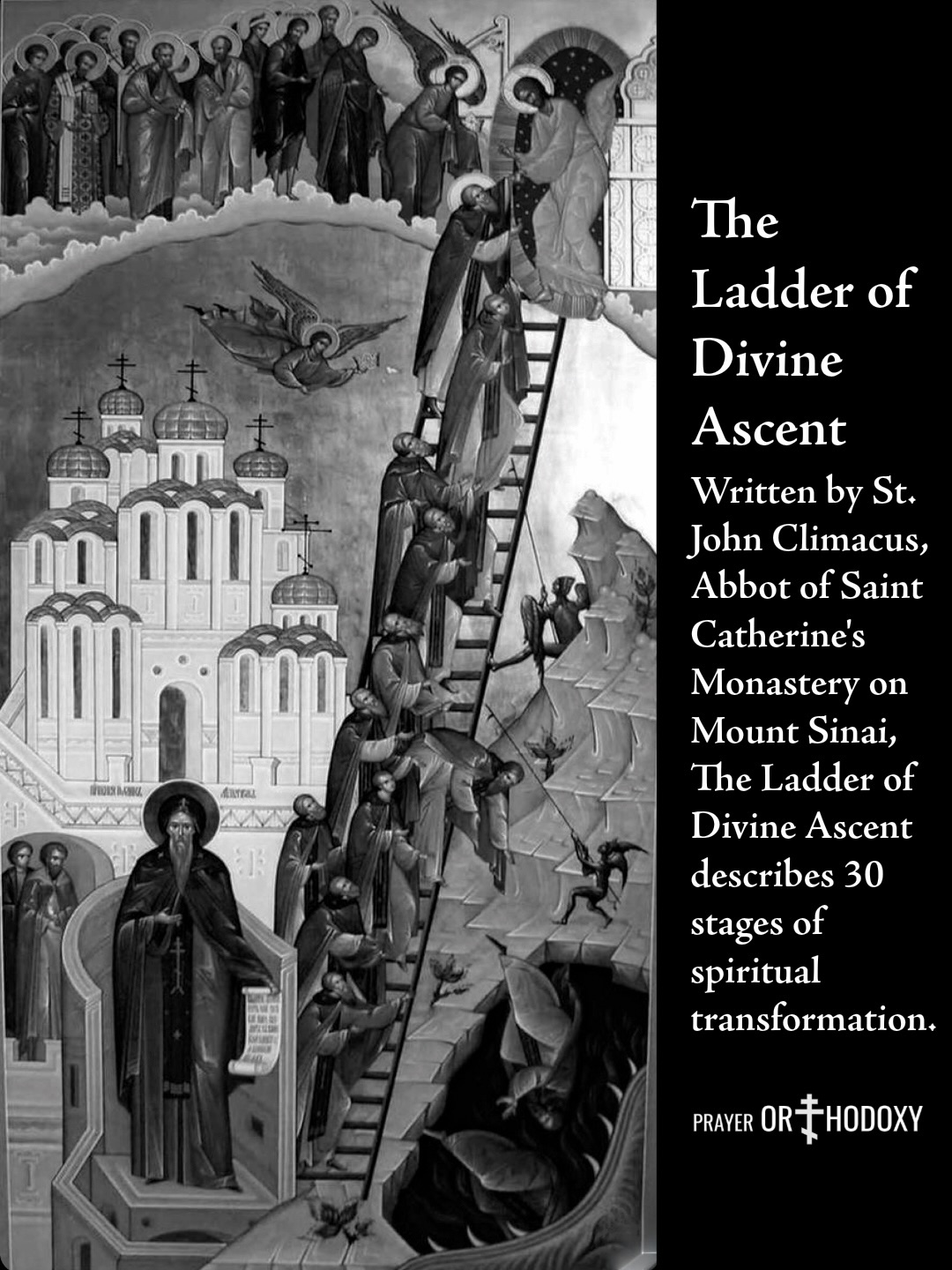
St. John Climacus's Ladder of Divine Ascent: 30 steps toward God

The post presents St. John Climacus's teaching from The Ladder of Divine Ascent. The saint outlines a spiritual journey of 30 steps that leads toward Christ. Each step represents progress in virtues including repentance, humility, prayer, and perseverance. The text identifies love as the highest virtue at the summit of the ladder. The post appears in both English and Greek, with the Greek text naming the work as Η Κλίμακα της Θείας Ανόδου and…

The post presents St. John Climacus's teaching from The Ladder of Divine Ascent. The saint outlines a spiritual journey of 30 steps that leads toward Christ. Each step represents progress in virtues including repentance, humility, prayer, and perseverance.

The text identifies love as the highest virtue at the summit of the ladder. The post appears in both English and Greek, with the Greek text naming the work as Η Κλίμακα της Θείας Ανόδου and the author as Ο Άγιος Ιωάννης της Κλίμακος. The content is marked as an original production of Prayer Orthodoxy.

  • St. John Climacus teaches a 30-step spiritual ascent toward Christ
  • The steps require repentance, humility, prayer, and perseverance
  • Love is identified as the highest virtue
  • The teaching appears in both English and Greek
  • The post is an original production of Prayer Orthodoxy
Read more
Athonite Audio YouTube

Sharing in Christ's sufferings: the necessary Christian path

Sharing in Christ's sufferings: the necessary Christian path 30:44

The speaker teaches that participation in Christ's sufferings is the necessary path for every Christian, citing 1 Peter 4:13 and St. Isaac the Syrian on rejoicing in proportion to that participation. Christ's entire life was affliction, abandonment, poverty, slander, betrayal, and death, and He promises His followers the same tribulations. Thomas à Kempis is quoted on the few who bear the cross compared to the many who desire consolation. The…

The speaker teaches that participation in Christ's sufferings is the necessary path for every Christian, citing 1 Peter 4:13 and St. Isaac the Syrian on rejoicing in proportion to that participation. Christ's entire life was affliction, abandonment, poverty, slander, betrayal, and death, and He promises His followers the same tribulations.

Thomas à Kempis is quoted on the few who bear the cross compared to the many who desire consolation. The Christian views all pain through the God-man Jesus, accepting tribulation as the means to mortify sin and be conformed to Christ's death so that His life may be manifested in the body. St. Paul's sufferings illustrate this fellowship; the apostle rejoices because his afflictions fill up what is lacking in Christ's afflictions for the Church.

The cross becomes a title of glory, not shame, and daily co-crucifixion with Christ transforms suffering into active practice. St. Basil the Great and St. John Chrysostom affirm that present hardships prepare eternal reward. Finally, eucharistic communion unites believers to Christ's body and to one another, making them partakers of the divine nature and heirs of glory, as St. Gregory of Nyssa proclaims in his resurrection sermon.

Key moments

  1. 0:01 The speaker opens with St. Isaac the Syrian and 1 Peter 4:13: rejoicing in proportion to participation in Christ's sufferings, with great gladness at His second coming.
  2. 1:32 Christ's words guarantee tribulation for His followers: 'If they persecuted me, they will also persecute you' (John 15:20) and 'let him deny himself and take up his cross and follow me' (Matthew 16:24).
  3. 2:03 Christ's sufferings were not only the cross; His whole life was pain, abandonment, poverty, slanders, hatred, scorn, blows, humiliations, loneliness, doubts, disputes, persecutions, betrayal, and death.
  4. 2:38 Thomas à Kempis is quoted: Jesus has many lovers of His kingdom but few bearers of His cross; many desire His consolation but few His tribulation; many follow to the breaking of bread but few to the cup of His passion.
  5. 4:43 Paul's desire in Philippians 3:10-11: to know Christ, share His sufferings, be conformed to His death, and so attain the resurrection from the dead.
  6. 7:21 Co-crucifixion with Christ means daily participation in His suffering; pain becomes active practice, and the believer crucifies the flesh with its passions and desires (Galatians 5:24).
  7. 16:48 The pain of Christ's crucified body is the pain of the Church; Paul fills up in his flesh what is lacking in Christ's afflictions for the sake of His body, the Church (Colossians 1:24).
  8. 22:33 Complete fellowship comes through the Eucharist: the cup of blessing is communion in Christ's blood, the bread broken is communion in His body, making believers one body and partakers of the divine nature (1 Corinthians 10:16-17; 2 Peter 1:4).

Elder Filimon: God's word must unite, not divide

Elder Filimon of the Pantokratoros Skete of Prophet Elias on Mount Athos compares human beings to people inside a castle who tear down their own protection by throwing stones at one another. He says this destroys the castle and wounds those inside. He insists we need philadelphia, brotherly love, rooted in genuine love and not malice, and warns against splitting into parties and factions. The elder recounts that Saint Porphyrios fell asleep…

Elder Filimon of the Pantokratoros Skete of Prophet Elias on Mount Athos compares human beings to people inside a castle who tear down their own protection by throwing stones at one another. He says this destroys the castle and wounds those inside. He insists we need philadelphia, brotherly love, rooted in genuine love and not malice, and warns against splitting into parties and factions.

The elder recounts that Saint Porphyrios fell asleep repeating "one, essence, one" until he closed his eyes, offering this as a call to unity. He warns that if we break into a thousand pieces, the devil rubs his hands in satisfaction. He urges that we must remain deeply loving and united. He states that the word of God must unite us; if it divides, it is not God's word but something else.

Key moments

  1. The bishop says we are like people in a castle who take its stones and throw them at each other, destroying the castle and wounding ourselves.
  2. He insists we need philadelphia, brotherly love, with real love, not malice, and warns against becoming parties and factions.
  3. He recounts that Saint Porphyrios fell asleep saying "one, essence, one" repeatedly until he closed his eyes.
  4. He warns that if we break into a thousand pieces, someone rubs his hands in satisfaction, the devil.
  5. He urges that we must be very loving and united.
  6. He states the word of God must unite us, not divide us; if it divides, it is not God's word but something else.
Read more
Ancient Faith YouTube

Deacon Seraphim on the Proskomedia: The Hidden Start of the Divine Liturgy

Deacon Seraphim on the Proskomedia: The Hidden Start of the Divine Liturgy 41:35

Deacon Seraphim begins a mini-series on the Divine Liturgy by explaining the Proskomedia, the service of preparation that takes place hours before the public worship. He describes how the clergy arrive early, say beginning prayers, venerate icons, and vest while reciting scriptural prayers. The priest asks God to strengthen him to stand uncondemned before the altar. At the table of preparation, the priest cuts the Lamb from the prosphora marked…

Deacon Seraphim begins a mini-series on the Divine Liturgy by explaining the Proskomedia, the service of preparation that takes place hours before the public worship. He describes how the clergy arrive early, say beginning prayers, venerate icons, and vest while reciting scriptural prayers. The priest asks God to strengthen him to stand uncondemned before the altar.

At the table of preparation, the priest cuts the Lamb from the prosphora marked with IC XC NIKA, speaking Isaiah's prophecy of the suffering servant with each cut while the deacon says, "Let us pray to the Lord." Commemorative particles are placed around the Lamb: first for the Theotokos at the Lamb's right hand, then for nine ranks of saints, then for the living and departed faithful by name, making the discos an icon of the whole Church.

Covering the gifts moves backward through salvation history: the star over the Lamb recalls Bethlehem, the veils recall creation and the Holy Spirit brooding over the waters. The service ends with censing and the opening proclamation "Blessed is the Kingdom," inviting the assembly into communion with the risen Lord. Deacon Seraphim emphasizes that "liturgy" (leitourgia) means a public work done on behalf of the people, not "the work of the people"; the Divine Liturgy begins and ends as Christ's work for us.

He also advises that unless a person has attended liturgy faithfully three or four times, they should not watch further, because explanation without participation files the mystery away without entering it. He notes that serving at the holy table is the greatest thing in his life and that everything else has been brought into relationship with what happens at the altar.

Key moments

  1. 0:31 The Divine Liturgy is the same repeated service week after week, and the faithful spend their lives doing this thing.
  2. 1:02 Serving at the holy table is the greatest thing in the deacon's life; everything else in his life has been brought into relationship with what happens at the altar.
  3. 4:14 Unless you have attended liturgy faithfully three or four times, you should not watch further; explanation without participation files the mystery away without entering it.
  4. 5:15 "Liturgy" (leitourgia) means a public work done on behalf of the people, not "the work of the people"; the Divine Liturgy begins and ends as Christ's work for us.
  5. 12:37 Clergy arrive hours early, pray beginning prayers, venerate icons, and the priest asks God to strengthen him to stand uncondemned before the fearful altar.
  6. 22:00 The priest cuts the Lamb from the prosphora marked with IC XC NIKA, speaking Isaiah's prophecy of the suffering servant with each cut while the deacon says "Let us pray to the Lord."
  7. 26:36 Commemorative particles are placed around the Lamb: first for the Theotokos at the Lamb's right hand, then for nine ranks of saints, then for the living and departed faithful by name.
  8. 31:16 Covering the gifts moves backward through salvation history: the star over the Lamb recalls Bethlehem, the veils recall creation and the Holy Spirit brooding over the waters.
Read more
Prayer Orthodoxy ® with The National Herald Instagram

Bishop Eirineos: Monasticism as Answer to Secularization

The historic Gouverneto Monastery in Chania, Crete, dedicated to the Virgin Mary, celebrates its feast on Bright Saturday. Thirteen monks live there under the leadership of Bishop Eirineos of Evmenia, who serves as abbot. Most of the monks are young men who have completed or are near completing higher education in Greece and abroad. In an interview, Bishop Eirineos said the Orthodox Church and the world have never needed coenobitic monasticism…

The historic Gouverneto Monastery in Chania, Crete, dedicated to the Virgin Mary, celebrates its feast on Bright Saturday. Thirteen monks live there under the leadership of Bishop Eirineos of Evmenia, who serves as abbot. Most of the monks are young men who have completed or are near completing higher education in Greece and abroad.

In an interview, Bishop Eirineos said the Orthodox Church and the world have never needed coenobitic monasticism more than today. He identified secularization as the removal of the sacred from life and society, the reduction of faith to mere religion, the distancing of the Church from its ecclesial identity, and the Protestantization of Orthodox theology.

He described modern societies as increasingly self-centered and materialistic, pushing the spirit to the margins and ignoring the soul's thirst while banishing God beyond the clouds. He listed consequences: addiction, depression, suicide, abandonment of life's struggles, and ultimately nihilism and resignation. Monasticism, he said, offers an alternative way of life and is Christianity's most authentic expression of itself.

Bishop Eirineos also remarked that Greek-Americans remain the most authentic expression of Hellenism beyond the borders of Greece, despite generations since the first settlers.

  • Gouverneto Monastery is a historic patriarchal and stavropegic monastery in Crete with 13 resident monks.
  • Bishop Eirineos of Evmenia serves as abbot and says the Church and world need coenobitic monasticism more than ever.
  • He defines secularization as removal of the sacred, reduction of faith to religion, loss of ecclesial identity, and Protestantization of theology.
  • He links modern self-centered materialism to addiction, depression, suicide, and nihilism.
  • He calls monasticism Christianity's most authentic expression and Greek-Americans the truest Hellenism abroad.
Read more
Orthodox Health Instagram

Fr. Michael Marcantoni on how passions make us passive

0:38

The social media post promotes Episode 83 of the Orthodox Health Podcast, titled "Why You Can't Find Real Peace," featuring Fr. Michael Marcantoni. The post opens with the phrase "I don't know what came over me," which the priest says reveals more than we realize. Fr. Marcantoni points out that the passions make us passive before them. A person is no longer simply acting but doing the bidding of the passion. This can manifest as anger, alcohol,…

The social media post promotes Episode 83 of the Orthodox Health Podcast, titled "Why You Can't Find Real Peace," featuring Fr. Michael Marcantoni. The post opens with the phrase "I don't know what came over me," which the priest says reveals more than we realize. Fr. Marcantoni points out that the passions make us passive before them.

A person is no longer simply acting but doing the bidding of the passion. This can manifest as anger, alcohol, or any habit or desire that reaches the point where the person is no longer in control. The priest frames the question as larger than addiction: are you still free enough to say no?

The video summary elaborates that the speaker describes how passions make a person passive, using the Greek term pathos to explain that one becomes acted upon rather than acting. He shares his personal experience with alcohol addiction, noting it developed incrementally. There was a period of moderate drinking before a line was crossed.

After that point, interaction with the substance meant he was no longer in control. The video points add that everyone has experienced losing their cool and apologizing by saying they don't know what overcame them. Passions make you passive; pathos means you are passive before it and do its bidding.

The speaker's addiction to alcohol was incremental. There was a time when he could drink moderately and did so for a period. A line was crossed at some point. After that line, when he interacted with alcohol, he was no longer in control.

Key moments

  1. Everyone has experienced losing their cool and apologizing by saying they don't know what overcame them.
  2. Passions make you passive; pathos means you are passive before it and do its bidding.
  3. The speaker's addiction to alcohol was incremental.
  4. There was a time when he could drink moderately and did so for a period.
  5. A line was crossed at some point.
  6. After that line, when he interacted with alcohol, he was no longer in control.
Read more