WeOrthodox
EN UA

Orthodox posts, videos and discussions

We follow Orthodox channels, communities and blogs across the web, summarise every post and video, and highlight the conversations with real substance.

Prayer Orthodoxy ® Instagram

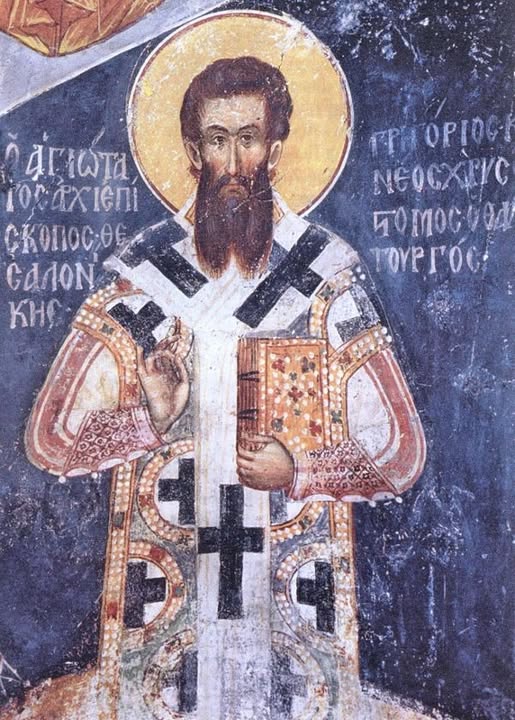
St. Gregory Palamas honored on November 14

The post marks the feast day of St. Gregory Palamas on November 14. It identifies him as Archbishop of Thessaloniki and a great teacher of prayer. It notes that his tomb rests in the cathedral that bears his name in Thessaloniki.

  • Feast day of St. Gregory Palamas observed on November 14
  • He served as Archbishop of Thessaloniki
  • Recognized as a great teacher of prayer
  • His tomb is located in the cathedral named for him in Thessaloniki
  • Post includes English and Greek texts with a prayer for intercession
Read more
CHRISTIANITY UNITED Instagram

Faith as trust beyond proof: Mount Athos and Saint Nikolaj Velimirović

The post opens by noting that the world constantly demands proof before belief, with people wanting to see miracles, receive signs, and have every question answered before trusting God. The Orthodox spiritual tradition, however, teaches something deeper: faith is not about having every answer but about learning to trust the One who holds all things in His hands. On Mount Athos, generations of monks have dedicated their lives to prayer, fasting,…

The post opens by noting that the world constantly demands proof before belief, with people wanting to see miracles, receive signs, and have every question answered before trusting God. The Orthodox spiritual tradition, however, teaches something deeper: faith is not about having every answer but about learning to trust the One who holds all things in His hands.

On Mount Athos, generations of monks have dedicated their lives to prayer, fasting, obedience, and repentance. They leave behind worldly ambitions not because they despise God's creation but because they desire to know Christ more intimately. Through years of spiritual struggle they seek the purification of the heart and communion with the living God.

Saint Nikolaj Velimirović (1881-1956), the great Serbian Orthodox bishop and spiritual writer, understood that faith changes perception. When hearts are consumed by pride, fear, and worldly distractions, people become spiritually blind even to the blessings surrounding them. As they grow in humility, prayer, and love for Christ, they begin to recognize His presence and providence in ways they previously overlooked.

The post clarifies that true faith is not blindness; it is trust in God that grows through prayer, experience, and a sincere search for truth. It suggests the greatest miracle is not seeing something extraordinary with physical eyes but allowing Christ to transform the heart. The author urges readers not to spend their entire lives demanding that God reveal Himself on their terms, but to begin seeking Him with sincerity, humility, and love, remembering that even when they cannot see the way forward, Christ has not abandoned them.

  • The world demands proof before belief, but Orthodox tradition teaches faith as trust in God.
  • Mount Athos monks pursue purification of heart and communion with God through prayer, fasting, obedience, repentance.
  • Saint Nikolaj Velimirović (1881-1956) taught that faith changes perception; pride and distractions cause spiritual blindness.
  • Humility, prayer, and love for Christ enable recognition of God's presence and providence.
  • True faith is not blindness but trust growing through prayer, experience, and sincere search for truth.
Read more

Fr. Alexey Uminsky: Why Christians Cannot Accept Reincarnation

Fr. Alexey Uminsky: Why Christians Cannot Accept Reincarnation 2:54

In a live-streamed question-and-answer session from August 25, 2026, Fr. Alexey Uminsky responds to a viewer's question about reincarnation. He states plainly that a Christian cannot believe in reincarnation because it is completely absurd for a Christian and contradicts the faith in the general resurrection. Christians believe that each person will rise in the body in which they were born, since a person is the image and likeness of God as a…

In a live-streamed question-and-answer session from August 25, 2026, Fr. Alexey Uminsky responds to a viewer's question about reincarnation. He states plainly that a Christian cannot believe in reincarnation because it is completely absurd for a Christian and contradicts the faith in the general resurrection. Christians believe that each person will rise in the body in which they were born, since a person is the image and likeness of God as a whole, spirit, soul, and body together, not as separate parts.

The Son of God became incarnate, took upon Himself the fullness of human nature, rose bodily in the very body in which He was born, ascended to heaven, and abides at the right hand of the Father in that body. Every person will rise bodily in the body in which they were born; every person is a unique personality and unique in their physicality.

The body is not a worn-out work uniform that can be changed; human gender and what a human is are not things that can be changed, they are what a person is born as and who they become, part of their personhood. Therefore Christians do not believe in any kind of reincarnation, and a person who believes in reincarnation cannot call themselves a Christian in the true sense of the faith.

The session was part of a regular live broadcast; Fr. Uminsky also announced the next stream for November 17 at 19:00 Moscow time and invited questions via email or live chat.

Key moments

  1. 0:00 If a person is a Christian and believes in Christ, they simply cannot believe in reincarnation, because it is completely absurd for a Christian.
  2. 0:32 Christians believe in the general resurrection, the resurrection of each of us in the body in which we were born.
  3. 0:32 A person is the image and likeness of God, spirit, soul, and body, the whole person, not separate parts.
  4. 1:04 The Son of God became incarnate, took upon Himself the fullness of human nature, rose bodily in the very body in which He was born, ascended to heaven, and abides at the right hand of the Father in that body.
  5. 1:35 Every person will rise bodily in the body in which they were born; every person is a unique personality and unique in their physicality.
  6. 2:06 The body is not a worn-out work uniform that can be changed; human gender and what a human is are not things that can be changed, they are what a person is born as and who they become, part of their personhood.
  7. 2:06 Therefore Christians do not believe in any kind of reincarnation, and a person who believes in reincarnation cannot call themselves a Christian in the true sense of the faith.
4 opinions in the discussion The soul part is unclear. Either God creates a new soul for each new person, or a person gets their soul along with the body from their parents. The theory that God created all souls in… Read the discussion
Orthodox Life Instagram

November 14: Saint Philip the Apostle, from Bethsaida to martyrdom in Hierapolis

The feast of Saint Philip the Apostle is commemorated on November 14. Philip was one of the Twelve, born in Bethsaida of Galilee, the same town as Saints Peter and Andrew. Well versed in the Law and the Prophets, he recognized Jesus as the promised Messiah when called, and brought his friend Nathanael (Bartholomew) to Christ with the words "come and see". The Gospels show his practical mindset and sincere curiosity: he calculated the cost of…

The feast of Saint Philip the Apostle is commemorated on November 14. Philip was one of the Twelve, born in Bethsaida of Galilee, the same town as Saints Peter and Andrew. Well versed in the Law and the Prophets, he recognized Jesus as the promised Messiah when called, and brought his friend Nathanael (Bartholomew) to Christ with the words "come and see".

The Gospels show his practical mindset and sincere curiosity: he calculated the cost of feeding the five thousand, helped Greek seekers approach Jesus, and at the Last Supper asked the Lord to show the disciples the Father, which drew Christ's answer that whoever has seen the Son has seen the Father. After Pentecost he preached in Asia Minor and Greece, traveling with his sister Saint Mariamne and the Apostle Bartholomew through Syria, Lydia and Phrygia.

They converted multitudes, healed the sick and raised the dead, while enduring stonings, beatings and imprisonment. In Hierapolis in Phrygia, pagans worshiped a large viper in a temple. Philip slew the serpent through prayer and healed many, including the wife of the city's governor.

The governor, enraged by his wife's conversion and the loss of the pagan cult, ordered Philip and Bartholomew to be crucified upside down. As Philip hung on the cross, an earthquake struck the city and swallowed the governor and the pagan priests, while Philip prayed for the salvation of the frightened crowd. Bartholomew was rescued alive, and Philip gave up his soul, receiving the crown of martyrdom.

  • Saint Philip, born in Bethsaida like Peter and Andrew, recognized Christ immediately and brought Nathanael to Him with "come and see"
  • At the Last Supper he asked to see the Father, and Christ answered that whoever has seen the Son has seen the Father
  • After Pentecost he preached in Asia Minor and Greece with Saint Mariamne and Apostle Bartholomew
  • In Hierapolis he slew a worshiped viper by prayer and converted the governor's wife
  • The governor ordered him crucified upside down; an earthquake killed the governor and priests, and Philip died a martyr
Read more
Mount Athos Legacy Facebook

St Gregory Palamas: from the imperial court to Mount Athos and the Second Sunday of Lent

The post marks the feast of St Gregory Palamas, Archbishop of Thessalonica, on the Second Sunday of Great Lent. It recalls his life and veneration: he was a skilled theologian, orator and philosopher who in the first half of the 14th century served at the imperial court in Constantinople before withdrawing to Mount Athos for a quieter life, devoting himself to moral perfection and study. He died in 1360 and was honoured as a saint soon after.…

The post marks the feast of St Gregory Palamas, Archbishop of Thessalonica, on the Second Sunday of Great Lent. It recalls his life and veneration: he was a skilled theologian, orator and philosopher who in the first half of the 14th century served at the imperial court in Constantinople before withdrawing to Mount Athos for a quieter life, devoting himself to moral perfection and study.

He died in 1360 and was honoured as a saint soon after. Patriarch Philotheos wrote an encomium in his honour in 1376, together with a service, and set his liturgical memory for the Second Sunday of Great Lent. The post also notes that after his body was exhumed it was found incorrupt, giving off fragrance and working miracles.

  • St Gregory Palamas, Archbishop of Thessalonica, is commemorated on the Second Sunday of Great Lent.
  • He was a theologian, orator and philosopher who served at the imperial court in Constantinople in the first half of the 14th century.
  • He withdrew to Mount Athos for a quieter life, given to moral perfection and study.
  • He died in 1360 and was soon honoured as a saint; Patriarch Philotheos wrote an encomium and a service for him in 1376 and set his memory on the Second Sunday of Lent.
  • After exhumation his body was incorrupt, fragrant and wonderworking.

Saint Gregory Palamas commemorated November 14 as defender of uncreated light

The post marks the November 14 commemoration of Saint Gregory Palamas, Archbishop of Thessaloniki, wonderworker, and major theologian. It notes his life devoted to prayer, asceticism, and defense of Orthodox faith. He is especially revered for upholding the teaching on the uncreated light of God and humanity's participation in divine grace. Through his teachings, Saint Gregory emphasizes that the Christian life aims not merely to know about God…

The post marks the November 14 commemoration of Saint Gregory Palamas, Archbishop of Thessaloniki, wonderworker, and major theologian. It notes his life devoted to prayer, asceticism, and defense of Orthodox faith. He is especially revered for upholding the teaching on the uncreated light of God and humanity's participation in divine grace.

Through his teachings, Saint Gregory emphasizes that the Christian life aims not merely to know about God but to know Him personally through prayer, repentance, humility, and purification of the heart. He teaches that all are called to holiness, to draw closer to Christ, and to become partakers of the divine nature. The post concludes with a prayer for his intercession.

Key moments

  1. The hymn addresses Jesus Christ as the joyful light of the holy glory of the immortal Father, the heavenly, holy, blessed one.
  2. The faithful arrive at the sunset and, seeing the evening light, sing praise to the Father, Son, and Holy Spirit as God.
  3. The Son of God is declared worthy to be praised with fitting voices at all times because he gives life.
  4. The world glorifies Christ as the giver of life.
Read more
Lives of the Saints 🙏 Instagram

Saints Cosmas and Damian: Unmercenary Physicians and Wonderworkers

The post recounts the lives of Saints Cosmas and Damian, brothers by birth and faith, commemorated by the Orthodox Church as the Holy Unmercenary Physicians and Wonderworkers. They were born in Asia to a pagan father and a Christian mother named Theodotia. After their father's death, Theodotia devoted herself to teaching them the Christian faith, raising them to become men of compassion, humility, and prayer. Both brothers studied medicine, but…

The post recounts the lives of Saints Cosmas and Damian, brothers by birth and faith, commemorated by the Orthodox Church as the Holy Unmercenary Physicians and Wonderworkers. They were born in Asia to a pagan father and a Christian mother named Theodotia. After their father's death, Theodotia devoted herself to teaching them the Christian faith, raising them to become men of compassion, humility, and prayer.

Both brothers studied medicine, but their greatest gift was their unwavering faith in God. They traveled among the sick, healing those who suffered and offering their services completely free of charge. They lived according to Christ's commandment: "Freely you have received, freely give" (Matthew 10:8), never seeking wealth or recognition.

One day, a woman named Palladia, whom Saint Damian had healed, begged him to accept three eggs in gratitude. Damian accepted them only because she had solemnly invoked the name of the Holy Trinity. When Cosmas heard of this, he became upset, believing his brother had accepted payment for healing.

He even requested that they should not be buried together. Yet after their peaceful repose, God revealed that the brothers should rest beside one another, for Damian had not accepted the gift out of greed. Their miracles continued after their deaths. According to Holy Tradition, a servant suffering terribly after a snake entered his body was saved when he called upon the saints for help.

The post concludes that their lives remind us that the gifts God gives are not meant for selfish gain but for serving others, and that true Christian love does not ask what it can receive in return but gives freely because Christ first gave everything for us.

  • Brothers born in Asia to a pagan father and Christian mother Theodotia, raised in the faith.
  • Studied medicine and healed the sick without payment, following Matthew 10:8.
  • Damian accepted three eggs from Palladia only after she invoked the Holy Trinity; Cosmas objected and requested separate burial.
  • After their deaths, God revealed they should be buried together, confirming Damian's lack of greed.
  • Post-death miracles include healing a servant afflicted by a snake; their example teaches that God's gifts are for service, not selfish gain.
Read more
Lives of the Saints 🙏 Instagram

Six of the Seventy Apostles and their missionary labors

The post describes six of the Seventy Apostles chosen to spread the Gospel. Saint Stachys was a companion of Saint Andrew the First-Called, who appointed him Bishop of Byzantium. He established and guided the Church in Argyropolis for seventeen years before reposing in peace. Saints Amplius and Urban also labored alongside Andrew. Amplius became Bishop of Lydda in Judea, and Urban was appointed Bishop in Macedonia. Both preached Christ…

The post describes six of the Seventy Apostles chosen to spread the Gospel. Saint Stachys was a companion of Saint Andrew the First-Called, who appointed him Bishop of Byzantium. He established and guided the Church in Argyropolis for seventeen years before reposing in peace.

Saints Amplius and Urban also labored alongside Andrew. Amplius became Bishop of Lydda in Judea, and Urban was appointed Bishop in Macedonia. Both preached Christ faithfully and received the crown of martyrdom. Saint Narcissus was appointed Bishop of Athens by the Apostle Philip, continuing the spread of Christianity in Greece.

Saint Apelles served as Bishop of Heraclea in Thrace, shepherding the faithful and proclaiming the Gospel. Saint Aristobulus, the brother of the Apostle Barnabas, traveled as far as Britain to bring the Christian faith there before reposing peacefully. The post notes that these six apostles remind us that the Church was built through the faithfulness, sacrifice, and tireless prayers of countless servants of God.

Some received martyrdom, others completed their ministry in peace, but all shared the purpose of making Jesus Christ known. Their lives teach that worldly fame is not needed to accomplish something precious in God's eyes; only a willing heart, steadfast faith, and the courage to follow Christ's call are required. The post concludes with a prayer to the holy apostles for intercession.

  • Stachys: companion of Andrew, Bishop of Byzantium, led Church in Argyropolis for 17 years
  • Amplius and Urban: labored with Andrew; Amplius Bishop of Lydda, Urban Bishop in Macedonia; both martyred
  • Narcissus: appointed by Philip as Bishop of Athens, spread Christianity in Greece
  • Apelles: Bishop of Heraclea in Thrace, shepherded the faithful
  • Aristobulus: brother of Barnabas, brought faith to Britain, reposed in peace
Read more
Fruits of Orthodoxy Instagram

Saint Philip's Skull Venerated in Cyprus; His Call to "Come and See"

The author recounts a January pilgrimage to the Holy Monastery of Timios Stavros in Omodos, Cyprus, where the sacred skull of Saint Philip the Apostle is preserved. The monastery also holds a fragment of the rope used to bind Christ's hands after His arrest, still marked by His blood. The post marks the apostle's feast day on November 14 and reflects on the Gospel reading for the day, John 1:43-51. In that passage, Philip tells Nathanael, "We…

The author recounts a January pilgrimage to the Holy Monastery of Timios Stavros in Omodos, Cyprus, where the sacred skull of Saint Philip the Apostle is preserved. The monastery also holds a fragment of the rope used to bind Christ's hands after His arrest, still marked by His blood. The post marks the apostle's feast day on November 14 and reflects on the Gospel reading for the day, John 1:43-51. In that passage, Philip tells Nathanael, "We have found him of whom Moses in the law and also the prophets wrote, Jesus of Nazareth, the son of Joseph."

When Nathanael doubts, Philip answers, "Come and see." The author draws a lesson: faith is not meant to be kept private but shared by inviting others to encounter Christ, both in word and by the example of one's life. The post ends with a request for the apostle's intercession.

  • Skull of Saint Philip venerated at Holy Monastery of Timios Stavros, Omodos, Cyprus
  • Monastery also preserves a fragment of the rope that bound Christ, marked with His blood
  • Feast day observed on November 14 with Gospel reading John 1:43-51
  • Philip's words "Come and see" presented as a model for sharing the faith
  • Call to invite others to encounter Christ through word and life example

Feast of the 100,000 Martyrs of Tbilisi and Metekhi Church

The author marks the feast day of the 100,000 Martyrs of Tbilisi, observed on November 13 according to the old calendar. These martyrs refused to renounce Christianity or spit on icons of Christ and the Theotokos when Persian Muslim invaders demanded it, and were killed for their refusal. The author notes that Metekhi Church in Tbilisi remains a living, functioning parish where all sacraments are celebrated, including daily Liturgy, funerals,…

The author marks the feast day of the 100,000 Martyrs of Tbilisi, observed on November 13 according to the old calendar. These martyrs refused to renounce Christianity or spit on icons of Christ and the Theotokos when Persian Muslim invaders demanded it, and were killed for their refusal. The author notes that Metekhi Church in Tbilisi remains a living, functioning parish where all sacraments are celebrated, including daily Liturgy, funerals, and marriages.

The author was married there and shares a photo from the wedding. The background audio is Tsmindao Ghmerto, the Georgian version of the Trisagion hymn.

  • November 13 (old calendar) is the feast of the 100,000 Martyrs of Tbilisi
  • Martyrs refused to renounce Christianity or desecrate icons under Persian Muslim invaders
  • Metekhi Church continues as an active parish with daily Liturgy and all sacraments
  • Author was married at Metekhi Church
  • Background song is the Georgian Trisagion, Tsmindao Ghmerto
Read more
Orthodox Life Instagram

Saint Gregory Palamas: the monk who defended the experience of God

The post commemorates Saint Gregory Palamas, Archbishop of Thessaloniki, on November 14. Born in Constantinople in 1296 to an aristocratic family, he was educated in philosophy and classical studies at the imperial court before choosing monasticism at about twenty years of age. He went to Mount Athos, where he gave himself to asceticism, silence, and the ancient prayer traditions of the Eastern Christian monks. Gregory became the leading…

The post commemorates Saint Gregory Palamas, Archbishop of Thessaloniki, on November 14. Born in Constantinople in 1296 to an aristocratic family, he was educated in philosophy and classical studies at the imperial court before choosing monasticism at about twenty years of age. He went to Mount Athos, where he gave himself to asceticism, silence, and the ancient prayer traditions of the Eastern Christian monks.

Gregory became the leading defender of Hesychasm, the tradition of continuous inner prayer aimed at union with God. When Barlaam of Calabria mocked the monks' practices and claimed that God was entirely unknowable to human experience, Gregory defended them. He argued that God's inner essence remains transcendent and inaccessible, but humans can genuinely experience God through His uncreated energies and divine grace.

His most famous work, The Triads, explains how body and soul can participate together in the transformative light of God, like the light the apostles saw at Christ's Transfiguration. His writings sparked the Hesychast controversy, a theological and political dispute that divided the Byzantine Empire for decades. Gregory faced imprisonment and temporary excommunication from his opponents but remained steadfast, and his teachings were vindicated by Church councils in Constantinople between 1341 and 1351.

  • Saint Gregory Palamas, Archbishop of Thessaloniki, is commemorated on November 14.
  • Born in Constantinople in 1296, he left the imperial court to become a monk on Mount Athos.
  • He defended Hesychasm against Barlaam of Calabria, who claimed God was entirely unknowable to human experience.
  • Gregory taught that God's essence is inaccessible, but humans can experience Him through His uncreated energies and divine grace.
  • His teachings were vindicated by Church councils in Constantinople between 1341 and 1351, after imprisonment and temporary excommunication.
Read more

St Gregory Palamas: Feast Day and Defense of Hesychasm

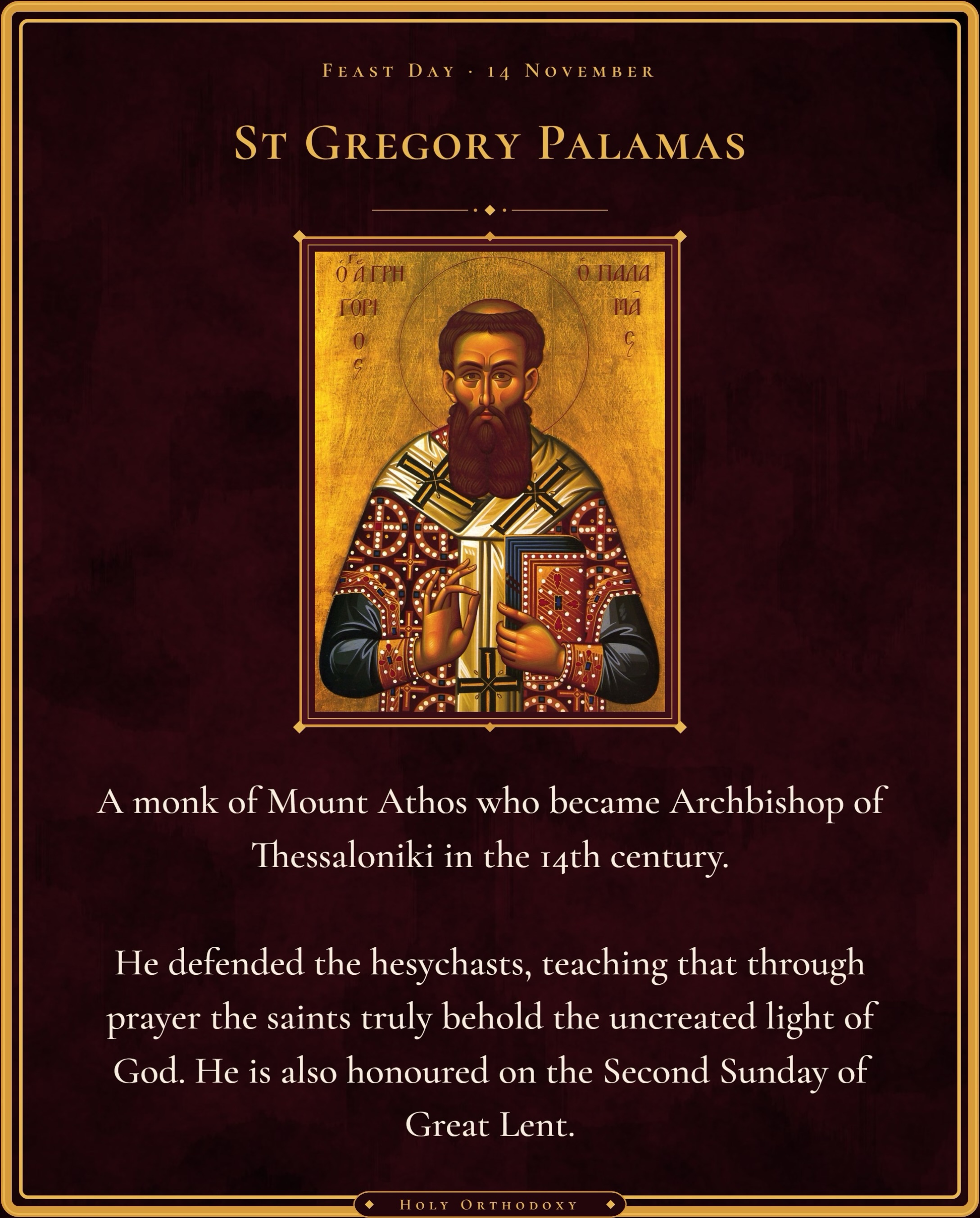
The post commemorates the feast of St Gregory Palamas on 14 November. Born in Constantinople in 1296 and raised near the imperial court, he abandoned a promising secular career for monastic life on Mount Athos. There he devoted himself to prayer. When the hesychast practice of prayer came under attack, Palamas defended it, teaching that through prayer the saints truly behold the uncreated light of God. His defense led to imprisonment. Later…

The post commemorates the feast of St Gregory Palamas on 14 November. Born in Constantinople in 1296 and raised near the imperial court, he abandoned a promising secular career for monastic life on Mount Athos. There he devoted himself to prayer. When the hesychast practice of prayer came under attack, Palamas defended it, teaching that through prayer the saints truly behold the uncreated light of God.

His defense led to imprisonment. Later appointed Archbishop of Thessaloniki, he faced initial rejection from his own city but remained faithful, humble, and loving toward his flock. The post notes that he is also honoured on the Second Sunday of Great Lent. It concludes with a reflective question: what are we willing to leave behind to draw closer to God?

  • Born 1296 in Constantinople, raised near imperial court
  • Left secular prospects for monastic life on Mount Athos
  • Defended hesychast prayer and the vision of uncreated light
  • Imprisoned for his defense; later made Archbishop of Thessaloniki
  • Also commemorated on the Second Sunday of Great Lent
Read more

Orthodox View on Papal Supremacy: Primacy Not Universal Jurisdiction

The post responds to a claim that Orthodox saints and ecumenical councils teach the Bishop of Rome is the universal head by divine right. The speaker argues that this claim confuses Rome's historical primacy of honour with the later Roman Catholic doctrine of universal papal supremacy. Roman Catholics often appeal to Saint Peter, apostolic succession, the Church Fathers, and the Ecumenical Councils to defend universal papal supremacy. He…

The post responds to a claim that Orthodox saints and ecumenical councils teach the Bishop of Rome is the universal head by divine right. The speaker argues that this claim confuses Rome's historical primacy of honour with the later Roman Catholic doctrine of universal papal supremacy. Roman Catholics often appeal to Saint Peter, apostolic succession, the Church Fathers, and the Ecumenical Councils to defend universal papal supremacy.

He examines Scripture: Christ gave Peter the keys of the kingdom (Matthew 16:19) but also gave all the apostles authority to bind and loose (Matthew 18:18). The Council of Jerusalem (Acts 15) shows the apostles deliberating together, illustrating the conciliar nature of the early Church. The speaker affirms apostolic succession but says inheriting an apostolic office does not automatically confer supreme jurisdiction over every other bishop.

He cites Canon 6 of Nicaea, which recognises ancient jurisdictional customs, and Canon 28 of Chalcedon, which connects Constantinople's ecclesiastical privileges to its imperial status, granting it equal rank with Rome. The Orthodox Church acknowledges Rome's ancient primacy of honour but disputes that this establishes universal jurisdiction.

Primacy is not the same as supremacy. The speaker cites Colossians 1:18 that Christ is the head of the Church, and the Church is governed by apostolic bishops in communion, not by one bishop's absolute authority. He challenges the questioner to produce a first-millennium ecumenical council that explicitly teaches the universal papal jurisdiction and infallibility defined at Vatican I in 1870.

The burden of proof remains: where did Christ establish that every bishop throughout the world must submit to the supreme jurisdiction of the Bishop of Rome?

Key moments

  1. 0:00 The questioner asks what Orthodox Christians do with the claim that their saints and ecumenical councils teach the Bishop of Rome is the universal head by divine origin from Peter.
  2. 0:30 The speaker replies that the argument mistakes Rome's historical primacy for universal papal supremacy, reading modern doctrine back into ancient history.
  3. 1:06 The speaker notes that Christ gave the keys to Peter but also gave binding and loosing authority to all the apostles, and Acts 15 shows doctrinal disputes resolved by a council, not by Peter alone.
  4. 1:06 The speaker affirms apostolic succession but says inheriting an apostolic office does not automatically confer supreme jurisdiction over every other bishop.
  5. 1:42 The speaker cites Nicaea Canon 6 and Chalcedon Canon 28, which recognize Rome's ancient customs and link its privileges to imperial status, granting Constantinople equal rank.
  6. 1:42 The speaker distinguishes primacy from supremacy: Rome's ancient primacy as first among bishops does not entail universal jurisdiction over all bishops.
  7. 1:42 The speaker cites Colossians 1:18 that Christ is the head of the Church, and the Church is governed by apostolic bishops in communion, not by one bishop's absolute authority.
  8. 2:28 The speaker challenges the questioner to produce a first-millennium ecumenical council that explicitly teaches the universal papal jurisdiction and infallibility defined at Vatican I in 1870.
15 opinions in the discussion Do Roman Catholics also forget that Peter was Bishop of Antioch too???? Read the discussion
Prayer Orthodoxy ® Instagram

Saint Paisios's Grave at Souroti Monastery Draws Pilgrims to Prayer

The post presents the Holy Monastery of Saint John the Theologian in Souroti, near Thessaloniki, Greece. Photographs show the monastery church and the grave of Saint Paisios the Athonite located outside beneath a simple wooden cross. The author writes that inside the church, holy icons draw hearts toward Christ, while the saint's words continue to guide many toward repentance, prayer, and trust in God. The site is described as a place to pause,…

The post presents the Holy Monastery of Saint John the Theologian in Souroti, near Thessaloniki, Greece. Photographs show the monastery church and the grave of Saint Paisios the Athonite located outside beneath a simple wooden cross. The author writes that inside the church, holy icons draw hearts toward Christ, while the saint's words continue to guide many toward repentance, prayer, and trust in God.

The site is described as a place to pause, pray, and remember that holiness grows through humility and love. The Greek portion includes an epitaph inscription stating that Saint Paisios fell asleep in the Lord on July 12, 1994, at age 70, identifying him as the holy and venerable father, Venerable Paisios of the Holy Mountain, and as Monk Paisios the Athonite.

The post concludes with the invocation "Saint Paisios, intercede for us" in both languages.

  • The monastery's icons direct worshippers toward Christ
  • Saint Paisios's grave lies outside under a simple wooden cross
  • His teachings continue guiding people to repentance, prayer, and trust in God
  • The site invites prayer and reflection on humility and love as paths to holiness
  • Epitaph records his repose on July 12, 1994, at age 70
Read more

Seeking direction when marriage, children, and monastic life seem closed

I'm something of a nerd, and people call me a "strange girl." I don't care for the label, but it fits. Having children is probably not possible for me because of vaginal pain, forgive the bluntness, but I can't think of a gentler way to say it. Marriage usually implies children, and besides, most men simply aren't a good match. I'm not the type who tries to please everyone. I'm glad to help others selflessly, but doing so inevitably pulls me…

I'm something of a nerd, and people call me a "strange girl." I don't care for the label, but it fits.

Having children is probably not possible for me because of vaginal pain, forgive the bluntness, but I can't think of a gentler way to say it. Marriage usually implies children, and besides, most men simply aren't a good match. I'm not the type who tries to please everyone. I'm glad to help others selflessly, but doing so inevitably pulls me into existential reflection, precisely because of the two issues I've mentioned.

Then there's the possibility of becoming a nun, that's no simple undertaking. In any case, I'd have to wait a while before pursuing it.

What would be the best course of action for me?

Let me guess: "Ask your priest"?

But when will we finally leave the priests alone? It seems everyone has gotten into the habit of looking to them, and only them, for answers.

I'd be very interested to hear your thoughts.

  • Children are likely impossible due to vaginal pain
  • Marriage seems unsuitable, men aren't a good match and she doesn't strive to please
  • Helping others leads to existential reflection about her situation
  • Monastic life is an option but not simple and would require waiting
  • She questions the reflexive advice to "ask your priest" and wants other perspectives
59 opinions in the discussion Whatever you do in life, do it for Christ. The phronema, that Orthodox mindset so often mocked by outsiders, teaches that nothing in creation is accidental; every soul and every… Read the discussion
Orthodox Health Instagram

Dr. Zac Porcu on Holy Unction, Miracles, and Becoming Fully Human

A social media post promotes Episode 86 of the Orthodox Health Podcast, "The Roots of Healthcare: Why Your Doctor Has a Theology," featuring Dr. Zachary Porcu. The post highlights a provocative moment in which Dr. Porcu describes what he has witnessed in ordinary Orthodox parish life. He recounts the story of a child pulled unresponsive from a pool who was not resuscitated at the hospital but woke after a priest anointed him with holy oil. Dr.…

A social media post promotes Episode 86 of the Orthodox Health Podcast, "The Roots of Healthcare: Why Your Doctor Has a Theology," featuring Dr. Zachary Porcu. The post highlights a provocative moment in which Dr. Porcu describes what he has witnessed in ordinary Orthodox parish life. He recounts the story of a child pulled unresponsive from a pool who was not resuscitated at the hospital but woke after a priest anointed him with holy oil.

Dr. Porcu suggests that in many instances, especially with children, the hospital can do nothing while the Church's ministry of Holy Unction brings healing. He says such miracles happen regularly at his church and are visible to those who pay attention to the community. Dr. Porcu has personally seen many healings during Holy Unction, which involves holy water, the Eucharist as the medicine of immortality, and prayer.

The discussion turns on the danger of a utilitarian approach to the sacraments. Dr. Porcu emphasizes that these healings are not proofs of religion's truth in an instrumental sense, where the right spiritual input guarantees a desired outcome. He argues that reducing the sacramental life to a technique for controlling results simply recreates a consumer mindset in religious clothing.

The point, he says, is not control but becoming more fully human in communion with God, so that the devil and the fallen world cannot ultimately hurt the person. The episode examines the theological roots of healthcare and why a doctor's theology shapes medical practice.

Key moments

  1. The speaker suggests that instead of going to the ER, one might go to church because there are many instances, especially with children, where the hospital did nothing and unction brought healing.
  2. The speaker recounts a story of a little boy found at the bottom of a pool, not breathing, who was not resuscitated at the hospital, but after a priest gave him holy oil, he woke up fine.
  3. The speaker says this kind of thing happens all the time at their church.
  4. The speaker observes that God's miracles are poured forth everywhere if you pay attention and are part of the community.
  5. The speaker has personally seen people healed of many things at unction, and though it cannot be explained, it is present in holy water, unction, the medicine of immortality, and prayer.
  6. The speaker clarifies that these healings do not validate the religion as true in an instrumental or utilitarian sense of getting the right input for the right output to live forever.
  7. The speaker explains that the point is about becoming more human so that the devil and the fallen world cannot hurt you.
Read more
Fr.TEDTalks Instagram

Discernment Comes from Holy Tradition, Not Intuition

The speaker distinguishes discernment from intuition, stating that discernment rests on holy tradition, scripture, and the word of God revealed over two thousand years. He observes that many people ask God for a sign about what to do with their lives, yet the tradition already supplies the guidance they seek. He points to the fathers, the scriptures, and the lives of thousands of saints as a treasury of theology, experience, and practical…

The speaker distinguishes discernment from intuition, stating that discernment rests on holy tradition, scripture, and the word of God revealed over two thousand years. He observes that many people ask God for a sign about what to do with their lives, yet the tradition already supplies the guidance they seek. He points to the fathers, the scriptures, and the lives of thousands of saints as a treasury of theology, experience, and practical direction.

The practical path, he says, is to wake up, pray, fast, attend church, and strive to be a good person.

Key moments

  1. Discernment is based on holy tradition, scripture, and the word of God revealed over 2000 years, not on intuition or signs.
  2. People often ask God for a sign about what to do with their lives, but the tradition already contains the guidance they need.
  3. The fathers, scriptures, and lives of thousands of saints form a treasury of theology, experience, and guidance.
  4. The concrete way to live is to wake up, do prayers, fast, go to church, and be a good person.
Read more

How fifth-century Christians knew Christ without printed Bibles

The speaker challenges a Protestant interlocutor with a historical question: how would an illiterate person in the fifth century learn about Jesus without access to a printed Bible? He argues that the Protestant model of Christianity, centered on individual reading of Scripture, is virtually impossible before the invention of the printing press and the rise of widespread literacy. By contrast, he presents his own view as not requiring a…

The speaker challenges a Protestant interlocutor with a historical question: how would an illiterate person in the fifth century learn about Jesus without access to a printed Bible? He argues that the Protestant model of Christianity, centered on individual reading of Scripture, is virtually impossible before the invention of the printing press and the rise of widespread literacy.

By contrast, he presents his own view as not requiring a logocentric, book-centered faith. He acknowledges that there was one historical church and presses a reductio ad absurdum: if Protestantism is correct, then the church taught erroneously for 1,500 years. He asks whether God would have allowed the faith he established to be corrupted for that entire period.

The exchange centers on the role of Scripture, tradition, and the church in transmitting the Christian faith before modernity.

Key moments

  1. The speaker asks the Protestant where a fifth-century person would go to find out about Jesus given widespread illiteracy.
  2. He states that the Protestant version of Christianity is virtually impossible before the printing press.
  3. He says he does not hold a logocentric vision of Christianity that requires a printed book.
  4. He asserts that Protestantism is essentially available only through modernity.
  5. He acknowledges that there was one church historically.
  6. He presents a reductio: the claim that Christianity was wrongly practiced for 1,500 years.
  7. He questions whether God would allow the church to erroneously teach the faith he established for 1,500 years.
15 opinions in the discussion "There was one church historically, but now we do whatever we want" Read the discussion
Disgruntled Docs with Trust God ☦︎︎︎ Instagram

Saint John Chrysostom: Feast Day and Selected Teachings

The post commemorates the feast of Saint John Chrysostom on November 13, providing a biographical sketch followed by twenty quotations attributed to him. The biography notes his birth in Antioch around 347, upbringing by his mother Saint Anthousa, theological study under Diodore of Tarsus, years of ascetic practice, ordination as deacon in 381 and priest in 386, and the origin of his epithet "Chrysostom" (Golden-Mouthed) from his preaching. It…

The post commemorates the feast of Saint John Chrysostom on November 13, providing a biographical sketch followed by twenty quotations attributed to him. The biography notes his birth in Antioch around 347, upbringing by his mother Saint Anthousa, theological study under Diodore of Tarsus, years of ascetic practice, ordination as deacon in 381 and priest in 386, and the origin of his epithet "Chrysostom" (Golden-Mouthed) from his preaching.

It records his election as Archbishop of Constantinople in 398, his charitable work among the poor and sick, his role in shaping the Divine Liturgy that bears his name, his confrontation with imperial power leading to deposition and exile, and his death in 407 with the final words "Glory to God for all things." The quotations cover a range of themes: reliance on divine mercy rather than personal virtue; the surpassing love of God; endurance in trials; happiness through gratitude; the power of prayer; Eucharistic unity drawn from 1 Corinthians 10:17; marriage as a "little Church" modeled on Christ's love for the Church; guarding the tongue; repentance as divine medicine; opposing virtues to vices; rejecting false doctrine in the name of love; valuing virtue over physical beauty; the social obligations of fasting including feeding the hungry and visiting the sick; the identification of hoarding wealth with theft; condemnation of abortion as worse than murder; and the insistence that honoring Christ's body requires caring for the poor rather than adorning churches with gold. The post presents these sayings without additional commentary or discussion.

  • Biographical overview of Saint John Chrysostom's life and episcopacy
  • Twenty quotations on mercy, prayer, repentance, and the Christian life
  • Teaching on the Eucharist as unity in one Body of Christ
  • Exhortations to charity, fasting, and care for the poor
  • Condemnation of abortion and critique of wealth hoarding
CHRISTIANITY UNITED Instagram

Calling Christ Lord vs. Living for Him: Orthodox Teaching on True Faith

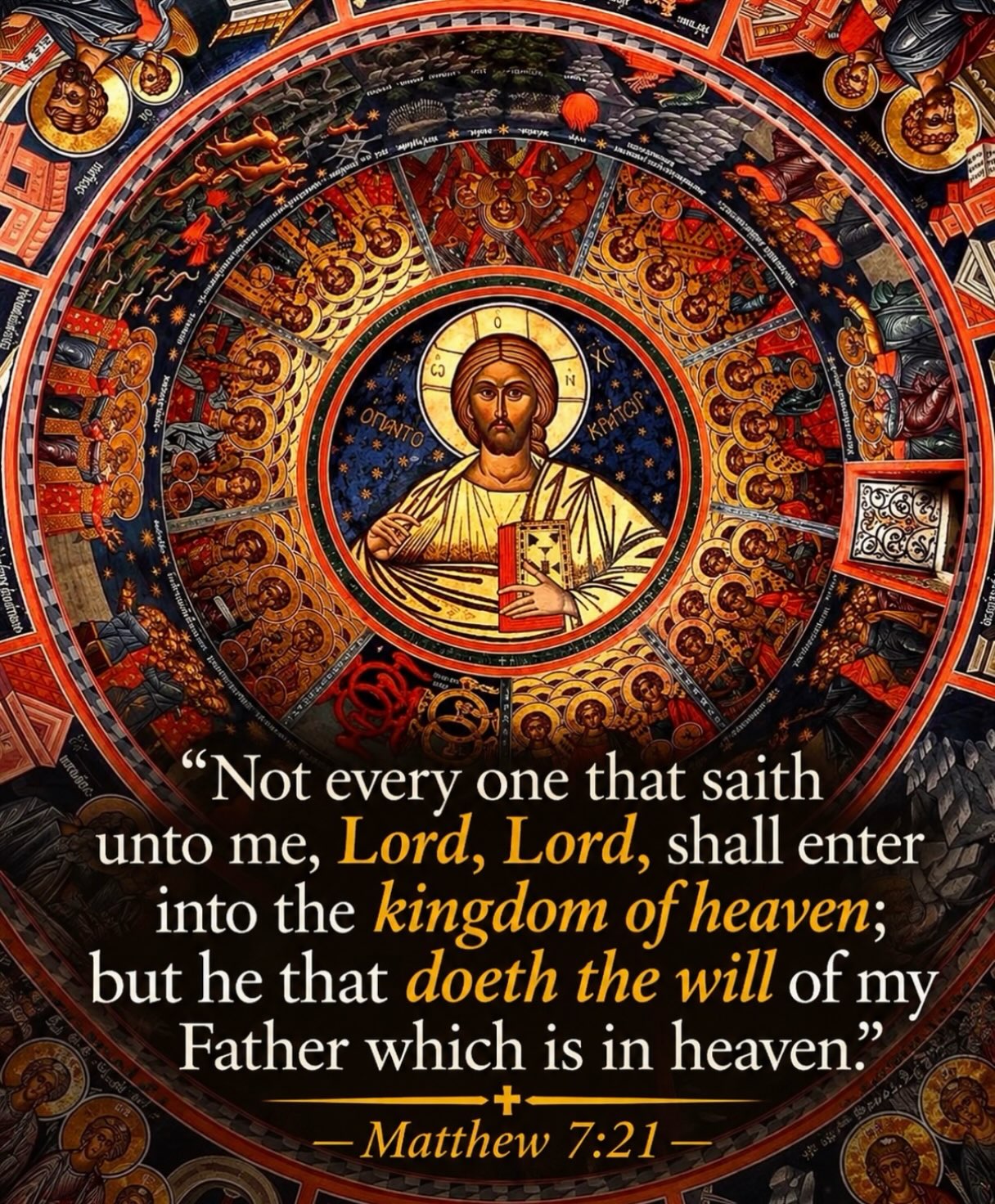
The post centers on Christ's warning in Matthew 7:21 that not everyone who calls Him Lord will enter the kingdom, but only those who do the Father's will. It explains that Orthodox Christianity understands salvation not as a one-time declaration of belief but as a lifelong journey of growing in communion with God, cooperating with His grace, and struggling against the passions that separate us from Him. The author emphasizes that genuine faith…

The post centers on Christ's warning in Matthew 7:21 that not everyone who calls Him Lord will enter the kingdom, but only those who do the Father's will. It explains that Orthodox Christianity understands salvation not as a one-time declaration of belief but as a lifelong journey of growing in communion with God, cooperating with His grace, and struggling against the passions that separate us from Him.

The author emphasizes that genuine faith must bear fruit in humility, forgiveness, and love, not merely in outward religious practices such as attending church, wearing a cross, or knowing Scripture. The saints are cited as models: even after years of prayer, fasting, and spiritual struggle, they continued to repent and ask for mercy rather than boast of their holiness.

The post draws a distinction between struggling against sin and becoming comfortable living in it. It concludes with a direct question for self-examination: whether one truly desires to follow Christ or only wants to be called a Christian, and a prayer that faith be visible in humility, forgiveness, and love.

  • Verbal confession of Christ as Lord is insufficient for salvation (Matthew 7:21).
  • Orthodox salvation is a lifelong communion with God, cooperating with grace and struggling against passions.
  • Genuine faith bears fruit in humility, forgiveness, and love, not only in outward religious acts.
  • Saints continued repenting despite years of spiritual struggle; they did not boast of holiness.
  • The decisive question: do I desire to follow Christ or only to be called a Christian?
Read more