WeOrthodox
EN UA

Orthodox posts, videos and discussions

We follow Orthodox channels, communities and blogs across the web, summarise every post and video, and highlight the conversations with real substance.

Ancient Faith YouTube

Why the Orthodox Church Reads the Septuagint

Why the Orthodox Church Reads the Septuagint 28:17

The podcast responds to Ben Merkle's argument that Protestant Bibles depend on the Masoretic Hebrew text preserved by post-70 AD rabbinic Judaism, and his suggestion that those who reject this should become Eastern Orthodox. Jamie Bennett agrees with Merkle's historical facts: the Westminster Confession binds Reformed churches to the Hebrew text, the Masoretic text is medieval (7th-10th century), and Christian Hebrew scholarship came through…

The podcast responds to Ben Merkle's argument that Protestant Bibles depend on the Masoretic Hebrew text preserved by post-70 AD rabbinic Judaism, and his suggestion that those who reject this should become Eastern Orthodox. Jamie Bennett agrees with Merkle's historical facts: the Westminster Confession binds Reformed churches to the Hebrew text, the Masoretic text is medieval (7th-10th century), and Christian Hebrew scholarship came through Jewish teachers like David Kimhi.

However, Bennett argues the apostles themselves quoted the Greek Septuagint, a Jewish translation made centuries before Christ, when citing the Old Testament in the New Testament. He gives several examples where New Testament doctrine rests on Septuagint readings that differ from the Masoretic text: Hebrews 10:5 ("a body" vs. "ears"), Matthew 1:23 ("virgin" vs. "young woman"), Acts 15 (Gentiles included via "mankind" vs. "Edom"), and Hebrews 1:6 (angels worship Christ, absent in Masoretic Deuteronomy).

Dead Sea Scrolls confirm that pre-70 Hebrew texts often match the Septuagint against the later Masoretic text. The Orthodox Church received the Septuagint as Scripture from the apostles onward and continues to read it in worship, not claiming it is a flawless autograph but trusting the church's reception of it. Augustine recounts a 403 AD congregation rioting over Jerome's Latin translation reading "ivy" instead of the traditional "gourd" in Jonah 4, showing deep attachment to the Greek-based Latin text.

Key moments

  1. 0:33 Augustine recounts a congregation rioting over Jerome's new Latin translation reading "ivy" instead of the traditional "gourd" in Jonah 4, showing deep attachment to the Greek-based Latin text.
  2. 2:43 Ben Merkle argues the Protestant Old Testament relies on the Masoretic text preserved by post-70 AD rabbis (7th-10th century), and without them Protestants lose their ability to read and translate the Hebrew Bible.
  3. 5:20 Merkle challenges his Reformed readers: if they have an "allergic reaction to the rabbis," they should go Eastern Orthodox, since the Westminster Confession (1.8) binds them to the Hebrew text as authentical.
  4. 9:26 Bennett agrees with Merkle's historical claims: Westminster 1.8 ties the Reformed to the Hebrew; the Masoretic text is medieval; Christian Hebrew learning came through Jewish teachers (Kimhi, Reuchlin) and Reformed scholars generally opposed burning Jewish books.
  5. 13:02 The Septuagint was a Jewish translation made in Alexandria around 250 BC for Greek-speaking Jews, centuries before Christ; it was the Bible of Philo and the synagogues Paul visited.
  6. 14:39 New Testament authors quote the Septuagint when citing the Old Testament: Hebrews 10:5/Psalm 40:6 ("body" vs. "ears"), Matthew 1:23/Isaiah 7:14 ("virgin" vs. "young woman"), Acts 15/Amos 9 ("mankind" vs. "Edom"), Hebrews 1:6/Deuteronomy 32:43 (angels worship line missing in Masoretic).
  7. 18:19 Dead Sea Scrolls (pre-70 AD) reveal multiple Hebrew text forms; many scrolls agree with the Septuagint against the Masoretic text (Jeremiah, Samuel, Deuteronomy 32:43), showing textual plurality before standardization.
  8. 24:30 Sirach's prologue (132 BC) honestly notes translation losses from Hebrew to Greek; the Orthodox Study Bible (Septuagint-based) is recommended by Merkle himself as an on-ramp to the Greek Old Testament.
Read more
Robel࿇🕊️ Instagram

Saint Athanasius refutes Arian reading of John 17:3

The post presents Saint Athanasius of Alexandria's argument against the Arian interpretation of John 17:3, where Christ calls the Father the only true God. The Arians cited this verse to deny Christ's divinity. Athanasius counters that the one speaking these words is the same Christ who declares, "I am the truth." He notes that Christ immediately adds, "and Jesus Christ whom you have sent," placing himself alongside the Father. Athanasius argues…

The post presents Saint Athanasius of Alexandria's argument against the Arian interpretation of John 17:3, where Christ calls the Father the only true God. The Arians cited this verse to deny Christ's divinity. Athanasius counters that the one speaking these words is the same Christ who declares, "I am the truth." He notes that Christ immediately adds, "and Jesus Christ whom you have sent," placing himself alongside the Father.

Athanasius argues that if the Son were merely a creature, there could be no fellowship between the true God and a creature. Therefore, Christ's words distinguish the true God from what is false by nature, not to exclude himself from divinity. The explanation follows Athanasius's theological reasoning that the Son shares the same divine nature as the Father, and the verse functions as a distinction between the true God and idols or false gods, not between the Father and the Son.

Key moments

  1. The Arians cite Christ's words in John 17, where he calls the Father the only true God, as a denial of his own divinity.
  2. The author counters that the one speaking these words is the same who declares, "I am the truth."
  3. Christ immediately adds, "and Jesus Christ whom you have sent," placing himself alongside the Father.
  4. If the Son were merely a creature, he could not share fellowship with the true God.
  5. Christ spoke these words to distinguish the true God from all that is false by nature, not to exclude himself.
Read more
radioimlemesou Instagram

Metropolitan Athanasios on listening as the art of dialogue in marriage

The post shares a quote from Metropolitan Athanasios of Limassol on the nature of dialogue in marriage. He states that marriage is a mystery of dialogue and communion between persons. The art of dialogue, he says, is not speaking but listening. True listening means receiving the word of the other person, not merely hearing sounds, but receiving their whole being and what they truly want to communicate. He observes that people claim to hear one…

The post shares a quote from Metropolitan Athanasios of Limassol on the nature of dialogue in marriage. He states that marriage is a mystery of dialogue and communion between persons. The art of dialogue, he says, is not speaking but listening.

True listening means receiving the word of the other person, not merely hearing sounds, but receiving their whole being and what they truly want to communicate. He observes that people claim to hear one another but have not learned genuine listening. When one says "I hear you," the other may ask "Do you hear me?" and the answer "I hear you" may be given, but real listening has not occurred.

To hear means to take in the word of one's brother, not only the sounds of hearing, but the whole being of the other, what they really want to say and what they truly say through the words they express.

Key moments

  1. Marriage is a mystery of dialogue and communion of one with the other.
  2. The art of dialogue is not speaking but listening, and true listening means receiving the word of the other, not just the sounds, but their whole being and what they truly want to say.
Read more
Kyle YouTube

How the Fathers and Councils Refute Papal Supremacy Claims

How the Fathers and Councils Refute Papal Supremacy Claims 25:42

The speaker responds to Catholic arguments for papal supremacy by examining Acts 15, patristic citations, and ecumenical councils. He argues that the early church recognized Peter as first among equals, not a monarchical ruler, and that Rome's honor derived from its doubly apostolic foundation by Peter and Paul, not from Peter alone. Augustine interpreted the rock in Matthew 16 as Peter's confession of faith or Christ himself, and taught that…

The speaker responds to Catholic arguments for papal supremacy by examining Acts 15, patristic citations, and ecumenical councils. He argues that the early church recognized Peter as first among equals, not a monarchical ruler, and that Rome's honor derived from its doubly apostolic foundation by Peter and Paul, not from Peter alone.

Augustine interpreted the rock in Matthew 16 as Peter's confession of faith or Christ himself, and taught that the keys were given to the whole church. Irenaeus praised Rome's preeminent authority because of its faith and apostolic origin, yet publicly rebuked Pope Victor over the Pascha controversy, treating him as a brother bishop.

Cyprian wrote that no bishop sets himself up as bishop of bishops and resisted Pope Stephen. Multiple ancient sees, Alexandria, Antioch, Constantinople, Carthage, Jerusalem, served as regional appeal courts, showing Rome was respected but not unique in appellate function. The Tome of Leo was accepted at Chalcedon because it matched the apostolic faith after examination alongside Cyril's teaching, not simply because the pope spoke.

The speaker contends that Vatican I's claims are contradicted by history: Lateran 649 was intended as ecumenical by popes but not recognized by the East; popes contradicted each other on Chalcedon's canon 28; and the Meletian schism demonstrates that a true church can exist outside communion with Rome. Eastern Catholicism's internal divisions further show that communion with Rome does not yield actual unity.

Key moments

  1. 0:03 Acts 15 is not on the Catholic list of 21 ecumenical councils; Peter is first among equals as a servant leader, but the bishop of Rome is not the sole successor of Peter since the bishop of Antioch was also founded by Peter.
  2. 0:34 Vatican I bases Rome's authority and papal infallibility on Peter alone, but Rome was held in high honor because both Peter and Paul died there, making it doubly apostolic.
  3. 1:04 Augustine interprets the rock in Matthew 16 as Peter's confession of faith or Christ, not a papal office, and teaches the keys were given to the entire church; Peter represents the church but other bishops also shepherd the flock.
  4. 3:06 Ignatius of Antioch says 'where the bishop is, there is the church', authority is local; the Didache appoints bishops and deacons locally with no mention of papal supremacy; Cyprian writes that no bishop sets himself up as bishop of bishops and resisted Pope Stephen.
  5. 4:41 Irenaeus praises Rome's preeminent authority because of its faith and apostolic origin (Peter and Paul), not universal jurisdiction; Irenaeus publicly rebuked Pope Victor over the Pascha controversy and treated him as a brother bishop, not a supreme ruler.
  6. 7:47 Multiple ancient sees served as regional appeal courts, Alexandria, Antioch, Constantinople, Carthage, Jerusalem, showing Rome was respected but not unique or supreme in appellate function.
  7. 10:56 The Tome of Leo was accepted at Chalcedon because it matched the apostolic faith after examination alongside Cyril's teaching, not simply because the pope spoke; councils tested Roman documents against tradition.
  8. 15:06 The Isaiah 22 parallel with Eliakim shows a steward under the king, not an infallible monarch; Lateran 649 was intended as ecumenical by popes but not recognized by the East; the Meletian schism proves a true church can exist outside communion with Rome.
Read more

Saint Josaphat Kuncevich accused of violent forced union with Rome

The video presents a critical perspective on Saint Josaphat Kuncevich, the Eastern Catholic bishop murdered by an Orthodox mob in 1623. It argues that Josaphat employed violent measures to compel union with Rome rather than dying as a peaceful martyr. Specific allegations include the removal of Orthodox priests, the closure of Orthodox churches, and legal proceedings against those who refused to submit to papal authority. The video cites a…

The video presents a critical perspective on Saint Josaphat Kuncevich, the Eastern Catholic bishop murdered by an Orthodox mob in 1623. It argues that Josaphat employed violent measures to compel union with Rome rather than dying as a peaceful martyr. Specific allegations include the removal of Orthodox priests, the closure of Orthodox churches, and legal proceedings against those who refused to submit to papal authority.

The video cites a Catholic official who supported the union but condemned Josaphat's methods, stating it never occurred to him that people would be forced to join by such violent measures. The narrative highlights the arrest and imprisonment of an Orthodox priest for refusing Rome's authority shortly before Josaphat's death. In the aftermath, 19 townsmen were executed by beheading, dozens more were sentenced to death in absentia, and the city lost its rights and privileges.

The speaker contends that Catholics defend the Crusades as defensive warfare against Muslim invasion while condemning Orthodox Christians for resisting religious persecution, characterizing this as a double standard. The discussion centers on whether Josaphat's actions constituted legitimate ecclesiastical discipline or persecution, and how historical memory shapes contemporary Catholic-Orthodox relations.

The video references historical events surrounding the Union of Brest and the suppression of Orthodox resistance in the Polish-Lithuanian Commonwealth.

Key moments

  1. 0:00 Josaphat Kuncevich was an Eastern Catholic bishop murdered by an Orthodox mob in 1623 after rumors spread that he wanted to destroy Eastern traditions and make everyone Latin.
  2. 0:30 Josaphat removed Orthodox priests, shut down Orthodox churches, and took legal action against those who refused to submit to Rome.
  3. 0:30 A Catholic official who supported the union criticized Josaphat, saying it never occurred to him that Josaphat would make people join by such violent measures.
  4. 0:30 An Orthodox priest was arrested and imprisoned for refusing to submit to Rome's authority shortly before Josaphat's death.
  5. 0:30 After Josaphat's death, 19 townsmen were executed by beheading, dozens more were sentenced to death in their absence, and the city was stripped of its rights and privileges.
  6. 1:02 Catholics defend the Crusades as fighting back against Muslim invasion but condemn Orthodox Christians for resisting religious persecution, showing a double standard.
22 opinions in the discussion Josaphat Kuntsevych took part in the persecution and torture of Orthodox Christians. Enough said. Read the discussion

Saints Cosmas and Damian: Unmercenary Healers and Wonderworkers

The post honors the feast of Saints Cosmas and Damian, the Unmercenary Wonderworkers. They were brothers by blood and spirit, born in Asia to a pagan father and a Christian mother named Theodotia. After their father's death, Theodotia devoted herself to raising them in the Christian faith. The brothers studied medicine and treated the sick using both their skill and the name of Jesus Christ. They accepted no payment, obeying Christ's command:…

The post honors the feast of Saints Cosmas and Damian, the Unmercenary Wonderworkers. They were brothers by blood and spirit, born in Asia to a pagan father and a Christian mother named Theodotia. After their father's death, Theodotia devoted herself to raising them in the Christian faith.

The brothers studied medicine and treated the sick using both their skill and the name of Jesus Christ. They accepted no payment, obeying Christ's command: "Freely you have received, freely give" (Matt. 10:8), and are therefore called unmercenary physicians. A tradition about three eggs illustrates their lack of greed: Cosmas became angry with Damian for accepting three eggs from a healed woman, Palladia, but Damian had accepted them only because she swore by the Holy Trinity to take them.

After their repose, divine revelation led to their burial together in the place called Fereman. The Lord glorified them with miracles, and the faithful continue to invoke them in sickness and distress. The post includes the Kondak in Tone 2 and the Tropar in Tone 8, which ask the saints to heal infirmities and pray to God for those who call upon them.

  • Saints Cosmas and Damian were brothers from Asia, raised by their Christian mother Theodotia after their pagan father's death.
  • They practiced medicine without payment, following Matthew 10:8, and are titled Unmercenaries.
  • A tradition recounts Cosmas objecting to Damian accepting three eggs from the healed woman Palladia, though Damian accepted due to her oath by the Holy Trinity.
  • They were buried together in Fereman after divine revelation, and God glorified them with miracles.
  • The post provides the Kondak (Tone 2) and Tropar (Tone 8) for their feast, invoking their healing intercession.
Read more

St. John Chrysostom: Golden-Mouthed Archbishop and Defender of the Poor

The speaker announces the commemoration of St. John Chrysostom, Archbishop of Constantinople, on November 13. He notes that Chrysostom lived in the fourth century and earned the epithet "Chrysostom," meaning golden mouth, because of the beauty and depth of his reflections. The speaker highlights Chrysostom's deep love for Holy Scripture, his defense of the poor, and his simple, quiet life. He adds that Chrysostom's homilies on the Divine Liturgy…

The speaker announces the commemoration of St. John Chrysostom, Archbishop of Constantinople, on November 13. He notes that Chrysostom lived in the fourth century and earned the epithet "Chrysostom," meaning golden mouth, because of the beauty and depth of his reflections. The speaker highlights Chrysostom's deep love for Holy Scripture, his defense of the poor, and his simple, quiet life.

He adds that Chrysostom's homilies on the Divine Liturgy give the keys to understand this great mystery. The speaker then poses three questions for reflection: what place the Word of God holds in one's life; how one participates in the Divine Liturgy to receive all that God grants through it; and how one lives solidarity and fraternity with those most in need. He invites viewers to follow for more on the saints and Church Fathers.

Key moments

  1. 0:11 Today, November 13, we commemorate St. John Chrysostom, Archbishop of Constantinople, who lived in the fourth century.
  2. 0:11 He is called Chrysostom, meaning golden mouth, because of the beauty and depth of all his reflections.
  3. 0:11 He was characterized by a deep love for the Holy Scriptures.
  4. 0:11 He defended the poor and lived a quiet and simple life.
  5. 0:11 His homilies on the Divine Liturgy give us the keys to understand this great and beautiful mystery.
  6. 0:49 The first question for reflection: what place does the Word of God occupy in our life?
  7. 0:49 The second question: when I go to the Divine Liturgy, what do I do to make it all that God grants me through it?
  8. 0:49 The third question: in what way do I live solidarity and fraternity with my brothers, those who need it most?
Orthodox Life Instagram

Saint Anthusa, Mother of Saint John Chrysostom, Honored November 13

Saint Anthusa was a prominent fourth-century Christian woman born around 347 in Antioch. She was intelligent and well-off. She married Secundus, an illustrious officer in the imperial Roman army. Tragedy struck early when her husband died, leaving her a widow at twenty with their infant son John. Rather than seeking a second marriage or yielding to social pressures, she chose to dedicate her entire life, energy, and wealth to raising her child…

Saint Anthusa was a prominent fourth-century Christian woman born around 347 in Antioch. She was intelligent and well-off. She married Secundus, an illustrious officer in the imperial Roman army. Tragedy struck early when her husband died, leaving her a widow at twenty with their infant son John.

Rather than seeking a second marriage or yielding to social pressures, she chose to dedicate her entire life, energy, and wealth to raising her child and serving God. Anthusa personally oversaw her son's early education, immersing him in the Holy Scriptures and sharing her own classical knowledge. She later placed him under the guidance of the pagan orator Libanius and the Christian theologian Diodore of Tarsus, laying the foundation for his future eloquence.

Her deep maternal and spiritual influence shaped her son into a titan of the early Church. That son grew up to become Saint John Chrysostom, whose name means "Golden-Mouthed." He became one of the most celebrated preachers and Archbishop of Constantinople.

Honored as a model of Christian motherhood, sacrifice, and virtue, Saint Anthusa is commemorated by the Orthodox Church on November 13 alongside her son. Her legacy lives on through charitable institutions such as the Philoptochos Society's Anthousa Chapter. The post includes an image showing a prayer of Saint Anthusa in Greek and a commemoration of Saint Gregory and Saint Nana in Georgian.

  • Saint Anthusa born c. 347 in Antioch, married imperial officer Secundus
  • Widowed at 20 with infant son John, devoted life to his upbringing and God
  • Oversaw his early education in Scripture and classical learning, then placed him under Libanius and Diodore of Tarsus
  • Son became Saint John Chrysostom, "Golden-Mouthed," Archbishop of Constantinople
  • Commemorated November 13 as model of Christian motherhood; legacy continues through Philoptochos Anthousa Chapter
Read more
The Burning Bush with simpleortho Instagram

Can Non-Orthodox Be Saved? Orthodox Perspectives on Judgment and Heresy

The speaker addresses whether non-Orthodox Christians go to hell, drawing on several Orthodox authorities. Pope Shenouda is cited saying it is not for us to judge who enters the kingdom, only who is inside or outside the Church. St. Augustine in Letter 43 distinguishes between those who hold false doctrine obstinately and those who inherited error from misguided parents yet seek the truth; the latter are not to be counted as heretics. The…

The speaker addresses whether non-Orthodox Christians go to hell, drawing on several Orthodox authorities. Pope Shenouda is cited saying it is not for us to judge who enters the kingdom, only who is inside or outside the Church. St. Augustine in Letter 43 distinguishes between those who hold false doctrine obstinately and those who inherited error from misguided parents yet seek the truth; the latter are not to be counted as heretics.

The speaker illustrates obstinacy with the example of people who would refuse to leave their church even if their beliefs were proven false. Augustine allows that those who received their faith from parents and did not devise heresy themselves may be let off the hook. A modern Coptic father, Gregory, is quoted saying the anathema against the Council of Chalcedon applies to the council itself as heretical, but not to individuals, because only God knows the heart.

The speaker acknowledges personal family ties to Catholics and Protestants and refuses to condemn them. He concludes that one must focus on one's own salvation by following the Church's canons and faith, leaving the salvation of others to God.

Key moments

  1. 0:03 The speaker raises the question of whether non-Orthodox go to hell and quotes Pope Shenouda that who enters the kingdom is not for us to say, only who is inside or outside the Church.
  2. 0:03 St. Augustine in Letter 43 says those who hold false doctrine without passion or obstinacy, having received it from misguided parents and seeking truth, are not to be counted heretics.
  3. 1:05 The speaker gives an example of obstinacy: people who would not leave their church even if their beliefs were proven false.
  4. 1:05 Augustine allows that those who inherited faith from parents and did not devise heresy themselves may be let off the hook.
  5. 1:36 The speaker recounts asking a modern Coptic father, Gregory, whether the anathema of Pope Dioscorus and Chalcedon applies to Chalcedonians today.
  6. 1:36 Gregory answers that the anathema applies to the council of Chalcedon as heretical, but not to individuals, because only God knows the heart.
  7. 2:08 The speaker acknowledges family members who are Catholic or Protestant and refuses to condemn them to hell.
  8. 2:08 The speaker says one must worry about one's own salvation by following the Church's canons and faith, and leave others' salvation to God.
Read more

St. Porphyrios: Rejoice in All Things, They Lead to God

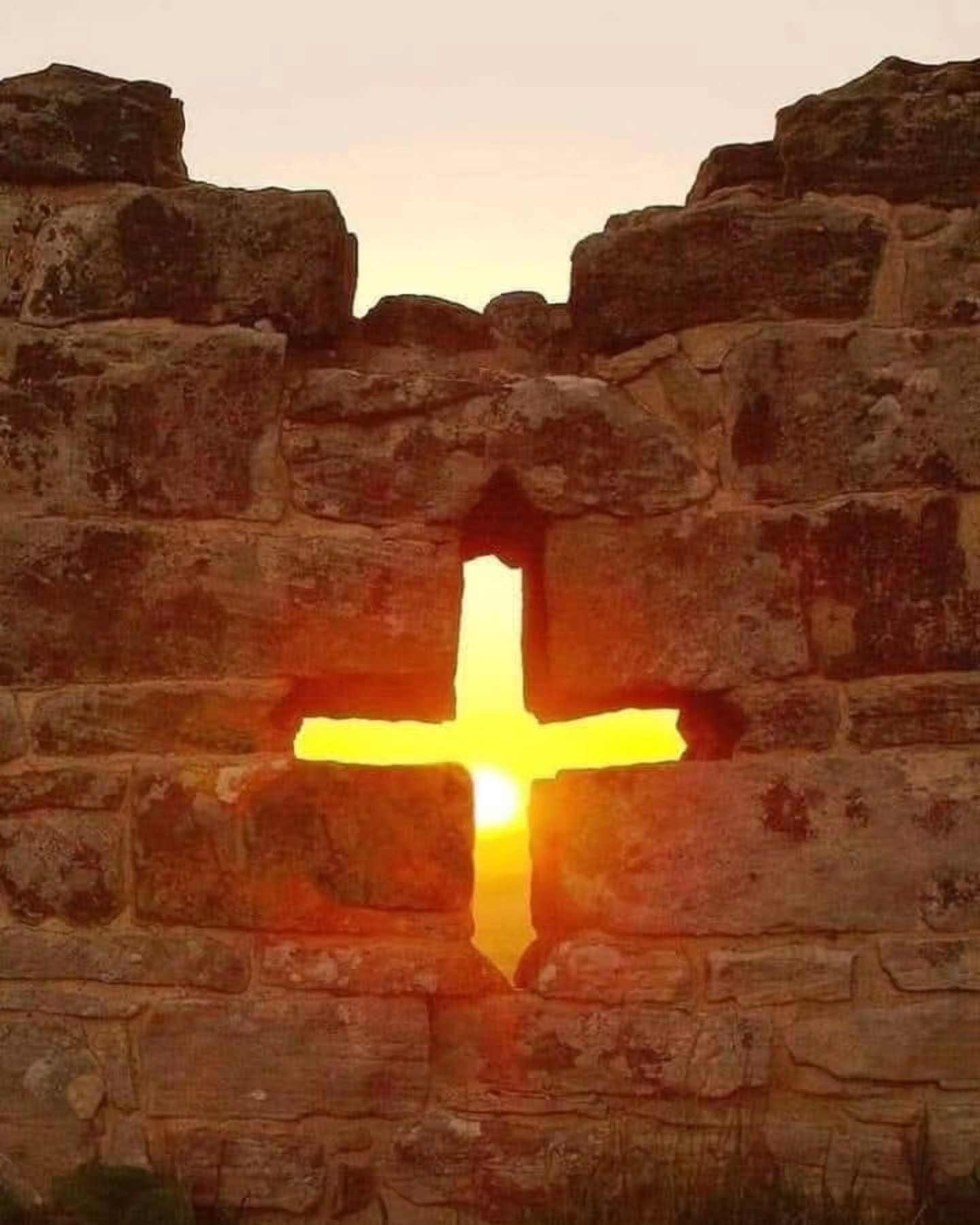
The post shares a saying of St. Porphyrios Kafsokalyvitis: "Rejoice in everything that surrounds us. Everything teaches us and leads us to God." The text is in Serbian Cyrillic. An accompanying image shows a stone wall with a cross-shaped opening through which the sun is setting or rising, illustrating the saint's words about creation pointing to God. The quote reflects the saint's teaching that all of creation can be a means to draw closer to…

The post shares a saying of St. Porphyrios Kafsokalyvitis: "Rejoice in everything that surrounds us. Everything teaches us and leads us to God." The text is in Serbian Cyrillic. An accompanying image shows a stone wall with a cross-shaped opening through which the sun is setting or rising, illustrating the saint's words about creation pointing to God.

The quote reflects the saint's teaching that all of creation can be a means to draw closer to God when received with gratitude and attention. The post presents the saying in Serbian Cyrillic without additional commentary.

  • St. Porphyrios Kafsokalyvitis urges rejoicing in all that surrounds us.
  • He teaches that everything instructs and guides us toward God.
  • The image of a cross-shaped opening in a stone wall with the sun aligns with the quote.
  • The post presents the saying in Serbian Cyrillic without additional commentary.
Read more

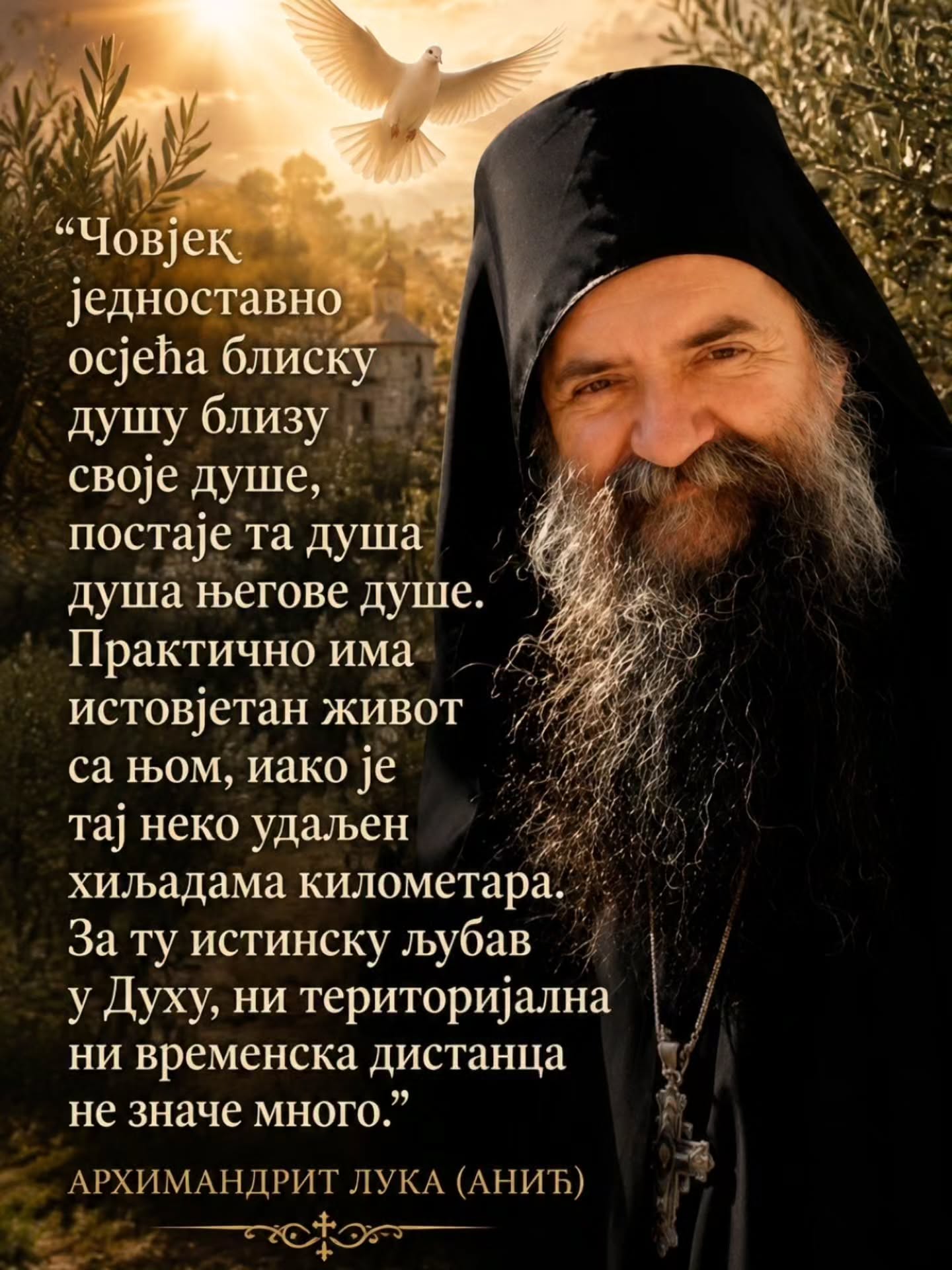
Archimandrite Luka: spiritual love knows no distance

The quote from Archimandrite Luka (Anich) describes how a person senses a kindred soul and that soul becomes the soul of their soul. They share an identical life even when separated by thousands of kilometers. For this true love in the Spirit, neither territorial nor temporal distance matters much.

  • A person feels a kindred soul near their own soul.
  • That soul becomes the soul of their soul.
  • They practically live an identical life despite physical separation.
  • True love in the Spirit transcends territorial distance.
  • True love in the Spirit transcends temporal distance.
Read more

Father Joil Bulatović on possession, confession, and healing of soul and body

Father Joil Bulatović recounts an exorcism of an unbaptized woman in her forties from eastern Serbia. Three men brought her to the church; she was foaming, screaming, and trying to climb the walls. The priest censed her with basil and holy water of St. Basil the Great. She screamed violently at the water. When he learned she was unbaptized, he explained that the devil enters the unbaptized freely. That evening, during a procession, her face…

Father Joil Bulatović recounts an exorcism of an unbaptized woman in her forties from eastern Serbia. Three men brought her to the church; she was foaming, screaming, and trying to climb the walls. The priest censed her with basil and holy water of St. Basil the Great.

She screamed violently at the water. When he learned she was unbaptized, he explained that the devil enters the unbaptized freely. That evening, during a procession, her face distorted and she seized the censer. The next morning she returned, saying two demons had left but one remained.

After the prayer of St. Basil against demons was read, her face normalized and the demon departed, asking forgiveness. Six months later she returned healthy and wrote down her experience. Father Joil stresses that 99 percent of illnesses are sin: when the soul hurts, the body hurts, and confession cleanses the soul.

He also relates a vision granted to a man who watched confessions: each confessed sin appeared as a snake that fell on the solea, writhed, and burned. A large snake appeared for a grave carnal sin the penitent was ashamed to name; it asked if there was more, and when the man said no, it left.

  • Possession is not mental illness but entry of unclean spirits after mortal sin
  • Unbaptized persons have no protection against demonic entry
  • Exorcism with holy water of St. Basil and his prayer drove out the demons
  • Confession heals because 99% of illnesses originate in sin
  • A vision showed confessed sins as snakes that fall, writhe, and burn on the solea
Read more

Metropolitan Amfilohije's Final Words: Resurrection Victory Over Death

The post shares the verses with which the late Metropolitan Amfilohije, Archbishop of Cetinje, Metropolitan of Montenegro and the Littoral, and Exarch of the Holy Throne of Peć, concluded his final address. The lines come from Saint Peter II Petrović Njegoš's work "The Ray of the Microcosm" and speak of Christ's Resurrection conquering death. The accompanying video summary proclaims that death bows and is defeated in the land that glorifies its…

The post shares the verses with which the late Metropolitan Amfilohije, Archbishop of Cetinje, Metropolitan of Montenegro and the Littoral, and Exarch of the Holy Throne of Peć, concluded his final address. The lines come from Saint Peter II Petrović Njegoš's work "The Ray of the Microcosm" and speak of Christ's Resurrection conquering death.

The accompanying video summary proclaims that death bows and is defeated in the land that glorifies its Savior, identifying this testimony with the Church of Saint Peter on the cliff. It states that the Montenegrin people have returned to God and the Church of God after eighty years of wandering through hunger, godlessness, fratricide, and deicide.

The message declares that the time has come to return to God and, through God, to one another, thereby restoring the holy things that the ancestors built into the people and their historical being.

Key moments

  1. Death bows and is defeated in the land that glorifies its Savior.
  2. This testimony is and must remain the Church of St. Peter on the cliff.
  3. The Montenegrin people have returned to God and God's Church after eighty years of wandering.
  4. The wandering passed through fields of hunger, godlessness, fratricide, and deicide.
  5. It is time to return to God and, through God, to return to one another.
  6. By returning to God and to each other, the people restore God and the holy things the ancestors built into them and their historical being.
Read more
Prayer Orthodoxy ® Instagram

Prayer at St. Paisios' Grave: A Testimony of the Theotokos' Providence

The video shows a quiet moment of prayer at the grave of St. Paisios the Athonite, located at the Holy Monastery of St. John the Theologian in Souroti near Thessaloniki. In the recording, a speaker addresses the Theotokos directly, stating they have come as she instructed. The speaker recounts that through her maternal providence the monastery has been reborn, those who had left the faith have returned, and no one was lost. The speaker declares…

The video shows a quiet moment of prayer at the grave of St. Paisios the Athonite, located at the Holy Monastery of St. John the Theologian in Souroti near Thessaloniki. In the recording, a speaker addresses the Theotokos directly, stating they have come as she instructed. The speaker recounts that through her maternal providence the monastery has been reborn, those who had left the faith have returned, and no one was lost.

The speaker declares readiness to remain in her will and adds that if it is her will to go to the Sinai desert, the answer is "Here I am." The caption accompanying the video repeats the location and offers the invocation "Saint Paisios, intercede for us" in both English and Greek. The content presents a personal spiritual testimony centered on obedience to the Theotokos, the renewal of a monastic community, the return of lapsed believers, and a radical willingness to follow a perceived divine call to the desert.

The discussion that follows such a testimony typically touches on the role of the Theotokos in guiding monastic life, the power of saintly intercession, the nature of vocational discernment, and the example of St. Paisios as a contemporary spiritual father.

Key moments

  1. 0:00 The speaker tells the Theotokos they have come as she told them to, and that through her maternal providence the monastery has been reborn, those who left the faith have returned, and no one was lost.
  2. 0:00 The speaker declares they are here in her will, and if it is her will that they go to the desert of Sinai, they answer "Here I am."
Read more

The icon of the Mother of God 'Koukouzelissa' at the Great Lavra

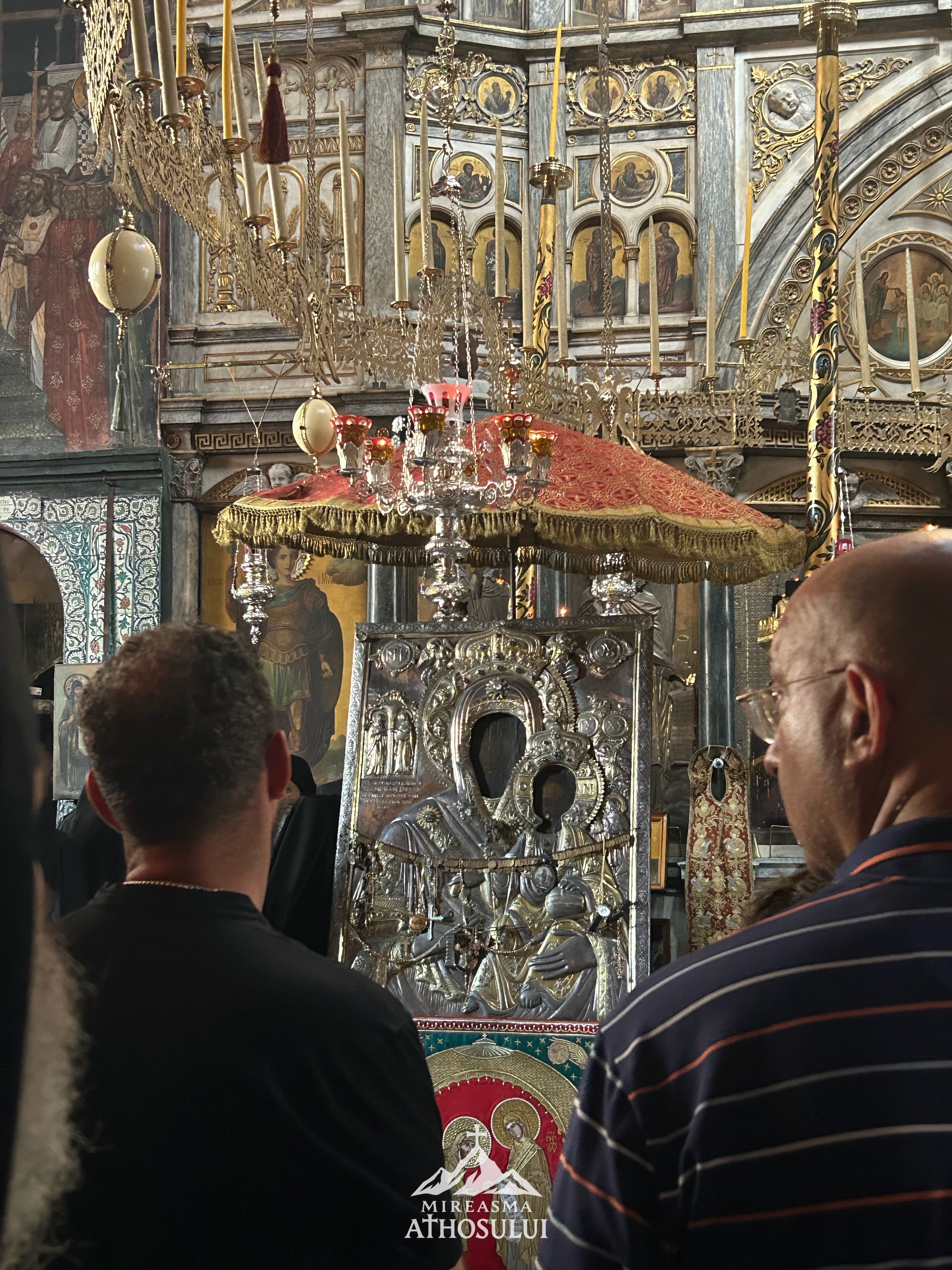
The post presents the icon of the Mother of God known as 'Koukouzelissa' (Cucuzelița), kept at the Great Lavra monastery on Mount Athos. The accompanying images show the icon in detail, including its inscriptions. Around the figures the Greek text reads 'MP ΘY' (Meter Theou, Mother of God) and 'NI', while below appears the prayer 'Θεοτόκε βοήθει τω δούλω σου Ιωάννη τω Παπαδόπουλω', 'Mother of God, help your servant John the Papadopoulos'. The…

The post presents the icon of the Mother of God known as 'Koukouzelissa' (Cucuzelița), kept at the Great Lavra monastery on Mount Athos. The accompanying images show the icon in detail, including its inscriptions. Around the figures the Greek text reads 'MP ΘY' (Meter Theou, Mother of God) and 'NI', while below appears the prayer 'Θεοτόκε βοήθει τω δούλω σου Ιωάννη τω Παπαδόπουλω', 'Mother of God, help your servant John the Papadopoulos'.

The name Koukouzelissa connects the icon with the tradition of St. John Koukouzelis, the famous Athonite cantor, to whom the icon is associated in Athonite memory. The post offers the icon itself for veneration and viewing, with no further discussion in the thread.

  • The icon of the Mother of God 'Koukouzelissa' is kept at the Great Lavra on Mount Athos.
  • The images show the icon in close detail.
  • The inscription includes the prayer 'Mother of God, help your servant John the Papadopoulos'.
  • The icon's name is linked to St. John Koukouzelis, the Athonite cantor.
Prayer Orthodoxy ® with Thekla Instagram

Friendship is a sacred vocation that leads to salvation

The post quotes St. John Chrysostom on love between friends. He teaches that one who loves should be ready to give even his soul if asked, and should rather run to offer the gift than wait to be asked. Nothing, he says, is sweeter than such love, and nothing grievous comes from it. He cites Scripture twice: a faithful friend is the medicine of life (Sirach 6:16) and a faithful friend is a strong defense (Sirach 6:14). Chrysostom asks what a…

The post quotes St. John Chrysostom on love between friends. He teaches that one who loves should be ready to give even his soul if asked, and should rather run to offer the gift than wait to be asked. Nothing, he says, is sweeter than such love, and nothing grievous comes from it.

He cites Scripture twice: a faithful friend is the medicine of life (Sirach 6:16) and a faithful friend is a strong defense (Sirach 6:14). Chrysostom asks what a genuine friend will not do, what pleasure, benefit and security he gives, and says that infinite treasures cannot compare with a genuine friend. He then describes the delight of friendship itself: a friend rejoices at seeing his friend and expands with joy, is knit to him with a union of soul that affords unspeakable pleasure, and is roused in mind and transported by the mere remembrance of him.

The author connects this to Christ's command in John's Gospel, where He told the disciples not only to love one another but commanded them to lay down their lives for their friends. From this the author concludes that friendship is not something external but a sacred vocation that leads to salvation.

Key moments

  1. The hymn asks the Lord Jesus to grant the departed rest.
  2. It repeats the plea that they are like the flowers of the field and have fallen, O Lord.
  3. The departed left all their possessions, their families and their friends, and went to the Lord the Most High, to the angels and to their relatives.
Read more

Caring for elderly monks: the hardest and most blessed obedience

Elder Philimon, Dikaios of the Holy Patriarchal Coenobitic Skete of the Prophet Elijah on Mount Athos, speaks about diakonia, service, in monastic life. He explains that the deacon is the one who serves, and that in serving you give something of yourself. He turns to the service of caring for the elderly monks and calls it a beautiful diakonia, though he notes that his own skete does not yet have this service because it has no elders. Caring for…

Elder Philimon, Dikaios of the Holy Patriarchal Coenobitic Skete of the Prophet Elijah on Mount Athos, speaks about diakonia, service, in monastic life. He explains that the deacon is the one who serves, and that in serving you give something of yourself. He turns to the service of caring for the elderly monks and calls it a beautiful diakonia, though he notes that his own skete does not yet have this service because it has no elders.

Caring for the elders, he says, is among the hardest and most blessed tasks a monk can be given. Whoever undertakes it gains many crowns, but the work demands great patience, because it forms a person into one who loves. The talk links the meaning of service in general to this concrete obedience: ministry is not an abstract idea but giving of oneself to another, and the frailty of aged fathers makes that giving daily, bodily and hidden.

The elder presents the care of the old not as a burden to be endured but as a task that rewards beyond measure while it costs patience and love at every moment.

Key moments

  1. The speaker says the deacon is the one who serves, and that serving means giving something of yourself.
  2. He calls the service of caring for the elders a beautiful one, but says they do not have it because they have no elders yet.
  3. Serving the elders is among the hardest and most blessed tasks, and you gain many crowns, but it requires great patience to be a person of love.
Read more
Holy Resurrection YouTube

St. Paisios: Self-Interest Blocks Prayer, Love Opens Heavens

St. Paisios: Self-Interest Blocks Prayer, Love Opens Heavens 5:26

The video presents a teaching from St. Paisios the Athonite, drawn from his Spiritual Counsels on Prayer, Chapter 3, 'So That God May Hear Us,' pages 17-19. The Elder explains that spiritual nobility, or philotimo, and self-sacrifice are necessary for communion with Christ because self-interest creates insulation that separates a person from God. He states that a monastic may fulfill obediences and prayer rules yet remain spiritually…

The video presents a teaching from St. Paisios the Athonite, drawn from his Spiritual Counsels on Prayer, Chapter 3, 'So That God May Hear Us,' pages 17-19. The Elder explains that spiritual nobility, or philotimo, and self-sacrifice are necessary for communion with Christ because self-interest creates insulation that separates a person from God.

He states that a monastic may fulfill obediences and prayer rules yet remain spiritually impoverished if he neglects love for the brethren. Communion with Christ requires that Christ find rest in one's whole life, and Christ finds rest when a person gives rest to his neighbor. Spiritual practices performed without self-sacrifice and love for others are rendered fruitless.

The Elder illustrates this with two experiences. As a novice, he served an exhausted 80-year-old elder despite a brother's warning that it would disrupt his prayer rule. The Elder says the brick tea brought to the suffering monk counted more in God's eyes than prostrations and prayer ropes performed with ease while refusing to help.

Later at Sinai during a severe drought, the monks refused thin olive branches to Bedouins for cooking and warmth. The Elder gathered and gave all the branches to them. An elderly Bedouin said, 'You're a good man. It will rain,' and before the Elder returned to the monastery it rained heavily. The Bedouin's prayer opened the heavens.

Key moments

  1. 0:11 Cultivate spiritual nobility (philotimo) so that self-interest departs; self-interest hinders prayers by creating insulation between a person and God.
  2. 0:41 A monastic can fulfill spiritual duties and practice asceticism yet fall short in self-sacrifice and love for the brethren, remaining spiritually impoverished.
  3. 1:13 Communion with Christ requires that Christ find rest in one's whole life, and Christ finds rest when you give rest to your neighbor.
  4. 1:45 Spiritual practices performed without self-sacrifice and love for others are rendered fruitless.
  5. 2:15 As a novice, the Elder brought soup, tea, and a warm brick to an exhausted 80-year-old elder despite a brother's warning that it would disrupt his prayer rule.
  6. 3:16 The Elder states that in God's eyes the brick tea counted for more than the prostrations and prayer ropes performed with ease while refusing to help the suffering elder.
  7. 3:48 At Sinai during a severe drought, the monks refused thin olive branches to Bedouins for cooking and warmth; the Elder gathered and gave all the branches to them.
  8. 4:51 An elderly Bedouin said, 'You're a good man. It will rain,' and before the Elder returned to the monastery it rained heavily; the Bedouin's prayer opened the heavens.
Read more

Ecumenical Patriarch: Human dignity cannot be added to or subtracted from by external factors

At the 2026 International Meeting for Peace in Assisi on October 27, 2026, Ecumenical Patriarch Bartholomew addressed what he called a fundamental subject: the God-given dignity of every human being. He cited the Holy and Great Council of Crete (2016), which confesses that every human being, regardless of color, religion, race, gender, nationality, or language, is created in the image and likeness of God and enjoys equal rights in society.…

At the 2026 International Meeting for Peace in Assisi on October 27, 2026, Ecumenical Patriarch Bartholomew addressed what he called a fundamental subject: the God-given dignity of every human being.

He cited the Holy and Great Council of Crete (2016), which confesses that every human being, regardless of color, religion, race, gender, nationality, or language, is created in the image and likeness of God and enjoys equal rights in society.

Expanding on this, the Patriarch stressed that skin color, ethnic origin, language, religion, gender, or social status cannot add to or subtract from the dignity of a person created in God's image. He rooted this conviction in Scripture, citing Acts 17:26 where Paul says God made every nation from one blood, and Galatians 3:28 where Paul declares there is neither Jew nor Greek, slave nor free, male nor female, for all are one in Christ Jesus.

The Patriarch noted that by affirming unity in Christ, the Apostle proclaimed a common dignity transcending worldly categories and hierarchies.

He said this common dignity originates in Christ, who opens his arms to all who come to him, never asking "Who are you?" but giving love to whoever seeks it, as shown in his words: "Whoever comes to me, I will never drive away" (John 6:37).

Referring to the Samaritan woman, Zacchaeus, and the Good Samaritan, the Patriarch said this Gospel openness finds its fulfillment on the Cross, where Christ stretches out his arms to embrace all humanity, fulfilling his words: "And I, when I am lifted up from the earth, will draw all people to myself" (John 12:32), indicating the kind of death he would die (John 12:33).

In the Crucified One's open arms, God's love is revealed, a love without exclusion that calls every person across all boundaries into communion.

The Patriarch also stressed that recognizing innate human dignity must be shown in concrete action to be genuine. He pointed to the parable of the Last Judgment, where the single criterion is simple: giving food, water, clothing, visiting the sick or imprisoned. The Lord identifies with the hungry and the stranger without asking about their faith or origin, saying, "Whatever you did for one of these least of my brothers and sisters, you did for me" (Matthew 25:40).

He then noted that Saint John sums up this service in the phrase "God is love" (1 John 4:8), and adds with severity that anyone who claims to love God while hating their brother or sister is a liar (1 John 4:20).

In light of these eternal truths, the Patriarch said the Orthodox Church embraces without hesitation the human rights language of the 1948 Universal Declaration: "All human beings are born free and equal in dignity and rights." He added that this principle draws its power from the Church's understanding of the human person: Orthodox theology of the person and of deifying communion between God and humanity gives this language a solid foundation and inner depth, preventing it from becoming a mere assertion of an autonomous, self-sufficient individual.

Referring to the martyrdom of the Church of Constantinople through the ages, the Patriarch said their history teaches that a Church living as a minority learns the full value of religious freedom and advocates for it for others with the same determination as for itself. They defend the dignity of a refugee child as they do an elderly person, and show equal concern for someone of another faith or no faith at all, because in every person they recognize the same image of God.

He concluded that in a globalized world, which stirs enthusiasm in some and apprehension in others, the ecumenical vision of Orthodoxy offers a path to understanding and hope: it invites us to broaden our perspective to embrace the whole earth without losing sight of each individual human face.

  • Human dignity is God-given and cannot be increased or decreased by any external factor such as race, gender, or social status.
  • This dignity is grounded in Scripture and finds its fullest expression in Christ's embrace of all people on the Cross.
  • Genuine recognition of human dignity requires concrete acts of mercy toward the needy, as taught in the parable of the Last Judgment.
  • The Orthodox Church affirms the Universal Declaration of Human Rights, rooted in its theology of the person and deifying communion.
  • The Church's history as a minority drives its advocacy for religious freedom and equal concern for every person, and its ecumenical vision offers hope in a globalized world.
11 opinions in the discussion All of this is absolutely true, and well said. Unfortunately it is also hypocritical, as the Ecumenical Patriarchate often engages in Greek ethnocentrism and treats its mission in the… Read the discussion
Orthodox Life Instagram

Saint John Chrysostom: Golden-Mouthed Preacher, Exiled for Truth

The post commemorates Saint John Chrysostom, Archbishop of Constantinople, on his feast day November 13. It outlines his life: born in Antioch to a devout mother named Anthusa, he received a classical education in rhetoric before embracing an ascetic life in the mountains. Extreme fasting permanently harmed his health, leading him back to the city. Ordained a priest in Antioch in 386, he became famous for clear, passionate sermons that earned…

The post commemorates Saint John Chrysostom, Archbishop of Constantinople, on his feast day November 13. It outlines his life: born in Antioch to a devout mother named Anthusa, he received a classical education in rhetoric before embracing an ascetic life in the mountains. Extreme fasting permanently harmed his health, leading him back to the city.

Ordained a priest in Antioch in 386, he became famous for clear, passionate sermons that earned him the surname Chrysostomos, meaning "Golden-Mouthed." His homilies stressed practical Christian living, straightforward scriptural interpretation, and care for the poor. In 397 he was reluctantly appointed Archbishop of Constantinople.

He immediately reduced lavish spending in the episcopal palace and redirected funds to build hospitals and aid the needy. He also worked to reform corrupt clergy, expand missionary outreach, and enrich liturgical worship. His uncompromising calls for moral integrity and denunciations of luxury alienated wealthy elites, fellow bishops, and the imperial court.

Open conflict with Empress Eudoxia over her extravagance and political abuses led to his deposition and exile twice. During a brutal forced march into deeper exile, he reposed near Comana in Pontus on September 14, 407, uttering the final words, "Glory be to God for all things." Thirty-one years later his relics were returned to Constantinople in triumph.

The post also includes OCR text from icons and church photographs showing Greek and English inscriptions such as the Trisagion and liturgical hymns honoring the saint.

  • Born in Antioch to mother Anthusa; educated in rhetoric; asceticism damaged his health.
  • Ordained priest in 386; renowned for clear sermons earning title "Golden-Mouthed."
  • Appointed Archbishop of Constantinople in 397; cut palace spending, built hospitals, reformed clergy.
  • Denounced luxury and corruption; clashed with Empress Eudoxia; deposed and exiled twice.
  • Died in exile 407 with words "Glory be to God for all things"; relics returned 31 years later.
Read more