WeOrthodox
EN UA

Prayer Orthodoxy ®

Instagram ↗ 196 discussions

Prayer Orthodoxy® Orthodox Christianity Through Scripture, Tradition, and the Saints Deepen Your Understanding of the Faith

Prayer Orthodoxy ® Instagram

Entrance of the Theotokos into the Temple Celebrated November 21

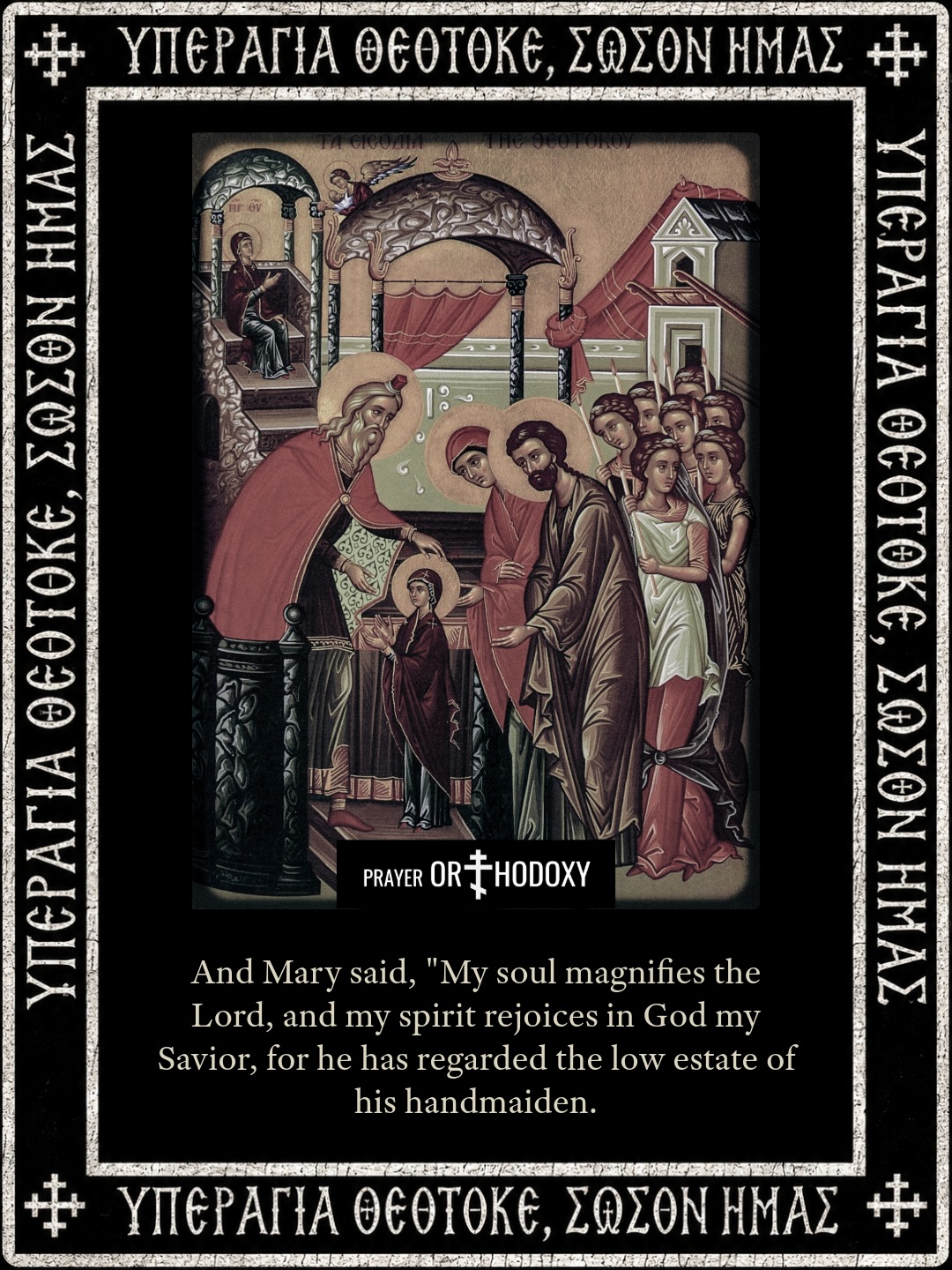
The post announces the feast of the Entrance of the Most Holy Theotokos into the Temple, celebrated on November 21. It explains that according to Holy Tradition, the Virgin Mary at the age of three was brought to the Temple in Jerusalem by her parents, Saints Joachim and Anna, fulfilling their promise to dedicate her to God. The High Priest Zacharias received her, and she entered the Holy of Holies, an event understood as preparing her for her…

The post announces the feast of the Entrance of the Most Holy Theotokos into the Temple, celebrated on November 21. It explains that according to Holy Tradition, the Virgin Mary at the age of three was brought to the Temple in Jerusalem by her parents, Saints Joachim and Anna, fulfilling their promise to dedicate her to God. The High Priest Zacharias received her, and she entered the Holy of Holies, an event understood as preparing her for her calling as the Mother of the Lord and Savior Jesus Christ.

The post provides this account in English followed by a Greek translation. An accompanying image displays the invocation "ΥΠΕΡΑΓΙΑ ΘΕΟΤΟΚΕ, ΣΩΣΟΝ ΗΜΑΣ" (Most Holy Theotokos, save us) repeated multiple times, interspersed with verses from Luke 1:39-55. Those verses recount Mary's journey to the hill country of Judah, her greeting of Elizabeth, the leaping of John the Baptist in Elizabeth's womb, Elizabeth's Spirit-filled proclamation of blessing, and Mary's response in the Magnificat, which begins "My soul magnifies the Lord."

The image text includes a minor variation in the seventh section where "ΣΩΣΟΝ" appears as "ΣΩΖΩΝ." The post ends with the invocation in both languages.

  • Feast of the Entrance of the Theotokos into the Temple on November 21
  • Virgin Mary presented at the Temple at age three by Saints Joachim and Anna
  • High Priest Zacharias receives her; she enters the Holy of Holies
  • Event understood as preparation for her becoming the Mother of Christ
  • Image pairs the Theotokos invocation with the Visitation and Magnificat (Luke 1:39-55)
Read more

The Entry of the Theotokos: Christmas begins in the Temple

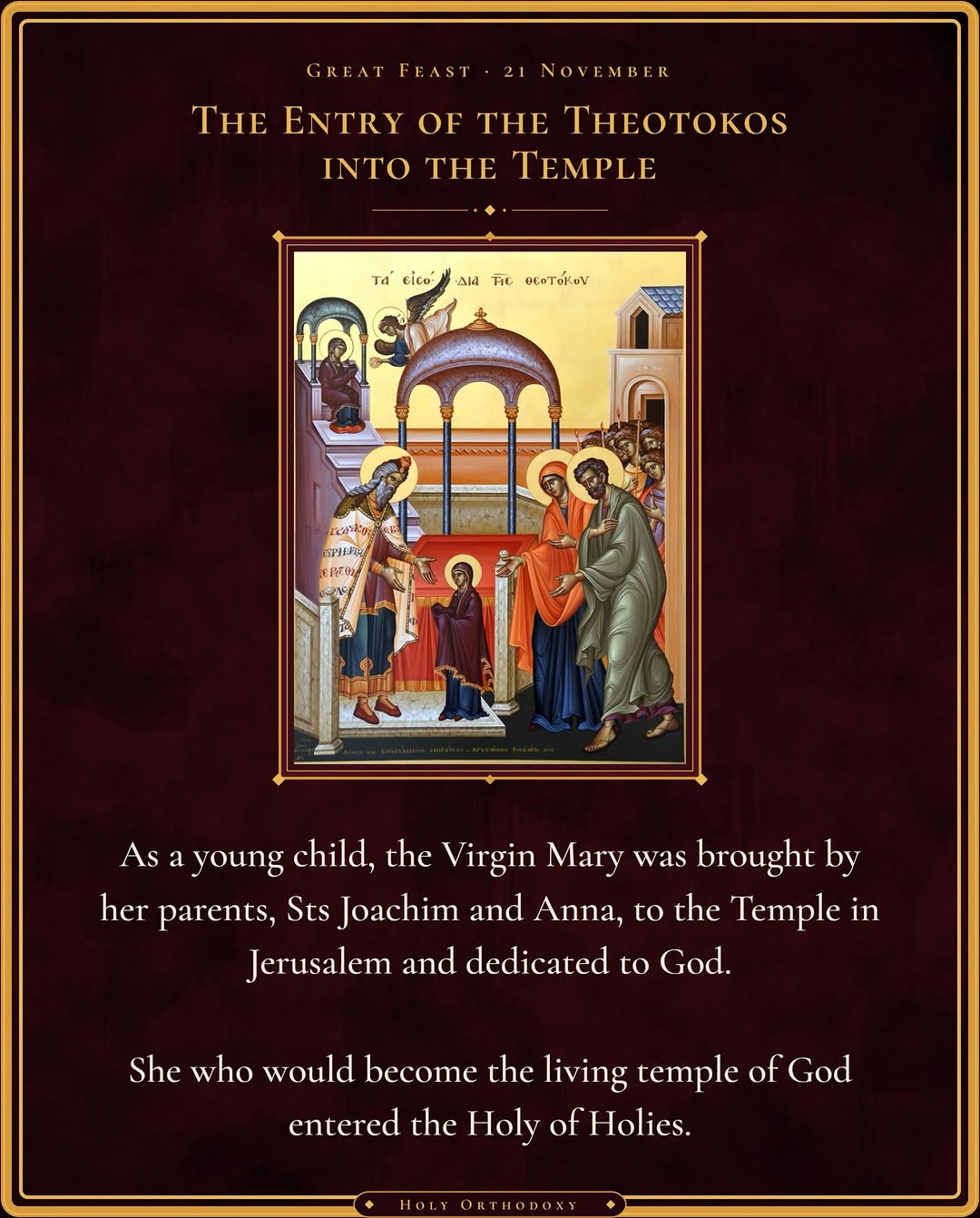
The post reflects on the Great Feast of the Entry of the Theotokos into the Temple, celebrated on 21 November. It describes how the Virgin Mary, as a young child, was brought by her parents, Sts Joachim and Anna, to the Temple in Jerusalem and dedicated to God. She entered the Holy of Holies, prefiguring her role as the living temple of God who would dwell in the flesh. The feast marks the first time in the liturgical year that the Church sings…

The post reflects on the Great Feast of the Entry of the Theotokos into the Temple, celebrated on 21 November. It describes how the Virgin Mary, as a young child, was brought by her parents, Sts Joachim and Anna, to the Temple in Jerusalem and dedicated to God. She entered the Holy of Holies, prefiguring her role as the living temple of God who would dwell in the flesh.

The feast marks the first time in the liturgical year that the Church sings the Nativity katavasia, "Christ is born, glorify Him!", signalling that the Nativity is already in sight. The author draws a parallel for the faithful: like Joachim and Anna, we are invited to offer what is most precious to us to God; like the Theotokos, we are called to make our hearts a place where He can live.

The post ends with the invocation, "Most Holy Theotokos, save us." The accompanying image text summarises the feast, noting that the Virgin Mary entered the Holy of Holies as a child and became the living temple of God.

  • Feast of the Entry of the Theotokos into the Temple on 21 November
  • Mary brought by Sts Joachim and Anna, entered the Holy of Holies
  • Prefigures her as the living temple of the Incarnation
  • Church begins singing "Christ is born, glorify Him!" for the first time
  • Invitation to offer our hearts to God as Joachim, Anna, and the Theotokos did
Read more
Prayer Orthodoxy ® with TimothyNegrete Instagram

Miracles Don't Prove a Church Is True: An Orthodox Perspective

0:32

The speaker presents an Orthodox dilemma regarding miraculous signs. Scripture lists signs that accompany believers, yet these signs appear in Protestant churches, Mormonism, Islam, and contradictory Protestant denominations. The presence of miracles does not prove a church is the one true church. Christ warns that some who cast out demons in His name will hear "I never knew you." God can perform miracles outside the Orthodox Church without…

The speaker presents an Orthodox dilemma regarding miraculous signs. Scripture lists signs that accompany believers, yet these signs appear in Protestant churches, Mormonism, Islam, and contradictory Protestant denominations. The presence of miracles does not prove a church is the one true church.

Christ warns that some who cast out demons in His name will hear "I never knew you." God can perform miracles outside the Orthodox Church without approving false teachings. The discussion centers on how Orthodoxy understands the relationship between spiritual phenomena and ecclesial truth, emphasizing that miraculous activity alone cannot validate doctrinal claims when contradictory groups all report similar experiences.

Key moments

  1. The Orthodox affirm Scripture including the signs that accompany believers.
  2. These signs, visions, dreams, healings, appear in Protestant churches, among Mormons, Muslims, and contradictory Protestant denominations.
  3. If every group claiming miracles belonged to the one true church, contradictory churches would all be true.
  4. Christ says some who cast out demons in His name will be told "I never knew you."
  5. God can perform miracles outside the Orthodox Church, but that does not mean He approves of false teachings.
Read more

St. Moses the Black on humility as the weapon against Satan

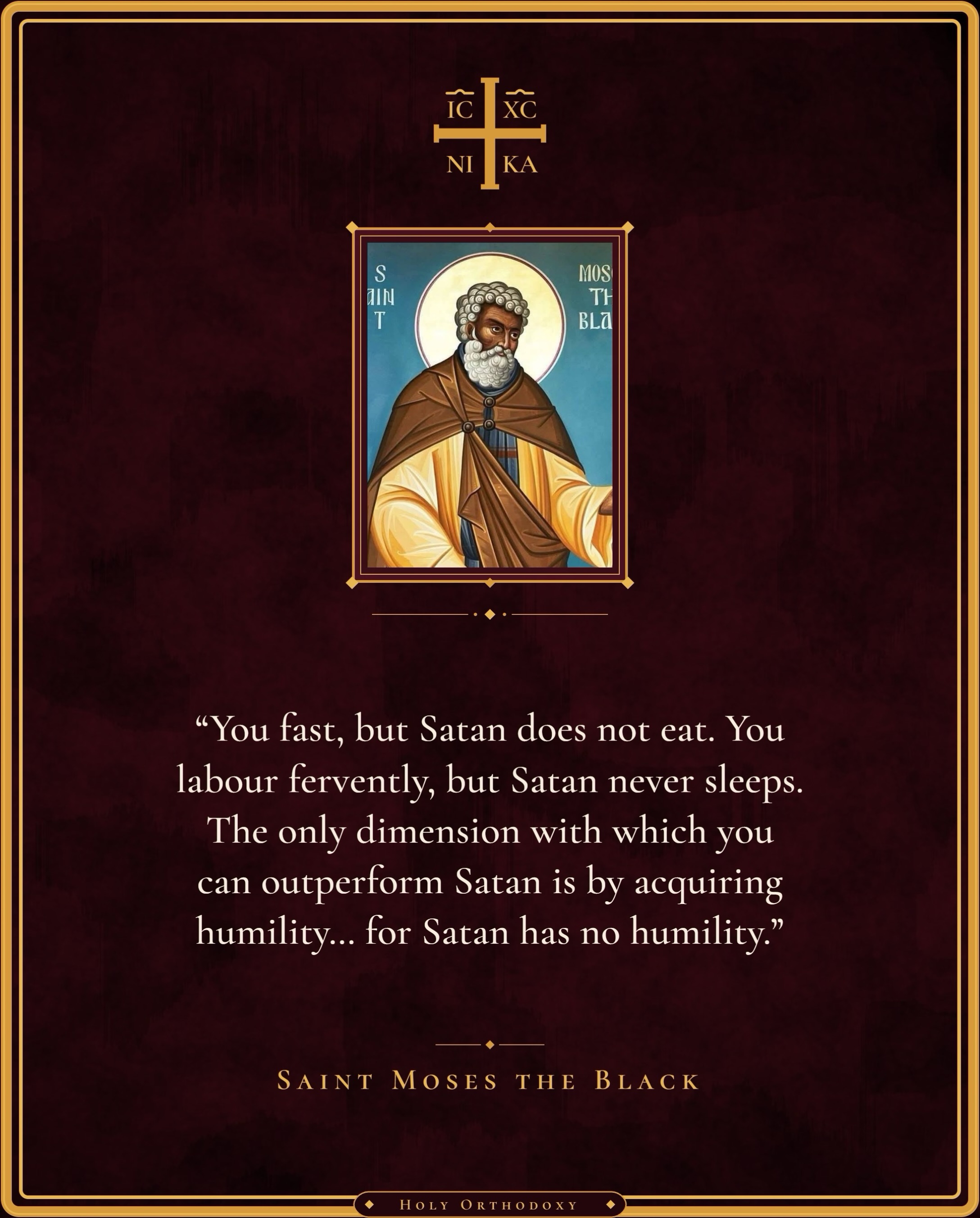
The post shares a saying attributed to St. Moses the Black, a fourth-century Egyptian robber who became a monk in Scetis and one of the great Desert Fathers. The saying contrasts human ascetic effort with Satan's nature: fasting does not affect Satan because he does not eat, and labor does not weary him because he never sleeps. The only dimension in which a person can surpass Satan is humility, since Satan has none. The post notes that Moses'…

The post shares a saying attributed to St. Moses the Black, a fourth-century Egyptian robber who became a monk in Scetis and one of the great Desert Fathers. The saying contrasts human ascetic effort with Satan's nature: fasting does not affect Satan because he does not eat, and labor does not weary him because he never sleeps. The only dimension in which a person can surpass Satan is humility, since Satan has none.

The post notes that Moses' own life illustrates this: his repentance, not his own strength, turned him from a feared gang leader into a saint. He was martyred by raiders in the early fifth century. The text concludes with a request for his prayers.

  • St. Moses the Black was a robber and gang leader in Egypt before converting and becoming a monk in Scetis
  • He is counted among the great Desert Fathers and was martyred in the early 5th century
  • The attributed saying states that fasting and labor cannot outdo Satan because Satan does not eat or sleep
  • Humility is the only virtue Satan lacks and the only way to surpass him
  • Moses' own repentance, not personal effort, transformed him from robber to saint
Read more

Four Biblical Habits for Spiritual and Mental Strength

The post outlines four biblical habits that build mental strength through surrender to Christ rather than self-reliance. The first habit is patience with God's timing, citing Ecclesiastes 7:8 that the patient in spirit is better than the proud in spirit. Unanswered prayers may require preparation and spiritual maturity, and God not answering as expected does not mean He has not heard. The second habit is accepting correction with humility,…

The post outlines four biblical habits that build mental strength through surrender to Christ rather than self-reliance. The first habit is patience with God's timing, citing Ecclesiastes 7:8 that the patient in spirit is better than the proud in spirit. Unanswered prayers may require preparation and spiritual maturity, and God not answering as expected does not mean He has not heard.

The second habit is accepting correction with humility, referencing Proverbs 15:31 that the ear that hears rebukes abides among the wise. Not every criticism is an attack; God sometimes uses others to expose weaknesses we refuse to see, and the Orthodox Church teaches humility is essential for spiritual growth. The third habit is remaining faithful without seeing results, walking by faith not by sight as stated in 2 Corinthians 5:7. Real faith means staying faithful during seasons when fasting, prayer, and church attendance do not change circumstances, trusting God even when we do not understand what He allows.

The fourth habit is finding strength through weakness, because Christ says His grace is sufficient and His strength is made perfect in weakness (2 Corinthians 12:9). Mental strength is not about becoming emotionless or pretending nothing affects us, but about developing patience, humility, perseverance, and unwavering faith in Jesus Christ.

Key moments

  1. 0:00 The first habit is learning patience with God's timing, because Ecclesiastes 7:8 says the patience of spirit is better than the proud in spirit.
  2. 0:00 The thing you are praying for may require patience, preparation, and spiritual maturity, and God not answering as expected does not mean he has not heard you.
  3. 0:32 The second habit is accepting correction with humility, since Proverbs 15:31 teaches that the ear hearing rebukes abides among the wise.
  4. 0:32 Not every criticism is an attack; God sometimes uses others to expose weaknesses we refuse to see, and the Orthodox Church teaches humility is essential for spiritual growth.
  5. 1:05 The third habit is remaining faithful without seeing results, walking by faith not by sight as 2 Corinthians 5:7 states.
  6. 1:05 Real faith means staying faithful during seasons when fasting, prayer, and church attendance do not change circumstances, trusting God even when you do not understand what he allows.
  7. 1:40 The fourth habit is finding strength through weakness, because Christ says his grace is sufficient and his strength is made perfect in weakness (2 Corinthians 12:9).
  8. 1:40 Mental strength is not about becoming emotionless or pretending nothing affects you, but about developing patience, humility, perseverance, and unwavering faith in Jesus Christ.
Read more
Prayer Orthodoxy ® Instagram

St. Paisios the Athonite: Baptized by St. Arsenios, formed on Mount Athos

The post presents the life of St. Paisios the Athonite (1924-1994). He was baptized by St. Arsenios of Cappadocia, who gave him his own name. St. Paisios later entered monastic life on Mount Athos, where Elder Tychon became one of his spiritual fathers. His life was devoted to humility, prayer, and guiding souls toward Christ. The post includes three sayings attributed to the saint, displayed on images with his icon and title in Greek. The first…

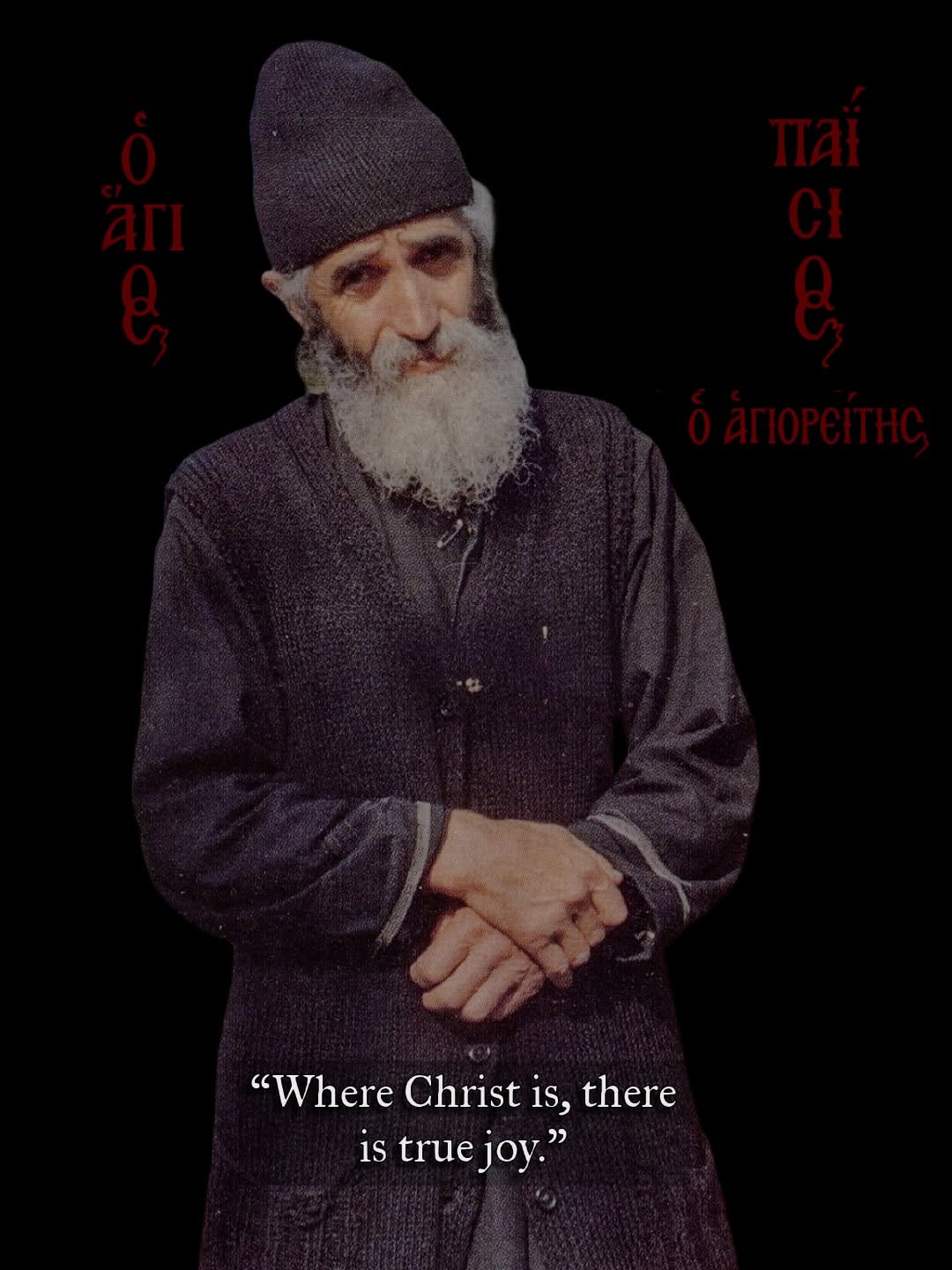
The post presents the life of St. Paisios the Athonite (1924-1994). He was baptized by St. Arsenios of Cappadocia, who gave him his own name. St. Paisios later entered monastic life on Mount Athos, where Elder Tychon became one of his spiritual fathers.

His life was devoted to humility, prayer, and guiding souls toward Christ. The post includes three sayings attributed to the saint, displayed on images with his icon and title in Greek. The first saying states that humility opens the gates of Heaven and brings down God's grace.

The second says that keeping God's commandments cultivates virtue and attains health of the soul. The third declares that where Christ is, there is true joy.

  • Baptized by St. Arsenios of Cappadocia, who gave him his name
  • Embraced monasticism on Mount Athos under Elder Tychon
  • Life devoted to humility, prayer, and guiding souls to Christ
  • Humility opens heaven's gates and draws God's grace
  • Keeping commandments cultivates virtue and soul health
Read more

Fr Sotirios on St. Paul's cure for modern bickering: good deeds over arguments

Fr Sotirios Papifilopoulos preaches that the modern spirit of constant arguing, fighting, and complaining comes from having too much idle time. He turns to St. Paul's letter to Titus, where the apostle gives two directives for the parish. First, insist that people apply themselves to good deeds, because those who are busy doing good have no time for negativity. Second, avoid stupid controversies, genealogies, dissensions, and quarrels over the…

Fr Sotirios Papifilopoulos preaches that the modern spirit of constant arguing, fighting, and complaining comes from having too much idle time. He turns to St. Paul's letter to Titus, where the apostle gives two directives for the parish. First, insist that people apply themselves to good deeds, because those who are busy doing good have no time for negativity.

Second, avoid stupid controversies, genealogies, dissensions, and quarrels over the law, citing Titus 3:9 that these are unprofitable and futile. The sermon connects this to a deeper human condition: we are created for community yet terrified of intimacy. We build barriers to hide our true selves, good, bad, and indifferent.

Marriage is given to teach communion by forcing a husband and wife to discover each other's full reality. When fear of intimacy prevails, people naturally gripe, fuss, and argue, declaring the other group evil. St. Paul's remedy is practical: fill the time with good works, and refuse to engage in pointless disputes.

Key moments

  1. We are made for community but feel strange in disconnection because we hunger for community while fearing intimacy.
  2. Our greatest fear is that the curtain will be pulled back and people will see us for what we really are, good, bad, and indifferent.
  3. Marriage teaches communion by forcing a man and a woman to discover each other's full reality, sometimes quickly, sometimes over a long time.
  4. If given over to fear of intimacy, we naturally gripe, fuss, complain, and argue; the spirit of the age is arguing, fighting, and declaring the other group evil.
  5. St. Paul tells Titus to insist that people apply themselves to good deeds, because those busy doing good have no time to argue, complain, or focus on what they lack.
  6. St. Paul also commands avoiding stupid controversies, genealogies, dissensions, and quarrels over the law, for they are unprofitable and futile.
  7. The modern age of bickering and complaining has stemmed from people not being busy enough and having too much time on their hands.
Read more

Father Jacob: Faith as Fidelity, Not Intellectual Assent

In an upcoming interview, Father Jacob addresses a common Protestant framing of justification by faith alone, citing Romans 3:28. He argues that this formulation often creates a false dichotomy between faith and works, as if the two were opposed. The priest explains that the Greek term pistis should be understood as faithfulness or fidelity to God, not mere intellectual assent or doctrinal correctness. He points to James 2:19, noting that demons…

In an upcoming interview, Father Jacob addresses a common Protestant framing of justification by faith alone, citing Romans 3:28. He argues that this formulation often creates a false dichotomy between faith and works, as if the two were opposed. The priest explains that the Greek term pistis should be understood as faithfulness or fidelity to God, not mere intellectual assent or doctrinal correctness.

He points to James 2:19, noting that demons believe and shudder, to demonstrate that intellectual belief is insufficient for salvation. Father Jacob illustrates fidelity with the analogy of a husband's faithfulness to his wife, which requires an ongoing, intimate relationship rather than distant acknowledgment or occasional recognition.

He states that fidelity to God is an intimate response, not simply knowing about God or affirming propositions about Him. The priest then asks whether a person can fall away from that fidelity each day, concluding that this is why Christians must take up their cross daily. The discussion centers on the Orthodox understanding of justification as a lived, relational fidelity rather than a legal declaration based on belief alone.

He emphasizes that faith is not a static mental agreement but a dynamic commitment that must be renewed each day through the cross. The conversation also touches on how the Protestant slogan "faith alone" can obscure the biblical teaching that faith without works is dead, and that true faith inevitably produces faithfulness. Father Jacob's approach draws on the patristic tradition that sees salvation as theosis, a process of growing in communion with God through faithful obedience.

He suggests that the daily cross is the means by which believers maintain and deepen their fidelity to Christ.

Key moments

  1. The speaker notes that the Protestant formulation "justified by faith apart from works of the law" (Romans 3:28) is often turned into a false dichotomy of faith versus works.
  2. He defines faith (pistis) as faithfulness or fidelity rather than mere knowledge or belief.
  3. He cites James 2:19: "The demons have faith in God and they shudder," to show that intellectual belief is insufficient.
  4. He illustrates fidelity with the example of a husband's faithfulness to his wife, which requires ongoing relationship, not distant acknowledgment.
  5. He states that fidelity to God is an intimate response, not just knowing about God.
  6. He asks whether a person can fall away from that fidelity every day.
  7. He concludes that this is why Christians must take up their cross daily.
Read more

Why Orthodox Christians "write" icons instead of painting them

The post explains the theological reasoning behind the Orthodox terminology of "writing" icons rather than "painting" them. It states that iconography is understood as a sacred theological expression, not merely an artistic practice. An icon functions as a visual proclamation of the Gospel, communicating the faith through sacred images.

Just as the Gospel is written in words, the icon is written in images. This linguistic distinction reflects the belief that iconography participates in the same revelatory work as Scripture.

  • Iconography is a sacred theological expression, not just art
  • Icons are visual proclamations of the Gospel
  • The Gospel is written in words; icons are written in images
  • The phrase "write an icon" reflects this theological understanding
  • The terminology distinguishes Orthodox iconography from secular painting
Read more

How three traditions answer which church is true after a split

The speaker compares how Catholics, Protestants, and Eastern Orthodox identify the true church after a split. Catholics rely on the Pope's authority as external confirmation. Protestants rely on private scriptural interpretation to judge each church. Eastern Orthodoxy requires submission to the bishop and does not allow private scriptural judgment of the church. The speaker then challenges the Catholic and Protestant approaches. He notes that…

The speaker compares how Catholics, Protestants, and Eastern Orthodox identify the true church after a split. Catholics rely on the Pope's authority as external confirmation. Protestants rely on private scriptural interpretation to judge each church.

Eastern Orthodoxy requires submission to the bishop and does not allow private scriptural judgment of the church. The speaker then challenges the Catholic and Protestant approaches. He notes that the Western Schism required a council to resolve competing papal claims, which challenges the Catholic method.

He also notes that when churches disagree, Protestants cannot determine whose scriptural interpretation is correct. Orthodox Christians instead appeal to the Holy Spirit working through the entire church, not one man's authority or individual interpretation. Through scripture, apostolic tradition, the fathers, and ecumenical councils, they can judge whether bishops remained faithful to the teachings handed down by the apostles.

Key moments

  1. 0:00 The question is how to know which side of a church split is the true church.
  2. 0:00 Catholics identify the true church by following the Pope as external confirmation.
  3. 0:00 Protestants identify the true church by privately judging each church against scripture.
  4. 0:00 Eastern Orthodoxy requires submission to the bishop and does not allow private scriptural judgment of the church.
  5. 0:00 The Western Schism required a council to resolve competing papal claims, challenging the Catholic method.
  6. 0:00 When churches disagree, Protestants cannot determine whose scriptural interpretation is correct.
  7. 0:00 Orthodox Christians appeal to the Holy Spirit working through the entire church, not one man's authority or individual interpretation.
  8. 0:37 Through scripture, apostolic tradition, the fathers, and ecumenical councils, we can judge whether bishops remained faithful to the teachings handed down by the apostles.
15 opinions in the discussion Beautifully put. Papalists and prots don't understand the EO position and strawman like crazy Read the discussion
Prayer Orthodoxy ® with Prayer Orthodoxy® Instagram

Prayer to see Christ in a child in need

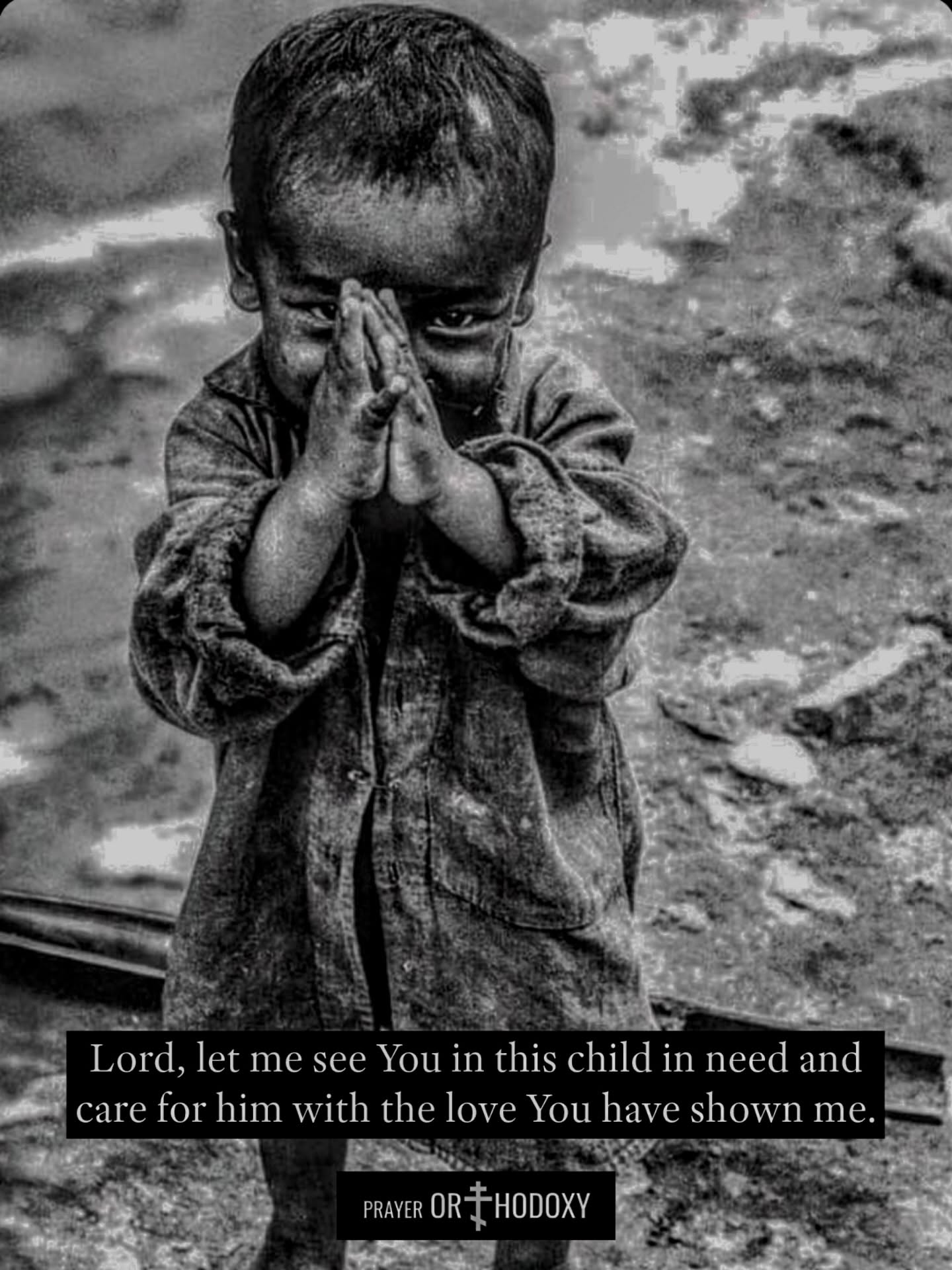
The post presents a prayer asking God to help the one praying see Christ in a child in need and care for that child with the love God has shown. The prayer cites Matthew 25:40, where Jesus says that whatever is done for the least of his brothers and sisters is done for him.

  • Prayer asking to see Christ in a needy child
  • Based on Matthew 25:40 about serving the least
  • Presented in English and Greek
  • Attributed to Prayer Orthodoxy production
Read more
Prayer Orthodoxy ® with PSALTIKON Instagram

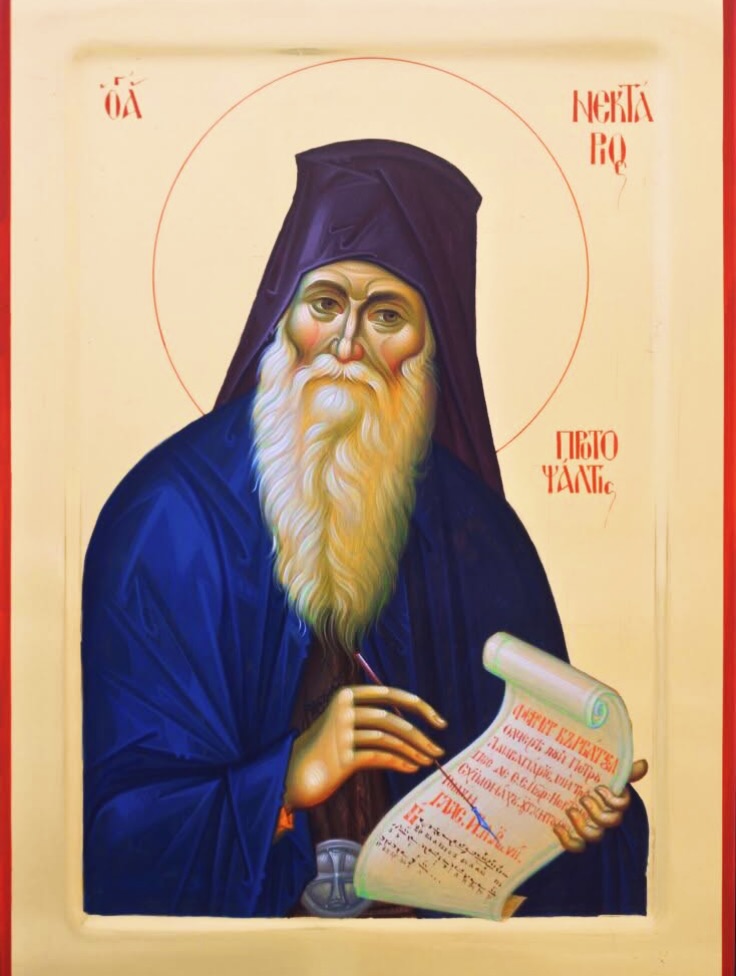
Venerable Nectarios the Protopsaltes of Prodromou commemorated November 18

The post commemorates Venerable Nectarios the Protopsaltes of Prodromou, whose feast day falls on November 18. It gives his name in Greek (Ὅσιος Νεκτάριος ὁ Πρωτοψάλτης τοῦ Προδρόμου), English (Venerable Nectarios the Protopsaltes of Prodromou), and Romanian (Sfântul Cuvios Nectarie Protopsaltul de la Prodromu). The title Protopsaltes indicates he served as chief cantor. No further biographical details, hymns, or teachings are provided in the text.

  • Feast day: November 18
  • Name given in Greek, English, and Romanian
  • Title Protopsaltes denotes chief cantor role
  • Commemoration post with Orthodox and Byzantine tags
Read more

The Theotokos as Model and Protectress of Mount Athos

The post presents the Orthodox Church's veneration of the Most Holy Theotokos as the model of purity, obedience, and complete devotion to God for nearly two thousand years. It states the ancient tradition that Mount Athos became her inheritance and is known as the Garden of the Panagia. For over a thousand years, monks have lived and prayed on the Holy Mountain under her protection, continually invoking her intercession with the prayer "Most Holy Theotokos, save us" (Υπεραγία Θεοτόκε, σώσον ημάς).

  • The Church has honored the Theotokos as model of purity, obedience, and devotion for nearly 2000 years
  • Ancient tradition holds Mount Athos as the Theotokos's inheritance, called the Garden of the Panagia
  • Monks have lived and prayed on Mount Athos under her protection for over 1000 years
  • The continual monastic prayer is "Most Holy Theotokos, save us" in Greek and English
  • The post presents this teaching in both English and Greek
Read more
Prayer Orthodoxy ® Instagram

Why Orthodox Christians ask saints to pray for them

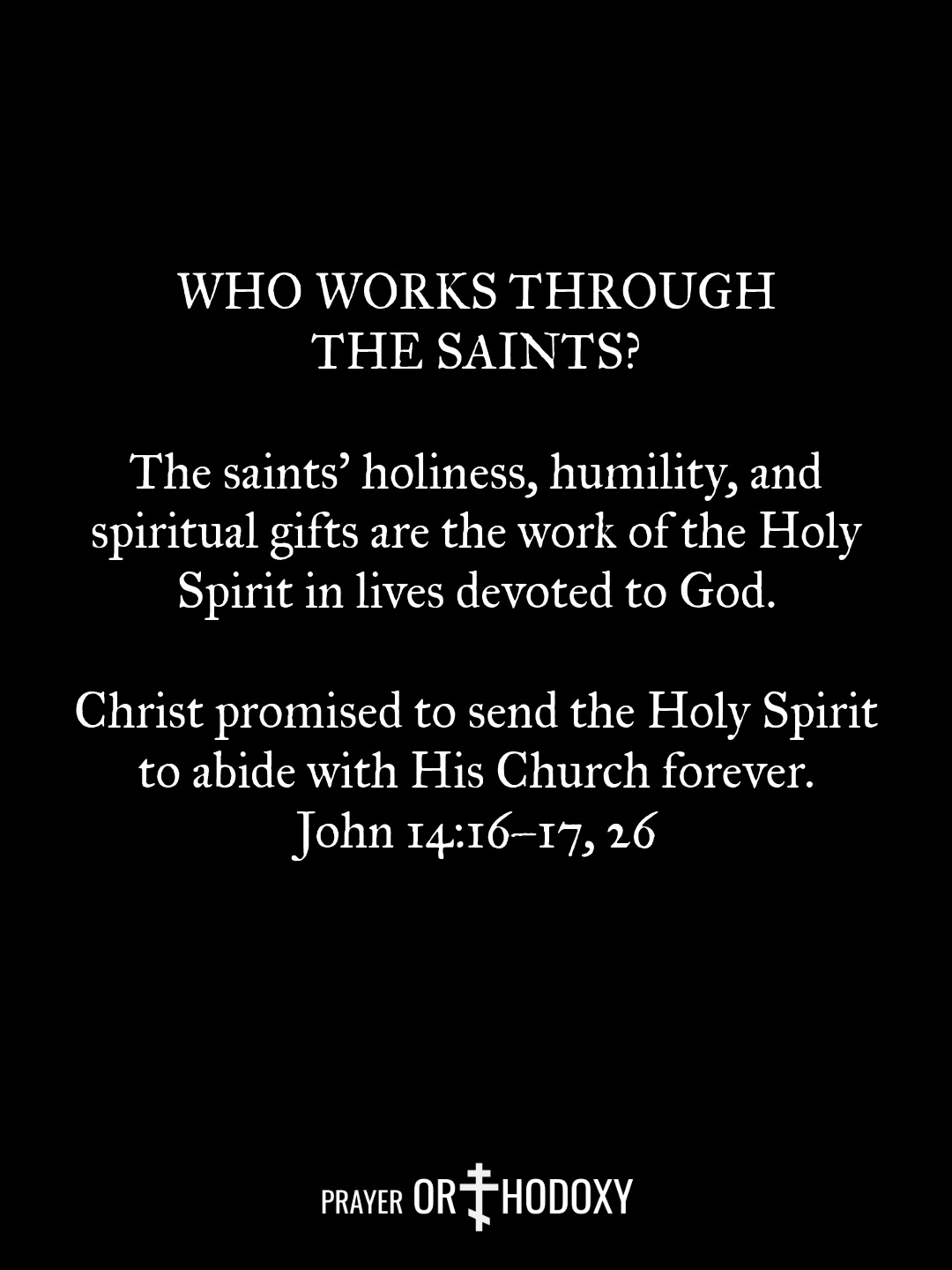
The post explains the Orthodox understanding of the communion of saints and why believers ask for their prayers. It begins with Christ's words that God is not the God of the dead but of the living, showing that saints remain alive in Christ and members of His Body. Their holiness and spiritual gifts are the work of the Holy Spirit, whom Christ promised to send to abide with the Church forever. Scripture lists gifts such as prophecy, healing, and…

The post explains the Orthodox understanding of the communion of saints and why believers ask for their prayers. It begins with Christ's words that God is not the God of the dead but of the living, showing that saints remain alive in Christ and members of His Body. Their holiness and spiritual gifts are the work of the Holy Spirit, whom Christ promised to send to abide with the Church forever.

Scripture lists gifts such as prophecy, healing, and discernment given by the Spirit according to God's will. To honor the saints is to honor the grace of God at work in them. The same apostolic faith that gave the Church its Scriptures calls believers to prayer, fasting, repentance, confession, and Eucharistic communion, as described in Acts 2:42. Asking saints to pray does not replace Christ's unique mediation; 1 Timothy 2:1-5 affirms both Christ's sole mediatorship and the Christian duty to intercede for one another.

The saints pray with and for the faithful. Worship belongs to God alone. The post concludes by listing the practices Christ and the Apostles command, prayer, fasting, repentance, mercy, forgiveness, as the way to respond to God's grace and follow the example of the saints.

  • Saints are alive in Christ, not dead, based on Mark 12:27
  • Their holiness and gifts are the Holy Spirit's work, promised in John 14:16-17, 26
  • Spiritual gifts such as prophecy and healing come through the Spirit, per 1 Corinthians 12:7-11
  • Asking saints to pray aligns with 1 Timothy 2:1-5 on Christian intercession
  • Apostolic life includes prayer, fasting, repentance, confession, and the Eucharist (Acts 2:42)
Read more

Trinity defense cites early heresies and church continuity

A video presents a debate on the Trinity. One speaker identifies as a Christian who rejects the Trinity, arguing it contradicts the Bible and urging others to reject it as well. Another speaker responds that denying the Trinity means rejecting Christ and the historic teaching of the church. The defender cites two second-century errors: Theodotus, who denied Christ's divinity and was excommunicated, and Noetus, who denied the distinction between…

A video presents a debate on the Trinity. One speaker identifies as a Christian who rejects the Trinity, arguing it contradicts the Bible and urging others to reject it as well. Another speaker responds that denying the Trinity means rejecting Christ and the historic teaching of the church. The defender cites two second-century errors: Theodotus, who denied Christ's divinity and was excommunicated, and Noetus, who denied the distinction between Father and Son and was refuted by Saint Hippolytus using Scripture.

The speaker concludes by challenging the idea that the Spirit-guided church erred on God's identity while a modern individual claims to have corrected it after 2,000 years.

Key moments

  1. I'm a Christian and I don't believe in the Trinity. And neither should you because the Trinity contradicts the Bible.
  2. You're not a Christian then, by rejecting who God is, you're denying what it means to follow Christ. You are rejecting Scripture and what the church has always taught.
  3. In the second century, Theodotus denied Christ's divinity and was excommunicated.
  4. In the second century, Noetus denied the distinction between Father and Son, Saint Hippolytus refuted this with Scripture.
  5. So why would we believe the church guided by the Holy Spirit erred on God's identity, but you figured it all out 2,000 years later.
Read more

Questions for a Spiritual Father About Correcting Strangers Online

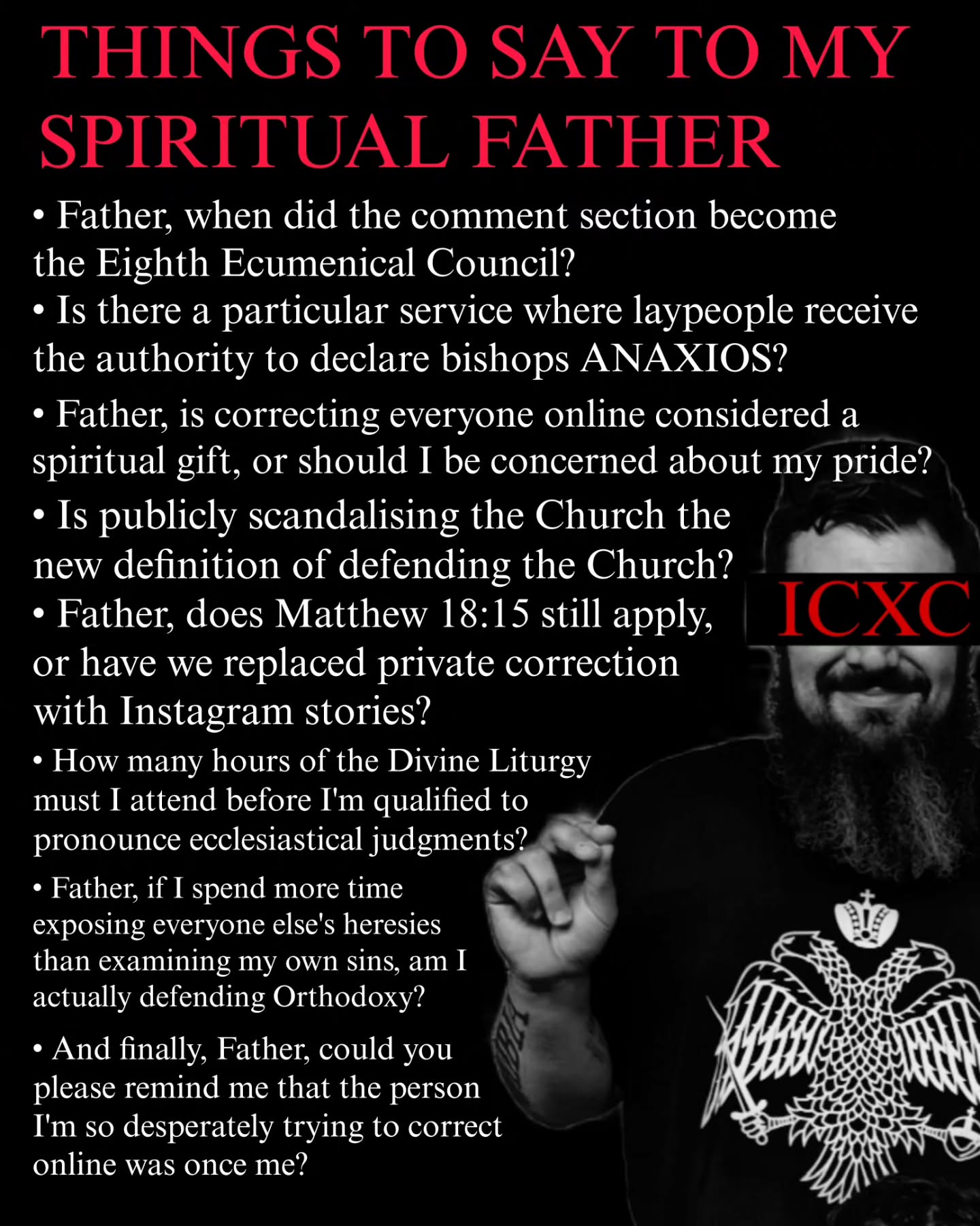
A satirical list framed as 'Things to say to my spiritual father' turns the lens on Orthodox Christians who spend their time correcting, exposing and condemning others online. One question cites Matthew 18:15, where Christ commands private correction before public rebuke, and asks whether Instagram stories have replaced it. Another asks how many hours of the Divine Liturgy qualify a person to pronounce ecclesiastical judgments. The sharpest…

A satirical list framed as 'Things to say to my spiritual father' turns the lens on Orthodox Christians who spend their time correcting, exposing and condemning others online. One question cites Matthew 18:15, where Christ commands private correction before public rebuke, and asks whether Instagram stories have replaced it. Another asks how many hours of the Divine Liturgy qualify a person to pronounce ecclesiastical judgments.

The sharpest question turns inward: if I spend more time exposing everyone else's heresies than examining my own sins, am I actually defending Orthodoxy? The list ends by asking the priest to remind the speaker that the person he is desperately trying to correct online was once himself. The author frames the post with 'Lord have mercy upon us all, especially myself' and the Greek 'Δόξα τῷ Θεῷ πάντων ἕνεκεν' (Glory to God for all things), closing with ICXC.

The piece reads as a self-directed examination of conscience about online polemics, pride and the commandment to correct in private.

  • The list poses satirical questions to a spiritual father about judging bishops and other Orthodox online
  • It asks which service grants laypeople authority to declare bishops 'anaxios'
  • It invokes Matthew 18:15 on private correction versus Instagram stories
  • It asks whether exposing others' heresies while neglecting one's own sins counts as defending Orthodoxy
  • It closes by asking to be reminded that the person one corrects online was once oneself
5 opinions in the discussion "I will not be asked how many hungry I fed, how many I clothed, or how many sick I nursed, but rather how many people I called heretics for making small mistakes online" -St Maria of Paris… Read the discussion
Prayer Orthodoxy ® Instagram

Private Prayer Sustains but Cannot Replace the Divine Liturgy

The post argues that a relationship with Christ requires participation in the Church He established, centered on the Divine Liturgy. It cites Matthew 16:18 where Christ says He will build His church, 1 Timothy 3:15 calling the church the pillar and ground of truth, and Acts 2:42 describing early Christians gathering for the Apostles' teaching, fellowship, breaking of bread, and prayer. The author notes that the Church is Christ's Body,…

The post argues that a relationship with Christ requires participation in the Church He established, centered on the Divine Liturgy. It cites Matthew 16:18 where Christ says He will build His church, 1 Timothy 3:15 calling the church the pillar and ground of truth, and Acts 2:42 describing early Christians gathering for the Apostles' teaching, fellowship, breaking of bread, and prayer.

The author notes that the Church is Christ's Body, referencing 1 Corinthians 10:17, and that St. Clement and St. Ignatius in the first and second centuries witnessed to the Church's apostolic ministry and shared worship. Early Christians sometimes met in homes but still gathered; location did not make communal worship optional. Private prayer sustains the life of the Church but cannot replace the Eucharist, the sacraments, or life together in His Body.

The post includes a graphic with four panels: the first challenges the claim that one does not need church for a relationship with Christ; the second presents scriptural foundations; the third explains the Church as His Body and the necessity of gathering; the fourth contrasts private prayer with the call to gather. The message appears in both English and Greek and ends with the tagline "Orthodoxy Since 33 AD."

The conclusion calls readers to attend the Divine Liturgy, prepare for the sacraments, and live as members of Christ's Body.

  • Christ established the Church as the pillar and ground of truth (Matthew 16:18; 1 Timothy 3:15).
  • Early Christians gathered for teaching, fellowship, breaking of bread, and prayer (Acts 2:42).
  • The Church is Christ's Body; believers partake of one bread (1 Corinthians 10:17).
  • St. Clement and St. Ignatius attest to apostolic ministry and shared worship in the first and second centuries.
  • Private prayer sustains but cannot replace the Eucharist, sacraments, and communal life in the Church.
Read more
Prayer Orthodoxy ® with Prayer Orthodoxy® Instagram

Orthodoxy: faith from Christ through apostles, fathers, martyrs

The author presents a concise statement of Orthodox identity and continuity. The faith was established by Christ in 33 AD, preached by the apostles, defended by the fathers, and sealed by the blood of martyrs. This same faith has been entrusted to the present generation and is lived through prayer, repentance, the holy mysteries, and love. The calling is to preserve it faithfully and pass it to the next generation. The accompanying image…

The author presents a concise statement of Orthodox identity and continuity. The faith was established by Christ in 33 AD, preached by the apostles, defended by the fathers, and sealed by the blood of martyrs. This same faith has been entrusted to the present generation and is lived through prayer, repentance, the holy mysteries, and love.

The calling is to preserve it faithfully and pass it to the next generation. The accompanying image reinforces the four pillars: established by Christ, preached by the apostles, defended by the fathers, sealed by the blood of martyrs.

  • Orthodoxy traced to Christ's establishment in 33 AD
  • Transmission through apostles, fathers, and martyrs
  • Faith lived through prayer, repentance, holy mysteries, and love
  • Duty to preserve and transmit the faith to future generations
  • Statement given in both English and Greek
Read more

Why Icons Are Not Idolatry: Kissing and Bowing as Respect

The speaker argues that Orthodox Christians face accusations of idolatry for using icons, while kissing and bowing before them are expressions of love and respect, not worship. He cites Saint Paul's instruction to greet one another with a holy kiss and the example of King Solomon bowing before his mother as biblical precedents for such gestures.

The speaker questions why religious images are labeled idolatry only when Orthodox Christians have them, implying a double standard in the criticism.

Key moments

  1. 0:04 The speaker asks why Orthodox Christians are accused of idolatry for having icons when kissing and bowing are expressions of love and respect, citing Saint Paul's command to greet with a holy kiss and King Solomon bowing before his mother.
14 opinions in the discussion To venerate means to treat someone or something with deep respect, reverence, or intense admiration. Do you "worship" your country's flag or venerate it? Medal of Honor recipients? What… Read the discussion

Mount Athos: A Living Icon of the Heavenly Kingdom

The text presents Mount Athos not merely as a geographic location but as a spiritual reality, a living icon of the Heavenly Kingdom on earth. It describes Athos as a silent refuge where souls weary of worldly noise follow the footsteps of the Mother of God, for this land is her portion and heavenly garden. Upon stepping onto Athos, one realizes all earthly glory is but a passing shadow before eternity. Among steep cliffs and ancient monastery…

The text presents Mount Athos not merely as a geographic location but as a spiritual reality, a living icon of the Heavenly Kingdom on earth. It describes Athos as a silent refuge where souls weary of worldly noise follow the footsteps of the Mother of God, for this land is her portion and heavenly garden. Upon stepping onto Athos, one realizes all earthly glory is but a passing shadow before eternity.

Among steep cliffs and ancient monastery walls, time loses its measure and the true inner dimension of existence opens: encounter with the living God in the depths of one's heart. The true feat of Athos lies not in stone temples but in the invisible struggle monks wage in the silence of their cells, the unceasing Jesus Prayer: "Lord Jesus Christ, Son of God, have mercy on me a sinner."

This prayer, like blessed dew, penetrates the parched heart, cleansing it of passions, anger, pride, and worldly sorrow. Athos teaches that God is found not in the noise of earthly events nor in the strong words of worldly sages, but in the "still small wind" of contrition and humility. Every rock, every prayerful sigh, every tear of repentance witnesses that man is created not for transience and death but for eternal joy in the unending Light of Trinitarian Love.

Athos thus remains a living call to all caught in daily busyness: to awaken, reconsider spiritual steps, and allow God's grace to transform the inner man. As long as lamps burn on Athos and prayers rise for the whole world, the Bethlehem star still shines over our planet, showing the path of salvation to all who will hear and see.

Key moments

  1. The sixth ode is appointed to be sung to the Lord.
  2. The refrain calls to praise the Lord and exalt Him unto all ages.
  3. Light and darkness, nights and days are summoned to bless the Lord.
  4. The text calls upon Israel to bless the Lord.
  5. The faithful bless the Father, Son, and Holy Spirit as the Lord.
  6. The faithful hymn and exalt the Lord unto all ages.
  7. The faithful praise, bless, and worship the Lord.
  8. The faithful hymn and glorify the Lord unto all ages.
Read more