WeOrthodox
EN UA

Prayer Orthodoxy ®

Instagram ↗ 196 discussions

Prayer Orthodoxy® Orthodox Christianity Through Scripture, Tradition, and the Saints Deepen Your Understanding of the Faith

Prayer Orthodoxy ® Instagram discussion

What brought you closer to the Orthodox Church?

I am asking what drew you nearer to the Orthodox Church. Was it the Divine Liturgy, the saints, Holy Tradition, the sacraments, prayer, or something else? Please share your story in the comments.

Τι σας έφερε πιο κοντά στην Ορθόδοξη Εκκλησία; Ήταν η Θεία Λειτουργία, οι Άγιοι, η Ιερά Παράδοση, τα Μυστήρια, η προσευχή ή κάτι άλλο; Μοιραστείτε την ιστορία σας στα σχόλια.

5 opinions in the discussion The theology. Without Orthodoxy I couldn't understand how Jesus could be God when all through the bible he's clearly and explicitly calling on God, with some verses that really troubled me.… Read the discussion

Geronda Damaskinos Neoskiotis chants the Jesus Prayer with his synodia

The video shows Geronda Damaskinos Neoskiotis chanting the Greek prayer "Ὦ ἀγαθὲ καὶ φιλάνθρωπε Δέσποτα, οἰκτῖραι ἡμᾶς" (O good and philanthropic Master, have mercy on us) together with his synodia. The chant begins at the start of the recording and continues without variation for seven minutes and thirty seconds. The prayer repeats continuously from 0:00 through the end at 7:30. No other hymns, readings, or spoken words appear in the recording.…

The video shows Geronda Damaskinos Neoskiotis chanting the Greek prayer "Ὦ ἀγαθὲ καὶ φιλάνθρωπε Δέσποτα, οἰκτῖραι ἡμᾶς" (O good and philanthropic Master, have mercy on us) together with his synodia. The chant begins at the start of the recording and continues without variation for seven minutes and thirty seconds. The prayer repeats continuously from 0:00 through the end at 7:30. No other hymns, readings, or spoken words appear in the recording.

The original post title in Romanian reads "Duhul Sfânt pe toate le dăruiește" (The Holy Spirit bestows all things) and identifies the chanter as gheronda Damaschin Neoskitiotul with his synodia.

Key moments

  1. 0:00 The prayer "Ὦ ἀγαθὲ καὶ φιλάνθρωπε Δέσποτα, οἰκτῖραι ἡμᾶς" begins and repeats.
  2. 0:30 The same prayer continues without change.
  3. 1:30 Repetition of the prayer persists.
Read more

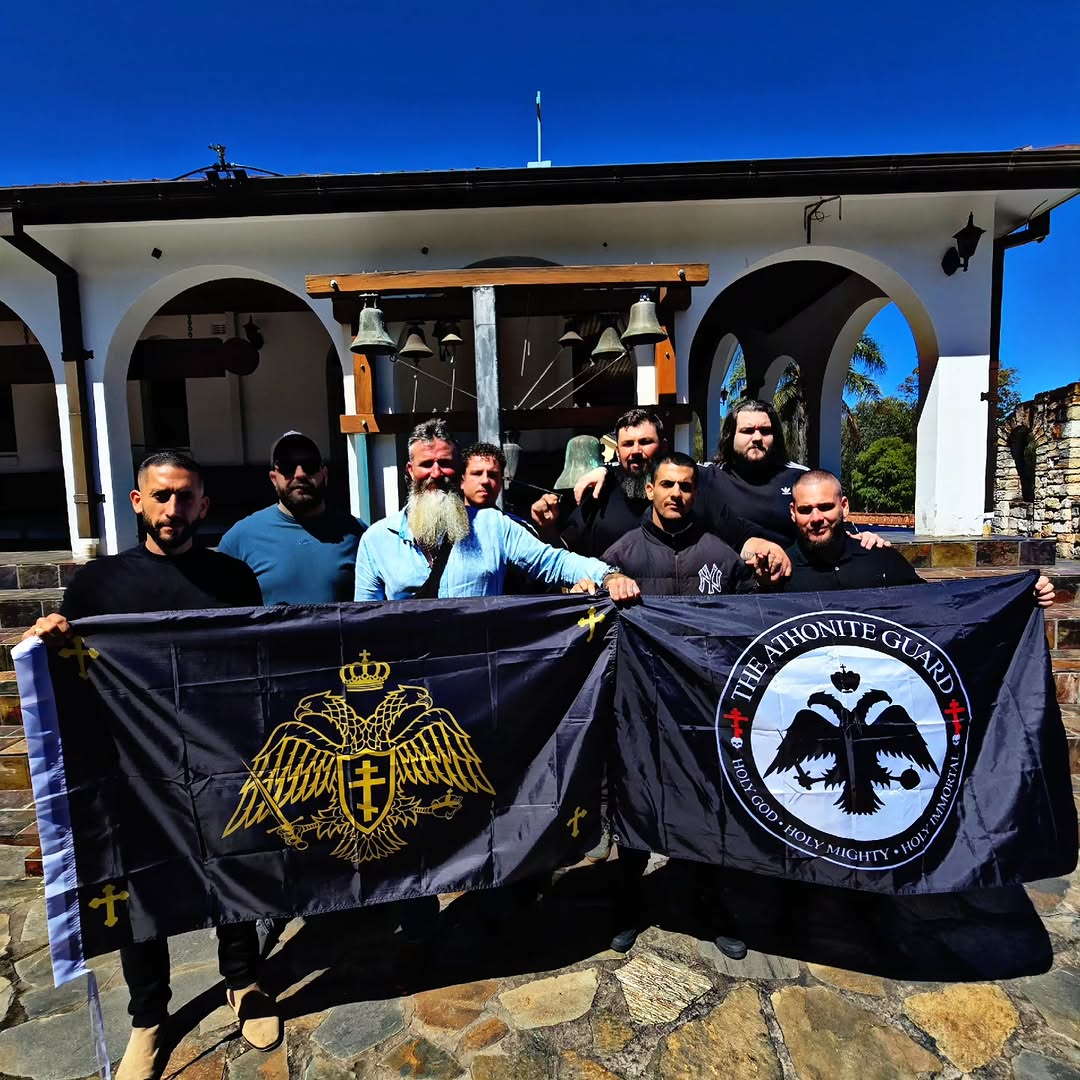
Athonite Guard attends Liturgy at Saint George Monastery with Bishop Iakovos

The Athonite Guard attended Divine Liturgy at Saint George Monastery in Yellow Rock this morning. His Grace Bishop Iakovos celebrated the service. The post expresses gratitude for the blessing of being present and asks for the Theotokos's protection and Christ's strength. A video accompanying the post presents a sequence of Orthodox Christian hymns to the Theotokos chanted in Greek. The opening prayer asks: "Open my mouth and fill it with…

The Athonite Guard attended Divine Liturgy at Saint George Monastery in Yellow Rock this morning. His Grace Bishop Iakovos celebrated the service. The post expresses gratitude for the blessing of being present and asks for the Theotokos's protection and Christ's strength.

A video accompanying the post presents a sequence of Orthodox Christian hymns to the Theotokos chanted in Greek. The opening prayer asks: "Open my mouth and fill it with spirit, and I will hymn the Queen Mother and appear as a celebrant, and unconfusedly her wonders." The refrain "Most Holy Theotokos, save us" recurs throughout.

The hymns address her with scriptural and liturgical titles: Christ's living book sealed in the Spirit; the great archangel cries "Rejoice, vessel of joy"; the curse of the first mother is loosed; "Rejoice, restoration of Adam, virgin bride; rejoice, heir of Adam; rejoice, throne of the King of all, the Almighty." A doxology to the Trinity follows: "Glory to Father and Son and Holy Spirit."

Then titles continue: "Unfading rose, rejoice, only one that blossomed; my fragrant apple, rejoice, you who budded; seal of the King of all, rejoice, unwedded, salvation of the world. Now and ever and unto ages of ages amen. Rejoice, purity of the breeze; through the fall we rose, rejoice, the breath; Lady lily, gladden the faithful; incense of precious fragrance."

A petition asks: "The hymns of the Theotokos, as an abundant divine source, having composed them, strengthen me spiritually. And in your divine glory, make me worthy of crowns of glory." This petition repeats twice. The final refrain returns to "Most Holy Theotokos, save us" with closing titles: "Ear of corn that sprouted God, as heaven blamelessly; rejoice living table, providing bread of life."

Key moments

  1. 0:00 Opening prayer: "Open my mouth and fill it with spirit, and I will hymn the Queen Mother and appear as a celebrant, and unconfusedly her wonders."
  2. 0:48 First refrain: "Most Holy Theotokos, save us." Titles follow: Christ's living book sealed in the Spirit; the great archangel cries "Rejoice, vessel of joy"; the curse of the first mother is loosed; "Rejoice, restoration of Adam, virgin bride; rejoice, heir of Adam; rejoice, throne of the King of all, the Almighty."
  3. 1:36 Doxology: "Glory to Father and Son and Holy Spirit." Then: "Unfading rose, rejoice, only one that blossomed; my fragrant apple, rejoice, you who budded; seal of the King of all, rejoice, unwedded, salvation of the world. Now and ever and unto ages of ages amen. Rejoice, purity of the breeze; through the fall we rose, rejoice, the breath; Lady lily, gladden the faithful; incense of precious fragrance."
  4. 2:24 Petition: "The hymns of the Theotokos, as an abundant divine source, having composed them, strengthen me spiritually. And in your divine glory, make me worthy of crowns of glory." Repeated twice.
  5. 3:12 Final refrain: "Most Holy Theotokos, save us." Closing titles: "Ear of corn that sprouted God, as heaven blamelessly; rejoice living table, providing bread of life."
Read more
Prayer Orthodoxy ® with ICXC☦︎NIKA Instagram

Divine Liturgy at Saint George Monastery, Yellow Rock

The author reflects on attending Divine Liturgy at Saint George Monastery in Yellow Rock. The post opens with the statement that without the Church there is no brotherhood. The author describes the liturgy as a blessing shared alongside brothers in Christ.

The text concludes with a prayer to the Panagia for protection beneath her holy veil and the doxology "Glory to God for all things." The post includes religious emojis but contains no extended discussion or thread.

  • The author attended Divine Liturgy at Saint George Monastery, Yellow Rock
  • The post states that without the Church there is no brotherhood
  • Worshipping alongside brothers in Christ is described as a blessing
  • The Panagia is invoked for protection beneath her holy veil
  • The post ends with "Glory to God for all things"
Read more

Saints teach repentance, sacrifice, perseverance, prayer as essential to Christian life

The post presents a brief teaching on the struggle of the Christian life in both English and Greek. It states that the Saints teach repentance, sacrifice, perseverance, and prayer as essential elements. The heart is purified through spiritual struggle, and each day offers a new opportunity to turn away from what separates a person from Christ and to return to Him. The text is attributed as an original production of Prayer Orthodoxy® and carries…

The post presents a brief teaching on the struggle of the Christian life in both English and Greek. It states that the Saints teach repentance, sacrifice, perseverance, and prayer as essential elements. The heart is purified through spiritual struggle, and each day offers a new opportunity to turn away from what separates a person from Christ and to return to Him.

The text is attributed as an original production of Prayer Orthodoxy® and carries hashtags for Orthodox, Repentance, Prayer, Saints, and Christ. No further discussion or commentary is included in the source.

  • The Saints identify repentance, sacrifice, perseverance, and prayer as essential to the Christian life
  • The heart is purified through spiritual struggle
  • Each day provides a new opportunity to turn from what separates from Christ and return to Him
  • The message appears in English and Greek
  • Attributed to Prayer Orthodoxy® as an original production
Read more

Simonopetra Monastery: founded on a cliff by Saint Simon the Myrrh-streamer

The post presents the Holy Monastery of Simonopetra on Mount Athos through bilingual text and a video summary. The English and Greek descriptions state that the monastery rises from the cliffs of Mount Athos and has stood for centuries as a place of prayer, sacrifice, and devotion to Christ. It was founded by Saint Simon the Myrrh-streamer in the 13th century, and the brotherhood continues its life of prayer above the Aegean Sea. The video…

The post presents the Holy Monastery of Simonopetra on Mount Athos through bilingual text and a video summary. The English and Greek descriptions state that the monastery rises from the cliffs of Mount Athos and has stood for centuries as a place of prayer, sacrifice, and devotion to Christ. It was founded by Saint Simon the Myrrh-streamer in the 13th century, and the brotherhood continues its life of prayer above the Aegean Sea.

The video summary adds that Saint Simon saw a brilliant star above a rock and heard a voice telling him to build a monastery there as a beacon of salvation. The cliff was steep and the task seemed impossible, but his faith did not falter. With his disciples he built Simonopetra, meaning Simon's Rock, upon the cliff overlooking the Aegean.

Through earthquakes, fires, and centuries of change, the monastery still stands, a witness to faith. At dawn the sound of the bells carries across the sea, calling the world once more to prayer. The post is credited as an original production of Prayer Orthodoxy and includes hashtags for Orthodox, Mount Athos, Simonopetra, Monasticism, and Prayer.

Key moments

  1. Saint Simon saw a brilliant star above a rock and heard a voice say, "Build your monastery here and it shall be a beacon of salvation."
  2. The cliff was steep and the task seemed impossible, yet his faith did not falter.
  3. With his disciples he built Simonopetra, meaning Simon's Rock, upon the cliff overlooking the Aegean.
  4. Through earthquakes, fires, and centuries of change, the monastery still stands as a witness of faith.
  5. At dawn the sound of the bells carries across the sea, calling the world once more to prayer.
Read more

Knocking on the door of the Theotokos after life's disappointments

The author describes a lifetime of knocking on various doors. Many opened, yet most resulted in disappointment. The author lists specific contrasts: where joy was expected, sorrow came; where strength was sought, weakness was given; where light was anticipated, darkness filled the space; where hope was desired, despair flooded in. After this catalog of failed doors, the author proposes a final door: that of the Panagia. The author states she…

The author describes a lifetime of knocking on various doors. Many opened, yet most resulted in disappointment. The author lists specific contrasts: where joy was expected, sorrow came; where strength was sought, weakness was given; where light was anticipated, darkness filled the space; where hope was desired, despair flooded in.

After this catalog of failed doors, the author proposes a final door: that of the Panagia. The author states she will open and save. The condition is knocking warmly, with faith and persistence, with warm prayer on the lips. The text ends with a direct address to the Theotokos as blessed, asking her to open the gate of compassion.

  • Life's doors often bring disappointment rather than fulfillment
  • The author contrasts expected gifts with actual outcomes: sorrow for joy, weakness for strength, darkness for light, despair for hope
  • The solution proposed is knocking on the door of the Panagia
  • This requires warm, persistent prayer with faith
  • A short prayer to the Theotokos is quoted asking her to open the gate of compassion
Read more

Saint Paisios on the speed of pride and humility

0:07

The post shares a saying attributed to Saint Paisios of Mount Athos. He states that Lucifer's fall from angel to devil did not take hours but only a few seconds. In the same way, a person can become like an angel or like a devil in a single second by choosing pride or choosing humility. The saint adds that the easiest way to be saved is through love and humility.

Key moments

  1. 0:05 The crowd chants "¡Viva la Virgen de la Macarena!" repeatedly.
Read more
Prayer Orthodoxy ® Instagram

Prayer Orthodoxy® announces presence on X

The post announces that Prayer Orthodoxy® is now on X. The account shares content on Orthodox Christian faith, prayer, tradition, Mount Athos, icons, Scripture, Saints, and the life of the Church. The announcement appears in both English and Greek. The handle provided is @PrayerOrthodoxy. The post includes hashtags for x, orthodoxy, prayerorthodoxy, social, and growth.

  • Prayer Orthodoxy® launches on X
  • Content covers Orthodox faith, prayer, tradition, Mount Athos, icons, Scripture, Saints, Church life
  • Bilingual announcement in English and Greek
  • Account handle: @PrayerOrthodoxy
Prayer Orthodoxy ® Instagram

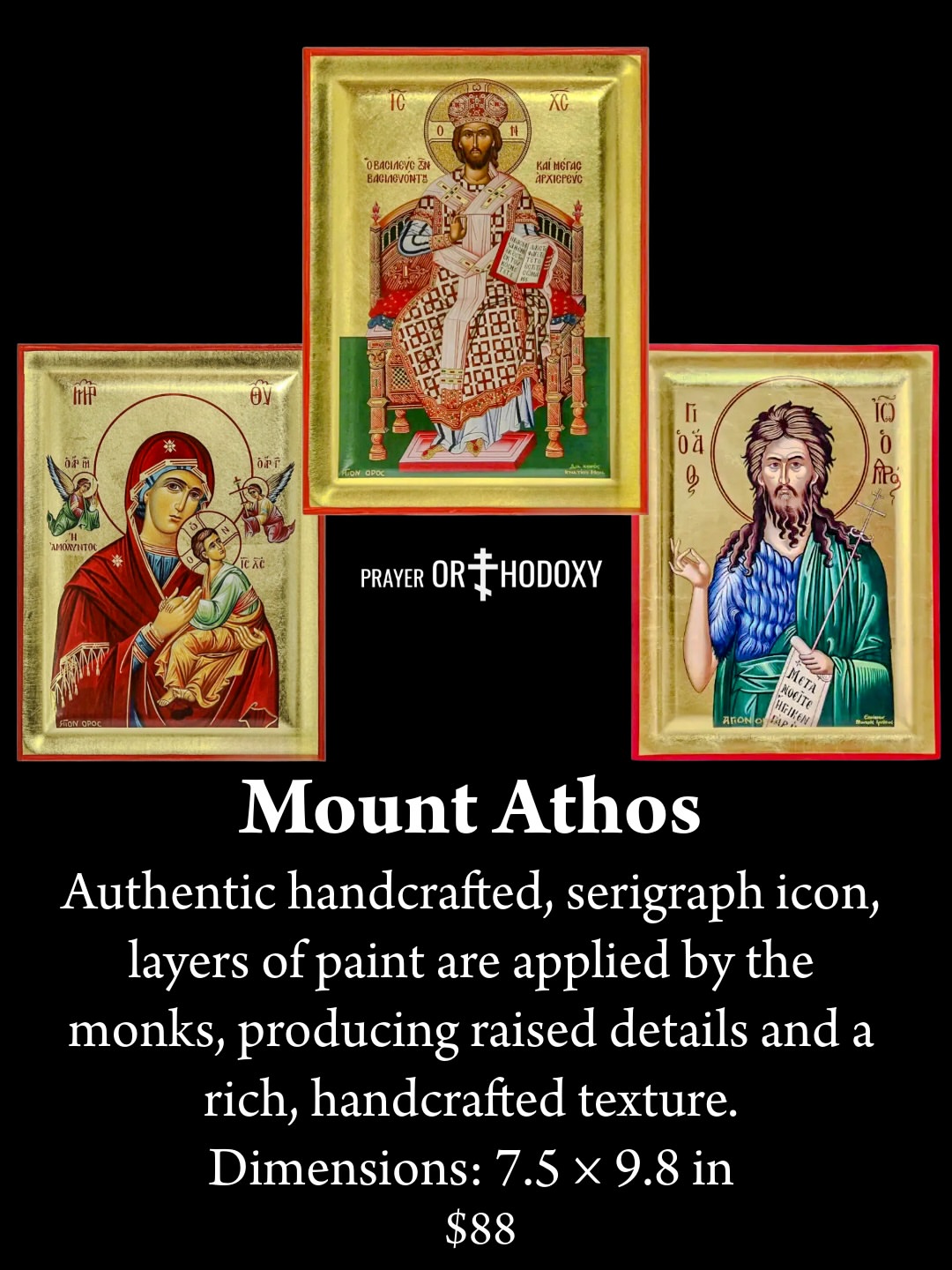
Serigraph Icons from Mount Athos Crafted by Monks

The post presents sacred Orthodox icons produced on Mount Athos using the traditional serigraph process. Monks apply layers of paint and finish each icon by hand, creating raised details and a rich textured surface. On some icons the names of the monks who made them appear on the back, preserving a direct connection to the hands that produced each sacred image. The featured icons are Christ the King and Great High Priest, the Theotokos of the…

The post presents sacred Orthodox icons produced on Mount Athos using the traditional serigraph process. Monks apply layers of paint and finish each icon by hand, creating raised details and a rich textured surface. On some icons the names of the monks who made them appear on the back, preserving a direct connection to the hands that produced each sacred image.

The featured icons are Christ the King and Great High Priest, the Theotokos of the Passion, and Saint John the Baptist and Forerunner. Each icon measures 7.5 by 9.8 inches. The description is given in English and in Greek. The post is identified as an original production of Prayer Orthodoxy.

  • Icons created on Mount Athos using traditional serigraphy
  • Monks apply paint layers and finish each piece by hand
  • Raised details and textured surface result from the process
  • Some icons bear the names of the monks who made them
  • Featured subjects: Christ the King and Great High Priest, Theotokos of the Passion, Saint John the Baptist and Forerunner
Read more
Prayer Orthodoxy ® Instagram

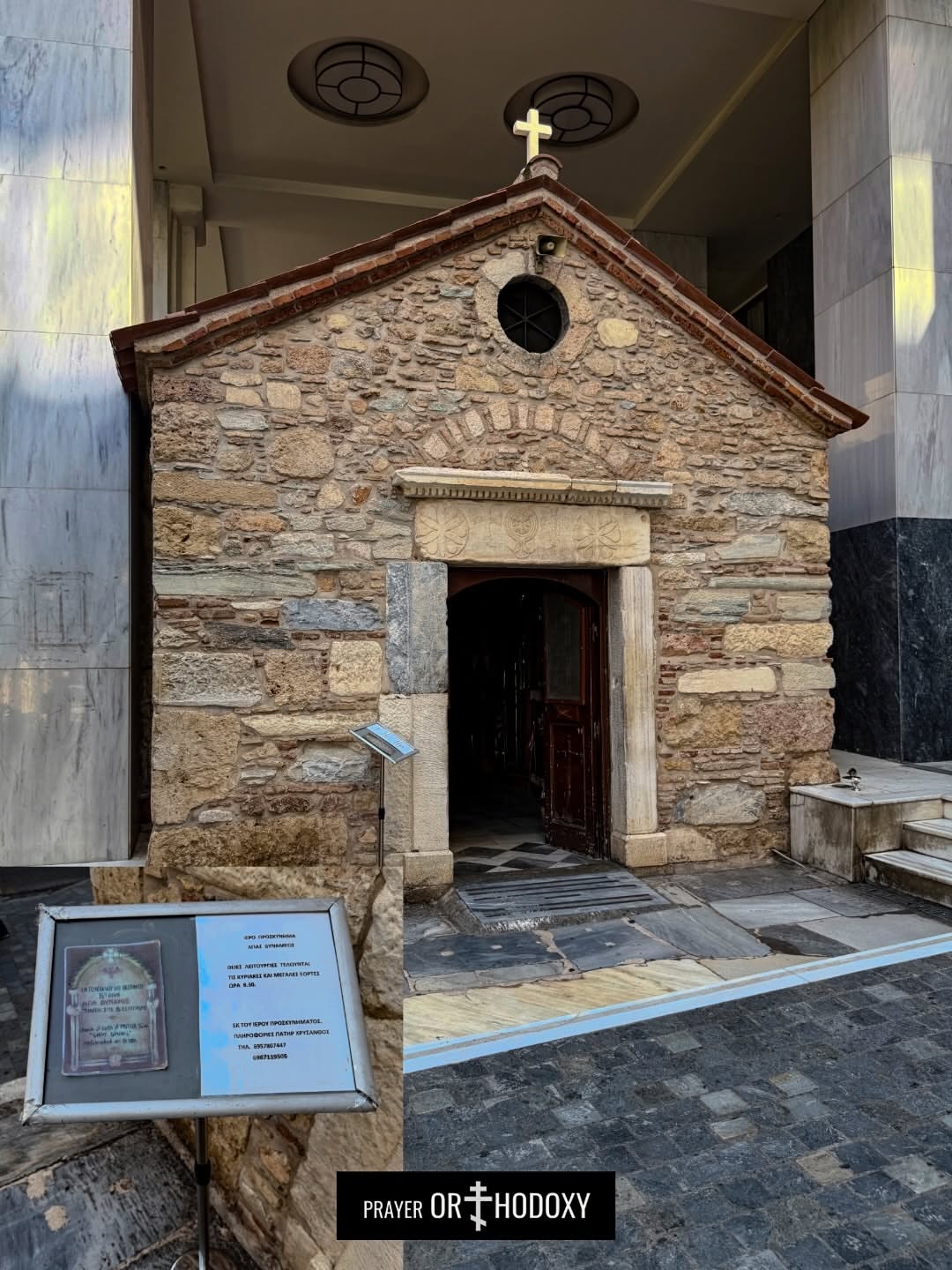
16th-century Athens chapel of Agia Dynamis linked to childbirth prayers and 1821 revolution

The post presents the chapel of Agia Dynamis, meaning Holy Power, which stands concealed beneath modern buildings in central Athens. The small chapel dates to the 16th century and is dedicated to the Nativity of the Theotokos. It once functioned as a dependency of the Monastery of Penteli. For generations, women visited the chapel to pray to the Panagia for strength and protection during childbirth. Local tradition also associates the chapel…

The post presents the chapel of Agia Dynamis, meaning Holy Power, which stands concealed beneath modern buildings in central Athens. The small chapel dates to the 16th century and is dedicated to the Nativity of the Theotokos. It once functioned as a dependency of the Monastery of Penteli.

For generations, women visited the chapel to pray to the Panagia for strength and protection during childbirth. Local tradition also associates the chapel with the Greek War of Independence; according to this tradition, ammunition was channeled secretly to Greek fighters before the Revolution of 1821. The post includes images credited to the author's brother and identifies itself as an original production of Prayer Orthodoxy.

  • 16th-century chapel dedicated to the Nativity of the Theotokos
  • Former dependency of the Monastery of Penteli
  • Women prayed for strength during childbirth
  • Tradition links it to secret ammunition supply before 1821 Revolution
  • Located in central Athens beneath modern buildings
Read more

Once a sheep of the world, now His: a short confession of faith

The author writes a short personal confession about leaving behind the desire to fit in with the crowd. They state that they no longer follow the crowd but follow Christ, and that they no longer seek acceptance from people but acceptance from Him. The author adds that they no longer live for this world but live for His Kingdom, and describes their former life as having been a sheep of the world, in contrast to belonging to Christ now. The post…

The author writes a short personal confession about leaving behind the desire to fit in with the crowd. They state that they no longer follow the crowd but follow Christ, and that they no longer seek acceptance from people but acceptance from Him. The author adds that they no longer live for this world but live for His Kingdom, and describes their former life as having been a sheep of the world, in contrast to belonging to Christ now.

The post closes with the word Amen and a set of symbols, including a cross. There is no discussion in the thread; the post is a single statement of personal commitment with no replies, questions, or further context given. The language is direct and declarative throughout, built on a series of contrasts: crowd versus Christ, acceptance by people versus acceptance by Him, this world versus His Kingdom, being the world's sheep versus being His.

  • The author no longer follows the crowd but follows Christ.
  • They seek acceptance from Christ rather than from people.
  • They say they no longer live for this world but for His Kingdom.
  • They describe their former self as a sheep of the world and now as belonging to Christ.
  • The post is a single statement of faith with no discussion or replies.
Read more
Prayer Orthodoxy ® with Prayer Orthodoxy® Instagram

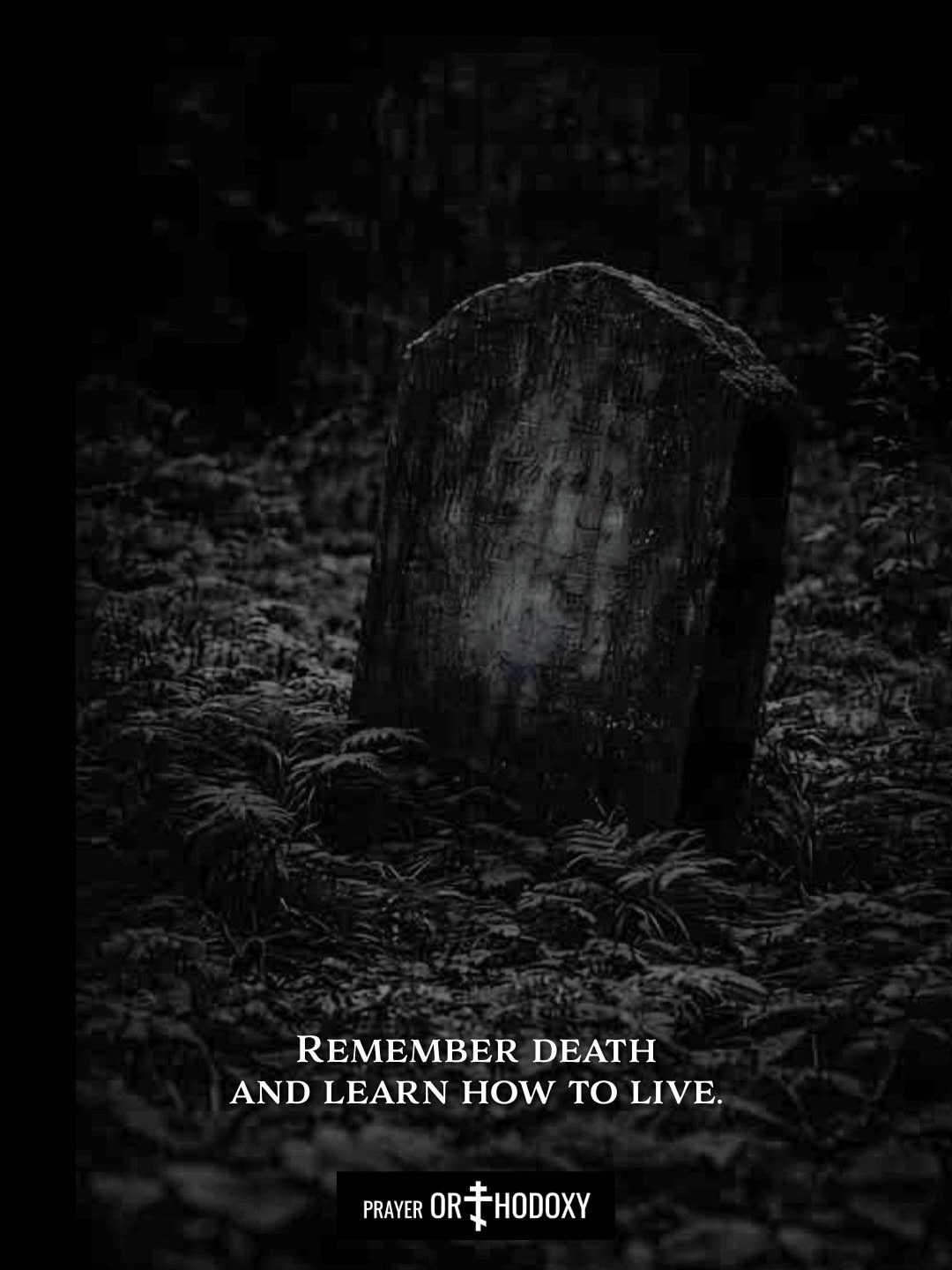
Remember Death, Remember Christ: Scripture on Eternity

The post presents a series of Scripture passages centered on mortality, resurrection, and eternal perspective. It opens with the exhortation to remember death and remember Christ, followed by Hebrews 13:14 on seeking the city to come, Colossians 3:2 on setting the mind on things above, and John 11:25 where Jesus declares himself the resurrection and the life. Each passage appears in English and Greek. The post concludes with the declaration that…

The post presents a series of Scripture passages centered on mortality, resurrection, and eternal perspective. It opens with the exhortation to remember death and remember Christ, followed by Hebrews 13:14 on seeking the city to come, Colossians 3:2 on setting the mind on things above, and John 11:25 where Jesus declares himself the resurrection and the life.

Each passage appears in English and Greek. The post concludes with the declaration that Christ has conquered death and an encouragement to live this life with eternity in the heart. The content is attributed to Prayer Orthodoxy as an original production.

  • Exhortation to remember death and remember Christ
  • Hebrews 13:14 on having no continuing city but seeking the one to come
  • Colossians 3:2 on setting the mind on things above
  • John 11:25 where Jesus identifies as the resurrection and the life
  • Statement that Christ has conquered death, with call to live with eternity in the heart
Read more

$uicideboy$ affiliate renounces nihilistic lyrics and affirms Orthodox faith

1:23

The post is a blessing sent to Ruby, an artist associated with the duo $uicideboy$, after a clip circulated in which Ruby, Cherry, and Scream say they have renounced their earlier dark nihilistic lyrics and cult affiliations. They identify as devout followers of Christ. One of them states a bucket list goal of saving 100,000 souls before death. On stage he thanks God for the chance to be alive that night rather than dead in a ditch, and he…

The post is a blessing sent to Ruby, an artist associated with the duo $uicideboy$, after a clip circulated in which Ruby, Cherry, and Scream say they have renounced their earlier dark nihilistic lyrics and cult affiliations. They identify as devout followers of Christ. One of them states a bucket list goal of saving 100,000 souls before death.

On stage he thanks God for the chance to be alive that night rather than dead in a ditch, and he credits his survival to the grace of Jesus Christ. He tells the audience he will speak about Jesus Christ whether or not the crowd agrees with him, and he acknowledges an Orthodox flag visible in the venue. He then recites prayer-like lyrics asking to have his soul washed clean in Christ's blood, to raise a sword against the enemy, to have his sins washed away by a mighty flood, and to be pressed out of chaos into righteousness.

The author of the post greets Ruby as a brother in Christ and asks the Lord to strengthen him to endure and remain steadfast in the faith. The post closes with the phrase Christ is in our midst and the Greek words Orthodoxy or death, followed by crosses and prayer bead emojis. The clip combines a public renunciation of the artists' former image with an unapologetic confession of faith before a crowd that may not share it.

Key moments

  1. The artists Ruby, Cherry, and Scream renounce their previous dark nihilistic lyrics and cult affiliations and identify as devout followers of Christ.
  2. A bucket list goal is stated: save 100,000 souls before death.
  3. Thanks God for the opportunity to be present tonight and not dead in a ditch.
  4. Credits survival to the grace of Jesus Christ, the Lord and Savior.
  5. Declares intention to talk about Jesus Christ regardless of whether the audience agrees.
  6. Gives a shout out to an Orthodox flag.
  7. Mentions a camera lighting adjustment.
  8. Recites a prayer or lyrics about washing the soul clean in Christ's blood, raising a sword against the enemy, asking for a mighty flood to wash sins away, and being pressed out of chaos into righteousness.
7 opinions in the discussion I was a big $B fan once, but as my faith got stronger I worried I'd eventually have to quit listening to them because of the blasphemous lyrics and all that. Then the new album dropped… Read the discussion
Prayer Orthodoxy ® Instagram

Ancestral Sin, Not Inherited Guilt: An Orthodox Distinction

A speaker in an interview explains the Orthodox understanding of ancestral sin by contrasting it with the Western idea of inherited guilt. To make the difference clear, he uses a stark analogy drawn from criminal justice. In the Western view, he says, if a father commits a heinous crime, justice would be carried out on his innocent child: the police demonstrate justice by shooting his 14-month-old daughter. He calls this madness. In the Eastern…

A speaker in an interview explains the Orthodox understanding of ancestral sin by contrasting it with the Western idea of inherited guilt. To make the difference clear, he uses a stark analogy drawn from criminal justice. In the Western view, he says, if a father commits a heinous crime, justice would be carried out on his innocent child: the police demonstrate justice by shooting his 14-month-old daughter.

He calls this madness. In the Eastern view, the father who committed the crime is shot dead himself, and his daughter lives on in a world with a dead dad. The daughter is guilty of nothing; she simply bears the consequences of her father's actions in a broken world. The speaker applies this analogy to the doctrine of original sin: Orthodoxy speaks of ancestral sin rather than inherited guilt.

On this reading, human beings are not born guilty of Adam's personal transgression, but they do live with the consequences of his fall, as children live with the aftermath of a parent's actions. The post itself is a short promotional clip announcing that the full interview is now available, with a link provided in the account's bio.

The account presenting the interview is the Hearts of Orthodoxy. The clip focuses on this single doctrinal contrast and does not develop other topics. The strength of the analogy and the fairness of its portrayal of Western theology are the points a viewer would weigh when watching; the speaker presents the two views as opposed answers to the question of what, exactly, passes from Adam to his descendants: guilt, or consequences.

Key moments

  1. Orthodoxy speaks of ancestral sin rather than inherited guilt.
  2. The speaker illustrates the Western idea with an analogy: a father commits a heinous crime, and the police demonstrate justice by shooting his 14-month-old daughter, which he calls madness.
  3. In the Eastern idea, the father who committed the crime is shot dead himself, and his daughter lives on in a world with a dead dad.
  4. The daughter is guilty of nothing; she only bears the consequences of her father's actions.
Read more
Prayer Orthodoxy ® Instagram

Why Orthodox Christians Baptize Infants

A lesson explains the Orthodox practice of baptizing infants. Baptism is described as the beginning of a new life in Christ and entrance into His Church, not a ceremony that waits for personal understanding or belief. Babies are welcomed into the Church and receive God's grace before they can understand the faith for themselves. The lesson states that Orthodox Christians do not baptize infants because the babies have personally sinned. Instead,…

A lesson explains the Orthodox practice of baptizing infants. Baptism is described as the beginning of a new life in Christ and entrance into His Church, not a ceremony that waits for personal understanding or belief. Babies are welcomed into the Church and receive God's grace before they can understand the faith for themselves.

The lesson states that Orthodox Christians do not baptize infants because the babies have personally sinned. Instead, every person is born into a fallen world marked by sin, corruption, suffering, and death, and Christ came to heal and restore humanity from this condition. Through baptism, chrismation, and Holy Communion, the child begins life in Christ, while parents and godparents take responsibility for raising the child in the faith.

The lesson connects infant baptism to the Church's belief that the life of Christ is a gift that should not be withheld until a person reaches a certain age. The baptized child is received as a true member of the Church and then grows into a conscious and personal faith through prayer, worship, repentance, the Sacraments, and the teaching of the Church.

From the beginning of life, the goal for every Christian is the same: to know Christ, become united to Him, and grow toward eternal life with God.

  • Baptism is the beginning of new life in Christ and entrance into the Church, not a ceremony that follows personal belief.
  • Infants are not baptized because they have personally sinned; all are born into a fallen world marked by sin, corruption, suffering, and death.
  • Christ came to heal and restore humanity from this fallen condition.
  • Through baptism, chrismation, and Holy Communion the child begins life in Christ, while parents and godparents commit to raising the child in the faith.
  • The baptized child grows into conscious faith through prayer, worship, repentance, the Sacraments, and the Church's teaching.
Read more
Prayer Orthodoxy ® Instagram

Theotokos fragment in the first mode from Petros Bereketis' eight-mode 'Agni Parthene'

A recording shares a fragment of Byzantine chant dedicated to the Mother of God, sung by Elder Damaschinenos (Gheronda Damaschin). The piece is the first verse in the first mode with a kratema (a melodic passage on syllables without words), taken from the eight-mode 'Theotoke Parthene' ('Agni Parthene') composed by Petros Bereketis. The post's title also carries the Romanian words 'Născătoare de Dumnezeu' ('Mother of God'), and the tags point to…

A recording shares a fragment of Byzantine chant dedicated to the Mother of God, sung by Elder Damaschinenos (Gheronda Damaschin). The piece is the first verse in the first mode with a kratema (a melodic passage on syllables without words), taken from the eight-mode 'Theotoke Parthene' ('Agni Parthene') composed by Petros Bereketis.

The post's title also carries the Romanian words 'Născătoare de Dumnezeu' ('Mother of God'), and the tags point to Byzantine chant, the Theotokos, and Mount Athos. The transcript of the recording itself contains only the repeated Greek prayer 'Kyrie eleison' ('Lord have mercy'), which continues from the beginning to the end of the recording with no other spoken text.

The post thus presents a short chant excerpt from Athonite monastic practice, attributed to a known composer of the piece and to a named elder as the singer.

Key moments

  1. 0:01 The prayer "Κύριε ἐλέησον" ("Lord have mercy") begins and is repeated many times.
  2. 0:31 The repetition of "Κύριε ἐλέησον" continues.
  3. 1:01 The repeated prayer continues to the end of the recording.
Read more
Prayer Orthodoxy ® Instagram discussion

What do you wish more people understood about Orthodoxy?

There are many misconceptions about the Orthodox Christian faith. Here is your chance to share something you wish others understood better about our worship, theology, traditions, or way of life. What would you tell them? Share your answer in the comments.

  • Many misconceptions exist about the Orthodox Christian faith
  • Readers are invited to share what they wish others understood about worship, theology, traditions, or way of life
24 opinions in the discussion Taking part in the Holy Sacraments with people of other denominations is a sin that requires confession and repentance. We are not united in one Church or one faith. We're called to love… Read the discussion
Prayer Orthodoxy ® Instagram

The Great Schema: Highest Degree of Orthodox Monastic Life

The post explains the Great Schema as the highest degree of Orthodox monastic life. The monk who receives it offers his life completely to Christ through repentance, prayer, obedience, and the struggle against the passions. Its symbols point to the Passion of Christ and the calling to die to the old man so that Christ may live within him. The same explanation is provided in Greek. The post is identified as an original production of Prayer Orthodoxy.

  • The Great Schema is the highest degree of Orthodox monastic life
  • The monk offers his life completely to Christ through repentance, prayer, obedience, and struggle against passions
  • Its symbols reference the Passion of Christ
  • The calling is to die to the old man so Christ may live within
  • The explanation appears in both English and Greek
CHRISTIANITY UNITED with Prayer Orthodoxy ® Instagram

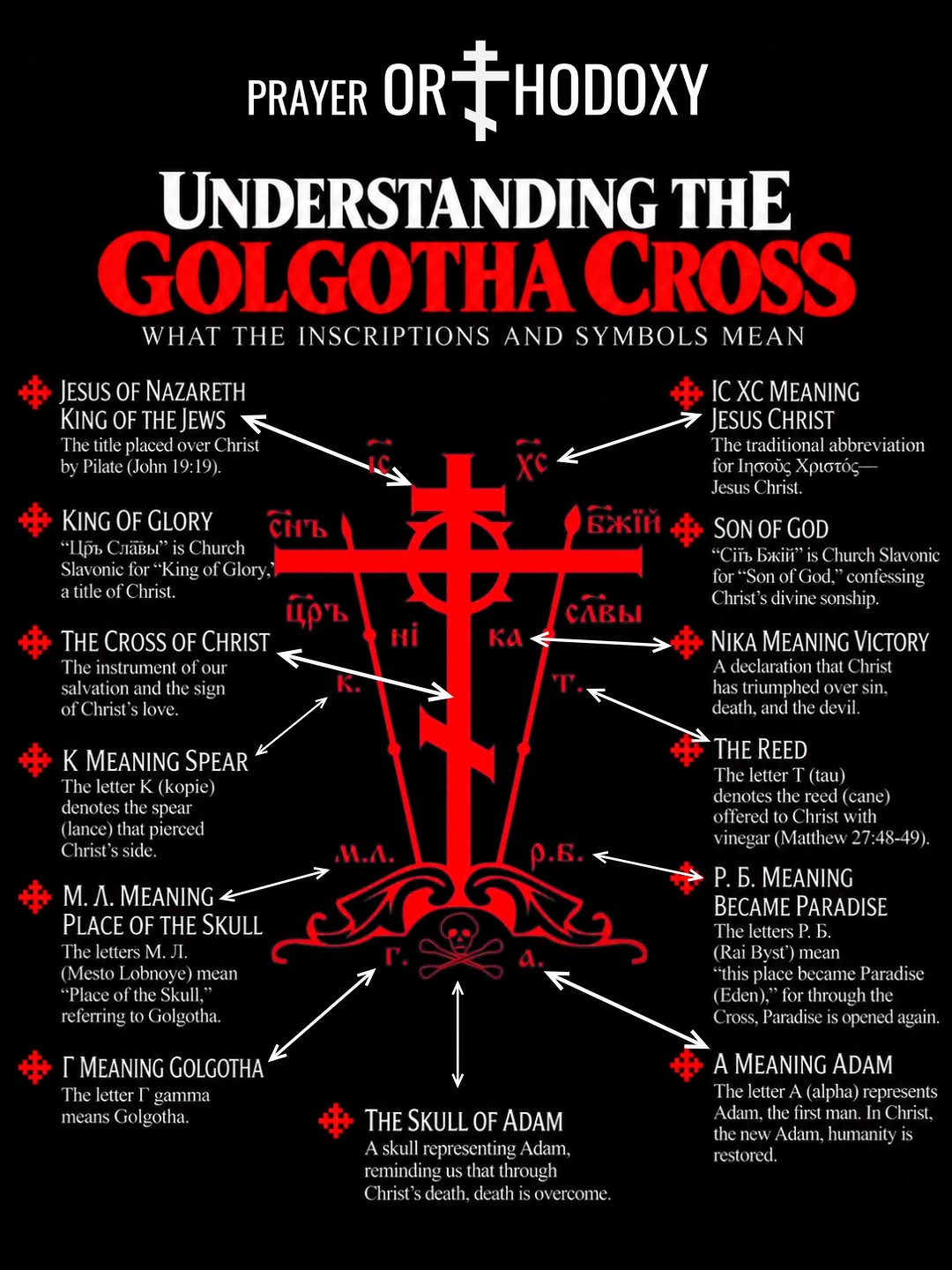
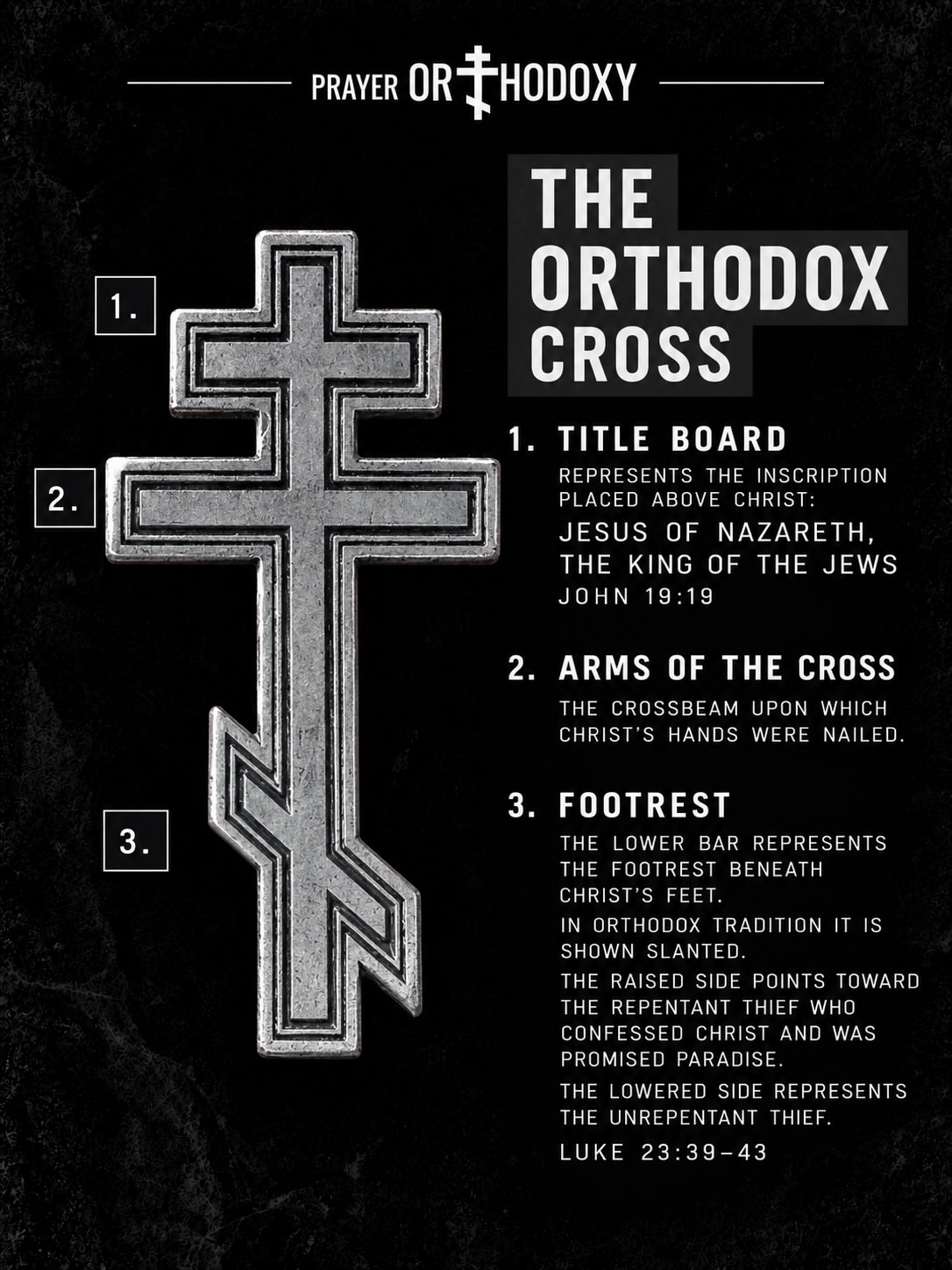
Why Orthodox Christians wear the cross: confession, remembrance, call to follow Christ

The post explains the reasons Orthodox Christians wear a cross. It states the cross serves as a visible confession of belonging to Christ. It reminds the wearer of Christ's Crucifixion and Resurrection, of Baptism into His death and new life, and of His command to take up one's own cross and follow Him. The cross also functions as a constant call to repentance, humility, prayer, and faithfulness. A section titled "THE CROSS BEFORE US" expands…

The post explains the reasons Orthodox Christians wear a cross. It states the cross serves as a visible confession of belonging to Christ. It reminds the wearer of Christ's Crucifixion and Resurrection, of Baptism into His death and new life, and of His command to take up one's own cross and follow Him.

The cross also functions as a constant call to repentance, humility, prayer, and faithfulness. A section titled "THE CROSS BEFORE US" expands that the Orthodox Cross calls to a life of repentance, humility, sacrifice, and hope. It reminds that suffering is never the final word. Through Christ, the Cross became the path to life, victory, and the Kingdom of Heaven.

To venerate the Cross is to remember what Christ has done and to ask whether one is willing to carry one's own cross faithfully. The same content appears in Greek. The post is attributed as an original production of Prayer Orthodoxy.

  • The cross is worn as a visible confession of belonging to Christ.
  • It recalls Christ's Crucifixion, Resurrection, and the wearer's Baptism into His death and new life.
  • It represents Christ's command to take up one's own cross and follow Him.
  • It serves as a constant call to repentance, humility, prayer, and faithfulness.
  • Venerating the Cross means remembering Christ's work and examining one's willingness to carry one's cross faithfully.
Read more