WeOrthodox
EN UA

Eastern Orthodoxy Daily He/Who/Is

Instagram ↗ 112 discussions

Scripture, Saints & Satire Left Rome for Home 📍Illinois USA📍 ╬☦️ Dyophysite Eastern Orthodox ☦️╬

Spiritual Warfare Means Union with Christ, Not Obsession with Demons

The post addresses a common tendency among Christians to attribute excessive power to the devil, wondering whether every misfortune is a demonic attack. It affirms that spiritual warfare, demons, and temptation are real, but emphasizes that Orthodox Christians are not called to live in constant fear of the enemy. Instead, they are called to live in Christ. Practical responses include making the sign of the Cross, praying the Jesus Prayer, going…

The post addresses a common tendency among Christians to attribute excessive power to the devil, wondering whether every misfortune is a demonic attack. It affirms that spiritual warfare, demons, and temptation are real, but emphasizes that Orthodox Christians are not called to live in constant fear of the enemy. Instead, they are called to live in Christ. Practical responses include making the sign of the Cross, praying the Jesus Prayer, going to confession, receiving the Holy Mysteries, repenting, remaining humble, and trusting in God's protection.

The teaching of St John Chrysostom is cited: believers should renounce Satan, belong to Christ, and arm themselves with the holy cross. The focus must remain on Christ through these practices because the goal of spiritual warfare is union with Christ, not fascination with demons. The post concludes by urging Christians to stop asking how powerful the devil is and to remember who their King is.

Key moments

  1. Christians give the devil far more power in their minds than he actually deserves.
  2. Every time something bad happens, people wonder if it is a demon, a nightmare, or an attack.
  3. Orthodox Christianity teaches that spiritual warfare is real and that demons are real and temptation is real.
  4. St John Chrysostom taught Christians to respond not with obsession but by renouncing Satan, belonging to Christ, and arming themselves with the holy cross.
  5. Your attention should not be constantly on the enemy; your attention should be on Christ.
  6. Crush yourself, pray the Jesus prayer, go to confession, receive the mysteries with the blessing and preparation of the church.
  7. Live a life of repentance because the goal of spiritual warfare is to become united to Christ, not to become fascinated with demons.
  8. Stop asking how powerful the devil is and start remembering who your king is.
Read more

Monothelitism: The Failed Compromise That Condemned Popes and Divided the Maronites

The post traces the history of Monothelitism, a seventh-century attempt to reconcile Chalcedonian and Miaphysite Christians by confessing two natures in Christ but only one will. Emperor Heraclius and Patriarch Sergius of Constantinople promoted the formula, first as Monoenergism (one operation) then as Monothelitism (one will). The imperial patriarch Cyrus of Alexandria negotiated a reunion with some non-Chalcedonian clergy in 633, but the…

The post traces the history of Monothelitism, a seventh-century attempt to reconcile Chalcedonian and Miaphysite Christians by confessing two natures in Christ but only one will. Emperor Heraclius and Patriarch Sergius of Constantinople promoted the formula, first as Monoenergism (one operation) then as Monothelitism (one will). The imperial patriarch Cyrus of Alexandria negotiated a reunion with some non-Chalcedonian clergy in 633, but the Coptic patriarch Benjamin I refused to participate.

St. Sophronius of Jerusalem opposed the teaching, and St. Maximus the Confessor argued that a complete human nature requires a human will; without it, the Incarnation cannot heal the human will. Maximus was tortured, his hand and tongue removed, and exiled. Pope Martin I condemned Monothelitism at the Lateran Council of 649, was arrested by imperial authorities, brought to Constantinople, and exiled to Cherson, where he died in 655. Pope Honorius I had endorsed the one-will language in correspondence with Sergius; the Sixth Ecumenical Council (680-681) condemned Monothelitism and anathematized Honorius by name, a condemnation ratified by Pope Leo II.

The post also examines the Maronites, a Syriac monastic community historically Chalcedonian, who became associated with Monothelitism during the seventh and eighth centuries. Eleventh-century Maronite liturgical texts and the Kitab al-Huda explicitly confess one will in Christ, distinguishing them from the Melkites who confessed two wills.

Around 1182, William of Tyre reported that approximately 40,000 Maronites renounced Monothelitism and entered communion with Rome. The author uses these historical facts to challenge claims of papal supremacy and infallibility.

  • Monothelitism emerged as an imperial attempt to unite Chalcedonians and Miaphysites by confessing two natures but one will in Christ.
  • St. Maximus the Confessor and Pope St. Martin I defended two wills; both were persecuted by imperial authorities.
  • Pope Honorius I was posthumously condemned for heresy by the Sixth Ecumenical Council.
  • The Maronites held a one-will Christology for centuries, documented in their own liturgical and theological texts.
  • Around 1182, large numbers of Maronites formally renounced Monothelitism and entered communion with Rome.
Read more

Debate clip challenges non-denominational view on early church and Scripture

A questioner confronts a non-denominational Protestant who identifies himself as simply following the Bible. The questioner asks what church he attends and challenges him to name anyone in the first nine hundred years of church history who held a comparable theological position. The Protestant repeats that he goes by the Bible alone. The questioner calls this a blunder, stating that Christians did not have the Bible for almost seven hundred…

A questioner confronts a non-denominational Protestant who identifies himself as simply following the Bible. The questioner asks what church he attends and challenges him to name anyone in the first nine hundred years of church history who held a comparable theological position. The Protestant repeats that he goes by the Bible alone. The questioner calls this a blunder, stating that Christians did not have the Bible for almost seven hundred years and relied on tradition and icons.

He argues that denying the church is denying the very foundation Christ built for his followers. The exchange centers on the historical availability of Scripture, the role of tradition in the early church, and the claim that a Bible-only approach lacks historical precedent in the first millennium.

Key moments

  1. The questioner asks "What is your church?" and says "We don't even know. What church are you attending?"
  2. The Protestant identifies as a non-denominational Protestant, and the questioner challenges him to name anybody in the first 900 years of the church who had his theological non-denominational position.
  3. The Protestant responds "I just go with the Bible, man. I just go..."
  4. The questioner calls this a huge blunder because people didn't even have the Bible for almost 700 years later.
  5. The questioner states that early Christians relied on tradition and icons.
  6. The questioner argues that denying the church is denying the very foundation that Christ built for us to follow him.
30 opinions in the discussion What would a non-denominational believer have used before compilation and canonization? Tradition. Read the discussion

True conversion demands deep study, not single issues

The post begins with a blunt critique of people who treat conversion to Orthodoxy as a reaction to a single doctrinal disagreement, such as the mode of baptism or the principle of sola scriptura. The author observes that many modern Protestants already hold views similar to the historic Orthodox position on baptism, so adopting that view does not by itself justify leaving a Protestant community. The author also mocks the vague label "Christ…

The post begins with a blunt critique of people who treat conversion to Orthodoxy as a reaction to a single doctrinal disagreement, such as the mode of baptism or the principle of sola scriptura. The author observes that many modern Protestants already hold views similar to the historic Orthodox position on baptism, so adopting that view does not by itself justify leaving a Protestant community.

The author also mocks the vague label "Christ follower" and the lack of urgency in discovering what that title actually entails, noting the inconsistency of accepting the Eucharist while rejecting the Church that defines it. The author also questions the "GCR social gospel" regardless of good intentions, and calls for the Lord's mercy.

The accompanying video summary expands on these themes. The speaker argues that comments about conversion are often ill-informed because people "jump ship without knowing the ship they are jumping into." They insist that converting over one conviction is not enough and recommend reading "Orthodoxy and the Religion of the Future" as a starting point for understanding the differences between traditions.

The speaker emphasizes that the Eucharist cannot be celebrated in any home or informal gathering, contrary to some evangelical podcast claims. True seeking, they say, requires removing bias, putting truth above comfort and relationships, and engaging deeply with patristic and contemporary Orthodox writings. When these sources are read without prejudice, a single concept can shatter an entire worldview.

The discussion that follows centers on the necessity of thorough study before conversion, the danger of picking and choosing beliefs, and the priority of truth over personal preference. The video points list eight specific observations, each reinforcing the central argument that conversion must be grounded in comprehensive study and a willingness to have one's paradigm broken.

Key moments

  1. Comments about conversion are sometimes the dumbest because people jump ship without knowing the ship they are jumping into.
  2. Converting over one conviction is not enough; changing a view on baptism does not require abandoning Protestant beliefs since many Protestants hold that view.
  3. You need to read Orthodoxy and the Religion of the Future and learn about the other traditions before deciding.
  4. Contrary to common evangelical podcast belief, you cannot just have the Eucharist in any home or per synagoga.
  5. Truly seeking means challenging your beliefs and reading the abundant resources available, patristics, contemporary saints, and historic Orthodox perspectives.
  6. When reading these sources without bias, you may find contradictions that destroy your paradigm.
  7. All it takes is one concept to shatter an entire worldview.
  8. You have to put truth above comfort and relationships; that is what following God is.
20 opinions in the discussion I never understood how people can still be Protestant nowadays, Google exists Read the discussion

Debate claim challenged: Orthodoxy as apostolic from the start

The video presents a speaker responding to a statement attributed to the apologist God Logic from a DebateCon event. The speaker quotes God Logic as saying there was no orthodox Christianity until several centuries after Jesus. The speaker rejects this assertion, arguing that orthodox Christianity is the original faith handed down from the first Christians. He explains that orthodoxy means acknowledging what the early Christians believed and the…

The video presents a speaker responding to a statement attributed to the apologist God Logic from a DebateCon event. The speaker quotes God Logic as saying there was no orthodox Christianity until several centuries after Jesus. The speaker rejects this assertion, arguing that orthodox Christianity is the original faith handed down from the first Christians.

He explains that orthodoxy means acknowledging what the early Christians believed and the tradition they transmitted. The speaker invites the audience to share their thoughts on the matter.

Key moments

  1. The speaker says God Logic admitted that Orthodox Christianity is apostolic.
  2. The speaker quotes God Logic from the debate: 'There was no such thing as orthodox Christianity until several centuries after Jesus.'
  3. The speaker counters that this is not true, stating that orthodox Christianity is simply orthodoxy and is the origin.
  4. The speaker disagrees with God Logic, explaining that orthodoxy means acknowledging what the early Christians believed and the tradition they handed down.
  5. The speaker asks the audience for their thoughts.
Read more

The Noonday Demon: When Discouragement Attacks Faith

The post explains the spiritual struggle known as the Noonday Demon, or despondency (acedia), as taught by early Church Fathers. Evagrius Ponticus named it the Noonday Demon, describing it as a state that makes a person restless, dissatisfied, and convinced that life would be better somewhere else. It attacks not through obvious temptation but through a loss of meaning, causing one to question purpose, circumstances, and relationship with God.…

The post explains the spiritual struggle known as the Noonday Demon, or despondency (acedia), as taught by early Church Fathers. Evagrius Ponticus named it the Noonday Demon, describing it as a state that makes a person restless, dissatisfied, and convinced that life would be better somewhere else. It attacks not through obvious temptation but through a loss of meaning, causing one to question purpose, circumstances, and relationship with God.

Saint Isaac the Syrian adds that it produces confusion, irritation, and wandering thoughts. The post advises that not every difficult season signals a need to change one's life; sometimes God calls for growth within it. The recommended response is to keep praying even without feeling, maintain discipline, attend Divine Liturgy, and seek guidance from a spiritual father.

It also notes that genuine exhaustion or mental health struggles deserve proper care. The greatest spiritual victory may be simply refusing to abandon the place where God has put you to grow.

Key moments

  1. The devil's attack doesn't always feel like a temptation; it can sound like "what's the point," causing loss of motivation, difficult prayer, meaningless work, and the sense that everyone else has a better life.
  2. The early church fathers knew this battle well and called it despondency; Evagrius named it the noonday demon.
  3. Evagrius taught that despondency makes people feel dissatisfied with where they are, who they're with, and what they are doing, the belief that life would be better somewhere else.
  4. Sometimes God isn't asking you to escape your life but to be faithful inside it.
  5. Saint Isaac the Syrian teaches that despondency produces confusion, irritation, and wandering thoughts.
  6. When you hit that season, don't make every decision from an exhausted mind.
  7. The response is to pray, keep your routine, go to church, speak to your spiritual father, and keep moving on.
  8. Sometimes your greatest spiritual victory is simply refusing to abandon the place where God has put you to grow.
Read more

Nine Martyred in Terrorist Attack on Jordan Orthodox Church

On 23 October 2026, gunmen opened fire at St. George's Greek Orthodox Church in Hamoud, Karak, Jordan, during a funeral service. Nine people were killed and dozens injured. The Greek Orthodox Patriarchate of Jerusalem condemned the attack, offered condolences to the bereaved families, and called the faithful to steadfast prayer. The post lists the names of those killed: Marwan Al-Khitan, Maheer Al-Zureiqat, Dr. Mohammed Al-Qusus, Bias Nayef…

On 23 October 2026, gunmen opened fire at St. George's Greek Orthodox Church in Hamoud, Karak, Jordan, during a funeral service. Nine people were killed and dozens injured. The Greek Orthodox Patriarchate of Jerusalem condemned the attack, offered condolences to the bereaved families, and called the faithful to steadfast prayer. The post lists the names of those killed: Marwan Al-Khitan, Maheer Al-Zureiqat, Dr. Mohammed Al-Qusus, Bias Nayef Al-Halsa, Dr. Assem Radqan, Mazen Rasmi Al-Qusus, Dr. Khaled Al-Halsa, and Dr. Fadi Al-Halsa.

A quote from St. Justin Martyr accompanies the list: "You can kill us but you cannot do us any real harm." The text ends with prayers for the departed, comfort for the grieving, healing for the wounded, and strength for the Orthodox faithful in Jordan.

  • Attack occurred during a funeral at St. George's Greek Orthodox Church in Hamoud, Karak, Jordan
  • Nine killed and dozens injured on 23 October 2026
  • Greek Orthodox Patriarchate of Jerusalem condemned the violence and called for prayer
  • Eight names of the martyred are listed, with a quote from St. Justin Martyr
  • Text concludes with prayers for the dead, the wounded, and the faithful in Jordan
Read more

True Orthodox masculine leadership requires more than financial provision

1:28

The post argues that providing financially for one's family, while important, does not constitute godly leadership from an Orthodox Christian perspective. The speaker outlines six areas where a husband and father must lead through responsibility, humility, discipline, and self-sacrifice rather than power or control. Spiritual leadership means the man prays, reads Scripture, attends Divine Liturgy, goes to confession, and teaches his children by…

The post argues that providing financially for one's family, while important, does not constitute godly leadership from an Orthodox Christian perspective. The speaker outlines six areas where a husband and father must lead through responsibility, humility, discipline, and self-sacrifice rather than power or control. Spiritual leadership means the man prays, reads Scripture, attends Divine Liturgy, goes to confession, and teaches his children by example rather than expecting his wife to carry the spiritual life of the home.

Emotional leadership involves feeling anger and fear but not being ruled by them, responding to conflict with patience instead of escalation. Protection requires building physical strength, awareness, and practical competence so that wife and children feel safe with him, never afraid of him. Keeping one's word means following through on promises, owning failures, and making them right, as Christ taught to let yes be yes and no be no. Vision and order involve knowing family values, managing money, deciding where to worship, and building a home by listening, planning with his wife, and taking responsibility.

Presence means giving family time, attention, service, and affection, putting down the phone, listening to his wife, and being with his children, because Christ's leadership was sacrificial, not selfish. The post concludes by asking men which of these six areas they find most challenging.

Key moments

  1. A man cannot expect his wife to carry the entire spiritual life of the home; he must pray, read scripture, go to Divine Liturgy, confess his sins, and teach his children by example.
  2. Emotional leadership means a man feels anger and fear but learns not to be ruled by them, responding to conflict with patience instead of escalation.
  3. Protection requires building physical strength, awareness, and practical competence so that wife and children feel safe with him, never afraid of him.
  4. Keeping one's word means following through on promises, owning failures, and making them right, as Christ teaches to let yes be yes and no be no.
  5. Vision and order involve knowing family values, managing money, deciding where to worship, and building a home by listening, planning with his wife, and taking responsibility.
  6. Presence means giving family time, attention, service, and affection, putting down the phone, listening to his wife, and being with his children, because Christ's leadership was sacrificial, not selfish.
Read more

Apostolic authority as a historical question: Chalcedon and the Eighth Council

The post shares a video in which Alex responds to a question about how to determine which church holds correct apostolic authority, specifically comparing the Eastern Orthodox Church to the Oriental Orthodox Church. He argues that this is a historical question requiring historical inquiry and evaluation of the merits. Regarding the Council of Chalcedon, he states that the Oriental Orthodox initially accepted it but then a mob lynched the new…

The post shares a video in which Alex responds to a question about how to determine which church holds correct apostolic authority, specifically comparing the Eastern Orthodox Church to the Oriental Orthodox Church. He argues that this is a historical question requiring historical inquiry and evaluation of the merits. Regarding the Council of Chalcedon, he states that the Oriental Orthodox initially accepted it but then a mob lynched the new patriarch and installed an anti-Chalcedonian patriarch, which he says resembles setting up a separate church.

Concerning the Eighth Ecumenical Council, he says that Rome and Constantinople agreed to recognize each other's jurisdiction and not alter the creed, but Rome went back on that agreement while the Orthodox Church maintained it. The video opens with a quotation from St. Irenaeus of Lyons on the ability to trace episcopal succession from the apostles to the present.

Key moments

  1. The question of which church has correct apostolic authority is a historical question that requires historical inquiry and evaluating the merits.
  2. At the Council of Chalcedon, the Oriental Orthodox initially accepted it but then a mob lynched the new patriarch and installed an anti-Chalcedonian patriarch, which appears to be setting up their own church.
  3. At the Eighth Ecumenical Council, Rome and Constantinople agreed to recognize each other's jurisdiction and not change the creed, but Rome went back on that agreement.
  4. The Orthodox Church is the one that maintained the agreement and did not change.
Read more

Saint John of Shanghai and San Francisco: A Life of Prayer and Care for Children

The video presents the life of Saint John of Shanghai and San Francisco, recognized as San Francisco's own Christian saint. He devoted himself to prayer, frequently giving up sleep to spend more time with God. While serving in Shanghai, he personally cared for over 1,500 abandoned and needy children, rescuing sick and starving children from the streets. He reposed in 1966, and his relics remain in San Francisco today. The video concludes that…

The video presents the life of Saint John of Shanghai and San Francisco, recognized as San Francisco's own Christian saint. He devoted himself to prayer, frequently giving up sleep to spend more time with God. While serving in Shanghai, he personally cared for over 1,500 abandoned and needy children, rescuing sick and starving children from the streets.

He reposed in 1966, and his relics remain in San Francisco today. The video concludes that his life demonstrates the path to holiness begins when we stop living for ourselves and start living completely for Jesus Christ.

Key moments

  1. San Francisco has its own Christian saint, Saint John of Shanghai and San Francisco.
  2. He dedicated his life to prayer and often sacrificed sleep to spend more time with God.
  3. He personally helped care for more than 1,500 abandoned and needy children in Shanghai.
  4. He rescued sick and starving children from the streets.
  5. He reposed in 1966.
  6. His relics remain in San Francisco to this day.
  7. Saint John reminds us that the path to holiness begins when we stop living for ourselves and start living completely for Jesus Christ.
Read more

Baptismal Regeneration and Synergism: The Early Church's Teaching

The speaker begins by reading a comment that mocks baptismal regeneration. He responds by stating that the early church historically taught baptism is the means by which a person becomes a Christian. To support this, he cites Jesus' words in John 3: "unless one is born of water and spirit he cannot enter the kingdom of God," and Paul's description in Titus 3: "the washing of water and regeneration of the Spirit." The speaker then argues that the…

The speaker begins by reading a comment that mocks baptismal regeneration. He responds by stating that the early church historically taught baptism is the means by which a person becomes a Christian. To support this, he cites Jesus' words in John 3: "unless one is born of water and spirit he cannot enter the kingdom of God," and Paul's description in Titus 3: "the washing of water and regeneration of the Spirit."

The speaker then argues that the doctrine of faith alone misunderstands belief as a passive act and makes God a hard determinist, thereby removing human free will. He turns to John 6, where Jesus says, "the work of God is to believe in the one he sent," demonstrating that belief itself is a work, not a passive act. He also references Mark 6, where Jesus could do no mighty work because of the people's unbelief, illustrating that healing requires synergy with Christ through belief.

From these passages he concludes that salvation involves synergism: humans cooperate with God through belief. The speaker notes that Christ commands the proclamation of the gospel, and that whoever believes, which is a work, and is baptized will be saved, while unbelief brings condemnation. He ends by affirming that belief and baptism belong together as a both/and, not an either/or.

Key moments

  1. 0:00 The speaker reads a comment that mocks baptismal regeneration and says the early church historically taught baptism is how you become a Christian.
  2. 0:31 Jesus says unless one is born of water and spirit he cannot enter the kingdom of God, and Titus 3 describes the washing of water and regeneration of the Spirit.
  3. 0:31 The idea of faith alone makes God a hard determinist and removes human free will.
  4. 1:01 In John 6 Jesus says the work of God is to believe in the one he sent, showing belief itself is a work, not a passive act.
  5. 1:36 Salvation involves synergism: humans work with God through belief, as shown in Mark 6 where unbelief prevented healing.
  6. 2:11 Christ commands proclaiming the gospel; whoever believes (a work) and is baptized will be saved, while unbelief brings condemnation.
  7. 2:45 Belief and baptism go together as a both/and, not an either/or.
Eastern Orthodoxy Daily He/Who/Is with Timothy Instagram

Debate on Orthodox continuity versus Catholic doctrinal development

A three-part exchange examines competing claims about tradition and doctrinal continuity between the Orthodox and Catholic Churches. The first speaker argues that the Orthodox Church is more consistent because it preserves tradition without altering it every few centuries, implying that the Catholic Church changes tradition. A second speaker counters that this view is backwards: after the Great Schism, the Orthodox Church gradually lost…

A three-part exchange examines competing claims about tradition and doctrinal continuity between the Orthodox and Catholic Churches. The first speaker argues that the Orthodox Church is more consistent because it preserves tradition without altering it every few centuries, implying that the Catholic Church changes tradition. A second speaker counters that this view is backwards: after the Great Schism, the Orthodox Church gradually lost doctrines in response to Catholic dogmatic definitions, and for the first thousand years both Churches shared the identical faith.

The third speaker replies that this objection assumes later Roman dogmas constituted the universal faith of the first millennium, which is precisely the point that requires proof. The Orthodox standard of continuity, the third speaker explains, asks whether a teaching belongs to the apostolic deposit, was taught by the Fathers, received in councils, prayed in the liturgy, and held across the undivided Church.

Continuity is measured by what was already received, not by whether Rome later defined something. To substantiate the claim that Orthodoxy abandoned doctrine, one must demonstrate that those doctrines were universally taught before the schism in substantially the same form that Rome later dogmatized. Otherwise the argument reads later Roman developments back into the early Church and makes Rome the retroactive standard of orthodoxy.

The speaker concludes that this approach makes Rome the measure of itself and ends with the doxology, "All glory to God."

Key moments

  1. A speaker says the Orthodox are more consistent because they stick to tradition without changing it every couple hundred years, implying the Catholic Church changes tradition.
  2. Another speaker argues this is backwards: after the schism the Orthodox Church gradually lost actual doctrines in response to Catholic dogmatic definitions, and for the first millennium both churches had the exact same faith.
  3. A third speaker replies that this assumes later Roman dogmas were the universal faith of the first millennium, which is what needs to be proven.
  4. The Orthodox standard of continuity is whether a teaching was the faith of the undivided church, taught by the Fathers, received in councils, prayed in the liturgy, and held across the church.
  5. Continuity is measured by the apostolic deposit already received, not by whether Rome later defined something.
  6. To claim Orthodoxy abandoned doctrine, one must demonstrate those doctrines were universally taught before the schism in substantially the same form Rome later dogmatized.
  7. Otherwise the argument reads later Roman developments back into the first millennium church and accuses Orthodoxy of abandoning the faith for not accepting that retroactive reading.
  8. The speaker concludes this makes Rome the retroactive standard and congratulates itself for matching it, ending with "All glory to God."
Read more

Saints in Heaven Are Alive: Transfiguration and Revelation Show Conscious Intercession

0:28

The speaker addresses the objection that praying to saints is praying to dead people, acknowledging that Mary and the apostles have died. He cites Ecclesiastes, which says the dead know nothing, but counters with the Transfiguration, where Moses appears alive and speaks with Jesus despite his earthly death. Jesus declares that he is the God of the living, not the dead. The Book of Revelation depicts saints in heaven consciously crying out to…

The speaker addresses the objection that praying to saints is praying to dead people, acknowledging that Mary and the apostles have died. He cites Ecclesiastes, which says the dead know nothing, but counters with the Transfiguration, where Moses appears alive and speaks with Jesus despite his earthly death. Jesus declares that he is the God of the living, not the dead.

The Book of Revelation depicts saints in heaven consciously crying out to God, asking him to act on earth. From these passages, the speaker concludes that the saints are conscious and interceding, and that asking for their intercession is more apostolic than relying on the canon alone.

Key moments

  1. Mary and the apostles are dead people, yet Christians pray to them.
  2. Scripture says the dead know nothing, referencing Ecclesiastes.
  3. Moses physically spoke with Jesus at the Transfiguration despite his earthly death.
  4. Jesus says he is the God of the living, not the dead.
  5. In Revelation, saints in heaven cry out to God asking him to act on earth.
  6. This shows the saints are conscious and interceding.
  7. Asking saints to intercede for us is more apostolic than the canon.
Read more

Unitarianism functionally polytheistic despite monotheistic claims

The post argues that Unitarian theology, while professing one God, assigns divine roles to Jesus as a creature, making it functionally polytheistic. The author states that praying to Jesus as "first of all creation" is still praying to a creature, and invoking that creature for salvation assigns it a divine role, elevating it to a lesser deity. By Islamic standards this constitutes shirk regardless of Unitarian insistence on monotheism. From a…

The post argues that Unitarian theology, while professing one God, assigns divine roles to Jesus as a creature, making it functionally polytheistic. The author states that praying to Jesus as "first of all creation" is still praying to a creature, and invoking that creature for salvation assigns it a divine role, elevating it to a lesser deity.

By Islamic standards this constitutes shirk regardless of Unitarian insistence on monotheism. From a traditional Christian perspective, worship belongs only to God; if Jesus is treated as spiritually essential while being denied divinity, religious reliance is placed on a creature. This issue is exactly what early Christians like St. Athanasius argued against when confronting Arian theology.

Jewish critiques come from a different angle: Judaism guards divine unity strictly, so assigning cosmic roles like judgment, mediation, or salvation to a human figure feels like adding another participant into God's authority. Even if technically subordinate, elevating a man into divine function crosses the boundary of pure monotheism.

Philosophically, the author distinguishes between saying there is one God and actually living as if only one ultimate reality exists. A belief system can claim one divine being in theory while in practice spreading devotion across multiple sacred centers. The author concludes that Unitarianism keeps monotheism as an idea but functionally drifts into something that looks more like polytheism in how devotion, authority, and meaning get divided when Christ gets involved.

To Muslims who favor Unitarians, the author promises that Unitarian theology would constitute shirk in Islam because Jesus is not a human or prophet in their theology but far beyond that.

  • Praying to Jesus as first of creation directs worship to a creature
  • Traditional Christianity requires Christ's divinity for spiritual reliance
  • St. Athanasius opposed similar Arian theology in the early Church
  • Judaism rejects assigning divine functions to a human figure
  • Islam would classify Unitarian devotion to Jesus as shirk
4 opinions in the discussion I'd like to see this same diagram done for the Catholic Filioque. What exactly about the structure of the Trinity gets broken by adding it? Read the discussion
Eastern Orthodoxy Daily He/Who/Is Instagram

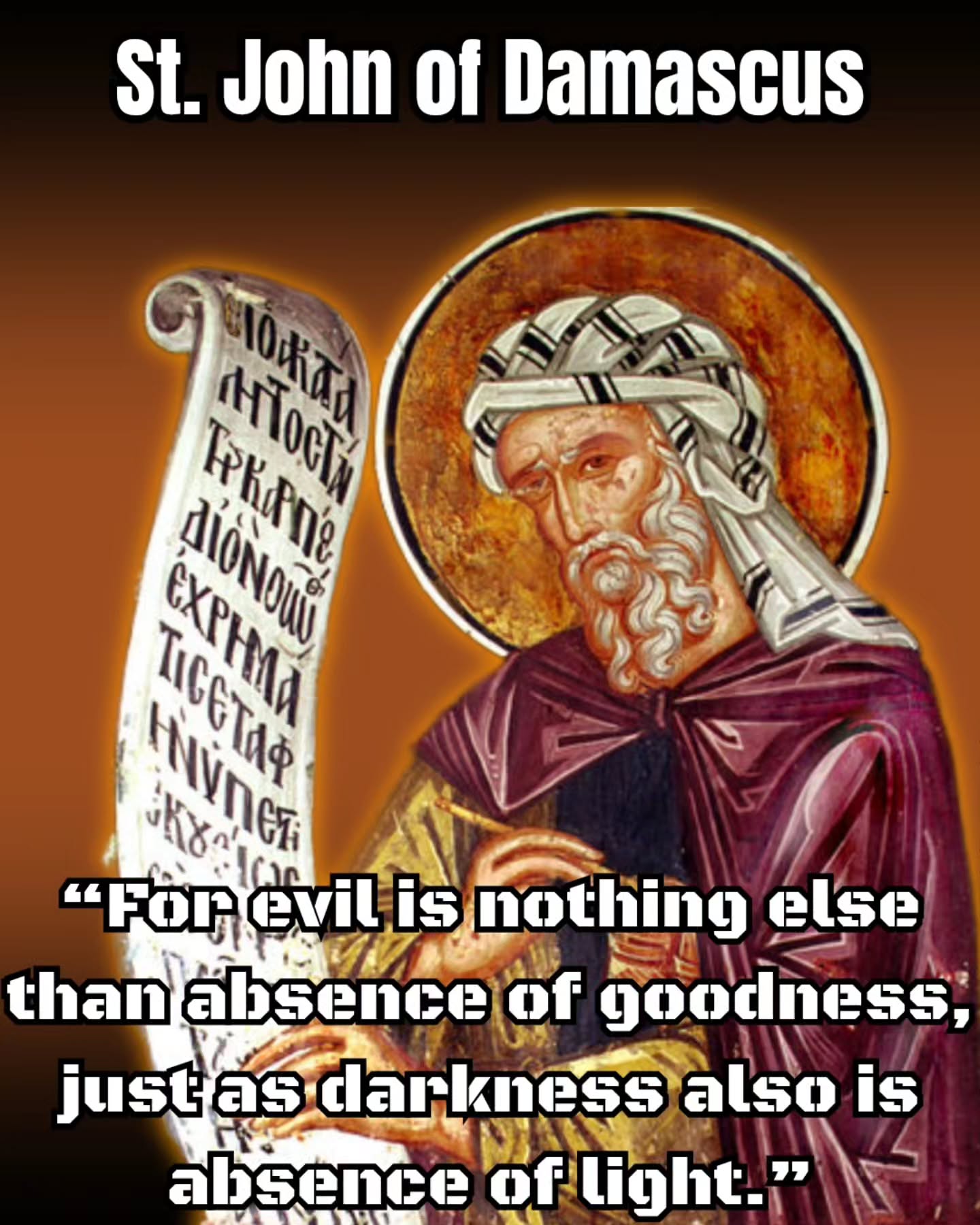
St. John of Damascus and His Exact Exposition of the Orthodox Faith

The post identifies St. John of Damascus and his work "An Exact Exposition of the Orthodox Faith" as the single most important resource for understanding Orthodoxy. It includes a quotation from the saint: "For evil is nothing else than absence of goodness, just as darkness also is absence of light." The statement presents evil as a privation of good rather than an independent reality.

  • St. John of Damascus wrote "An Exact Exposition of the Orthodox Faith"
  • The work is called the most important single resource for understanding Orthodoxy
  • The post quotes the saint on evil as absence of goodness
  • The quote compares evil to darkness as absence of light

Debating the Canon: Scripture, Archaeology, and External Evidence

0:19

A challenger asks how one can know Scripture is true without appealing to Scripture itself, arguing that Scripture cannot prove itself. The respondent points to archaeology as a literal science and to manuscript evidence that would be admissible in a court of law. The challenger replies that archaeology does not establish what the canon is, and claims this demonstrates the limits of external evidence.

Key moments

  1. The challenger asks how one knows scripture is true outside of scripture, stating scripture cannot prove itself.
  2. The respondent appeals to archaeology as a literal science and manuscript evidence admissible in a court of law.
  3. The challenger counters that no archaeology establishes what the canon is, claiming this proves their point.
Read more
Eastern Orthodoxy Daily He/Who/Is Instagram

Why Freemasonry Contradicts Christian Faith

The speaker argues that Freemasonry is bound up with Judaism in its sources and theology, while denying that Christianity shares this bond. He states that containing Jewish elements does not make something Judaism. He criticizes Masonic reliance on the Zohar and Talmud, citing Masonic authority Albert Mackey who directs readers to these texts for the secrets of God, which the speaker calls rabbinic theology rather than ancient wisdom. He…

The speaker argues that Freemasonry is bound up with Judaism in its sources and theology, while denying that Christianity shares this bond. He states that containing Jewish elements does not make something Judaism. He criticizes Masonic reliance on the Zohar and Talmud, citing Masonic authority Albert Mackey who directs readers to these texts for the secrets of God, which the speaker calls rabbinic theology rather than ancient wisdom.

He disagrees with Mackey and Harvard scholar William Green, who writes that Masonry's ethos is Jewish. The speaker observes that Masonry can be shaped into whatever one wants because it lacks emphasis on Christianity, except perhaps in later York Rite versions. He states that Masonry downplays the divinity of Christ and the specifics of Christianity.

Referencing Albert Pike, he says Masonry is based on syncretism, the idea that all religions are masks of one ultimate God, which contradicts Christian absolutes. He concludes that participating in Masonry as a Christian is like joining with ecumenists and is antithetical to the absolutes of Christianity.

Key moments

  1. The speaker asserts that Freemasonry is bound up with Judaism to some degree.
  2. The speaker denies that Christianity is bound up with Judaism, stating that containing Judaism does not make something Judaism.
  3. The speaker says Freemasons, through Mackey, direct people to read the Zohar and the Talmud for the secrets of God, which he calls rabbinic theology and not ancient.
  4. The speaker disagrees with Mackey and with Harvard scholar William Green, who writes that Masonry's ethos is Jewish.
  5. The speaker observes that Masonry can be made into whatever one wants because it lacks emphasis on Christianity except perhaps in later York Rite versions.
  6. The speaker states that Masonry downplays the divinity of Christ and the specifics of Christianity.
  7. The speaker references Albert Pike, saying Masonry is based on syncretism, the idea that all religions are masks of one ultimate God.
  8. The speaker concludes that participating in Masonry as a Christian is like joining with ecumenists and is antithetical to the absolutes of Christianity.

Saint Seraphim of Sarov: Life, Teaching, and the Acquisition of the Holy Spirit

The post presents a biographical overview of Saint Seraphim of Sarov (1754-1833), one of the most beloved saints of the Eastern Orthodox Church. It describes his early devotion to Christ, monastic life, and years of ascetic struggle in the forests of Sarov. The text notes his brutal attack by robbers and his response of humility and forgiveness. Later in life, he welcomed countless visitors seeking spiritual guidance, greeting them with the…

The post presents a biographical overview of Saint Seraphim of Sarov (1754-1833), one of the most beloved saints of the Eastern Orthodox Church. It describes his early devotion to Christ, monastic life, and years of ascetic struggle in the forests of Sarov. The text notes his brutal attack by robbers and his response of humility and forgiveness.

Later in life, he welcomed countless visitors seeking spiritual guidance, greeting them with the words "My joy, Christ is risen!" The post highlights his central teaching that "the acquisition of the Holy Spirit is the true aim of the Christian life" and that Christianity is about union with God through grace rather than outward practices alone.

Following the biography, the post lists nine sayings attributed to Saint Seraphim, covering silence, peace, trust in God, endurance of affliction, illness and patience, and the importance of establishing oneself in God before helping others. An image description mentions a painting of the saint kneeling by a stream, and a line in Church Slavonic gives his title. The post originates from a page dedicated to the Church Fathers and their teachings.

  • Saint Seraphim devoted himself to Christ from youth, embracing monasticism, solitude, and unceasing prayer in the Sarov forests.
  • He responded to a brutal robbery attack with humility and forgiveness.
  • His central teaching: the acquisition of the Holy Spirit is the true aim of Christian life.
  • He greeted visitors with "My joy, Christ is risen!" and offered spiritual guidance.
  • The post includes nine attributed sayings on silence, peace, trust, affliction, illness, and establishing oneself in God.
Read more
Eastern Orthodoxy Daily He/Who/Is with Timothy Instagram

The Monarchy of the Father: Source and Unity in the Trinity

The post explains the Orthodox doctrine of the Monarchy of the Father, drawing on the Cappadocian Fathers, St. Basil the Great, St. Gregory the Theologian, and St. Gregory of Nyssa. It defines Monarchia as the one principle or source within the Trinity, not a political hierarchy. The Father is the unbegotten archē, the sole eternal source of the Son and the Holy Spirit. The Son is eternally begotten, the Spirit eternally proceeds; these are not…

The post explains the Orthodox doctrine of the Monarchy of the Father, drawing on the Cappadocian Fathers, St. Basil the Great, St. Gregory the Theologian, and St. Gregory of Nyssa. It defines Monarchia as the one principle or source within the Trinity, not a political hierarchy. The Father is the unbegotten archē, the sole eternal source of the Son and the Holy Spirit.

The Son is eternally begotten, the Spirit eternally proceeds; these are not temporal events but eternal relations of origin. There was never a Father without the Son or the Spirit. The distinction between ousia (essence) and hypostasis (person) is central: one divine ousia is shared fully by three distinct hypostases. The Persons are distinguished by incommunicable hypostatic properties, the Father is unbegotten, the Son begotten, the Spirit proceeds, which are not attributes of the essence but identify each Person's mode of existence.

The text rejects any ontological subordination: the Father's causality does not imply superiority, greater divinity, or temporal priority. The Son is homoousios with the Father, true God from true God. The unity of God is maintained because the three Persons share one numerically undivided divine essence and are inseparable in their eternal relationships and operations, as St. Gregory of Nyssa argues in 'On Not Three Gods'.

The Cappadocians defended both the unity of God and the full divinity of the Son and Spirit: St. Basil distinguished the common essence from particular hypostatic properties; St. Gregory the Theologian emphasized the Father's unique position as source while rejecting inferiority of the Son or Spirit; St. Gregory of Nyssa developed the relationship between unity of nature, personal distinctions, and inseparability of divine operations.

Finally, the post emphasizes the limits of human language: terms like generation, procession, and cause are necessary but cannot be understood by analogy with created realities. St. Gregory the Theologian, in his Fifth Theological Oration, insists that the manner of the Son's generation remains incomprehensible.

  • The Father is the sole eternal source (archē) of the Son and the Holy Spirit.
  • The Son is eternally begotten and the Spirit eternally proceeds; these are not temporal events.
  • One divine ousia is shared fully by three distinct hypostases, distinguished by incommunicable properties.
  • The Monarchy of the Father does not imply superiority or subordination; the Son and Spirit are fully divine and consubstantial with the Father.
  • The Cappadocian Fathers articulated this doctrine to preserve both the unity of God and the real distinction of the Persons, while acknowledging the incomprehensibility of divine generation and procession.
Read more

Salvation requires cooperation with grace, not passive righteousness

0:23

The speaker rejects the claim that a person contributes nothing to salvation. He argues that equating the righteousness of a believer who struggles with sin but has the Holy Spirit with that of any other believer contradicts Scripture's commands to persevere, obey Christ, and not fall away. He describes a scenario where he stands before God next to someone unable to stop drinking yet who has the Holy Spirit, saying both would stand on the same…

The speaker rejects the claim that a person contributes nothing to salvation. He argues that equating the righteousness of a believer who struggles with sin but has the Holy Spirit with that of any other believer contradicts Scripture's commands to persevere, obey Christ, and not fall away. He describes a scenario where he stands before God next to someone unable to stop drinking yet who has the Holy Spirit, saying both would stand on the same level of righteousness under that view.

He references Romans, stating that God will render to each one according to his works. He concludes that salvation cannot be earned but requires free cooperation with God's grace.

Key moments

  1. The speaker states that he contributes zero to his salvation.
  2. He describes standing before God next to someone unable to stop drinking but who has the Holy Spirit, saying both stand on the same level of righteousness.
  3. He says this view contradicts all of Scripture when it tells us to persevere, obey Christ, and not fall away.
  4. He references Romans, stating that God will render each one according to his works.
  5. He concludes that we cannot earn salvation but must freely cooperate with God's grace.
Read more