WeOrthodox
EN UA

Orthodox posts, videos and discussions

We follow Orthodox channels, communities and blogs across the web, summarise every post and video, and highlight the conversations with real substance.

Saint Wisdom Instagram

Saint Paisios on choosing a wife: prioritize soul over beauty

Saint Paisios of Mount Athos speaks on the subject of choosing a wife. He states that wealth and physical beauty should not be the main concerns in this decision. Instead, he identifies four qualities to seek first: simplicity, humility, a good disposition, and the fear of God. The saint contrasts the beauty of the soul with outward beauty, explaining that attention to the soul's beauty allows two people to understand each other and to face…

Saint Paisios of Mount Athos speaks on the subject of choosing a wife. He states that wealth and physical beauty should not be the main concerns in this decision. Instead, he identifies four qualities to seek first: simplicity, humility, a good disposition, and the fear of God.

The saint contrasts the beauty of the soul with outward beauty, explaining that attention to the soul's beauty allows two people to understand each other and to face life's difficulties together. The presentation also notes that Haven offers help to those who feel lost in finding their way back to God.

Key moments

  1. Do not make wealth or physical beauty the main concern when looking for a wife.
  2. Look first for simplicity, humility, a good disposition, and the fear of God.
  3. Pay more attention to the beauty of the soul than to outward beauty.
  4. This allows two people to understand one another and face the difficulties of life together.
  5. If you are feeling lost, Haven can help you find your way back to God.
Read more
Kyle YouTube discussion

AI Won't Destroy Us — the Real Danger Is Measuring Human Worth by Productivity

AI Won't Destroy Us — the Real Danger Is Measuring Human Worth by Productivity 33:48

This video argues that the greatest threat posed by artificial intelligence is not a science-fiction takeover but a spiritual one: the temptation to define human value by productivity and output. The speaker traces how a materialist worldview already reduces people to producers and consumers, and how AI's superiority at tasks sharpens that reduction into a crisis: if machines can do everything better, what is a human being for? Christianity…

This video argues that the greatest threat posed by artificial intelligence is not a science-fiction takeover but a spiritual one: the temptation to define human value by productivity and output. The speaker traces how a materialist worldview already reduces people to producers and consumers, and how AI's superiority at tasks sharpens that reduction into a crisis: if machines can do everything better, what is a human being for?

Christianity answers with a different anthropology — human dignity rests on being created in God's image and on the calling to theosis, communion with God, not on economic usefulness.

The discussion reviews OpenAI's shift from a nonprofit mission to a for-profit arms race, noting the industry's paradox of warning about extinction risk while racing to build ever more powerful systems, with fear functioning as marketing. Science fiction is surveyed as a mirror of our anxieties: hubris in Frankenstein, misalignment in 2001, weapons control in Terminator, dependence in The Matrix, artificial intimacy in Her, and questions of personhood in Blade Runner.

The speaker's diagnosis is that the root problem is fallen human intelligence — AI magnifies passions but cannot heal sin and death.

The practical response offered is distinctly Orthodox: use AI as a tool, never as an authority; guard the heart; pray, worship, love one's neighbor, do manual work, and live sacramentally, keeping repentance and theosis at the center. Commenters extended the discussion in several directions — memories of underestimating the smartphone's social impact, concern about people treating AI as an unquestionable authority, skepticism about machine sentience on theological and technical grounds (model collapse), and debates about what a true AGI would mean for elites and society.

The overall tone is sober rather than alarmist: the machine is not the enemy, but uncritical dependence on it is a real spiritual danger.

Key moments

  1. 0:00 Historical fears of technology; AI as a tool that becomes dangerous when it becomes the standard by which we measure human value.
  2. 1:01 Modern worldview reduces humans to production and consumption; AI's superiority in tasks forces the question: what is a human being for?
  3. 2:02 Christian anthropology: human dignity comes from being created in God's image, called to theosis (communion with God), not productivity.
  4. 3:35 OpenAI's origin as a nonprofit for AGI benefit, creation of a for-profit subsidiary, and ChatGPT's release transforming public access to AI.
  5. 6:10 AI industry's paradox: companies warn of extinction risk while racing to build; fear functions as marketing for power and investment.
  6. 10:47 Science fiction explores man-machine relationships: hubris (Frankenstein), alignment (2001), weapons control (Terminator), dependence (Matrix), artificial intimacy (Her), personhood (Blade Runner/AI), dependence on artificial thought (Dune).
  7. 15:56 Core Christian diagnosis: the problem is fallen human intelligence—AI magnifies passions but cannot heal sin and death.
  8. 26:48 Practical Christian response: use AI as a tool, not an authority; guard heart, love neighbor, worship, pray, do manual work, live sacramentally, focus on repentance and theosis.
10 opinions in the discussion My priest wrote a book on AI, its dangers, and how it relates to Christianity. I haven't read it yet because it's written in academic-level Greek, but I suppose I'll have to make the effort… Read the discussion
Orthodox Sound YouTube

Christ and Globalization: Elder George Kapsanis on True and False Unity

Christ and Globalization: Elder George Kapsanis on True and False Unity 8:34

Archimandrite George Kapsanis, Abbot of the Holy Monastery of Gregoriou on Mount Athos, wrote this reflection at Christmas in 1998 under the title Christ and Globalization. He warns against a planned globalization in economy, politics, and religion that, he says, seeks to replace Christ with the Antichrist under the banner of the New Age movement. In this false globalization, religions are required to abandon absolute truth and merge into a…

Archimandrite George Kapsanis, Abbot of the Holy Monastery of Gregoriou on Mount Athos, wrote this reflection at Christmas in 1998 under the title Christ and Globalization. He warns against a planned globalization in economy, politics, and religion that, he says, seeks to replace Christ with the Antichrist under the banner of the New Age movement.

In this false globalization, religions are required to abandon absolute truth and merge into a super-religion. He points to interreligious prayers and dialogues in which participating Orthodox clergy fail to confess the Trinity and the Incarnation, and recalls a pan-religious gathering in Romania that included Orthodox patriarchs and archbishops.

He also connects this system to registration and surveillance, saying he feared the Schengen agreement as a forerunner of worldwide registration, citing difficulties Orthodox Balkan Christians faced entering the country.

Against this, Fr. George sets true globalization, which began with the Incarnation. Christ assumed all human nature, united what was divided, and became the universal man in whom there is neither Jew nor Greek, slave nor free, male nor female. A Christian united to Christ becomes universal, embracing all humanity and creation through self-sacrificial love, as seen in the apostles, martyrs, and ascetics.

He contrasts the Antichrist, who sacrifices humans for ideology, with Christ, who sacrificed Himself. He draws a parallel between the Pax Romana, founded on slavery, exploitation, and emperor worship, and today's globalization. The Nativity Vespers hymn contrasts Caesar's enrollment of peoples with the faithful's enrollment in Christ's divinity.

Only the God-man can abolish idols, and Christians seek a theanthropic globalization in the Body of the Church, worshiping Jesus alone and praying for grace to remain faithful unto death.

Key moments

  1. 0:00 Globalization is being actively planned in economy, superstate, and religion, with the New Age movement aiming to replace Christ with the Antichrist by the third millennium.
  2. 0:31 The Christian symbol Ichthys would be replaced by Aquarius as a symbol of the Antichrist, requiring religions to abandon absolute truth for a mixed super-religion.
  3. 1:02 Interreligious dialogues emphasize a shared God among monotheists, but participating Christians often fail to confess the Triune God and incarnate Word; a pan-religious gathering in Romania included Orthodox patriarchs and archbishops.
  4. 2:05 This globalization is against Christ, serving the Antichrist and removing human freedoms; the speaker feared the Schengen agreement as a forerunner of worldwide registration and surveillance.
  5. 3:06 Difficulties faced by Orthodox Balkan Christians entering the country showed the agreement could harm Orthodoxy; Christians refuse cooperation with New Age-inspired globalization.
  6. 3:38 True globalization began with the Incarnation: Christ assumed all human nature, united what was divided, and became the universal man in whom there is neither Jew nor Greek, slave nor free, male nor female.
  7. 5:13 The Antichrist usurps universality by sacrificing humans for ideology, unlike Christ who sacrificed himself; the Pax Romana prefigured this false unity based on slavery and emperor worship.
  8. 6:17 The Nativity Vespers hymn contrasts Caesar's enrollment of peoples with the faithful's enrollment in Christ's divinity; only the God-man can abolish idols, and Christians seek a theanthropic globalization in the Church.
Orthodox Sound YouTube

During Prayer, a Kind of Mystery Takes Place: Elder Ephraim on the Jesus Prayer

During Prayer, a Kind of Mystery Takes Place: Elder Ephraim on the Jesus Prayer 11:09

Elder Ephraim of Arizona recalls the teaching on prayer he received from Elder Joseph the Hesychast during their years in the wilderness. The monks woke around sunset, took a little coffee to stay awake, and each withdrew into his cell for the night vigil, leaving behind the day's activities and conversations. Elder Joseph allowed no conversation at sunset; he motioned his disciple to leave, entered his cell and, as Elder Ephraim describes it,…

Elder Ephraim of Arizona recalls the teaching on prayer he received from Elder Joseph the Hesychast during their years in the wilderness. The monks woke around sunset, took a little coffee to stay awake, and each withdrew into his cell for the night vigil, leaving behind the day's activities and conversations. Elder Joseph allowed no conversation at sunset; he motioned his disciple to leave, entered his cell and, as Elder Ephraim describes it, entered into his heart, remaining for hours and sometimes chanting mournful, compunctious hymns to rest his mind.

Elder Joseph taught them to prepare the heart before praying: to remember the end of earthly life, their sinfulness, God's judgment, and eternity, without forming images, until the heart softened and acquired contrition. Then the prayer begins: 'Lord Jesus Christ, have mercy on me.' The wandering mind is gathered and led inward, called back from its dispersion to remain attentive to the invocation of Christ.

The monastic method joins the prayer to attention on the heart and to breathing, but Elder Ephraim warns that the mind must not form an image of Christ or the Mother of God; the name of Christ is enough.

He warns that unnecessary speech and distraction during the day spill what prayer has gathered, like a man who milks a cow and then knocks over the container. The enemy opposes prayer because it creates a spiritual fortress, so the struggle begins before the place of prayer, with the first thoughts and words of the day. Elder Ephraim describes prayer as an encounter, sometimes accompanied by tears, while insisting that no technique can manufacture grace: we prepare the vessel, and God decides when to fill it.

During prayer, he says, a kind of mystery takes place, one that cannot be fully expressed in ordinary words.

Key moments

  1. 0:00 In the wilderness, the monks awoke around sunset, took a little coffee to stay awake, and each withdrew into his cell for the night vigil, leaving behind the day's activities and conversations.
  2. 1:03 Elder Joseph taught them to prepare the heart first: to remember the end of earthly life, their sinfulness, God's judgment, and eternity, without forming images, until the heart softened and acquired contrition.
  3. 1:35 Then the prayer begins: 'Lord Jesus Christ, have mercy on me.' The wandering mind is gathered and led inward, called back from its dispersion to remain attentive to the invocation of Christ.
  4. 2:07 Elder Ephraim describes the monastic method of joining the prayer to attention on the heart and to breathing, but warns that the mind must not form an image of Christ or the Mother of God; the name of Christ is enough.
  5. 3:07 The enemy opposes prayer because it creates a spiritual fortress, so the struggle begins before the place of prayer: the first thoughts, conversations, unnecessary words, and impressions of the day all matter.
  6. 3:38 Elder Ephraim gives the image of a man who milks a cow and then carelessly knocks over the container: a person may struggle in prayer and then scatter everything through unnecessary speech, distraction, and careless living.
  7. 4:40 Elder Joseph allowed no conversation at sunset; he motioned his disciple to leave, entered his cell and, as Elder Ephraim describes it, entered into his heart, remaining for hours and sometimes chanting mournful, compunctious hymns to rest his mind.
  8. 6:12 Elder Ephraim compares the quieted nous being drawn toward God to a spiritual magnet, and to two people who love one another meeting after years apart: tears flow because the heart has encountered the one for whom it was created.
harmony YouTube

Entering the Kingdom: A Guided Journey Through the Orthodox Divine Liturgy

Entering the Kingdom: A Guided Journey Through the Orthodox Divine Liturgy 40:40

This video offers a guided narration through the Orthodox Divine Liturgy, explaining the meaning of each part from the opening blessing to the dismissal. It presents the Liturgy as an entry into the Kingdom of God—a mystery outside of time in which the faithful join the angelic powers in worship. The narration is drawn from the book 'The Divine Services of the Orthodox Church,' written by Fr Patrick O'Grady, Fr Lucas Christensen, Fr Joshua…

This video offers a guided narration through the Orthodox Divine Liturgy, explaining the meaning of each part from the opening blessing to the dismissal. It presents the Liturgy as an entry into the Kingdom of God—a mystery outside of time in which the faithful join the angelic powers in worship. The narration is drawn from the book 'The Divine Services of the Orthodox Church,' written by Fr Patrick O'Grady, Fr Lucas Christensen, Fr Joshua Genig, and Dr Emmanuel J. Melonakos.

The video explains the laypeople's high calling to intercessory prayer, stressing that outward singing must be united with the heart's intention. It recounts the historical origin of the Trisagion hymn, revealed during earthquakes in Constantinople, and follows St. Maximus in teaching that the consecration is spiritual rather than accessible to bodily senses, symbolized by the closed doors and veils.

The great entrance is explained as preserving the ancient procession of the gifts and revealing the celestial liturgy. At the heart of the service, the anaphora of St. John Chrysostom is described as the moment the Holy Trinity makes Christ bodily present and unites the faithful as His body. The Lord's Prayer is walked through petition by petition, including reliance on God for daily bread, forgiveness as a condition of our own forgiveness, and deliverance from the evil one.

The video also discusses worthy reception of Communion with fear, faith, and love, and closes by emphasizing that the Liturgy never truly ends—Christians go forth in peace to carry paradise into the world. The production includes original music, such as aulos and cello arrangements of liturgical hymns.

Key moments

  1. 1:05 The opening blessing heralds the Divine Liturgy as entry into the Kingdom of God, bringing not earthly peace but the righteous harmonization of cosmos and humanity.
  2. 2:37 The primary role of the laity is to offer sacred intercession for the church and world; simply singing 'Lord have mercy' is not enough—one must unite the heart's intention with the outward expression.
  3. 6:51 The Trisagion hymn originated from a divine revelation during four months of earthquakes in Constantinople in the time of St. Proclus; after the people sang 'Holy God, Holy Mighty, Holy Immortal,' the earthquakes ceased.
  4. 12:03 Following St. Maximus, the closed doors and veils teach that the consecration is not accessible to bodily senses; the Annunciation icon on the doors reveals the spiritual reality taking place on the altar.
  5. 16:49 The great entrance preserves the ancient procession of gifts from the prothesis through the north aisle to the altar, revealing the celestial liturgy and calling to mind Christ's second coming.
  6. 22:34 The anaphora, most commonly that of St. John Chrysostom, is the heart of the synaxis of the faithful, in which the bread and wine become the very body and blood of Christ and the faithful are made His body by the Holy Spirit.
  7. 29:06 The Lord's Prayer, the climax of the Sermon on the Mount, is explained petition by petition, including reliance on God for daily bread, forgiveness of debts as a condition of our own forgiveness, and deliverance from the evil one.
  8. 36:55 The dismissal 'go forth in peace' is a commission, not merely an ending: for the Orthodox Christian the Divine Liturgy never ends but is our entire way of life, carrying paradise into the world.
Read more
CHRISTIANITY UNITED Instagram

Saint Paisios confronts a man over stolen inheritance

1:27

The post shares a scene from the Greek series "Saint Paisios, From Farasa to Heaven" in which the elder confronts Michalis about secretly taking their mother's property and fields after their father's death, putting everything in his own name without sharing the inheritance. The elder tells Michalis that God is love and that loving the world makes one like God, while selfishness and injustice separate a person from Him. He calls the injustice a…

The post shares a scene from the Greek series "Saint Paisios, From Farasa to Heaven" in which the elder confronts Michalis about secretly taking their mother's property and fields after their father's death, putting everything in his own name without sharing the inheritance. The elder tells Michalis that God is love and that loving the world makes one like God, while selfishness and injustice separate a person from Him.

He calls the injustice a stone around Michalis's neck and warns him to fear when he commits injustice. Michalis admits his sin and asks for forgiveness. The elder instructs him to restore the injustice, find a spiritual father, confess, and return to speak again. He also tells Michalis to ask God to enlighten him to remember all the sins he has committed up to today.

The post reflects on how Saint Paisios could speak directly about sin without destroying the person, and how repentance in the Orthodox Church moves beyond regret to confession and repair of wrongs. English-subtitled episodes are available through Pemptousia TV. Saint Paisios (1924-1994) lived on Mount Athos, was canonized in 2015, and emphasized humility, repentance, prayer, sacrifice for others, and love for Christ.

Key moments

  1. The elder states that God is love and becoming like Him requires loving the whole world, while selfishness and injustice make one unlike Him.
  2. The elder accuses Michalis of wronging his brother by secretly taking their mother's property and fields after their father's death and putting everything in his own name.
  3. The elder calls this injustice a stone around Michalis's neck and says one must fear when committing injustice.
  4. Michalis admits his sin and asks the elder for forgiveness.
  5. The elder tells Michalis to restore the injustice, find a spiritual father, confess, and return to speak again.
  6. The elder also instructs Michalis to ask God to enlighten him to remember all the sins he has committed up to today.
Read more
Robel࿇🕊️ Instagram

Saint Basil: Evil Is Not from God but a Falling Away from the Good

The post presents Saint Basil the Great's teaching on the origin of evil, drawn from his homilies. The central argument is that attributing evil to God is impious because contrary cannot proceed from contrary — just as darkness does not come from light, nor sickness from health. Evil is neither uncreated nor created by God; it is not a substance or living essence. Rather, evil is a privation, a condition of the soul that arises when the will…

The post presents Saint Basil the Great's teaching on the origin of evil, drawn from his homilies. The central argument is that attributing evil to God is impious because contrary cannot proceed from contrary — just as darkness does not come from light, nor sickness from health. Evil is neither uncreated nor created by God; it is not a substance or living essence.

Rather, evil is a privation, a condition of the soul that arises when the will turns away from the good. The analogy of darkness as the absence of light illustrates this: evil is the soul's absence of virtue. Consequently, the cause of evil is not external; each person is the first author of his own vice through free choice.

The video summarizes these points clearly, emphasizing personal responsibility and the theological coherence of the Orthodox understanding of evil as non-being rather than a created reality.

Key moments

  1. It is impious to say evil originates from God.
  2. Contrary cannot proceed from contrary (life/death, darkness/light, sickness/health).
  3. Evil is neither uncreated nor created by God.
  4. Evil is not a living, animated essence.
  5. Evil is a condition of the soul opposed to virtue, arising from falling away from the good.
  6. Analogy: darkness is absence of light; evil is the soul's falling away from the good.
  7. Do not seek the cause of evil outside yourself.
  8. Each person is the first author of his own vice.
Read more
Fruits of Orthodoxy Instagram

Saint Sophia and Her Daughters: Faith, Hope, and Love in Hymn

This video presents a liturgical hymn in honour of Saint Sophia and her three daughters, the martyrs Faith, Hope, and Love (Vera, Nadezhda, and Lyubov). The hymn draws on the imagery of a fruitful olive tree planted in the courts of the Lord, portraying Sophia as a mother who brought forth her daughters as a most sweet fruit offered to Christ. Sophia is addressed as the 'wisdom of martyrs' (Sophia martyron), joined to Christ, and praised for…

This video presents a liturgical hymn in honour of Saint Sophia and her three daughters, the martyrs Faith, Hope, and Love (Vera, Nadezhda, and Lyubov). The hymn draws on the imagery of a fruitful olive tree planted in the courts of the Lord, portraying Sophia as a mother who brought forth her daughters as a most sweet fruit offered to Christ.

Sophia is addressed as the 'wisdom of martyrs' (Sophia martyron), joined to Christ, and praised for nurturing her children in the womb with noble love, hope, and God-minded faith — virtues through which the daughters surpassed all things. The post is devotional in character: rather than a biographical account, it offers the Church's own poetic voice, letting the hymnography of the Orthodox tradition speak about the saints.

The imagery reflects a long-standing liturgical tradition in which the martyrdom of the three young women and the suffering of their mother are contemplated through the very virtues whose names they bear. Viewers are invited to listen to the hymn as sung praise and as a meditation on how faith, hope, and love are formed in a soul — and, in Sophia's case, in a mother who witnessed her daughters' confession of Christ.

The video serves both as prayer and as a brief introduction to these saints, whose feast is kept in the Orthodox Church and whose names have made them among the most beloved martyrs, particularly venerated in Slavic lands.

Key moments

  1. Saint Sophia is likened to a fruitful olive tree that sprouted and flourished in the courts of the Lord.
  2. She is called the 'wisdom of martyrs' (Sophia martyron), having been joined to Christ.
  3. Her children (the shoots of her womb — Faith, Hope, and Love) are described as a most sweet fruit offered to Christ.
  4. She nurtured her offspring with noble love, hope, and God-minded faith, through which they excelled above all.
Read more
Orthodox Sound YouTube

A Protestant Challenges Orthodox Worship, and Fr. Daniel Sysoev Answers from Scripture

A Protestant Challenges Orthodox Worship, and Fr. Daniel Sysoev Answers from Scripture 16:35

In Fr. Daniel Sysoev's account 'A Protestant's Walk Through an Orthodox Church,' a Protestant visitor objects to what he sees inside an Orthodox church: icons, the iconostasis, candles, incense, the altar, and the priesthood. Fr. Daniel answers each objection by turning to Scripture, comparing Orthodox worship with the tabernacle and temple of Israel and with the heavenly worship described in Revelation. He connects the iconostasis with the…

In Fr. Daniel Sysoev's account 'A Protestant's Walk Through an Orthodox Church,' a Protestant visitor objects to what he sees inside an Orthodox church: icons, the iconostasis, candles, incense, the altar, and the priesthood. Fr. Daniel answers each objection by turning to Scripture, comparing Orthodox worship with the tabernacle and temple of Israel and with the heavenly worship described in Revelation.

He connects the iconostasis with the temple's sacred divisions, the altar with the heavenly altar, and lamps and incense with the biblical pattern of worship. Sacred images, he explains, differ from idols: God commanded cherubim over the ark in the Old Testament, and the commandment against idols concerns false gods, not images that direct the mind toward God, especially after the Son of God became visible in the flesh.

In Revelation, St. John sees a throne, an altar, lamps, elders, incense, hymns, and angels and saints bowing before God; earthly worship directs the person toward that heavenly reality. Lamps burned before God in the tabernacle and temple, and church candles recall Christ the light of the world and the Christian calling to shine through faith and repentance.

Orthodox worship involves soul and body together: bread, wine, water, oil, bowing, the sign of the cross, singing, and seeing sacred images, since God created matter and the Son assumed a human body. The liturgy is the common worship of the church, saturated with Scripture, joining the earthly church with the worship of heaven. The account ends with a personal turn: the visitor who arrived with objections is later seen by Fr. Daniel among those waiting for confession, beginning repentance and the attempt to live according to God's commandments.

Key moments

  1. 0:00 A visitor entering an Orthodox church encounters icons, candles, incense, the iconostasis, and clergy moving in an order that can seem mysterious or unnecessary.
  2. 1:02 Father Daniel Sisov answers a Protestant's challenges not by appealing to tradition but by asking how the Bible describes worship on earth and in heaven.
  3. 2:07 The iconostasis is connected with the biblical temple, which had curtains, lamps, holy vessels, and images of cherubim revealed by God.
  4. 2:38 In Revelation, St. John sees a throne, an altar, lamps, elders, incense, hymns, and angels and saints bowing before God; earthly worship directs the person toward that heavenly reality.
  5. 4:45 Sacred images are biblical: God commanded cherubim over the ark, and the commandment against idols concerns false gods, not images that direct the mind toward God, especially after the incarnation.
  6. 6:17 Lamps burned before God in the tabernacle and temple and before his throne in Revelation; church candles recall Christ the light of the world and the Christian calling to shine through faith and repentance.
  7. 8:51 Orthodox worship involves soul and body: bread, wine, water, oil, bowing, the sign of the cross, singing, and seeing sacred images, since God created matter and the Son assumed a human body.
  8. 14:36 The Protestant visitor who entered with objections is later seen by Father Daniel among those waiting for confession, beginning repentance and the attempt to live according to God's commandments.

Fr. Alexey Uminsky Reads Taneda Santōka: Poetry of Ordinary Grace

Fr. Alexey Uminsky Reads Taneda Santōka: Poetry of Ordinary Grace 1:02

In this episode of "Reading Books with Fr. Alexey Uminsky," the priest introduces the Japanese poet-monk Taneda Santōka, who remains largely unknown to Russian-speaking audiences. Santōka's poetry is characterized by its simplicity, conversational tone, and tactile immediacy. Fr. Alexey reads a representative poem: "Drinking, drinking sake. Blossoms on the branches, buds on the trees. An ant wanders across my eyelash." He reflects on how these…

In this episode of "Reading Books with Fr. Alexey Uminsky," the priest introduces the Japanese poet-monk Taneda Santōka, who remains largely unknown to Russian-speaking audiences. Santōka's poetry is characterized by its simplicity, conversational tone, and tactile immediacy. Fr. Alexey reads a representative poem: "Drinking, drinking sake.

Blossoms on the branches, buds on the trees. An ant wanders across my eyelash." He reflects on how these seemingly mundane lines — depicting everyday moments like drinking, observing nature, or noticing a tiny insect — open a space of profound joy and peace. The discussion emphasizes that Santōka's work teaches us to see beauty in the most ordinary circumstances and to accept life as it is.

The poems function as a kind of essential spiritual tranquilizer, providing hope, joy, and the quiet assurance that the world rests in God's hands. The post invites viewers to engage with this poetic vision through the ongoing series, which is supported via various subscription platforms.

Key moments

  1. 0:00 Introduces reading Taneda Santōka and quotes a poem: 'Drinking, drinking sake. Blossoms on the branches, buds on the trees. An ant wanders across my eyelash.' Notes the words seem almost meaningless.
  2. 0:30 Describes the poems as ordinary lines that can be opened anywhere and read with amazing joy, acting as the most essential tranquilizer, giving hope, joy, and assurance that the world is in God's hands.
Read more
Holy Resurrection YouTube

The Unenslaved Heart: St. John Climacus on Spiritual Perfection and the Roots of the Passions

The Unenslaved Heart: St. John Climacus on Spiritual Perfection and the Roots of the Passions 6:16

This post presents ascetical teachings from St. John Climacus (The Ladder of Divine Ascent) as found in the Philokalia, Volume II, Chapter 3. The text outlines the marks of those perfected in piety: an unenslaved heart, perfect love, humility, detachment from worldly things, unceasing prayer, and a longing for death to the world. Such souls become fellow servants with angels, masters of the passions, and intercessors for the world, compelling…

This post presents ascetical teachings from St. John Climacus (The Ladder of Divine Ascent) as found in the Philokalia, Volume II, Chapter 3. The text outlines the marks of those perfected in piety: an unenslaved heart, perfect love, humility, detachment from worldly things, unceasing prayer, and a longing for death to the world.

Such souls become fellow servants with angels, masters of the passions, and intercessors for the world, compelling God's mercy. Spiritual perception must be continually sought; when it appears, the external senses cease to deceive the soul. Monastic life is to be lived in the awareness of the heart, with monks serving as lights for the people, arming themselves against the three principal passions — gluttony, vainglory, and pride — with corresponding virtues so that God may rise within them and scatter their enemies.

Divine truths are learned chiefly through labor and practice, not mere words, for at death deeds are presented, not words. The eight principal passions are traced to three chief roots: gluttony births lust; vainglory births despondency and pride; sorrow and anger spring from all three. Humility is identified as the death of all passions, and God is revealed through labors accompanied by simplicity and humility.

The text also details specific sins arising from each passion (e.g., untimely laughter from lust or vainglory, blasphemy from pride, hardness of heart from overindulgence) and the virtues opposed to them. Ultimately, humility conquers all passions, and the fear of rulers or love of physical beauty serve as images of the fear and love of God.

Key moments

  1. 0:12 Marks of the perfect in piety: unenslaved heart, perfect love, humility, departure from earthly things, movement by Christ, preservation of light and prayer, divine illumination, longing for death, hatred of worldly life, detachment from body, intercession for the world, fellowship with angels, abyss of understanding, dwelling of mysteries, treasury of revelations, savior of men, god over demons, master of passions, ruler of body, commander of nature, stranger to sin, dwelling of dispassion, imitator of the Master.
  2. 0:43 Necessity of continually seeking spiritual perception; when it appears, external senses cease to deceive. Monastic life must be lived in awareness of the heart, otherwise not truly monastic. Some are naturally inclined to virtues, others force themselves.
  3. 1:14 Monks are light for the people, with angels as their light; must strive to be good example in all things. Arm against three principal passions with three corresponding virtues. If God rises through active virtue, enemies scattered; if draw near through contemplation, haters flee.
  4. 1:45 Divine truths learned through labor and practice, not mere words; at departure deeds presented, not words. Parable of hidden treasure: those who labor guard it, those rich without labor are wasteful.
  5. 2:17 Genealogy of the eight principal passions: mother of lust is gluttony; mother of despondency is vainglory; sorrow and anger born from all three chief passions; mother of pride is vainglory. In irrational passions there is neither order nor method.
  6. 2:49 Specific sins from passions: untimely laughter from lust, vainglory, or overindulgence; excessive sleep from overeating, proud fasting, despondency, or constitution; talkativeness from overeating or vainglory; blasphemy from pride, judging neighbor, or demonic envy; hardness of heart from overindulgence, spiritual insensitivity, or attachment.
  7. 4:54 Attachment arises from lust, love of money, gluttony, vainglory, etc.; malice from pride and anger; hypocrisy from self-conceit and self-will. Virtues opposed to passions born from opposite parents.
  8. 5:25 Humility is the death of all passions; whoever acquires it conquers them all. Fear of rulers as example of fear of God; love of physical beauty as image of love for God. God revealed through labors with simplicity and humility; Lord rejects worker lacking humility.
Read more
Orthodox Christian TV YouTube

Jonathan Jackson on Christ as the Story Every Story Reaches Toward

Jonathan Jackson on Christ as the Story Every Story Reaches Toward 27:16

Actor and author Jonathan Jackson discusses his new book, The Eternal Poet and the Cosmic Drama (releasing September 26th), in an interview with Father Chris. Unlike his earlier book The Mystery of Art, which addressed the artist's spiritual approach to work, the new book examines storytelling, drama, and poetry as reflections of humanity made in the image of God, the Eternal Poet. Jackson argues that narrative principles found in ancient…

Actor and author Jonathan Jackson discusses his new book, The Eternal Poet and the Cosmic Drama (releasing September 26th), in an interview with Father Chris. Unlike his earlier book The Mystery of Art, which addressed the artist's spiritual approach to work, the new book examines storytelling, drama, and poetry as reflections of humanity made in the image of God, the Eternal Poet.

Jackson argues that narrative principles found in ancient tragedy—planting seeds and fulfilling promises—point toward the Incarnation, Crucifixion, and Resurrection of Christ, and that God's providential authorship can be discerned in our own lives. The conversation covers why storytelling is foundational to human culture, how poetry has been reduced to sentimentalism when it is far deeper, and how modern society consumes art like fast food rather than nourishing, generational meals.

Jackson rejects postmodern relativism about aesthetics, insisting there is such a thing as bad art—work that fails aesthetically or is nihilistic and sentimental without transformative depth. He notes that the idea of art shaping virtue or exciting base passions is pre-Christian, going back to Aristotle's teaching on music, so this is not merely Christian moralizing; art need not be explicitly Christian to be transcendent, since the best art awakens the right questions.

The book's first section examines Aristotle's Poetics and Shakespearean tragedy, showing that even before the Incarnation, ancient cultures stumbled upon narrative truths because Christ, the Alpha and Omega, is the author and finisher of our faith. Jackson also draws on Chekhov's 'rifle on the hearth' principle—promises planted and fulfilled—mirroring Scripture's prophecies, and suggests that recognizing God as the eternal author of our lives brings comfort against chaos, despair, and nihilism.

The book is intended for artists of all kinds, since the arts are deeply connected, as well as readers interested in theology. Jackson is the author of two previous books, The Mystery of Art and The Harrowing of Hell.

Key moments

  1. 1:01 Jackson introduces his new book, explaining it focuses on the art of storytelling and narrative—tragedy and drama—and how they connect to Scripture and who Christ is, unlike his earlier book The Mystery of Art which focused on the artist's spiritual approach to work.
  2. 2:34 The intended audience includes artists of all kinds, since the arts are deeply connected, as well as those interested in theology.
  3. 3:36 Storytelling is foundational to human history and culture, reflecting that we are made in the image of God the Maker; poetry has been devalued into sentimentalism when it is far deeper, as in epic works like the Odyssey and Paradise Lost.
  4. 6:14 Modern society consumes art like fast food rather than nourishing, generational meals; story has been devalued both secularly (as escapism and even idolatry) and spiritually (as a superficial tool to illustrate points).
  5. 10:28 There is such a thing as bad art; Jackson rejects postmodern relativism about aesthetics, citing Roger Scruton, and notes art can fail aesthetically or be nihilistic and sentimental without transformative depth.
  6. 12:34 The idea that art can inspire virtue or excite base passions is pre-Christian—Aristotle taught this about music—so it is not merely Christian moralizing; art need not be explicitly Christian to be transcendent, as the best art awakens the right questions.
  7. 15:13 The book's first section examines Aristotle's Poetics and Shakespearean tragedy, showing that even before the Incarnation, ancient cultures stumbled upon narrative truths because Christ, the Alpha and Omega, is the author and finisher of our faith.
  8. 23:45 Chekhov's 'rifle on the hearth' principle—promises planted and fulfilled—mirrors Scripture's prophecies; God as the eternal author has 'rifles' in our lives, and recognizing His providential authorship brings comfort against chaos, despair, and nihilism.
George Instagram discussion

From a Cretan village to 40 countries: learning Orthodoxy by choice, not birth

1:20

The speaker grew up in a small village in Crete, where going to church and helping in the church were part of everyday life. He says he was Orthodox mostly because of how he was raised, not because he understood the faith. After leaving home young, he lost his daily connection with God, though he never stopped believing, wore his cross, and called himself a Christian. He then traveled to more than 40 countries across five continents and met…

The speaker grew up in a small village in Crete, where going to church and helping in the church were part of everyday life. He says he was Orthodox mostly because of how he was raised, not because he understood the faith. After leaving home young, he lost his daily connection with God, though he never stopped believing, wore his cross, and called himself a Christian.

He then traveled to more than 40 countries across five continents and met Muslims, Buddhists, atheists, and Christians. He found that conversations with these people kept bringing him back to his own faith. That experience changed what he wants from Orthodoxy: he no longer wants to follow it by birth alone but to understand it and live it, through prayer, fasting, reading scripture, and going to church.

He states clearly that he is not teaching others how to be Orthodox. He is learning to become a better Orthodox Christian himself, and he will share that process as it unfolds. The account moves between two settings: the childhood faith of a Cretan village, where church life was simply part of the day, and the years of travel that put his inherited belief in contact with people of other religions and of none.

The discussion centers on the difference between belonging to a faith by upbringing and choosing it deliberately, and on what it looks like for an adult to take up practices he grew up around but never practiced with understanding.

Key moments

  1. He grew up in a small village in Crete, went to church and helped there as a child, and was Orthodox mostly because of how he was raised.
  2. After leaving home young, he lost his daily connection with God but never stopped believing, wore his cross, and called himself a Christian.
  3. He traveled to over 40 countries on five continents and met Muslims, Buddhists, atheists, and Christians; those conversations kept bringing him back to his own faith.
  4. He now wants to understand Orthodoxy and live it: to pray, fast, read scripture, and go to church.
  5. He says he is not here to teach how to be Orthodox but to learn how to become a better one himself, and he will share that journey.
6 opinions in the discussion I agree. I was raised Orthodox, and while I never doubted who God was or that Jesus sacrificed Himself for me, I didn't have *a relationship* with Christ. After a 10 year detour through New… Read the discussion
Kyle YouTube discussion

The Real Revolution Is Repentance, Not Politics

The Real Revolution Is Repentance, Not Politics 11:02

This video reflects on the quote 'Christ is the only exit from this world,' arguing that seeking ultimate fulfillment in pleasure, political utopia, or wealth are blind alleys ending in death. Only Christ leads beyond corruption—not by rejecting creation as evil, but by freeing it from sin and death through union with Him. The true revolution, the host argues, begins in the human heart through repentance rather than political conquest. The…

This video reflects on the quote 'Christ is the only exit from this world,' arguing that seeking ultimate fulfillment in pleasure, political utopia, or wealth are blind alleys ending in death. Only Christ leads beyond corruption—not by rejecting creation as evil, but by freeing it from sin and death through union with Him. The true revolution, the host argues, begins in the human heart through repentance rather than political conquest.

The centerpiece is a clip from a conversation with Luke Smith, an influential Orthodox YouTuber, responding to a critic who dismissed his quiet village life as a 'waste' and called him an 'Orthodox LARPer.' Luke rejects the idea that one must attack the system directly as a political agitator, calling that mindset a trap the system itself lures people into.

Believing one will change the system from within—after getting tenure, for example—is delusional, he says; it is better for one's salvation to build something better outside it. He explains that his village life is simply normal human life, that he wants to build rather than fight, and that he does not want his children fighting the battles he fought.

Having produced enough content, he wants to actually live what he has preached rather than repeat videos forever, though more releases are planned.

The discussion also touches on his video about the Logos, how Christianity transformed pagan philosophy, and how Orthodoxy is intellectually serious yet accessible at every level—a 'buffet' with saints for everyone, from philosophers to fools for Christ.

Viewers responded thoughtfully: one former leftist revolutionary noted that repentance transformed Rome and can transform America; another quoted a priest saying, 'We are not trying to win the system, we are building an alternative to it.' Others pushed back, arguing that some political resistance is necessary to avoid persecution, and that history shows every human system decays except the Church.

Key moments

  1. 0:00 The quote 'Christ is the only exit from this world' means that seeking ultimate salvation through pleasure, politics, or wealth are blind alleys ending in death; only Christ leads beyond corruption.
  2. 1:00 Christ as the exit doesn't mean escaping creation as evil, but escaping the bondage of sin and death through union with Christ—a distinctly Orthodox understanding.
  3. 1:31 The world says to change the system and defeat enemies; Christianity says to die to the ego, repent, and love your enemies—the true revolution begins in the heart.
  4. 2:33 Luke Smith responds to criticism that he wastes his life as an 'Orthodox LARPer,' rejecting the assumption that one must directly attack the evil system as a political agitator.
  5. 3:35 Luke says believing you'll change the system from inside (e.g., after getting tenure) is delusional; it's better for salvation to build something better outside it.
  6. 4:36 Luke explains he doesn't want to repeat the same videos until age 70—at some point one must actually live what one preaches.
  7. 5:08 We are not supposed to fight celestial battles ourselves; we must focus on our own salvation, or there will be no true alternative even if politics 'wins.'
  8. 8:15 Orthodoxy is intellectually serious yet accessible to every IQ level—like a buffet with more than one person can consume, with saints for everyone from philosophers to fools for Christ.
8 opinions in the discussion This video was exactly what I needed. As someone who used to be a leftist with revolutionary leanings, I've come to see that revolution isn't necessary. Repentance can transform whole… Read the discussion

Can Western Thought Be Orthodox? A Symbolic Ontology of Creation

Can Western Thought Be Orthodox? A Symbolic Ontology of Creation 5:38

In this reflection, Professor Seraphim Bruce Foltz examines whether Western philosophical traditions can be integrated into an Orthodox worldview. He identifies a persistent tension in Western thought between transcendence and immanence, the visible and the invisible, spirit and matter — polarities that Orthodoxy resolves through a symbolic ontology rooted in the theology of St. Maximus the Confessor and St. Gregory Palamas. According to this…

In this reflection, Professor Seraphim Bruce Foltz examines whether Western philosophical traditions can be integrated into an Orthodox worldview. He identifies a persistent tension in Western thought between transcendence and immanence, the visible and the invisible, spirit and matter — polarities that Orthodoxy resolves through a symbolic ontology rooted in the theology of St. Maximus the Confessor and St. Gregory Palamas.

According to this framework, every created being carries its own logos, a divine intention, and participates in God’s uncreated energies, making the material world a true meeting place of the invisible. Creation is not a veil to be pierced but a sacrament to be read. Foltz draws on personal encounters with nature — fields, birds, a coyote — as moments of revelation, and shows how Western figures such as Van Gogh, John Muir, Coleridge, Ruskin, and Gerard Manley Hopkins intuited this symbolic depth without full theological articulation.

He critiques naturalistic reductionism that mistakes scientific abstraction for the whole of reality, insisting that beauty, goodness, and holiness are not subjective projections but objective features of a creation radiant with God’s presence. The result is a vision in which the world is holy, meaningful, and everywhere discloses the divine.

Key moments

  1. 0:00 Creation's being is to be a symbol (sumbolon) uniting visible and invisible; Western thought is caught between polarities of transcendence and immanence.
  2. 0:31 Personal experiences of God in nature (fields, birds, a coyote) served as little revelations.
  3. 1:03 Orthodox theology provides a framework for divine immanence without pantheism: divine energies distinct from essence, and St. Maximus's logoi in every being.
  4. 2:06 This framework illuminates Western literature and art (Van Gogh, John Muir) in the author's 'Noetics of Nature'.
  5. 2:37 Current project: a 'symbolic ontology' drawing on St. Gregory of Nyssa, St. Ephrem, St. Dionysius, and St. Maximus.
  6. 3:39 19th-century romantics (Coleridge, Ruskin, Hopkins, Van Gogh) arrived at similar insights but lacked full Orthodox articulation.
  7. 4:41 Critique of naturalism: science is an abstraction, not the whole reality; beauty, goodness, holiness are not mere mental add-ons.
  8. 5:13 At a concrete level, creation is holy and everywhere reveals God.
P Paul Kingsnorth Substack discussion

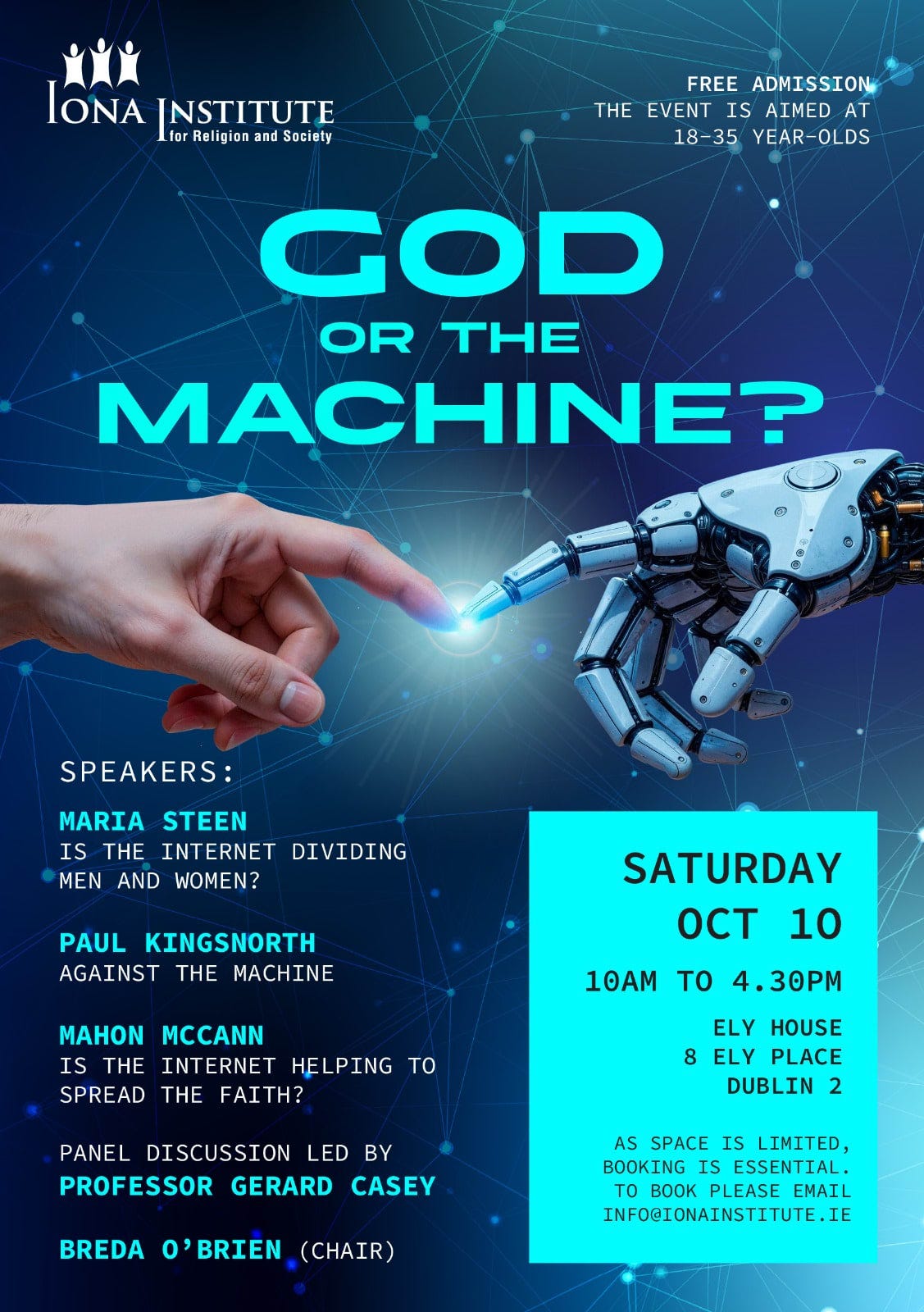
Paul Kingsnorth Announces Speaking Tour on AI and Human Identity

Paul Kingsnorth shares an update on his upcoming speaking engagements, all centered on the question of what it means to be human in the age of artificial intelligence. He notes that the rise of AI has forced this existential question into mainstream discourse, leading to invitations from major media outlets and event organizers. Over the next two months, he will speak at a youth-focused gathering in Dublin, a conference in Georgia (USA)…

Paul Kingsnorth shares an update on his upcoming speaking engagements, all centered on the question of what it means to be human in the age of artificial intelligence. He notes that the rise of AI has forced this existential question into mainstream discourse, leading to invitations from major media outlets and event organizers. Over the next two months, he will speak at a youth-focused gathering in Dublin, a conference in Georgia (USA) alongside Carl Trueman, a public talk at a university in Wisconsin, and a conference in Amsterdam addressing civilization in crisis.

Kingsnorth expresses reluctance about public speaking, feeling unqualified, but participates to contribute to the conversation. He concludes with a personal reflection on the simple human joy of being home for Christmas, contrasting it with what a robot could never appreciate. The comments reveal a mix of support and concern: several readers urge him to prioritize his health and limit travel, suggesting his writing may be a more sustainable vocation.

Others affirm the importance of his voice in secular forums, while discussing the spiritual and ethical dimensions of AI. A few commenters share personal encounters with his work in monastic settings, highlighting its reach beyond typical audiences.

  • Kingsnorth links the surge of public interest in human identity to the rise of AI.
  • Four events scheduled: Dublin (youth), Georgia conference, Wisconsin public lecture, Amsterdam conference.
  • He feels unqualified but participates to address spiritual and ethical implications of AI.
  • Comments emphasize concern for his health and debate the value of speaking versus writing.
  • Personal reflection on Christmas as a uniquely human experience beyond machine comprehension.
16 opinions in the discussion Ah... the very fact that this question even needs asking shows how adrift, uprooted and bewildered we've become. The game is over, surely... go quiet, as you always meant to...? I've no… Read the discussion
Holy Resurrection YouTube

Saint Maximus the Greek on Latin Innovations: Filioque, Celibacy, and Unleavened Bread

Saint Maximus the Greek on Latin Innovations: Filioque, Celibacy, and Unleavened Bread 19:29

This post presents the second part of Saint Maximus the Greek’s “Response to Nicholas the Latin,” a polemical work defending Orthodox tradition against Latin (Roman Catholic) practices. Drawing on apostolic canons, ecumenical councils, and patristic testimony, Saint Maximus argues that four key Latin innovations lack foundation in the ancient Church: the addition of the Filioque to the Creed, fasting on Saturdays, mandatory clerical celibacy,…

This post presents the second part of Saint Maximus the Greek’s “Response to Nicholas the Latin,” a polemical work defending Orthodox tradition against Latin (Roman Catholic) practices. Drawing on apostolic canons, ecumenical councils, and patristic testimony, Saint Maximus argues that four key Latin innovations lack foundation in the ancient Church: the addition of the Filioque to the Creed, fasting on Saturdays, mandatory clerical celibacy, and the use of unleavened bread (azymes) in the Eucharist.

He contends that the Filioque has no support among the Holy Fathers; that Saturday fasting violates Apostolic Canon 64, which forbids fasting on Saturdays except Great Saturday; that compulsory celibacy contradicts the Apostolic Canons and Canon 13 of the Sixth Ecumenical Council, which uphold the lawful marriage of clergy; and that unleavened bread derives from Jewish and Armenian practice, condemned by Apostolic Canon 70 and Laodicea Canon 11. Saint Maximus traces the universal use of leavened bread to Christ and all the apostles, noting that only Jews, Armenians, and Latins adopted azymes.

He links the division between the Churches to the Latins’ departure from conciliar and apostolic teaching, while affirming Orthodox fidelity to the original Tradition. The text concludes by commending further study to Metropolitan Daniel of Russia and asserting that the errors separating Latins from Greeks are so grave that only God can correct them.

Key moments

  1. 0:11 Apostolic Canon 64 forbids fasting on Saturdays (except Great Saturday) under penalty of deposition for clergy and excommunication for laity.
  2. 0:44 A council presided by Pope Agatho and Gregory of Agrigentum decreed that the Roman Church must observe the canon against Saturday fasting; the author notes Latins fast until the 9th hour (3 PM) while the divine service is at the 3rd hour (9 AM).
  3. 1:44 Regarding priestly marriage: dissolving the marriage of a man ordained after marrying and living chastely is lawlessness; Clement of Rome and Apostolic Canon 5 forbid clergy from putting away their wives under pretense of piety.
  4. 3:49 The Sixth Ecumenical Council (under Pope Agatho) legislated against Latin practices including unleavened bread, Saturday fasting, and mandatory clerical celibacy; Canon 13 declares lawful cohabitation of clergy with wives inviolate.
  5. 5:21 Unleavened bread (azymes) is rejected: Christ called himself 'leavened bread' (John 6), used bread (artos) at the Last Supper, and all Eastern patriarchates use leavened bread; only Jews, Armenians, and Latins use unleavened bread.
  6. 7:28 Apostolic Canon 70 and Laodicea Canon 11 forbid clergy and laity from accepting or eating unleavened bread of the Jews, under penalty of deposition or excommunication.
  7. 8:28 All apostles (Peter in Antioch, James in Jerusalem, Mark in Alexandria, Thomas in Persia/India, etc.) celebrated with leavened bread; the Latin practice originated later from the Armenians via Apollinarius.
  8. 15:13 The separation of Latins from Greeks occurred under Constantine and Irene; the author commends further study to Metropolitan Daniel of Russia and asserts the errors of the Latins are so great only God can correct them.
Archim. Christódoulos Papadeas Instagram

Saints Euphemia and George: Youth That Confessed Christ

This post centers on the words of Saint Paul to Timothy, "Let no one despise your youth, but be a model to the faithful in speech, in conduct, in love, in spirit, in faith, in purity" (1 Timothy 4:12), quoted in both English and Greek. Speaking ahead of the feast of the Great Martyr Saint Euphemia on September 16th, the speaker draws on the inspiration of Vespers to address young people directly. He recalls that Saint Euphemia, a young virgin,…

This post centers on the words of Saint Paul to Timothy, "Let no one despise your youth, but be a model to the faithful in speech, in conduct, in love, in spirit, in faith, in purity" (1 Timothy 4:12), quoted in both English and Greek. Speaking ahead of the feast of the Great Martyr Saint Euphemia on September 16th, the speaker draws on the inspiration of Vespers to address young people directly.

He recalls that Saint Euphemia, a young virgin, and Saint George, a young man, were both still young when they gave their lives for Christ, courageously standing against idol worshippers and those who hated God. The Church remembers them in her hymns and services as living with Christ in the heavenly realm. The speaker acknowledges that today's young people are not called to literal martyrdom, yet the same call remains: to give themselves wholly to Christ in love.

He outlines practical ways to do this: faithful attendance at church services, keeping daily morning and evening prayers, glorifying God for all His gifts, from the sunshine to the rains, and continually preparing to receive Holy Communion, the Body and Blood of Christ. The discussion is a short homiletic exhortation with no recorded comments; its focus stays on the witness of the young martyrs and the everyday ascetic practices by which young believers can become, in Paul's words, a model or type of the faithful.

The post offers an encouraging, traditional Orthodox message: youth is not an obstacle to holiness but, as the lives of Euphemia and George show, a time when the confession of Christ can shine with particular boldness and purity.

Key moments

  1. Feast of Saint Euphemia, the great martyr, celebrated on September 16th.
  2. Saint Euphemia, a young virgin, gave her life for Christ, standing up to idol worshippers and God haters.
  3. Saint George, also a young man, likewise gave his life for Christ.
  4. Both saints are remembered in services and hymns and live in the heavenly realm with Christ.
  5. Young people may not be called to martyrdom, but should give themselves to Christ in love.
  6. Show love through attending church services and daily morning and night prayers.
  7. Glorify God for the sunshine, the rains, and everything He gives.
  8. Always prepare to receive Christ's body and blood in Holy Communion.
Tzanetos Kavaliotis YouTube

The Devil Does Not Need You Evil, Only Distracted (St. John Cassian)

The Devil Does Not Need You Evil, Only Distracted (St. John Cassian) 16:35

The speaker argues that the enemy does not need to make a person actively evil; perpetual distraction achieves the same end. Drawing on St. John Cassian, Abba Moses, St. Hesychios, St. Theophan the Recluse, St. Paisios the Athonite, St. Isaac the Syrian, St. Porphyrios, and others, he describes how screens and noise scatter the mind before it wakes and harvest souls through triviality. Cassian records Abba Moses' image of the soul as a millstone…

The speaker argues that the enemy does not need to make a person actively evil; perpetual distraction achieves the same end. Drawing on St. John Cassian, Abba Moses, St. Hesychios, St. Theophan the Recluse, St. Paisios the Athonite, St. Isaac the Syrian, St. Porphyrios, and others, he describes how screens and noise scatter the mind before it wakes and harvest souls through triviality.

Cassian records Abba Moses' image of the soul as a millstone driven by rushing water: the turning cannot be stopped, but the man chooses whether it grinds wheat or weeds. Cassian also asks Elder Serenus why useless thoughts steal in so subtly, and the elder answers that thoughts arise without our choice while accepting or rejecting them lies in our power; the soul is like a feather, easily lifted unless weighed down by earthly passions.

Cassian compares the discerning mind to a skilled money changer who examines every thought for the image of the heavenly King or of Caesar. St. Hesychios defines watchfulness (nepsis) as fixing thought at the entrance to the heart, since distraction is a Trojan horse admitting demons of sadness, lust, and paralysis. St. Theophan says the mind wanders because we live in a state of fullness, and the principal thing is to stand with the mind in the heart before God unceasingly.

St. Paisios warns that people trapped in machines find only fatigue and emptiness, because the soul is rested by the silence of God, which terrifies the enemy. The remedy given is the unceasing invocation of the Name: Cassian's tenth conference offers the verse 'O God, make speed to save me, O Lord, make haste to help me,' and the speaker urges the Jesus Prayer, 'Lord Jesus Christ, Son of God, have mercy on me a sinner,' as the sword of the spirit that starves the machine of attention.

Key moments

  1. 0:03 The screen fills the morning with notifications and arguments before the mind wakes, and the evil one harvests souls through unrelenting triviality, needing only your eyes pointed downward.
  2. 2:40 St. John Cassian records Abba Moses' image: the soul is like a millstone driven by rushing water that never stops, and the man decides whether it grinds wheat or weeds.
  3. 5:16 Cassian asks Elder Serenus why useless thoughts steal in so subtly, and the elder answers that while thoughts arise without our choice, accepting or rejecting them lies in our power; the soul is like a feather, easily lifted unless weighed down by the dampness of earthly passions.
  4. 7:52 Cassian says we must act as skilled money changers, examining every thought to see if it bears the image of the heavenly King or of Caesar; when distracted, we accept demonic suggestions as our own feelings.
  5. 8:23 St. Hesychius defines watchfulness as a continual fixing of thought at the entrance to the heart, since distraction is a Trojan horse that lets demons of sadness, lust, and paralysis into the fortress.
  6. 9:56 St. Theophan the Recluse says the mind wanders because we are in a state of fullness, and the principal thing is to stand with the mind in the heart before God unceasingly.
  7. 11:01 St. Paisios warns that people trapped in machines and endless activities find only fatigue and emptiness, because the soul is rested not by noise but by the silence of God, which terrifies the enemy.
  8. 12:37 Cassian's tenth conference gives the anchor for the wandering mind: 'O God, make speed to save me, O Lord, make haste to help me,' meditated without ceasing, and the speaker urges the Jesus prayer, 'Lord Jesus Christ, Son of God, have mercy on me a sinner,' as the sword of the spirit.
Read more
Father Moses YouTube discussion

Why You Don't Love God: Self-Love and the Misdirected Heart

Why You Don't Love God: Self-Love and the Misdirected Heart 14:08

A priest, Father Moses, examines why love for God often feels absent in the Christian life, arguing that the Holy Fathers identify love of self as the root of every sin. The heart, he says, has a limited capacity for love, and when it is given over to things like possessions, money, compliments, and comfort, little room remains for God. Love for God therefore grows only as the heart is purified of these misplaced attachments—a spiritual reality,…

A priest, Father Moses, examines why love for God often feels absent in the Christian life, arguing that the Holy Fathers identify love of self as the root of every sin. The heart, he says, has a limited capacity for love, and when it is given over to things like possessions, money, compliments, and comfort, little room remains for God.

Love for God therefore grows only as the heart is purified of these misplaced attachments—a spiritual reality, not merely a psychological one. He illustrates this with a personal story: after noticing how much he enjoyed the compliments his Nike jacket attracted, he gave it away to a homeless man at the prompting of his spiritual father, recognizing how such small attachments consume the heart.

The talk also addresses the modern 'self-love' gospel: the Gospel commands love of God and neighbor but never love of self, because we already struggle with excessive self-regard. Even self-hatred, shame, and harsh self-criticism in confession are revealed as forms of pride and self-obsession rather than humility. Sin, he explains, is not the destruction of natural desires but their misdirection—intimacy becomes lust, hunger becomes gluttony, work becomes greed, and time meant for repentance becomes busyness.

Drawing on the desert fathers, he recounts Abba Anthony's bold claim to love God more than a monk who fasted and prayed more, showing that love for God is a gift given to those open to self-denial, and that God bestows grace according to what each person is willing to receive, as in the parable of the talents. The talk culminates in the claim that Christ offers each of us a crucifixion proportioned to our willingness, for there is no resurrection without crucifixion—and little crucifixion means little love for Christ.

Key moments

  1. 0:00 Christ wants to give us crucifixion so we can participate in the fullness of resurrection; each person must decide the degree to which they are willing to be crucified, and little crucifixion means little love for Christ.
  2. 0:31 The heart's capacity to love is often misdirected toward wrong things—boots, sports teams, money—so we must be purified, and as we are, more of the heart is given over to the love of God.
  3. 1:32 We must strive to purify our hearts of what we love, and God will incrementally fill it with His love; this is a deep spiritual reality, not a psychological one.
  4. 2:05 A personal story: the speaker loved the compliments he received from a Nike jacket, and at the prompting of Father Turbo gave the jacket to a homeless man, recognizing that such attachments take up our heart's capacity.
  5. 4:11 A saint compared himself to a prickly pear—no matter how thrown, it lands prickles down—because all sins and struggles distill down to one thing: the love of self.
  6. 5:14 The gospel commands love of God and neighbor but not love of self, since we already struggle with too much self-love; even self-criticism and shame in confession ('I can't believe I did this') are actually self-obsession and pride, not humility.
  7. 6:49 All sins are misdirected natural desires—intimacy into lust, food into gluttony, work into greed, and time given for repentance into busyness and skipping church.
  8. 8:26 From the desert fathers: Abba Anthony, though another monk fasted and prayed more, said 'I love God more than he does,' showing that love for God is a spiritual gift given to those open to self-denial; God bestows grace according to what we are willing and able to receive and work with, as in the parable of the talents.
11 opinions in the discussion Ever since I sold my Camaro I've wanted another one. Watching this made me realize that what I actually miss isn't the car itself, but the attention it brought me. Maybe I don't actually… Read the discussion