WeOrthodox
EN UA

Orthodox posts, videos and discussions

We follow Orthodox channels, communities and blogs across the web, summarise every post and video, and highlight the conversations with real substance.

George Instagram

The speaker observes daily violation of the third commandment through casual use of God's name

The speaker observes that most people break the third commandment every day without noticing by saying "Oh my God" casually. The third commandment states: "You shall not take the name of the Lord your God in vain," where "in vain" means for nothing, empty, without meaning. The speaker notes the contradiction: in the Our Father we say "hallowed be your name" or "holy be your name," then an hour later use that name like "wow" or "really." God's…

The speaker observes that most people break the third commandment every day without noticing by saying "Oh my God" casually. The third commandment states: "You shall not take the name of the Lord your God in vain," where "in vain" means for nothing, empty, without meaning. The speaker notes the contradiction: in the Our Father we say "hallowed be your name" or "holy be your name," then an hour later use that name like "wow" or "really."

God's name is not an expression; it is the name we call on when we pray, when we are sick, afraid, or dying. The saints said God's name with tears, but we throw it around without thinking. The speaker offers a suggestion: when about to say "Oh my God," change it, if something good, say "Glory to God"; if something bad, say "Lord have mercy."

The same moment becomes a prayer instead of a vain use of God's name. The speaker asks how many times the listener said "Oh my God" today.

Key moments

  1. Most people break the third commandment every day without noticing by saying "Oh my God" casually.
  2. The third commandment: "You shall not take the name of the Lord your God in vain", in vain means for nothing, empty, without meaning.
  3. In the Our Father we say "hallowed be your name" or "holy be your name," then an hour later use that name like "wow" or "really."
  4. God's name is not an expression; it is the name we call on when we pray, when we are sick, afraid, or dying.
  5. The saints said God's name with tears, but we throw it around without thinking.
  6. Suggestion: when about to say "Oh my God," change it, if something good, say "Glory to God"; if something bad, say "Lord have mercy."
  7. The same moment becomes a prayer instead of a vain use of God's name.
  8. The speaker asks how many times the listener said "Oh my God" today.
Read more
☦️An Orthodox Blog☦️ with Orthodoxy ☦︎ Instagram

Prophet Joel commemorated October 19; Great Doxology text presented

The post notes the commemoration of the Prophet Joel on 19 October. The accompanying video presents the text of the Great Doxology. The Doxology opens with the angelic hymn from Luke's nativity account: glory to God in the highest and on earth peace, goodwill among men. The prayer continues with praise, blessing, worship, glorification, and thanksgiving addressed to the Trinity, God the Father almighty, the only-begotten Son Jesus Christ, and…

The post notes the commemoration of the Prophet Joel on 19 October. The accompanying video presents the text of the Great Doxology. The Doxology opens with the angelic hymn from Luke's nativity account: glory to God in the highest and on earth peace, goodwill among men.

The prayer continues with praise, blessing, worship, glorification, and thanksgiving addressed to the Trinity, God the Father almighty, the only-begotten Son Jesus Christ, and the Holy Spirit. It then turns to Christ as Lamb of God and Son of the Father who takes away the sin of the world, asking for mercy, the reception of prayer, and acknowledging his session at the right hand of the Father.

Key moments

  1. Opens with the angelic doxology: glory to God in the highest, on earth peace, goodwill among men.
  2. Offers praise, blessing, worship, glorification, and thanksgiving for God's great glory.
  3. Addresses the Trinity: Lord Heavenly King God the Father almighty, Lord only-begotten Son Jesus Christ, and Holy Spirit.
  4. Invokes Christ as Lord God, Lamb of God, Son of the Father who takes away the sin of the world.
  5. Asks for mercy, the reception of prayer, and confesses Christ seated at the right hand of the Father.

Kissing Icons: Honor to the Person, Not Worship of Wood

The speaker addresses whether Christians should kiss icons by comparing the act to a soldier kissing a photograph of his family. The gesture honors the person represented, not the paper or ink. He cites Exodus, where God commands images of angels on the ark, and Joshua, who bows before the ark, as biblical precedents for making and venerating sacred images. For centuries, icons taught the gospel to Christians who could not read. St. Basil the…

The speaker addresses whether Christians should kiss icons by comparing the act to a soldier kissing a photograph of his family. The gesture honors the person represented, not the paper or ink. He cites Exodus, where God commands images of angels on the ark, and Joshua, who bows before the ark, as biblical precedents for making and venerating sacred images.

For centuries, icons taught the gospel to Christians who could not read. St. Basil the Great writes that honor paid to an image passes to its prototype. Icons function as windows into heaven that direct the heart toward God and the saints who dedicated their lives to him.

The speaker emphasizes that worship remains reserved for God alone; wood and paint are not worshiped.

Key moments

  1. The question "Should we kiss icons?" is answered with a battlefield analogy: kissing a picture of a wife or daughter shows honor and love to the person, not worship of the picture.
  2. In Exodus, God commands the making of images of angels on the ark.
  3. In Joshua, he bowed down before the ark.
  4. For centuries, Christians used icons because they could not read, and icons were how they learned the gospel.
  5. St. Basil the Great writes that the honor paid to the image passes to the prototype.
  6. We do not worship wood and paint.
  7. Icons are windows into heaven to remind our hearts of God and the saints who dedicated their lives to him.
  8. Ultimately, we only worship God alone.
Read more
George Instagram

Sharing faith through visible life and invitation

The speaker shares personal advice on talking about faith without forcing it, drawing from experience with the mother of their son who is not religious. The core observation is that people change when they see something desirable in others, not through winning arguments. Three practices are outlined. First, live the faith visibly so others notice calmness, kindness, patience, and peace without a word being spoken. Second, wait for questions…

The speaker shares personal advice on talking about faith without forcing it, drawing from experience with the mother of their son who is not religious. The core observation is that people change when they see something desirable in others, not through winning arguments. Three practices are outlined. First, live the faith visibly so others notice calmness, kindness, patience, and peace without a word being spoken.

Second, wait for questions before speaking, following 1 Peter 3:15 which calls for readiness to give an answer about the hope within, with gentleness and respect. When asked, the speaker advises telling one's own story of what God has done rather than delivering a lecture. Third, invite without pressure, echoing Philip's words to Nathanael: "Come and see."

This means inviting others to liturgy, a feast, or to light a candle together, then leaving the outcome to God. Above all, the speaker emphasizes daily prayer for others as more effective than any conversation.

Key moments

  1. People don't change because we win an argument; they change when they see something in us that they want, too.
  2. First, live the faith visibly: let others see you calmer, kinder, more patient, and more at peace without saying a word.
  3. Second, wait for them to ask, as St. Peter writes: "Always be ready to give an answer to everyone who asks you about the hope that's in you, with gentleness and respect."
  4. When they ask, don't give a lecture; just tell your own story of what God has done in your life.
  5. Third, invite don't push: like Philip told Nathanael, "Come and see," invite them to liturgy, a feast, or to light a candle with you.
  6. Leave the rest to God after the invitation.
  7. Most of all, pray for them every day, which does more than any conversation.
Read more

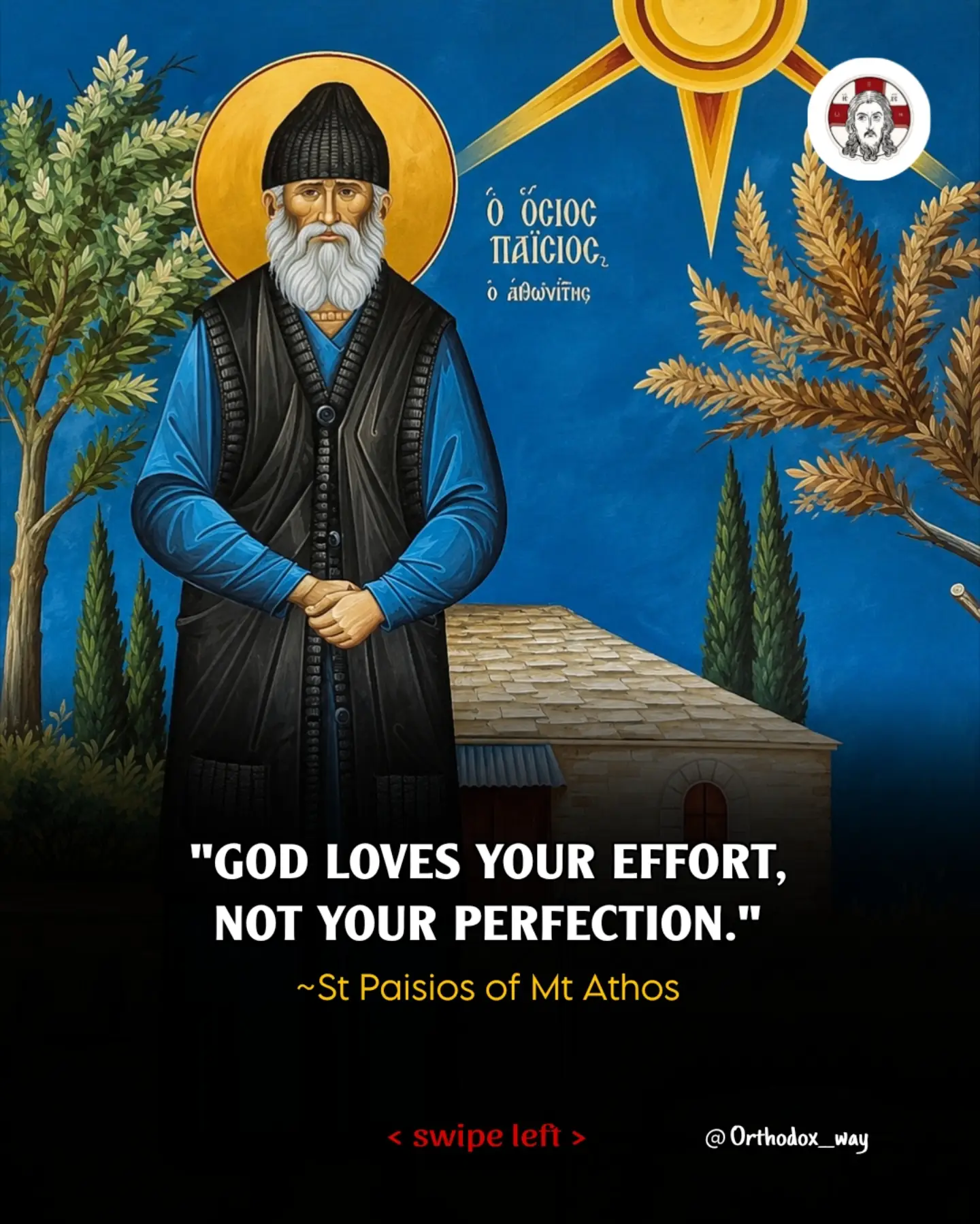
Saint Paisios: The Hermit Who Carried the World's Pain to God

Saint Paisios of Mount Athos (1924-1994) was born Arsenios Eznepidis in Cappadocia. He served as a radio operator during the Greek Civil War, volunteering for the most dangerous missions to spare his comrades. After the war he withdrew to the Holy Mountain of Athos and embraced strict asceticism in primitive hermitages such as the cell of Panagouda. His discipline included radical self-denial, intense fasting, and endless hours of nocturnal…

Saint Paisios of Mount Athos (1924-1994) was born Arsenios Eznepidis in Cappadocia. He served as a radio operator during the Greek Civil War, volunteering for the most dangerous missions to spare his comrades. After the war he withdrew to the Holy Mountain of Athos and embraced strict asceticism in primitive hermitages such as the cell of Panagouda.

His discipline included radical self-denial, intense fasting, and endless hours of nocturnal prayer. He lived on meager rations of dry bread and tea and endured freezing winters without heating. Through these struggles he sought to subdue egoism and cultivate continuous noetic prayer.

Despite his love for solitary silence, his hermitage became a refuge for thousands of pilgrims. He spent his days listening to the brokenhearted, offering psychological and spiritual guidance, and comforting the sick, often sacrificing his own rest so that no visitor left empty-handed. He viewed asceticism not as rigid rules but as a labor of love for God and humanity.

He described himself as a "radio operator" who intercepted the prayers and agonies of the world to pass them along to God. The Ecumenical Patriarchate canonized him in 2015. His legacy continues to inspire millions as an example of how extreme self-denial can blossom into boundless compassion and joy.

  • Born Arsenios Eznepidis in Cappadocia; served as radio operator in Greek Civil War
  • Embraced strict asceticism on Mount Athos in hermitages like Panagouda
  • Lived on dry bread and tea, endured freezing winters without heating
  • Received thousands of pilgrims, offering guidance and comfort at cost of his rest
  • Canonized by Ecumenical Patriarchate in 2015; saw himself as a spiritual radio operator
Read more
Prayer Orthodoxy ® with The National Herald Instagram

47 New Archons Installed at Holy Trinity Cathedral in NYC

The Order of St. Andrew the Apostle, formally known as the Archons of the Ecumenical Patriarchate, welcomed 47 new members during a ceremony at the Greek Orthodox Archdiocesan Cathedral of the Holy Trinity in New York City. The induction took place after the celebration of the Divine Liturgy. The title Archon derives from Ancient Greek meaning "the one who is trusted with authority." In the modern context, these lay leaders commit to protecting…

The Order of St. Andrew the Apostle, formally known as the Archons of the Ecumenical Patriarchate, welcomed 47 new members during a ceremony at the Greek Orthodox Archdiocesan Cathedral of the Holy Trinity in New York City. The induction took place after the celebration of the Divine Liturgy. The title Archon derives from Ancient Greek meaning "the one who is trusted with authority."

In the modern context, these lay leaders commit to protecting and advocating for the Mother Church of Constantinople, the Ecumenical Patriarchate located in Istanbul, Turkey. Candidates for the order must demonstrate sustained commitment to the Greek Orthodox Church at three levels: active support of their local parish, contributions on a national scale within the Greek Orthodox Archdiocese of America, and dedication to the Ecumenical Throne itself.

The ceremony adds to the order's membership, which works to defend religious freedom and the rights of the Ecumenical Patriarchate. The event was reported by journalist Chris Benis for The National Herald, a Greek-American newspaper also referenced as TNH or EK.

  • 47 new Archons inducted at Holy Trinity Cathedral in NYC
  • Ceremony held after Divine Liturgy
  • Archons pledge to protect the Ecumenical Patriarchate in Constantinople
  • Membership requires demonstrated support at parish, national, and international levels
  • Event reported by Chris Benis for The National Herald
Read more

Orthodox speaker challenges Maronite Catholic on Eucharist and conversion

An Orthodox speaker responds to a Maronite Catholic who acknowledges Orthodox dogmas such as the Filioque and papal claims but argues conversion is impractical because they already have access to saints, the Eucharist, tradition, and confession. The speaker denies that Maronites possess the Eucharist and states that prayer life and confession differ considerably in Orthodoxy. He accuses the questioner of choosing comfort over truth and placing…

An Orthodox speaker responds to a Maronite Catholic who acknowledges Orthodox dogmas such as the Filioque and papal claims but argues conversion is impractical because they already have access to saints, the Eucharist, tradition, and confession. The speaker denies that Maronites possess the Eucharist and states that prayer life and confession differ considerably in Orthodoxy.

He accuses the questioner of choosing comfort over truth and placing personal convenience above Christ and His exclusive Church. The speaker dismisses the claim that being Maronite is "basically Orthodox," calling it heterodox, and challenges the questioner to abandon worldly attachments and familial ties. He asks why the questioner does not adhere to even older familial ties of being Orthodox, comparing the situation to other cultural heritage claims.

The speaker urges the questioner to reject titles and comfort, submit to the truth, stop putting minor cares over the historic witness, and read the Holy Fathers on ecclesial exclusivity.

Key moments

  1. The questioner grants Orthodox dogmas such as the Filioque and papacy are true but argues conversion is impractical because they already have saint intercession, the Eucharist, tradition, and confession as a Maronite.
  2. The speaker denies that Maronites have the Eucharist and states that prayer life and confession are considerably different in Orthodoxy.
  3. The speaker accuses the questioner of putting ease over truth and personal comfort over the Lord Jesus Christ and His exclusive Church.
  4. The speaker challenges whether the process of becoming a catechumen and finding an Orthodox church truly outweighs the truth for the questioner.
  5. The speaker says this attitude is common and tells the questioner to let go of worldly attachments, including familial ties to being Maronite.
  6. The speaker asks why the questioner does not stick to even older familial ties of being Orthodox, comparing the situation to WASPs today or pseudo-heritage Catholics in the British Isles.
  7. The speaker declares that Maronite is not basically Orthodox but heterodox.
  8. The speaker urges the questioner to reject titles and comfort, submit to the truth, stop putting tiny cares over the historic witness, and read the Holy Fathers on exclusivity.
21 opinions in the discussion I said some really dumb stuff back when I was a Protestant too 😭💀 Read the discussion
Orthodox Life Instagram

Panagia Machairiotissa: icon found by knife on Cyprus mountain

The post marks the October 18 commemoration of the Holy Icon of the Theotokos known as Panagia Machairiotissa, which refers both to a miraculous icon and the Machairas Monastery in Cyprus. The monastery sits on Mount Kionia in the Troodos range at 870 meters altitude and is regarded as the second most prestigious monastic site on the island. Tradition holds the icon is one of seventy painted by Saint Luke the Apostle, who is also commemorated on…

The post marks the October 18 commemoration of the Holy Icon of the Theotokos known as Panagia Machairiotissa, which refers both to a miraculous icon and the Machairas Monastery in Cyprus. The monastery sits on Mount Kionia in the Troodos range at 870 meters altitude and is regarded as the second most prestigious monastic site on the island.

Tradition holds the icon is one of seventy painted by Saint Luke the Apostle, who is also commemorated on this day. A hermit brought the icon, then called Panagia Hagiosoritissa, from Constantinople to Cyprus during the Iconoclastic period (716-843 AD) and hid it in a remote cave, where it remained forgotten for centuries after his death.

Around 1145 the hermits Neophytos and Ignatios were guided by the Virgin Mary to the cave and given a knife (machairi in Greek) to clear the overgrowth blocking the entrance. The icon took the name Machairiotissa ("of the knife") and the monastery built on the spot was named Machairas. The icon survived catastrophic fires in 1530 and 1892 without damage; global fundraising supported reconstruction.

Today the monastery follows a strict communal rule modeled on Mount Athos and houses a brotherhood of monks.

  • Icon believed painted by Saint Luke, brought from Constantinople during Iconoclasm
  • Hidden in a cave, rediscovered in 1145 by hermits Neophytos and Ignatios
  • Virgin Mary gave them a knife to clear the entrance, giving the icon its name
  • Monastery at 870 meters on Mount Kionia, second in prestige on Cyprus
  • Icon survived fires in 1530 and 1892; monastery runs on Athonite communal model
Read more
Athonite Audio YouTube

Elder Ephraim: Humility as the Cloak of the Godhead

Elder Ephraim: Humility as the Cloak of the Godhead 23:02

Elder Ephraim of Philotheou and Arizona delivers a homily on humility as the cloak of the Godhead, beginning with Christ's entry into Jerusalem on a donkey. The same crowds that shouted "Hosanna" on Sunday demanded "Crucify him" five days later, showing the instability of the world and of man. Christ's humility appears in His endurance of slaps, scourging, the cross, and crucifixion, God struck by a hand He fashioned, and this humility is His…

Elder Ephraim of Philotheou and Arizona delivers a homily on humility as the cloak of the Godhead, beginning with Christ's entry into Jerusalem on a donkey. The same crowds that shouted "Hosanna" on Sunday demanded "Crucify him" five days later, showing the instability of the world and of man. Christ's humility appears in His endurance of slaps, scourging, the cross, and crucifixion, God struck by a hand He fashioned, and this humility is His glory, not haughty rule.

The homily explains that God permits trials to humble the mind; a saint teaches tribulations cease only when man humbles himself, while the devil uses suffering to suggest God is unjust, though the Father's love is proven by the Cross. Humility defeats the devil, who fell through pride and deceived Eve with the promise of becoming gods; Christ chose uneducated fishermen and made them apostles.

St. Isaac the Syrian says true humility from experience is the cloak of divinity; God veiled His divinity in human nature so the earth could bear His presence (Exodus 33:20). At the final judgment Christ will show His wounds and ask what we endured; voluntary and involuntary asceticism, patient endurance of illness, mockery, loss, are our offering, and conscience will witness the truth without need for Christ to speak.

Key moments

  1. 0:01 Humility is the cloak of the Godhead; Holy Week begins with Christ's entry from Bethany on a donkey, showing the throne of glory and throne of humility together.
  2. 0:33 The crowds chant "Hosanna" (Matt 21:9) but five days later cry "Crucify him!" (John 19:15), revealing the instability of the world and of man.
  3. 2:06 Christ endures slaps, scourging, the cross, and falls under its weight, God struck by a human hand made of clay, and His glory is precisely this humility.
  4. 4:10 God allows trials to humble our mindset; a saint says tribulations will not cease unless man humbles himself, and the devil tries to paint God as unjust when suffering comes.
  5. 7:51 The devil was defeated by humility; man fell through egotism, believing the serpent's lie "you will become gods," while Christ chose illiterate fishermen and made them wise apostles.
  6. 11:30 St. Isaac the Syrian teaches that genuine humility from experience is the cloak of divinity; God veiled His divinity in human nature so the earth could bear His presence (Exodus 33:20).
  7. 13:06 Humility clothes a person with the divine garment that repels the devil; egotism leaves us naked before his claws, and anger reveals the ugliness of pride.
  8. 18:53 At judgment Christ will ask what we endured; voluntary asceticism and involuntary asceticism (patient endurance of illness, mockery, loss) are our offering, and conscience will bear witness.

Fr. Konstantinos Kenanidis on Unity as Gift of the Holy Spirit

Fr. Konstantinos Kenanidis on Unity as Gift of the Holy Spirit 1:59

Fr. Konstantinos Kenanidis, General Secretary of the Office of the Orthodox Church at the European Union, reflects on unity in the Orthodox Church. He explains that unity is not administrative agreement or institutional consensus, such as a corporate board reaching anonymous decisions. True ecclesial unity is a gift and reality of the Holy Spirit, rooted in grace, peace, and life in Christ. During the Divine Liturgy, the faithful pray for the…

Fr. Konstantinos Kenanidis, General Secretary of the Office of the Orthodox Church at the European Union, reflects on unity in the Orthodox Church. He explains that unity is not administrative agreement or institutional consensus, such as a corporate board reaching anonymous decisions. True ecclesial unity is a gift and reality of the Holy Spirit, rooted in grace, peace, and life in Christ.

During the Divine Liturgy, the faithful pray for the unity of the Holy Spirit because this is the only real unity. When unity is absent, something deeper is wounded in the spiritual life of the community; lack of unity proves the community does not partake of the same grace of the Holy Spirit.

Fr. Konstantinos also addresses the need for an uncompromising Orthodox witness. He recounts how an editor of a Protestant volume asked him to make his article less Orthodox, but he refused, saying "This is what it is." He insisted the Orthodox approach cannot be altered for flexibility or to fit the expectations of a different audience.

Authentic dialogue requires clarity, not dilution. Unity, peace, and spiritual power come when the Church remains faithful to the Orthodox approach and witnesses the truth as it is.

Key moments

  1. 0:00 Lack of unity proves we do not partake of the same grace of the Holy Spirit; someone is missing something.
  2. 0:00 Unity in the Orthodox Church is not an administrative consensus.
  3. 0:31 The speaker wrote an article for a Protestant volume; the editor asked him to change his writing to be less Orthodox.
  4. 0:31 The speaker refused, saying "This is what it is," and kept the article about unity, peace, and power in the Orthodox Church.
  5. 1:02 During the liturgy the church prays for the unity of the Holy Spirit, which is the only real unity.
  6. 1:02 When there is a lack of unity, we are not united, proving we do not share the same grace of the Holy Spirit.
  7. 1:32 Unity is not an administrative consensus like a company board reaching anonymous agreement.
George Instagram

Saint Porphyrios on turning from sin to Christ

The video explains Saint Porphyrios' teaching from his book Wounded by Love on the proper way to fight sin. It begins by describing the common experience: most people try to fight sins by resolving each morning not to sin, but they fall again by evening. Saint Porphyrios offers a different approach. He says, "Do not fight to expel the darkness from the chamber of your soul." He uses the analogy of a dark room: when a room is dark, you do not…

The video explains Saint Porphyrios' teaching from his book Wounded by Love on the proper way to fight sin. It begins by describing the common experience: most people try to fight sins by resolving each morning not to sin, but they fall again by evening. Saint Porphyrios offers a different approach. He says, "Do not fight to expel the darkness from the chamber of your soul."

He uses the analogy of a dark room: when a room is dark, you do not fight the darkness; you turn on the light and the darkness disappears. The same principle applies to sins. You will not become saints by hounding after evil. Instead, ignore evil and look toward Christ. The more we stare at our sins, the more space they take in our mind, even while we are fighting them.

When temptation comes, do not argue with it. Turn away, turn to Christ, say a short prayer, and do something good for someone. Fill that space with love for God and the darkness slowly loses its place. The video clarifies that this does not mean we stop going to confession. We bring our sins there, but we do not live staring at them. We live looking at Christ.

Key moments

  1. Most people fight sins by resolving each morning not to sin, but they fall again by evening.
  2. Saint Porphyrios in Wounded by Love says, "Do not fight to expel the darkness from the chamber of your soul."
  3. When a room is dark, you do not fight the darkness; you turn on the light and the darkness disappears.
  4. The same applies to sins: you will not become saints by hounding after evil; ignore evil and look toward Christ.
  5. The more we stare at our sins, the more space they take in our mind, even while we are fighting them.
  6. When temptation comes, do not argue with it; turn away, turn to Christ, say a short prayer, and do something good for someone.
  7. Fill that space with love for God and the darkness slowly loses its place.
  8. This does not mean we stop going to confession; we bring our sins there but we do not live staring at them; we live looking at Christ.
Read more
☦️An Orthodox Blog☦️ with Orthodoxy ☦︎ Instagram

St. Paisios on complacency and corrupted rationalism

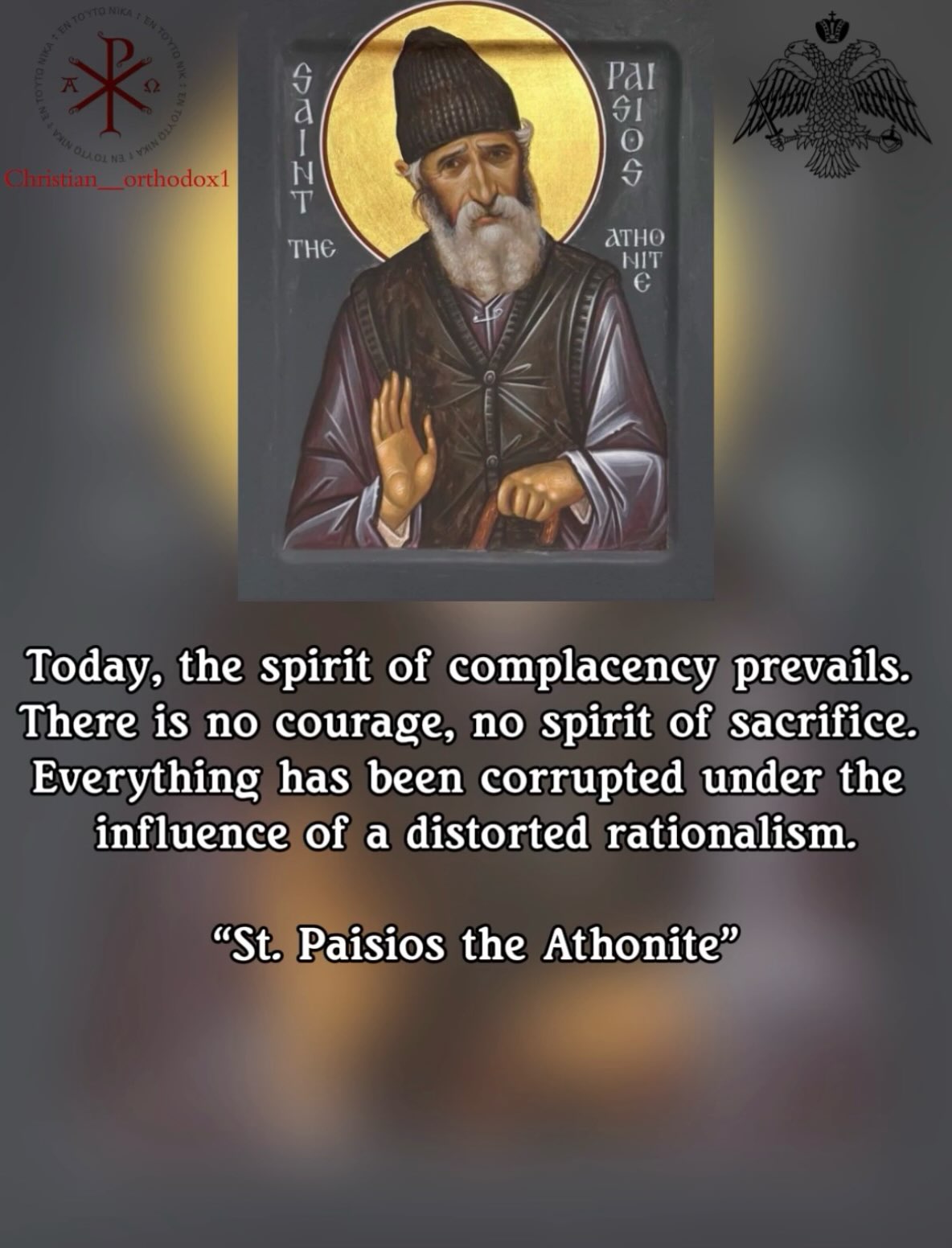
The post shares a brief statement attributed to St. Paisios the Athonite. The text reads: "Today, the spirit of complacency prevails. There is no courage, no spirit of sacrifice. Everything has been corrupted under the influence of a distorted rationalism." The passage identifies three related conditions: a prevailing complacency, an absence of courage and sacrificial spirit, and a corruption attributed to a distorted rationalism. No further…

The post shares a brief statement attributed to St. Paisios the Athonite. The text reads: "Today, the spirit of complacency prevails. There is no courage, no spirit of sacrifice. Everything has been corrupted under the influence of a distorted rationalism."

The passage identifies three related conditions: a prevailing complacency, an absence of courage and sacrificial spirit, and a corruption attributed to a distorted rationalism. No further commentary, context, or discussion is included in the source. The hashtags indicate the post is categorized under Christian, Orthodox, church, saints, and church fathers topics.

  • St. Paisios identifies a prevailing spirit of complacency
  • He notes the absence of courage and sacrificial spirit
  • He attributes corruption to distorted rationalism
Robel࿇🕊️ Instagram

Saint Justin Martyr on suffering and the eternal kingdom

The post shares a statement attributed to Saint Justin Martyr describing the Christian response to persecution. The speaker says they are condemned for being Christians, yet regard themselves as the most excellent people because Christ taught them not to deny him. Their lives may be taken, but they cannot be truly harmed, because they do not place their hopes in this present world but look forward to the kingdom of God. The video summary expands…

The post shares a statement attributed to Saint Justin Martyr describing the Christian response to persecution. The speaker says they are condemned for being Christians, yet regard themselves as the most excellent people because Christ taught them not to deny him. Their lives may be taken, but they cannot be truly harmed, because they do not place their hopes in this present world but look forward to the kingdom of God.

The video summary expands this into six points: condemnation for the Christian name, the claim to excellence through Christ's teaching, the possibility of death, the impossibility of true harm, the rejection of worldly hope, and the orientation toward God's eternal kingdom. The text reflects the apologetic tone of Justin's writings, where he defends Christians before Roman authorities by contrasting temporal punishment with everlasting reward.

The post presents the martyr's voice directly, without additional commentary or modern application.

Key moments

  1. They are condemned for being Christians.
  2. They are the most excellent people taught by Christ not to deny him.
  3. Their lives may be taken.
  4. They cannot be truly harmed.
  5. They do not place their hopes in this present world.
  6. They look forward to the kingdom of God.
Read more
CHRISTIANITY UNITED Instagram

Father Spyridon Bailey on worldly dependence and trust in God from Matthew 6

The post presents Father Spyridon Bailey's teaching on the tension between caring for earthly needs and depending on God. The priest explains that Christ in Matthew 6 places a question before believers: at what point does providing for families and fulfilling responsibilities become dependence on those things more than on God. The danger begins when hearts attach to money, possessions, clothes, food, comfort, security, and tomorrow's plans so…

The post presents Father Spyridon Bailey's teaching on the tension between caring for earthly needs and depending on God. The priest explains that Christ in Matthew 6 places a question before believers: at what point does providing for families and fulfilling responsibilities become dependence on those things more than on God. The danger begins when hearts attach to money, possessions, clothes, food, comfort, security, and tomorrow's plans so that losing them feels like losing everything.

Peace becomes measured by financial security rather than relationship with God. The Orthodox Fathers teach that attachment to earthly things is dangerous not because creation is evil but because anything placed above God becomes a master. The priest contrasts time spent worrying about tomorrow with time spent preparing souls for eternity.

Seeking first the Kingdom of God does not mean abandoning responsibilities but putting them in proper place: work without worshiping money, plan without becoming a slave to fear, enjoy gifts without forgetting the Giver. The video summary adds that Jesus teaches anxiety about food, clothing, and tomorrow reveals dependence on worldly things disrupting relationship with God.

He calls for freedom from anxiety, not an end to planning. Venerating saints honors the image of God restored in them through freedom from worldly dependence. This veneration should challenge believers to examine whether they suppress God's image through dependence and corruption or allow Him to restore it. Eternal needs are met only in God, not in the material world.

Key moments

  1. Jesus says we must question our dependence on the things of this world, citing Matthew's Gospel.
  2. Anxiety about food, clothing, and tomorrow reveals a dependence that disrupts our relationship with God.
  3. Jesus is not forbidding planning or care, but forbidding anxiety and dependence on material things.
  4. We venerate saints because they have become pure by breaking dependence on this world and avoiding what corrupts the mind.
  5. Veneration should challenge us to ask whether we have aspired to freedom from anxiety and dependence.
  6. We must examine how far we suppress God's image through dependence and corruption, or allow Him to restore it.
  7. Healing comes by remembering that our eternal needs are met only in God, not through clothes, food, or the material world.
Read more
☦️An Orthodox Blog☦️ with Orthodoxy ☦︎ Instagram

Fr. Seraphim Rose warns of counterfeit grace in the last times

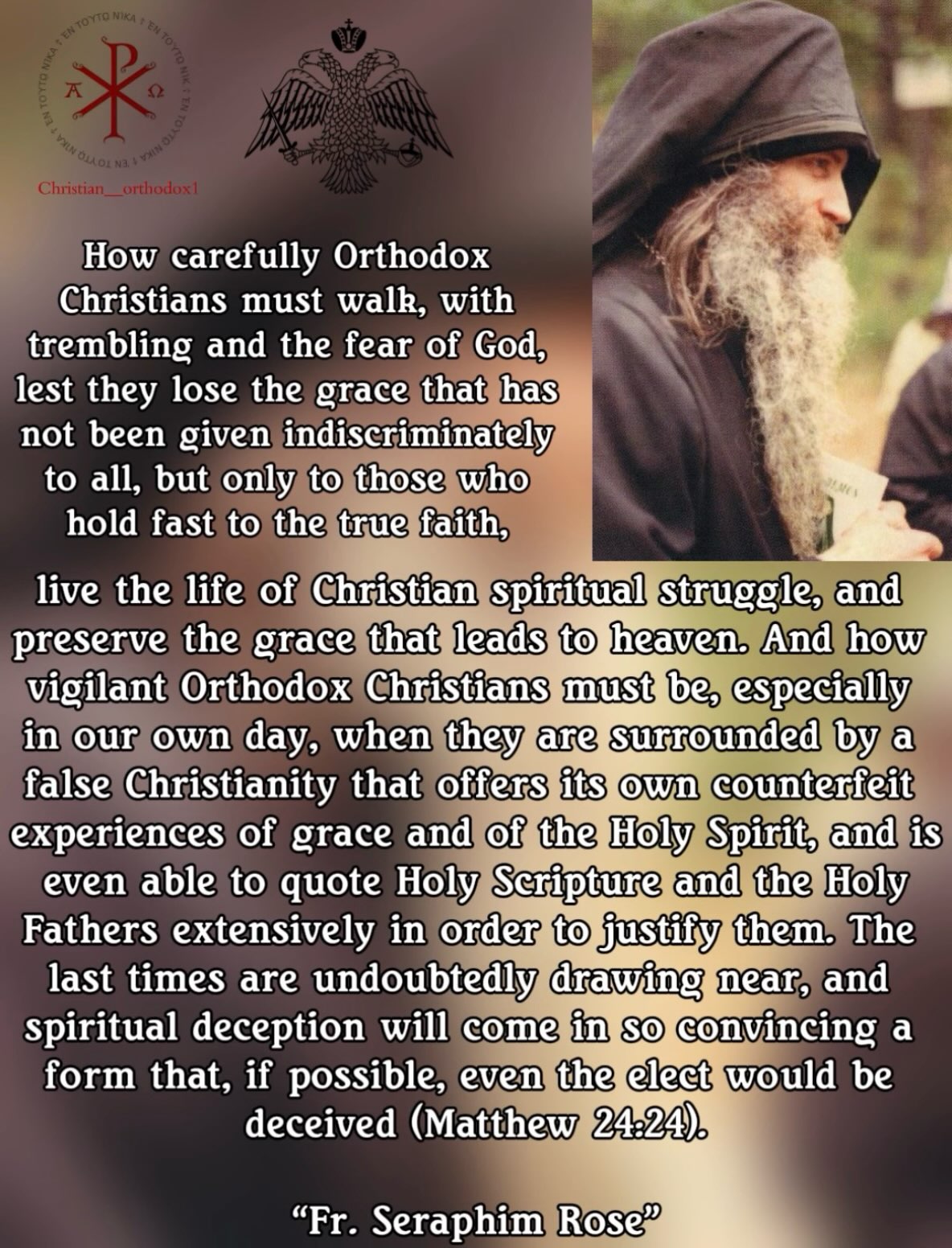
Fr. Seraphim Rose writes that Orthodox Christians must walk carefully with trembling and fear of God, because grace is not given indiscriminately but only to those who hold the true faith, live the life of spiritual struggle, and preserve the grace that leads to heaven. He says Christians must be especially vigilant today, surrounded by a false Christianity that offers counterfeit experiences of grace and the Holy Spirit, and that can quote Holy…

Fr. Seraphim Rose writes that Orthodox Christians must walk carefully with trembling and fear of God, because grace is not given indiscriminately but only to those who hold the true faith, live the life of spiritual struggle, and preserve the grace that leads to heaven. He says Christians must be especially vigilant today, surrounded by a false Christianity that offers counterfeit experiences of grace and the Holy Spirit, and that can quote Holy Scripture and the Holy Fathers extensively to justify them.

He states that the last times are undoubtedly drawing near, and spiritual deception will come in so convincing a form that, if possible, even the elect would be deceived, citing Matthew 24:24.

  • Grace is given only to those who hold the true faith, struggle spiritually, and preserve grace.
  • False Christianity offers counterfeit experiences of grace and the Holy Spirit.
  • Deceivers quote Scripture and the Fathers to justify their claims.
  • The last times are near, and deception will be so convincing it could deceive the elect.
  • Christians must walk with trembling and fear of God, remaining vigilant.
Read more
Prayer Orthodoxy ® with SpyridonFilms Instagram

Great Vespers at Orthodox Youth Weekend in Belgium features Psalm 140 chant

The video captures a moment from Great Vespers during an Orthodox Youth Weekend held in Zedelgem, Belgium. A chanter recites a Greek phrase, "Άγγελος δεινόν ά-βον τό-φεν με," then delivers the English translation of Psalm 140:3: "Set a watch, O Lord, before my mouth, and door of enclosure about my lips." He continues with the next verse in English: "Incline not my heart to evil word, to make excuses in. With men who work lawlessness, and I will"…

The video captures a moment from Great Vespers during an Orthodox Youth Weekend held in Zedelgem, Belgium. A chanter recites a Greek phrase, "Άγγελος δεινόν ά-βον τό-φεν με," then delivers the English translation of Psalm 140:3: "Set a watch, O Lord, before my mouth, and door of enclosure about my lips." He continues with the next verse in English: "Incline not my heart to evil word, to make excuses in.

With men who work lawlessness, and I will" before the recording ends. The service forms part of a gathering for Orthodox youth in Belgium.

Key moments

  1. 0:08 Greek phrase 'Άγγελος δεινόν ά-βον τό-φεν με' and English translation of Psalm 140:3: 'Set a watch, O Lord, before my mouth, and door of enclosure about my lips.'
  2. 0:45 English continuation of Psalm 140:4: 'Incline not my heart to evil word, to make excuses in. With men who work lawlessness, and I will'
Read more
Prayer Orthodoxy ® Instagram

Elder Ephraim's tomb at Arizona monastery chapel

The post describes the Chapel of Saint Menas at St. Anthony's Greek Orthodox Monastery in Arizona, founded by Elder Ephraim. The chapel contains Elder Ephraim's tomb. The text notes his life of prayer, repentance, and love for Christ continues to inspire many faithful. It includes a quotation attributed to Saint Seraphim of Sarov: "Acquire the spirit of peace, and thousands around you will be saved." The post ends with a request that Elder…

The post describes the Chapel of Saint Menas at St. Anthony's Greek Orthodox Monastery in Arizona, founded by Elder Ephraim. The chapel contains Elder Ephraim's tomb. The text notes his life of prayer, repentance, and love for Christ continues to inspire many faithful. It includes a quotation attributed to Saint Seraphim of Sarov: "Acquire the spirit of peace, and thousands around you will be saved."

The post ends with a request that Elder Ephraim's prayers strengthen readers to seek the narrow path to the Kingdom of God. The post is credited as an original production of Prayer Orthodoxy and includes hashtags for Orthodoxy, Arizona, Elder Ephraim, Saint Menas, and Prayer.

Key moments

  1. 0:00 Kyrie eleison, Christe eleison, Kyrie eleison chanted in succession
  2. 0:35 Gloria in excelsis Deo begins with the angels' hymn and praise to God
  3. 0:35 Laudamus te, benedicimus te, adoramus te, glorificamus te, gratias agimus tibi
  4. 0:35 Address to Domine Deus, Rex caelestis, Deus Pater omnipotens
  5. 0:35 Address to Domine Fili Unigenite, Jesu Christe, Domine Deus, Agnus Dei
  6. 1:05 Qui tollis peccata mundi, miserere nobis; suscipe deprecationem nostram
  7. 1:05 Qui sedes ad dexteram Patris, miserere nobis
  8. 1:05 Quoniam tu solus Sanctus, tu solus Dominus, tu solus Altissimus, Jesu Christe, cum Sancto Spiritu in gloria Dei Patris. Amen.
Read more

Memorial for Metropolitan Chrysostom of Rodostolon at Protaton

A memorial service for Metropolitan Chrysostom of Rodostolon was held on October 16, 2026, at the Protaton, the cathedral church of the Dormition in Karyes. Metropolitan Chrysostom of Symi presided at the invitation of the Holy Epistasia of Mount Athos. Concelebrants included the Protos of Mount Athos, Elder Georgios of Vatopedi, and abbots Prodromos of Great Lavra, Nathanael of Iviron, and Methodios of Hilandar, along with numerous hieromonks…

A memorial service for Metropolitan Chrysostom of Rodostolon was held on October 16, 2026, at the Protaton, the cathedral church of the Dormition in Karyes. Metropolitan Chrysostom of Symi presided at the invitation of the Holy Epistasia of Mount Athos. Concelebrants included the Protos of Mount Athos, Elder Georgios of Vatopedi, and abbots Prodromos of Great Lavra, Nathanael of Iviron, and Methodios of Hilandar, along with numerous hieromonks and representatives of all Athonite monasteries and several sketes.

The civil governor of Mount Athos, Alkiviadis Stefanis, a graduate of the Athoniada, also attended. Metropolitan Chrysostom spent 75 years on Mount Athos as a monk of Great Lavra. He was ordained bishop in 1978 by decision of the Ecumenical Patriarchate so that the Holy Mountain would have a hierarch to ordain hieromonks in Athonite brotherhoods.

He ordained many Hilandar monks, including the late Archimandrite Paisios, first abbot after the renewal of the cenobitic life at Hilandar, and Elder Stefan, currently the senior Hilandar monk by years of monastic life. Abbot Methodios was ordained deacon and elevated to archimandrite by him. Metropolitan Chrysostom served as professor and director of the Athoniada monastic academy and left numerous theological works; he was also noted for his gift of chanting.

From his pension as a professor he restored several old churches and assisted in building new ones. He wore episcopal insignia only during services and otherwise dressed very simply, in typical Athonite style. Athonites testify that those who did not know him could not guess he was a hierarch.

In his modest cell were found only a multitude of books; all other items such as fine vestments, miters, and enkolpia he gave to other hierarchs. He reposed in his monastic cell after the Divine Liturgy on October 1, 2025, at age 92, and was buried the next day at the Great Lavra cemetery. Photo: romfea.gr

  • Memorial service held October 16, 2026 at Protaton in Karyes for Metropolitan Chrysostom of Rodostolon.
  • Metropolitan Chrysostom of Symi presided; concelebrants included Protos Elder Georgios, abbots of Great Lavra, Iviron, Hilandar, and many hieromonks.
  • Metropolitan Chrysostom lived 75 years on Mount Athos as a monk of Great Lavra; ordained bishop in 1978 by Ecumenical Patriarchate to ordain Athonite hieromonks.
  • He ordained many Hilandar monks including Archimandrite Paisios and Elder Stefan; Abbot Methodios ordained deacon and archimandrite by him.
  • Known for theological works, chanting, simple dress, giving away episcopal items, and using pension to restore churches; reposed October 1, 2025 at age 92, buried at Great Lavra.
Read more

Elder Joseph the Hesychast on self-knowledge as the foundation of humility

The text attributed to Elder Joseph the Hesychast of Vatopedi Monastery opens with the command to know oneself before all else. This means recognizing who one truly is, not who one imagines oneself to be. Such knowledge brings wisdom, humility, and grace from the Lord. Without self-knowledge, merely counting one's labors keeps a person far from the path. The elder cites the Prophet who says not "Behold, Lord, my labor" but "Behold my humility…

The text attributed to Elder Joseph the Hesychast of Vatopedi Monastery opens with the command to know oneself before all else. This means recognizing who one truly is, not who one imagines oneself to be. Such knowledge brings wisdom, humility, and grace from the Lord.

Without self-knowledge, merely counting one's labors keeps a person far from the path. The elder cites the Prophet who says not "Behold, Lord, my labor" but "Behold my humility and my labor." Labor belongs to the body, humility to the soul, and both together serve the whole person.

The one who has conquered the devil is the one who has learned his own sickness, passions, and faults. Fear of self-knowledge keeps a person from true knowledge; such a person looks only for the faults of others to condemn them, seeing gifts in himself but not in others. A fault of the present age is the failure to recognize the gifts of others.

One person lacks what another has; recognizing this brings humility. In this way we honor and glorify God, who has adorned people in many ways and made his creations different. God created all things in wisdom. The elder urges his spiritual child to establish a firm foundation of humility, learn obedience, and acquire prayer.

Above all, every good thing has its beginning in God: every good thought, word, and deed is a gift from God. Every perfect gift comes from above. All is from God; we have nothing of our own.

  • Self-knowledge is the prerequisite for wisdom, humility, and grace
  • The Prophet emphasizes humility alongside labor, not labor alone
  • Conquering the devil requires knowing one's own passions and faults
  • Judging others while ignoring one's own faults shows lack of self-knowledge
  • All good thoughts, words, and deeds are gifts from God; we possess nothing of our own

Saint Mary's Nativity welcomes seekers home to Christ

Saint Mary's Nativity Antiochian Orthodox Church in Mays Hill, Sydney, posted a message addressing two groups: those who have entered the Church through Baptism and Chrismation, and those still searching. The post quotes St. Augustine: "You have made us for Yourself, O Lord, and our heart is restless until it rests in You." It describes the heart as made for God and invites people to come and see. An accompanying video features a speaker…

Saint Mary's Nativity Antiochian Orthodox Church in Mays Hill, Sydney, posted a message addressing two groups: those who have entered the Church through Baptism and Chrismation, and those still searching. The post quotes St. Augustine: "You have made us for Yourself, O Lord, and our heart is restless until it rests in You." It describes the heart as made for God and invites people to come and see.

An accompanying video features a speaker describing personal experience of God's love. The speaker says that when God loves them, they feel weightless. When God calls them chosen, they feel purpose. God has changed them into a new creation. The speaker declares that God will always be their favorite form of love.

Key moments

  1. The speaker asks why they love God
  2. When God loves them, they feel like they are floating
  3. When God calls them chosen, they feel like somebody with purpose
  4. God changed them into a new creation
  5. God will always be their favorite form of love
Read more