WeOrthodox
EN UA

Orthodox posts, videos and discussions

We follow Orthodox channels, communities and blogs across the web, summarise every post and video, and highlight the conversations with real substance.

Kyle YouTube discussion

Convert Argues Papal Supremacy Lacks Scriptural and Historical Basis

Convert Argues Papal Supremacy Lacks Scriptural and Historical Basis 18:49

A convert from Catholicism to Orthodoxy argues that Catholic apologetics for papal supremacy relies on worldly reasoning rather than scripture and the history of the first thousand years. He contends that the early church operated as a communion of autocephalous churches with the bishop of Rome holding only a customary honor. Modern Catholic documents such as the Alexandria, Chady, and Ratzinger formula admit the current papal system is an…

A convert from Catholicism to Orthodoxy argues that Catholic apologetics for papal supremacy relies on worldly reasoning rather than scripture and the history of the first thousand years. He contends that the early church operated as a communion of autocephalous churches with the bishop of Rome holding only a customary honor. Modern Catholic documents such as the Alexandria, Chady, and Ratzinger formula admit the current papal system is an innovation based on forgeries and cannot be reconciled with conciliar authority above the pope in the first millennium.

The speaker asserts that centralized papal authority enabled sweeping liturgical changes like the Novus Ordo, heavily influenced by Protestants, and Vatican II's teaching that Muslims worship the same God, which he calls a dogmatic contradiction. He contrasts this with Orthodoxy's preservation of the ancient Liturgy of St. John Chrysostom through decentralized synodical governance.

At Vatican I, Cardinal Guidi opposed an expansive definition of papal infallibility and was told by Pius IX, "I am tradition. I am the church"; the council defined papal declarations as irreformable of themselves, not by the church's consent. The speaker maintains that Catholic unity is only political, not theological, citing parishes ranging from pride masses to traditional Latin masses that condemn the Novus Ordo, while Orthodoxy maintains theological and liturgical unity despite jurisdictional disputes.

He identifies the rock in Matthew 16 as Peter's confession of faith, not Vatican I papal supremacy, and notes that Leo's Tome was examined for orthodoxy before acceptance at Chalcedon. He concludes that the New Testament presents the church as a communion of local churches each gathered around its bishop, following St. Ignatius, not as a single bishop exercising universal jurisdiction, and that doctrinal disputes in the first millennium were settled by ecumenical councils through conciliar deliberation and reception by the church, not by papal decree.

Key moments

  1. 0:00 Catholic apologetics appeals to reason divorced from scripture and church history; the first ecumenical council shows the bishop of Rome had only a customary honor and bishops were chosen locally in a communion of autocephalous churches.
  2. 0:30 Modern Catholic documents such as the Alexandria, Chady, and Ratzinger formula admit the current papal system is an innovation that evolved from forgeries and cannot be reconciled with the first thousand years of conciliar authority above the pope.
  3. 2:04 Centralized papal authority allowed the Novus Ordo liturgical reform, heavily influenced by Protestants, and Vatican II's teaching that Muslims worship the same God, which the speaker calls a dogmatic contradiction and a step toward the religion of the antichrist.
  4. 4:10 The supreme bishop can enforce liturgical changes on the whole church, restricting the traditional Latin Mass, whereas Orthodoxy retains the Liturgy of St. John Chrysostom from the early centuries.
  5. 5:13 At Vatican I, Cardinal Guidi opposed an expansive definition of papal infallibility and was told by Pius IX, "I am tradition. I am the church"; the council defined papal declarations as irreformable of themselves, not by the church's consent.
  6. 6:46 The Catholic Church's unity is only political, not theological: parishes range from pride masses to traditional Latin masses that condemn the Novus Ordo, while Orthodoxy is united in liturgy, saints, and theology despite disputes like Constantinople and Moscow.
  7. 10:55 The New Testament presents the one church as a communion of local churches each gathered around its bishop (St. Ignatius), not as a single bishop exercising universal jurisdiction; the rock in Matthew 16 is Peter's confession of faith, not Vatican I papal supremacy.
  8. 16:07 Doctrinal disputes in the first millennium were settled by ecumenical councils through conciliar deliberation and reception by the church, not by papal decree; Leo's Tome was examined for orthodoxy before acceptance.
9 opinions in the discussion In the Western part of Europe, Christianity slowly turned into humanism. Over a long and difficult stretch of time, the God-Man was diminished, changed, narrowed, and finally reduced to… Read the discussion

Dura-Europos baptistry paintings show icons shaped worship experience

The speaker investigates whether icons were apostolic by examining early Christian images. Archaeologists uncovered a third-century house church at Dura-Europos in Syria with a baptistry painted with Christ the Good Shepherd and a procession of women carrying torches toward the font. Scholars interpret the procession as the wise virgins meeting Christ the bridegroom. For a person about to be baptized, walking toward the font alongside these…

The speaker investigates whether icons were apostolic by examining early Christian images. Archaeologists uncovered a third-century house church at Dura-Europos in Syria with a baptistry painted with Christ the Good Shepherd and a procession of women carrying torches toward the font. Scholars interpret the procession as the wise virgins meeting Christ the bridegroom.

For a person about to be baptized, walking toward the font alongside these painted figures toward Christ above created an experience of participation rather than mere instruction. This indicates icons were not only educational but changed how believers interacted with the worship space.

Key moments

  1. The question of whether icons were apostolic can be approached by studying early Christian images and their use.
  2. A third-century house church at Dura-Europos in Syria contains a baptistry with paintings of Christ the Good Shepherd and a procession of women with torches moving toward the baptismal font.
  3. Scholars interpret the procession as the wise virgins going to meet Christ the bridegroom.
  4. For a baptismal candidate, walking toward the font alongside these painted figures toward Christ above creates an experience of participation, not just didactic teaching.
  5. This indicates icons were not merely educational but changed how believers interacted with the worship space.
Read more

Saint James the Apostle: Preached in Egypt, Martyred by Crucifixion

The post recounts the life of Saint James, the son of Alphaeus, one of the Twelve Apostles and brother of Saint Matthew the Evangelist. He witnessed Christ's teachings, miracles, suffering, Resurrection, and Ascension. After Pentecost, he preached first in Eleutheropolis and surrounding regions, then traveled to Egypt. Through his preaching and miracles, casting out demons, healing the sick, delivering people from spiritual darkness, he…

The post recounts the life of Saint James, the son of Alphaeus, one of the Twelve Apostles and brother of Saint Matthew the Evangelist. He witnessed Christ's teachings, miracles, suffering, Resurrection, and Ascension. After Pentecost, he preached first in Eleutheropolis and surrounding regions, then traveled to Egypt.

Through his preaching and miracles, casting out demons, healing the sick, delivering people from spiritual darkness, he challenged pagan worship and brought many to Christianity. Churches were established, and bishops and priests were appointed to guide the new communities. In the Egyptian city of Ostracine, pagans seized him and condemned him to death by crucifixion.

He gave his life for the Lord whose Resurrection he had witnessed and whose Gospel he had preached. The post concludes that his life shows following Christ requires faithfulness through sacrifice, suffering, and every trial, not merely verbal belief.

  • Saint James, son of Alphaeus, was one of the Twelve Apostles and brother of Saint Matthew
  • He preached in Eleutheropolis and Egypt after Pentecost, performing miracles and converting many
  • Churches were founded and clergy appointed through his apostolic work
  • He was martyred by crucifixion in the Egyptian city of Ostracine
  • His life exemplifies faithfulness to Christ through sacrifice and suffering
Read more

Saint Pelagia the Penitent: from a life of sin to holiness through repentance

Saint Pelagia was born in Antioch and lived a life far from God, using her extraordinary beauty for sinful purposes and gaining wealth through immorality. One day, while passing the Church of Saint Julian the Martyr, she heard Bishop Nonnus preaching about the Last Judgment and the consequences of sin. His words pierced her heart, and she saw the true condition of her soul. Overcome with sorrow, she fell before the bishop and begged him to…

Saint Pelagia was born in Antioch and lived a life far from God, using her extraordinary beauty for sinful purposes and gaining wealth through immorality. One day, while passing the Church of Saint Julian the Martyr, she heard Bishop Nonnus preaching about the Last Judgment and the consequences of sin. His words pierced her heart, and she saw the true condition of her soul.

Overcome with sorrow, she fell before the bishop and begged him to baptize her, crying, "Have mercy on me, a sinner, and baptize me and teach me repentance. I am a sea of lawlessness, an abyss of destruction." Saint Nonnus baptized her, and the deaconess Romana became her godmother, guiding her in the Christian faith. Pelagia did not stop at baptism. Desiring to leave her former life completely, she gave all her wealth to the poor and secretly traveled to Jerusalem.

There, under the name Pelagius, she lived as a monk in a small cell on the Mount of Olives, dedicating herself to fasting, prayer, vigils, and deep repentance. After three years of spiritual struggle, Deacon James, a disciple of Saint Nonnus, visited her. When he returned a few days later, he found that she had peacefully departed to the Lord. Saint Pelagia reposed around the year 461.

  • Born in Antioch, lived in sin and gained wealth through immorality.
  • Heard Bishop Nonnus preach on the Last Judgment at the Church of Saint Julian, leading to repentance.
  • Baptized by Nonnus with deaconess Romana as godmother.
  • Gave all wealth to the poor, became a monk named Pelagius on the Mount of Olives.
  • After three years of asceticism, visited by Deacon James; reposed c. 461.
Read more

Saints Sergius and Bacchus: Roman Soldiers Who Chose Christ Over Honor

The post recounts the martyrdom of Saints Sergius and Bacchus, who were respected military officers at the court of Emperor Maximian. The emperor admired them for their courage, wisdom, and loyalty. When he discovered they were Christians, his admiration turned into anger. During a pagan celebration, Maximian commanded them to offer sacrifices to the idols. Both saints refused, openly confessing their faith in Jesus Christ. Furious, the emperor…

The post recounts the martyrdom of Saints Sergius and Bacchus, who were respected military officers at the court of Emperor Maximian. The emperor admired them for their courage, wisdom, and loyalty. When he discovered they were Christians, his admiration turned into anger.

During a pagan celebration, Maximian commanded them to offer sacrifices to the idols. Both saints refused, openly confessing their faith in Jesus Christ. Furious, the emperor stripped them of their military uniforms, dressed them in women's clothing, placed iron rings around their necks, and paraded them through the streets of Rome to humiliate them.

Yet their faith remained unshaken. They were sent to the governor Antiochus, a man who had received his position through their help. He begged them to deny Christ and save themselves from torture and death. But they answered: "Honor and dishonor, life and death: all are the same to the one who seeks the Kingdom of Heaven."

Saint Bacchus was tortured first. He was beaten so severely that his body was broken, and his soul was carried by angels into the presence of the Lord. Saint Sergius was then forced to walk in iron shoes filled with sharp nails. After enduring terrible suffering, he was taken to Resafa in Syria, where he was beheaded for Christ.

Around the year 309, both saints received the crowns of martyrdom. They lost their military ranks, their earthly honors, and finally their lives, but they never lost Christ. The post closes with the invocation: Holy Martyrs Sergius and Bacchus, pray to God for us.

  • Sergius and Bacchus were high-ranking Roman officers under Emperor Maximian.
  • They refused to sacrifice to idols and confessed Christ during a pagan festival.
  • Maximian humiliated them publicly, then sent them to Governor Antiochus.
  • Bacchus died from severe beating; Sergius was beheaded in Resafa around 309.
  • The account ends with a prayer for their intercession.
Read more
Eastern Orthodoxy Daily He/Who/Is Instagram

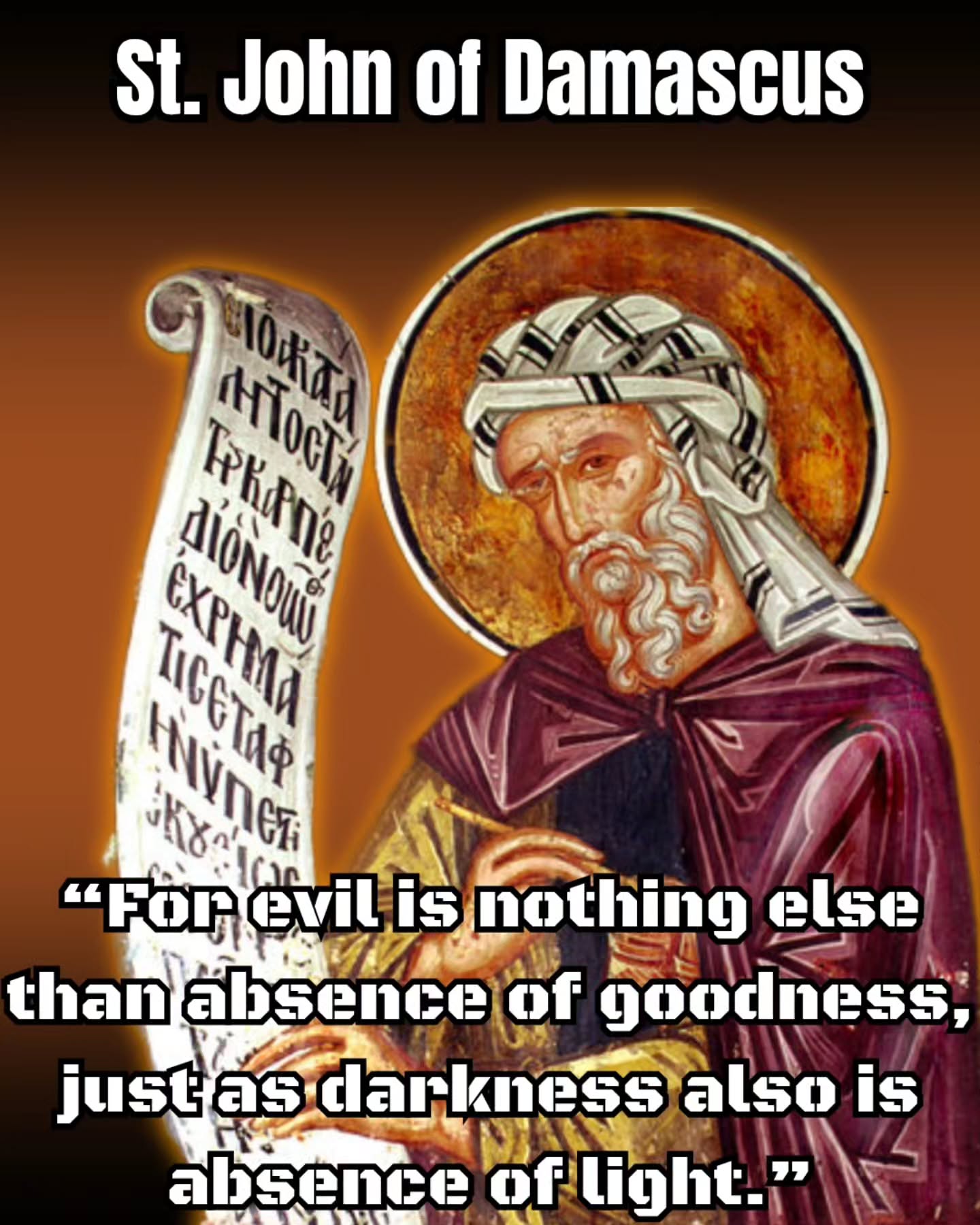
St. John of Damascus and His Exact Exposition of the Orthodox Faith

The post identifies St. John of Damascus and his work "An Exact Exposition of the Orthodox Faith" as the single most important resource for understanding Orthodoxy. It includes a quotation from the saint: "For evil is nothing else than absence of goodness, just as darkness also is absence of light." The statement presents evil as a privation of good rather than an independent reality.

  • St. John of Damascus wrote "An Exact Exposition of the Orthodox Faith"
  • The work is called the most important single resource for understanding Orthodoxy
  • The post quotes the saint on evil as absence of goodness
  • The quote compares evil to darkness as absence of light
Robel࿇🕊️ Instagram

Saint Irenaeus on God's Self-Sufficiency and Our Need for Communion

Saint Irenaeus of Lyons teaches that God created Adam not because He needed humanity but because He desired to bestow His benefits upon someone. Before any creation existed, the Son was glorifying the Father and was glorified by the Father, showing that God lacks nothing within Himself. The saint explains that God commands us to follow Him not because He requires our service but because He wishes to offer us salvation. To follow the Savior is to…

Saint Irenaeus of Lyons teaches that God created Adam not because He needed humanity but because He desired to bestow His benefits upon someone. Before any creation existed, the Son was glorifying the Father and was glorified by the Father, showing that God lacks nothing within Himself. The saint explains that God commands us to follow Him not because He requires our service but because He wishes to offer us salvation.

To follow the Savior is to share in salvation, just as to follow the light is to perceive the light. Those who are in the light do not illuminate it; they are themselves illuminated and made radiant by it. This teaching underscores the gratuity of creation and the purpose of divine commandments: they are given for our benefit, not to fulfill any lack in God.

Irenaeus presents a vision of communion in which human beings receive life and radiance from God, who remains the unchanging source of all good.

Key moments

  1. God created Adam not because he needed man but because he desired someone upon whom to bestow his benefits.
  2. Before Adam and before all creation, the Son was glorifying the Father and was himself glorified by the Father.
  3. God commanded us to follow him not because he needed our service but because he desired to offer us salvation.
  4. To follow the Savior is to share in salvation, just as to follow the light is to perceive the light.
  5. Those who are in the light do not illuminate it; they are themselves illuminated and made radiant by it.
Read more
r/OrthodoxChristianity Reddit

Terrorist attack on Orthodox church in Jordan kills eight

Reuters, the New York Times, and several official sources report that three gunmen opened fire on about two hundred mourners at the Orthodox Hammoud Church in Karak, Jordan. The shooting lasted five minutes and left seven dead and thirty-seven wounded. Footage circulating online shows the attackers. This is not the first time Christians in Karak have been targeted. Ten years ago, the 2016 Al-Karak attack took place, for which the Islamic State…

Reuters, the New York Times, and several official sources report that three gunmen opened fire on about two hundred mourners at the Orthodox Hammoud Church in Karak, Jordan. The shooting lasted five minutes and left seven dead and thirty-seven wounded. Footage circulating online shows the attackers.

This is not the first time Christians in Karak have been targeted. Ten years ago, the 2016 Al-Karak attack took place, for which the Islamic State claimed responsibility.

Please pray for the victims; they need it. Pray for this wave of terrorism across the world to end, because we are exhausted.

Edit: A recording I had included turned out to be unrelated.

Edit: One of the wounded has died at Prince Ali Hospital, raising the death toll to eight martyrs.

Eternal glory and peace to the souls of the martyrs of Christ. May they rest in the eternal embrace of the Lord.

  • Three gunmen attacked the Orthodox Hammoud Church in Karak, Jordan, killing eight and wounding thirty-seven
  • The 2016 Al-Karak attack by Islamic State shows a pattern of targeting Christians in the area
  • The author asks for prayers for the victims and for an end to global terrorism
  • A previously shared recording was corrected as unrelated
  • The death toll rose to eight after a victim succumbed to injuries
Read more

Father Vasilije Kostić: Confession beyond avoided sins, the parable of talents

Father Vasilije Kostić addresses a common pattern in confession where people list sins they have avoided rather than good they have failed to do. He draws on Christ's parable of the talents, noting that the third servant was condemned not for stealing or wasting but for burying his talent and returning it unchanged. God asks what good we could have done and did not do. The priest observes that every person can perform at least one good act: say…

Father Vasilije Kostić addresses a common pattern in confession where people list sins they have avoided rather than good they have failed to do. He draws on Christ's parable of the talents, noting that the third servant was condemned not for stealing or wasting but for burying his talent and returning it unchanged. God asks what good we could have done and did not do. The priest observes that every person can perform at least one good act: say a kind and beautiful word, offer a compliment.

The goal set by God is higher than mere avoidance of evil; it is to love enemies, pray for them, and bless those who curse us. He warns that excuses are often covered by false piety, which is rooted in fear of sinning rather than in a living relationship with the living God. Sin can lead a person back to God through repentance, yet a life lived in cramped fear of every mistake freezes the person and everyone around them.

The gifts God gives are not our own property; they are entrusted to us to give to others and multiply.

Key moments

  1. Confession often becomes a list of sins not committed, did not steal, did not kill, but the parable of the third servant shows God asks what good we could have done and failed to do.
  2. Every person can do at least some good: say a kind and beautiful word, offer a compliment.
  3. The perfection God gives and requires is to love enemies, pray for them, and bless those who curse us.
  4. Excuses are often covered by false piety; true piety is not fear of sinning but a living relationship with the living God.
  5. Sin can lead a person back to God through repentance.
  6. A life lived in cramped fear of sinning freezes the person and everyone around them.
  7. The gifts God gives are not our own; they are entrusted to us to give to others and multiply.
Read more
CHRISTIANITY UNITED Instagram

The Beauty of Orthodox Worship: Turning Hearts to God

The post reflects on the experience of entering an Orthodox church, describing the sensory elements, incense, candles, icons, quiet prayers, sunlight, that create a space removed from worldly noise. It explains that these elements are not merely decorative but serve to turn hearts toward God: icons remind worshippers of Christ, the Theotokos, and the saints; candles represent prayers and self-offering; incense symbolizes prayers rising to…

The post reflects on the experience of entering an Orthodox church, describing the sensory elements, incense, candles, icons, quiet prayers, sunlight, that create a space removed from worldly noise. It explains that these elements are not merely decorative but serve to turn hearts toward God: icons remind worshippers of Christ, the Theotokos, and the saints; candles represent prayers and self-offering; incense symbolizes prayers rising to heaven.

At the center is Jesus Christ, calling all to repentance, prayer, and communion. The author notes that people come with hidden burdens, to give thanks, seek forgiveness, or stand in silence, and that silent prayer before an icon can be a starting point when words fail. The reflection cites Hebrews 13:8 on Christ's unchanging nature.

The accompanying video presents a series of spiritual maxims on humility, prayer, and salvation. One saying urges keeping the head low but the soul close to God, being active in deeds while at peace with people as the way to salvation. Another advises humbling the heart and reproaching oneself, for the monk sleeps but sin watches.

The maxims warn that if one does not hear others' groans, neither fasts nor prostrations will help, and that God values truthfulness and honesty over outward appearance. They caution against judging others, laughing at another's need, and attachment to the world, while extolling a pure heart as a spring useful to all and reliance on God as the path to salvation.

The discussion turns on the connection between external worship and inner disposition, and the priority of compassion and humility over ritual performance.

Key moments

  1. Keep your head low but your soul close to God; be active in deeds but at peace with people as the way to salvation.
  2. Humble your heart and reproach yourself, for the monk sleeps but sin watches.
  3. If you do not become a people-pleaser, you will become pleasing to God.
  4. If you do not hear others' groans, neither fasts nor prostrations will help you.
  5. People care about appearance, but God cares about truthfulness and honesty.
  6. Whoever prays to God will not be put to shame; do not laugh at another's need lest you not escape your own trouble.
  7. He who reproaches others forgets his own sins; a humble person is a priceless diamond.
  8. A pure heart is like a spring, useful to all; the world deceives those attached to it, but God saves those who rely on Him.
Read more
Prayer Orthodoxy ® with The National Herald Instagram

Gunmen Open Fire at Greek Orthodox Church in Karak, Jordan

Gunmen opened fire inside a Greek Orthodox church in Karak, Jordan, on Friday, causing a number of deaths and injuries, the kingdom's law enforcement agency said. Authorities did not immediately provide a death toll. The church is located about 180 kilometers south of the capital, Amman. Government spokesman Mohammad al-Momani stated that security services were investigating the shooting. Karak is home to a minority Christian population. The…

Gunmen opened fire inside a Greek Orthodox church in Karak, Jordan, on Friday, causing a number of deaths and injuries, the kingdom's law enforcement agency said. Authorities did not immediately provide a death toll. The church is located about 180 kilometers south of the capital, Amman. Government spokesman Mohammad al-Momani stated that security services were investigating the shooting.

Karak is home to a minority Christian population. The city was previously targeted in 2016 when gunmen ambushed police in a series of attacks, including at a Crusader castle popular with tourists. Those attacks killed ten people, among them seven officers, and wounded dozens. Jordanian security forces killed the gunmen after a long standoff.

  • Gunmen attacked a Greek Orthodox church in Karak, Jordan, on Friday.
  • The shooting caused deaths and injuries; no official toll was released immediately.
  • Security services are investigating, per government spokesman Mohammad al-Momani.
  • Karak has a minority Christian population and experienced a deadly terrorist attack in 2016.
  • In 2016, gunmen killed ten people, including seven police officers, at a Crusader castle and other sites.
Read more

Priest's daughter questions Orthodox family ideal after traumatic upbringing

I'm drawn to many things in Orthodoxy and would like to keep it in my life and raise a family within it, though differently. I believe in God, but the traditions, the lifestyle, and some priests' views are sometimes hard for me to handle. The problem is I carry a lot of trauma from my upbringing, and it's difficult to reconcile certain things. My father has been a priest for over thirty years, respected, serving in several churches and having…

I'm drawn to many things in Orthodoxy and would like to keep it in my life and raise a family within it, though differently. I believe in God, but the traditions, the lifestyle, and some priests' views are sometimes hard for me to handle.

The problem is I carry a lot of trauma from my upbringing, and it's difficult to reconcile certain things. My father has been a priest for over thirty years, respected, serving in several churches and having built several. My mother is held up as an example for Orthodox women: nine children, never worked outside the home, devoted her life to them, helped extensively at church, now sings in the choir.

I grew up inside this family and know it from within. Converts who come as adults probably have a different experience because they lack this background. I'm not just from an Orthodox family; I'm from a family presented as a model of Orthodoxy.

We grew up in a village. Seven of the nine children never attended kindergarten. We observed all the fasts, including Wednesdays and Fridays, and even the little ones didn't eat dairy. If we ate or drank anything before communion, we didn't receive.

We prayed for twenty-five minutes every morning and night, often not starting the evening prayers until ten or eleven. We attended church every Sunday, often Saturdays too, and on feast days. I sang in the choir, my brothers served at the altar.

I'm the third child and the first girl. Whenever my mother was in the maternity ward, I stayed home in charge: putting the kids to bed, checking homework, cooking. I cried and called her because it was so hard. My father lacked patience with the children and was often absent. He drove us to the metro for school, but I don't recall him spending time with us or talking to me. He never asked how I was, didn't even know what grade I was in.

We were punished frequently. We were struck on the buttocks with hands and a belt, hard enough to leave bruises. We could also be hit on the back, shoved, sometimes slapped in the face in anger, with clothing, with a stick. Once my little brother misbehaved and my mother sat on him and stuffed a rag in his mouth to quiet him.

My father would splash us with cold water in the bathroom when we cried. We were made to kneel on buckwheat and stand in corners. The last severe punishment I received was around age thirteen; I had stripes of bruises because I hadn't picked up the little ones' toys, though no one had told me to. There's much more.

My mother can be verbally harsh. She would say things like "dirty pig," "what a lazy breed," "didn't you already get the belt this morning? Do you want it?", "get out, I don't want to see you," "go ahead and cry, I'm hurt too," "I didn't think you were this brainless." She never apologized afterward. My parents never apologized for their behavior, ever.

They never said they loved us, weren't particularly warm, and my father often spoke to us in a distant, strict manner.

I understand my mother runs out of patience, but she doesn't hide that she considers this normal. She says: "If a child doesn't know how to behave, he needs to be whipped, and harder. The earlier you start the better, after six it's too late." I have no words. She also often said we'd drive her to an early grave, that she'd die young because of us, that she has no free time and can't do anything for herself.

At seventeen I moved abroad and lived alone for almost four years. Now circumstances have brought me back to live with them for a year. Because of the war they moved to Europe, and they treat the younger children better now, but I still hear name-calling and they still sometimes smack a child. Yesterday my mother hit my eight-year-old brother hard on the neck and called him a ram several times because he forgot his jacket.

I'm twenty-two, my older brothers are twenty-four and twenty-six.

  • Whether rejecting the family model means she's stubborn or normal
  • Whether the abusive upbringing represents the ideal Orthodox family
  • Why having many children is seen as more pious than fewer raised with love
  • How to reconcile Orthodox teachings on discipline, gender roles, family size with her trauma
  • Difficulty relating to Orthodox men who expect traditional roles
19 opinions in the discussion By coming here, I think you already realize that a lot of the harm in your childhood didn't come from Orthodoxy's actual teachings and practices. It came from how your parents twisted them,… Read the discussion
Disgruntled Docs Instagram discussion

Don't give in to despair; seek help and find hope in God

I miss my brother. I wish I could have done more for him. He left behind his wife and daughter. Don't give in to the struggle against the demons. Please seek help and support if you need it. Your life is worth living. I have walked that road and it only leads to more pain. I have found that even in the darkest moments when I cried out to God for help, He pulled me out of the darkness. There is hope, but it is a long road ahead. To all the…

I miss my brother. I wish I could have done more for him. He left behind his wife and daughter. Don't give in to the struggle against the demons. Please seek help and support if you need it. Your life is worth living. I have walked that road and it only leads to more pain.

I have found that even in the darkest moments when I cried out to God for help, He pulled me out of the darkness. There is hope, but it is a long road ahead. To all the military brothers, stay strong, and if you need anything, please send me a message or go into an Orthodox church.

5 opinions in the discussion "Cast thy burden upon the LORD, and he shall sustain thee: He shall never suffer the righteous to be moved." Psalm 55:22 KJV "Casting all your care upon him; for he careth for you." 1 Peter… Read the discussion
Tzanetos Kavaliotis YouTube discussion

St. Paisios on Anxiety: Let Thoughts Fly Past, Fix Eyes on Christ

St. Paisios on Anxiety: Let Thoughts Fly Past, Fix Eyes on Christ 17:46

The video presents Saint Paisios of Mount Athos's teaching on anxiety as a spiritual problem with a cure. Paisios compares anxious thoughts to airplanes: ignoring them lets them pass, but paying attention builds an airport where they land. He identifies anxiety as the work of the devil, which distances people from God by consuming the heart's marrow. Christ's teaching in Matthew 6 and the story of Martha and Mary show that worry turns even good…

The video presents Saint Paisios of Mount Athos's teaching on anxiety as a spiritual problem with a cure. Paisios compares anxious thoughts to airplanes: ignoring them lets them pass, but paying attention builds an airport where they land. He identifies anxiety as the work of the devil, which distances people from God by consuming the heart's marrow.

Christ's teaching in Matthew 6 and the story of Martha and Mary show that worry turns even good things into doubt. The video outlines Paisios's three practical remedies: do not engage thoughts but turn to the Jesus Prayer, deliberately choose good thoughts like a bee finding flowers, and simplify life by putting hope in Christ rather than self-control.

Saint John Chrysostom's commentary in Homilies 21 and 22 on Matthew and the account of Peter walking on water illustrate that peace comes from fixing eyes on Christ, not the wind. The video draws from Paisios's Spiritual Counsels I and III, Chrysostom's homilies, and Palladius's Dialogue on the Life of St. John Chrysostom. It ends with six steps for the 3 AM hour and Chrysostom's dying words, "Glory be to God for all things."

Key moments

  1. 1:39 Paisios says thoughts are like airplanes flying overhead; if you ignore them they pass, but if you pay attention you build an airport in your head and give them permission to land.
  2. 2:42 Paisios calls anxiety the work of the devil, not as an accusation but because fear about tomorrow is the enemy's favorite way into the soul, and too many worries distance people from God.
  3. 4:19 The Gospel account of Martha shows that serving Christ with anxiety turns good work into a reason to accuse God: "Lord, don't you care?" Christ answers that only one thing is needed.
  4. 6:24 Christ asks in Matthew 6 whether worrying can add a single hour to life; Chrysostom preached that nothing pains the soul more than anxiety, more than poverty or sickness.
  5. 9:01 Peter walks on water while looking at Christ, but the moment he sees the wind he sinks; worry is looking at the wind instead of the one walking on top of it.
  6. 10:34 Paisios teaches not to fight thoughts head-on at 3 AM but to stop giving them a runway, turn attention elsewhere, and pray the Jesus Prayer or Peter's three words: "Lord, save me."
  7. 11:05 Paisios contrasts the fly, which finds filth in a garden, with the bee, which finds a flower in a rubbish heap; choosing good thoughts deliberately makes a person almost unshakeable.
  8. 12:39 Simplicity is the third cure: fewer commitments, fewer screens, fewer opinions on what cannot be changed, and putting all hope in Christ rather than in one's own planning and control.
6 opinions in the discussion "your carrying days God hasn't given to you." Very well said! Every day is a blessing and a promise that was never given to us. Instead what does Christ say - "Repent! For the kingdom of… Read the discussion

Elder Philimon on the Good Alteration: Grace of God and the Panagia's Blessing

In a video from the YouTube channel "Parish Life - Holy Church of St. Demetrios Piraeus", Elder Philimon of the Holy Coenobiatic Pantokratoros Skete of Prophet Elijah on Mount Athos speaks about what he calls "the good alteration". He recounts how he helped some people, and afterward women approached him asking what he had done because they noticed a change in those individuals. The elder responded that they have great weakness and asked what…

In a video from the YouTube channel "Parish Life - Holy Church of St. Demetrios Piraeus", Elder Philimon of the Holy Coenobiatic Pantokratoros Skete of Prophet Elijah on Mount Athos speaks about what he calls "the good alteration". He recounts how he helped some people, and afterward women approached him asking what he had done because they noticed a change in those individuals.

The elder responded that they have great weakness and asked what else they could do. He attributed the change not to his own actions but to the grace of God and the blessing of the Panagia. He encouraged them not to be discouraged, to do what they can, and trust that God will do the rest.

The teaching emphasizes humility, reliance on divine grace, and the role of the Theotokos in spiritual transformation.

Key moments

  1. Women notice a change in people after an elder helps them and ask what he did.
  2. The elder says they have great weakness and asks what else they can do.
  3. The elder attributes the change to the grace of God and the blessing of the Panagia.
  4. The elder tells them not to be discouraged, to do what they can, and God will do the rest.
Read more
Holy Resurrection YouTube

St. John Climacus on Passions, Illness, and the Struggle for Dispassion

St. John Climacus on Passions, Illness, and the Struggle for Dispassion 5:08

The video summarizes teachings from St. John Climacus in Philokalia Volume II, Chapter 3, on virtues, passions, and the ascetic struggle. It explains that illness can be sent by God to cleanse sins or humble pride when a person neglects ascetic labors. Every event can be received in three ways: with a good disposition, a passionate disposition, or a mixed disposition, illustrated by three brothers who suffered the same loss but reacted…

The video summarizes teachings from St. John Climacus in Philokalia Volume II, Chapter 3, on virtues, passions, and the ascetic struggle. It explains that illness can be sent by God to cleanse sins or humble pride when a person neglects ascetic labors. Every event can be received in three ways: with a good disposition, a passionate disposition, or a mixed disposition, illustrated by three brothers who suffered the same loss but reacted differently.

Farmers sowing the same virtues, fasting, vigils, almsgiving, do so with vastly different intentions, such as paying debts, gaining wealth, honoring their master, seeking praise, vexing an enemy, or avoiding reproach. Passions often hide within virtues: gluttony with hospitality, lust with love, pride with humility, and vainglory acts as a poison that corrupts even good works.

The Lord desires to free all from passions instantly but respects free will; unanswered prayers result from asking at the wrong time, beyond one's measure, from vainglory, or because granting the request would cause pride or negligence. Pride alone can replace all other passions and cast a person down from heaven. Demons sometimes withdraw to lull the soul into carelessness before attacking, or they leave when the soul is fixed in sinful habits.

A fifth kind of dispassion arises from simplicity and guilelessness, where God frees the upright heart without the person's awareness.

Key moments

  1. 0:12 Illness is sent for the cleansing of sins or to humble pride and self-exaltation; when someone is negligent in ascetic labors, the Lord humbles the flesh through illness as a less demanding form of ascetic struggle.
  2. 0:42 All events can be received in three ways: with a good disposition, a passionate disposition, or a mixed disposition; three brothers suffered the same loss, one was indignant, one undisturbed, one joyful.
  3. 1:12 Farmers sow the same seeds, fasting, vigils, almsgiving, acts of service, but with different intentions: to pay debts, become rich, honor their master, earn praise, vex an enemy, or avoid reproach for idleness.
  4. 1:43 Passions secretly entwine with virtues: gluttony with hospitality, lust with love, excessive severity with discernment, cunning with prudence, suspicion with slowness, laziness with contentiousness, self-will with meekness, the urge to teach with silence, self-conceit with joy, hope with laziness, judgment with love, despondency with stillness, bitterness with purity, undue boldness with humility.
  5. 2:13 Vain glory comes last as a common remedy that is actually a poison; we should not grieve when the Lord does not answer our requests for a long time.
  6. 2:44 The Lord desires all to become free from passions in a single moment but encounters the obstacle of free will; unanswered prayers result from asking before the proper time, asking beyond one's measure, asking from vainglory, or because granting would cause pride or negligence.
  7. 3:14 Sometimes all passions depart except pride, which alone takes the place of all others and can cast a person down even from heaven; divine fire consumes and uproots the substance of passions from the soul.
  8. 4:17 Demons withdraw to lull the soul into carelessness then suddenly attack and plunder it, or they withdraw when the soul is fixed in sinful habits like infants sucking fingers after weaning; a fifth dispassion arises from simplicity and guilelessness, where God frees the upright heart without their awareness.
Orthodox Life Instagram

Saint James the Brother of the Lord: First Bishop of Jerusalem

The post commemorates Saint James the Apostle, called the Brother of God (Adelphotheos) and James the Just, on October 23. In Orthodox tradition he is the son of Joseph the Betrothed from a previous marriage, making him the step-brother of Jesus Christ, and the Church carefully distinguishes him from the other apostles named James, specifically James the son of Zebedee and James the son of Alphaeus. From youth he lived a strict ascetic life,…

The post commemorates Saint James the Apostle, called the Brother of God (Adelphotheos) and James the Just, on October 23. In Orthodox tradition he is the son of Joseph the Betrothed from a previous marriage, making him the step-brother of Jesus Christ, and the Church carefully distinguishes him from the other apostles named James, specifically James the son of Zebedee and James the son of Alphaeus.

From youth he lived a strict ascetic life, abstaining from oil and animal fats, subsisting on bread and water, and praying so much on his knees that his skin hardened like a camel's. After the Ascension he became the first Bishop of Jerusalem, serving for thirty years. He presided at the Council of Jerusalem recorded in Acts 15, where his judgment guided the early Church on Gentile believers.

Even Jewish elders respected his integrity, calling him James the Just. The Apostle Paul notes a personal appearance of the risen Christ to James in 1 Corinthians 15:7. Around 63 A.D. Jewish authorities, angered by his preaching of the resurrection, pushed him from the pinnacle of the Temple. He survived the fall, knelt and prayed for his persecutors, and was stoned; a fuller struck the final blow with a club.

The accompanying images show Greek inscriptions identifying him as the holy Adelphotheos, including a Gospel manuscript fragment and a liturgical text that reads: "Holy Apostle & James Brother of the Lord and remember your death, and we confess your resurrection. Do this so that you do not forget me. For as often as you eat this bread and drink this cup, you will proclaim the death of the Son of Man, and confess his resurrection until he comes."

A fresco depicts a saint being struck down, and another inscription names the holy church of Father Paul in Jerusalem and Saint Luke.

  • Commemorated October 23 as the Brother of God and first Bishop of Jerusalem
  • Identified as son of Joseph from a prior marriage, step-brother of Christ
  • Presided at the Council of Jerusalem (Acts 15) and served thirty years
  • Known for extreme asceticism and constant prayer; knees hardened like a camel's
  • Martyred c. 63 A.D. by being thrown from the Temple, stoned, and clubbed
Read more
Prayer Orthodoxy ® with Prayer Orthodoxy® Instagram

St. Porphyrios of Kavsokalyvia: Biography and Three Sayings

The post provides a concise overview of the life of St. Porphyrios of Kavsokalyvia. It states that he was born in 1906 on the island of Evia in Greece. As a young boy he went to Mount Athos, where he lived a monastic life. He became widely known for his dedication to prayer, his humility, his love for others, and his gift of spiritual discernment. The saint reposed on December 2, 1991, and was formally canonized in 2013. In addition to the…

The post provides a concise overview of the life of St. Porphyrios of Kavsokalyvia. It states that he was born in 1906 on the island of Evia in Greece. As a young boy he went to Mount Athos, where he lived a monastic life.

He became widely known for his dedication to prayer, his humility, his love for others, and his gift of spiritual discernment. The saint reposed on December 2, 1991, and was formally canonized in 2013. In addition to the biographical details, the post includes three short sayings attributed to St. Porphyrios.

The first saying urges believers to love Christ and to put nothing before that love. The second saying notes that in his own life prayer held the first place. The third saying declares that Christ is everything, identifying Him as joy, life, and light.

The entire text is presented in both English and Greek, with the Greek translation following the English version. There is no further discussion or commentary included in the post.

  • Born 1906 in Evia, Greece; entered Mount Athos as a boy
  • Renowned for prayer, humility, love, and spiritual discernment
  • Reposed December 2, 1991; canonized 2013
  • "Love Christ and put nothing before His Love"
  • "Christ is everything. He is joy, He is life, He is light."
Read more
☦️An Orthodox Blog☦️ Instagram

The Trinity: Mystery Lived in Liturgy, Not Solved by Reason

The video presents the Orthodox understanding of the Trinity as one God in three distinct persons, Father, Son, and Holy Spirit, who share the same divine essence without confusion or division. The baptism of Jesus reveals all three simultaneously: the Father speaks from heaven, the Son stands in the water, and the Spirit appears as a dove. The Father is unbegotten, the Son is begotten, and the Holy Spirit proceeds from the Father. The…

The video presents the Orthodox understanding of the Trinity as one God in three distinct persons, Father, Son, and Holy Spirit, who share the same divine essence without confusion or division. The baptism of Jesus reveals all three simultaneously: the Father speaks from heaven, the Son stands in the water, and the Spirit appears as a dove.

The Father is unbegotten, the Son is begotten, and the Holy Spirit proceeds from the Father. The ecumenical councils of 325 and 381 established these boundaries to protect the apostolic faith, affirming that Christ is consubstantial with the Father and the Spirit is the Lord and giver of life. Orthodoxy does not defend the Trinity in philosophical debate but on its knees in the liturgy, immersing the mind in the infinite rather than trying to contain the infinite in the mind.

St. Gregory the Theologian described the balance: no sooner do I conceive of the One than I am illumined by the Three; no sooner do I distinguish the Three than I am carried back to the One. St. Basil the Great wrote that the way of knowing God goes from the one Spirit through the one Son to the one Father. The Trinity is not a mathematical problem to solve but a mystery in which Christians participate, lived in communion rather than rationalized.

Key moments

  1. The Trinity is not a mathematical problem to solve but a mystery in which Christians participate.
  2. St. Gregory the Theologian described the balance: no sooner do I conceive of the One than I am illumined by the Three; no sooner do I distinguish the Three than I am carried back to the One.
  3. The Father is unbegotten, the Son is begotten, and the Holy Spirit proceeds from the Father.
  4. The councils of 325 and 381 fixed the limits of the faith to protect the apostolic teaching.
  5. The Trinity is not rationalized but lived in communion.
  6. St. Basil the Great wrote that the way of knowing God goes from the one Spirit through the one Son to the one Father.
☦️An Orthodox Blog☦️ Instagram

Prayer to the Theotokos for Cuba's people

The prayer calls on the Most Holy Theotokos as Mother of the Word and Virgin to save those greatly afflicted by temptations. The speaker seeks refuge from passions and assaults of despondency that overwhelm the soul. The prayer asks the Maiden to bring peace through the calm of her Son and God.

A doxology glorifies the Father, Son, and Holy Spirit, acknowledging that the Virgin bore the Savior and God. The speaker lifts up both soul and mind to her now and forever.

Key moments

  1. The speaker calls on the Most Holy Theotokos to save those greatly afflicted by temptations, fleeing to her as Mother of the Word and Virgin for deliverance from difficult and terrible things.
  2. Passions and assaults of great despondency overwhelm the soul; the prayer asks the Maiden to bring peace with the calm of her Son and God, the All-blameless One.
  3. Glory is given to the Father, Son, and Holy Spirit, acknowledging that the Virgin bore the Savior and God, and the speaker lifts up both soul and mind to her now and ever and unto ages of ages.
Read more