WeOrthodox
EN UA

Orthodox posts, videos and discussions

We follow Orthodox channels, communities and blogs across the web, summarise every post and video, and highlight the conversations with real substance.

St. Isaac the Syrian on Love That Seeks God

0:20

The post shares a saying attributed to St. Isaac the Syrian that contrasts two kinds of love. The first kind seeks something in return; St. Isaac compares it to a small lantern that shines only while it is fed oil, or to a winter stream that flows only when rain falls. The second kind has God as its end, and he calls God "the only Fountain of love."

This love is likened to a river whose current never ceases and whose waters never run dry. The text presents the analogy without additional commentary or explanation.

  • St. Isaac distinguishes love that seeks a return from love whose end is God.
  • Conditional love is compared to a lantern needing oil and a winter stream needing rain.
  • Love directed to God is compared to a perpetual river.
  • God is identified as "the only Fountain of love."
  • The quote comes from St. Isaac the Syrian, a recognized Church Father.

St. John Chrysostom on love and hatred

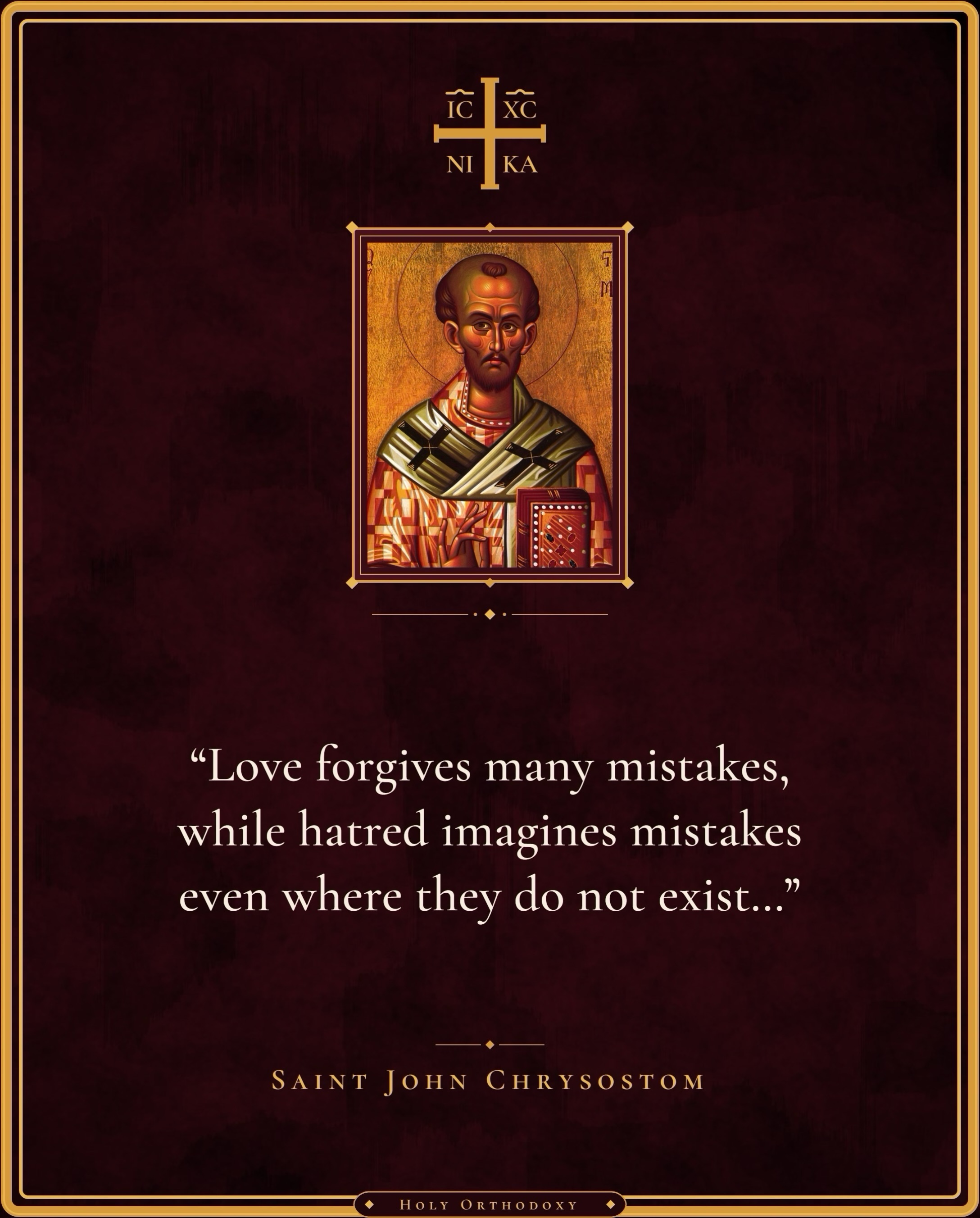
The post shares a saying attributed to St. John Chrysostom: "Love sees the person. Hatred invents the fault." It gives background on Chrysostom (c. 349-407), Archbishop of Constantinople, known as "golden-mouthed" for his preaching; the Divine Liturgy used most Sundays in Orthodox churches bears his name. The post links the saying to 1 Peter 4:8, "Love will cover a multitude of sins," and explains that love makes us slow to notice faults while…

The post shares a saying attributed to St. John Chrysostom: "Love sees the person. Hatred invents the fault." It gives background on Chrysostom (c. 349-407), Archbishop of Constantinople, known as "golden-mouthed" for his preaching; the Divine Liturgy used most Sundays in Orthodox churches bears his name. The post links the saying to 1 Peter 4:8, "Love will cover a multitude of sins," and explains that love makes us slow to notice faults while resentment makes us see faults that are not there.

It concludes with a reflective question: who could you see with gentler eyes today? The accompanying image carries a similar phrase: "Love forgives many mistakes, while hatred imagines mistakes even where they do not exist."

  • Quote attributed to St. John Chrysostom contrasting love and hatred
  • Biographical note on Chrysostom as Archbishop and preacher
  • Connection to 1 Peter 4:8 on love covering sins
  • Explanation of how love and resentment affect perception of faults
  • Reflective question about seeing others with gentler eyes
Read more
Prayer Orthodoxy ® with ☦︎ICXC•NIKA☦︎ Instagram

A sinner's return: mercy found in the pits of hell

1:27

The author describes a long journey back to Christ after years of pride, ambition, and wandering away. He calls it the ultimate betrayal, yet Christ called him back from what he describes as the pits of hell. He was not beyond God's reach, and God did not abandon him in darkness. Through mercy, God began to strengthen him. The journey remains unfinished. He must continue to endure, repent, and humble himself to become the husband, father, and…

The author describes a long journey back to Christ after years of pride, ambition, and wandering away. He calls it the ultimate betrayal, yet Christ called him back from what he describes as the pits of hell. He was not beyond God's reach, and God did not abandon him in darkness.

Through mercy, God began to strengthen him. The journey remains unfinished. He must continue to endure, repent, and humble himself to become the husband, father, and man Christ calls him to be, not by his own strength or will, but through grace and mercy. His family needs him to lead through love, sacrifice, prayer, and obedience to Christ, not through pride or self-righteousness.

He acknowledges he has a long way to go and remains a sinner in need of mercy. He prays for strength to endure, to carry his cross, to lead his family in Christ's truth, and to remain steadfast until death. He concludes with "Glory to God for all things."

  • Years of pride and wandering ended when Christ called the author back from despair
  • God's mercy, not the author's strength, began the restoration
  • The journey of repentance and humility continues daily
  • Family leadership must come through love, sacrifice, prayer, and obedience
  • The author prays for endurance to carry the cross and remain steadfast
Read more

St. Demetrios Cathedral: 5th-century basilica with relics and martyrdom crypt

The post describes the Cathedral of Saint Demetrios in Thessaloniki, Greece, one of the most important pilgrimage destinations in Orthodox Christianity. The basilica was constructed in the 5th century on the site traditionally linked to the martyrdom of Saint Demetrios, the Great Martyr, who suffered in 306 AD. He is honored as the patron saint and protector of Thessaloniki. Below the church lies the ancient crypt associated with his…

The post describes the Cathedral of Saint Demetrios in Thessaloniki, Greece, one of the most important pilgrimage destinations in Orthodox Christianity. The basilica was constructed in the 5th century on the site traditionally linked to the martyrdom of Saint Demetrios, the Great Martyr, who suffered in 306 AD. He is honored as the patron saint and protector of Thessaloniki.

Below the church lies the ancient crypt associated with his imprisonment and martyrdom, a place of deep veneration. The cathedral also houses the sacred relics of Saint Demetrios, which draw Orthodox faithful from around the world. His feast day is celebrated annually on October 26. The post includes a Greek translation of the same historical and devotional details.

Five images accompany the text: the first shows the cathedral's exterior or a title card; the second depicts an ornate altar area with a dome and rows of wooden chairs; the third reveals the interior with a dome mosaic of the Virgin Mary and Child, lit by large windows; the fourth captures a close-up of the apse with mosaics and icons, highlighting architectural details; the fifth presents the underground crypt of martyrdom.

The English and Greek texts are nearly identical, providing the same historical timeline, spiritual significance, and liturgical information. The images collectively illustrate the cathedral's architectural grandeur, its iconographic program centered on the Theotokos and the saint, and the subterranean space where the martyr's final witness occurred.

The post concludes with the invocation, "Saint Demetrios, pray unto God for us," in both English and Greek.

  • Cathedral built in the 5th century over the site of Saint Demetrios' martyrdom in 306 AD
  • Saint Demetrios is the patron saint and protector of Thessaloniki
  • Ancient crypt beneath the church linked to his imprisonment and martyrdom
  • Sacred relics of Saint Demetrios are housed in the cathedral
  • Feast day celebrated on October 26
☦️An Orthodox Blog☦️ Instagram

Saint Demetrios Hymn: Martyr's Victory and Prayer for Mercy

1:09

The video presents a hymn addressed to Saint Demetrios, calling him the great martyr who has triumphed over the nations and contended in the stadium. The hymn asks the saint to intercede with Christ God so that great mercy may be granted to the faithful. The content focuses on the saint's martyrdom and his role as an intercessor, reflecting the Orthodox practice of seeking the prayers of the martyrs.

Key moments

  1. The hymn calls Saint Demetrios the great martyr and describes his victories over the nations and his contest in the stadium.
  2. It asks Saint Demetrios to pray to Christ God to grant us great mercy.
Read more

My ex-boyfriend, a catechumen, died by suicide two weeks ago

The title sums it up. I miss him terribly. I am also a catechumen, but continuing my catechesis feels wrong now. I do not want to be baptized without him. When we first started dating he told me his goal was to be baptized before he died. I joked and asked if he was planning to die soon. Looking back, it is horrible to think his plan all along was to take his own life. I am staying in the Church, yet every Liturgy now brings me sadness, even…

The title sums it up. I miss him terribly. I am also a catechumen, but continuing my catechesis feels wrong now. I do not want to be baptized without him. When we first started dating he told me his goal was to be baptized before he died. I joked and asked if he was planning to die soon. Looking back, it is horrible to think his plan all along was to take his own life.

I am staying in the Church, yet every Liturgy now brings me sadness, even though I know it should not.

I am in a strange stage of grief. His death has made it hard to focus on some of my responsibilities. I am considering going back on antidepressants to manage the pain. After the funeral I spent days crying and staying in bed; I was also sick, which made everything harder. I have accepted that he is gone, but I still wish more than anything that I could go back in time and bring him back.

I do not even see his name on the pamphlets at church that list the catechumens. He loved the Church so much, and that absence is deeply disheartening.

  • Grief over the suicide of an ex-boyfriend who was a catechumen
  • Struggle to continue catechesis and face baptism without him
  • Sadness during the Liturgy despite remaining in the Church
  • Considering antidepressants to cope with the pain
  • His name missing from the catechumen list at church
7 opinions in the discussion Please, I beg you, don't quit praying for his soul right now. Keep praying for him and his salvation, and if you can, try to find a Spiritual Father at your baptism who can keep praying for… Read the discussion
Disgruntled Docs with ☦︎ICXC•NIKA☦︎ Instagram

Prayer for Seven Martyrs Killed in Jordan Church Attack

The author lights seven candles in memory of seven martyrs who died in a tragedy at a Greek Orthodox church in Jordan. The post calls for remembrance of their sacrifice and their names, while directing attention above all to the sacrifice of Jesus Christ for the salvation of the world. The author prays for the repose of their souls and for their memory to be eternal, affirming that they bore witness to Christ and received a crown of martyrdom as…

The author lights seven candles in memory of seven martyrs who died in a tragedy at a Greek Orthodox church in Jordan. The post calls for remembrance of their sacrifice and their names, while directing attention above all to the sacrifice of Jesus Christ for the salvation of the world. The author prays for the repose of their souls and for their memory to be eternal, affirming that they bore witness to Christ and received a crown of martyrdom as testimony of faithfulness unto death.

The text concludes with a doxology and the phrase "Memory Eternal" in Greek, Arabic, and English.

  • Seven candles lit for seven martyrs killed at a Greek Orthodox church in Jordan
  • Remembrance of their sacrifice and names linked to Christ's sacrifice
  • Prayer for eternal rest and memory eternal
  • Affirmation of their martyrdom as witness to Christ
  • Trilingual "Memory Eternal" in Greek, Arabic, and English
Read more
Athonite Audio YouTube

Evergetinos Hypothesis 28: Avoiding Self-Conceit in Monastic Asceticism

Evergetinos Hypothesis 28: Avoiding Self-Conceit in Monastic Asceticism 11:08

The video presents Hypothesis 28 from the third book of the Evergetinos, which teaches that monks should not exceed the common monastic rule out of self-conceit. The reading opens with Hebrews 11 describing the righteous who wandered in deserts and caves, destitute and tormented, of whom the world was not worthy. Saint Euthymios teaches that public displays of stricter fasting are unreasonable and harmful; true abstinence consists in eating only…

The video presents Hypothesis 28 from the third book of the Evergetinos, which teaches that monks should not exceed the common monastic rule out of self-conceit. The reading opens with Hebrews 11 describing the righteous who wandered in deserts and caves, destitute and tormented, of whom the world was not worthy. Saint Euthymios teaches that public displays of stricter fasting are unreasonable and harmful; true abstinence consists in eating only enough to remain hungry and fighting the passions secretly with humility, temperance, study, discernment, and godly obedience.

Saint Pachomius corrects a brother who follows his own will, quoting Christ's words that he came to do the Father's will, not his own, and warns that the enemy envies and seeks to despoil such labors. Pachomius instructs the brother to keep the common rule of meals, eating in moderation according to his strength, and to practice asceticism until he overcomes the demon of boasting.

In another instance, Pachomius sees a brother displaying two rush mats instead of the required one, done for vainglory, and says the brother has given all his labor to the devil and cherishes human glory over God's. Abba Daniel remains in Scetis during a barbarian invasion, trusting God, passes unseen through the barbarians, then tells himself to flee like the other fathers because that is the human course.

Saint Ephrem commands monks in a cenobium not to deviate from the typicon, to join in common worship and meals, and to accept whatever food is set before them with thanksgiving, recalling that Christ ate barley loaves.

Key moments

  1. 0:01 The reading from Hebrews describes the righteous who wandered in deserts and caves, destitute and tormented, of whom the world was not worthy.
  2. 0:32 Saint Euthymios considers it unreasonable and harmful for monks to publicly display greater fasting than the common rule, and he wants goodness to go unnoticed.
  3. 1:02 Euthymios teaches that the best abstinence is to eat only enough to still feel hunger, and to resist the passions secretly with the virtues of humility, temperance, study, discernment, and godly obedience.
  4. 1:35 Saint Pachomius admonishes a brother who follows his own will, quoting Christ's words that he came to do the Father's will, not his own, and warns that the enemy envies and seeks to despoil his labors.
  5. 2:06 Pachomius instructs the brother to keep the common rule of meals, eating in moderation according to his strength, and to practice asceticism until he overcomes the demon of boasting.
  6. 4:40 Pachomius sees a brother displaying two rush mats instead of the required one, done for vainglory, and says the brother has given all his labor to the devil and cherishes human glory over God's.
  7. 6:45 Abba Daniel remains in Scetis during a barbarian invasion, trusting God, passes unseen through the barbarians, then tells himself to flee like the other fathers because that is the human thing to do.
  8. 7:17 Saint Ephrem commands monks in a cenobium not to deviate from the typicon, to join in common worship and meals, and to accept whatever food is set before them with thanksgiving, recalling that Christ ate barley loaves.

Fr. Spyridon Bailey on humility as foundation of virtues and peacemaking

Fr. Spyridon Bailey explains that Jesus begins the Beatitudes with "blessed are the poor," establishing humility as the foundation of all virtues. He notes that both Satan and Adam fell through pride, while Jesus raises humanity up through humility. To acquire this humility, each person must build into their life a time of separation for prayer and time alone with God, because true change cannot happen without time with God. Fr. Spyridon also…

Fr. Spyridon Bailey explains that Jesus begins the Beatitudes with "blessed are the poor," establishing humility as the foundation of all virtues. He notes that both Satan and Adam fell through pride, while Jesus raises humanity up through humility. To acquire this humility, each person must build into their life a time of separation for prayer and time alone with God, because true change cannot happen without time with God.

Fr. Spyridon also addresses the beatitude "blessed are the peacemakers," clarifying that it refers not simply to those at peace within themselves but to those who bring peace to others and to the world. He calls listeners to examine the effects they have on other people, asking whether those who encounter them leave angry and agitated or with peace.

Key moments

  1. Jesus begins the Beatitudes with "blessed are the poor," establishing humility as the foundation of all virtues.
  2. Both Satan and Adam fell through pride, and Jesus raises us up through humility.
  3. Everyone must build into their lives a time of separation for prayer and time alone with God to acquire humility.
  4. We cannot truly change unless we have time with God.
  5. Jesus says "blessed are the peacemakers", not those at peace within themselves, but those who bring peace to others and the world.
  6. This is a calling to examine the effects we have on other people.
  7. We must look at our lives closely and ask how we are affecting other people.
  8. When people encounter us, we must ask whether they leave angry and agitated or with peace.
Read more
Saint Wisdom Instagram

Saint Basil the Great on Humility and Moderation

The speaker presents a paraphrased teaching from Saint Basil the Great on humility. The instruction urges the listener not to turn life into a performance aimed at impressing others. Speech, behavior, and self-presentation should be marked by moderation rather than by a desire to appear greater, wiser, or more important than one is. The call is to learn humility as a practical discipline. The teaching identifies the temptation to make every…

The speaker presents a paraphrased teaching from Saint Basil the Great on humility. The instruction urges the listener not to turn life into a performance aimed at impressing others. Speech, behavior, and self-presentation should be marked by moderation rather than by a desire to appear greater, wiser, or more important than one is.

The call is to learn humility as a practical discipline. The teaching identifies the temptation to make every action a kind of display, whether in words, conduct, or the way one carries oneself. Basil's counsel replaces that impulse with moderation, a steady restraint that does not seek to elevate the self in the eyes of others. The paraphrase does not elaborate on specific situations or quote Basil's original texts; it distills the core exhortation: avoid performance, choose moderation, pursue humility.

Key moments

  1. Do not make everything you do into a performance; let your speech, behavior, and self-presentation be marked by moderation rather than the desire to impress.
Read more

Saint Porphyrios on spiritual health and Christ's light

Saint Porphyrios of Kavsokalyvia contrasts two states of the soul: one marked by gentleness, humility, peace, and love, the other by nervousness, hatred, and constant quarreling. He states plainly that love is the higher state. Those who deny this truth, he says, are spiritually ill. Sin causes a person to become spiritually disturbed, and this imbalance cannot be corrected by any human means. Resolution comes only through the light of Christ.…

Saint Porphyrios of Kavsokalyvia contrasts two states of the soul: one marked by gentleness, humility, peace, and love, the other by nervousness, hatred, and constant quarreling. He states plainly that love is the higher state. Those who deny this truth, he says, are spiritually ill. Sin causes a person to become spiritually disturbed, and this imbalance cannot be corrected by any human means.

Resolution comes only through the light of Christ. The saint describes the process: Christ makes the first move. Then human beings accept this light by their own free will. This acceptance is expressed through love for Christ, through prayer, through participation in the life of the Church, and through participation in the Holy Mysteries.

The teaching presents spiritual health as a cooperation between divine initiative and human response, with the sacramental life of the Church as the concrete setting where this cooperation unfolds.

  • Love, peace, and humility are higher than hatred and quarreling
  • Denial of this truth indicates spiritual illness
  • Sin causes spiritual disturbance that human means cannot fix
  • Christ initiates healing through His light
  • Human acceptance comes through love, prayer, Church life, and the Holy Mysteries
Read more

St. John Chrysostom: Repent While You Still Breathe

St. John Chrysostom addresses those burdened by sin, listing examples: the greedy are reminded of the thief on the cross, the impure of the harlot, blasphemers of the Apostle Paul before his conversion, unbelievers of the magi. He acknowledges that sin leads to despair but urges the fallen to rise, the fornicator to repent, the adulterer to amend. He states that human repentance is small but God's love is great. As long as one breathes, even on…

St. John Chrysostom addresses those burdened by sin, listing examples: the greedy are reminded of the thief on the cross, the impure of the harlot, blasphemers of the Apostle Paul before his conversion, unbelievers of the magi. He acknowledges that sin leads to despair but urges the fallen to rise, the fornicator to repent, the adulterer to amend.

He states that human repentance is small but God's love is great. As long as one breathes, even on a deathbed, one should repent. He notes many spiritual wounds but each has its remedy: the Church brings gifts of the Spirit, the multitude of martyrs and other ranks call one back to righteousness. What was wasted by sin is renewed by grace.

  • St. John Chrysostom reminds sinners of biblical figures who repented: the thief, the harlot, St. Paul, the magi.
  • He urges the fallen to rise, the fornicator to repent, the adulterer to amend.
  • He contrasts small human repentance with God's great love.
  • He insists on repentance as long as one breathes, even on a deathbed.
  • He points to the Church's gifts of the Spirit and the example of martyrs as remedies for spiritual wounds.
Read more

Protestant exploring Orthodoxy, family surprisingly open, seeking advice on first liturgy

I grew up Baptist, attended a Lutheran church and school through seventh grade, then spent years in nondenominational Bible churches. As I got older I lost interest in the church we were attending. It was exhausting to hear the same recycled contemporary music, to listen to someone beg for money for the first ten minutes of every service, and to have every sermon feel like it was lacking. I married my wife, who did not grow up going to church,…

I grew up Baptist, attended a Lutheran church and school through seventh grade, then spent years in nondenominational Bible churches. As I got older I lost interest in the church we were attending. It was exhausting to hear the same recycled contemporary music, to listen to someone beg for money for the first ten minutes of every service, and to have every sermon feel like it was lacking.

I married my wife, who did not grow up going to church, and after about eighteen months I took a "break" from church for six years. This was entirely on me; she wanted to go, but I was so fed up that I figured I would read the Bible at home or something.

Recently both of us started feeling a pull to get back into church in some capacity. We started taking our kids to a nondenominational church that my parents and grandparents attend.

Throughout my life, even as a teenager, I always struggled with the sermons. They constantly felt shallow, like something was missing or standing in the way of the truth. I have always believed in God, even in the years I was staying home on Sunday mornings. But I had a hard time taking any of the churches we went to seriously because I was always left with a lingering, "That was it?" feeling.

Now I'm thirty with multiple kids, and my wife (who didn't grow up religious) and I decided to start our family back in church. She was worried about where to even start learning the faith, and I told her it's okay to be intimidated, and that I would do all of the beginner Bible study with her.

It has been a long time since I was regularly reading the Bible, and I think I finally realized that just because I grew up passively going to church that did not make me the expert in Christianity that I pretended I was. I felt I needed to be absolutely sure that the foundation we build for our children is based on truth.

I started researching what was necessary for salvation just to help explain generic western Protestantism, but that led me to realize sola scriptura isn't a universally agreed upon idea. At first I was completely dismissive. I assumed it was just elitism or pagan-influenced "Catholic" baggage. But I stumbled onto Protestant versus Orthodox debates, expecting a logical Protestant PhD to effortlessly dismantle a "magic idol worshiping" opponent.

Instead, watching the Orthodox side pick apart Protestant assumptions completely blew my mind. It was a whole world I had been completely blind to.

Why did we have a different Bible? Which one is right? What is even in those extra books? What even is a Church Father? Is that like the first Pope? (Looking back at this note is funny.) How did 1,500 years of Christian history between Jesus and Martin Luther fail to ever be taught to me at any church or class?

Also why had I never even thought of it a single time? Why are we NOT doing the same thing as Christians in the year 100? They probably know more than we do, right?

I spent the next six months reading everything I could get my hands on. I kept it a secret because while I started to feel an undeniable pull towards Orthodoxy, my father and grandfather are very religious men who are both Protestant. Just the word Catholic makes them recoil in physical pain (my grandmother had some bad times in a Roman Catholic upbringing). They are both people I've always looked up to for guidance.

My grandfather was involved with Campus Crusade back in the day and knows retired pastors everywhere. My father was constantly, judgment-free, pestering me over those six years I was away from the church.

Carrying the weight of this, I finally decided to talk to my grandfather. I was fully expecting him to gently tell me I was insane and easily disprove everything I was looking into. In a way I was actually hoping for that, just to make the soul searching stop. Instead, he listened, humored me, and took my copy of Becoming Orthodox to read.

  • Struggled with shallow sermons and "That was it?" feeling across Protestant denominations
  • Research into salvation led to discovering Orthodoxy and 1,500 years of missing church history
  • Grandfather (83, Campus Crusade background) read Becoming Orthodox and said "we've essentially been lied to"
  • Father also acknowledged ignorance of Great Schism and bought books to learn more
  • Still wrestling with icon veneration, saint intercession, Marian theology, and anxiety about first liturgy with toddlers
25 opinions in the discussion Mental blocks are just mental blocks. It's great that you are aware you have them. It took my wife 10 years to kiss an icon. We are very different from Protestantism but, from what you… Read the discussion

St. John Chrysostom: Joint Prayer of Spouses Drives Satan Away

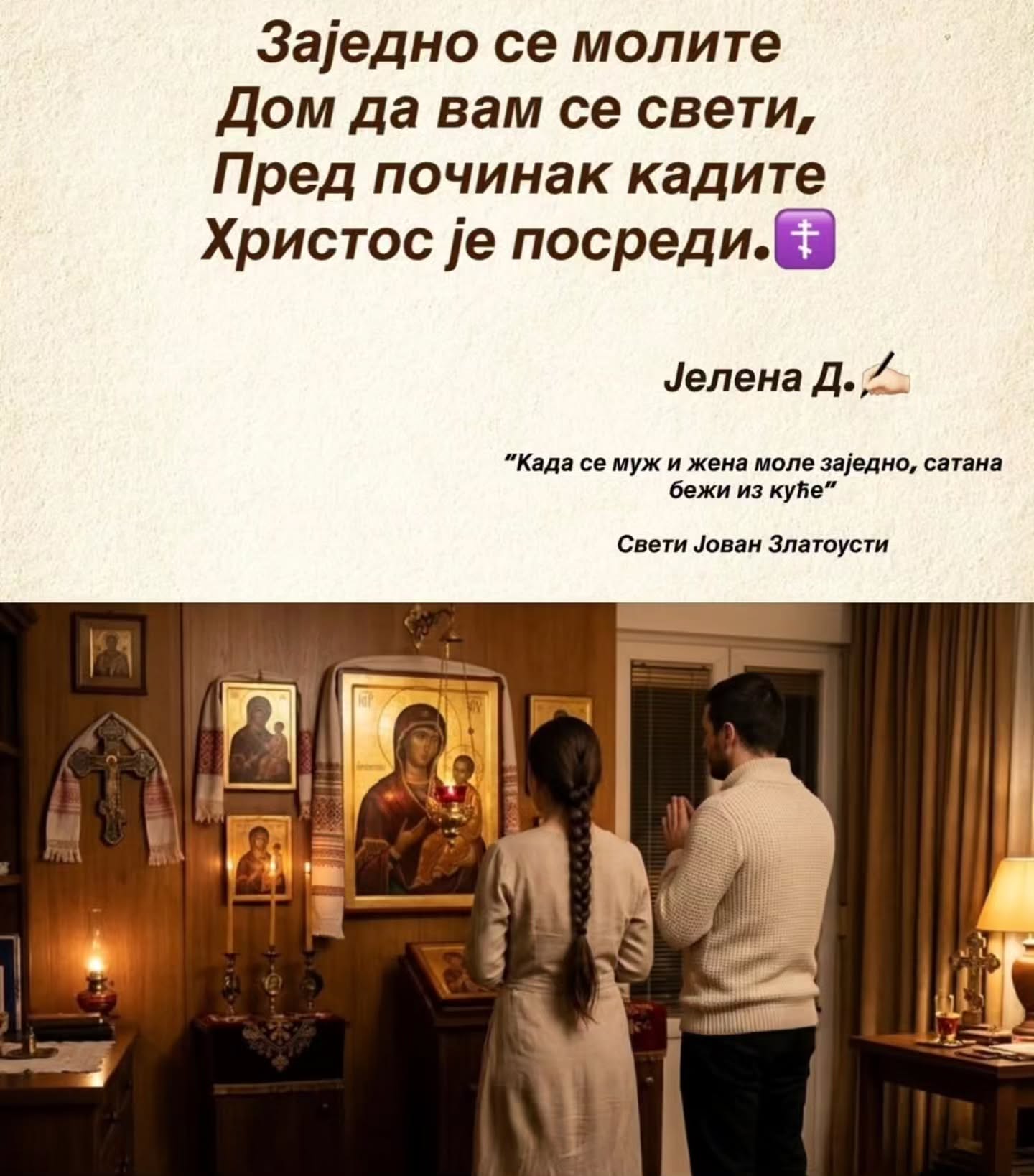
The post presents a quotation attributed to St. John Chrysostom: "When a husband and wife pray together, Satan flees from the house." The text accompanies an image of a couple standing in prayer before icons. The saying points to the spiritual effect of shared prayer in marriage.

  • St. John Chrysostom is cited on the power of a husband and wife praying together
  • The quote states that Satan leaves the house when spouses pray jointly
  • The accompanying image shows a couple at prayer before icons
Read more
Mount Athos Legacy Facebook

Make the sign of the cross and say two prayers in life's difficulties

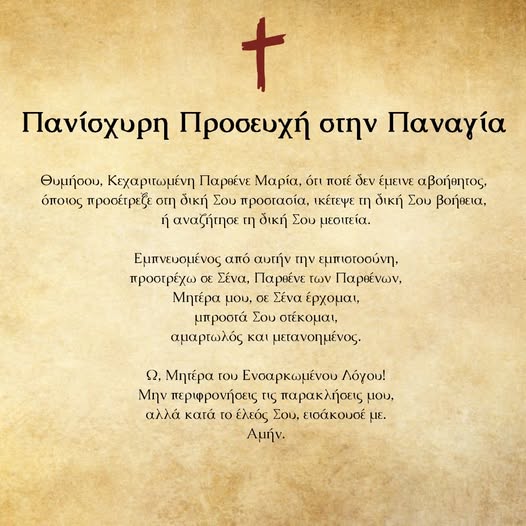
The post gives a brief spiritual instruction for confronting life's difficulties. The author tells readers to make the sign of the cross and say two prayers: "Most Holy Theotokos save us" and "Lord Jesus Christ have mercy on me," adding that these are enough. The image supplies the full Greek text of the Memorare, a traditional prayer to the Virgin Mary that begins "Remember, O most gracious Virgin Mary, that never was it known that anyone who fled to your protection..." No further explanation or discussion accompanies the post.

  • Make the sign of the cross when facing difficulties
  • Recite "Most Holy Theotokos save us"
  • Recite "Lord Jesus Christ have mercy on me"
  • These two prayers are described as sufficient
  • Image contains the Memorare prayer to the Theotokos
Orthodox Health Instagram

The Opposite of Addiction Is Freedom, Not Just Abstinence

Fr. Michael Marcantoni discusses addiction and freedom on Episode 83 of the Orthodox Health Podcast. He argues that the opposite of addiction is not merely abstinence but freedom. Many people mistake relief from discomfort, boredom, resentment, or themselves for peace. When something reliably provides that relief, it becomes easy to stop questioning its effect. The discussion moves beyond narrow addiction to the passions. The key question is not…

Fr. Michael Marcantoni discusses addiction and freedom on Episode 83 of the Orthodox Health Podcast. He argues that the opposite of addiction is not merely abstinence but freedom. Many people mistake relief from discomfort, boredom, resentment, or themselves for peace.

When something reliably provides that relief, it becomes easy to stop questioning its effect. The discussion moves beyond narrow addiction to the passions. The key question is not whether something is technically permissible but whether one retains the freedom to put it down.

Christian asceticism, fasting, prayer, repentance, and watchfulness, are not arbitrary restrictions but practices for learning freedom so that not every appetite, emotion, or impulse gets a vote. Peace is not found by satisfying every demand; it begins when one recognizes that the thing promising relief has become a master. The conversation notes that a line is crossed when interaction with a substance means loss of control.

Relapse often starts with unmanaged resentment months before actual use. One may be powerless against the first drink but not powerless to address that fact, which is why recovery steps exist. Sobriety creates a condition where a person is neither fully corrupt nor a helpless victim.

Addiction is obvious with a bottle, pill, or needle, but harder to see when the master is a job, phone, gym, or health regimen. The real question is whether one is still free enough to say no, and the talk addresses what owns a person.

Key moments

  1. A line gets crossed where interaction with a substance means you are no longer in control.
  2. Relapse often begins with unmanaged resentment months before the actual use, not on the day you go to the store.
  3. You may be powerless against the first drink, but you are not powerless to address that fact, which is why steps exist.
  4. Sobriety creates circumstances where you are neither fully corrupt nor a helpless victim.
  5. If something in your life functions like addiction, you must act or it will take everything.
  6. Addiction is obvious with a bottle, pill, or needle, but harder to see when the master is a job, phone, gym, or health.
  7. The real question is whether you are still free enough to tell it no, and the talk addresses what owns you.

Apostolic authority as a historical question: Chalcedon and the Eighth Council

The post shares a video in which Alex responds to a question about how to determine which church holds correct apostolic authority, specifically comparing the Eastern Orthodox Church to the Oriental Orthodox Church. He argues that this is a historical question requiring historical inquiry and evaluation of the merits. Regarding the Council of Chalcedon, he states that the Oriental Orthodox initially accepted it but then a mob lynched the new…

The post shares a video in which Alex responds to a question about how to determine which church holds correct apostolic authority, specifically comparing the Eastern Orthodox Church to the Oriental Orthodox Church. He argues that this is a historical question requiring historical inquiry and evaluation of the merits. Regarding the Council of Chalcedon, he states that the Oriental Orthodox initially accepted it but then a mob lynched the new patriarch and installed an anti-Chalcedonian patriarch, which he says resembles setting up a separate church.

Concerning the Eighth Ecumenical Council, he says that Rome and Constantinople agreed to recognize each other's jurisdiction and not alter the creed, but Rome went back on that agreement while the Orthodox Church maintained it. The video opens with a quotation from St. Irenaeus of Lyons on the ability to trace episcopal succession from the apostles to the present.

Key moments

  1. The question of which church has correct apostolic authority is a historical question that requires historical inquiry and evaluating the merits.
  2. At the Council of Chalcedon, the Oriental Orthodox initially accepted it but then a mob lynched the new patriarch and installed an anti-Chalcedonian patriarch, which appears to be setting up their own church.
  3. At the Eighth Ecumenical Council, Rome and Constantinople agreed to recognize each other's jurisdiction and not change the creed, but Rome went back on that agreement.
  4. The Orthodox Church is the one that maintained the agreement and did not change.
Read more
Disgruntled Docs with Trust God ☦︎︎︎ Instagram

Saints warn against false doctrine under pretext of love

The post presents a collection of quotations from four Orthodox saints addressing the relationship between doctrinal integrity and Christian love. Saint Paisios of the Holy Mountain recounts an encounter with two Catholic visitors, a journalist and a Vatican secretary, who proposed saying the Lord's Prayer together. He declined, stating that doctrinal agreement is required for common prayer, because between them there is a great chasm. When they…

The post presents a collection of quotations from four Orthodox saints addressing the relationship between doctrinal integrity and Christian love. Saint Paisios of the Holy Mountain recounts an encounter with two Catholic visitors, a journalist and a Vatican secretary, who proposed saying the Lord's Prayer together. He declined, stating that doctrinal agreement is required for common prayer, because between them there is a great chasm.

When they asked whether only Orthodox Christians would be saved, since God is with all people, he replied by asking how many people are with God. A second saying attributed to Saint Paisios identifies three demonic tentacles: communism for the poor, ecumenism for the faithful, and freemasonry for the rich. Saint John Chrysostom is cited with the maxim not to accept any false doctrine under the pretext of love.

Saint Justin Popovich describes ecumenism as the common name for the pseudo-Christianity of the pseudo-Churches of Western Europe, rooted in European humanism with the papacy at its head, and calls each such church a heresy. Saint Nicholas Velimirovich distinguishes between reconciliation of people and reconciliation of religions, affirming the command to love all people even to the point of giving one's life for them while insisting that Christ's truths must remain unscathed because they are not human property to do with as one pleases.

  • St. Paisios refuses joint prayer with Catholics, citing doctrinal chasm
  • St. Paisios questions how many people are with God when asked about salvation outside Orthodoxy
  • St. John Chrysostom warns against accepting false doctrine under pretext of love
  • St. Justin Popovich denounces ecumenism as pseudo-Christianity and heresy
  • St. Nicholas Velimirovich separates love for people from compromise of Christ's truths
Read more
George Instagram

Acedia and the Phone: Evagrius's Cure for Prayer Procrastination

The speaker describes a daily struggle with prayer procrastination. The pattern begins with the intention to pray later, followed by picking up the phone for a moment and scrolling for hours, which leaves the person too tired and distracted to pray. He identifies this condition as acedia, the laziness of the soul that the desert fathers called the noonday demon. He references Evagrius's fourth-century account of a monk in his cell who feels the…

The speaker describes a daily struggle with prayer procrastination. The pattern begins with the intention to pray later, followed by picking up the phone for a moment and scrolling for hours, which leaves the person too tired and distracted to pray. He identifies this condition as acedia, the laziness of the soul that the desert fathers called the noonday demon.

He references Evagrius's fourth-century account of a monk in his cell who feels the sun has stopped and the day lasts fifty hours, restless and bored, looking out the window. The speaker compares the phone to that window, the modern distraction that fuels acedia. The cure, he says, is simple but not easy: put the phone in another room, stand before the icons, and pray for just five minutes even when feeling nothing.

He quotes Evagrius's promise that if one does not give up, peace and joy will follow. He invites the listener to practice this together today.

Key moments

  1. The speaker admits fighting prayer procrastination daily, spending more time scrolling than praying.
  2. He describes the cycle: intending to pray later, picking up the phone for a moment, scrolling for hours, then feeling too tired and distracted to pray.
  3. He names this condition acedia, the laziness of the soul, known by the desert fathers as the noonday demon.
  4. He references Evagrius's fourth-century description of a monk in his cell who feels the sun has stopped and the day lasts 50 hours, restless and bored, looking out the window.
  5. He compares the phone to that window, the modern distraction that fuels acedia.
  6. The cure, he says, is to just do it: put the phone in another room, stand before the icons, and pray five minutes even if you feel nothing.
  7. He quotes Evagrius's promise that if you do not give up, peace and joy will come after praying.
  8. He invites the listener to do this practice together today.
Read more

Igumen Gavrilo recounts mother's witness of blasphemer struck by lightning

Igumen Gavrilo Raletinački relates a story his mother told throughout her life. As a young girl returning from garden work, she passed a construction site where a worker had returned for a forgotten bag. The man was furious and cursed God extensively. On a clear, calm, sunny day without any storm warning, a single lightning bolt struck and killed him instantly. The few witnesses, including the narrator's mother, were left frozen in shock and…

Igumen Gavrilo Raletinački relates a story his mother told throughout her life. As a young girl returning from garden work, she passed a construction site where a worker had returned for a forgotten bag. The man was furious and cursed God extensively. On a clear, calm, sunny day without any storm warning, a single lightning bolt struck and killed him instantly.

The few witnesses, including the narrator's mother, were left frozen in shock and fear. The experience left his mother with a lasting horror of blasphemy, particularly cursing directed at God. The account is presented as a firsthand testimony meant to warn against the sin of blasphemy.

  • Igumen Gavrilo Raletinački shares his mother's eyewitness account
  • A construction worker cursed God violently after forgetting his bag
  • On a clear sunny day with no storm, lightning killed the man instantly
  • The mother and other witnesses were terrified and stunned
  • The event caused his mother to fear blasphemy for the rest of her life
Read more