WeOrthodox
EN UA

Orthodox posts, videos and discussions

We follow Orthodox channels, communities and blogs across the web, summarise every post and video, and highlight the conversations with real substance.

☦️An Orthodox Blog☦️ Instagram

Saint Demetrios of Thessaloniki: Faith That Transforms Life

The video presents the life of Saint Demetrios of Thessaloniki, a fourth-century martyr commemorated on October 26. He held an important position in the city but placed his love for Christ above his status, confessing his faith during persecution and accepting imprisonment and death. The speaker explains that Saint Demetrios teaches that Christian faith requires living according to the Gospel even when difficult, defending truth without hatred,…

The video presents the life of Saint Demetrios of Thessaloniki, a fourth-century martyr commemorated on October 26. He held an important position in the city but placed his love for Christ above his status, confessing his faith during persecution and accepting imprisonment and death. The speaker explains that Saint Demetrios teaches that Christian faith requires living according to the Gospel even when difficult, defending truth without hatred, practicing justice, helping the needy, and remaining faithful in daily decisions.

His witness is not merely historical but a living example that faith must transform one's way of life. The presentation emphasizes that it is possible to remain faithful to Christ in a world that pressures one to deny Him. Saint Demetrios lived as a man of high standing in Thessaloniki, yet his life was defined by his love for Christ.

During persecution he did not conceal his faith but confessed Jesus Christ, leading to his imprisonment and martyrdom. Christian faith is not limited to attending church, venerating icons, or knowing Church teachings. Being a Christian means living according to the Gospel even when it is difficult, defending truth without hatred, practicing justice, helping the needy, and staying faithful in everyday choices.

Saint Demetrios is not only a hero of the past but a living example that faith must transform how we live. His testimony should inspire believers not to be ashamed of the Gospel and to demonstrate by their works that Christ lives in them.

Key moments

  1. It is possible to remain faithful to Christ in a world that pressures one to deny Him.
  2. Saint Demetrios lived in the fourth century as a man of high standing in Thessaloniki, yet his life was defined by his love for Christ.
  3. During persecution he did not conceal his faith but confessed Jesus Christ, leading to his imprisonment and martyrdom.
  4. Christian faith is not limited to attending church, venerating icons, or knowing Church teachings.
  5. Being a Christian means living according to the Gospel even when it is difficult, defending truth without hatred, practicing justice, helping the needy, and staying faithful in everyday choices.
  6. Saint Demetrios is not only a hero of the past but a living example that faith must transform how we live.
  7. His testimony should inspire believers not to be ashamed of the Gospel and to demonstrate by their works that Christ lives in them.
Read more

Saint John of Shanghai and San Francisco: A Life of Prayer and Care for Children

The video presents the life of Saint John of Shanghai and San Francisco, recognized as San Francisco's own Christian saint. He devoted himself to prayer, frequently giving up sleep to spend more time with God. While serving in Shanghai, he personally cared for over 1,500 abandoned and needy children, rescuing sick and starving children from the streets. He reposed in 1966, and his relics remain in San Francisco today. The video concludes that…

The video presents the life of Saint John of Shanghai and San Francisco, recognized as San Francisco's own Christian saint. He devoted himself to prayer, frequently giving up sleep to spend more time with God. While serving in Shanghai, he personally cared for over 1,500 abandoned and needy children, rescuing sick and starving children from the streets.

He reposed in 1966, and his relics remain in San Francisco today. The video concludes that his life demonstrates the path to holiness begins when we stop living for ourselves and start living completely for Jesus Christ.

Key moments

  1. San Francisco has its own Christian saint, Saint John of Shanghai and San Francisco.
  2. He dedicated his life to prayer and often sacrificed sleep to spend more time with God.
  3. He personally helped care for more than 1,500 abandoned and needy children in Shanghai.
  4. He rescued sick and starving children from the streets.
  5. He reposed in 1966.
  6. His relics remain in San Francisco to this day.
  7. Saint John reminds us that the path to holiness begins when we stop living for ourselves and start living completely for Jesus Christ.
Read more

Saints Peter and Fevronia of Murom: Love as a Feat of Fidelity

The post recounts the life of Saints Peter and Fevronia of Murom. Prince Peter fell gravely ill and was healed by Fevronia, the daughter of a poor beekeeper. He promised to marry her but hesitated because of her humble origin. When the illness returned, he fulfilled his promise and married her. The Murom boyars demanded that he abandon his wife; Peter chose her over his princely authority. Together they left the city, accepting uncertainty for…

The post recounts the life of Saints Peter and Fevronia of Murom. Prince Peter fell gravely ill and was healed by Fevronia, the daughter of a poor beekeeper. He promised to marry her but hesitated because of her humble origin.

When the illness returned, he fulfilled his promise and married her. The Murom boyars demanded that he abandon his wife; Peter chose her over his princely authority. Together they left the city, accepting uncertainty for the sake of faithfulness.

The people later called them back, and they continued a life of piety and charity. In old age they received monastic tonsure, taking the names David and Euphrosyne. They wished to be buried together. Tradition says that despite attempts to separate their bodies, they were found together again and were laid in a single grave.

In their hagiography love is not a passing feeling but a feat of fidelity. Peter refused to keep power at the price of renouncing his wife. Fevronia sought neither wealth nor honors, but a love that remains constant when all else changes.

True love does not measure a person by origin, status, or wealth. It is revealed in the willingness to bear each other's burdens, to forgive, to preserve the dignity of the beloved, and to walk the path of salvation together. Love is described as the longest prayer, a prayer lived each day through patience, understanding, tenderness, attention, and sacrifice.

The text concludes with a prayer to Saints Peter and Fevronia for spouses, families, and all who seek true love, that in Christ they may find strength to love, forgive, and remain faithful to their covenant.

  • Prince Peter healed by Fevronia, daughter of a poor beekeeper
  • He married her after initial hesitation; boyars demanded he abandon her
  • He chose her over princely power; they left the city and later returned
  • In old age they took monastic vows as David and Euphrosyne and were buried together
  • Their life shows love as a feat of fidelity, lived through patience, forgiveness, and shared salvation
Giovanni Guaita YouTube

Hieromonk Giovanni Guaita on the Widow of Nain: Compassion Over Law

Hieromonk Giovanni Guaita on the Widow of Nain: Compassion Over Law 11:24

Hieromonk Giovanni Guaita meditates on Luke 7:11-16, the raising of the widow of Nain's son, delivered on October 25, 2026. He sets the scene: two processions meet at the city gate, Jesus' followers rejoicing and the widow's funeral crowd. In a patriarchal society, the widow's only son was her sole security; his death leaves her without present or future. She behaves with quiet dignity, no loud wailing, a modest funeral on a wooden board, and…

Hieromonk Giovanni Guaita meditates on Luke 7:11-16, the raising of the widow of Nain's son, delivered on October 25, 2026. He sets the scene: two processions meet at the city gate, Jesus' followers rejoicing and the widow's funeral crowd. In a patriarchal society, the widow's only son was her sole security; his death leaves her without present or future.

She behaves with quiet dignity, no loud wailing, a modest funeral on a wooden board, and she does not approach Jesus or ask for help. Jesus sees her, is moved with compassion, stops his journey, and says "Do not cry," caring for her grief first. He touches the bier, violating the religious prohibition against contact with a corpse, and raises the young man, restoring him to his mother.

Fear seizes the crowds and they glorify God, calling Jesus a great prophet and recognizing God's visitation. Drawing on his experience serving in a Moscow children's hospice, Guaita says words cannot answer why a child dies; only empathy and shared grief help. Jesus does not remove suffering magically but crucifies Himself with us, and on the cross frees us from suffering.

Our solidarity requires stopping our selfish journey when meeting others' suffering and crucifying ourselves with those who cannot answer "Why?"

Key moments

  1. 1:47 Two processions meet at the city gate: Jesus' rejoicing followers and the widow's funeral crowd.
  2. 2:53 The widow's only son was her guarantee of survival in a patriarchal society; his death leaves her with no future.
  3. 4:02 The widow behaves with surprising dignity, no loud wailing, a modest funeral on a wooden board, and she does not approach Jesus.
  4. 5:11 Jesus sees her, is moved with compassion, stops, and says "Don't cry," caring for her grief first.
  5. 6:16 Jesus touches the bier, violating the religious prohibition against touching a corpse, and raises the young man.
  6. 8:33 The speaker recounts serving in a Moscow children's hospice: words are useless before a child's death; only empathy and shared grief help.
  7. 10:14 Jesus stops his journey for this woman's grief; we too must stop in our selfish journey when meeting others' suffering.
  8. 10:53 The Son of God does not magically free us from the cross but crucifies Himself with us, and on the cross frees us from suffering; our solidarity means crucifying ourselves with those who cannot answer "Why?"
Read more

Hieromonk Isaiah Recounts 2002 Miracle of St. Basil of Ostrog Healing Mute Boy

In a video recording, Hieromonk Isaiah recounts a miracle that occurred in early 2002 at Ostrog monastery in Montenegro. He describes how a mother named Ružica from the town of Danilovgrad brought her six-year-old son Luka to the monastery. The boy had been mute since the age of two. Hieromonk Isaiah read a prayer for health over the child and anointed him with oil from the vigil lamp (kandilo) before noon. According to the account, that very…

In a video recording, Hieromonk Isaiah recounts a miracle that occurred in early 2002 at Ostrog monastery in Montenegro. He describes how a mother named Ružica from the town of Danilovgrad brought her six-year-old son Luka to the monastery. The boy had been mute since the age of two. Hieromonk Isaiah read a prayer for health over the child and anointed him with oil from the vigil lamp (kandilo) before noon.

According to the account, that very afternoon the boy began to run and speak normally. The following day, Luka himself asked to be anointed again with the oil. Hieromonk Isaiah presents this event as a manifestation of the intercession of Saint Basil of Ostrog, the monastery's founder and a renowned wonderworker in the Serbian Orthodox tradition.

Key moments

  1. Hieromonk Isaiah describes a miracle from early 2002 at Ostrog monastery where St. Basil of Ostrog healed a mute child.
  2. Mother Ružica from Danilovgrad brought her son Luka, age six, who had not spoken since he was two.
  3. Isaiah read a short prayer for health and anointed Luka with oil from the kandilo before noon.
  4. That afternoon Luka was running and talking, and the next day he asked to be anointed again with the oil.
Read more

Troparion of Saint Demetrios the Myrrh-Streamer performed by Melethis choir

The post presents the troparion of Saint Demetrios the Myrrh-Streamer in Romanian, as sung by the Melethis vocal group from the Orthodox Theology Faculty in Cluj-Napoca. The hymn addresses the saint as a great champion found by the world in perils, a victor over the pagans. It recalls how he humbled the pride of Lyaios and gave courage to Nestor in the stadium.

The faithful ask the martyr to intercede with Christ God for great mercy. The post includes the full Romanian text of the troparion and an English summary of its meaning.

Key moments

  1. The world found in Saint Demetrios a great champion in perils, the victor over the pagans.
  2. He quelled the pride of Lyaios and gave courage to Nestor in the stadium.
  3. The faithful ask the great martyr Demetrios to pray to Christ God to grant them great mercy.
Read more

Baptismal Regeneration and Synergism: The Early Church's Teaching

The speaker begins by reading a comment that mocks baptismal regeneration. He responds by stating that the early church historically taught baptism is the means by which a person becomes a Christian. To support this, he cites Jesus' words in John 3: "unless one is born of water and spirit he cannot enter the kingdom of God," and Paul's description in Titus 3: "the washing of water and regeneration of the Spirit." The speaker then argues that the…

The speaker begins by reading a comment that mocks baptismal regeneration. He responds by stating that the early church historically taught baptism is the means by which a person becomes a Christian. To support this, he cites Jesus' words in John 3: "unless one is born of water and spirit he cannot enter the kingdom of God," and Paul's description in Titus 3: "the washing of water and regeneration of the Spirit."

The speaker then argues that the doctrine of faith alone misunderstands belief as a passive act and makes God a hard determinist, thereby removing human free will. He turns to John 6, where Jesus says, "the work of God is to believe in the one he sent," demonstrating that belief itself is a work, not a passive act. He also references Mark 6, where Jesus could do no mighty work because of the people's unbelief, illustrating that healing requires synergy with Christ through belief.

From these passages he concludes that salvation involves synergism: humans cooperate with God through belief. The speaker notes that Christ commands the proclamation of the gospel, and that whoever believes, which is a work, and is baptized will be saved, while unbelief brings condemnation. He ends by affirming that belief and baptism belong together as a both/and, not an either/or.

Key moments

  1. 0:00 The speaker reads a comment that mocks baptismal regeneration and says the early church historically taught baptism is how you become a Christian.
  2. 0:31 Jesus says unless one is born of water and spirit he cannot enter the kingdom of God, and Titus 3 describes the washing of water and regeneration of the Spirit.
  3. 0:31 The idea of faith alone makes God a hard determinist and removes human free will.
  4. 1:01 In John 6 Jesus says the work of God is to believe in the one he sent, showing belief itself is a work, not a passive act.
  5. 1:36 Salvation involves synergism: humans work with God through belief, as shown in Mark 6 where unbelief prevented healing.
  6. 2:11 Christ commands proclaiming the gospel; whoever believes (a work) and is baptized will be saved, while unbelief brings condemnation.
  7. 2:45 Belief and baptism go together as a both/and, not an either/or.
Eastern Orthodoxy Daily He/Who/Is with Timothy Instagram

Debate on Orthodox continuity versus Catholic doctrinal development

A three-part exchange examines competing claims about tradition and doctrinal continuity between the Orthodox and Catholic Churches. The first speaker argues that the Orthodox Church is more consistent because it preserves tradition without altering it every few centuries, implying that the Catholic Church changes tradition. A second speaker counters that this view is backwards: after the Great Schism, the Orthodox Church gradually lost…

A three-part exchange examines competing claims about tradition and doctrinal continuity between the Orthodox and Catholic Churches. The first speaker argues that the Orthodox Church is more consistent because it preserves tradition without altering it every few centuries, implying that the Catholic Church changes tradition. A second speaker counters that this view is backwards: after the Great Schism, the Orthodox Church gradually lost doctrines in response to Catholic dogmatic definitions, and for the first thousand years both Churches shared the identical faith.

The third speaker replies that this objection assumes later Roman dogmas constituted the universal faith of the first millennium, which is precisely the point that requires proof. The Orthodox standard of continuity, the third speaker explains, asks whether a teaching belongs to the apostolic deposit, was taught by the Fathers, received in councils, prayed in the liturgy, and held across the undivided Church.

Continuity is measured by what was already received, not by whether Rome later defined something. To substantiate the claim that Orthodoxy abandoned doctrine, one must demonstrate that those doctrines were universally taught before the schism in substantially the same form that Rome later dogmatized. Otherwise the argument reads later Roman developments back into the early Church and makes Rome the retroactive standard of orthodoxy.

The speaker concludes that this approach makes Rome the measure of itself and ends with the doxology, "All glory to God."

Key moments

  1. A speaker says the Orthodox are more consistent because they stick to tradition without changing it every couple hundred years, implying the Catholic Church changes tradition.
  2. Another speaker argues this is backwards: after the schism the Orthodox Church gradually lost actual doctrines in response to Catholic dogmatic definitions, and for the first millennium both churches had the exact same faith.
  3. A third speaker replies that this assumes later Roman dogmas were the universal faith of the first millennium, which is what needs to be proven.
  4. The Orthodox standard of continuity is whether a teaching was the faith of the undivided church, taught by the Fathers, received in councils, prayed in the liturgy, and held across the church.
  5. Continuity is measured by the apostolic deposit already received, not by whether Rome later defined something.
  6. To claim Orthodoxy abandoned doctrine, one must demonstrate those doctrines were universally taught before the schism in substantially the same form Rome later dogmatized.
  7. Otherwise the argument reads later Roman developments back into the first millennium church and accuses Orthodoxy of abandoning the faith for not accepting that retroactive reading.
  8. The speaker concludes this makes Rome the retroactive standard and congratulates itself for matching it, ending with "All glory to God."
Read more
Fr.TEDTalks with Olav Myrvang Instagram

Attack on Greek Orthodox church in Jordan kills several at funeral

The author recounts a conversation with Father Ted covering jiu-jitsu, Orthodoxy, war, and Christian persecution. The discussion turns to a deadly attack the previous day on a Greek Orthodox church in Jordan, where multiple people were killed while gathered for a funeral. The author expresses difficulty finding words after the event and offers prayer for the dead, the injured, and those mourning lost loved ones. A video summary accompanying the…

The author recounts a conversation with Father Ted covering jiu-jitsu, Orthodoxy, war, and Christian persecution. The discussion turns to a deadly attack the previous day on a Greek Orthodox church in Jordan, where multiple people were killed while gathered for a funeral. The author expresses difficulty finding words after the event and offers prayer for the dead, the injured, and those mourning lost loved ones.

A video summary accompanying the post states that Christianity is the most persecuted faith in 2026, with statistically more Christians killed for their faith than any other religious group. The persecution is said to occur predominantly in Muslim countries and also in communist countries. The speaker notes that many people do not know Christianity holds this position and that the sheer number of Christians being killed exceeds that of any other religion.

Key moments

  1. The speaker says people do not even know that Christianity is the number one persecuted faith.
  2. The speaker says the sheer number of Christians being killed is higher than for any other religion.
Read more
Father Moses YouTube

Father Moses Distinguishes Judgment from Observation

Father Moses Distinguishes Judgment from Observation 5:36

Father Moses addresses the common accusation that Christians are judgmental. He explains that critics often equate judgment with identifying destructive behaviors, such as abortion. The speaker compares this to a doctor warning a patient that 10,000 mg of vitamin C daily will damage the kidneys; no one calls the doctor judgmental. Similarly, a Christian who says a behavior will destroy the soul is making an observation, not a condemnation. He…

Father Moses addresses the common accusation that Christians are judgmental. He explains that critics often equate judgment with identifying destructive behaviors, such as abortion. The speaker compares this to a doctor warning a patient that 10,000 mg of vitamin C daily will damage the kidneys; no one calls the doctor judgmental.

Similarly, a Christian who says a behavior will destroy the soul is making an observation, not a condemnation. He defines true biblical judgment as condemnation: declaring that a person will never change and ruling out God's power to transform. He illustrates with an example: noting that Uncle Bob has a drinking problem and will likely get drunk is observation; saying Uncle Bob will die drunk is judgment because it denies the possibility of repentance.

The speaker argues that humans are drawn to sin even to their own destruction, so pointing out destructiveness is not judgment. A good doctor would not affirm self‑destructive behavior but would warn that it is unhealthy, because caring means telling the truth. Christians, by holding out hope that everyone can repent and turn from sin, are actually the least judgmental people alive.

Key moments

  1. The main criticism from society is that Christians are judgmental, meaning Christians say certain behaviors are destructive.
  2. A Christian saying abortion damages the soul is called judgmental, but this is the same framework doctors use when warning about harmful health choices.
  3. Humans are attracted to sin even to their own destruction, so pointing out destructiveness is not judgment.
  4. Observing that Uncle Bob has a drinking problem and will likely get drunk is observation, not judgment.
  5. Real judgment is condemnation, such as saying Uncle Bob will never change and die drunk, which rules out God's power and repentance.
  6. A doctor warning that excessive vitamin C will kill you is not judgmental; it is observing a bad decision.
  7. A good doctor would not affirm self-destructive behavior but warn it is unhealthy, because caring means telling the truth.
  8. Christians are the least judgmental because they hold out hope that everyone can repent and turn from sin, not be condemned to hell.
Read more
Kyle YouTube discussion

Knowing the Path Is Not Enough; You Must Walk It

Knowing the Path Is Not Enough; You Must Walk It 19:19

The speaker shares a revelation from his faith journey: knowing the right path is not enough; one must walk it. Orthodoxy holds together two truths often separated in modern thought: the importance of what we do (correct belief, right outcomes) and the importance of how we do it (humility, love, relational responsibility). He illustrates this through a priest's observation about Chinese culture, where giving directions without knowing the way…

The speaker shares a revelation from his faith journey: knowing the right path is not enough; one must walk it. Orthodoxy holds together two truths often separated in modern thought: the importance of what we do (correct belief, right outcomes) and the importance of how we do it (humility, love, relational responsibility). He illustrates this through a priest's observation about Chinese culture, where giving directions without knowing the way fulfills a relational duty, and through St. Paisios's teaching that being factually correct can be spiritually wrong if handled without humility.

The Lord of the Rings character Boromir shows how pursuing a good end through corrupt means destroys the soul, while The Matrix's distinction between knowing and walking the path mirrors the Orthodox insistence that theology is not academic knowledge but embodied truth. The speaker confesses his own past of using Orthodox theology for intellectual pride rather than heart transformation, admitting he once knew the Filioque, essence-energies, and the councils while lacking an Orthodox heart.

Salvation is theosis, participation in God's life through repentance, fasting, and prayer, not merely holding correct opinions. The journey itself is where transformation occurs; external actions matter, but internal disposition matters more. Truth and love must be united: truth without love becomes a weapon of pride, love without truth becomes sentimentality.

The Christian life requires both knowing the way and walking it in humility, becoming like Christ through grace.

Key moments

  1. 0:00 The core revelation of the speaker's faith journey is that knowing the right path is not enough; you must walk that path.
  2. 0:32 Orthodoxy unites a Western emphasis on results, definitions, and objective correctness with an Eastern emphasis on relationships, the manner of acting, and the disposition of the person.
  3. 1:34 A priest who served in China observed that someone may give directions they do not know to fulfill a relational responsibility, showing hospitality and refusing to dismiss a person in need, rather than to convey accurate information.
  4. 2:36 St. Paisios teaches that a person can be factually right in a dispute yet spiritually wrong in how they handle being right; humbling oneself for reconciliation can be more important than winning the argument.
  5. 7:16 Boromir in The Lord of the Rings wants to save his people but tries to use the Ring, a corrupting power, to achieve that good end; his redemption comes not from wielding the Ring but from recovering courage, sacrifice, and love.
  6. 9:23 The Matrix illustrates the gap between knowing the path intellectually and walking it through struggle, fear, and transformation; theology must descend from the mind into the heart.
  7. 12:59 The speaker admits he once used Orthodox theology as a tool for pride, knowing the Filioque, essence-energies, and the councils, while lacking an Orthodox heart, and warns that theological knowledge can become self-exaltation.
  8. 15:34 Salvation is theosis, participation in the life of God, not a destination reached by correct beliefs; prayer, fasting, and repentance are means by which the heart is healed, and the journey itself is the point.
7 opinions in the discussion Dobri taught me that even someone with nothing material can be rich in every way that matters. I pray he is made a saint someday ❤ Read the discussion
radioimlemesou Instagram

Metropolitan Athanasios of Limassol on Humility and the Spiritual Father

Metropolitan Athanasios of Limassol teaches that entry into spiritual life requires humility and simplicity under the oversight of a spiritual father. The spiritual father acts as a spiritual physician who prescribes appropriate spiritual medicines to heal double-mindedness and the fragmentation of human existence. The Metropolitan states that when a person humbles themselves and asks for God's help, God becomes immediately present. A journalist…

Metropolitan Athanasios of Limassol teaches that entry into spiritual life requires humility and simplicity under the oversight of a spiritual father. The spiritual father acts as a spiritual physician who prescribes appropriate spiritual medicines to heal double-mindedness and the fragmentation of human existence. The Metropolitan states that when a person humbles themselves and asks for God's help, God becomes immediately present.

A journalist then asks how one should receive God's presence once His help arrives. The Metropolitan answers that grace itself instructs the person on how to respond. He describes several ways grace may move a person: at times the person weeps and offers thanksgiving to God; at times they swim in the ocean of the Father's divine love; at times they glorify God; at times they encounter God's presence with silence.

Each response corresponds to the particular grace given. The discussion centers on the necessity of a spiritual guide, the healing of inner division, the immediacy of God's response to humility, and the varied manifestations of grace in the believer's life.

Key moments

  1. We must enter spiritual life humbly and simply through the spiritual oversight of our spiritual father.
  2. The spiritual father acts as a spiritual physician who gives appropriate spiritual medicines to heal double-mindedness and the fragmentation of our existence.
  3. When a person humbles themselves and asks for God's help, God is immediately present.
  4. The grace that arrives teaches the person what to do.
  5. Sometimes the person weeps and thanks God.
  6. Sometimes the person swims in the ocean of the Father's divine love.
  7. Sometimes the person glorifies God.
  8. Sometimes the person faces God's presence with silence, and grace is given accordingly.
Read more
George Instagram

Why Orthodox Christians Confess to a Priest

The speaker addresses the question of why Orthodox Christians confess to a priest rather than directly to God. In Orthodox practice, confession is made to God while the priest stands as a witness. The priest reminds the penitent that Christ stands invisibly present to receive the confession. The priest does not act as a judge but prays with the penitent, offers guidance, and reads the prayers of forgiveness. The speaker cites Christ's words…

The speaker addresses the question of why Orthodox Christians confess to a priest rather than directly to God. In Orthodox practice, confession is made to God while the priest stands as a witness. The priest reminds the penitent that Christ stands invisibly present to receive the confession.

The priest does not act as a judge but prays with the penitent, offers guidance, and reads the prayers of forgiveness. The speaker cites Christ's words after the resurrection when he breathed on the apostles and said, "Receive the Holy Spirit. If you forgive the sins of any, they are forgiven," giving that authority to the church.

He also quotes St. James: "Confess your sins to one another and pray for one another, that you may be healed," emphasizing that confession functions as a hospital rather than a courtroom. The speaker shares his personal experience: before regular confession, he repeated the same small sins, telling himself God would always forgive him, and because no one knew, nothing changed.

Since beginning confession, he finds himself holding back from sin because he knows he will have to speak it aloud to his spiritual father, and that accountability has changed him more than he expected.

Key moments

  1. The speaker addresses the common question of why one should confess to a priest instead of directly to God.
  2. The speaker says that in Orthodox tradition, confession is made to God, and the priest reminds the penitent that Christ stands invisibly present receiving the confession while the priest acts only as a witness.
  3. The speaker states that the priest is not a judge but is there to pray with the penitent, guide them, and read the prayers of forgiveness over them.
  4. The speaker cites Christ's words after the resurrection: he breathed on the apostles and said, "Receive the Holy Spirit. If you forgive the sins of any, they are forgiven," giving that authority to the church.
  5. The speaker quotes St. James: "Confess your sins to one another and pray for one another, that you may be healed," emphasizing that confession is a hospital, not a courtroom.
  6. The speaker describes his own experience before confession: he repeated the same small sins again and again, telling himself God would always forgive him, and because nobody knew, nothing changed.
  7. The speaker says that since he started going to confession, he holds back from sin because he knows he will have to say it out loud to his spiritual father, and that accountability changed him more than he expected.
Read more

St. Paisios: Christ turns bitterness of pain into honey

The post shares a saying attributed to St. Paisios the Athonite. He states that when a person brings the bitterness of his pain to Christ, who is sweet, that bitterness and poison are transformed into pure honey. The quote presents the spiritual teaching that Christ's sweetness converts suffering into something sweet and healing.

  • St. Paisios teaches that bringing pain to Christ transforms it.
  • Christ is described as sweet.
  • Bitterness and poison become pure honey.
  • The saying illustrates the redemptive power of Christ over suffering.
☦️An Orthodox Blog☦️ Instagram

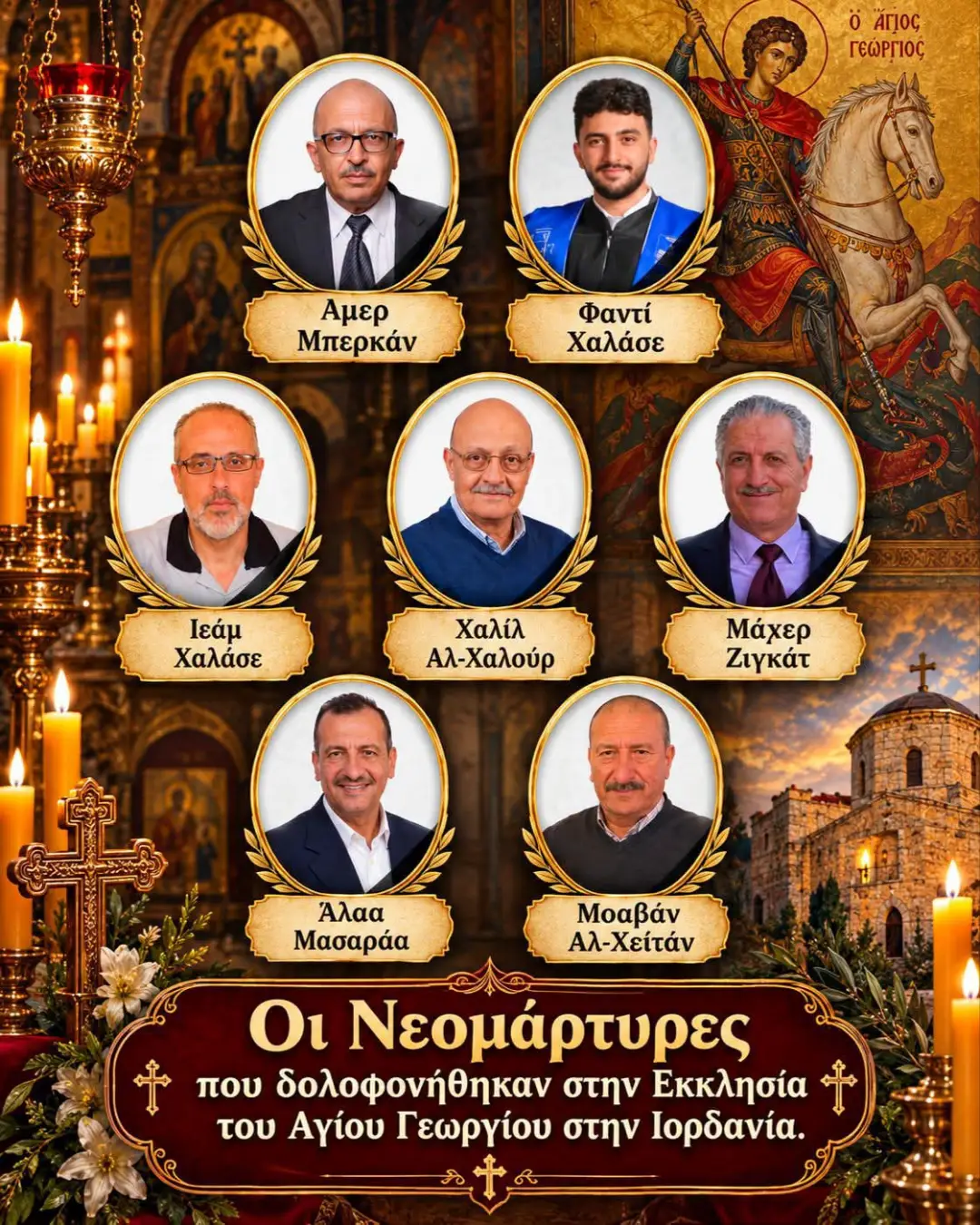
New Martyrs of Saint George Church in Jordan commemorated

The image presents a list of nine names identified as New Martyrs who were killed in the Church of Saint George in Jordan. The first line names Saint George, likely the church's patron. The following eight lines give names in Greek transliteration from Arabic: Amer Berkan, Fanti Halase, Ieam Halase, Halil Al-Halour, Macher Zigat, Alaa Masaraa, Moavan Al-Heitan. The caption states these are the New Martyrs murdered in that church.

  • List of eight individuals named as New Martyrs
  • Killed in the Church of Saint George in Jordan
  • Names given in Greek transliteration
  • Saint George named as patron of the church
  • No additional details or discussion provided
CHRISTIANITY UNITED Instagram

St. Paul's Call to Be a Good Soldier of Christ

The post reflects on Saint Paul's exhortation to Timothy to be a good soldier of Christ, applying it to the spiritual life of Orthodox Christians today. It explains that Christian life involves struggle against unseen battles: lust, pride, anger, greed, laziness, jealousy, resentment, and constant distractions that pull the heart from God. The greatest enemy is often the passions allowed to grow within. The author clarifies that Saint Paul's…

The post reflects on Saint Paul's exhortation to Timothy to be a good soldier of Christ, applying it to the spiritual life of Orthodox Christians today. It explains that Christian life involves struggle against unseen battles: lust, pride, anger, greed, laziness, jealousy, resentment, and constant distractions that pull the heart from God.

The greatest enemy is often the passions allowed to grow within. The author clarifies that Saint Paul's warning against entanglement in the affairs of this life does not mean abandoning family, work, or responsibilities, but refusing to let worldly desires surpass one's relationship with Christ. The Orthodox Church provides the necessary weapons for this warfare: prayer, fasting, Confession, the Holy Eucharist, Scripture, and the guidance of the Holy Fathers.

The post emphasizes that a soldier of Christ is not someone who never falls, but someone who gets back up, repents, and continues fighting against sin within, not against other people. Perseverance through difficulty, not perfection, defines the faithful soldier.

  • Saint Paul's words to Timothy urge endurance in spiritual struggle
  • The battle is against inner passions and distractions, not external enemies
  • Worldly entanglement means misplaced priorities, not neglect of duties
  • Orthodox spiritual tools include prayer, fasting, Confession, the Eucharist, Scripture, and the Fathers
  • A soldier of Christ persists through failure by repentance and return to the fight
Read more

St. John Chrysostom: Death as a Flight to Heaven

The post shares a saying attributed to St. John Chrysostom: "If you see your son or a relative lying in repose, do not think of him as dead, but as one who has flown away and ascended to heaven." The quote reframes the death of a loved one as a departure to heaven rather than an end.

  • Quote from St. John Chrysostom on death as ascension
  • Encourages viewing the deceased as having flown to heaven
Read more
George Instagram discussion

After shooting at Greek Orthodox church in Karak, a call to prayer over hate

A speaker responds to an attack on a Greek Orthodox church in Karak, Jordan, where gunmen opened fire fifteen minutes into a funeral service, killing seven people and wounding dozens. He acknowledges the natural rise of anger but warns that hate is the devil's tool to poison hearts and win twice, once in the church and once in the believers' hearts. The victims are described as brothers and sisters in the one church family, so the response is…

A speaker responds to an attack on a Greek Orthodox church in Karak, Jordan, where gunmen opened fire fifteen minutes into a funeral service, killing seven people and wounding dozens. He acknowledges the natural rise of anger but warns that hate is the devil's tool to poison hearts and win twice, once in the church and once in the believers' hearts.

The victims are described as brothers and sisters in the one church family, so the response is grief, solidarity, and prayer rather than hatred. Those killed in prayer are said to have a special place in Christ's kingdom and now pray for the living. The speaker recalls that for over 2,000 years Christians have faced martyrdom by dying without hate, a witness that draws others to Christ, citing Tertullian's statement that the blood of Christians is seed.

He also references Christ's words: "In the world you will have tribulation, but take heart; I have overcome the world." The conclusion is a prayer for rest for the departed, healing for the wounded, comfort for families, and protection of hearts from hate.

Key moments

  1. 0:00 Seven people were killed and dozens wounded when gunmen opened fire fifteen minutes into a funeral service at a Greek Orthodox church in Karak, Jordan.
  2. 0:32 The devil tries to poison hearts through hate, and when believers hate back, he wins twice, once in the church and once in their hearts, causing them to forget Christ's teaching.
  3. 1:02 The victims are not strangers but brothers and sisters in the one church family, so believers grieve with them, stand with them, and pray for them without silence.
  4. 1:33 Those killed inside the church in prayer now have a special place in Christ's kingdom and from there pray for the living.
  5. 1:33 Christ commanded love for enemies and demonstrated it on the cross; Christians have been martyred for over 2,000 years, and the church grows through such witness.
  6. 1:33 Tertullian wrote almost 1,800 years ago that the blood of Christians is seed.
  7. 2:05 Christ said, "In the world you will have tribulation, but take heart; I have overcome the world."
  8. 2:05 The church's response is to pray: for rest for the departed, healing for the wounded, comfort for families, and guarding of hearts from hate.
4 opinions in the discussion All your videos are good but I especially liked this one. The moment I heard that 7 orthodox Christians were killed my blood boiled, I felt instant anger, general hate toward all Muslims.… Read the discussion

The Lord's Prayer in Orthodox worship and home

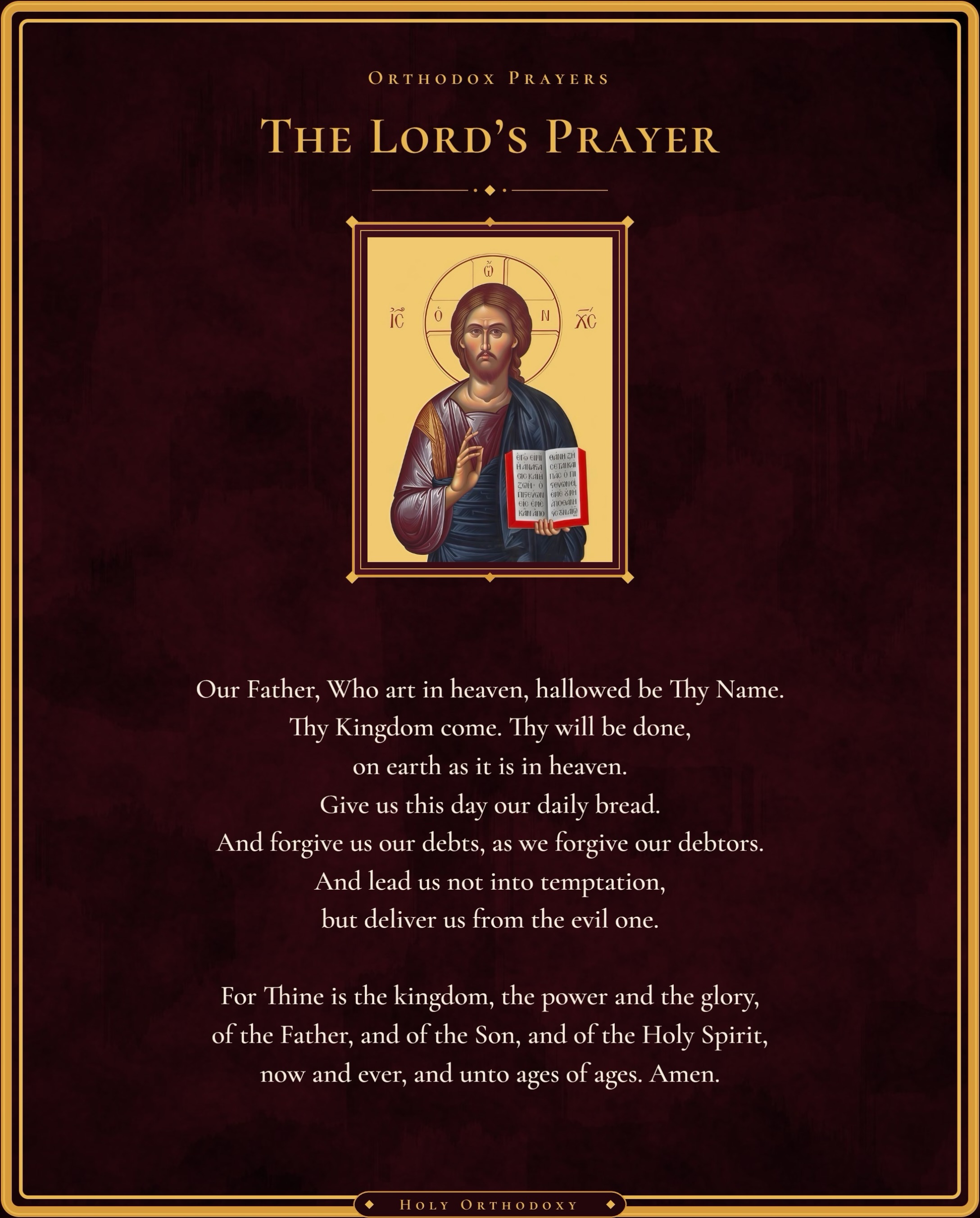
The post presents the Lord's Prayer, the prayer Christ gave, as it is used in the Orthodox Church. The text notes it is prayed at every Divine Liturgy and in every Orthodox home, and is often the first prayer a person learns. In the Liturgy, the priest concludes it with a doxology to the Holy Trinity. The accompanying image displays the full prayer: "Our Father, Who art in heaven, hallowed be Thy Name. Thy Kingdom come. Thy will be done, on…

The post presents the Lord's Prayer, the prayer Christ gave, as it is used in the Orthodox Church. The text notes it is prayed at every Divine Liturgy and in every Orthodox home, and is often the first prayer a person learns. In the Liturgy, the priest concludes it with a doxology to the Holy Trinity.

The accompanying image displays the full prayer: "Our Father, Who art in heaven, hallowed be Thy Name. Thy Kingdom come. Thy will be done, on earth as it is in heaven. Give us this day our daily bread. And forgive us our debts, as we forgive our debtors.

And lead us not into temptation, but deliver us from the evil one." It includes the concluding doxology: "For Thine is the kingdom, the power and the glory, of the Father, and of the Son, and of the Holy Spirit, now and ever, and unto ages of ages. Amen."

  • Christ gave the Lord's Prayer
  • Prayed at every Divine Liturgy
  • Prayed in every Orthodox home
  • Often the first prayer learned
  • Priest concludes with Trinitarian doxology
Read more

St. Paisios gives a loukoumi to a film seller, prompting repentance

Gerontas Filimon, a monk of the Holy Pantokratoros Skete of the Prophet Elias on Mount Athos, shares a story about St. Paisios. The saint encountered a man who owned a shop selling inappropriate films. St. Paisios gave the man a loukoumi, a traditional sweet. The man put the sweet in his pocket and said that it was not eaten. St. Paisios responded by asking whether the products the man sold to people were eaten. The question pierced the man's…

Gerontas Filimon, a monk of the Holy Pantokratoros Skete of the Prophet Elias on Mount Athos, shares a story about St. Paisios. The saint encountered a man who owned a shop selling inappropriate films. St. Paisios gave the man a loukoumi, a traditional sweet. The man put the sweet in his pocket and said that it was not eaten.

St. Paisios responded by asking whether the products the man sold to people were eaten. The question pierced the man's conscience. He immediately understood the implication, repented of his former occupation, and left the business. He then traveled to Albania, where he collaborated with Archbishop Anastasios to build churches, establish ministries, and carry out charitable works.

Gerontas Filimon concludes by observing that such transformative moments often pass unnoticed because people remain closed in their own will, failing to hear or see the miracles that God works through his saints.

Key moments

  1. St. Paisios gives a loukoumi to a man who owned a shop selling inappropriate films.
  2. The man puts the loukoumi in his pocket and says it is not eaten.
  3. St. Paisios asks whether what the man gives to people is eaten.
  4. The man immediately understands, repents, and leaves his former business.
  5. He goes to Albania and works with Archbishop Anastasios building churches, ministries, and charitable works.
  6. The speaker notes that we do not hear or see such wonders yet remain closed in our own will.
Read more