WeOrthodox
EN UA

Orthodox posts, videos and discussions

We follow Orthodox channels, communities and blogs across the web, summarise every post and video, and highlight the conversations with real substance.

Is it okay to have icons in the bedroom?

Is it acceptable to keep icons in the bedroom? A friend who is Eastern Orthodox told me that in Orthodoxy you shouldn't have icons in your room because you change clothes there and so on. Is that true?

I don't believe my icons can actually see anything; I think that idea borders on idolatry, so I don't see why my actions in front of an object would matter. God is always watching anyway, right?

  • Is it okay to have icons in the bedroom?
  • A friend says Orthodoxy forbids icons in the bedroom because of changing clothes.
  • Is that claim true?
  • The author does not believe icons can see and considers that view borderline idolatry.
  • God is always watching regardless.
31 opinions in the discussion The only version of this I've ever come across is "no icons in the bathroom." Read the discussion

Sinai's spiritual heritage and a monk's silence

The post shows Archimandrite Benedict (Jovanović) standing in silence on Mount Sinai at sunrise. The text explains Sinai's place in biblical and Christian tradition. According to Exodus, Moses received the Ten Commandments on this mountain, and God appeared to him in the burning bush that was not consumed. At the foot of the mountain stands the Orthodox Monastery of St. Catherine, one of the most important centers of ancient Christian…

The post shows Archimandrite Benedict (Jovanović) standing in silence on Mount Sinai at sunrise. The text explains Sinai's place in biblical and Christian tradition. According to Exodus, Moses received the Ten Commandments on this mountain, and God appeared to him in the burning bush that was not consumed.

At the foot of the mountain stands the Orthodox Monastery of St. Catherine, one of the most important centers of ancient Christian monasticism. The monastery preserves valuable Christian icons and manuscripts, as well as the tradition of St. Catherine the Great Martyr. Sinai is also the site of the spiritual struggle of St. John Climacus, who served as abbot of the Sinai monastery and wrote the famous "Ladder", one of the most significant works of Orthodox ascetic literature.

The Sinai spiritual heritage bears witness to centuries of prayer, monastic life, and devotion to God.

  • Photo of Archimandrite Benedict (Jovanović) on Mount Sinai at sunrise
  • Sinai as the mountain where Moses received the Ten Commandments
  • The burning bush theophany at Sinai
  • St. Catherine's Monastery preserves icons, manuscripts, and St. Catherine's tradition
  • St. John Climacus wrote The Ladder while abbot of the Sinai monastery
Read more
CHRISTIANITY UNITED Instagram

Metropolitan Athanasios on Monasticism: A Life Given Entirely to God

The post presents Metropolitan Athanasios of Limassol's teaching on monastic life. Born in Limassol, Cyprus, in 1959, he spent many years on Mount Athos before becoming Metropolitan of Limassol in 1999. He explains that monasticism is not merely leaving possessions, comfort, or ordinary life, but a decision to give one's entire life to God. A monk leaves behind things most people pursue, not because marriage, family, or work are evil, but…

The post presents Metropolitan Athanasios of Limassol's teaching on monastic life. Born in Limassol, Cyprus, in 1959, he spent many years on Mount Athos before becoming Metropolitan of Limassol in 1999. He explains that monasticism is not merely leaving possessions, comfort, or ordinary life, but a decision to give one's entire life to God.

A monk leaves behind things most people pursue, not because marriage, family, or work are evil, but because of a special calling to dedicate himself completely to Christ. The monk seeks communion with God, not wealth, recognition, or worldly success. The inner life of a monk is described as a lifelong journey of prayer, repentance, humility, and growing closer to Christ.

The metropolitan notes that this inner life is known by God alone and cannot be fully described; it is an inconceivable mystery. A monk journeys continually, dynamically, and unceasingly toward God alone. Although most people will not become monks, the lesson applies to all: families, jobs, and responsibilities should not take the place of God in the heart.

Christ calls every person to holiness, whether in a monastery or in the world, as expressed in Luke 18:22. The greatest lesson of monasticism is that a person can leave behind almost everything the world considers important and discover the One who matters most. A life completely given to Christ is never wasted.

Key moments

  1. The inner life of a monk is known by God alone.
  2. What transpires in the soul of a man who loves God can only be truly known by a beloved God.
  3. It is neither possible nor easy to speak about these things.
  4. The journey of a man who devotes his life to God is an inconceivable mystery.
  5. A monk is he who in his entire being journeys continually, dynamically, and unceasingly towards God and God alone.
Read more

Church on Mount Rumija: faith as living tradition and ancestral heritage

The post shares photographs of a church on Mount Rumija in Montenegro, taken at night under a moonlit sky. The accompanying text reflects that faith is not merely a word but a tradition preserved, a prayer offered, and love for the shrines handed down by ancestors. The author thanks Aleksandar and his brother for providing the images. The church sits on a rocky hill, its bell tower and crosses silhouetted against the moon. The reflection…

The post shares photographs of a church on Mount Rumija in Montenegro, taken at night under a moonlit sky. The accompanying text reflects that faith is not merely a word but a tradition preserved, a prayer offered, and love for the shrines handed down by ancestors. The author thanks Aleksandar and his brother for providing the images.

The church sits on a rocky hill, its bell tower and crosses silhouetted against the moon. The reflection connects the physical presence of the church to the continuity of Orthodox practice and reverence for holy places maintained across generations.

  • Photographs show a church on Mount Rumija at night under moonlight
  • Text describes faith as preserved tradition, prayer, and love for ancestral shrines
  • Author credits Aleksandar and his brother for the images
  • Church bell tower with crosses visible against the moon
  • Reflection ties the physical church to continuity of Orthodox heritage
Read more
Fr.TEDTalks with Olav Myrvang Instagram

Fr. Ted recommends Early Christian Writings for inquirers

Fr. Ted advises anyone interested in the Orthodox Church to read the Penguin Classics volume "Early Christian Writings," which collects the Apostolic Fathers. These are the earliest authenticated Christian texts after the New Testament, dating from the second century. The volume includes letters from St. Ignatius of Antioch and St. Polycarp of Smyrna, the Didache (Teaching of the Apostles), and the Shepherd of Hermas. These manuscripts are…

Fr. Ted advises anyone interested in the Orthodox Church to read the Penguin Classics volume "Early Christian Writings," which collects the Apostolic Fathers. These are the earliest authenticated Christian texts after the New Testament, dating from the second century. The volume includes letters from St. Ignatius of Antioch and St. Polycarp of Smyrna, the Didache (Teaching of the Apostles), and the Shepherd of Hermas.

These manuscripts are accepted by Protestants, Orthodox, and Catholics as genuine. They demonstrate that early Christians believed the Eucharist is truly the body and blood of Christ, not merely a symbol, and they reveal a church structure of bishops, priests, and deacons with liturgical worship. Fr. Ted suggests reading this book after reading the Bible. The recommendation comes from a conversation posted on YouTube, where he gives this specific piece of advice to inquirers from any denomination.

Key moments

  1. 0:00 The speaker tells every inquirer, regardless of denomination, to read the Penguin Classics book "Early Christian Writings" (also called the Apostolic Fathers) after reading the Bible.
  2. 0:34 The volume contains the earliest substantiated Christian writings: letters of St. Ignatius of Antioch and St. Polycarp of Smyrna, the Didache (Teaching of the Apostles), and the Shepherd of Hermas.
  3. 1:05 These manuscripts are authenticated and accepted by Protestants, Orthodox, and Catholics as genuine second-century documents, not forgeries.
  4. 1:37 The writings show early Christians believed the Eucharist is truly the body and blood of Christ, not a symbol, and they reveal a church with bishops, priests, deacons, and liturgy.
Read more
Fr.TEDTalks with Olav Myrvang Instagram

Catechumens and white belts: zeal without basics

The speaker compares new catechumens to white belts in jiu-jitsu. Both begin with zeal and excitement but try to do everything at once. The jiu-jitsu beginner watches short videos, buys instructionals, expensive gear, and ghee. Similarly, catechumens buy many icons, build prayer corners three times larger than the speaker's, and acquire censers and other Orthodox memorabilia. They do not actually use these items properly or know how to use them.…

The speaker compares new catechumens to white belts in jiu-jitsu. Both begin with zeal and excitement but try to do everything at once. The jiu-jitsu beginner watches short videos, buys instructionals, expensive gear, and ghee.

Similarly, catechumens buy many icons, build prayer corners three times larger than the speaker's, and acquire censers and other Orthodox memorabilia. They do not actually use these items properly or know how to use them. They do not yet know the basics of the faith. The speaker tells them they need to practice and learn the basics: learning the faith, learning how to pray, fasting, and going to church.

Key moments

  1. New catechumens are like white belts in jiu-jitsu, they have zeal and excitement but want to do everything at once.
  2. The new jiu-jitsu practitioner watches reels and shorts, buys instructionals, expensive ghee, and all the gear.
  3. Catechumens similarly buy many icons, build prayer corners three times larger than the speaker's, and acquire sensors and other Orthodox memorabilia.
  4. They do not actually use these items properly or know how to use them.
  5. They do not yet know the basics of the faith.
  6. The speaker tells them they need to practice and learn the basics.
  7. The basics are learning the faith, learning how to pray, fasting, and going to church.

Parable of the Life-Saving Station: When a Church Becomes a Club

Parable of the Life-Saving Station: When a Church Becomes a Club 6:13

Fr. John Parker, Dean of Saint Tikhon's Orthodox Seminary, presents a 1950s parable by an Episcopal priest about a life-saving station founded to rescue drowning people. The station begins as a crude hut with members keeping constant watch and searching tirelessly. Over time, members add beds and furniture, turning the station into a comfortable club. Fewer go on rescue missions; they hire crews instead. After a major wreck brings dirty, sick…

Fr. John Parker, Dean of Saint Tikhon's Orthodox Seminary, presents a 1950s parable by an Episcopal priest about a life-saving station founded to rescue drowning people. The station begins as a crude hut with members keeping constant watch and searching tirelessly. Over time, members add beds and furniture, turning the station into a comfortable club.

Fewer go on rescue missions; they hire crews instead. After a major wreck brings dirty, sick victims, a shower is built outside so they can clean up before entering the club. The membership eventually votes to stop life-saving activities as unpleasant. Those who insist on the original mission leave to start a new station, and the cycle repeats.

Fr. Parker applies this to parish life: when a church forgets it exists to receive, heal, teach, and rescue, it becomes a club for existing members. The suffering and spiritually shipwrecked appear as interruptions rather than people Christ brings to the door. He criticizes the attitude that expects visitors to be clean and Christian before entering.

Baptism is the shower, catechesis the clothing, chrismation the healing; the church must help people clean up, not demand they arrive clean. Mission begins when the stranger is welcomed not as a nuisance but as one being called home.

Key moments

  1. 0:32 Introduces the parable of the life-saving station written by an Episcopal priest in the 1950s about the nature of evangelism and mission.
  2. 1:02 The station begins as a crude hut with devoted members keeping constant watch and tirelessly searching for the lost day and night.
  3. 1:33 Members make the building comfortable with beds and furniture, turning it into a club; fewer go on rescue missions and they hire crews instead.
  4. 2:35 After a major wreck brings dirty, sick victims, a shower is built outside so they can clean up before entering the beautiful club.
  5. 3:05 The membership votes to stop life-saving activities as unpleasant; those who insist on the original mission are voted down and leave to start a new station.
  6. 3:35 The cycle repeats: the new station becomes a club, another is founded, and today many exclusive clubs line the shore while most people drown.
  7. 4:42 Churches often treat visitors as 'fish jumping into boats' with suspicion, 'what are you doing here?', instead of welcoming them with love.
  8. 5:12 The church expects people to become Christians before arriving, but baptism is the shower, catechesis the clothing, chrismation the healing, we must help them clean up.

Nine Martyred in Terrorist Attack on Jordan Orthodox Church

On 23 October 2026, gunmen opened fire at St. George's Greek Orthodox Church in Hamoud, Karak, Jordan, during a funeral service. Nine people were killed and dozens injured. The Greek Orthodox Patriarchate of Jerusalem condemned the attack, offered condolences to the bereaved families, and called the faithful to steadfast prayer. The post lists the names of those killed: Marwan Al-Khitan, Maheer Al-Zureiqat, Dr. Mohammed Al-Qusus, Bias Nayef…

On 23 October 2026, gunmen opened fire at St. George's Greek Orthodox Church in Hamoud, Karak, Jordan, during a funeral service. Nine people were killed and dozens injured. The Greek Orthodox Patriarchate of Jerusalem condemned the attack, offered condolences to the bereaved families, and called the faithful to steadfast prayer. The post lists the names of those killed: Marwan Al-Khitan, Maheer Al-Zureiqat, Dr. Mohammed Al-Qusus, Bias Nayef Al-Halsa, Dr. Assem Radqan, Mazen Rasmi Al-Qusus, Dr. Khaled Al-Halsa, and Dr. Fadi Al-Halsa.

A quote from St. Justin Martyr accompanies the list: "You can kill us but you cannot do us any real harm." The text ends with prayers for the departed, comfort for the grieving, healing for the wounded, and strength for the Orthodox faithful in Jordan.

  • Attack occurred during a funeral at St. George's Greek Orthodox Church in Hamoud, Karak, Jordan
  • Nine killed and dozens injured on 23 October 2026
  • Greek Orthodox Patriarchate of Jerusalem condemned the violence and called for prayer
  • Eight names of the martyred are listed, with a quote from St. Justin Martyr
  • Text concludes with prayers for the dead, the wounded, and the faithful in Jordan
Read more
Prayer Orthodoxy ® with Jesus My Inspiration Instagram

St. Demetrios Foretells Nestor's Victory and Martyrdom

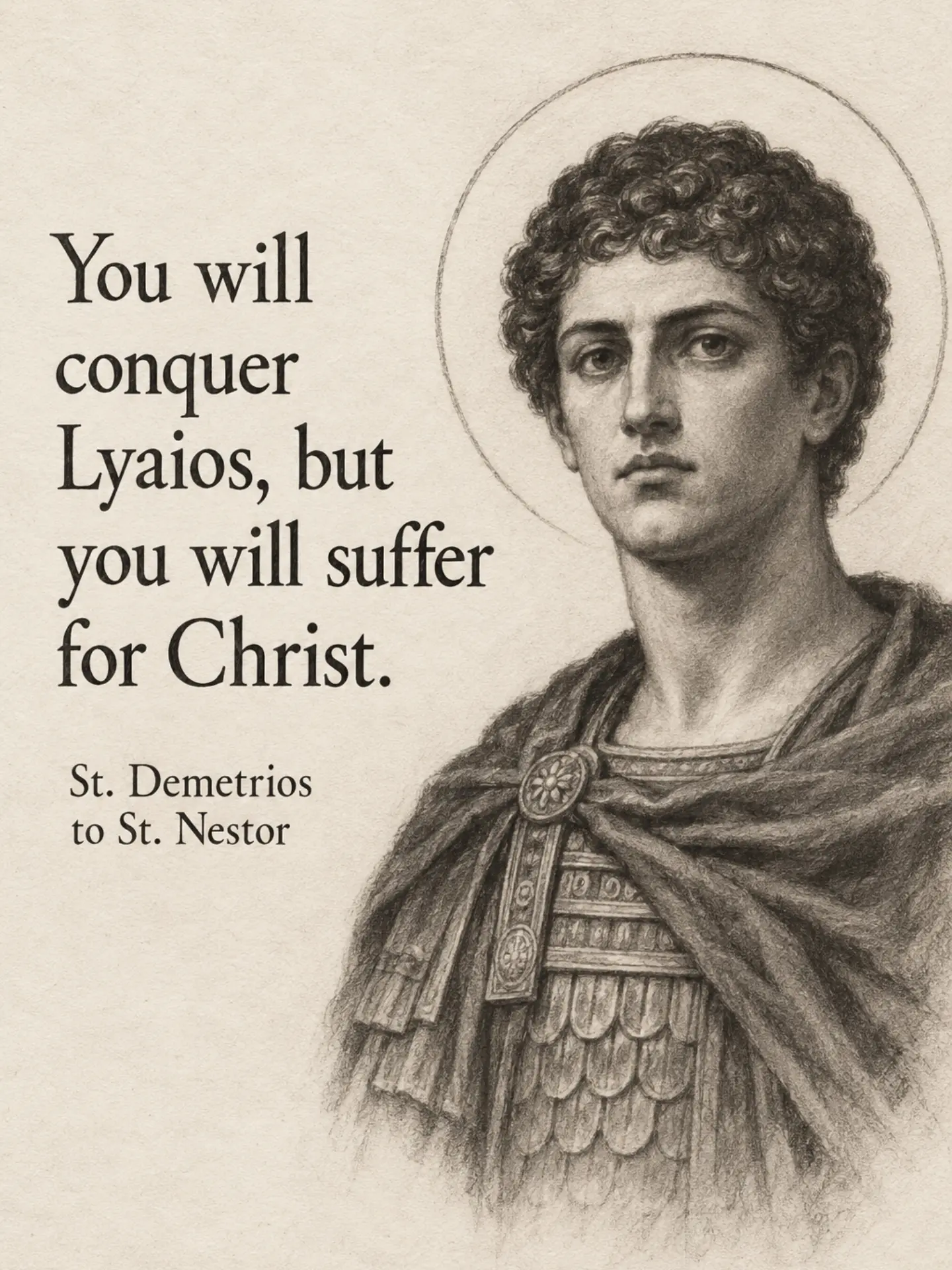
The Orthodox Church commemorates St. Demetrios the Myrrh-streamer of Thessaloniki on October 26. According to the tradition recorded in the post, St. Demetrios blessed the young Nestor before his contest with Lyaios. The saint foretold two outcomes: Nestor would conquer Lyaios, and he would suffer martyrdom for Christ. The image accompanying the post carries the direct words attributed to St. Demetrios: "You will conquer Lyaios, but you will…

The Orthodox Church commemorates St. Demetrios the Myrrh-streamer of Thessaloniki on October 26. According to the tradition recorded in the post, St. Demetrios blessed the young Nestor before his contest with Lyaios. The saint foretold two outcomes: Nestor would conquer Lyaios, and he would suffer martyrdom for Christ. The image accompanying the post carries the direct words attributed to St. Demetrios: "You will conquer Lyaios, but you will suffer for Christ."

This brief account highlights the spiritual dimension of Nestor's physical victory, the triumph was not an end in itself but a prelude to witness through death. The commemoration of St. Demetrios on this day brings to mind his role as a spiritual father who strengthened a young martyr, and the myrrh-streaming associated with his relics in Thessaloniki continues to draw veneration.

The post presents the core of the narrative without elaboration on the historical context of the games in Thessaloniki, the identity of Lyaios, or the later veneration of both saints.

  • St. Demetrios the Myrrh-streamer is commemorated on October 26
  • He blessed the young Nestor before his contest with Lyaios
  • St. Demetrios foretold Nestor's victory over Lyaios
  • St. Demetrios also foretold Nestor's martyrdom for Christ
  • The prophecy is quoted: "You will conquer Lyaios, but you will suffer for Christ"
Read more
George Instagram

Over 380 million Christians face persecution; the response is prayer, not hate

The speaker notes that many people are unaware of the scale of Christian persecution today. Over 380 million Christians live in countries with high levels of persecution, and nearly 5,000 were killed in one year, with 3,500 deaths in Nigeria alone. In North Korea, owning a Bible leads to prison camps, while in China thousands are arrested, and in Somalia, Yemen, Sudan, and Syria, being Christian can cost your life. Despite this, the world…

The speaker notes that many people are unaware of the scale of Christian persecution today. Over 380 million Christians live in countries with high levels of persecution, and nearly 5,000 were killed in one year, with 3,500 deaths in Nigeria alone. In North Korea, owning a Bible leads to prison camps, while in China thousands are arrested, and in Somalia, Yemen, Sudan, and Syria, being Christian can cost your life. Despite this, the world largely ignores the suffering.

Christ warned that his followers would be persecuted as he was, and persecution has continued from the apostles and Roman martyrs to today. The Christian response, passed from the apostles through the martyrs and saints, has never been hatred but love and prayer. Answering persecution with hate makes Christians lose their faith and become like their persecutors; instead, believers should pray for persecutors, worship freely, and draw closer to God, the very thing persecuted Christians are dying to do.

Key moments

  1. Many people don't know what's happening to Christians worldwide; we are privileged to worship freely.
  2. Christ warned that his followers would be persecuted as he was, and persecution has continued from the apostles and Roman martyrs to today.
  3. More than 380 million Christians currently live in countries with high persecution, and 4,900 were killed in one year, 3,500 in Nigeria alone.
  4. In North Korea owning a Bible sends you to a prison camp; in China thousands are arrested; in Somalia, Yemen, Sudan, and Syria being Christian can cost your life.
  5. The world largely does not care about this suffering.
  6. From the apostles to the saints, Christians have answered persecution with love and prayer, not hate, focusing on drawing closer to God.
  7. Answering with hate makes Christians lose their values, faith, and everything Christ taught, becoming like their persecutors and letting evil into their hearts.
  8. Instead of feeding anger, Christians should pray for persecutors, go to church, practice their faith freely, and come closer to God, what persecuted Christians are dying to do.
Read more
Athonite Audio YouTube

Evergetinos Hypothesis 30: Origin and Remedy of Blasphemous Thoughts

Evergetinos Hypothesis 30: Origin and Remedy of Blasphemous Thoughts 15:30

The Evergetinos, Hypothesis 30, gathers teachings on the origin and cure of blasphemous thoughts. From the Gerontikon, a brother visited Abba Poemen repeatedly but left in sorrow each time because he could not confess his blasphemous thoughts from shame. The elder discerned the struggle and urged him to speak. When the brother finally admitted that the devil wars against him to make him blaspheme, he felt immediate relief. Poemen instructed him…

The Evergetinos, Hypothesis 30, gathers teachings on the origin and cure of blasphemous thoughts. From the Gerontikon, a brother visited Abba Poemen repeatedly but left in sorrow each time because he could not confess his blasphemous thoughts from shame. The elder discerned the struggle and urged him to speak. When the brother finally admitted that the devil wars against him to make him blaspheme, he felt immediate relief.

Poemen instructed him to answer the thought: "I am not responsible for this thought. May your blasphemy be upon you, Satan. My soul has no desire for this."

Another father explained that blasphemous thoughts arise from maligning others, pride, self-will, neglected prayer, and anger, and can hand a person over to the demon of fornication and perdition. Saint Anastasios the Sinaite added that these thoughts often assault the devout involuntarily during prayer and communion, driving some to despair and even suicide because they fear they have committed the unforgivable sin against the Holy Spirit.

Anastasios said God permits the temptation to humble the proud, while demons envy those who advance in devotion; the thoughts are not the person's own, so the believer is not condemned. He noted that because no one dares confess these thoughts, people waste away or exhaust themselves with asceticism to no avail. The remedy is to despise the thought and rebuke the demon: "May your toil return upon your own head, you wicked and unclean demon...

I worship the Lord my God, and him alone shall I serve." Saint Maximos noted that the demon of blasphemy attacks when the mind progresses in love of God, and that the struggle makes the soul more steadfast and genuine in its love for God.

Key moments

  1. 0:33 Abba Poemen discerns the brother's hidden blasphemous thoughts and urges him to confess, saying he leaves in sorrow each time because he keeps them to himself.
  2. 1:04 The brother confesses the devil wars against him to make him blaspheme, and as soon as he speaks the thought to the elder he feels relief.
  3. 1:35 Abba Poemen instructs him to say when the thought comes: "I am not responsible for this thought. May your blasphemy be upon you, Satan. My soul has no desire for this."
  4. 2:07 An elder teaches that blasphemous thoughts come from maligning others, pride, following one's own will, neglecting prayer, and anger, and can lead to the demon of fornication and perdition.
  5. 3:09 Saint Anastasios describes how souls involuntarily utter blasphemous words during worship and communion, causing some to despair of salvation and consider suicide.
  6. 4:10 Anastasios explains the thoughts come either from pride (God permits Satan to humble) or demonic envy of the devout, and no one dares confess them, so people waste away or exhaust themselves with asceticism to no avail.
  7. 9:46 Anastasios gives the remedy: when the devil whispers blasphemy, say "May your toil return upon your own head, you wicked and unclean demon... I worship the Lord my God, and him alone shall I serve."
  8. 14:27 Saint Maximos says the demon of blasphemy tempts the mind when it progresses in love of God, but the attack makes the soul more steadfast and genuine in its love for God.
Athonite Audio YouTube

Pride Alone Can Destroy a Christian: Evergetinos Hypothesis 29

Pride Alone Can Destroy a Christian: Evergetinos Hypothesis 29 34:01

The video presents Hypothesis 29 from the third volume of the Evergetinos, which teaches that pride alone is sufficient to destroy a Christian. Those who become puffed up over their accomplishments are abandoned by divine grace and suffer a deadly fall. The hypothesis draws on several sources. From Palladius, it recounts the story of Valens, a monk from Palestine who attained a high measure of asceticism but fell into pride. He believed angels…

The video presents Hypothesis 29 from the third volume of the Evergetinos, which teaches that pride alone is sufficient to destroy a Christian. Those who become puffed up over their accomplishments are abandoned by divine grace and suffer a deadly fall. The hypothesis draws on several sources. From Palladius, it recounts the story of Valens, a monk from Palestine who attained a high measure of asceticism but fell into pride.

He believed angels were conversing with him and accepted a lamp lit by the devil to find a lost needle. When the devil appeared disguised as Christ with torch-bearing demons, Valens worshipped him and declared he had no need of Holy Communion because he had seen Christ. The fathers Chronius, James, and Paphnutius taught that events occur either by God's good pleasure or by his permission, and that pride causes God to withdraw the angel of providence, leaving the monk in the adversary's clutches.

Valens was cured only after a year of chains, prayer, and humiliation. Syncletica identifies pride as the devil's ultimate weapon, the sword he uses last after exhausting gluttony, fornication, and avarice. She prescribes meditating on the words 'I am a worm and no man' and comparing oneself to greater ascetics.

The Gerontikon provides concrete examples: elders deflect praise, assign humiliating tasks to proud monks, and teach that moderation and humility are the royal way. Abba Isidore teaches that it is more profitable to eat meat than to fast and become conceited, and the elders say to pull down a younger monk climbing to heaven by his own will.

A Thebaid monk practicing extreme asceticism was tempted to seek miracles; when he prayed for this power, God sent him to an elder who saw demons of vainglory and pride on his shoulders and assigned him the humiliating task of buying and eating meat, bread, and wine for ten days. Cassian compares pride to a pestilence that destroys the entire soul, not just one part.

He urges guarding the heart by always repeating 'Not I, but the grace of God which was with me' and 'Without me you can do nothing.'

Key moments

  1. 0:00 Hypothesis 29 states that pride alone is sufficient to destroy a Christian and that those who become puffed up over their accomplishments are abandoned by divine grace and suffer a deadly fall.
  2. 0:31 Valens, a monk from Palestine who attained the highest measure of askesis, fell into pride and believed angels were conversing with him, even accepting a lamp lit by the devil to find a lost needle.
  3. 1:33 When the devil appeared to Valens disguised as Christ with torch-bearing demons, Valens worshipped him and declared he had no need of Holy Communion because he had seen Christ.
  4. 3:35 The fathers Chronius, James, and Paphnutius taught that events occur either by God's good pleasure or by his permission, and that pride causes God to withdraw the angel of providence, leaving the monk in the adversary's clutches.
  5. 6:42 Syncletica identifies pride as the devil's ultimate weapon, the sword he uses last after exhausting gluttony, fornication, and avarice, and she prescribes meditating on 'I am a worm and no man' and comparing oneself to greater ascetics.
  6. 13:29 Abba Isidore teaches that it is more profitable to eat meat than to fast and become conceited, and the elders say to pull down a younger monk climbing to heaven by his own will.
  7. 16:05 A Thebaid monk practicing extreme asceticism was tempted to seek miracles; when he prayed for this power, God sent him to an elder who saw demons of vainglory and pride on his shoulders and assigned him the humiliating task of buying and eating meat, bread, and wine for ten days.
  8. 29:35 Cassian compares pride to a pestilence that destroys the entire soul, not just one part, and urges guarding the heart by always repeating 'Not I, but the grace of God which was with me' and 'Without me you can do nothing.'

St. Paisios: The Guardian Angel Given at Baptism

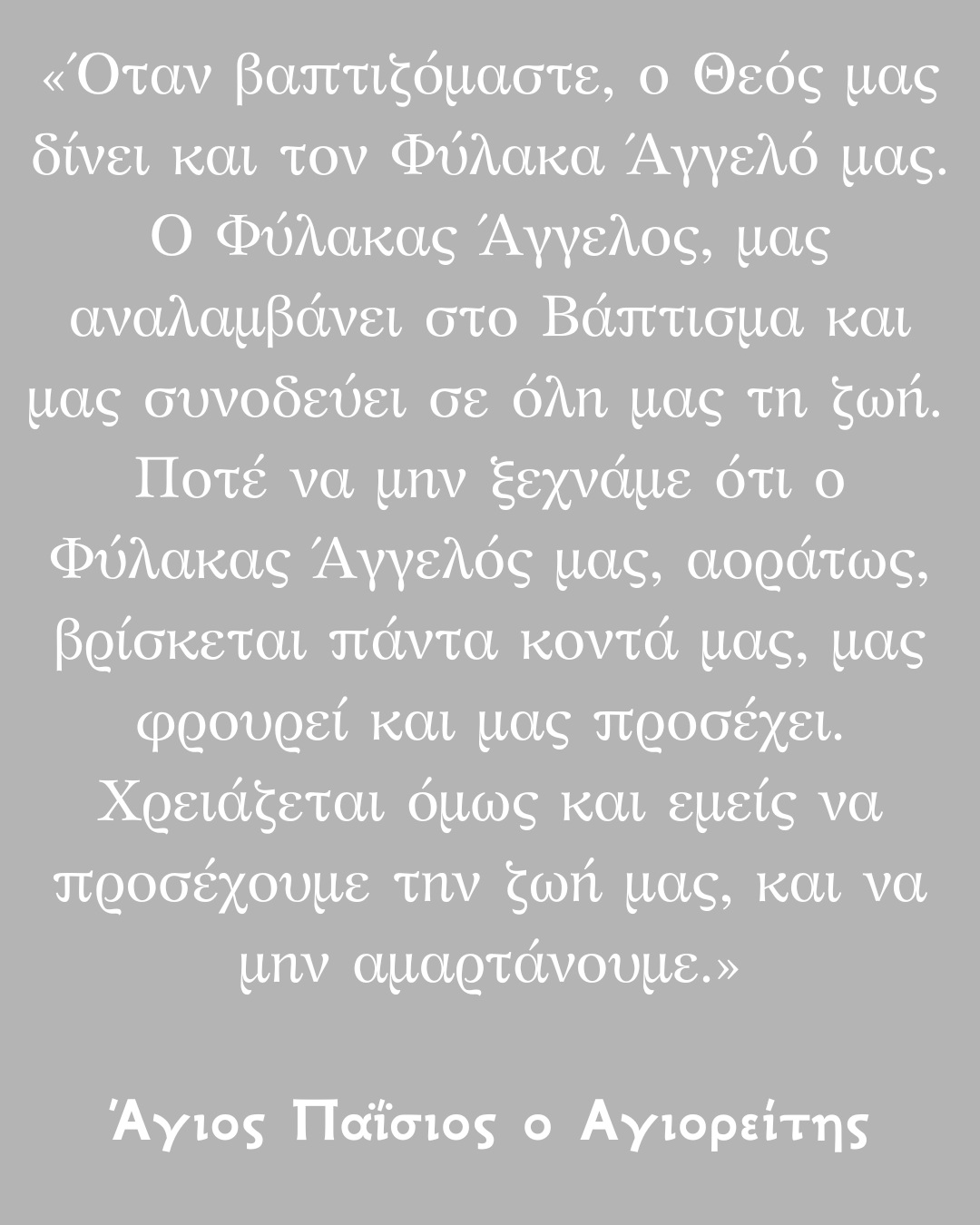
The post presents an excerpt from the sixth volume of Saint Paisios the Athonite's discourses on prayer, published by the Holy Hesychasterion of Saint John the Theologian in Vasilika, Thessaloniki, in its eighth reprint of 2024. The passage appears on pages 93 and 96 under the subsection titled "The Guardian Angel." In the excerpt, Saint Paisios teaches that when a person is baptized, God assigns a guardian angel who takes charge of that person…

The post presents an excerpt from the sixth volume of Saint Paisios the Athonite's discourses on prayer, published by the Holy Hesychasterion of Saint John the Theologian in Vasilika, Thessaloniki, in its eighth reprint of 2024. The passage appears on pages 93 and 96 under the subsection titled "The Guardian Angel." In the excerpt, Saint Paisios teaches that when a person is baptized, God assigns a guardian angel who takes charge of that person at baptism and accompanies them throughout their entire life.

The saint stresses that the guardian angel remains invisibly close at all times, guarding and watching over the individual. He also adds a condition: the person must likewise attend to their own life and refrain from sin. The text is a direct transcription from the book and includes the bibliographic reference for verification. No further commentary or discussion accompanies the quote.

  • At baptism God gives a guardian angel who takes charge of the person.
  • The guardian angel accompanies the person throughout life, invisibly present.
  • The angel guards and watches over the person.
  • The person must also attend to their life and not sin.
  • The excerpt is from Saint Paisios's sixth volume on prayer, pages 93 and 96.
Read more

St. Paisios on Parental Love and Honoring God

The post shares a teaching from St. Paisios the Athonite responding to the claim that some children feel hurt by their parents' love. The elder states that no one is harmed by the love of parents. Whoever feels hurt by it is foolish, because he ought to thank God for the love and tenderness of his parents. St. Paisios then connects the duty toward parents to the duty toward God: if someone does not honor and love his parents, he cannot possibly…

The post shares a teaching from St. Paisios the Athonite responding to the claim that some children feel hurt by their parents' love. The elder states that no one is harmed by the love of parents. Whoever feels hurt by it is foolish, because he ought to thank God for the love and tenderness of his parents.

St. Paisios then connects the duty toward parents to the duty toward God: if someone does not honor and love his parents, he cannot possibly love, honor, and fear God. The teaching presents parental love as a gift from God that demands gratitude, and the honor given to parents as a necessary foundation for a right relationship with God.

  • St. Paisios rejects the idea that parental love can harm children
  • Those who feel hurt by parental love are called foolish
  • Children should thank God for parental love and tenderness
  • Honoring and loving parents is a prerequisite to loving, honoring, and fearing God
  • The teaching comes from St. Paisios the Athonite, a recognized Orthodox saint
Read more
Robel࿇🕊️ Instagram

Saint Ephrem the Syrian's cry for repentance

The post presents a brief invocation attributed to Saint Ephrem the Syrian: "I cry out to you my Lord Jesus." The accompanying video summary expands on the spirit of this cry, describing a soul that weeps for its sins yet continues to commit them, knows the good but chooses evil, and feels its soul wounded while delaying healing. The speaker asks the Lord how long they will betray His love and pleads to be turned back before the heart grows cold…

The post presents a brief invocation attributed to Saint Ephrem the Syrian: "I cry out to you my Lord Jesus." The accompanying video summary expands on the spirit of this cry, describing a soul that weeps for its sins yet continues to commit them, knows the good but chooses evil, and feels its soul wounded while delaying healing.

The speaker asks the Lord how long they will betray His love and pleads to be turned back before the heart grows cold and can no longer feel God's mercy. This reflects the penitential theology characteristic of Saint Ephrem, a fourth-century deacon and Doctor of the Church known for his hymns and prayers on repentance, humility, and the mercy of God.

Key moments

  1. The speaker weeps for their sins yet does not cease from them, knowing the good but choosing the evil, and asks the Lord to turn them back before their heart grows cold and they can no longer feel His mercy.
Read more
Orthodox Life Instagram

Saint Tabitha, Raised by Peter, Model of Quiet Charity

The post commemorates Saint Tabitha, also called Dorcas, on October 25. She lived in Joppa and is mentioned in Acts 9:36-42. Luke calls her a disciple, a title rarely given to women in the New Testament. Her Aramaic and Greek names both mean gazelle. She served the early Church through practical charity: as a skilled seamstress she made tunics and coats for widows and orphans in her community. When she fell ill and died, the believers sent for…

The post commemorates Saint Tabitha, also called Dorcas, on October 25. She lived in Joppa and is mentioned in Acts 9:36-42. Luke calls her a disciple, a title rarely given to women in the New Testament. Her Aramaic and Greek names both mean gazelle. She served the early Church through practical charity: as a skilled seamstress she made tunics and coats for widows and orphans in her community.

When she fell ill and died, the believers sent for Peter, who was preaching in nearby Lydda. Widows met him weeping and showed him the garments Tabitha had sewn. Peter knelt, prayed, and said, "Tabitha, arise." She opened her eyes, sat up, and was restored to life.

The miracle spread through Palestine, leading many Jews and pagans to believe in Christ. Tabitha continued her charitable work for many more years and reposed at a very old age. The accompanying images include an icon of the raising and a Greek inscription praising almsgiving: "The merciful saint, brothers: he who loves and shows mercy to the poor shall receive mercy from God unto the light."

  • Commemorated October 25; named Tabitha (Aramaic) and Dorcas (Greek), both meaning gazelle
  • Explicitly called a disciple by Luke in Acts 9:36-42
  • Expressed faith through sewing garments for widows and orphans in Joppa
  • Raised from the dead by Peter after widows showed him her handiwork
  • Miracle led many to belief; she lived on serving quietly until old age
Read more
Discover Orthodox Christianity Facebook

Myrrh miracle at St. Demetrios' relics witnessed by deacon in 1987

Fr. Christos Kotios, then a newly ordained deacon at the Church of St. Demetrios in Thessaloniki, recounts a miracle he witnessed on the evening of October 26, 1987. The city was celebrating its liberation from Ottoman rule (1430-1912) on the feast of the martyrdom of its protector, St. Demetrios. Around 10:00 p.m., about thirty to forty pilgrims were in the church. A group of ten women chanted the Paraklesis before the silver reliquary holding…

Fr. Christos Kotios, then a newly ordained deacon at the Church of St. Demetrios in Thessaloniki, recounts a miracle he witnessed on the evening of October 26, 1987. The city was celebrating its liberation from Ottoman rule (1430-1912) on the feast of the martyrdom of its protector, St. Demetrios. Around 10:00 p.m., about thirty to forty pilgrims were in the church.

A group of ten women chanted the Paraklesis before the silver reliquary holding the saint's relics. The only cleric present was the deacon, instructed to stay by the proistamenos, the future Metropolitan Panteleimon of Boeria, Naousa and Kampania. During the chant, the women shouted; the deacon ran to them and saw the reliquary bathed in an oily, yellowish-green myrrh.

The quantity was so great he likened it to at least two buckets poured down the sides. The fragrance was indescribable and filled the church and the street outside. The deacon fetched cotton from the altar and soaked up the myrrh, but it continued to flow mystically without a visible source.

He noticed that after he cleaned a smooth area of the reliquary, a woman's touch immediately caused fresh myrrh to appear on her hand. Meanwhile, pilgrims discovered that all the icons in the church, on stands and on the iconostasis, were also streaming myrrh; handkerchiefs wiped on the icon frames turned yellow. Soon a line formed to venerate the reliquary. The proistamenos and other priests arrived, unlocked the reliquary, and found the relics fragrant, though the myrrh's scent was distinct.

Metropolitan Panteleimon II Chrysaphakes of Thessaloniki attributed the miracle to a university celebration that evening where the keynote speaker omitted any mention of the saint. He said St. Demetrios showed he would never abandon the city, having saved it from slavery and earthquakes, while some proved ungrateful and distant from Christ.

Twenty-four years later, Fr. Christos writes as a priest in Thessaloniki, recalling the joy, astonishment, and sense of living a mystery. He says such events strengthen faith and confirm that the faith is alive.

  • Deacon witnesses myrrh gushing from St. Demetrios' relics during Paraklesis on Oct 26, 1987
  • Myrrh flows abundantly, fragrance fills church and street, icons also stream myrrh
  • Pilgrims venerate, priests open reliquary, relics fragrant with distinct myrrh scent
  • Metropolitan Panteleimon II Chrysaphakes links miracle to university speaker omitting saint
  • Fr. Christos reflects 24 years later: event strengthens faith, shows faith is alive
Read more

Mount Athos: The Garden of the Theotokos and a millennium of monastic life

The post describes Mount Athos as the Garden of the Most Holy Theotokos, a center of Orthodox monasticism for over a thousand years. The Holy Mountain is dedicated to the Virgin Mary, whom the monks honor as its Abbess and Protectress. Generations of monks have devoted their lives to Christ there, continually seeking the Panagia's intercessions.

  • Mount Athos has been a center of Orthodox monasticism for over a thousand years
  • It is known as the Garden of the Theotokos, dedicated to the Virgin Mary
  • Monks honor the Theotokos as Abbess and Protectress of the Holy Mountain
  • Generations of monks have lived lives of prayer, fasting, and spiritual struggle
  • The post includes the prayer "Most Holy Theotokos, save us" in English and Greek
Read more

Christ's compassion at Nain reveals God-man action in us

Christ's compassion at Nain reveals God-man action in us 5:23

The sermon by Fr. Alexey Uminsky examines the Gospel account of Christ raising the widow's son at Nain. The reading describes the first resurrection miracle where Christ encounters a funeral procession for a widow's only son and approaches the bier to raise him. The text notes that Jesus had compassion on the widow. This detail shows Christ's human heart at work, revealing that miracles are God-man actions where human nature acts together with…

The sermon by Fr. Alexey Uminsky examines the Gospel account of Christ raising the widow's son at Nain. The reading describes the first resurrection miracle where Christ encounters a funeral procession for a widow's only son and approaches the bier to raise him. The text notes that Jesus had compassion on the widow. This detail shows Christ's human heart at work, revealing that miracles are God-man actions where human nature acts together with the divine rather than stepping aside.

The young man is the only son of a widow, just as Christ is the only son of the widowed Theotokos. The miracle may occur before her eyes as he tells the grieving mother not to weep. The widow loses not only her son but her entire future support, since the law required children to provide for aging parents, leaving her with no one to look after her.

Christ's care for his mother is fulfilled on the cross when he entrusts her to John, obeying the law that commands children to care for widowed parents. From the cross Christ gives his mother the care of John and of every believer, making the Gospel passage a revelation of God-man compassion and God-man care. The Apostolic reading declares that it is no longer I who live but Christ lives in me, which is itself a God-man action and the pattern for Christian life.

Because the God-man has conquered death, this life is given to each person in whom Christ dwells. The Lord calls believers to act in a God-man way with his strength, love, authority, gospel word, and healing. The conquest of death by the God-man is shared with all in whom Christ lives.

Key moments

  1. 0:00 The Gospel reading describes the first resurrection miracle where Christ encounters a funeral procession for a widow's only son and approaches the bier to raise him.
  2. 0:31 The detail "He had compassion on her" shows Christ's human heart at work, revealing that miracles are God-man actions where human nature acts together with the divine rather than stepping aside.
  3. 2:02 The young man is the only son of a widow, just as Christ is the only son of the widowed Theotokos, and the miracle may occur before her eyes as He tells the grieving mother "Do not weep."
  4. 2:32 Christ's care for His mother is fulfilled on the cross when He entrusts her to John, obeying the law that commands children to care for widowed parents.
  5. 3:06 The widow loses not only her son but her entire future support, since the law required children to provide for aging parents, leaving her with no one to look after her.
  6. 3:37 From the cross Christ gives His mother the care of John and of every believer, making the Gospel passage a revelation of God-man compassion and God-man care.
  7. 4:08 The Apostolic reading states "It is no longer I who live, but Christ lives in me," which is itself a God-man action and the pattern for Christian life.
  8. 4:38 The Lord calls believers to act in a God-man way with His strength, love, authority, gospel word, and healing, because the God-man's conquest of death is given to all in whom Christ lives.
Read more

True Orthodox masculine leadership requires more than financial provision

1:28

The post argues that providing financially for one's family, while important, does not constitute godly leadership from an Orthodox Christian perspective. The speaker outlines six areas where a husband and father must lead through responsibility, humility, discipline, and self-sacrifice rather than power or control. Spiritual leadership means the man prays, reads Scripture, attends Divine Liturgy, goes to confession, and teaches his children by…

The post argues that providing financially for one's family, while important, does not constitute godly leadership from an Orthodox Christian perspective. The speaker outlines six areas where a husband and father must lead through responsibility, humility, discipline, and self-sacrifice rather than power or control. Spiritual leadership means the man prays, reads Scripture, attends Divine Liturgy, goes to confession, and teaches his children by example rather than expecting his wife to carry the spiritual life of the home.

Emotional leadership involves feeling anger and fear but not being ruled by them, responding to conflict with patience instead of escalation. Protection requires building physical strength, awareness, and practical competence so that wife and children feel safe with him, never afraid of him. Keeping one's word means following through on promises, owning failures, and making them right, as Christ taught to let yes be yes and no be no. Vision and order involve knowing family values, managing money, deciding where to worship, and building a home by listening, planning with his wife, and taking responsibility.

Presence means giving family time, attention, service, and affection, putting down the phone, listening to his wife, and being with his children, because Christ's leadership was sacrificial, not selfish. The post concludes by asking men which of these six areas they find most challenging.

Key moments

  1. A man cannot expect his wife to carry the entire spiritual life of the home; he must pray, read scripture, go to Divine Liturgy, confess his sins, and teach his children by example.
  2. Emotional leadership means a man feels anger and fear but learns not to be ruled by them, responding to conflict with patience instead of escalation.
  3. Protection requires building physical strength, awareness, and practical competence so that wife and children feel safe with him, never afraid of him.
  4. Keeping one's word means following through on promises, owning failures, and making them right, as Christ teaches to let yes be yes and no be no.
  5. Vision and order involve knowing family values, managing money, deciding where to worship, and building a home by listening, planning with his wife, and taking responsibility.
  6. Presence means giving family time, attention, service, and affection, putting down the phone, listening to his wife, and being with his children, because Christ's leadership was sacrificial, not selfish.
Read more