WeOrthodox
EN UA

Orthodox posts, videos and discussions

We follow Orthodox channels, communities and blogs across the web, summarise every post and video, and highlight the conversations with real substance.

Prayer Orthodoxy ® with ICXC☦️NIKA Instagram

St. Catherine's Monastery threatened with conversion to tourism resort

The post presents Saint Catherine's Monastery at Mount Sinai as the single most significant historical and theological location in the world. It states the monastery has stood for more than fifteen centuries with unceasing prayer. Inside are the actual Burning Bush, the oldest church on the planet, the oldest and most critical library containing scientific and historical documents over 1,000 years old, the oldest and largest collection of…

The post presents Saint Catherine's Monastery at Mount Sinai as the single most significant historical and theological location in the world. It states the monastery has stood for more than fifteen centuries with unceasing prayer. Inside are the actual Burning Bush, the oldest church on the planet, the oldest and most critical library containing scientific and historical documents over 1,000 years old, the oldest and largest collection of ancient iconography, the Well of the Prophet Moses where he met Sarah, the oldest complete Bible in existence (Codex Sinaiticus), and the oldest depiction of Jesus Christ.

The Prophet Muhammad issued a protective edict signed with his handprint. Napoleon Bonaparte is said to have called it home during exile. Countless saints were forged there. It is a UNESCO World Heritage Site.

The post warns that a single legal action now threatens its extermination. Some media outlets portray this as a victory for humanity; the author calls it the furthest thing from victory. The monastery has welcomed visitors since the third century; the first written account is by Egeria from Spain in the fourth century, before Emperor Justinian built the outer walls.

Greedy individuals now seek to strip the monastery of rights that have stood for millennia to turn it into a tourism resort. For more than 1,700 years the Sinaitic Fathers have prayed for the world; the author urges readers to take action in whatever way they can. The consequences are described as dire. The post ends with "Lord have mercy."

Key moments

  1. The speaker says: "Here is mine. Here, in this space, in my world. In this world here, next to this world here."
Athonite Audio YouTube

Elder Joseph of Vatopaidi: Trials as Providential Instruments for Correction

Elder Joseph of Vatopaidi: Trials as Providential Instruments for Correction 8:39

The post presents teachings from Elder Joseph of Vatopaidi's work "On Trials and the Spiritual Law," drawn from the life and teachings of St. Joseph the Hesychast. The elder's guiding principle was "Give blood and receive the spirit," meaning that resolve and daring, joined with faith in God, draw down divine energy that heals and completes what is lacking. He judged every event by the spiritual law, tracing outcomes back to their initial…

The post presents teachings from Elder Joseph of Vatopaidi's work "On Trials and the Spiritual Law," drawn from the life and teachings of St. Joseph the Hesychast. The elder's guiding principle was "Give blood and receive the spirit," meaning that resolve and daring, joined with faith in God, draw down divine energy that heals and completes what is lacking.

He judged every event by the spiritual law, tracing outcomes back to their initial provocation with such precision that his disciples were astounded at the place the law of the spirit of life held within him. The elder taught that repentance must be accompanied by painful toil to satisfy the spiritual law; when a disciple made a mistake, he assigned a penance of pointless labor and explained that without a corresponding degree of painful toil alongside repentance, the judgment of the spiritual law is not satisfied and an unknown trial may befall.

Abba Mark is cited teaching that real knowledge is patiently to accept affliction and not to blame others for our own misfortunes. The elder regarded misfortunes as providential instruments for correction, calling them trials, and repeated the patristic saying: take away trials and no one would be saved. His experience centered on a double duty: to deal wisely with the causes and occasions of temptations to forestall them, and when they occur to confront them bravely with faith and hope of the ensuing benefit.

Two titanic forces, love toward God and love of this world, create an unbreakable tug of war with man in the middle; trials are the occasions that awaken those entangled in these opposing loves. God calls all but tests those who accept in proportion to the knowledge given; the negative side is the love of this world, which is in the power of the evil one and deceives some while attempting to stifle others by open force.

Natural needs, passions, demons, and the law of sin in our members all conspire against our good intention, and only the misfortunes called trials can wake us and push us forward.

Key moments

  1. 0:01 The elder's motto "Give blood and receive the spirit" expresses that resolve and daring, combined with faith in God, arouse divine energy which heals what is infirm and completes what is wanting.
  2. 0:34 The elder judged everything by the spiritual law, analyzing events from their results back to the initial provocation with such precision that his disciples were astounded at the place the law of the spirit of life held within him.
  3. 2:10 When the speaker made a mistake, the elder gave a penance of pointless labor and explained that without a corresponding degree of painful toil alongside repentance, the judgment of the spiritual law is not satisfied and an unknown trial may befall.
  4. 2:42 Abba Mark teaches that real knowledge is patiently to accept affliction and not to blame others for our own misfortunes.
  5. 3:13 The elder regarded misfortunes as providential instruments for correction, calling them trials, and repeated the patristic saying: take away trials and no one would be saved.
  6. 4:16 The elder's experience centered on a double duty: to deal wisely with the causes and occasions of temptations to forestall them, and when they occur to confront them bravely with faith and hope of the ensuing benefit.
  7. 4:47 Two titanic forces, love toward God and love of this world, create an unbreakable tug of war with man in the middle; trials are the occasions that awaken those entangled in these opposing loves.
  8. 6:22 God calls all but tests those who accept in proportion to the knowledge given; the negative side is the love of this world, which is in the power of the evil one and deceives some while attempting to stifle others by open force.
Athonite Audio YouTube

Elder Joseph of Vatopedi: Regime as Foundation of Monastic Life

Elder Joseph of Vatopedi: Regime as Foundation of Monastic Life 11:16

Elder Joseph of Vatopedi teaches that good order and a fixed regimen are the foundation of monastic life. He quotes St. Ephraim the Syrian that those without guidance fall like leaves, and illustrates the principle through Elder Theophylactos of the hermitage of St. Artimios, a strict hesychast who demanded exact placement of every object and dismissed a disciple after a third instance of disorder. The elder describes how breaking the typikon,…

Elder Joseph of Vatopedi teaches that good order and a fixed regimen are the foundation of monastic life. He quotes St. Ephraim the Syrian that those without guidance fall like leaves, and illustrates the principle through Elder Theophylactos of the hermitage of St. Artimios, a strict hesychast who demanded exact placement of every object and dismissed a disciple after a third instance of disorder.

The elder describes how breaking the typikon, whether in diet, silence, or watchfulness, immediately threw prayer and fervor into turmoil, while keeping it preserved spiritual stability. When questioned about his severity, the elder replied that experience proved he could not continue his God-given hesychastic vocation without it, citing 1 Corinthians 9:17. He contrasts the common path of unrestricted hospitality with the rare calling of stillness, noting that St. Gregory Palamas fled to holes in the ground for isolation.

Regulation, he teaches, restores the equilibrium of soul and body shattered by the fall, and ceases only when the mortal puts on immortality and no law is laid down for the just (1 Timothy 1:9). The elder clung to St. Isaac the Syrian as a manual, reciting by heart chapters on order from beginner practice to perfection, especially the seventh discourse on considering oneself less than one's brethren and their servant.

Key moments

  1. 0:01 The elder taught that good order and keeping to a regimen are fundamental duties, describing disorder in the blackest colors and quoting St. Ephraim the Syrian: those who have no guidance fall like leaves, signifying lack of regimen.
  2. 0:32 Elder Theophylactos of the hermitage of St. Artimios, a strict hesychast who ate no oil, told his disciple Father Arenos that without order and regimen he would never become a monk, showing him the fixed place for every object, jug, cup, bowls, rusks, and warning that a third disorder would mean dismissal.
  3. 1:35 The elder described Elder Theophylactos as a man of watchfulness whose nous was caught up in visions; demons once dragged him naked through snow all night yet he was unharmed, and a deer with a broken leg came to his cell for healing, returning every eight days until cured.
  4. 3:09 The main characteristic of such spiritual warriors was strictness in keeping their rule of life, and the elder taught that the beginning of acquiring character and personhood lies in insistence on an ordered, systematic way of life, which builds the resolve and bravery needed to confront the serpent prowling like a roaring lion (1 Peter 5:8).
  5. 4:12 A second reason for regime is the mutability of fallen human nature: sinfulness dulls courage, inexperience and ignorance increase discouragement, and firm resolve in a worked-out regime is the greatest human aid to success in the invisible war.
  6. 5:15 The elder clung to St. Isaac the Syrian as a manual, reciting by heart chapters on order from beginner practice to perfection, especially the seventh discourse: "wherever you are consider yourself less than your brethren and their servant."
  7. 8:22 The speaker learned through repeated mishaps that precise observance of the typikon, wherever they were, preserved fervor, zeal, prayer, and inspired state, while any contravention of diet, silence, or watchfulness threw everything into turmoil.
  8. 9:24 When asked why he was harsh in the typikon despite being sympathetic to people, the elder said testing and experience convinced him this was necessary to continue what God led him to, quoting 1 Corinthians 9:17; he distinguished the common path of unrestricted hospitality from the hesychastic vocation of stillness, noting St. Gregory Palamas hid in holes for isolation, and taught that law and regulation exist to restore the equilibrium of soul and body split by the fall, ceasing only when the mortal puts on immortality (1 Corinthians 15:54, 2 Corinthians 5:4) and no law is laid down for the just (1 Timothy 1:9).

God's Desperate Love: Christ's Cross and Descent into Hades

The video presents an Orthodox theological explanation of God's love for humanity as revealed in Scripture and the Church Fathers. The speaker argues that the biblical narrative and patristic tradition consistently witness to a God who is desperately in love with humanity, not a deity who turned away in wrath after the Fall. Humanity was the target of God's love from before the foundations of the world. Christ, identified as the Lamb slain…

The video presents an Orthodox theological explanation of God's love for humanity as revealed in Scripture and the Church Fathers. The speaker argues that the biblical narrative and patristic tradition consistently witness to a God who is desperately in love with humanity, not a deity who turned away in wrath after the Fall. Humanity was the target of God's love from before the foundations of the world.

Christ, identified as the Lamb slain before creation, utterly united himself to humanity by emptying himself and accepting public crucifixion so the whole world would know this love. By being lifted up on the cross and becoming "cursed" according to the scriptural declaration "cursed is he who hangs on a tree," Christ removes any claim that a person is beyond rescue.

The speaker emphasizes that this act robs every human being of the ability to say "you can't rescue me." Christ invades death itself and descends to the deepest parts of Sheol to claim even the lowest, saying "you're mine." The teaching addresses those who might feel their sins place them beyond forgiveness, asserting that the cross and descent into Hades demonstrate that no depth of human failure exceeds God's reach.

Key moments

  1. The story of the scriptures and of the New Testament is a story of a God who's desperately in love with us, not a God who saw us mess up in the garden and in his wrath can't look upon us.
  2. The tradition of the fathers and everyone else confirms this as a story of a God who's desperately in love with us.
  3. Man is the target of God, and even before the foundations of the world.
  4. Christ, the lamb slain before the foundations of the world, so utterly united himself to us that he emptied himself and allowed himself to be murdered on a cross publicly so the whole world can know that he loves us.
  5. He calls all men to him to invade death and to tell his bride, "I will never leave you."
  6. To people who might hear that message and go, "that's neat, but I'm cursed" or "I've done something so evil God could never forgive it," Scripture says otherwise because "cursed is he who hangs on a tree."
  7. Christ allowing himself to be lifted up on the cross and to be called cursed robs any human being of saying, "you can't rescue me."
  8. He can crawl into the deepest parts of Sheol under the lowest person in there and say, "You're mine. You're mine."
Read more
Fr.TEDTalks with Ally ☦︎ Instagram

Forgiveness is a daily struggle of the heart, not just words

The post reflects on the difficulty of genuine forgiveness. The author observes that many claim to have forgiven yet still harbor resentment when the offender is mentioned. Forgiveness is not forgetting, excusing wrongdoing, or pretending pain does not exist. It is an active struggle against the passion of resentment through prayer, humility, repentance, and God's grace. The author notes we often wait for an apology before forgiving, but…

The post reflects on the difficulty of genuine forgiveness. The author observes that many claim to have forgiven yet still harbor resentment when the offender is mentioned. Forgiveness is not forgetting, excusing wrongdoing, or pretending pain does not exist. It is an active struggle against the passion of resentment through prayer, humility, repentance, and God's grace.

The author notes we often wait for an apology before forgiving, but forgiveness is mercy, not a reward. We ask God for mercy we withhold from others, citing Matthew 6:14. Forgiveness does not require restoring trust or allowing continued harm, but letting go of hatred. We must examine our own hearts, repent for our own passions, and pray for those who wronged us.

Forgiveness is a daily struggle, not a feeling. The post quotes St. John Chrysostom: "But with a brother, never be at enmity in thy heart." It encourages honest self-examination and reliance on Christ to soften the heart.

  • Many claim forgiveness but still harbor resentment when the offender is mentioned.
  • Forgiveness is an active struggle against resentment through prayer, humility, and grace, not forgetting or excusing wrongdoing.
  • Forgiveness is mercy, not a reward dependent on the offender's repentance or apology.
  • We ask God for mercy we often refuse to extend to others (Matthew 6:14).
  • Forgiveness does not require restoring trust or allowing harm, but letting go of hatred; it is a daily struggle, not a feeling.
Read more

Nine Martyrs of Jordan and the Living Christian Heritage of the Land

The post commemorates nine martyrs of Christ in Jordan and presents a historical argument for the deep, indigenous Christian presence in the country. It moves through several key sites: the ancient church of Aqaba dating to approximately 290 AD, the Baptism Site of Christ at Al-Maghtas, the sixth-century Madaba mosaic map in the Church of Saint Georgios, and the broader archaeological remains of Byzantine churches and monastic communities. The…

The post commemorates nine martyrs of Christ in Jordan and presents a historical argument for the deep, indigenous Christian presence in the country. It moves through several key sites: the ancient church of Aqaba dating to approximately 290 AD, the Baptism Site of Christ at Al-Maghtas, the sixth-century Madaba mosaic map in the Church of Saint Georgios, and the broader archaeological remains of Byzantine churches and monastic communities.

The text insists that Christians are not visitors or recent arrivals but have lived, worshipped, and witnessed in these lands since the dawn of Christianity. It then references a commemorative postage-stamp collection titled "Jordan Saints" issued by Jordan in October 2025, which highlights saints, monks, and martyrs connected to the land.

The post concludes with a direct exhortation: if Christians do not know their faith, they cannot live it or pass it on. It calls believers to learn the Scriptures, study the Church Fathers, participate in the sacramental life of the Church, and raise their children in the faith, warning that spiritual ignorance opens the door to attacks against the faith.

  • Commemoration of nine martyrs of Christ in Jordan
  • Ancient Christian presence evidenced by the Aqaba church (~290 AD), the Baptism Site at Al-Maghtas, the Madaba mosaic map, and Byzantine ruins
  • Christians are indigenous to Jordan, present since the dawn of Christianity
  • Jordan issued a "Jordan Saints" commemorative stamp collection in October 2025
  • Call to know the faith through Scripture, Church Fathers, sacramental life, and raising children in the faith to avoid spiritual ignorance
Read more

Saints on Greece's 1940 resistance: faith and the Theotokos' protection

The post collects words from three Orthodox elders on the Greek resistance to the Italian invasion of October 28, 1940. Blessed Father Athanasios Mytilineos states that the Greeks were not broken by tanks, artillery, or bombs because their souls were strengthened by faith in God and the Motherland. He recounts that soldiers at the front testified the Panagia covered and protected them, and that the soul of the Greek people, both at the front and…

The post collects words from three Orthodox elders on the Greek resistance to the Italian invasion of October 28, 1940. Blessed Father Athanasios Mytilineos states that the Greeks were not broken by tanks, artillery, or bombs because their souls were strengthened by faith in God and the Motherland. He recounts that soldiers at the front testified the Panagia covered and protected them, and that the soul of the Greek people, both at the front and behind the lines, was filled with faith and life.

Saint Paisios the Athonite is quoted twice: first, that by a handful of brave men the nation was sustained, and that those who die bravely do not die; second, that during the 1940 war Greeks at the front argued among themselves about who would go in the first line. Bishop Augustinos Kantiotis adds that the victory belonged to the Panagia and the honor belongs to her.

The passages present the 1940 conflict as a moment when spiritual strength and the intercession of the Theotokos were seen as decisive, with the elders emphasizing courage, self-sacrifice, and divine protection as the true sources of victory.

  • Fr. Athanasios Mytilineos: Greek souls prevailed over weapons through faith in God and the Motherland
  • Soldiers testified the Panagia covered and protected them at the front
  • St. Paisios: the nation was sustained by a handful of brave men; those who die bravely do not die
  • St. Paisios: Greeks at the front argued over who would take the first line
  • Bp. Augustinos Kantiotis: the victory belonged to the Panagia, the honor is hers
Read more

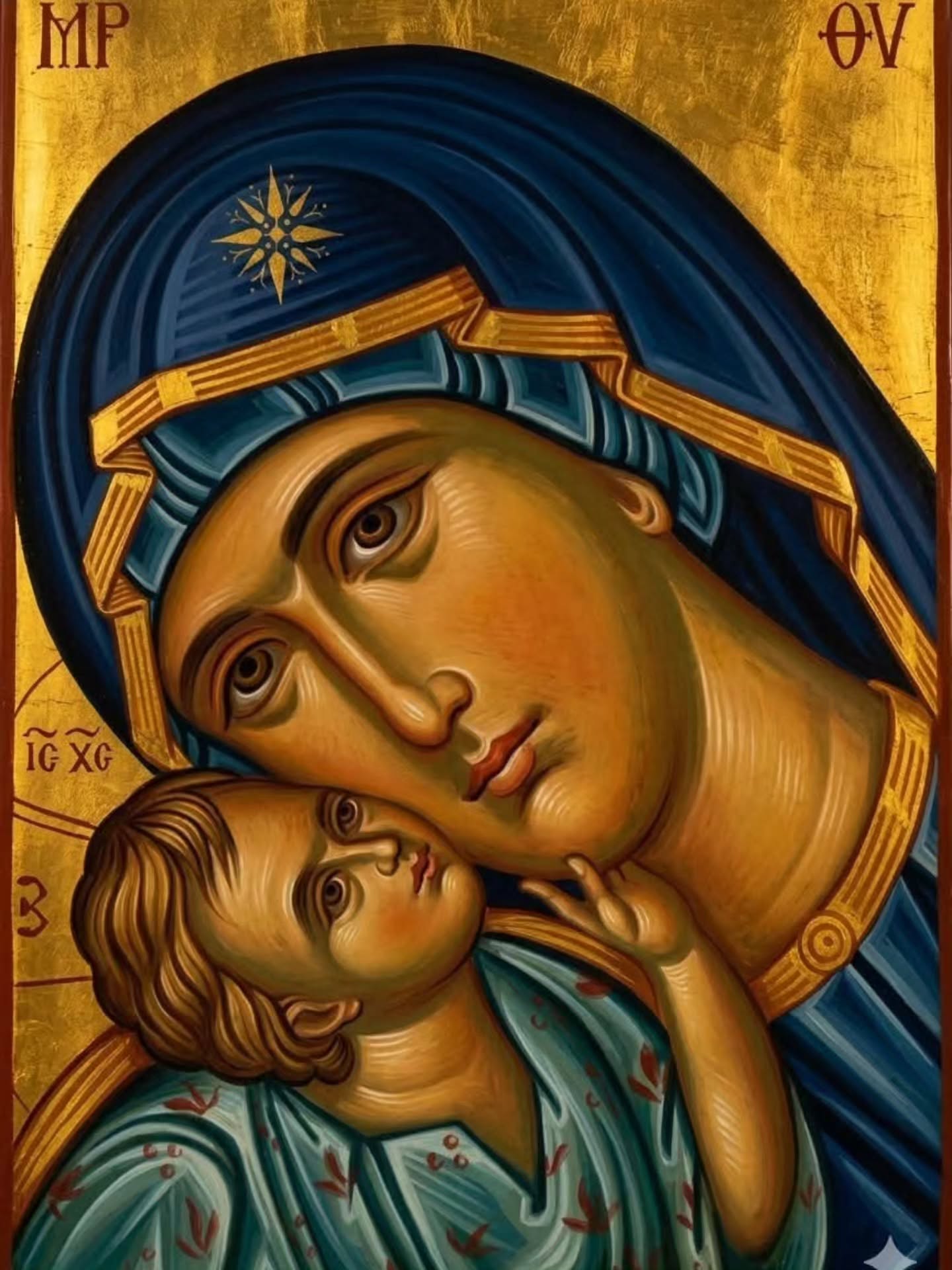
Elder Joseph the Hesychast: embrace the Theotokos' icon as your mother

The post presents a spiritual counsel from Saint Elder Joseph the Hesychast. He advises embracing the icon of the Most Holy Theotokos as if she were alive and one's own mother, telling her all problems while watering the icon with pure tears, with the assurance of receiving eternal consolation.

  • Elder Joseph the Hesychast urges embracing the Theotokos' icon as a living presence
  • The faithful should pour out their problems to the Mother of God
  • Tears shed before the icon are called pure
  • The promised outcome is eternal consolation
  • The post includes traditional Christological and Marian abbreviations

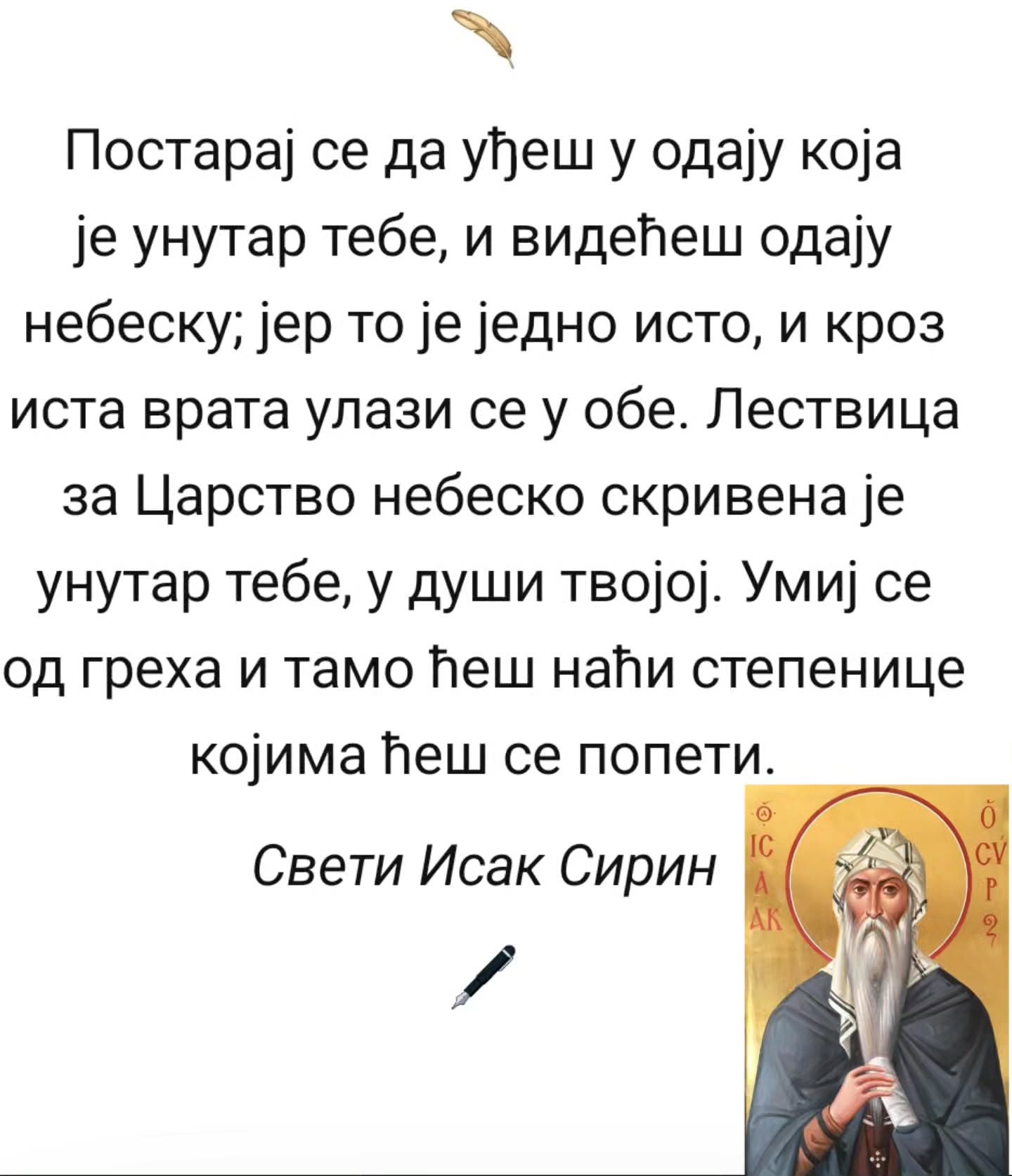
St. Isaac the Syrian: The Kingdom of Heaven Is Within You

The post presents a saying of St. Isaac the Syrian, a seventh-century Syrian monk and bishop known for his ascetical writings. He writes that a person should strive to enter the inner room that is within oneself, and then one will see the heavenly room, because the two are one and the same and are entered through the same doors. The ladder that leads to the Kingdom of Heaven is hidden inside the soul. By cleansing oneself from sin, one finds the…

The post presents a saying of St. Isaac the Syrian, a seventh-century Syrian monk and bishop known for his ascetical writings. He writes that a person should strive to enter the inner room that is within oneself, and then one will see the heavenly room, because the two are one and the same and are entered through the same doors. The ladder that leads to the Kingdom of Heaven is hidden inside the soul.

By cleansing oneself from sin, one finds the steps by which to ascend. The text is accompanied by an icon depicting the bearded saint with a halo.

  • St. Isaac the Syrian teaches that the heavenly room is found by entering the inner room of the heart.
  • The inner room and the heavenly room are one and accessed through the same doors.
  • The ladder to the Kingdom of Heaven is hidden within the soul.
  • Cleansing from sin reveals the steps of that ladder.
  • The post includes an icon of the saint.
Read more
Athonite Audio YouTube

Evergetinos Hypothesis 33: Causes, Benefits, and Kinds of Temptations

Evergetinos Hypothesis 33: Causes, Benefits, and Kinds of Temptations 40:25

The video presents Hypothesis 33 from the third volume of the Evergetinos, a compilation of patristic teachings on the causes, benefits, and kinds of temptations and tribulations. Abba Mark teaches that no tribulation comes unjustly; all occur by God's just judgment, some for one's own sins and others for the sins of neighbors. He explains that enduring afflictions with faith uncovers hidden evil thoughts, brings true humility, and reveals vain…

The video presents Hypothesis 33 from the third volume of the Evergetinos, a compilation of patristic teachings on the causes, benefits, and kinds of temptations and tribulations. Abba Mark teaches that no tribulation comes unjustly; all occur by God's just judgment, some for one's own sins and others for the sins of neighbors. He explains that enduring afflictions with faith uncovers hidden evil thoughts, brings true humility, and reveals vain conceit.

Abba Mark distinguishes two kinds of interaction: one from malice, which makes a person involuntarily responsible for a neighbor's suffering, and one from love, exemplified by Christ and the apostles who took others' tribulations upon themselves for their salvation. He also outlines three kinds of right conduct before God: not sinning; sinning but enduring consequent afflictions patiently; and sinning without endurance but later repenting through God's grace.

Abba Mark adds that each person's thoughts are the cause of every occurrence; words and deeds proceed from thoughts and create interactions through which we assume responsibility for one another in ways we do not know.

St. Maximos the Confessor adds that afflictions serve three purposes: the annulment of past sins, correction of present negligence, and prevention of future sins. He notes that the wise person blames himself rather than the instrument of his chastisement. St. Maximos observes that temptation follows an increase of grace, as with Christ after his baptism and the apostles after receiving the Comforter.

He states that trials from divine love produce humility and longing for God, while those permitted because of pride are crushing and require the cure of humility through prayer and tears.

St. Barsanuphius distinguishes temptations that arise from one's own will, which are harmful, from those permitted by God to test character, which bring hope and salvation. The Gerontikon and other fathers affirm that no one enters the kingdom without temptations, that a monk is revealed in temptation, and that fleeing beneficial temptation is fleeing eternal life.

Key moments

  1. 0:00 No tribulation comes upon a person unjustly; all things occur according to the just judgment of God, some for one's own misdeeds and others for the misdeeds of neighbors.
  2. 2:05 The Lord brings afflictions for our benefit to uncover secret evil thoughts, acquire true and unfeigned humility, and disclose our vain conceit.
  3. 6:13 Each person's thoughts are the cause of every occurrence; words and deeds proceed from thoughts and create interactions through which we assume responsibility for one another in ways we do not know.
  4. 7:47 Interaction from malice makes one involuntarily responsible for the tribulations of the person wronged, while interaction from love, begun by Christ, means taking on others' tribulations for their salvation.
  5. 15:11 There are three kinds of right conduct before God: not sinning; sinning but enduring the consequent afflictions patiently; and sinning without endurance but later repenting through God's grace.
  6. 24:30 Afflictions befall us for chastening, to annul past sins, correct present negligence, or prevent future sins, and the conscious person gives thanks to God and blames himself rather than the instrument of the tribulation.
  7. 29:16 Temptation comes only after the soul has attained a higher spiritual state and received an increase of grace, as with Christ after his baptism and the apostles after receiving the Comforter.
  8. 36:01 There are two kinds of temptation: those for which we are responsible, arising from our own will and desires, which are harmful; and those occurring by God's permission to test character, which are beneficial and bring hope.
M mysteries_of_christendom Instagram

The Mosaic That Saved the Church of the Nativity in 614

The Church of the Nativity in Bethlehem was built in the 320s by Emperor Constantine and his mother Helena over the cave where Jesus was born. Stables in Bethlehem were often caves because the town sits on limestone hills, which is why Orthodox icons show Christ born in a cave rather than a wooden stable. The church survived two invasions. In 614 the Persian Empire burned church after church in the region, but when soldiers reached the Church of…

The Church of the Nativity in Bethlehem was built in the 320s by Emperor Constantine and his mother Helena over the cave where Jesus was born. Stables in Bethlehem were often caves because the town sits on limestone hills, which is why Orthodox icons show Christ born in a cave rather than a wooden stable. The church survived two invasions. In 614 the Persian Empire burned church after church in the region, but when soldiers reached the Church of the Nativity they saw a mosaic of the three wise men dressed in Persian clothes.

Christian tradition holds that the wise men were priests from Persia, so the soldiers recognized their own people and left the church standing. Just over twenty years later the armies of the new Islamic Empire took the Holy Land, and Caliph Omar promised that the church would remain in Christian hands, so it was left alone again.

The speaker's great-grandparents were Christians from Bethlehem, part of a community whose presence there has lasted for centuries. In 1922 almost nine out of ten people in Bethlehem were Christian Palestinians; today the share is fewer than one in six. Orthodox Christians still gather in the church to worship, bowing through the door of humility to reach the basilica.

Key moments

  1. Constantine and his mother Helena built the church in the 320s over the cave where Jesus was born.
  2. Stables in Bethlehem were often caves because the town sits on limestone hills, so Orthodox icons show Christ born in a cave instead of a wooden stable.
  3. In 614 the Persian Empire invaded and burned church after church, but when soldiers reached the Church of the Nativity they saw a mosaic of the three wise men dressed in Persian clothes, since Christian tradition holds the wise men were priests from Persia, and they left the church standing.
  4. Just over 20 years later the armies of the new Islamic Empire took the Holy Land, but Caliph Omar promised the church would stay in Christian hands, so it was left alone again.
  5. In 1922 almost nine out of ten people in Bethlehem were Christian Palestinians, and today it is fewer than one in six, but they still bow through the door of humility to pray in the same church.
  6. The story is a tribute to the speaker's great-grandparents, who were Christian Palestinians from Bethlehem.
Read more

St. Nikolai Velimirovich on Halloween's pagan origins

The post explains that Halloween has its origin among the pagan Celtic peoples in Ireland, Britain, and northern France. The Celts believed that life is born from death, so they marked the beginning of their new year at the end of autumn when nature dies and, according to their belief, the time of darkness, decay, and death begins. On that day they extinguished the fire on their domestic hearths and darkness reigned everywhere. According to…

The post explains that Halloween has its origin among the pagan Celtic peoples in Ireland, Britain, and northern France. The Celts believed that life is born from death, so they marked the beginning of their new year at the end of autumn when nature dies and, according to their belief, the time of darkness, decay, and death begins.

On that day they extinguished the fire on their domestic hearths and darkness reigned everywhere. According to pagan Celtic tradition, the souls of the dead would fall completely under the authority of the god Samhain, the prince of death, who had to be propitiated by sacrifice on the day of the new year, and Samhain would allow the souls of the dead to visit the homes of their families on that day.

From this comes the custom of "masking" in costumes of ghosts, spirits, witches, and demons. In this way the living would enter into a "mystical" communion with the dead through the act of imitating the dead and walking about in darkness. According to the belief, the souls of the dead who came "visiting" were exhausted by hunger and begged for food, so they had to be fed, hence the custom called "trick or treating".

If one of the living did not treat the souls of the dead, the vengeance of the god Samhain would reach them. The author asserts that Orthodox Christians cannot and must not take part in such idolatrous festivity at any level, even if it is "only" entertainment for children, because it directly represents a denial of our Lord and our holy Orthodox faith.

For if we agree to "mask" our children and let them go about in darkness and beg for sweets, we thereby voluntarily consent to communion with the dead, whose god is not the Celtic deity Samhain but Satan himself, the prince of evil, and the sweets they receive will not be innocent gifts for children but an offering to the devil.

The text recalls that our ancestors, Christians from the earliest centuries, chose bodily death in the worst torments rather than offer sacrifice to idols and thereby deny Christ our God, who commanded: "You shall have no other gods before Me." In today's spiritually impoverished world heavy darkness and sloth prevail, and it is easy to convince almost everyone that the origin of such feasts is insignificant and that Halloween is ordinary, harmless fun.

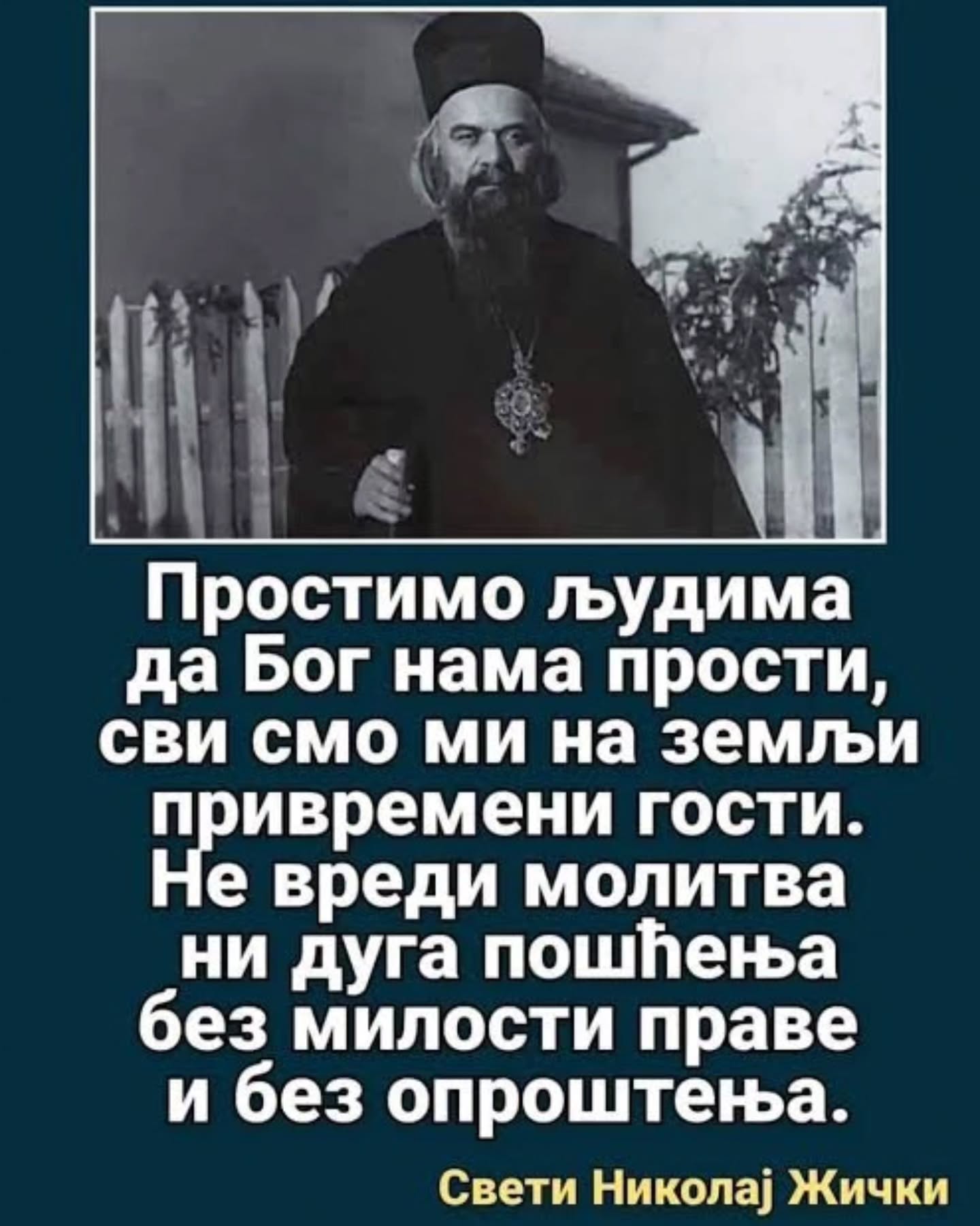
The post concludes with a saying attributed to St. Nikolai Zica: "Forgive people that God may forgive you; we are all temporary guests on earth. Prayer and long fasting are worthless without true mercy and forgiveness."

  • Halloween originates from the Celtic festival of Samhain, marking the new year at autumn's end when the dead were believed to visit the living.
  • Costumes and trick-or-treating derive from customs to appease and feed the returning souls under the lord of death.
  • Orthodox Christians cannot participate because it is idolatrous and constitutes communion with the dead whose master is Satan.
  • Early Christians chose martyrdom over idol sacrifice, obeying the commandment to have no other gods.
  • The post includes a quote from St. Nikolai Zica on forgiveness as essential to prayer and fasting.
Read more
George Instagram

Worry is not love: Christ's question and a practical response

The speaker explains that many people unconsciously equate worry with love, believing that to stop worrying means they no longer care. This belief keeps the mind replaying anxious thoughts at night under the guise of responsibility. The speaker distinguishes worry from love: worry is an attempt to control what cannot be controlled, while love takes concrete action. Christ asked which of us can add a cubit to his stature by worrying, and the…

The speaker explains that many people unconsciously equate worry with love, believing that to stop worrying means they no longer care. This belief keeps the mind replaying anxious thoughts at night under the guise of responsibility. The speaker distinguishes worry from love: worry is an attempt to control what cannot be controlled, while love takes concrete action.

Christ asked which of us can add a cubit to his stature by worrying, and the answer is no one. Worry changes nothing outside the person; it only steals the present moment. The speaker offers a practical step: when worry arises, ask whether there is one thing to do right now about the situation.

If there is, do it. If there is nothing to do, turn the worry into prayer for the person or situation. This is what love does with what it cannot control, allowing one to care just as much without suffering for it.

Key moments

  1. People believe they worry because they care, so stopping worry feels like they no longer care.
  2. The mind unconsciously replays worries at night and calls it responsibility.
  3. Worry is trying to control something you cannot control, whereas love does something.
  4. Christ asked which of you by worrying can add one cubit to his stature, and the answer is not one.
  5. Worry changes nothing outside you; it only changes you and steals your today and your moments.
  6. When you catch yourself worrying, ask if there is one thing you can do right now about it.
  7. If there is something to do, do it; if not, turn the worry into a prayer for them.
  8. This is what love does with what it cannot control, and you still care just as much but stop suffering for it.
Read more

St. Mark the Ascetic: Forgiveness as the Sign of Sincere Love

The post presents two quotations from Orthodox saints. The first, from St. Porphyrios of Kausokalyvia, states that a person who is a man of God, makes confession, receives Holy Communion, and wears a cross suffers no harm even if all demons attack. The second, from St. Mark the Ascetic, identifies the sign of sincere love as the forgiveness of wrongs done to us, noting that Christ loved the world with such love. The post shares these teachings without additional commentary.

  • St. Porphyrios of Kausokalyvia teaches that confession, Communion, and wearing a cross protect a man of God from demonic harm.
  • St. Mark the Ascetic defines sincere love by the willingness to forgive offenses.
  • Christ's love for the world is given as the model of such forgiving love.
Read more

Why Sola Scriptura Is Not Biblical: An Orthodox Argument

The speaker argues that Sola Scriptura cannot be true because the principle itself is not found in the Bible. He explains that the deduction behind Sola Scriptura rests on the premise that God has more authority than any person, so His speech carries more authority than any other speech. However, this does not mean that every belief must have an explicit proof text. The speaker notes that the apostles preached the gospel and established churches…

The speaker argues that Sola Scriptura cannot be true because the principle itself is not found in the Bible. He explains that the deduction behind Sola Scriptura rests on the premise that God has more authority than any person, so His speech carries more authority than any other speech. However, this does not mean that every belief must have an explicit proof text.

The speaker notes that the apostles preached the gospel and established churches years before the New Testament was written. During that period, the earliest Christians used icons and learned directly from their priests through apostolic tradition. Paul instructs believers to hold fast to traditions whether received orally or in writing.

The early church followed the traditions taught by their priests and the successors of the apostles before a closed canon existed. The speaker contends that the practice of the early church demonstrates that Scripture was never intended to function as the sole rule of faith apart from the living tradition of the church. He observes that the formation of the New Testament canon occurred within the context of the church that already possessed the fullness of the faith through apostolic succession.

The argument concludes that Sola Scriptura is a later development that does not align with the historical reality of how the Christian faith was transmitted in the first centuries.

Key moments

  1. Sola Scriptura cannot be true because it is not found in the Bible.
  2. The deduction for Sola Scriptura is that God has more authority than any person, therefore His speech has more authority than any other speech.
  3. Sola Scriptura is not the idea that you must have an explicit proof text for everything you believe.
  4. The apostles preached the gospel and established churches years before the New Testament was written.
  5. The earliest Christians used icons and learned from their priests directly through apostolic tradition.
  6. Paul tells believers to hold fast to traditions whether received orally or in writing.
  7. The early church did not have a closed canon and followed the traditions taught by their priests and the successors of the apostles.
22 opinions in the discussion Sola Scriptura disproves itself. The Bible was never written to be interpreted by individuals. It was written to be taught by a priest during liturgy. Every Protestant denomination can't be… Read the discussion

Patristic sayings on suffering, obedience, and prayer

The post presents a numbered collection of eleven sayings attributed to Orthodox saints and elders. St. Gregory of Nazianzus states that suffering reveals human limits and the need for God. St. John Climacus describes obedience as the burial of the will and the resurrection of humility. St. Seraphim of Sarov teaches that leaving everything to God's will brings true joy. Metropolitan Anthony Bloom writes that God can save the sinner one is, but…

The post presents a numbered collection of eleven sayings attributed to Orthodox saints and elders. St. Gregory of Nazianzus states that suffering reveals human limits and the need for God. St. John Climacus describes obedience as the burial of the will and the resurrection of humility.

St. Seraphim of Sarov teaches that leaving everything to God's will brings true joy. Metropolitan Anthony Bloom writes that God can save the sinner one is, but not the saint one pretends to be. Fr. Arsenie Boca says God's love for the greatest sinner exceeds the holiest man's love for God.

St. Sophrony of Essex observes that sufferings bear much fruit, and if we were wiser we would not wish to come down from the cross. St. Moses the Black notes that deeds not in harmony with prayer mean labor in vain. Another saying attributed to St. Seraphim of Sarov states the devil drives us into despair because depression is Satan's utmost joy.

Abba Arsenius the Great says he often regretted spoken words but never his silence. St. Macarius the Great declares that if one knew who is with them, they would fear nothing the world offers. The final line identifies the page as dedicated to the Church Fathers and their teachings.

  • St. Gregory of Nazianzus: suffering reveals human limits and the need for God
  • St. John Climacus: obedience buries the will and resurrects humility
  • St. Seraphim of Sarov: leaving all to God's will brings true joy
  • Metropolitan Anthony Bloom: God saves the sinner you are, not the saint you pretend to be
  • Abba Arsenius: regretted spoken words, never silence
Read more
Disgruntled Docs Instagram

Emotional Maturity as Spiritual Work: St. Seraphim Rose on Passions and Correction

The post examines how idolizing emotions prevents receiving correction and hinders spiritual growth. The author argues that people often reject hard words because they hurt, treating emotions as idols that control behavior. This extends to celebrity worship where criticism triggers emotional outbursts, revealing misplaced identity. Christians are called to transcend emotional reactivity. The post cites St. Seraphim Rose, who teaches that…

The post examines how idolizing emotions prevents receiving correction and hinders spiritual growth. The author argues that people often reject hard words because they hurt, treating emotions as idols that control behavior. This extends to celebrity worship where criticism triggers emotional outbursts, revealing misplaced identity.

Christians are called to transcend emotional reactivity. The post cites St. Seraphim Rose, who teaches that spiritual maturity requires emotional maturity, the ability to receive a hard word without defensiveness. An accompanying image quotes a theological distinction between soul and spirit: the spirit is the higher part oriented toward God through prayer and obedience, while the soul encompasses ordinary ideas, feelings, and culture.

The quote warns that underdeveloped emotional life in the soul, inability to respond to normal human love and friendship, blocks spiritual progress, citing 1 John 4:20. A diagram traces the progression: emotions become feelings, feelings become behaviors, behaviors become habits, habits become passions. The final slide emphasizes delivery: "It's not what you say.

But how you say it." The discussion centers on the interplay between emotional health and spiritual life, the danger of emotional idolatry, and the patristic view that rightly ordered emotions serve rather than rule the person.

  • Emotional reactivity blocks reception of correction and reveals idolatry
  • St. Seraphim Rose links spiritual maturity to emotional maturity
  • The soul/spirit distinction shows how undeveloped emotions hinder prayer and obedience
  • Passions form through a chain: emotions → feelings → behaviors → habits → passions
  • Both speaker and listener bear responsibility for how words are given and received
Read more

Repentance as rebirth from God and the narrow path to peace

The author reflects on repentance as a spiritual rebirth from God and the soul's return to true freedom. Repentance is described as the mortification of sin and the beginning of innocence, bringing peace to heart and soul. The text portrays the moment when the soul casts off earthly burdens and, in the silence of the heart, cries out to the Lord. In response, stones open before it and divine light illuminates the paths leading to the heavenly…

The author reflects on repentance as a spiritual rebirth from God and the soul's return to true freedom. Repentance is described as the mortification of sin and the beginning of innocence, bringing peace to heart and soul. The text portrays the moment when the soul casts off earthly burdens and, in the silence of the heart, cries out to the Lord.

In response, stones open before it and divine light illuminates the paths leading to the heavenly kingdom. The author contrasts the broad road traveled by many with the narrow, steep path of the heart that loves God. On this path, a person remains alone with the Creator, finding a peace that the world can neither give nor take away.

The reflection presents repentance not merely as regret but as a fundamental reorientation of the soul toward God, framed as a divine gift that restores the soul to its true liberty. The language of mortification and innocence echoes patristic theology, where repentance kills the old man and restores the baptismal garment. The image of the soul shedding earthly burdens in the silence of the heart recalls the hesychast tradition of inner stillness.

The opening of stones and illumination by divine light evokes both the resurrection narrative and the transformative power of grace. The narrow path is explicitly identified with the heart that loves God, a path of solitude with the Creator rather than worldly company. The peace found there is distinguished from worldly peace by its inviolability.

The final metaphor of the heart as a temple and prayer as incense draws on liturgical and biblical imagery, while the closing reference to the Lord's nearness to the brokenhearted cites Psalm 34:19 (LXX 33:19) / Psalm 51:19. The post is accompanied by a photograph credited to @vaske13 and tagged with references to Ostrog monastery in Nikšić, Montenegro.

  • Repentance defined as rebirth from God, return to true freedom, mortification of sin, beginning of innocence, and peace of heart and soul.
  • The soul that casts off earthly burdens and cries to God in silence encounters opened stones and divine light on the path to the heavenly kingdom.
  • The narrow, steep path of the heart that loves God is contrasted with the broad road; on it one stands alone with the Creator, finding peace the world cannot give or take.
  • The heart is urged to become a temple and prayer to rise as incense to the heavenly stars.
  • The reflection closes with the scriptural assurance that the Lord is near to the brokenhearted and humble in spirit (Psalm 34:19 / 51:19).
Read more
Francesco Hasibra Instagram

Why Orthodox Christians Stand in Church: Nicea and St. Basil

The video explains that the First Council of Nicea in 325 issued a canon directing Christians to pray standing on Sundays and throughout the fifty days from Easter to Pentecost. The council linked this posture to the resurrection of Christ, which Sunday commemorates. St. Basil the Great is cited as teaching that standing recalls the victory over death and expresses the joy of the resurrection. Kneeling, by contrast, signifies humility and…

The video explains that the First Council of Nicea in 325 issued a canon directing Christians to pray standing on Sundays and throughout the fifty days from Easter to Pentecost. The council linked this posture to the resurrection of Christ, which Sunday commemorates. St. Basil the Great is cited as teaching that standing recalls the victory over death and expresses the joy of the resurrection.

Kneeling, by contrast, signifies humility and repentance, which are appropriate for weekdays but not for the festal celebration of the Lord's day. The video emphasizes that the rule is not a test of faith. Those who are sick, elderly, or otherwise unable to stand are permitted to sit, because attentive prayer matters more than physical posture.

The presenter notes that it is better to sit and focus on God than to stand and be distracted by pain. The explanation draws on the canonical tradition and patristic commentary to show the theological reason for the practice while affirming the pastoral flexibility that has always accompanied it.

Key moments

  1. The Council of Nicea in 325 made a canon that Christians pray standing on Sundays and from Easter to Pentecost, because Sunday is the day of Christ's resurrection and standing signifies that joy, as St. Basil the Great explains.
  2. Standing is not a test of faith; those who are sick, old, or unable to stand should sit, because it is better to sit and focus on God than to stand and be distracted by physical pain.
Read more
Timothy Instagram discussion

Critic calls prayer to Mary worship; responder cites Scripture and early prayer

A video presents two speakers debating whether prayer to the Virgin Mary constitutes worship reserved for God alone. The first speaker argues that directing prayers to Mary becomes idolatry because prayer is worship and belongs only to God. He denies that Mary functions as an intercessor, mediator, or hearer of prayers, and warns that devotion replacing dependence on God carries eternal consequences. The second speaker responds that equating…

A video presents two speakers debating whether prayer to the Virgin Mary constitutes worship reserved for God alone. The first speaker argues that directing prayers to Mary becomes idolatry because prayer is worship and belongs only to God. He denies that Mary functions as an intercessor, mediator, or hearer of prayers, and warns that devotion replacing dependence on God carries eternal consequences.

The second speaker responds that equating prayer with worship collapses the distinction between worship and intercession. He notes that Christians regularly ask both living believers and saints for prayers, and that if asking a saint to pray is worship, then asking a friend to pray would also be idolatry. He challenges the claim that saints cannot hear us, stating that the Mother of the Lord is alive in Christ.

He cites Revelation 5:8, where the twenty-four elders hold golden bowls of incense representing the prayers of the saints, and references one of the earliest surviving Christian prayers that directly asks the Theotokos for help and protection. He asks whether the early Church corrupted the faith immediately or whether the critic operates with a narrow definition of prayer, and urges learning the difference between worship and intercession before accusing Christians of idolatry.

Key moments

  1. The first speaker claims honoring Mary becomes a problem when she receives prayers, because prayer is worship and belongs to God alone.
  2. The first speaker asserts Mary is not an intercessor, mediator, or hearer of prayers, and that devotion replacing dependence on God is unbiblical with eternal consequences.
  3. The second speaker responds that equating prayer with worship collapses the argument, since Christians ask saints and other believers for intercession regularly.
  4. The second speaker argues that if asking saints to pray is worship, then asking friends to pray is also idolatry, making every prayer request idolatrous.
  5. The second speaker challenges the claim that saints cannot hear us, stating the Mother of the Lord is alive in Christ.
  6. The second speaker cites Revelation 5:8, where the 24 elders hold golden bowls of incense representing the prayers of the saints.
  7. The second speaker notes one of the earliest surviving Christian prayers directly asks the Theotokos for help and protection.
  8. The second speaker asks whether Christians corrupted the faith immediately or the critic has a narrow definition of prayer, and urges learning the difference between worship and intercession before calling Christians idolaters.
9 opinions in the discussion "Not biblical". What about the Theotokos' intercession at the wedding? Read the discussion