WeOrthodox
EN UA

Orthodox posts, videos and discussions

We follow Orthodox channels, communities and blogs across the web, summarise every post and video, and highlight the conversations with real substance.

Archimandrite Ambrosije Jurasov on blessing each day through prayer
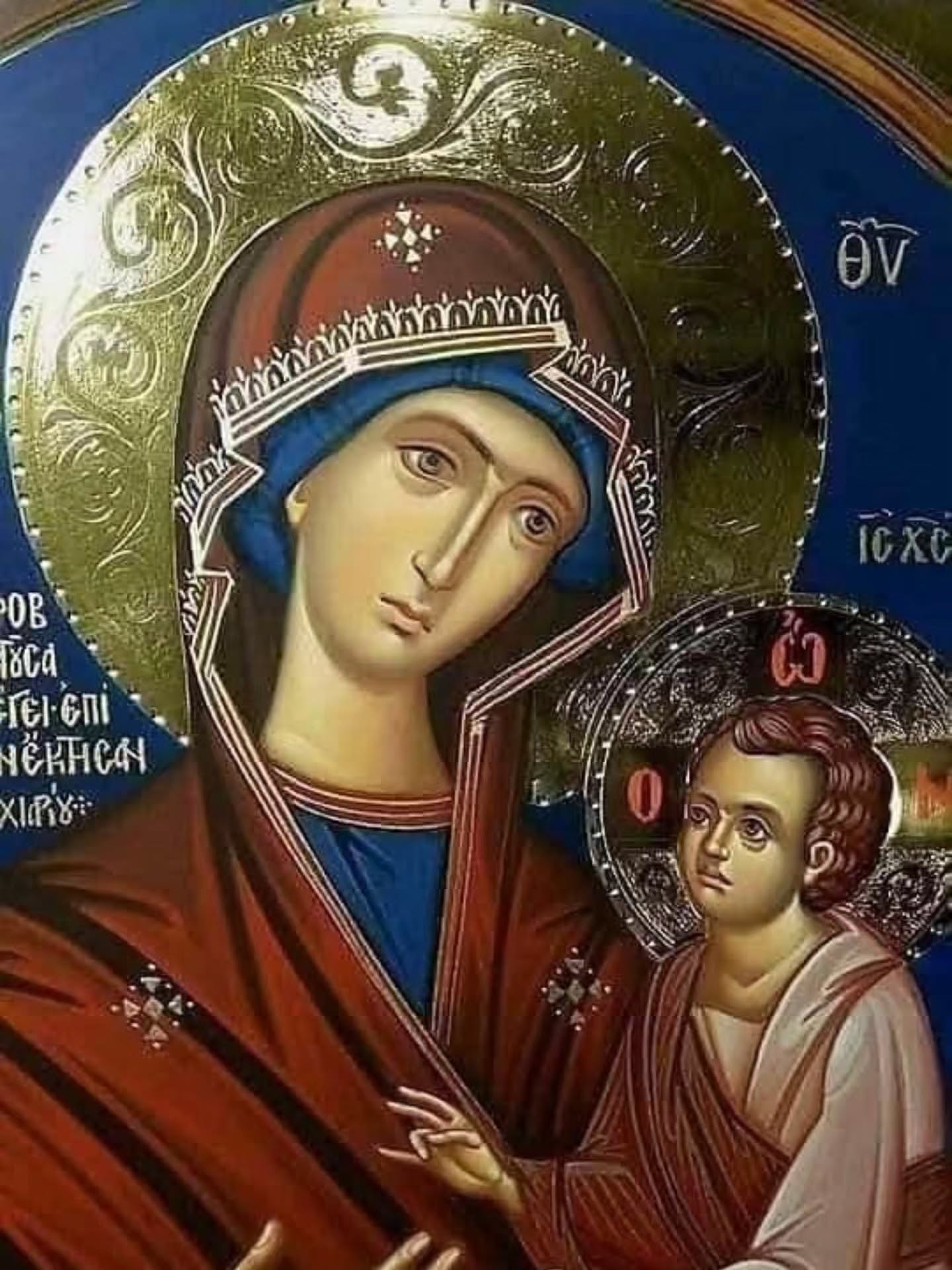
The post presents a teaching from Archimandrite Ambrosije Jurasov on making prayer the fabric of daily life. He outlines a practical rhythm that begins the moment a person wakes: give thanks to God, pray, read the Gospel, and say the Jesus Prayer so that the whole day is blessed until evening. Every undertaking should start with "God, bless!" and end with "Lord, glory to You!" When the telephone rings, the response is "Lord, bless. Give me…

The post presents a teaching from Archimandrite Ambrosije Jurasov on making prayer the fabric of daily life. He outlines a practical rhythm that begins the moment a person wakes: give thanks to God, pray, read the Gospel, and say the Jesus Prayer so that the whole day is blessed until evening. Every undertaking should start with "God, bless!" and end with "Lord, glory to You!"

When the telephone rings, the response is "Lord, bless. Give me understanding what to say." If a neighbor, girlfriend, or friend comes to visit, the greeting should be "God has blessed you!" followed by an inward plea, "Lord, teach me how to answer." The archimandrite stresses that this can be done thoughtfully because the eyes of the Lord watch constantly; God does not sleep, and He sees and hears everything.

At bedtime one says "God, bless!" Upon rising in the morning, one must immediately cross oneself and say, "Lord, bless! Glory to You for the past night. Bless me for today." The principle applies everywhere: whatever a person does, he must thank God for all things. The archimandrite concludes that if someone seeks a blessing, God will give it.

  • Morning rule: thanks, prayer, Gospel, Jesus Prayer to bless the day
  • Before every task: "God, bless!" After: "Lord, glory to You!"
  • Phone calls and visitors become occasions for blessing and discernment
  • Bedtime and waking prayers frame sleep with the sign of the cross
  • God's constant watchfulness undergirds the call to unceasing prayer
Read more
Fr.TEDTalks Instagram

Repentance as rising toward God, not self-hatred

The post explains that true repentance in Orthodox practice is not self-hatred but the repeated willingness to turn back toward God. The practice of prostrations (metanias) embodies this: the believer makes the sign of the cross, bows down, and rises again. Falling down represents sin; rising up represents repentance. The movement always ends upright. The goal is not to finish perfect but to finish upright, looking up at God rather than down at…

The post explains that true repentance in Orthodox practice is not self-hatred but the repeated willingness to turn back toward God. The practice of prostrations (metanias) embodies this: the believer makes the sign of the cross, bows down, and rises again. Falling down represents sin; rising up represents repentance.

The movement always ends upright. The goal is not to finish perfect but to finish upright, looking up at God rather than down at the devil. The speaker notes there is "another guy down downstairs" and expresses the desire not to look at him.

Key moments

  1. Repentance is not self-hatred. Repentance is the willingness to turn back toward God again and again and again.
  2. This is why we do metanias, prostrations.
  3. We do our cross, we bow down. We come back up again. When we fall, we sin, we fall down. But then we get back up.
  4. The movement doesn't end down. It ends up. We always finish the prostration up.
  5. You want to just finish upright. You want to finish the race looking up at God. Not looking down. Because there's another guy down downstairs. I don't want to look at him.
Read more
Kyle YouTube discussion

Spreading Orthodoxy through ordinary sanctity and daily faithfulness

Spreading Orthodoxy through ordinary sanctity and daily faithfulness 9:30

The speaker says Christianity is not about rules or platforms but about becoming a saint through ordinary, daily faithfulness. He illustrates this with his godson, a graduate student whose quiet witness, attending liturgy, going to confession, helping at Sunday school, inviting friends, led multiple people to Orthodoxy. The faith spreads from the ground up through small acts that bring others closer to Christ. The real work is inward: realizing…

The speaker says Christianity is not about rules or platforms but about becoming a saint through ordinary, daily faithfulness. He illustrates this with his godson, a graduate student whose quiet witness, attending liturgy, going to confession, helping at Sunday school, inviting friends, led multiple people to Orthodoxy. The faith spreads from the ground up through small acts that bring others closer to Christ.

The real work is inward: realizing "I am the problem" rather than trying to fix the world. Suffering is inevitable, but embracing the cross with Christ turns bitterness into the path of salvation. Practical disciplines such as fasting, long services, prayer, and gratitude train the heart to endure suffering with meaning.

The speaker cites his father's warning that the psychological trials of the last times will equal the physical martyrdoms of the early church, urging listeners to "escape the matrix" by living in the Church through prayer and worship.

Key moments

  1. 0:00 Christianity is about examples not rules; everyone is called to become a saint by seeing the sinner in themselves and the good in others, being transfigured by Christ.
  2. 0:31 The Church has many types of saints for many types of people, but it is built on ordinary saints living faithful daily lives.
  3. 1:01 The speaker's godson, a graduate student working, attending liturgy and confession, helping at Sunday school, models ordinary sanctity.
  4. 1:32 The godson's simple invitation brought a friend and the friend's mother into Orthodoxy, showing how grassroots witness spreads the faith.
  5. 2:34 Christianity grows from the ground up through ordinary people; God works through small acts that plant seeds and soften hearts.
  6. 4:07 True conversion reveals "I am the problem," not the world; Christ addresses the disposition of the heart, not external rules.
  7. 5:09 Suffering is inevitable; embracing the cross with Christ turns bitterness into the path of salvation, as He transformed the cross from death into life.
  8. 8:17 All are called to martyrdom, self-denial for Christ, and the speaker's father warned that psychological trials of the last times will equal the physical martyrdoms of the early church, so we must "escape the matrix" by living in the Church through prayer.
6 opinions in the discussion Had this on my mind lately. I was feeling down about the people around me, that I fail to convert them or help them grow in the faith. Mentioned it to a friend earlier today. Two things… Read the discussion
George Instagram

Truth Is a Person, Not Information: Reflection on John 14:6

The author reflects on Jesus' statement "I am the way, the truth, and the life" (John 14:6) and Pilate's question "What is truth?" (John 18:38). He notes that Pilate stood before Christ, the answer, yet did not recognize Him. Similarly, people today search for truth in news, opinions, and endless scrolling, becoming more confused.

The author emphasizes that truth is not a piece of information but a Person, Christ, who can be known. He cites John 8:32: "And you shall know the truth, and the truth shall make you free."

  • Jesus declares Himself the way, the truth, and the life (John 14:6).
  • Pilate asks "What is truth?" while facing Christ (John 18:38).
  • Modern search for truth in news and opinions leads to confusion.
  • Truth is a Person, not information, and can be known.
  • Knowing the truth (Christ) brings freedom (John 8:32).
Read more

Orthodox Apologetics: Synodal Structure, Petrine Primacy, and Historical Continuity

The post presents a structured argument for Eastern Orthodoxy over Catholicism and Protestantism, organized in four main sections. First, it argues that the Orthodox Church has structure without over-centralization: bishops govern together in synods, and no single bishop possesses unilateral universal jurisdiction. It cites Apostolic Canon 34 (4th century) requiring the first among bishops to act with the consent of all, and Nicene Canon 6 (325…

The post presents a structured argument for Eastern Orthodoxy over Catholicism and Protestantism, organized in four main sections. First, it argues that the Orthodox Church has structure without over-centralization: bishops govern together in synods, and no single bishop possesses unilateral universal jurisdiction. It cites Apostolic Canon 34 (4th century) requiring the first among bishops to act with the consent of all, and Nicene Canon 6 (325 AD) affirming the ancient privileges of the sees of Alexandria, Antioch, and Rome.

Second, it addresses Petrine primacy, stating that the Orthodox recognize a primacy of honor as first among equals but that the keys were given to all apostles. It quotes St. Cyprian (Epistle 70, 256 AD; De Unitate Ecclesiae, 251 AD) on Peter not claiming primacy insolently, and the Fourth Lateran Council (1215 AD) on the priesthood and sacraments.

Third, it emphasizes historical continuity through apostolic succession. It cites St. Ignatius of Antioch (Epistle to the Smyrnaeans, 107 AD) on doing nothing without the bishop, and St. Irenaeus (Against Heresies, 180 AD) on the succession of bishops preserving apostolic tradition. Fourth, it rejects private interpretation of Scripture, citing 1 Timothy 3:15, St. Irenaeus (Against Heresies 3.2.1-2) on heretics rejecting both Scripture and tradition, and St. Vincent of Lérins (Commonitorium, 5th century) on the need for the Church's interpretive rule due to diverse heretical readings. The post concludes with a repeated call to follow for more content.

  • Orthodox governance is synodal: bishops govern together without a single universal jurisdiction, per Apostolic Canon 34 and Nicene Canon 6.
  • Petrine primacy is recognized as first among equals; the keys were given to all apostles, per St. Cyprian and the Fourth Lateran Council.
  • Historical continuity is maintained through apostolic succession of bishops in the five ancient patriarchates, per St. Ignatius and St. Irenaeus.
  • Scripture is interpreted within the Church's living tradition, not by private judgment, per 1 Timothy 3:15, St. Irenaeus, and St. Vincent of Lérins.
  • The post frames these points as reasons why Catholics and Protestants convert to Orthodoxy.
15 opinions in the discussion I am a Catholic. I respect Orthodoxy, but I would never join it, though I pray for greater union and am saddened by its separation from the mother Church. Its practices are solid and… Read the discussion

Fr. Seraphim Rose: The Holy Fathers as Guide for Modern Questions

The post presents a statement attributed to Fr. Seraphim Rose asserting that reading the Holy Fathers with reverence and careful attention resolves every problem in confused times. It cites complex philosophical questions such as evolution and clear moral issues including abortion, euthanasia, and birth control. The text identifies the Holy Fathers and living spiritual fathers who follow their footsteps as the one sure and unfailing guide in all these matters.

  • Fr. Seraphim Rose teaches that the Holy Fathers answer every problem when read with reverence and attention.
  • Examples include evolution as a philosophical question and abortion, euthanasia, birth control as moral issues.
  • The Holy Fathers and contemporary spiritual fathers who walk in their footsteps are the sure guide.
  • The statement applies to both complex and clear-cut contemporary questions.
CHRISTIANITY UNITED Instagram discussion

Orthodox perspective on Halloween and St. Luke's commemoration

The author urges Orthodox Christians to reconsider participation in Halloween, noting its historical connections to the Celtic festival of Samhain and Western Christian traditions around All Saints' Day. Modern imagery often centers on witches, demons, death, and the occult, which conflicts with teaching children to guard their hearts and follow Christ. On the Old Calendar, October 31 commemorates the Holy Apostle and Evangelist Luke, the…

The author urges Orthodox Christians to reconsider participation in Halloween, noting its historical connections to the Celtic festival of Samhain and Western Christian traditions around All Saints' Day. Modern imagery often centers on witches, demons, death, and the occult, which conflicts with teaching children to guard their hearts and follow Christ.

On the Old Calendar, October 31 commemorates the Holy Apostle and Evangelist Luke, the beloved physician and companion of Saint Paul; on the New Calendar, Saint Luke is commemorated on October 18. The author prefers to teach children about the courage of martyrs, the wisdom of the Holy Fathers, and the lives of saints rather than encourage a fascination with darkness.

A priest in an accompanying video states that Orthodox Christians do not participate in Halloween because it is a satanic holiday. He acknowledges that some may dress as saints if necessary, but insists they must not dress as witches, warlocks, or demons. The priest asserts that witches, warlocks, and demons are not make-believe but real, and that Halloween involves actual sacrifices by those who practice witchcraft.

He asks what parents are teaching their children by participating and concludes that this is not something Christians ought to do. The author adds that not every family celebrating Halloween has evil intentions, but not everything the world celebrates needs to become part of Christian life. Children can have joyful childhoods rooted in Christ, His Church, and the example of His saints, citing Ephesians 5:11: "Have no fellowship with the unfruitful works of darkness."

Key moments

  1. The priest received phone calls asking what to do about Halloween with families.
  2. The correct answer is that Orthodox Christians do not participate in Halloween because it is a satanic holiday.
  3. Some people might dress up as saints if they have to, but they must not dress as witches, warlocks, or demons because those are on the wrong team.
  4. Witches, warlocks, and demons are not make-believe; they are real.
  5. The priest asks what we are teaching our children by participating.
  6. Things are done on Halloween that people do not know about, including sacrifices made by witches, warlocks, and demonic people.
  7. This is not something Christians ought to do.
8 opinions in the discussion What's the harm in getting free candy? Some people use the day for witchcraft and sacrifices, but plenty of people just want some tasty treats. It's only a satanic holiday if you're doing… Read the discussion
Robel࿇🕊️ Instagram

Saint Basil the Great confesses the Trinity, the Incarnation, and the veneration of icons

The post presents a confession of faith attributed to Saint Basil the Great. The speaker affirms belief in one God, the Father, the Son, and the Holy Spirit. He professes the mystery of the Son's incarnation and declares that the Virgin Mary is truly the Mother of God. He acknowledges the holy apostles, prophets, and martyrs, asking them to intercede for him so that God may grant forgiveness. He also honors and kisses the icons of the saints,…

The post presents a confession of faith attributed to Saint Basil the Great. The speaker affirms belief in one God, the Father, the Son, and the Holy Spirit. He professes the mystery of the Son's incarnation and declares that the Virgin Mary is truly the Mother of God.

He acknowledges the holy apostles, prophets, and martyrs, asking them to intercede for him so that God may grant forgiveness. He also honors and kisses the icons of the saints, which have been handed down from the apostles and are found in all churches. The text covers core Orthodox doctrines: the Trinity, the Incarnation, the Theotokos, the intercession of saints, and the veneration of icons as apostolic tradition.

Key moments

  1. The speaker confesses belief in one God, the Father, the Son, and the Holy Spirit.
  2. The speaker professes the mystery of the Son's coming in the flesh and that the holy Virgin Mary is truly the Mother of God.
  3. The speaker acknowledges the holy apostles, prophets, and martyrs and calls upon them to intercede before God.
  4. The speaker asks that through their mediation the merciful God may be gracious and grant forgiveness for his sins.
  5. The speaker honors and kisses the icons of the saints, which have been handed down from the holy apostles and are found in all churches.
Read more
Lives of the Saints 🙏 Instagram

Saint Longinus: Centurion at the Cross who refused to deny the Resurrection

The post recounts the life of Saint Longinus, a Roman centurion stationed at Golgotha during the Crucifixion. Witnessing the earthquake and the events surrounding Christ's death, he confessed, "Truly this was the Son of God" (Matthew 27:54). Longinus also served among the guards at the tomb. When religious authorities bribed the soldiers to claim the disciples had stolen the body, he refused to participate in the lie. Together with two fellow…

The post recounts the life of Saint Longinus, a Roman centurion stationed at Golgotha during the Crucifixion. Witnessing the earthquake and the events surrounding Christ's death, he confessed, "Truly this was the Son of God" (Matthew 27:54). Longinus also served among the guards at the tomb. When religious authorities bribed the soldiers to claim the disciples had stolen the body, he refused to participate in the lie.

Together with two fellow soldiers who had come to believe, he left military service, received baptism, and traveled to Cappadocia. There he devoted himself to fasting, prayer, and preaching the Gospel, converting many pagans through his testimony as an eyewitness of the Crucifixion and Resurrection. Pursued by enemies, Longinus learned through spiritual insight that soldiers had been sent to kill him.

Instead of fleeing, he welcomed them into his home, fed them, and spent the night in prayer. At dawn, he and his two companions dressed in white burial garments and revealed their identities. The soldiers hesitated, ashamed by his hospitality, but Longinus was prepared to die for Christ.

All three were martyred, receiving the crowns of glory. The account concludes with a request for the saint's intercession.

  • Longinus was a Roman centurion at Golgotha who confessed Christ as the Son of God
  • He guarded the tomb and refused a bribe to spread the false story that disciples stole the body
  • He left the military, was baptized, and preached in Cappadocia with two fellow believers
  • He welcomed the soldiers sent to kill him, fed them, and prayed all night before revealing his identity
  • He and his two companions were martyred, dressed in white burial garments
Read more
Prayer Orthodoxy ® with Prayer Orthodoxy® Instagram

Christ's power over demons shows the Kingdom has come; no neutrality possible

The post presents Luke 11:20 and 11:23 in English and Greek. It states that Christ casts out demons by the finger of God, signaling the arrival of God's Kingdom. It emphasizes that there is no neutrality in spiritual life: those not with Christ are against Him, and those who do not gather with Him scatter. The reflection urges followers to stand with Christ, gather in His name, and remain steadfast in faith.

  • Christ casts out demons by the finger of God (Luke 11:20).
  • The Kingdom of God has come upon the listeners.
  • There is no spiritual neutrality: whoever is not with Christ is against Him (Luke 11:23).
  • Whoever does not gather with Christ scatters.
  • Following Christ means standing with Him, gathering in His name, and remaining steadfast in faith.
Read more

Saint Stephen the Great: Defender of Moldavia and the Orthodox Faith

The post presents the life and legacy of Saint Stephen the Great, ruler of Moldavia in the fifteenth century. When Ottoman armies advanced on Christian territories, Stephen refused to abandon his faith or his people. In 1475 at Vaslui, his forces inflicted a severe defeat on an invading Ottoman army, though the text notes that not every battle ended in victory. The author argues that Stephen's true legacy cannot be measured by military successes…

The post presents the life and legacy of Saint Stephen the Great, ruler of Moldavia in the fifteenth century. When Ottoman armies advanced on Christian territories, Stephen refused to abandon his faith or his people. In 1475 at Vaslui, his forces inflicted a severe defeat on an invading Ottoman army, though the text notes that not every battle ended in victory.

The author argues that Stephen's true legacy cannot be measured by military successes alone. It is also written in the monasteries he founded and endowed, the churches he raised to God's glory, and the prayers offered by generations of the faithful. The Ottoman Empire has passed away, kingdoms have risen and fallen, but the Church continues to celebrate the Holy Mysteries and proclaim Christ.

Stephen's example is held up as a reminder that true strength lies not in pride, hatred, or the glory of men, but in steadfastness, sacrifice, and faithfulness to Christ. The post concludes with a prayer to the saint and a doxology.

Key moments

  1. 0:00 Stephen the Great stood as a ruler who refused to abandon his faith, his people, or his God when Ottoman armies advanced on Christian lands.
  2. 0:30 In 1475 at Vaslui, his forces dealt a devastating blow to an invading Ottoman army while Moldavia stood its ground.
  3. 1:07 His legacy cannot be measured by battles won but by the holy monasteries he founded, churches raised to God's glory, and prayers offered by generations.
  4. 1:43 The Ottoman Empires came and went, kingdoms rose and fell, but the Church continued to pray, celebrate the holy mysteries, and proclaim Christ.
  5. 2:20 True strength is found not in pride, hatred, or the glory of men, but in faithfulness, sacrifice, and fidelity to Christ.
Read more

We Taste the Kingdom with Body and Soul: St. Nicodemus the Athonite

The post quotes St. Nicodemus the Athonite on boasting in the Lord, in His Mother, and in the Church, which he calls the pillar and foundation of the truth. He states that we cannot taste the Kingdom in this life except in Orthodoxy, and that we perceive the great things of God with our senses: we see, smell, taste, and touch them, living them with body and soul. The quote closes with the acclamation 'Emmanuel, God is with us.' There is no…

The post quotes St. Nicodemus the Athonite on boasting in the Lord, in His Mother, and in the Church, which he calls the pillar and foundation of the truth. He states that we cannot taste the Kingdom in this life except in Orthodoxy, and that we perceive the great things of God with our senses: we see, smell, taste, and touch them, living them with body and soul.

The quote closes with the acclamation 'Emmanuel, God is with us.' There is no further discussion in the post; it presents the saint's words on experiencing the Kingdom through the life of the Orthodox Church.

  • St. Nicodemus the Athonite says we can boast in the Lord, in His Mother, and in the Church, the pillar and foundation of the truth.
  • He teaches that we cannot taste the Kingdom in this life except in Orthodoxy.
  • The great things of God are seen, smelled, tasted, touched, and lived with body and soul.
  • The quote ends with 'Emmanuel, God is with us.'
George Instagram discussion

Spiritual father refuses monastic rhythm at home, directs man to family

George decided to adopt a monastic rhythm at home with more prayer, more silence, and more time with God. He sat down with his spiritual father and told him everything about this decision. The spiritual father did not give his blessing and explained that George is not a monk because he has a family and his time belongs to them. The spiritual father said it is good to pray morning and night but not to overdo it because that is also a temptation…

George decided to adopt a monastic rhythm at home with more prayer, more silence, and more time with God. He sat down with his spiritual father and told him everything about this decision. The spiritual father did not give his blessing and explained that George is not a monk because he has a family and his time belongs to them.

The spiritual father said it is good to pray morning and night but not to overdo it because that is also a temptation where the enemy can pull George down until he overwhelms himself. George realized that through making videos he receives many messages and questions, and without noticing he started feeling he needs to pray more, say more, and become more.

This drive was causing him to lose the time he should give to his own family, which he could not see himself but his spiritual father could. George grew up without his father in the picture and nobody ever told him "no, don't do that," so he never thought twice about his actions. The spiritual father's refusal was the first time someone put a break on him not to control him but because he wants what is best for George, and George calls it one of the most loving things anyone has said to him. He explains that a true spiritual father sees us when we cannot see ourselves.

Key moments

  1. George decided to become a monk at home with more prayer, more silence, more time with God, following a monastic rhythm.
  2. He sat down with his spiritual father and told him everything about this decision.
  3. The spiritual father did not give his blessing and explained that George is not a monk because he has a family and his time belongs to them.
  4. The spiritual father said it is good to pray morning and night but not to overdo it because that is also a temptation where the enemy can pull George down until he overwhelms himself.
  5. George realized that through making videos he receives many messages and questions, and without noticing he started feeling he needs to pray more, say more, and become more.
  6. This drive was causing him to lose the time he should give to his own family, which he could not see himself but his spiritual father could.
  7. George grew up without his father in the picture and nobody ever told him "no, don't do that," so he never thought twice about his actions.
  8. The spiritual father's refusal was the first time someone put a break on him not to control him but because he wants what is best for George, and George calls it one of the most loving things anyone has said to him.
13 opinions in the discussion Hello, I'm not orthodox yet but can I still follow orthodox ways? Read the discussion

The Jesus Prayer: Scripture, Monastic Practice, and Daily Use

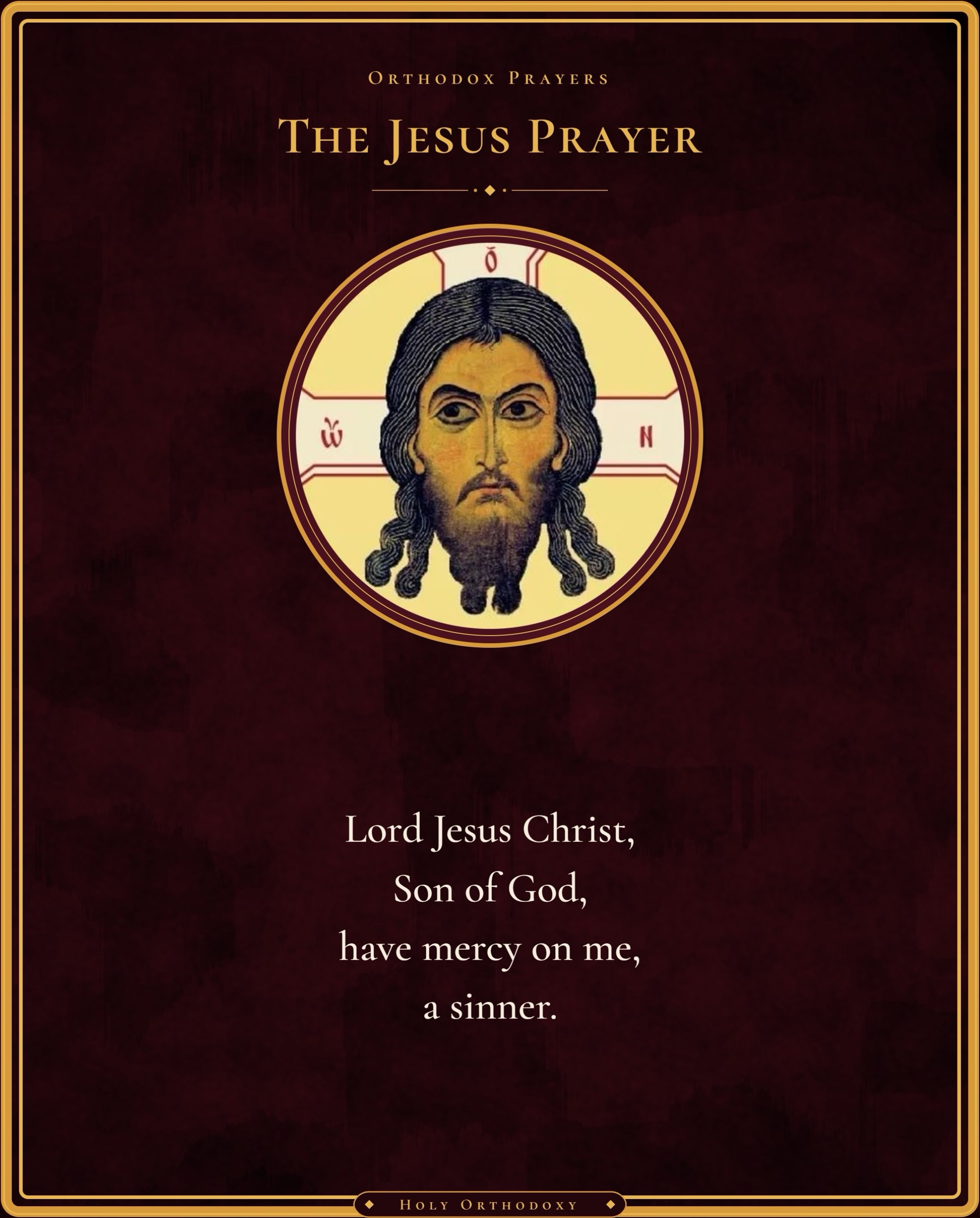
The post presents the Jesus Prayer, "Lord Jesus Christ, Son of God, have mercy on me, a sinner," and traces its roots to two gospel passages. The first is the cry of the blind man in Mark 10:47, who calls out, "Jesus, Son of David, have mercy on me!" The second is the prayer of the humble publican in Luke 18:13, who says, "God, be merciful to me a sinner!" The post notes that monks on Mount Athos pray this prayer continuously, day and night. It…

The post presents the Jesus Prayer, "Lord Jesus Christ, Son of God, have mercy on me, a sinner," and traces its roots to two gospel passages. The first is the cry of the blind man in Mark 10:47, who calls out, "Jesus, Son of David, have mercy on me!" The second is the prayer of the humble publican in Luke 18:13, who says, "God, be merciful to me a sinner!"

The post notes that monks on Mount Athos pray this prayer continuously, day and night. It encourages laypeople to adopt the same practice in daily life, on the bus, at work, before sleep. Many Orthodox Christians use a prayer rope, moving from knot to knot, as a way to follow Saint Paul's exhortation in 1 Thessalonians 5:17 to "pray without ceasing."

The image accompanying the text shows an icon of Christ's face with the prayer written beneath it, under the heading "Orthodox Prayers: The Jesus Prayer."

  • The Jesus Prayer text: "Lord Jesus Christ, Son of God, have mercy on me, a sinner."
  • Biblical roots: the blind man's cry (Mark 10:47) and the publican's prayer (Luke 18:13).
  • Monks on Mount Athos pray it unceasingly, day and night.
  • Laypeople can pray it anywhere, on the bus, at work, before sleep.
  • Use of a prayer rope with knots follows 1 Thessalonians 5:17 to "pray without ceasing."
Read more

I think my priest doesn't like me after confession

I went to confession at my church last Sunday and confessed a sin I know was serious. I didn't want to go anywhere else or confess to any other priest, this church is practically my second home, and I'm very happy there. Since then I've had the feeling that the priest doesn't like me anymore. He didn't say anything harsh or give any sign of disapproval; it's just my own thought. I'm taking the sin very seriously, praying and repenting over it.

30 opinions in the discussion You're overthinking it. He's probably heard it before. Read the discussion
Holy Resurrection YouTube

St. Nilus of Sinai on Prayer Without Delusion

St. Nilus of Sinai on Prayer Without Delusion 4:35

St. Nilus of Sinai's Ascetical Instructions from the Philokalia, Volume II, chapters 73-82 on prayer, are the basis of this teaching. When the mind begins to pray purely without passions, demons shift their attack from the left to the right, presenting false visions of divine glory or pleasing sensory images to deceive the mind into thinking it has reached the full goal of prayer. Evagrius explains this deception comes from vain glory and…

St. Nilus of Sinai's Ascetical Instructions from the Philokalia, Volume II, chapters 73-82 on prayer, are the basis of this teaching. When the mind begins to pray purely without passions, demons shift their attack from the left to the right, presenting false visions of divine glory or pleasing sensory images to deceive the mind into thinking it has reached the full goal of prayer.

Evagrius explains this deception comes from vain glory and demonic manipulation of a specific brain area, causing vascular trembling or inflammation that alters the light around the mind and leads it to rashly claim divine knowledge. Because the mind stands pure before God, it never suspects hostile activity and is convinced the manifestation is truly divine, though it is demonic.

An angel of God ends these enemy activities with a single word and restores the mind's light to work without delusion. The speaker identifies this with the angel offering incense in Revelation, which signifies the grace that enables right prayer so the mind stands without confusion, discouragement, or distress. The vessels of incense are the prayers of the saints offered by the twenty-four elders; the vessel itself means communion with God or perfect spiritual love in which prayer is offered in spirit and truth.

When one thinks there is no need to weep over sins during prayer, one should consider how far one is from God despite being called to abide in Him, and this realization brings hot tears of repentance like Isaiah's lament over his uncleanness among a people of unclean lips and enemy thoughts. Right prayer brings full certainty on many things, surrounds one with angels as with Daniel, and illumines insight into the causes of things.

Angels urge us to pray, stand beside us, and rejoice in praying for us; therefore sloth and contrary thoughts grieve them deeply because they labor for us while we scarcely beseech God for ourselves, abandoning our service to God to converse with unclean demons in our thoughts. The speaker concludes by urging prayer with peace and without disturbance, chanting with understanding and a good soul, so one becomes like an eaglet soaring on high.

Key moments

  1. 0:12 When the mind begins to pray purely without passions, demons no longer attack from the left but from the right, presenting what appears to be a manifestation of God's glory or pleasing sensory images to deceive the mind into thinking it has reached the full goal of prayer.
  2. 0:43 Evagrius explains this deception comes from vain glory and demonic manipulation of a certain brain area, causing vascular trembling or inflammation; the devil touches that spot and changes the light around the mind as he wishes.
  3. 1:13 Vain glory then produces a thought that rashly urges the mind to attribute divine, essential knowledge to itself; because the mind stands pure before God, it never suspects hostile activity and is convinced the manifestation is truly divine, though it is demonic.
  4. 1:44 An angel of God, with a single word, puts an end to enemy activities within us and moves the mind's light to work without delusion; the speaker links this to the angel offering incense with the prayers of the saints in Revelation, seeing it as the grace that grants the ability to pray rightly so the mind stands without confusion, discouragement, or distress.
  5. 2:15 The vessels filled with incense are the prayers of the saints offered by the twenty-four elders; the vessel signifies communion with God or perfect spiritual love for Him, in which prayer is offered in spirit and truth.
  6. 2:46 When one thinks there is no need to weep over sins during prayer, one should consider how far one is from God despite the call to abide in Him always, and this realization brings the hottest tears; after recognizing one's true poverty and nothingness, one weeps with repentance like Isaiah, lamenting one's uncleanness among enemies of God and forces of impure thoughts while daring to stand before the Lord of hosts.
  7. 3:17 If one prays rightly, one receives full certainty about many things, angels surround one as they did Daniel, and insight is illumined with knowledge of the causes of things; angels urge us to pray, stand beside us, and rejoice in praying for us.
  8. 3:48 Sloth and allowing contrary thoughts grieve the angels greatly because they labor diligently for us while we scarcely wish to beseech God for ourselves, neglecting our service to God and abandoning their God and Master to engage in conversation with unclean demons; therefore pray with peace and without disturbance, chant with understanding and a good soul, and you will become like an eaglet soaring on high.
Read more
Orthodox Life Instagram

Saint Anastasia of Rome: Martyr under Decius

The post recounts the life and martyrdom of Saint Anastasia of Rome, a third-century nun commemorated on October 29. Orphaned at three, she was raised by Abbess Sophia in a women's monastery near Rome and spent seventeen years in ascetic prayer, becoming known for her holiness and physical beauty. During the persecution under Emperor Decius (249-251 AD), the city administrator Probus ordered her arrest. She received a blessing from Abbess Sophia…

The post recounts the life and martyrdom of Saint Anastasia of Rome, a third-century nun commemorated on October 29. Orphaned at three, she was raised by Abbess Sophia in a women's monastery near Rome and spent seventeen years in ascetic prayer, becoming known for her holiness and physical beauty. During the persecution under Emperor Decius (249-251 AD), the city administrator Probus ordered her arrest.

She received a blessing from Abbess Sophia and went willingly before the tribunal. Probus tried to persuade her to renounce Christ with flattery and promises of luxury, but Anastasia declared Christ her life, wealth, and only spouse. Enraged, Probus ordered severe tortures: whippings and mutilation.

According to tradition, her endurance and the cruelty of the punishments stirred outrage among pagan onlookers. To prevent a riot, Probus halted the torture and ordered her beheading outside Rome around 250 AD. The post also includes Greek inscriptions from an icon depicting scenes of her martyrdom, identifying her as "Anastasia the Roman" and "Anastasia the Pharmakolytria" (deliverer from poisons).

  • Orphaned at three, raised by Abbess Sophia in a monastery near Rome
  • Lived seventeen years in ascetic discipline, noted for holiness and beauty
  • Arrested during Decius' persecution by administrator Probus
  • Refused to renounce Christ despite flattery and promises of luxury
  • Tortured severely; public outrage led to beheading around 250 AD
Read more
Prayer Orthodoxy ® Instagram

Saint Paisios: Pride draws us to the devil, humility to Christ

The post shares a saying of Saint Paisios of Mount Athos, presented in both English and Greek. The saying states that pride brings a person closer to the devil, while humility brings a person closer to Christ. It adds that Saint Paisios called the devil the greatest egotist, and poses the question of whose company one chooses when pride and selfishness rule the heart. The post also includes a video summary. In the video, the speaker recounts a…

The post shares a saying of Saint Paisios of Mount Athos, presented in both English and Greek. The saying states that pride brings a person closer to the devil, while humility brings a person closer to Christ. It adds that Saint Paisios called the devil the greatest egotist, and poses the question of whose company one chooses when pride and selfishness rule the heart.

The post also includes a video summary. In the video, the speaker recounts a memory of his mother asking her children who is the biggest egoist. His brother Rafael answered. The mother then explained that the biggest egoist is the devil. She asked the speaker if he is an egoist, and whose friend he would be in that case. She urged her children to humble themselves.

Key moments

  1. The mother asks who is the biggest egoist.
  2. Rafael, the speaker's brother, answers the mother's question.
  3. The mother wants to say that the biggest egoist is the devil.
  4. The mother asks if the speaker is an egoist, whose friend he would be.
  5. The mother urges her children to humble themselves.
Read more
Anthony’s Cell YouTube

The Feast of Weeks fulfilled in Pentecost

The Feast of Weeks fulfilled in Pentecost 4:46

The audio reading from Anthony's Cell presents an article from the Orthodox Study Bible on the Feast of Weeks, known as Pentecost. It explains how the Old Testament agricultural festival of firstfruits, celebrated fifty days after Passover, finds its fulfillment in the descent of the Holy Spirit in Acts 2. The reading traces the feast's origin in Leviticus 23:15-16 as a grain harvest offering at the Tabernacle, one of three major Jewish feasts…

The audio reading from Anthony's Cell presents an article from the Orthodox Study Bible on the Feast of Weeks, known as Pentecost. It explains how the Old Testament agricultural festival of firstfruits, celebrated fifty days after Passover, finds its fulfillment in the descent of the Holy Spirit in Acts 2. The reading traces the feast's origin in Leviticus 23:15-16 as a grain harvest offering at the Tabernacle, one of three major Jewish feasts alongside Passover and the Feast of Tabernacles.

It then outlines four fulfillments described by the Church Fathers: the firstfruits become the Jews who believed and were baptized, with St. John Chrysostom calling the Spirit a keen-edged sickle; the two leavened loaves prefigure the gathering of Jews and Gentiles, with St. John Cassian likening the apostles' preaching to true bread of the first fruits feeding five thousand; the fiftieth day signifies the fullness of time and the mystery of the eighth day; and the giving of the Law to Moses is completed by the giving of the Spirit to the Church.

The summary notes that Orthodox Pentecost services emphasize the Spirit's full descent transcending the Mosaic law, bestowing gifts directly in believers through Christ rather than in the law's shadow. The services include Old Testament readings from Ezekiel 36:24-28, Joel 2:23-32 (quoted by Peter at Pentecost), and Numbers 11:24-29 where seventy elders prophesy when the Spirit comes upon them.

Moses' wish that all the Lord's people might be prophets is seen as prophetic of Pentecost. A feast hymn contrasts the division of tongues at Babel with the unity brought by tongues of fire at Pentecost, declaring that with one accord we glorify the all-holy Spirit.

Key moments

  1. 0:32 The Feast of Weeks was a harvest festival where Hebrews offered first fruits at the Tabernacle, one of three major Jewish feasts alongside Passover and the Feast of Tabernacles.
  2. 1:02 Leviticus 23:15-16 prescribes seven weeks from the morning after the Passover Sabbath, giving the feast its name; later it was called Pentecost, the fiftieth day.
  3. 1:32 The Jewish Pentecost is fulfilled in Acts 2 when the Holy Spirit is poured out on the disciples as Christ promised.
  4. 2:04 Four fulfillments: first fruits become baptized believers (Chrysostom: Spirit as "keen-edged sickle"); two loaves signify Jews and Gentiles (Cassian: apostles' preaching as "true bread of the first fruits" feeding 5,000); the fiftieth day marks fullness of time and the eighth day mystery; the Law given to Moses is completed by the Spirit given to the Church.
  5. 2:37 Orthodox Pentecost services emphasize the Spirit's full descent, which transcends the Mosaic law, the Spirit now bestowed in truth through Christ, not in the law's shadow.
  6. 3:10 The services repeatedly show Old Testament prophecies fulfilled: Ezekiel 36:24-28, Joel 2:23-32 (quoted by Peter at Pentecost), and Numbers 24-29 where seventy elders prophesy when the Spirit comes upon them.
  7. 3:41 Moses' wish, "Would that all the Lord's people might be prophets", is prophetic of Pentecost when the Spirit is poured out on all.
  8. 4:12 A feast hymn declares: at Babel the Most High divided nations by confounding tongues; at Pentecost He divides tongues of fire to call all men into unity, and with one accord we glorify the all-holy Spirit.

St. Porphyrios: open a window to Christ rather than fight darkness

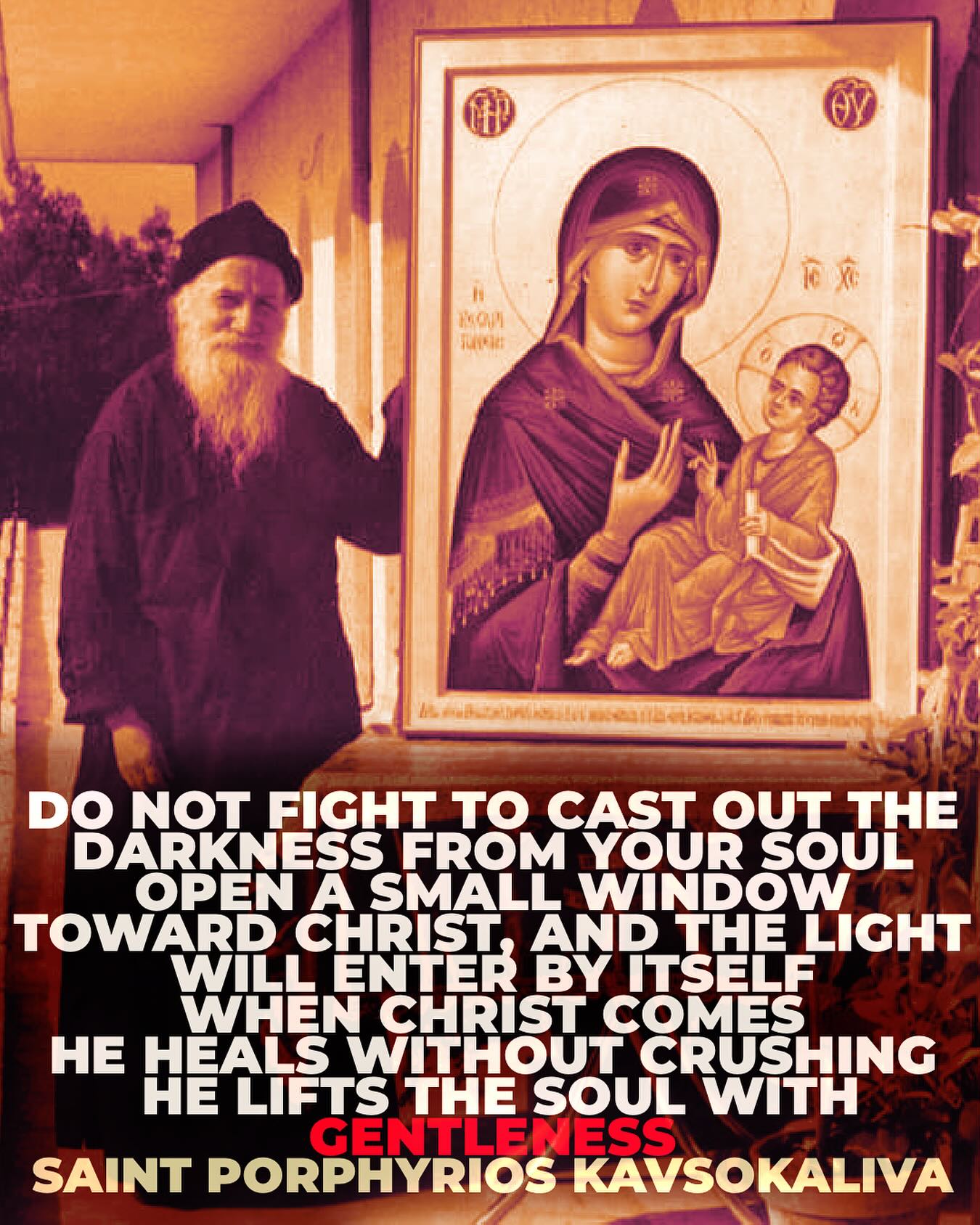
The post presents a teaching from St. Porphyrios of Kavsokalyva. He writes that one should not fight to cast out darkness from the soul. Instead, one should open a small window toward Christ, and the light will enter by itself. When Christ comes, He heals without crushing; He lifts the soul with gentleness.

  • Do not fight darkness directly in the soul
  • Open a small window toward Christ
  • Christ's light enters by itself
  • Christ heals without crushing
  • Christ lifts the soul with gentleness
Read more