WeOrthodox
EN UA

Orthodox posts, videos and discussions

We follow Orthodox channels, communities and blogs across the web, summarise every post and video, and highlight the conversations with real substance.

George Instagram discussion

Nativity Fast Begins: 40 Days of Spiritual Preparation

The speaker announces that the Nativity fast begins on November 15th, or November 28th for those following the old calendar. This 40-day period of abstaining from meat, dairy, and eggs lasts until Christmas. The fast is presented not as a dietary rule but as spiritual preparation, drawing a parallel to Moses who fasted for 40 days on the mountain before receiving the word of God; Christians fast for 40 days before receiving the Word himself,…

The speaker announces that the Nativity fast begins on November 15th, or November 28th for those following the old calendar. This 40-day period of abstaining from meat, dairy, and eggs lasts until Christmas. The fast is presented not as a dietary rule but as spiritual preparation, drawing a parallel to Moses who fasted for 40 days on the mountain before receiving the word of God; Christians fast for 40 days before receiving the Word himself, born in Bethlehem.

The speaker contrasts the fast with the secular pattern of starting Christmas celebrations in November through parties and shopping, which leaves people tired by the actual feast. The fast, by contrast, slows the believer down. Citing St. John Chrysostom, the speaker explains that fasting must extend beyond the mouth to the eyes, ears, and hands.

This means reducing scrolling and gossip, and increasing prayer and almsgiving. To support this journey, the speaker has created a free program titled "40 Days to Bethlehem" that guides participants through the fast day by day. At the time of the announcement, over 150 people had already registered for the program.

Key moments

  1. The Nativity fast begins November 15th (or November 28th on the old calendar) and lasts 40 days until Christmas, abstaining from meat, cheese, milk, and eggs.
  2. The fast parallels Moses fasting 40 days on the mountain before receiving the word of God; Christians fast 40 days before receiving the Word himself, born in Bethlehem.
  3. The world starts celebrating Christmas in November with parties and shopping, leaving people tired by the actual feast; the fast does the opposite by slowing you down.
  4. St. John Chrysostom teaches that not only the mouth should fast, but also the eyes, ears, and hands, meaning less scrolling, less gossip, more prayer, and more giving to those in need.
  5. The speaker created a free program called "40 Days to Bethlehem" to go through the fast together day by day, with over 150 people already signed up.
10 opinions in the discussion We're Orthodox too, but our fast starts later and goes until January 6. We celebrate together with Mount Athos and Jerusalem. Read the discussion

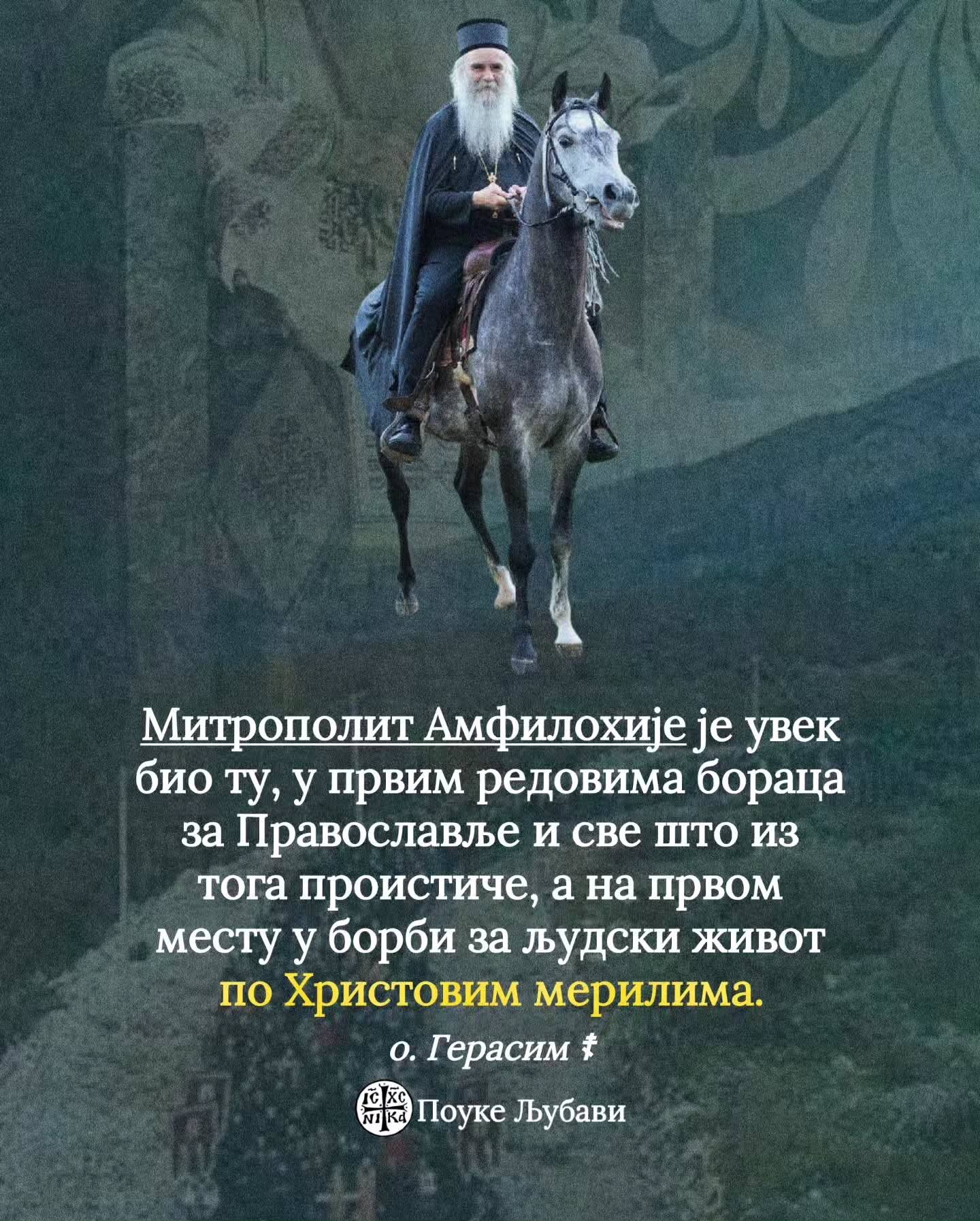
Tribute to Metropolitan Amfilohije as defender of Orthodoxy and Serbian identity

The text honors Metropolitan Amfilohije of Montenegro and the Littoral, describing him as a spiritual thinker and fiery preacher of Christ's Gospel who uncompromisingly opposed evil and inhumanity. It states he left a lasting mark on the Serbian people and remained a fighter for what is pleasing to God and the people until his death, making him beloved by believers and non-believers alike who recognized his defense of human identity. The author…

The text honors Metropolitan Amfilohije of Montenegro and the Littoral, describing him as a spiritual thinker and fiery preacher of Christ's Gospel who uncompromisingly opposed evil and inhumanity. It states he left a lasting mark on the Serbian people and remained a fighter for what is pleasing to God and the people until his death, making him beloved by believers and non-believers alike who recognized his defense of human identity.

The author compares his significance to that of Saint Sava, Karadjordje, and Njegoš, placing him among the most significant Serbs. The post concludes with the Paschal greeting "Christ is Risen, Metropolitan" signed by Father Gerasim. An accompanying image text from Father Gerasim notes that Metropolitan Amfilohije was always in the front ranks of fighters for Orthodoxy and for human life measured by Christ's standards.

  • Metropolitan Amfilohije praised as spiritual thinker and uncompromising preacher against evil
  • Described as defender of both Orthodox faith and human identity
  • Beloved by believers and non-believers for his principled stance
  • Compared in significance to Saint Sava, Karadjordje, and Njegoš
  • Father Gerasim's tribute emphasizes his frontline role for Orthodoxy
Read more

Fr. Alexey Uminsky on asking God for material needs

Fr. Alexey Uminsky on asking God for material needs 3:47

Father Alexey Uminsky addresses whether Christians may ask God for material goods such as a home or employment. The questioner notes that some priests say it is fine but wonders why we should ask if God already knows our needs. The host references a program titled "Why doesn't God hear our prayers?" that discusses the Gospel words "Ask and you will receive" and "Whatever you ask the Father in My name, He will give you." Father Alexey affirms…

Father Alexey Uminsky addresses whether Christians may ask God for material goods such as a home or employment. The questioner notes that some priests say it is fine but wonders why we should ask if God already knows our needs. The host references a program titled "Why doesn't God hear our prayers?" that discusses the Gospel words "Ask and you will receive" and "Whatever you ask the Father in My name, He will give you."

Father Alexey affirms that we can ask God for material help, pointing to the Lord's Prayer petition "Give us this day our daily bread" as evidence that we ask for help in earthly life. He warns that earthly life and God's help in it should not take first place, because the promise "whatever you ask in My name" must be read in the context of the Sermon on the Mount: "Seek first the Kingdom of God and His righteousness, and all these things will be added to you."

If a person asks for God's things, spiritual goods such as salvation, wisdom, understanding, and God's will, that prayer will certainly be heard and joy will be complete. Once that primary prayer is heard, it is normal to also ask for earthly help; those in need of a home can ask for a home, and those seeking work can ask the Lord to help them find a good job.

Requests for material things should be for what is truly needed to get on one's feet and continue moving toward God, not to increase wealth like the rich man who hoarded his harvest and said, "My soul, rejoice for many days, eat, drink, and be merry." Father Alexey concludes with the line "There is a season turn turn turn and a time to every purpose under heaven."

Key moments

  1. 0:00 The questioner asks whether it is permissible to ask God for material goods, noting that some priests say it is fine but wondering why we should ask if God already knows our needs.
  2. 0:31 The host refers to a program titled "Why doesn't God hear our prayers?" that discusses the Gospel words "Ask and you will receive" and "Whatever you ask the Father in My name, He will give you."
  3. 1:01 Father Alexey affirms that we can ask God for material help, pointing to the Lord's Prayer petition "Give us this day our daily bread" as evidence that we ask for help in earthly life.
  4. 1:32 He warns that earthly life and God's help in it should not take first place, because the promise "whatever you ask in My name" must be read in the context of the Sermon on the Mount: "Seek first the Kingdom of God and His righteousness, and all these things will be added to you."
  5. 2:03 If a person asks for God's things, spiritual goods such as salvation, wisdom, understanding, and God's will, that prayer will certainly be heard and joy will be complete.
  6. 2:34 Once that primary prayer is heard, it is normal to also ask for earthly help; those in need of a home can ask for a home, and those seeking work can ask the Lord to help them find a good job.
  7. 3:06 Requests for material things should be for what is truly needed to get on one's feet and continue moving toward God, not to increase wealth like the rich man who hoarded his harvest and said, "My soul, rejoice for many days, eat, drink, and be merry."
  8. 3:39 Father Alexey concludes with the line "There is a season turn turn turn and a time to every purpose under heaven."
3 opinions in the discussion I've seen it more than once: help arrives at exactly the right moment even without asking, and it's so unlikely that it doesn't fit even into a millionth of a probability. All I really ask… Read the discussion
Discover Orthodox Christianity Facebook

Child Healed of Leukemia Through St. David of Evia's Intercession in 1976

Nicholas and Eleutheria Kouphomargaritis from Moschato in Attica had a daughter named Martha who suffered from leukemia. The parents consulted many doctors, but none offered hope for the child's recovery. They then met Eleutheria Tzini from Rovies in Evia, who had herself been rescued from a serious illness by Venerable David. Eleutheria Tzini spoke to them about "our Saint," Venerable David of Evia. When the mother asked who this saint was,…

Nicholas and Eleutheria Kouphomargaritis from Moschato in Attica had a daughter named Martha who suffered from leukemia. The parents consulted many doctors, but none offered hope for the child's recovery. They then met Eleutheria Tzini from Rovies in Evia, who had herself been rescued from a serious illness by Venerable David.

Eleutheria Tzini spoke to them about "our Saint," Venerable David of Evia. When the mother asked who this saint was, having never heard of him, Eleutheria replied, "Venerable David." The mother then took her sick child into her arms, lifted her up, and prayed from her heart: "My Saint David, make my daughter well."

At that moment the child became immediately well. The parents brought the healthy child to the monastery where St. David had lived, and there they glorified the holy Elder. The miracle occurred in 1976. The Orthodox Church celebrates the feast day of St. David of Evia on November 1st.

  • Martha Kouphomargaritis suffered from leukemia and doctors gave no hope
  • Eleutheria Tzini from Rovies told the parents about Venerable David of Evia
  • The mother prayed directly to St. David: "My Saint David, make my daughter well"
  • The child was healed instantly at that moment in 1976
  • The family brought the healed child to the monastery to glorify the saint
Read more
radioimlemesou Instagram

Metropolitan Athanasios of Limassol on social media addiction

Metropolitan Athanasios of Limassol speaks about the captivity many experience with social media. He notes that people of all ages confess in confession to spending whole hours on pages and applications. This addiction causes them to miss work responsibilities, appointments, and important matters because they cannot tear themselves away.

The Metropolitan does not say to reject these technologies entirely from life, but he urges careful attention to avoid becoming addicted to them, if that is possible.

Key moments

  1. People of all ages spend entire hours watching social media pages and applications.
  2. The addiction makes them lose work cases, meetings, and very important things.
  3. They cannot tear themselves away, showing how strong the addiction is.
  4. The speaker does not tell anyone to reject it completely from life.
  5. But one must pay very close attention not to become addicted to it, if that is possible.
Read more

St. Porphyrios: Christ's love removes loneliness and transforms all things

St. Porphyrios the Kapsokalyvite teaches that the love of Christ removes loneliness and brings peace and joy. In this state there is no sorrow, illness, anxiety, despair, or hell. The love of God transforms, sanctifies, heals, renews, and transfigures all things.

  • The love of Christ eliminates loneliness and brings peace and joy.
  • Sorrow, illness, anxiety, despair, and hell are absent where divine love dwells.
  • God's love transforms, sanctifies, heals, renews, and transfigures everything.
  • The saying is attributed to St. Porphyrios the Kapsokalyvite.
George Instagram discussion

Your mind answers whatever question you ask it

The speaker explains that the mind operates like a search engine: it returns answers to whatever question is posed without checking whether the question itself is true. When something goes wrong, many people ask, "Why does this always happen to me?" That question carries two hidden lies, that bad things happen constantly and that they single out the asker. Because the mind does not argue with the premise, it pulls up every past mistake and…

The speaker explains that the mind operates like a search engine: it returns answers to whatever question is posed without checking whether the question itself is true. When something goes wrong, many people ask, "Why does this always happen to me?" That question carries two hidden lies, that bad things happen constantly and that they single out the asker.

Because the mind does not argue with the premise, it pulls up every past mistake and disappointment, turning a single bad moment into a whole bad day within a minute. The speaker says this pattern was the first thing addressed in coaching clients. The same dynamic appears in Psalm 42:5, where David asks his soul why it is cast down and disquieted, then immediately answers himself: "Hope in God, for I shall yet praise Him."

David does not stay in the question; he redirects it. The speaker proposes replacing "Why me?" with "Lord, what do You want me to learn from this?" so the mind begins searching for God's hand in the circumstance instead of evidence that life is hard. The post ends by asking readers what question they most ask themselves when things go wrong.

Key moments

  1. The mind functions like a search engine that finds answers to any question asked but never checks whether the question itself is correct.
  2. The typical question "Why does this always happen to me?" hides two lies: that bad things happen always and that they happen specifically to the asker as if the world is against them.
  3. Because the mind does not argue with the question, it retrieves every past mistake and disappointment, constructing a whole bad day from a single bad moment within a minute.
  4. The speaker addressed this pattern first when coaching clients and later found the same dynamic in Psalms where David asks why his soul is cast down.
  5. David does not stay in the question but answers it himself with "Hope in God," thereby changing the direction the question leads.
  6. The speaker proposes asking "Lord, what do you want me to learn from this?" instead of "Why me?" so the mind searches for God's hand rather than evidence that life is hard.
  7. The speaker asks the audience what question they ask themselves most when things go wrong.
3 opinions in the discussion when something bad happens to me, my first thought is that I deserved it and that God is cleansing me of my sins this way, so for the bad and the good alike, glory be to God for everything☦️ Read the discussion

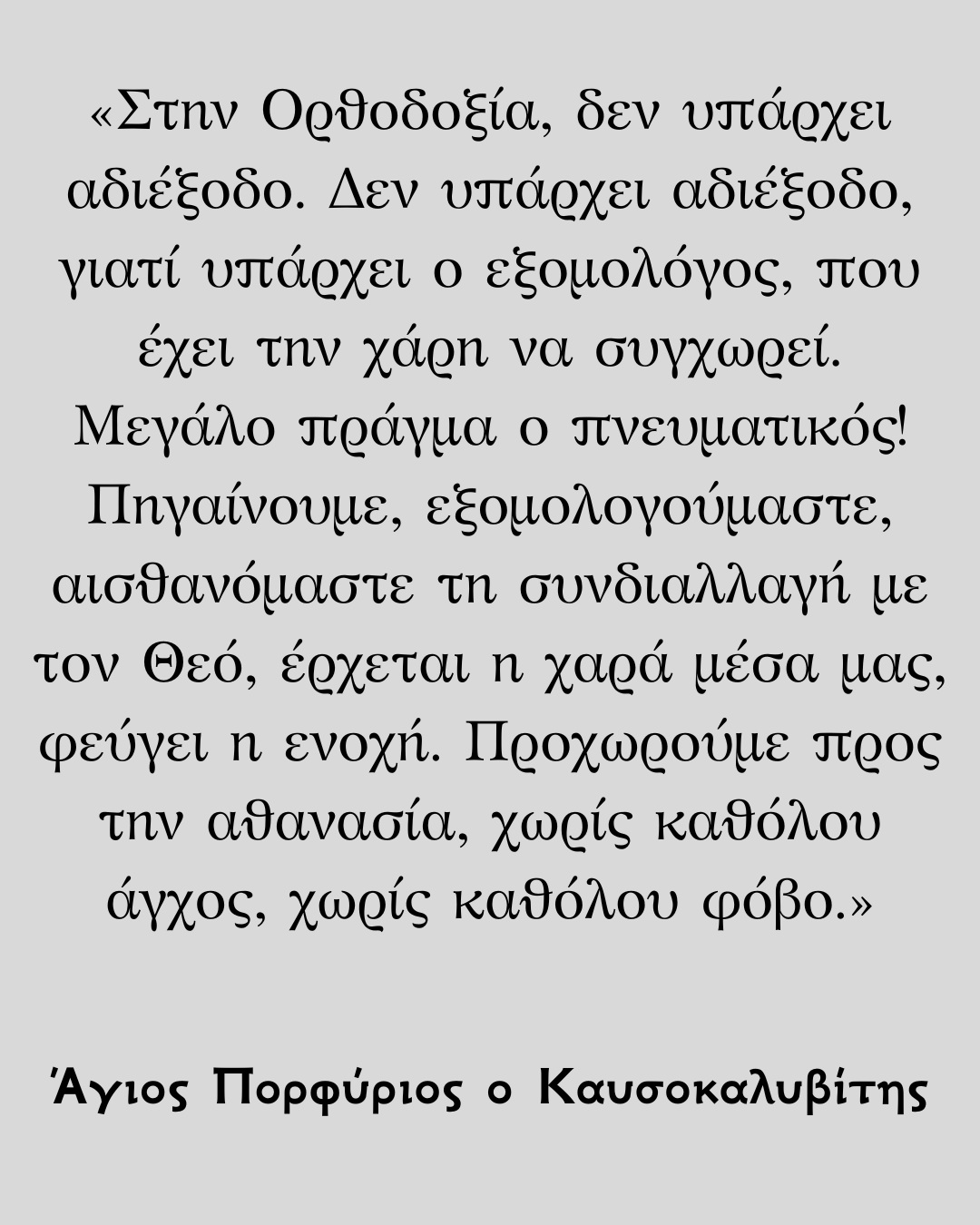
Saint Porphyrios: In Orthodoxy there is no dead end

The post shares a passage from Saint Porphyrios the Kausokalyvites, taken from the book "Vios kai Logoi" (Life and Words) in the 2003-2023 Anniversary Edition published by the Holy Monastery of Chrysopigi in Chania, page 399. The excerpt comes from a subsection titled "True repentance brings sanctification." The saint states that in Orthodoxy there is no dead end because the confessor possesses the grace to forgive. He describes confession as a…

The post shares a passage from Saint Porphyrios the Kausokalyvites, taken from the book "Vios kai Logoi" (Life and Words) in the 2003-2023 Anniversary Edition published by the Holy Monastery of Chrysopigi in Chania, page 399. The excerpt comes from a subsection titled "True repentance brings sanctification." The saint states that in Orthodoxy there is no dead end because the confessor possesses the grace to forgive.

He describes confession as a great gift: one goes to the spiritual father, confesses, experiences reconciliation with God, receives joy, and is freed from guilt. Through this sacrament, the faithful advance toward immortality without anxiety or fear.

  • Quote from Saint Porphyrios the Kausokalyvites from "Vios kai Logoi" Anniversary Edition 2003-2023
  • Orthodoxy has no dead end because the confessor has grace to forgive
  • Confession brings reconciliation with God, joy, and freedom from guilt
  • The spiritual father is described as a great gift
  • Through confession the faithful proceed toward immortality without anxiety or fear
Read more

St. Tikhon of Zadonsk on Christians as pilgrims seeking the heavenly homeland

The post shares a quotation from St. Tikhon of Zadonsk stating that true Christians live in this world as travelers, pilgrims, and sojourners who look toward their heavenly homeland. The author adds a personal reflection, describing himself as a pilgrim passing through this world seeking the Kingdom that has no end, and invites others to join him. The text presents the Christian life as a pilgrimage toward the eternal Kingdom.

  • St. Tikhon of Zadonsk describes Christians as travelers and pilgrims in this world
  • Christians look toward their heavenly homeland
  • The author identifies as a pilgrim seeking the eternal Kingdom
  • The post invites others to join this pilgrim journey
Read more

Gerontas Filimon: God knows better than we do; despair is the worst sin

Gerontas Filimon of the Holy Monastery of Prophet Elijah on Mount Athos speaks about facing daily surprises and hardships. He says each new day brings unexpected events, some of them difficult, but remaining close to Christ makes it possible to resolve them. He refers to recent troubles such as children being harmed and earthquakes, and warns that more unknown challenges may come. Because the Lord God lives, he insists we must not give in to…

Gerontas Filimon of the Holy Monastery of Prophet Elijah on Mount Athos speaks about facing daily surprises and hardships. He says each new day brings unexpected events, some of them difficult, but remaining close to Christ makes it possible to resolve them. He refers to recent troubles such as children being harmed and earthquakes, and warns that more unknown challenges may come.

Because the Lord God lives, he insists we must not give in to discouragement. Despair is called the worst sin; he recalls Father Epiphanios teaching that when a person despairs the devil rejoices. What happens may seem strange to us, but God knows better than we do.

Key moments

  1. The day that dawns always brings surprises, some of them difficult.
  2. If you are close to Christ, you can resolve these difficulties.
  3. Recent hardships include children being struck and earthquakes occurring, with more unknown challenges ahead.
  4. Because the Lord God lives, we must not be discouraged.
  5. Despair is the worst sin; when one despairs, the devil rejoices, as Father Epiphanios taught.
  6. What happens seems strange to us, but God knows better than we do.
Read more

St. Ephraim the Syrian: Hold fast to truth and hope amid turmoil

The post presents an exhortation attributed to St. Ephraim the Syrian. He urges his disciples to remember him, remain steadfast in the way of truth and their traditions, and not be shaken by wars and turmoil, which signal the end times. He cites Christ's words that heaven and earth will pass away but not one jot of the Law will pass away, affirming the certainty of Scripture.

He reminds them they will stand before the Judge and encourages striving for perfection through good works done with patience.

  • Exhortation to remember the teacher and keep the way of truth and tradition.
  • Wars and turmoil indicate the end is near.
  • Scripture will be fulfilled; not one jot of the Law will pass away.
  • Believers will stand before the Judge.
  • Perfection is sought through good works accomplished with patience.

Struggling with Jesus calling Gentiles dogs in Mark 7:27

I've been trying to hold onto the faith for years; it's a deliberate choice for me. Though I was raised Greek-American Orthodox, I walked away around age twelve and only returned in my early twenties. You know the pattern, skepticism and all. The verse that troubles me is Mark 7:27, where Jesus tells the Syrophoenician woman, "Let the children be fed first, for it is not right to take the children's bread and throw it to the dogs." The…

I've been trying to hold onto the faith for years; it's a deliberate choice for me. Though I was raised Greek-American Orthodox, I walked away around age twelve and only returned in my early twenties. You know the pattern, skepticism and all.

The verse that troubles me is Mark 7:27, where Jesus tells the Syrophoenician woman, "Let the children be fed first, for it is not right to take the children's bread and throw it to the dogs."

The "children" are understood as the Jews, and the "dogs" as Gentiles.

I cannot reconcile this; it sickens me. Has the Lord of Spirits podcast or any comparable academic Orthodox source addressed this passage? I haven't been able to locate such a discussion.

God bless you all. Please pray for me if you can.

  • Struggling to reconcile Mark 7:27 with faith
  • Asks if Lord of Spirits or similar Orthodox academic source has discussed this passage
  • Requests prayers
17 opinions in the discussion The Greek word Jesus uses here isn't for wild street dogs (kyon), but kynaria household puppies under the table. He's painting a domestic picture, not hurling an insult, and she matches His… Read the discussion

Three Signs You Are Drifting from God Without Realizing It

The speaker outlines three indicators that a person may be drifting from Christ while appearing successful in worldly terms. The first sign is justifying actions one knows are wrong instead of repenting, which James 4:17 identifies as sin when we fail to do the good we know. The second sign is treating God as a low priority: time is found for business, fitness, social media, and relationships, but not for daily prayer or Sunday church, contrary…

The speaker outlines three indicators that a person may be drifting from Christ while appearing successful in worldly terms. The first sign is justifying actions one knows are wrong instead of repenting, which James 4:17 identifies as sin when we fail to do the good we know. The second sign is treating God as a low priority: time is found for business, fitness, social media, and relationships, but not for daily prayer or Sunday church, contrary to Matthew 6:33's command to seek first the Kingdom.

The third sign is building a life of achievement without genuine dependence on God, neglecting confession, heartfelt prayer, and gratitude, despite Christ's statement in John 15:5 that without Him we can do nothing. From an Orthodox perspective, true success is measured not by wealth, physical strength, or recognition, but by one's relationship with Christ, willingness to repent, humility, and obedience.

The message urges listeners not to become so occupied with building their lives that they forget the One who gave them life.

Key moments

  1. The first sign is knowing what is wrong but making excuses instead of confronting it, which silences the conscience over time according to James 4:17.
  2. The second sign is having God in your life but not as a priority; time exists for the gym, business, social media, and relationships but not for ten minutes of prayer or Sunday church, contrary to Matthew 6:33.
  3. The third sign is building a successful life without depending on God, lacking confession, heartfelt prayer, or gratitude, despite John 15:5 stating that without Christ we can do nothing.
Read more

Catechumen seeks guidance on atheist girlfriend and marriage

I am a soon-to-be catechumen and love my girlfriend very much; she means everything to me. She is a very kind soul who cares a lot about the world and other people. Honestly she does it better than I do depending on how you look at it. But she is an atheist. I have tried to tell her that in order for us to get married she will have to become Orthodox or at least some sort of Christian. I told her that getting married in the church is…

I am a soon-to-be catechumen and love my girlfriend very much; she means everything to me. She is a very kind soul who cares a lot about the world and other people. Honestly she does it better than I do depending on how you look at it. But she is an atheist.

I have tried to tell her that in order for us to get married she will have to become Orthodox or at least some sort of Christian. I told her that getting married in the church is non-negotiable and that marriage to me is not just a civil union but a union between us and God. She respects my religious beliefs but gets very upset when I bring up that I want her to also seek Christ.

I beg God to show her a sign. It breaks my heart to see someone I love so much be so misled. I think every day that if something happens to her I will not be able to see her again.

She has given me reasons why she does not believe: science disproves religion, religion is oppressive, and it is just a coping mechanism. These are things that I can easily disprove and debunk. But she still does not listen. I know she is annoyed at me, but I am doing this because I love her and she does not understand that. I do not want to lose her and I do not know what to do.

  • Marriage in the Church requires her to become Orthodox or at least Christian
  • Girlfriend respects his faith but gets upset when he asks her to seek Christ
  • He fears for her salvation if she dies without faith
  • She raises objections: science disproves religion, religion is oppressive, a coping mechanism
  • He does not know what to do and does not want to lose her
51 opinions in the discussion I'm gonna say it, and you're not gonna listen, but here it goes: do not be unequally yoked. It's gonna be strife and pain and friction and frustration and eventually, to keep the peace,… Read the discussion

One Bible, Many Confessions: The Failure of Sola Scriptura to Unite Doctrine

The post presents a systematic comparison of doctrinal disagreements among major Protestant traditions, arguing that the principle of Scripture alone (Sola Scriptura) cannot produce a unified confession. The author structures the argument in eight sections. First, infant baptism: Lutherans, Presbyterians, Anglicans, and Methodists affirm it; Baptists and Pentecostals deny it, both appealing to Scripture. Second, the Eucharist: Lutherans affirm…

The post presents a systematic comparison of doctrinal disagreements among major Protestant traditions, arguing that the principle of Scripture alone (Sola Scriptura) cannot produce a unified confession. The author structures the argument in eight sections. First, infant baptism: Lutherans, Presbyterians, Anglicans, and Methodists affirm it; Baptists and Pentecostals deny it, both appealing to Scripture.

Second, the Eucharist: Lutherans affirm Christ's true body and blood; Presbyterians, Baptists, Anglicans, and Methodists reject bodily presence, yet all cite "This is My body" (Matthew 26:26). Third, predestination: Calvinists defend unconditional election; Methodists, Arminians, Baptists, and Lutherans hold conditional election, both sides appealing to Romans 9 and Ephesians 1. Fourth, eternal security: Calvinists and Baptists say salvation cannot be lost; Methodists, Lutherans, Free Will Baptists, and Arminians say genuine believers can fall away.

Fifth, church government: Anglicans require historic episcopacy; Presbyterians, Congregationalists, Baptists, and Methodists reject a distinct episcopal order. Sixth, speaking in tongues: Assemblies of God require tongues as initial evidence of Spirit baptism; Charismatics, Cessationists, Baptists, and Lutherans deny this. Seventh, a summary table adds women's ordination: Methodists affirm, Baptists deny.

The author contends these are not mere preferences but contradictory confessions on essential doctrines. Since each tradition claims biblical authority, the post asks what universally binding authority can resolve the contradictions if Scripture alone is final. It concludes with Ephesians 4:5: "One Lord, one faith, one baptism," asserting that Sola Scriptura has failed to produce a universally united Protestant confession.

  • The post catalogues seven doctrinal areas where Protestant confessions contradict one another while each appeals to Scripture alone.
  • Infant baptism, the Eucharist, predestination, eternal security, church government, speaking in tongues, and women's ordination are shown with opposing denominational positions.
  • In each case, both sides cite the same biblical passages to support mutually exclusive conclusions.
  • The author argues that without a common, binding interpretive authority, Sola Scriptura cannot settle doctrine.
  • The post concludes with Ephesians 4:5, asserting that Christ established one Church, not a marketplace of competing confessions.
Athonite Audio YouTube

How to Withstand Temptations: Lessons from Evergetinos Volume 3

How to Withstand Temptations: Lessons from Evergetinos Volume 3 26:52

The post presents teachings from the third volume of the Evergetinos, Hypothesis 34, on how to withstand temptations. It draws from the lives of saints and sayings of desert fathers. St. John the Merciful loses thirteen ships carrying cargo worth 3,300 pounds of gold in a storm. He gives thanks to God, absolves the sailors, and attributes the loss to his own high-mindedness in almsgiving. He says God will provide for the hungry despite his…

The post presents teachings from the third volume of the Evergetinos, Hypothesis 34, on how to withstand temptations. It draws from the lives of saints and sayings of desert fathers. St. John the Merciful loses thirteen ships carrying cargo worth 3,300 pounds of gold in a storm.

He gives thanks to God, absolves the sailors, and attributes the loss to his own high-mindedness in almsgiving. He says God will provide for the hungry despite his fault, and soon afterward God doubles the church's assets so he can give even more. A monk begs St. Pachomius to pray for martyrdom during a time of peace.

Pachomius refuses, calling monastic life a voluntary martyrdom and warning against seeking danger. He eventually prays for the monk's desire but warns that one who seeks martyrdom by his own will and exposes himself unnecessarily is in error, citing Christ's command to pray not to enter temptation. The monk is captured by barbarians, denies Christ under threat of swords, offers libations to idols, and eats sacrificial meat, suffering spiritual death instead of martyrdom.

St. Barsanuphius tells brothers not to flee from rumored brigand attacks. He distinguishes between unexpected temptation, in which God protects, and willfully courting disaster, which violates Christ's command. He compares temptation to a furnace testing gold and bricks baked in fire becoming fire-resistant, saying tribulation works patience, experience, and hope.

Abba Mark teaches to accept present afflictions with expectation of future spiritual pleasure, to reconcile affairs to God through prayer, and to cut off evil thoughts at their onset before they linger and increase evil. Abba Isaac urges constant remembrance of God and prayer before afflictions arrive, citing Noah's ark built in peace.

The Evergetinos adds that spiritual hymns lighten temptation's burden, tearful prayer extinguishes evil desires, and the example of Lazarus shows that bearing misery without murmuring leads to paradise.

Key moments

  1. 0:01 St. John the Merciful loses 13 ships with 3,300 pounds of gold in cargo during a storm, gives thanks to God, absolves the sailors, and attributes the loss to his own high-mindedness in almsgiving.
  2. 2:37 St. John says God will provide for the hungry despite his fault, and soon after God doubles the church's assets so he can give even more.
  3. 3:39 A monk begs St. Pachomius to pray for martyrdom despite peace in the church; Pachomius refuses, calling monastic life a voluntary martyrdom and warning against seeking danger.
  4. 5:10 Pachomius eventually prays for the monk's desire, warning that one who seeks martyrdom by his own will and exposes himself unnecessarily is in error, citing Christ's command to pray not to enter temptation.
  5. 7:48 The monk is captured by barbarians, denies Christ under threat of swords, offers libations to idols, and eats sacrificial meat, suffering spiritual death instead of martyrdom.
  6. 12:30 St. Barsanuphius tells brothers not to flee from rumored brigand attacks, distinguishing between unexpected temptation (God protects) and willfully courting disaster (violating Christ's command to pray not to enter temptation).
  7. 16:35 Barsanuphius compares temptation to a furnace testing gold, and bricks baked in fire becoming fire-resistant; tribulation works patience, experience, and hope.
  8. 20:20 Abba Mark teaches to accept present afflictions with expectation of future spiritual pleasure, reconcile affairs to God through prayer, and cut off evil thoughts at their onset before they linger and increase evil.

Orthodox perspective on Halloween: light versus darkness

The post contrasts Halloween's themes of darkness, death, fear, demons, ghosts, and witchcraft with the Christian movement from darkness to light. It cites Ephesians 5:8, where Paul writes that believers were once darkness but are now light in the Lord, and John 8:12, where Christ calls himself the light of the world. The author notes that the Orthodox Church celebrates the Sunday of All Saints on the first Sunday after Pentecost, presenting the…

The post contrasts Halloween's themes of darkness, death, fear, demons, ghosts, and witchcraft with the Christian movement from darkness to light. It cites Ephesians 5:8, where Paul writes that believers were once darkness but are now light in the Lord, and John 8:12, where Christ calls himself the light of the world. The author notes that the Orthodox Church celebrates the Sunday of All Saints on the first Sunday after Pentecost, presenting the saints as the fruit of the Holy Spirit poured out on the Church.

In the West, the feast of All Saints came to be fixed on November 1 from the eighth and ninth centuries, making October 31 its eve, All Hallows' Eve, later Halloween. Saint John Chrysostom is quoted warning Christians not to imitate pagan or superstitious customs because society accepts them, but to let every part of life be shaped by Christ.

Second Corinthians 6:14 is cited: "What fellowship has light with darkness?" The post concludes that for an Orthodox Christian the goal is not to glorify fear, occult imagery, death, or demonic themes even as entertainment, but to celebrate Christ's victory over death, the holiness of his saints, and the light of eternal life.

  • Halloween centers on darkness, death, fear, and occult imagery as entertainment
  • Christian life moves from darkness to light, from death to life, from fear to hope in Christ
  • Orthodox All Saints Sunday after Pentecost shows saints as fruit of the Holy Spirit
  • Western All Saints fixed on November 1 from 8th-9th centuries; October 31 became All Hallows' Eve
  • St. John Chrysostom warned against adopting pagan customs; St. Paul asks what fellowship light has with darkness
Read more

The Sign of the Cross: Apostolic Tradition, Not Upside-Down Cross

The speaker addresses a misconception that making the sign of the cross forms an upside-down cross. He explains that the forehead marks the center point where God is, and the sign is a confession of Christ crucified and a reminder that believers belong to Him. Christians have practiced the sign of the cross since the earliest centuries, handed down through apostolic tradition. Unlike modern practices such as altar calls and youth groups, the…

The speaker addresses a misconception that making the sign of the cross forms an upside-down cross. He explains that the forehead marks the center point where God is, and the sign is a confession of Christ crucified and a reminder that believers belong to Him. Christians have practiced the sign of the cross since the earliest centuries, handed down through apostolic tradition.

Unlike modern practices such as altar calls and youth groups, the sign of the cross has a long history in the ancient church. Christian tradition is something received from those who came before, not invented for oneself.

Key moments

  1. Making the sign of the cross is not an upside-down cross; the forehead marks the center point where God is.
  2. The sign is a confession of Christ crucified and a reminder that we belong to Him.
  3. Christians have practiced the sign of the cross since the earliest centuries and it has been handed down through apostolic tradition.
  4. Modern practices like altar calls and youth groups lack the long history that the sign of the cross has in the ancient church.
  5. Christian tradition is not something we invent for ourselves; it is something we receive from those who came before us.
7 opinions in the discussion Also: the cross of Saint Peter is upside down. Anyone calling it demonic is just buying into Hollywood nonsense. Read the discussion
George Instagram discussion

Guardian angels assigned at baptism remain lifelong protectors

The speaker explains that every Orthodox Christian receives a guardian angel at baptism who remains constantly present throughout life. Christ affirmed this in the Gospel, saying the angels of the little ones always see the face of the Father in heaven. Psalm 91 promises that God gives his angels charge over believers to keep them in all their ways. Saint Basil the Great describes the angel as a protector and shepherd. The baptismal service…

The speaker explains that every Orthodox Christian receives a guardian angel at baptism who remains constantly present throughout life. Christ affirmed this in the Gospel, saying the angels of the little ones always see the face of the Father in heaven. Psalm 91 promises that God gives his angels charge over believers to keep them in all their ways.

Saint Basil the Great describes the angel as a protector and shepherd. The baptismal service includes a prayer for a radiant angel to guard the newly baptized from every snare of the evil one. The angel never abandons the person, even when they sin, but prays for them, guards them, and seeks to draw them closer to God.

Evening prayers include a petition to the guardian angel asking forgiveness for anything done that day that made the angel sad. The discussion emphasizes that most Orthodox Christians are unaware of this baptismal gift and the angel's continuous presence while waking, working, sleeping, falling, and rising. The angel stands beside the believer at all times, not leaving when the person sins, but interceding and protecting.

The baptismal prayer specifically asks for a radiant angel to protect against the evil one. The guardian angel is a baptismal gift who does not leave when the person sins, but prays for them, guards them, and seeks to bring them closer to God. The evening prayers include a prayer to the guardian angel asking forgiveness for anything done that day that made the angel sad.

This teaching highlights the constant companionship and intercession of the guardian angel as a reality of baptismal life.

Key moments

  1. Most Orthodox Christians are unaware that a guardian angel has been assigned to them since baptism.
  2. The angel stands beside the believer at all times, waking, working, sleeping, falling, and rising.
  3. Christ said the angels of the little ones always see the face of the Father in heaven.
  4. The Psalmist declares that God gives his angels charge over you to keep you in all your ways.
  5. Saint Basil the Great teaches that beside every believer stands an angel as a protector and a shepherd.
  6. In the baptism service, the priest prays for God to give the newly baptized a radiant angel to protect them from every snare of the evil one.
  7. The guardian angel is a baptismal gift who does not leave when the person sins, but prays for them, guards them, and seeks to bring them closer to God.
  8. The evening prayers include a prayer to the guardian angel asking forgiveness for anything done that day that made the angel sad.
10 opinions in the discussion Orthodoxy ties everything together so beautifully... we pray for protection, guidance, wisdom and deliverance from every enemy and evil. Read the discussion

Father Slobodan Zeković: The Resurrection is the foundation of faith

Father Slobodan Zeković speaks on the Resurrection as the foundation of faith. He begins with Christ's words to Thomas: because you have seen me, you have believed; blessed are those who have not seen and yet have believed. The encounter between Thomas and the risen Christ is presented as sufficient to dispel all doubts for every believer. After Pentecost, the apostles went into the world proclaiming what they had heard, seen, and touched with…

Father Slobodan Zeković speaks on the Resurrection as the foundation of faith. He begins with Christ's words to Thomas: because you have seen me, you have believed; blessed are those who have not seen and yet have believed. The encounter between Thomas and the risen Christ is presented as sufficient to dispel all doubts for every believer.

After Pentecost, the apostles went into the world proclaiming what they had heard, seen, and touched with their hands, as Scripture attests. The Resurrection remained the central message of the apostles and their successors throughout history. They confessed the risen Christ fearlessly before judges, elders, emperors, and kings, sealing their witness with martyrdom.

All the apostles died as martyrs except Saint John the Theologian, who ended his life in exile on the island of Patmos at a very old age.

Key moments

  1. The Lord says: because you have seen me, you have believed; blessed are those who have not seen and yet have believed.
  2. Thomas's encounter with the risen Lord is sufficient for each of us to have all doubts dispelled.
  3. After receiving the Holy Spirit, the apostles went throughout the world to preach not only what they heard and saw but also what, as Holy Scripture says, they touched with their hands.
  4. Christ's Resurrection was and remains the central preaching of the apostles and their successors to this day.
  5. The apostles fearlessly confessed the risen Christ before judges, elders, emperors, and kings, sealing their faith and love with the shedding of blood; all suffered martyrdom except Saint John the Theologian, who died a natural death in exile on the island of Patmos in deep old age.
Read more