WeOrthodox
EN UA

Ιερά Σκήτη Προφήτη Ηλία Αγίου Όρους

Instagram ↗ 41 discussions

Καλώς ήρθατε στο επίσημο κανάλι της Ιεράς Κοινοβιακής Παντοκρατορινής Σκήτης Προφήτου Ηλιού Αγίου Όρους, στο Instagram!

Gerontas Filimon's parable of the sleeping town and the watchful driver

The post shares a video from the YouTube channel of the Holy Church of St. Demetrios titled "The beauty of the end (2nd part)" in memory of Gerontas Filimon, a righteous monk of the Holy Coenobitic Pantokratoros Skete of Prophet Elias on Mount Athos. The video presents an allegory told by Gerontas Filimon: a driver describes a strange place where inhabitants sleep all year in their beds, waking only before festivals to repair roads, roofs, and…

The post shares a video from the YouTube channel of the Holy Church of St. Demetrios titled "The beauty of the end (2nd part)" in memory of Gerontas Filimon, a righteous monk of the Holy Coenobitic Pantokratoros Skete of Prophet Elias on Mount Athos. The video presents an allegory told by Gerontas Filimon: a driver describes a strange place where inhabitants sleep all year in their beds, waking only before festivals to repair roads, roofs, and prepare the choir.

During festivals they celebrate with tables, wine, love, kisses, songs, bells, and fireworks, but afterward numbness returns and they go back to sleep. The driver's role is to pass through keeping watch so no one oversleeps, no fountain stays open, and no fire starts. He is headed to Athens to deliver a load; his home is the national highway, not a house, and his friends are those he chooses to pick up along the way.

The driver also says he has swallowed his tongue but something eats at him. The post includes links to two YouTube videos: the full talk on the church's channel, and another video on the "Nectar of the Soul" channel titled "Fr. Filimon bids farewell to Dionysis Savvopoulos."

Key moments

  1. 0:00 The driver explains that the people in this place sleep all year in their beds and wake only before festivals to fix roads, roofs, and prepare the choir.
  2. 0:35 The driver describes the festival as a time of tables set with wine, love, kisses, songs, bells, fireworks, and organs, after which the people fall back into numbness and sleep.
  3. 1:06 The driver says his role is to pass through and watch that no one oversleeps, no fountain is left open, and no fire starts, and he must reach Athens to deliver a load.
  4. 1:06 The driver reveals he has swallowed his tongue but something eats at him, and when asked about family, home, and friends, he answers that his home is the national highway.
  5. 1:36 The driver says his family is the national highway, his friends make him τοστοπ, but he chooses who to pick up, and tells the passenger to stop at Rapsani where they sell μούστο if he needs anything.
Read more

Elder Filimon: God's word must unite, not divide

Elder Filimon of the Pantokratoros Skete of Prophet Elias on Mount Athos compares human beings to people inside a castle who tear down their own protection by throwing stones at one another. He says this destroys the castle and wounds those inside. He insists we need philadelphia, brotherly love, rooted in genuine love and not malice, and warns against splitting into parties and factions. The elder recounts that Saint Porphyrios fell asleep…

Elder Filimon of the Pantokratoros Skete of Prophet Elias on Mount Athos compares human beings to people inside a castle who tear down their own protection by throwing stones at one another. He says this destroys the castle and wounds those inside. He insists we need philadelphia, brotherly love, rooted in genuine love and not malice, and warns against splitting into parties and factions.

The elder recounts that Saint Porphyrios fell asleep repeating "one, essence, one" until he closed his eyes, offering this as a call to unity. He warns that if we break into a thousand pieces, the devil rubs his hands in satisfaction. He urges that we must remain deeply loving and united. He states that the word of God must unite us; if it divides, it is not God's word but something else.

Key moments

  1. The bishop says we are like people in a castle who take its stones and throw them at each other, destroying the castle and wounding ourselves.
  2. He insists we need philadelphia, brotherly love, with real love, not malice, and warns against becoming parties and factions.
  3. He recounts that Saint Porphyrios fell asleep saying "one, essence, one" repeatedly until he closed his eyes.
  4. He warns that if we break into a thousand pieces, someone rubs his hands in satisfaction, the devil.
  5. He urges that we must be very loving and united.
  6. He states the word of God must unite us, not divide us; if it divides, it is not God's word but something else.
Read more

Gerontas Filimon on optimism through faith in God

The post shares a video from the website pemptousia.gr featuring Gerontas Filimon, who is identified as the dikaios of the Holy Monastery Skete of Prophet Elijah on Mount Athos. The Greek text accompanying the link reads "Έχει ο Θεός, ας είμαστε αισιόδοξοι" which translates to "We have God, let us be optimistic." The video is titled "The letters of St. Paisius Velichkovsky." In the video, Gerontas Filimon speaks about the foundation of Christian…

The post shares a video from the website pemptousia.gr featuring Gerontas Filimon, who is identified as the dikaios of the Holy Monastery Skete of Prophet Elijah on Mount Athos. The Greek text accompanying the link reads "Έχει ο Θεός, ας είμαστε αισιόδοξοι" which translates to "We have God, let us be optimistic." The video is titled "The letters of St. Paisius Velichkovsky."

In the video, Gerontas Filimon speaks about the foundation of Christian optimism. He states that believers have God and therefore can be optimistic, and he connects this optimism to the practice of iconography or painting. He describes God's grace as a gift that cannot be stolen by any external circumstance.

He makes reference to the act of hoping in Christ even when despair threatens to overwhelm. He says that Christ appears in hopeless situations and provides the strength to continue. The post includes hashtags in Greek and English related to God, optimism, faith, Christianity, Orthodoxy, and the speaker's name and skete.

Key moments

  1. The speaker states they have God and are optimistic through iconography or painting.
  2. God's grace is mentioned as something that cannot be stolen.
  3. A reference is made to hoping in Christ even when despairing.
  4. Christ appears before them in hopeless circumstances and gives strength to continue.
Read more

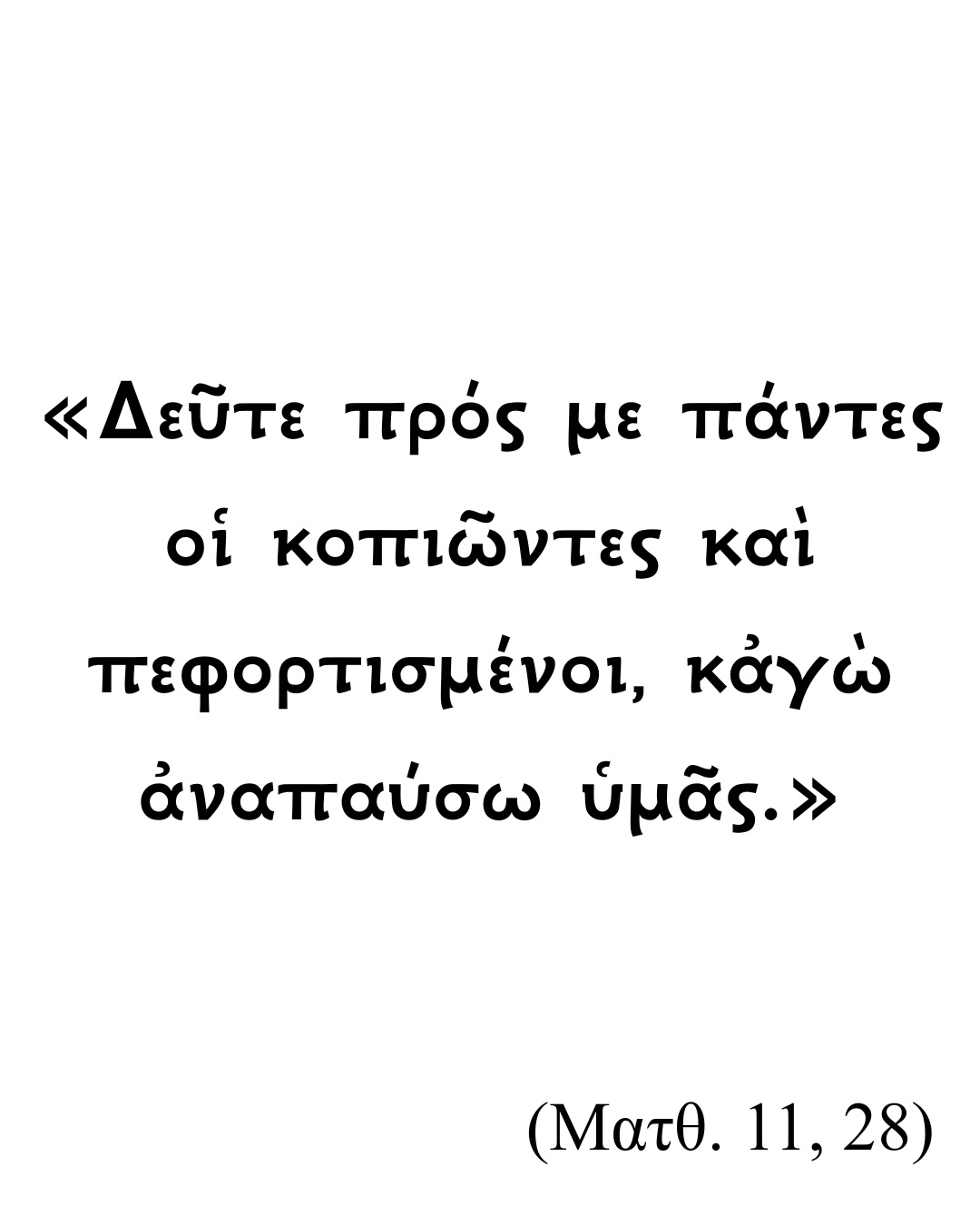
Come to Me, All Who Labor: Matthew 11:28 Explained by Panagiotis Trembelas

The post presents the verse inscribed on an icon: 'Come to me, all who are weary and burdened by the weight of sin and sorrows, and by the burden of the Pharisaic traditions, with which the God-inspired law was turned into an unbearable load. Come to me, and I will give you rest.' The author cites the text from the Gospel according to Matthew, chapter 11, verse 28, and notes that the icon itself carries both the verse and a short interpretation.…

The post presents the verse inscribed on an icon: 'Come to me, all who are weary and burdened by the weight of sin and sorrows, and by the burden of the Pharisaic traditions, with which the God-inspired law was turned into an unbearable load. Come to me, and I will give you rest.' The author cites the text from the Gospel according to Matthew, chapter 11, verse 28, and notes that the icon itself carries both the verse and a short interpretation.

The interpretation quoted in the image description comes from the book 'The New Testament, with a Brief Interpretation' by the late professor of the Theological School of the University of Athens, Panagiotis N. Trembelas, and the Brotherhood of Theologians 'O Sotir'. The post specifies that the edition used is the 11th edition, published in Athens in May 2025.

The verse itself is given in an expanded form that names what weighs on the weary: the burden of sin, the weight of sorrows, and the load of Pharisaic traditions that turned the divinely inspired law into something unbearable. The promise attached to the call is rest. The post does not reproduce the full text of Trembelas's interpretation; it identifies the source of the commentary printed in the image description and gives the publication details.

The reader is directed to the icon and its accompanying note for the interpretation itself.

  • The icon bears the verse Matthew 11:28: 'Come to me, all who are weary and burdened, and I will give you rest.'
  • The quoted form of the verse names the burdens: sin, sorrows, and the Pharisaic traditions that made the God-inspired law an unbearable load.
  • The short interpretation in the image description comes from Trembelas's 'The New Testament, with a Brief Interpretation'.
  • The author is the late Panagiotis N. Trembelas, professor at the Theological School of the University of Athens, and the Brotherhood of Theologians 'O Sotir'.
  • The edition cited is the 11th, published in Athens in May 2025.
Read more

A monk, a sack of flour, and the Panagia Portaitissa

Elder Philemon, Dikaios of the Holy Coenobitic Skete of the Prophet Elias of Pantokrator on Mount Athos, tells a small and instructive miracle of the Panagia Portaitissa. A monk of the monastery went to ask for a little bread and was told there was none. The Panagia then gave him a sack of flour (the 'flouri') so that he would have bread to eat. When Portaris saw the flour and asked what it was and where it came from, the monk answered that a…

Elder Philemon, Dikaios of the Holy Coenobitic Skete of the Prophet Elias of Pantokrator on Mount Athos, tells a small and instructive miracle of the Panagia Portaitissa. A monk of the monastery went to ask for a little bread and was told there was none. The Panagia then gave him a sack of flour (the 'flouri') so that he would have bread to eat.

When Portaris saw the flour and asked what it was and where it came from, the monk answered that a woman had given it to him, the Panagia. After seeing the miracle, his whole behavior changed. Elder Philemon draws the lesson that we should see the other person with love, as an image of God and as a veneration, just as Portaris saw the miracle.

The story is presented in a video on the website pemptousia.gr, titled 'The Ministry in Monastic Life', and the post links to the full recording. The post carries hashtags on Mount Athos, the Panagia, miracle, faith, Christianity and Orthodoxy, in Greek and English.

Key moments

  1. We should see the other with love, as an image of God, a veneration.
  2. A monk went to ask for a little bread and was told there was none.
  3. The Panagia gave him the flour and told him to go eat, to have a little bread.
  4. Portaris asked what it was and where he found it; the monk answered it was from the Panagia, a woman gave it to him.
  5. His whole behavior changed after seeing the miracle.
Read more

Gerontas Filimon on joy as fruit of the Holy Spirit

The post shares a video from the YouTube channel "Nectar of the Soul" featuring Gerontas Filimon, a righteous elder of the Holy Communal Skete of the Pantocrator of Prophet Elijah on Mount Athos. The video addresses joy as a gift of God and a fruit of the Holy Spirit. The elder begins by noting that joy is often misunderstood as foolish cheerfulness without reason. He also points out that the beatitude about those who mourn can create confusion…

The post shares a video from the YouTube channel "Nectar of the Soul" featuring Gerontas Filimon, a righteous elder of the Holy Communal Skete of the Pantocrator of Prophet Elijah on Mount Athos. The video addresses joy as a gift of God and a fruit of the Holy Spirit. The elder begins by noting that joy is often misunderstood as foolish cheerfulness without reason.

He also points out that the beatitude about those who mourn can create confusion about how joy relates to mourning. To illustrate the proper understanding, the elder cites a Romanian saying: weep in the evening over sins, but laugh in the day because each day is new, God is great, and we live according to His will. He explains that this joy does not mean denying the reality of sin; rather, it means trusting in God's forgiveness and drawing courage from that trust.

The elder identifies despair that says "I am not saved" as the worst spiritual condition. He teaches that joy and courage arise from the awareness that God, the guardian angel, and the Panagia are near. Finally, he observes that joy cannot be hidden; it spreads hope to others, while despair withers everyone around.

Key moments

  1. Joy is a gift of God and a fruit of the Holy Spirit.
  2. Joy is often misunderstood as foolish cheerfulness without reason.
  3. The beatitude "blessed are those who mourn" can cause confusion.
  4. The Romanians say: weep in the evening for sins, laugh in the day because each day is new and God is great.
  5. Joy does not mean denying sins; it means trusting God's forgiveness and taking courage.
  6. Despair that says "I am not saved" is the worst state.
  7. Joy and courage come from awareness of God's presence, the guardian angel, and the Panagia.
  8. Joy is contagious and transmits hope to others, while despair withers those around.
Read more

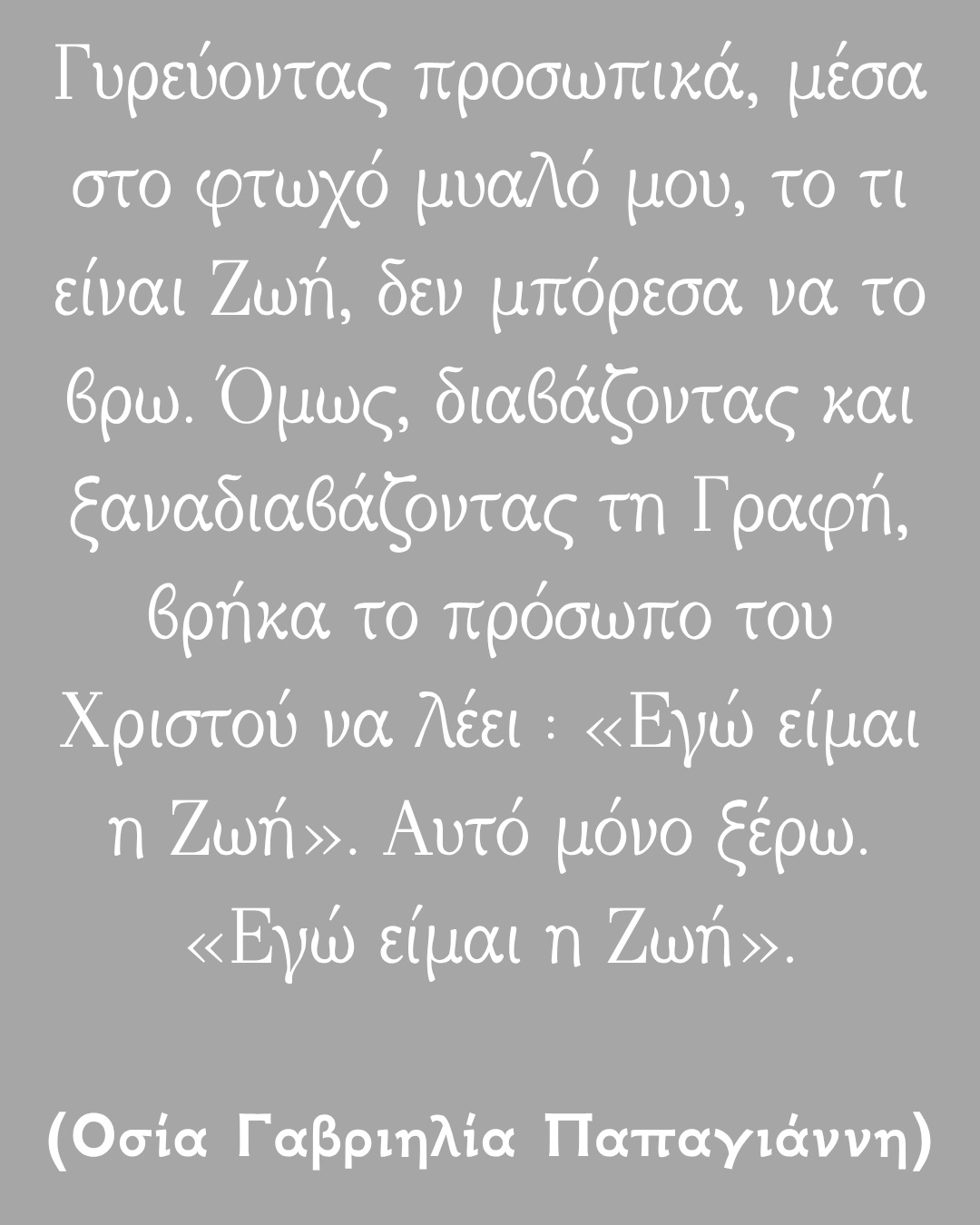
Quote from Gerontissa Gavrilia's "The Asceticism of Love"

The post presents a short excerpt from the book "The Asceticism of Love" by Gerontissa Gavrilia (1897-1992), published by Akritas Editions in May 2023. The excerpt appears on page 200 in the paragraph titled "for what is Life."

  • Excerpt from "The Asceticism of Love"
  • Author: Gerontissa Gavrilia (1897-1992)
  • Publisher: Akritas Editions, May 2023
  • Page 200, paragraph "for what is Life"
  • The post shares this citation
Read more

Illiterate monk's stairway prayer on Mount Athos

The post shares a YouTube video from the channel of the Holy Church of Saint Demetrios. The video features Gerontas Filimon, a righteous monk of the Pantokratoros Skete of Prophet Elijah on Mount Athos, recounting a story about an illiterate grandfather in a monastery. The grandfather climbs many stairs while saying the Jesus Prayer. He speaks directly to Christ and answers himself as if Christ replies, "What do you want?" He asks Christ to help…

The post shares a YouTube video from the channel of the Holy Church of Saint Demetrios. The video features Gerontas Filimon, a righteous monk of the Pantokratoros Skete of Prophet Elijah on Mount Athos, recounting a story about an illiterate grandfather in a monastery. The grandfather climbs many stairs while saying the Jesus Prayer.

He speaks directly to Christ and answers himself as if Christ replies, "What do you want?" He asks Christ to help him reach Paradise. Christ asks whether he fasts, prays, and keeps vigil; the grandfather answers, "Whatever I can." On the next floor he addresses the Theotokos as Most Holy Theotokos and answers himself with her voice calling him "my little bird."

He then calls her Mother and asks her to intercede with her Son so he may go to Paradise. The grandfather knows no patristic writings or holy Scriptures. His simple daily conversation with Christ is described as fruitful.

One heartfelt word and a sigh from the heart equal ten patristic sayings. Living this way is enough.

Key moments

  1. An illiterate grandfather in a monastery climbs many stairs while saying "Lord Jesus Christ" and answering himself as if Christ replies, "What do you want?"
  2. He asks Christ to help him reach Paradise; Christ asks whether he fasts, prays, and keeps vigil; he answers, "Whatever I can."
  3. On the second floor he addresses the Theotokos, "Most Holy Theotokos," and answers himself, "What is it, my little bird?"
  4. He then calls her "Mother" and asks her to intercede with her Son so he may go to Paradise.
  5. He knows no patristic writings or holy Scriptures.
  6. His simple, daily conversation with Christ is described as fruitful.
  7. One heartfelt word and a sigh from the heart equal ten patristic sayings.
  8. It is enough to live this way.
Read more

Elder Filimon on silent preaching at Mount Athos

The post shares a video from the YouTube channel DIMITRIS APOSTOLOU featuring Gerontas Filimon, a righteous elder of the Holy Monastery of Pantokratoros Skete of Prophet Elijah on Mount Athos. In the video, two monks, an elder and his disciple, go to the shore, walk, and return to the Holy Mountain. The disciple tells the elder they came to preach and have done so. The elder explains that a simple, humble, dignified, pious monk does not have…

The post shares a video from the YouTube channel DIMITRIS APOSTOLOU featuring Gerontas Filimon, a righteous elder of the Holy Monastery of Pantokratoros Skete of Prophet Elijah on Mount Athos. In the video, two monks, an elder and his disciple, go to the shore, walk, and return to the Holy Mountain. The disciple tells the elder they came to preach and have done so.

The elder explains that a simple, humble, dignified, pious monk does not have many words. He cites a poet in Thessaloniki who says "gather many words, do not anger, silence." Words are many but without inner experiences they are empty. A person who has something to say often conveys it through silence.

Key moments

  1. Two monks from Mount Athos, an elder and his disciple, go to the shore and walk back.
  2. The disciple says they came to preach and they have done it.
  3. A simple, humble, dignified, pious monk does not have many words.
  4. He quotes a poet in Thessaloniki: "gather many words, do not anger, silence."
  5. Words are many but without inner experiences they are empty.
  6. A person who has something to say often gives it through silence.
Read more

Elder Philimon of Mount Athos: From earthly death to true life

Elder Philimon, a clergyman of the Holy Coenobitic Skete of the Prophet Elias of Pantokrator on Mount Athos, speaks in a talk titled 'From earthly death to true life' about the trial of loss. He begins with a detail about the Greek language: a child who loses a parent is called an orphan, yet Greek, despite being a rich language, has no word for a parent who loses a child and must describe it in a roundabout way. From this observation he moves…

Elder Philimon, a clergyman of the Holy Coenobitic Skete of the Prophet Elias of Pantokrator on Mount Athos, speaks in a talk titled 'From earthly death to true life' about the trial of loss. He begins with a detail about the Greek language: a child who loses a parent is called an orphan, yet Greek, despite being a rich language, has no word for a parent who loses a child and must describe it in a roundabout way.

From this observation he moves to the Christian answer to grief. Sorrow, he says, gives way to resurrection, because life does not end when it is seen in Christ. He argues that there is no need to grieve over things that are unreal, since the body we feed and care for one day says 'I am leaving'.

To make the point lighter, he tells an anecdote about two grandfathers who ask Death to become their best man, or koumbaros, and try to hide from him in a kindergarten, but Death finds them anyway. He closes with the statement that we do not fear death. The talk was published on YouTube by the channel 'Parish Life - Holy Church of Saint Demetrios of Piraeus', and the post shares the full video link along with hashtags on death, life, faith, Christianity and Orthodoxy in Greek and English.

The discussion around the post centers on how the elder combines a word about grief with humor, and on his central claim that death loses its terror when viewed in Christ.

Key moments

  1. Το παιδί που χάνει τον πατέρα του ορφανεύει, αλλά η ελληνική γλώσσα δεν έχει λέξη για τον γονιό που χάνει το παιδί του.
  2. Μέσα από τη θλίψη έρχεται η ανάσταση, γιατί η ζωή δεν τελειώνει όταν το βλέπουμε εν Χριστώ.
  3. Δεν χρειάζεται να λυπόμαστε για πράγματα που είναι ψεύτικα.
  4. Το σώμα μας το ταΐζουμε και το φροντίζουμε, αλλά μια μέρα λέει «φεύγω».
  5. Ανέκδοτο: δύο παπούδες ζητούν από τον Χάρο να γίνει κουμπάρος και κρύβονται σε παιδικό σταθμό, αλλά ο Χάρος τους βρίσκει.
  6. Εμείς δεν φοβόμαστε, να μας πάει ο Χάρος άτα.
Read more

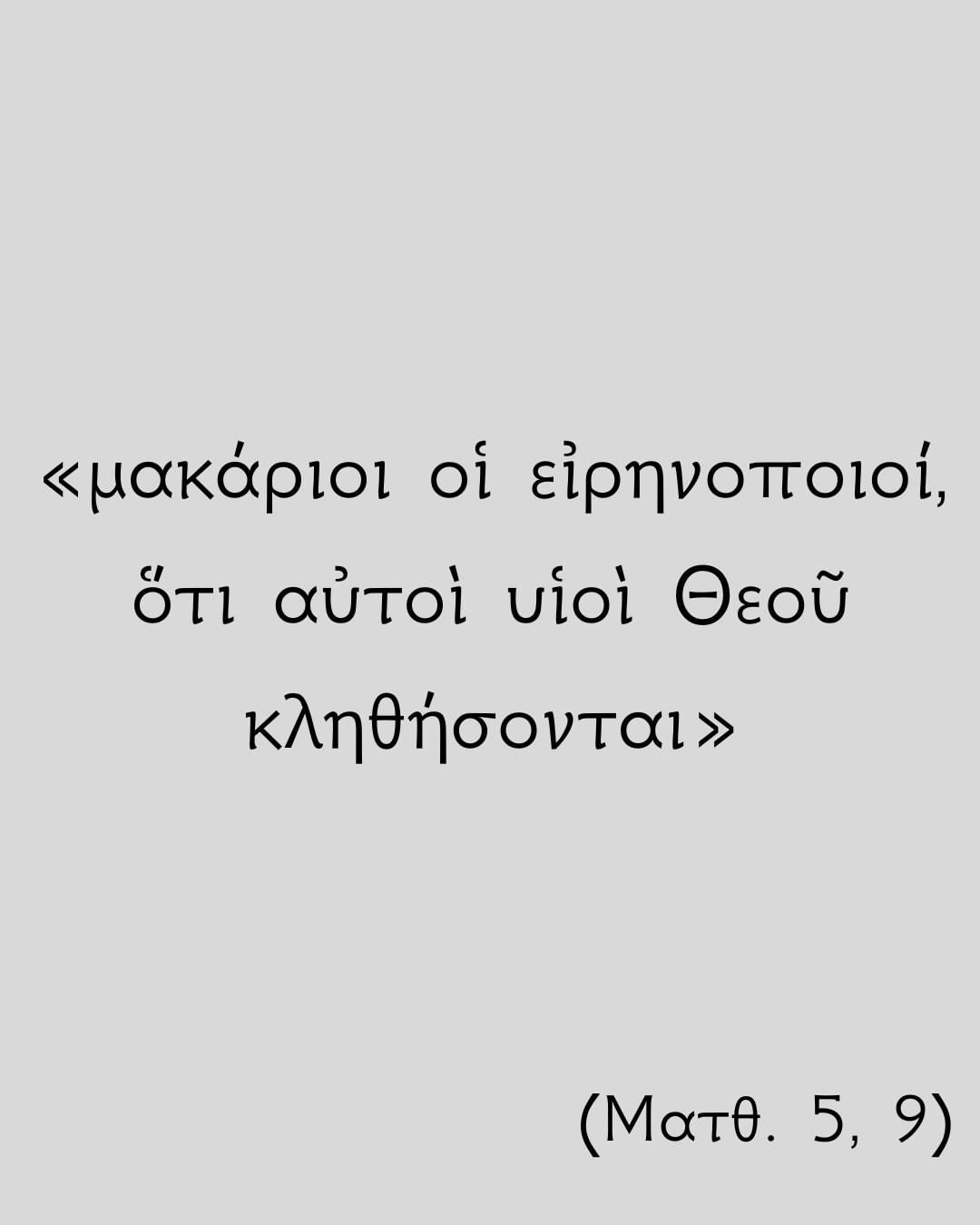
Blessed are the peacemakers: Matthew 5:9 interpreted by Trembelas

The post presents the ninth beatitude from Matthew 5:9 in Greek: "Blessed are those who have peace within themselves, which comes from the sanctification of the soul, and transmit it to others, making peace with their fellow human beings and with God; for they shall be recognized and proclaimed in the heavenly world as sons of God." The text cites the verse reference. A short interpretation accompanying the image comes from the book "The New…

The post presents the ninth beatitude from Matthew 5:9 in Greek: "Blessed are those who have peace within themselves, which comes from the sanctification of the soul, and transmit it to others, making peace with their fellow human beings and with God; for they shall be recognized and proclaimed in the heavenly world as sons of God."

The text cites the verse reference. A short interpretation accompanying the image comes from the book "The New Testament with Brief Interpretation" by the late Professor Panagiotis N. Trembelas of the Theological School of the University of Athens and the Brotherhood of Theologians "O Soter" (11th edition, May 2025, Athens). The post shares this scriptural passage and its patristic-style commentary without additional discussion.

  • Quote of Matthew 5:9 in Greek with emphasis on inner peace from sanctification
  • Peace transmitted to others and with God
  • Identification as sons of God in the heavenly world
  • Source: Trembelas and Brotherhood of Theologians "O Soter" commentary
  • 11th edition published May 2025 in Athens
Read more

Elder Philemon: Christ Turns Water into Wine, Wine into Blood, Blood into Resurrection

Elder Philemon, Dikaios of the Coenobitic Skete of the Prophet Elias (Pantokratoros) on Mount Athos, speaks about the joy of life in Christ. He describes a chain of transformations that Christ performs: water into wine, wine into His blood, and that blood into resurrection, life, and paradise. The elder applies this sequence to the Christian life today. In our era, he says, there should also be this trained, incorruptible light. He admits this…

Elder Philemon, Dikaios of the Coenobitic Skete of the Prophet Elias (Pantokratoros) on Mount Athos, speaks about the joy of life in Christ. He describes a chain of transformations that Christ performs: water into wine, wine into His blood, and that blood into resurrection, life, and paradise. The elder applies this sequence to the Christian life today.

In our era, he says, there should also be this trained, incorruptible light. He admits this is not easy, but he says it at least shows us a solution. He sets a boundary for how a Christian should relate to this light: a Christian should not be deified by it, but should know that this is our path, see it, and hold on to it so as not to become discouraged.

The post shares a video from the channel Kiriakos Agio Oros, where the full talk can be watched, and lists hashtags on Christ, joy, life, faith, Christianity, and Orthodoxy. The discussion in the source stays with the elder's own words: the transformation of water into wine, wine into blood, and blood into resurrection and paradise; the presence of a trained, incorruptible light in our era; the difficulty of this; the solution it points to; and the counsel that a Christian should see this path and hold on to it in order to avoid disappointment.

The post is in Greek, with English hashtags alongside the Greek ones, and identifies the speaker by name and by his office in the Holy Skete of the Prophet Elias on Mount Athos.

Key moments

  1. Christ turned water into wine, the wine into His blood, and that blood into resurrection, life, and paradise.
  2. In our era there should also be this trained, incorruptible light; it is not easy, but it shows a solution.
  3. A Christian should not be deified by it, but know this is our path, see it, and hold on to it so as not to be disappointed.
Read more

Elder Philimon: When a Person Feels Like Nothing, God Works Through Him

Elder Philimon, a elder of the Holy Koinobiotic Skete of the Prophet Elijah on Mount Athos, speaks about the emptiness of the self and the Grace of God. He says that when a person is emptied and feels like nothing, then God works through him. He contrasts this with the present state of Christians: today, he says, we live in pretense and call ourselves Christians, but a real Christian feels he is nothing. He uses stark images to describe this…

Elder Philimon, a elder of the Holy Koinobiotic Skete of the Prophet Elijah on Mount Athos, speaks about the emptiness of the self and the Grace of God. He says that when a person is emptied and feels like nothing, then God works through him. He contrasts this with the present state of Christians: today, he says, we live in pretense and call ourselves Christians, but a real Christian feels he is nothing.

He uses stark images to describe this inner state: a real Christian feels like an upside-down cockroach in a bathtub, a nobody, a piece of trash. Against this, he sets our actual condition: we swell up and deflate, and we cannot even bear being judged by a simple child. The talk is presented under the title about the nihilism of our ego and the Grace of God, and the themes are marked with the tags kenosis, egoism, the Grace of God, faith, Christianity and Orthodoxy.

The full video is available on the Pemptousia website of the Holy Skete. The discussion the talk opens concerns how the self must be emptied, in the sense of kenosis, so that divine Grace can act in a person, and how far our everyday Christian self-image stands from this humility. The elder's words place the measure of true Christianity not in outward identity but in the inner feeling of one's own nothingness before God.

Key moments

  1. When a person is emptied and feels like nothing, God works in him.
  2. Today we are Christians only in pretense, says the speaker.
  3. A true Christian feels he is nothing, like an upside-down cockroach in a bathtub, a nobody, a piece of trash.
  4. We swell up and deflate, and we cannot tolerate being judged even by a simple child.
Read more

'Attention and prayer': Elder Maximos' counsel to a monk on the road of life

A monk on Mount Athos recalls the advice he received from Elder Maximos, who served as prosmonarios, the guest-master, at the Monastery of Iviron, at the Panagia Portaitissa. The elder compared life to driving: a person may drive well, but he is not alone on the road, and someone beside him, perhaps drunk or looking at his phone, may crash into him. For this reason, the elder said, we must be very careful. The speaker, Father Ioakim, says that…

A monk on Mount Athos recalls the advice he received from Elder Maximos, who served as prosmonarios, the guest-master, at the Monastery of Iviron, at the Panagia Portaitissa. The elder compared life to driving: a person may drive well, but he is not alone on the road, and someone beside him, perhaps drunk or looking at his phone, may crash into him.

For this reason, the elder said, we must be very careful. The speaker, Father Ioakim, says that every time he went to confess and seek counsel, Elder Maximos gave him the same two-word answer: 'Father Ioakim, attention and prayer.' The elder explained that a person watches out as far as it is humanly possible, and then the grace of God, together with prayer, opens the mind so that one makes fewer mistakes.

The video was posted by the Holy Church of Saint Demetrius in the municipality of Saint Demetrius, and the speaker is Elder Philemon, Dikaios of the Holy Coenobitic Skete of the Prophet Elias of Pantokrator on Mount Athos. The post points viewers to the full video on YouTube. The short clip centers on one theme: human effort alone is not enough, and vigilance must be joined to prayer so that divine grace can guard a person where his own strength ends.

Key moments

  1. The speaker compares life to driving: you may drive well, but you are not alone, and another driver, drunk or distracted, may hit you, so we must be very careful.
  2. The speaker's elder was Father Maximos, prosmonarios at the Monastery of Iviron, at the Panagia Portaitissa.
  3. Every time the speaker went to confess and ask counsel, Elder Maximos told him, 'Father Ioakim, attention and prayer.'
  4. Elder Maximos explained that one watches out as far as humanly possible, and God's grace with prayer opens the mind to make fewer mistakes.
Read more

Recurring Thoughts After Confession: Elder Philemon on Rejecting Temptation

A questioner asks Elder Philemon, a confessor at the Holy Monastic Skete of the Prophet Elias on Mount Athos, what to do when thoughts of past mistakes keep returning even after confession, sometimes appearing in dreams. The elder answers that the mind is not our best friend and jokes that in English 'ideas' sounds like 'my ties', so we should not keep company with our thoughts. He advises treating a troublesome thought like a dirty fly from the…

A questioner asks Elder Philemon, a confessor at the Holy Monastic Skete of the Prophet Elias on Mount Athos, what to do when thoughts of past mistakes keep returning even after confession, sometimes appearing in dreams. The elder answers that the mind is not our best friend and jokes that in English 'ideas' sounds like 'my ties', so we should not keep company with our thoughts.

He advises treating a troublesome thought like a dirty fly from the toilet that lands in your mouth: reject it instantly and the temptation leaves quickly. If the thought comes, let it come, but do not accept it. He warns that the devil often replaces prayer with anxious self-examination, making us ask 'why did I say that' instead of saying 'Lord have mercy', so we waste time.

He quotes an elder who said that when we are covered in mud, we should leave it to dry and it falls off by itself. The discussion stays on this theme: do not dwell on weaknesses, because when you think about them they do not go away.

Key moments

  1. 0:00 A questioner says that after confessing a mistake to the spiritual father, the thought of it keeps coming back, even in dreams, and asks if prayer is the answer.
  2. 0:50 The speaker says the mind is not our best friend and jokes that 'ideas' in English sounds like 'my ties', so we should not keep company with our thoughts.
  3. 1:10 He advises picturing the troublesome thought as a dirty fly from the toilet in your mouth, so you reject it at once and the temptation leaves quickly; if it comes, let it come, do not accept it.
  4. 1:30 The devil often makes us think anxiously 'why did I say that' instead of saying 'Lord have mercy', and we waste time; leave it.
  5. 1:50 An elder said that when we are covered in mud, do not touch it; let it dry and it falls off. Do not dwell on weaknesses, because when you think about them they do not go away.
Read more

Elder Philemon of Mount Athos: Choosing Retreat, Calm and Peace

Elder Philemon, a priest of the Holy Coenobitic Skete of the Prophet Elijah of Pantokratoros on Mount Athos, speaks about choosing retreat, calm and peace instead of quarreling. He tells the story of two monks who heard others arguing and decided to argue as well. They placed a glass in the middle, and one of them declared that the glass belonged to him. The other answered: 'If it is yours, take it,' and the argument ended there. The two monks…

Elder Philemon, a priest of the Holy Coenobitic Skete of the Prophet Elijah of Pantokratoros on Mount Athos, speaks about choosing retreat, calm and peace instead of quarreling. He tells the story of two monks who heard others arguing and decided to argue as well. They placed a glass in the middle, and one of them declared that the glass belonged to him.

The other answered: 'If it is yours, take it,' and the argument ended there. The two monks never came to a quarrel. Elder Philemon notes that the same spirit operates in his own monastery. There, calm prevails and the prevailing attitude is 'don't trouble yourself, take it.' He presents this disposition as a way of life rather than a story from elsewhere.

The talk is presented by Pemptousia, and the full video, titled 'Mount Athos: The Garden of the Panagia,' is available on the Pemptousia website. The post carries hashtags on Mount Athos, retreat, calmness, peace, faith, Christianity and Orthodoxy, and names Elder Philemon and the Holy Skete of the Prophet Elijah. The video summary shows that the talk centers on this one anecdote and its application to monastic life: two monks imitate an argument, stage a dispute over a glass, and dissolve it with a single sentence of concession.

The elder connects the anecdote to the daily atmosphere of his skete, where monks avoid disputes by yielding to one another. The card points readers to the full video for the elder's own words.

Key moments

  1. Δύο μοναχοί άκουσαν άλλους να μαλώνουν και είπαν να μαλώσουν κι εκείνοι.
  2. Έβαλαν ένα ποτήρι στη μέση και ο ένας είπε: 'Αυτό το ποτήρι είναι δικό μου'.
  3. Ο άλλος απάντησε: 'Άμα είναι δικό σου, πάρ' το', και δεν μαλώσανε.
  4. Ο ομιλητής λέει ότι κάτι τέτοιο γίνεται και στο δικό του περιβάλλον: υπάρχει ηρεμία και το πνεύμα του 'δεν βαριέσαι, πάρ' το'.
Read more

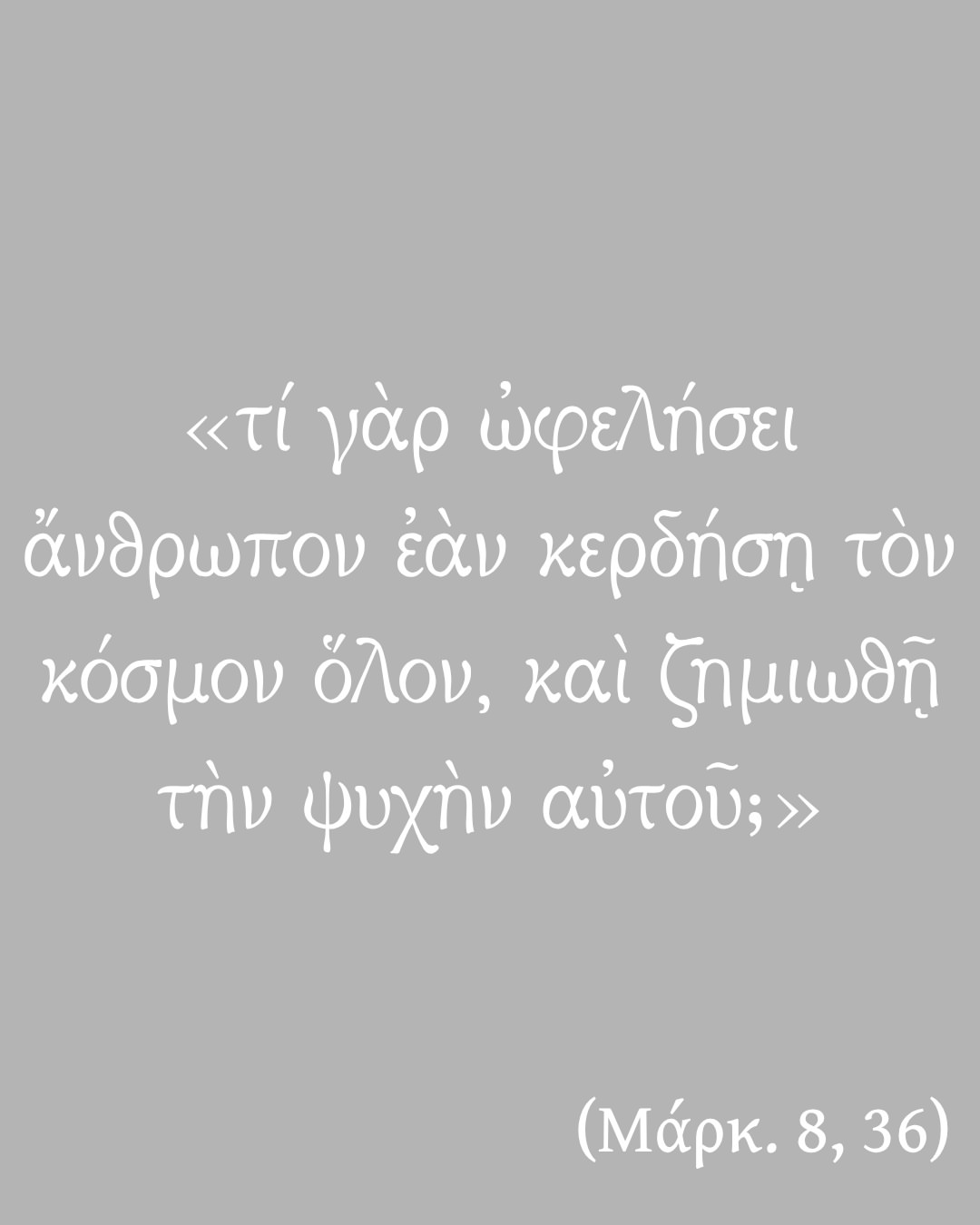
What profit if you gain the world but lose your soul?

The post presents Christ's question from Mark 8:36 about the value of gaining the whole material world while losing one's soul. The verse states that the soul, being spiritual and eternal, cannot be compared to any material good of this perishable world. The brief interpretation accompanying the image comes from the book "The New Testament with Brief Interpretation" by the late Professor Panagiotis N. Trembelas of the Theological School of the…

The post presents Christ's question from Mark 8:36 about the value of gaining the whole material world while losing one's soul. The verse states that the soul, being spiritual and eternal, cannot be compared to any material good of this perishable world. The brief interpretation accompanying the image comes from the book "The New Testament with Brief Interpretation" by the late Professor Panagiotis N. Trembelas of the Theological School of the University of Athens and the Brotherhood of Theologians "O Soter," 11th edition published May 2025 in Athens.

  • Christ's question from Mark 8:36 on worldly gain versus the soul
  • The soul is spiritual and eternal, not comparable to material goods
  • Interpretation sourced from Trembelas and the "O Soter" brotherhood
  • Book edition: 11th, May 2025, Athens
Read more

Elder Filimon on screens, fasting, and artificial intelligence

The post shares a YouTube video from the Association of Friends of Mount Athos Heraklion featuring Gerontas Filimon, the righteous of the Holy Communal Pantocrator Skete of Prophet Elijah on Mount Athos. In the video, Gerontas Filimon recalls an elder who said the true fast is not abstaining from meat but avoiding the screen for a day. That elder promised communion to anyone who could give up television, even if they ate meat. The speaker…

The post shares a YouTube video from the Association of Friends of Mount Athos Heraklion featuring Gerontas Filimon, the righteous of the Holy Communal Pantocrator Skete of Prophet Elijah on Mount Athos. In the video, Gerontas Filimon recalls an elder who said the true fast is not abstaining from meat but avoiding the screen for a day.

That elder promised communion to anyone who could give up television, even if they ate meat. The speaker observes that today everyone, young and old, watches screens that show lies, and not everything seen is true, especially with artificial intelligence being pushed on people. He acknowledges that AI has many good things, but warns that we must avoid the trap of virtual reality.

He says we should have images, but images of God. The video is available on the association's YouTube channel.

Key moments

  1. The best fast is not eating meat but not looking at the tablet for a day.
  2. The Elder said if you avoid television you can eat meat and he will commune you.
  3. The television of that time is referenced.
  4. Now we all, young and old, see lies on screens; not everything is true.
  5. Artificial intelligence is being used to pass things to us.
  6. AI has many good things.
  7. God protect us from falling into the trap of virtual reality.
  8. We should have images, but images of God.

St. Anthony's prideful thought answered by a blind shoemaker

The post shares a story told by Elder Joachim, a monk of the Holy Monastery of Pantokratoros Skete of Prophet Elijah on Mount Athos. The elder recounts how St. Anthony the Great experienced a logismos of pride, wondering whether another ascetic in the desert fasted more strictly than he did. God sent an angel during the night to protect Anthony and show him someone greater. The angel did not lead Anthony deeper into the desert but to Alexandria,…

The post shares a story told by Elder Joachim, a monk of the Holy Monastery of Pantokratoros Skete of Prophet Elijah on Mount Athos. The elder recounts how St. Anthony the Great experienced a logismos of pride, wondering whether another ascetic in the desert fasted more strictly than he did. God sent an angel during the night to protect Anthony and show him someone greater.

The angel did not lead Anthony deeper into the desert but to Alexandria, to a basement where a blind shoemaker lived. The shoemaker explained that he worked humbly, producing ten eggs each day. He gave five eggs to the poor and kept five for his children.

Anthony was humbled by this encounter and ceased the prideful reasoning. The video appears on the YouTube channel "Friends of Byzantine Music" with a link provided. The post includes hashtags referencing logismoi, pride, faith, St. Anthony the Great, Christianity, Orthodoxy, Elder Joachim, and the Holy Skete of Prophet Elijah on Mount Athos.

Key moments

  1. The reasoning of pride is terrifying.
  2. The speaker refers to the Great Anthony, his fellow disciple, to explain the logismos of pride.
  3. Anthony himself had the thought: is there a greater ascetic who fasts more than he does?
  4. God sent an angel at night to protect him and show him someone greater.
  5. The angel took Anthony to Alexandria, not the inner desert.
  6. In a basement they met a blind shoemaker, a man of God.
  7. The shoemaker explained he works humbly, produces ten eggs daily, gives five to the poor and five to his children.
  8. Anthony was humbled and no longer entertained the prideful reasoning.
Read more

The Tears of Repentance: Elder Philemon on Tears as a Second Baptism

Elder Philemon, Dikaios of the Holy Koinobiotic Skete of the Prophet Elias of Pantokrator on Mount Athos, speaks about tears of repentance in a video published by the Holy Church of Saint Demetrios in the Municipality of Agiou Dimitriou. He calls tears the second baptism: when we repent and weep, God sees it. To show what this means, he tells a story about a father who was about to leave the world and asked those around him to bring him a gift.…

Elder Philemon, Dikaios of the Holy Koinobiotic Skete of the Prophet Elias of Pantokrator on Mount Athos, speaks about tears of repentance in a video published by the Holy Church of Saint Demetrios in the Municipality of Agiou Dimitriou. He calls tears the second baptism: when we repent and weep, God sees it. To show what this means, he tells a story about a father who was about to leave the world and asked those around him to bring him a gift.

One person brought bread, another brought a glass of cold water, and a third searched and found the tear of a repentant person. The father chose the tear and said, 'This is what I want.' Elder Philemon asks whether this is not a parable: Christ and our God seek from us our repentance and our tears. The video is available in full on YouTube through the link in the post, and the post carries hashtags in Greek and English on tears, repentance, faith, Christianity and Orthodoxy.

Key moments

  1. Tears are the second baptism, because we repent, weep, and God sees it.
  2. A father, about to leave the world, asked for a gift from each person.
  3. One brought bread, another a glass of cold water, and a third found the tear of a repentant person.
  4. The father chose the tear, saying, 'This is what I want.'
  5. The speaker says this is like a parable: Christ seeks our repentance and our tears.
Read more