WeOrthodox
EN UA

Eastern Orthodoxy Daily He/Who/Is

Instagram ↗ 112 discussions

Scripture, Saints & Satire Left Rome for Home 📍Illinois USA📍 ╬☦️ Dyophysite Eastern Orthodox ☦️╬

Coldest Sayings from the Orthodox Nous challenges modern Christianity
The post introduces a collection titled "The Coldest Sayings from the Orthodox Nous" featuring words from Orthodox fathers, saints, and elders. These sayings challenge modern Christianity, expose theological contradictions, and call believers back to the faith once delivered to the saints. The text makes three assertions: not every truth is comfortable, not every popular teaching is apostolic, and not every claim to follow Scripture represents a…

The post introduces a collection titled "The Coldest Sayings from the Orthodox Nous" featuring words from Orthodox fathers, saints, and elders. These sayings challenge modern Christianity, expose theological contradictions, and call believers back to the faith once delivered to the saints. The text makes three assertions: not every truth is comfortable, not every popular teaching is apostolic, and not every claim to follow Scripture represents a continuation of the early Church's faith.

The post poses a central question: whether what we believe has been received, preserved, and lived within the Holy Tradition of the One, Holy, Catholic, and Apostolic Church. A supporting quote states: "The Church is not a museum of dead doctrines, but the living Body of Christ." The post identifies its themes as Holy Tradition, Apostolic Faith, and the Orthodox Mind.

  • Collection of sayings from Orthodox fathers, saints, and elders
  • Sayings challenge modern Christianity and expose theological contradictions
  • Not every popular teaching is apostolic or continues early Church faith
  • Central question: whether beliefs are received and lived within Holy Tradition
  • Quote: "The Church is not a museum of dead doctrines, but the living Body of Christ"
Read more

Saint Paisios on the speed of pride and humility

0:07

The post shares a saying attributed to Saint Paisios of Mount Athos. He states that Lucifer's fall from angel to devil did not take hours but only a few seconds. In the same way, a person can become like an angel or like a devil in a single second by choosing pride or choosing humility. The saint adds that the easiest way to be saved is through love and humility.

Key moments

  1. 0:05 The crowd chants "¡Viva la Virgen de la Macarena!" repeatedly.
Read more

Christ's Warning on Wealth: The Rich Young Ruler

2:23

The video presents Mark 10:17-27. A rich young man runs to Jesus and asks what he must do to inherit eternal life. Jesus lists several commandments. The man says he has kept them from youth. Jesus then tells him to sell all he has, give to the poor, and follow him. The man goes away sorrowful because he had great possessions. Jesus tells the disciples how hard it is for the rich to enter the kingdom of God. He says it is easier for a camel to go…

The video presents Mark 10:17-27. A rich young man runs to Jesus and asks what he must do to inherit eternal life. Jesus lists several commandments. The man says he has kept them from youth. Jesus then tells him to sell all he has, give to the poor, and follow him.

The man goes away sorrowful because he had great possessions. Jesus tells the disciples how hard it is for the rich to enter the kingdom of God. He says it is easier for a camel to go through the eye of a needle than for a rich man to enter the kingdom.

When the disciples ask who can be saved, Jesus replies that with God all things are possible. The speaker notes that Christ saw the man's heart was captive to wealth despite his outward righteousness. Christ looked at him and loved him before asking him to surrender his possessions, not to punish but to free him.

The Orthodox perspective emphasizes detachment from worldly possessions and placing Christ above all things.

Key moments

  1. 0:00 The video opens with Mark 10:17 where a rich young man runs to Jesus and asks what he must do to inherit eternal life.
  2. 0:32 Jesus lists several commandments and the man says he has kept them from youth; Jesus then tells him to sell all he has, give to the poor, and follow him.
  3. 1:17 The man goes away sorrowful because he had great possessions, and Jesus tells the disciples how hard it is for the rich to enter the kingdom of God.
  4. 1:50 Jesus says it is easier for a camel to go through the eye of a needle than for a rich man to enter the kingdom, and when the disciples ask who can be saved he replies that with God all things are possible.
  5. 2:20 The speaker notes that Christ saw the man's heart was captive to wealth despite his outward righteousness.
Read more
Eastern Orthodoxy Daily He/Who/Is Instagram

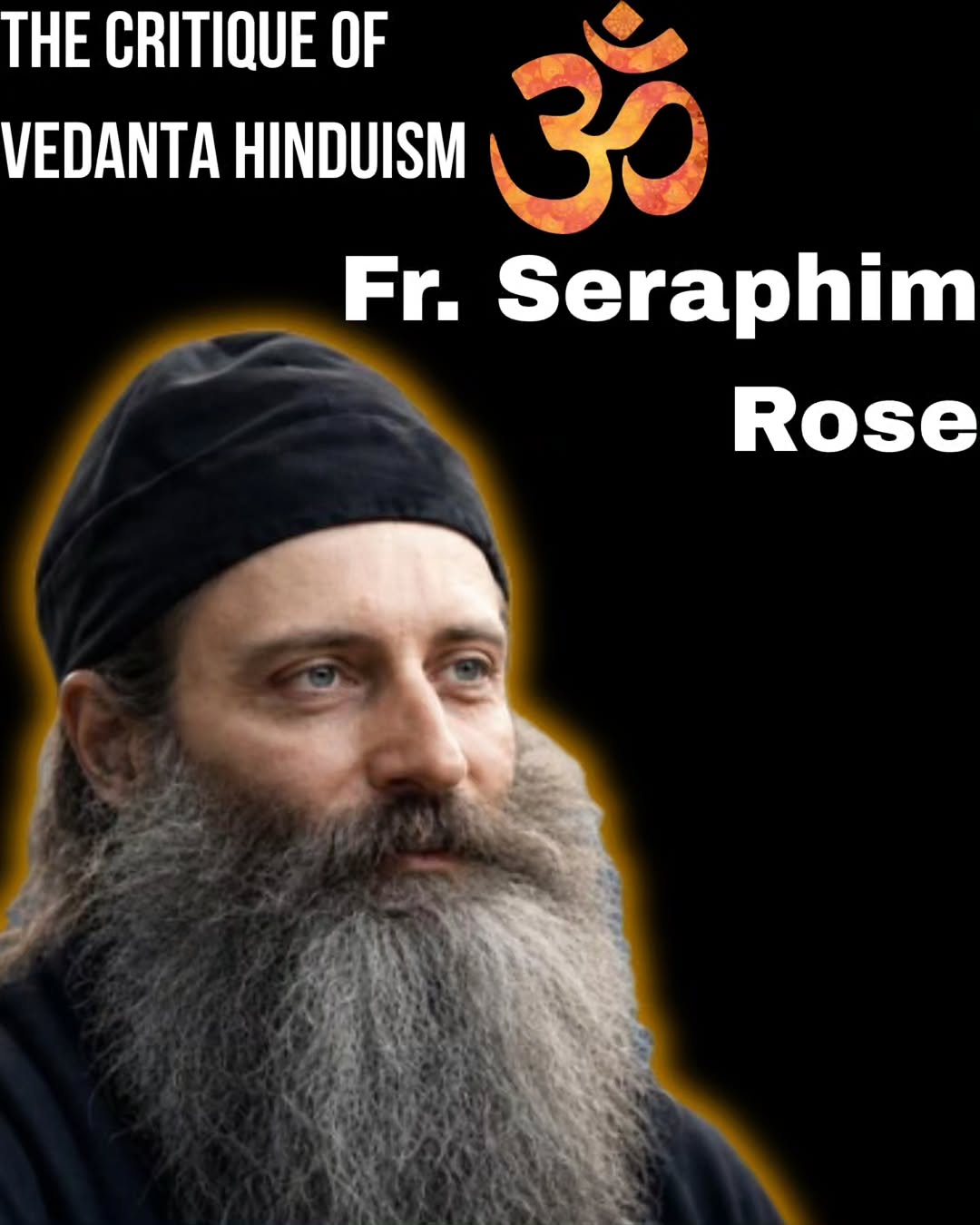
Fr. Seraphim Rose's critique of Vedanta in "The Power of the Pagan Gods"

The post recommends Fr. Seraphim Rose's book and highlights Chapter II, "The Power of the Pagan Gods," which examines the Vedanta School. The author expected layman-level material but found the chapter engages deeply with metaphysical and epistemological problems in Vedanta. An Amazon link is provided for purchasing the book.

  • Fr. Seraphim Rose critiques the Vedanta School in Chapter II of his book
  • The chapter is titled "The Power of the Pagan Gods"
  • The analysis covers metaphysical and epistemological issues
  • The author found the material more rigorous than expected
  • An Amazon purchase link is included
Read more

Once a sheep of the world, now His: a short confession of faith

The author writes a short personal confession about leaving behind the desire to fit in with the crowd. They state that they no longer follow the crowd but follow Christ, and that they no longer seek acceptance from people but acceptance from Him. The author adds that they no longer live for this world but live for His Kingdom, and describes their former life as having been a sheep of the world, in contrast to belonging to Christ now. The post…

The author writes a short personal confession about leaving behind the desire to fit in with the crowd. They state that they no longer follow the crowd but follow Christ, and that they no longer seek acceptance from people but acceptance from Him. The author adds that they no longer live for this world but live for His Kingdom, and describes their former life as having been a sheep of the world, in contrast to belonging to Christ now.

The post closes with the word Amen and a set of symbols, including a cross. There is no discussion in the thread; the post is a single statement of personal commitment with no replies, questions, or further context given. The language is direct and declarative throughout, built on a series of contrasts: crowd versus Christ, acceptance by people versus acceptance by Him, this world versus His Kingdom, being the world's sheep versus being His.

  • The author no longer follows the crowd but follows Christ.
  • They seek acceptance from Christ rather than from people.
  • They say they no longer live for this world but for His Kingdom.
  • They describe their former self as a sheep of the world and now as belonging to Christ.
  • The post is a single statement of faith with no discussion or replies.
Read more

Seventh Council and the distinction between veneration and worship

1:04

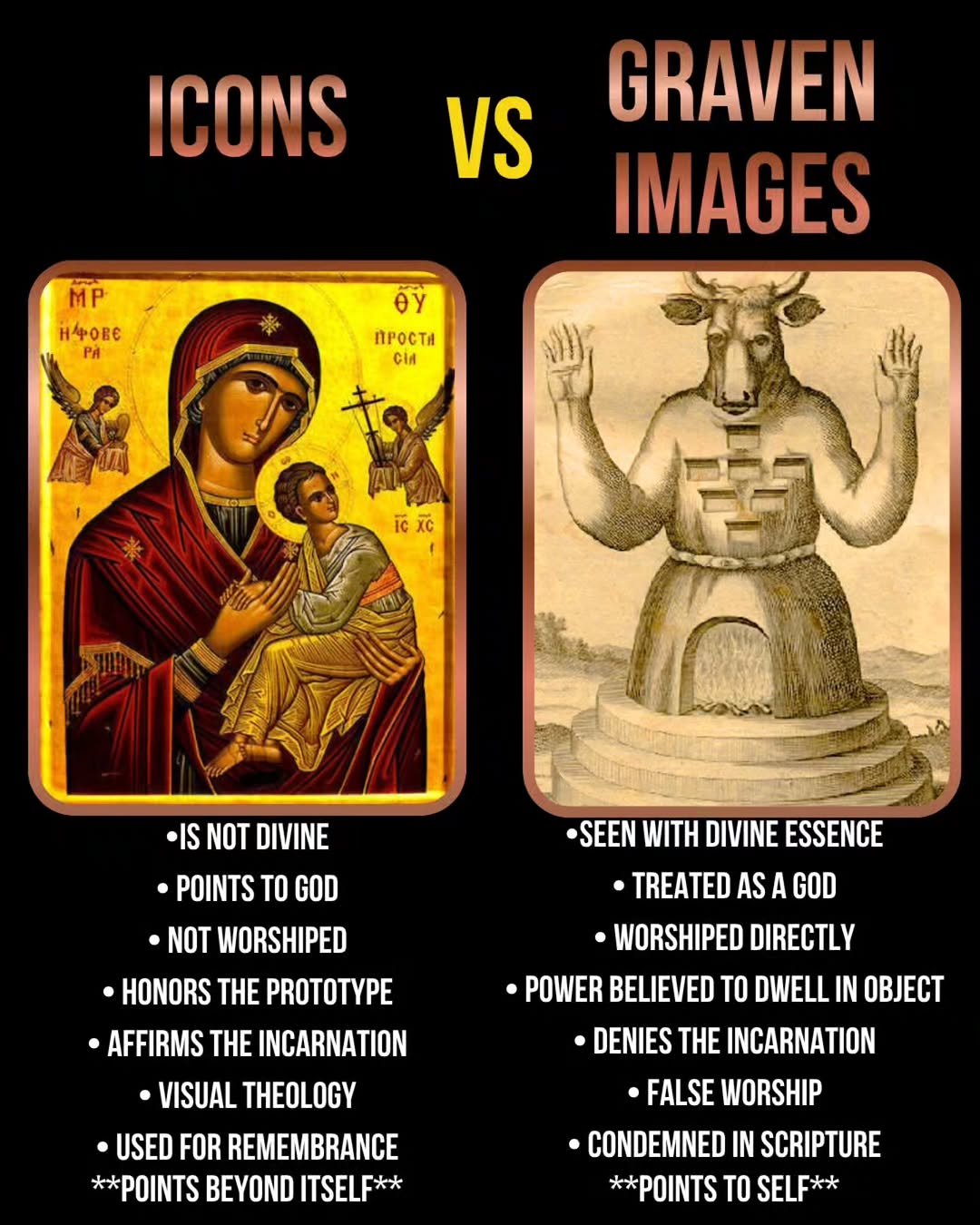
The speaker addresses the biblical prohibition against making images for bowing down, found in the Ten Commandments, and contrasts it with the Seventh Ecumenical Council's decree that Christians must bow down to images. He argues that the iconoclastic position commits two category errors. First, the second commandment forbids idolatry, making an image and worshipping it as God, not images in general, since God later commanded golden cherubim for…

The speaker addresses the biblical prohibition against making images for bowing down, found in the Ten Commandments, and contrasts it with the Seventh Ecumenical Council's decree that Christians must bow down to images. He argues that the iconoclastic position commits two category errors. First, the second commandment forbids idolatry, making an image and worshipping it as God, not images in general, since God later commanded golden cherubim for the ark.

Second, veneration differs from worship; Scripture distinguishes acts of honor from the divine adoration owed to God alone. Orthodox Christians venerate the person depicted in an icon without offering sacrifice or divine adoration. The Seventh Council separated honor from true worship due to the divine nature.

The speaker contends that collapsing the distinction between icon and idol or veneration and worship fails to refute iconography and reveals a low view of worship.

Key moments

  1. The speaker references the biblical prohibition against making images to bow down to, found in the Ten Commandments.
  2. The speaker states the Seventh Ecumenical Council said "You must bow down to images."
  3. The iconoclastic argument makes two basic category errors.
  4. First error: the second commandment prohibits idolatry, making an image and worshipping it as God, not images in general; evidenced by God commanding golden cherubim for the ark five chapters later.
  5. Second error: veneration is not worship; Scripture distinguishes acts of honor and reverence from the worship owed uniquely to God.
  6. Orthodox Christians do not offer icons sacrifice or divine adoration; they venerate the person depicted.
  7. The Seventh Ecumenical Council distinguished honor from the true worship owed to the divine nature alone.
  8. Inability to distinguish an icon from an idol or veneration from worship collapses categories Scripture already distinguished and shows a low view of worship.
16 opinions in the discussion They say it's idol worship bc they don't even show God the same honor we show Saints. So ofc to them it looks like worship😂 Read the discussion
Eastern Orthodoxy Daily He/Who/Is Instagram

Fourteen Orthodox Churches and a Catechism That Isn't for Everyone

0:29

The speaker, an Orthodox Christian, opens by saying he is tired of a certain style of Catholic apologetics, which he calls papal slop apologetics. He then makes a structural argument about church organization. In his view there is no single Eastern Orthodox Church; there are 14, one for each patriarch, each with its own structure. He sets this against the Catholic side, where the Catechism of the Catholic Church, promulgated by John Paul II,…

The speaker, an Orthodox Christian, opens by saying he is tired of a certain style of Catholic apologetics, which he calls papal slop apologetics. He then makes a structural argument about church organization. In his view there is no single Eastern Orthodox Church; there are 14, one for each patriarch, each with its own structure.

He sets this against the Catholic side, where the Catechism of the Catholic Church, promulgated by John Paul II, functions as a common reference text. He argues that the book's title is misleading and that it should be called the catechism of the Roman Catholic Church, since it is written for Roman Catholic readers rather than for all Catholics.

The speaker anticipates the objection that Catholics are bound to accept the catechism as authoritative over other sources of teaching, and he answers that this is not how Catholics understand themselves or their own tradition. The discussion therefore turns on two questions: how the Orthodox churches are organized in relation to their patriarchs, and how the authority of a catechism works within Catholicism.

The speaker's point is that comparisons between the two traditions often misstate both sides, treating Orthodoxy as one centralized body and treating the catechism as a universal binding code, when in his account neither description matches the self-understanding of the traditions involved. The post is framed as a complaint about apologetics content that, in his view, keeps repeating these inaccuracies.

Key moments

  1. 0:00 There is no single Eastern Orthodox Church; there are 14, matching the number of patriarchs.
  2. 0:00 The Catechism of the Catholic Church was promulgated by John Paul II and should be called the catechism of the Roman Catholic Church, since it is written for Roman Catholic readers.
  3. 0:00 The speaker expects objections that Catholics must accept the catechism over other things, and says that is not the Catholic self-understanding.
Read more
Eastern Orthodoxy Daily He/Who/Is Instagram

Unity Without Truth Is Not True Unity

The author argues that Christian unity cannot rest on doctrinal compromise or on the claim that all faiths and teachings are equally true. The Orthodox Church, in this view, is called to preserve the Apostolic Faith, uphold the truth of the Gospel, and remain faithful to what has been handed down through Holy Tradition. The post warns against treating love and unity as reasons to abandon the truth, and closes with the statement that unity…

The author argues that Christian unity cannot rest on doctrinal compromise or on the claim that all faiths and teachings are equally true. The Orthodox Church, in this view, is called to preserve the Apostolic Faith, uphold the truth of the Gospel, and remain faithful to what has been handed down through Holy Tradition. The post warns against treating love and unity as reasons to abandon the truth, and closes with the statement that unity without truth is not true unity.

The text is a short confessional statement rather than a discussion thread: it sets out a position on ecumenism and doctrinal relativism without citing specific events, documents, or dialogues. Its core claims are that truth and unity are inseparable, that compromise on doctrine is a false path to unity, and that fidelity to Holy Tradition takes precedence over agreement at any cost.

  • Christian unity cannot be built on doctrinal compromise or on the belief that all faiths are equally true.
  • The Orthodox Church is called to preserve the Apostolic Faith and the truth of the Gospel.
  • Fidelity to the teachings handed down through Holy Tradition is presented as a duty.
  • Love and unity must not become excuses for abandoning the truth.
  • The author concludes that unity without truth is not true unity.
Read more

Street evangelist Bryce Crawford tells a stranger what he 'senses' about his past

The post asks whether Bryce Crawford has always done what the poster calls the mind reading prophet thing, tagging it with orthodox, protestant, orthodoxchristian, apologetics and christianreels. The clip shows Crawford, a street evangelist, approaching a young man and telling him he senses in his heart that the man lost a friend between the ages of 8 and 10. He asks whether that is true, says he is going to check on him, calls him Tupac, and…

The post asks whether Bryce Crawford has always done what the poster calls the mind reading prophet thing, tagging it with orthodox, protestant, orthodoxchristian, apologetics and christianreels. The clip shows Crawford, a street evangelist, approaching a young man and telling him he senses in his heart that the man lost a friend between the ages of 8 and 10. He asks whether that is true, says he is going to check on him, calls him Tupac, and gives him a hug.

When the young man asks how he could know that, Crawford answers that he does not know, and that Jesus sees the man in his pain. He then asks the young man what he thinks about it. The question in the post invites viewers to weigh this style of evangelism: whether such statements about a stranger's private grief are a legitimate way of pointing someone to Christ, or a performance that borrows the language of prophecy.

The tags suggest the audience for the debate includes both Orthodox and Protestant Christians interested in apologetics, and the poster's phrasing hints at skepticism about the practice. The clip itself does not resolve the question; it only records the encounter and Crawford's own explanation, which attributes the knowledge to Jesus rather than to himself.

Key moments

  1. Bryce Crawford tells a young man he heard in his heart that the man lost a friend when he was 8 to 10 years old, and asks if it is true.
  2. He says he is going to go check on the man, calls him Tupac, and gives him a hug.
  3. Asked how he could know that, he says he does not know, and that it is because Jesus sees the man in his pain.
  4. He asks the young man what he thinks about this.
21 opinions in the discussion "When you were 8 to 10 years old". That's exactly how psychics and mediums work. A two-year window is not the kind of accuracy you see when the Holy Spirit actually operates. Read the discussion

Kissing Icons in Athens: Answering the Charge of Shirk from Exodus

A man whispers inside a church in Athens, where people are praying, and takes up the objection that kissing icons violates Exodus 20:3-5, which forbids making images and bowing to them. He notes that the first thing Christians do on entering the church is kiss the icons. A Muslim caller had told him the practice is an innovation and shirk, and he answers the charge directly. His first argument is that Muhammad found images of Mary and Jesus in…

A man whispers inside a church in Athens, where people are praying, and takes up the objection that kissing icons violates Exodus 20:3-5, which forbids making images and bowing to them. He notes that the first thing Christians do on entering the church is kiss the icons. A Muslim caller had told him the practice is an innovation and shirk, and he answers the charge directly.

His first argument is that Muhammad found images of Mary and Jesus in the Kaaba and did not destroy them. He then turns to Scripture and cites Exodus 25, where God commands Moses to make images of cherubim and place them on the Ark of the Covenant. He reads Exodus 20 as a prohibition against idolatry rather than against images as such, and points to the golden calf episode in Exodus 32 as the example of what God condemned.

He adds a third biblical example: in Numbers 21 God told Moses to make a bronze serpent so that the people who looked at it would be healed. He says Jesus alluded to that serpent as a type of himself on the cross. The video moves quickly between the church setting, the caller's objection, and the biblical texts, keeping the focus on whether the command in Exodus 20 rules out the veneration Christians show to icons.

The examples from the Kaaba, the Ark, and the bronze serpent are the core of his case, and each one is meant to show a difference between honoring an image connected to God's work and worshiping an image as a god.

Key moments

  1. 0:00 The speaker is in a church in Athens and whispers because people are praying there; he quotes Exodus 20:3-5 forbidding images and worshiping them, and says the first thing one does entering the church is kiss the icons.
  2. 0:33 He answers a Muslim who calls the practice an innovation and shirk, saying Muhammad found a picture of Mary and Jesus in the Kaaba and did not destroy it.
  3. 1:06 He cites Exodus 25, where God commands Moses to make images of the cherubim and place them on the Ark of the Covenant.
  4. 1:46 He says Exodus 20 was a prohibition against idolatry, shown by God's displeasure with the golden calf in Exodus 32.
25 opinions in the discussion "I was an Orthodox Christian" **Proceeds to read Exodus and skip Orthodox History** Read the discussion