WeOrthodox
EN UA

Disgruntled Docs

Instagram ↗ 117 discussions

Doc posting memes ☦️ Reader Nektarios Veteran owned All my opinions are my own

Disgruntled Docs with ☦︎ICXC•NIKA☦︎ Instagram

Prayer for Seven Martyrs Killed in Jordan Church Attack

The author lights seven candles in memory of seven martyrs who died in a tragedy at a Greek Orthodox church in Jordan. The post calls for remembrance of their sacrifice and their names, while directing attention above all to the sacrifice of Jesus Christ for the salvation of the world. The author prays for the repose of their souls and for their memory to be eternal, affirming that they bore witness to Christ and received a crown of martyrdom as…

The author lights seven candles in memory of seven martyrs who died in a tragedy at a Greek Orthodox church in Jordan. The post calls for remembrance of their sacrifice and their names, while directing attention above all to the sacrifice of Jesus Christ for the salvation of the world. The author prays for the repose of their souls and for their memory to be eternal, affirming that they bore witness to Christ and received a crown of martyrdom as testimony of faithfulness unto death.

The text concludes with a doxology and the phrase "Memory Eternal" in Greek, Arabic, and English.

  • Seven candles lit for seven martyrs killed at a Greek Orthodox church in Jordan
  • Remembrance of their sacrifice and names linked to Christ's sacrifice
  • Prayer for eternal rest and memory eternal
  • Affirmation of their martyrdom as witness to Christ
  • Trilingual "Memory Eternal" in Greek, Arabic, and English
Read more

Fr. Spyridon Bailey on humility as foundation of virtues and peacemaking

Fr. Spyridon Bailey explains that Jesus begins the Beatitudes with "blessed are the poor," establishing humility as the foundation of all virtues. He notes that both Satan and Adam fell through pride, while Jesus raises humanity up through humility. To acquire this humility, each person must build into their life a time of separation for prayer and time alone with God, because true change cannot happen without time with God. Fr. Spyridon also…

Fr. Spyridon Bailey explains that Jesus begins the Beatitudes with "blessed are the poor," establishing humility as the foundation of all virtues. He notes that both Satan and Adam fell through pride, while Jesus raises humanity up through humility. To acquire this humility, each person must build into their life a time of separation for prayer and time alone with God, because true change cannot happen without time with God.

Fr. Spyridon also addresses the beatitude "blessed are the peacemakers," clarifying that it refers not simply to those at peace within themselves but to those who bring peace to others and to the world. He calls listeners to examine the effects they have on other people, asking whether those who encounter them leave angry and agitated or with peace.

Key moments

  1. Jesus begins the Beatitudes with "blessed are the poor," establishing humility as the foundation of all virtues.
  2. Both Satan and Adam fell through pride, and Jesus raises us up through humility.
  3. Everyone must build into their lives a time of separation for prayer and time alone with God to acquire humility.
  4. We cannot truly change unless we have time with God.
  5. Jesus says "blessed are the peacemakers", not those at peace within themselves, but those who bring peace to others and the world.
  6. This is a calling to examine the effects we have on other people.
  7. We must look at our lives closely and ask how we are affecting other people.
  8. When people encounter us, we must ask whether they leave angry and agitated or with peace.
Read more
Disgruntled Docs with Trust God ☦︎︎︎ Instagram

Saints warn against false doctrine under pretext of love

The post presents a collection of quotations from four Orthodox saints addressing the relationship between doctrinal integrity and Christian love. Saint Paisios of the Holy Mountain recounts an encounter with two Catholic visitors, a journalist and a Vatican secretary, who proposed saying the Lord's Prayer together. He declined, stating that doctrinal agreement is required for common prayer, because between them there is a great chasm. When they…

The post presents a collection of quotations from four Orthodox saints addressing the relationship between doctrinal integrity and Christian love. Saint Paisios of the Holy Mountain recounts an encounter with two Catholic visitors, a journalist and a Vatican secretary, who proposed saying the Lord's Prayer together. He declined, stating that doctrinal agreement is required for common prayer, because between them there is a great chasm.

When they asked whether only Orthodox Christians would be saved, since God is with all people, he replied by asking how many people are with God. A second saying attributed to Saint Paisios identifies three demonic tentacles: communism for the poor, ecumenism for the faithful, and freemasonry for the rich. Saint John Chrysostom is cited with the maxim not to accept any false doctrine under the pretext of love.

Saint Justin Popovich describes ecumenism as the common name for the pseudo-Christianity of the pseudo-Churches of Western Europe, rooted in European humanism with the papacy at its head, and calls each such church a heresy. Saint Nicholas Velimirovich distinguishes between reconciliation of people and reconciliation of religions, affirming the command to love all people even to the point of giving one's life for them while insisting that Christ's truths must remain unscathed because they are not human property to do with as one pleases.

  • St. Paisios refuses joint prayer with Catholics, citing doctrinal chasm
  • St. Paisios questions how many people are with God when asked about salvation outside Orthodoxy
  • St. John Chrysostom warns against accepting false doctrine under pretext of love
  • St. Justin Popovich denounces ecumenism as pseudo-Christianity and heresy
  • St. Nicholas Velimirovich separates love for people from compromise of Christ's truths
Read more

Saint John of Shanghai and San Francisco: A Life of Prayer and Care for Children

The video presents the life of Saint John of Shanghai and San Francisco, recognized as San Francisco's own Christian saint. He devoted himself to prayer, frequently giving up sleep to spend more time with God. While serving in Shanghai, he personally cared for over 1,500 abandoned and needy children, rescuing sick and starving children from the streets. He reposed in 1966, and his relics remain in San Francisco today. The video concludes that…

The video presents the life of Saint John of Shanghai and San Francisco, recognized as San Francisco's own Christian saint. He devoted himself to prayer, frequently giving up sleep to spend more time with God. While serving in Shanghai, he personally cared for over 1,500 abandoned and needy children, rescuing sick and starving children from the streets.

He reposed in 1966, and his relics remain in San Francisco today. The video concludes that his life demonstrates the path to holiness begins when we stop living for ourselves and start living completely for Jesus Christ.

Key moments

  1. San Francisco has its own Christian saint, Saint John of Shanghai and San Francisco.
  2. He dedicated his life to prayer and often sacrificed sleep to spend more time with God.
  3. He personally helped care for more than 1,500 abandoned and needy children in Shanghai.
  4. He rescued sick and starving children from the streets.
  5. He reposed in 1966.
  6. His relics remain in San Francisco to this day.
  7. Saint John reminds us that the path to holiness begins when we stop living for ourselves and start living completely for Jesus Christ.
Read more

Saints in Heaven Are Alive: Transfiguration and Revelation Show Conscious Intercession

0:28

The speaker addresses the objection that praying to saints is praying to dead people, acknowledging that Mary and the apostles have died. He cites Ecclesiastes, which says the dead know nothing, but counters with the Transfiguration, where Moses appears alive and speaks with Jesus despite his earthly death. Jesus declares that he is the God of the living, not the dead. The Book of Revelation depicts saints in heaven consciously crying out to…

The speaker addresses the objection that praying to saints is praying to dead people, acknowledging that Mary and the apostles have died. He cites Ecclesiastes, which says the dead know nothing, but counters with the Transfiguration, where Moses appears alive and speaks with Jesus despite his earthly death. Jesus declares that he is the God of the living, not the dead.

The Book of Revelation depicts saints in heaven consciously crying out to God, asking him to act on earth. From these passages, the speaker concludes that the saints are conscious and interceding, and that asking for their intercession is more apostolic than relying on the canon alone.

Key moments

  1. Mary and the apostles are dead people, yet Christians pray to them.
  2. Scripture says the dead know nothing, referencing Ecclesiastes.
  3. Moses physically spoke with Jesus at the Transfiguration despite his earthly death.
  4. Jesus says he is the God of the living, not the dead.
  5. In Revelation, saints in heaven cry out to God asking him to act on earth.
  6. This shows the saints are conscious and interceding.
  7. Asking saints to intercede for us is more apostolic than the canon.
Read more

St. Joseph the Hesychast: Ascetic Struggle and the Jesus Prayer

The post presents the life and teachings of St. Joseph the Hesychast, a 20th-century Athonite monk known for his dedication to the Jesus Prayer. It describes his years of intense ascetic struggle, including physical hardships, sleepless nights, and spiritual trials, which he endured through faith and obedience to his spiritual elders. For St. Joseph, hesychasm was not merely outward solitude but an inner life of constant communion with God. He…

The post presents the life and teachings of St. Joseph the Hesychast, a 20th-century Athonite monk known for his dedication to the Jesus Prayer. It describes his years of intense ascetic struggle, including physical hardships, sleepless nights, and spiritual trials, which he endured through faith and obedience to his spiritual elders.

For St. Joseph, hesychasm was not merely outward solitude but an inner life of constant communion with God. He taught his disciples that prayer requires patience, humility, and complete trust in divine grace. His disciples later helped renew monastic life on Mount Athos and spread his spiritual legacy throughout the Orthodox world.

The post includes seven sayings attributed to St. Joseph: an acknowledgment of sin and God's mercy; a reminder that the heavenly Father is always near; an explanation that temptation tests zeal and love for God; a reflection on the heaviness of the cross and the inevitability of falling; a call to surrender one's own will as a barrier to divine illumination; and a statement linking purification from passions to peace, wisdom, and understanding of God.

A black-and-white photograph shows an elderly monk with a long beard, hooded robe, walking stick, and prayer beads. The image also bears a Ukrainian inscription identifying St. Joseph the Hesychast. The post comes from a page dedicated to the Church Fathers and their teachings.

His life reminds us that holiness is not attained through worldly greatness but through self-denial, repentance, and a heart wholly devoted to Christ. In the silence of the wilderness he sought God; through ascetic struggle he pursued purity of heart; and through unceasing prayer he bore witness to the transforming grace of Jesus Christ.

  • St. Joseph the Hesychast devoted himself to the Jesus Prayer through years of ascetic struggle.
  • He taught that hesychasm is an inner stillness and constant communion with God, requiring patience, humility, and trust in grace.
  • His disciples contributed to the renewal of monastic life on Mount Athos and spread his legacy across the Orthodox world.
  • The post includes seven quotes from St. Joseph on repentance, God's nearness, temptation, the cross, surrendering the will, and purification from passions.
  • A photograph shows the saint as an elderly monk with prayer beads, accompanied by a Ukrainian inscription.
Read more
Disgruntled Docs Instagram discussion

Don't give in to despair; seek help and find hope in God

I miss my brother. I wish I could have done more for him. He left behind his wife and daughter. Don't give in to the struggle against the demons. Please seek help and support if you need it. Your life is worth living. I have walked that road and it only leads to more pain. I have found that even in the darkest moments when I cried out to God for help, He pulled me out of the darkness. There is hope, but it is a long road ahead. To all the…

I miss my brother. I wish I could have done more for him. He left behind his wife and daughter. Don't give in to the struggle against the demons. Please seek help and support if you need it. Your life is worth living. I have walked that road and it only leads to more pain.

I have found that even in the darkest moments when I cried out to God for help, He pulled me out of the darkness. There is hope, but it is a long road ahead. To all the military brothers, stay strong, and if you need anything, please send me a message or go into an Orthodox church.

5 opinions in the discussion "Cast thy burden upon the LORD, and he shall sustain thee: He shall never suffer the righteous to be moved." Psalm 55:22 KJV "Casting all your care upon him; for he careth for you." 1 Peter… Read the discussion

Debating the Canon: Scripture, Archaeology, and External Evidence

0:19

A challenger asks how one can know Scripture is true without appealing to Scripture itself, arguing that Scripture cannot prove itself. The respondent points to archaeology as a literal science and to manuscript evidence that would be admissible in a court of law. The challenger replies that archaeology does not establish what the canon is, and claims this demonstrates the limits of external evidence.

Key moments

  1. The challenger asks how one knows scripture is true outside of scripture, stating scripture cannot prove itself.
  2. The respondent appeals to archaeology as a literal science and manuscript evidence admissible in a court of law.
  3. The challenger counters that no archaeology establishes what the canon is, claiming this proves their point.
Read more

Saint Seraphim of Sarov: Life, Teaching, and the Acquisition of the Holy Spirit

The post presents a biographical overview of Saint Seraphim of Sarov (1754-1833), one of the most beloved saints of the Eastern Orthodox Church. It describes his early devotion to Christ, monastic life, and years of ascetic struggle in the forests of Sarov. The text notes his brutal attack by robbers and his response of humility and forgiveness. Later in life, he welcomed countless visitors seeking spiritual guidance, greeting them with the…

The post presents a biographical overview of Saint Seraphim of Sarov (1754-1833), one of the most beloved saints of the Eastern Orthodox Church. It describes his early devotion to Christ, monastic life, and years of ascetic struggle in the forests of Sarov. The text notes his brutal attack by robbers and his response of humility and forgiveness.

Later in life, he welcomed countless visitors seeking spiritual guidance, greeting them with the words "My joy, Christ is risen!" The post highlights his central teaching that "the acquisition of the Holy Spirit is the true aim of the Christian life" and that Christianity is about union with God through grace rather than outward practices alone.

Following the biography, the post lists nine sayings attributed to Saint Seraphim, covering silence, peace, trust in God, endurance of affliction, illness and patience, and the importance of establishing oneself in God before helping others. An image description mentions a painting of the saint kneeling by a stream, and a line in Church Slavonic gives his title. The post originates from a page dedicated to the Church Fathers and their teachings.

  • Saint Seraphim devoted himself to Christ from youth, embracing monasticism, solitude, and unceasing prayer in the Sarov forests.
  • He responded to a brutal robbery attack with humility and forgiveness.
  • His central teaching: the acquisition of the Holy Spirit is the true aim of Christian life.
  • He greeted visitors with "My joy, Christ is risen!" and offered spiritual guidance.
  • The post includes nine attributed sayings on silence, peace, trust, affliction, illness, and establishing oneself in God.
Read more

Salvation requires cooperation with grace, not passive righteousness

0:23

The speaker rejects the claim that a person contributes nothing to salvation. He argues that equating the righteousness of a believer who struggles with sin but has the Holy Spirit with that of any other believer contradicts Scripture's commands to persevere, obey Christ, and not fall away. He describes a scenario where he stands before God next to someone unable to stop drinking yet who has the Holy Spirit, saying both would stand on the same…

The speaker rejects the claim that a person contributes nothing to salvation. He argues that equating the righteousness of a believer who struggles with sin but has the Holy Spirit with that of any other believer contradicts Scripture's commands to persevere, obey Christ, and not fall away. He describes a scenario where he stands before God next to someone unable to stop drinking yet who has the Holy Spirit, saying both would stand on the same level of righteousness under that view.

He references Romans, stating that God will render to each one according to his works. He concludes that salvation cannot be earned but requires free cooperation with God's grace.

Key moments

  1. The speaker states that he contributes zero to his salvation.
  2. He describes standing before God next to someone unable to stop drinking but who has the Holy Spirit, saying both stand on the same level of righteousness.
  3. He says this view contradicts all of Scripture when it tells us to persevere, obey Christ, and not fall away.
  4. He references Romans, stating that God will render each one according to his works.
  5. He concludes that we cannot earn salvation but must freely cooperate with God's grace.
Read more

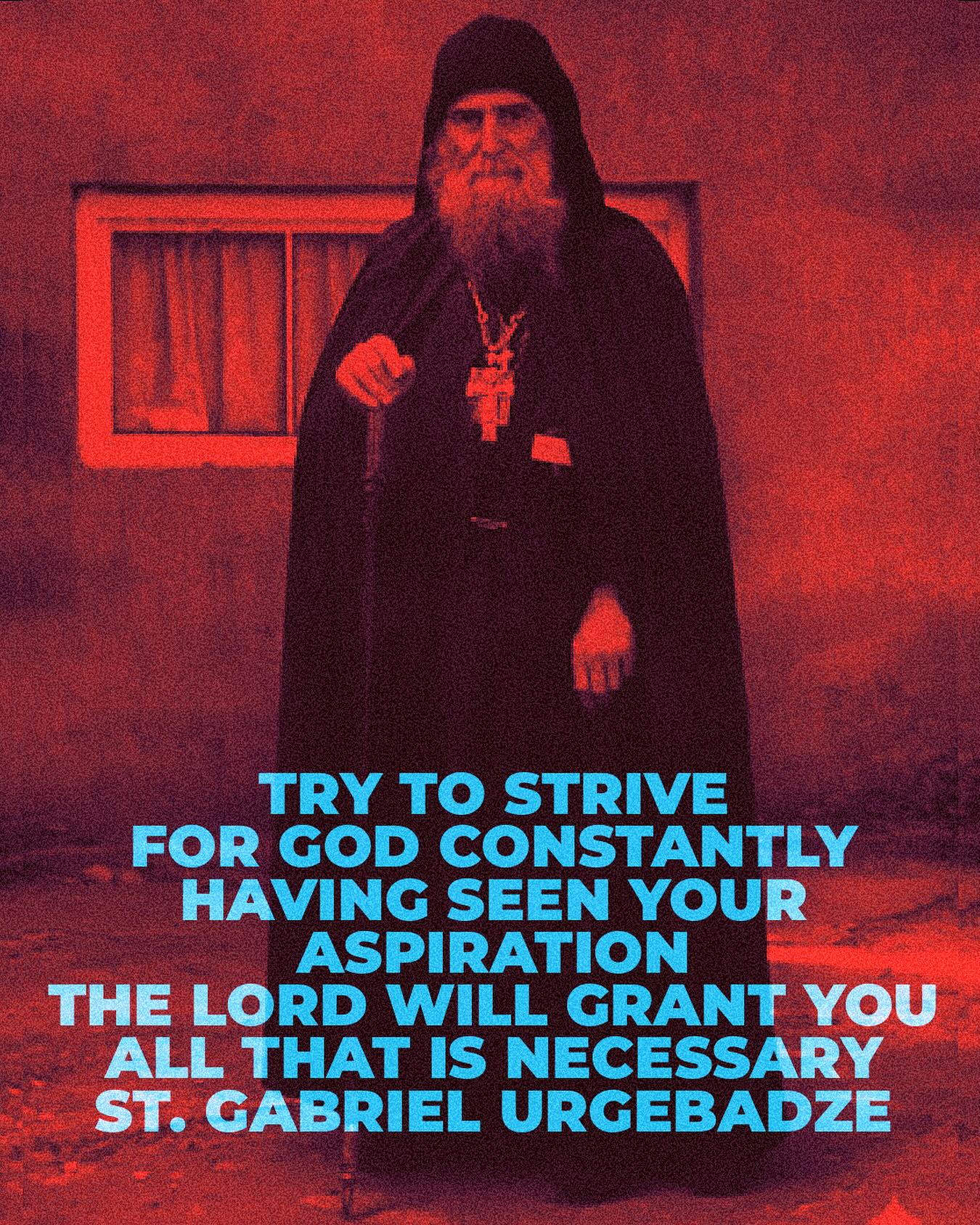
St. Gabriel Urgebadze: Strive for God Constantly

The post shares a saying attributed to St. Gabriel Urgebadze, a Georgian Orthodox saint. The quote reads: "TRY TO STRIVE FOR GOD CONSTANTLY HAVING SEEN YOUR ASPIRATION THE LORD WILL GRANT YOU ALL THAT IS NECESSARY." It encourages believers to maintain continuous effort toward God, with the assurance that God recognizes this aspiration and provides what is needed. No further discussion or commentary is present in the source.

  • Strive for God constantly.
  • The Lord sees your aspiration.
  • He will grant all that is necessary.
  • Attributed to St. Gabriel Urgebadze.
Read more

The Church as Hospital and Heaven: Chrysostom and Germanus on Orthodox Worship

The post presents two patristic quotes and a brief explanation of Orthodox worship. Saint John Chrysostom describes the Church as a hospital for souls rather than a courtroom. The author notes that every icon proclaims the Gospel, every candle represents prayer, and every act of worship draws the faithful closer to Christ.

Saint Germanus of Constantinople teaches that the Church is an earthly heaven in which the heavenly God dwells and walks. The same content appears in Greek translation.

  • Saint John Chrysostom: the Church is a hospital for souls, not a courtroom
  • Icons proclaim the Gospel, candles symbolize prayer, worship draws us to Christ
  • Saint Germanus of Constantinople: the Church is an earthly heaven where God dwells and walks
  • The text is given in English and Greek
Read more
Disgruntled Docs with Orthodox Logos ☦️ Instagram

Saint Paisios' Prophecy on Europe's Future Amid Unrest

The post describes recent widespread demonstrations, violence, and vandalism in France, Italy, and other countries, linking them to cost-of-living crises, housing shortages, and declining disposable income. It states that far-left activists and migrants have taken to the streets in waves of looting and unprecedented destruction of public and private property, and that France has descended into chaos. The author argues that Europe, once…

The post describes recent widespread demonstrations, violence, and vandalism in France, Italy, and other countries, linking them to cost-of-living crises, housing shortages, and declining disposable income. It states that far-left activists and migrants have taken to the streets in waves of looting and unprecedented destruction of public and private property, and that France has descended into chaos.

The author argues that Europe, once predominantly Christian, is moving toward political, economic, spiritual, and social decline because of what is called the suicidal policy of the European Union. The EU is accused of either being unable or unwilling to understand that mass illegal migration of Muslim populations will gradually lead to the Islamisation of the continent.

The post then turns to a prophecy attributed to Saint Paisios, saying that God revealed to him that the nations of Europe will eventually wake up and take the measures necessary to protect their societies, their identity, and their spiritual heritage. A quotation from the book "Elder Paisios" by N. Zournatzoglou, Volume II, first edition, page 359, is provided: "Later, they will understand what is happening and then they will be the first to take measures against them.

You will see what they will do." The image text adds a headline: "Saint Paisios: Forget about those who gather Muslims and build mosques," and notes that the prophetic words spoken to pilgrims more than thirty years ago are more relevant than ever. The post presents the prophecy as a direct response to the current situation.

  • Recent unrest in Europe includes massive demonstrations, looting, and property destruction in France and Italy.
  • The author attributes Europe's decline to EU migration policies that enable Islamisation.
  • Saint Paisios is cited as prophesying that European nations will eventually wake up and take protective measures.
  • The prophecy is sourced from "Elder Paisios" by N. Zournatzoglou, Volume II, page 359.
  • The post frames the prophecy as directly relevant to current events.
Disgruntled Docs with MaximosPTO Instagram

Saint Spyridon: shepherd, bishop, and defender of the Trinity at Nicaea

2:34

The post shares a video recounting the life of Saint Spyridon of Trimythous. Born in Cyprus around 270 AD, he worked as a shepherd, married, and after his wife's death entrusted his daughter to the church and entered monastic life. The video describes his miracles: he halted robbers, parted a stream to save the innocent, had choirs of angels chant during empty divine services, and healed the sick; his generosity and true faith made him widely…

The post shares a video recounting the life of Saint Spyridon of Trimythous. Born in Cyprus around 270 AD, he worked as a shepherd, married, and after his wife's death entrusted his daughter to the church and entered monastic life. The video describes his miracles: he halted robbers, parted a stream to save the innocent, had choirs of angels chant during empty divine services, and healed the sick; his generosity and true faith made him widely known.

His reputation led to his consecration as bishop during the Arian controversy, when followers of Arius denied the divinity of Christ and the Holy Spirit, considering both as creatures. On his way to the Council of Nicaea, Arians decapitated his horses while he slept at an inn; he placed the heads on the bodies, prayed, and the horses were resurrected, though the heads were mixed up and discovered only in the morning.

When Arians bribed shipmasters to block his crossing, he made the sign of the cross, spread his cloak on the water, stepped onto it, and sailed across, arriving before his adversaries. At the council, the Arian advocate Eulogius presented heretical views well, stunning many bishops, but Saint Spyridon stepped forward and proclaimed the Orthodox faith: God created all by his Word and Spirit, the Word is the Son of God who became incarnate, suffered, died, rose, and is of one essence with the Father, a mystery beyond human comprehension.

He took a brick, squeezed it, and in the name of the Father fire burst forth, in the name of the Son water flowed, and in the name of the Holy Spirit dry clay remained; he said the three elements are one brick, just as the Trinity is three persons but one Godhead. The council was astonished, Eulogius accepted his words and acknowledged his error, renounced his heresies in the church, Orthodoxy prevailed, and the Arians were excommunicated.

The caption accompanying the video notes that the saint's relics remain incorrupt after nearly 1700 years and contrasts Orthodox saints with modern pastors and heterodox groups.

Key moments

  1. 0:00 Saint Spiridon was born in Cyprus in 270 AD, was a shepherd from a humble family, married, became a widower, entrusted his daughter to the church community, and entered monastic life.
  2. 0:00 He halted robbers, parted streams to save the innocent, had choirs of angels chant in his empty divine services, and healed the sick, and his generosity and true faith made him incredibly well-known.
  3. 0:31 He became a bishop during the Arian controversy, when the followers of Arius were numerous and refused to acknowledge the divinity of Christ and the Holy Spirit, considering both as creatures.
  4. 0:31 On the road to the Council of Nicaea, the Arians decapitated his horses while he slept at an inn; he placed the heads on the bodies, prayed, and the horses were resurrected, though the heads were mixed up and discovered only in the morning.
  5. 1:03 The Arians bribed shipmasters to prevent him from crossing the water to Nicaea; he made the sign of the cross, spread his cloak, stepped onto it, and sailed across, arriving before his adversaries.
  6. 1:33 At the council, Eulogius presented heretical views well, stunning many bishops, but Saint Spiridon stepped forward and proclaimed the Orthodox faith: God created all by his Word and Spirit, the Word is the Son of God who became incarnate, suffered, died, rose, and is of one essence with the Father, a mystery beyond human comprehension.
  7. 2:04 He took a brick, squeezed it, and in the name of the Father fire burst forth, in the name of the Son water flowed, and in the name of the Holy Spirit dry clay remained; he said the three elements are one brick, just as the Trinity is three persons but one Godhead.
  8. 2:04 The council was astonished, Eulogius accepted his words and acknowledged his error, renounced his heresies in the church, Orthodoxy prevailed, and the Arians were excommunicated.
Read more

Elder Thaddeus of Vitovnica on Humility and Guarding Thoughts

Elder Thaddeus of Vitovnica (1914-2003) was a Serbian Orthodox monk and spiritual father born Tomislav Štrbulović. He devoted his life to prayer, humility, repentance, and love for Christ. Despite illness, war, and suffering, he became known for his gentle spirit and spiritual wisdom. As a spiritual father he guided many people toward inner peace and a deeper relationship with God. He taught that true Christian life is not merely outward…

Elder Thaddeus of Vitovnica (1914-2003) was a Serbian Orthodox monk and spiritual father born Tomislav Štrbulović. He devoted his life to prayer, humility, repentance, and love for Christ. Despite illness, war, and suffering, he became known for his gentle spirit and spiritual wisdom.

As a spiritual father he guided many people toward inner peace and a deeper relationship with God. He taught that true Christian life is not merely outward religious practice but the transformation of the heart through God's grace. His most widely known teaching is preserved in the book Our Thoughts Determine Our Lives.

In it he emphasizes the importance of guarding our thoughts because they influence our hearts, relationships, and spiritual lives. He taught that anger, pride, judgment, and resentment disturb inner peace, while prayer, humility, forgiveness, and love help us grow closer to God. Rather than trying to change everyone around us, we must first allow Christ to transform our own hearts.

His life reflects the words of Christ: "Blessed are the peacemakers, for they shall be called the sons of God" (Matthew 5:9). The post also includes three sayings attributed to Elder Thaddeus: "Until you have suffered much in your heart, you cannot learn humility." "It is our duty to pray sincerely for all men, that God may grant peace and joy to all." "If we ourselves do not learn humility, God will not stop humbling us."

  • Elder Thaddeus (1914-2003) was a Serbian Orthodox monk and spiritual father known for humility and prayer.
  • His book Our Thoughts Determine Our Lives teaches that thoughts shape the heart and spiritual life.
  • He identified anger, pride, judgment, and resentment as disturbances to inner peace.
  • He stressed prayer, humility, forgiveness, and love as means to grow closer to God.
  • Three quoted sayings highlight suffering as a path to humility and the duty to pray for all.
Read more

Debate on Scripture's authority and the Church

0:23

A debate examines the foundation for knowing truth when discussing the canon of Scripture. One participant asks what foundational truth the other holds and how they know what is true. Another cites John 17:17 as the standard if the Church is rejected. A third argues that appealing to Scripture to prove Scripture is circular reasoning. A fourth counters that Jesus, as God, declares truth by his own authority, not by appealing to Scripture. The…

A debate examines the foundation for knowing truth when discussing the canon of Scripture. One participant asks what foundational truth the other holds and how they know what is true. Another cites John 17:17 as the standard if the Church is rejected.

A third argues that appealing to Scripture to prove Scripture is circular reasoning. A fourth counters that Jesus, as God, declares truth by his own authority, not by appealing to Scripture. The exchange centers on whether Scripture authenticates itself or requires the Church's witness, and whether Christ's divine authority makes his words self-authenticating.

Key moments

  1. The speaker asks what the other's foundational truth is and how they know what is true.
  2. Another speaker says that if the church is rejected, John 17:17 states what is true.
  3. A participant responds that this appeal uses scripture to prove scripture.
  4. Another replies that Jesus did the same.
  5. A different voice disagrees, stating that Jesus is God and his word is true because he is God, not because he appeals to scripture.
Read more

Saint Porphyrios on loving Christ as the path to holiness

The post presents the life and teaching of Saint Porphyrios of Kavsokalyvia (1906-1991), a monk of Mount Athos recognized as a saint in the Eastern Orthodox Church. From childhood he sought to give himself entirely to Christ. On Athos he pursued prayer, repentance, and humility while enduring physical illness. He devoted himself to spiritual guidance and comfort for many who came to him. The elder taught that Christians draw near to God not by…

The post presents the life and teaching of Saint Porphyrios of Kavsokalyvia (1906-1991), a monk of Mount Athos recognized as a saint in the Eastern Orthodox Church. From childhood he sought to give himself entirely to Christ. On Athos he pursued prayer, repentance, and humility while enduring physical illness. He devoted himself to spiritual guidance and comfort for many who came to him.

The elder taught that Christians draw near to God not by battling darkness directly but by turning the heart toward Christ, who is the Light. He said the Christian life should be rooted in love for Christ rather than fear of sin. Genuine repentance, prayer, and humility gradually transform the heart. He encouraged a living relationship with Christ through Scripture, the mysteries of the Church, and unceasing prayer, especially the Jesus Prayer.

Saint Porphyrios insisted that holiness comes not through pride, judgment, or outward appearances but through a heart filled with divine love. Love for Christ naturally overflows into love for every person. Prayer offered with faith and humility brings peace to troubled souls. He summarized his message: "The more you love Christ, the less you fear sin, and the more your heart is transformed by His grace."

The post includes nine direct quotations. Among them: "You won't become saints by hounding after evil. Ignore evil. Look towards Christ and He will save you." "Somebody who is Christ's must love Christ, and when he loves Christ he is delivered from the Devil, from hell and from death." "Whoever wants to become a Christian must first become a poet."

"With humility you attract the grace of God... even if you do all in the world, you achieve nothing if you haven't acquired humility." He described Christ as friend, brother, and everything good and beautiful. He taught that all created things, flowers, for example, are little loves through which we attain the great Love that is Christ.

He noted that what is not expressed often has greater power than words. The post also references the book "Wounded by Love: The Life and the Wisdom of Saint Porphyrios."

  • Saint Porphyrios (1906-1991) lived as a monk on Mount Athos and became a spiritual father to many despite chronic illness.
  • He taught that turning toward Christ as Light, not fighting darkness, is the path to God.
  • Love for Christ, not fear of sin, should root the Christian life; humility attracts divine grace.
  • The Jesus Prayer, Scripture, and the Church's mysteries nurture a living relationship with Christ.
  • Nine direct quotations illustrate his emphasis on love, humility, and poetic sensitivity to God's presence.
Read more

Orthodox Response to James White: Kissing Icons Shows Love to Christ, Not Wood

The speaker responds to James White's criticism of the Orthodox practice of kissing icons. According to the speaker, White made a significant error by comparing the veneration of icons to the handling of a photograph of a deceased loved one. White reportedly said that it would be inappropriate for parents but appropriate for children to lovingly frame, decorate, and kiss such a photograph at a funeral, placing this behavior within the bounds of…

The speaker responds to James White's criticism of the Orthodox practice of kissing icons. According to the speaker, White made a significant error by comparing the veneration of icons to the handling of a photograph of a deceased loved one. White reportedly said that it would be inappropriate for parents but appropriate for children to lovingly frame, decorate, and kiss such a photograph at a funeral, placing this behavior within the bounds of Christian freedom.

The speaker then challenges the audience to consider whether anyone can show the same kind of visual affection to an image of Christ or the saints. He answers his own question negatively, explaining that the audience lacks personal knowledge of the persons depicted in those images. However, the speaker asserts that believers can indeed know Jesus at a personal level and enter into a relationship with him.

It is this personal relationship, he concludes, that explains why Orthodox Christians kiss icons: the act expresses love toward the person represented, not toward the material wood and paint. The discussion thus turns on the distinction between a photograph of a family member, which only those who knew the person can meaningfully venerate, and an icon of Christ, which all believers can venerate because all can know Christ personally.

The speaker's argument defends the theological basis of icon veneration against the charge of idolatry by grounding it in a living relationship with the prototype.

Key moments

  1. The speaker claims James White makes a massive blunder.
  2. It is inappropriate for parents but appropriate for a lot of children to lovingly frame, decorate, and kiss the picture of a dead loved one at a funeral.
  3. That practice is within the realm of Christian freedom.
  4. The speaker asks whether anyone in the audience can show identical visual affection to an image of Christ or the saints.
  5. The speaker answers no, because they did not have personal knowledge of the person in the image.
  6. We can know Jesus at a personal level and have a relationship with him.
  7. That is why when we kiss an icon, we show love to him, not the actual wood and paint.
Read more
Disgruntled Docs with TimothyNegrete Instagram

The Bible's coherence and the Church's role in preserving Christ's teachings

The speaker addresses the objection that the Bible is merely a human book and therefore not credible. He notes that the Bible has forty authors writing across three continents in three languages, yet presents one coherent message. He argues that without the Church, one cannot know which scriptures are truly inspired by God. Christianity existed before the Bible; the Bible was formed within the Church. The better question is how Jesus's teachings…

The speaker addresses the objection that the Bible is merely a human book and therefore not credible. He notes that the Bible has forty authors writing across three continents in three languages, yet presents one coherent message. He argues that without the Church, one cannot know which scriptures are truly inspired by God.

Christianity existed before the Bible; the Bible was formed within the Church. The better question is how Jesus's teachings have been preserved unchanged. The answer lies in the continuous writings from the time of the apostles through their successors to the present day, showing the same faith passed down.

Key moments

  1. The objection is that the Bible was written by men, so they can put whatever they want in it, making it not a credible source.
  2. The Bible has forty separate authors across three different continents, written in three different languages, yet it is still one coherent message.
  3. Without the church, you cannot know which scriptures are truly inspired by God.
  4. Christianity was not built on the Bible; the Bible was formed within Christianity.
  5. The better question is how we know Jesus's teachings have been preserved unchanged and in one faith.
  6. We know this by looking at writings from the time of Jesus till today, seeing the same faith shared by the apostles, passed down through their successors and preserved until today.
Read more

Why Constantine didn't create Nicene Christianity

The post refutes the claim that Emperor Constantine created Nicene Christianity or dictated the Council of Nicaea's outcome in 325. It cites primary sources: Eusebius of Caesarea's Life of Constantine, Socrates Scholasticus's Ecclesiastical History, and Athanasius's On the Decrees of Nicaea and Defense Against the Arians. Arius, a presbyter of Alexandria, taught the Son had a beginning, sparking controversy before the council. Constantine…

The post refutes the claim that Emperor Constantine created Nicene Christianity or dictated the Council of Nicaea's outcome in 325. It cites primary sources: Eusebius of Caesarea's Life of Constantine, Socrates Scholasticus's Ecclesiastical History, and Athanasius's On the Decrees of Nicaea and Defense Against the Arians. Arius, a presbyter of Alexandria, taught the Son had a beginning, sparking controversy before the council.

Constantine convened the council because theological divisions threatened church and imperial unity. His correspondence in Eusebius (Life of Constantine II.64-72) shows he initially viewed the dispute as unnecessary and sought reconciliation, not a theological definition. The bishops debated and formulated the creed; an icon of the council depicts the infant Christ in the altar, the Gospel as head, bishops conversing, Constantine sitting silently, and Arius beneath them.

After Nicaea, Constantine reversed course, allowed Arius to return from exile, and ordered his restoration to communion. He also exiled Athanasius in 335 on political and ecclesiastical charges, not for rejecting the creed. Arian influence grew under later emperors, which would be inexplicable if Constantine had invented Nicene orthodoxy.

Pre-Nicaea writers such as Ignatius of Antioch, Irenaeus of Lyons, and Origen already affirmed Christ's divinity, though with different terminology. The post acknowledges Constantine's political influence, he convened, supported, and enforced the council's decisions, but insists political sponsorship is not theological creation. The argument turns on the distinction between Constantine's role as convener and the episcopate's role as doctrinal formulators, and on the historical trajectory after 325. Nicaea defended the apostolic understanding of Christ's divinity against Arian theology.

  • Constantine convened Nicaea to address existing divisions, not to invent doctrine.
  • The bishops formulated the Nicene Creed; Constantine did not dictate its theology.
  • Post-Nicaea events, Constantine's reconciliation with Arius and exile of Athanasius, contradict the claim he authored the creed.
  • Pre-Nicaea fathers (Ignatius, Irenaeus, Origen) already taught Christ's divinity.
  • Political sponsorship of the council differs from theological creation; Nicaea defended apostolic faith against Arianism.
Read more