WeOrthodox
EN UA

Orthodox posts, videos and discussions

We follow Orthodox channels, communities and blogs across the web, summarise every post and video, and highlight the conversations with real substance.

Fr.TEDTalks with Olav Myrvang Instagram

Fr. Ted on Jiu-Jitsu as Christian spiritual practice and protection of others

The author describes a conversation with Fr. Ted about the place of martial arts in Christian life. They argue that Christians are called not only to love their neighbor but also to stand up for those who cannot defend themselves. Training in Jiu-Jitsu, they say, teaches humility, discipline, courage, and self-sacrifice. The primary purpose of such training is spiritual: to conquer the self and the ego. A secondary purpose is to be able to…

The author describes a conversation with Fr. Ted about the place of martial arts in Christian life. They argue that Christians are called not only to love their neighbor but also to stand up for those who cannot defend themselves. Training in Jiu-Jitsu, they say, teaches humility, discipline, courage, and self-sacrifice.

The primary purpose of such training is spiritual: to conquer the self and the ego. A secondary purpose is to be able to protect oneself and others against those who would do evil, even while loving those aggressors and feeling no malice, anger, or hate toward them. This duty to protect is not limited to any particular vocation; it applies to priests, lay people, police officers, soldiers, and ordinary people on the street.

True strength, the discussion concludes, is not about dominating others but about having the courage to protect those in need, the humility to restrain oneself, and the willingness to put oneself at risk for the sake of others. The Christian struggle, therefore, is not only spiritual; love also calls for concrete action. The full conversation has been published on YouTube.

Key moments

  1. We train first of all for our own spirituality, to conquer the self and the ego.
  2. We also train to conquer those who would do evil, even if we love them and have no malice, anger, or hate toward them.
  3. This duty to protect ourselves applies to everyone: priests, lay people, police officers, soldiers, and ordinary people on the street.
Holy Resurrection YouTube

St. Nikolaj Velimirović: The Trinitarian Reason for Loving God Wholly

St. Nikolaj Velimirović: The Trinitarian Reason for Loving God Wholly 4:46

St. Nikolaj Velimirović, in a homily for the 15th Sunday after Pentecost on Matthew 22:35-46, explains why Christ commands love for God with all heart, soul, and mind. He gives two reasons: first, to impress the commandment deeply and to show that love for God excludes every competing love or attempt to serve two masters; second, a mystical reason rooted in the Trinity. God is Father, Son, and Holy Spirit in unity, and man is also a trinity of…

St. Nikolaj Velimirović, in a homily for the 15th Sunday after Pentecost on Matthew 22:35-46, explains why Christ commands love for God with all heart, soul, and mind. He gives two reasons: first, to impress the commandment deeply and to show that love for God excludes every competing love or attempt to serve two masters; second, a mystical reason rooted in the Trinity.

God is Father, Son, and Holy Spirit in unity, and man is also a trinity of heart, soul, and mind. Since the whole God loves man, the whole man must love the whole God; divided love is not love at all. Loving only one Person of the Trinity or only one faculty of the soul is not true love.

True love proceeds from wholeness toward wholeness, requiring the destruction of every internal division and the gathering of the whole man directed wholly toward God. The homily cites Simon the New Theologian (St. Symeon the New Theologian) who illustrates perfect love through examples: a man who wept for sinners, struck himself for their salvation, confessed their sins as his own, and prayed for them with abundant tears; another who rejoiced in the ascetic labors of others as if he would receive their reward, and grieved over sinners so intensely he believed he alone would answer for them; a third who desired his brethren's salvation so fervently he asked God either to save them or to deliver him to torment with them, having no desire to be saved without them, united by the bond of holy love in the Holy Spirit.

This teaching refutes heresies against the Trinity and exposes the shallowness of psychologies that fragment the inner man.

Key moments

  1. 0:07 The Lord commands love for God with all heart, soul, and mind for two reasons: to reinforce the commandment deeply and to show that love for God excludes every competing love and every attempt to serve two masters, God and Mammon.
  2. 0:39 A mystical reason: God is a Trinity, Father, Son, and Holy Spirit in unity, and man is also a trinity of heart, soul, and mind; the whole God loves man, so the whole man must love the whole God.
  3. 1:10 When one part of man loves one part of God, love is not complete; a divided man is not man and a divided God is not God.
  4. 1:41 Loving only the Father, only the Son, or only the Holy Spirit is not love for God; likewise, loving only with heart, only with soul, or only with mind is not love for God.
  5. 2:12 True love proceeds from wholeness toward wholeness; destroy every division within yourself and gather the whole man directed wholly toward God.
  6. 2:43 Simon the New Theologian gives an example: a man who wept over sinners, struck himself for their salvation, put himself in the sinner's place, confessed the brother's sin as his own, and prayed for forgiveness with abundant tears.
  7. 3:13 Another man rejoiced over those laboring in asceticism as though he would receive their reward, and grieved over sinners so intensely he did not doubt he alone would answer for them and be cast into hell.
  8. 3:44 Another man desired his brethren's salvation so fervently he implored God either to save them or to deliver him to torment with them, having no desire to be saved without them, united by the bond of holy love in the Holy Spirit.

Gunmen Attack Jordanian Orthodox Church During Funeral, Seven Killed

A social media post reports that on October 23, 2026, two gunmen attacked the Greek Orthodox Church of Saint George in Hamoud village, Al Karak, Jordan during a funeral service. According to Jordan's Public Security Directorate, seven faithful were killed and thirty-four wounded. The post states that the faithful had gathered to mourn and that what should have been prayer became terror. The Church of Saint George is described as part of the…

A social media post reports that on October 23, 2026, two gunmen attacked the Greek Orthodox Church of Saint George in Hamoud village, Al Karak, Jordan during a funeral service. According to Jordan's Public Security Directorate, seven faithful were killed and thirty-four wounded. The post states that the faithful had gathered to mourn and that what should have been prayer became terror.

The Church of Saint George is described as part of the ancient Christian community of Jordan, Christians who have kept the faith in that land since the time of the Apostles. The author asks readers to pray for the victims, their families, and the Christians of Jordan, ending with "Memory Eternal. Lord have mercy." The accompanying image text repeats the breaking news headline and details: gunmen opened fire inside the Greek Orthodox Church during a funeral, seven killed and thirty-four wounded, and notes the attack occurred during a Christian funeral.

  • Attack occurred October 23, 2026 at Greek Orthodox Church of Saint George in Hamoud, Al Karak, Jordan
  • Two gunmen opened fire during a funeral service
  • Seven killed and thirty-four wounded per Jordan's Public Security Directorate
  • Church belongs to ancient Christian community dating to Apostolic times
  • Author requests prayers for victims, families, and Christians of Jordan
Read more
Anthony’s Cell YouTube

The Tabernacle's Typology: Christ, the Theotokos, and the Christian Temple

The Tabernacle's Typology: Christ, the Theotokos, and the Christian Temple 4:25

The audio reading presents an article from the Orthodox Study Bible on the tabernacle built by Moses according to precise divine instructions received on Mount Sinai. The tabernacle was a movable tent where God manifested his glory in a shining cloud and promised: "I shall be known to you to speak to you. There I shall give directions to the children of Israel, and I shall be sanctified in my glory." The Ark of the Covenant held three objects…

The audio reading presents an article from the Orthodox Study Bible on the tabernacle built by Moses according to precise divine instructions received on Mount Sinai. The tabernacle was a movable tent where God manifested his glory in a shining cloud and promised: "I shall be known to you to speak to you. There I shall give directions to the children of Israel, and I shall be sanctified in my glory."

The Ark of the Covenant held three objects that prefigure Christ: the tablets of the law point to Christ the lawgiver, the manna to Christ as the bread of life, and Aaron's budded staff to the life-giving cross. St. Gregory of Nyssa teaches that the tabernacle encompasses the universe and is Christ, the power and wisdom of God, and also prefigures the Theotokos whose womb became the tabernacle where the Lord dwelt.

St. John Chrysostom identifies the "greater and more perfect tabernacle not made with hands" as the flesh of Christ, in whom the fullness of the Godhead dwells. The wilderness tabernacle was superseded by the temple in Jerusalem, which in turn is superseded by Christ and his body, the Church. In holy baptism every Christian becomes a temple of the Holy Spirit, as St. Paul writes: "Or do you not know that your body is the temple of the Holy Spirit?"

St. Isaac of Nineveh affirms this indwelling. The fulfillment comes in the kingdom of heaven where, as St. John sees, "the Lord God Almighty and the Lamb are its temple," and all earthly types vanish as the redeemed behold God in unmediated glory.

Key moments

  1. 0:33 Moses received precise instructions for building the tabernacle on Mount Sinai, a movable tent where God met the assembly of Israel and manifested his glory in a shining cloud.
  2. 1:04 The Lord promises at the tabernacle: "I shall be known to you to speak to you. There I shall give directions to the children of Israel, and I shall be sanctified in my glory."
  3. 1:35 The Ark of the Covenant held three objects prophetic of Christ: the tablets of the law prefigure Christ the lawgiver, the manna points to Christ as the bread of life, and Aaron's budded staff prefigures the life-giving cross.
  4. 2:07 St. Gregory of Nyssa says the tabernacle encompasses the universe and is Christ, the power and wisdom of God, and also prefigures Mary the Theotokos whose womb becomes the tabernacle where the Lord dwells.
  5. 2:40 St. John Chrysostom explains that the "greater and more perfect tabernacle not made with hands" in the New Testament means the flesh of Christ, in whom God the Word and all the power of the Spirit dwell.
  6. 3:12 The movable tabernacle is superseded by the temple in Jerusalem, which in turn is superseded by Christ and the church which is his body.
  7. 3:12 In baptism every Christian becomes a tabernacle, a dwelling place of the Holy Spirit, as St. Paul says: "Or do you not know that your body is the temple of the Holy Spirit?"
  8. 3:45 St. John sees no temple in heaven because "the Lord God Almighty and the Lamb are its temple," and all earthly types vanish as the redeemed behold God in unmediated glory.

Archimandrite Ephraim recounts Father Nazaro's grace and miracles

Archimandrite Ephraim, abbot of Vatopedi Monastery, speaks about Saint Paisios the Athonite and relates stories concerning Father Nazaro, a priest described as graced with experience of divine grace and divine perception, who could speak with animals. In one account, a woman named Sabra approaches Father Nazaro and declares, "There is God," nodding affirmatively before those present. In another episode, Father Nazaro opens a container of Turkish…

Archimandrite Ephraim, abbot of Vatopedi Monastery, speaks about Saint Paisios the Athonite and relates stories concerning Father Nazaro, a priest described as graced with experience of divine grace and divine perception, who could speak with animals. In one account, a woman named Sabra approaches Father Nazaro and declares, "There is God," nodding affirmatively before those present.

In another episode, Father Nazaro opens a container of Turkish delights that is filled with ants. He takes a single Turkish delight, places it on the ground, and calls the ants to it; the ants leave the container and gather on that one piece. The talk presents these narratives as examples of the spiritual gifts manifested in the lives of Athonite elders.

Key moments

  1. Father Nazaro was graced, had experience of divine grace and divine perception, and spoke with animals.
  2. Sabra comes to him and says "There is God," nodding yes in front of others.
  3. Father Nazaro opens a container of Turkish delights that is full of ants.
  4. He takes one Turkish delight out onto the ground and tells the ants to come, and they all go to that one delight.
Read more

Saints in Heaven Are Alive: Transfiguration and Revelation Show Conscious Intercession

0:28

The speaker addresses the objection that praying to saints is praying to dead people, acknowledging that Mary and the apostles have died. He cites Ecclesiastes, which says the dead know nothing, but counters with the Transfiguration, where Moses appears alive and speaks with Jesus despite his earthly death. Jesus declares that he is the God of the living, not the dead. The Book of Revelation depicts saints in heaven consciously crying out to…

The speaker addresses the objection that praying to saints is praying to dead people, acknowledging that Mary and the apostles have died. He cites Ecclesiastes, which says the dead know nothing, but counters with the Transfiguration, where Moses appears alive and speaks with Jesus despite his earthly death. Jesus declares that he is the God of the living, not the dead.

The Book of Revelation depicts saints in heaven consciously crying out to God, asking him to act on earth. From these passages, the speaker concludes that the saints are conscious and interceding, and that asking for their intercession is more apostolic than relying on the canon alone.

Key moments

  1. Mary and the apostles are dead people, yet Christians pray to them.
  2. Scripture says the dead know nothing, referencing Ecclesiastes.
  3. Moses physically spoke with Jesus at the Transfiguration despite his earthly death.
  4. Jesus says he is the God of the living, not the dead.
  5. In Revelation, saints in heaven cry out to God asking him to act on earth.
  6. This shows the saints are conscious and interceding.
  7. Asking saints to intercede for us is more apostolic than the canon.
Read more
Fr.TEDTalks with Olav Myrvang Instagram

Orthodox priest explains injury risk from BJJ as sole pastor

An Orthodox priest who is the sole pastor of a parish with 700 Sunday attendees explains that he cannot risk injury from Brazilian Jiu-Jitsu because the Divine Liturgy requires physical actions such as giving communion, carrying the gifts, and leading processions. A broken arm, hand, or leg would make it impossible for him to serve. With no replacement priest available, he cannot call in sick, and the church must continue regardless. He notes…

An Orthodox priest who is the sole pastor of a parish with 700 Sunday attendees explains that he cannot risk injury from Brazilian Jiu-Jitsu because the Divine Liturgy requires physical actions such as giving communion, carrying the gifts, and leading processions. A broken arm, hand, or leg would make it impossible for him to serve.

With no replacement priest available, he cannot call in sick, and the church must continue regardless. He notes that people do not typically associate his priesthood with martial arts, but the risk of injury directly threatens his ability to fulfill his ministry.

Key moments

  1. People don't think about this, but a priest cannot be injured.
  2. If an Orthodox priest breaks an arm or a hand, it is dangerous because he cannot do the liturgy, he cannot give communion, carry the gifts, or perform the physical actions required.
  3. If he breaks a leg, he cannot walk or do the processions, and he cannot do anything at all.
  4. He is alone in his parish with 700 people on Sunday and there is no replacement if he is injured.
  5. This is a big risk for him; if he is injured it will really affect his ministry because he cannot call in sick for two weeks.
  6. He practices jiu-jitsu, and people do not put his profession and his martial art together, but he cannot be injured because he cannot physically do the job and there is nobody to replace him.
  7. The church needs to continue regardless.
Read more
Athonite Audio YouTube

The Sacrament of Repentance as Therapeutic Praxis in Orthodoxy

The Sacrament of Repentance as Therapeutic Praxis in Orthodoxy 53:37

Metropolitan Hierotheos of Nafpaktos presents the sacrament of repentance as the Church's therapeutic praxis, drawing on St. Gregory Palamas, St. John of Damascus, and St. Basil the Great. Repentance is described as the beginning, middle, and end of Christian life, restoring humanity from the unnatural state caused by sin to the natural state of illumination of the nous and onward to deification. The sacred canons function as medicines for…

Metropolitan Hierotheos of Nafpaktos presents the sacrament of repentance as the Church's therapeutic praxis, drawing on St. Gregory Palamas, St. John of Damascus, and St. Basil the Great. Repentance is described as the beginning, middle, and end of Christian life, restoring humanity from the unnatural state caused by sin to the natural state of illumination of the nous and onward to deification.

The sacred canons function as medicines for healing passions rather than laws for punishment, with the bishop acting as spiritual physician who applies penances according to the quality of the sin and the readiness of the sinner. St. Basil outlines four stages of repentance: weeping outside the church, hearing in the narthex, kneeling in the nave until the readings, and standing with the faithful without communion, culminating in reception of the holy mysteries as the sign of healing.

St. John of Damascus divides the soul into rational, incensive, and appetitive powers, each with specific sins and corresponding therapies: faith and prayer for the rational, love and compassion for the incensive, fasting and self-control for the appetitive. Sin originates in provocation, coupling, and assent, and when repeated becomes a passion that distorts the soul's powers.

The pilgrim's confession from The Pilgrim Continues His Way illustrates true repentance as a detailed recognition of not loving God or neighbor, lacking faith, and being ruled by pride and sensuality. The spiritual father's therapy aims not at soothing conscience but at healing the soul's powers so that communion becomes purifying rather than punitive.

Key moments

  1. 0:32 Repentance is the basic message of the prophets and Christ, and St. Gregory Palamas says it is the beginning, middle, and end of the Christian life, which consists in communion with God and deification.
  2. 1:35 St. John of Damascus teaches that repentance is man's return from his unnatural state to what is above nature, moving from the divine image (a given gift of nous and free will) to the divine likeness (perfection through grace).
  3. 4:43 Hell is not the absence of God but the experience of God's energy as punitive instead of purifying, illuminating, and deifying; sin is the unnatural movement of the soul's energies that darkens the nous and cuts off participation in God's uncreated grace.
  4. 8:24 Repentance has a theological perspective: it leads a person from God's image to his likeness, from darkening of the nous through purification and illumination to endless deification, and the loss of this method is what secularizes the church.
  5. 11:01 The sacred canons are medicines for the cure of souls and healing of passions, not laws for punishment; the bishop as spiritual physician must examine the quality of the sin and the sinner's readiness for conversion to apply suitable penance.
  6. 16:46 St. Basil the Great defines four stages of repentance, weeping outside the church, hearing in the narthex, kneeling in the nave until the readings, and standing with the faithful without communion, through which the penitent passes before receiving the holy gifts.
  7. 27:44 St. John of Damascus divides the soul into rational, incensive, and appetitive aspects, each with specific sins and corresponding therapies: faith and prayer for the rational, love and compassion for the incensive, fasting and self-control for the appetitive.
  8. 41:17 The pilgrim's confession reveals that true repentance is a thorough self-examination exposing the absence of love for God and neighbor, lack of faith, and domination by pride and sensuality, showing that sin is a state of spiritual death rather than mere moral failure.
Mount Athos Legacy Facebook

The Theotokos: Panagia, All-Holy, and Ever-Virgin according to St. Gregory Palamas

The post presents a concise theological explanation of the titles attributed to the Virgin Mary in Orthodox Christianity. It opens with the designation Panagia, All-Holy, and supports it with a phrase from St. Gregory Palamas: she is the summit and perfection of every saint. The author asserts that Mary committed no sin throughout her life. From the age of three until fifteen, when she conceived Christ by the Holy Spirit, she lived in the Holy…

The post presents a concise theological explanation of the titles attributed to the Virgin Mary in Orthodox Christianity. It opens with the designation Panagia, All-Holy, and supports it with a phrase from St. Gregory Palamas: she is the summit and perfection of every saint. The author asserts that Mary committed no sin throughout her life.

From the age of three until fifteen, when she conceived Christ by the Holy Spirit, she lived in the Holy of Holies and reached theosis. Consequently she is called Achrantos, meaning spotless and pure from every sin and thought in both body and soul. The title Hyper-eulogemene, supremely blessed, indicates that she received great grace from the fullness of God's grace.

Endoxos, glorious, signifies that she is filled with the glory of God, a glory manifested also in her Dormition. Despoina and Kyria, Mistress and Lady, derive from her giving birth to the Lord of all; therefore her intercession and prayers possess strong power and she is the Protection of Christians. Theotokos, God-bearer, is used because she did not bear a simple human being but the Second Person of the Holy Trinity who is God.

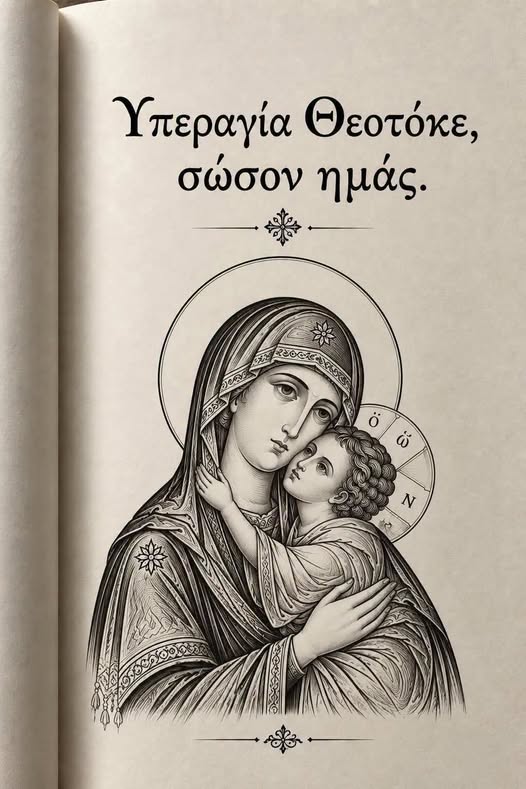
Finally, Aeiparthenos, Ever-Virgin, affirms her virginity before, during, and after childbirth, a reality depicted in holy icons by three stars on her forehead and shoulders. The image accompanying the text shows an icon of the Virgin holding the Christ Child with the inscription "Most Holy Theotokos, save us."

  • Mary is called Panagia because she is the summit and perfection of all saints (St. Gregory Palamas).
  • She lived without sin from childhood in the Holy of Holies until the Annunciation, achieving theosis.
  • Her titles, Achrantos, Hyper-eulogemene, Endoxos, Despoina, Kyria, Theotokos, Aeiparthenos, each express a facet of her holiness and role.
  • As Theotokos she bore the Second Person of the Trinity, not a mere man.
  • Her perpetual virginity before, during, and after birth is depicted in icons by three stars.

Unitarianism functionally polytheistic despite monotheistic claims

The post argues that Unitarian theology, while professing one God, assigns divine roles to Jesus as a creature, making it functionally polytheistic. The author states that praying to Jesus as "first of all creation" is still praying to a creature, and invoking that creature for salvation assigns it a divine role, elevating it to a lesser deity. By Islamic standards this constitutes shirk regardless of Unitarian insistence on monotheism. From a…

The post argues that Unitarian theology, while professing one God, assigns divine roles to Jesus as a creature, making it functionally polytheistic. The author states that praying to Jesus as "first of all creation" is still praying to a creature, and invoking that creature for salvation assigns it a divine role, elevating it to a lesser deity.

By Islamic standards this constitutes shirk regardless of Unitarian insistence on monotheism. From a traditional Christian perspective, worship belongs only to God; if Jesus is treated as spiritually essential while being denied divinity, religious reliance is placed on a creature. This issue is exactly what early Christians like St. Athanasius argued against when confronting Arian theology.

Jewish critiques come from a different angle: Judaism guards divine unity strictly, so assigning cosmic roles like judgment, mediation, or salvation to a human figure feels like adding another participant into God's authority. Even if technically subordinate, elevating a man into divine function crosses the boundary of pure monotheism.

Philosophically, the author distinguishes between saying there is one God and actually living as if only one ultimate reality exists. A belief system can claim one divine being in theory while in practice spreading devotion across multiple sacred centers. The author concludes that Unitarianism keeps monotheism as an idea but functionally drifts into something that looks more like polytheism in how devotion, authority, and meaning get divided when Christ gets involved.

To Muslims who favor Unitarians, the author promises that Unitarian theology would constitute shirk in Islam because Jesus is not a human or prophet in their theology but far beyond that.

  • Praying to Jesus as first of creation directs worship to a creature
  • Traditional Christianity requires Christ's divinity for spiritual reliance
  • St. Athanasius opposed similar Arian theology in the early Church
  • Judaism rejects assigning divine functions to a human figure
  • Islam would classify Unitarian devotion to Jesus as shirk
4 opinions in the discussion I'd like to see this same diagram done for the Catholic Filioque. What exactly about the structure of the Trinity gets broken by adding it? Read the discussion
Ancient Faith YouTube

Dr. Nicholas Roumas on Orthodox Apocryphal Stories

Dr. Nicholas Roumas on Orthodox Apocryphal Stories 38:02

Melanie interviews Dr. Nicholas Roumas about his book Stories Not in the Bible: Apocryphal Books from the Orthodox Tradition, published by Ancient Faith Publishing. Roumas, a theology professor at Hellenic College with a doctorate in dogmatics from Marquette University, explains how his study of Old Testament pseudepigrapha led to the project. He recounts that he grew up in a mixed religious household and learned Orthodoxy by reading books such…

Melanie interviews Dr. Nicholas Roumas about his book Stories Not in the Bible: Apocryphal Books from the Orthodox Tradition, published by Ancient Faith Publishing. Roumas, a theology professor at Hellenic College with a doctorate in dogmatics from Marquette University, explains how his study of Old Testament pseudepigrapha led to the project.

He recounts that he grew up in a mixed religious household and learned Orthodoxy by reading books such as the New Testament, the Infancy Gospel of Thomas, and the Protoevangelium of James. At Marquette he studied under Marcus Plested and Andrei Orlov, gaining expertise in Old Testament pseudepigrapha. The book presents seven apocryphal texts preserved by Orthodox scribes for nearly two thousand years, many surviving only in Slavonic manuscripts until the printing press displaced them.

Roumas arranges the texts in biblical chronological order: the Death of Adam (Life of Adam and Eve/Apocalypse of Moses), Enoch and the Watchers (Book of Watchers/1 Enoch), the Coming of the Flood (Slavonic Enoch/2 Enoch), Abraham and the Idols (Apocalypse of Abraham), the Story of Aseneth (Aseneth's Prayer), the Genesis of Mary (Protoevangelium of James), and the Trial of Jesus (Acts of Pilate/Gospel of Nicodemus).

He chose these seven for their narrative quality and their shared arc from sin to redemption. Roumas describes the translation challenges: the manuscript tradition is chaotic, with garbled wording in Slavonic copies and scribes who freely added, removed, or rewrote material, so no single authoritative version exists. He acted as a scribe selecting the most coherent tellings. Roumas emphasizes that these books are not Scripture, not on par with the Church Fathers, and not factually reliable; they are edifying storytelling for "serious fun," a playground for sacred history that belongs to the Orthodox tradition.

He notes that the Protoevangelium of James likely recorded existing oral traditions about Mary rather than originating them. His key message is that this material is part of the Orthodox tradition that disappeared for a historical blip and is now available again for Orthodox readers to reclaim and read as their own.

Key moments

  1. 1:02 Dr. Rumis introduces himself: he lives in Massachusetts, has always been Orthodox but grew up in a mixed religious household and learned Orthodoxy by reading books such as the New Testament, the Infancy Gospel of Thomas, and the Protoevangelium of James.
  2. 2:09 He is a professor of theology at Hellenic College teaching New and Old Testament, with a doctorate in dogmatics from Marquette University where he studied under Marcus Plested and Andrei Orlov, gaining expertise in Old Testament pseudepigrapha.
  3. 6:50 The book contains seven apocryphal texts preserved by Orthodox scribes for nearly 2,000 years, many only surviving in Slavonic until the printing press displaced them from common awareness.
  4. 10:06 The seven books are arranged in biblical chronology: Death of Adam (Life of Adam and Eve/Apocalypse of Moses), Enoch and the Watchers (Book of Watchers/1 Enoch), Coming of the Flood (Slavonic Enoch/2 Enoch), Abraham and the Idols (Apocalypse of Abraham), Story of Aseneth (Aseneth's Prayer), Genesis of Mary (Protoevangelium of James), and Trial of Jesus (Acts of Pilate/Gospel of Nicodemus).
  5. 13:25 He chose these seven because they are great stories that provide enjoyment as narrative theology, and they fit together with an arc from sin (Adam, Enoch) to redemption (Mary, Christ).
  6. 19:45 The hardest part was sorting through the chaotic manuscript tradition: some texts exist only in Slavonic with garbled wording, and scribes freely added, removed, or rewrote material, so no single authoritative version exists.
  7. 26:33 These books are not Scripture, not on par with the Church Fathers, and not factually reliable; they are edifying storytelling for "serious fun", a playground for sacred history. The Protoevangelium of James likely recorded existing oral traditions about Mary rather than originating them.
  8. 36:58 His key message: this is part of the Orthodox tradition that disappeared for a historical blip and is now available again for Orthodox readers to reclaim and read as their own.
George Instagram discussion

Why Orthodox Christians cross right to left: history and theology

1:22

The speaker notes that a video on the sign of the cross received over 1.5 million views and many comments claiming the Orthodox method is wrong because they go to the left shoulder first. He explains that for more than a thousand years all Christians, East and West, crossed themselves from right to left. Around the year 1200 the Western practice slowly changed to left to right, while the Orthodox retained the ancient custom. The difference is…

The speaker notes that a video on the sign of the cross received over 1.5 million views and many comments claiming the Orthodox method is wrong because they go to the left shoulder first. He explains that for more than a thousand years all Christians, East and West, crossed themselves from right to left. Around the year 1200 the Western practice slowly changed to left to right, while the Orthodox retained the ancient custom.

The difference is not an error but a preserved habit. The biblical basis for the right-to-left motion is that the right side signifies honor and blessing. Christ sits at the right hand of God after his ascension, and at the last judgment he places the righteous on his right. Thus, when Orthodox Christians cross themselves to the right first, they are praying, "Lord, place me on your right side; let me be with you." Though a small movement, each sign of the cross becomes a prayer for salvation.

Key moments

  1. The video garnered over 1.5 million views and many viewers commented that the Orthodox way of crossing is wrong because they go to the left shoulder first.
  2. For more than 1000 years all Christians, both East and West, crossed themselves from right to left.
  3. Around the year 1200 the Western practice slowly changed to left to right, while the Orthodox Church kept the original tradition.
  4. The difference is not a matter of error but of preserved habit; the church's tradition explains why the right side comes first.
  5. In Scripture the right side represents honor and blessing, and after his ascension Christ sat at the right hand of God.
  6. At the last judgment Jesus will place the righteous on his right and the others on his left.
  7. When Orthodox Christians cross themselves to the right first, they are praying, "Lord, place me on your right side; let me be with you."
  8. Though a small movement, each sign of the cross becomes a prayer for salvation.
11 opinions in the discussion Russian Orthodox here, always right to left. Incidentally we also wear our wedding ring on the right hand. Read the discussion

St. Luke of Crimea: Surgeon, Archbishop, Confessor

0:31

The post presents the life of St. Luke of Crimea (1877-1961), born Valentin Voino-Yasenetsky. He was a distinguished surgeon, professor of medicine, and Archbishop of Simferopol and Crimea. His life exemplifies the union of science, faith, and self-sacrifice. In 1921, during severe persecution of the Church, he was ordained a priest and later tonsured a monk. He continued to practice medicine, not separating his medical service from his…

The post presents the life of St. Luke of Crimea (1877-1961), born Valentin Voino-Yasenetsky. He was a distinguished surgeon, professor of medicine, and Archbishop of Simferopol and Crimea. His life exemplifies the union of science, faith, and self-sacrifice.

In 1921, during severe persecution of the Church, he was ordained a priest and later tonsured a monk. He continued to practice medicine, not separating his medical service from his episcopal calling. During World War II he treated wounded soldiers, and his scientific research in purulent surgery earned him the Stalin Prize first degree in 1946, from the same regime that had previously arrested and persecuted him for his faith.

After years of imprisonment and exile, he lost his sight completely in old age. Nevertheless, he continued to serve the Liturgy, preach, and spiritually guide his flock. St. Luke is remembered as a physician who dedicated his life to healing bodies and a hierarch who witnessed to faith in Christ even through suffering.

His life shows that knowledge and faith need not be opposed but can become two paths of service to humanity.

  • Born Valentin Voino-Yasenetsky (1877-1961), became a renowned surgeon and professor.
  • Ordained priest in 1921 and later tonsured a monk during Soviet persecution.
  • Continued medical practice alongside episcopal ministry, treating wounded in WWII.
  • Awarded Stalin Prize first degree in 1946 for research in purulent surgery.
  • Lost sight in later years but kept serving Liturgy, preaching, and guiding faithful.
Read more

Trusting God's answers through uncertainty and rain

The author reflects on how God's answers to prayer often arrive differently than expected. The text states that not every divine response comes as imagined, and that passing through incomprehensible circumstances may be necessary before their meaning becomes clear. The author encourages belief, patient waiting, and perseverance in hope, asserting that everything will eventually receive its meaning. An accompanying image offers a metaphor: when…

The author reflects on how God's answers to prayer often arrive differently than expected. The text states that not every divine response comes as imagined, and that passing through incomprehensible circumstances may be necessary before their meaning becomes clear. The author encourages belief, patient waiting, and perseverance in hope, asserting that everything will eventually receive its meaning.

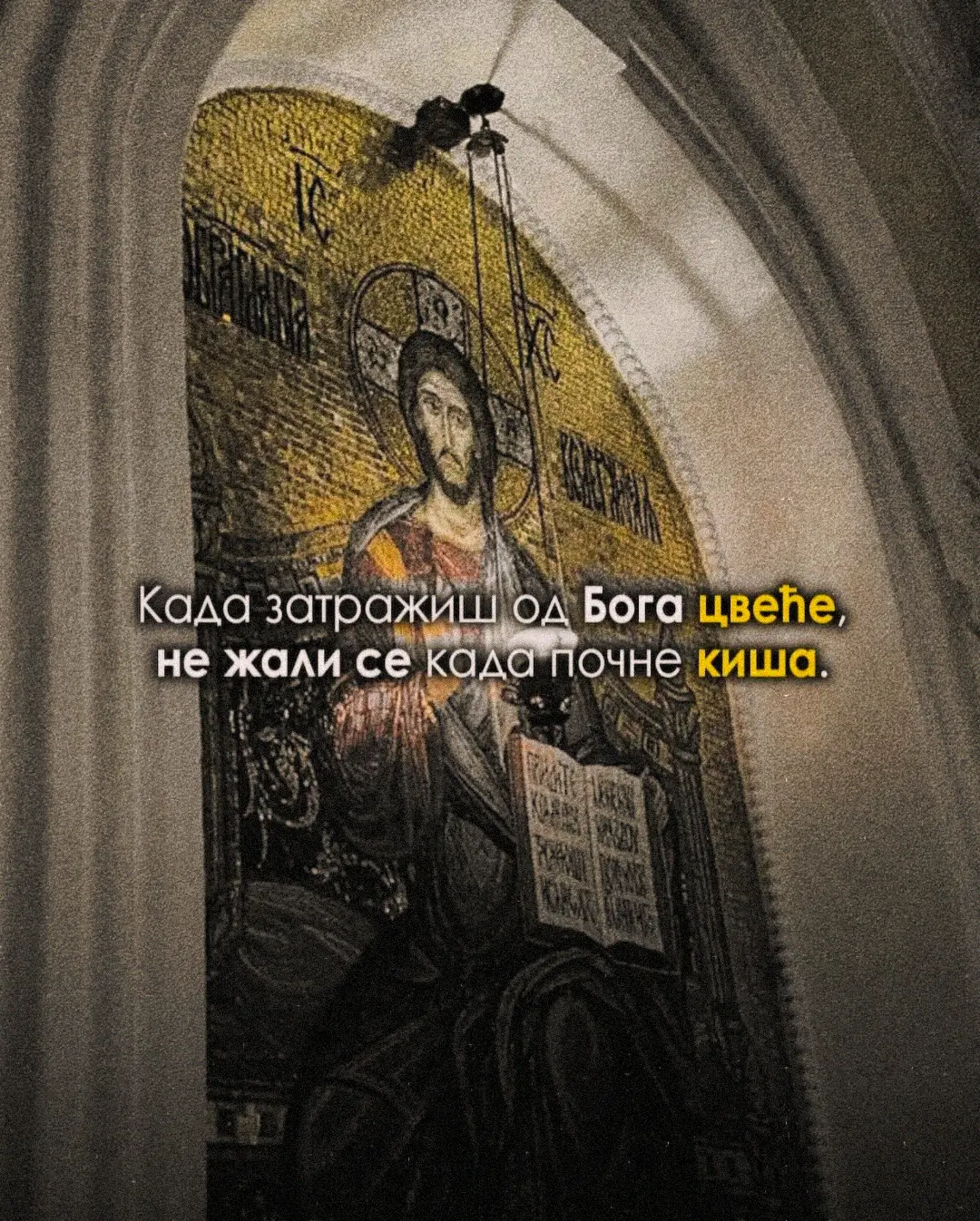
An accompanying image offers a metaphor: when someone asks God for flowers, they should not complain when rain begins, since rain is necessary for flowers to grow. The post presents this perspective as spiritual guidance for those experiencing unanswered prayers or difficult seasons.

  • God's answers may not match human expectations
  • Understanding often comes only after enduring confusion
  • The author urges faith, patience, and sustained hope
  • A metaphor compares asking for flowers to accepting necessary rain
  • The post frames difficulties as part of a larger divine purpose
Read more
Prayer Orthodoxy ® with Live Orthodox Instagram

St. Anthony the Great on love casting out fear

The post shares a saying attributed to St. Anthony the Great describing how a believer's relationship with God changes. As one grows closer to God, dread and terror of damnation give way to intimate affection. The internal panic of punishment disappears when a person truly knows and loves God.

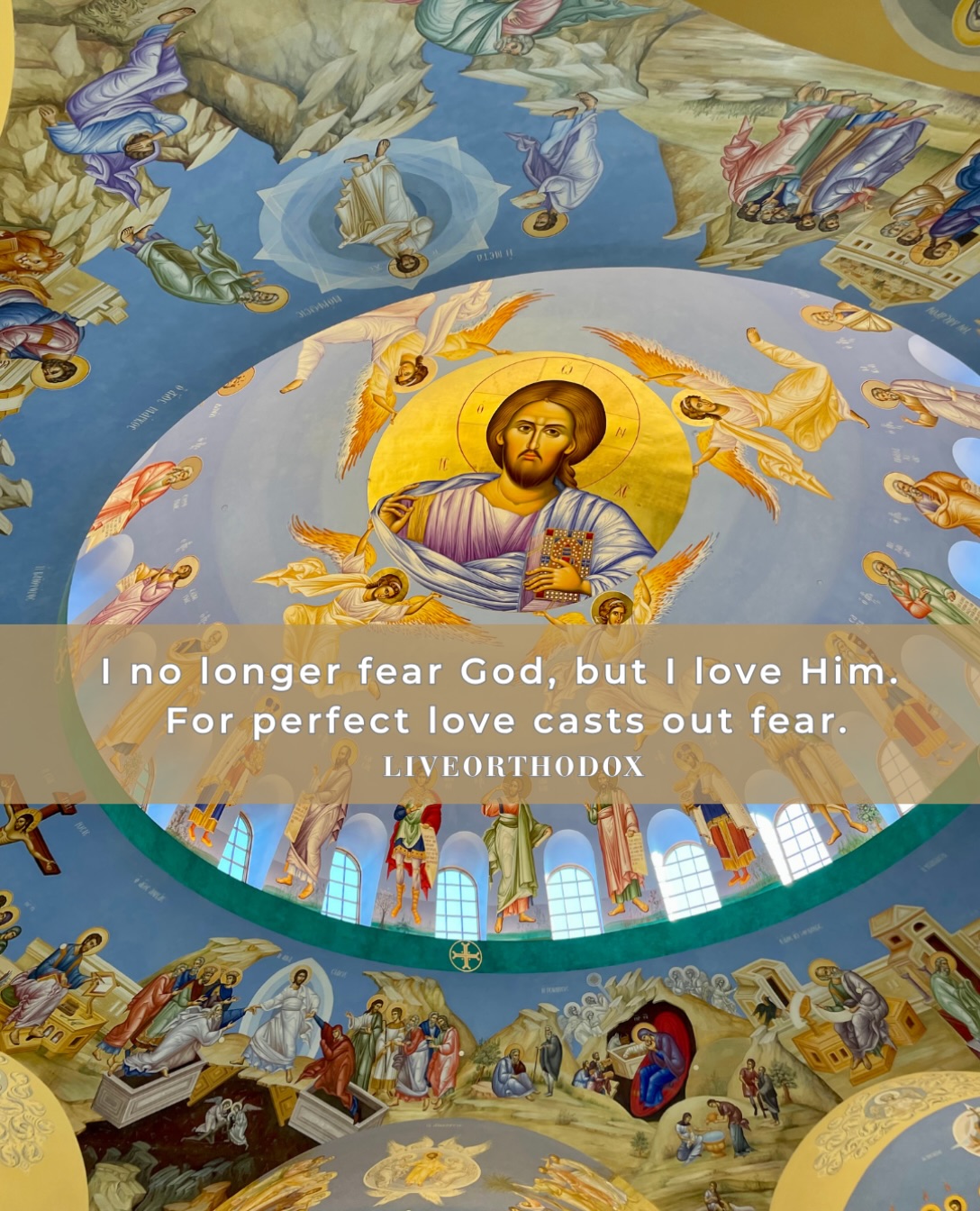
The accompanying image text quotes the saint directly: "I no longer fear God, but I love Him. For perfect love casts out fear," referencing 1 John 4:18. The passage presents the classic monastic teaching that perfect love removes servile fear.

  • St. Anthony the Great teaches that closeness to God replaces fear with love
  • The dread of damnation disappears through true knowledge of God
  • Direct quote: "I no longer fear God, but I love Him"
  • References 1 John 4:18: "perfect love casts out fear"
  • Illustrates the monastic distinction between servile fear and filial love
Read more
T timotheos.orthodoxy Instagram

Catechumen Shares Journey from Atheism and Occultism to Orthodoxy

Tim, a catechumen in the Greek Orthodox Church, shares his spiritual journey through eleven numbered reflections. He grew up in a non-Christian household where church attendance occurred at most once a year for Christmas, and he never questioned this absence of faith, simply pushing God away. He later became what he describes as a proud atheist. Years later, he found himself always searching for answers, feeling there was no real meaning to…

Tim, a catechumen in the Greek Orthodox Church, shares his spiritual journey through eleven numbered reflections. He grew up in a non-Christian household where church attendance occurred at most once a year for Christmas, and he never questioned this absence of faith, simply pushing God away. He later became what he describes as a proud atheist. Years later, he found himself always searching for answers, feeling there was no real meaning to life.

He turned to numerology, astrology, runes, and a bunch of other things, but never felt he had arrived and always had to keep searching for more. Whenever someone asked what religion he belonged to, he said Christianity as the most convenient answer, but felt nothing when he said it. Until something inside him made him ask his parents for a Bible for Christmas.

He started reading it every day and realized what he had been missing out on: God is real. So he had to come back to Christianity. He notes the rest of the story is coming soon. The post also includes a call to follow his account for content on Orthodoxy, fitness, and business, and mentions a free habit tracker.

  • Grew up in a non-Christian home with minimal church exposure
  • Became an atheist but later searched for meaning through occult practices
  • Felt empty despite identifying as Christian for convenience
  • Asked for a Bible for Christmas and began daily reading
  • Realized God is real and is now a catechumen in the Greek Orthodox Church

Ego identified as Satan's nature and root of corruption

The speaker identifies the ego as the nature of Satan and the root of corruption and nihilism. He asks where pride resides and answers that it is within oneself, calling the ego the parasite of the devil. The ego exists only for itself and acknowledges no other. In contrast, Jesus is named as the true creator and elder of all being. The speaker then references the fall of the demons, citing the words "I saw Satan fall like lightning from…

The speaker identifies the ego as the nature of Satan and the root of corruption and nihilism. He asks where pride resides and answers that it is within oneself, calling the ego the parasite of the devil. The ego exists only for itself and acknowledges no other. In contrast, Jesus is named as the true creator and elder of all being.

The speaker then references the fall of the demons, citing the words "I saw Satan fall like lightning from heaven," but rejects this as a lie. He states that it was not Satan's own doing but God who cast him down, precisely to prevent the ego from saying "I." The ego asserts itself; humility does not.

Key moments

  1. The speaker asks where pride is and who the devil is, then answers that the ego himself is the parasite of the devil.
  2. The ego is declared to be the nature of Satan, the nature of loss, and the basis of corruption and nihilism.
  3. Ego exists only for itself; there is no other ego.
  4. Jesus is named as the true creator and the elder of all beings.
  5. A heretical teaching is mentioned that claims to explain how the demons fell.
  6. That teaching quotes "I saw Satan as lightning falling from heaven."
  7. The speaker rejects this as lies: God cast Satan down, not Satan himself.
  8. The purpose of the casting down was so that the ego would not say "I"; the ego commands us.
Read more

St. Joseph the Hesychast: Ascetic Struggle and the Jesus Prayer

The post presents the life and teachings of St. Joseph the Hesychast, a 20th-century Athonite monk known for his dedication to the Jesus Prayer. It describes his years of intense ascetic struggle, including physical hardships, sleepless nights, and spiritual trials, which he endured through faith and obedience to his spiritual elders. For St. Joseph, hesychasm was not merely outward solitude but an inner life of constant communion with God. He…

The post presents the life and teachings of St. Joseph the Hesychast, a 20th-century Athonite monk known for his dedication to the Jesus Prayer. It describes his years of intense ascetic struggle, including physical hardships, sleepless nights, and spiritual trials, which he endured through faith and obedience to his spiritual elders.

For St. Joseph, hesychasm was not merely outward solitude but an inner life of constant communion with God. He taught his disciples that prayer requires patience, humility, and complete trust in divine grace. His disciples later helped renew monastic life on Mount Athos and spread his spiritual legacy throughout the Orthodox world.

The post includes seven sayings attributed to St. Joseph: an acknowledgment of sin and God's mercy; a reminder that the heavenly Father is always near; an explanation that temptation tests zeal and love for God; a reflection on the heaviness of the cross and the inevitability of falling; a call to surrender one's own will as a barrier to divine illumination; and a statement linking purification from passions to peace, wisdom, and understanding of God.

A black-and-white photograph shows an elderly monk with a long beard, hooded robe, walking stick, and prayer beads. The image also bears a Ukrainian inscription identifying St. Joseph the Hesychast. The post comes from a page dedicated to the Church Fathers and their teachings.

His life reminds us that holiness is not attained through worldly greatness but through self-denial, repentance, and a heart wholly devoted to Christ. In the silence of the wilderness he sought God; through ascetic struggle he pursued purity of heart; and through unceasing prayer he bore witness to the transforming grace of Jesus Christ.

  • St. Joseph the Hesychast devoted himself to the Jesus Prayer through years of ascetic struggle.
  • He taught that hesychasm is an inner stillness and constant communion with God, requiring patience, humility, and trust in grace.
  • His disciples contributed to the renewal of monastic life on Mount Athos and spread his legacy across the Orthodox world.
  • The post includes seven quotes from St. Joseph on repentance, God's nearness, temptation, the cross, surrendering the will, and purification from passions.
  • A photograph shows the saint as an elderly monk with prayer beads, accompanied by a Ukrainian inscription.
Read more

Father Nikola Milić: Listen to Christ above the noise of screens

Father Nikola Milić cites the divine command from the Transfiguration: "This is my beloved Son, in whom I am well pleased; listen to him." He observes that people today waste their days consuming internet content, watching mobile phones and various videos, giving attention to everything except the Lord. As a result, Christ remains the least present in their hearts. The priest states that God will ask only about the condition of the heart and…

Father Nikola Milić cites the divine command from the Transfiguration: "This is my beloved Son, in whom I am well pleased; listen to him." He observes that people today waste their days consuming internet content, watching mobile phones and various videos, giving attention to everything except the Lord. As a result, Christ remains the least present in their hearts.

The priest states that God will ask only about the condition of the heart and desires a pure heart. Therefore, he urges the faithful to listen to Christ rather than to human voices, to fears sown by the impure one, or to evil things. Instead, they should focus on what is good and useful for the soul and for salvation.

Key moments

  1. The speaker cites the words: "This is my beloved Son, in whom I am well pleased; listen to him."
  2. He states that people now listen to everything and waste the whole day watching the internet, mobile phones, and various videos, giving attention to all things except the Lord.
  3. He asserts that God will ask only what our heart was like and that God wants us to bring Him a pure heart.
  4. He concludes that we must listen to Christ, not to what other people say, not to fears the impure one sows in our minds, not to what is bad, but to what is good and useful for our souls and salvation.
Read more

St. Paisios: True love reveals itself without outward signs

The post shares a saying attributed to St. Paisios the Athonite. He states that true love reveals itself to the other without outward signs. The one who loves perceives the other's love, and the other perceives his love. People understand whether love is true or tainted by hypocrisy.

  • True love reveals itself without outward signs
  • Lovers perceive each other's love mutually
  • People discern true love from hypocritical love