WeOrthodox
EN UA

Orthodox posts, videos and discussions

We follow Orthodox channels, communities and blogs across the web, summarise every post and video, and highlight the conversations with real substance.

St. Gabriel of Georgia: Feast Day and Selected Sayings

The post marks the November 2 feast of St. Gabriel (Urgebadze), a 20th-century Georgian confessor and fool-for-Christ glorified by the Georgian Orthodox Church in 2012. His relics are venerated at Samtavro Monastery in Mtskheta. The text collects twenty sayings attributed to him. Themes include personal repentance over judging others; warnings about end-times deception, especially the expectation of salvation from space or aliens identified as…

The post marks the November 2 feast of St. Gabriel (Urgebadze), a 20th-century Georgian confessor and fool-for-Christ glorified by the Georgian Orthodox Church in 2012. His relics are venerated at Samtavro Monastery in Mtskheta. The text collects twenty sayings attributed to him. Themes include personal repentance over judging others; warnings about end-times deception, especially the expectation of salvation from space or aliens identified as demons; the distinction between faith in the heart versus faith in the mind; ecumenism described as a super heresy; the necessity of prayer compared to an eagle's wings; compassion and prayer for neighbors; nightly self-examination; the proper frequency of Holy Unction; God's wrath toward abortion; hope in God's providence; hell as estrangement from God; perseverance when evil becomes law; and reverence for the grace of the Divine Liturgy.

The quotations are presented without commentary or specific source references beyond the saint's name.

  • Feast day of St. Gabriel of Georgia (Urgebadze), glorified in 2012
  • Sayings on repentance, judgment, and self-examination
  • Warnings about Antichrist-era deception involving false salvation from space
  • Teachings on prayer, compassion, Holy Unction, and abortion
  • Exhortations to persevere in faith amid world collapse
Read more
Orthodox Life Instagram

Saint Gabriel of Georgia: Death Is Transfiguration, Fear the Judgment

The post shares a quotation attributed to Saint Gabriel of Georgia. He says death is transfiguration and tells listeners not to fear death but to fear the Judgment Day. He compares the anxiety of facing a professor during examinations to the far greater awe of standing before the Creator, emphasizing the incomparable greatness of God.

  • Saint Gabriel of Georgia calls death a transfiguration.
  • He urges believers not to fear death but to fear the Judgment Day.
  • He likens the fear of an exam before a professor to the fear before God.
  • He stresses the incomparable greatness of God.
Read more
Ancient Faith YouTube

How the Divine Liturgy Begins: Blessing, Great Litany, and the Small Entrance

How the Divine Liturgy Begins: Blessing, Great Litany, and the Small Entrance 54:38

Deacon Seraphim walks through the opening portion of the Divine Liturgy, the Liturgy of the Catechumens. The service starts when the deacon asks the priest for a blessing and the priest proclaims the Kingdom of the Father, Son, and Holy Spirit. The Great Litany follows, led by the deacon, with the people answering "Lord, have mercy" to petitions for peace, salvation, the Church, civil authorities, the sick, travelers, and captives. While the…

Deacon Seraphim walks through the opening portion of the Divine Liturgy, the Liturgy of the Catechumens. The service starts when the deacon asks the priest for a blessing and the priest proclaims the Kingdom of the Father, Son, and Holy Spirit. The Great Litany follows, led by the deacon, with the people answering "Lord, have mercy" to petitions for peace, salvation, the Church, civil authorities, the sick, travelers, and captives.

While the litany continues, the priest prays the first antiphon prayer secretly, addressing God whose power is immeasurable, glory incomprehensible, mercy boundless, and love for mankind inexpressible. The first antiphon uses Psalm 103 to teach how to bless the Lord. The second antiphon's prayer asks God to sanctify those who serve His house and glorify them by divine power.

The hymn "Only-begotten Son" confesses Christ's incarnation, crucifixion, and victory over death. The third antiphon presents the Beatitudes as a portrait of Kingdom citizens. The Small Entrance brings the Gospel book out as Christ's verbal icon, uniting earthly worship with the heavenly liturgy.

St. Germanus interprets the antiphons as the Old Testament period of prophetic announcement and the Small Entrance as Christ coming into the world in the Gospel book. The petition for the bishop confesses that an Orthodox eucharistic assembly exists only through communion with an Orthodox bishop; without the bishop there is no Church and no functioning Liturgy.

The Church prays for civil authorities and those serving in the armed forces regardless of personal approval, because Scripture commands prayer for rulers and the early Church did so under hostile emperors.

Key moments

  1. 0:01 The Divine Liturgy begins with the deacon saying "Bless, Master" and the priest blessing the Kingdom of the Father, Son, and Holy Spirit, followed by the Great Litany petitioning for peace, salvation, weather, the sick, travelers, the bishop, government, harvest, and prisoners.
  2. 3:43 The deacon asks for the blessing because the service is received from God, and the priest proclaims the Kingdom as the rule of the living God, love and peace in the Holy Spirit, confessing the Holy Trinity in the Liturgy's first sentence.
  3. 5:49 The Great Litany opens with "In peace let us pray to the Lord"; each petition names a person or need to be included in the cry "Lord, have mercy," which means forgiveness, healing, protection, and all that restores God's creatures.
  4. 11:38 The petition for the bishop confesses that an Orthodox eucharistic assembly exists only through communion with an Orthodox bishop; without the bishop there is no Church and no functioning Liturgy.
  5. 13:42 The Church prays for civil authorities and those serving in the armed forces regardless of personal approval, because Scripture commands prayer for rulers and the early Church did so under hostile emperors.
  6. 23:37 While the litany continues, the priest prays the first antiphon prayer secretly, addressing God whose power is immeasurable, glory incomprehensible, mercy boundless, and love for mankind inexpressible, "ineffable" meaning beyond words.
  7. 33:33 The hymn "Only-begotten Son" confesses that the immortal Son of God became man without change from the Theotokos, was crucified, trampled death by death, and is one of the Holy Trinity glorified with the Father and the Spirit.
  8. 45:17 St. Germanus interprets the antiphons as the Old Testament period of prophetic announcement, and the Small Entrance as Christ coming into the world in the Gospel book, His verbal icon.
George Instagram discussion

Responding to hatred with Christ's command to love enemies

A speaker reflects on a viral video showing a university student attacking a Jewish woman and screaming she should have killed her while being arrested. The speaker condemns the violence and calls for prayer for the victim, but notes that thousands of commenters responded with hate, curses, and wishes for the attacker's destruction. This pattern of division appears across religious, ideological, and political lines, with opponents shouting past…

A speaker reflects on a viral video showing a university student attacking a Jewish woman and screaming she should have killed her while being arrested. The speaker condemns the violence and calls for prayer for the victim, but notes that thousands of commenters responded with hate, curses, and wishes for the attacker's destruction.

This pattern of division appears across religious, ideological, and political lines, with opponents shouting past each other. The speaker compares the moment to the fractured world of Christ's time, divided among Jews and Samaritans, Romans and rebels, Pharisees and Sadducees, and cites Christ's warning that increasing lawlessness makes love grow cold.

Christ commands believers to love enemies, do good to those who hate, bless those who curse, and pray for those who mistreat. Justice belongs to the courts, but the heart is one's own responsibility. Answering hate with hate lets evil win twice, once in the attacker and once in oneself.

The speaker urges prayer for the victim's peace and for God to touch the attacker's heart.

Key moments

  1. A young woman at an American university attacked a Jewish woman, pushed her to the ground, and while police took her away screamed that she should have killed her.
  2. The speaker says the violence was wrong and the woman who was attacked deserves prayers.
  3. Thousands of commenters responded with hate, insults, curses, and wishes for the worst toward the attacker.
  4. The same pattern appears everywhere online: believers fighting believers, atheists fighting believers, left fighting right, with everyone debating but no one listening.
  5. The world Christ was born into was similarly divided among Jews and Samaritans, Romans and rebels, Pharisees and Sadducees.
  6. Christ warned that because lawlessness will increase, the love of many will grow cold.
  7. Christ said to love your enemies, do good to those who hate you, bless those who curse you, and pray for those who mistreat you.
  8. Justice belongs to the courts, but the heart is one's own responsibility, and answering hate with hate lets evil win twice, once in them and once in oneself.
10 opinions in the discussion She was let go without any charges. Read the discussion

Why an Orthodox artist keeps creating when AI can do it faster

The author, who has run Creative Orthodox for ten years, reflects on why they continue making picture books, coloring books, and graphic novels about saints despite AI-generated content flooding the market and even a near-exact spoof of their own account. The reflection traces back to childhood in Cairo, where their grandfather (Gedo) brought home saint images after Liturgy and told their stories. The author drew them reflexively, not as a…

The author, who has run Creative Orthodox for ten years, reflects on why they continue making picture books, coloring books, and graphic novels about saints despite AI-generated content flooding the market and even a near-exact spoof of their own account. The reflection traces back to childhood in Cairo, where their grandfather (Gedo) brought home saint images after Liturgy and told their stories.

The author drew them reflexively, not as a creative choice but as a response. Their father loved teaching church history and theology, but that did not lead directly to bookmaking. Years later in Canada, after graduation and a period of feeling lost, daily drawing became a routine that shook something loose: story is how they come to know God and the saints.

Now a parent, they stand on their grandfather's side of the story, making books for their own children's spiritual formation. The author acknowledges their work is not the most effective, visually impressive, or comprehensive way to tell stories in the Church. They have accepted that serving their little church with their "two pennies" is good enough; if it helps anyone else, that is a blessing.

The core reason remains personal: when Gedo handed them a perfectly good image, they still drew it themselves. It had nothing to do with speed or quality and everything to do with who they are.

  • Childhood in Cairo: grandfather brought saint images after Liturgy and told their stories; the author drew them reflexively
  • After graduation in Canada, daily drawing during a low period revealed that story is how the author knows God and the saints
  • Now a parent, the author creates books for their children's spiritual formation, continuing the grandfather's role
  • AI can produce content faster and with higher visual polish, and a spoof account copied the author's work nearly 1:1
  • The author accepts their work is not the most effective or impressive but continues as a personal offering to their parish and family
Read more

Apolytikion of Saint Gabriel of Georgia in Dutch

The post presents the Apolytikion of Saint Gabriel of Georgia in the Dutch language. The hymn addresses Gabriel as a God-inspired monk and priest who was proven in his divine way of life. It venerates him as a beacon of spiritual insight and a healer of the sick, from whom abundant power flows. The faithful call upon him as father and grant of God's ways, asking for his blessing upon all who honor him. This Apolytikion is a liturgical hymn sung…

The post presents the Apolytikion of Saint Gabriel of Georgia in the Dutch language. The hymn addresses Gabriel as a God-inspired monk and priest who was proven in his divine way of life. It venerates him as a beacon of spiritual insight and a healer of the sick, from whom abundant power flows.

The faithful call upon him as father and grant of God's ways, asking for his blessing upon all who honor him. This Apolytikion is a liturgical hymn sung in honor of the saint, expressing the Church's veneration and seeking his intercession. The Dutch translation makes this traditional Orthodox hymn accessible to Dutch-speaking faithful.

Key moments

  1. The hymn addresses Gabriel as a God-inspired monk and priest proven in his divine life.
  2. Gabriel is venerated as a beacon of spiritual insight and a healer of the sick.
  3. The faithful ask Gabriel, as father and grant of God's ways, to bestow his blessing on those who honor him.
Kyle YouTube discussion

Star Wars prequels as a map of spiritual delusion

Star Wars prequels as a map of spiritual delusion 33:46

The video examines Anakin Skywalker's fall in the prequel trilogy as an allegory for the way good intentions, when twisted by fear and pride, become the very evil they meant to oppose. The speaker argues that Anakin's alienation from the Jedi Order mirrors the experience of many young men who see institutions promise justice but deliver hypocrisy. The Jedi reduce holiness to genetics (midi-chlorians), entangle themselves in political power, and…

The video examines Anakin Skywalker's fall in the prequel trilogy as an allegory for the way good intentions, when twisted by fear and pride, become the very evil they meant to oppose. The speaker argues that Anakin's alienation from the Jedi Order mirrors the experience of many young men who see institutions promise justice but deliver hypocrisy.

The Jedi reduce holiness to genetics (midi-chlorians), entangle themselves in political power, and pursue a Buddhist-like balance instead of surrender to God, leaving Anakin unloved and exposed to Palpatine's manipulation. Palpatine does not offer evil for its own sake; he exploits Anakin's desire to save his wife from death, presenting a transhumanist counterfeit of theosis that preserves the ego rather than emptying it.

The three villains, Maul, Dooku, Grievous, function as mirrors of the rage, corrupted idealism, and dehumanization Anakin gradually internalizes. On Mustafar, Anakin's fear becomes self-fulfilling: he kills Padme while trying to save her. The speaker warns that Christians face the same temptation to become evil in fighting evil, and insists the only path is repentance, humility, and union with Christ in the Church, not reactionary politics or revolutionary force.

Key moments

  1. 0:15 Anakin's story resonates with millennial youth because he began as an innocent idealist who wanted to do good but whose idealism turned into frustration, resentment, and hatred as he grew alienated from the Jedi Council and his mentor Obi-Wan.
  2. 0:46 Five factors drive this resonance: institutional alienation, desire for normal human life (marriage and family), institutional hypocrisy (Jedi preach peace but lead armies), disillusionment after suffering slavery and his mother's death, and longing for order in a collapsing republic.
  3. 3:26 Anakin's understandable frustrations and noble intentions gradually twist into revenge, possession, willingness to embrace tyranny, and the Sith path, he becomes evil to defeat evil, which the speaker calls a profound Christian warning.
  4. 5:29 Recognizing corruption and injustice does not make one's reaction automatically right; the Christian struggle is against pride, confusion, hatred, and passions within, not against human enemies, and external problems should drive us to humility, love of neighbor, prayer, and Christ.
  5. 10:45 The Virgin Birth imagery and Chosen One prophecy in Episode I deliberately evoke Christian messianic archetypes, but the Jedi's Buddhist-influenced concept of balance, preserving both light and dark, reveals their hidden pride and spiritual blindness.
  6. 15:31 Palpatine does not tempt Anakin with evil for its own sake but exploits his good intentions distorted by fear and pride, whispering promises of power to save loved ones from death, a transhumanist, Sith counterfeit of theosis that preserves the ego rather than emptying it.
  7. 19:10 The three prequel villains (Maul, Dooku, Grievous) are not random obstacles but mirrors arranged by Palpatine that foreshadow Anakin's own descent into uncontrolled rage, corrupted idealism, and dehumanization into a machine.
  8. 22:17 The Jedi Order's collapse is spiritual, not merely political: they reduce grace to genetics (midi-chlorians), entangle in political power, pursue external balance instead of surrender to God, and fail to love Anakin, leaving him vulnerable to the darkness that consumes them all.
30 opinions in the discussion It's society that's pushing young men toward extremes, not some made-up character. Read the discussion
Eastern Orthodoxy Daily He/Who/Is Instagram

God Is Love: Eternal Reality, Sacrifice, and the Incarnation

The author revisits an earlier reflection on divine love, adding theological nuance about the limits of human language when speaking of God. The post begins with the statement "God is Love" from 1 John 4:8 and observes that love cannot be measured arithmetically; sacrifice reveals what is valued above oneself. However, sacrifice is not the ontological foundation of love, because the Father loved the Son before the foundation of the world (John…

The author revisits an earlier reflection on divine love, adding theological nuance about the limits of human language when speaking of God. The post begins with the statement "God is Love" from 1 John 4:8 and observes that love cannot be measured arithmetically; sacrifice reveals what is valued above oneself. However, sacrifice is not the ontological foundation of love, because the Father loved the Son before the foundation of the world (John 17:24), before any suffering or death existed.

The Cross reveals eternal divine love within a world wounded by sin, not a love that begins with suffering. The author then addresses evil as a privation of good, arguing that love does not depend on evil or deprivation to be recognizable, since God loved eternally before creation. Human love is presented as participation in divine love, following St. Maximus the Confessor, rather than a projection onto God.

The discussion touches on analogical predication: human concepts cannot apply directly to divine simplicity. The author emphasizes that God's essence remains unknowable while His uncreated energies truly reveal Him, and that the Incarnation makes love visible in history. Citing Philippians 2 and St. Athanasius's On the Incarnation, the post describes Christ's self-emptying as the unveiling of divine character, not a loss of divinity.

St. Maximus is quoted: "What He is by essence the creature might become by participation" and "The one who possesses love possesses God Himself, since 'God is love.'" The post also notes the three ways terms can be applied to God, ontological, analogical, univocal, and suggests that love is not a human idea projected onto God but a reality in which human love participates.

The author writes that "I Love You" means "Your being is worth my loss," and argues that love does not require absence; evil as privation does not make love dependent on it. St. Maximus's teaching that love is the movement of being toward communion is cited, with love as the cause of creation, the ground of unity, and the restoration of humanity in Christ.

The Incarnation solves the problem of love remaining an idea: in Christ love becomes visible as self-emptying, equality with God revealed through voluntary descent, suffering, and death. St. Athanasius is quoted on the Word taking a body capable of death to undo corruption. The post concludes with the Orthodox distinction that God's essence is unknowable while His uncreated energies are God Himself in activity, inseparable from His essence.

  • God is Love ontologically; the Father loved the Son before creation (John 17:24), so love precedes sacrifice.
  • Sacrifice reveals priority but is not the foundation of love; the Cross manifests eternal love in a fallen world.
  • Evil is a privation of good; love does not depend on evil or suffering to be recognizable.
  • Human love participates in divine love (St. Maximus), not a projection; language about God is analogical.
  • The Incarnation makes divine love visible in history: Christ's self-emptying (Philippians 2) unveils God's character; St. Athanasius and St. Maximus affirm love as uncreated energy and participation.
Read more

Saint Ignatius the Venerable Martyr: Monastic Life and Martyrdom under Ottoman Rule

Saint Ignatius the Venerable Martyr was born in Stara Zagora, Bulgaria, a city known for producing many Orthodox ascetics, confessors, and martyrs. From youth he was drawn to God and the spiritual life. He traveled to Mount Athos and entered monastic life at the Skete of Saint John the Forerunner, where he devoted himself to repentance, humility, fasting, and prayer. During a period when confessing Christianity could lead to persecution, he…

Saint Ignatius the Venerable Martyr was born in Stara Zagora, Bulgaria, a city known for producing many Orthodox ascetics, confessors, and martyrs. From youth he was drawn to God and the spiritual life. He traveled to Mount Athos and entered monastic life at the Skete of Saint John the Forerunner, where he devoted himself to repentance, humility, fasting, and prayer.

During a period when confessing Christianity could lead to persecution, he voluntarily presented himself before Ottoman authorities to witness to his faith in Jesus Christ. Aware of the danger, he chose martyrdom out of love for Christ. On October 8, 1814, he was hanged in Constantinople. After his death, his relics became known for miraculous healings.

The post notes that his martyrdom became a testimony of unwavering faith and devotion to Christ. It states that Saint Ignatius reminds us that true love for Christ requires more than words, that it remains faithful through suffering, sacrifice, and even death, and that his witness continues to strengthen the faithful more than two centuries later.

His precious head is preserved at the Monastery of Saint Panteleimon on Mount Athos, where it is honored with reverence.

  • Born in Stara Zagora, Bulgaria
  • Monastic life at the Skete of Saint John the Forerunner on Mount Athos
  • Voluntarily confessed faith before Ottoman authorities
  • Hanged in Constantinople on October 8, 1814
  • Relics known for miraculous healings; head preserved at Monastery of Saint Panteleimon
Read more
George Instagram

Christ in the Least: Matthew 25:40 and St. John Chrysostom on Serving the Poor

The speaker argues that many misread Christ's words in Matthew 25:40. Christ says, "Whatever you did to one of the least of these My brethren, you did it to Me," not "like Me." In the passage Christ describes the last judgment, listing the hungry, thirsty, stranger, naked, sick, and imprisoned. The righteous ask when they saw Him in such need, and He answers that whatever they did for the least of these, they did for Him. The speaker cites St.…

The speaker argues that many misread Christ's words in Matthew 25:40. Christ says, "Whatever you did to one of the least of these My brethren, you did it to Me," not "like Me." In the passage Christ describes the last judgment, listing the hungry, thirsty, stranger, naked, sick, and imprisoned. The righteous ask when they saw Him in such need, and He answers that whatever they did for the least of these, they did for Him.

The speaker cites St. John Chrysostom, who teaches that honoring the body of Christ means caring for the poor outside the church, not only venerating Him in silk vestments while walking past Him cold and naked on the street. Concrete examples are given: a man outside a supermarket dismissed as a junkie, an elderly neighbor who receives no visitors, a new colleague eating alone, a relative who has not been called.

In each case Christ says, "That is Me." The speaker emphasizes that love does not have to be grand. Small acts: stopping to say hello, looking someone in the eye, asking their name, buying a coffee or sandwich, knocking on a neighbor's door, sitting beside a colleague, picking up the phone can make a person feel seen. The speaker states that making someone feel seen is not merely kindness; it is serving Christ directly.

The discussion turns on the practical implication of this teaching: the distinction between seeing service as imitation and seeing it as direct encounter with Christ. The speaker urges viewers to identify one person to reach out to this week.

Key moments

  1. Most people read Christ's saying wrongly; they think helping the poor is like helping Jesus, but Christ says "you did it to me."
  2. In Matthew 25, Christ describes the last judgment listing the hungry, thirsty, stranger, naked, sick, and imprisoned; the righteous ask when they saw him, and he answers "whatever you did to one of the least of these my brethren, you did it to me."
  3. St. John Chrysostom says: do you want to honor the body of Christ? Then do not honor him in church dressed in silk and walk past him outside cold and naked.
  4. The man outside the supermarket dismissed as a junkie, the old neighbor alone, the new colleague eating alone, the relative not called, Christ says that is me.
  5. Showing love does not have to be big: stop and say hello, look in the eye, ask their name, buy a coffee or sandwich, knock on a neighbor's door, sit next to a colleague, pick up the phone and call.
  6. The greatest thing you can give someone is to make them feel seen; when you do that, you are not just being kind, you are serving Christ himself.
  7. The speaker asks: who is the one person you can show this love to this week?
Read more
The Burning Bush with simpleortho Instagram

Responder argues Eastern Orthodox venerate Miaphysite saints

The video addresses a question about why the Ethiopian Orthodox Church venerates Saint John of Damascus on December 17 despite his condemnation of them as monophysites and heretics. The responder counters that if all Oriental Orthodox saints are considered heretics, then Eastern Orthodox must explain their veneration of King Kaleb of Axum, who lived in a Miaphysite kingdom that rejected Chalcedon, received orders from a Miaphysite patriarch, and…

The video addresses a question about why the Ethiopian Orthodox Church venerates Saint John of Damascus on December 17 despite his condemnation of them as monophysites and heretics. The responder counters that if all Oriental Orthodox saints are considered heretics, then Eastern Orthodox must explain their veneration of King Kaleb of Axum, who lived in a Miaphysite kingdom that rejected Chalcedon, received orders from a Miaphysite patriarch, and retired to a Miaphysite monastery.

The responder cites Empress Theodora, who was baptized by Miaphysites, actively assisted them, is recognized by scholarship as a non-Chalcedonian empress, and hid Miaphysites from persecution by her husband Justinian. The responder points to Hezekiah of Jerusalem, who opposed Juvenal of Jerusalem, a direct attendee of Chalcedon, wrote against Leo's Tome, and explicitly condemned the Council of Chalcedon by name.

The responder lists Gazan saints venerated by Eastern Orthodox, Isaiah of Scetis, Barsanuphius, and Dositheus, and states they were Miaphysites. The responder asserts that Chalcedonian saints themselves condemned this situation at the Third Council of Constantinople regarding monophysites, and later fabricated additional saints to account for the veneration of heretics.

The responder concludes that if the Ethiopian veneration of John of Damascus stems from a local 13th-century manuscript error, then by the same logic the Eastern Orthodox calendar is filled with Miaphysite saints that would fill an entire church. The responder claims that the same standard would implicate the entire Eastern Orthodox calendar.

Key moments

  1. The questioner notes that the Ethiopian Orthodox Church commemorates Saint John of Damascus on December 17 even though he explicitly calls them monophysites and heretics.
  2. The responder counters that if all Oriental Orthodox saints are considered heretics, then Eastern Orthodox must explain their veneration of King Kaleb of Axum, who lived in a Miaphysite kingdom that rejected Chalcedon, received orders from a Miaphysite patriarch, and retired to a Miaphysite monastery.
  3. The responder cites Empress Theodora, who was baptized by Miaphysites, actively assisted them, is recognized by scholarship as a non-Chalcedonian empress, and hid Miaphysites from persecution by her husband Justinian.
  4. The responder points to Hezekiah of Jerusalem, who opposed Juvenal of Jerusalem (a direct attendee of Chalcedon), wrote against Leo's Tome, and explicitly condemned the Council of Chalcedon by name.
  5. The responder lists Gazan saints venerated by Eastern Orthodox, Isaiah of Scetis, Barsanuphius, Dositheus, and states they were Miaphysites.
  6. The responder asserts that Chalcedonian saints themselves condemned this situation at the Third Council of Constantinople regarding monophysites, and later fabricated additional saints to account for the veneration of heretics.
  7. The responder concludes that if the Ethiopian veneration of John of Damascus stems from a local 13th-century manuscript error, then by the same logic the Eastern Orthodox calendar is filled with Miaphysite saints that would fill an entire church.
Read more

St. Nektarios on discerning the eternal from the trivial

The post shares a saying attributed to St. Nektarios the Wonderworker. He states that a person who does not understand the true nature of things cannot judge their worth or distinguish between the base and the precious, the worthless and the valuable. As a result, such a person exhausts himself chasing empty and trivial matters while remaining indifferent to what is eternal and most precious.

  • St. Nektarios teaches that ignorance of the true nature of things prevents proper evaluation.
  • Without discernment, a person pursues vain and trivial things.
  • The indifferent person neglects eternal and most precious things.
Anthony’s Cell YouTube

The Sabbath, Sunday, and the Eighth Day in Orthodox Teaching

The Sabbath, Sunday, and the Eighth Day in Orthodox Teaching 4:26

The audio reading presents the article "The Sabbath Day, Sunday, and the Eighth Day" from the Orthodox Study Bible. The article explains the Sabbath commandment's two biblical reasons: God's rest after creation in Exodus and Israel's deliverance from Egypt in Deuteronomy. Sabbath observance involved rest from almost all work to contemplate these acts and reinforce the covenant. Synagogue worship on the Sabbath developed during the Babylonian…

The audio reading presents the article "The Sabbath Day, Sunday, and the Eighth Day" from the Orthodox Study Bible. The article explains the Sabbath commandment's two biblical reasons: God's rest after creation in Exodus and Israel's deliverance from Egypt in Deuteronomy. Sabbath observance involved rest from almost all work to contemplate these acts and reinforce the covenant.

Synagogue worship on the Sabbath developed during the Babylonian exile around the sixth century BC. Early Jewish Christians observed the Sabbath but also celebrated the Eucharist on Sunday, the Lord's Day, because Jesus rose on Sunday. St. Ignatius of Antioch in 107 AD writes that Christians gave up keeping the Sabbath and ordered their lives by the Lord's Day.

Constantine the Great decreed in 321 AD that every Sunday would be a holy day. Orthodox Christians still keep Saturday as the Sabbath, remembering the departed because Christ rested in the tomb on Holy Saturday. Sunday as the eighth day is the day beyond nature and time, the beginning of another world, whether called day or eternity.

The church celebrates Pascha for eight days during Bright Week, babies are named on the eighth day, and baptismal fonts have eight sides indicating entry into the eighth day of eternal rest in Christ's kingdom. The article cites numerous scriptural passages including Genesis 2:1-3, Exodus 20:8, 11; 31:12-17, Deuteronomy 5:15, Acts 20:7, 1 Corinthians 16:1-2, Hebrews 4:1-11, and Revelation 1:10.

Key moments

  1. 0:35 The Sabbath commandment in Exodus gives creation as the reason: God rested on the seventh day after making heaven and earth in six days.
  2. 1:06 Deuteronomy adds a second reason: God delivered Israel from Egypt by a mighty hand, so they must guard and sanctify the Sabbath.
  3. 1:38 Sabbath observance required rest from almost all work to contemplate creation and deliverance, reinforcing the covenant; synagogue worship on Sabbath began during the Babylonian exile around the 6th century BC.
  4. 2:09 Early Jewish Christians observed the Sabbath but also celebrated the Eucharist on Sunday, the Lord's day, because Jesus rose on Sunday.
  5. 2:40 St. Ignatius of Antioch in 107 AD writes that Christians gave up keeping the Sabbath and ordered their lives by the Lord's day.
  6. 3:11 Constantine the Great decreed in 321 AD that every Sunday would be a holy day; Orthodox Christians still keep Saturday as the Sabbath, remembering the departed because Christ rested in the tomb on Holy Saturday.
  7. 3:11 Sunday as the eighth day is the day beyond nature and time, the beginning of another world, whether called day or eternity.
  8. 3:42 The church celebrates Pascha for eight days during Bright Week, babies are named on the eighth day, and baptismal fonts have eight sides indicating entry into the eighth day of eternal rest in Christ's kingdom.
Robel࿇🕊️ Instagram

Saint Augustine on Scripture and the Apostolic Church

Saint Augustine argues that Scripture cannot be separated from the Apostolic Church. He states that a person cannot claim to be Christian while teaching doctrine that contradicts the Christian faith. The authority of the gospel and apostolic writings derives from the church founded by the apostles, which bears witness to the authenticity of those writings. Because the church founded by the apostles preserves the apostolic writings and confirms…

Saint Augustine argues that Scripture cannot be separated from the Apostolic Church. He states that a person cannot claim to be Christian while teaching doctrine that contradicts the Christian faith. The authority of the gospel and apostolic writings derives from the church founded by the apostles, which bears witness to the authenticity of those writings.

Because the church founded by the apostles preserves the apostolic writings and confirms their authority, accepting the supreme authority of Scripture entails recognizing the apostolic authority of that church. This authority is maintained worldwide through the succession of bishops. Augustine's reasoning shows that the church and Scripture are interdependent: the church authenticates Scripture, and Scripture guides the church.

The argument emphasizes that the apostolic succession of bishops is the means by which the church's witness to Scripture continues across generations.

Key moments

  1. You cannot profess to be a Christian when your doctrine fundamentally contradicts the Christian faith.
  2. Scripture's authority depends on the church founded by the apostles, which bears witness to the authenticity of the apostolic writings.
  3. Acknowledging the supreme authority of scripture entails recognizing the apostolic authority of the church preserved worldwide through the succession of bishops.
Read more
Lives of the Saints 🙏 Instagram

Saint Artemius: Commander Who Defied Emperor Julian for Christ

Saint Artemius was born in Egypt and served as a distinguished military commander under Emperor Constantine the Great. After the miraculous appearance of the victorious Cross to Constantine, Artemius embraced Christianity and received Holy Baptism. He was later entrusted with transferring the holy relics of the Apostle Andrew from Patras and the Evangelist Luke from Thebes to Constantinople. He carried out this sacred mission with great joy and…

Saint Artemius was born in Egypt and served as a distinguished military commander under Emperor Constantine the Great. After the miraculous appearance of the victorious Cross to Constantine, Artemius embraced Christianity and received Holy Baptism. He was later entrusted with transferring the holy relics of the Apostle Andrew from Patras and the Evangelist Luke from Thebes to Constantinople.

He carried out this sacred mission with great joy and was eventually appointed imperial governor of Egypt. When Emperor Julian the Apostate came to power, Christians again faced persecution. While in Antioch, Artemius witnessed two Christian priests, Eugenius and Macarius, being cruelly tortured for refusing to renounce their faith.

He could not remain silent. Standing courageously before the emperor, Artemius asked: "Why, O Emperor, do you torture these innocent men devoted to God, and force them to abandon the Orthodox Faith?" He even warned Julian that his downfall was near. Furious, the emperor stripped Artemius of his military rank and ordered him to be brutally beaten.

Wounded and covered in blood, Artemius was thrown into prison. According to his holy life, Jesus Christ Himself appeared to him, healed his wounds, and comforted him. But his suffering was not over. The emperor ordered him to be crushed between heavy stones, and finally Saint Artemius was beheaded in the year 362. Julian later died during his military campaign against Persia, just as Artemius had foretold.

The account concludes that Saint Artemius reminds us that no earthly authority is greater than Christ. He possessed power, honor, and a high position, yet he willingly surrendered everything rather than remain silent in the face of persecution. The post ends with the invocation: Holy Great Martyr Artemius, pray to God for us.

  • Born in Egypt, served as commander under Constantine the Great
  • Converted after Constantine's vision of the Cross, baptized, transferred relics of Andrew and Luke to Constantinople
  • Appointed governor of Egypt; confronted Julian the Apostate over torture of priests Eugenius and Macarius
  • Imprisoned, healed by Christ, then crushed between stones and beheaded in 362
  • Julian died in Persia as foretold; Artemius exemplifies surrendering earthly power for Christ
Read more
George Instagram discussion

The Prayer Rope: A Tool for the Jesus Prayer

The speaker identifies the object as a prayer rope used for the Jesus Prayer: "Lord Jesus Christ, Son of God, have mercy on me a sinner." This prayer combines the blind man's cry for mercy and the tax collector's plea from the Gospels, two prayers Jesus answered. The repetition follows Saint Paul's instruction to pray without ceasing, and each knot on the rope marks one prayer said with one breath to keep the mind from wandering. When focus is…

The speaker identifies the object as a prayer rope used for the Jesus Prayer: "Lord Jesus Christ, Son of God, have mercy on me a sinner." This prayer combines the blind man's cry for mercy and the tax collector's plea from the Gospels, two prayers Jesus answered. The repetition follows Saint Paul's instruction to pray without ceasing, and each knot on the rope marks one prayer said with one breath to keep the mind from wandering.

When focus is lost, the next knot brings the person back to prayer. The speaker encourages using the rope for prayer rather than merely wearing it.

Key moments

  1. The object is a prayer rope, not a bracelet or necklace, though many wear it without knowing its purpose.
  2. Every knot represents one repetition of the Jesus Prayer: "Lord Jesus Christ, Son of God, have mercy on me a sinner."
  3. The prayer merges the blind man's cry "Jesus, Son of David, have mercy on me" and the tax collector's prayer "God, be merciful to me a sinner," both of which Jesus answered.
  4. Saint Paul's command to "pray without ceasing" is the reason for repeating the prayer continuously.
  5. Each knot corresponds to one prayer said with one breath, serving as a physical anchor for attention.
  6. When the mind wanders, moving to the next knot restores focus.
  7. The speaker urges using the rope for prayer rather than only wearing it as an accessory.
  8. The speaker asks whether the listener has ever prayed the Jesus Prayer or is hearing of it for the first time.
14 opinions in the discussion I pray until i fall asleep, it helps me relax Read the discussion

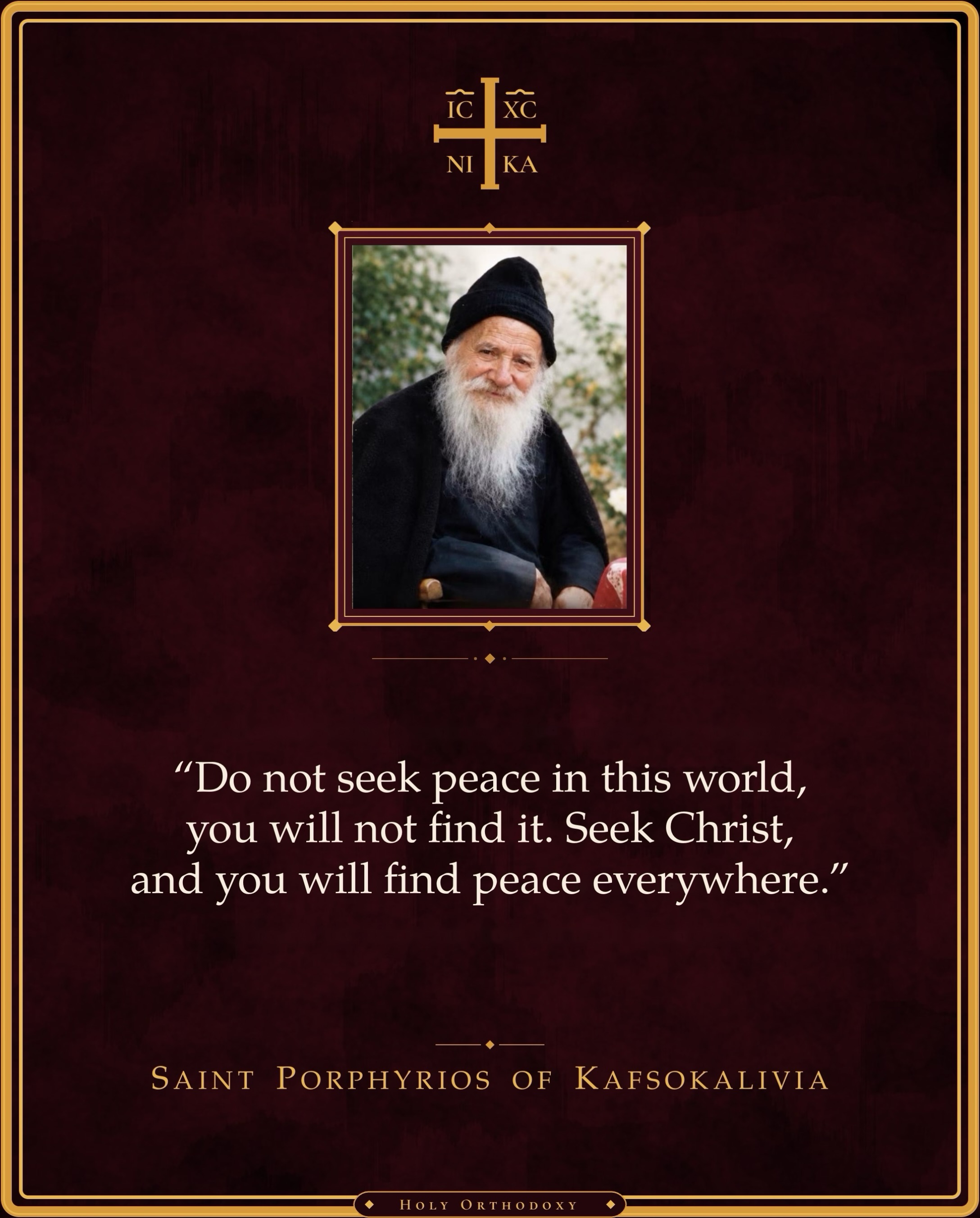
Saint Porphyrios: Peace Comes Only Through Christ

The post introduces Saint Porphyrios of Kavsokalyvia (1906-1991), a Greek Orthodox monk and elder known for his life of prayer, humility, and service. It shares his statement that peace cannot be found in worldly things but only in Christ, and that by turning one's heart to Christ, peace is found even amid life's struggles. The post ends with a request for the saint's intercession.

  • Saint Porphyrios of Kavsokalyvia lived from 1906 to 1991 as a monk and elder on Mount Athos.
  • He taught that true peace is not found in the world but only in Christ.
  • The quote "Do not seek peace in this world, you will not find it. Seek Christ, and you will find peace everywhere" is attributed to him.
  • The post asks for his prayers.
Read more

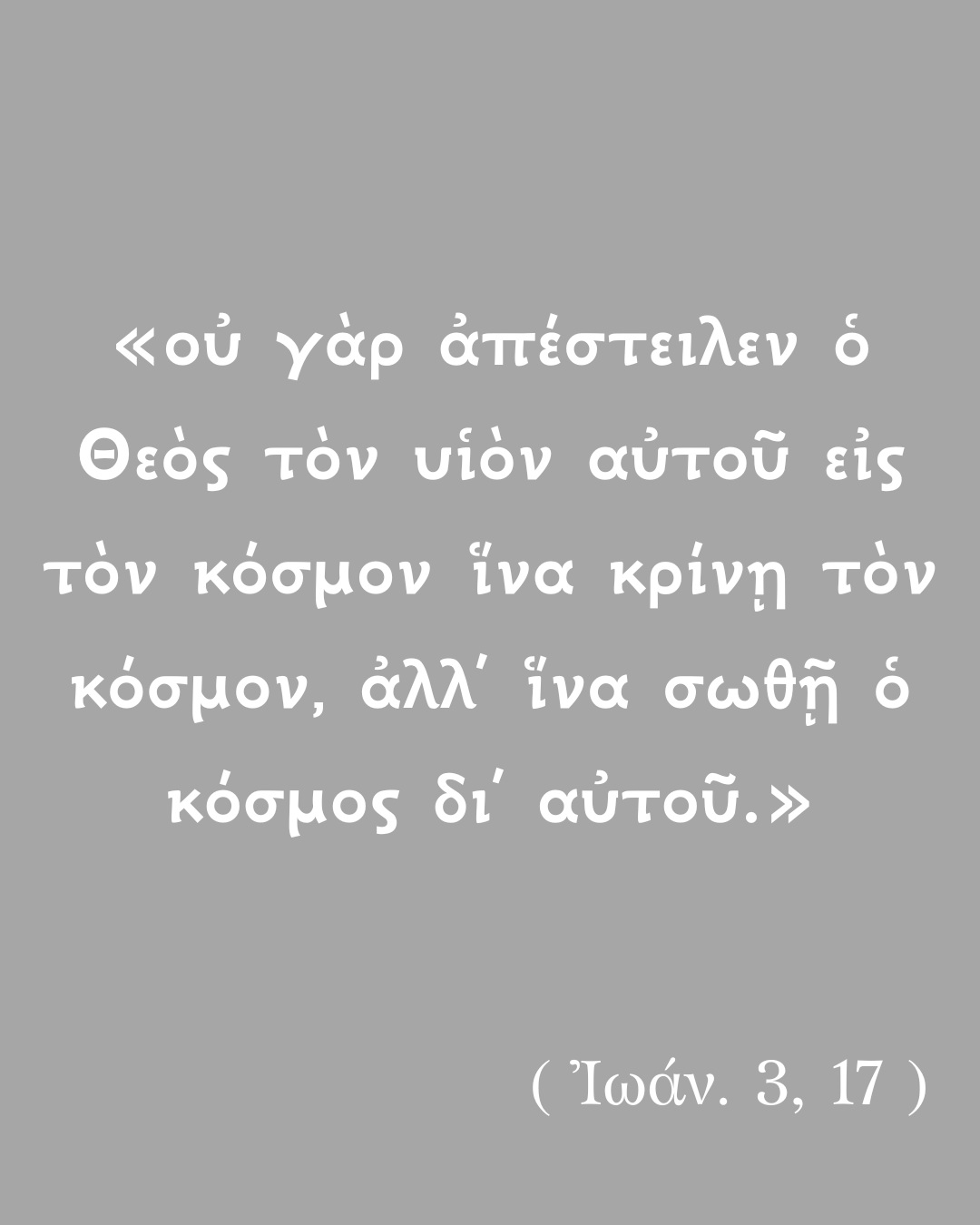
Commentary on John 3:17: Christ Sent to Save, Not Condemn

The post presents a brief commentary on John 3:17 from the book "The New Testament with Brief Commentary" by the late Professor Panagiotis N. Trembelas of the Theological School of the University of Athens and the Brotherhood of Theologians "The Savior" (11th edition, May 2025). The commentary contrasts the universal scope of Christ's mission with a particular Jewish expectation of the Messiah. It explains that God did not send His Son to judge…

The post presents a brief commentary on John 3:17 from the book "The New Testament with Brief Commentary" by the late Professor Panagiotis N. Trembelas of the Theological School of the University of Athens and the Brotherhood of Theologians "The Savior" (11th edition, May 2025). The commentary contrasts the universal scope of Christ's mission with a particular Jewish expectation of the Messiah.

It explains that God did not send His Son to judge and condemn humanity, but that the whole world might be saved through Him. The commentary notes that some Jews believed the Messiah would save only Jews and condemn all other nations, while the Gospel reveals God's purpose is the salvation of the entire human race. The post includes the Greek text of John 3:17: "For God did not send His Son into the world to judge the world, but that the world might be saved through Him."

  • Commentary on John 3:17 from an Orthodox theological publication
  • Contrasts universal salvation with a particular messianic expectation
  • Explains Christ's mission is to save, not condemn
  • Notes some Jews expected Messiah to save only Jews
  • Source: Professor Trembelas and Brotherhood of Theologians "The Savior"
Read more

Gerontas Filimon on Tears of Joy and the Meaning of χαρά

Gerontas Filimon, a monk of the Holy Coenobiatic Pantokratoros Skete of the Prophet Elias on Mount Athos, speaks in a video shared by the Association of Friends of Mount Athos in Heraklion about the necessity of tears. He distinguishes the tears that are needed: not tears of sorrow, but tears of joy. The Church calls this state χαρμολύπη, joyful sorrow. The elder explains the origin of the Greek word for joy, χαρά, tracing it to the verb…

Gerontas Filimon, a monk of the Holy Coenobiatic Pantokratoros Skete of the Prophet Elias on Mount Athos, speaks in a video shared by the Association of Friends of Mount Athos in Heraklion about the necessity of tears. He distinguishes the tears that are needed: not tears of sorrow, but tears of joy. The Church calls this state χαρμολύπη, joyful sorrow. The elder explains the origin of the Greek word for joy, χαρά, tracing it to the verb αραρίσκω, which means to fit together or to harmonize.

From this he draws a spiritual lesson: when a person has harmony within, he has joy; and when he has joy, he stands beside the light. The video is available on the YouTube channel of the Association of Friends of Mount Athos in Heraklion. The teaching connects the experience of joyful tears to an inner condition of harmony and to a positional nearness to divine light.

The elder's words present joy not as a fleeting emotion but as the fruit of a harmonious soul, and tears of joy as the expression of that harmony. The discussion turns on the meaning of χαρμολύπη as a paradoxical union of joy and sorrow, the etymology of χαρά as harmony, and the resulting spiritual stance of standing beside the light.

Key moments

  1. We need tears, but one tear of joy.
  2. The Church names this joyful sorrow, χαρμολύπη.
  3. The word χαρά (joy) comes from αραρίσκω, which means harmony.
  4. When a person has harmony, he has joy.
  5. When he has joy, he is next to the light.
Read more
Orthodox Life Instagram

Saint Gabriel of Georgia: Fool for Christ and Confessor of the Faith

On November 2 the Church commemorates Saint Gabriel the Fool for Christ, New Confessor of Georgia. Born Goderdzi Urgebadze in Tbilisi in 1929, he grew up during intense Soviet crackdowns on religion. From youth he felt a calling to spiritual life, building a small church in his family's yard and reading the Gospels with devotion. In May 1965 he made a public stand against the regime by setting fire to a massive portrait of Vladimir Lenin during…

On November 2 the Church commemorates Saint Gabriel the Fool for Christ, New Confessor of Georgia. Born Goderdzi Urgebadze in Tbilisi in 1929, he grew up during intense Soviet crackdowns on religion. From youth he felt a calling to spiritual life, building a small church in his family's yard and reading the Gospels with devotion.

In May 1965 he made a public stand against the regime by setting fire to a massive portrait of Vladimir Lenin during a May Day parade. Arrested, beaten, and interrogated by the KGB, he was officially declared mentally unstable to discredit his actions. Afterward he embraced the ancient path of the fool for Christ, hiding his deep wisdom, prayer life, and clairvoyant gifts behind eccentric behavior.

He lived in poverty, often sleeping in a makeshift wooden coop or ruins near Samtavro Monastery in Mtskheta. Through his feigned madness he shocked people out of complacency and drew them toward genuine repentance. In his final years he became a beloved spiritual elder. He reposed on November 2, 1995, and was buried at Samtavro Monastery.

Innumerable pilgrims flocked to his grave to pray and seek healing. On December 20, 2012, the Holy Synod of the Georgian Orthodox Church officially canonized him as Holy Father Saint Gabriel, Confessor and Fool for Christ. His relics were uncovered in February 2014 and placed in the Transfiguration Cathedral at Samtavro Monastery, where they continue to draw the faithful.

The post includes historical photographs of his act of defiance, his later life as an elder, and fresco and tomb details from his shrine. His central teaching remains: "In the end days a man will be saved by love, humbleness, and kindness."

  • Born Goderdzi Urgebadze in Tbilisi, 1929; built a church in his yard as a youth.
  • Burned a Lenin portrait during a 1965 May Day parade; arrested, beaten, declared mentally unstable by KGB.
  • Embraced fool-for-Christ path, lived in poverty near Samtavro Monastery, feigned madness to awaken repentance.
  • Reposed 1995, buried at Samtavro; pilgrims sought healing at his grave.
  • Canonized by Georgian Orthodox Holy Synod in 2012; relics uncovered 2014, placed in Transfiguration Cathedral; teaching: salvation through love, humility, kindness.
Read more