WeOrthodox
EN UA

Prayer Orthodoxy ®

Instagram ↗ 196 discussions

Prayer Orthodoxy® Orthodox Christianity Through Scripture, Tradition, and the Saints Deepen Your Understanding of the Faith

Prayer Orthodoxy ® Instagram

Why the priest cuts the bread with a spear at Proskomide

The post explains the meaning of the liturgical spear used during the Proskomide. The spear recalls Christ's sacrifice and His pierced side on the cross. Around the Lamb, which is the portion of bread that becomes the Body of Christ, the priest places particles for the Theotokos, the saints, the living, and the departed. This arrangement shows the whole Church gathered around Christ. The text is given in English and Greek.

  • The spear symbolizes Christ's pierced side and His sacrifice.
  • The Lamb represents Christ.
  • Particles around the Lamb commemorate the Theotokos and the saints.
  • Particles also commemorate the living and the departed.
  • The arrangement reveals the whole Church gathered around Christ.
Read more

Resurrection of Christ distinguished from pagan myths by historical eyewitness testimony

The speaker tells his Christian friends that even if every biblical event happened exactly as written, the resurrection would not be unique because pagan gods also rise from the dead. He says his friends get upset when he makes this point. He then challenges them to show one pagan god who rose with historical eyewitness testimony comparable to that of Jesus Christ. He argues that they are confusing mythology with historical testimony. He states…

The speaker tells his Christian friends that even if every biblical event happened exactly as written, the resurrection would not be unique because pagan gods also rise from the dead. He says his friends get upset when he makes this point. He then challenges them to show one pagan god who rose with historical eyewitness testimony comparable to that of Jesus Christ.

He argues that they are confusing mythology with historical testimony. He states that the resurrection of Christ is not some recycled pagan myth. Rather, it is a historical claim rooted in apostolic testimony and preserved by the church until this day.

The discussion centers on the distinction between mythological resurrection stories and the specific historical evidence for Christ's resurrection, particularly the apostolic eyewitness accounts maintained continuously by the church.

Key moments

  1. He says his Christian friends get crazy when he says if everything in the Bible happened exactly as it said, literally.
  2. He says resurrection happens all the time and pagan gods resurrect all the time.
  3. He challenges them to show one pagan god who rose with historical eyewitness testimony comparable to that of Jesus Christ.
  4. He says they are confusing mythology with historical testimony.
  5. He says the resurrection of Christ isn't some recycled pagan myth.
  6. He says it is a historical claim rooted in apostolic testimony and preserved by the church until this day.
Read more

Hieromonk Theodosios chants a hymn to the Theotokos on her purity and Gabriel's greeting

The video presents a fragment of a liturgical hymn addressed to the Theotokos, chanted by Hieromonk Theodosios at the Cell of the Holy Unmercenaries in New Skete. The hymn references the Theotokos's purity and the announcement of the Archangel Gabriel, who cries out to her. It poses the question of what name to give to the one who received the Word in her womb, and concludes with a petition for grace. The recording captures the chanting in a monastic setting.

Key moments

  1. The hymn addresses the Theotokos, mentioning her purity and Gabriel's announcement to her.
Read more
Prayer Orthodoxy ® with Holy Orthodoxy Instagram

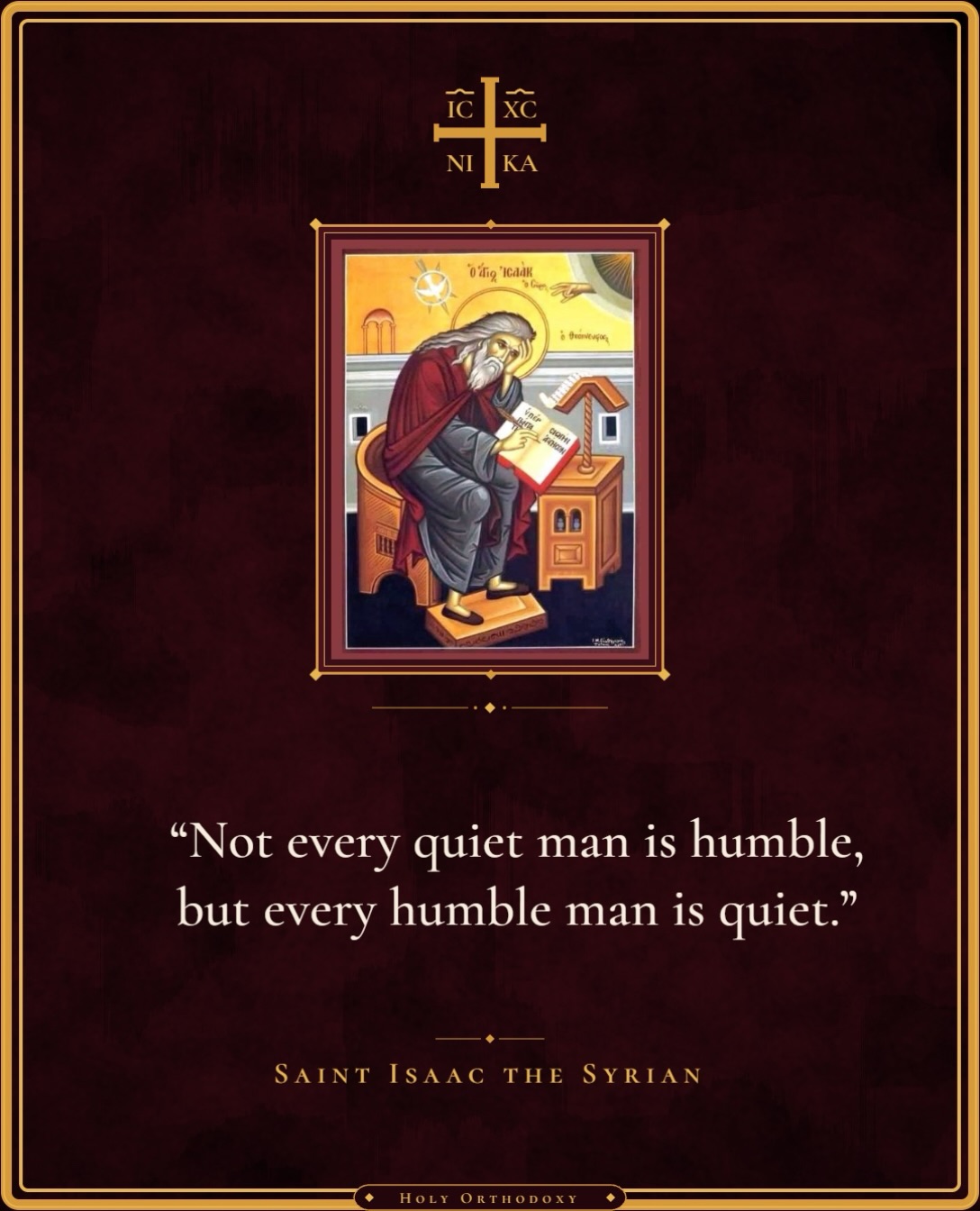
St. Isaac the Syrian: Not every quiet man is humble, but every humble man is quiet

The post shares a saying attributed to St. Isaac the Syrian that distinguishes between mere silence and true humility. The author notes that silence alone is not a virtue because a person can be outwardly quiet while inwardly judging, resentful, or proud. Genuine humility, however, naturally produces a stillness that removes the need to prove oneself, win arguments, or have the last word. The post concludes with a request for the saint's…

The post shares a saying attributed to St. Isaac the Syrian that distinguishes between mere silence and true humility. The author notes that silence alone is not a virtue because a person can be outwardly quiet while inwardly judging, resentful, or proud. Genuine humility, however, naturally produces a stillness that removes the need to prove oneself, win arguments, or have the last word.

The post concludes with a request for the saint's prayers. The accompanying image displays the same saying in Greek and English alongside the saint's title and the phrase "IC XC NI KA."

  • Silence by itself is not a virtue; inner disposition matters.
  • A quiet person may still harbor judgment, resentment, or pride.
  • True humility brings an inner stillness that ends the need to prove oneself or win arguments.
  • The saying is attributed to St. Isaac the Syrian.
  • The post asks for the saint's intercession.
Read more

St Nicholas relic destroyed in France; theology of relic veneration explained

A small bone fragment of St Nicholas of Myra, approximately 1-2 cm long, was stolen from a display beneath his statue at the Basilica of Saint-Nicolas-de-Port in France and reportedly burned and crushed. The principal relics, including the arm-shaped reliquary, remain intact. The thief has been identified, arrested, confessed, and is expected to face trial in December 2026. The post traces the journey of St Nicholas' relics: the saint died in…

A small bone fragment of St Nicholas of Myra, approximately 1-2 cm long, was stolen from a display beneath his statue at the Basilica of Saint-Nicolas-de-Port in France and reportedly burned and crushed. The principal relics, including the arm-shaped reliquary, remain intact. The thief has been identified, arrested, confessed, and is expected to face trial in December 2026.

The post traces the journey of St Nicholas' relics: the saint died in 343 in Myra (modern Turkey); in 1087 Italian merchants from Bari took the relics from the monks who guarded them, despite local inhabitants begging for at least a small portion; some relics were later distributed regionally, including to France. The primary relics remain in the crypt tomb at the Basilica di San Nicola in Bari, where Orthodox services are held every Tuesday and Thursday, making it a significant site for Catholic-Orthodox dialogue.

The post explains Orthodox veneration of relics through the theology of theosis. Salvation is attained not by works or moral laws but through humility and repentance uniting us to God. At the Second Coming, Christ resurrects the dead in body and soul for judgment, so the body plays an equal role in salvation.

Those who lived in holiness receive grace that does not separate from their bodies after death. Archimandrite George Kapsanis of Mount Athos, citing St Gregory Palamas, writes that the grace of theosis preserves saints' bodies incorruptible; grace first unites with their souls, then takes up residence in their bodies, graves, icons, and churches.

This is why Orthodox Christians venerate and kiss relics, icons, graves, and churches, all retain something of the grace the saint possessed through union with God. The post also mentions relics at St Nicholas Monastery in Cyprus (4th century), a relics cabinet at St John's Monastery on Patmos containing part of St Nicholas' head, and the intact body of St Savvas in Kalymnos, Greece, with items in Sydney that exude myrrh.

  • A small relic fragment of St Nicholas was stolen and destroyed in France in 2026; the thief was arrested and confessed
  • St Nicholas' relics traveled from Myra (343) to Bari (1087) and were later distributed to France and other regions
  • Primary relics remain in Bari's Basilica di San Nicola, a site of Catholic-Orthodox dialogue with regular Orthodox services
  • Orthodox veneration of relics is grounded in theosis: grace remains in saints' bodies after death and extends to their graves, icons, and churches
  • The body is essential to salvation; at the Second Coming Christ resurrects body and soul for judgment
Read more
Prayer Orthodoxy ® Instagram

The Asterisk: Star of Bethlehem Over the Diskos

The post explains the asterisk, a small metal frame placed over the bread on the diskos during the Proskomide. Its two curved bands cross to support the veil so it does not touch the bread. The word asterisk means "little star." As the priest places it, he recalls the Gospel account of the star that stood over the place where the Christ Child lay. The star above the diskos represents the Star of Bethlehem that guided the Magi to Christ. This…

The post explains the asterisk, a small metal frame placed over the bread on the diskos during the Proskomide. Its two curved bands cross to support the veil so it does not touch the bread. The word asterisk means "little star." As the priest places it, he recalls the Gospel account of the star that stood over the place where the Christ Child lay.

The star above the diskos represents the Star of Bethlehem that guided the Magi to Christ. This action connects the preparation of the Holy Gifts with the birth of the Savior. The Child born in Bethlehem is the same Lord who offered Himself on the Cross and rose from the dead.

The bread beneath the star is prepared for the Eucharist, in which the faithful receive His true Body and Blood. The asterisk draws attention to the unity of Christ's saving work from His birth to His sacrifice and Resurrection. The teaching is presented in both English and Greek, emphasizing the continuity between the Nativity and the Divine Liturgy.

  • The asterisk (ἀστερίσκος) is a small metal frame placed over the bread on the diskos during the Proskomide.
  • Its crossed bands support the veil so it does not touch the bread.
  • The name means "little star" and symbolizes the Star of Bethlehem that guided the Magi.
  • The priest recalls the Gospel account of the star when placing it, linking the Nativity to the preparation of the Holy Gifts.
  • The asterisk signifies the unity of Christ's saving work from His birth to His sacrifice and Resurrection, as the same Child born in Bethlehem is received in the Eucharist.
Read more
Prayer Orthodoxy ® with Prayer Orthodoxy® Instagram

St. Paul on affliction and the light of Christ in 2 Corinthians 4

The post presents a reflection on the fourth chapter of St. Paul's Second Letter to the Corinthians. The English text states that though we are afflicted, we are not crushed, and the light of Christ continues to shine through every trial. It notes that human weakness does not prevent God's power from working within us, and that as we carry our cross, the life of Jesus should be revealed in our patience, faith, and love. A Greek translation…

The post presents a reflection on the fourth chapter of St. Paul's Second Letter to the Corinthians. The English text states that though we are afflicted, we are not crushed, and the light of Christ continues to shine through every trial. It notes that human weakness does not prevent God's power from working within us, and that as we carry our cross, the life of Jesus should be revealed in our patience, faith, and love.

A Greek translation follows the same points. Three images contain scriptural quotations attributed to St. Paul. The first quotes 2 Corinthians 4:6: God who commanded light to shine out of darkness has shone in our hearts to give the light of the knowledge of the glory of God in the face of Christ. The second quotes 2 Corinthians 4:8-10: we are afflicted in every way but not crushed, perplexed but not driven to despair, persecuted but not forsaken, struck down but not destroyed, always carrying in the body the death of Jesus so that the life of Jesus may be manifested in our bodies.

The third quotes 2 Corinthians 4:11: while we live we are always being given up to death for Jesus' sake, so that the life of Jesus may be manifested in our mortal flesh. Each image bears the label "PRAYER ORTHODOXY" and the Greek abbreviation for Saint Paul.

  • Reflection on 2 Corinthians 4 with English and Greek text
  • First image: 2 Corinthians 4:6 on light shining in our hearts
  • Second image: 2 Corinthians 4:8-10 on affliction without crushing
  • Third image: 2 Corinthians 4:11 on carrying Christ's death to manifest his life
  • Theme: human weakness as vessel for divine power
Read more

Sacraments as Christ's Medicine for Healing and Salvation

The speaker addresses a claim that sacraments are a way for the church through the priest to have control over people in the most important times of their life. The opposing view states that God's word says you don't need sacraments, you only need Jesus. The speaker counters that the sacraments are gifts from God, given to us for our healing and salvation. He points out that Christ commanded baptism, instituted the Eucharist, and gave his…

The speaker addresses a claim that sacraments are a way for the church through the priest to have control over people in the most important times of their life. The opposing view states that God's word says you don't need sacraments, you only need Jesus. The speaker counters that the sacraments are gifts from God, given to us for our healing and salvation.

He points out that Christ commanded baptism, instituted the Eucharist, and gave his apostles authority to forgive sins. Citing St John Chrysostom, the speaker describes the church as a hospital, not a court of justice. In this framework, sin is a sickness, Christ is the physician, and the sacraments are the medicine through which God heals us and unites us to himself.

The church is the body of Christ. To reject the church's mysteries is to reject the very means of healing and salvation Christ has given us. The discussion turns on whether the sacraments are human inventions for ecclesiastical control or divine gifts for salvation. The speaker argues that Christ himself established these mysteries, and the fathers of the church, such as St John Chrysostom, understood them as therapeutic means by which the sickness of sin is healed.

The church as the body of Christ is the context in which these mysteries operate, and separation from them means separation from the healing presence of Christ the physician.

Key moments

  1. The opposing view states that sacraments are a way for the church through the priest to have control over people in the most important times of their life.
  2. The opposing view states that God's word says you don't need sacraments, you only need Jesus.
  3. The sacraments are gifts from God, given to us for our healing and salvation.
  4. Christ commanded baptism, instituted the Eucharist, and gave his apostles authority to forgive sins.
  5. St John Chrysostom said the church is a hospital, not a court of justice.
  6. Sin is a sickness, Christ is the physician, and the sacraments are the medicine through which God heals us and unites us to himself.
  7. The church is the body of Christ.
  8. To reject the church's mysteries is to reject the very means of healing and salvation Christ has given us.
Read more

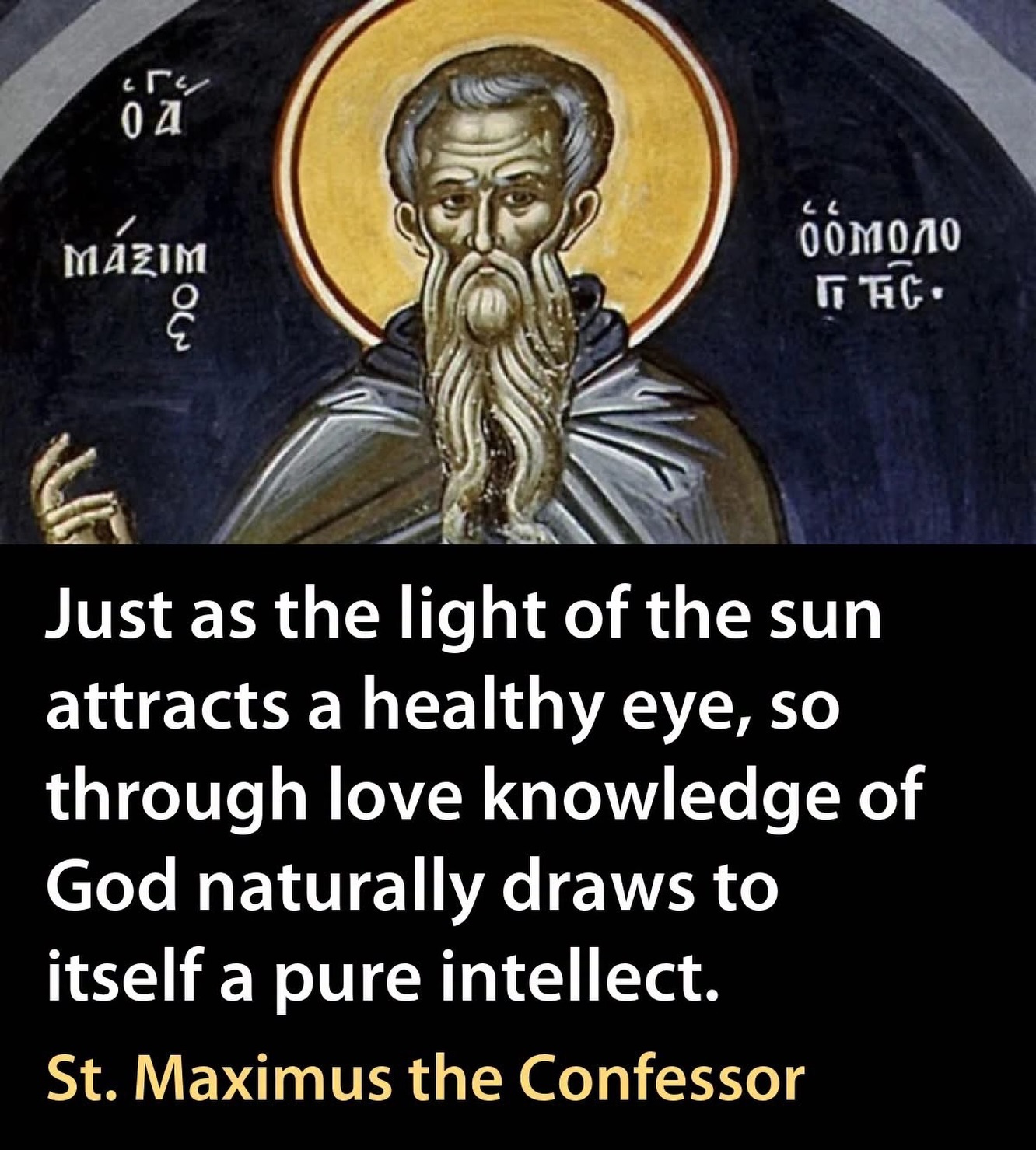
St. Maximus the Confessor on love and knowledge of God

The post presents a prayer to St. Maximus the Confessor and a quotation attributed to him. The quotation states that just as sunlight naturally draws a healthy eye, so through love the knowledge of God naturally draws a pure intellect to itself. The Greek text in the image gives the original wording of the saying.

  • Prayer to St. Maximus the Confessor
  • Quote comparing divine knowledge to sunlight attracting the eye
  • Love as the means by which knowledge of God draws the pure intellect
  • Greek text of the saying shown in the image
Prayer Orthodoxy ® Instagram

The Antimension: Cloth Linking Liturgy to Christ's Burial and the Martyrs

During the Orthodox Divine Liturgy the priest unfolds a consecrated linen or silk cloth called the antimension upon the Holy Altar. The cloth typically depicts Christ's entombment with the four Evangelists at its corners and often bears words from the Holy Saturday hymn describing Joseph of Arimathea wrapping Christ's body in fine linen and laying it in a new tomb. The image and hymn connect the antimension with Christ's burial and His saving…

During the Orthodox Divine Liturgy the priest unfolds a consecrated linen or silk cloth called the antimension upon the Holy Altar. The cloth typically depicts Christ's entombment with the four Evangelists at its corners and often bears words from the Holy Saturday hymn describing Joseph of Arimathea wrapping Christ's body in fine linen and laying it in a new tomb.

The image and hymn connect the antimension with Christ's burial and His saving sacrifice. When folded the antimension is kept inside a protective cloth called the eileton, often red, beneath the Gospel Book; traditional explanations associate these cloths with the burial linens of Christ. The priest unfolds them in preparation for the Eucharistic offering and after Communion carefully gathers any sacred particles remaining on them.

The antimension is consecrated by a bishop and bears his signature authorizing its use. The bishop is the chief pastor of his diocese and stands within the Church's apostolic succession; even when absent the priest celebrates with his blessing. The signed antimension expresses the communion of bishop, clergy, and faithful within the one Orthodox Church.

Ordinarily the antimension contains a small relic of a saint, traditionally a martyr, secured in a sewn pocket. This preserves the early Christian practice of celebrating the Eucharist at the tombs of martyrs. Beneath the Holy Gifts rests a tangible reminder of those who remained faithful to Christ even unto death and who live in Him.

  • The antimension is a consecrated cloth placed on the altar beneath the Holy Gifts during the Divine Liturgy.
  • It depicts Christ's entombment, often with the four Evangelists and words from the Holy Saturday hymn.
  • The cloth is kept folded in a protective eileton and unfolded by the priest for the Eucharistic offering.
  • It bears the bishop's signature, authorizing its use and expressing the communion of the local church.
  • A saint's relic, usually a martyr's, is sewn into the antimension, linking the Liturgy to the early Church's worship at martyrs' tombs.
Read more

God's Strength Is Made Perfect in Weakness

The post reflects on why some of the strongest Christians are those who have endured hardship rather than easy lives. It describes believers who have faced rejection, betrayal, loneliness, disappointment, and seasons when God seemed silent, yet who continue to pray, attend Divine Liturgy, repent, and glorify God even when life has not unfolded as they hoped. The author argues that such strength does not come from willpower alone but from the…

The post reflects on why some of the strongest Christians are those who have endured hardship rather than easy lives. It describes believers who have faced rejection, betrayal, loneliness, disappointment, and seasons when God seemed silent, yet who continue to pray, attend Divine Liturgy, repent, and glorify God even when life has not unfolded as they hoped.

The author argues that such strength does not come from willpower alone but from the grace of God, citing St Paul's words in 2 Corinthians 12:9: "My grace is sufficient for you, for My strength is made perfect in weakness." The post also sets a boundary against a possible misunderstanding: in Orthodox Christianity, suffering is not proof that a person is chosen or spiritually superior.

What matters is how suffering is endured. When a person bears trials with faith, humility, patience, and repentance, God can transform those trials into opportunities for spiritual growth. The author concludes that true faith is not shown only when God gives a person what he wants; it is shown when a person continues to trust God even when he does not understand His plan.

There is no further discussion in the post; it stands as a short reflection on endurance, grace, and trust in God amid trials.

  • The strongest Christians are often those who endured rejection, betrayal, loneliness, and disappointment yet still pray, attend Divine Liturgy, repent, and glorify God.
  • Their strength comes from the grace of God, not willpower alone, citing 2 Corinthians 12:9: "My grace is sufficient for you, for My strength is made perfect in weakness."
  • In Orthodox Christianity, suffering is not proof that someone is chosen or spiritually superior.
  • When suffering is endured with faith, humility, patience, and repentance, God can turn trials into opportunities for spiritual growth.
  • True faith is revealed when we trust God even when we do not understand His plan.
Read more

Protestant argues Reformers abandoned apostolic Christianity

The speaker identifies as a Protestant by conviction, not convenience or complacency, and argues that the Reformers, Martin Luther, John Calvin, Ulrich Zwingli, Philipp Melanchthon, and John Knox, did not restore apostolic Christianity but departed from it. He names them as those who reformed the church but says they actually did the opposite of restoring apostolic Christianity. He cites three early church fathers to show what the early church…

The speaker identifies as a Protestant by conviction, not convenience or complacency, and argues that the Reformers, Martin Luther, John Calvin, Ulrich Zwingli, Philipp Melanchthon, and John Knox, did not restore apostolic Christianity but departed from it. He names them as those who reformed the church but says they actually did the opposite of restoring apostolic Christianity.

He cites three early church fathers to show what the early church held. Saint Ignatius of Antioch defended the authority of bishops. Saint Irenaeus of Lyons defended apostolic succession. Saint Basil the Great defended holy tradition and its authority.

The speaker then points to specific rejections by two leading Reformers. Luther rejected the sacramental priesthood. Calvin rejected the Eucharistic sacrifice. The speaker asserts these departures contradict both the early church and Scripture itself.

He observes that Protestants remain divided over baptism, the Eucharist, salvation, and church authority. He concludes that a movement cannot claim to restore the apostolic faith while remaining divided over what that faith is. The speaker presents his case as a Protestant who has examined the historical record and found the Reformation's claims wanting.

The discussion turns on whether the Reformation was a recovery or a rupture, and the speaker contends the evidence shows rupture.

Key moments

  1. The speaker states he is a Protestant out of conviction, not convenience or complacency.
  2. He names the Reformers, Martin Luther, John Calvin, Zwingli, Melanchthon, Knox, as those who reformed the church but says they actually did the opposite of restoring apostolic Christianity.
  3. He cites St. Ignatius defending the authority of bishops, St. Irenaeus defending apostolic succession, and St. Basil defending holy tradition and its authority.
  4. He says Luther rejected the sacramental priesthood and Calvin rejected the Eucharistic sacrifice.
  5. He asserts these departures contradict the early church and Scripture itself.
  6. He observes Protestants remain divided over baptism, the Eucharist, salvation, and church authority.
  7. He concludes you cannot claim to restore the apostolic faith while remaining divided over what the faith even is.
8 opinions in the discussion And then all the reformers went to war with each other and produced an endless number of denominations. 👌 Read the discussion
Prayer Orthodoxy ® Instagram

Saint Arsenios the Cappadocian: Priest, Healer, Spiritual Father of Saint Paisios

Saint Arsenios the Cappadocian is commemorated on November 10. He was a priest from Cappadocia known for deep prayer, humility, and love for those who suffered. Through his prayers God granted healing and comfort to Christians and Muslims alike. He baptized the infant who would become Saint Paisios, giving him the name Arsenios. He accompanied his community to Greece during the population exchange of 1924. He fell asleep in the Lord on November…

Saint Arsenios the Cappadocian is commemorated on November 10. He was a priest from Cappadocia known for deep prayer, humility, and love for those who suffered. Through his prayers God granted healing and comfort to Christians and Muslims alike. He baptized the infant who would become Saint Paisios, giving him the name Arsenios.

He accompanied his community to Greece during the population exchange of 1924. He fell asleep in the Lord on November 10, 1924 on the island of Corfu. His holy relics are treasured at the Monastery of Saint John the Theologian in Souroti near Thessaloniki, where Saint Paisios's grave is also located.

The commemoration includes a Greek translation of the same text. The feast marks his life of prayer that brought healing and comfort to many at the monastery, the veneration of his relics there, his baptism of the future Saint Paisios, the presence of Saint Paisios's grave at the same monastery, and the intercession of both saints.

Key moments

  1. November 10th marks the feast of Saint Arsenius the Cappadocian.
  2. Saint Arsenius was a holy priest whose life of prayer brought healing and comfort to many at the monastery of Saint John the Theologian in Suroti near Thessaloniki.
  3. His holy relics are treasured at that monastery.
  4. Saint Arsenius baptized the child who would become Saint Paisios.
  5. Saint Paisios's grave also rests within these sacred grounds.
  6. As we approach his holy relics and the grave of Saint Paisios, we remember two lives devoted to Christ, whose love continues to draw souls toward him.
  7. Saint Arsenius and Saint Paisios intercede for us.
Read more
Prayer Orthodoxy ® with Holy Orthodoxy, Timothy Instagram

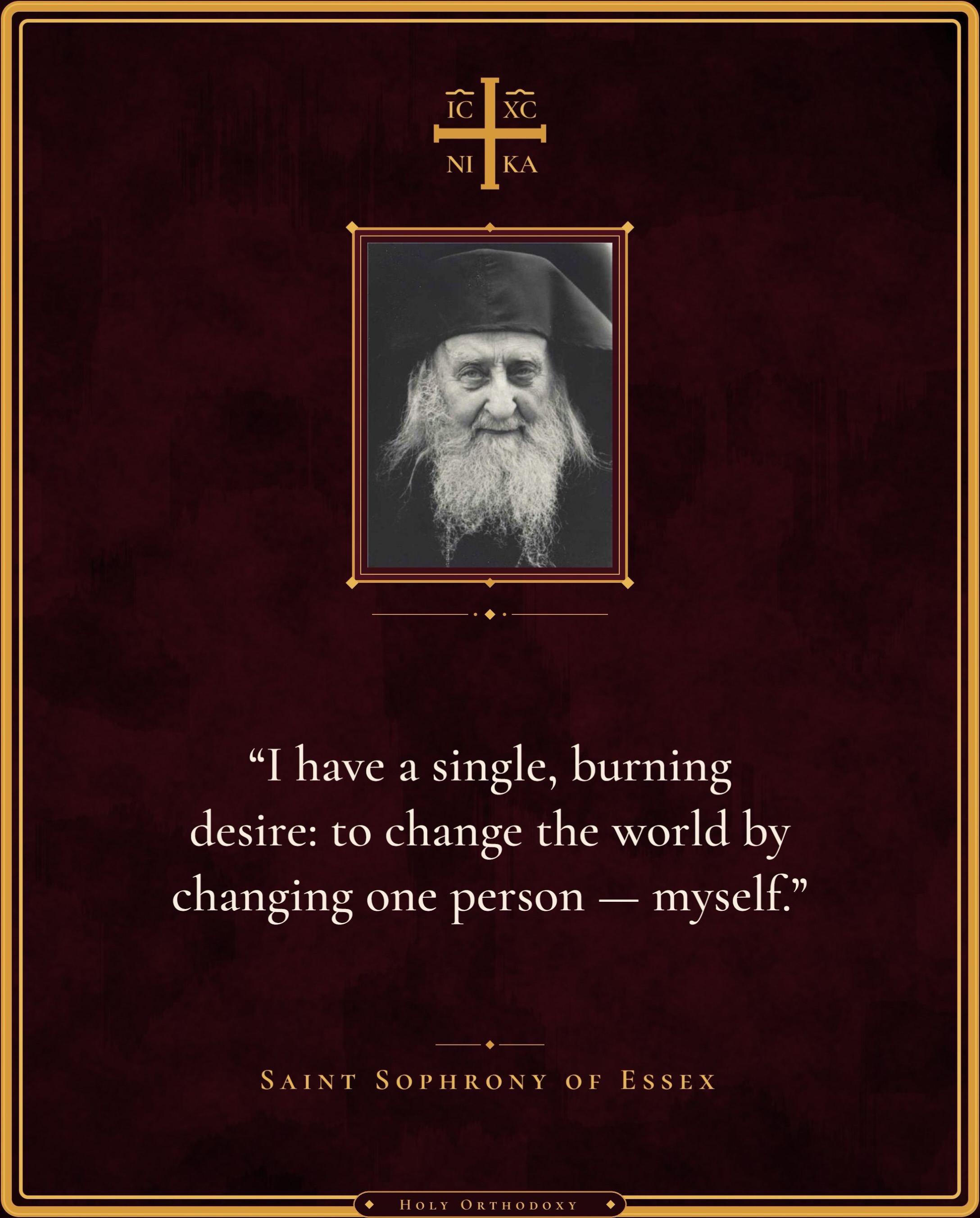
St. Sophrony of Essex: Change Begins with One's Own Heart

The post shares a quotation from Saint Sophrony of Essex: "I have a single, burning desire: to change the world by changing one person, myself." The author reflects that while it is easy to want the world to change, St. Sophrony points to the heart as the true starting point. Through repentance, prayer, and humility, the Lord transforms a person, and that transformation then extends to those around them.

The post concludes with a request for the saint's intercession: "Holy Father Sophrony, pray for us."

  • St. Sophrony of Essex teaches that changing the world begins with changing oneself.
  • The quote expresses a single burning desire to transform oneself.
  • Repentance, prayer, and humility are the means by which the Lord transforms a person.
  • Personal transformation then affects those around the individual.
  • The post ends with a prayer to Holy Father Sophrony.
Read more
Prayer Orthodoxy ® Instagram

The zeon: why hot water is poured into the chalice before Communion

The post explains the Orthodox rite known as the zeon, from the Greek word meaning boiling or fervent. Just before Holy Communion, the priest or deacon pours a small amount of hot water into the chalice. The water recalls the blood and water that flowed from Christ's pierced side when a soldier thrust a spear into Him, as recorded in the Gospel of John. The warmth of the water points to the risen life of Christ and the fervor of the Holy Spirit.…

The post explains the Orthodox rite known as the zeon, from the Greek word meaning boiling or fervent. Just before Holy Communion, the priest or deacon pours a small amount of hot water into the chalice. The water recalls the blood and water that flowed from Christ's pierced side when a soldier thrust a spear into Him, as recorded in the Gospel of John.

The warmth of the water points to the risen life of Christ and the fervor of the Holy Spirit. Together, the water and its heat proclaim Christ's sacrifice on the Cross and His victory over death. As the faithful approach the chalice, they receive the true Body and Blood of the same Lord who suffered for them, rose from the tomb, and now unites them to Himself in Holy Communion.

The post presents this teaching in both English and Greek, and the accompanying image text breaks the explanation into a series of short slides that repeat the same points.

  • The rite is called zeon, from the Greek for boiling or fervent.
  • Hot water is added to the chalice by the priest or deacon just before Holy Communion.
  • The water recalls the blood and water from Christ's pierced side (John 19:34).
  • The warmth symbolizes Christ's risen life and the fervor of the Holy Spirit.
  • Receiving the chalice unites the faithful with the Lord who suffered, rose, and gives life.
Read more
Prayer Orthodoxy ® with Jamey Bennett Instagram

Free Orthodox Field Guide Explains the Divine Liturgy in 33 Stops

The post announces a free online resource called A Field Guide to the Orthodox Church, available at orthodoxfieldguide.com. The guide is designed to be used like a field guide during a church visit. It covers practical details for a first visit, including where to stand and when to sit, and walks through the Divine Liturgy in 33 stops from the courtyard to the coffee urn.

The author suggests reading the guide before Sunday so that visitors can focus on paying attention during the service rather than figuring out what to do.

Key moments

  1. The Orthodox Field Guide is a free online resource at orthodoxfieldguide.com designed to be taken to church like a field guide.
  2. It covers a first visit, where to stand, when to sit, and the Divine Liturgy in 33 stops from the courtyard to the coffee urn.
  3. The guide should be read before Sunday so visitors can focus on paying attention during the service.
Read more

Discerning God's Will: Salvation Over a Detailed Life Plan

The speaker addresses the frequent question of how to discern God's will daily. He observes that many Christians carry a Protestant-influenced anxiety that God has a detailed life plan requiring exact choices for marriage and career. The speaker states that God's will is for all people to be saved and to come to the knowledge of the truth. Daily discernment therefore consists in keeping Christ's commands: to be loving, gentle, peaceful,…

The speaker addresses the frequent question of how to discern God's will daily. He observes that many Christians carry a Protestant-influenced anxiety that God has a detailed life plan requiring exact choices for marriage and career. The speaker states that God's will is for all people to be saved and to come to the knowledge of the truth.

Daily discernment therefore consists in keeping Christ's commands: to be loving, gentle, peaceful, merciful, and a presence of Christ. He emphasizes God's mercy and eternity: even if someone fails for thirty, forty, or fifty years, God does not close the book or shut the door as long as He grants more time.

Key moments

  1. 0:00 The number one question is what is God's will for me and how to discern it daily, and the speaker notes a Protestant-influenced mindset that God has a detailed life plan requiring exact marriage and job choices.
  2. 0:32 God's will is that all be saved and come to the knowledge of the truth, so on a daily basis we follow his commands to be loving, gentle, peaceful, merciful, and a presence of Christ.
  3. 0:32 God is merciful and eternal; even if one messes up the first 30, 40, or 50 years, if he gives more time, that is all that matters because he does not close the book or shut the door.
Read more

Saint George Church in Mantouki preserves Saint Cosmas of Aetolia's sacred shirt

The Church of Saint George in Mantouki, Corfu, contains a red-and-gold wooden iconostasis with intricate carvings crowned by dragons that symbolize Christ's triumph over evil. The church also safeguards the sacred shirt of Saint Cosmas of Aetolia, an Orthodox missionary saint. The relic was brought to Mantouki in the 19th century and has been preserved in Saint George's Church after its original home was destroyed during World War II.

  • The church features a carved red-and-gold iconostasis with dragons representing Christ's victory over evil.
  • It houses the sacred shirt of Saint Cosmas of Aetolia, a revered Orthodox missionary.
  • The relic was transferred to Mantouki in the 19th century.
  • The shirt was preserved in Saint George's Church after the destruction of its previous location in World War II.
  • The site combines artistic, historical, and spiritual significance.
Read more

Saint Silouan the Athonite on Humility and Prayer for Enemies

The post presents the life and teaching of Saint Silouan the Athonite (1866-1938), a Russian Orthodox monk at the Monastery of St. Panteleimon on Mount Athos. Born Simeon Ivanovich Antonov, he entered monastic life in 1892 and devoted himself to prayer, repentance, humility, and unceasing communion with God. Through profound spiritual struggles he experienced the grace of Christ and became known for extraordinary humility, compassion, and love…

The post presents the life and teaching of Saint Silouan the Athonite (1866-1938), a Russian Orthodox monk at the Monastery of St. Panteleimon on Mount Athos. Born Simeon Ivanovich Antonov, he entered monastic life in 1892 and devoted himself to prayer, repentance, humility, and unceasing communion with God. Through profound spiritual struggles he experienced the grace of Christ and became known for extraordinary humility, compassion, and love for all humanity.

His central teaching is "Keep thy mind in hell, and despair not," which expresses the struggle against pride and despair through humility and unwavering hope in Christ. His spiritual life was deeply rooted in prayer for the whole world, including his enemies, whom he regarded as equally worthy of God's mercy. The post also includes a second saying: "The man who cries out against evil men but does not pray for them will never know the grace of God."

His life and writings were preserved by his disciple Archimandrite Sophrony, and he remains a powerful witness to Orthodox spirituality and the path of genuine holiness.

  • Saint Silouan (1866-1938) was a Russian monk at St. Panteleimon Monastery on Mount Athos.
  • His central teaching: "Keep thy mind in hell, and despair not."
  • He emphasized prayer for the whole world, including enemies.
  • A second saying: "The man who cries out against evil men but does not pray for them will never know the grace of God."
  • His spiritual legacy was preserved by his disciple Archimandrite Sophrony.
Read more
Prayer Orthodoxy ® Instagram

Saint Nektarios: faithfulness through injustice and suffering

The post presents Saint Nektarios of Aegina as a model of faithfulness amid false accusation, rejection, and misunderstanding. It states that he answered injustice with humility and bitterness with forgiveness, and that his life shows God sees every hidden sorrow and holiness can grow through suffering. The feast day is given as November 9. Three sayings attributed to Saint Nektarios appear in the image: "Seek the Lord daily; but seek Him within…

The post presents Saint Nektarios of Aegina as a model of faithfulness amid false accusation, rejection, and misunderstanding. It states that he answered injustice with humility and bitterness with forgiveness, and that his life shows God sees every hidden sorrow and holiness can grow through suffering. The feast day is given as November 9. Three sayings attributed to Saint Nektarios appear in the image: "Seek the Lord daily; but seek Him within your heart," "He who loves God, naturally, also loves God's work," and "Our purpose in life is to become perfect and holy."

The text is bilingual, English and Greek, and ends with a request for the saint's intercession.

  • Saint Nektarios endured false accusation and rejection with humility and forgiveness
  • His life illustrates that God sees hidden sorrows and holiness can grow through suffering
  • Feast day celebrated November 9
  • Three sayings: seek the Lord within the heart; love of God leads to love of God's work; life's purpose is to become perfect and holy
  • Bilingual English and Greek text with intercessory prayer
Read more