WeOrthodox
EN UA

Појединац, Породица и Друштво

Instagram ↗ 209 discussions

Ова страница је посвећена ПРАВОСЛАВЉУ и ДОБРОТОЉУБЉУ🫒

Luke 7: Faith, humility, mercy, and repentance

The post presents a thematic spiritual overview of Luke chapter 7, drawing on the Gospel text and the commentary of Blessed Theophylact of Ohrid. It examines four episodes. First, the Roman centurion whose servant Jesus heals after the centurion says he is not worthy for Jesus to enter his house but asks only for a word; Jesus marvels at his faith, greater than any in Israel. Second, Jesus meets a widow at Nain mourning her only son, has…

The post presents a thematic spiritual overview of Luke chapter 7, drawing on the Gospel text and the commentary of Blessed Theophylact of Ohrid. It examines four episodes. First, the Roman centurion whose servant Jesus heals after the centurion says he is not worthy for Jesus to enter his house but asks only for a word; Jesus marvels at his faith, greater than any in Israel.

Second, Jesus meets a widow at Nain mourning her only son, has compassion, tells her not to weep, and raises the young man. Third, Jesus affirms John the Baptist as the greatest prophet born of women, calling for steadfastness in truth and spiritual vigilance. Fourth, a sinful woman washes Jesus' feet with tears and anoints them with myrrh in a Pharisee's house; the Pharisee judges her past, but Jesus sees her repentance and love, declaring her many sins forgiven and sending her in peace.

The post concludes that Luke 7 calls believers to cultivate faith, humility, mercy, and repentance, not to judge by past or status, and to remember that God knows the heart's depth. Source cited: Holy Gospel according to Luke 7:1-50; Blessed Theophylact of Ohrid, Commentary on Luke, chapter 7, Belgrade: Obraz svetacki, 2018.

Key moments

  1. Light a kandilo, extinguish the flame, and let the soul shine with light.
  2. Pray for health and salvation in the name of Jesus Christ, stand before an icon, keep the soul pure, pray only to Jesus Christ, and light frankincense each day.
St. Mark the Ascetic: Trials as Unexpected Affliction Leading to God

The post presents a saying of St. Mark the Ascetic on the nature of temptation. He writes that since no one pleases God without undergoing temptation, believers should thank God for everything that befalls them. He illustrates this with three biblical examples. Peter's successful catch by day followed an unsuccessful night of fishing (Luke 5:5). Paul gained spiritual sight only after being struck with bodily blindness (Acts 9:8). Stephen saw the…

The post presents a saying of St. Mark the Ascetic on the nature of temptation. He writes that since no one pleases God without undergoing temptation, believers should thank God for everything that befalls them. He illustrates this with three biblical examples. Peter's successful catch by day followed an unsuccessful night of fishing (Luke 5:5).

Paul gained spiritual sight only after being struck with bodily blindness (Acts 9:8). Stephen saw the heavens open and beheld God only after being falsely accused as a blasphemer (Acts 6:13-7:36). St. Mark concludes that just as action in accordance with God is called virtue, so unforeseen affliction is called temptation.

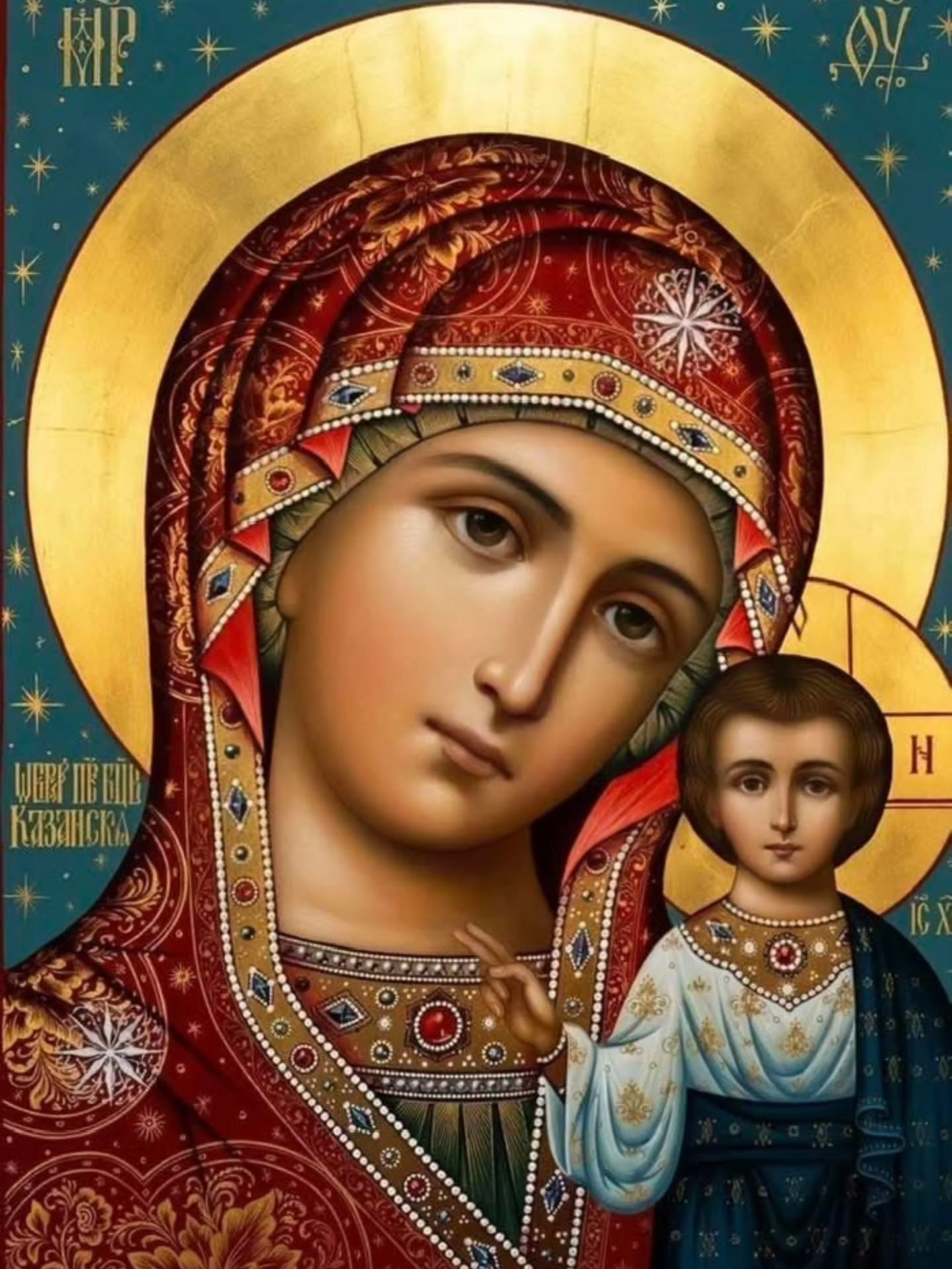
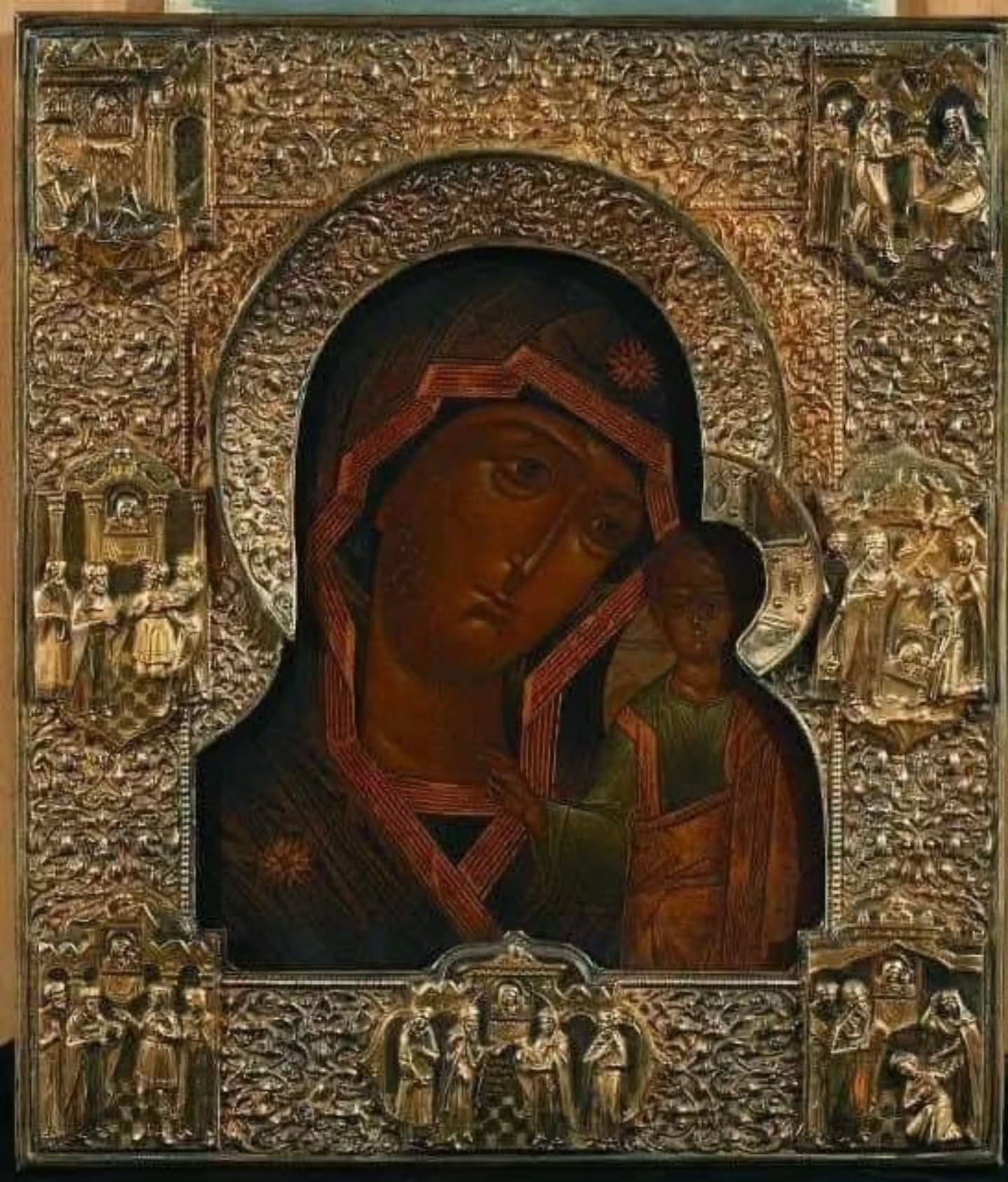
The accompanying image shows an icon of the Virgin Mary and the Christ Child framed by embossed scenes.

  • St. Mark the Ascetic teaches that no one pleases God without temptation.
  • Believers should thank God for all that befalls them.
  • Peter's daytime catch followed a fruitless night (Luke 5:5).
  • Paul received spiritual vision after physical blindness (Acts 9:8).
  • Stephen saw heaven open after being slandered (Acts 6:13-7:36).
Read more

Dragan Bogavac on shifting from physical strength to spiritual wealth

Dragan Bogavac describes a change in his life priorities and measures of value. He states that he realized success is not found in what a person possesses but in what he carries in his soul and in the relationship he builds with God. He contrasts his former condition: physically strong but spiritually weak, thinking he had everything while actually having nothing.

The post presents a personal testimony about the reorientation of life toward spiritual substance rather than material or physical achievement.

  • Success redefined as inner spiritual state and relationship with God
  • Contrast between physical strength and spiritual weakness
  • Recognition that material possession does not equal true wealth
  • Personal testimony of a shift in life priorities
Read more

Former Red Star footballer Dragan Bogavac: true victory is spiritual, not worldly

Former professional footballer Dragan Bogavac, who played for Red Star Belgrade and the Montenegro national team, shares his testimony that the most important encounter in a person's life is with God. He writes that human transformation does not depend on social position, material wealth, popularity, or professional achievements. One can win titles, gain recognition, and have a successful career yet still lack true peace. When a person opens his…

Former professional footballer Dragan Bogavac, who played for Red Star Belgrade and the Montenegro national team, shares his testimony that the most important encounter in a person's life is with God. He writes that human transformation does not depend on social position, material wealth, popularity, or professional achievements.

One can win titles, gain recognition, and have a successful career yet still lack true peace. When a person opens his heart to God, a different measure of life begins to appear: faith, humility, repentance, and love for neighbor. Bogavac emphasizes that the greatest victory is not on the sports field nor in competition with others, but the spiritual victory obtained through repentance, humility, and the struggle against one's own passions by God's grace.

The greatest transformation is not a change of external circumstances but a change of the human heart, its return to God. In a video summary, Bogavac adds that he came to the church not only through suffering but by a call from the Lord. He recalls that playing for Red Star and being loved by the players was beautiful, yet the glory carried him away and he did not reflect on who he was.

He describes how hard it was to bear the fans chanting his name and surname, yet he thanks God for all of it.

Key moments

  1. I came to the church not only through suffering, but by a call from the Lord.
  2. Playing for Red Star and being loved by the players was beautiful, but the glory carried me away and I did not think about who I was.
  3. It was hard to bear the fans chanting my name and surname, and I asked myself if I really experienced that.
  4. Nevertheless, I thank God for all of it.

St. Silouan on the Monk as Unceasing Intercessor for the World

The post presents five sayings attributed to Starets Silouan on the nature and purpose of monasticism. The first saying contrasts the layperson who prays occasionally with the monk who prays constantly, identifying the monk as an intercessor for all people. A second saying states that thanks to monks on earth, prayers to the Lord never cease, and that the world endures because of prayer. A third saying describes monasticism among Serbs as an…

The post presents five sayings attributed to Starets Silouan on the nature and purpose of monasticism. The first saying contrasts the layperson who prays occasionally with the monk who prays constantly, identifying the monk as an intercessor for all people. A second saying states that thanks to monks on earth, prayers to the Lord never cease, and that the world endures because of prayer.

A third saying describes monasticism among Serbs as an immense historical reality that has played a greater role than ktetorship (endowment of churches), because a ktetor gives all his possessions while a monk gives himself in service to God. A fourth saying defines monasticism as conscience, consciousness, and the revelation of the Kingdom of God in man.

The final saying repeats that the monk is an intercessor for all. The post is tagged with Visoki Dečani, Orthodoxy, the Serbian Orthodox Church, Kosovo and Metohija, and Serbia, indicating its connection to Serbian Orthodox monastic tradition and the monastery of Visoki Dečani.

  • The monk prays unceasingly as an intercessor for all people, unlike the layperson who prays occasionally
  • The world continues to exist because of the unceasing prayers of monks
  • Among Serbs, monasticism has been a greater historical force than church endowment, because the monk gives himself entirely to God
  • Monasticism is described as conscience, consciousness, and the revelation of God's Kingdom in man
  • Attributed to Starets Silouan, posted with tags linking to Visoki Dečani and the Serbian Orthodox Church
Read more

Metropolitan Dimitrije: The Theotokos is our mother

Metropolitan Dimitrije describes the Virgin Mary's purity, humility, and devotion to God. He explains that by giving birth to Christ she became our mother and adopts us to God. This draws believers into the unique love between the Theotokos and her Son, a mystery that continues in the Church where its power is experienced when the faithful gather. He states that she is honored as more honorable than the Cherubim and more glorious than the…

Metropolitan Dimitrije describes the Virgin Mary's purity, humility, and devotion to God. He explains that by giving birth to Christ she became our mother and adopts us to God. This draws believers into the unique love between the Theotokos and her Son, a mystery that continues in the Church where its power is experienced when the faithful gather.

He states that she is honored as more honorable than the Cherubim and more glorious than the Seraphim, having fallen asleep in the Lord and remaining closest to Him. Angels and archangels rejoice in her, and Saint John Damascene's hymn declares that all creation, both angelic hosts and the human race, rejoices in her. Her womb became wider than the heavens, and she is all joy, love, power, and help when we turn to her.

In hardship, suffering, and life's crossroads, Metropolitan Dimitrije urges the faithful to remember the Theotokos, her faith, and to pray to her before relying on their own thoughts and reasoning.

Key moments

  1. The Virgin Mary appears with purity, humility, and devotion to God, and by giving birth to Christ she becomes our mother and adopts us to God.
  2. We enter the unique relationship of love between the Theotokos and Jesus Christ, a mystery that continues in the Church where we experience its power when gathered together.
  3. She is not only mother but more honorable than the Cherubim and more glorious than the Seraphim, having fallen asleep in the Lord and being closest to Him.
  4. Angels and archangels rejoice in her, and St. John Damascene's hymn declares that all creation, angelic hosts and the human race, rejoices in her.
  5. Her womb became wider than the heavens, and she is all joy, love, power, and help when we turn to the Theotokos.
  6. In hardship, suffering, life problems, and crossroads, we should remember the Theotokos, her faith, and pray to her before our own thoughts and reasoning.
Read more

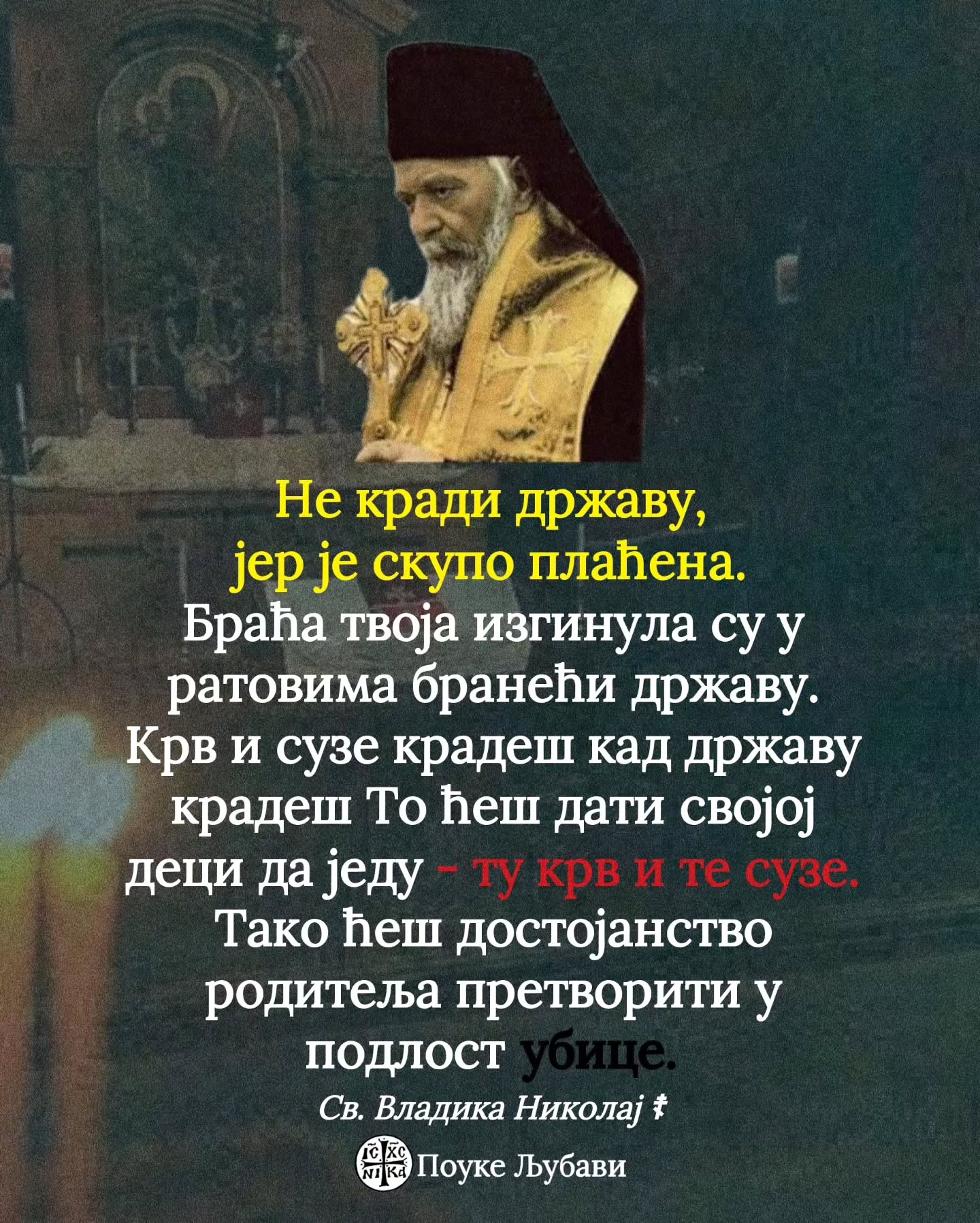
St. Nikolai Velimirovich: Stealing from the state is betrayal of ancestors

The post presents a passage from St. Nikolai Velimirovich's "Teachings of Love" condemning theft of state property. The saint cites Zechariah 5:3, where God declares that every thief and false swearer shall be cut off, calling both acts a curse. He warns that stealing from the state, money, land, forests, materials, or any public property, brings a curse upon the thief, his household, and the state itself. St. Nikolai argues that the state was…

The post presents a passage from St. Nikolai Velimirovich's "Teachings of Love" condemning theft of state property. The saint cites Zechariah 5:3, where God declares that every thief and false swearer shall be cut off, calling both acts a curse. He warns that stealing from the state, money, land, forests, materials, or any public property, brings a curse upon the thief, his household, and the state itself.

St. Nikolai argues that the state was bought with the blood, sweat, tears, and lives of one's ancestors who fought, suffered, and died for it. To steal from the state is to steal from one's own kin, from the fatherland, and from the brothers, sons, and daughters of one's forebears. The ancestors, he says, do not recognize the thief as a citizen; they reject him before God and count him among traitors.

The saint attributes this blindness to unbelief in the living, all-seeing God, the terrible avenger of justice. He warns that the hour of realization will come, but it may be the thirteenth hour, too late. The accompanying image text repeats the core message: the state was dearly paid for with the lives of brothers in war; stealing it means stealing blood and tears, which one will feed to one's own children, turning parental dignity into the baseness of a murderer.

  • St. Nikolai cites Zechariah 5:3 to show theft and false oaths are divine curses
  • Stealing state property brings a curse on the thief, his house, and the state
  • The state was won by ancestors' blood, suffering, and death in its defense
  • Ancestors reject the thief before God and count him among traitors
  • Unbelief in the just, all-seeing God blinds one to this reality
Read more

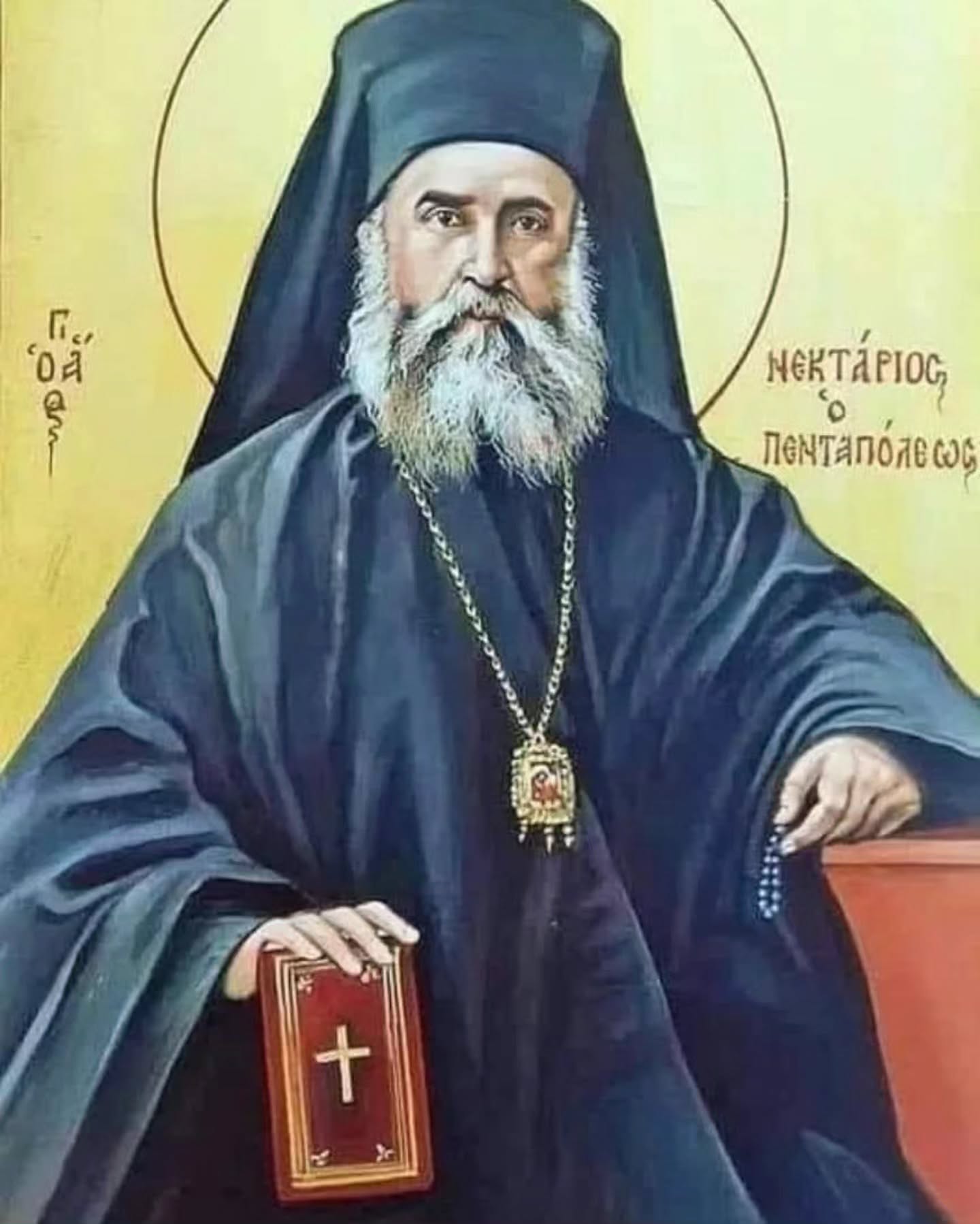
Saint Nectarios of Aegina on trusting God's providence in confusion

The post presents a quotation attributed to Saint Nectarios of Aegina, also titled Saint Nectarios of Pentapolis in the accompanying Greek text. The quotation addresses a person who finds life incomprehensible and confusing. It describes God as a loving Father who leads by a path the person would not have chosen. It urges trust in God even in silence and unknowing. It states that God's providence is perfect and that today's tears will become dew…

The post presents a quotation attributed to Saint Nectarios of Aegina, also titled Saint Nectarios of Pentapolis in the accompanying Greek text. The quotation addresses a person who finds life incomprehensible and confusing. It describes God as a loving Father who leads by a path the person would not have chosen.

It urges trust in God even in silence and unknowing. It states that God's providence is perfect and that today's tears will become dew for tomorrow's joy. The post contains no additional commentary, discussion, or explanation beyond the quotation and the saint's name in Serbian and Greek.

  • Quotation from Saint Nectarios of Aegina (Saint Nectarios of Pentapolis)
  • Encouragement not to worry when life seems incomprehensible
  • God portrayed as a loving Father leading on an unchosen path
  • Call to trust God even in silence and unknowing
  • Assurance that God's providence is perfect and tears become future joy
Read more

Feast of St. Nektarios celebrated at Aegina with relic procession and all-night vigil

On November 8, 2026, the feast of St. Nektarios of Aegina was celebrated on the island of Aegina. A festive Vespers was served at the Monastery of the Holy Trinity and at the grand church dedicated to the saint. A large number of faithful and pilgrims from various parts of Greece and abroad gathered for the celebration. After the Vespers at the monastery, the honorable head of St. Nektarios was transferred in a solemn litany to the church, where…

On November 8, 2026, the feast of St. Nektarios of Aegina was celebrated on the island of Aegina. A festive Vespers was served at the Monastery of the Holy Trinity and at the grand church dedicated to the saint. A large number of faithful and pilgrims from various parts of Greece and abroad gathered for the celebration.

After the Vespers at the monastery, the honorable head of St. Nektarios was transferred in a solemn litany to the church, where a hierarchical festive Vespers was served. An all-night vigil followed during the night. The post describes St. Nektarios as a great wonderworker and healer who remains one of the most beloved saints of the Orthodox world.

People from all over the world turn to his prayerful intercession seeking consolation, strengthening, and God's help. The post concludes with the invocation: "Holy Father Nektarios, pray to God for us!" Sources cited are Aegina Portal, Saronic Magazine, and Orthodoxia News Agency.

  • Feast of St. Nektarios celebrated November 8, 2026 on Aegina
  • Services at Monastery of the Holy Trinity and the saint's grand church
  • Honorable head of St. Nektarios processed in solemn litany to the church
  • Hierarchical festive Vespers and all-night vigil served
  • St. Nektarios described as great wonderworker and healer, beloved worldwide
Read more

Luke 6: Mercy, prayer, love for enemies, and a firm foundation

The post explains the sixth chapter of Luke, showing what life of a true follower of Christ looks like. Christ demonstrates that mercy must not yield to external formalism by healing a man on the Sabbath, revealing that doing good is inseparable from God's will. Before choosing the twelve apostles, He withdraws to a mountain and spends the night in prayer, showing the importance of prayer in every significant work. In the Beatitudes He reveals…

The post explains the sixth chapter of Luke, showing what life of a true follower of Christ looks like. Christ demonstrates that mercy must not yield to external formalism by healing a man on the Sabbath, revealing that doing good is inseparable from God's will. Before choosing the twelve apostles, He withdraws to a mountain and spends the night in prayer, showing the importance of prayer in every significant work.

In the Beatitudes He reveals the true values of the Kingdom of God: poverty, hunger, weeping, and suffering for Christ's sake are not the final word on human life. Opposite them stand woes to those satisfied with earthly wealth, fullness, and human glory. Patristic interpretation stresses that Christ's words about the rich apply not to every wealthy person but to those who seek nothing beyond wealth.

The deepest call of the chapter is the command to love enemies: do good to those who hate you, bless those who curse you, pray for those who abuse you. The Fathers say this command is given for our spiritual growth. "Be merciful, even as your Father is merciful." Christ calls us not to judge, to forgive, and to give.

He warns us to examine our own heart first, because a person's inner state is revealed through words and deeds, as a tree is known by its fruit. The chapter ends with the essential lesson: it is not enough to hear Christ's words and call Him Lord; one must do what He commands. Such a person resembles one who built a house on a firm foundation, on rock.

Key moments

  1. Light a candle if it has gone out, and let your soul shine with light.
  2. Pray for health and salvation in the name of Jesus Christ.
  3. Stand before the icon, keep your soul pure, and do not pray to anyone but Jesus Christ.
  4. Light a candle every day until death.

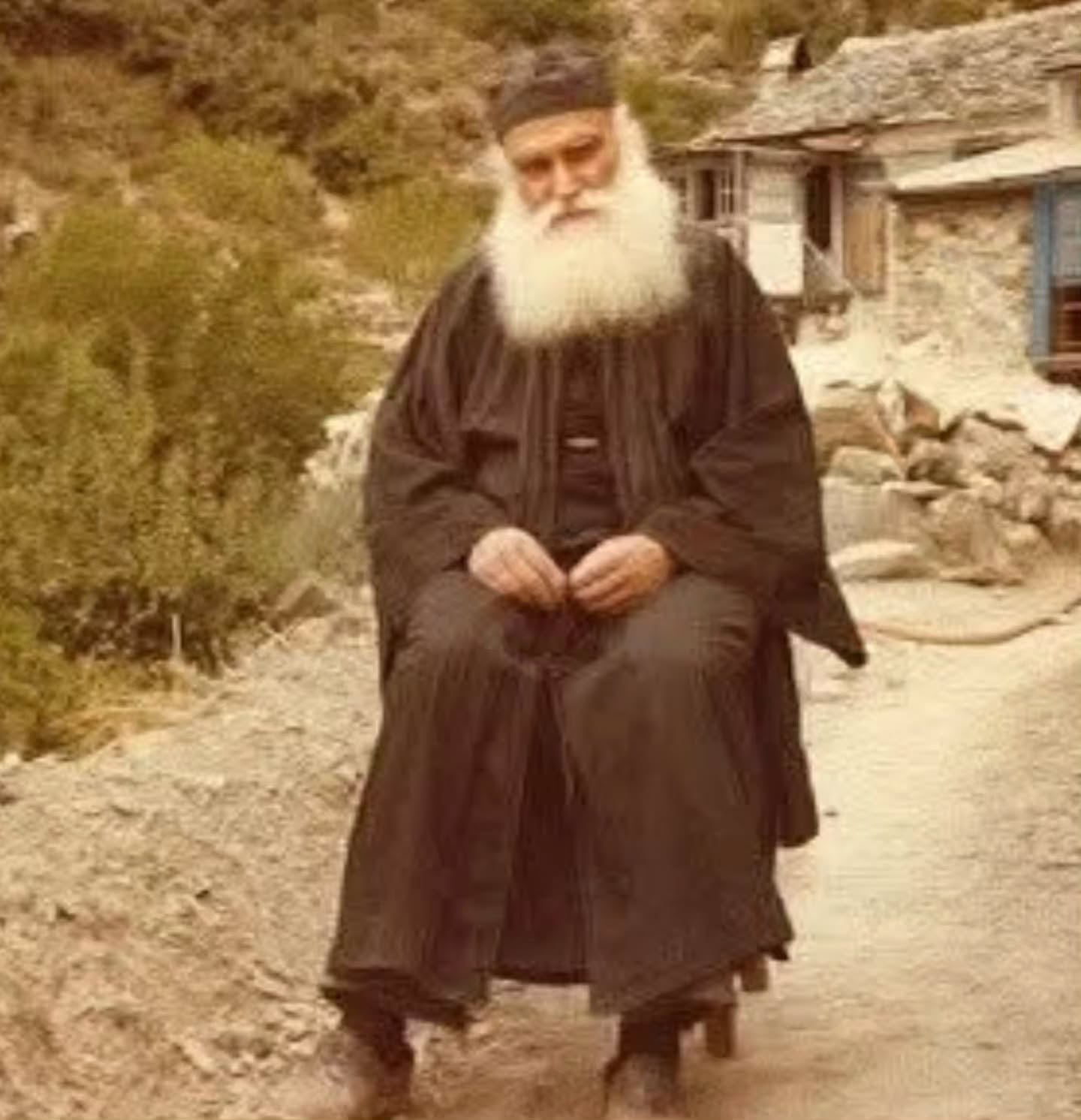
Elder Ephraim of Katounakia: Prayer as a direct line to Christ and the Theotokos

The post shares a saying attributed to Elder Ephraim of Katounakia. He compares the Jesus Prayer ("Lord Jesus Christ, have mercy on me") to Christ's phone number and the prayer to the Theotokos ("Most Holy Theotokos, save me") to her phone number. He urges believers to use these prayers often, not only in desperate situations but also when life is going well. The image shows an elderly bearded monk in dark robes sitting outdoors, likely depicting the elder.

  • Elder Ephraim of Katounakia likens the Jesus Prayer to a direct line to Christ.
  • He likens the prayer to the Theotokos to a direct line to her.
  • He encourages frequent use of both prayers.
  • The prayers should be used in good times as well as in crises.
  • The post includes an image of an elderly monastic figure outdoors.
Read more

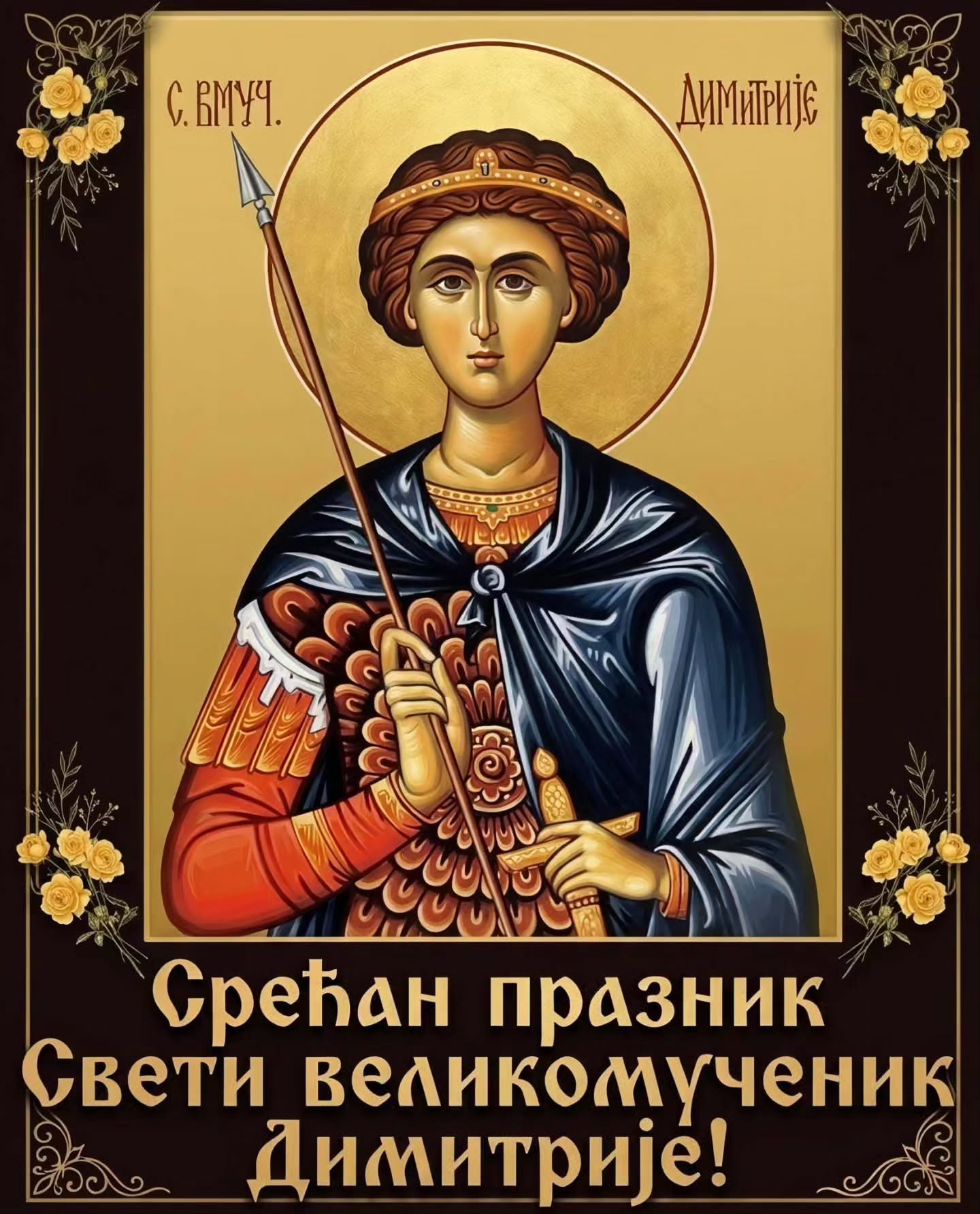
Great Martyr Demetrios of Thessaloniki: life, martyrdom, and miracles

The post recounts the life of Saint Demetrios, born in Thessaloniki to Christian parents who concealed their faith from unbelievers during persecution while raising their son in love for Christ. When Emperor Maximian appointed him proconsul of the Thessalonian region, expecting him to persecute Christians, Demetrios instead confessed Christ publicly, preached the Gospel, distributed his wealth to the needy, and prepared for suffering. Imprisoned…

The post recounts the life of Saint Demetrios, born in Thessaloniki to Christian parents who concealed their faith from unbelievers during persecution while raising their son in love for Christ. When Emperor Maximian appointed him proconsul of the Thessalonian region, expecting him to persecute Christians, Demetrios instead confessed Christ publicly, preached the Gospel, distributed his wealth to the needy, and prepared for suffering.

Imprisoned for his faith, he blessed the young Christian Nestor, who entered the arena against Lyaios, the emperor's wrestler, and defeated him. Maximian ordered Nestor executed and then Demetrios pierced with spears; the saint suffered around 306 AD. The account describes miracles accompanying his veneration: according to his Life, myrrh flowed from his relics and the sick received healing.

The Illyrian noble Leontius, seriously ill, was healed at the saint's tomb and built a church in his honor out of gratitude. When Leontius attempted to take a portion of the relics to his estate, Saint Demetrios appeared to him and forbade it; Leontius took only a mantle soaked in the martyr's blood. The Life also states that the saint miraculously protected Thessaloniki from enemy attacks and famine.

For this reason he is venerated as a myrrh-streaming great martyr and heavenly protector of Thessaloniki, his name glorified by Orthodox Christians through the ages. The text concludes with greetings for the feast of Mitrovdan and for those celebrating the saint as their family patron (slava), asking that his prayers bring peace, health, harmony, and every good thing.

  • Born in Thessaloniki to pious parents who hid their faith during persecution
  • Appointed proconsul by Maximian but confessed Christ and aided the poor instead of persecuting Christians
  • Blessed Nestor from prison, who defeated the imperial wrestler Lyaios; both martyred c. 306
  • Myrrh flowed from his relics; healings occurred; Leontius built a church after being cured
  • Venerated as myrrh-streaming great martyr and protector of Thessaloniki; feast is Mitrovdan
Read more

History of Seraphim-Diveyevo Monastery: Fourth Portion of the Theotokos

The history of the Seraphim-Diveyevo Monastery begins around 1758 when the widow Agafia Semenovna Melgunova, with her three-year-old daughter, entered the Kiev Florovsky Ascension Convent and received the monastic name Alexandra. According to monastery tradition, the Theotokos appeared to her in Kiev and directed her to travel north through Russia, visiting convents dedicated to Her, promising to reveal the site for a great monastery. On her way…

The history of the Seraphim-Diveyevo Monastery begins around 1758 when the widow Agafia Semenovna Melgunova, with her three-year-old daughter, entered the Kiev Florovsky Ascension Convent and received the monastic name Alexandra. According to monastery tradition, the Theotokos appeared to her in Kiev and directed her to travel north through Russia, visiting convents dedicated to Her, promising to reveal the site for a great monastery.

On her way to the Sarov desert, Alexandra stopped in the village of Diveyevo, where the Theotokos appeared again and identified this as the chosen place. She declared that She would found Her community there, calling it the Fourth Portion on earth after Iveria, Mount Athos, and Kiev. Around 1767 Alexandra returned to Diveyevo. In 1773 she began building a stone church dedicated to the Kazan Icon of the Theotokos on the site associated with the apparition; it was completed in 1779 after six years.

In 1788 she obtained land for a sisterhood, built three cells, and gathered sisters living in prayer and work. Before her repose on June 13, 1789, she entrusted the sisters to Elder Pachomius and the Venerable Seraphim of Sarov. Tradition holds that on November 25, 1825, the Theotokos appeared to Seraphim in the Sarov forest and instructed him to establish a new sisterhood in Diveyevo.

Eight sisters were chosen, and on December 9, 1826, construction of a mill began, giving the community the name Mill Community. The sisters built cells and the Holy Canal, which became one of Diveyevo's most renowned holy sites. The two sisterhoods were united into a monastery by a decision of the Holy Synod in 1861, and on November 17, 1862, Maria (Ushakova) was appointed abbess.

During her tenure numerous churches and monastery buildings were erected, including the Trinity Cathedral in 1875. The monastery was closed in 1927. Church life began to revive in 1988, and the decision to restore the monastery was published on July 21, 1991.

  • Foundation by nun Alexandra after Theotokos apparitions in Kiev and Diveyevo (c. 1758-1767).
  • Construction of Kazan Icon church (1773-1779) and establishment of sisterhood (1788).
  • Entrustment to Elder Pachomius and St. Seraphim of Sarov before Alexandra's repose (1789).
  • St. Seraphim's vision of the Theotokos (1825) leading to Mill Community and Holy Canal.
  • Unification as monastery by Holy Synod (1861), closure (1927), revival (1988) and restoration decision (1991).
Read more

Bishop Dositej on Marriage and Virginity as Complementary Paths

Bishop Dositej speaks on the holiness of marriage and the holiness of virgin life, presenting them as two great virtues that complement each other and two ways to please God. He notes that virginity slightly surpasses marriage, citing the Apostle Paul: whoever unites with the Lord becomes one spirit with Him, while whoever unites with a woman becomes one flesh. The bishop explains that both states share the same fidelity, because in each a…

Bishop Dositej speaks on the holiness of marriage and the holiness of virgin life, presenting them as two great virtues that complement each other and two ways to please God. He notes that virginity slightly surpasses marriage, citing the Apostle Paul: whoever unites with the Lord becomes one spirit with Him, while whoever unites with a woman becomes one flesh.

The bishop explains that both states share the same fidelity, because in each a person surrenders their being to the chosen one. This surrender shows trust in God to keep that trust toward the beloved, and thus demonstrates trust in God and fidelity to God.

Key moments

  1. The speaker notes the great holiness of marriage and the holiness of virgin life.
  2. The speaker states these are two great virtues that complement each other.
  3. The speaker says they are two ways to please God.
  4. The speaker explains that virginity slightly surpasses marriage, citing the Apostle Paul: whoever unites with the Lord becomes one spirit with Him.
  5. The speaker contrasts that whoever unites with a woman becomes one flesh.
  6. The speaker asserts that both are the same fidelity, because one surrenders one's being to the chosen one.
  7. The speaker adds that this surrender shows trust in God to keep that trust toward the beloved.
  8. The speaker concludes that this demonstrates trust in God and fidelity to God.
Read more

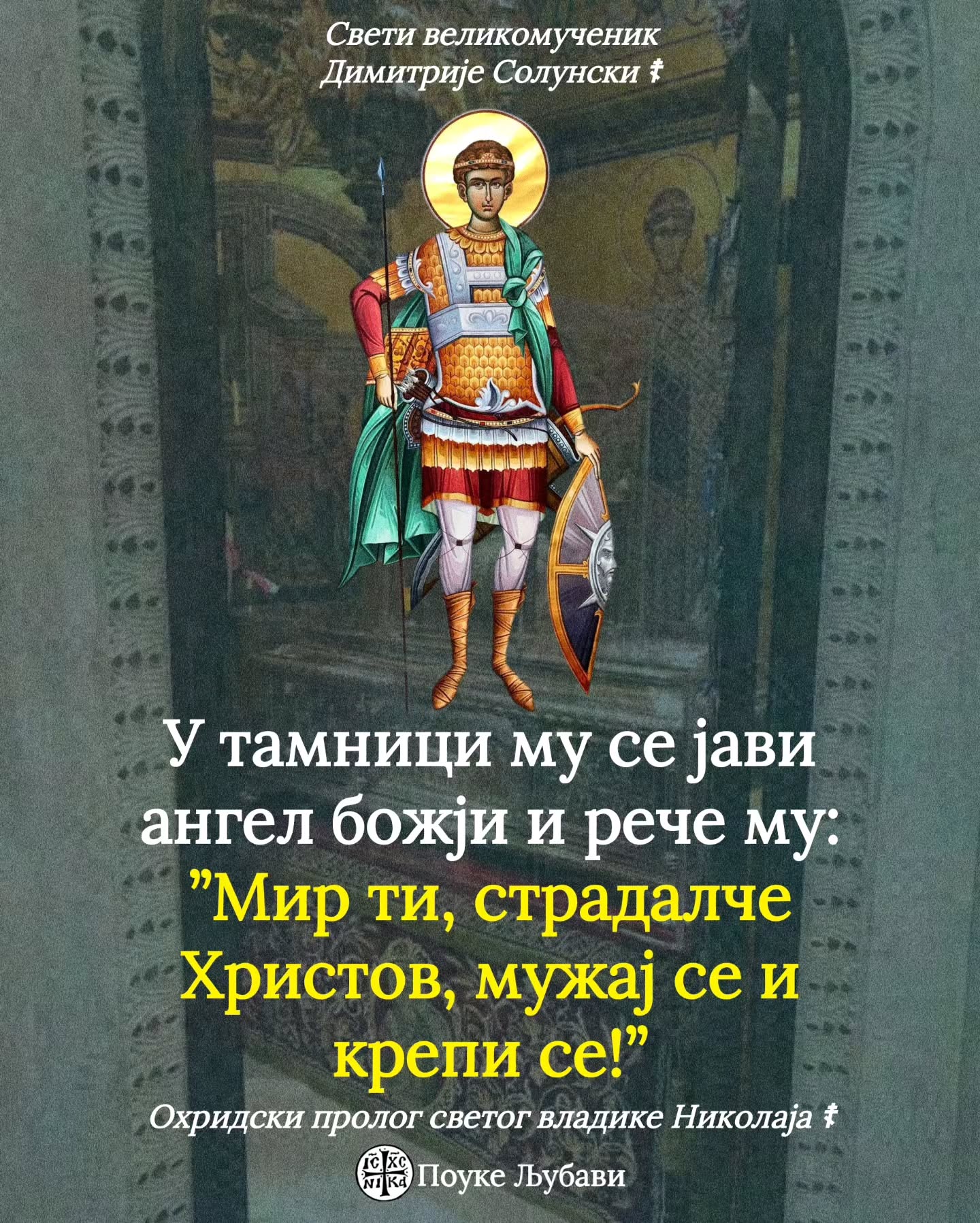
St. Demetrios of Thessaloniki: Martyrdom, Myrrh, and City Protector

The post presents the life of St. Demetrios of Thessaloniki as told in the Ohrid Prologue of St. Nikolai Velimirovich. Born to noble, pious parents in Thessaloniki, he was their only child after years of childlessness. His father served as the city's commander; after his death, Emperor Maximian appointed Demetrios to the same post. The emperor ordered him to persecute Christians, but Demetrios openly confessed Christ and preached the faith. When…

The post presents the life of St. Demetrios of Thessaloniki as told in the Ohrid Prologue of St. Nikolai Velimirovich. Born to noble, pious parents in Thessaloniki, he was their only child after years of childlessness. His father served as the city's commander; after his death, Emperor Maximian appointed Demetrios to the same post.

The emperor ordered him to persecute Christians, but Demetrios openly confessed Christ and preached the faith. When Maximian returned from war against the Sarmatians, he stopped in Thessaloniki to test Demetrios. The saint confessed his faith and denounced idolatry, leading to his imprisonment.

Before his arrest, Demetrios gave his possessions to his servant Lupus to distribute to the poor and went to prison joyfully. An angel appeared to him, saying, 'Peace to you, sufferer for Christ, be brave and strong!' Soldiers later found him praying and killed him with spears. Christians secretly buried his body, from which healing myrrh flowed.

A small church was built over his relics. An Illyrian nobleman, Leontius, suffering from an incurable illness, was healed at the relics and built a larger church in gratitude; the saint appeared to him twice. Emperor Justinian later attempted to transfer the relics to Constantinople, but flames erupted from the tomb and a voice commanded, 'Stop, do not touch!' The relics remained in Thessaloniki.

As the city's protector, St. Demetrios appeared many times and saved it from great calamities. The text notes that his miracles are innumerable. It also states that Russians regard him as the patron of Siberia, which was conquered and annexed to Russia on October 26, 1581.

  • St. Demetrios, born to noble parents in Thessaloniki, was appointed commander by Emperor Maximian but openly confessed Christ and denounced idolatry.
  • He was imprisoned, visited by an angel, and martyred by spears while praying.
  • Healing myrrh flowed from his relics; a small church was built over them.
  • The nobleman Leontius was healed at the relics, built a larger church, and the saint appeared to him twice.
  • Emperor Justinian's attempt to move the relics to Constantinople was stopped by flames and a voice; the relics remained in Thessaloniki, and Russians venerate him as patron of Siberia annexed on October 26, 1581.

Grace Comes Through Persistent Liturgy Attendance, Not Private Prayer Alone

The speaker explains that reading all the prayers of the world cannot substitute for being present at the liturgy and united in its communal prayer. Without that liturgical unity, it is difficult to heal from spiritual shortcomings. He observes that a person's paths and vistas open when they keep returning to the liturgy, even if they feel nothing the first time; grace comes with the second or third visit and draws the person back. He gives…

The speaker explains that reading all the prayers of the world cannot substitute for being present at the liturgy and united in its communal prayer. Without that liturgical unity, it is difficult to heal from spiritual shortcomings. He observes that a person's paths and vistas open when they keep returning to the liturgy, even if they feel nothing the first time; grace comes with the second or third visit and draws the person back.

He gives examples of people who previously did not attend but now come regularly, and others who have continued coming. Without God, without faith, and without love among all people, there is no salvation and no survival. Hatred must be pushed back because it brings nothing good; it brings only the pride for which the devil was cast out of heaven.

Key moments

  1. Reading all worldly prayers cannot replace being at the liturgy and united in that prayer.
  2. Without liturgical unity, it is hard to heal from spiritual shortcomings.
  3. A person's paths open when they persist in attending liturgy even if they feel nothing at first.
  4. God's grace is felt by the second or third visit, drawing the person to return.
  5. The speaker knows people who once did not attend but now come regularly, and others who have kept coming.
  6. Without God, faith, and mutual love, there is neither salvation nor survival.
  7. We must urgently return to love among ourselves.
  8. Hatred must be suppressed because it brings nothing good, only the pride that cast the devil from heaven.
Read more

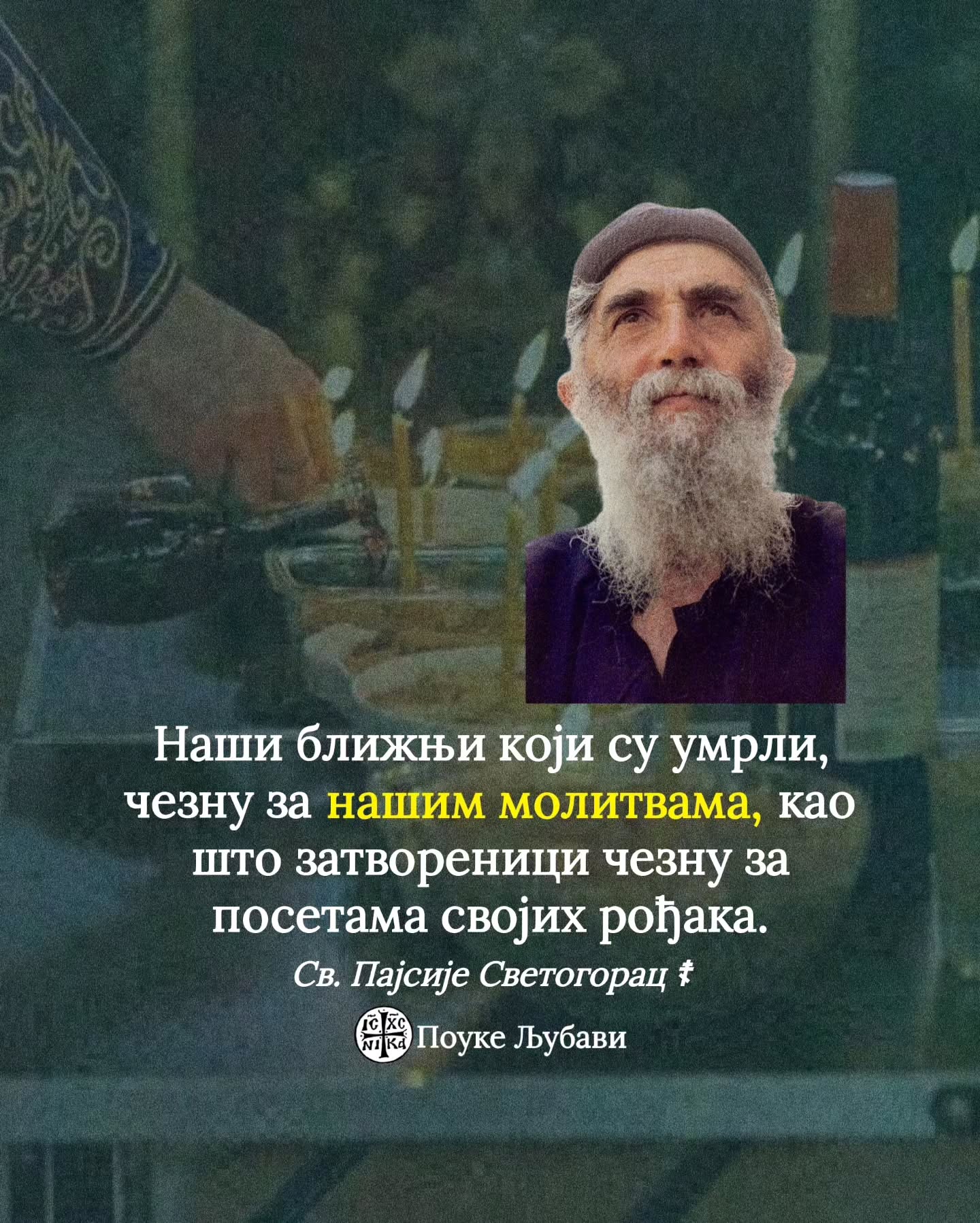
Zadušnice: The Orthodox Saturdays for the Departed

The post explains Zadušnice, the designated Saturdays in the Orthodox Church set aside for commemorating the dead. It opens with a saying attributed to Saint Nikolai Velimirovich: if the dead could speak, they would ask only for prayers, because they can no longer pray for themselves. The text describes the practice: on these Saturdays the Church serves the Divine Liturgy and parastas (memorial service), and the faithful bring koliva (boiled,…

The post explains Zadušnice, the designated Saturdays in the Orthodox Church set aside for commemorating the dead. It opens with a saying attributed to Saint Nikolai Velimirovich: if the dead could speak, they would ask only for prayers, because they can no longer pray for themselves. The text describes the practice: on these Saturdays the Church serves the Divine Liturgy and parastas (memorial service), and the faithful bring koliva (boiled, sweetened wheat) and written lists of their departed baptized relatives.

The priest censes the offerings and prays for the repose of all departed Orthodox Christians. A second quotation from Saint Paisios the Athonite compares the longing of the departed for our prayers to the longing of prisoners for visits from family.

  • Zadušnice are specific Saturdays dedicated to memorial services for the departed
  • The faithful bring koliva and lists of names to be commemorated at Liturgy and parastas
  • Saint Nikolai Velimirovich is quoted on the dead's inability to pray for themselves
  • Saint Paisios the Athonite likens the departed's desire for prayers to prisoners awaiting visits
  • The Church prays for all departed Orthodox Christians every Saturday, not only on Zadušnice
Read more

Father Danilo on Holiness and Saint Basil of Ostrog

Father Danilo (Ljubotina) speaks from a holy site where God manifested through the body of Saint Basil of Ostrog, a miracle-worker of great power. He explains that God gave humanity the possibility to become saints by perfecting the gifts He bestowed. A saint is one who has perfected these gifts and maximally strives to reveal himself before people as the true and eternal shepherd. This revelation occurs in Jesus Christ, the incarnate Logos, who…

Father Danilo (Ljubotina) speaks from a holy site where God manifested through the body of Saint Basil of Ostrog, a miracle-worker of great power. He explains that God gave humanity the possibility to become saints by perfecting the gifts He bestowed. A saint is one who has perfected these gifts and maximally strives to reveal himself before people as the true and eternal shepherd.

This revelation occurs in Jesus Christ, the incarnate Logos, who is both true man and true God. The teaching connects the veneration of Saint Basil's relics with the universal call to holiness, showing how the saint's life exemplifies the path of cooperating with divine grace to become a shepherd in Christ's image.

Key moments

  1. This is a holy place where the living God shone in the holy body of Basil of Ostrog, miracle-worker of great proportions, energy, and power.
  2. God gave the possibility for man to become a saint, meaning to be set apart.
  3. A saint is one who has perfected God's gifts and maximally strove to show himself before people as the true and eternal shepherd.
  4. This happens in our Lord Jesus Christ, the incarnate Logos, who is true man and true God.
Read more

Elder Cleopa on the Theotokos as protectress and a daily prayer rule

The post shares counsel attributed to Elder Cleopa of Romania urging the faithful to keep an icon of the Theotokos at home with a burning vigil lamp. He advises taking her as protectress and helper, calling her Mother in heaven and on earth, Queen of heaven and earth. The recommended practice is to read an akathist to her each morning with the lamp lit and a supplicatory canon each evening. The elder states that those who do so will receive help…

The post shares counsel attributed to Elder Cleopa of Romania urging the faithful to keep an icon of the Theotokos at home with a burning vigil lamp. He advises taking her as protectress and helper, calling her Mother in heaven and on earth, Queen of heaven and earth. The recommended practice is to read an akathist to her each morning with the lamp lit and a supplicatory canon each evening.

The elder states that those who do so will receive help in life, at the hour of death, and on the Day of Judgment. The post adds a rhetorical question about the power of the Theotokos before the Throne of the Holy Trinity and remarks that without her intercession the world would have perished long ago. The image shows Church Slavonic abbreviations for Mother of God, faith, blessed, and Jesus Christ.

  • Elder Cleopa recommends a home icon of the Theotokos with a vigil lamp
  • Daily rule: morning akathist and evening supplicatory canon before the icon
  • Promise of help in life, at death, and at the Last Judgment
  • Emphasis on the Theotokos's intercessory power before the Holy Trinity
  • Image contains Church Slavonic abbreviations for Marian and Christological titles
Read more

Theotokos 'Joy of All Who Sorrow': myrrh-streaming icon survived fire

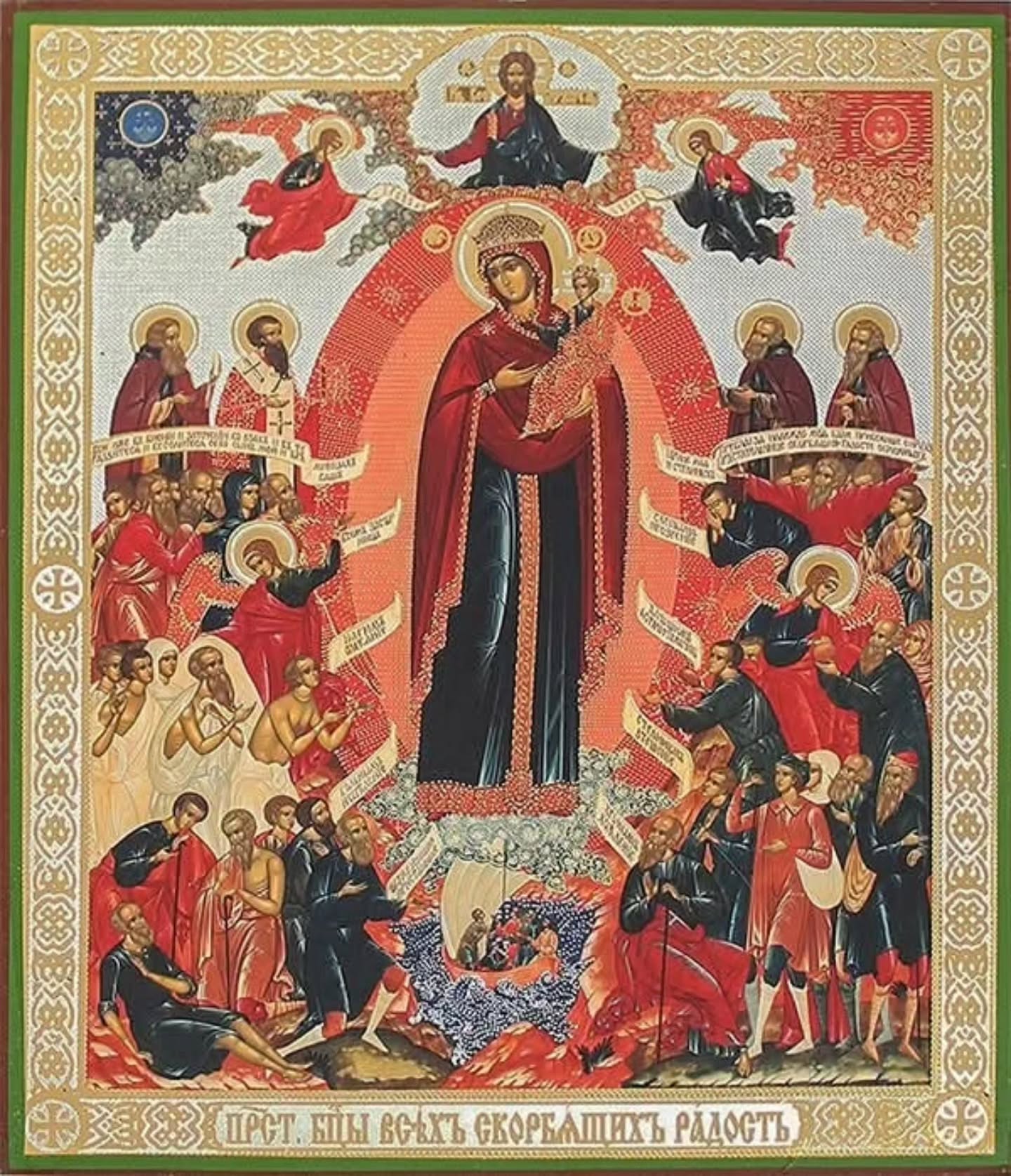
The post focuses on the icon of the Most Holy Theotokos known as 'Joy of All Who Sorrow.' It describes moments when human words fail to console a heart worn out by sorrow, and the faithful turn with special hope to the Mother of God. Before her icon bearing this title, centuries of prayers have accumulated from those who suffer, grieve, and seek her intercession. The name carries a deep spiritual message: no human sorrow is unknown to the One…

The post focuses on the icon of the Most Holy Theotokos known as 'Joy of All Who Sorrow.' It describes moments when human words fail to console a heart worn out by sorrow, and the faithful turn with special hope to the Mother of God. Before her icon bearing this title, centuries of prayers have accumulated from those who suffer, grieve, and seek her intercession.

The name carries a deep spiritual message: no human sorrow is unknown to the One who loves us, nor is any tear outside His mercy. The text highlights a particular icon of this type preserved in Russia, which, according to church testimonies, has been streaming myrrh since 1995. It also notes that the icon remained untouched during a fire in the temple where it was housed.

The author invites readers to pray to the Most Holy Theotokos, remembering all who today carry the cross of illness, sorrow, loneliness, and life's temptations, ending with the invocation: 'Most Holy Theotokos, Joy of All Who Sorrow, pray to God for us!'

  • Theotokos as 'Joy of All Who Sorrow' offers comfort when human words fail.
  • The icon's title means no sorrow is unknown to God and no tear outside His mercy.
  • A specific icon in Russia has reportedly streamed myrrh since 1995.
  • The same icon survived a church fire unharmed, according to church testimonies.
  • The post ends with a prayer for those bearing crosses of illness, grief, loneliness, and temptation.
Read more