WeOrthodox
EN UA

Појединац, Породица и Друштво

Instagram ↗ 209 discussions

Ова страница је посвећена ПРАВОСЛАВЉУ и ДОБРОТОЉУБЉУ🫒

What Christ Is: Heaven That Came Down to Be With Us

Fr Dr Oliver Subotic, a priest of the Serbian Orthodox Church serving at the church of St Alexander Nevsky in Dorcol, Belgrade, head of the Missionary Department of the Belgrade-Karlovac Archdiocese, and a doctor of sociological sciences, theologian and software engineer, explains what Christ is through the architecture of Hagia Sophia. He reads the building as an image of the Incarnation: heaven has come down to be here with us. God became man…

Fr Dr Oliver Subotic, a priest of the Serbian Orthodox Church serving at the church of St Alexander Nevsky in Dorcol, Belgrade, head of the Missionary Department of the Belgrade-Karlovac Archdiocese, and a doctor of sociological sciences, theologian and software engineer, explains what Christ is through the architecture of Hagia Sophia.

He reads the building as an image of the Incarnation: heaven has come down to be here with us. God became man while remaining fully God, and he came down to us in the most intimate way possible. The speaker quotes St Justin Martyr, who says that Christ took on everything that is ours, everything bound by the five simple senses, and did this all for our sake.

The movement of the Incarnation runs in both directions. God comes among us so that we can go up again, made gods by grace. The talk stays with this single theme: the descent of the Son of God into everything that belongs to human life, and the ascent of man that this descent makes possible. The architecture of the great church serves the speaker as a way to see the mystery rather than only speak of it, since its dome and space draw the eye from earth toward heaven, the same direction the Incarnation reverses and completes.
Key moments

  1. Hagia Sophia's architecture shows what Christ is: heaven that came down to be here with us.
  2. God became man while remaining fully God, coming down to us in the most intimate way possible.
  3. As Justin says, Christ took on everything that is ours, bound by the five simple senses, all for our sake.
  4. God comes among us so that we can go up again, made gods by grace.
How a boy who survived a firing squad found Elder Joseph on Mount Athos

Archimandrite Luka (Anić), abbot of the Dajbabe monastery, now departed in the Lord, tells the life and spiritual struggles of Elder Ephraim of Arizona. He notes that stories of the Athonite ascetics' struggles are not yet written down and may only be recorded after Elder Ephraim's repose, though we hope God keeps him among us for our sake, since he no longer needs it himself. The heart of the talk is the story of Elder Ephraim's arrival on…

Archimandrite Luka (Anić), abbot of the Dajbabe monastery, now departed in the Lord, tells the life and spiritual struggles of Elder Ephraim of Arizona. He notes that stories of the Athonite ascetics' struggles are not yet written down and may only be recorded after Elder Ephraim's repose, though we hope God keeps him among us for our sake, since he no longer needs it himself.

The heart of the talk is the story of Elder Ephraim's arrival on Mount Athos. In 1942, during mass executions in which Germans shot Greek villagers, a boy called little Janis from Volos was not hit by a bullet. A merciless officer then fired a shot at the boy's head, but the boy did not move and only felt his ear burn from the blast.

The officer fell down, kissed his feet, and called him an angel. Janis did not run home but to a priest, who saw God's hand in what happened and told him he was not for this world, to go to Mount Athos, find a good elder and obey him as God, and to ask for Elder Joseph. Janis was about 16 years old when he arrived by ship. A monk waiting on the dock recognized him immediately and said that Elder Joseph had sent him to fetch the boy.

In this way Ephraim came to Elder Joseph. Archimandrite Luka adds that the five men who recognized in Elder Joseph a hesychast not born for a thousand and a half years later became abbots of five great Athonite monasteries, each today numbering around 100 to 120 monks, and they carry on Elder Joseph's work through their hands.

Key moments

  1. 0:00 Stories of the Athonite ascetics' struggles are not found in books yet and will probably be told when Elder Ephraim goes to the Lord, though we hope God keeps him here for our sake, since he no longer needs it himself.
  2. 0:00 In 1942, during mass executions in which Germans shot Greek villagers, a boy called little Janis from Volos was not hit by a bullet.
  3. 0:00 A merciless officer fired a shot at the boy's head, but he did not move; only his ear burned from the blast, and the officer fell down, kissed his feet, and said: You are an angel.
  4. 0:00 Janis ran to a priest instead of home, and the priest, seeing God's hand in it, told him he was not for this world, to go to Mount Athos as a monk, find a good elder and obey him as God, and to ask for Elder Joseph.
  5. 0:30 When Janis, about 16 years old, arrived by ship, a monk on the dock recognized him by name and said Elder Joseph had sent him to bring the boy.
  6. 0:30 The five men who recognized in Elder Joseph an ascetic not born for a thousand and a half years became abbots of five great Athonite monasteries, each today numbering about 100 to 120 monks, continuing Elder Joseph's work through their hands.
Read more

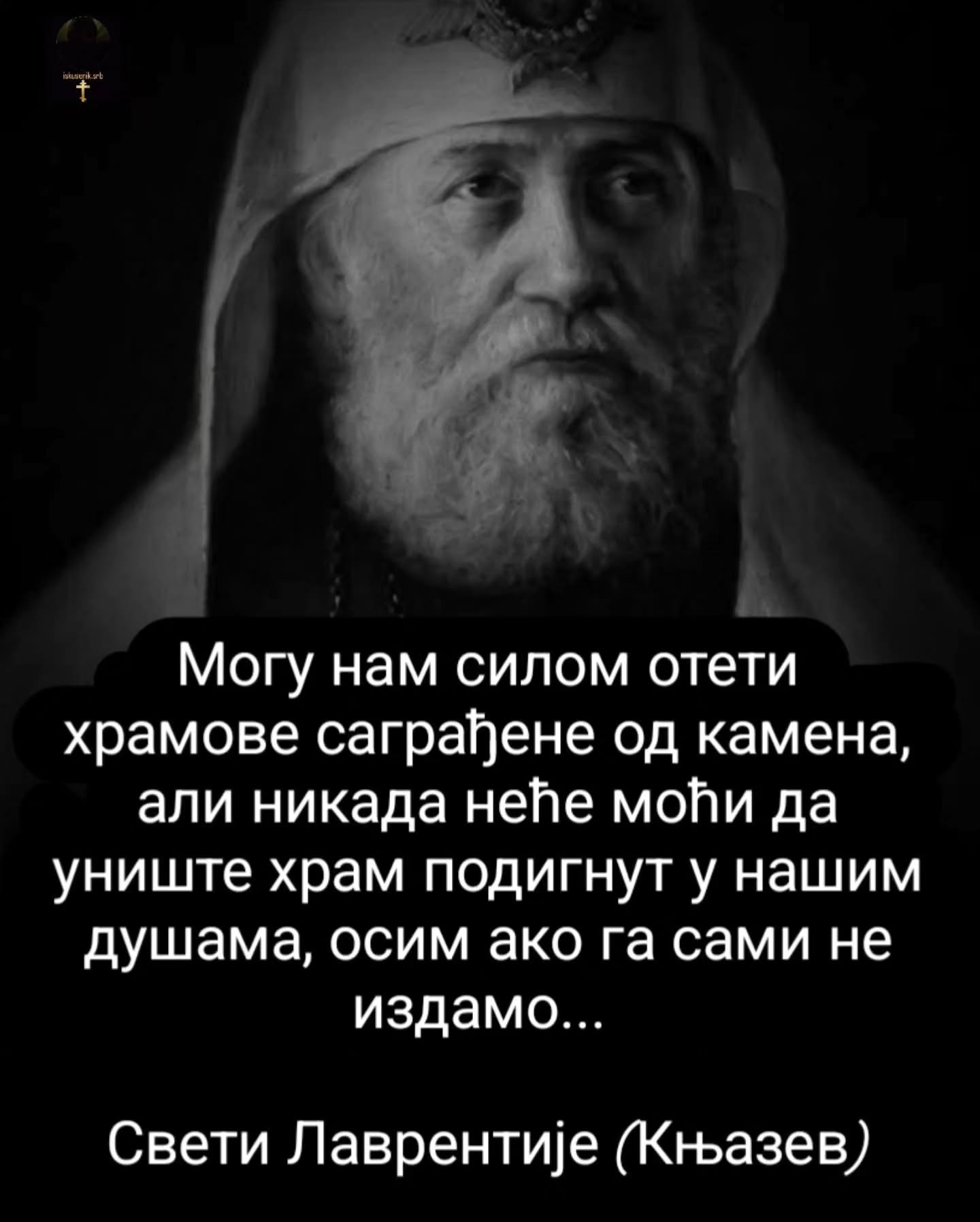
Saint Lavrentije on the temple of the soul

The post shares a saying attributed to Saint Lavrentije (Knezhev): "They can take away by force temples built of stone, but they will never be able to destroy the temple raised in our souls, unless we ourselves betray it." The quote emphasizes that the true church is the inner spiritual life, which cannot be destroyed by external persecution unless one abandons it willingly.

  • Saint Lavrentije (Knezhev) is the source of the saying.
  • The saying contrasts physical churches made of stone with the spiritual temple in the soul.
  • External force can destroy stone buildings but not the inner temple.
  • The inner temple can only be lost through personal betrayal.
  • The quote reflects Orthodox teaching on the resilience of faith under persecution.
Read more

Kipina Monastery: a church carved into a vertical rock above the Kalaritikos river

The Monastery of the Dormition of the Mother of God, known as Kipina, stands in the region of Epirus, in the mountains of Northern Tzoumerka near the village of Kalarites in Greece, built into an almost vertical rock above the Kalaritikos river. One tradition says Archbishop Gregory founded it in 1212, another attributes its founding to monks of the nearby Vyliza monastery in the 13th century. The Archaeological Service of Ioannina records its…

The Monastery of the Dormition of the Mother of God, known as Kipina, stands in the region of Epirus, in the mountains of Northern Tzoumerka near the village of Kalarites in Greece, built into an almost vertical rock above the Kalaritikos river. One tradition says Archbishop Gregory founded it in 1212, another attributes its founding to monks of the nearby Vyliza monastery in the 13th century.

The Archaeological Service of Ioannina records its existence at least from 1349. The monastery received its present architectural form at the end of the 17th and the beginning of the 18th century. It is dedicated to the Dormition of the Mother of God and also celebrates on Friday of Bright Week, the feast of the Life-Giving Spring.

The church is set into a natural cave, its walls decorated with 18th-century frescoes, and the complex includes monastic cells on two levels fitted into the rock. A narrow path cut into the rock and a wooden drawbridge, which monks once raised for protection against unwanted visitors, lead to the monastery. From the church one enters a cave 240 metres long, decorated with stalactites and stalagmites, closed to visitors.

Under Ottoman rule, according to local tradition, the monastery housed a secret school and the cave served as a refuge for the local population. The monastery flourished in the 18th century; its abbot Kallinikos is recorded as donating money in 1760 for the construction of a bridge. It was abandoned in the 19th century, and since 1931 it has been a dependency of the Monastery of the Nativity of the Mother of God on Tsouka.

It has no permanent monastic community today; its preservation is cared for by Archimandrite Thomas Andreu, abbot of the Tsouka monastery.

  • Kipina is dedicated to the Dormition of the Mother of God and also celebrates the Life-Giving Spring on Friday of Bright Week.
  • Traditions differ on its founding: Archbishop Gregory in 1212, or monks of the Vyliza monastery in the 13th century; it is documented from at least 1349.
  • The church is carved into a natural cave with 18th-century frescoes, and monks once raised a wooden drawbridge for protection.
  • A 240-metre cave with stalactites and stalagmites lies behind the church; under Ottoman rule it sheltered locals and, by tradition, a secret school.
  • Abandoned in the 19th century, since 1931 it has been a dependency of the Tsouka monastery, cared for by Archimandrite Thomas Andreu.
Read more

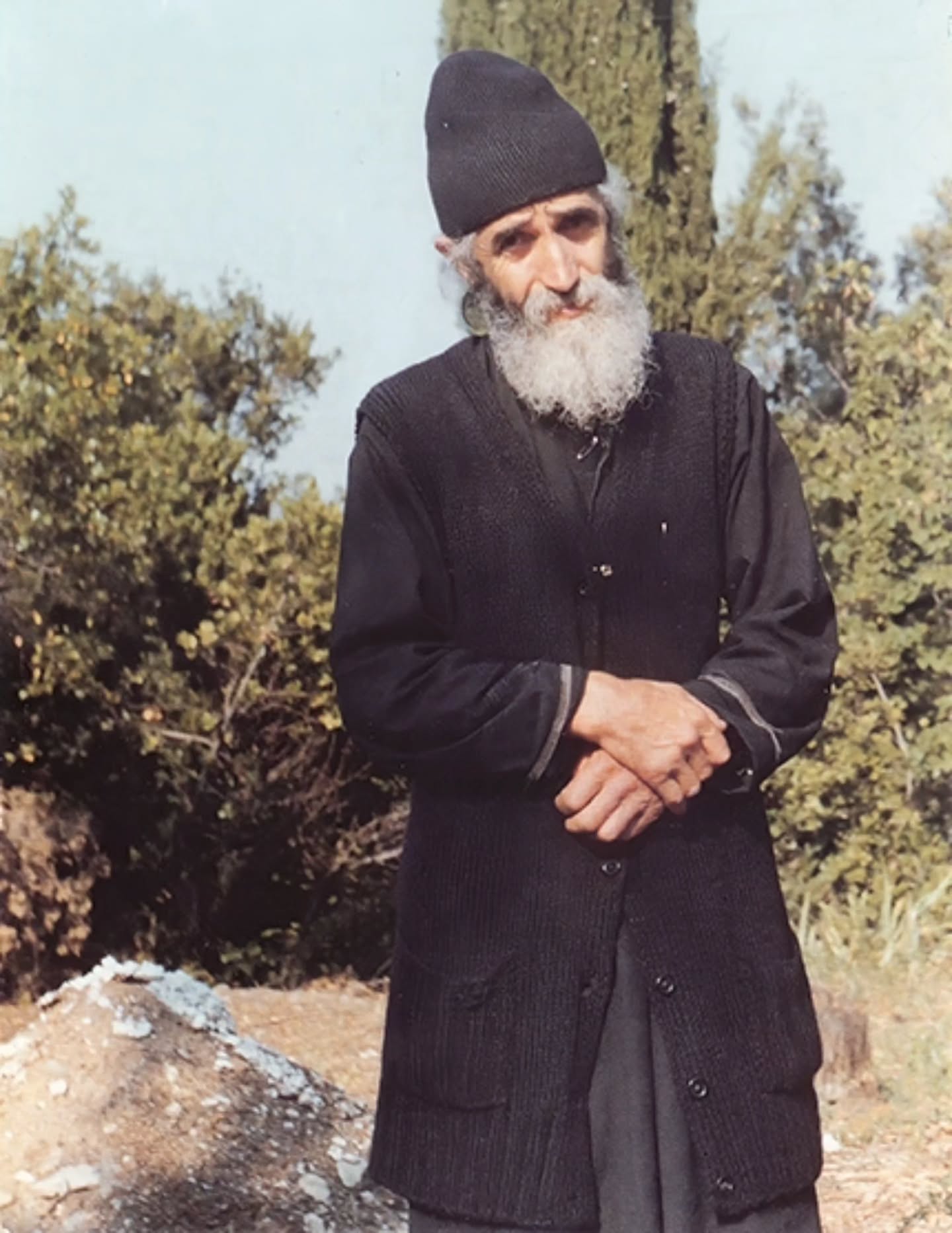
Elder Paisios and the Cat Healed by Humility

Elder Paisios of Mount Athos recounts that a cat came to his cell in severe pain, twisting like a snake. He made the sign of the cross over it twice, but the animal did not recover. The elder then reproached himself, saying that after so many years as a monk he could not help even a cat. As soon as he humbled himself inwardly, the cat was instantly healed, approached him, licked his feet, and performed a joyful somersault. The elder concludes…

Elder Paisios of Mount Athos recounts that a cat came to his cell in severe pain, twisting like a snake. He made the sign of the cross over it twice, but the animal did not recover. The elder then reproached himself, saying that after so many years as a monk he could not help even a cat.

As soon as he humbled himself inwardly, the cat was instantly healed, approached him, licked his feet, and performed a joyful somersault. The elder concludes that this demonstrates the power of humility, citing the scriptural promise that the Lord remembers us in humility and meekness.

  • A suffering cat comes to Elder Paisios's cell
  • The sign of the cross does not heal the cat
  • The elder rebukes himself for lacking humility
  • The cat recovers immediately when the elder humbles himself
  • The story illustrates the power of humility with a scriptural reference
Read more

Patriarch Pavle on wasting bread and world hunger

The post shares a quote from the late Serbian Patriarch Pavle addressing children about the meaning of hunger. He contrasts the casual wasting of bread crumbs at the table with the reality of hungry children around the world, particularly in Africa, for whom a single crust can mean life and hope. The patriarch urges remembrance of these children whenever bread is thrown away. The image shows Patriarch Pavle breaking bread over a plate. The text…

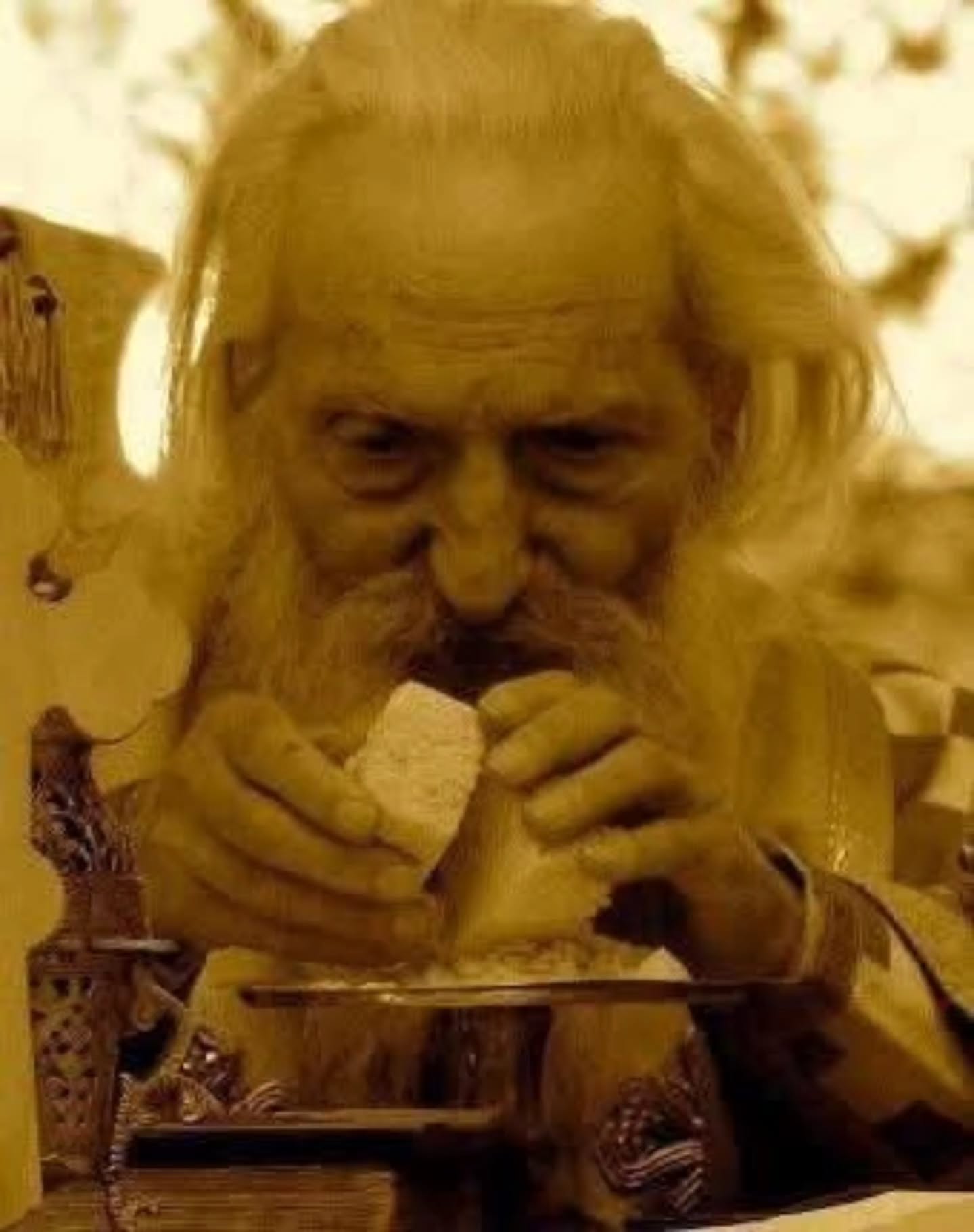
The post shares a quote from the late Serbian Patriarch Pavle addressing children about the meaning of hunger. He contrasts the casual wasting of bread crumbs at the table with the reality of hungry children around the world, particularly in Africa, for whom a single crust can mean life and hope. The patriarch urges remembrance of these children whenever bread is thrown away.

The image shows Patriarch Pavle breaking bread over a plate. The text is a direct exhortation against waste and a call to compassion, rooted in the patriarch's known ascetic lifestyle and concern for the poor. No further discussion or commentary accompanies the quote.

  • Patriarch Pavle speaks to children about the reality of global hunger
  • He contrasts wasted bread crumbs with children for whom a crust is life
  • He specifically mentions hungry children in Africa and worldwide
  • He urges remembrance of the hungry when seeing bread thrown away
  • The quote reflects his personal asceticism and care for the poor
Read more

St. Justin Popovich on St. George's Victory Over Diocletian

The post presents a passage from St. Justin Popovich reflecting on the Great-martyr George's triumph over the Roman Emperor Diocletian. St. Justin emphasizes that George, though a youth, conquered the all-powerful emperor not by weapons but by martyrdom. Through his suffering and death, George demonstrated and proved that Christ is truly risen and that He is the Eternal Truth. The accompanying image contains the Greek text of the troparion to…

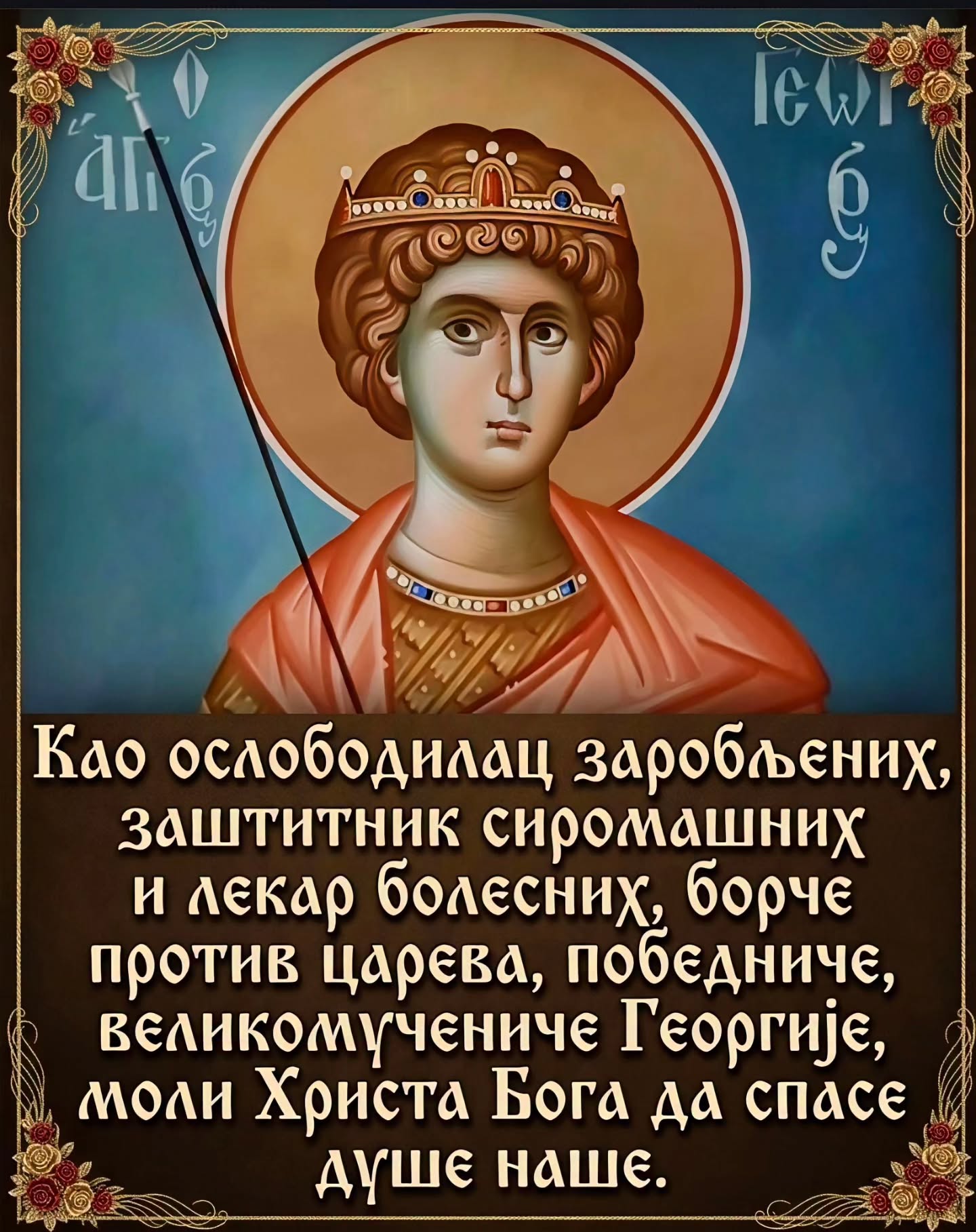
The post presents a passage from St. Justin Popovich reflecting on the Great-martyr George's triumph over the Roman Emperor Diocletian. St. Justin emphasizes that George, though a youth, conquered the all-powerful emperor not by weapons but by martyrdom. Through his suffering and death, George demonstrated and proved that Christ is truly risen and that He is the Eternal Truth.

The accompanying image contains the Greek text of the troparion to St. George, addressing him as liberator of captives, protector of the poor, physician of the sick, contender against kings, and victor, asking him to intercede with Christ God for the salvation of souls. The passage connects the historical martyrdom under Diocletian's persecution with its theological significance: the martyr's witness becomes the proof of the Resurrection.

St. Justin Popovich, a prominent 20th-century Serbian theologian and ascetic, frames the martyr's victory as the definitive Christian answer to worldly power.

  • St. Justin Popovich describes St. George's martyrdom as a victory over Emperor Diocletian
  • The victory was achieved not by weapons but by martyrdom itself
  • George's martyrdom proves Christ is truly risen and is the Eternal Truth
  • The image includes the Greek troparion to St. George as liberator, protector, physician, and victor
  • The troparion asks St. George to pray to Christ God for the salvation of souls
Read more

Miracle-working St. George icon at Xenophontos survived fire, sword, sea

The post describes the miracle-working icon of the Great Martyr and Victory-Bearer George at the katholikon of the Holy Mountain monastery of Xenophontos. According to tradition, during the period of iconoclasm the icon was in Constantinople. Iconoclasts threw it into a fire, but it remained untouched. They then struck its face with a sword, and blood immediately flowed, to the dismay of the iconoclasts. In a final attempt to destroy it, they…

The post describes the miracle-working icon of the Great Martyr and Victory-Bearer George at the katholikon of the Holy Mountain monastery of Xenophontos. According to tradition, during the period of iconoclasm the icon was in Constantinople. Iconoclasts threw it into a fire, but it remained untouched.

They then struck its face with a sword, and blood immediately flowed, to the dismay of the iconoclasts. In a final attempt to destroy it, they cast it into the sea, but the icon miraculously sailed to the Holy Mountain and the monastery of Xenophontos in the 10th century. This evening a vigil is being held at Zografou and Xenophontos, and numerous Athonite cells are also celebrating the feast.

The accompanying photograph is credited to the Holy Monastery Xenophontos. The image bears the Greek inscription "Ο ΑΓΙΟΣ ΝΙΚΟΛΑΟΣ" (Saint Nicholas).

  • Icon of St. George at Xenophontos Monastery is miracle-working
  • During iconoclasm in Constantinople, icon thrown into fire but unharmed
  • Iconoclasts struck icon's face with sword; blood flowed immediately
  • Thrown into sea, icon miraculously reached Mount Athos in 10th century
  • Tonight vigil celebrated at Zografou and Xenophontos and many Athonite cells
Read more

St. Nikolai Velimirovich: Human praise and punishment versus God's judgment

The post shares a passage from the Missionary Letters of St. Nikolai Velimirovich, a Serbian bishop and theologian of the twentieth century. The text contrasts human and divine responses to good and evil actions. It states that if a person does evil, people may praise them, but God will punish them. If a person does good, people may punish them, but God will reward them. The saint points to Christ as the definitive example: Christ did only good,…

The post shares a passage from the Missionary Letters of St. Nikolai Velimirovich, a Serbian bishop and theologian of the twentieth century. The text contrasts human and divine responses to good and evil actions. It states that if a person does evil, people may praise them, but God will punish them.

If a person does good, people may punish them, but God will reward them. The saint points to Christ as the definitive example: Christ did only good, yet people crucified Him. The passage concludes with a direct exhortation not to look to people for validation or fear their reaction, but to turn toward God. The quote stands alone without additional commentary or discussion in the source.

  • Evil deeds may earn human praise but incur divine punishment
  • Good deeds may incur human punishment but earn divine reward
  • Christ exemplifies this pattern: He did only good and was crucified
  • The faithful should not seek human approval or fear human judgment
  • The proper orientation is to turn toward God
Read more

Patriarch Pavle commemorated 17 years after repose with quote on human strength

The post marks 17 years since the repose of Serbian Patriarch Pavle, referred to as a "living saint" and "grandfather Paja." It notes that his grave is located in the portico of the Monastery of the Holy Archangels Michael and Gabriel (Rakovica) in Belgrade. The post includes a quote attributed to Patriarch Pavle: "Man is stronger dead than a non-human alive!" The text also states that Christ gave not only an example by His life but also the…

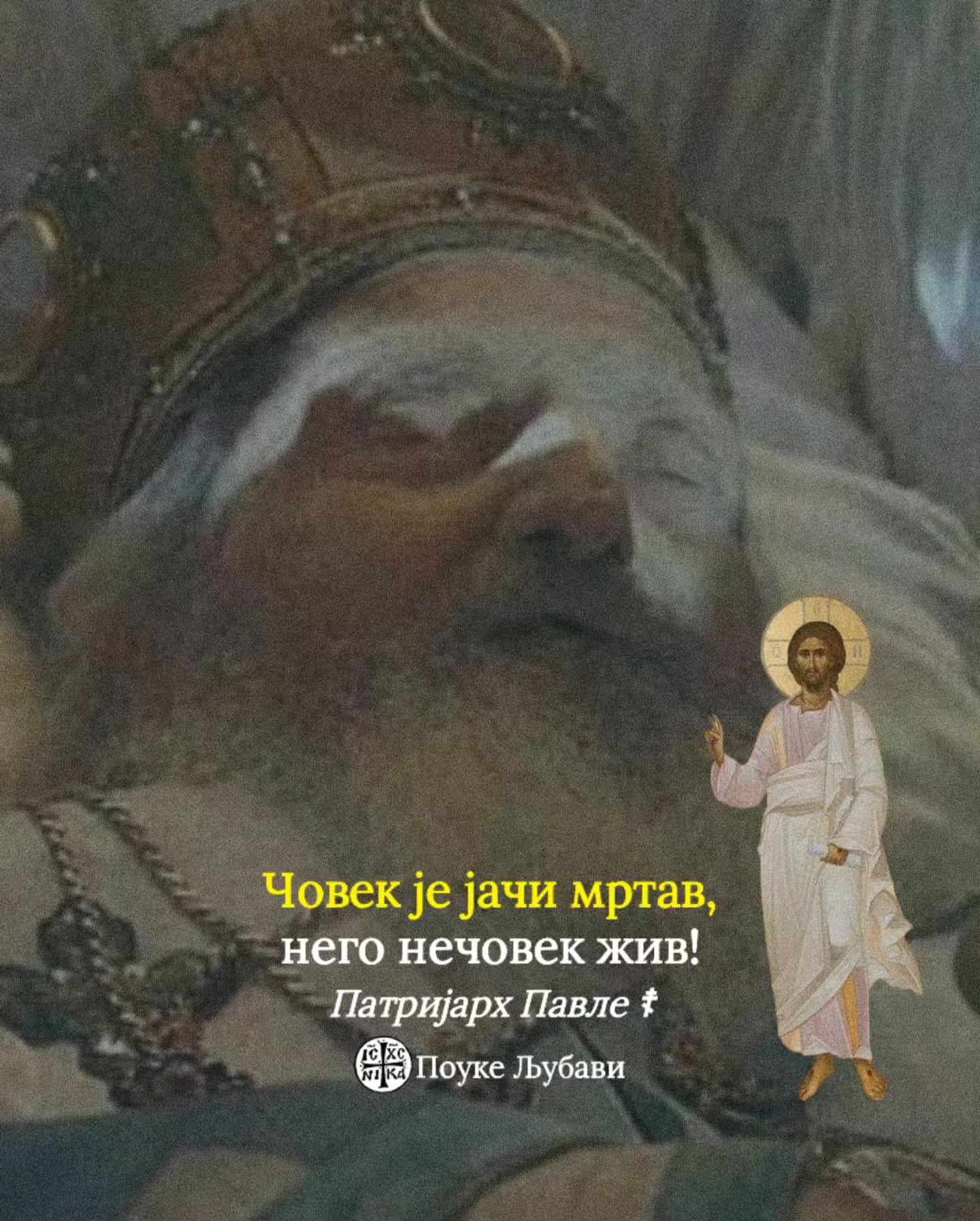
The post marks 17 years since the repose of Serbian Patriarch Pavle, referred to as a "living saint" and "grandfather Paja." It notes that his grave is located in the portico of the Monastery of the Holy Archangels Michael and Gabriel (Rakovica) in Belgrade. The post includes a quote attributed to Patriarch Pavle: "Man is stronger dead than a non-human alive!"

The text also states that Christ gave not only an example by His life but also the strength to follow His path. The image accompanying the post bears the title "Teachings of Love."

  • 17th anniversary of Patriarch Pavle's repose noted.
  • Grave located at Rakovica Monastery in Belgrade.
  • Quote: "Man is stronger dead than a non-human alive!"
  • Christ gives both example and strength to follow Him.
  • Post includes image titled "Teachings of Love."
Read more

St. Nektarios of Aegina: Seek God in the heart with humility

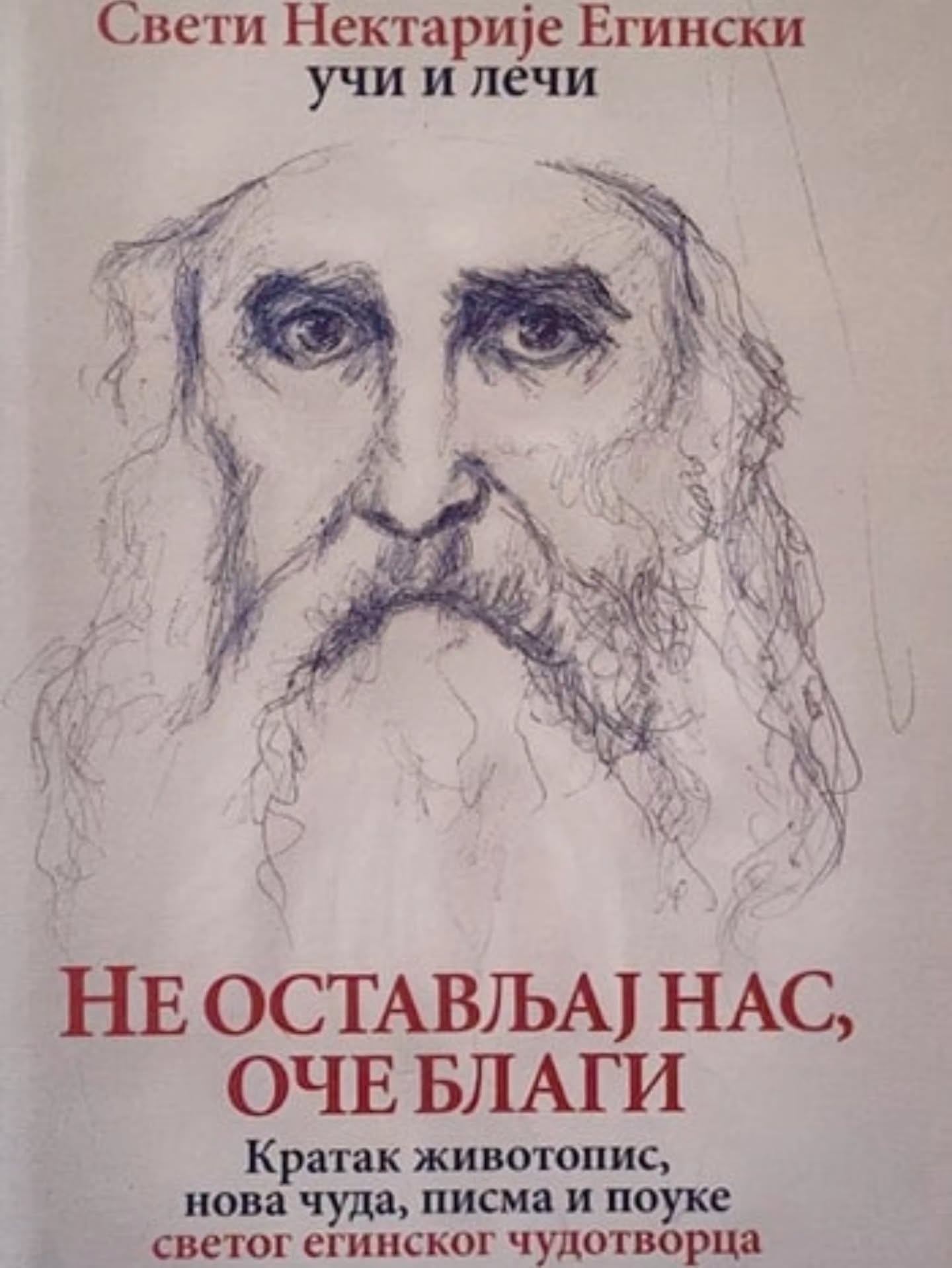
The post shares a quote from St. Nektarios of Aegina urging believers to seek the Lord daily within their own hearts rather than externally. When God is found, the heart becomes His throne and one should stand before Him with fear and reverence like the cherubim and seraphim. The saint emphasizes humility as the path to finding God, noting that the Lord resists the proud but visits those with humble hearts. The accompanying image text references…

The post shares a quote from St. Nektarios of Aegina urging believers to seek the Lord daily within their own hearts rather than externally. When God is found, the heart becomes His throne and one should stand before Him with fear and reverence like the cherubim and seraphim. The saint emphasizes humility as the path to finding God, noting that the Lord resists the proud but visits those with humble hearts.

The accompanying image text references a publication containing a short biography, new miracles, letters, and teachings of the saint.

  • Seek God daily in your heart, not outside it.
  • When God is found, the heart becomes His throne; stand before Him with fear and reverence.
  • Humility is necessary to find the Lord; humble yourself to the ground.
  • God resists the proud but visits and loves the humble of heart.
  • The image promotes a book with a short biography, new miracles, letters, and teachings of St. Nektarios.
Read more

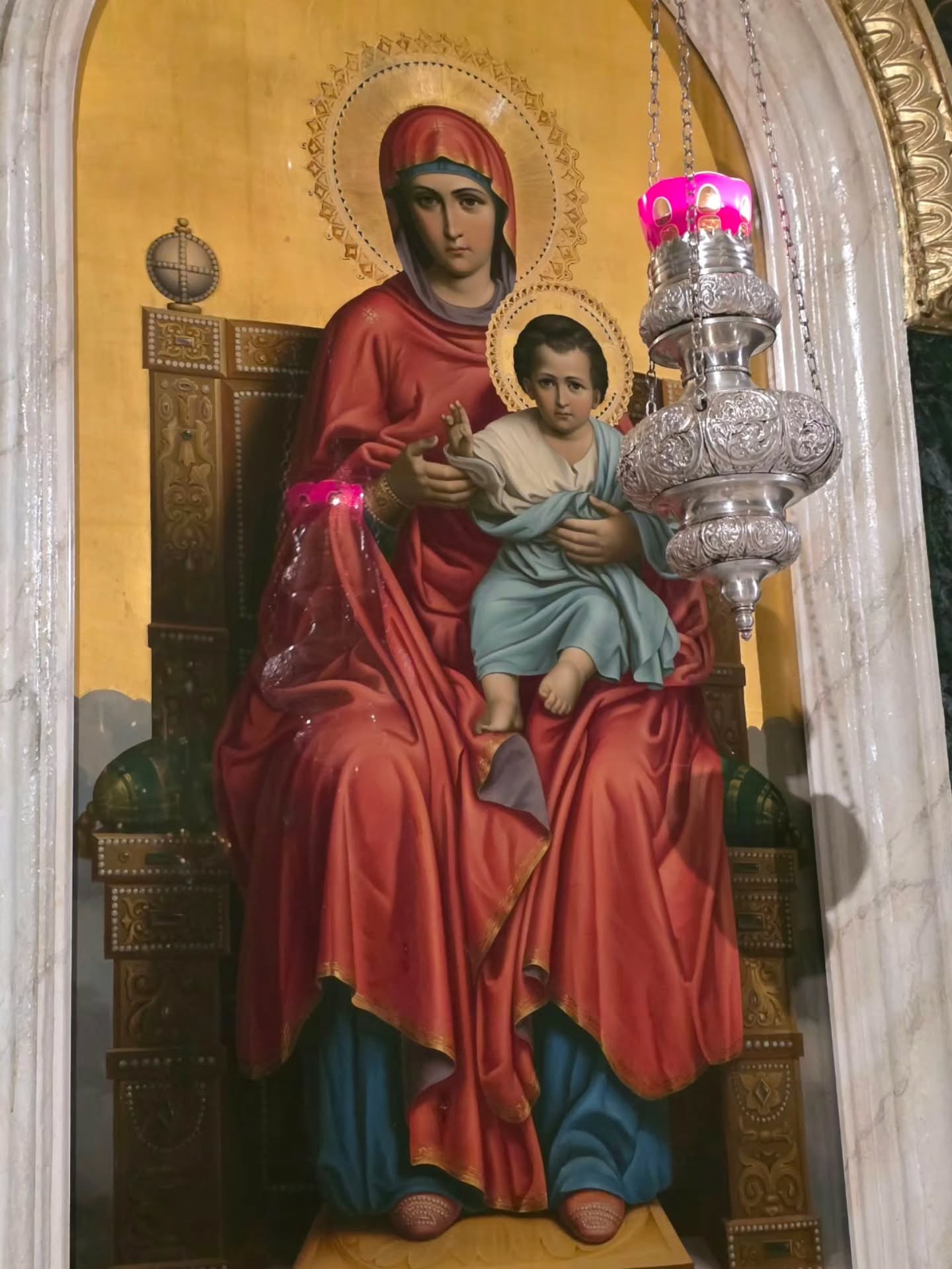
Prayer to the Most Holy Theotokos before the Seven Arrows Icon

The post presents a prayer to the Most Holy Theotokos said before the Sedmystrelnaya (Seven Arrows) icon. The prayer addresses her as the much-suffering Mother of God, exalted above all daughters of the earth by her purity and by the many sufferings she endured on earth. It asks her to receive the sorrowful sighs of those praying and to keep them under the shelter of her mercy, since there is no other refuge or warm intercession besides her. It…

The post presents a prayer to the Most Holy Theotokos said before the Sedmystrelnaya (Seven Arrows) icon. The prayer addresses her as the much-suffering Mother of God, exalted above all daughters of the earth by her purity and by the many sufferings she endured on earth. It asks her to receive the sorrowful sighs of those praying and to keep them under the shelter of her mercy, since there is no other refuge or warm intercession besides her.

It appeals to her boldness before the One whom she bore, asking her help and salvation through her prayers so that the faithful may reach the Heavenly Kingdom unhindered, where with all the saints they will glorify the One God in the Trinity, now and always and unto ages of ages. The accompanying text adds a personal note of love for the Theotokos, comparing her to the light that dawns on the heart, saying that in moments when the soul hurts her hands are always felt near, and calling her sweet Panagia, strength, hope and joy wherever one may be.

Key moments

  1. The speaker tells the Theotokos he loves her deeply, like the light that dawns on the heart.
  2. In the moments when his soul hurts, he always feels her hands close to him.
  3. He calls her sweet Panagia, his strength, hope and joy wherever he may be.
Read more

Saints Cosmas and Damian: Unmercenary Healers and Wonderworkers

The post honors the feast of Saints Cosmas and Damian, the Unmercenary Wonderworkers. They were brothers by blood and spirit, born in Asia to a pagan father and a Christian mother named Theodotia. After their father's death, Theodotia devoted herself to raising them in the Christian faith. The brothers studied medicine and treated the sick using both their skill and the name of Jesus Christ. They accepted no payment, obeying Christ's command:…

The post honors the feast of Saints Cosmas and Damian, the Unmercenary Wonderworkers. They were brothers by blood and spirit, born in Asia to a pagan father and a Christian mother named Theodotia. After their father's death, Theodotia devoted herself to raising them in the Christian faith.

The brothers studied medicine and treated the sick using both their skill and the name of Jesus Christ. They accepted no payment, obeying Christ's command: "Freely you have received, freely give" (Matt. 10:8), and are therefore called unmercenary physicians. A tradition about three eggs illustrates their lack of greed: Cosmas became angry with Damian for accepting three eggs from a healed woman, Palladia, but Damian had accepted them only because she swore by the Holy Trinity to take them.

After their repose, divine revelation led to their burial together in the place called Fereman. The Lord glorified them with miracles, and the faithful continue to invoke them in sickness and distress. The post includes the Kondak in Tone 2 and the Tropar in Tone 8, which ask the saints to heal infirmities and pray to God for those who call upon them.

  • Saints Cosmas and Damian were brothers from Asia, raised by their Christian mother Theodotia after their pagan father's death.
  • They practiced medicine without payment, following Matthew 10:8, and are titled Unmercenaries.
  • A tradition recounts Cosmas objecting to Damian accepting three eggs from the healed woman Palladia, though Damian accepted due to her oath by the Holy Trinity.
  • They were buried together in Fereman after divine revelation, and God glorified them with miracles.
  • The post provides the Kondak (Tone 2) and Tropar (Tone 8) for their feast, invoking their healing intercession.
Read more

St. Porphyrios: Rejoice in All Things, They Lead to God

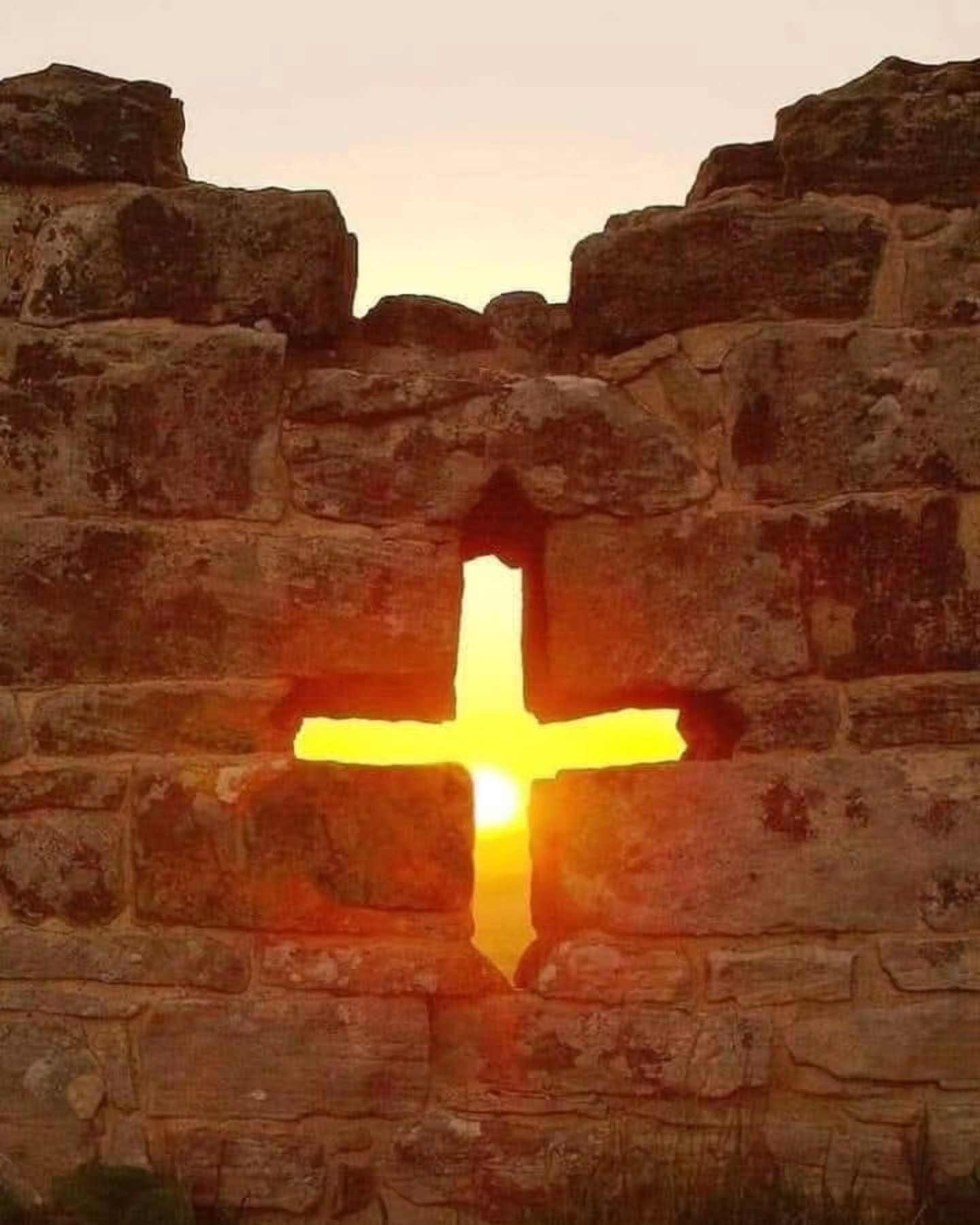
The post shares a saying of St. Porphyrios Kafsokalyvitis: "Rejoice in everything that surrounds us. Everything teaches us and leads us to God." The text is in Serbian Cyrillic. An accompanying image shows a stone wall with a cross-shaped opening through which the sun is setting or rising, illustrating the saint's words about creation pointing to God. The quote reflects the saint's teaching that all of creation can be a means to draw closer to…

The post shares a saying of St. Porphyrios Kafsokalyvitis: "Rejoice in everything that surrounds us. Everything teaches us and leads us to God." The text is in Serbian Cyrillic. An accompanying image shows a stone wall with a cross-shaped opening through which the sun is setting or rising, illustrating the saint's words about creation pointing to God.

The quote reflects the saint's teaching that all of creation can be a means to draw closer to God when received with gratitude and attention. The post presents the saying in Serbian Cyrillic without additional commentary.

  • St. Porphyrios Kafsokalyvitis urges rejoicing in all that surrounds us.
  • He teaches that everything instructs and guides us toward God.
  • The image of a cross-shaped opening in a stone wall with the sun aligns with the quote.
  • The post presents the saying in Serbian Cyrillic without additional commentary.
Read more

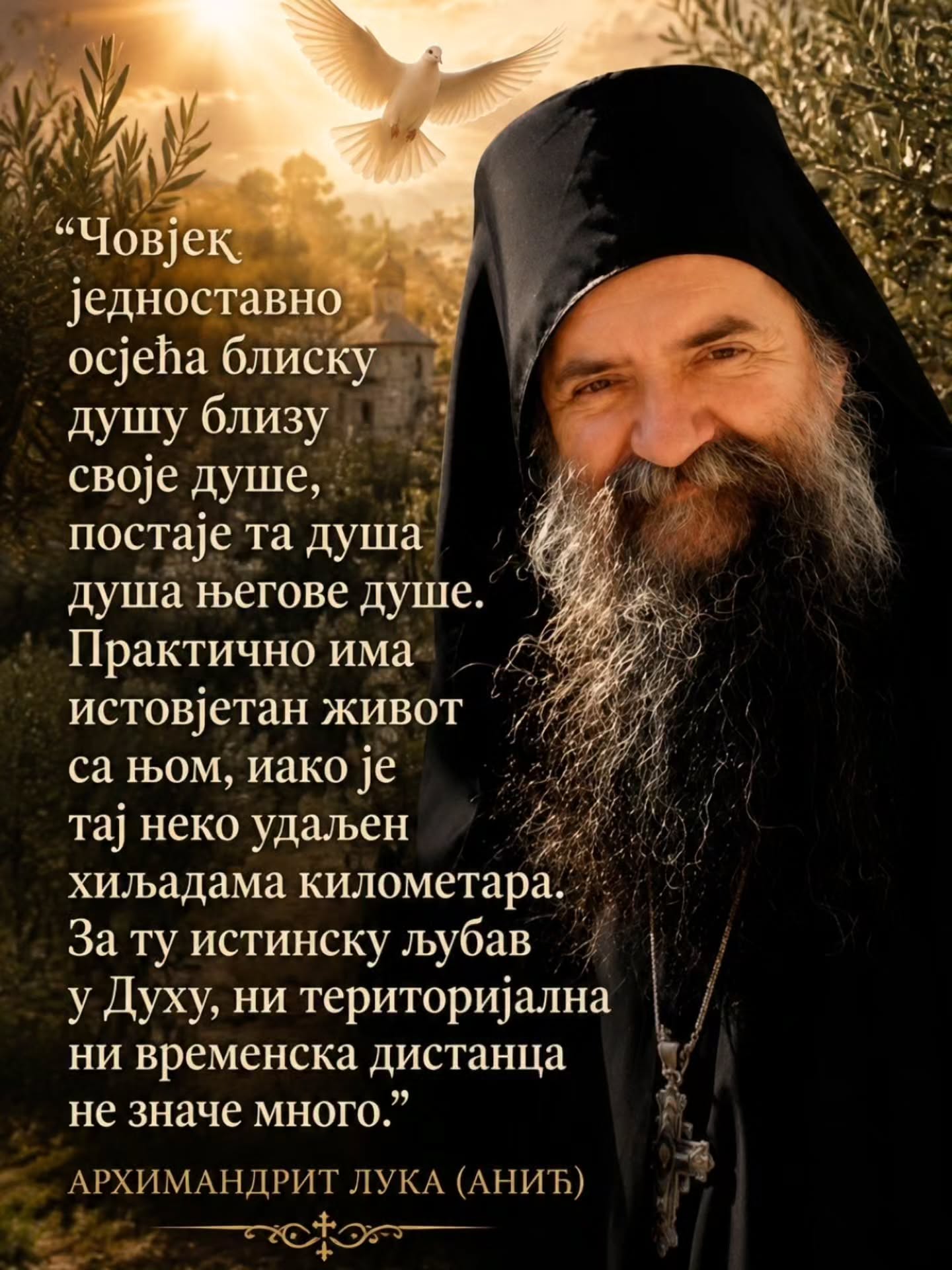
Archimandrite Luka: spiritual love knows no distance

The quote from Archimandrite Luka (Anich) describes how a person senses a kindred soul and that soul becomes the soul of their soul. They share an identical life even when separated by thousands of kilometers. For this true love in the Spirit, neither territorial nor temporal distance matters much.

  • A person feels a kindred soul near their own soul.
  • That soul becomes the soul of their soul.
  • They practically live an identical life despite physical separation.
  • True love in the Spirit transcends territorial distance.
  • True love in the Spirit transcends temporal distance.
Read more

Father Joil Bulatović on possession, confession, and healing of soul and body

Father Joil Bulatović recounts an exorcism of an unbaptized woman in her forties from eastern Serbia. Three men brought her to the church; she was foaming, screaming, and trying to climb the walls. The priest censed her with basil and holy water of St. Basil the Great. She screamed violently at the water. When he learned she was unbaptized, he explained that the devil enters the unbaptized freely. That evening, during a procession, her face…

Father Joil Bulatović recounts an exorcism of an unbaptized woman in her forties from eastern Serbia. Three men brought her to the church; she was foaming, screaming, and trying to climb the walls. The priest censed her with basil and holy water of St. Basil the Great.

She screamed violently at the water. When he learned she was unbaptized, he explained that the devil enters the unbaptized freely. That evening, during a procession, her face distorted and she seized the censer. The next morning she returned, saying two demons had left but one remained.

After the prayer of St. Basil against demons was read, her face normalized and the demon departed, asking forgiveness. Six months later she returned healthy and wrote down her experience. Father Joil stresses that 99 percent of illnesses are sin: when the soul hurts, the body hurts, and confession cleanses the soul.

He also relates a vision granted to a man who watched confessions: each confessed sin appeared as a snake that fell on the solea, writhed, and burned. A large snake appeared for a grave carnal sin the penitent was ashamed to name; it asked if there was more, and when the man said no, it left.

  • Possession is not mental illness but entry of unclean spirits after mortal sin
  • Unbaptized persons have no protection against demonic entry
  • Exorcism with holy water of St. Basil and his prayer drove out the demons
  • Confession heals because 99% of illnesses originate in sin
  • A vision showed confessed sins as snakes that fall, writhe, and burn on the solea
Read more

Metropolitan Amfilohije's Final Words: Resurrection Victory Over Death

The post shares the verses with which the late Metropolitan Amfilohije, Archbishop of Cetinje, Metropolitan of Montenegro and the Littoral, and Exarch of the Holy Throne of Peć, concluded his final address. The lines come from Saint Peter II Petrović Njegoš's work "The Ray of the Microcosm" and speak of Christ's Resurrection conquering death. The accompanying video summary proclaims that death bows and is defeated in the land that glorifies its…

The post shares the verses with which the late Metropolitan Amfilohije, Archbishop of Cetinje, Metropolitan of Montenegro and the Littoral, and Exarch of the Holy Throne of Peć, concluded his final address. The lines come from Saint Peter II Petrović Njegoš's work "The Ray of the Microcosm" and speak of Christ's Resurrection conquering death.

The accompanying video summary proclaims that death bows and is defeated in the land that glorifies its Savior, identifying this testimony with the Church of Saint Peter on the cliff. It states that the Montenegrin people have returned to God and the Church of God after eighty years of wandering through hunger, godlessness, fratricide, and deicide.

The message declares that the time has come to return to God and, through God, to one another, thereby restoring the holy things that the ancestors built into the people and their historical being.

Key moments

  1. Death bows and is defeated in the land that glorifies its Savior.
  2. This testimony is and must remain the Church of St. Peter on the cliff.
  3. The Montenegrin people have returned to God and God's Church after eighty years of wandering.
  4. The wandering passed through fields of hunger, godlessness, fratricide, and deicide.
  5. It is time to return to God and, through God, to return to one another.
  6. By returning to God and to each other, the people restore God and the holy things the ancestors built into them and their historical being.
Read more

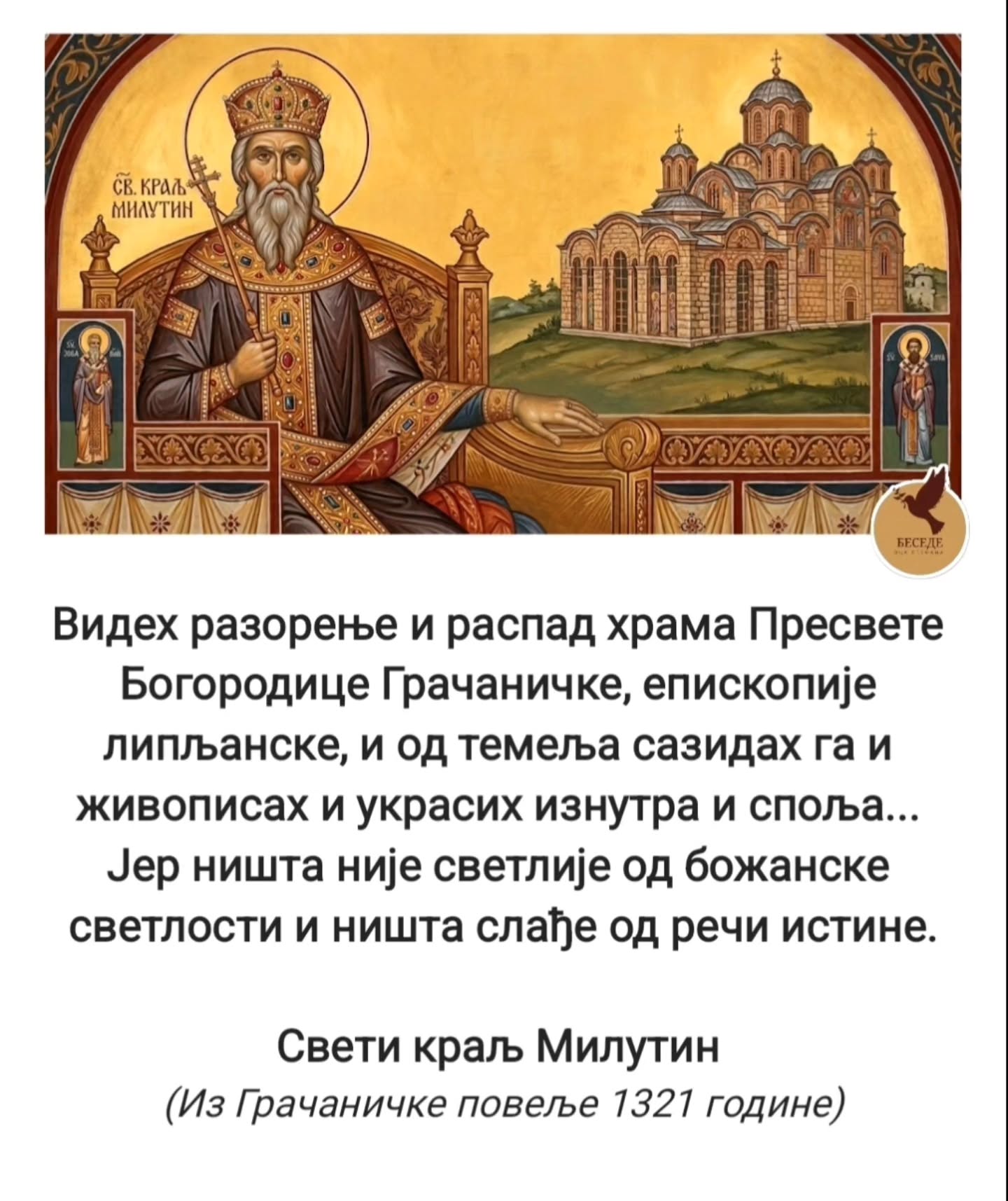
St. King Milutin's Rebuilding of Gračanica Monastery (1321 Charter)

The text presents an excerpt from the 1321 charter of Gračanica Monastery, in which St. King Milutin of Serbia describes the destruction of the Church of the Most Holy Theotokos of Gračanica, seat of the Lipljan diocese, and his subsequent reconstruction of the church from its foundations, including its interior and exterior fresco decoration. The charter records the king's own words: "For nothing is brighter than divine light and nothing…

The text presents an excerpt from the 1321 charter of Gračanica Monastery, in which St. King Milutin of Serbia describes the destruction of the Church of the Most Holy Theotokos of Gračanica, seat of the Lipljan diocese, and his subsequent reconstruction of the church from its foundations, including its interior and exterior fresco decoration.

The charter records the king's own words: "For nothing is brighter than divine light and nothing sweeter than the word of truth." This document illustrates the king's role as a ktetor (founder) and his theological motivation for restoring a major ecclesiastical center. Gračanica Monastery, located in Kosovo, remains one of the most significant medieval Serbian Orthodox monuments, known for its architecture and frescoes.

The charter reflects the close connection between royal authority and church building in medieval Serbia, and the enduring veneration of King Milutin as a saint in the Serbian Orthodox Church.

  • Excerpt from the 1321 Gračanica charter by St. King Milutin
  • Describes destruction and rebuilding of the Church of the Theotokos at Gračanica, seat of the Lipljan diocese
  • King Milutin rebuilt the church from foundations and decorated it inside and out
  • Includes the statement: "Nothing is brighter than divine light and nothing sweeter than the word of truth"
  • Illustrates the king's role as ktetor and the link between royal power and church restoration in medieval Serbia
Read more

Chain of kindness at a rainy bus stop

A video shows a person at a bus stop in the rain giving their rain protection to someone with a child, saying the other needs it more. The protection is then passed along to others waiting as the bus approaches. The accompanying text reads: "Good returns to the good! By good deeds only, let the Lord judge us."

Key moments

  1. A person gives their rain protection to someone with a child, saying "You need it more than I do."
  2. The protection is passed along to others at the stop as a bus arrives.

The Evening Prayer to the Theotokos: 'It Is Truly Meet' and a Supplication for Mercy

The post presents the text of a prayer to the Theotokos used in the Orthodox evening prayer rule. It begins with the hymn "It is truly meet" (Достојно је), which honors the Virgin Mary as more honorable than the cherubim and more glorious than the seraphim, the Mother of God who gave birth to God the Word without corruption. The hymn confesses that she is truly the Theotokos because she bore God the Word incarnate. The text continues with a…

The post presents the text of a prayer to the Theotokos used in the Orthodox evening prayer rule. It begins with the hymn "It is truly meet" (Достојно је), which honors the Virgin Mary as more honorable than the cherubim and more glorious than the seraphim, the Mother of God who gave birth to God the Word without corruption. The hymn confesses that she is truly the Theotokos because she bore God the Word incarnate.

The text continues with a personal supplication addressing the Theotokos as the blessed Mother of the King, the all-pure and blessed Theotokos Mary. It asks her to pour out the mercy of her Son and our God upon the speaker's sinful soul, and through her prayers to guide the speaker to good works. The petition asks that the remaining time of life be spent without blemish and that the speaker find paradise through her, addressing her as the Virgin Theotokos, the only pure and blessed one.

The post identifies this combination as part of the evening prayer rule read before sleep. The text is given in Serbian Cyrillic.

  • The hymn "It is truly meet" glorifies the Theotokos as Mother of God and surpassing the angelic orders.
  • A personal supplication follows, asking the Theotokos to intercede for mercy and guidance.
  • The prayer asks to live the remaining time of life without blemish and to find paradise.
  • The post notes this is part of the Orthodox evening prayer rule read before sleep.
  • The text is provided in Serbian Cyrillic.
Read more